Front matter
Reading edition
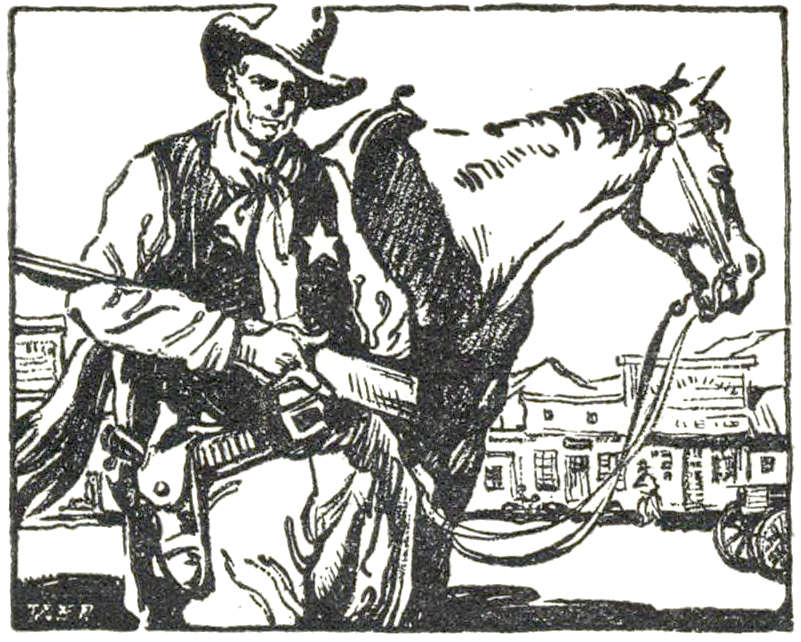
SHOTGUN GOLD
By W. C. Tuttle
A New Hashknife and Sleepy Story
“And that’s how it comes that I’m sheriff of Black Horse—and may I be hung with horseshoes and rabbit-feet, et cettery.”
Roaring Rigby tilted back in an old swivel chair and looked disconsolately at the white-haired man who sat across the battered desk. The man had a long, deeply-lined face, slightly reddish nose, somber blue eyes beneath white eyebrows.
Roaring Rigby himself was long, lean, bony of face and figure, with the pouched eyes of a bloodhound. His nose was long too, and slightly out of line; his cheekbones were almost visible through the tightly stretched skin that covered them. His ears were of the hating variety, and his neutral-colored hair was thin, like foxtail grass on alkali flats.
The room in which these two men sat was the sheriff’s office in the town of Turquoise, the county-seat of Black Horse County. It was a small room, unpapered, except for an array of reward notices, a State map and a calendar of the previous year. A desk, several chairs and a gun-cabinet completed the furnishings. The floor was uncarpeted and had been scored deeply by years of high heel scraping.
Roaring Rigby lifted his feet and rasped one spurred heel across the top of the desk, as if to express his contempt for such a piece of furniture.
“And so Jim Randall, sheriff of this county, went away, did he?” sighed the old man.
“He did that.”
Roaring Rigby turned his sad-dog eyes upon the old man.
“Yea-a-ah, he went away, Jim Randall did. He wrote out his resignation, packed up his fambly, folded his tent, as you might say, and silently stole away. But I don’t blame him, Judge. He’s a married man. You’re as much to blame as he is. You two opined to make Turquoise sanitary. You ought to know better, Judge; you’re an old-timer. Jim Randall was born and raised in a cow-town, and he knew better. ’Sall right to set down upon crime. Oh, I ain’t sayin’ your motives ain’t right. Turquoise needs cleanin’. English Ed’s honkatonk ain’t noways a Sunday School, and that redlight district hadn’t ought to be there, but—”
“I know,” nodded Judge Beal.
“Yea-a-ah, you know now. You should have knowed before. Jim Randall got his warnin’ twice. They told him he’d get the third one in the dark, and Jim always was scared of the dark. You’ve got your first one, Judge.”
“Turquoise isn’t fit for a decent woman. Why, a—”
“It was before you two started yore crew—crew—”
“Crusade, Roaring.”
“Yeah, that’s it. You posted your notices, and you didn’t have nothin’ to back ’em. Jim Randall posts his notice, demandin’ that every puncher bring his gun to the sheriff’s office when he got to town, or get arrested. Did they, I ask you, Judge? They did like hell! You told ’em in plain English that the honkatonk must go. Did it?”
“No,” said the judge sadly. “I am obliged to admit that it is still there. I heard that Jim Randall had resigned, so I came to you, Roaring; you will be appointed sheriff, because you were Jim’s deputy. Now, what are you going to do?”
“Me, huh?”
Roaring savagely rasped his spurred heel half-wayacross the desk top.
“I’m goin’ to try and hold the job, Judge.”
“Meaning that you are not in sympathy with my campaign?”
“Meanin’ that I’m in sympathy with my own skin. Your campaign! Judge, if you’ll take my friendly advice, you’ll foller Jim Randall. The road is plenty wide. Why, doggone you, Judge, nobody takes you seriously. You drink more liquor than any single drinker in this town.”
“Granted.”
“And you’re single.”
“Fortunately.”
“There you are, Judge. You want to clean up the town. Do you love the morals of your feller-men so much that you’d take a chance on gettin’ shot? You’ve got no wife to be offended by the honkatonk girls, and it’s a cinch you ain’t temperate. Go back and set on your bench, Judge. Cleanin’ up Turquoise ain’t no single-handed job.”
“They’ll not run me out.”
“Mm-m-m-m-m-mebby not, Judge. Damn it, I’m not any more stuck on things than you are! I don’t like hornets, but I don’t poke their nests.”
“In other words, you are not going to enforce Randall’s notices regarding carrying arms in town?”
“Well, I’m no fool, if that’s what you mean, Judge.”
The old judge nodded sadly. His was a forlorn cause, the cleaning up of Turquoise City. The sheriff, backed by a county judge, had made a half-hearted attempt to change conditions; but he had been virtually run out of town. He had resigned, taken his family and moved away, fearful of what might happen to him.
The old judge was sincere, drunkenly so most of the time, although in a dignified manner. That is, he was drunkenly dignified. Judge Beal had come of a good family and was well educated. He might have gone far in his chosen profession, except for his love of liquor; he had drifted into Turquoise City, when that place was in the throes of a mining fever, so he hung out his shingle and became the lawyer of Turquoise.
That was twenty years ago. His old shingle still hung outside of his office, but the lettering had long since faded. For five of those years he had been the county judge. He had seen Turquoise City in boom days, when men scrambled for raw gold; he had seen it gradually change after the days of the big strikes to a commonplace cow-town. When the railroad came along it boomed again, in a way. The railroad made it the shipping point of the valley, the logical shopping city for the surrounding range and for the mining district northeast of Turquoise. It was a busy county seat.
It had also become the gambling center of the country—the flesh-pot of the cowmen and miners. Turquoise City was unmoral rather than immoral. It was a wide-open town; business was good. Even if painted women did flaunt themselves on the streets, and an occasional cowpuncher decided to make the main street a bucking-chute, or shot at some one’s sign, it did not seem to hurt business. Many liked the wild excitement.
But to Judge Beal it was an offense to decent folks. He had persuaded Jim Randall, the sheriff, that something must be done, and they had started a two-handed crusade, which was doomed to fail, for Turquoise City did not want reform.
Jim Randall had received two warnings. The second one said:
There will be one more but you won’t see it, because it will come out of the dark.
No name had been signed. The old judge had received one that read the same as the first one Randall had received.
The road is open. This is your first warning.
It was evident that the gambling element of Turquoise City did not desire the continued presence of Judge Beal, although he had accomplished nothing against it.
He left the sheriff’s office and crossed the street to the front of the Black Horse Saloon, gambling-house and honkatonk, the largest building in Turquoise City. It was a huge, barn-like structure, not at all ornamental.
English Ed Holmes owned the place. He was an immaculate, cold-blooded gambler, a man of middle-age, and in a way very suave and handsome.
As the judge passed the Black Horse he met a cowboy, who flashed him a whitetoothed smile. It was Pete Conley, a half-breed cowboy, whose father, old Moses Conley, owned the Double Circle C, known as the Hot Creek ranch. Pete was about twenty-five years of age, more Indian than white.
“Hello, Peter,” said the judge kindly.
“Very good,” smiled Pete. “How you, Judge?”
“Nicely, thank you, Peter. Folks all well?”
“Pretty good; I buy you drink, Judge.” The old judge shook his head.
“Thank you just the same, Peter.”
He passed on down the street, turned through an alley and walked slowly out to his home. It was a little frame building, rather dilapidated, with an old picket-fence around part of it.
The old judge was a bachelor, but he afforded a cook, in the person of an old Chinese, who was crippled with rheumatism. The cook met him at the door and waited until the judge hung up his broad-brimmed hat and removed his soiled white collar.
“I flind him unda doo’,” said the Chinese, producing a sealed envelope, unmarked except by contact of soiled hands.
The old judge’s lips compressed firmly as he examined the envelope.
“Somebody leabe him,” said the Chinese.
“Undoubtedly,” replied the judge evenly.
He knew what it contained. The other envelope had been the same. After a few moments of indecision he tore open the envelope and quickly scanned the single sheet of paper it contained.
There will be one more but you won’t see it. Go! ! !
Slowly he tore the envelope and paper to bits, his old face grim with determination. He walked to the door and threw the papers outside, while he looked casually up and down the street.
The Chinese watched him curiously, but the old judge made no comment as he slowly removed his boots and put on an old pair of carpet-slippers. Then he went to an old chest of drawers, from which he took a heavy Colt gun, carrying it over to the table, where he placed it beside a book. The Chinese turned and walked back to the kitchen.
“You didn’t see anybody around here, did you?” asked the old judge.
The Chinese stopped and looked back toward the door.
“I no see,” he said blankly.
“All right.”
The judge sat down, sighed deeply and picked up his book.
The Hot Creek ranch was rather a bone of contention in the Black Horse country. In the days before the cattle business had grown to mean much, Moses Conley had homesteaded his legal amount of land and bought enough to make five hundred acres, in the center of which he had built his ranch-houses. Within this five hundred acres was Hot Spring Valley, a deep swale, protected from the north by a pile of old lava beds, and fairly well bordered on the other sides by cottonwood and live oaks.
In the bottom of this swale were warm springs, that never froze, even in the bitter winters, and they kept the temperature much above the average. The surrounding lava beds and trees broke the force of the north winds, and the little valley was of sufficient size for many cattle to find refuge from blizzard and heavy snow.
Moses Conley looked much like the usual conception of his Biblical namesake. He was a huge man, white-haired, white-bearded, with a stern cast of countenance. In his youth he had married a Nez Perce squaw named Minnie, who was still his wife. There were two children, Pete and Dawn. Dawn was twenty, a tall, lithe girl, more white than Indian, and the prettiest girl in the valley.
Old Moses Conley’s life had been one of strife. His ranch was midway between Turquoise City and the Big 4 ranch, the biggest cow outfit in the valley. Time after time the Big 4 had tried to buy out Moses Conley; but the old man had refused all of their offers.
He hated Franklyn Moran, who owned the Big 4 and lived in ease and luxury in Chicago. Men said that that was why Moses Conley refused to sell out to the Big 4. There was a story told about some trouble between Conley and Moran in the old mining days; Moran was alleged to have cheated Conley out of a piece of property.
The truth of the matter was that Moran had money, and by offering a bigger price than Conley could pay he had acquired the property after Conley had offered to take Moran in with him on the deal.
The Big 4 had made life rather hard for Conley, and he had retaliated by fencing in his five hundred acres with four strands of barbed-wire, almost impoverishing himself to buy the material to shut out the Big 4 cattle from Hot Spring Valley, or Hot Creek, as it was commonly known.
Moran had sent Conley a final offer of more than the ranch was worth; but the squaw-man refused flatly to consider any offer. He would keep his ranch; it was home to him, and a home meant more than money.
Moran had one son, Jimmy, who came from college to show the Big 4 how it should be run; but he got into trouble with “Slim” Regan, the foreman, and tried by telegraph to have the whole outfit fired. Failing in that, he drew every cent he had on deposit in a Chicago bank, his inheritance from his mother, who had died two years before he came to Black Horse Valley. He bought out the Stumbling K ranch, two miles east of Conley’s ranch; it was known as the Busted ranch, because every owner had gone broke.
Jimmy Moran was going to show the world how to raise cows. He hired “Wind River” Jim, who had no other name, as far as he knew, and “Lovely” Lucas, who had been christened Ephriam, to punch cows for him, and “Horse-Collar” Fields to do the cooking.
Jimmy was of medium height, sandy-haired, freckled, with a streak of good and a streak of mean. He liked liquor and cards and was not averse to fighting occasionally. In fact Jimmy liked cards so well that everybody predicted no change in the name or fortunes of the Busted ranch. But their opinions meant little to Jimmy, as he went his joyful way, regardless of anything.
He had met and liked Dawn Conley, and he had also met Moses Conley, who told him to keep away from the Hot Creek ranch.
“He’s afraid I’m after his daughter,” said Jimmy, but he knew the real reason was because of the enmity Conley held against his father.
Pete Conley had always treated Jimmy civilly. But Pete was more like old Conley’s wife—nearly all Indian. Dawn did not look or act like an Indian.
Apparently there was no law against selling liquor to a half-breed in Turquoise City, and Pete was a regular customer of the Black Horse Saloon and of the gambling tables. More often than not, he quit a winner. It may have been his proverbial luck and his rather insolent smile that caused Joe Mallette, one of English Ed’s gamblers, to dislike him.
They had clashed several times, and Mallette had asked English Ed to bar the half-breed from the place; but the owner of the saloon refused. Mallette was a big man, with the cold, hard eyes of a professional gambler and the chin of a fighter. He hated to see Pete Conley buy chips in his game, and he did not conceal his dislike of the half-breed.
It was after dark that night when Pete took a chair in Mallette’s stud-poker game. It was not Mallette’s shift, but the other dealer had not put in an appearance. Mallette treated Pete civilly, for once; perhaps he thought that the other dealer would show up presently. Mallette had been drinking rather heavily and was just a bit clumsy in stacking up Pete’s chips. Jimmy Moran was in the game, loser, as usual, but still smiling.
“I heard that Jim Randall pulled out,” said one of the players casually.
“Time he did,” growled Mallette, shoving the chips over to the young half-breed.
“Randall damn good man,” said Pete slowly.
Mallette was too diplomatic to start an argument, so he said nothing. He played a close game, which was the natural thing for the dealer to do. He knew that Pete Conley had very little money, so he waited for a chance to break him; but the half-breed knew how Mallette played his cards. Pete was lucky, and his stacks of red and blue chips increased rapidly.
It was about nine o’clock, and the other dealer had come in, but Mallette was in a pot which he had opened. He was playing very coldly and had opened the pot for a substantial bet, thinking that the others would drop out; but Pete had raised him heavily. Jimmy Moran, sitting at Pete’s left, had turned his cards in such a way that Pete got a flash of the king of hearts.
But it made no difference in the play, because Jimmy passed the opening bet and threw his hand in the discards. Mallette was dealing. After deliberating heavily, Mallette called Pete’s raise. Pete drew one card, which he seemed to ignore; Mallette drew two. He dropped his cards one-handed from the top of the deck, and one of them skidded on top of some of the discards.
At the same time, Mallette upset a stack of chips in front of him and straightened them up carefully. He looked at his cards and checked the bet. Pete studied Mallette’s face. Pete had four sevens in his hand. The best Mallette could have had before the draw would have been three of a kind, and with threes he would have drawn only one card, masking the fact of his having threes. Or perhaps he had only one pair of jacks or better to open on, and had held up another card as a “kicker.” Pete felt safe. After a moment of deliberation he shoved all of his chips to the center. There was possibly two hundred dollars’ worth of chips.
“That’s all I got,” said Pete slowly. “I bet that.”
Mallette turned the edges of his cards slightly, a half-sneer on his lips, as he shoved out enough chips to cover the bet. Pete grinned, as he spread out the four sevens; but his grin faded when Mallette showed four kings and began raking in the pot.
Mallette nodded to the other dealer and started to slide his chair back from the table. Pete’s eyes were upon him; his lips twisted queerly.
“You—you thief!” choked the half-breed.
He jerked to his feet, reaching back for his gun. Jimmy Moran flung himself against Pete, blocking his draw, while another player twisted Pete’s gun from his hand. Mallette straightened up, his lips white.
“What’s that?” he snapped. “Who’s a thief?”
“You are!” rasped the enraged Pete. “Leave it to Jimmy Moran. He had that king of hearts in his hand. It was a dead card. You stole it, you thief!”
Mallette’s eyes shifted to Jimmy Moran, who was looking at him, his mouth half-open.
“By golly, I can’t remember,” said Jimmy. “Seems to me—no, I can’t say.”
“I reckon you can’t,” said Mallette dryly.
He turned and started toward the bar, when Pete tore away from Jimmy and started for Mallette.
“Give back that money!” demanded Pete. “You stole—”
Mallette whirled and met Pete, smashing him full in the face with a powerful right-hand swing. It knocked Pete flat on his back, almost under the feet of the men who come to see what it was all about. Mallette turned away and went out through the rear of the building.
Pete sat up, wiping the blood from his lips, looking around in a dazed way. English Ed shoved his way to Pete. He had heard what it was all about.
“Get up!” he exclaimed. “Pick up your hat and get out of here, you damned half-breed, and stay out! Don’t never come in here again.”
“Wait just a minute,” said Jimmy Moran.
He had secured Pete’s six-shooter and now he handed it to Pete.
“Wait for what?” asked English Ed.
“The trouble was caused by Mallette havin’ too many kings,” said Jimmy slowly. “I think I remember the king of hearts bein’ in my hand.”
“I see it,” nodded Pete. “When you lay hand down, I see it.”
“I don’t believe a word of it!” said English Ed.
Whap!
Jimmy Moran struck English Ed across the face with an open hand, and the sound of it could have been heard across the street. It caused the gambler to half-turn on his heels; and before he could recover his balance Jimmy swung a hard right fist against English Ed’s jaw, knocking him backward into the deserted poker table, where he went down in a sitting position, his eyes set in a silly stare.
The room was in an uproar. A woman screamed, another laughed. Jimmy grinned widely and nudged Pete with his elbow.
“Better get out, Pete,” he said. “If ye want Mallette, he’ll be spendin’ your money for dollar bottles of beer in one of our houses of ill fame.”
Pete wiped the back of his hand across his bleeding lips and headed for the back door, still carrying the gun in his hand. No one made any attempt to molest him. Jimmy Moran backed against the wall and watched English Ed regain his senses.
The big gambler was punch-drunk. He slowly got to his feet, tried to smile, but merely grimaced. A gambler came with a wet towel; but he motioned it aside and went to the bar. Some of the men followed him. The gambler with the towel came in closer to Jimmy.
“Mallette was drunk,” he said, as if excusing him for what he had done. “All day he’s been drinking absinth with his whisky. Maybe he didn’t know what he was doing.”
“Yeah, I know,” said Jimmy. “He was dead drunk. My, my, he was so drunk he could steal a card and none of us seen him. Drunk, hell! What’re you tryin’ to do, protect him?”
“Oh, no, I just thought—do you suppose the half-breed will try to get him?”
“Are you tryin’ get a statement from me?” demanded Jimmy. “English got what was comin’ to him. He backed a thief.”
“I wouldn’t say that to Mallette, if I was you, Moran.”
“A-a-a-aw, go wrap that rag around your head! If English Ed is goin’ to run a den of thieves, he can expect what a thief must expect. If Mallette had done that to me, he’d be in hell right now, ridin’ on the hot end of a bullet! It was me that cramped the half-breed, and I’m sorry I did.”
Jimmy jerked his hat down over his eyes and strode through the room, going straight past the bar, where English Ed and a crowd of men were having a drink. The big gambler knew now what it was all about and he turned his head to watch Jimmy leave the place.
“He got you when you wasn’t lookin’,” said a man.
English Ed nodded slowly.
“Did Mallette steal that card?” he asked.
One of the men from the poker game was at the bar, and it was to him that English directed the question.
“I don’t know,” said the man truthfully. “I wasn’t in the pot, so I didn’t pay any attention.”
“Mallette is getting clumsy,” said English slowly.
“It’s a wonder he can keep his feet,” said the bartender. “He’s full of absinth and whisky. He won’t know what it’s all about tomorrow.”
“How much did he win from the breed?”
“About two hundred dollars,” said the dealer who was to take Mallette’s place. “Goin’ to give it back?”
“Not unless I get more proof than I’ve got. Don’t let that half-breed ever come in here again. He’s all through.”
“How about Moran?”
“I’ll handle Moran myself.”
“Somebody ought to find Mallette and tell him to look out for Conley,” said the gambler. “That breed will kill him, if he gets a chance—and he’s huntin’ him now.”
A man came through the room and shoved his way up to the bar beside English Ed.
“The sheriff ain’t in here, is he?” he asked nervously.
“What do you want him for?” asked English.
“Found a dead man. He’s between here and the north end of the redlight district. It’s Mallette, the gambler.”
“Mallette!” English grasped the man by the arm. “When did you find him?”
“Who the hell do you think you’re pinchin’?” demanded the man, yanking his arm away. “I just found him. I was comin’ alone and almost fell over him. Oh, he’s dead all right.”
The man had spoken loud enough for every one to hear, and there was a general exodus to view the body. A lantern was secured, and the crowd went through the rear entrance. It was about four hundred feet from the rear of the saloon to the line of buildings that comprised the redlight district of Turquoise City.
The last house of this row, on the north end, was possibly two hundred yards from the rear of the saloon; and between that building and the Turquoise Hotel, which fronted on the main street, was Judge Beal’s little house.
The crowd went past the rear of his building and found the body of Mallette. He had been shot squarely between the eyes. Indifferent to the fact that the sheriff and coroner might care to view the remains as found, they picked up the body and carried it back to the Black Horse Saloon and placed it on a cot in a rear room.
Some one found Roaring Rigby in a restaurant and told him what had happened. He left his meal and hurried to the saloon, shouldering his way into the little room. Rigby was mad; he knew his rights. He turned on English Ed, who leaned against the wall, his face a trifle more white than usual.
“Who the hell brought that body here?” demanded Roaring.
“We did,” said English. “There was a crowd of us.”
“You did, eh?” Roaring hooked his thumbs over his belt and glared at the gambler. “A crowd of you, eh? Tromped all over everythin’, eh? Picked him right up. Hell, a sheriff has a fat chance of findin’ out anythin’. Don’tcha suppose I’d like to have seen him where he laid?”
“What’s the use?” said English Ed coldly. “That half-breed Conley went out to get him.”
Roaring Rigby squinted closely at English Ed for a moment before turning to the crowd.
“Git out of here,” he ordered. “No, you stay here, Ed.”
He moved them all out, closed the door tightly and turned to the gambler.
“What about Pete Conley?”
In a few words the gambler told him about the trouble, but made no mention of his trouble with Jimmy Moran. Roaring listened closely.
“Did Mallette steal that card, English?” he asked.
The gambler shrugged his shoulders.
“I didn’t see the play. Jimmy Moran saw the play, but wasn’t sure. He was the one who was supposed to have discarded that king of hearts. Mallette was drinking and—”
“Had a right to steal a card, I suppose.”
“I didn’t say that!”
“You meant it. Did Mallette carry a gun?”
“I’ve never seen him with one. He had none on him when we found him. Conley murdered him.”
Roaring Rigby took a deep breath, rather a jerky one.
“Murder? Yeah, I reckon that’s right,” softly.
“The damn half-breed!” exclaimed English Ed under his breath.
“Blood don’t make no difference,” said Roaring quickly. “The law don’t draw no color line, English.”
“The law be damned! Mallette was murdered. Mallette was a gambler—one of my men. Judge Beal would turn Conley loose. He’d never hang a man for killing a gambler.”
“Old Judge Beal is a square-shooter, English. Nobody can say he ain’t honest. But he ain’t hangin’ nobody unless they need it.”
“Well, he better keep his nose out of my business.”
“Yeah, I s’pose. You better send somebody for a doctor. Old Doc Shelley is the coroner; so you better get him, not that he can do Mallette any good, but to make it legal.”
They opened the door and walked out into the saloon. Business was at a standstill. A knot of girls stood near the honkatonk platform, talking in subdued voices, and a crowd of cowboys and gamblers were at the bar. For once, the whirr of the roulette-wheel and the clatter of chips were stilled.
Roaring Rigby walked past the long bar, and a cowboy called to him:
“If you want to save that half-breed for trial, you better start travelin’, Rigby.”
It was Mark Clayton, of the Big 4 outfit. Roaring turned and looked at Clayton.
“And you better sober up and go home,” said Roaring. “This is a man’s job—and you ain’t dry behind the ears.”
Roaring walked straight across the street to a general store. He knew the crowd in the Black Horse would watch to see what he would do. Straight through the store he went, opened a back door and headed around to his stable, which was behind the sheriff’s office.
He knew the crowd in the saloon was planning either to go out to the Hot Creek ranch after Pete Conley, or to take Pete away from him when he brought him to jail. Roaring saddled his sorrel gelding, circled the town and headed for the Conley ranch, riding swiftly.
Jimmy Moran rode away from Turquoise City, a grin on his lips. His right hand ached a little, but he minded it not. He could still see the vacant stare in English Ed’s eyes; he chuckled to himself. There had been a certain satisfaction in hitting the big gambler.
“Mebby I can save a little money, if I get in bad with all the gamblers and rum sellers,” he told his horse.
He had championed the cause of the son of his father’s ancient enemy, and he wondered what his father would say if he knew about it. He realized that he had put himself in bad with English Ed and his gang, which meant that he would be none too safe in Turquoise City.
He forded the river that ran near the Hot Creek ranch and traveled along Moses Conley’s barbed-wire fence. About half-way along this side of the fence the road forked, turning to the left to Jimmy’s ranch. Only a short distance beyond the forks was Conley’s gate, where cottonwoods lined the road and grew along the fence.
As Jimmy turned into his road, he caught the flash of a white dress in the moonlight near the gate. He turned his horse back to the main road, and went slowly up to the gate. The wearer of the white dress was Dawn Conley. She was holding the reins of her horse and had swung the gate partly open.
“Well, bless my soul!” exclaimed Jimmy. “Dawn!”
“Hello, Jimmy,” said the girl simply.
Jimmy dismounted and dropped his reins, knowing that the chunky bay would stand as long as the reins hung down. Jimmy went close to her, his hat in his hand.
“I was waiting for Dad,” she said. “I—I thought it was him. He went over to the 7AL this afternoon.”
The 7AL was located about five miles east of Turquoise City.
“I see,” said Jimmy. “You—you don’t think anythin’ has happened to him, do you, Dawn?”
“Oh, no; but I—I—”
“Uh-huh.”
Jimmy swallowed heavily; he shifted uneasily. He wanted to put out a hand and touch her. Whenever he saw her he forgot that she was part Indian and daughter of his father’s enemy. Standing there in the moonlight, within half an arm’s reach of her, Jimmy hooked his thumbs over his belt and stared at her face.
“Dawn,” he said hoarsely, “Dawn, you’re beautiful.”
“Jimmy Moran, you—why say that?” She moved slightly away.
“Don’t go away,” he said slowly. “It’s all right, Dawn; I had to say that. It ain’t wrong to say what you think. No, I’m not drunk; I never was more sober in my life. I’ve never seen you in my life when I didn’t think you was the most beautiful girl I ever seen.”
“You mustn’t say that, Jimmy.”
“Why not? It may not mean anythin’ to you, but it does to me. Standin’ here like a danged idiot, tellin’ you things like that is like drinkin’ liquor. It kinda makes me dizzy. Funny, ain’t it? I’m scared to tell you things like that, and still I’m doin’ it. It’s like doin’ things when you’re drunk—mebby you hadn’t ought to, but you do it just the same.”
“Well,” said Dawn vaguely, “I don’t know.”
“You wouldn’t,” said Jimmy softly. “You’ve got to love to feel that way, Dawn.”
“To love?”
“Yes, Dawn—I love you.”
“You love me?” slowly.
Neither of them saw Roaring Rigby. He came riding up the dusty road, his horse still dripping from the water of the ford, his horse’s hoofs muffled in the dust. But he saw them, and turned his horse into the shadow of the cottonwood. He dismounted and came ahead on foot, keeping close to the trees.
“I swear I love you, Dawn,” said Jimmy. “I’ve never had a chance to tell you before. Oh, I know our fathers hate each other; but what has that to do with us?”
“I’m Injun,” she said.
“I’m Irish.”
He did not try to go closer to her, and for a long time neither of them spoke. Then:
“I heard that you might marry Roarin’ Rigby,” said Jimmy. “They say he’s been comin’ out to see you, Dawn.”
“He’s a friend of Dad’s.”
“But comin’ out to see you, Dawn.”
“Perhaps; but he’s too old, Jimmy. Dad likes him.”
“Do you like him, Dawn?”
“He’s a nice man, but he is so homely, Jimmy—and old. No, I never could marry him. He looks funny.”
Jimmy was silent for several moments. A breeze rattled the dry leaves of the cottonwoods.
“Dawn, why were you anxious to meet your father?”
“It was Peter,” she said anxiously. “He came home awhile ago. He had been fighting, Jimmy. His lips are bleeding and he looks awful. He wouldn’t tell me what had happened, and I was afraid. I wanted to have Dad go to town and find out. Oh, I hope it isn’t anything serious. You know how they feel about—half-breeds.”
Jimmy laughed softly.
“Don’t worry, Dawn. I can tell you what happened.”
Without giving himself any credit, he told her about the poker game and about the stolen king of hearts.
“Oh, Jimmy, I’m glad you took his gun!” she exclaimed. “It would go hard with him if he used that gun. I’m glad that’s all there is to it.”
“That’s all, Dawn. Pete was right. Mallette stole that card.”
“English Ed came out here a few days ago,” she said.
“He did, eh?” Jimmy’s tone was belligerent. “What’d he want?”
“Nothing, I guess.”
“Nothin’?”
Dawn laughed.
“I didn’t meet him. Dad talked to him. He asked Dad about me. And he told Dad that you were almost broke.”
“What did your dad say, Dawn?”
“He said that was good.”
Jimmy laughed softly.
“I suppose they talked a lot about me, eh?”
“Quite a lot, Jimmy. Dad said that for a college-educated man, you were the biggest fool in the world; he said it was in your blood and that college brought it out.”
Jimmy laughed chokingly.
“College!” he exclaimed. “Good Lord, that’s a long time back, it seems. I’ve even forgotten how to talk English. I’m as much a part of this country as if I had been born and raised here. I think like a cowboy, Dawn. Mebby I am goin’ broke. I know now that English Ed’s games are crooked. That knowledge will save me money. I’ve been a fool, but I hope to outgrow it. I owe money, gosh! I owe money to the Turquoise City Bank and I owe money to English Ed; but I can pay it all back some day. Your father hates me, because I’m a son of my father. That’s a foolish hate, Dawn. He hates the Big 4. That’s nothin’—so do I. Dad owns the Big 4, and I ought to be loyal to the darned place, but I can’t. I don’t like Slim Regan, the foreman. Dad thinks he’s a wonder. And there you are. Will you marry me, Dawn?”
But before Dawn could answer they heard the plop-plop-plop of horse’s hoofs, and turned to see the dark bulk of a horse and rider coming up to the gate. It was Roaring Rigby.
“Well, if it ain’t Jimmy Moran and Dawn Conley,” he exclaimed.
“Hello, Roarin’,” said Jimmy quickly.
“Good evening, Mr. Rigby,” said Dawn.
“Nice night,” said Roaring. His voice sounded as if he had a bad cold. He cleared his throat harshly.
“Is Pete at home, Dawn?” he asked thickly.
“Pete? Why, yes, he’s at home, Mr. Rigby.”
“Uh-huh.” He appeared miserable.
Roaring turned in his saddle and looked back toward the ford. He felt that it wouldn’t be long before some of the Black Horse gang would be riding out that way.
“If it’s any of my business—what do you want Pete for?” asked Jimmy.
“It’s kinda tough,” said Roaring slowly. “You know that I’m sheriff now, don’tcha?”
“I know Randall resigned,” said Jimmy.
“And I’m sheriff now, Jimmy. You was in that poker game in the Black Horse tonight, wasn’t you?”
“I was. If you mean the trouble between Pete and Mallette, I know all about it, Roaring.”
“Mebby not, Jimmy. A while ago they found Mallette over near the end of redlight row, with a bullet square between his eyes.”
“My God!” exclaimed Dawn.
Jimmy remained silent. He had seen Pete Conley go out the back door of the saloon, carrying that big Colt gun in his hand. Only a few moments before that, Mallette had gone out through the same door.
“So you see,” said Roaring slowly, “you might not know it all, Jimmy.”
“Mallette robbed him,” declared Jimmy.
“English Ed said you wasn’t sure about it, Jimmy.”
“English Ed said that; but I’m sure, Roarin’. Right at the time I hesitated. You hate to be sure of a thing like that. I was confused, excited; but, as soon as I had a chance to think about it, I remembered turnin’ my cards toward Pete, and I had that king of hearts. I threw my cards over toward Mallette. Mebbe one of ’em turned so he saw what it was. I remember he dealt one-handed, dropping the cards several inches, and one kinda skidded away. It was his way of gettin’ that king. And he upsets his chips. That was done to draw our attention away while he got that card.”
“I know,” sighed Roaring, “it was crooked work; but Mallette didn’t have a gun on him tonight.”
“You mean they’ll call it murder, Roarin’?”
“Looks that way, Jimmy. And Mallette was one of English Ed’s men. That means they’ll try to take the law in their own hands.”
“Well, what’s to be done, Roarin’?”
“Let’s go and see Pete.”
“Will you put him in jail?” asked Dawn anxiously.
“I wish I had him there now,” said Roaring. “He’d be safe in jail. Let’s go and have a talk with him. Where’s your pa, Dawn?”
“He went to the 7AL this afternoon and hasn’t come home yet.”
“All right; let’s see Pete.”
Dawn and Jimmy mounted, and they rode to the ranch-house. Pete met them in the living-room. He had covered his split lips with court-plaster. He seemed to realize that something was wrong, and stepped back toward the entrance to the kitchen, as if preparing for a quick retreat.
“Better stay here, Pete,” said the sheriff warningly, as he closed the door behind him.
“What do you want?” asked Pete warily.
“Mallette was shot and killed tonight. What do you know about it, Pete?”
Pete stiffened slightly and his eyes shifted from face to face.
“Mallette shot, eh?” He smiled crookedly. “I don’t care; he was a thief. Jimmy Moran knows; he saw him steal.”
“What do you know about the killin’ of Mallette?” asked Roaring coldly.
“Not a damned thing!”
“Not a thing, eh?”
“How would I know?” demanded Pete.
“They told me you went out to get him.”
Pete’s left hand went to his sore lips and he scowled heavily.
“You come to get me for shootin’ Mallette?”
Roaring nodded slowly.
“I’m sorry, Pete. They think you done it, you know.”
Pete leaned back against the wall, his right hand swinging close to the butt of his gun. Roaring knew that Pete was fast with a gun. There was something of the trapped animal about this swarthy, bright-eyed young man.
“Peter!” said Dawn sharply. “Don’t be foolish.”
“You think I want go to jail?” he asked harshly.
“If English Ed and his gang get you, you’ll wish you was in jail,” warned Roaring.
Pete flashed a snarling grin.
“They come too, eh?”
Jimmy Moran stepped back and opened the door. The hills were bathed in moonlight, making it possible to distinguish objects at quite a distance. He leaned forward for a moment, jerked back and closed the door.
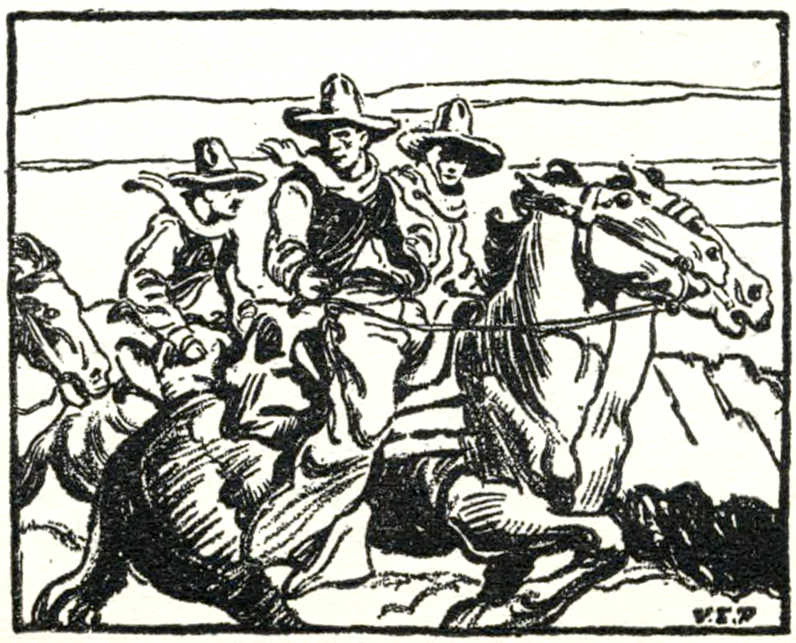
“They’re comin’!” he snapped. “I saw two riders cuttin’ east down there. They’ve broken the fence, I’ll bet.”
“Surroundin’ us, eh?” said Roaring quickly. “Pete, you’ve got one chance. If they get you they’ll lynch you quick. Git out through the kitchen! C’mon, Jimmy!”
They ran outside. Their horses were on the dark side of the house. They saw a rider on a light-colored horse, moving along a ridge north of the stables.
It was evident that English Ed’s gang was intending to surround the place. Roaring doubted if they knew that he was there.
“Is your bronc still saddled, Pete?” asked Roaring.
“Yeah,” said Pete quickly. “I think I might go back to town tonight.”
“You probably will,” said Roaring dryly. “There’s one chance in a dozen that you will—and we’ll take that one chance.”
English Ed had no trouble in getting up a lynching party. Slim Regan and three of his men were there from the Big 4; Kent Cutter, foreman of the 7AL, and two of his men, showed up in time to join the crowd. There was always a goodly crew of hangers-on at the Black Horse Saloon; always they would willingly ride to a killing.
English Ed did not go with them. He engineered the deal and then stayed at home. At least a dozen armed men rode out of Turquoise City with the avowed intention of making Pete Conley pay for his misdeeds. They rode fast, because they knew Roaring Rigby’s horse was gone from his stable, and they knew Roaring had been courting Dawn Conley. They figured that Roaring might tip off Pete and give the half-breed a running start to freedom.
Old Moses Conley had ridden as far as the edge of town with Cutter and his men from the 7AL. They knew he would ride slowly to his ranch; so they rode swiftly to overtake the old man, because he was reputed to be a dangerous man with a Winchester and that he might, if things broke badly for the posse, cause them considerable suffering with that same gun.
They overtook the old man just at the ford of Black Horse river. Cutter knew that Conley was unarmed, so he did not hesitate to tell him what they were coming out there for. He did not tell the old man that they suspected Pete of the killing, but stated Pete’s guilt as a fact.
The old man said nothing. The riders hemmed him in, as they crossed the ford. At the corner of the fence they stopped, while two of the men cut the fence wires. There they received their orders for circling the ranch.
“He’ll be lookin’ for us,” said Slim Regan. “We’ve got to stop him from makin’ a getaway. Four of you better go. Head for a point due east of the ranch-house. Some of us will go through the gate and hold the south line and kinda string around to the west and north. Move in fairly close and wait until I whistle. I don’t look for the breed to make a break, but you never can tell.”
“Where’s the sheriff?” asked Moses Conley. “It seems to me that this is his affair.”
“Oh, that damn fool!” snorted a cowboy.
“This don’t require any law,” said Regan coldly.
“It shore don’t require the services of Judge Beal,” laughed another.
“Stop all that noise!” snapped Regan. “Do you want to tell him we’re comin’?”
“It seems to me it takes a lot of brave men to capture one half-breed,” said the old man bitterly.
“It takes twelve men to hang one,” retorted Cutter. “We want to make this thing legal.”
“Stop talkin’!” warned Regan again.
They opened the gate and rode through, following along the cottonwoods until they came in sight of the house. Cutter took four of the men with him and headed north, with the intention of blocking all chance of escape to the north and west, while Regan led the rest of the men straight toward the ranch-house, where they could block the way to the south.
Regan rode knee to knee with Moses Conley.
Suddenly a shot rang out beyond the ranch-house, and the men jerked up their horses. There was no further need of concealment. They whirled and galloped straight toward the house. Another rifle shot rattled through the hills.
Regan caught a glimpse of a gray horse heading in their general direction, and he thought it was one of his own men, coming back from Cutter’s crowd; but the horse swung further to the north and then headed straight for the gate. The light was not so good, but he seemed to remember that none of them was riding a gray horse.
“There he goes!” yelled a cowboy. “That gray horse! It’s the one Pete rides! He’s heading for the gate!”
There was no chance for Regan and his men to head off this running horse. In some way Pete had luckily ridden between Cutter’s men and Regan’s detachment. Regan threw up his revolver and emptied it at the horse and rider, knowing that the gun would not be effective at that distance. One of his men carried a rifle, but his horse was a little gun-shy, and the fusilade from Regan’s gun had made the horse too jumpy for the rider to hope to hit anything. Cutter’s men were coming back, riding swiftly, but the man on the gray horse reached the gate. Riders were coming from all directions and they joined Regan near the gate. Old Moses Conley was forgotten now.
“Damn it, he must have seen us comin’!” panted a cowboy. “He broke for the east, but I took a shot at him, and he cut back this way. How did he get past you, Regan?”
“Didn’t see him in time,” growled Regan. “That gray horse wasn’t visible. Which way did he go from the gate?”
“North,” said Cutter. “C’mon!”
They strung out through the gate and galloped north, spreading out like a skirmish line, driving their horses as fast as possible. But every man knew how impossible it would be to catch Pete Conley now. The half-breed knew every angle of the country better than any one else, and with that almost invisible gray horse he could ride into a clump of brush, wait until the riders passed him and then double back.
For thirty minutes they rode straight ahead, searching the country. Regan was about to call the men in and wait until morning, when they saw their quarry silhouetted against the sky on a narrow ridge. He seemed to be waiting for them. Then he dropped off the ridge, seemingly unhurried.
All the men of the posse had seen him. But their horses were getting winded, the traveling was mostly up-hill. They reached the ridge and drew rein. Regan called them together and they held a parley. On the next ridge, not over two hundred yards away, appeared the rider again. He stopped and appeared to be watching them. Cutter borrowed a rifle and fired two shots, but neither seemed to have any effect.
“You can’t hit anythin’ in this light,” growled Cutter, giving back the rifle.
“That half-breed shore has a lot of gall,” snorted Regan. “If he wants to play hide-and-seek with us, we’ll play.
Let’s split up and see if we can’t get around him.”
The rider moved slowly off the ridge, as the dozen riders spurred ahead, circling from both ends of the line. They passed the ridge, with the end riders swinging farther out all the time.
They had gone about a mile beyond the spot where they had last seen their quarry, when the gray horse moved slowly out of a clump of brush near the crest of the ridge. The horse was led by its rider. They crossed the ridge beside a tangle of brush and rocks, where the man mounted and rode swiftly back toward Turquoise City.
It was Roaring Rigby, the sheriff of Black Horse, riding Pete Conley’s gray horse. He came in along the fence and followed it to where the posse had cut the wire near the corner; and there he found his own horse.
He dismounted, tied up the reins on the gray horse, gave it a slap with his hat; it went trotting back toward the Hot Creek ranch. Then he untied his own horse, mounted and rode on toward town.
“I may be old as hell, and funny to look at,” he said bitterly, “but I’m smarter ’n all the gamblers and horsethieves around here.”
It was about eight o’clock in the morning when the tired man hunters came back to Turquoise City, empty-handed. Regan had taken his men back to the Big 4, but Cutter brought his men to town for breakfast. All night they had combed the hills, hoping for another glimpse of Pete Conley. They were in a vile humor when they came back.
Cutter rode down to the sheriff’s office and found Roaring Rigby just getting ready to go to breakfast.
“When are you goin’ to git Pete Conley?” demanded Cutter.
“When?”
Roaring shut one eye and looked curiously at Cutter with the other. Cutter was a small man, slightly gray, with a ferret-like face and a none too pleasant disposition.
“Yeah—when?” snapped Cutter.
Roaring shook his head slowly.
“I ain’t goin’,” he said slowly.
“You ain’t, eh? I suppose murder don’t mean anythin’ to you, Rigby.”
“I dunno—” lazily—“never gave it much thought.”
“Oh, you haven’t!”
“No-o-o-o.”
“Then yo’re not goin’ out after Pete Conley, eh?”
“Nope.”
“Why not?”
“Because he’s already in jail.”
Cutter’s jaw dropped and he looked at Roaring, with his mouth open, gasping.
“In jail!” he exploded. “When did you put him im jail?”
“Last night.”
“Last night? Why, we—we—” Cutter spluttered helplessly. “Why, we chased him half the night.”
“You did like hell,” drawled Roaring. “You started out to foller a gray horse, but the gray horse doubled back on yuh. You’re a hell of a man-hunter, you are.”
Cutter was speechless. Roaring locked the door, put the key in his pocket and started up the street toward a restaurant, paying no attention to Cutter, who jerked his horse around and rode straight to the Chinese restaurant, where the posse had gone for breakfast.
A tall cowboy riding a bay horse swung into the upper end of the street, and rode toward the Black Horse Saloon, but he saw Roaring on the sidewalk and went over to him. It was “Wind River” Jim, one of Jimmy Moran’s men.
He did not know what his right name was. The Arapaho Indians had raised him, his parentage being obscure; and they had named him Wind River Jim. He was tall, tow-headed, lean-faced, addicted to chewing tobacco and profanity, but withal possessed of a certain sense of humor.
“Hyah, Roarin’,” he grinned, “Jimmy said fer me to come in and tell you he sent me. He kinda had the idea that you’d need a good deputy, so he picks me.”
Roaring Rigby cuffed his hat on one side of his head, looked Wind River Jim over carefully. His face was puckered from an effort to think just what to do. Then he reached in his pocket, took out a deputy’s badge and gave it to Wind River Jim.
“Pin ’er on you, cowboy; that’s your license to git shot, and no damages asked.”
“Do I swear to anythin’?” asked Wind River, as he pinned the badge on his vest, swelling his chest beneath the shining badge.
“Swear to nothin’,” said Roarin’. “Make no promises, and you won’t have anythin’ to break. Here’s the key to the office. I’m goin’ to ham and egg m’self. See you later.”
Wind River Jim rode down to the office, tied his horse to the little hitch-rack, spat vigorously, unlocked the door and went in. He sent his tall Stetson spinning toward a nail, missed it by three feet, sat down in the rickety swivel chair, hooked his feet over a corner of the desk, and yawned.
“Well, I’ve reached my height,” he said aloud. “Officer of the law, and I’ve got a badge to prove it. Next thing I know I’ll be a Senator or some other funny thing, and you never can tell where I’ll go from there. Hello, yourself!”
Jefferson Ryker, prosecuting attorney of Black Horse, stepped inside the office and looked curiously at Wind River. Ryker was above average height, but was very thin. He wore tall white collars and a stringy black bow tie. The collar was big enough to give ample play to his Adam’s apple. His suit was a rusty black and would have fitted him had he been fifty pounds heavier.
Ryker was rather an old-timer in the country. For a number of years he had operated an assay office in Turquoise City, but with the falling off of the mining industry he had devoted himself to the law, had been admitted to the state bar and was now serving his third term as prosecutor. “Mica” Jones, formerly assistant to Ryker in the assay business, was running the assay office for Ryker, and barely making a living.
Wind River Jim did not like Ryker. He took one look at him and groaned slightly; but otherwise he remained silent, after his first greeting, which had not been returned by Jefferson Ryker. The prosecutor stepped back to the doorway and looked up the street.
“Where’s the sheriff?” he asked.
“He’s eatin’ breakfast.”
Ryker leaned against the doorway and examined a cigar, which was rather badly unwrapped. He licked it gently in spots, trying to work the wrapper back into place. Finally he lighted it and puffed convulsively, but got no results.
“Anythin’ you want around here?” queried Wind River. “I’m doin’ the sheriffin’ while Roarin’ Rigby nourishes.”
“You are?” Ryker looked curiously at Wind River, who gave him plenty of opportunity to see the nickel-plated badge.
“Oh, I see.” Ryker came back closer to Wind River. “All right, Wind River, I want to see the prisoner.”
“The prisoner?”
“Yes—Pete Conley.”
“Huh!” snorted Wind River. “Well, now, from where I set, you’ve got a fine chance, Ryker.”
“I have a right to see him!” snapped the lawyer.
“Yea-a-a-ah, the devil you have!”
Wind River jerked his feet off the desk and faced Ryker.
“Your rights and wrongs don’t mean nothin’ to me. If you keep your hat on until I let you see Pete Conley, they’ll have to saw it off when you’re dead.”
“I wonder how Roaring Rigby ever happened to appoint such an ignorant person,” said the lawyer.
“Because he couldn’t trust the smart ones, that’s why. The smarter they are the crookeder they are, Ryker, and I’ve heard that you’re the smartest man in this valley.”
Ryker walked back to the door, boiling with wrath.
“I’m going to find the sheriff,” he said hotly. “You can’t call me a crook and get away with it.”
“Well, you’re a friend of English Ed.”
“What has that got to do with it?”
“He’s crooked. You never see a lot of lambs hobnobbin’ with a coyote, do you?”
Ryker whirled on his heel and left the office.
Wind River Jim chuckled to himself as he uncoiled his length from the creaking old chair and walked over to a cracked mirror on the wall. He looked intently at himself.
“You don’t look crazy to me,” he told himself, “but you must be. Appearances are shore deceptive. But I don’t like that cat-eyed lawyer, and it was a good chance to let him know it. Anybody who didn’t know me would think I was mean as dirt.”
The jail adjoined the sheriff’s office, and there was no exit, except through the sheriff’s office. The front of the jail was a blank wall. At the side and rear were small barred windows, not large enough for a man to crawl through. It was not a well ventilated jail, it is true, but it was built to hold a prisoner.
Roaring Rigby came back a few minutes later, carrying a tray of food for Pete Conley.
“This is your job after this, Wind River,” he said, placing the tray on the desk. “What did you say to Ryker?”
“He wanted to see Pete,” grinned Wind River. “I told him to go to hell.”
Roaring grinned widely.
“I thought so. He shore was sore as a boil. Met me at the door of the restaurant and jumped all over me about you.”
“The devil he did! What did you say, Roarin’?”
“Me? I slapped his old face loose from his hat. Mebby that wasn’t exactly the right thing for a sheriff to do, but it’s all I could think of at the time. I never took no oath of office. Anyway, I don’t think there’s anythin’ in the oath about not slappin’ lawyers. Ha-ha-ha-ha-ha! Let’s feed the animal.”
They unlocked the door into the jail and carried the tray in. There was a short hall, about six feet wide, across the room, at each side of which were barred doors. Pete Conley leaned against the bars of one cell, smoking a cigaret.
“Got you some ham and eggs, Pete,” said the sheriff cheerfully.
“Good!” said the half-breed. “What’s new?”
Roaring unlocked the door and put the tray on a chair.
“Nothin’ much. English Ed’s gang is pretty sore. They rode all night. Ha-haha-ha! Aw, they’ll cool off. Last night they was in a lynchin’ mood, tha’s all. Ryker wants to see you, Pete. Jist remember he’s the jigger that’ll try to hang you. Don’t tell him a thing, sabe? You don’t have to talk.”
Pete nodded quickly.
“I like see Judge Beal.”
“You can’t, Pete; he’s the judge.”
“He’s good man.”
“Uh-huh—shore, but he can’t see you until you walk into his courtroom. You’ll have to hire a lawyer, I reckon.”
“What for?”
“To prove you didn’t kill Mallette.”
“What lawyer see who kill him?”
“Oh, hell, there you are, Wind River!” exploded Roaring. “Can you imagine that? What lawyer seen who shot him?”
“I dunno,” said Wind River innocently. “Did any?”
Roaring stared open-mouthed at Wind River. Finally he closed his mouth and shook his head sadly.
“Well, I reckon it’s all right,” he said resignedly. “I hired you because you was honest, Wind River.”
“My old man come town yet?” asked Pete, beginning to eat.
“Not yet.”
“Huh! How soon they hang me?”
“Are you in any hurry, Pete?”
“Not much.”
“Well, that’s fine. They’ll have to try you first, so you’ll jist have to be patient. First they’ll give you a hearin’ and decide if yo’re worth hangin’. Then they’ll hold the trial and see when you git hung. It’ll take quite a while.”
“Nobody ask me if I kill Mallette,” said Pete, his mouth filled with food. “I like kill him pretty good, but somebody kill him. He stole my money.”
“You like to kill him, eh?”
“Sure.”
“Uh-huh. You’ll make a hell of a good witness for the State—as long as you last.”
Roaring left Wind River Jim with Pete and went to see Dr. Shelley, the coroner, who had an office at the east end of the street. The old doctor was a short, fat, breathless man, with two double chins and no waist-line.
“Going to have an inquest, I suppose,” puffed the doctor.
“Shore,” nodded Roaring. “He won’t keep a long while this kinda weather. You fix up about the inquest, Doc. That’s somethin’ I dunno anythin’ about. Are you shore Mallette didn’t kill himself?”
“Might have shot himself at long-range. No powder marks on his face, and the bullet went through his head.”
“Uh-huh.”
“Funny thing,” said the doctor. “You know, Mallette wore boots—the short kind. Well, there was dirt in both boots.”
“What about it?”
“I don’t know; I just mentioned it.”
“Uh-huh. Mallette didn’t look to me like a man who had taken a bath very often. You fix up about that inquest, will yuh, Doc? You’ve held ’em before.”
“All right, Roaring. Ryker was down to look at the corpse. He says there’s no doubt in his mind that Pete Conley killed Mallette. They chased Conley all night last night.”
“Yeah, I heard they did.”
Roaring didn’t bother to tell the doctor that he had Pete in jail. He went from the doctor’s office to Judge Beal’s home, where Wong Kee opened the door for him. The old judge was slumped down in an old rocker, half dressed, an uncorked bottle of whisky beside him on the table. On his lap was a much worn copy of the Bible.
“Come in, Roaring,” he said softly. “Sit down and tell me all the news. We’ve only heard rumors here. Between Wong’s rheumatism and my bottle of rye, we’ve not been able to get out and gather the news. Have a drink—it’s good stuff. Wong, bring the gentleman a glass.”
It was evident to Roaring that the judge was mellow with liquor. But that was as far as he ever got—mellow. No one had ever seen Judge Beal drunk—as a drunk is measured in Turquoise City.
Roaring took the drink and told the judge what had happened the night before. The old jurist chuckled over how Roaring drew the lynchers away from the ranch, while Jimmy Moran brought Pete safely to Turquoise.
“Oh, they’d have hung him, Judge,” assured Roaring. “Pete wasn’t stuck on comin’ to jail, but he could see that it was the only safe place for him.”
“That’s very true, Roaring. I got my second warning yesterday.”
“You did? Gosh! What are you goin’ to do, Judge?”
The old judge smiled grimly.
“Die in a good cause,” he said slowly. “Why run away? I’ve no place to go. After all, I am the judge of this district. English Ed and his cohorts fear justice, and it may be that English Ed has political influence enough to get a friendly judge elected, or rather appointed, in case he can frighten me into resigning.”
“Mebby,” nodded Roaring. “He scared Randall out.”
“But you are not one of his men, Roaring.”
“I hope to die if I am! I’ve got Wind River Jim for a deputy and I’ll run that office as long as she’s got a wheel to turn on—and when she ain’t, I’ll keep her draggin’. I dunno much about my office, Judge. Randall never did tell me much, so I’ve kinda got to run her by ear. English Ed and his gang don’t like me; but that ain’t goin’ to git me down. Well, I better go back and see how Wind River is makin’ out. I plumb forgot to tell him that bein’ a deputy sheriff don’t give him a right to shoot anybody he happens to get sore at. See you later, Judge.”
The inquest over the body of Mallette created quite a lot of interest, and the six jurors did not hesitate to bring in a verdict to the effect that Mallette had been killed by Peter Conley. Roaring Rigby refused to produce Pete in court.
“That half-breed is behind the bars, neck intact,” he told the coroner, “and there he stays until he has to go into a reg’lar courtroom. There’s too much iron among those present, I’ll tell you that.”
Jimmy Moran’s testimony regarding the poker game in which Mallette stole a card was rather in favor of Pete; and the audience enjoyed Jimmy’s story of how Roaring was chased by the posse. Jimmy admitted that it was he who brought Pete to jail that night.
Every one noticed that Jimmy showed Dawn marked attention during the trial, and Slim was foolish enough to mention this to Jimmy later on.
“Is it any of your damn business?” demanded Jimmy. “You may be in charge of my father’s cattle, but you’re not in charge of my father’s son. And get this straight, Slim. If I want to marry—”
“Sure, sure,” nodded Slim hastily. “Excuse me, Jimmy.”
Slim subsided, but he hurried to the telegraph office and sent a long telegram to Franklyn Moran, explaining what had happened and mentioning that Jimmy might need a bit of fatherly advice regarding matrimony. Not that it mattered to Slim, except that he had orders to keep Moran informed on Jimmy’s activities. Franklyn Moran loved Jimmy, in his own way, and he wanted Jimmy with the Big 4. According to his views of the matter, the sooner Jimmy went broke, the better, perhaps, for the relations between father and son.
Kent Cutter, owner of the 7AL, failed to see any humor in Jimmy’s recital of the fruitless chase of Pete Conley. Kent went back to the Black Horse after the inquest, imbibed a sufficient number of drinks to make him free of speech and then proceeded to tell the world that he didn’t care very much for Jimmy Moran.
Lovely Lucas, Jimmy’s sole remaining cowboy, was in the Black Horse and heard Cutter’s loud-voiced, profane opinion of Jimmy. Lovely was a huge figure of a man. In fact he was so big that his eight and one-half by six and one-half Stetson did not seem at all out of proportion on his head. He had a big nose and an enormous mouth. He had been born and raised in southern Texas, and he had an easy drawl. He sauntered over to the bar, rested one elbow lazily and considered Cutter.
“You jist kinda like to talk, don’tcha?” he said slowly.
Cutter turned his bloodshot eyes upon the bulky Lucas.
“Mebby,” he said shortly, and turned his back.
“He-he-he-he-he!” chuckled Lovely. He had imbibed a few drinks himself.
“My talkin’ don’t ache you none, does it?” demanded Cutter frigidly.
“It ain’t got that far—yit,” smiled Lovely, “but you’ve done got to remember that Jimmy Moran is my boss, Cutter. He ain’t no damn angel, so anythin’ you feel like sayin’ about him might better be said to his face, ’cause I’ll shore tell him what you said, and I might make it sound a heap worse ’n you would.”
“Huh!” snorted Cutter. “That’s no dream!”
“I’d prob’ly lie,” said Lovely softly.
“You would,” admitted Cutter incautiously.
Lovely Lucas moved swiftly for a big man. One huge hand caught the back of Cutter’s muffler, while the other caught the back of his cartridge-belt and, with a heave, he swung Cutter off the floor.
“Comin’ up!” snorted Lovely, and he swung Cutter over the bar, letting loose of him in mid-air.
The bartender fell out of the way, giving Cutter plenty of room to catch his legs across the top of the back-bar, hooking his spurred heels behind stacks of polished glasses, and bringing everything down on top of him when he crashed to the floor.
Lovely whirled around and headed for the door, his mouth wide open in a chuckling laugh. No one tried to stop him. He crossed the street and went straight to the sheriff’s office, where he found Roaring Rigby and Wind River Jim. It was several moments before Lovely was able to tell them what had happened.
“I jist kinda valised him over,” laughed Lovely.
“Yeah, and you’ll wish you hadn’t,” said Roaring. “That whole 7AL gang will lay for you.”
“But he called me a liar,” protested Lovely. “He said somethin’ ought to be done about Jimmy Moran marryin’ Dawn Conley.”
Roaring Rigby shifted his eyes and looked down at his boots. Wind River Jim looked reprovingly at Lovely and shook his head. Wind River knew more about it than Lovely did. But Lovely didn’t understand.
“If Jimmy wants to wed with that half-breed girl, I reckon we’ll all step out and help make it a success, eh, Roarin’?”
Roaring rubbed a thumb along the edge of his boot-top.
“Yea-a-ah,” he said slowly. “I reckon you’ve got to stick up for your friends, Lovely.”
“Shore! That’s why I played ante-over with Cutter. He-he-he-he! I s’pose English Ed will send me a bill for damages. Cutter’s legs swept every glass off the back-bar.”
“And you better tell Jimmy to look out for Ed,” advised Roaring. “That gambler ain’t forgot that Jimmy cooled him off the night that Mallette was killed.”
“Oh, Jimmy ain’t asleep, Roarin’. Say, I’ll let you in on somethin’, if you’ll keep still about it. After the inquest, old Mose Conley told Jimmy to keep away from the Hot Creek ranch; said he appreciated what Jimmy was doin’ for ’em, but that Jimmy was to keep away from Dawn. I reckon it was because he hates Jimmy’s pa. He didn’t say that was the reason. Jimmy got kinda hot and told the old man he was aimin’ to marry Dawn. He-he-he-he! The old man says Jimmy better think it over a long time, ’cause Dawn is a half-breed; and Jimmy asks him how long he took to think things over before he married Dawn’s mother. He-he-he-he-he!
“He had the old man up a stump, but the old man stuck to it. Jimmy asks him what he’ll do in case he decides to come to see Dawn. ‘I told you not to,’ says the old man. ‘All men look pretty much the same in the dark, and I’ve got to protect myself.’ And there you are. I didn’t talk with Jimmy afterwards; he piled on his bronc and went home.”
Some one stopped at the doorway of the office, and they turned to see English Ed. He looked coldly at Lovely.
“You owe me forty dollars, Lucas,” said the gambler. “That is the amount of glassware you broke awhile ago.”
“Forty dollars,” said Lovely softly. “Lotta glasses, Ed.”
“A month’s salary,” said Wind River Jim.
“And here’s a letter to take to Jim Moran,” said English Ed, handing Lovely an envelope. “You see that he gets it.”
“Yea-a-a-ah? And I owe you forty dollars, eh?” Lovely sat up straight and glared at the gambler. “Say! You cold-jawed card-slicker, do you think I’ll ever pay that? Pay you forty dollars for busted glasses! Why, I wouldn’t give forty dollars for everythin’ in your place, even if they’d throw in your hide and taller.
“You think you’re runnin’ this town, don’tcha? You runs Jim Randall out, but the rest of us has kinda got our heels braced, sabe? You’ve got a couple gunmen dealers over there. Mack Ort and Keno Smiley, I’m meanin’. You had three, until Mallette got hung on the hot end of a bullet.
“Well, you tell ’em to cut loose any old time. See if they can tear forty dollars’ worth out of my hide, English; and that’s the only way you’ll ever collect. Yeah, I know all about the warnin’ you sent to Jim Randall. You scared him out; but you ain’t scared old Judge Beal out yet. And if I was you, I’d turn right around and go back to my little playmates, knowin’ well that old man Lucas’ little boy ain’t never goin’ to give you that forty dollars. What do you think?”
English Ed did not change expression, no matter what he felt. It was no place for him to protest Lovely’s decision. These three hard-bitted cowboys were closer than brothers and, judging from their expressions, welcomed any argument he might start. So he merely nodded coldly, turned and walked away.
Lovely grinned widely and looked at the envelope. It was unsealed, and Lovely did not hesitate to open it and take out the enclosure. It read:
Jim Moran: Your I.O.U.’s, aggregating over twelve hundred dollars, are long past due. These must be met at once, or I shall be obliged to levy an attachment on the Stumbling K.
—EDWARD HOLMES
“Twelve hundred dollars!” exploded Lovely. “Jimmy shore played high and handsome, didn’t he! Whooee! Levy an attachment, eh? What kind of a thing is that, Roarin’?”
“Some law thing. I told you English Ed would shut down on Jimmy.”
“And Jimmy can’t pay it,” declared Wind River Jim. “Why, he ain’t got it. Every time pay-day came around he had to sell enough cows to pay us off. Betcha he ain’t got fifty head of stock left. The Black Horse Saloon has got rich off of Jimmy Moran. He owes the bank, too. They’ve got a mortgage for a couple thousand.”
“Yeah, it kinda looks as though Jimmy was about sunk,” agreed Lovely.
He walked back to the door and looked out. Cutter was crossing the street, looking down toward the office. He met Ryker in front of the post-office, and they went up the street together.
“Cutter and Ryker are pretty good friends, ain’t they?” asked Lovely.
“Always have been,” grunted Roaring.
“Cutter’s prob’ly fixin’ to have me arrested,” grinned Lovely. “Mebby I better go home while the way is clear. How soon do they have Pete’s trial?”
“Next week,” replied Roaring.
“Before Judge Beal?”
“If he lives that long.”
“Who—Pete?”
“No, Judge Beal.”
The overland train ground to a stop at the little station of Sibley Junction, unloaded one passenger and a couple of heavy valises, and then hurried on, as if glad to get away.
Sibley Junction consisted of the depot, a water-tank and a saloon. The depot and water-tank were on one side of the railroad; the saloon was on the other. The saloon was a weatherbeaten, false-fronted structure, one side of which still bore traces of having been decorated with a circus poster.
There was no sidewalk, no awning. The false-front leaned back, as if weary of it all. The surrounding hills were hazy with the afternoon heat, and the dust from the passing train seemed to hang suspended in the windless atmosphere. There was no sign of life, except two saddled horses dozing at the hitch-rack beside the saloon.
The lone passenger from the overland picked up his valises and walked heavily to the waiting-room of the depot, dropped the valises and mopped his red face. He was a big man, square-headed, heavy-jawed, well dressed. His baggage was of expensive leather. He looked around sourly as the head and shoulders of a sleepy-eyed depot-agent appeared at the ticket window.
“Howdy, Mr. Moran,” said the man with the sleepy eyes. “I kinda thought somebody got off Number Six.”
“Yeah!” grunted Franklyn Moran.
“Goin’ over to Turquoise City, eh?”
“Yeah. Train on time?”
“Might be here on time tomorrow—not today. They went in the ditch this side of Wiebold, and the report is that they won’t move nothin’ over this jerkwater line for at least twenty-four hours, Mr. Moran. I’m sorry.”
Moran almost exploded. Slim Regan’s telegram had caused him to drop everything and head for Turquoise City. And here he was, twenty-five miles away, with no hotel, no livery-stable, no way for him to travel that twenty-five miles, except on foot.
“That means I can’t get a train to Turquoise until tomorrow, eh?”
“Probably about tomorrow even’.”
“Anybody around here got a horse I could buy or rent?”
“I don’t think so.”
“I saw two horses over at the saloon rack.”
“Couple of strange cowboys. They rode in today from the Outpost country. Been punching cows for the Muller outfit.”
“I wonder if they’re headin’ for Turquoise City?”
“I don’t think so. They asked about the Long Bend country.”
“Maybe I better take a look at ’em. I’ll leave my baggage here.”
Moran mopped his face again and crossed the track to the saloon. It was a dusty, fly-specked place. The bartender was humped over in a chair, reading a paper-backed novel; a gray cat was curled up on the end of the bar, and at the one card table sat two dusty cowboys, eating canned salmon, peaches and crackers.
Moran stopped at the bar and looked around. The bartender showed mild interest, marking the page of his book by crimping a page. The two cowboys did not even show mild interest. One of them was very tall and thin, with a long, serious face, which just now he was stuffing with food. The other was of medium height, broad-shouldered, with very wide blue eyes and a deeply-lined face. Their well worn garb was typical of the cow-country.
“I’ll buy a drink,” invited Moran.
The tall cowboy swallowed heavily and shook his head.
“Thank you just the same,” he said pleasantly. “We tried it.”
“They don’t know good liquor,” said the bartender rather plaintively, and getting to his feet.
“I reckon that’s right,” nodded the tall one, digging into the salmon can with his pocket-knife.
“Beer?” queried Moran.
The tall one grimaced.
“Hot. There ain’t been no ice here since the glacial period.”
“What’ll you have?” asked the bartender.
Moran considered.
“Anything cold?”
The bartender rubbed his chin ruefully.
“Not that I’ve seen. Been pretty hot lately.”
“I guess I don’t want anything, thank you.”
“Uh-huh.”
The bartender went back to his novel, and Moran sat down near the two cowboys.
“I’m Franklyn Moran,” he told them, “from Chicago. I own the Big 4 ranch near Turquoise City.”
“What former experience have you had, and why did you leave your last place?” queried the blue-eyed cowboy seriously.
“Eh?” said Moran.
“I was just thinkin’ how I’d hate to live here,” said the blue-eyed one seriously.
“Mm-m-m-m,” muttered Moran. He knew that wasn’t what the cowboy had said.
“It’s all right, after you get used to it,” said the bartending bookworm.
“That may be,” smiled Moran. “I expected to catch that afternoon train to Turquoise City, and find that there’s a wreck which will take twenty-four hours to clear. I’d give twenty-five dollars for a horse to ride to the Big 4 ranch.”
“Twenty-five dollars for twenty-five miles?” queried the bartender.
“It’s worth it to me,” declared Moran. “If one of you boys will let me have a horse—”
“You must be in a hurry,” observed the tall cowboy. He wiped his lips and prepared to roll a cigaret.
“I am. That’s my offer. I’d even ride double.”
“What kind of a place is this Turquoise City?”
“Wide open town. You boys lookin’ for work?”
“No-o-o-o, lookin’ for a job. We’re too intelligent to look for work, pardner.”
Moran smiled and offered them cigars, which were declined.
“How about my offer?” he asked anxiously.
The tall one elevated his eyebrows and looked at his companion.
“I’ll tell you what we will do with you,” said the short one. “You can ride my bronc, if you’ll pay twenty-five dollars and give me a railroad ticket to that town. I’ll wait for the train tomorrow afternoon.”
“Cinch!” Moran dug in his pocket and drew out a ticket. “Here’s mine. How soon do we start?”
“Right now, if the bartender will let me have half of his bed tonight,” said the short one.
“Pleased to have you,” nodded the bartender. “I won’t have to talk to myself tonight.”
“I’ll leave my baggage with you,” said Moran.
“All right.”
They threw the empty cans outside and went to the horses. The cowboys helped Moran adjust the stirrups to the proper length.
“My name’s ‘Hashknife’ Hartley,” said the tall cowboy. “This pardner of mine is named Stevens. Folks call him ‘Sleepy,’ ’cause he ain’t.”
“Well, I’m both glad and lucky to meet you,” laughed Moran. “There’s some trouble over in Turquoise City, and I’m anxious to get over there.”
“Trouble, eh?” Hashknife Hartley’s long nose twitched.
Moran mounted and picked up his reins. Sleepy Stevens was looking at Hashknife, a queer expression in his blue eyes.
“Seems there is,” nodded Moran. “Ready?”
“Yeah,” nodded Hashknife. He turned to Sleepy.
“Don’t miss that train, pardner; I’ll be lookin’ for you.”
Sleepy nodded solemnly and watched them ride away. Finally he cuffed his Stetson over on one side of his head, spat disgustedly and walked back toward the saloon.
“Trouble!” he snorted aloud. “By God, there wasn’t nothin’ but a depot and a saloon, a depot-agent and a bartender —and we found trouble jist the same.”
That same afternoon, which was two days after Lovely Lucas had tossed Kent Cutter over the Black Horse bar, Jeff Ryker, prosecuting attorney, rode out to Conley’s ranch, wearing a new mailorder suit and an extra large collar. Dawn saw him coming from afar. She had been expecting Jimmy to ignore her father’s warning, and at first she thought it might be Jimmy; but, when she saw who it was, she departed hurriedly, leaving her mother to do the talking.
The very fat, stolid old Indian woman filled the rocking-chair to creaking capacity. She wore an old print wrapper and moccasins, a very brassy necklace and an even more brassy bracelet. Minnie Conley had never become civilized, as far as apparel was concerned.
Ryker rode up to the porch, tipped his hat to Mrs. Conley and dismounted. She nodded coldly. Moses Conley had explained to her that Ryker was the man who would try to hang Peter.
“Rather hot today, Mrs. Conley,” he said pleasantly.
“Pretty damn hot,” she said forcibly.
“Yeah, it is,” he sat down in the vacant chair and mopped his brow. “Hot in town today. I thought I’d take a ride and cool off. Where’s Mr. Conley?”
“He not here.”
“I see.”
He craned his neck and glanced through the doorway.
“Dawn not here,” said the woman.
“I see. Well, you’re here, Mrs. Conley.”
“I here,” stolidly. “I mos’ always here. Too fat to ride.”
Ryker laughed cautiously.
“Well, you’re good and healthy, Mrs. Conley.”
“Pretty good. What you want?”
“That depends, Mrs. Conley. Peter’s in jail, you know.”
“I know very well.”
“And they might hang him, Mrs. Conley,” he said heartlessly.
The Indian woman’s eyes flickered for a moment, as she shifted her gaze past Ryker. He watched her face closely, but beyond the flicker of her eyelids there was no emotion.
“And you don’t want that to happen,” he said softly.
“No,” she said. “No want that to happen.”
“He’s your son,” said Ryker.
“You right, my son.”
“There’s just me and you here, Mrs. Conley. I don’t mind telling you, I love Dawn. I want to marry Dawn.”
The woman’s gaze came back to Ryker, and he shifted uneasily under the stare of those beady eyes.
“You want marry Dawn?” she asked.
“Yeah, that’s the idea, Mrs. Conley. I’m a big man in Turquoise City, you understand. If I say they must hang Peter—they hang Peter. If I am going to marry Dawn, I not say for them to hang Peter. You sabe that?”
“Damn right!”
“Fine. When Dawn say she marry me, I get Peter loose. If she not marry me—” Ryker hesitated meaningly.
“You hang Peter,” said the woman heavily.
“That’s the idea, Mrs. Conley. We make a trade, eh?”
“S’pose Dawn no marry you?”
“She like to see Peter get hung?” countered Ryker.
“She not like.”
“And there you are, Mrs. Conley. You tell her about it. You not need to tell Moses. He not need to know. Our secret, eh?”
“I not tell nobody.”
“Good! Well, I’ll be goin’ on. Peter have trial next week. You let me know Monday.”
Ryker mounted his horse and rode away, well pleased with himself. Once he turned in his saddle and waved back at the huddled figure on the old porch, which did not wave back at him.
After Ryker had passed from sight, Dawn came out. She halted near her mother and stared across the hills toward the Black Horse ford.
“I heard everything he said, mother.”
“Good! Ryker mamook hyas cultus wau-wau.”
Stress of emotion caused the old squaw to revert to the trade language of her people. Translated, it meant that Ryker made a very bad talk.
“How can he turn Peter loose?” demanded Dawn indignantly. “Is Ryker the law?”
“Crooked!” said the old lady.
“It surely is! If I marry him he’ll turn Peter loose. Why, I wouldn’t marry him.”
“Peter hang, mebby.”
“Oh, I don’t mean it that way, mother. I want Peter to go free. You know that, don’t you? Why, he’s my brother; but to marry Jeff Ryker—”
“Too much talk about marry,” said the old lady. “Cutter talk to Mose. You don’t know. He want marry you. Jimmy Moran want marry you.”
“Kent Cutter want to marry me?”
“You right. Mose tell him go to hell.”
Dawn laughted bitterly.
“I wonder what’s got into ’em? Why don’t they come to me, I wonder?”
“Jimmy come to you, eh?”
“Yes,” softly.
“Roarin’ come to you, Dawn?”
“No.”
“He not come to nobody—jus’ come. Good man.”
“Yes, he’s a good man, mother; but I don’t want to marry him. Oh, I don’t want to marry anybody.”
Her mother looked at her keenly for several moments.
“I guess you marry man you want,” she said slowly. “Peter have trial next week. Mose hire good lawyer. Mebby I tell judge what Ryker say. Here come Mose now.”
Moses Conley rode to the corral, unsaddled his horse and came up to the house.
“Was Ryker here?” he asked.
Mrs. Conley nodded.
“He jus’ stop little while, Mose.”
“What for?”
“Dawn.”
“Dawn?” Mose Conley twisted his head and looked at Dawn. “Came to see you? What did he say to you?”
“I didn’t talk with him.”
“He want marry her,” said Mrs. Conley.
“Huh!” The old man ran his fingers through his white beard, frowning heavily. “The prosecutin’ attorney wants to marry Dawn. That’s funny. There’s Cutter, Rigby, English Ed, Moran, and now comes Ryker. How do you account for all this, Dawn?”
“I don’t,” said Dawn seriously.
“You’re pretty,” said Conley slowly.
“I’m a half-breed.”
“You stop that! I hate that word, Dawn. If there’s any mixed blood that you might be ashamed of, it’s on my side. You mother is an American.”
“You right!” said Mrs. Conley. “My father big chief.”
“Well, I wouldn’t rate him too high,” said Conley. “If I hadn’t tracked some horses he stole from me to his teepee, I wouldn’t have met you; so that’s all right.”
“That was my grandfather,” said Dawn bitterly. “A horsethief.”
“Well,” amended Conley, “he didn’t really steal ’em, Dawn. Me and him made a deal. He kept six pintos and I took his daughter. That’s the only time I ever cheated an Injun.”
Conley looked fondly at his fat wife. She smiled. Dawn laughed and turned toward the door, going into the house.
A moment later came the sound of horses, and two riders swept around the corner of the house. They jerked to a stop, throwing a shower of gravel against the steps. Moses Conley sprang to his feet.
The men were Slim Regan and Mark Clayton of the Big 4. Regan whirled his horse against the side of the porch and at the same time, he covered Moses Conley with a six-shooter. Clayton dismounted.
“What’s the matter with you?” demanded Conley.
“I’ll show you what’s the matter with me!” rasped Regan angrily. “Keep your hands above your waist, Conley.”
“I’m not armed,” said Conley. “What’s gone wrong with you, Regan?”
Mark Clayton halted at the bottom of the steps. He held a gun in his right hand and seemed to wait for Regan to give him further orders.
“You know damn well what’s wrong,” declared Regan hotly. “We found where you cut your upper fence; so we rode down to see what it meant. Oh, we found out all right. There’s eight white-faced, Big 4 steers dead at Hot Creek. You let ’em in and then shot ’em for trespassin’, eh?”
Conley’s right hand went to his beard, trembling slightly.
“Keep your hands still,” warned Clayton.
“You don’t need to deny anythin’,” said Regan coldly. “We’ve got the deadwood on you, Conley. I reckon you’ll claim they didn’t have any right there, eh? Mebby not. But that won’t help you any. Come off that porch and saddle your bronc. You go to jail, sabe?”
“To jail?” Conley shook his head slowly. “I don’t know what you’re talkin’ about, Regan. Put up that gun and let’s talk sensible.”
“Like hell! Come off that porch.”
Mark Clayton holstered his gun, as the old man started to obey Regan. It was evident that the old man carried no arms of any kind.
“Drop that gun, Regan!”
Regan’s head jerked sidewise enough for him to see Dawn Conley and the muzzle of a double-barreled shotgun. She was not over a dozen feet away. He dropped his gun. Clayton stood perfectly still. Dawn had circled the house and come in almost behind them. Now she moved closer, holding the big gun easily in her two hands, the first finger of her right hand crooked around a trigger.
“Take their guns, Dad,” she said huskily.
Clayton made no objection as Conley removed the gun from his holster. He knew what a shotgun would do at short range, and he had no desire to be picked up in chunks.
The old man took Regan’s gun and stepped back to the edge of the porch. Dawn went slowly to him and laid the gun on the porch floor.
“Where do you keep the shells for this gun, Dad?” she asked. “I looked all over for them.”
“There ain’t any, Dawn,” he said. “I’ve been goin’ to buy some, but I put it off.”
“Wasn’t loaded, eh?” gritted Regan.
“Hasn’t been for a week,” said Conley.
“Pretty good bluff, at that,” said Clayton. “It’s all right with me. Any old time you point one of them twin tubes at my anatomy, I sag visibly.”
“What’s it goin’ to get you?” demanded Regan. “Put down them guns. You’re goin’ to town with us.”
“Not now, Regan. The Big 4 can’t arrest me. If you’ve got a complaint to make, go to the sheriff.”
“Oh, yes! And have him pull a deal with us like he did with Pete.”
“Then go home and mind your own business. I’m not goin’ to town with you, Regan. I don’t care to see you two any longer than I have to. I fenced this place to keep all the Big 4’s off my land; so you better pilgrim home.”
Clayton mounted hurriedly.
“We’ll come back, Conley,” said Regan. “You’ve butchered eight of our steers on your land, and if the Big 4 don’t wipe you off the earth, I’ll miss my guess.”
They whirled their horses and galloped off down the road. Regan was so mad he spurred his pet saddle horse unmercifully on the way to the gate. The sun was just going down. He wasn’t certain just what to do. They drew rein at the gate.
“What are you laughin’ about?” demanded Regan.
“I can’t help it,” chuckled Clayton. “The look on your face, when you saw that shotgun! Ha-ha-ha-ha-ha-ha!”
“Is that so! Well, I didn’t see you do anythin’, except reach for the sky.”
“An empty gun, too! Whooee-e-e! Say, Slim, I never knowed how danged pretty that girl was until now. She’s a bird.”
“Yeah, and she needs her wings clipped. What had we better do, Mark? We can’t let the old man destroy the evidence. It would be like him to drag every steer out of sight.”
“Let’s go and get Roarin’ Rigby. We can come back with him and see that he does what we want him to do. I know I’d like to have my gun but it’ll be dark pretty quick.”
“That’s the worst of it. Wonder who this is comin’.”
Two horsemen were coming up the road from the ford, and the fading sunlight showed them to be riding a tall gray and a sorrel.
“Pretty tall man on that gray,” observed Regan.
“Plenty big on the sorrel,” Clayton. “I don’t sabe that tall gray, Slim.”
As the riders drew closer, the two men at the gate recognized Franklyn Moran as the rider of the sorrel.
“Well, I’ll be danged!” snorted Regan.
“Hello, Moran!”
“Hello Slim,” called Moran. “Howdy, Clayton.”
He shook hands with the two cowboys and introduced them to Hashknife and, at the same time, he told them how it happened that he was riding to the ranch. Slim looked appraisingly at Hashknife. Slim was a cowman and a judge of cowboys. His practised eye noted the riding rig of the tall cowboy, the cut of his well worn chaps, the hang of his belt and gun. His eyes flashed back to Hashknife’s serious face, and he half-smiled as he said:
“Boy, howdy! Your outfit never got to lookin’ that way from ridin’ now and then.”
“I’ve been around,” said Hashknife modestly.
“I’ll betcha. Lookin’ for work?”
Hashknife grinned at Moran.
“Must be a habit in this country, Moran—this ‘work’ idea.”
Moran laughed and explained.
“I was just wonderin’ if it was ag’in’ the law to wear a gun around here,” smiled Hashknife, indicating Regan’s empty holster.
“Not unless they get the drop on you!” blurted Clayton. “You tell ’em, Slim.”
Slim told them, while Moran swore explosively. Hashknife rolled a cigaret during the recital and tried to appear indifferent, but his eyes smiled when Regan told how Dawn Conley had stuck them up with an empty shotgun.
“That’s the dirty old squaw-man I told you about, Hartley,” said Moran. “That’s how he gets even with me. I’ll send him to the pen for that, if there’s any law in the county.”
“Well, there ain’t,” declared Clayton. “Roarin’ Rigby is stuck on Dawn Conley and—”
“What about Jim Randall, the sheriff?”
“Gone. The Black Horse Saloon outfit scared him out of the country. Roarin’ Rigby is sheriff, and he’s hired Wind River Jim for a deputy.”
“And that is the most ridiculous thing I ever heard,” declared Moran. “This country needs a shake-up. What about Jimmy? Oh, you don’t need to be afraid to talk in front of Hartley. I’ve told him all about things.”
“Well, there’s no secret about him goin’ to marry Dawn Conley, I guess,” said Slim. “I happen to know Jimmy borrowed money from the bank on a mortgage, and he owes English Ed quite a lot of money.
“You knew they had Pete Conley in jail for killin’ Joe Mallette. Well, that same night, Jimmy had a fight with English Ed, and knocked Ed out. That caused bad blood. Then Jimmy and Roarin’ Rigby foxed the gang that went out to hang Pete, and got Pete safe to jail. It put Jimmy in bad with a lot of folks. They held the inquest and indicted Pete. Kent Cutter got to talkin’ kinda loud about Jimmy in the Black Horse, and Lovely Lucas pitched Kent over the bar, bustin’ forty dollars’ worth of glasses. Oh, we’ve had a lot of fun around here lately, but Joe Mallette is the only one that’s been killed. You know, the same gang that scared Jim Randall out sent warnings to Judge Beal, but the old judge is still in evidence, although he sticks pretty close to home.”
“And all this will lead to more killin’,” said Moran. “I’ll tell you what to do, Slim. You and Mark go to town and bring Roarin’ Rigby out to the Big 4. Tell him I want to talk with him.”