THE END OF CANDIA
Reading edition
BY GABRIELE D’ANNUNZIO
Translated by Frederic Taber Cooper. Copyright, 1907, by P. F. Collier & Son.
I
Three days after the Easter banquet, which was traditionally a great occasion in the Lamonica household, both in its lavishness and in the number of its guests, Donna Cristina Lamonica was counting the table linen and silver service, and replacing them one by one, methodically, in drawer and cupboard, in readiness for future banquets.
As usual, she had with her, to help in the task, the chambermaid, Maria Bisaccia, and the laundress, Candida Marcanda, familiarly known as Candia. The huge hampers, filled with fine linen, stood in a row upon the floor. The silver platters and other table service gleamed brightly from the sideboard—massive vessels, somewhat crudely wrought by rustic silver-smiths, and of more or less liturgical design, like all the plate which rich provincial families hand down from generation to generation. A fresh fragrance of soapy water pervaded the room.
From the hampers Candia took tablecloths, napkins, and towels; she made the mistress take note that each piece was intact, and then passed them over to Maria, who laid them away in the drawers, while the mistress sprinkled lavender between them and entered the numbers in a book. Candia was a tall, lean, angular woman of fifty, with back somewhat bent from the habitual attitude of her calling, with arms of unusual length, and the head of a bird of prey mounted on a turtle’s neck. Maria Bisaccia was a native of Ortona, a trifle stout, with a fresh complexion and the clearest of eyes; she had a soft fashion of speech, and the light, leisurely touch of one whose hands were almost always busy over cakes and sirups, pastry and preserves. Donna Cristina, also an Ortonese, and educated in a Benedictine convent, was of small stature, with a somewhat too generous expanse of bosom, a face overstrewn with freckles, a large, long nose, poor teeth, and handsome eyes cast downward in a way that made one think of a priest in woman’s clothing.
The three women were performing their task with the utmost care, giving up to it the greater part of the afternoon. All at once, just as Candia was leaving with the empty baskets, Donna Cristina, in the course of counting the small silver, found that a spoon was missing.
“Maria! Maria!” she cried, in utter dismay, “count these! There’s a spoon missing! Count them yourself!”
“But how could it? That’s impossible, Signora!” replied Maria, “let me have a look.” And she in turn began to count the small pieces, telling off the numbers aloud, while Donna Cristina looked on, shaking her head. The silver gave forth a clear, ringing sound.
“Well, it’s a fact!” Maria exclaimed at last, with a gesture of despair; “what’s to be done about it!”
She herself was safe from all suspicion. For fifteen years she had given proofs of her fidelity and honesty in this very household. She had come from Ortona together with Donna Cristina at the time of the wedding, almost as though she were a part of the marriage settlement; and from the first she had acquired a certain authority in the house, through the indulgence of her mistress. She was full of religious superstitions, devoted to the saint and the belfry of her birthplace, and possessed of great shrewdness. She and her mistress had formed a sort of offensive alliance against Pescara and all pertaining to it, and more particularly against the saint of the Pescarese. She never missed a chance to talk of her native town, to vaunt its beauty and its riches, the splendor of its basilica, the treasures of San Tommaso, the magnificence of its religious ceremonies, as compared with the poverty of San Cetteo, that possessed only one single little silver cross.
Donna Cristina said:
“Take a good look in there.”
Maria left the room to extend the search. She explored every nook and corner of the kitchen and the balcony, but in vain. She came back empty-handed.
“It isn’t there! It isn’t there!”
Then the two together tried to think, to make conjectures, to ransack their memories. They went out upon the balcony that communicated with the court, the balcony back of the laundry, to make one last research. As they talked together in loud tones, women’s heads began to appear at the windows of the surrounding houses.
“What has happened, Donna Cristina? Tell us about it.”
Donna Cristina and Maria related the occurrence with many words and many gestures.
“Lord, Lord! Then there have been thieves here?”
In a moment the report of the theft had spread through the neighborhood, through all Pescara. Men and women fell to discussing, to imagining who could have been the thief. By the time the news had reached the most distant houses of Sant’ Agostino, it had gathered volume; it was no longer a question of a mere spoon, but of all the silver plate in the house of Lamonica.
Now, since the weather was fine and roses were beginning to bloom upon the balcony, and a pair of linnets were singing in their cage, the women lingered at their windows, for the pleasure of gossiping across the grateful warmth of the outdoor air. Female heads continued to appear from behind the pots of sweet basil, and a chatter arose that must have rejoiced the cats upon the housetops.
Clasping her hands, Donna Cristina asked: “Who could it have been?”
Donna Isabella Sertale, nicknamed the Pole-cat, who had the lithe and stealthy movements of a beast of prey, asked in a strident voice: “Who did you have with you, Donna Cristina? It seems to me that I saw Candia on her way—”
“Ahah!” exclaimed Donna Felicetta Margasanta, nicknamed the Magpie because of her continuous garrulity. “Ahah!” repeated the other gossips.—“And you hadn’t thought of it?”—“And you never noticed?”—“And you don’t know about Candia?”—“We can tell you about Candia!”—“Indeed we can!”—“Oh, yes, we can tell you about her!”
“She washes clothes well, there is no denying it. She is the best laundress in Pescara, there’s no question about it. But the trouble with her is that she is too light-fingered—didn’t you know that, my dear?”
“She got a couple of towels from me once.”—“And a napkin from me.”—“And a night-gown from me.”—“And three pairs of stockings from me.”—“And a new petticoat from me.”—“And I never got them back again.”—“Nor I.”—“Nor I.”
“But I didn’t discharge her. Whom could I get? Silvestra?”
“Oh! oh!”
“Angelantonia? The African?”
“Each one worse than the other!”
“We must put up with it.”
“But it’s a spoon this time!”
“That’s a little too much!”
“Don’t you let it pass, Donna Cristina, don’t you let it pass!”
“Let it pass, or not let it pass!” burst forth Maria Bisaccia, who in spite of her placid and benign appearance, never let an opportunity pass for displaying her superiority over her fellow servants. “That is for us to decide, Donna Isabella, that is for us to decide!”
And the chatter continued to flow back and forth from windows to balcony. And the accusation spread from lip to lip throughout the whole countryside.
II
The following morning, Candia Marcanda already had her arms in a tubful of clothes, when the village constable, Biagio Pesce, nicknamed the Little Corporal, appeared at her door.
“His Honor, the mayor, wants you up at his office right away,” he told the laundress.
“What’s that?” demanded Candia, wrinkling her brows into a frown, yet without interrupting the task before her.
“His Honor, the mayor, wants you up at his office, right away.”
“Wants me? What does he want me for?” Candia demanded rather sharply, for she was at a loss to understand this unexpected summons, and it turned her as stubborn as a horse balking at a shadow.
“I can’t tell you what for,” replied the Little Corporal, “those were my orders.”
“What were your orders?” From an obstinacy that was natural to her, she would not cease from asking questions. She could not convince herself that it was a reality. “The mayor wants me? What for? What have I done, I should like to know? I’m not going. I haven’t done anything.”
The Little Corporal, losing his temper, answered: “Oh, you won’t go, won’t you? We’ll see about that!” and he went off, muttering, with his hand upon the hilt of the ancient sword he wore.
Meanwhile there were others along the narrow street who had overheard the conversation and came out upon their doorsteps, where they could watch Candia vigorously working her arms up and down in the tubful of clothes. And since they knew about the silver spoon, they laughed meaningly and interchanged ambiguous phrases, which Candia could not understand. But this laughter and these phrases awoke a vague foreboding in the woman’s mind. And this foreboding gathered strength when the Little Corporal reappeared, accompanied by another officer.
“Step lively,” said the Little Corporal peremptorily.
Candia wiped her arms, without replying, and went with them. In the public square, people stopped to look. One of her enemies, Rosa Panura, called out from the door of her shop, with a hateful laugh: “Drop your stolen bone!”
The laundress, dazed by this persecution for which she could find no reason, was at a loss for a reply.
Before the mayor’s office a group of curious idlers had gathered to watch her as she went in. Candia, in an access of anger, mounted the steps in a rush and burst into the mayor’s presence, breathlessly demanding: “Well, what is it you want of me?”
Don Silla, a man of peaceful proclivities, was for the moment perturbed by the laundress’s strident tones, and cast a glance at the two faithful custodians of his official dignity. Then, taking a pinch of tobacco from his horn snuff-box, he said to her: “My daughter, be seated.”
But Candia remained standing. Her beak-like nose was inflated with anger, and her wrinkled cheeks quivered curiously. “Tell me, Don Silla.”
“You went yesterday to take back the wash to Donna Cristina Lamonica?”
“Well, and what of it? What of it? Was there anything missing? All of it counted, piece by piece—and not a thing missing. What’s the matter with it now?”
“Wait a moment, my daughter! In the same room there was the table silver—”
Candia, comprehending, turned like an angry hawk, about to swoop upon its prey. Her thin lips twitched convulsively.
“The silver was in the room, and Donna Cristina found that a spoon was missing. Do you understand, my daughter? Could you have taken it—by mistake?”
Candia jumped like a grasshopper before the injustice of this accusation. As a matter of fact she had stolen nothing.
“Oh, it was I, was it? I? Who says so? Who saw me? I am astonished at you, Don Silla! I am astonished at you! I, a thief? I? I?”
And there was no end to her indignation. She was all the more keenly stung by the unjust charge, because she knew herself to be capable of the action they attributed to her.
“Then it was you who took it?” interrupted Don Silla, prudently sinking back into the depths of his spacious judicial chair.
“I am astonished at you!” snarled the woman once more, waving her long arms around as though they had been two sticks.
“Very well, you may go. We will see about it.”
Candia went out without a salutation, blindly bumping into the doorpost. She had turned fairly green; she was beside herself. As she set foot in the street and saw the crowd which had gathered, she realized that already public opinion was against her; that no one was going to believe in her innocence. Nevertheless, she began to utter a vociferous denial. The crowd continued to laugh as it dispersed. Full of fury, she returned home, and hopelessly began to weep upon her doorstep.
Don Donato Brandimarte, who lived next door, said mockingly: “Cry louder, cry louder! There are people passing by!”
Since there were heaps of clothing still waiting for the suds, she finally calmed herself, bared her arms, and resumed her task. As she worked, she thought out her denials, elaborated a whole system of defense, sought out in her shrewd woman’s brain an ingenious method of establishing her innocence; racking her brain for specious subtleties, she had recourse to every trick of rustic dialectic to construct a line of reasoning that would convince the most incredulous.
Then, when her day’s work was ended, she went out, deciding to go first to see Donna Cristina.
Donna Cristina was not to be seen. It was Maria Bisaccia who listened to Candia’s flood of words, shaking her head but answering nothing, and withdrawing in dignified silence.
Next, Candia made the circuit of all her clients. To each in turn she related the occurrence, to each she unfolded her defense, continually adding some new argument, amplifying her words, growing constantly more excited, more desperate, in the face of incredulity and distrust. And all in vain; she felt that from now on there was no further defense possible. A sort of blind hopelessness took possession of her—what more was there to do? What more was there to say?
III
Meanwhile Donna Cristina Lamonica gave orders to send for Cinigia, a woman of the people, who practised magic and empirical medicine with considerable success. Cinigia had several times before discovered stolen goods; and it was said that she was secretly in league with the thieves.
“Find that spoon for me,” Donna Cristina told her, “and you shall have a big reward.”
“Very well,” Cinigia replied; “twenty-four hours are all I need.”
And twenty-four hours later she brought back her answer; the spoon was to be found in a hole in the courtyard, near the well.
Donna Cristina and Maria descended to the courtyard, made search, and, to their great amazement, found the spoon.
Swiftly the news spread throughout Pescara.
Then triumphantly Candia Marcanda went the rounds of all the streets. She seemed to have grown taller; she held her head erect; she smiled, looking every one straight in the eye, as if to say, “I told you so! I told you so!”
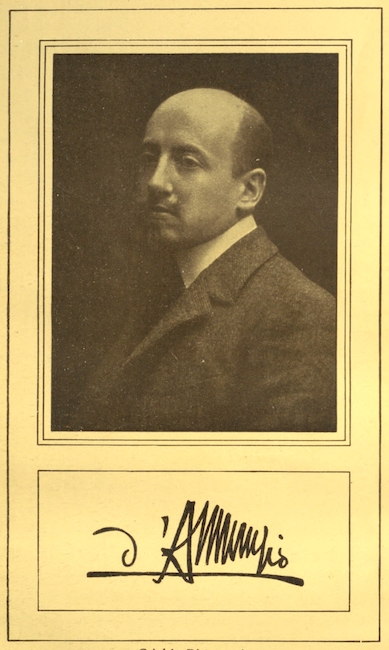
Gabriele D’Annunzio
The people in the shops, seeing her pass by, would murmur something and then break forth into a significantly sneering laugh. Filippo La Selvi, who sat drinking a glass of liqueur brandy in the Café d’Ange, called Candia in.
“Another glass for Candia, the same as mine!”
The woman, who was fond of strong spirits, pursed up her lips covetously.
“You certainly deserve it, there’s no denying that!” added Filippo La Selvi.
An idle crowd had gathered in front of the café. They all had the spirit of mischief in their faces. While the woman drank, Filippo La Selvi turned and addressed his audience:
“Say, she knew how to work it, didn’t she? Isn’t she the foxy one?” and he slapped the laundress familiarly upon her bony shoulder.
The crowd laughed. A little dwarf, called Magnafave, or “Big Beans,” weak-minded and stuttering, joined the forefinger of his right hand to that of his left, and striking a grotesque attitude and dwelling upon each syllable, said:
“Ca—ca—ca—Candia—Ci—ci—Cinigia!” and he continued to make gestures, and to stammer forth vulgar witticisms, all implying that Candia and Cinigia were in league together. His spectators indulged in contortions of merriment.
For a moment Candia sat there bewildered, with the glass still in her hand. Then in a flash she understood—they did not believe in her innocence. They accused her of having brought back the silver spoon secretly, by agreement with the sorceress, to save herself further trouble.
An access of blind anger came upon her. Speechless with passion, she flung herself upon the weakest of them, upon the little hunchback, in a hurricane of blows and scratches. And the crowd, at the sight of this struggle, formed a circle and jeered at them in cruel glee, as at a fight between two animals, and egged on the two combatants with voice and gesture.
Big Beans, badly scared by her unexpected violence, tried to escape, hopping about like a little ape; and held fast by the laundress’s terrible arms, whirled round and round with increasing velocity, like a stone in a sling, until at last he fell violently upon his face.
Some of the men hastened to pick him up. Candia withdrew in the midst of hisses, shut herself within her house, and flung herself across her bed, sobbing and gnawing her fingers, in the keenness of her suffering. The new accusation cut her deeper than the first, and all the more that she knew herself capable of such a subterfuge. How was she to clear herself now? How was she to establish the truth? She grew hopeless as she realized that she could not allege in defense any material difficulties that might have interfered with carrying out the deception. Access to the courtyard was perfectly simple; a door, that was never fastened, opened from the ground floor of the main stairway; people came and went freely through that door, to remove the garbage, or for other causes. So it was impossible for her to close the lips of her accusers by saying, “How could I have got in?” The means of successfully carrying out such a plan were many and easy.
Candia proceeded to conjure up new arguments to convince them; she sharpened up her wits; she invented three, four, five different cases to prove that the spoon never could have been found in that hole in the courtyard; she spilt hairs with marvelous ingenuity. Next she took to making the rounds of the shops and the houses, seeking in every possible way to overcome the people’s incredulity. They listened to her, greatly entertained by her captious reasoning; and they would end by saying, “Oh, it’s all right!”
But there was a certain tone in their voice that left Candia annihilated. So, then, all her trouble was for nothing! No one would believe her! Yet with marvelous persistence she would return to the attack, spending whole nights in thinking out new arguments. And little by little, under this continued strain, her mind gave way; she could no longer follow any sustained thought but that of the silver spoon.
Neglecting her work, she had sunk to a state of actual want. When she went down to the river bank, under the iron bridge, where the other wash-women congregated, she would sometimes let slip from between her fingers the garments that the current swept away forever. And she would talk continually, unweariedly, of the one single subject. In order not to hear her, the young laundresses would begin to sing, and would mock her with the improvised rimes of their songs. And she meanwhile would shout and gesticulate like a crazy woman.
No one could give her work any longer. Out of pity, some of her former employers would send her food. Little by little she fell into the habit of begging, and wandered through the streets, bowed over, unkempt, and all in rags. The street urchins would tag behind her, shouting: “Tell us the story of the spoon, 'cause we never heard it, Auntie Candia!”
She would stop strangers sometimes as they passed by, to tell them the story and to argue out her defense. Young fellows would sometimes send for her, and pay her a copper to tell it all over, two, three, or four times; they would raise up difficulties against her arguments; they would hear her all the way through, and then at last stab her with a final word. She would shake her head, and go on her way; she found companionship among other beggars and would reason with them endlessly, indefatigably, invincibly. Her chosen friend was a deaf woman, whose skin was a mass of angry blotches, and who limped on one leg.
In the winter of 1874 she was at last stricken with serious illness. The woman with the blotches cared for her. Donna Cristina Lamonica sent her a cordial and a scuttle of coals.
The sick woman, lying on her pallet, still raved of the silver spoon. She would raise herself on her elbow and struggle to wave her arm, to give emphasis to her fevered arguments.
And at the last, when her staring eyes already seemed overspread with a veil of troubled waters that rose from within, Candia gasped forth:
“It wasn’t I, madam—because you see—the spoon—”
SIGNORA SPERANZA
BY LUIGI PIRANDELLO

Luigi Pirandello, master of style, the humorist of a group of young Italian writers who are said to be inaugurating a renaissance in Italian literature, was born at Girgenti, Sicily, in 1867. He appeared first as a poet, pure in style, severe in inspiration, but later “found himself” in the writing of humorous tales. His humor, though at bottom sad and almost pessimistic, is not of the quiet sort. To him man appears as a creature more miserable than grotesque, eternally made sport of by the irony of fate. Such is the philosophy in his lugubriously fanciful “Mathias Pascal,” skeptical in spirit, in “Il Turno,” with its cruel pictures of Sicilian peasant life, and in “Signora Speranza,” one of the latest and most characteristic of his novelettes. For the purpose of this work the discursive passages have been here and there condensed and made more direct.