ZOZO.
Reading edition
Through a thickly falling snow, on the outskirts of one of New York’s suburban towns, (a hamlet of some two hundred thousand population,) walked a man who had but one desire in the world ungratified. His name was Richard Brant, and he was a large, deep-chested, handsome man—a man’s man; hardly a woman’s man at all: and yet the sort of man that is likely to make a pretty serious matter of it if he loves a woman, or if a woman loves him.
Mr. Richard Brant came from the West, the Western-born child of Eastern-born parents. He made his fortune before he was thirty-five, and for five years he had been trying to find out what he wanted to do with that fortune. He was a man of few tastes, of no vices, and of a straight-forward, go-ahead spirit that set him apart from the people who make affectation the spice of life. He wanted only one thing in the world, and that one thing money would not buy for him. So he was often puzzled as to how he might best spend his money; and he often spent it foolishly. As he walked through the suburban streets of the suburban city, this sharp Winter’s night, he was reflecting on the folly of spending money on a fur coat. He was wearing the coat—a magnificent affair of bearskin and sable.
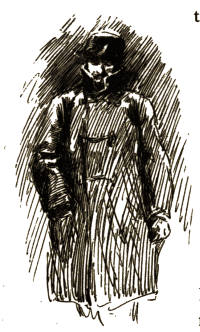
“South of Canada,” he said to himself, “this sort of thing is vulgar and unnecessary. I don’t need it, any more than a cow needs a side-pocket. It’s too beastly hot for comfort at this moment. I’d carry it over my arm, only that I should feel how absurdly heavy it really is.”
Then he looked ahead through the thick snow, and, although he was a man of strong nerves, he started and stepped back like a woman who sees a cow.
“Great Cæsar’s Ghost!” said he.
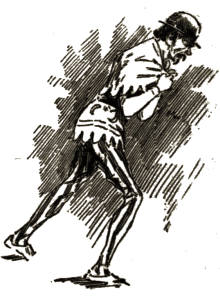
He was justified in calling thus upon the most respectable spook of antiquity. The sight he saw was strange enough in itself: seen in the squalid, commonplace sub-suburban street, it was bewildering. There, ahead of him, walked Mephistopheles—Mephistopheles dressed in a red flannel suit, trimmed with yellow, all peaks and points; and on the head of Mephistopheles was an old, much worn, brown Derby hat.
Brant caught Mephisto by the shoulder and turned him around. He was a slight, undersized man of fifty, whose moustache and goatee, dyed an impossible black, served only to accentuate the meagre commonness of his small features.
“Who are you?” demanded Brant.
“Sh-h-h!” said the shivering figure, “lemme go! I’m Zozo!”
Brant stared at him in amazement. What was it? A walking advertisement—for an automatic toy or a new tooth-powder?
“It’s all right,” said the slim man, his teeth chattering, “lemme get along. I’m most freezing. I’m Zozo—the astrologer. Why—don’t you know?—on Rapelyea Street?”
Brant dimly remembered that there was a Rapelyea Street, through which he sometimes passed on his way to the railroad station, and he had some faint memory of a gaudily painted shanty decked out with the signs of the zodiac in gilt papier maché.
“My orfice got a-fire this evening,” explained Zozo, “from the bakery next door. And I had to light out over the back fence. Them people in that neighborhood is kinder superstitious. They ain’t no idea of astrology. They don’t know it’s a Science. They think it’s some kind of magic. And if they’s to see me drove out by a common, ordinary fire, they’d think I was no sort of an astrologer. So I lit out quiet.”
His teeth chattered so that he made ten syllables out of “quiet.”
“They don’t understand the Science of it,” he continued, “and the fire got at my street clo’es before I knew it, and so I had to light out mighty quick. Now, jes’ lemme get home, will you? This here flannel ain’t no fur coat.”
Brant’s coat came off his shoulders in an instant.
“Put this on,” he said. “Confound you!—” as the man resisted,—“put it on!”
The astrologer slipped into the coat with a gasp of relief.
“Cracky!” he cried, “but I was freezin’!”
“Do you live far from here?” Brant inquired.
“Just a bit up the road. I’m ’most home, now,” replied Zozo, still chattering as to his teeth.
As they walked along the half-built street, Zozo told his tale. He had been in the astrology business for thirty years, and it had barely yielded him a living. Yet he had been able, by rigorous economy, to save up enough money to build himself a house—“elegant house, sir,” he said; “‘tain’t what you may call large; but it’s an elegant house. I got the design out of a book that cost a dollar, sir, a dollar. There ain’t no use in trying to do things cheap when you’re going to build a house.”
But his joy in his house was counterbalanced by his grief for the loss of his “orfice.” He had taken the ground-rent of the city lot, and had erected the “orfice” at his own cost. Three hundred and twenty-seven dollars he had spent on that modest structure. No, he had not insured it. And now the bakery had caught fire, and his “orfice” was burned to the ground, and his best suit of street-clothes with it—his only suit, as he owned after a second’s hesitation.
In ten minutes’ walk they arrived at Zozo’s house. It was quite the sort of house that might have come out of a dollar book, with a great deal of scroll-work about it, and with a tiny tower, adorned with fantastically carved shingles. As they stood on the porch—nothing would content Zozo but that his new friend should come in and warm himself—Mr. Brant looked at the name on the door-plate.
“Zozo’s only my name in the Science,” the astrologer explained. “My real name—my born name—is Simmons. But I took Zozo for my business name. ‘Zs’ seem to kinder go with the astrology business, somehow—I don’t know why. There’s Zadkiel, and Zoroaster, and—oh, I don’t know—they’re ‘Zs’ or ‘Xs’, most of ’em; and it goes with the populace. I don’t no more like humoring their superstition than you would; but a man’s got to live; and the world ain’t up to the Science yet. Oh, that’s you, Mommer, is it?” he concluded, as the door was opened by a bright, buxom, rather pretty woman. “Mother ain’t to bed yet, is she? Say, Mommer, the orfice is burnt down!”
“Oh, Popper!” cried the poor woman; “you don’t reelly say!”
“True’s I live,” said the astrologer, “and my street-clo’es, too.”
“Oh, Popper!” his wife cried, “what’ll we do?”
“I don’t know, Mommer, I don’t know. We’ll have to think. Jes’ let this here gentleman in, though. I’d most ’a’ froze if he hadn’t lent me the loan of his overcoat. My sakes!” he broke out, as he looked at the garment in the light of the hall-lamp, “but that cost money. Mommer, this here’s Mr.—— I ain’t caught your name, sir.”
“Brant,” said the owner of the name.
“Band. And a reel elegant gentleman he is, Mommer. I’d ‘a’ froze stiff in my science clo’es if’t hadn’t been for this coat. My sakes!” he exclaimed, reverently, “never see the like! That’d keep a corpse warm. Shut the door, Mommer, an’ take the gentleman into the dining-room. He must be right cold himself. Is Mother there?”
“Yes,” said Zozo’s wife, “and so’s Mamie. You was so late we all got a kinder worried, and Mamie come right down in her nighty, just before you come in. ‘Where’s Popper?’ sez she; ‘ain’t he came in yet to kiss me good night? ’Tain’t mornin’, is it?’ sez she. And the orfice burned down! Oh, my, Popper! I thought our troubles was at an end. Come right in, Mr.—Mr.—I ain’t rightly got your name; but thank you kindly for looking after Popper, and if you had an idee how easy he takes cold on his chist, you’d know how thankful I am. Come right into the dinin’-room. Mother, this is Mr. Band, and he lent Simmons the loan of his coat to come home with. Wa’n’t it awful?”
“What’s that?” croaked a very old woman in the corner of the dining-room. It was a small dining-room, with a small extension-table covered with a cheap red damask cloth.
“Simmons’s orfice is burned up, and his best suit with it,” explained Mrs. Simmons. “Ain’t it awful!”
“It’s a jedgement,” said the old lady, solemnly. She was a depressing old lady. And yet she evidently was much revered in the family. A four-year-old child hung back in a corner, regarding her grandmother with awe. But when her father entered, she slipped up to his knee, and took his kisses silently, but with sparkling eyes.
“Only one we’ve got,” said Zozo, as he sat down and took her on his knee. “Born under Mercury and Jupiter—if that don’t mean that she’ll be on top of the real-estate boom in this neighborhood, I ain’t no astrologer. Yes, Ma,” he went on, addressing the old woman, who gave no slightest sign of interest, “the orfice burned down, and I had to get home quick. Wouldn’t ’a’ done for them Rapelyea Street folks to see me, scuttin’ off in my orfice clo’es.”
He had shed Brant’s huge overcoat, and his wife was passing her hand over his thin flannel suit.
“Law, Simmons!” she said, “you’re all wet!”
“I’ll dry all right in these flannels,” said Zozo. “Don’t you bother to get no other clo’es.”
He had forgotten that he had told Brant that the suit in his office was his only suit. Or perhaps he wished to spare his wife the humiliation of such an admission.
“I’m dryin’ off first-rate,” he said, cheerfully; “Mamie, Popper ain’t wet where you’re settin’, is he? No. Well, now, Mommer, you get out the whiskey and give Mr.—Mr. Band—a glass, with some hot water, and then he won’t get no chill. We’re all pro’bitionists here,” he said, addressing Brant, “but we b’lieve in spirits for medicinal use. Yes, Mother, you’d oughter’ve seen that place burn. Why, the flames was on me before I know’d where I was, and I jist thought to myself, thinks I, if these here people see me a-runnin’ away from a fire, I won’t cast no horoscope in Rapelyea Street after this; and I tell you, the way I got outer the back window and over the back fence was a caution! There’s your whiskey, sir: you’ll excuse me if I don’t take none myself. We ain’t in the habit here.”
Brant did not greatly wonder at their not being in the habit when he tasted the whiskey. It was bad enough to wean a toper on. But he sipped it, and made overtures to the baby. And after a while she showed an inclination to come and look at his wonderful watch, that struck the hour when you told it to. Before long she was sitting on his knee. Her father was telling the female members of the family about the fire, and she felt both sleepy and shut out. She played with Brant’s watch for a while, and then fell asleep on his breast. He held her tenderly, and listened to the astrologer as he told his pitiful tale over and over again, trying to fix the first second when he had smelled smoke.
He was full of the excitement of the affair: too full of the consciousness of his own achievement to realize the extent of the disaster. But his wife suddenly broke down, crying out:
“Oh, Simmons! where’ll you get three hundred dollars to build a new orfice?”
Brant spoke up, but very softly, lest he might wake the baby, who was sleeping with her head on his shoulder.
“I’ll be happy to—to advance the money,” he said.
Zozo looked at him almost sourly.
“I ain’t got no security to give you. This is a Building Society house, and there’s all the mortgage on it that it’s worth. I couldn’t do no better,” he concluded, sullenly.
Brant had been poor enough himself to understand the quick suspicion of the poor. “Your note will do, Mr. Simmons,” he said; “I think you will pay me back. I sha’n’t worry about it.”
But it was some time before the Simmons family could understand that a loan of the magnitude of three hundred dollars could be made so easily. When the glorious possibility did dawn upon them, nothing would do but that Mr. Brant should take another drink of whiskey. It was not for medicinal purposes this time; it was for pure conviviality; and Brant was expected, not being a prohibitionist, to revel vicariously for the whole family. He drank, wondering what he had at home to take the taste out of his mouth.
Then he handed the baby to her mother, and started to go. But Simmons suddenly and unexpectedly turned into Zozo, and insisted on casting his benefactor’s horoscope. His benefactor told him the day of his birth, and guessed at the hour. Zozo figured on a slate, drawing astronomical characters very neatly indeed, and at last began to read off the meaning of his stellar stenography, in a hushed, important voice.
He told Brant everything that had happened to him, (only none of it had happened; but Brant did not say him nay.) Then he told him various things that were to happen to him; and Zozo cheered up greatly when his impassive and sleepy guest sighed as he spoke of a blonde woman who was troubling his heart, and who would be his, some day. There was a blonde woman troubling Brant’s heart; but there was small probability of her being his some day or any day. And then Zozo went on to talk about a dark woman who would disturb the course of true love; but only temporarily and as a side issue, so to speak.
“She ain’t serious,” he said. “She may make a muss; but she ain’t reel serious.”
“Good night!” said Brant.
“You don’t b’lieve in the Science,” said Zozo, in a voice of genuine regret. “But you jist see if it don’t come true. Good night. Look out you don’t trip over the scraper.”
✳ ✳ ✳ ✳ ✳
The blonde woman in Mr. Brant’s case was Madame la Comtesse de Renette. No, she was not a French woman: she was a loyal American. She was the daughter of an American millionaire; she had lived for many years in France, and her parents had married her, at the age of eighteen, to a title. The title was owned by a disagreeable and highly immoral old spendthrift, who had led her a wretched life for two weary years, and then had had the unusual courtesy and consideration to die. Then she took what he had left of her millions, went home to the town of her birth, bought a fine estate on its outskirts, and settled down to enjoy a life wherein she could awake each morning to feel that the days would never more bring her suffering and humiliation.
Then Mr. Richard Brant disturbed her peace of mind by falling in love with her, and what was worse, asking her to marry him. That, she said, she could not do. He was her best, her dearest friend: she admired and esteemed him more than any man in the world. If she ever could marry a man, she would marry him. But she never, never could. He must not ask her.
Of course, he did ask her. And he asked her more than once. And there matters stood, and there they seemed likely to stay.
But Richard Brant was a man who, when he wanted a thing, wanted it with his whole heart and his whole soul, and to the exclusion of every other idea from his mind. After eighteen months of waiting, he began to find the situation intolerable. He had no heart in his business—which, for the matter of that, took care of itself—and he found it, as he said to himself, “a chore to exist.” And what with dwelling on the unattainable, and what with calling on the unattainable once or twice every week, he found that he was getting into a morbid state of mind that was the next thing to a mild mania.
“This has got to stop,” said Richard Brant. “I will put an end to it. I will wait till an even two years is up, and then I will go away somewhere where I can’t get back until—until I’ve got over it.”
Opportunity is never lacking to a man in this mood. Some scientific idiot was getting up an Antarctic expedition, to start in the coming June. Brant applied for a berth.
“That settles it,” he said.
Of course, it didn’t settle it. He moped as much as ever and found it just as hard as ever to occupy his mind. If it had not been for the astrologer, he would hardly have known what to do.
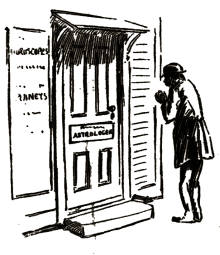
It amused him to interest himself in Zozo and his affairs. He watched the building of the new “orfice”, and discussed with Zozo the color of the paint and the style of the signs. Zozo tried to convert him to astrology, and that amused him. The little man’s earnest faith in this “science” was an edifying study.
Then, when the “orfice” was completed, and Zozo began business again, he took great pleasure in sitting hid in Zozo’s back room, listening to Zozo’s clients, who were often as odd as Zozo himself. He had many clients now. Had he not miraculously evanished from a burning building, and come back unscathed?
✳ ✳ ✳ ✳ ✳
But there are two sides to every friendship. Brant took an amused interest in Zozo. Zozo worshiped Brant as his preserver and benefactor. Zozo’s affairs entertained Brant. Brant’s affairs were a matter of absorbing concern to Zozo. Zozo would have died for Brant.
So it came about that Zozo found out all about the blonde lady in Brant’s case. How? Well, one is not an astrologer for nothing. Brant’s coachman and Mme. de Renette’s maid were among Zozo’s clients. No society gossip knew so much about the Brant-Renette affair as Zozo knew, inside of two months.
✳ ✳ ✳ ✳ ✳
“It’s perfectly ridiculous, Annette! I can’t see the man!”
“Madame knows best,” said Annette, wiping away a ready tear. “It is only that I love Madame. And it is not well to anger those who have the power of magic. If they can bring good luck, they can bring bad. And he is certainly a great magician. Fire can not burn him.”
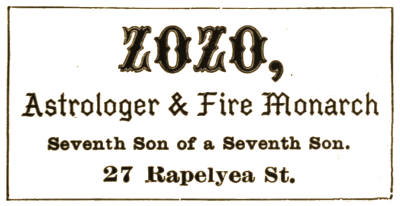
Mme. de Renette toyed with a gorgeously-printed card that read:
“Well,” she said at last, “show him in, Annette. But it’s perfectly absurd!”
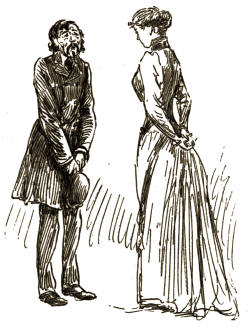
Zozo, in a very ready-made suit, with no earthly idea what to do with his hat, profuse of bows and painfully flustered, did not inspire awe.
“You wish to see me?” inquired Mme. de Renette, somewhat sternly.
“Madam,” began her visitor, in a tremulous voice, “I come with a message from the stars.”
“Very well,” said Mme. de Renette, “will you kindly deliver your message? I do not wish to detain you—from your stars.”
✳ ✳ ✳ ✳ ✳
It was a flushed, but a self-complacent, beaming, happy Zozo who stopped Richard Brant on the street an hour later.
“If you please, Mr. Brant, sir,” he said; “I’d like a few minutes of your time.”
“Certainly,” said Mr. Brant, wondering if Zozo wanted to borrow any more money.
“You’ve been a great good friend to me, Mr. Brant,” Zozo began, “and I hope you b’lieve, sir, that me and Mommer and Ma Simmons and Mamie are jist as grateful as—well, as anything.”
“Oh, that’s all right, Simmons—“
“Yes, sir. Well, now you’ll pardon me for seeming to interfere, like, in your business. But knowin’ as I done how your affairs with the blonde lady was hangin’ fire, so to speak—“
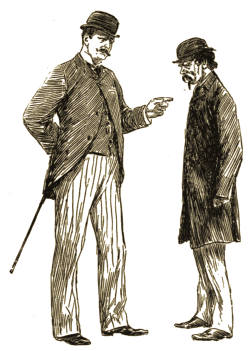
“‘The blonde lady!’” broke in Brant.
“Madam dee Rennet,” explained Zozo.
“The devil!” said Brant.
“Well, sir, knowin’ that, as I done, and knowin’ that there couldn’t be nothin’ to it—no lady would chuck you over her shoulder, Mr. Brant, sir—but only jist that her mind wasn’t at ease with regard to the dark lady—whereas the stars show clear as ever they showed any thin’ that the dark lady was only temporary and threatened, and nothin’ reel serious—why, I made so free as jist to go right straight to Madam dee Rennet and ease her mind on that point—and I did.”
“Great heavens!” Brant yelled. “You infernal meddler! what have you done? I don’t know a dark woman in the world! What have you said?—oh, curse it!” he cried, as he realized, from the pain of its extinction, that hope had been alive in his heart, “what have you done?—you devil!”
He turned on his heel and rushed off toward Madame de Renette’s house.
“This does settle it,” he thought. “There’s no getting an idea like that out of a woman’s head.”
✳ ✳ ✳ ✳ ✳
“I understand,” he said, as he hurriedly presented himself to the lady of his love, “that a madman has been here—“
“Yes,” said Mme. de Renette, severely.
“You didn’t pay any attention to his nonsense?”
“About the dark woman?” inquired Mme. de Renette.
“Why, there’s no other woman dark or light—“
“I don’t know whether there is or not, Richard,” said Mme. de Renette, with icy distinctness; “but I know that there won’t be, after—well, sir, could you break your June engagement for—me?”
And Zozo was justified.
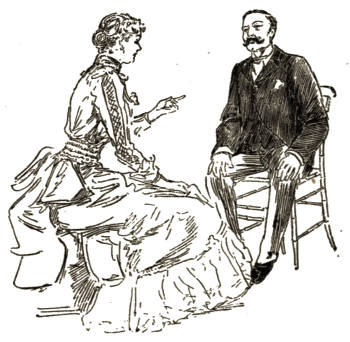
AN OLD, OLD STORY.
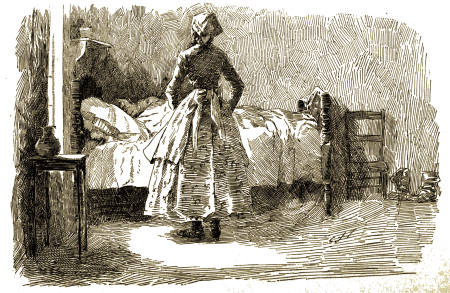
“‘Sophronia—’tain’t you!’”