PART I WORKS BY SHERWOOD ANDERSON
Reading edition
Individual Works
WINDY McPHERSON’S SON. 1916
1. WINDY | McPHERSON’S | SON | [panel line] | BY | SHERWOOD ANDERSON | [double panel line] | NEW YORK: JOHN LANE COMPANY | LONDON: JOHN LANE, THE BODLEY HEAD | MCMXVI [title surrounded by a triple line border]
[1]-347p. 20½ × 13½ cm. Orange cloth stamped in gold on spine and gold and green on cover. One page of advertisements appears on the verso of p.347.
On verso of title-page (p.[4]): Press of J. J. Little & Ives Company, New York.
Dedication (p.[5]): To the living men and women of my own Middle Western home town this book is dedicated.
2. First English edition:
London, John Lane, 1916. 347p.
3. Reprints:
New York, B. W. Huebsch, 1922. 349p. Revised edition with a new concluding chapter.
London, Jonathan Cape, 1923. 349p.
MARCHING MEN. 1917
4. MARCHING | MEN | [panel line] | BY | SHERWOOD ANDERSON | AUTHOR OF “WINDY McPHERSON’S SON” | [double panel line] | NEW YORK: JOHN LANE COMPANY | LONDON: JOHN LANE, THE BODLEY HEAD | TORONTO: S. B. Gundy ⁂ ⁂ MCMXVII [title surrounded by a triple line border]
314p. 19½ × 13 cm. Red cloth stamped in gold on cover and spine.
On verso of title-page (p[4]): Press of J. J. Little & Ives Company, New York.
Dedication (p.[5]): To American workingmen.
5. Reprint:
New York, B. W. Huebsch, 1921. 264p.
6. Translation:
V nogu! Leningrad, Mysl, 1927. 232p. Tr., Mark Volosov. Foreword, V. Lavretski.
MID-AMERICAN CHANTS. 1918
7. MID-AMERICAN | CHANTS | BY SHERWOOD ANDERSON | AUTHOR OF “MARCHING MEN,” “WINDY McPHERSON’S SON,” ETC. | NEW YORK: JOHN LANE COMPANY | LONDON: JOHN LANE, THE BODLEY HEAD | MCMXVIII
82p. 21½ × 14 cm. Yellow cloth stamped in gold on cover and spine; green panel on cover.
On verso of title-page (p.[4]): Press of J. J. Little & Ives Company, New York.
Dedication (p.[5]): To Marion Margaret Anderson.
A Foreword by Anderson, dated February 1918, appears on p.7-8.
Contents: The cornfields; Chicago; Song of industrial America; Song of Cedric the Silent; Song of the break of day; Song of the beginning of courage; Revolt; A lullaby; Song of Theodore; Manhattan; Spring song; Industrialism; Salvo; The planting; Song of the middle world; The stranger; Song of the love of women; Song of Stephen the Westerner; Song to the lost ones; Forgotten song; American spring song; The beam; Song to new song; Song for dark nights; The lover; Night whispers; Song to the sap; Rhythms; Unborn; Night; A visit; Chant to dawn in a factory town; Song of the mating time; Song for lonely roads; Song long after; Song of the soul of Chicago; Song of the drunken business man; Song to the laugh; Hosanna; War; Mid-American prayer; We enter in; Dirge of war; Little song to a Western statesman; Song of the bug; Assurance; Reminiscent song; Evening song; Song of the singer.
8. Reprint:
New York, B. W. Huebsch, 1921. 82p.
WINESBURG, OHIO. 1919
9. WINESBURG, OHIO | A GROUP OF TALES OF | OHIO SMALL TOWN LIFE | [panel line] | BY | SHERWOOD ANDERSON | [publishers’ device with panel line above and below] | NEW YORK | B. W. Huebsch | MCMXIX [title surrounded by single line border]
[x] 303p. 19 × 13 cm. Orange cloth with white paper label on spine and publishers’ device blind-stamped on cover. Top edge stained orange yellow. Map of Winesburg, Ohio, by Harald Toksvig appears on paste-down endpaper. In the first printing, p.86, line 5, reads: “an intense silence seemed to lay over everything.” Later printings changed “lay” to “lie.” On p.251, line 3, the type in the word “the” is broken. For further identification of the first and later printings, see item 713.
Dedication (p.[v]): To the memory of my mother Emma Smith Anderson.
Contents: The book of the grotesque; Hands; Paper pills; Mother; The philosopher; Nobody knows; Godliness (Parts I and II); Surrender (Part III); Terror (Part IV); A man of ideas; Adventure; Respectability; The thinker; Tandy; The strength of God; The teacher; Loneliness; An awakening; “Queer”; The untold lie; Drink; Death; Sophistication; Departure.
10. First English edition:
London, Jonathan Cape, 1922. 303p.
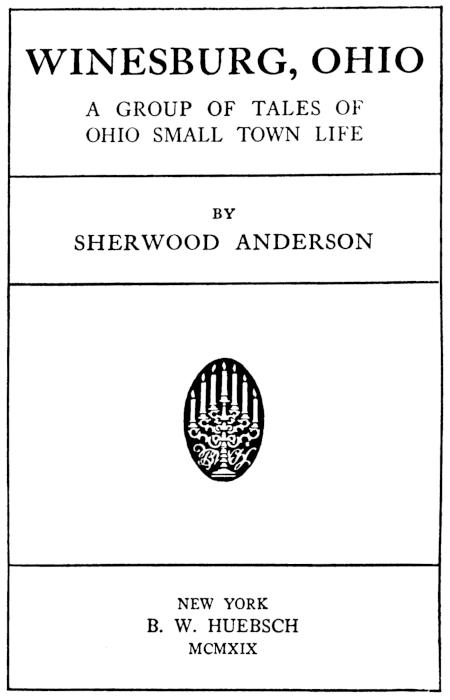
Title page from the first issue of Winesburg, Ohio.
Item 9
11. Reprints:
New York, Modern Library [1919] xv, 303p. Introduction, Ernest Boyd.
Girard, Kansas, Haldeman-Julius company [1925] 63p. (Little Blue Book, no. 865) A selection entitled Hands, and other stories. Contents: Hands; Paper pills; Mother; The philosopher; Nobody knows; A man of ideas; Adventure.
Harmondsworth, England, Penguin Books, 1948. 224p.
New York, New American Library [1956] 159p. (Signet Books 1304)
New York, Viking Press [1958] 303p. (Compass Books Edition. C39)
12. Translations:
An Tê Shên Hsüan Chi. Taepei, Hsinlu Book Company, 1958. 147p.
Mestečko v Ohiu. Prague, SNKLHU, 1958. 212p. Tr. Eva Kondrysová.
Winesburg, Ohio. En amerikansk Provinsbys Menneskeskaebner. Copenhagen, Funkis Förlag, 1934. 264p. Tr., Elias Bredsdorff.
En by i Ohio. Copenhagen. Reitzel, 1959. 144p. Tr., Henrik Larsen.
Pikkukaupunki. Helsinki, Werner Söderström, 1955. 204p. Tr., Leena-Maija Reunanen.
Winesburg-en-Ohio. Paris, Gallimard, 1927. 253p. Tr., Marguerite Gay.
Winesburg, Ohio. Berlin and Frankfurt, Suhrkamp, 1958. 193p. Tr., Hans Erich Nossack.
Solitudine: Winesburg, Ohio. Turin, Slavia, 1931. 304p. Tr., Ada Prospero.
Piccola città nell’ Ohio. Rome, Polin [194-] 221p. Tr., Orsola Nemi.
Racconti dell’ Ohio. Turin, Einaudi, 1950. 263p. Tr., Giuseppe Trevisani.
Miasteczko Winesburg. Obrazki z zycia w stanie Ohio. Warsaw, Czytelnik, 1958. 280p. Tr., Jerzy Krzyszton.
A secreta mentira. Pôrto Alegre, Globo, 1950. xvi, 258p. Tr., James Amado and Moacir Werneck de Castro.
A cidade dos estranhos. Lisbon, Livros do Brasil, 1951. 232p. Tr., James Amado and Moacir Werneck de Castro.
O livro dos grotescos. Rio de Janeiro, Revista Branca, 1952. 248p. Tr., Constantino Paleólogo.
Uinsberg Okhaio. Moscow, Gosudarstvennoye Izdatelstvo, 1924. 224p. Tr., S. D. Matveyev.
Uainsburg, Ogaio. Moscow and Leningrad, L. D. Frenkel, 1924. 248p. Tr., P. Okhrimenko. Foreword, M. Levidov.
Uainsburg, Ogaio. Moscow and Leningrad, Zemlya i Fabrika, 1925. 360p. Tr., P. Okhrimenko.
Winesburgo, Ohio. Madrid, Zeus, 1932. 263p. Tr., Armando Ros. Preface, Ernest Boyd.
Las novelas de lo grotesco. Buenos Aires, S. Rueda [1942] iv, 303p. Tr., Armando Ros. Preface, Max Dickman.
Winesburgo, Ohio. La novela de lo grotesco. Madrid, Aguilar, 1949. Tr., Armando Ros. Preface Germán Gómez de la Mata.
Den lilla staden. Stockholm, C. E. Fritze, 1951. 297p. Tr., Olov Jonason.
Varošica Vajnsberg u državi Ohajo, Belgrade Novo Pokolenje, 1954. 307p. Tr., Slobodan A. Jovanović.
POOR WHITE. 1920
13. POOR WHITE | A NOVEL BY | SHERWOOD | ANDERSON | AUTHOR OF | WINESBURG, OHIO | [publishers’ device] | NEW YORK B. W. HUEBSCH, Inc. MCMXX [title surrounded by a single line border]
[vi] 371p. 19½ × 13 cm. Blue cloth stamped in yellow on spine and publishers’ device blind-stamped on cover. Some copies top edge stained blue.
Dedication (p.[v]): To Tennessee Mitchell Anderson.
14. First English edition:
London, Jonathan Cape, 1921. 315p.
15. Reprint:
New York, Modern Library [1926] viii, 371p. With an introduction by Anderson.
16. Translations:
Arme blanke. The Hague, H. P. Leopold, 1928. 284p. Tr., H. J. Smeding.
Der arme Weise. Leipzig, Insel-Verlag, 1925. 299p. Tr., Karl Lerbs.
I istoria tou Hugh MacVay. Athens, Atlantis, 1958. 240p. Tr., B. Kalantzi.
A nagy ember. Budapest, Révai, 1934. 279p. Tr., Lili Doberhoff.
Un povero bianco. Verona, Mondadori, 1959. 305p. Tr., Luisella Quilico.
Pobre blanco. Barcelona, Gráfica Moderna, 1929. 258p. Tr., Julio Calvo Alfaro. Preface, Angel Flores.
Mannen från västern. Stockholm, Tiden, 1928. 340p. Tr., Stina Dahlberg.
THE TRIUMPH OF THE EGG. 1921
17. THE TRIUMPH OF THE EGG | A BOOK OF IMPRESSIONS | FROM AMERICAN LIFE | IN TALES AND POEMS | BY | SHERWOOD ANDERSON | IN CLAY BY | TENNESSEE MITCHELL | [publishers’ device] | (quotation, six lines, from “Mid-American Chants”) | PHOTOGRAPHS BY EUGENE HUTCHINSON | NEW YORK B. W. HUEBSCH, INC. MCMXXI
[xii] 269p. 20½ × 14 cm. Dark green cloth lettered in yellow on spine and cover; design blind-stamped on cover. First issue has top edge stained yellow.
“Impressions in clay by Tennessee Mitchell” appears on eight unnumbered leaves following p.[viii]
A poem, beginning “Tales are people who sit on the doorstep,” appears on p.[i], the page preceding the half-title.
Dedication (p.[vii]): To Robert and John Anderson.
Contents: The dumb man; I want to know why; Seeds; The other woman; The egg; Unlighted lamps; Senility; The man in the brown coat; Brothers; The door of the trap; The New Englander; War; Motherhood; Out of nowhere into nothing; The man with the trumpet.
18. First English edition:
London, Jonathan Cape, 1922. xi, 269p.
19. Reprint:
Tokyo, Kairyudo [1958?] 2 volumes: 147, 167p. Edited and annotated by Kichinosuke Ohashi. (Kairyudo’s Mentor Library, no. 10)
20. Translations:
Un païen de l’Ohio. Nouvelles tirées de The triumph of the egg et de Horses and men. Paris, Rieder, 1927. 218p. Tr., Marguerite Gay. Preface, Eugène Jolas.
Das Ei triumphiert; Novellen. Leipzig, Insel-Verlag, 1926. 263p. Tr., Karl Lerbs.
Aus dem Nirgends ins Nichts. Leipzig, Insel-Verlag [1927] 77p. Tr., Karl Lerbs. A translation of the story “Out of nowhere into nothing.”
I racconti son uomini. Rome, Editrice Cultura Moderna [1945] 160p. Tr., Guglielmo Santangelo. A selected edition of five stories.
Onna ni natta otoka; Tamago. Tokyo, Eihô-sha, 1956. 194p. Tr., Rikuo Taniguchi and Yoshizô Miyazaki. A translation of the story “The egg.”
Torzhestvo yaitsa. Moscow, Sovremennyie Problemy, 1925. 257p. Tr., P. Okhrimenko.
Yaitso. Moscow, Biblioteka Zhurnala “Ogonyok”, 1926. 63p. Tr., P. Okhrimenko. A translation of the story “The egg.”
HORSES AND MEN. 1923
21. HORSES AND MEN | Tales, long and short, from | our American life | BY | SHERWOOD ANDERSON | [publishers’ device] | NEW YORK | B. W. HUEBSCH, INC. | MCMXXIII
[xiv] 347p. 19½ × 13 cm. Orange cloth with white paper label on spine and publishers’ device blind-stamped on cover. Top edge stained orange.
Dedication (p.[v]): To Theodore Dreiser.
Contents: Foreword; Dreiser; I’m a fool; The triumph of a modern; “Unused”; A Chicago Hamlet; The man who became a woman; Milk bottles; The sad horn blowers; The man’s story; An Ohio pagan.
22. First English edition:
London, Jonathan Cape, 1924. xiii, 347p.
23. Reprints:
London, Jonathan Cape, 1927. 221p. (Travellers’ Library)
New York, Peter Smith, 1933. 222p. (Travellers’ Library)
24. Translations:
L’Homme qui devint femme. Trois nouvelles tirées de Horses and men. Paris, Émile-Paul, 1926. 190p. Tr., Bernard Fay and Jean Rivière. Preface, Bernard Fay.
Un païen de l’ Ohio. Nouvelles tirées de The Triumph of the egg et de Horses and men. Paris, Rieder, 1927. 218p. Tr., Marguerite Gay. Preface, Eugène Jolas.
L’Uomo che diventò donna. Milan, Longanesi, 1949. 314p. Tr., G. Baldini.
Onna ni natta otoko; Tamago. Tokyo, Eihô-sha, 1956. 194p. Tr., Rikuo Taniguchi and Yoshizô Miyazaki. A translation of the story “The man who became a woman.”
Koni i lyudi. Leningrad and Moscow, Petrograd, 1926. 249p. Tr., M. Volosov.
Loshadi i lyudi. Moscow and Leningrad, Gosudarstvennoye Izdatelstvo, 1927. 250p. Tr., M. Kovalenskaya.
MANY MARRIAGES. 1923
25. SHERWOOD ANDERSON | [single line] | MANY MARRIAGES | [publishers’ device] | NEW YORK B. W. HUEBSCH, INC. MCMXXIII [title surrounded by a single line border]
[x] 264p. 19½ × 13 cm. Blue cloth stamped in orange on cover and spine. Top edge stained orange.
Dedication (p.[v]): To Paul Rosenfeld.
A Foreword and an Explanation by Anderson appear on p.[vii-viii] and p.[ix], respectively.
26. Reprint:
New York, Grosset & Dunlap, 1929. 264p.
27. Translations:
Mange Aegteskaber. Copenhagen, Gyldendal, 1946. 218p. Tr., Ole Sarvig.
Molti matrimoni; romanzo. Milan, Mondadori, 1945. 267p. Tr., Luigi Giovanola. Reprinted: 1958.
AN EXHIBITION OF PAINTINGS BY ALFRED H. MAURER. 1924
28. AN EXHIBITION OF | PAINTINGS | BY | ALFRED H. MAURER | BEGINNING | JANUARY FIFTEENTH | -1924- | E. WEYHE | 794 LEXINGTON AVENUE | (Bet. 61st and 62nd Sts.) | NEW YORK
Single folded leaf, [4]p. 14 × 9 cm.
Anderson’s essay on Alfred H. Maurer is untitled and appears on p.[2-3]
Copy in the New York Public Library.
A STORY TELLER’S STORY. 1924
29. A Story Teller’s Story | The tale of an American writer’s journey | through his own imaginative world and | through the world of facts, with many of | his experiences and impressions among other | writers—told in many notes—in four books | —and an Epilogue. | Sherwood Anderson | [publishers’ device] | New York B. W. Huebsch, Inc. Mcmxxiv [title surrounded by a double line border]
[vi] 442p. 21 × 14 cm. Brown cloth stamped in yellow on cover and spine.
Dedication (p.[v]): To Alfred Stieglitz.
30. First English edition:
London, Jonathan Cape, 1925. 442p.
31. Reprints:
Garden City, New York, Garden City Publishing Company [1928] 442p.
New York, Grove Press [1958] 442p. (Evergreen Books, E-109)
32. Translations:
Un conteur se raconte. In two volumes: I. Mon père et moi; II. Je suis un homme. Paris, Editions Kra, 1928-1929. 209, 151p. Tr., Victor Llona. (Collection européenne)
Der Erzähler erzählt sein Leben. Leipzig, Insel-Verlag, 1927. 438p. Tr., Karl Lerbs.
Storia di me e dei miei racconti. Turin, Einaudi, 1947. xix, 338p. Tr., Fernanda Pivano.
Istoriya rasskazchika. Moscow, Gos. izd-vo khudozh. lit-ry, 1935. 318p. Tr., E. Romanova. Introduction, S. Dinamov.
Rasskazy. Leningrad, Gos. izd-vo khudozh. lit-ry, 1959. 506p. Tr., D. M. Gorfinkel.
Sherwood Anderson y yo. Buenos Aires, Santiago Rueda, 1943. 385p. Tr., Luis Echávarri.
DARK LAUGHTER. 1925
33. [Type ornament rule] | DARK | LAUGHTER | [single line] | SHERWOOD ANDERSON | [single line and publishers’ device] | NEW YORK MCMXXV | BONI & LIVERIGHT | [type ornament rule] [title printed in black and blue]
319p. 19½ × 13½ cm. Black cloth stamped in yellow on cover and spine. Decorated endpapers. Also 350 numbered and signed copies, and 20 lettered and signed copies.
Dedication (p.[5]): Dedicated to Jane W. Prall.
34. First English edition:
London, Jarrolds, 1926. 288p.
35. Reprints:
Leipzig, Tauchnitz, 1926. 263p. (Collection of British and American Authors, vol. 4756)
New York, Grosset & Dunlap, 1927. 319p.
Cleveland, World Publishing Company, 1942. 319p.
36. Translations:
Mørk latter. Copenhagen, Gyldendal, 1945. 222p. Tr., Per Lange.
Riso nero. Turin, Frassinelli, 1932. vi, 253p. Tr., Cesare Pavese.
Yoru no aibiki. Tokyo, Kadokawa shoten, 1953. 309p. Tr., Yoshihide Iijima.
Mørk latter. Oslo, Jorgensensboktr., 1929. 267p. Tr., Hans Heiberg.
Mørk latter. Oslo, Reistad. 1940. 221p. Tr., Hans Heiberg.
La risa negra. Madrid, Zeus, 1931. 244p. Tr., Augusto Centeno.
La risa negra. Buenos Aires, Futuro, 1944. 244p. Tr., Augusto Centeno.
Mörkt skratt. Stockholm, Bonnier, 1928. 286p. Tr., Elsa af Trolle. Preface, Anders Osterling.
THE MODERN WRITER. 1925
37. THE MODERN | WRITER | BY SHERWOOD ANDERSON | [woodcut in red] | SAN FRANCISCO MCMXXV | THE LANTERN PRESS | GELBER, LILIENTHAL, INC.
[iv] 44p. 21½ × 14 cm. Black paper over boards stamped in gold on cover.
Colophon (p.[45]): One thousand copies of this book have been printed for The Lantern Press, San Francisco, (Gelber, Lilienthal, Inc.) by Edwin & Robert Grabhorn. Nine hundred & fifty copies are on B. R. Book Paper, numbered from 51 to 1000, and fifty on Japan Vellum, numbered from 1 to 50.
SHERWOOD ANDERSON’S NOTEBOOK. 1926
38. Sherwood | Anderson’s | NOTEBOOK | [panel line] | Containing Articles Written During | the Author’s Life as a Story Teller, | and Notes of his Impressions from | Life [vignette] scattered through the Book | [publishers’ device and panel line] | NEW YORK MCMXXVI | BONI & LIVERIGHT [title surrounded by a triple line border of which the outer line is a decorated rule]
230p. 21½ × 14½ cm. Blue decorated paper over boards; purple cloth spine stamped in gold. Also 225 large paper copies numbered and signed.
Dedication (p.[7]): Dedicated to two friends, M. D. F. and Emerson.
Contents: From Chicago; Four American impressions (Gertrude Stein, Paul Rosenfeld, Ring Lardner, Sinclair Lewis); Notes out of a man’s life (Notes 1-5); A note on realism; After seeing George Bellows’ Mr. and Mrs. Wase; I’ll say we’ve done well; A meeting South; Notes out of a man’s life (Notes 6-10); Notes on standardization; Alfred Stieglitz; Notes out of a man’s life (Notes 11-16); When the writer talks; Notes out of a man’s life (Notes 17-22); An apology for crudity; King Coal; Notes out of a man’s life (Notes 23-29).
TAR: A MIDWEST CHILDHOOD. 1926
39. TAR | A | Midwest Childhood | SHERWOOD ANDERSON | [publishers’ device] | NEW YORK | BONI AND LIVERIGHT | 1926 [first three lines enclosed within a blue decorated border; title surrounded by a single line border]
xviii, 346p. 21½ × 14½ cm. Brown cloth stamped in gold and blue on cover and spine. Also 350 large paper copies numbered and signed.
Dedication (p.[v]): To Elizabeth Anderson.
A Foreword by Anderson appears on p.ix-xviii.
40. First English edition:
London, Martin Secker, 1927. xviii, 346p.
41. Reprint:
New York, Boni and Liveright, 1931. xviii, 346p.
42. Translations:
Tar. Paris, Stock, Delamain et Boutelleau, 1931. 231p. Tr., Marguerite Gay and Paul Genty. Preface, René Lalou.
Tar. Budapest, Athenæum, 1934. 275p. Tr., Andor Gál.
Tar. Barcelona, José Janés, 1948. 295p. Tr., Mario G. Alcántara.
A NEW TESTAMENT. 1927
43. A New | Testament | [panel line] | Sherwood Anderson [panel line] | BONI AND LIVERIGHT | New York mcmxxvii [title, printed in black and red, is surrounded by a double line border]
118p. 18 × 11 cm. Blue cloth stamped in gold and red on cover and spine. Also 265 large paper copies numbered and signed.
Dedication (p.[7]): Dedicated to Horace Liveright.
Contents: A young man; One who looked up at the sky; Testament—four songs; The man with the trumpet; Hunger; Death; The healer; Man speaking to a woman; A dreamer; Man walking alone; Testament of an old man; Half gods; Ambition; In a workingman’s rooming house; A man standing by a bridge; The red-throated black; Singing swamp negro; Thoughts of a man passed in a lonely street at night; Cities; A youth speaking slowly; One who sought knowledge; The minister of God; A persistent lover; The visit in the morning—; The dumb man; A poet; A man resting from labor; A stoic lover; A young Jew; The story teller; A thinker; The man in the brown coat; One puzzled concerning himself; The dreamer; A vagrant; Young man in a room; Negro on the docks at Mobile, Ala.; Word factories; Man lying on a couch; The ripper; One who would not grow old; The New Englander; The builder; Young man filled with the feeling of power; A dying poet; Brother; The lame one; Two glad men; Answering voice of a second glad man; Chicago; Challenge of the sea; Poet; At the well; An emotion; Der Tag; Another poet; A man and two women standing by a wall facing the sea.
ALICE AND THE LOST NOVEL. 1929
44. ALICE AND THE LOST NOVEL | by | SHERWOOD ANDERSON | being Number Ten of | The Woburn Books | [publishers’ device] | Published at London in 1929 by | ELKIN MATHEWS & MARROT [title surrounded by a double line border]
[1]-[28]p. 20½ × 15 cm. Light blue paper over boards colored in dark blue on covers. Pages uncut. Signed by the author on p.[2]
Colophon (p.[2]): Five hundred and thirty numbered copies of this story have been set in Monotype Eleven Point Plantin, and printed by Robert MacLehose & Co. Ltd., at the University Press, Glasgow; Nos. 1-500 only are for sale and Nos. 501-530 for presentation.
HELLO TOWNS! 1929
45. HELLO TOWNS! | [decorated line] | by | SHERWOOD ANDERSON | [single line] | [decorated line] | 19 [publishers’ device] 29 | [decorated line] | New York · Horace Liveright [title, single line, and publishers’ device in red]
[1]-339p. 21½ × 14½ cm. Brown cloth stamped in orange on spine and blind-stamped on cover. Top edge stained orange. In first printing, page 35, line 30, “fingers” is misspelled.
Dedication (p.[5]): To my friends, Mr. and Mrs. Burton Emmett.
Frontispiece: “Map of Smyth County, Virginia” by Tom Ewald.
46. Translation:
Hello town! Munich, Langewiesche-Brandt, 1956. 121p. Tr., Maria von Schweinitz.
NEARER THE GRASS ROOTS. 1929
47. NEARER THE | GRASS ROOTS | BY SHERWOOD ANDERSON | and by the same author, an account of | a journey [vignette in red] ELIZABETHTON | [woodcut] | San Francisco: The Westgate Press: 1929 | [single line]
[iv] 35p. 23 × 15 cm. Decorated green paper over boards; black cloth spine stamped in gold. Autographed by the author on the half-title page.
Colophon: An edition of five hundred copies. Typography by The Grabhorn Press. Wood-cuts by John Ira Gannon. Each copy signed by the author.
THE AMERICAN COUNTY FAIR. 1930
48. THE | AMERICAN | COUNTY | FAIR | by | Sherwood Anderson | [woodcut] | RANDOM HOUSE, NEW YORK | 1930
[ii] 13p. 21 × 14 cm. Stiff green paper covers with label on spine.
On verso of title-page (p.[2]): 875 copies for Random House, PJ [Paul Johnston], printed in the U. S. A. by the Southworth Press.
One of six “Prose Quartos” issued by Random House; title of the series from slip case containing the six pamphlets.
PERHAPS WOMEN. 1931
49. PERHAPS WOMEN | By | Sherwood Anderson | [publishers’ device] | HORACE LIVERIGHT, INC. | NEW YORK [title surrounded by a double line border and printed on a yellow background]
[1]-[144]p. 19½ × 14 cm. Blue cloth stamped in gold on cover and spine. Top edge stained yellow.
Frontispiece: Woodcut by Julius J. Lankes.
On verso of title-page (p.[4]): Copyright, 1931.
Dedication (p.[5]): To Maurice Long.
An Introduction by Anderson, dated April 1931, appears on p.[7]
Contents: Machine song; Lift up thine eyes; Loom dance; It is a woman’s age; Perhaps women; Night in a mill town; Ghosts; Entering the mill at night; Perhaps women; Will America have to turn to women?; Perhaps women; The cry in the night.
BEYOND DESIRE. 1932
50. SHERWOOD | ANDERSON | [single line] | BEYOND | DESIRE | [single line] | [publishers’ device] | LIVERIGHT · INC. | NEW YORK [title surrounded by a red single line border]
[viii] 359p. Tan cloth stamped in red and black on cover and spine. Red endpapers. Top edge stained red. Also limited signed edition.
On verso of title-page (p.[iv]): Manufactured ... at the Van Rees Press.
Dedication (p.[v]): To Elenore.
51. Translations:
Hinsides alt Begaer. Copenhagen, J. H. Schultz, 1937. 376p. Tr., Ole Restrup.
Po tu storonu zhelaniya. Moscow and Leningrad, Gos. izd-vo khudozh. lit-ry, 1933. 320p. Tr., P. Okhrimenko. Introduction, S. Dinamov.
Más allá del deseo. Buenos Aires, Editorial Sud-americana [1945] 458p. Tr., Manuel Barberá.
DEATH IN THE WOODS. 1933
52. DEATH IN THE | WOODS | AND OTHER STORIES | [ornament] | SHERWOOD | ANDERSON | [publishers’ device] | LIVERIGHT · INC · PUBLISHERS | NEW YORK [title surrounded by a triple line border of which the inner line is a broken line]
[viii] 298p. 21 × 14½ cm. Orange cloth stamped in black and gold on spine.
On verso of title-page (p.[iv]): Copyright, 1933. Manufactured ... at the Van Rees Press.
Dedication (p.[v]): To my friend Ferdinand Schevill.
Contents: Death in the woods; The return; There she is—she is taking her bath; The lost novel; The fight; Like a queen; That sophistication; In a strange town; These mountaineers; A sentimental journey; A jury case; Another wife; A meeting South; The flood; Why they got married; Brother Death.
NO SWANK. 1934
53. NO SWANK | [single line] | Sherwood Anderson | [single line] | [publishers’ device] | The Centaur Press | Philadelphia | 1934
[x] 130p. 19½ × 13 cm. Black cloth stamped in gold on spine. One thousand unnumbered copies of which 50 were signed by the author.
On verso of title-page (p.[iv]): Printed and bound ... by The Haddon Craftsmen, Inc.
Dedication (p.[v]): To Laura Lou Copenhaver in appreciation.
Contents: Meeting Ring Lardner; Death on a winter day; The Dreiser; Prize fighters and authors; Mr. J. J. Lankes and his woodcuts; Two Irishmen; To George Borrow; A Stonewall Jackson man; Lincoln Steffens talks of Russia; No swank; Visit to a painter; Gertrude Stein; A man’s mind; Lawrence again; Margaret Anderson: real—unreal; Paul; To Jasper Deeter: a letter.
PUZZLED AMERICA. 1935
54. Puzzled America | [single line] | By | Sherwood Anderson | [decoration] | [single line] | Charles Scribner’s Sons | New York MCMXXV London
xvi, 287p. 21 × 14½ cm. Blue cloth stamped in gold on spine and cover. First printing has code letter A on copyright page.
Dedication (p.[v]): To Roger Sergel.
Contents: Introduction; At the mine mouth; The price of aristocracy; People; Tough babes in the woods; Blue smoke; “I want to work”; A union meeting; New tyrants of the land; Elizabethton, Tennessee; “Please let me explain”; The nationalist; They elected him; Revolt in South Dakota; Village wassail; Night in a corn town; Olsonville; The return of the princess.
KIT BRANDON. 1936
55. KIT BRANDON | A PORTRAIT | [type ornament rule] | BY | SHERWOOD | ANDERSON | 1936 | [type ornament rule] | CHARLES SCRIBNER’S SONS · NEW YORK | CHARLES SCRIBNER’S SONS · LTD · LONDON
[x] 373p. 19½ × 13½ cm. Black cloth stamped in white on spine and cover. Top edge stained blue. First printing has code letter A on copyright page.
Dedication (p.[vii]): To Mary Pratt Emmett.
56. First English edition:
London, Hutchinson, 1937. 346p.
57. Reprint:
London, Hutchinson, 1938. 346p. (Cheap edition)
58. Translations:
Kit Brandon. Copenhagen, Hasselbalch, 1937. 366p. Tr., Arne Stevns.
Kit Brandon. Amsterdam, Wereldbibliotheek, 1947. 312p. Tr., Waldie van Eck.
Ritratto di Kit Brandon. Romanzo. Milan, G. Feltrinelli, 1959. 381p. Tr., Marcella Bonsanti.
PLAYS, WINESBURG AND OTHERS. 1937
59. PLAYS | Winesburg | and Others | By | SHERWOOD | ANDERSON | CHARLES SCRIBNER’S SONS | New York | CHARLES SCRIBNER’S SONS, LTD. | London | [panel line] | 1937 [title enclosed by four crossed lines and surrounded by a double line border]
xxii, 242p. Brown cloth stamped in blue on spine.
Contents: An explanation; Note; Jasper Deeter: a dedication; Winesburg, Ohio; The triumph of the egg; Mother; They married later.
A WRITER’S CONCEPTION OF REALISM. 1939
60. SHERWOOD | ANDERSON | [single line] | A | WRITER’S | CONCEPTION | OF REALISM | AN ADDRESS DELIVERED | ON JANUARY 20, 1939 AT | OLIVET COLLEGE | [single line] | PUBLISHED AT OLIVET COLLEGE | OLIVET, MICHIGAN, MCMXXXIX
20p. 15 × 8½ cm. Wrappers.
On verso of cover (p.2): Copyright 1939, by Sherwood Anderson.
HOME TOWN. 1940
61. THE FACE OF AMERICA | EDWIN ROSSKAM, EDITOR | [single line] | HOME TOWN | BY | SHERWOOD ANDERSON | PHOTOGRAPHS BY FARM SECURITY PHOTOGRAPHERS | [single line] | [publishers’ device] | ALLIANCE BOOK CORPORATION | NEW YORK
[iv] 145p. 26 × 17½ cm. Gray cloth stamped in green on cover and spine.
On verso of title-page (p.[iv]): Copyright 1940 by Sherwood Anderson.
SHERWOOD ANDERSON’S MEMOIRS. 1942
62. Sherwood | Anderson’s | Memoirs | New York | HARCOURT, BRACE AND COMPANY [title surrounded by a single line border]
[x] 507p. 22 × 14½ cm. Black cloth stamped in gold on spine and cover.
On verso of title-page (p.[iv]): Copyright, 1942 by Eleanor Anderson.
Contents: This book; Book I. What a man’s made of: The age; The family; A small town street; Through the corn; Experiments; Discovery of a father; New worlds; Ohio pagans; Horses, bicycles and men; My sister Stella; Book II. American money: Chicago; We share; Money! Money!; The capture of Caratura; I court a rich girl; The golf ball; The Italian’s garden; The man of ideas; Brother Earl; Book III. A robin’s egg renaissance: The nest; Bayard Barton; In Jackson Park; We little children of the arts; Margy Currie; Ben and Burton; All will be free; The death of Mrs. Folger; A chance missed; The conquering male; The finding; Book IV. The literary life: Waiting for Ben Huebsch; I write too much of queer people; Be little; Old Mary, the dogs, and Theda Bara; Certain Meetings South; New York, the ’20’s; Dreiser’s party; Writing stories; Man with a book; Meeting Horace Liveright; I build a house; Book V. Into the Thirties: A dedication and an explanation; A man friend; Why I live where I live; The death of Lawrence; I become a protester; Backstage with a martyr; The feeders; The sound of the stream; Book VI. Life, not death—: The other one; Work fast, man; I went with Eleanor; Writers sweet and sour; Mexican night; Dinner in Thessaly; After a conference; The dance is on; One by one; God bless the Americas; The fortunate one.
63. Translation:
Intimidad de un novelista; memorias de Sherwood Anderson. Buenos Aires, Editorial Claridad [1947] 520p. Tr., Francisco Madrid. (Coleccion de viajes, memorias y aventuras. vol. 2)
THE SHERWOOD ANDERSON READER. 1947
64. THE | Sherwood | Anderson | READER | Edited, with an Introduction, | by Paul Rosenfeld | [publishers’ device] HOUGHTON MIFFLIN COMPANY · BOSTON 1947 | [single line] | The Riverside Press Cambridge
xxx, 850p. 21 × 14 cm. Light tan cloth stamped in red and green on spine and cover. Top edge stained red.
Contents: Introduction; Nobody laughed; Blackfoot’s masterpiece; Paper pills; Hands; Tandy; The untold lie; Unlighted lamps; The New Englander; Chicago; Song of the soul of Chicago; Chicago again; The egg; I want to know why; The contract; The sad horn-blowers; The man with the trumpet; The lame one; The dumb man; Brothers; One throat; When we care; Song of Theodore; The book of the grotesque; Alfred Stieglitz; Foreword from Horses and men; The man’s story; Milk-bottles; A meeting South; The return; Meeting Ring Lardner; Brother death; A part of earth; The yellow gown; A writer’s conception of realism; We little children of the arts; The sound of the stream; Morning roll-call; I’m a fool; A sentimental journey; Justice; A dead dog; The death of Bill Graves; Daughters; An Ohio pagan; The man with a scar; River journey; Smyth County News (Editorials); Father Abraham; a Lincoln fragment; Machine song; Loom dance; Mill girls; The TVA; Tough babes in the woods; ‘Please let me explain’; Bud (As Kit saw him); Brown bomber; Dedication of the Memoirs; Introduction to the Memoirs; Discovery of a father; Girl by the stove; White spot; All will be free; I build a house; The American small town; The corn-planting; A walk in the moonlight; His chest of drawers; Not sixteen; Tim and General Grant.
The following items included in this volume were previously unpublished: Nobody laughed; A part of earth; Morning roll-call; Daughters; Father Abraham: a Lincoln fragment; White spot; Tim and General Grant.
65. Translations:
Il meglio di Sherwood Anderson. Milan, Longanesi, 1954. 1048p. Tr., Marcella Hannau.
Ur ingenstans in i ingenting. Stockholm, C. E. Fritze, 1952. 287p. Tr., Olov Jonason. Preface, Artur Lundkvist.
THE PORTABLE SHERWOOD ANDERSON. 1949
66. The Portable | Sherwood Anderson | Edited, and with an introduction, by | Horace Gregory | New York | The Viking Press | 1949
vi, 631p. 17 × 11 cm. Brown cloth stamped in dark brown.
Contents: Editor’s introduction; The chronology of Sherwood Anderson’s life and books; A selected bibliography on Sherwood Anderson. From Winesburg, Ohio: Hands; The philosopher; Godliness; The strength of God; The teacher; Loneliness; Departure. Poor white. Selected stories: The contract; The egg; I’m a fool; The man who became a woman; A meeting South; Death in the woods. Men and women: Four American impressions: Gertrude Stein, Paul Rosenfeld, Ring Lardner, Sinclair Lewis; Dreiser. Reportage and editorial: The American county fair; In Washington. A selection of letters: To Alfred Stieglitz, John Anderson, Burton Emmett, Ferdinand Schevill, Edmund Wilson, Dorothy Dudley, Burton and Mary Emmett, Theodore Dreiser, John L. Lewis, Henry Goddard Leach, Mary Blair, James Boyd, Paul Appel, Maxwell Perkins, Ettie Stettheimer, Gilbert Wilson, and Anita Loos.
67. Reprint:
New York, Viking Press [1956] vi, 631p. (Viking Paperbound Portable, P42)
LETTERS. 1953
68. Letters of | SHERWOOD ANDERSON | SELECTED AND EDITED WITH AN | INTRODUCTION AND NOTES BY | Howard Mumford Jones | IN ASSOCIATION WITH | Walter B. Rideout | With Illustrations | [publishers’ device] | Little, Brown and Company · Boston
xxv, 479p. 22½ × 14½ cm. Black cloth stamped in gold on spine.
On verso of title-page (p.[iv]): Copyright 1953, by Eleanor Anderson.
Essays and Stories
69. City plowman. In Frank, Waldo, and others, editors. America and Alfred Stieglitz. Garden City, N. Y., Doubleday, Doran, 1934. p.303-08.
70. Harry breaks through. In Kreymborg, Alfred, and others, editors. The new caravan. New York, W. W. Norton, 1936. p.84-89.
71. I want to be counted. In National Committee for the Defense of Political Prisoners. Harlan miners speak. New York, Harcourt, Brace [1932] p.298-312. (“An address delivered before a meeting held by the National Committee ... in New York City on December 6, 1931, to protest the legal and illegal terror in the Harlan, Kentucky, coal fields”)
72. Man and his imagination. In Centeno, Augusto, editor. The intent of the artist. Princeton, Princeton University Press, 1941. p.39-79.
73. Ohio: I’ll say we’ve done well. In Gruening, Ernest Henry, editor. These United States; a symposium. First series. New York, Boni and Liveright [1923] p.109-17.
74. There she is—she is taking her bath. In Kreymborg, Alfred, and others, editors. The second American caravan. New York, Macaulay, 1928. p.100-11.
Introductions and Forewords
75. Alfred Stieglitz presents 7 Americans; A catalogue of an exhibition at the Anderson Galleries, New York, March 9-28, 1925. [New York, 1925] Introduction in form of a poem entitled “Seven alive,” p.3.
76. Crane, Stephen. The works of Stephen Crane. Volume XI: Midnight sketches and other impressions. New York, Alfred A. Knopf [1926] Introduction, dated September 1926, p.xi-xv.
77. Dreiser, Theodore. Free and other stories. New York, Modern Library [1918] Introduction, p.v-x.
78. Jolas, Eugène. Cinema. New York, Adelphi Company, 1926. Introduction, dated June 1, 1926, p.9-10.
79. McKee, Philip. Big town. New York, John Day [1931] Foreword, p.1-9.
80. Shaw, Lloyd. Cowboy dances. Caldwell, Idaho, Caxton Printers, 1939. Foreword, in the form of a letter written from Marion, Virginia, p.5. Revised edition, 1949.
81. Sklar, George and Albert Maltz. Peace on earth. New York and Los Angeles, Samuel French; London, Samuel French, Ltd., 1934. Foreword, p.v-vi.
82. Whitman, Walt. Leaves of grass. New York, Thomas Y. Crowell [1933] Introduction, entitled “Walt Whitman,” p.v-vii.
Letters
83. Desperate need. Nation 135:506 November 23, 1932. Letter to the Editor concerning the Prisoners’ Relief Fund.
84. The herald angel sings. New York Times December 10, 1933, section 10, p.4. Letter to the Drama Editor, dated December 4, 1933, regarding the Theatre Union’s production of “Peace on earth.”
85. Letter [to V. F. Calverton] Modern Quarterly 2:81 Fall 1924. In reference to Calverton’s article on Anderson: see item 529.
86. Letters from Sherwood Anderson. In Paul Rosenfeld, voyager in the arts, edited by Jerome Mellquist and Lucie Wiese. New York, Creative Age, 1948. p.197-232.
87. The letters of Sherwood Anderson. Atlantic Monthly 191:30-33 June 1953. Letters to Roy Jansen and George Freitag, edited by H. M. Jones.
88. Letters of Sherwood Anderson. Berkeley no.1:1-4 [1947] Letters to Robert Morss Lovett and Ferdinand Schevill.
89. Letters of Sherwood Anderson. Harper’s Bazaar 73:130, 201-03 February 1949. Letters to John Anderson and Theodore Dreiser.
90. [Letters to Gertrude Stein] In The flowers of friendship; letters written to Gertrude Stein, edited by Donald Gallup. New York, Alfred A. Knopf, 1953. Includes eleven letters from Anderson.
91. Letters to Van Wyck Brooks. Story 19:42-62 September-October 1941.
Dramatizations
92. Above suspicion. In The Free Company presents; a collection of plays about the meaning of America. New York, The Free Company; New York, Dodd, Mead, 1941. p.269-301. Reprinted as a pamphlet by the Free Company in the same year.
93. I’m a fool. Dramatized by Christopher Sergel. Chicago, Dramatic Publishing Company [1942] 34p.
94. Mother. A one-act play. In Wilde, Percival, editor. Contemporary one-act plays from nine countries. Boston, Little, Brown, 1936. p.43-58.
95. Textiles. A play for the radio. In Kozlenko, William, editor. Contemporary one-act plays. New York, Charles Scribner’s Sons, 1938. p.1-22.
96. The triumph of the egg. A drama in one act; dramatized by Raymond O’Neil. Chicago, Dramatic Publishing Company [1932] 25p.
97. Winesburg, Ohio. A drama in three acts. Dramatized by Christopher Sergel. New York premiere, February 5, 1958. Unpublished.
Contributions to Periodicals
Reprintings in collections of Anderson’s work are indicated as follows:
ALN Alice and The Lost Novel
BD Beyond Desire
DW Death in the Woods
HM Horses and Men
HT Hello Towns
KB Kit Brandon
LSA Letters of Sherwood Anderson
MAC Mid-American Chants
NGR Nearer the Grass Roots
NS No Swank
NT New Testament
PA Puzzled America
PSA Portable Sherwood Anderson
PW Perhaps Women
PWO Plays, Winesburg and Others
SAM Sherwood Anderson’s Memoirs
SAN Sherwood Anderson’s Notebook
SAR Sherwood Anderson Reader
SS Story Teller’s Story
TE Triumph of the Egg
WO Winesburg, Ohio
98. Aching breasts and snow-white hearts; being some fan letters of Ezra Bone of Elmore, Tennessee, to Gloria Swanson. Vanity Fair 25:51, 108 January 1926.
99. Adventures in form and color. Little Review 7:[64] January-March 1921.
100. Advertising a nation. Agricultural Advertising 12:389 May 1905.
101. Alfred Stieglitz. New Republic 32:215-17 October 25, 1922. SAN, SAR.
102. America on a cultural jag. Saturday Review of Literature 4:364-65 December 3, 1927.
103. American spectator. American Spectator 2,no.16:1 February 1934.
104. Another wife. Scribner’s Magazine 80:587-94 December 1926. DW.
105. An apology for crudity. Dial 63:437-38 November 8, 1917. SAN.
106. At Amsterdam. New Masses 8:11 November 1932.
107. At the mine mouth. Today 1:5, 19-21 December 30, 1933. PA (with revisions).
108. An awakening. Little Review 5:13-21 December 1918. WO.
109. Backstage with a martyr. Coronet 8:39-41 July 1940. SAM.
110. Beauty. Harper’s Bazaar 63:78-79, 118 January 1929. ALN (entitled “Alice”), DW (entitled “Like a queen”).
111. Betrayed. Golden Book 1:743-44 May 1925. Concerns Nathaniel Wright Stephenson’s biography of Lincoln.
112. Blackfoot’s masterpiece. Forum 55:679-83 June 1916. SAR.
113. Blue smoke. Today 1:6-7, 23 February 24, 1934. PA.
114. Boardwalk fireworks. Today 5:6-7, 19 November 9, 1935.
115. Broken. Century 105:643-56 March 1923. HM (entitled “A Chicago hamlet”).
116. Brothers. Bookman (N.Y.) 53:110-15 April 1921. TE, SAR.
117. Brown boomer. Signatures no.3:302-08 Winter 1937-1938. SAR (with corrected title, “Brown bomber”).
118. Burt Emmett. Colophon n.s.1,no.1:7-9 Summer 1935.
119. A business man’s reading. Reader 2:503-04 October 1903.
120. Business types: the boyish man. Agricultural Advertising 11:53 October 1904.
121. Business types: the discouraged man. Agricultural Advertising 11:43-44 July 1904.
122. Business types: the good fellow. Agricultural Advertising 11:36 January 1904.
123. Business types: the hot young ’un and the cold old ’un. Agricultural Advertising 11:24-26 September 1904.
124. Business types: the liar—a vacation story. Agricultural Advertising 11:27-29 June 1904.
125. Business types: the man of affairs. Agricultural Advertising 11:36-38 March 1904.
126. Business types: silent men. Agricultural Advertising 11:19 February 1904.
127. Business types: the solicitor. Agricultural Advertising 11:21-24 August 1904.
128. Business types: the traveling man. Agricultural Advertising 11:39-40 April 1904.
129. Business types: the undeveloped man. Agricultural Advertising 11:31-32 May 1904.
130. Carl Sandburg. Bookman (N.Y.) 54:360-61 December 1921.
131. Caught. American Mercury 1:165-76 February 1924. SS (entitled “Epilogue”).
132. Censorship. Laughing Horse no.17:[5] February 1930.
133. Chicago—a feeling. Vanity Fair 27:53, 118 October 1926.
134. City gangs enslave moonshine mountaineers. Liberty 12:12-13 November 2, 1935.
135. Cityscapes. American Spectator 2,no.16:2 February 1934.
136. Communications. American Spectator 1,no.11:2 September 1933.
137. Confessions and letters: questionnaire. Little Review 12:12-13 May 1929. Reprinted: The Little Review Anthology, p.354-55.
138. The contract. Broom 1:148-53 December 1921. SAR, PSA.
139. The corn planting. American Magazine 118:47, 149-50 November 1934; Penguin Parade 1:115-22 November 1937. SAR.
140. Cotton mill. Scribner’s Magazine 88:1-11 July 1930.
141. Country town notes. Vanity Fair 32:63, 112, 126 May 1929.
142. The country weekly. Forum 85:208-13 April 1931.
143. County squires. Vanity Fair 33:63, 128 October 1929.
144. A criminal’s Christmas. Vanity Fair 27:89, 130 December 1926. HT.
145. The cry in the night. Vanity Fair 37:49-50, 80 September 1931.
146. The dance is on. Rotarian 58:7 June 1941. SAM.
147. Danville, Virginia. New Republic 65:266-68 January 21, 1931. SAM (as part of chapter “I become a protester”).
148. A dead dog. Yale Review 20:554-67 Spring 1931. SAR.
149. Death in the woods. American Mercury 9:7-13 September 1926. DW, PSA. A French translation, “Mort dans les bois,” by Hélène Boussinesq appeared in Europe 15:5-22 September 15, 1927.
150. Delegation. New Yorker 9:36, 38 December 9, 1933.
151. Discovery of a father. Reader’s Digest 35:21-25 November 1939. SAM, SAR.
152. Domestic and juvenile. Vanity Fair 34:35-37 March 1930.
153. The door of the trap. Dial 68:567-76 May 1920. TE.
154. Dreiser. Little Review 3:5 April 1916.
155. Educating an author. Vanity Fair 28:47-48 May 1927.
156. Elizabethton, Tennessee. Nation 128:526-27 May 1, 1929. NGR, PA.
157. An estimate of “Mr. and Mrs. Philip Wase”. Vanity Fair 25:57, 94 November 1925. SAN (entitled “After seeing George Bellows’ Mr. and Mrs. Wase”).
158. Explain! Explain! Again explain! Today 1:3 December 2, 1933.
159. Factory town. New Republic 62:143-44 March 26, 1930.
160. The far West. Vanity Fair 27:39-40, 104 January 1927.
161. The farmer wears clothes. Agricultural Advertising 9:6 February 1902.
162. Feud. American Magazine 119:71, 112-14 February 1935.
163. The fight. Vanity Fair 29:72, 106, 108 October 1927. DW.
164. Five poems (A dreamer; Man walking alone; Half-gods; Ambition; A man standing by a bridge). American Mercury 11:26-27 May 1927. NT.
165. For what? Yale Review 30:750-58 June 1941. SAM (entitled “We little children of the arts”), SAR.
166. Four American impressions. New Republic 32:171-73 October 11, 1922. Concerns Gertrude Stein, Ring Lardner, Paul Rosenfeld, and Sinclair Lewis. SAN. The section on Rosenfeld is reprinted in Paul Rosenfeld, voyager in the arts. New York, Creative Age press, 1948. p.233.
167. From Chicago. Seven Arts 2:41-59 May 1917. (Part II is a reprint of “The novelist”.) MAC, SAN.
168. From little things. This Week February 11, 1940, p.2. HT.
169. The fussy man and the trimmer. Agricultural Advertising 11:79-82 December 1904.
170. Gertrude Stein. American Spectator 2,no.18:3 April 1934. NS.
171. Gertrude Stein’s kitchen. Wings (Literary Guild of America) 7,no.9:12-13, 26 September 1933.
172. A ghost story. Vanity Fair 29:78, 142 December 1927.
173. Girl by the stove. Decision 1:19-22 January 1941. SAM, SAR.
174. Give a child room to grow. Parents’ Magazine 11:17 April 1936.
175. Give Rex Tugwell a chance. Today 4:5, 21 June 8, 1935.
176. The good life at Hedgerow. Esquire 6:51, 198A, 198B, 199 October 1936. PWO (entitled “Jasper Deeter”).
177. A good one. New Republic 85:259 January 8, 1936. A review of Evan Shipman’s Free-for-all.
178. A great factory. Vanity Fair 27:51-52 November 1926.
179. Hands. Masses 8:5, 7 March 1916. WO, SAR, PSA.
180. Hard-boiled. Direction 1,no.4:8-9 April 1938.
181. Hello, big boy. Vanity Fair 26:41-42, 88 July 1926. HT (entitled “Hello towns”).
182. Hello Yank. Saturday Review 132:172-74 August 6, 1921; Living Age 311:173-75 October 15, 1921.
183. Here they come. Esquire 13:80-81 March 1940.
184. His chest of drawers. Household Magazine 39:4-5 August 1939. SAR.
185. How I came to communism: symposium. New Masses 8:8-9 September 1932.
186. I get so I can’t go on. Story 3:55-62 December 1933.
187. I live a dozen lives. American Magazine 128:58 October 1939.
188. I want to know why. Smart Set 60:35-40 November 1919. TE, SAR. A Spanish translation, “Quisiera saber por que,” by Lenka Franulic appears in his Antología del cuento norteamericano. Santiago, Ercilla, 1943. p.109-19.
189. I want to work! Today 1:10-11, 22 April 28, 1934.
190. I was a bad boy. This Week May 18, 1941, p.12, 17. SAM (with revisions).
191. I will not sell my papers. Outlook 150:1286-87 December 5, 1928. HT (revised and entitled “Will you sell your newspapers”).
192. I’m a fool. Dial 72:119-29 February 1922; London Mercury 6:19-27 May 1922 (entitled “I am a fool”). HM, SAR, PSA.
193. An impression of Mexico—its people. Southern Literary Messenger 1:241-42 April 1939.
194. In a boxcar. Vanity Fair 31:76, 114 October 1928.
195. In a strange town. Scribner’s Magazine 87:20-25 January 1930. DW.
196. Italian poet in America. Decision 2:8-15 August 1941.
197. It’s a woman’s age. Scribner’s Magazine 88:613-18 December 1930. PW.
198. J. J. Lankes and his woodcuts. Virginia Quarterly Review 7:18-27 January 1931. NS.
199. Jug of moon. Today 2:6-7, 23 September 15, 1934. SAM.
200. A jury case. American Mercury 12:431-34 December 1927. DW.
201. Just walking. Vanity Fair 30:76, 108 April 1928. HT.
202. A landed proprietor. Rotarian 58:8-10 March 1941.
203. Legacies of Ford Madox Ford. Coronet 8:135-36 August 1940. SAM.
204. Let’s go somewhere. Outlook 151:247, 278, 280 February 13, 1929.
205. Let’s have more criminal syndicalism. New Masses 7:3-6 February 1932.
206. Lift up thine eyes. Nation 130:620-22 May 28, 1930. PW.
207. Lindsay and Masters. New Republic 85:194-95 December 25, 1935. A review of Edgar Lee Masters’ Vachel Lindsay.
208. The line-up. American Spectator 2,no.20:1 June 1934.
209. Listen, Hollywood! Photoplay 52:28-29 March 1938.
210. Listen, Mr. President. Nation 135:191-93 August 31, 1932. SAM. An open letter to Herbert Hoover.
211. Little magazines. Intermountain Review 2,no.2:1 Fall 1937.
212. Little people and big words. Reader’s Digest 39:118-20 September 1941.
213. A living force in literature. Brentano’s Book Chat June 1921, p.17-18. Concerns D. H. Lawrence.
214. Living in America. Nation 120:657-58 June 10, 1925.
215. Look out, brown man! Nation 131:579-80 November 26, 1930.
216. Loom dance. New Republic 62:292-94 April 30, 1930. PW, SAR.
217. The lost novel. Scribner’s Magazine 84:255-58 September 1928. ALN, DW.
218. Machine child-rearing. New York Times November 8, 1931, section IX, p.2. Excerpt from speech during the Bertrand Russell-Sherwood Anderson debate on abolition of the family.
219. Machine song: automobile. Household Magazine 30:3 October 1930. PW, SAR.
220. The magnificent idler. Reader’s Digest 28:88-90 February 1936. Excerpt from A Story Teller’s Story.
221. Making it clear. Agricultural Advertising 24:16 February 1913.
222. The man and the book. Reader 3:71-73 December 1903.
223. The man at the filling station. Vanity Fair 30:53, 88, 90 August 1928.
224. The man in the brown coat. Little Review 7:18-21 January-March 1921. TE, NT.
225. A man’s mind. New Republic 63:22-23 May 21, 1930. A review of D. H. Lawrence’s Assorted Articles. NS.
226. A man’s song of life. Virginia Quarterly Review 9:108-14 January 1933. NS (entitled “Lawrence again”).
227. The man’s story. Dial 75:247-64 September 1923. HM, SAR.
228. Many marriages. Dial 73:361-82, 533-48, 623-44; 74:31-49, 165-82, 256-72 October 1922-March 1923.
229. Maury Maverick in San Antonio. New Republic 102:398-400 March 25, 1940.
230. Meeting Ring Lardner. New Yorker 9:36, 38 November 25, 1933. NS, SAR.
231. A meeting South. Dial 78:269-79 April 1925. SAN, DW, SAR, PSA.
232. Mid-American prayer. Seven Arts 2:190-92 June 1917.
233. Mid-American songs (Song of Stephen the Westerner; American spring song; A visit; Song of the drunken business man; Evening song; Song of industrial America). Poetry 10:281-91 September 1917. MAC.
234. Mill girls. Scribner’s Magazine 91:8-12, 59-64 January 1932. BD, SAR.
235. Mr. Joe’s doctor. American Magazine 118:81-82 August 1934.
236. A moonlight walk. Red Book 70:43-45, 100-04 December 1937. SAR.
237. Mother. Seven Arts 1:452-61 March 1917. WO.
238. Motor trip. American Spectator 2,no.22:9 August 1934.
239. A mountain dance. Vanity Fair 29:59, 110 November 1927. HT.
240. A mountain marriage. Fight Against War and Fascism 3:16-17, 25 October 1936. KB.
241. My fire burns. Survey 47:997-1000 March 25, 1922. SAN (entitled “King coal”).
242. The nationalist. American Spectator 2,no.14:1 December 1933; Fortnightly Review 142:24-29 July 1934; American Spectator Yearbook. New York, Frederick A. Stokes, 1934. p.3-10. PA.
243. Nearer the grass roots. Outlook 148:3-4, 27 January 1928. NGR.
244. A new chance for the men of the hills. Today 1:10-11, 22-23 May 12, 1934. PA, SAR.
245. The New Englander. Dial 70:143-58 February 1921. TE, SAR.
246. The new note. Little Review 1:23 March 1914. Reprinted: Little Review Anthology, p.13-15.
247. New Orleans: a prose poem in the expressionist manner. Vanity Fair 26:36, 97 August 1926.
248. New Orleans, The double dealer and the modern movement in America. Double Dealer 3:119-26 March 1922.
249. New paths for old. Today 1:12-13, 32 April 7, 1934.
250. A new testament. Double Dealer 3:64-67 February 1922. NT (entitled “A thinker”).
251. A new testament (The visit in the morning; Negro on the docks; The ripper; Chicago; Hunger; Death). Vanity Fair 28:75 April 1927. NT.
252. A new testament: The builder. Double Dealer 3:311 June 1922. NT.
253. A new testament: A man speaks out of the new confusion. Playboy 2,no.1:9-11 First quarter 1923.
254. A new testament: Testament one. Little Review 6:3-6 October 1919.
255. A new testament: Testament two. Little Review 6:19-21 November 1919. NT (entitled “The dreamer”; with revisions).
256. A new testament: III. Little Review 6:17-19 December 1919. NT. A portion reprinted under title “Man standing by a bridge,” see item 164; also Literary Digest 93:34 May 21, 1927.
257. A new testament: IV-V Little Review 6:15-17 January 1920. NT (final section of “IV” entitled “In a workingman’s rooming house”; “V” entitled “Word factories”). “V” also appeared in Vanity Fair under title “The word maker,” see item 282.
258. A new testament: VI-IX. Little Review 6:12-16 March 1920. NT. “VI” also appeared under title “Ambition,” see item 164; “VII” appeared in Vanity Fair 28:75 April 1927 under title “Chicago”; “VIII” entitled “Cities” in NT.
259. A new testament: X. Little Review 6:58-60 April 1920.
260. A new testament: XI-XII. Little Review 7:58-61 July-August 1920. NT. Part of “XI” also appeared under title “Man walking alone,” see item 164.
261. A new testament: No. 13. Double Dealer 6:181-82 August-September 1924. NT (entitled “A dreamer”). See also item 164.
262. New tyrants of the land. Today 1:10-11, 20 May 26, 1934. PA (with revisions).
263. New York. Vanity Fair 28:33, 94 July 1927. SAM. A French translation by Marguerite Gay appears in Bibliothèque Universelle et Revue de Genève January 1930, p.46-51.
264. Nice girl. New Yorker 12:15-17 July 25, 1936.
265. No swank. Today 1:4-5, 23-24 November 11, 1933. NS.
266. Nobody’s home. Today 3:6-7, 20-21 March 30, 1935.
267. Northwest unafraid. Today 3:8-9, 22-23 January 12, 1935. PA (entitled “Olsonville”; with revisions).
268. Not knocking. Agricultural Advertising 9:22-23 December 1902.
269. Not sixteen. Tomorrow 5:28-32 March 1946. SAR.
270. A note on realism. New York Evening Post Literary Review October 25, 1924, p.1-2. SAN.
271. A note on story tellers. Vanity Fair 28:42, 82 August 1927. HT.
272. Notes out of a man’s life. Vanity Fair 26:47, 98 March 1926. SAN.
273. The novelist. Little Review 2:12-14 January-February 1916. See also item 167.
274. Off balance. New Yorker 9:12-14 August 5, 1933.
275. Oh, the big words! This Week March 31, 1940, p.2.
276. Ohio: I’ll say we’ve done well. Nation 115:146-48 August 9, 1922. SAN.
277. On being a country editor. Vanity Fair 29:70, 92 February 1928. HT (entitled “Notes for newspaper readers”).
278. On being published. Colophon pt.1:[February 1930, 4p.]. Reprinted: Adler, Elmer, ed. Breaking into print. New York, Simon and Schuster, 1937. p.3-7. Included with the reprint is a letter from Anderson to Elmer Adler, dated December 27, 1936.
279. On conversing with authors. Vanity Fair 28:40, 98 June 1927. HT.
280. The other woman. Little Review 7:37-44 May-June 1920. TE.
281. Out of nowhere into nothing. Dial 71:1-18, 153-69, 325-46 July-September 1921. TE, SAR.
282. Pages from a new testament (Addressed to a woman; The word maker). Vanity Fair 19:57 October 1922. NT (the first as “A persistent lover”; the second as “Word factories”). See also item 257.
283. Pastoral. Red Book 74:38-39, 59 January 1940.
284. Paying for old sins. Nation 139:49-50 July 11, 1934. A review of Carl Carmer’s Stars Fell on Alabama and Langston Hughes’ The Ways of White Folks.
285. The persistent liar. Tomorrow 6:10-12 September 1946.
286. Personal protest. Canadian Forum 17:168-69 August 1937.
287. The philosopher. Little Review 3:7-9 June-July 1916. WO.
288. A plan. Modern Monthly 7:13-16 February 1933. PA (entitled “Please let me explain”). SAR.
289. Pop. New Yorker 9:12 May 27, 1933.
290. Price of aristocracy. Today 1:10-11, 23 March 10, 1934.
300. Prohibition. Vanity Fair 27:68, 96 February 1927.
301. Queer. Seven Arts 1:97-108 December 1916. WO.
302. The rabbit-pen. Harper’s 129:207-19 July 1914.
303. Real-unreal. New Republic 63:103-04 June 11, 1930. A review of Margaret Anderson’s My Thirty Years’ War. NS. Millett (item 696) lists a reprinting in the form of a leaflet with the title “Sherwood Anderson on Margaret Anderson.” No copy located.
304. The return. Century 110:3-14 May 1925. DW, SAR.
305. The right to die: dinner in Thessaly. Forum 95:40-41 January 1936. SAM.
306. A robin’s egg renaissance. Story 19:11-28 September-October 1941.
307. Rot and reason (About country roads; About inquiries; About cleverness; About suspicion; Paragraphs). Agricultural Advertising 10:56-58 November 1903.
308. Rot and reason (Doing stunts; Packingham; Of no value; Chicago inspirations; The stamp as a salesman). Agricultural Advertising 10:12-14 April 1903.
309. Rot and reason (The golden harvest farmer; Golden harvest manufacturers; The golden fake). Agricultural Advertising 10:22-25 August 1903.
310. Rot and reason (The lightweight; The born quitter). Agricultural Advertising 10:18-20 March 1903.
311. Rot and reason (Knock no. 1; Knock no. 2; Boast no. 1). Agricultural Advertising 10:54-57 June 1903.
312. Rot and reason (The new job; The laugh of scorn; The traveling man; Push, push, push; Unfinished contracts). Agricultural Advertising 10:13-16 February 1903.
313. Rot and reason (Office tone; Fun and work; Work in the dark). Agricultural Advertising 10:22-26 July 1903.
314. Rot and reason (The old and the new; A Christmas thought; Men that are wanted). Agricultural Advertising 10:50-51 December 1903.
315. Rot and reason (Twenty years in the West; What Henry George said twenty years ago; Twenty years in figures; Fairs). Agricultural Advertising 10:17-19 October 1903.
316. Rot and reason (Unfinished; Finding our work). Agricultural Advertising 10:20-22 May 1903.
317. The sad horn blowers. Harper’s 146:273-89 February 1923. HM, SAR.
318. The sales master and the selling organization. Agricultural Advertising 12:306-08 April 1905.
319. Samovar. American Spectator 2,no.21:3 July 1934.
320. Seeds. Little Review 5:24-31 July 1918; English Review 34:13-20 January 1922. TE.
321. Senility. Little Review 5:37-39 September 1918. TE.
322. A sentimental journey. Vanity Fair 29:46, 118 January 1928. HT, DW, SAR.
323. Sherwood Anderson goes home. Today 3:6-7, 23 December 8, 1934. PA (entitled “Night in a corn town”; with revisions).
324. Sherwood Anderson to Theodore Dreiser. American Spectator 1,no.8:1 June 1933.
325. Sister. Little Review 2:3-4 December 1915.
326. Sit-downers stick: opinions. Literary Digest 123:8 February 13, 1937. A brief statement regarding sit-down strikes.
327. The situation in American writing: seven questions (Part II). Partisan Review 6,no.5:103-05 Fall 1939.
328. A small boy looks at his world. Woman’s Home Companion 53:19-20, 42, 45 July 1926. Tar (with revisions).
329. Small town notes. Vanity Fair 30:58, 120 June 1928; 32:72, 106 April 1929; 32:48, 110 July 1929 (reprinted: London Mercury 20:473-76 September 1929, under title “Small town notes: ashamed”); 33:72, 110, 114 September 1929.
330. So you want to be a writer? Saturday Review of Literature 21:13-14 December 9, 1939; condensation in Reader’s Digest 36:109-11 January 1940.
331. “Sold!” To the tobacco company. Globe 2:30-35 July 1938; condensation in Youth Today 2:28-30 September 1939 under title “Sold.”
332. A soliloquy. Agricultural Advertising 9:25 April 1902. (Signed “Anderson”)
333. The South. Vanity Fair 27:49-50, 138 September 1926. HT.
334. Statements of belief II; further credos of America’s leading authors. Bookman (N.Y.) 68:204 October 1928. Reprinted (without title) in Herrmann, Eva. On parade, caricatures ... edited by Erich Posselt, contributions by prominent authors. New York, Coward-McCann, 1929. p.10.
335. Stewart’s on the square. New Yorker 10:77-80 June 9, 1934.
336. Stolen day. This Week April 27, 1941, p.6, 23.
337. The story-teller’s job. Book Buyer ser.4,v.2,no.8:8 December 1936.
338. A story-teller’s story. Phantasmus 1:1-37, 109-64 May-June 1924. SS.
339. The story writers. Smart Set 48:243-48 January 1916.
340. The strength of God. Masses 8:12-13 August 1916. WO.
341. The struggle. Little Review 3:7-10 May 1916. Reprinted: Little Review Anthology, p.55-59. TE (entitled “War”).
342. Tar Moorhead’s father. Woman’s Home Companion 53:19-20, 154-55 June 1926. Tar (with revisions).
343. Tar’s day of bravery. Woman’s Home Companion 53:25-26, 184-85 October 1926. Tar (with revisions).
344. Tar’s wonderful Sunday. Woman’s Home Companion 53:29-30, 50 November 1926. Tar (with revisions).
345. Testament (containing songs of one who would be a priest); song number two. Double Dealer 7:59-60 November-December 1924. NT (entitled “Song number two”).
346. Testament: one puzzled concerning himself. Double Dealer 7:100 January-February 1925. NT.
347. Testament: song number one. Double Dealer 7:15-16 October 1924. NT.
348. Testament of two glad men. Double Dealer 3:203-05 April 1922. NT.
349. These mountaineers. Vanity Fair 33:44-45, 94 January 1930. DW.
350. They come bearing gifts. American Mercury 21:129-37 October 1930.
351. They got this one. Book Buyer n.s.1,no.4:10-11 June 1935. Excerpt from Puzzled America.
352. The thinker. Seven Arts 2:584-97 September 1917. WO.
353. To remember. American Spectator 1,no.7:1 May 1933. Reprinted: American Spectator Yearbook. New York, Frederick A. Stokes, 1934. p.172-74.
354. Tom Grey could so easily lead them. Today 1:8-9, 23 March 24, 1934. PA (entitled “A union meeting”; with revisions).
355. Tough babes in the woods. Today 1:6-7, 22 February 10, 1934. PA, SAR.
356. The triumph of a modern. New Republic 33:245-47 January 31, 1923. HM.
357. The triumph of the egg. Dial 68:295-304 March 1920. TE, SAR, PSA (entitled “The egg”). “L’Oeuf,” a French translation by Bernard Fay, appears in Revue Européenne 2:1-13 September 1923; a Spanish translation, “La victoria del huevo,” is in John Peale Bishop’s Antología de escritores contemporáneos de los Estados Unidos. Santiago, Chile, Nascimento, 1944. v.1., p.262-76.
358. Two lovers. Story 14:16-25 January-February 1939.
359. Unlighted lamps. Smart Set 65:45-55 July 1921. TE, SAR.
360. The untold lie. Seven Arts 1:215-21 January 1917. WO, SAR.
361. V. F. Calverton. Modern Quarterly 11,no.7:41 Fall 1940.
362. Valley apart. Today 3:6-7, 22-23 April 20, 1935.
363. Vibrant life. Little Review 3:10-11 March 1916.
364. Village wassail. Today 3:8-9, 20 January 26, 1935. PA.
365. Virginia. Vanity Fair 32:66, 74 August 1929. SAM.
366. Virginia justice. Today 2:6-7, 24 July 21, 1934. SAR (entitled “Justice”).
367. War of the winds. Today 3:8-9, 20 February 23, 1935. PA (entitled “Revolt in South Dakota”; with revisions).
368. We are all small-towners. This Week June 16, 1940, p.2. HT.
369. We would be wise: talking it out. Agricultural Advertising 10:45-47 January 1903.
370. What makes a boy afraid. Woman’s Home Companion 54:19-20, 96 January 1927. Tar (with revisions).
371. When America goes to war: a symposium. Modern Monthly 9:201 June 1935.
372. When are authors insulted? Bookman (N.Y.) 75:564 October 1932. Letter to the editor signed by Sherwood Anderson, Waldo Frank, James Rorty, William Jones, Elliot E. Cohen (National Committee for the Defense of Political Prisoners).
373. When I left business for literature. Century 108:489-96 August 1924. SS.
374. When the writer talks. New York Evening Post Literary Review April 18, 1925, p.1-2. SAN.
375. When we care. Twice a Year 10/11:238-44 Spring-Summer/Fall-Winter 1943. SAR.
376. The white streak. Smart Set 55:27-30 July 1918.
377. Whither the American writer (a questionnaire). Modern Quarterly 6,no.2:12 Summer 1932.
378. Why I live where I live. Golden Book 16:398-400 November 1932. SAM.
379. Why I write. Writer 49:363-64 December 1936.
380. Why men write. Story 8:2, 4, 103, 105 January 1936.
381. Why there must be a Midwestern literature. Vanity Fair 16:23-24 March 1921. HM, SAR (entitled “Milk bottles”).
382. Why they got married. Vanity Fair 32:74, 116 March 1929. DW.
383. Winter day’s walk in New York. American Spectator 2,no.15:3 January 1934.
384. A word of advice. Literary Workshop 1,no.2:43 1934.
385. Worlds of fancy and of facts. Woman’s Home Companion 53:27-28, 79 September 1926. Tar (with revisions).
386. A writer’s conception of realism. Writer 54:3-6 January 1941. SAR; see also item 60.
387. A writer’s notes. New Masses 8:10 August 1932. SAM (as part of the chapter “I become a protester”).
388. Writing it down. Agricultural Advertising 9:46 November 1902.
389. The yellow gown. Mademoiselle 15:94-95, 154-57 September 1942. SAR.
390. Young man from West Virginia. Today 3:5, 23-24 December 1, 1934. PA (entitled “They elected him”).
Serial Publications Edited by Anderson
391. American Spectator. New York, N.Y. December 1933-March 1935. (Anderson was one of six editors, the others being George Jean Nathan, Ernest Boyd, James Branch Cabell, Eugene O’Neill, and Theodore Dreiser.)
392. Commercial Democracy. [Elyria, Ohio. 1909?-1910?] No file located.
393. Marion Democrat. Marion, Virginia. November 1927-1929.
394. Smyth County News. Marion, Virginia. November 1927-1929.
Contributions to the Smyth County News
EDITORS’ NOTE: With the issue of November 3, 1927, Sherwood Anderson assumed the editorship of the Smyth County News. He continued to edit this and its companion weekly, the Marion Democrat, for more than two years, and it is generally acknowledged that during much of that period Anderson contributed an appreciable percentage of the articles published in both newspapers. Files of both papers are, unfortunately, exceedingly rare. The citations in this section have been drawn from the Newberry Library’s microfilm of the Smyth County News covering the period November 3, 1927, through December 26, 1929. We have been unable to examine a file of the Marion Democrat.
The list which follows makes no attempt to include all of Anderson’s contributions to the Smyth County News. Rather, it is meant to give some indication of the type and variety of materials Anderson chose to publish along with the weekly accounts of local news. We have included only those articles signed with Anderson’s name or in his capacity as “Editor” (i.e., unsigned editorials are largely excluded), and reprintings of Anderson’s own stories and articles (often unsigned). Articles signed with the pseudonym “Buck Fever” are separately listed. The numerous anonymous and pseudonymous articles (e.g., letters from “Hannah Stoots” and various Coon Hollow folks) contributing to the Buck Fever fiction, though undoubtedly written by Anderson, have been omitted.
395. Alice. May 2, 1929, p.2.
396. The black hole of Marion. April 12, 1928, p.8. (Unsigned) HT.
397. Brothers. September 27, 1928, p.1-2. (Unsigned; reprinted from TE)
398. Cattle rustler picked up near Marion. December 22, 1927, p.1. (Unsigned) HT.
399. A criminal’s Christmas. December 6, 1928, p.1, 5. (Unsigned) HT.
400. Editorial statement. July 19, 1928, p.1.
401. A garden masterpiece. June 7, 1928, p.2. (Unsigned, but includes references to the writing of Poor White)
402. Glade Spring claims it’s the grass. May 10, 1928, p.3. (Signed “The Editor”).
403. Hands. January 17, 1929, p.5, 8. Reprinted from WO.
404. In a box car. October 25, 1929, p.7. (Unsigned)
405. In gratitude. December 22, 1927, p.4. (An unsigned Christmas editorial)
406. In New York. November 29, 1928, p.1. HT.
407. In Washington. February 9, 1928, p.1, 3. HT, PSA.
408. The life of a country editor. February 16, 1928, p.1, 5. Reprinted from Vanity Fair.
409. The lost novel. September 20, 1928, p.5. (Unsigned; reprinted from Scribner’s Magazine)
410. A man of ideas. January 19, 1927, p.6-7. Reprinted from WO.
411. Milk bottles. January 10, 1929, p.2, 7. Reprinted from HM.
412. Nellie is dead; the print shop cat passes away. January 12, 1928, p.6. (Unsigned) HT.
413. The newspaper and the modern age. August 15, 1929, p.1, 4, 10. A speech made at the Institute of Public Affairs, University of Virginia, August 12, 1929.
414. Our new editor’s bow. November 3, 1927, p.1.
415. Print shop to have picture of Thomas Jefferson presented by Governor Byrd. August 30, 1928, p.1. (Signed “The Editor”)
416. A sentimental journey. June 21, 1928, p.5. Reprinted from Vanity Fair.
417. Soliloquy. January 31, 1929, p.3. Reprinted from Vanity Fair.
418. Sophistication. August 30, 1928, p.1, 3. Reprinted from WO.
419. The sophistication. May 23, 1929. p.1, 4.
420. That subscription. September 13, 1928, p.1. (Signed “The Editor”)
421. Tom Greer. March 8, 1928, p.4. (Unsigned) HT.
422. A traveler’s notes. February 7, 1929, p.1; February 14, 1929, p.1, 5; March 28, 1929, p.1, 5. (The April 4, 1929 “What Say” column continued this series.)
423. A traveler’s notes: Elizabethton. April 18, 1929, p.1, 8.
424. The untold lie. December 27, 1928, p.7. Reprinted from WO.
425. War. November 24, 1927, p.5. Reprinted from TE.
426. What is happening. April 5, 1928, p.6. (Signed “The Editor”)
427. What say! (This column first appeared, unsigned, in the issue of November 3, 1927, p.8, and was a weekly feature throughout Anderson’s term of editorship. With the issue of November 10, 1927, a standard heading incorporating Anderson’s picture was adopted, and in the November 17, 1927, issue notice of copyright appeared with the column. Poems, sketches, and letters by other writers were often included along with Anderson’s own pieces, and on a few occasions the entire column was given over to the work of others.)
428. Why they got married. March 28, 1929, p.1, 4; April 4, 1929, p.2. Reprinted from Vanity Fair.
429. Will you sell your news papers. November 8, 1928, p.2. (Unsigned)
430. The writer’s trade. January 3, 1929, p.4, 8. Reprinted from Vanity Fair. HT.
Articles Signed “Buck Fever”
431. Alas, poor Nellie. December 29, 1927, p.6. HT.
432. The big June. June 14, 1928, p.1.
433. Boss back. January 17, 1929, p.1.
434. Buck Fever comments. January 26, 1928, p.8.
435. Buck Fever says. (This column first appeared in the issue for December 8, 1927; next appeared December 29, 1927; and was not repeated until February 2, 1928. In the February 9, 1928, issue the column carried the line drawing of Buck by Wharton Esherick which thereafter distinguished it. Usually a front-page feature, the column appeared almost weekly from February through August, 1928; thereafter it appeared irregularly on an average of twice a month, the last appearance being in the issue for December 19, 1929. The column served primarily as an outlet for Buck’s opinions and his accounts of the fictional happenings up Coon Hollow way; Buck’s reports on actual local events usually took the form of a news story with his by-line.)
436. Chilhowie officers tree the coon. May 31, 1928, p.2.
437. Come and dance. July 19, 1928, p.1.
438. The council. August 30, 1928, p.1.
439. Deep sea club on cruise. October 25, 1928, p.3.
440. Don’t you dare call it a scrap. December 29, 1927, p.5.
441. Fine hunting weather. November 17, 1927, p.1. HT.
442. [Henry Mencken Park] March 8, 1928, p.8.
443. Henry Staley plunges into history. January 17, 1929, p.1.
444. Husband’s day in court. June 28, 1928, p.2.
445. In Coon Hollow. July 26, 1928, p.2.
446. In darkest Marion. November 17, 1927, p.1.
447. It may be the bunk. February 2, 1928, p.5.
448. Kiwanis club. January 26, 1928, p.1; February 2, 1928, p.1; February 9, 1928, p.1; April 5, 1928, p.1; April 26, 1928, p.1; May 31, 1928, p.1; June 27, 1929, p.1; December 6, 1928, p.1.
449. Kiwanis show turns out the town. March 8, 1928. p.1.
450. Look out snakes. December 15, 1927, p.1.
451. Marion High wins first game of season. April 5, 1928, p.1.
452. Marion sports have big night. January 19, 1928, p.2.
453. Mayor bags ’em. November 24, 1927, p.1.
454. The melancholy maid. June 6, 1929, p.8.
455. Mrs. Jimmy Dutton. August 30, 1928, p.6. HT.
456. Odd fellows have fine feast. January 26, 1928, p.4.
457. On the rialto. October 25, 1928, p.1; December 27, 1928, p.2; January 31, 1929, p.1.
458. On the rialto; conversation with Uncle Steve Groseclose. April 25, 1929, p.1.
459. On the rialto—rain. October 11, 1928, p.7.
460. One day court. May 31, 1928, p.2.
461. 100 to 15 or 7 to 1. December 27, 1928, p.5.
462. Over the top. January 19, 1928, p.1.
463. Progress. June 20, 1929, p.1.
464. A question. July 26, 1928, p.2.
465. Rotarians to back Bud’s band. December 13, 1928, p.1.
466. Saltville boys have big night. April 12, 1928, p.2.
467. Sam’s Bible. May 31, 1928, p.3.
468. Scandal in Kiwanis club. June 28, 1928, p.1.
469. The school teachers. September 13, 1928, p.2.
470. Them Andersons. November 15, 1928, p.4.
471. They came. They saw. They conquered. March 8, 1928, p.1.
472. They left there; the gun did it. December 13, 1928, p.2.
473. They liked it. October 11, 1928, p.4.
474. Three McCormack sisters. January 19, 1928, p.1.
475. To Mrs. P. B. Y. July 12, 1928, p.5.
476. Town council. February 9, 1928, p.6.
477. Try this on your piano. December 1, 1927, p.1.
478. Wanted his wife. January 26, 1928, p.1. HT.
479. Well well and oh oh. January 3, 1929, p.1.
480. What about it Ed? June 14, 1928, p.1.
481. What is a good steak? March 1, 1928, p.3.
482. What the boys in jail had for Christmas dinner. December 29, 1927, p.7.