CHRISTOPHER WILSON
Reading edition
A MEMOIR
(Reprinted, by kind permission of the Editor, from The Musical Times of April 1, 1919)
When Christopher Wilson published his master-song, "Come away, Death," in 1901, The Times said of it that it was "all that such a song should be—fantastic, yet deeply pathetic, and as musicianly as a work by a Mendelssohn scholar ought to be." The words italicised remain true of all that this gifted composer left us; and the pity of it is that for various reasons, some of which will appear in the present notice, so little of his work has been printed.
"Chris" Wilson, as he was known to hosts of friends in Bohemian circles, was born at Melbourne, in Derbyshire, on October 7, 1874. He came of musical stock on both sides. Many stories, based on undoubted fact, are current as to the boy's proficiency on the pianoforte, even before he reached his teens; and while at Derby School, where his headmaster was J. R. Sterndale Bennett, a son of the composer, he played for the eleven—a somewhat rare combination of talents. There was never a doubt as to young Christopher's future calling; and his brilliant career at the Academy more than fulfilled his early promise. He carried off no fewer than three bronze and three silver medals, and was at the end of his third year awarded three certificates: for the pianoforte, harmony, and sight-singing. He also gained the Agnes Zimmermann Prize. Wilson received every encouragement from the Principal, Sir Alexander Mackenzie, while his professors for harmony and composition, pianoforte, and viola (his second subject) were Mr Frank Davenport (his uncle), Mr Oscar Beringer, and Mr Walenn, respectively. No one was surprised when he capped all his previous successes by carrying off the Mendelssohn Scholarship in 1895. He went abroad—as winners of the British Prix de Rome usually do—and studied under Wüllner at Cologne, von Herzogenberg at Berlin, and Widor at Paris. His gifts were appreciated by his foreign teachers as they had been at home. The beautiful Suite for strings (since, 1901, published by Schott) was performed at Cologne at one of the principal concerts—a compliment that had been paid to only one young Englishman before him, Arthur Sullivan. Moreover, he was selected by Wüllner to "coach" a tenor at the Opera in the part of Tristan—no small distinction. There can be no question that Wilson brought back to England one great asset[1]: he had heard all the great operas over and over again, and it was as a composer and conductor for the theatre that he was destined to make his mark. His sense of the stage and of atmosphere and his love for everything relating to the theatre were remarkably keen; so his success in this sphere was not surprising. His gifts were quickly recognised by Sir Frank Benson, Mr Oscar Asche, Miss Ellen Terry, Mr and Mrs Fred Terry, Mr Otho Stuart, Mr Waller, and others; for the two first named he acted as musical director for well over ten years. Apart from the numerous Shakespearian productions for which he wrote the music, his most striking successes were obtained in Kismet, The Pied Piper of Hamelin, and the Greek plays. In these latter he made no more use of the ancient modes than Mendelssohn had done; but the result was highly effective and true to atmosphere. Opinions are bound to differ as to the comparative merit of the music written for the Shakespeare plays: on the whole, perhaps, King Lear, Richard II., Antony and Cleopatra, Much Ado about Nothing, The Merchant of Venice, and Measure for Measure mark his highest level of achievement. Wilson was, of course, acquainted with all the traditional music, of which he availed himself whenever he considered it suitable; the numerous gaps he filled in with unerring taste and skill. Future searchers in the British Museum Catalogue may consider his output relatively small, in spite of the fact that he died in his forty-fifth year. But it should be remembered that incidental music of this kind, apart from the lyrics, mostly remains in MS. None the less, one may rest assured that its spirit and traditions will live on, and that much of it will be handed on by successive conductors for the enjoyment of future generations.
His published works include, besides those mentioned elsewhere in this memoir, settings of "On the Ground," "Take, oh take those lips away" (1906), and a duet, "It was a Lover and his Lass" (1907); "Rest in Peace" (words by W. Melville, 1900); "If we may not meet" (H. Kendall, 1901); "Roses for my Lady" (Harold Begbie, 1903); "To a Nosegay" (E. Broad, 1903); "There lived a Singer" (Swinburne, 1903); "When Roses blush" (E. Lyall Swete, 1904); "I bring thee Roses" (F. Stayton, 1908); "Ave Maria" for S.A.T.B. (unaccompanied—organ part for rehearsal only—1910); three Duets and a Song from Kismet (1911); and a Novelette in D for the piano, (1903). Of the unpublished works, the most important are the music to a wordless play "Inconstant Pierrot" (the scenario by Sidney Dark); a second Suite for strings; a Mass; a Pianoforte Quartet; two String Quartets; two Violin Sonatas; and a number of lyrics (including several by Shakespeare and a fine setting of Browning's "Prospice"). He also wrote the music for two pageants.
During the last year of his life, when his health was beginning to fail, Wilson worked much at the British Museum on a series of papers for The Stage, dealing with Shakespeare and the host of composers who have set him to music; here his knowledge and experience, if not unrivalled, were certainly unsurpassed. Of these articles, five had appeared up to the time of his death: (1) and (2), Introductory and "A Midsummer Night's Dream" (October 31 and November 7, 1918); (3) and (4), "Macbeth" (December 5 and December 27, 1918); (5), "Romeo and Juliet" (February 6, 1919). The last of the series was published eleven days before the end came suddenly—for "Chris" died of heart failure in the early morning of February 17. A few hours before he fell asleep he was asked to write the music for the forthcoming production by Miss Doris Keane of this same play of Romeo and Juliet—a pathetic coincidence!
Anyone anxious to form some faint idea of "Chris" Wilson's delightful personality, his kindness to all, his utter selflessness, his childlike simplicity of nature, and his humour, should read the two articles on his experiences as a conductor which he contributed to The Stage in 1917. But it is the humbler members of his orchestras who probably know more of his goodness of heart than even his most intimate friends; and it is their testimony he would have valued most highly. It should be added that he was a widely-read man, and possessed a sound knowledge of art and of architecture.
A fine tribute to his memory was paid him by his brother Savages—among whom he had spent so many happy hours—on the Saturday night of the week in which he died, when Mr George Baker sang his "Come away, Death" with an effect that will never be forgotten by those who were present.
INTRODUCTORY
When I first contemplated writing these articles it seemed to me to be a very interesting, amusing, and pleasant job indeed. I had seen a great number of Shakespeare's plays, read some of them, and written or conducted music for most. All I had to do, I thought, was to jot down a few notes of what I had heard or read, and out of them make a readable couple of columns. I began to make the notes, and swiftly it dawned upon me what an enormous task I had taken on. I found that nearly every composer, great or small, since Shakespeare's time had been inspired, directly or indirectly, by our poet. True, Handel avoided him (I can find no trace of Shakespeare in the opera Julius Cæsar), and I don't suppose Bach ever heard of him; but I feel sure that Beethoven's "Coriolan" Overture owes something to Shakespeare as well as to von Collin, the direct author of the play. But when the plays began to be translated and circulated abroad, composers all over Europe came under his extraordinary influence, and began composing music to his plays or about characters in them.
No music to the plays by contemporary composers has survived. Most people associate him with Purcell, Locke, Robert Johnson, Bannister, or Pelham Humphrey; but all these were born some years after his death, except Johnson, whose settings of "Where the Bee Sucks" and "Full Fathom Five" are supposed to be the original; but, as Johnson was only twelve years old when Shakespeare died, The Tempest must have been produced without these songs, or Johnson must have been more than usually precocious. The Encyclopaedia Britannica definitely says that Johnson's settings are the original.
There are many theories to account for the singular absence of contemporary musical settings of Shakespeare's lyrics: a quite possible one being that he wrote his songs to popular tunes of the day, which everyone knew and no one troubled to write down and print. Many of our great revue composers hammer out the tune first and then get some versifier to write words to it. Anyhow, if one is going to produce Shakespeare's plays and only use settings composed for the original productions, one would have very little music; and, as he was always calling for music, both in his stage directions and from the mouths of his characters, the performances might please the Stage Society, but certainly would not have pleased the author.
Musically, there are many ways of producing Shakespeare's plays. One is the absolutely "correct" method—that is, to play The Tempest, say, with the precocious Johnson's two songs only. Another way, not so "correct," would be to use the precocious one's two songs, and also use contemporary music not written originally for the words, but adapted by the producer. Yet another way is the "broad-minded," and includes any setting of Shakespeare's words written within a hundred years or so. This method is still roughly described as Elizabethan, but if you include yet another hundred years the music is called Shakespearian. After that you get the Old English Wardour Street variety, and, later still, the tambourin school. To some people a liberal tambourin part in two-four time denotes "Old English" music:
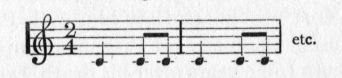
(The same figure on the tambourin with the tinkling bells, is called "Eastern.")
A quite good method is to use the best of all the written music and make it into a hotch-potch. This is really a very practical way, and often gives good results. Finally, one takes the whole music written specially for one play by one composer of any period, and does it as written, with no addition or alteration: this is an ideal method very rarely put into practice. Even when commissioning a living composer, managers try to bring in a favourite number by Arne or Horn, and, unless the composer is a very strong or a very rich man, his musical scheme will be broken by some well-known tune not in the least in the style of the rest of his music.
It is difficult to persuade the average Shakespearian producer that Shakespeare, Arne, Sir Henry Bishop, and Horn were not great friends who used to meet daily at the Mermaid Tavern to discuss incidental music.
CHRISTOPHER WILSON.
SHAKESPEARE AND MUSIC
ANTONY AND CLEOPATRA
There is a long list of operas under the names Cléopâtre and Kleopatra in Clément et Larousse's Dictionnaire Lyrique, and in Riemann's Opernhandbuch, but it is doubtful if a single one of them can be said to be founded on Shakespeare's Antony and Cleopatra. There seems material in it for hundreds of operas, but no one seems to have been inspired to write them.
Sir Henry Bishop has certainly written an "Epicedium," or funeral dirge, for the end of the play, for the production at Covent Garden; but though no author's name save Shakespeare's appears on the title-page, I can trace no text of Shakespeare's in this "Epicedium." It was produced in November 1813, and Grove's Dictionary of Music and Musicians does not mention it. It was sung at the end of the play, and is for chorus, orchestra, solo tenor and baritone. The first and second choruses are laments of the soldiers over Antony's death; then the solo baritone tells the chorus not to be ashamed of shedding tears, and the chorus sentimentalise over his bravery and generosity. The tenor sings of how he (Antony) was deserted by Mars and Neptune, and tells them to bury the lovers together. The final chorus is quite cheerful. Everyone seems pleased with the monument that has been erected, and "the shout of warriors thunders o'er the tomb." It is not a very dignified production, and I should not have paid much attention to it but for the fact that so little has been written musical on this subject that I thought some of my readers might be interested by this slight and incongruous work.
K. H. Graun in 1742 composed an overture to this play which is, I think, the earliest known work on the subject. The only available copy of the score is in Berlin, and, at the time of writing, rather difficult to get at. Graun was born in 1701, at Wahrenbrück, Saxony, and is one of the few celebrated composers who were famous operatic singers before they were composers. His oratorio The Death of Jesus takes the same place in Germany as Handel's Messiah does here in England.
August Enna, a Danish composer, wrote an opera founded on Shakespeare's play, which was produced at the Royal Opera House, Copenhagen, in 1894; but, with the exception of the overture, none of it has been performed in London. The overture was played under Sir Henry Wood by the Queen's Hall Orchestra on July 6, 1912. The opera was not a success in Copenhagen, in spite of the popularity of the composer and the natural sympathy he would receive from his compatriots. The critics said that he was obviously too much under the double influence of Wagner and Verdi, and, though admiring his prodigious technique in orchestration, gave him otherwise but faint praise. Enna was born May 13, 1860. He was largely self-taught; but, with the help of Niels Gade, won the Ancker Scholarship, a sort of Danish "Prix de Rome," which enabled him to study in Germany and acquire a considerable technique—a useful possession for a modern grand-opera composer.
Rodolphe Kreutzer, whose violin exercises have driven thousands of amateurs nearly to suicide, composed a "Grand Historic Ballet" on Antony and Cleopatra, which was produced in Vienna, but the date is as uncertain as the work's connection with Shakespeare's play. It would seem impossible to anyone who has seen or read the play not to have been influenced by it to a certain extent, and as Kreutzer was born in 1766 he may have seen or read some translation; but he does not appear to have gathered the slightest glimmer of the tragedy of Antony and Cleopatra, and he was content to compose a whole series of numbers, all equally banal, not one of them suggesting for a single moment either of the great lovers or the surroundings. The only redeeming feature of a long and tedious work is that there is no attempt at Wardour Street Egyptian music.
Hector Berlioz made his third unsuccessful attempt on the Prix de Rome with a cantata on this subject. Though not founded on a scene or scenes from Shakespeare's play, it was undoubtedly inspired by the poet. Berlioz describes the action as follows:—"The subject was, Cleopatra after Actium; dying in convulsions, she invokes the spirit of the Pharaohs, demanding, criminal though she be, whether she dare claim a place beside them in their mighty tombs. It was a magnificent theme, and I had often pondered over Juliet's 'But if, when I am laid into the tomb,' which is, at least in terror of approaching death, analogous to the appeal of the Egyptian Queen." Berlioz himself says: "I think it deserved the prize." And I am sure it did; but the Grand Prix was not awarded that year, so that the composer had to wait twelve months before winning the coveted honour. He afterwards used the music, unchanged, for that curious but interesting work Lelio.
"The Vision of Cleopatra," a "Tragic Poem for Orchestra, Soli, and Chorus," words by Gerald Cumberland, music by Havergal Brian, is inscribed to the Southport Triennial Festival, who gave it its first performance. Though not an actual setting of a scene or scenes from this play, the work owes much to Shakespearian inspiration. For instance, though Antony and Cleopatra belong to anyone, Iris and Charmian, who appear in this work, are essentially Shakespeare's creations. This "Tragic Poem" is scored for a very large orchestra, and two choruses, one large, the other small. In addition to the usual full modern orchestra, there are two extra ad lib. horn parts, making six, and four trumpet parts. For the sake of "Oriental colour," the percussion list is so unusually heavy that I must quote it: glockenspiel, tympani, bass drum, side drum, triangle, castanets, Indian drum, gong, large cymbals, and small cymbals—rather a healthy lot when they all get going! The work opens with a slave dance, allegro con fuoco, and is marked double pianissimo. After a few introductory bars (twelve), the dance proper begins, still very softly and in a curious syncopated rhythm. According to the composer's directions the dance grows "gradually wild and riotous," then comes a slower passage marked "yearning," followed by a long stringendo passage leading to the climax, "wild and uneven"; this presently dies away, and Iris and Charmian have a long duet, the chorus occasionally breaking in, telling how the "Queen is sick for Antony," and how "once more
Venus and Bacchus meet, and all the world Stands still to watch the bliss of living gods."
The music here is very difficult; the rhythm changes often, every other bar, as does the key; the intervals are strangely unexpected, and the singer can look for no help from the orchestra. A passage marked "In regal martial style" ushers in the lovers, and we have a long vivid duet. Cleopatra sings a lengthy mystic solo, which is followed by an ominous chorus, at the end of which Antony seems to have died, for Cleopatra sings a very powerful dirge for him:—
Now all is finished, all is done, My world is dead; And he whose glory shamed the sun Lies shamed instead. These lips that frenzied him with love Have death bestowed.
The Finale is marked "Marche Funèbre," and is a short chorus, dirge-like in feeling, rounding up the work effectively. It is a very interesting composition, difficult and most complicated, very restless and disjointed, to most ears singularly unmelodious and unsatisfactory, yet, at the same time, full of novel effects, and to that extent certainly worth study; but I suspect that none of it ever got on the Southport barrel organs.
Unfortunately, I cannot get hold of Dr Ethel Smyth's overture of this name, but Mr J. A. Fuller-Maitland, in his English Music in the Nineteenth Century, writes: "Ethel Smyth's genius lies in the direction of strong and even virile work; her overture 'Antony and Cleopatra,' given at the Crystal Palace and the London Symphony concerts, showed that she understood all the resources of the orchestra, and that she was no amateur." The last six words seem hardly necessary. The composer has since proved her worth in her two operas, The Wreckers and The Boatswain's Mate.
Schubert's setting of "Come, thou monarch of the vine" is not so successful as his "Who is Sylvia?" or "Hark, the lark." It is a straight, robust song, mostly in unison. There is a quite unnecessary second verse added by one "N. N." Other but not important settings of these words are by William Linley, 1815, for solo boy and male chorus; Bishop, 1837, for three male voices; and Weiss, 1863, for bass solo.
Michael Balling's music for Frank Benson's production of Antony and Cleopatra contains, among other very good music, a baritone song to these words, with male chorus. Unfortunately, he did not write an overture or entr'actes, but his Cæsar and Antony marches are full of contrasted character, and his "Rose Procession" for the last "Gaudy Night" is really beautiful. Sir Henry Bishop set these words to a S.A.T.B. quartet and full chorus, and by repeating each line several times, and most of the words pretty often, has made quite a long and uninteresting number out of it.
Thomas Chilcot in 1745 published a setting of these words for a tenor voice. It is a good florid song, with a running accompaniment for strings. The composer omits the fifth line of the lyric for some reason I cannot understand. Surely the poem is very short as it is. In setting it he certainly seems to have found it so, as he repeats several sentences. The line he cuts makes rather a good refrain—"Cup us till the world goes round"—and most composers make their effect here.
Miss Frances Allitsen has composed for Madame Clara Butt a "Scena"; the text chiefly from Shakespeare, the words of the aria by Thomas S. Collier. It is supposed to be the death scene of Cleopatra, and the words are a sad jumble of odd lines taken from here and there. The music is very pretentious, and obviously not written round Cleopatra, but round Madame Butt's exceptional voice. The prayer to Isis and Osiris, with its un-Shakespearian rhymes of "supplication" and "desolation," would sound quite right with small verbal alterations in any Methodist chapel. The aria is vocal and to a certain extent melodious in a "ballad concert" manner, but it is utterly lacking in dignity. A long recitative follows in which nearly every note has an accent on it; Cleopatra applies the asp to a tremolo accompaniment, and finally dies, singing a series of accented high notes, as if the asp were hurting a good deal; and a few bars of minor chords bring the work to a close.
AS YOU LIKE IT
As You Like It has not been dealt with much by musicians, though one of them, Sir Henry Bishop, has been very hard upon it. The earliest known opera on the subject is by Francesco Maria Veracini. It was produced under the title of Rosalinda during the composer's visit to London in 1744. Mr W. Barclay Squire, in his article on Shakespearian operas, mentions three operas of this name, by Capelli, Ziani, and J. C. Smith, but adds that they have no connection with Shakespeare's comedy. Bishop's pasticcio opera on this subject was produced at the Royal, Covent Garden, in 1819. The overture is a potpourri of so-called Shakespearian songs, simply harmonised and roughly hung together. The first number is a duet for Rosalind and Celia, "Whilst inconstant fortune smiled," words freely adapted from The Passionate Pilgrim. There is nothing much to say about it: it seems quite innocuous, but very dull. Rosalind's song, which she sings after having fallen in love with Orlando, is a setting of the 148th Sonnet, minus the two last lines. It is again quite dull. Celia has a long and depressing aria in praise of friendship, the words taken from the 123rd Sonnet. After these numbers it is quite refreshing to come across a cheerful male-voice hunting glee—"Even as the sun" is the title—the words being taken from Venus and Adonis. There are the usual horn effects, fortissimo chorus effects, and pianissimo echoes, all the old tricks, but put together by a good old hand, Bishop. Dr Arne's setting of "Under the greenwood tree" follows for Amiens, and a beautiful setting it is. Touchstone, in this version, is a tenor (somehow I never fancied him as a tenor), and sings a bright little song, "Fair was my love," from The Passionate Pilgrim. This is followed by a trio for Rosalind, Celia, and Touchstone, beginning "Crabbed age and youth," the words again taken from The Passionate Pilgrim (what a useful poem it is to pasticcio opera composers!). This trio is a very simple one. The first verse consists of alternate phrases by the three singers, who then all sing together, over and over again, the line "For methinks thou stay'st too long." A welcome relief is Dr Arne's broad, flowing setting of "Blow, blow, thou winter wind," by far the best to these words. The next number is a terrible setting by Bishop of the first eight lines of the 7th Sonnet, "Low in the Orient when the gracious light," for male voices. Silvius now has a sentimental song to words taken, slightly altered, from Venus and Adonis. The situation is inverted: Silvius sings Venus's words reproaching Adonis, to Phoebe; but Bishop is undaunted, and "Oh thou obdurate flint, hard as steel" is addressed to a woman! (By the way, Shakespeare wrote "Art," not "Oh.") Rosalind sings a sentimental ballad to the words from Venus and Adonis beginning "If love had lent you twenty thousand tongues," of no great importance. Dr Arne's beautiful setting of "When daisies pied," from Love's Labour's Lost, is another welcome relief, and I remember in several modern revivals of this play managers introducing this song when they had a Rosalind able to sing well enough. The next number is a march and dance for the procession of Hymen, and is for orchestra only. It is a good example of absolutely straight writing, with no bother about the romance or mystery of the masque of Hymen—a good workaday march in D major and common time. This is followed by the last number, words actually from As You Like It. Hymen, who in the original production was played by a boy, sings "Then is there mirth in heaven," a long, tedious, florid song, full of endless repetitions of single words. It is a curious fact that the beautiful lyric, "It was a lover and his lass," does not occur in this version, though really part of the original play.
It was a great pity that Sir George Alexander did not commission Edward German to write the whole of his music for the As You Like It revival at the St James's, instead of the Masque only. This Masque is so very good that one would like to have an overture and full entr'actes, but one must be thankful for what one has got. The work is in four movements. First, an introduction, very quiet and moderately slow, leading to the "Woodland Dance" in the minor, beginning very quietly, but working up to twelve ff bars in the middle, and then dying away. The second number is a very graceful "Children's Dance," piano throughout, most melodious, and very delicately scored. The last number, "Rustic Dance," is the longest and most important. It begins allegro con spirito and fortissimo, and keeps it up till the first episode, which is in the same time, but pianissimo and in the minor. Soon this is worked up to a big forte rallentando effect, which leads into the last theme, pianissimo to begin with, getting quicker and quicker and more crescendo to the coda, which is presto fortissimo. This is by far the most effective of the movements, but the "Children's Dance" is the most beautiful. Mr German's setting of "It was a lover and his lass," one of the best of this lyric, was not composed for this production.
Clarence Lucas's overture to the comedy is one of the few purely orchestral works associated with As You Like It. It begins very brightly, the first theme being a rollicking one in Old English style. This is developed until we come to the second subject, which is much slower, and is first played on the clarinet. The whole overture is really in valse time, and the second half of the second theme makes a most interesting syncopated valse. The first half ends with a horn passage, suggesting the banished Duke and his friends hunting. There are no new themes. Those which I have described are taken through their phases in various keys, and the work comes to a sparkling finish by means of a presto coda. It is a very lively comedy overture, and not at all difficult to perform.
THE COMEDY OF ERRORS
I must just copy the whole of the title-page of Sir Henry Bishop's operatic version of The Comedy of Errors. Nothing could give any idea of what Shakespeare has been through save an analysis of the music that follows, but I can only touch on that. "The overture, songs, two duets, and glees in Shakespeare's Comedy of Errors, performed at the Theatre Royal, Covent Garden; the words selected entirely from Shakespeare's Plays, Poems, and Sonnets. The music composed and the whole adapted and compressed from the score for the voice and pianoforte by Sir Henry R. Bishop, Composer and Director of the Music to the Theatre Royal, Covent Garden."
I have written this down just as it was printed. I was so overwhelmed by it that I felt sure that neither I nor anyone else could improve upon it. I knew there was only one bit of the play set to music—and not a very beautiful example either—in the ordinary anthologies of Shakespeare's music. It is by Dr Kemp, who died in 1824. He chose these few lines from Act ii., Scene 2, lines 187-191, but Bishop, very wisely, does not touch these lines. He brings in every kind of song and tune, from, as he puts it, "Shakespeare's Plays, Poems, and Sonnets," with no reference to the play for which he was composing music. The overture is of the "potpourri" style. After four bars of slow music the theme of Ophelia's song in Hamlet, "How shall I my true love know?", is played. A few bars afterwards a theme from The Tempest, then a very cheerful subject from Macbeth, followed by a bright little thing from The Winter's Tale. Then comes an old tune for "When that I was" (Twelfth Night); next a melody from The Tempest and "St Valentine's Day" lead pleasantly into the catch, "Which is the properest day to drink," from Twelfth Night, all preparing the way for "Under the greenwood tree" (As You Like It). After this theme is given a fair chance, a subject from The Winter's Tale is produced, followed by "Blow, blow," from As You Like It. A sad little bit from Macbeth, succeeded by a very bright coda from The Winter's Tale, brings the overture to a conclusion. But why call it the "Overture to The Comedy of Errors"? There is not a suggestion or a line in this overture, except the one on the title-page, that has anything to do with the play to which that is supposed to be the opening, though it is beautifully printed as "Comedy of Errors Overture."
No one minds Bishop writing a potpourri overture and calling it "Shakespeariana," but why call it "The Comedy of Errors"?—unless he wishes the title to describe the overture, not the overture the play.
The first vocal number in this strange work is a setting of "It was a lover," from As You Like It. It is a simple but quite pretty song. The next is a song for Antipholus of Ephesus, words selected from Shakespeare's Sonnets; it is called "Beauty's valuation," and is a good example of the composer's worst manner. Then comes a strange setting of "Blow, blow," from As You Like It. The melody of the first part is by Dr Arne and the refrain by Mr Stephens, the whole arranged for four male voices by Bishop; it makes a strange medley! After this one is not surprised to find the "Willow song" from Othello sung by Adriana to quite a cheerful tune. Dr Arne's "Under the greenwood tree," arranged for a male quartet by Bishop, follows. The next number is a curious duet for Ceremon and Antipholus of Ephesus to the words beginning "Saint Witnold footed thrice the world," from King Lear (Act iii., Scene 4). There is no attempt to bring out the weirdness of these strange words. Bishop then composed a very obvious duet for tenor and baritone, with effective cantabile passages and plenty of pauses and shakes. Adriana now sings Bishop's setting of "Come live with me" (Marlowe), quite the prettiest number in the opera, though the words seem a little bold for her, and more suited to the nameless character, the last in Shakespeare's cast. Luciana then sings Sir Henry's "favourite cavatina," "Sweet rose, fair flower," words culled from The Passionate Pilgrim, but ascribed by Bishop to the Sonnets. Perhaps this was a "favourite cavatina." The publisher says so, and ought to know, having bought it; but I cannot say I really like it.
The third act is brought to a brilliant finish by Bishop's famous glee from As You Like It, "What shall he have who killed the deer?" The fourth act begins cheerfully by Adriana singing the composer's "Take, oh take those lips away," which is really a very bad setting. The Passionate Pilgrim is again drawn upon for the next number, a duet for Adriana and Luciana. This is a feeble affair rather in Horn's "I know a bank" manner, and the words are again attributed to "The Sonnets." Sir Henry appears to have no more idea of what a sonnet really is than the London editor who asked a poet for a sonnet "not more than a hundred lines long." A pleasant change is caused by the glee party singing "Come, thou monarch of the vine," from Antony and Cleopatra, as an unaccompanied trio. Luciana now sings "The springtime of love," words from The Two Gentlemen of Verona, a good florid vocal soprano solo; and the opera finishes with "Lo, here the gentle lark," from Venus and Adonis, with flute obbligato. This is too well known to need description. I daresay it made as good an end as any other that Bishop could have devised.
I have written at some length on this musical "pasticcio," as this kind of opera is called, because it presents strange points of interest. The persistent way in which no single line from The Comedy of Errors was set to music for this production is only equalled by the manner in which Purcell did not set a line of Shakespeare in his Fairy Queen. Whenever modern critics point out the faults in our occasional Shakespearian productions, one can always say, "Remember 1819, the year of the first performance of this atrocity."
It is not surprising to find that Sir Henry Bishop was knighted (in these days he might get the O.B.E.); but it is odd that he should have succeeded Dr Crotch in the chair of music at Oxford.
CORIOLANUS
Despite the fact that Clément and Larousse, the French musical operatic historians, give no fewer than seven Italian operas entitled Coriolanus, and mention four more, unfortunately not one of them is founded on Shakespeare's play. One great overture that is always associated with the play was not composed directly for Shakespeare's drama but for a work on the same subject by Baron von Collin, a Viennese dramatist. M. H. Laboix fils, the celebrated French musical critic, in his essay, "Les traducteurs de Shakespeare en musique," says: "Among symphonic works it is not possible to avoid mentioning Beethoven's 'Coriolan Overture,' and we should have placed it in the front rank if a scruple did not require us to refer only to music directly inspired by Shakespeare." In spite of the character of grandeur and majesty which gives it its stamp, the overture "Coriolanus" was not composed for the English tragedy, and a little story will serve to show this.
A German poet, von Collin, had written a play, Coriolanus. To give relief to his tragedy, he took it to the composer of Fidelio and prayed him to write an overture. Perhaps Beethoven knew the English Coriolanus; perhaps the stern Roman pleased him so much by reason of his vindictive and indomitable character that one night, so say the historians, sufficed the composer to provide the magnificent pages that serve to preface the work for which we have to thank von Collin. The critics have found, with reason, the striking connection between Shakespeare's play and Beethoven's overture; but if the anecdote be true, these analogies are a proof of that intimate tie which binds together great men of genius. The overture is too well known to require analysis. Everyone will remember the austere opening, the turbulent principal theme, the perfect melody of the second theme, the wonderful fiery development, and the exquisite morendo at the end. Beethoven, one feels, must have known Shakespeare's Coriolanus.
Of real incidental music composed for this play very little has survived. Most managers were content to play the Beethoven overture if the orchestra was large enough, and to get through with a couple of marches—one for the Romans and one for the Volscians,—a few fanfares, and a little soft music to illustrate the "home life" of the hero.
Not so Sir Henry Irving, all honour to him. He commissioned Sir Alexander Mackenzie to write special music, which it is my privilege to discuss now. The composer has made his incidental music into a suite of four movements. The first number is called "Prelude," and is in C minor and common time. It opens with a vigorous, decisive chromatic theme lasting only for nine bars, and is followed by a very tender and beautiful subject for strings, which is soon developed, in an animated manner, into a forte passage, that quickly dies down and enables a tranquil melody for wood wind and harp to be heard. After a little while the trumpets enter with a rapid fanfare figure, which quickly spreads over the rest of the orchestra, and works up finely to the return of the first theme fortissimo. All these themes are now finely treated in various ways by the composer, and the movement ends with a brilliant coda in the major. The second number is a march in D major. After a quiet introduction for strings pizzicato, the violins give out a martial theme very quietly, and presently the wood wind joins in, and a graceful, rather florid theme for the wood is added; then comes the first theme again, and the march ends with some piano trumpet fanfares. The trio is in the minor and slower; its theme is broad and flowing, and at its end Sir Alexander introduces a longish piece of complex development music working to the first march theme, which is played for the first time fortissimo, but soon gets piano again. The coda is quite short and quiet, with a reference to the trio: the music gets slower and slower, and ends pianissimo.
The third number is a funeral march. The opening theme is practically the same as the few bars of the prelude, but is developed more lyrically. The middle part, or trio, is even more solemn; there is a very impressive kettledrum effect, and a fateful subject is played on trombone and cornet in octaves against a strong string passage. The first part is repeated with very little alteration, and the end is fitly funereal. The fourth and last number is by far the most descriptive of the suite; it is called "Voces Populi," and gives, musically, the effect of an angry crowd being gradually stirred up to great heights of wrath. This is followed by an expressive affettuoso theme, mostly for the violins, leading to a new melody, very triumphant and happy, but soon broken in upon by the murmuring of the people, this time sounding even more ominous. After a short appearance of the affettuoso theme the movement finishes triumphantly on the third theme in a great blaze of music. No stage music could be more in keeping with the true meaning of the play; it is all on a very high and important level, and is most worthy of its distinguished composer.
It is of this Coriolanus production that a very good story is told. After the final dress rehearsal two stage hands were discovered outside the stage door reading through the day-bill. One said: "Scenery designed by Sir Laurence Alma Tadema; music composed by Sir Alexander Mackenzie; produced by Sir Henry Irving—three knights. About all it will —— well run." Unfortunately, owing to no fault of the music, this prophecy was not very far out.
CYMBELINE
During my researches in Shakespearian music, operatic or other, I have been often hindered by the strange titles under which works were hidden. Having a smattering of French, German, Latin, and a tiny bit of Italian, I could recognise The Merchant of Venice under the title of Il Mercante di Venezia, or Der Kaufman von Venedig, or Shylock; but why Jessica? Yet there is an opera founded on that play, called Jessica, by a Frenchman named Louis Deffès. Romeo and Juliet is easy to discover under the title I Capuletti ed i Montecchi; but why Les Amants de Verone? Much Ado About Nothing one "spots" at once under the title Beaucoup de Bruit pour Rien, or Béatrice et Bénédict; but why Hero or Ero? The Tempest is easily discovered as La Tempesta, Die Geisterinsel, Der Sturm, or Miranda, as is The Winter's Tale as Wintermärchen or Conte d'Hiver; but why did Max Bruch call his opera on the same subject Hermione? Twelfth Night is easy to find as Was Ihr Wollt, not so easy as Cesario. Under the fine-sounding title, Ricardus, Angliæ Rex, ab Henrico Richmondæ comite vita, simul et Regno exitus, we find an old friend, Richard III.; and Timone Misantropo almost sounds like a pet name for Timon of Athens. The title Macbetto is a very thin and seemingly purposeless disguise for Macbeth; and King Lear is generally called Cordelia, operatically. The Merry Wives of Windsor is called severally Le Vieux Coquet, Falstaff, Falstaff, ossia Letre Burle, Die Lustigen Weibervon Windsor; and Antony and Cleopatra is generally named after the lady. But the greatest surprise I received was when I discovered, lurking under the name of Dinah, Shakespeare's Cymbeline!
It is an opera in four acts, book by Michel Carré, jun., and Paul Choudens, music by Edmond Missa. Carré fils is the son of the well-known librettist of Faust and Romeo fame, and Choudens is connected with Choudens Fils, who publish this opera; but concerning the composer, Grove and Riemann are silent. The opera was produced at the Comedie Parisienne, on June 27, 1894, and was not a success. There are only five characters, and a chorus of lords and courtesans. The scene is laid in Venice during the Middle Ages. The characters are Mentano (Posthumus), Iachimo, Philario, Dinah (Imogen), and Flora, a courtesan, a high soprano, not occurring in Shakespeare's text. Cymbeline and the rest of Shakespeare's characters are cut. Boiled down, the plot is (I will give Shakespeare's names):—Posthumus is the lover and beloved of Imogen; they are not married secretly, as in the play; Iachimo is so madly in love with Imogen that he forces a quarrel on Posthumus, and they fight. Just as Posthumus is about to fall under the furious attack of Iachimo, Philario enters and separates them. Iachimo then offers to lay his entire fortune that, within twenty-four hours, he will bring to Posthumus the bracelet the latter had given to Imogen, as proof that he is her lover. Posthumus accepts the wager. In the second act Iachimo creeps into Imogen's sleeping chamber and steals the bracelet. At the appointed hour Posthumus realises that, in one fell swoop, he has lost his fortune and his mistress. From this point the action becomes very obscure, involved, and difficult to follow. Somehow or other Imogen and Posthumus realise the truth; Philario mortally wounds Iachimo in a duel, and the curtain falls on Iachimo apologising handsomely for his shocking behaviour. It will be noted that there is very little Shakespeare in this version, but, really, I have given all there is; and were it not that the librettists have carefully said, "d'aprés Cymbeline de Shakespeare," few people would have noticed it. It is a mystery to me why the authors changed the beautiful name of Imogen into Dinah. I have always associated the name of Dinah with coon songs and the kitten in Through the Looking-Glass.
The first act opens in Venice with a canal at the back of the stage. The gondoliers sing a bad Mascagni chorus, and Flora enters singing in imitation Italian style. All Flora's part is written in this manner, and unfortunately the composer has chosen a very bad model to imitate—good Mascagni is good, but bad is——! The music is in a curious jumble of styles: sometimes Italian, sometimes pseudo-modern French, with occasional attempts at Wagnerian imitations—Missa's constant use of intentional consecutive fifths becomes very wearing after a time. The music in the masked-ball scene is pretty, and the duet in which Flora tempts Posthumus is melodious, though the situation is rather comic. Imogen's song at the opening of the second act is the best number in the piece, and it is followed by a really good bit of pantomime music while she is preparing for bed; but on the entrance of Iachimo all becomes vulgar again. In the last act Iachimo dies to the tune to which Imogen prepared to go to bed; and if anyone, hearing it, should remember where he heard it before, it might raise a quiet smile. The music is admirably suited to the libretto. Both are in the worst possible taste, and the words "d'aprés Cymbeline de Shakespeare" seem rather in the nature of an outrage. Still, it is the only opera I can find on the subject, and perhaps on the whole I am glad; a few more Cymbeline operas in this style might smash the entente cordiale.
With the notable exception of the lyric, "Hark, hark, the lark," beautifully set to music by Schubert, very little attention has been paid by important composers to the songs in Cymbeline. True, more than a dozen composers, dating from 1750 to the present day, have set those words, and also the exquisite lyric "Fear no more the heat of the sun," but with indifferent success. An interesting story of the composition of "Hark, hark, the lark," by Schubert, is told by the composer's old friend Doppler. "Returning from a Sunday stroll with some friends through the village of Währing, he (Schubert) saw a friend sitting at a table in the beer-garden of one of the taverns. The friend, when they joined him, had a volume of Shakespeare on the table. Schubert seized it and began to read; but, before he had turned over many pages, pointed to 'Hark, hark, the lark,' and exclaimed, 'Such a lovely melody has come into my head, if I had but some music paper.' Someone drew a few staves on the back of the bill of fare; and there, amid the hubbub of the beer-garden, that beautiful song, so perfectly fitting the words, so skilful and happy in its accompaniment, came into perfect existence." Two other songs probably followed the same evening: the drinking-song from Antony and Cleopatra, marked "Währing, July 26," and Who is Sylvia? of the same date—a very good day's work. As for the other settings of these lyrics, G. A. Macfarren's part-songs for S.A.T.B. are, as is usual with him, very musicianly but not inspired.
HAMLET
Hamlet offers great scope for composers to show their virtues and their limitations, and a large number have done so from Graun, 1701, to the present day. This is the more curious, as there are fewer references to music in the text or the stage directions than in most of the plays. True, there are many fanfares, Ophelia's mad songs, and the gravedigger's song in the last act; but, as a whole, music is kept in a very subordinate position. I can find no trace of contemporary incidental music for this play. I should like to hear a real Hamlet tucket. From the text, we know that whenever King Claudius drank a cup of Rhenish a trumpet and a kettle-drum played a flourish, and a cannon was fired to let the Danes know exactly what the King was doing at that time. But, alas! I can find no trace of a real contemporary Hamlet fanfare. The versions still in use in this country of Ophelia's mad songs and the first gravedigger's song are supposed to be the originals, handed down by aural tradition from mother to daughter, from father to son; but I know something of the wonderful things, transformations, etc., that appear as the result of aural tradition. I have heard Zulus singing what the ordinary white visitor to Africa is told are native folk-songs; but these I have been able to trace from their sources, though the original composers, Messrs Moody and Sankey, would have some difficulty in recognising their own inspired tunes! It is well known, if a story is repeated from one to the other by a number of people, how strangely the last version varies from the original. If this is so in words, how much more so must it be in music, where the varying compass of the voices must be taken into consideration: the singer substituting a high note for a low note that he cannot touch, or vice versâ. Still, the songs in Hamlet may bear a general likeness to the songs sung in the first production. I wonder!
Of course, an enormous amount of incidental music has been composed for Hamlet. Every producer must have some Ghost music, fanfares, a King's march for the Play scene, and a funeral march for Ophelia. Also scene music helps to pass the time during the frequent scene changes that are necessary in this play, and this has been done and re-done by hundreds of composers, orchestrators, arrangers, and hack workers. But this stuff is mostly ephemeral, and at the end of the run or the tour the music goes to the stores in a basket (the remnants that have been collected from the orchestra), and is heard no more; unless, indeed, the stage manager thinks that perhaps the Hamlet march would suit a situation in the new modern patriotic play just about to be produced, or, with the assistance of a tam-tam, could be converted into a grand Oriental march for the forthcoming production of Ali Baba.
On the other hand, several important producers have commissioned celebrated composers to write for them. Thus, Sir Herbert Tree asked Sir George Henschel to do the music for his production, and, what is more, actually allowed it to be played more or less as written. Sir Frank Benson's music was obtained with the scenery and props, prompt books, etc., when he took over the company from Bentley, and is rather a hotch-potch. It has been added to from time to time, but it is beyond improvement. The Otho Stuart-H. B. Irving-Oscar Asche Hamlet music was insignificant. Hamilton Clark's music to Sir Henry Irving's production I cannot find, even at the British Museum, but I remember it well as thoroughly sound, effective incidental music, a great help to the play, and never obtrusive.
The Henschel music was far more complicated. Tree produced Hamlet at the Haymarket in January 1892. The prelude is a solemn largo movement, lasting about five minutes, with nothing very distinctive about it. The Ghost music is the usual 'cello and bass effect, long pianissimo holding notes (octaves), with plenty of pauses. The cock-crowing imitation on the oboe is most effective. The triple piano, high B flat, triplet dropping an octave, gives a most realistic effect. The next number is very important. It is called "Danish March," and I take Sir George Henschel's word for it that it is one. It is very long, and serves to bring the King, Queen, and court on and off whenever necessary. The prelude to Act ii. is called "Ophelia," and is quite conventionally affettuoso.
The fanfares are all good. There is a prelude to Act iii., allegro impetuoso, but it has no label, and might suit Hamlet or Laertes equally well. The prelude to Act iv., called "Ophelia's Death," is a funeral march for muted strings and timpani. There is very effective melodrama music while the Queen describes Ophelia's death, muted strings pianissimo, and the clarinets playing broken snatches of the mad songs. The prelude to Act v. is a pastorale for full orchestra, and the churchyard music is for solo organ on stage. At the end of the whole play, at the cue "And flights of angels sing thee to thy rest," a female chorus on the stage sings, in three parts, "Good-night, sweet Prince, good-night," which makes a pretty ending. I gather this was Sir Herbert Tree's idea.
In addition to the fine "Fantasy Overture," which I discuss later as a separate piece of orchestral music, Tschaikowsky composed an overture, entr'actes, and full incidental music for Hamlet. It was written for a special production at Petrograd, and is much the finest music for the play. The whole is composed for small orchestra, double wood wind, two horns, two trumpets, trombone, and drums, and these limitations seem to have suited Tschaikowsky's genius particularly well. The overture is founded on the themes of the "Fantasy Overture," but is considerably shorter. The Ghost music is very awe-inspiring and original, very piano, deep notes on the trombone and trumpets, combined with strange, eccentric scale passages on the clarinets. The fanfares throughout are particularly fine, the first being an elaborate and long flourish in nine-eight rhythm, scored for the full brass, but, curiously enough, without kettledrums; nor are these used in any of the subsequent fanfares. Now, Shakespeare in his text makes Hamlet say (Act i., Scene 4), "The King doth wake to-night, and takes his rouse, Keeps wassail, and the swaggering upspring reels. And, as he drains his draughts of Rhenish down, The kettledrum and trumpet thus bray out The triumph of his pledge." And, later (Act v., Scene 2), the King says, "Give me the cups; And let the kettle to the trumpet speak, The trumpet to the cannoneer without," etc. Now, this seems to me to be a strange omission. It cannot have been done intentionally. Perhaps in the Russian version the text is altered and the kettledrum missed out. Of course, the side-drum is generally used in England, because it is easy to take on the stage, and our managers do not like hiring extra stage kettledrums; but this would scarcely apply to Petrograd or Moscow. No. 3 is a powerful piece of melodrama music, mostly on the Hamlet theme, on the solo bassoon at first, and subsequently taken up by the clarinets, all on their low register: a very sinister number this. No. 4 is another melodrama, very agitato, scored for pizzicato strings and bassoon, with a very curious and ominous kettledrum figure, frequently repeated. The entr'acte between Acts i. and ii. is marked allegro semplice; it is a graceful waltz, very characteristic of the composer, and is obviously meant for Ophelia. Then comes a strange fanfare for two oboes, two clarinets, two bassoons, and tamburino: this is long and florid, rather like a street march. No. 6 is a long florid fanfare for two trumpets; the first leading off with the theme, and the second following a bar or so later, in canon style: this is a most interesting fanfare. The entr'acte between Acts ii. and iii. is a beautifully melodious movement for strings only, sad, and exquisitely written for the instruments. The melodrama music in this act is the same as in the first act.
Before Act iv. is an élégie for strings: one of the most beautiful works of the kind ever written. Tschaikowsky has composed several elegies for this combination of instruments, but none better than this. Nothing more ideal as preparation for the Ophelia scenes could be imagined. Next follow Ophelia's songs. These are all freshly set by the composer in folk-song manner, accompanied very delicately by the orchestra. Before the last act comes the Funeral March, very striking, very funèbre, very dignified, and very wistful; in all, a perfect piece of elegiac writing, than which nothing more thoroughly in keeping with the spirit of the play could be imagined. It is on the same lines as Berlioz's "Marche Funèbre" in the same situation. The Gravedigger's song is newly set, to a lively and very Russian-sounding tune, accompanied by full orchestra; but I doubt the wisdom of having orchestral accompaniment either to Ophelia's songs or to the Grave-digger's single one. A long and florid fanfare for two trumpets accompanies the King's toast to Hamlet (without kettledrums). The Funeral March is repeated at Hamlet's death, and the martial music for Fortinbras is in splendid contrast. It is a short, quick movement, only nineteen bars in length, marked allegro risoluto, and makes a great end to the play. The music is absolutely worthy of the play, and is a perfect example of what incidental music should be. Sir Johnston Forbes-Robertson was wise enough to use nearly all this music in his fine production. He did not adopt Tschaikowsky's settings for Ophelia's songs or the Gravedigger's, but used the so-called traditional ones, and I am sure he was right here. But why, after having played the great funeral march as an entr'acte, he did not use it again, as directed by the composer, for Hamlet's funeral procession, I can't understand. Instead, he used a march by Carl Armbruster, quite good in its way, but very pale after Tschaikowsky. Still, it was a praise-worthy act of Sir Johnston to use the large amount of the music he did, and he deserves great thanks for only interpolating one number.
Unfortunately, the music composed by Norman O'Neill for Martin Harvey's production of Hamlet in 1907 is as yet unpublished. Mr O'Neill wrote the entire score. He had already composed an overture built on the themes on which he draws largely for the incidental music in this production, and he uses the overture itself in its entirety as a prelude to the second act, under the title "Prelude, Hamlet." The prelude for the first act is sombre, quiet, and brooding, with a very curious cuckoo effect at the end, which is repeated in the subsequent Ghost music. Of course, I do not know the habits of the Danish cuckoo, but obviously, according to Mr O'Neill, he is either a very late or a very early bird. Perhaps he is cracking an Elizabethan wheeze at the expense of the Ghost's widow's unholy marriage. The big processional march for the entrance of the King and Court is, curiously enough, not founded on the King's theme, but on Hamlet's theme from the overture now used as the prelude to the second act. The scene-change music before Ophelia's first scene is founded on "How shall I my true love know?", with varied accompaniment, sometimes simple, sometimes complex, and once as clarinet solo with harp accompaniment. At the cue, "Held his wont to walk," there is a fanfare for the clarinet, but, as in most incidental music, no kettledrums. The Ghost music in this act is all founded on the Hamlet theme. The prelude to Act ii. is, as I have said, the overture proper. It begins with the Hamlet theme, allegro maestoso, very bold and rhythmic, which suddenly breaks off with a pianissimo suggestion of "How shall I my true love know?", which is used as the second subject, and very much developed. These themes are worked out in a complex manner, and there is a curious fanfare effect before the coda, which is marked grandioso, in the major key, and is very triumphant. The players come on to perform their tragedy to a pretty little tune, quite light and graceful, played on the oboe and clarinet, which has a quaint and interesting effect. Before Act iii. (the arrangement of the scenes is according to Mr Harvey's stage version) is an entr'acte entitled "Ophelia," founded on her traditional songs; but I wish Mr O'Neill would use more of his original melodies. An entr'acte entitled "Laertes" is a fine, vigorous number. In the last number of all, on the cue "The rest is silence," we have the Hamlet theme in the major, with sweeping arpeggios for the harp, a gradual crescendo to a fortissimo grandioso finish to the act. This makes a fine theatrical curtain.
Karl Heinrich Graun, Court musician to Frederick the Great, composed an overture and incidental music to Hamlet; but as the only known score is in the Court Library at Berlin, it is impossible, at the time of writing, to get hold of it.[1]
Robert Browning's Abt Vogler (Abbé Georg Joseph Vogler) composed an overture and incidental music for this play for a production at Mannheim in 1779. Born at Würzburg in 1749, he was educated by the Jesuits at that town, and soon became a famous musician. He was ordained priest at Rome in 1773, but still continued his career as a composer and organ virtuoso. He was a famous teacher also, Weber and Meyerbeer being his best pupils.
Some very good incidental music to this play was written by Victorin de Joncières for Alexandre Dumas and Paul Meurice's version. The composer was born in Paris in 1839, and entered the Paris Conservatoire, but left suddenly, as he disagreed with his counterpoint master, Leborne (a very conservative musician), concerning Richard Wagner, who had just given his first concert in Paris. This work consists of an overture, march, entr'actes, and melodramas. It was performed at the Grand, Nantes, on September 21, 1867, the composer conducting the orchestra, and the part of Hamlet being played by Mme. Judith, ex-sociétaire of the Comédie Française. When the play was produced the following year at the Gaieté in Paris, this excellent music was for some strange reason refused by M. Perrier, the producer.
The earliest known opera on Hamlet is by Francesco Gasparini, and was produced in Venice in 1705 and in London at the Queen's in 1712. The composer was born near Lucca in 1668, and was a pupil of Archangelo Corelli, the celebrated violinist and composer. The libretto is by Apostolo Zeno, and the work is in three acts. The style is very much like Corelli's, florid and melodious. Dr Burney, the musical historian, who wrote a General History of Music and Musicians from the Earliest Ages to the Present Period, has a short account of this opera in the fourth volume of his work. He does not seem to like it. He writes (in 1789): "Hamlet, in Italian, Ambleto; written by Apostolo Zeno, and set for the Venetian Theatre, 1705, by Francesco Gasparini, was brought on our stage under the conduct of Nicolini, who dedicated the poem to the Earl of Portland. There is very little resemblance in the conduct of this drama to Shakespeare's tragedy of the same name, though both seem to have been drawn from the same source, the Danish history of Saxo Grammaticus. But if Zeno is much inferior to our divine Shakespeare, in variety of character, knowledge of the human heart, and genius in its most unlimited acceptation, his drama is exempt from all the absurdities and improprieties which critics, insensible to the effects of music, had leisure to find in former operas." So much for the libretto. For the music, there is an overture, ending in a jig; but whether the curtain rises on the last note of this dance for the "Rampart" scene, is not shown in the score. Dr Burney seems to like the music even less than the libretto. He writes: "There are few songs, however, in this opera which would please modern judges of music either by their melody or harmony." And on the whole I agree with the doctor.
Though Hamlet has been treated many times operatically, the only setting that is ever performed is that of Ambroise Thomas, in five acts, book by Carré and Barbier, produced in Paris 1860. Boito did the libretto for Faccio's Hamlet, produced in Genoa 1865, but I cannot get a copy. Anyway, Boito's libretto would certainly be the best Hamlet one ever written. After Gasparini comes a whole list of names of Hamlet composers, much too tedious to quote, the only interesting name between him and Faccio being Domenico Scarlatti, the famous harpsichord player and composer, whose opera was produced in Rome, 1715.
Thomas's prelude is very short, and obviously connected with the supernatural happenings at Elsinore. The opening chorus is bright, and all in praise of the King and Queen. Everyone seems happy until Hamlet and Ophelia come on, and their first duet opens very sadly. All through this work one gets glimpses of familiar quotations, but there is no close adherence to Shakespeare; rather have MM. Carré and Barbier followed in the paths of Shadwell, Davenant, and Colley Cibber. Laertes, on his entrance, sings a very stirring patriotic song, and manages to get away without any advice from Polonius. The part of Polonius is mercilessly cut down to almost nothing. Fancy a singing Polonius! Scene 2 is a very serviceable Ghost scene, with the clock striking twelve, fanfares and plenty of tremolo; and the operatic version gives a very fair idea of the original scene.
Act ii. opens with a short prelude on one of Ophelia's themes, and then there is a long recitative and aria for her (Ophelia). I do not think it would be wise or expedient to give an exact analysis of this work, so I will pass over with but few references.
Act iv. begins with a long and complicated ballet, which is about the changes of weather from which we suffer, and Ophelia's "mad scene" comes in the midst of it. The tyranny of the grand-opera ballet is one of the most cramping things that have ever helped to ruin the fine spontaneity of dramatic art. Everyone knows how Wagner fought against it, and of the final débâcle in Paris. Wagner, as a sop to the Jockey Club and Napoleon III., put a ballet in Tannhäuser, but it was a logical ballet, and in keeping with the general idea of the opera. But because it was performed in the only possible place in the work where it was suitable, the Parisians hooted the opera off the stage. So why should not Ambroise Thomas have put a ballet in Hamlet? Wagner gave way to his producer, but was firm as to where the ballet should come. The ballet ran on from the overture, and there was no question of a superimposed ballet. The Paris ballet music, Wagner using the Tannhäuser melodies with the Tristan technique, is one of the most interesting of all Wagner's struggles against what he loathed so much. In spite of his giving way to the Paris convention, the ballet was a failure, because he would have it in the first act; but it still serves to remind us English people that we are not the only inartistic nation in the world, though we seldom sing pæans in our own praise.
A very entertaining innovation of our French adapters is that instead of Hamlet telling the players how to act, or in opera how to sing, he calls for wine, and sings a merry drinking song, which probably pleased the performers much more than a free singing lesson or a few tips on elocution. I should very much like to see how Wagner would have treated this scene. I feel sure he would have made Hamlet tell the singing players to use the Italian bel canto production, but, at the same time, to sing the words as if they meant something and were not as unimportant as the perpetual A—A—A of the singing exercises.
The usual end of the opera differs a little from Shakespeare's. The Queen, Laertes, and Polonius live, and Hamlet is crowned King of Denmark to music very similar to that which is sung in the first act, in praise of Claudius and his Queen. But there is another ending sometimes played to this opera. It is an ending that ought to make Cibber blush! Sir Alexander Mackenzie told me he saw this closing scene in Paris. The poor, unimaginative, bourgeois English producer could never rise to such Latin heights. Here it is:—At the end of the play, Ophelia marries Hamlet, and the Ghost, with full melodrama-musical accompaniment, gives them his blessing. It is a dull thing to be a simple Anglo-Saxon!
One of the most interesting things about this opera is that Hamlet is a bass-baritone; very few people would believe this unless they heard the opera, or saw it in black and white in the score.
A very interesting opera on this subject is Aristide Hignard's lyric drama in five acts, book by Pierre de Garal. The composer finished the score in the well-founded hope of a speedy production, neither he nor his friends knowing that Ambroise Thomas's work on the same subject was already accepted and being rehearsed at the Opéra, Paris, which fact upset all his hopes. In this deeply studied work the composer had made an effort to discover a new form, and believed that he had succeeded. The new form consisted in this, says M. Hignard in his preface to the score: in the vocal part of his work he interpolates declamation, replacing the recitatives, and fully backed by the orchestra. This procedure, which Massenet employed much later in Manon, was undoubtedly new then, and the honour of inventing it falls distinctly to Hignard. The composer was so disappointed at not being first in the field, that even before the production and subsequent success of his colleague's opera he abandoned all hopes of producing his work on the stage in Paris, but published the score, not only to make it known but also to prove that it had been conceived by him at the same time as his illustrious confrère's opera. After twenty years it saw the light in his native town of Nantes, and its success gave some consolation to its composer for his earlier disappointment. Clément and Larousse, in their account of it, say: "This Hamlet is remarkable in more than name. In it one finds much music of a real and high inspiration; in the numbers it is necessary to mention, the Platform scenes are treated very dramatically; the beautiful septuor which follows the Play scene, and particularly the music that accompanies the funeral of Ophelia, when the composer finds music of great pathos, are most suitable. The entr'actes, ballets, and character passages make delightful episodes, being full of charm and grace, and very picturesque in colouring. To sum up, it is the work of an artist, always learned, and does great honour to the hand that signed it." Grove's Dictionary of Music does not mention this composer's name, but Riemann says he was born in Nantes, May 22, 1822, was a pupil of Halévy at the Paris Conservatoire, composed much music, including several comic operas, and died at Vernon in 1898.
Franco Faccio had the inestimable boon of the services of Boito as librettist for his Hamlet opera. Faccio was born 1840, at Verona, and at the age of fifteen entered the Conservatoire at Milan. He and Boito fought together in the Garibaldian Army in 1867-68, after the opera had been successfully produced at the Teatro Carlo Felice, Genoa, on May 30, 1865; it was revived at the Scala in 1871, but was a failure. The work is called Amleto, a lyrical tragedy in four acts. "Dubita pur che brillino (sortita d'Ophelia)" is a sort of paraphrase of Hamlet's letter:—
Doubt thou the stars are fire, Doubt that the sun doth move, Doubt truth to be a liar, But never doubt I love.
It is quite a beautiful song, very melodious and dramatic, and in a style of its own. Ophelia is a high soprano. There is a fine drinking song for the King and Queen, Hamlet, and Ophelia, with a chorus of courtiers. After an ironic recitative, mostly addressed to Hamlet, the King leads off singing very solemnly and slowly the words "Requie ai defunti," and immediately afterwards in a most lively style, "e colmisi d'almo liquor la tazza." Then slowly and solemnly again, "Oriam per essi," and quickly, "e calice sia vittima ed altar." The song now continues as a very lively bolero, until just before the end of the first verse, when the King sings, solemnly again, "Requie ai defunti," and the chorus brings the first verse to a close with shouts for the King. The Queen has the next verse just on the same lines as the King's verse. Hamlet and Ophelia both have serious asides in the next verse, but the chorus does not notice them, and finishes up the number in a fine, reckless operatic way. The second part of the first act opens in a remote part of the Castle ramparts. The night is very dark, but the light in the banqueting-hall can be seen in the distance. The opening music is intensely dramatic; the 'cellos are divided into five parts, and while the orchestra in front are playing this most tragic music, one can hear occasionally, beautifully blending with the rest of the score, the lively strains of the King's private band playing in the great dining-hall. Dramatically the Ghost enters just as the lively music is dominating. Hamlet, in an impassioned outburst, calls on the Ghost for an explanation; and, beginning very quietly, the Ghost works himself up to a tremendous pitch of excitement in telling his story. Finally he disappears, and his voice is heard below the stage singing "Giurate" ("Swear"). Hamlet, Horatio, and Marcellus finish the act singing, pianissimo, "De profundis clamavi." This is indeed a fine concerted number, and much the most dramatic in any of the Hamlet operas. The famous soliloquy, "Essere, o non essere!" ("To be, or not to be!"), is faithfully and dramatically set, a strange 'cello part giving singular point to the words "To die, to sleep." Hamlet and Ophelia have a very elaborate duet in this act, the former pretending to be mad. The King and Queen also have a duet, entitled "Vieni, compagna," a very pretty, melodious, and light number. The third act opens with the King's prayer; the orchestra plays a long and solemn introduction, and the prayer is beautiful and dignified. The last number is a trio for Queen, Hamlet, and Ghost. Hamlet upbraids his mother in bolero rhythm, to which she replies tragically, and then the Ghost appears, and the dance rhythm stops suddenly. They sing a grim trio, and the act finishes in a tragic manner.
The next number is called "The Madness of Ophelia." She sings a touching, sad little song, sometimes quite frivolous, but always pathetic, Laertes and the King joining in now and again. This is broken in upon by the populace, who have revolted, and wander about singing songs of pillage and sacking. Ophelia finishes by laughing quite madly, and Hamlet first, and then the King, says "Unfortunate one." Unluckily, this is the last published number, so one has to guess how the opera ends, as there is no copy of the libretto to be found in the British Museum Library. Mr W. Barclay Squire, in his contribution to Homage to Shakespeare, says of the work: "It had the advantage of an admirable libretto, in which Shakespeare's tragedy was closely followed." Hence one concludes that the opera ends more or less in the same way as Shakespeare's play.
An interesting opera on this subject is Alexandre Stadtfeldt's lyric drama Hamlet, book by Jules Guillaume. The composer, a Belgian, was a distinguished pupil of the Brussels Conservatoire, winning the Prix de Rome in 1849. As he was unable to produce his opera in his native country, he had the libretto translated into German, and the work was performed with success at Bonn in 1881, and subsequently at Weimar.
Hamlet, Franz Liszt's great symphonic poem, was one of the latest of the series, being composed in 1859. It was first performed at Sondershausen in 1886. The work is planned on a large scale, and is very difficult to perform. So far as I can find out, it is the only Shakespearian work of the composer, but it is a very important one. The main key of the work is B minor, and the greater part of it passionate and agitato. The prelude opens slowly, sombrely, and piano, with occasional sudden crescendos and sforzatos, and significant tremolo string passages, marked "stormy" in the score. Then comes the principal theme, a quick, passionate subject, given out by the violins, and presently taken up by the rest of the orchestra. This is quickly followed by a strongly marked theme, allotted to the full strings in unison, and these subjects are developed until the Ophelia music is heard. This, naturally, is very different from the preceding music, being slow, piano, with a violin solo accompanied by piano wood wind. It is soon broken in upon by the Hamlet music, first on the bassoons, marked "ironical" in the score, and later repeated by the rest of the wood wind. One fresh theme is introduced, also agitato, and this thematic material suffices for the composer. After much excitement and working up, we get a return to the slow opening, followed by an à funèbre episode, founded on the Hamlet motive, which finishes the whole movement. The end is very tragic, and the whole a notable and interesting addition to our modern Shakespearian music.
Tschaikowsky's Phantasie Overture, Hamlet, is dedicated to Edvard Grieg. It is really a great work, full of dignity, strength, and beauty. The twelve o'clock effect is curiously given by twelve sforzato semibreves on muted horns, beginning pianissimo, and swelling up until the twelfth note is given triple fortissimo. The first subject is energetic, obviously for Hamlet, with his mind very much made up; but gradually the theme gets more and more undecided and vacillating, and leads to the second theme, Ophelia, a beautiful and tender subject given out by the oboe. The whole development is long, complicated, and interesting; towards the end a strange quasi-funèbre theme is given out on the brass and drums, closely followed by a long passage for full orchestra, marked triple fortissimo, culminating in a chord for the wind marked with five f's. Then comes a very solemn and dignified ending, strings muted and everything dying away to a whisper. This work is one of the finest commentaries on the play ever written.
Berlioz's contributions to Hamlet music consist of two numbers: a ballad for two female voices, entitled "La mort d'Ophélie," done into English by the Rev. J. Troutbeck under the title "Ophelia"; and a funeral march for the last scene in the play. The words of the ballad are by Berlioz, and are a description of Ophelia's last hours, her wandering by the brook making fantastic wreaths, with many very ingenious references to Shakespeare's scene so beautifully described by the Queen in the play. Naturally, the music is throughout exquisitely sad, and is beautifully descriptive of Ophelia's death. It is not at all difficult to perform, and very melodious; I cannot understand why Ladies' Choral Societies do not take it up.
The "Marche Funèbre" is not in ordinary march form. There are no trios in it; it is all the development of one theme. It begins pianissimo in A minor, and ends pianissimo in the same key. It has a monotonous bass throughout, and Berlioz uses all kinds of drums with his usual weird skill. The impression of many men marching slowly and solemnly must be realised by even the most unimaginative hearer, and it is a work that requires no programme. It tells its own story absolutely to anyone who cares to hear it. There is a tremendous fortissimo triumphant effect in the middle, the bass stalking up and down in slow dotted notes, while the rest of the orchestra sustains a slow, heavy melody. After a terrific triple forte effect, there is a dead silence; then a long, deep, sustained note; then occur about twenty bars of the most hopelessly despairing music I have ever heard, and then the drums again take up their dreadful figure; and so the whole march winds to a close. It does not end on any note of hope. There is no thought of a glorious resurrection—all is lost, hopeless, despairing. It would make a splendid entr'acte played before the last act of Hamlet, and would put the audience into exactly the proper state of mind. The march should be oftener used on occasions of national mourning.
Edward Alexander MacDowell, the best-known American composer, wrote two symphonic poems for orchestra entitled Hamlet and Ophelia. These works are dedicated jointly to Henry Irving and Ellen Terry. The composer was born in New York in 1861, but studied mostly in France and Germany, afterwards teaching at the Conservatoires of Darmstadt and Wiesbaden. In these two poems there is no attempt to tell any story. The Hamlet one is naturally more excited than the Ophelia; but as there seem to be no Ghost, King, or any of the accustomed secondary characters, I presume that the composer means exactly what he says, viz. that the one represents his conception of Hamlet, and the other that of Ophelia. The result is two excellent, if rather dull, works. The theme for French horn at the beginning of the Ophelia poem is the most striking in either of the pieces, and is the only melody that stands out at all. It is also very skilfully developed.
Edward German's symphonic poem, Hamlet, dedicated to Hans Richter, the conductor, was first produced at the Birmingham Festival of 1897. The composer, in a preface to the printed copy, says: "In this symphonic poem the composer has endeavoured to depict the character of Hamlet as stern and relentless, yet in this mood alternately hesitating and impetuous. The influence of this character may be said to dominate the entire work. Hamlet's love for Ophelia is overpowered by his doubts, his distrust of the Queen, and his determination to avenge the murder of his father. His fury reaches its height as he stabs the King. The poison which Hamlet has received from the weapon of Laertes now begins to take effect, and hence to the end the music is descriptive of the ebbing away of his life." This gives the reader a very fair idea of Edward German's work. It is planned on a large scale for a large orchestra, and is quite the most important serious work that Mr German has given us. It opens with a picture of night, sombre and serious, followed by the inevitable bell tolling twelve. Then a short agitato episode leads to a bold theme entitled "Hamlet" in the score. Shortly afterwards come a very pleading Ophelia theme for clarinet and harp, and a fine pomposo march theme for the King. All these are freely worked out, and in the middle of this development occurs a very touching episode called "Death of Ophelia." Mr German, following his own programme, works now for his great climax, the killing of Claudius by Hamlet, after which the music grows slower and slower and more and more piano till it finally dies away.
It is a beautiful and ambitious work, and well worthy of the colossal theme that it is founded upon. It is a great credit to British musicianship, and I only wish it could be heard oftener.
I have frequently wished that Grieg had composed music for Hamlet. In several productions I have heard numbers from his Sigurd Jörsalfar suite, played as entr'actes, and sometimes as incidental music, and they always sounded exactly in keeping with the feeling and atmosphere of the play. I have just discovered the reason. His master and fellow-countryman, Niels Gade, had composed a Hamlet overture, and Grieg, unlike some of our modern English composers, who freely set poems and stories immortalised by Handel, was a very modest man, and left his master alone in the field, to our great loss.
Some time ago Sir Frederick Bridge unearthed in the Pepys Library at Cambridge a strange setting of the soliloquy "To be, or not to be," for bass voice, viol de gamba, and lute. Pepys is supposed to have had the music specially composed for him, but, unfortunately, the composer's name is still unknown. "It is a broad, declamatory setting" (says The Times), "something in the manner adopted by Pelham Humphrey and Blow in their sacred recitatives; and though it does not differ from a great deal of contemporary music, it is as much more effective as it is less pretentious than the strange setting of the same words in Thomas's version. There is a vague reference to this in the Diary: 'Dined at home very well, and spent all the afternoon with my wife within doors, and getting a speech out of Hamlet, "To be, or not to be," without book.'"
KING HENRY IV
There have been several operas composed about this King when he was Prince of Wales, but only one of them, Mercadante's Gioventu di Enrico V., Milan, 1834, has any connection with Shakespeare's play. Verdi's Falstaff opera contains some bits from the Henry IV. plays which I am dealing with under The Merry Wives of Windsor.
The most important modern work on this subject is "Falstaff, symphonic study in C minor, with two interludes in A minor, composed by Sir Edward Elgar, Op. 68." The work is dedicated to Landon Ronald, was composed for the Leeds Musical Festival, and was produced there, the composer conducting, on October 2, 1913. Sir Edward, in a foreword, says: "We must dismiss from our minds the Falstaff of The Merry Wives of Windsor and turn to the Falstaff of Henry IV., parts one and two." A literary civil servant, Maurice Morgan, wrote a defence of Sir John from the general accusation of cowardice, which has, to some extent, helped the composer's inspiration. This essay was published in 1777, and contains several most interesting passages. In one place, quoted by Elgar, he writes: "...a conception, hardly less complex, hardly less wonderful, than that of Hamlet"; and again: "He is a character made up by Shakespeare entirely of incongruities, a man at once young and old, enterprising and fat, a dupe and a wit, harmless and wicked, meek in principle and resolute by constitution, cowardly in appearance and brave in reality: a knave, a gentleman and a soldier, without either dignity, decency, or honour." This is the complicated character that Sir Edward sets out to portray in music.
Mr Gilbert Webb, who made the analytical notes for the performance at the Albert Hall Sunday Concerts on December 14, 1913, divides the work into four parts:—(1) Falstaff and Prince Henry. (2) Eastcheap, Gadshill, The Boar's Head. (3) Falstaff's March. The Return through Gloucestershire. The New King. The hurried Ride to London. (4) King Henry V.'s Progress. The Repudiation of Falstaff and his Death—and this seems a very wise division. The work opens with a boisterous theme given out on the bass instruments, depicting the mature Falstaff in the height of his fame or infamy, as you will. It would be impossible in my limited space to follow the ramifications of this immensely complicated work. It is a Pageant of Falstaff's life and death. Of the two interludes mentioned in the title, the first is headed in the score, "Dream Interlude." "Jack Falstaff, now Sir John, a boy and page to Thomas Mowbray, Duke of Norfolk." The music here is very quiet, melodious, and graceful. The second interlude represents Justice Shallow's orchard, and is again very calm and reposeful. There is much fine march music for the King's coronation procession, and the meeting between the King and his old companion is graphically and tragically described. The work ends sadly, the various characteristic themes already used being heard again, but in much sadder mode: Mistress Quickly's beautiful account of Sir John's death (in Henry V.) is very touchingly musicked, and the work closes on a pianissimo chord. It would take a long pamphlet to describe this symphonic poem, and it must be heard and studied often and deeply to be appreciated properly.
HENRY VIII
John Liptrot Hatton, born 1809 at Margate, wrote an overture and incidental music for Henry VIII., dedicated to Mrs Charles Kean, and performed at the Princess's. The overture begins with a slow introduction of a sugary type, followed by a very obvious allegro. The themes here are not of much value, and the development does not invest them with any great interest. There is no attempt at character drawing, and the only things standing out in the overture, except its dullness, are a few scale passages for the bells. The first entr'acte is called "A Maske-dance," interrupted at intervals by Henry's love-song to Anne Boleyn. The dance part has a strange likeness to a number by Edward German, but the trio episodes representing Henry's love-making are quite sad and sentimental. The number ends with the dance music. The next section is headed "Shakespeare's Favourite Tune" (Lightie Love Ladies), and old dances, and opens with a bright country dance called "Wolsey's Wild," followed by another six-eight country dance, "Sellinger's Round," very graceful, with again a dash of Edward German. This is followed by a rather contrapuntal arrangement of the well-known old morris-dance, and the whole movement finishes with "Lightie Love Ladies," said by the publishers and Hatton to be "Shakespeare's favourite tune." It is a broad, simple melody, flowing in style, and, for all I know, may have been Shakespeare's favourite tune; but I cannot trace it in any Shakespeare reference book. The next entr'acte is a prelude and air with variations. The air and variations, five in number, are made after the fashion of Mendelssohn's works in the same form, though simple. There is nothing outstanding about the whole movement. The third and fourth entr'actes are both marches: the first in the minor, the second in the major key. Both are good working marches with the regular trios, and call for no comment.
The setting of "Orpheus with his lute" is interesting. It is written for soprano and contralto; it was first sung by the Misses Broughton, two celebrated artists. The composer, in the phrasing of the first two lines, actually makes sense of them—a very rare thing to happen to the musician setting these words; but afterwards he falls from grace. With only a fair number of repetitions he gets to the end of the second verse, but then goes back to the first, and finishes at the end of it, utterly failing to see how right Fletcher or Shakespeare was in concluding with the perfect lines, "Killing care and grief of heart, fall asleep or hearing die."
Sir Henry Irving showed good judgment in commissioning Edward German to write the music for his great revival of Henry VIII. The composer took full advantage of his opportunity, and the music for this play contains certainly the most popular numbers that Mr German has ever composed. I need hardly say that I mean the famous "Three Dances," well known and popular throughout the world. I once heard them in Germany, under the extraordinary title of "Three German Dances from Saint Saëns's Henry VIII.," but they were these three all the same—the Morris Dance, the Shepherd's Dance, and the Torch Dance. They are too familiar to call for any more attention from me, so I will pass on to the rest of the music.
The overture is a strong and vigorous work, full of striking themes and ideas. The first subject is just right for the King, bluff and overbearing in style, but full of real strength. The second theme in the relative minor is very pathetic, and in strong contrast to the first. Then comes a third subject, a very decided march tune, which is used later on in the prelude to Act ii. These themes are all well and skilfully developed, and the whole overture finishes brilliantly with a coda on the "Henry VIII." motif, the music getting faster and faster until the end. The prelude to the second act is called "Intermezzo Funèbre," and the opening is exactly in the manner of a funeral march, while the trio has a very graceful subject. This is beautifully broken in upon by the funeral theme, which finally wins a very unequal battle. For the prelude to Act iii. Mr German writes a very pretty, graceful movement, quite in his own style, full of melody and good musicianship. The prelude to Act iv. is a march in the conventional form, brilliantly scored and most effective from an orchestral point of view; but the ideas do not seem so fresh as those in the remainder of the music, and the whole gives rather a theatrical effect. Still, it is a very good march.
The prelude to Act v. is a "Thanksgiving Hymn" for the birth of Princess, afterwards Queen, Elizabeth, and is good, stirring patriotic English music; the melodies broad and flowing and the harmonies diatonic—a perfect "Thanksgiving Hymn," in fact. There is a very delightful trio for three of the Queen's ladies (words actually from the play): "Orpheus with his lute." This trio, which was dedicated to Miss Ellen Terry, who was playing the Queen in this revival, is a beautiful example of the composer's happy knack of fitting music to exquisite words, and adding melody and real vocal part-writing. This number again is very easy to sing, and deserves much greater publicity. On the whole, Edward German's music to Henry VIII. is about the most successful modern example of English incidental theatre music. There is, with him, no question of writing down to a theatre audience (generally very unmusical), but a deep knowledge of the play and a very useful knowledge of the stage and how music can help it practically. As performed at the Lyceum, the music was never preponderating, but was always there and always right at the proper moment; and, of course, the "Three Dances" are rightly immortal.
Sir Arthur Sullivan's "Incidental Music to Henry VIII." in its published form is much slighter, but I have never heard it in its entirety. Much of it is still, unfortunately, in manuscript, but those portions published by Metzler are very interesting. The "Graceful Dance" is still very popular (it seems strange that dances in this piece are always winners), and is frequently played in theatres and restaurants; and the King's song, "Youth will have dalliance," is one of the composer's best songs. I really ought not to touch on it here, as Shakespeare was not the author of the words, but the song is so much associated with the play that I cannot help myself; and even though Shakespeare did not write the words, Henry VIII. did, and, anyway, he was in the period. That versatile king, poet, and theologian also wrote music, and very beautiful music, to his own lyrics. The opening music in my edition of the score consists of a long fanfare leading up to a not very dignified march, rather recalling happy old Savoy days than the Shakespeare or Shakespeare-Fletcher drama. The second theme is also rather of the cheap variety, and the third is reminiscent of Rossini; but I am certain that, judging from the high level of excellence shown in the "Graceful Dance" and "King's Song," much very beautiful music is hidden away in manuscript. Sullivan's setting of "Orpheus with his lute" is one of the most beautiful songs in the English language. It is a very early work of the composer, written long before the rest of his Henry VIII. music. The accompaniment is strangely reminiscent of Schubert's Who is Sylvia?