X THE “BLANK WEEK”
Reading edition
“Great Nature spoke; observant man obeyed.”—Pope.
Having dealt with the workings of the right ovary, perhaps the simplest plan to follow now would be to examine the action of the uterine organs from day to day throughout the lunar month in their proper order. It is not very generally understood that the lunar month of every woman holds a “blank week,” or kind of close-time, during which no conception can occur. Yet this is true of all normal women who function regularly, and the exceptions merely go to prove the rule. Thus, given that the menses be regular, and counting from the first day of the period, a blank week exists from the sixteenth to the twenty-first day of the lunar month.
During that time both ovaries, male and female, are temporarily in a state of apparently complete inactivity. This is what actually happens. In the first week of the lunar month, counting from the period of menstruation, the ovum is discharged. Then follow eight days of expectancy, when fertilisation may have taken place, but after that the womb becomes atrophied, and from that time (i.e. the sixteenth to the twenty-first day) provided she be regular, a woman may safely consider herself immune from fertilisation. If more wives were aware of this fact, many would take advantage of the “immunity” to shield themselves from a too large or too rapid increase of family. In contrast with the drawbacks of so-called “preventive measures,” this is a harmless and innocent means of prevention offered by natural laws.
Unfortunately every woman is not normal, and there are some who may never benefit from a “blank week.” This occurs where the period is habitually too early, often as much as a week or ten days before it is due. In such cases the “blank week” has been trespassed upon, the next period is already on its way, and no respite has been allowed to the harassed uterus. Such indications point to a state of weakness sometimes no more than temporary, and, with proper treatment and care may in time be remedied. But such a condition frequently denotes serious ill-health, such as anæmia, which, if allowed to continue, will cause much trouble. It is also at the root of many abortions.
On the other hand, where the period is retarded for two or three days, or more, the “blank” week may develop into a close-time of ten days or a fortnight. This state of affairs is usually beneficial both to the uterus, and to the general health of the individual. It should, in fact, be stated that the “late” period is a sign of strength, and as long as it is not attended by any other troubles, or by distressing “white discharges” in between the periods, should cause no kind of anxiety. Most healthy young girls are “late” for many years after menstruation begins, and sometimes go on for four months without a period. These girls I have found to be quite healthy and normal, enjoying easy confinements in married life, in contrast to those who are perpetually troubled by “early” or even “regular to the day” courses and by an over-profuse catamenial flow.
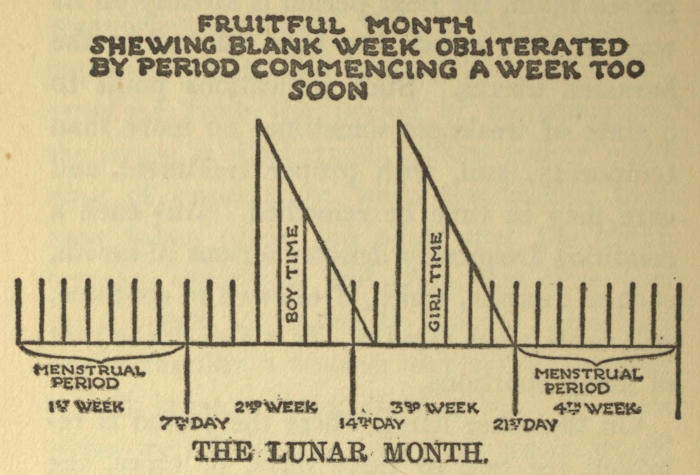
FRUITFUL MONTH SHEWING BLANK WEEK OBLITERATED BY PERIOD COMMENCING A WEEK TOO SOON
It is the latter class of women who are far more susceptible to the fertilisation of the female ova. With persons of rarer and “late” periods, the very opposite conditions prevail. To take a few instances, a woman I know had but one day of actual “flow” every six weeks and invariably relied on a “blank” of twenty days. She gave birth to seven boys, but not a single daughter. Again a certain French peasant woman only had a day’s period every two months; her family consisted of three boys and no girls. An American lady, who gave birth to eight sons and one girl, had a period regularly every five weeks, lasting half a day only. Her first-born was the girl, and it was remarkable that, in early married life, she had been more “regular” with scanty periods.
A lady wanting a son wrote to me as follows:
I fear my periods are very irregular—always three weeks late. I have never had a mishap and am very healthy and robust.
She had two boys in succession.
Another wrote:
I am very regular, but invariably “late,” 32 days being the usual time.
She had sons only.
Another letter runs thus:
Before the birth of my girl I was always very regular at 28 days; now somehow I am always “late.”
Her three following children were boys.
I could give innumerable cases in further support of this contention. In a like manner my available evidence goes to prove the tendency to girl-pregnancies among women of profuse and “early” periods. This is readily understood, when one considers how easily the “blank” week may cease to exist, obliterated by the over-active left ovary, so that the unfortunate wife becomes the mother of an unlooked-for girl. Every alternate month the danger is present, and, though often avoided, may sooner or later cause the advent of a daughter.
A lady writes thus:
My periods are very profuse and always too early; I long for a son, but have had only four girls.
Another writes:
I never have more than ten days entirely free ... but my confinements have been quite normal ... I have two little girls.
With the women of rare and scant menstruation, on the other hand, the “blank” week is very real and reliable.
Lady A. wrote to me as follows:
What you tell me about the blank week I have heard discussed, and some of my friends make use of it.... Twenty years ago, Lady E., a very old friend of mine, said to me in private: “Now, my dear, I do wish you would warn my niece not to have any more children. She is shocked at the idea of preventives, but were you to tell her all about the ‘blank week,’ as my mother told me, I am sure she would make full use of it.”
The mere fact of the right ovary remaining quiescent till its appointed time proves that the male ovary is probably the healthiest and the most likely to produce ova for fertilisation. The right ovary unless diseased is never too early. This is chiefly due to its being naturally stronger and more self-contained, and discharging its ovum after the period has actually begun. Where the periods are too early, it will be generally found that one ovary works quicker than the other, and that this ovary is the left.
Thus it is possible for three weeks to elapse after one period, four after the next or two weeks one time, three and a half the next and so on. If it happens that the male ovary is also “early,” after years of irregularity, this is because of a “reflex” activity, resulting from the insistent stimulus of the left side.
Generally speaking, just as a tendency to constipation bespeaks in any given person better health than proneness to diarrhœa, so the longer “blank” week and the “later” period prove more strength in a woman than the “early” and profuse menstruation. The latter trouble needs drastic treatment; the former responds to gentle coaxing and modifying.
Having thus shown the existence of a “blank” week, which provides immunity from conception to every female enjoying normal health and regular menstruation, we now arrive at the twenty-first day of a woman’s lunar month. Adhering to my programme, let us proceed to examine what occurs, in every normal woman, after the completion of the third week of this fruitful month.
I hope my readers will be clear in their minds, in so far as we have arrived at the point already demonstrated.
(1) When male children are safely and easily begotten.
(2) When the blank week affords nature’s means of repose to the organs of procreation.