DISPOSAL OF SEWAGE.
Reading edition
The vital thing which thus presents itself is the disposal of fecal matter and other refuse so that the wells, upon which most rural families depend for their drinking water, may remain pure. To this matter we will first turn our attention.
Every person who tills the soil is acquainted with the remarkable transforming power of the superficial layers of the earth upon manure and excrement. Out of these offensive wastes harmless substances are produced which are essential to the growth of vegetation. This power, known as decay, is now generally attributed to very minute organisms (bacteria) which are found in immense numbers in the superficial layers of the soil, which diminish in number as we go deeper, and which completely disappear below a depth of 6 to 12 feet, according to the physical condition of the soil. Bacteria are more numerous where waste and excrement are most abundant. When night soil and manure are deposited in excavations or so-called cesspools in the earth, from which the fluid matter may enter the ground at some depth below the surface, where the air or certain kinds of bacteria can penetrate only to a slight extent, the substances, which under the influence of the air (oxygen) and of bacteria near the surface, would have decayed, now undergo partial putrefaction with the setting free of disagreeable gases and odors. The deeper layers of the earth slowly become saturated with organic matter, which is carried by the ground-water into the wells or springs near by. There is also some reason to believe that disease germs live longer in the oxygen-free depths of the soil than at or near the surface.
The extent to which the filling up of the soil with excrementitious matter may go on in densely populated cities has been shown by Fodor for the Hungarian city Budapest. By analyzing the soil at different levels from the surface to a depth of about 13 feet, he found, over an area comprising 15 acres, about 1,000,000,000 pounds organic matter, equivalent to the excrement of 100,000 people voided during thirty-seven years.
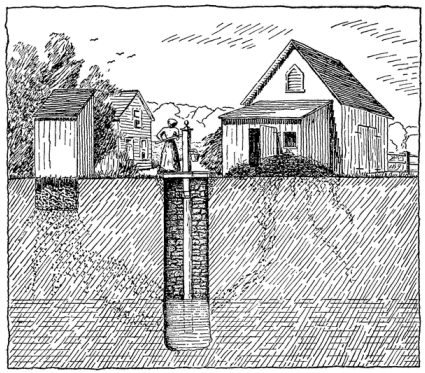
Fig. 1.—The shallow barnyard well, with privy vault and manure heaps near by. The water is likely to receive fluid from these at any time.
To the surface of the earth we owe thus a purifying influence whose activity furnishes us vegetation and food on the one hand and preservation from disease on the other. This purifying power is not possessed by the deeper layers, and therefore the percolation of organic refuse into them from deep cesspools is wasteful to agriculture and dangerous to our storehouse of drinking water.
Even the surface of the soil when overloaded with sewage loses partially its power of purifying the organic matter. After sufficient rest, such an overloaded soil regains its original power. The purifying activity of the soil from a sanitary aspect is the same as that governing fertility from an agricultural standpoint, hence any further discussion of this subject is unnecessary.
A hint as to the proper disposition of waste, excrement, etc., is furnished by what is stated above concerning the purifying capacities of the earth's surface. Waste, night soil, etc., should be deposited with proper precautions on or immediately below the surface of the soil, where it may perform the double function of ridding the household of a nuisance and of enriching the soil itself. This leads us to a consideration of the best means of taking care of the household wastes. These are, in general, of three classes: First, fecal matter; second, kitchen and chamber slops; and third, miscellaneous rubbish and ashes.
NIGHT SOIL.
The proper disposition of fecal matter or night soil in the country has been one of the most pressing and vexatious problems of modern sanitation. Many plans have been suggested, much apparatus has been invented to meet the difficulty, but opinions not only differ but change from year to year and have led to different practices in different countries. Moreover, different climatic conditions and the divergent tendencies of rural populations in the various sections of our own country make it impossible to apply the same scheme to the whole country. Different degrees of prosperity and wealth, even in the same locality, will bring into use widely different schemes to accomplish the same end. There are in use several systems—
The privy.—The old-fashioned privy, at present still quite a common thing even in cities, is, perhaps, the most favored method of disposing of fecal matter in the country. A pit is dug and a small building set over it. The excrement deposited in it slowly fills it up. The fluids and the solids dissolved by them penetrate the subsoil and diffuse themselves in the ground. Rarely is such a pit cleaned out. Another is dug and the old one covered up. In this way the ground becomes overloaded with refuse organic matter. It is even stated on good authority that such collections of fecal matter have been found under the dwelling; also, that the privy vaults have been dug until the current of ground-water was reached which was to facilitate the removal of the excrement. It is difficult to conceive a more pernicious custom, or one more certain to pollute the drinking water. The privy vault is the most rudimentary way of getting rid of night soil, and its dangerous features are too plain to be referred to.
The cesspool.—Next comes the cesspool, which is usually connected with a water-closet, and may also receive the slops from the kitchen.
These are constructed in two ways, either as water-tight receptacles or as simple pervious pits differing in no way from the privy vault excepting, perhaps, in their more dangerous tendencies. All sanitary authorities agree in condemning the leaky cesspool as a most shiftless and dangerous method of getting rid of sewage. In most countries they are prohibited by law in populous communities. In exceptional cases, leaky cesspools may do no harm, as in an isolated house in the country whose cesspool is built at a considerable distance both from the house and the well. The safe distance from any well it would be difficult to state, because that would depend on the character of the subsoil and the general slope of the land. In any case, the cesspool should be on lower ground than the well, as the current of the ground water feeding the latter, usually but not always, conforms to the slope of the surface. A fair estimate of the least allowable distance between well and cesspool would be 100 feet. Soluble salts from sewage might still find their way into the well water, but it is quite improbable that disease germs could penetrate the soil for such a distance except where fissures and cracks may be present.
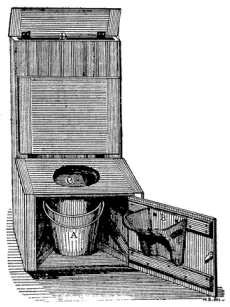
Fig. 2.—Portable earth closet. A, the pail to receive the excrement; B, the urine-separating receptacle hanging on the open door; C, mouth of the hopper conveying the dry-earth or ashes from reservoir D upon the night soil in A.
In villages, leaky cesspools are still of frequent occurrence. If the drinking water is taken from wells, such cesspools are a constant menace, and all that is needed in many such towns is a spark in the shape of some disease germ to kindle an epidemic. It is true that years may pass by without the occurrence of more than the usual amount of illness, but even then we have good reason to suppose that in many villages using cesspools the average amount of sickness and mortality is far too high, not to mention the occasional epidemics of typhoid-fever. We may sum up the matter of leaky cesspools by the statement that they may do no harm near isolated houses on farms, provided they are sufficiently far away from the source of water-supply. In small towns cesspools should be prohibited, or only very thoroughly constructed water-tight ones permitted, according to circumstances. The same holds true for the well-known privies.
The dry-earth closet.—The dry conservancy system is a much better method of disposal of excrement, and is extensively in use to-day even in certain large cities on the Continent of Europe where sewers have not yet been introduced. This consists in the main of the frequent removal of excreta in the country by some man servant or member of the family; in villages and towns according to some cooperative plan. This system has taken various directions, according to circumstances. Thus there are what is called the pail system, which consists in the daily or less frequent removal of a pail receiving the excreta; and the earth closet invented by the Rev. Henry Moule, of England, the chief feature of which consists in the covering of the excreta with some absorbent substance like dry-earth or ashes. In some places the excreta are received into a well-built brick or stone receptacle and covered with earth, from which they may be removed from time to time. Of these systems the dry-earth closet has received the greatest amount of attention and discussion. It consists, essentially, of a pail to receive night soil, which is covered either automatically or with a scoop with dry-earth (fig. 2). The earth absorbs the fluids and the odors and keeps the closet inoffensive.
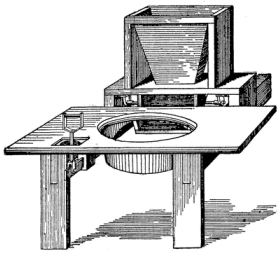
Fig. 3.—The old form of earth closet with frame and pail removed to show the mechanism. The handle on the left when raised throws into the pail a certain quantity of dry-earth or ashes from the reservoir or hopper in the rear.
The earth to be used should be a rather fine loam, sifted to remove coarse particles, thoroughly dried by spreading out in the sun or under a shed, and then stored in barrels. The drier the earth the better it is. The finer the particles of earth the greater the capacity for absorbing fluids. For this reason sand is not satisfactory. Goal or wood ashes are quite satisfactory, as they are, after proper sifting, of the requisite fineness and are thoroughly dry. The mixture of earth or ashes and night soil should be removed at certain times, depending on the location of the closet, the season of the year, and other conditions. The more frequent the removal the better. The mixture of soil and excrement is so unobjectionable that it has been used over a number of times after being dried each time. This can not be recommended, however, as it is generally accepted nowadays that disease germs may remain alive in such a mixture for some time.
In place of the movable earth closets, a water-tight, concreted area may be built in an annex to the house, which is to receive the night soil from a closet on the floor above with the necessary quantity of dry soil (see fig. 4). Poore, from whose book the illustration is taken, recommends, in addition, the construction of the floor of such a pit with an inclination sufficient to carry away the urine into some gutter outside filled with absorbent soil. The area should have suitable openings for inspection and for removal of contents, as well as for ventilation. Waring recommended a similar system many years ago. The closet described by him discharges into a water-tight vault in the cellar, which requires emptying only occasionally. The contents remain inoffensive, provided sufficient thoroughly dry earth is used.
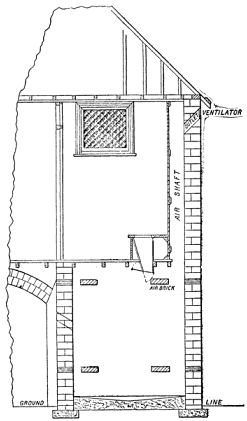
Fig. 4.—Earth closet and dry catch (from Poore's "Rural hygiene," scale, ½ inch equals 1 foot). To prevent drafts the earth closet is closed below by a hinged flap which opens and shuts automatically by means of a counterpoise. The catch below is provided with air bricks and an air shaft leading to a ventilator.
In cold climates, indoor closets are especially desirable to obviate the exposure which can not be avoided when closets are out of doors. For invalids there should be a carefully managed earth closet kept in a well-aired room set apart for this purpose. In warm climates, earth closets should be frequently cleaned. To prevent the attraction of flies and insects and the too rapid decomposition of the contents a little unslacked lime added with the earth to the excrement will be of value. The discharges of persons suffering from typhoid-fever and bowel troubles should be mixed with thin slacked lime[1] (milk of lime). One-half to one hour after the mixing, such discharges may be put upon the soil, always at some distance from a well or spring, a stream, or a field under cultivation.
In Europe, the use of earth and ashes has been superseded by peat dust. The upper layer of peat is dried in the air and ground in a suitable machine. The coarser particles are removed by sifting and used for bedding in stables. The fine portion, which has a very high absorbing power for fluids and is also capable of preventing odors, is used in dry closets. In Germany there are at present about thirty factories engaged in the preparation of peat moss for the purposes mentioned. Its great advantages over dry earth should bring it into use in our country. (See fig. 5.)
It does not matter from a sanitary standpoint which one of the dry-earth systems is adopted, provided the necessary attention be given to it. Every system which can be recommended is bad if not properly attended to. The conditions to be observed are:
The night soil should be received in water-tight receptacles.
It should be frequently removed.
It should be utilized in the garden or field by being placed under a thin layer of soil.
To excreta from the sick, milk of lime or unslacked lime should be added before disposal in the soil.
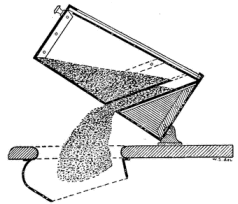
Fig. 5.—Self-acting peat dust closet. The lid is replaced by a hinged reservoir containing the peat dust. Whenever this is let down a certain quantity of peat dust is discharged automatically and thrown, upon the night soil. (From Weyl's Handbuch der Hygiene. II, p. 315.)
The water-closet.—There can be no doubt that to-day the water-carriage system, as it is called, or, in simpler language, the indoor water-closet, is preferred to all other contrivances. This is true for the open country as well as for villages and the suburban territories of cities. There is much to be said in favor of the present-day perfect contrivance for the rapid removal of excreta and the exposure thereby prevented. But for all rural inhabitants the cost should be carefully weighed before a water-carriage system is introduced into a house, for none but the best will answer, as all others are likely to become nuisances.
The supply of water must be sufficient to flush the water-closet thoroughly and keep all the pipes clean; the plumbing must conform to that in vogue in cities, with its traps and ventilating pipes to prevent the odors of the pipes from escaping into the house; and the disposal of the large quantity of liquid sewage, the most difficult problem, must be properly attended to or it is likely to prove more dangerous to the water-supply than the old dry privy pits.
LIQUID SEWAGE.
The methods available to dispose of liquid sewage in the country are water-tight cesspools and irrigation.
Vaults.—Water-tight cesspools should be constructed of hard-burned brick, laid in cement, and having a similar brick or a concreted bottom. The inside and outside surfaces of the brick wall should be coated with a thin layer of cement, and clay rammed in around the wall, to increase its imperviousness to water. It should be vaulted above, and topped by a square or round central opening, covered with stone or iron plate. Cesspools are also made of cast or wrought iron, the joints being made water-tight. Cesspools must be ventilated by two pipes, one rising several feet above ground, the other carried to the roof of the house, barn, or other structure near by. The current will, in most cases, tend down the short and up the long pipe. The latter may be dispensed with and the soil pipe of the house act as a flue, provided all branches are perfectly trapped.
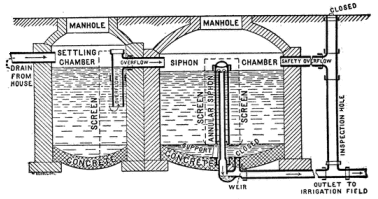
Fig. 6.—Settling chamber and flush tank for surface and subsurface irrigation of sewage. (From Gerhard's "The Disposal of Household Wastes," 1890.)
Irrigation.—The disposal of sewage by irrigation is by far the best method now within reach. Two methods are in use, viz, surface and subsoil irrigation. The first in its most complete form consists in carrying the liquid sewage to a piece of ground set apart for the purpose and carefully underdrained. The sewage is allowed to flow over the ground in shallow channels. The fluid slowly disappears in the soil and enters the drains as comparatively pure water, which may be allowed to flow into a stream. For villages this is the best means of disposing of sewage. Those who as village officials may be interested in this method will find plans of such sewage farms, together with faithful accounts of their operation and the results obtained, in the annual report of the State Board of Health of Massachusetts for 1892, page 559, and same report for 1893, page 563. Suggestions for its application to country houses are given farther on.
For isolated rural homes, or village homes commanding a certain amount of ground around the house, the liquid sewage from water-closets, the kitchen and chamber slops may be disposed of by the simple means of subsoil irrigation, first described by Mr. Moule and subsequently elaborated by Colonel Waring.
The system as used at present in its most successful form consists, outside of the house, of the following parts (see fig. 6):
Two adjoining water-tight receptacles of brick. One of these receives the sewage from the house and is intended to act as a settling chamber for the coarser particles, paper, etc. This communicates with the second receptacle, which receives from it the fluid sewage. This chamber is called the flush tank and is provided with a siphon. When the fluid has reached a certain level, the siphon is set in operation and discharges the contents of the chamber at one time into the subsoil pipes.
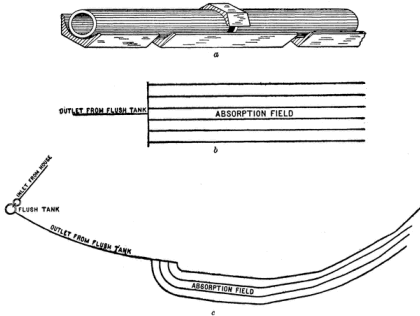
Fig. 7.—Subsurface irrigation of sewage: a, absorption tiles (Gerhard's "The Disposal of Household Wastes"); b and c, lines of absorption tiles showing their relation to flush tank (From Waring's "Sewerage and Land Drainage").
From the second cistern a system of subsoil pipes laid over a treeless piece of ground, preferably a lawn, receives and discharges the sewage into the ground. These pipes should consist of porous tiles, 2 inches in diameter and about 1 foot long, laid from 8 to 16 inches beneath the surface of the ground, and with a gentle inclination of 2 or 3 inches for every 100 feet. The tiles should have open joints not less than one-fourth of an inch wide. They are laid upon earthen gutters and the joints are protected above by caps from being clogged with earth. The intermittent discharge of the liquid sewage is quite essential to the successful working of this system. If the sewage is allowed to dribble away into the pipes certain portions of these will become supersaturated with fluid and others will not receive any; the purification of the sewage in the soil is thereby rendered imperfect. The discharge of a large quantity of fluid at one time, besides scouring the system of pipes, fills it more uniformly and distributes the work to all parts of the subsoil system.
The successful construction of such a plant requires the services of someone familiar with it, and it is therefore not necessary for me to do more than call attention to it here as a highly recommended system for homes, especially in villages, where the proper amount of land is procurable and where the sewage must be disposed of in a manner both inoffensive and safe. In any case the soil of such land must be porous, not clayey and retentive. Those who wish to familiarize themselves with the details will find descriptions in the Sanitary Engineer for 1883, page 530, by Philbrick; in "The Disposal of Household Wastes," by Gerhard, and in "Sewerage and Land Drainage," by Waring. The entire plant is said to cost $200 to $300, the annual expenditures for cleaning, repairs, etc., about $10.
The method of subsurface irrigation just described may be too complex and too expensive where land is abundant and neighboring houses at some distance. The simpler method of surface irrigation may be resorted to by laying out at some distance—at least 100 feet—from the house a small sewage farm where the sewage may flow in shallow trenches over the surface and slowly sink into the ground. Such an irrigation field must have the same qualities demanded by subsurface irrigation. Its surface should have sufficient slope and the soil should be porous, not retentive. The liquid sewage, including kitchen and chamber slops, is conducted to this field in a water-tight tile drain and then allowed to flow into shallow trenches. To avoid the overloading of the soil with sewage at any one place the main distributing trench should be so arranged that it and the irrigating trenches branching from it may be temporarily blocked at any point to divert the sewage into one or more different trenches every day. In winter the warmth of the sewage will keep it in motion and the filtration will go on although the field may be covered with snow and ice. The use of the flush tank as described above would cause a more uniform distribution of the fluid over the field and make the filtration distinctly intermittent. The ground between the trenches may be cultivated to increase the amount of evaporation. If conveniently situated, an orchard may be used as the irrigation field. It should be distinctly understood, however, that marketable fruits and vegetables should not be carelessly allowed to come in contact with fresh sewage, nor should the irrigation field be near the well unless the latter is fairly deep and tubed or tiled to the surface of the water.
KITCHEN AND CHAMBER SLOPS.
The removal of kitchen and chamber slops is a matter which also requires proper attention, as this liquid frequently gives rise to unhealthful conditions, annoying alike to sight and smell when carelessly disposed of. The simplest way to utilize kitchen slops is to pour them upon plants about the house in summer, in winter upon the soil, each time in another spot, so as not to supersaturate the surface layers of soil in any one place. A means of less trouble recommended by Waring is to partly fill with soil a barrel with leaky bottom and cover this with a layer of stable manure to prevent the puddling of the soil. The slops filter through the soil and leave the barrel below as a clear fluid. The barrel is emptied two or three times a year and the contents used for fertilizer.
House slops may be disposed of by surface irrigation or by subsoil pipes, as already described. The originator of this method, Mr. Moule, may here be profitably quoted as to its simplicity and success:
Where there is a garden the house slops and sink water may, in most cases, be made of great value and removed from the house without the least annoyance The only requirement is that there shall be a gradual incline from the house to the garden. Let all the slops fall into a trapped sink, the drain from which to the garden shall be of glazed socket pipes well jointed, and emptying itself into a small tank, 18 inches deep, about a foot wide, and of such length as may be necessary. The surplus rain water from the roof may also enter this. Out of this tank lay 3-inch common drain pipes, 8 feet apart and 12 inches below the surface. Lay mortar at the top and bottom of the joints, leaving the sides open. If these pipes are extended to a considerable length, small tanks about 1 foot square and 18 inches deep must be sunk at about every 20 or 40 feet to allow for subsidence. These can be emptied as often as required, and the deposit may be either mixed with dry-earth or be dug in at once as manure. The liquid oozes into the cultivated soil, and the result is something fabulous. * * *
On a wall 55 feet in length and 16 feet high a vine grows. A 3-inch pipe runs parallel with this at a distance of 6 feet from it for the entire length. The slops flow through this pipe as above described. On this vine year after year had been grown 400 well-ripened bunches of grapes, some of the bunches weighing three-fourths of a pound. During a period of four years, for a certain purpose, the supply was cut off. To the surprise of the gardener scarcely any grapes during those years appeared; but afterwards the supply was restored, and the consequence was an abundant crop, the wood grow fully 16 feet, of good size and well ripened.
In place of an indoor sink, an upright tube or hopper may be constructed out of doors in communication with the subsurface pipes into which the waste fluids are poured.
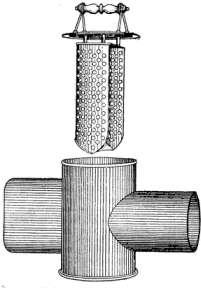
Fig. 8.—Garbage cremator. The garbage is placed in the perforated frame. The latter is pushed into the smoke pipe, where the garbage becomes slowly carbonized.
WASTE AND GARBAGE.
The attractiveness of a rural home depends largely upon the promptness with which all kinds of waste material are disposed of. The abundance of space around the house is a great temptation for the members of the household to use it as a place for storing rubbish and useless, worn-out things. Sifted ashes are easily utilized in earth closets and upon walks and roads, to make them compact and firm. Other articles of no use, such as broken crockery, bottles, tin cans, etc., can be thrown into depressions and gullies and covered over with earth, or else buried in trenches where subsoil drainage is desirable. The removal of rubbish is a very fruitful theme and might be dealt with at length. Its importance as related to health and disease is a subordinate one, and the reformer must appeal to the love of order, propriety, and beauty in and around the home in order to make an impression.
Garbage is of much less annoyance in the country than in the city, where its collection and destruction is a great expense, and is frequently very unsatisfactorily done. In the country, the household garbage is fed to the swine and poultry, and is in this way profitably used. There are, however, homes where garbage must be taken care of in other ways. It may be buried in the garden or else burned in the kitchen range. Recently a device has been patented which enables the housekeeper to place the garbage in a section of the smoke pipe of the range, where it dries out rapidly, burns, and leaves only a little charcoal behind, which may be used for fuel next day. This device has been well recommended by sanitarians (see fig. 8).