PLATES
Reading edition
See larger version
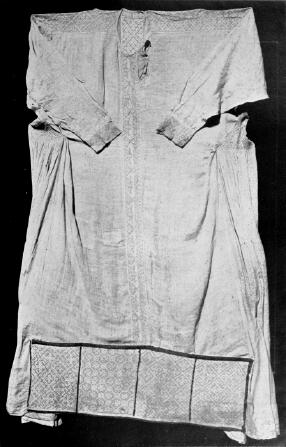
Plate I. THE ALB, PRESERVED AT ASSISI, SAID TO HAVE BEEN WORN BY ST. FRANCIS
See larger version
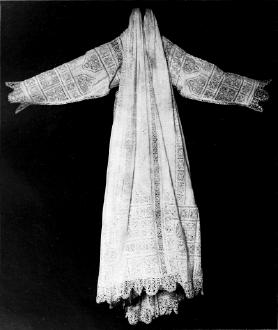
Plate II. THE ALB WHICH IS SAID TO HAVE BEEN WORN BY POPE BONIFACE, A.D. 1298
See larger version
Plate III.
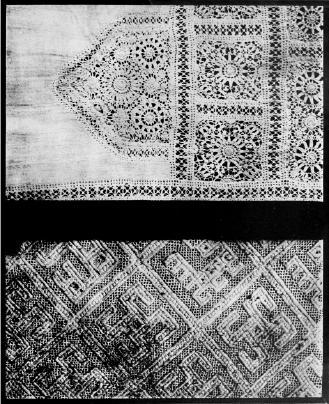
(1) DETAIL OF THE ALB OF POPE BONIFACE VIII. (2) DETAIL OF THE ASSISI ALB.
See larger version
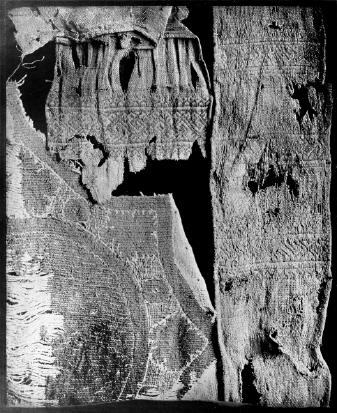
Plate IV. THREE PIECES OF NEEDLEWORK FROM EGYPTO-ROMAN OR COPTIC TOMBS OF THE SECOND AND THIRD CENTURIES
One is part of a circular panel or roundel, and the other two are parts of girdles. The gammadion or symbol of the cross can be traced in all three: and the polygonal character of the design is similar to that of the Assisi alb
See larger version
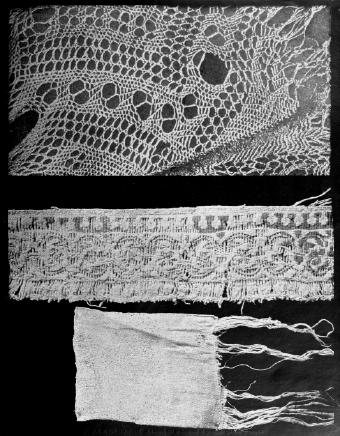
Plate V. (1) A PIECE OF BOBBIN-MADE LACE. (2) DARNED WORK WITH WHITE LINEN THREAD. (3) PORTION OF A MUMMY CLOTH
No. 1 is a piece of bobbin-made lace, found in the Coptic tombs in 1903, and now in the Cluny Museum in Paris. Bobbins were found at the same time. I do not think this fabric was made on a lace pillow, but that a sort of frame with pegs was used to keep the bobbins separate
No. 2 is darned work with linen white thread, very similar to the Italian towel No. 1 in Plate XXVIII.; the background is afterwards darned in with coloured wool. This is also from a Coptic tomb of the third century
No. 3 is a portion of a mummy cloth of the Eighteenth Dynasty, 1700 B.C. The linen is very strong and of a wiry nature
See larger version
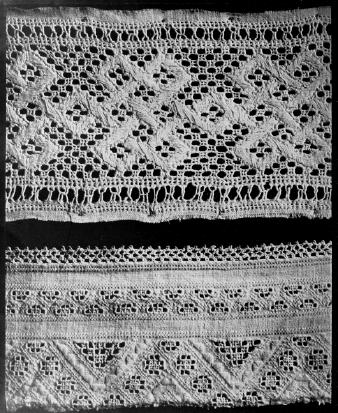
Plate VI. TWO EXAMPLES OF ITALIAN TELA TIRATA AND PUNTO REALE
Chosen as showing similarity to the work of the Assisi alb. Together 13 ft. 7 in. long
Italian. 16th century
See larger version
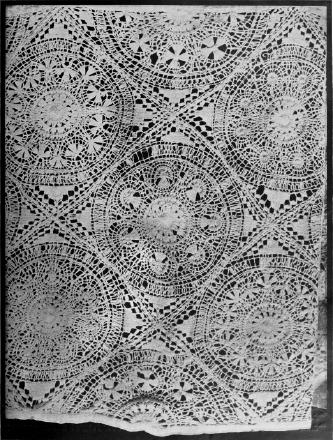
Plate VII. AN EXAMPLE OF EARLY LACIS OR SFILATURA
Chosen as showing similarity to the work of the alb of Pope Boniface. The square mesh netting has centres worked in matting stitch, punto a stuora; threads radiate from these centres and darning stitch and punto di treccia are both used to form various patterns, some cruciform
7 ft. 9 in. × 10 in.
Sicilian, 15th century
See larger version
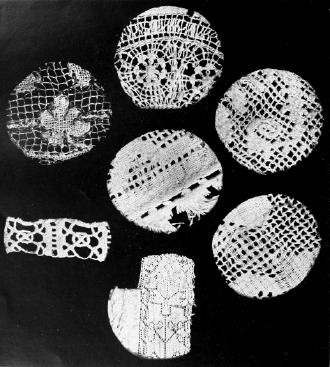
Plate VIII. SEVEN ENLARGED STITCHES USED IN LACIS AND LINEN LACE
No. 1. Early lacis work, showing the punto a stuora and punto di treccia
No. 2. Lacis with square knotted mesh and pattern darned with punto a tela. In this specimen gold thread has been run round the pattern
No. 3. Lacis with a twisted mesh, darned with punto a rammendo; this style is called Buratto in Italy
No. 4. Tela tirata. The threads are only partly drawn, and the pattern left in the linen, some threads being cut
No. 5. Tela tirata. In this style some threads of both warp and woof in the whole piece of linen are drawn: the missing threads of the pattern are then darned in again; the background is then sewn over as in the other style. No threads at all are cut, which makes it more even and durable
No. 6. Punto avorio. The needle-made knots make a very even surface resembling ivory
No. 7. English needle-point, called Hollie or Holy Work, a stitch which resembles the Alençon réseau in the working, as after completing a row the thread is passed back so as always to begin at the same point
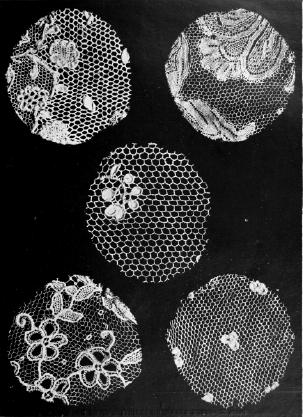
See larger version
Plate IX. FIVE ENLARGED VARIETIES OF RÉSEAUX
No. 1. Small and large réseaux of Point d'Alençon
No. 2. Point de Venise à réseau
No. 3. Point d'Argentan.
No. 4. Brussels needle-made réseau
No. 5. Brussels bobbin-made réseau
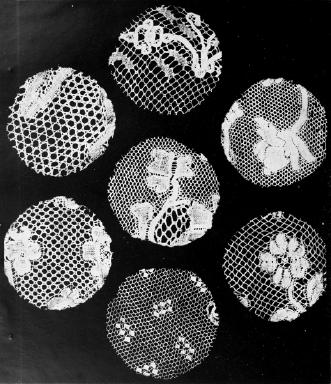
See larger version
Plate X. SEVEN ENLARGED VARIETIES OF RÉSEAUX
No. 1. Bobbin-made Maglia di Spagna
No. 2. Bobbin-made Fond chant or Point de Paris
No. 3. Round mesh bobbin-made Valenciennes
No. 4. Bobbin-made Mechlin
No. 5. Cinq trous réseau
No. 6. Bobbin-made square mesh Valenciennes
No. 7. Lille, Arras, or Buckingham réseau
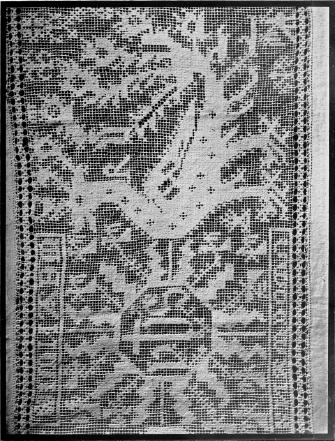
See larger version
Plate XI. BORDER OF LACIS OR DARNED SQUARE MESH NET. PUNTO A TELA OR LINEN-STITCH
With religious inscriptions: a fanciful peacock and the letters I.H.S. surrounded by a glory of flames and by little angular angels
4 ft. 10 in. × 2 ft. 10 in.
Italian, 15th century
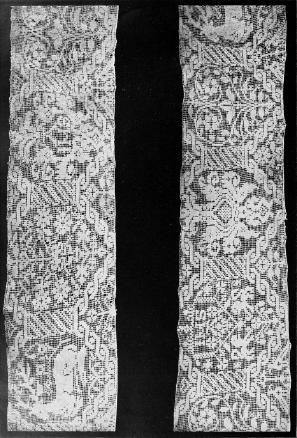
See larger version
Plate XII. BORDER OF SQUARE MESH LACIS
Intended probably for an altar-cloth with a design of ornamental hexagonal compartments worked in linen stitch, in each of which are various devices, I.H.S. in a heart-shape above two heraldic lions, elsewhere a stag, pairs of birds, symmetrical devices of leaf and blossom, etc.
6 ft. × 10 in.
French, 15th century
See larger version
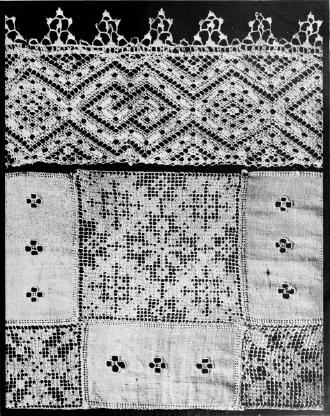
Plate XIII. TWO EXAMPLES OF LACIS WORK
No. 1. Lacis with gammadion, or early Christian symbol. 4 ft.
No. 2. Lacis cover, containing 39 squares of different patterns darned with punto a tela or linen stitch. The border is of bobbin-made lace. 2 ft. 1 in. × 21 in.
Italian, 15th century
See larger version
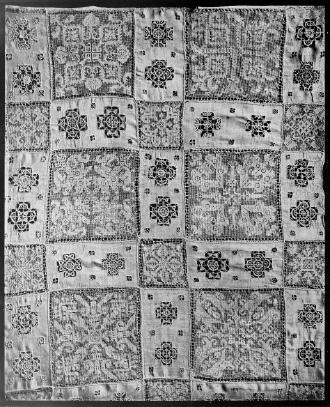
Plate XIV. PART OF A QUILT
Made of squares of lacis work alternating with oblongs of linen in which are squares worked in needle-point called reticello or cut-work.
3 ft. 8 in. × 2 ft. 4 in.
Italian, 15th century
See larger version
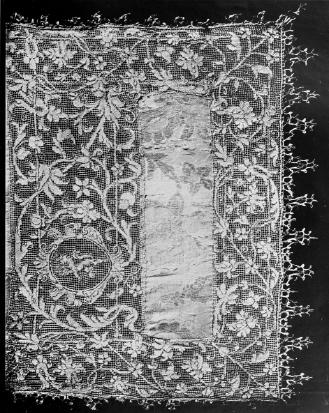
Plate XV. LACIS TABLE-COVER
Of square mesh net worked in linen stitch with bold and graceful scrolls, leaves, etc., amidst which are cartouches of foliated shields bearing a heraldic lion in the centre. The pattern is outlined and enriched with gold thread, and the cartouches have a variety of stitches. It has a bobbin-made vandyke edging of lace (merletti a fuselli) with gold thread introduced into it.
5 ft. 6 in. × 22 in.
Italian, 16th century
See larger version
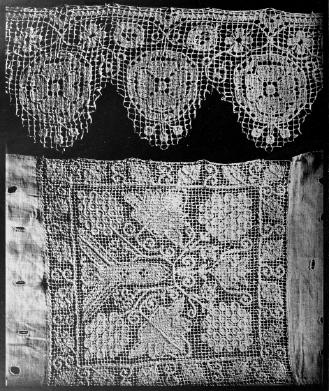
Plate XVI. (1) VANDYKE BORDER OF LACIS. (2) PART OF A QUILT OF SQUARES OF LACIS
No. 1. Vandyke border of lacis knotted square mesh net darned in linen stitch with repeated large and small blossoms; the larger ones resemble Tudor roses. 4 ft.
English, 16th century
No. 2. Part of a quilt of squares of lacis, the one shown has a pattern of a vine: alternating with rectangles of linen decorated with small cut-work. 3 ft. 3 in. × 2 ft.
German, 16th century
The pattern in both pieces is outlined and partly worked with punto riccio
See larger version
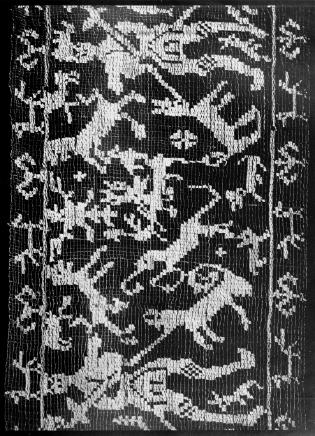
Plate XVII. BORDER OF LACIS WITH THE TWISTED MESH CALLED BURATTO
The design is worked in punto a rammendo with numerous armed men and animals.
5 ft. 9 in.
Italian, 15th century
See larger version
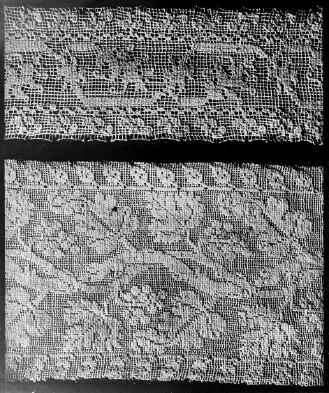
Plate XVIII. TWO BORDERS OF LACIS CALLED BURATTO
The darning or punto a rammendo of the edge pattern is in each case worked the reverse way to that employed for the main design.
Together 4 ft. 7 in.
Italian, 16th century
See larger version
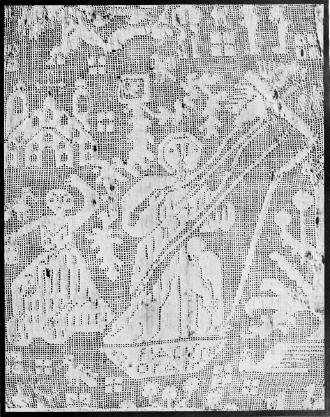
Plate XIX. BAND OF TELA TIRATA OR DRAWN WORK
The pattern left in the linen represents a variety of sacred and other subjects. A king and a queen between whom is an angel: St. Michael engaging Satan: St. Rafael holding Tobit by the hand, etc. The photograph shows a portion, representing St. Francis receiving the Stigmata; below are the words: S. Francisca. ora pr., above to his left a church
6 ft. 7 in. × 12½ in.
Italian, early 14th century
See larger version
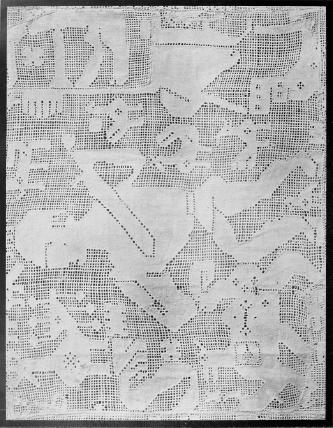
Plate XX. PART OF A COVER OF TELA TIRATA OR DRAWN WORK
The pattern left in the linen includes a man in armour, about to slay a curious beast; elsewhere are archaic birds.
3 ft. 2 in. × 21 in.
Italian, early 14th century
See larger version
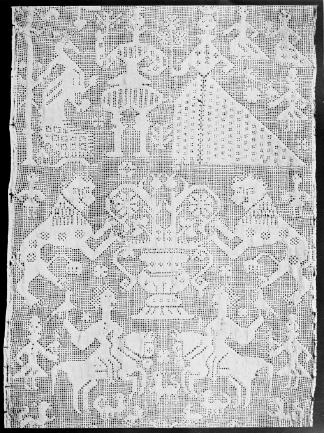
Plate XXI. BAND OR FLOUNCE OF TELA TIRATA OR DRAWN WORK
The pattern includes various figures, a wedding-party above two lions flanking a flower-pot: a hawking-party below
6 ft. 1 in. × 14 in.
Italian, about 1540
See larger version
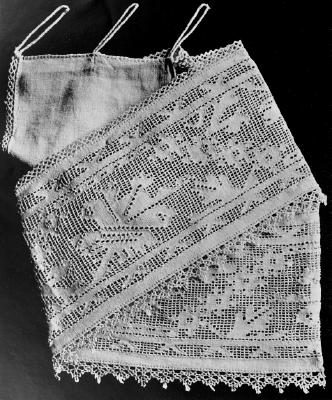
Plate XXII. AN INFANT'S SWADDLING BAND OR "FASCIA" OF TELA TIRATA
The pattern is of a conventional stem and leaf design. The edging on the sides is of bobbin-made lace of two patterns
3 ft. × 6 in.
Sicilian, 16th century
See larger version
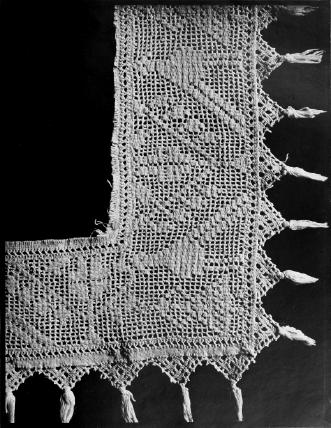
Plate XXIII. BAND OF A VARIETY OF TELA TIRATA
With a darned pattern in heavy thread of female figures alternating with birds; the vandyked edging is of punto avorio
10 ft. 6 in. × 5½ in.
Sardinia, 16th century
See larger version
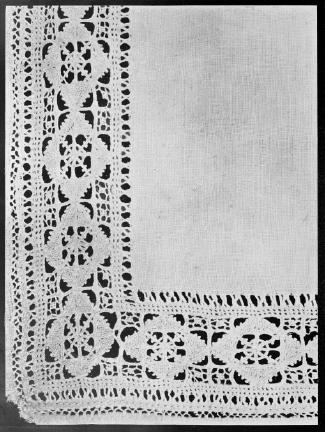
Plate XXIV. LINEN CLOTH WITH BORDER
Of tela tirata worked with looped and knotted stitches and reticello: the geometrical pattern is repeated without variation
25 in. × 17 in.
Italian, 15th century
See larger version
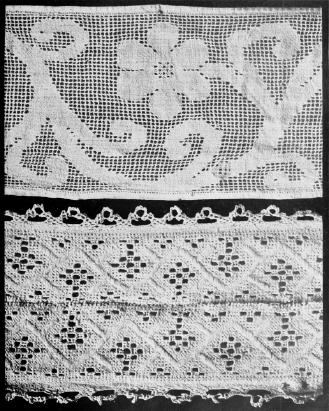
Plate XXV. TWO BANDS
No. 1. Band of a variety of tela tirata or drawn-work: pattern a scroll with a flower: there are no cut threads in this work. 3 ft. 8 in.
No. 2. Band of punto reale and tela tirata with a bobbin-made edging. 4 ft. 11 in.
Italian, 17th century
See larger version
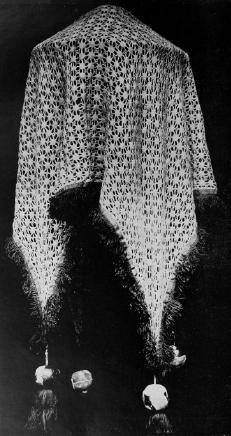
Plate XXVI. PYX VEIL OF TELA TIRATA, OR DRAWN THREAD WORK
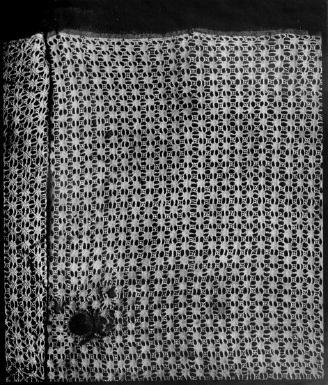
This interesting piece is a survival from pre-reformation times. It is 2 ft. 4 in. square and has no cut threads in it. The pattern is made by drawing 12 threads both of warp and woof and leaving small squares of 12 threads. The loose threads are then most ingeniously whipped over, forming a star-like pattern between the squares. The worker has passed her needle behind the squares 8 times so as to form a star at the back of each square, the corners have wooden balls gilt: and a silk fringe surrounds the whole
See larger version
Plate XXVII. A PORTION OF THE PYX CLOTH, TO SHOW BOTH SIDES OF THE WORK
See larger version
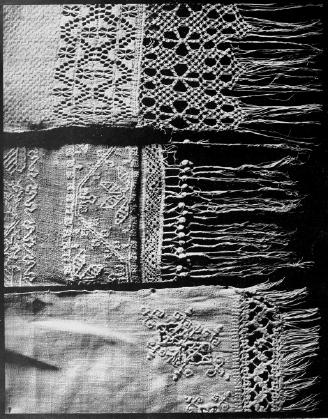
Plate XXVIII. THREE CLOTHS, FRINGED
No. 1 has a geometric effect worked on the drawn foundation: this style is called sfilatura in Italy; the knotted fringe is of macramé. 4 ft. × 2 ft.
No. 2 has a design of birds and scrolls in punto riccio, a border worked in punto avorio, and a curious hand-made fringe. 6 ft. 6 in. × 2 ft.
No. 3 is ornamented with reticello and punto riccio and has a bobbin-made edging and fringe. 3 ft. 6 in. × 2 ft.
See larger version
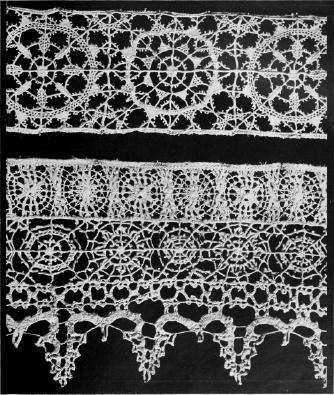
Plate XXIX. TWO BORDERS
No. 1. Border of reticello or needle-point cut-work: the geometrical rosettes are repeated with very slight internal alteration. 9½ in.
No. 2 is a curious piece consisting of two borders and an edging; the upper border is a mixture of punto a festone, punto di treccia and punto a stuora work. The vandyke edge is of bobbin-work (merletti a fuselli). 2 ft. 8 in.
Italian, 15th century
See larger version
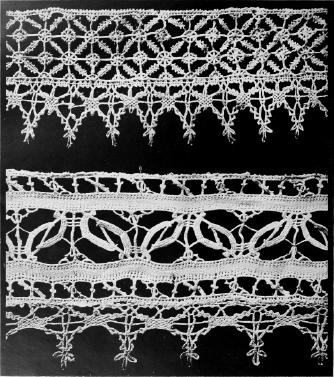
Plate XXX. TWO BORDERS
Of needle-point on linen, called reticello or cut-work. The pointed edgings of both pieces are bobbin-made lace, sometimes called plaited lace
Together 9 ft. 2 in. × 4 in.
Italian, 16th century
See larger version
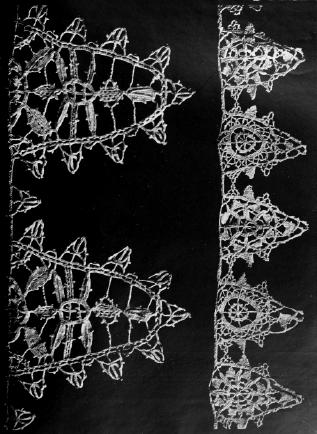
Plate XXXI. TWO EXAMPLES
Of dentated or vandyke edgings of needle-point called punto in aria, because it is made independently of any foundation.
Together 4 ft. 8 in.
Italian, about 1550
See larger version
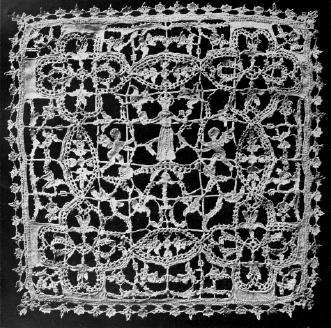
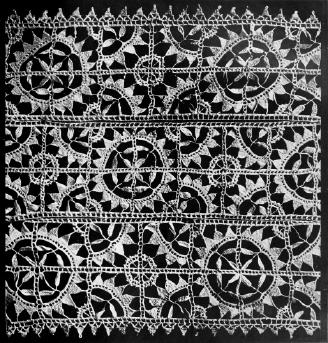
Plate XXXII. CHALICE COVER OF RETICELLO AND PUNTO IN ARIA
In the centre is the figure of St. Peter with the Bible in his right hand and the Keys in his left. Two winged cherubs hold portions of a long chain pattern which encircles the details of conventional foliage and flowers. A lattice of reticello work supports the punto in aria devices. The linen can be seen at the sides, which have an edge of punto in aria.
13½ in. × 7½ in.
17th century
See larger version
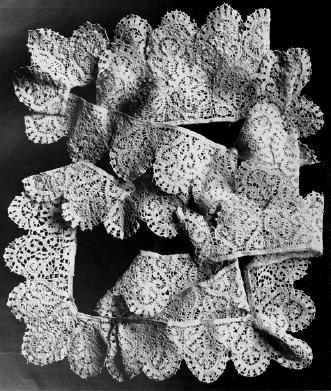
Plate XXXIII. A RETICELLO PATTERN WORKED IN VERY FINE PUNTO IN ARIA AND PUNTO AVORIO
A pointed edge is also finely worked in punto avorio.
5 ft. 8 in.
Italian, 17th century
See larger version
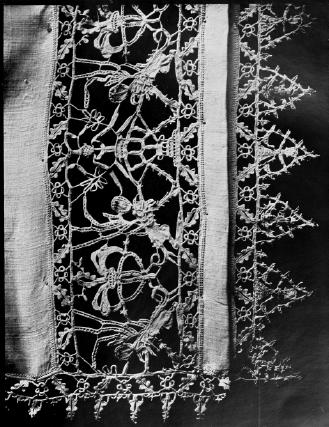
Plate XXXIV. SCALLOPED BORDER OF A CORPORAL OF FLAT NEEDLE-POINT LACE, CALLED PUNTO IN ARIA
In which the repeating conventional semi-floral forms are connected by small brides.
6 ft.
German, early 17th century
See larger version
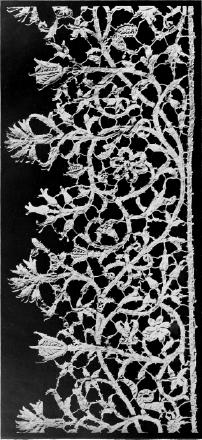
Plate XXXV. A CLOTH WITH INSERTION AND BORDER OF PUNTO IN ARIA
The border has a figure in each vandyke, either a lady with two birds or a siren; the insertion has strange winged and tailed animals supporting vases of flowers: all the figures, birds and animals have tiny black beads for eyes.
6 ft. 4 in. × 3 ft.
Italian, 16th century
See larger version
Plate XXXVI. NEEDLE-POINT BORDER OF FLAT NEEDLE-POINT LACE, CALLED PUNTO IN ARIA
The design of open scrolling and continuous floral stems is arranged to form points alternately of carnations and hyacinths and includes stags, hounds, peacocks and other animals: the Visconti crest—a crowned serpent—is introduced, and the stems sometimes twist into true lovers' knots. This piece was probably made for a wedding.
4 ft. 3 in. × 5½ in.
Venetian, 16th century
See larger version
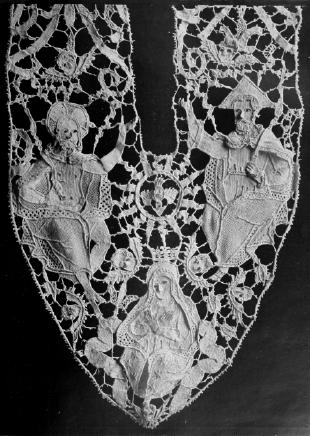
Plate XXXVII. ORNAMENT FOR THE NECK OF AN ALB OF PUNTO IN ARIA
The Madonna, in a robe sprinkled with stars and crowned, is seated on clouds, her foot resting on the head of a cherub. The three persons of the Trinity are above. Cherubs and conventional flowers are introduced into the background: the robes are worked apart from the figures in a lacis stitch called mezza mandolina. Small glass beads are added to the eyes.
18 in. × 6½ in.
16th century
See larger version
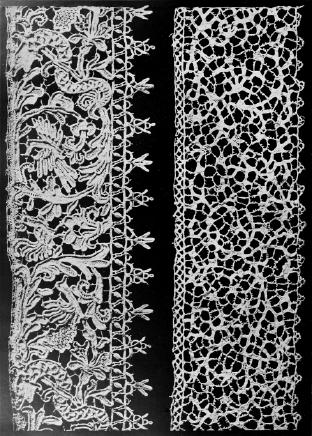
Plate XXXVIII. BORDER AND EDGING
No. 1. Border of needle-point lace, called punto in relievo or rose-point. Birds and serpents occur in the design and each portion of the pattern is outlined by a thick cordonnet worked in buttonhole stitch, punto à festone. This thick cordonnet is also used to denote the scales of the serpent and to accentuate the features of the birds, the narrow braid at the top of the lace is bobbin-made, the edging is of very fine needle-point called punto avorio.
11 in. × 3½ in.
Italian, 16th century
No. 2. Edging of flat needle-point lace à brides. The pattern is a somewhat confused rendering of a continuous scrolling stem type; the brides irregularly introduced have pronounced picots; and this feature has given rise to the title of coraline lace, on account of its suggestion of coral forms.
Venetian, about 1660
See larger version
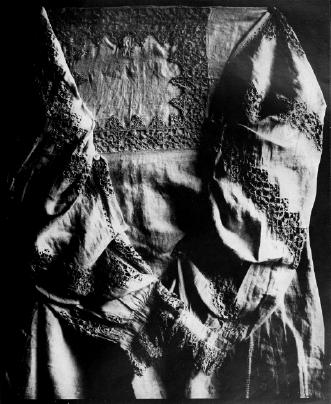
Plate XXXIX. A LADY'S CAMISIA OR SHIRT
The back and front are in one piece with a square opening for the head: this is worked all round with a fine insertion and vandyked edge of punto in aria: the sleeves have oblique insertions of reticello work. In the cuffs bobbin-made lace has replaced the original work
Italian, 16th century
See larger version
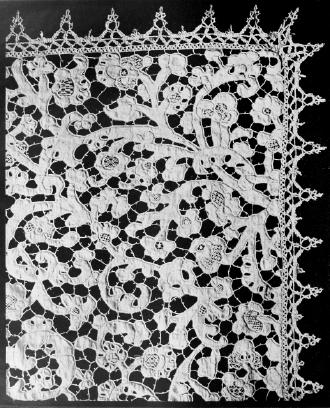
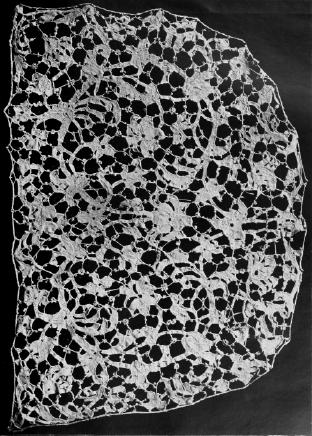
Plate XL. BED-COVER OF CUT LINEN LACE (TELA TAGLIATA A FOLIAMI AND PUNTO A FESTONE)
The pattern is of bold flowing scrolls, cut in linen, edged by buttonhole stitch, and joined by brides: a few modes are introduced into the blossom forms, the edging is of bobbin-made lace (merletto a fuselli).
7 ft. 6 in. × 4 ft. 8 in.
Venetian, 17th century
See larger version
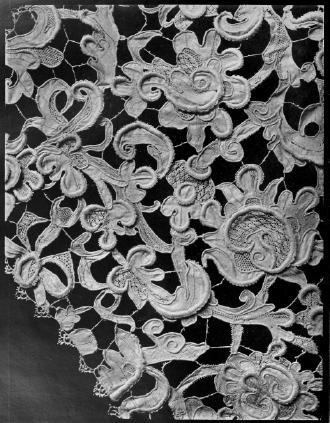
Plate XLI. RABAT OF FLAT NEEDLE-POINT LACE À BRIDES
The pattern is of well-balanced scrolls and conventional flowers enriched with a few simple modes and joined by brides variously picotées
11½ in. × 7½ in.
Venetian, about 1640
See larger version
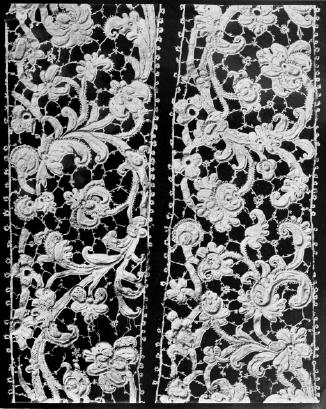
Plate XLII. PART OF A DRESS TRIMMING OF VERY FINE NEEDLE-POINT, CALLED ROSE-POINT (PUNTO TAGLIATO A FOLIAMI)
The pattern wrought chiefly in close toilé consists of scrolls and conventional flowers joined by very few brides. Intermixed with the toilé are variations of simple modes.
31 in. × 10 in.
Venetian, about 1640
See larger version
Plate XLIII. PARTS OF A COLLAR OF NEEDLE-POINT, CALLED ROSE-POINT, OR POINT DE VENISE (PUNTO TAGLIATO A FOLIAMI)
Pattern of continuous scrolls and conventional flowers frequently enriched on their raised cordonnets with picots and joined by brides picotées
5 ft. 9 in. × 3½ in.
Venetian, 17th century
See larger version
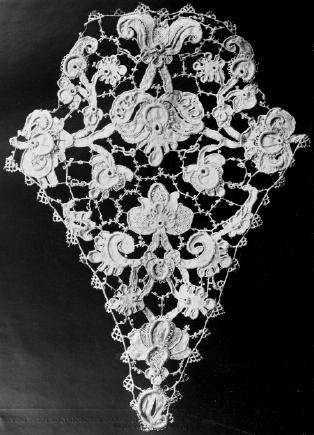
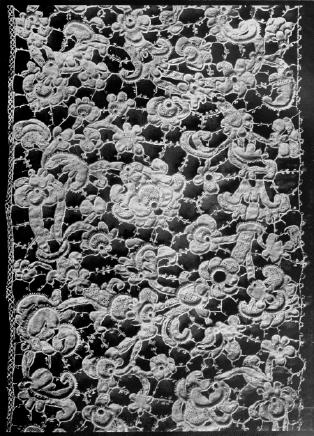
Plate XLIV. STOMACHER (FOR A DRESS) OF NEEDLE-POINT, CALLED ROSE-POINT, OR POINT DE VENISE
(PUNTO TAGLIATO A FOLIAMI)
Pattern of conventional flowers joined by brides picotées: the clothing or toilé of these flowers is of very close work
10 in. long.
Venetian, 17th century
See larger version
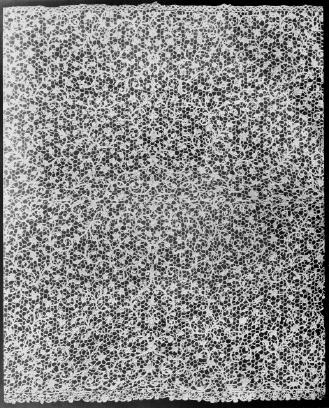
Plate XLV. PART OF A FLOUNCE OF NEEDLE-POINT, CALLED ROSE-POINT, OR POINT DE VENISE
(PUNTO TAGLIATO A FOLIAMI)
A splendid scroll occurs in the pattern here shown which is rich with conventional flowers and double brides picotées
17 in. × 9½ in.
Venetian, 17th century
See larger version
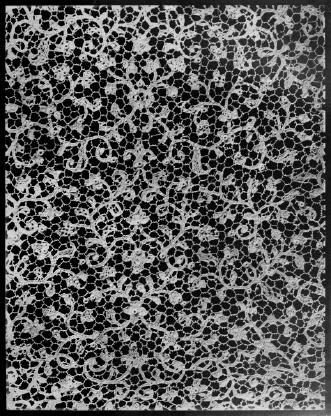
Plate XLVI. PART OF A BEAUTIFUL FLOUNCE OF DELICATE NEEDLE-POINT OF RAISED OR ROSE-POINT LACE, KNOWN AS POINT DE VENISE
The pattern consists of well-balanced elegantly scrolling devices, terminating in conventional leaves and flowers with occasional raised work on them, and is set in a ground of brides picotées arranged in hexagons. The style of many features in the design is French (Louis XIV.) and the specimen seems to be of Franco-Venetian origin
17½ in. × 19½ in.
Venice, 17th century
See larger version
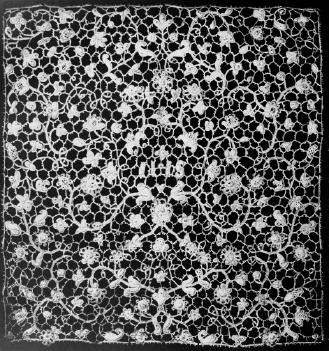
Plate XLVII. PORTION OF XLVI. ACTUAL SIZE
See larger version
Plate XLVIII. PATEN COVER OF NEEDLE-POINT RAISED, OR ROSE-POINT LACE, VERY SIMILAR IN STYLE AND GRACEFULNESS TO THAT OF No. XXXIII.
The pattern consists of slender scrolls, with flowers enriched with massings or galleries of picots surrounding the letters I.H.S. at the centre
6½ in. square.
Venetian, about 1670
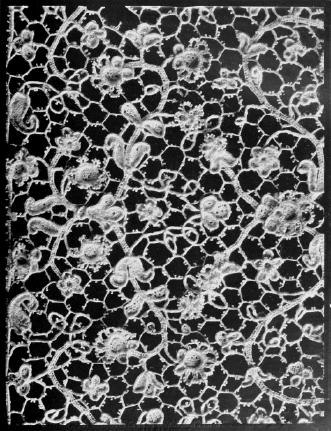
See larger version
Plate XLIX. A PORTION OF XLVIII., MAGNIFIED TO SHOW THE STITCHES
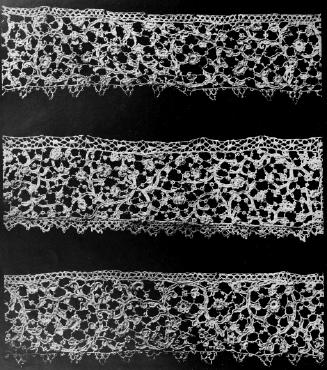
See larger version
Plate L. THREE BORDERS OF DELICATE NEEDLE-POINT RAISED OR ROSE-POINT LACE
Sometimes called point de neige on account of the massings or galleries of picots on the raised rosettes. It is also called rosaline in Italy. Some authorities claim this style as French, and it is one that may be fairly termed Franco-Venetian, about 1670-80
Together 4 ft. 8 in. × 2 in.
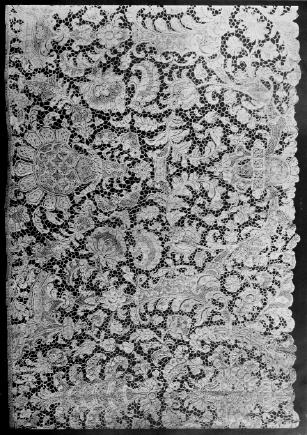
See larger version
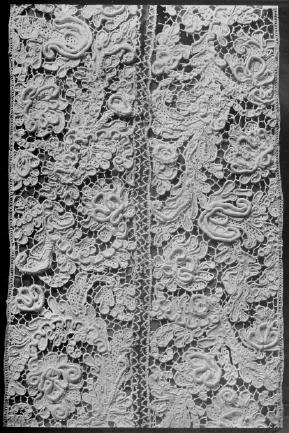
Plate LI. DEEP FLOUNCE OF NEEDLE-POINT LACE À BRIDES PICOTÉES, USUALLY CALLED POINT DE FRANCE
This handsome design, in the rendering of which the play of contrast as between toilé and simple modes is a salient feature, is composed of semi-realistic leaf, fruit and flower forms arranged symmetrically in groups which are repeated alternately through the whole length of the flounce. Accentuations of raised cordonnet are occasionally introduced.
9 ft. 2 in. × 13½ in.
French (Alençon or Sedan), about 1690
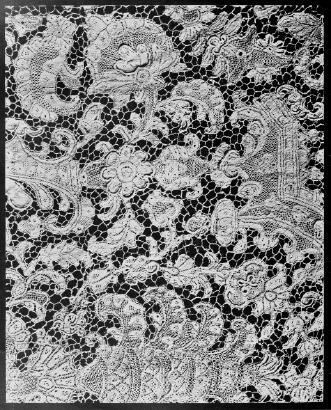
See larger version
Plate LII. PORTION OF LI., ENLARGED
See larger version
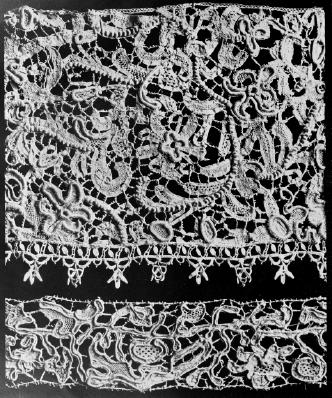
Plate LIII. BORDER OF NEEDLE-POINT RAISED LACE, CALLED SPANISH ROSE-POINT
The fond or toilé of this lace is partly made of bobbin-made tape; on this is raised work, and gimps as well as buttonhole-stitched cordonnets of different dimensions outline and accentuate the rounded serrations and inner portions of the conventional foliage forms, into which are introduced many varieties of modes.
4 ft. 6½ in.
Spanish, 17th century
See larger version
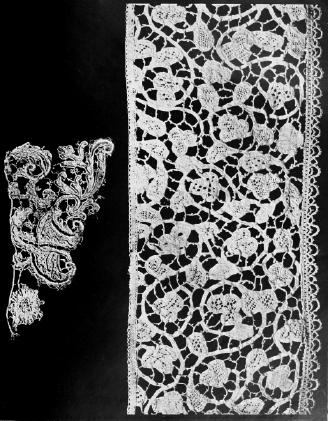
Plate LIV. TWO SPECIMENS OF NEEDLE-POINT RAISED LACE, CALLED SPANISH ROSE-POINT
(SLIGHTLY REDUCED IN SIZE)
This fond is partly of bobbin-made tape: on this is raised work of gimp and various cordonnets buttonhole stitched and edged with loops. These latter, from their sort of caterpillar effect, originate the fanciful name sometimes given of caterpillar point
Spanish, 17th century
See larger version
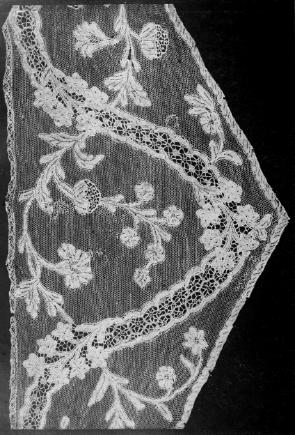
Plate LV. TWO EXAMPLES OF NEEDLE-POINT LACE
No. 1 is of silk needle-point lace with cordonnet, buttonholed in different sizes. This is a small portion, actual size, of the lace used to embellish the Jewish talith or silk mantle or scarf worn at prayers.
Venetian, 17th century
No. 2. Border of needle-point lace sometimes called mezzo-punto, as fine bobbin-made tape or braid is used to outline the pattern, two or three varieties of needle fillings are wrought within the tape forms. 19 in.
17th century
See larger version
Plate LVI. CAP OF NEEDLE-POINT LACE À RÉSEAU
The design consists of a waved open ornamental riband device crossing a spray of conventional flowers. This lace may be distinguished from Alençon by the use of a single thread instead of a buttonholed stitch in the cordonnet as well as by the make and lay of the meshed ground, point de Venise à réseau. The style of the design is borrowed from the French of the latter part of the 17th century.
2 ft. 8 in. × 6 in.
Venetian, late 17th century
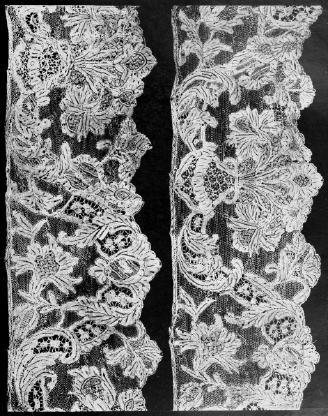
See larger version
Plate LVII. A BORDER OF NEEDLE-POINT LACE, VENETIAN POINT À RÉSEAU
The leading masses of the pattern undulate, and between the undulations are either conventional leaves or flowers filled in with simple diaper modes and more openly arranged brides picotées.
3 ft. 5 in.
Venetian, late 17th century
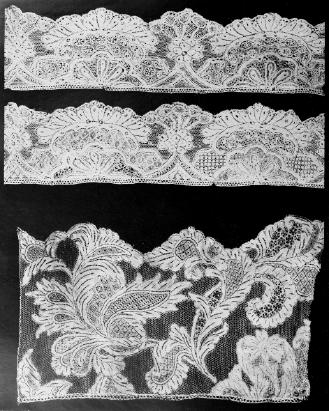
See larger version
Plate LVIII. TWO EXAMPLES OF VENETIAN POINT À RÉSEAU
No. 1. Needle-point lace usually called Venetian point à réseau. The pattern entirely covers the lace and is of conventional floral type: the fillings are very varied. This lace is not Venetian in design, and was probably made at Sedan.
6 ft. 5 in.
Sedan, early 18th century
No. 2 is a beautiful fragment, actual size, of Venetian point à réseau.
Venice, late 17th century
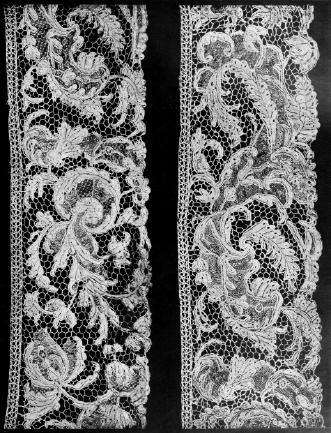
See larger version
Plate LIX. A BORDER OF NEEDLE-POINT LACE, POSSIBLY VENETIAN, THOUGH THE STYLE IS FRENCH
The pattern is of leafy scrolls and conventional flowers well marked, enriched with light fillings and outlined with cordonnet of fine buttonhole stitching. The ground is of buttonholed brides arranged into hexagons strongly suggestive of Point d'Argentan.
6 ft. 6 in.
(French (?) Alençon or Sedan) late 17th century
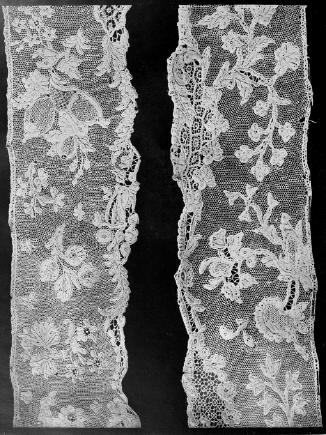
See larger version
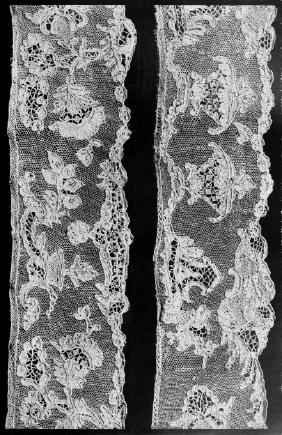
Plate LX. TWO PATTERNS NEEDLE-POINT LACE À RÉSEAU, CALLED POINT D'ALENÇON
In No. 1 the pattern is Venetian in style and the fillings and réseau also mark it as from Burano. In No. 2 the style is more French and it may be from Alençon: every detail of the patterns is outlined with a buttonhole-stitch cordonnet.
Together 9 ft. 6 in.
Late 17th century
See larger version
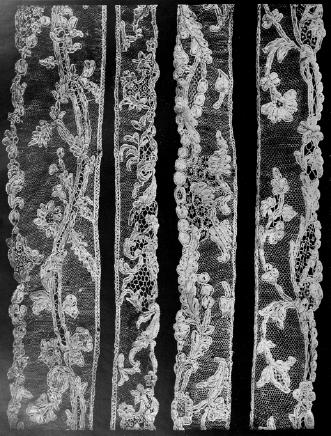
Plate LXI. TWO BORDERS OF NEEDLE-POINT LACE A RÉSEAU, CALLED POINT D'ALENÇON
In the border small compartments are treated with modes or à jours and occasional brides picotées: a buttonhole-stitch cordonnet outlines every detail of the pattern.
4 ft. 8 in.
Alençon, about 1710
See larger version
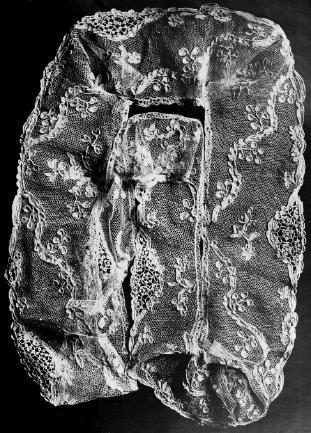
Plate LXII. FOUR BORDERS OF NEEDLE-POINT LACE À RÉSEAU, CALLED POINT D'ALENÇON
Together 13 ft. 6 in.
Alençon, about 1740
See larger version
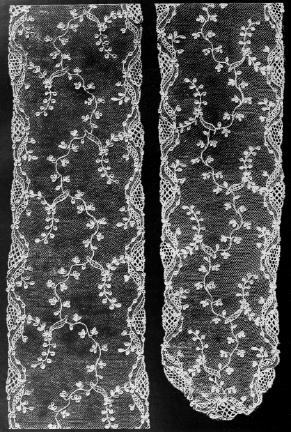
Plate LXIII. CAP-BORDER OF NEEDLE-POINT LACE À RÉSEAU, CALLED POINT D'ALENÇON
The pattern consists of a waved stem serrated, from which spring small sprays of flowers. The width is graduated and the length is without a join. The modes or fillings, at intervals along the edge, are of dainty star and other geometric devices and all particularly characteristic of French (Alençon) lace.
3 ft. 4 in.
Alençon, middle 18th century
See larger version
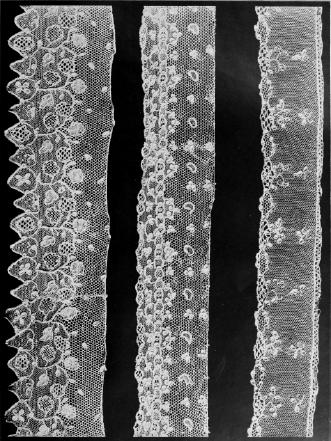
Plate LXIV. BEAUTIFUL LAPPET OF NEEDLE-POINT LACE À RÉSEAU, CALLED POINT D'ALENÇON
The pattern is of tiny wavy stems, having little leaves and peapods, which recur in the design of the outer border with lattice and honeycomb fillings enriched with minute picots.
4 ft.
Alençon, late 18th century
See larger version
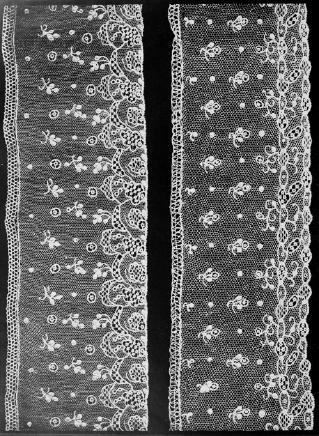
Plate LXV. THREE PATTERNS OF NEEDLE-POINT LACE À RÉSEAU, CALLED POINT D'ALENÇON
The ornamental design is mainly confined to the border, the réseau being sprinkled with dots, called pois or sometimes larmes (hence the expression semé de larmes).
Together 7 ft. 6 in.
Alençon, late 18th century
See larger version
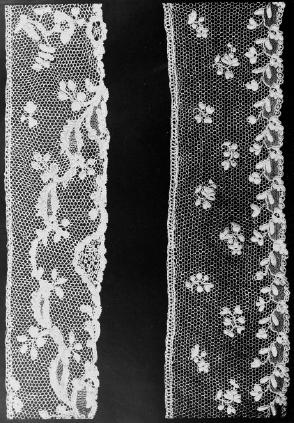
Plate LXVI. TWO PATTERNS OF NEEDLE-POINT LACE À RÉSEAU, CALLED POINT D'ALENÇON
The main ornamentation is along the border. The ground is semé de pois and little sprays, after the style of other such small devices, some of which gave rise to the term semé de larmes.
Together 9 ft. 10 in.
Alençon, late 18th century
See larger version
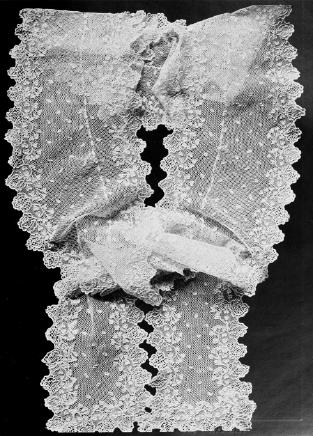
Plate LXVII. CAPE OF NEEDLE-POINT CALLED POINT D'ALENÇON
This piece shows two sizes of mesh in the réseaux: the large forms the main ground, semé de larmes, whilst the finer is introduced as a mode in the border of pointed leafy forms.
5 ft. 3 in. × 5½ in.
See larger version
Plate LXVIII. TWO BORDERS OF NEEDLE-POINT LACE
Called point d'Argentan, on account of the make of the big mesh ground. The pattern of the first is similar to that of No. LXIII.; in the waved garland is a filling of very fine mesh (the Alençon ground). The pattern of the second is of the semé de pois or de larmes style and in the edge is a recurrent filling of fine Alençon ground. The main ground of both pieces is composed of hexagonal meshes worked over in buttonhole stitch, as in Argentan lace.
Together 4 ft. 10 in.
Argentan. No. 1 about 1750. No. 2 about 1780
See larger version
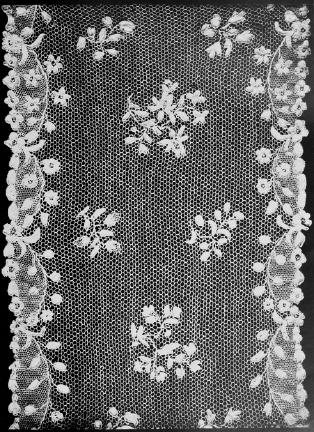
Plate LXIX. LAPPET OF NEEDLE-POINT LACE, CALLED POINT D'ARGENTAN
The edge is formed by repeated curved sprays enclosing small spaces which are filled by a fine Alençon réseau: sprays of flowers also occur at intervals along the lace. The ground is entirely composed of hexagonal meshes worked over in button-hole stitch of Point d'Argentan.
4 ft. 2 in. × 7 in.
Argentan, late 18th century
See larger version
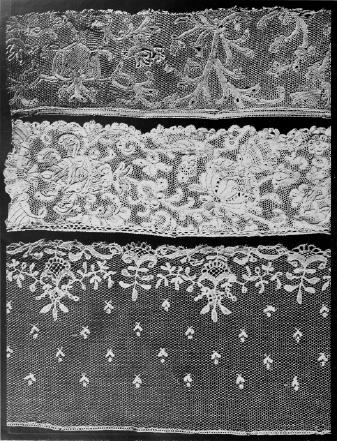
Plate LXX. THREE SPECIMENS OF NEEDLE-POINT LACE
No. 1 is of silk lace à réseau and has a quaint stiff pattern of branches with birds introduced; a stout thread cordonnet outlines most of the pattern, that of the eye, wing and tail of each bird is overworked with buttonhole stitch.
Probably Portuguese, 18th century
No. 2 is from a floral design treated with occasional buttonhole cordonnet as in No. 2.
No. 3. Border of needle-point, called "point de gaze" on account of the extreme delicacy of the bobbin-made réseau (vrai réseau de Bruxelles): the pattern is a flowery border with small sprays recurring in the ground in the style of the Louis XVI. period.
Together 3 ft. 3 in.
Brussels, 18th century
See larger version
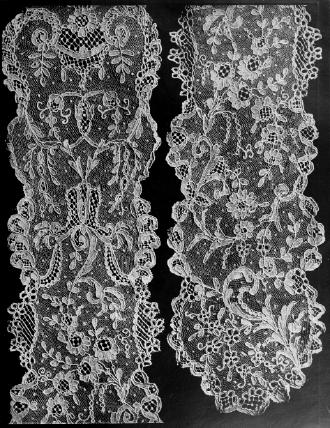
Plate LXXI. LAPPET OF NEEDLE-POINT LACE
Called point de gaze on account of the delicacy of the réseau. The design of scrolls and flowers is chiefly worked in a rather loose toilé, outlined with a stout thread cordonnet and enriched with various open modes or fillings.
3 ft. 3 in. × 4½ in.
Brussels, 1830
See larger version
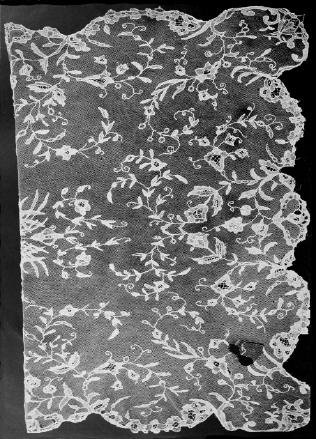
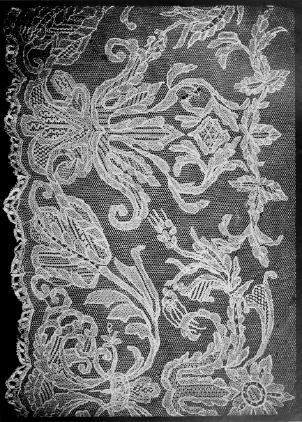
Plate LXXII. PART OF A SCARF
Or veil of light needle-point fine stem floral pattern worked on a foundation of machine-made net
6 ft. × 2 ft.
Brussels, 1840
See larger version
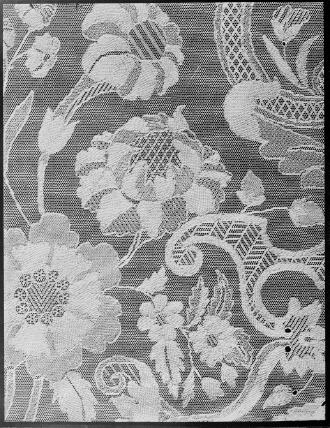
Plate LXXIII. FLOUNCE OF MACHINE-MADE NET WITH PATTERN DARNED ON IT
This class of work is now usually called Limerick lace, but it was often made in England and in many places abroad
3 ft. × 7 in.
Italian, about 1830
See larger version
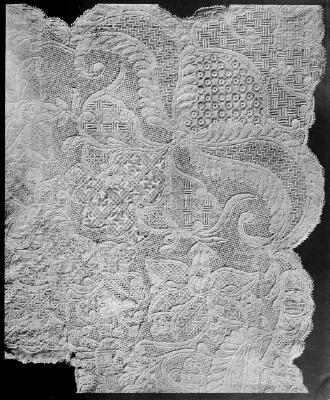
Plate LXXIV. PART OF FULL-SIZE COTTA OF NET WITH LARGE FLOWER PATTERN DARNED IN SILK INTO IT
The work is very evenly done
French, about 1839
See larger version
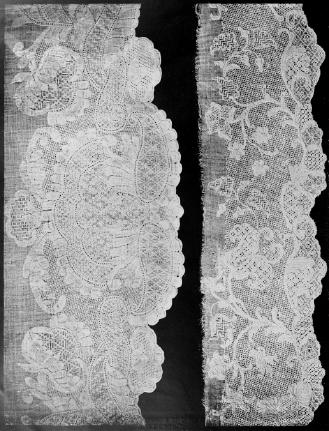
Plate LXXV. A SPECIMEN OF THE EMBROIDERED MUSLIN WORK CALLED TÖNDER LACE
This is formed of two thicknesses of muslin sewn in different patterns by the needle: in places the second thickness of muslin is cut away when the needlework is completed. The design is composed of leaf and floral ornaments gracefully shaped and somewhat French in style
12 in. × 8 in.
Danish, 18th century
See larger version
Plate LXXVI. TWO SPECIMENS OF THE EMBROIDERED MUSLIN WORK, CALLED TÖNDER LACE
In No. 1 only one thickness of muslin is employed: the thicker looking parts of the toilé result from the passing of very evenly darned threads at the back of it
In No. 2 two thicknesses of muslin are used. The floral forms, much more slender than in No. 1, are defined with a stout thread cordonnet.
Together 5 ft. 10 in.
Danish, 18th century
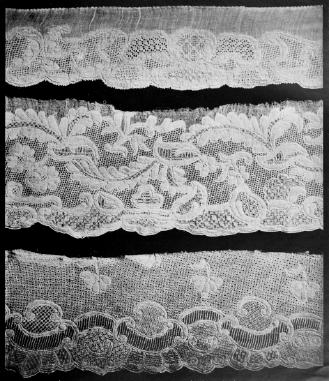
See larger version
Plate LXXVII. THREE PATTERNS OF MUSLIN LACE
From German Bohemia. Two thicknesses of muslin are used.
Together 7 ft.
18th century
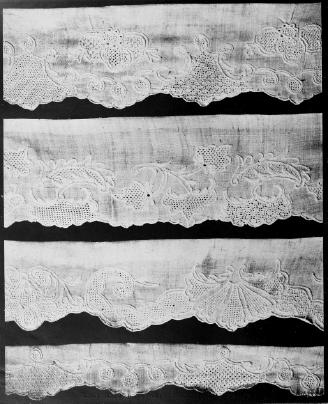
See larger version
Plate LXXVIII. FOUR PATTERNS OF DUTCH LINEN LACE
The outlines of conventional floral patterns are in chain stitch, and the fillings very various and finely executed
Together 8 ft. 9 in.
Gouda, 18th century.
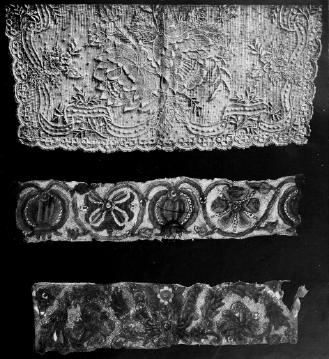
See larger version
Plate LXXIX. (1) MANILA LACE. (2 AND 3) LACE WORKED IN NEEDLE-POINT
No. 1. A specimen of needlework called Manila lace, made upon a light cambric-like stuff woven from fibre of great fineness. The flowers are embroidered and the whole ground of square meshes is worked by the needle, in the same way as the tela tirata work
Manila, about 1840
Nos. 2 and 3. Lace worked in fine needlepoint stitches with human hair of different shades—the pattern is evidently copied from the Venetian
English, about 1800
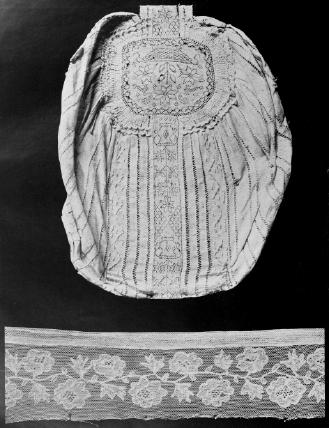
See larger version
Plate LXXX. (1) INFANT'S BAPTISM CAP. (2) A CAP BORDER
No. 1. Infant's Baptism cap with insertions of needlepoint lace called Hollie or Holy point: the design in the crown shows the doves and the pot with flowers reminiscent of the Annunciation
English, 16th century
No. 2. A cap border of Limerick run lace
Irish, 19th century
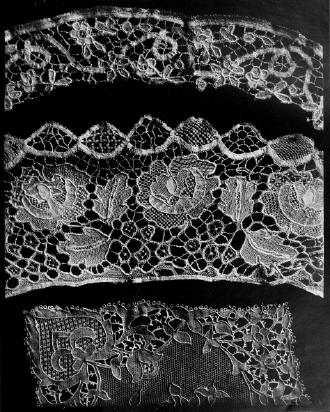
See larger version
Plate LXXXI. THREE SPECIMENS OF EARLY IRISH NEEDLE-POINT LACE
No. 1 has a tape introduced. No. 3 is the so-called Carrickmacross lace (first made about 1848)
Together 6 ft.
About 1848
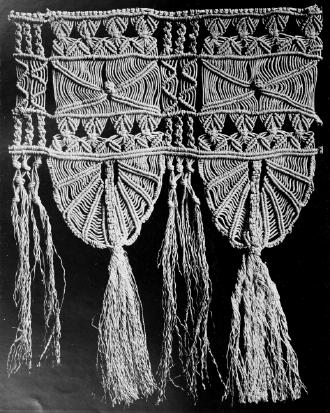
See larger version
Plate LXXXII. SPECIMEN OF KNOTTED AND TWISTED STRING OR THREAD WORK, CALLED MACRAMÉ
This sort of work is often made by knotting the frayed ends on the edge of a woven material, or else separately by knotting strings of cords of linen or silk, the ends of which are fastened to a small cushion or pillow, but bobbins are not used in this work.
10 in. × 12 in.
Italian, 18th century
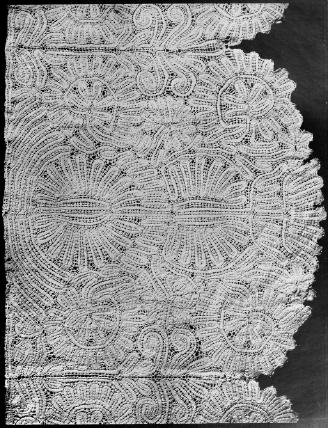
See larger version
Plate LXXXIII. FLOUNCE
For an alb of bobbin-made lace, in the making of which a continuous braid is used to form the pattern. The lace is shaped on its lower edge into flatly curving scallops or mitres.
9 ft. 4 in. × 10½ in.
Maltese, early 16th century
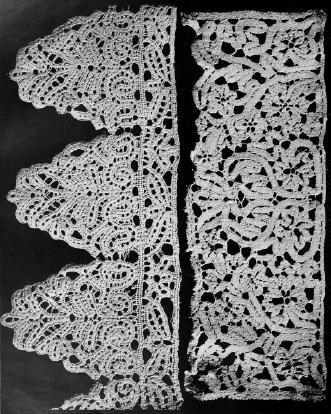
See larger version
Plate LXXXIV. TWO PATTERNS OF BOBBIN-MADE LACE
No. 1 a design decidedly Eastern. No. 2 has a floral design. Both are made in the first manner, the pattern entirely carried out with the tape it was begun with, no brides or réseau being added
Together 4 ft. 7 in.
Venetian, 16th century
See larger version
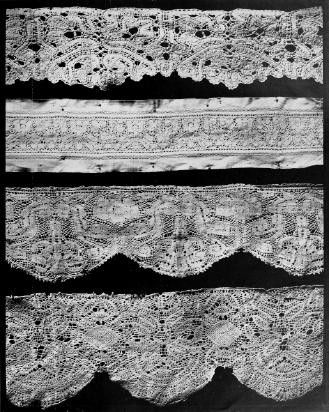
Plate LXXXV. FOUR BOBBIN-MADE LACES (REDUCED IN SIZE)
No. 1 is peasant lace of the familiar type
No. 2 a fine insertion to ornament bed-linen, with a conventional floral design
No. 3 a similar design in a coarser lace
Italian, 16th century
No. 4 is a Maltese lace of the 16th century
Together 10 ft. 2 in.
See larger version
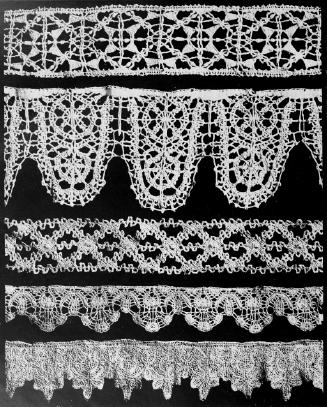
Plate LXXXVI. FOUR BOBBIN-MADE LACES (REDUCED IN SIZE)
No. 1 is a reticello pattern
No. 2 is a vandyked pattern in so-called plaited lace
No. 3 is a simple plaited lace or gimp
Italian, 16th century
Nos. 4 and 5 are very fine examples of early Italian bobbin laces of 16th century.
Together 23½ yards
See larger version
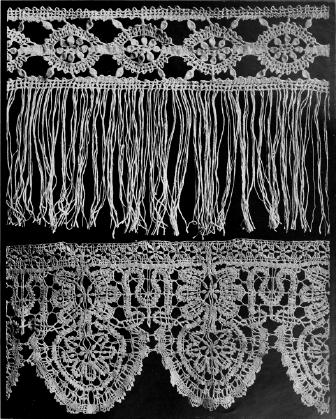
Plate LXXXVII. BOBBIN-MADE LACE
No. 1. Fringed edging of bobbin-made lace. In both pieces the characteristic little seed shapes are freely used
No. 2. Scalloped border of bobbin-made lace called collar lace, in which the ornament is formed chiefly by a continuous narrow toilé or braid. The same threads are used in the whole width of the lace
Together 3 ft. 2 in.
Genoese, late 16th or early 17th century
See larger version
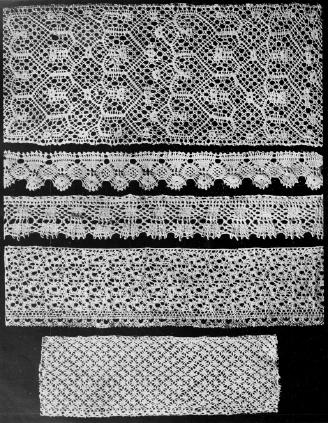
Plate LXXXVIII. FIVE BOBBIN-MADE LACES
No. 1 a curious early pattern of lace made in Umbria
Nos. 2 and 3 are Sicilian peasant laces
No. 4 a lace called in Umbria piedi di gallina
No. 5 a peasant lace called zeccatello
Together 10 ft. 4 in.
Italian, 16th century
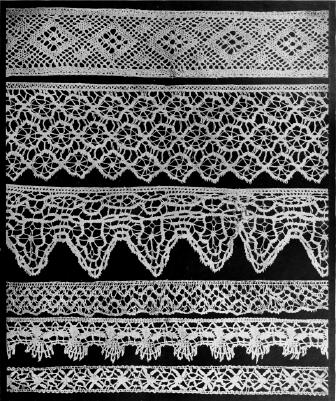
See larger version
Plate LXXXIX. SIX SPECIMENS OF LACE MADE BEFORE 1850
One each in Russia, Madeira, Portugal, and Ceylon, and two from Le Puy in France
Together 14 ft.
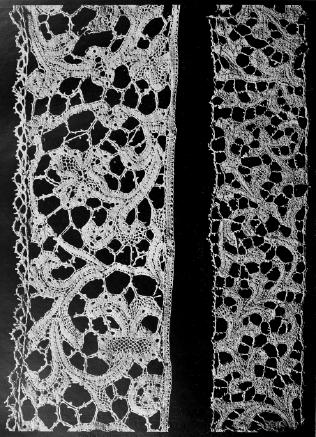
See larger version
Plate XC. TWO BORDERS OF BOBBIN-MADE LACE À BRIDES
The pattern of scrolls and leaves is made separately and joined on the pillow by single and knotted brides in the smaller piece and by double and knotted brides in the larger one.
Together, 8 ft. 7 in. × 5 in.
Genoese, 17th century
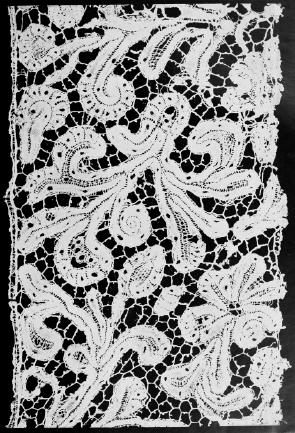
See larger version
Plate XCI. FLOUNCE OF BOBBIN-MADE LACE À BRIDES IN WHICH THE TOILÉ IS WELL DEVELOPED
The pattern is of large conventional sprays made separately on the pillow and afterwards joined by bobbin-made knotted brides.
5 ft. 7 in. × 6 in.
Italian, early 17th century
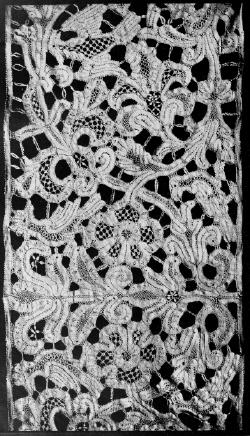
See larger version
Plate XCII. FLOUNCE OF BOBBIN-MADE LACE
The pattern includes birds (an eagle, a peacock, a parrot, a crow, etc.) set amidst conventional scrolls and flowers. These are all made separately and joined on the pillow by double and knotted brides
9 ft. 11 in. × 9 in.
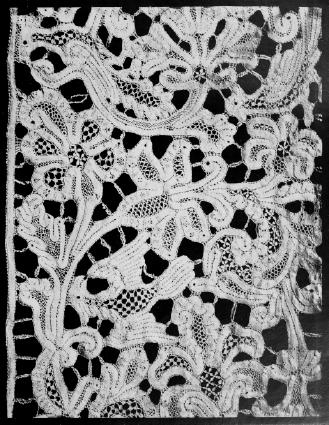
See larger version
Plate XCIII.
The lace, as XCII actual size.
Genoese, 17th century
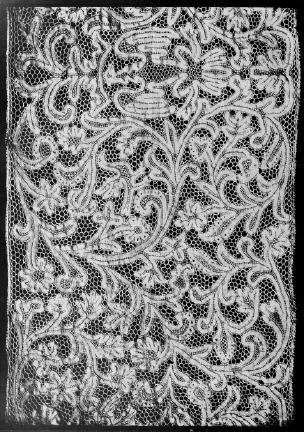
See larger version
Plate XCIV. FLOUNCE OF BOBBIN-MADE LACE
The pattern of beautifully arranged scrolls and flowers includes an eagle with a "marquis" coronet and other small birds: a réseau connects the whole.
3 ft. × 12 in.
Milanese, 18th century
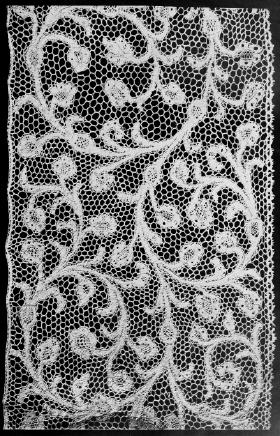
See larger version
Plate XCV. PART OF A FLOUNCE FOR AN ALB, OF BOBBIN-MADE LACE À RÉSEAU
The pattern is made separately and arranged to form conventional scrolls and flowers: a réseau unites the whole.
16 in. × 8 in.
Milanese, 17th century
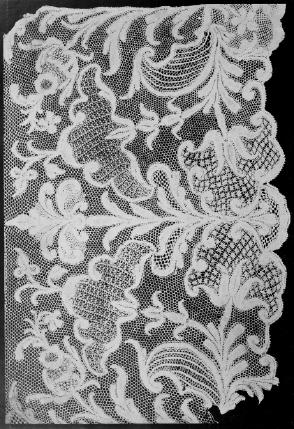
See larger version
Plate XCVI. FLOUNCE FOR AN ALB OF BOBBIN-MADE LACE À RÉSEAU
The pattern is of graceful conventional floral and other forms arranged symmetrically in groups repeating one another. A variety of noticeable fillings is introduced. This specimen is reduced in size.
9 ft. 8 in. × 14½ in.
Milanese, 18th century
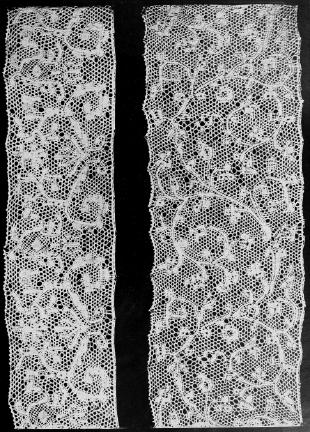
See larger version
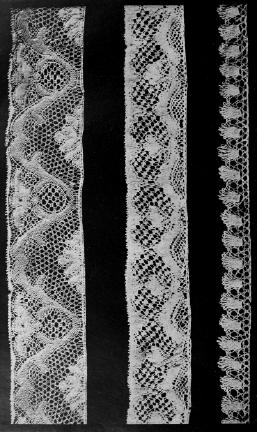
Plate XCVII. TWO BORDERS OF BOBBIN-MADE LACE
No. 1. Border of bobbin-made lace. The pattern consists of repeated groupings of scrolls and pendant forms; the same thread is used throughout
Italian, 17th century
No. 2. Border of bobbin-made lace à réseau. The pattern is composed with a slender toilé arranged to form continuous scrolls with leafy offshoots: the réseau ground is of the fond chant type: the same thread is used throughout.
Together 11 ft.
Italian, 17th century
See larger version
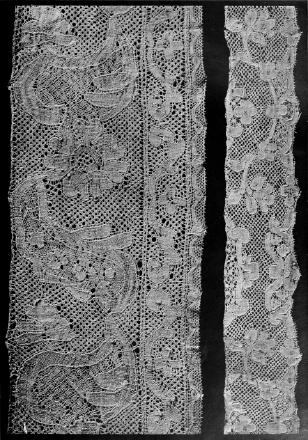
Plate XCVIII. THREE BORDERS OF BOBBIN-MADE EDGING
Together 10 ft. 7 in.
Maltese, 18th century
See larger version
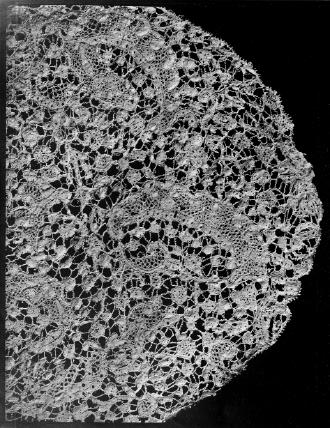
Plate XCIX. BOBBIN-MADE LACE À RÉSEAU
No. 1 is made up of three lengths of lace sewn together. The straight edge indicates perhaps an earlier date for this interesting specimen than that of the narrower piece.
Together 5 ft.
Flanders, 17th century
See larger version
Plate C. CAP OF BOBBIN-MADE LACE, CALLED POINT DE FLANDRE À BRIDES PICOTÉES
The ornamental details were made separately and then joined by bobbin-made brides: the modes or fillings are in the style of the cinq trous réseau.
12 in. long
Flanders, late 17th century
See larger version
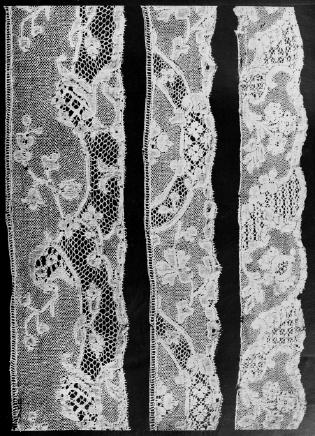
Plate CI. THREE PATTERNS OF BOBBIN-MADE MECHLIN LACE
The patterns are in the style of the Point d'Angleterre, but the toilé is outlined with a thread cordonnet: the same quality of thread is used for both toilé, réseau and fillings: the réseau is peculiar to this beautiful lace.
Together 6 ft.
Mechlin, early 18th century
See larger version
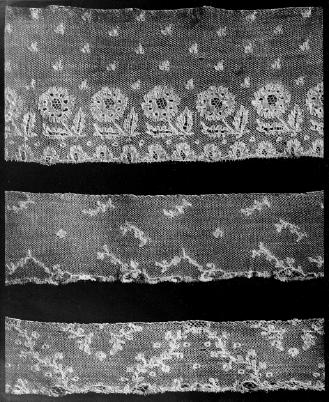
Plate CII. THREE BORDERS OF BOBBIN-MADE MECHLIN LACE
The patterns of the later style of lace are much lighter in effect and gradually become merely a border of small floral ornament.
Together 9 ft. 8 in.
Mechlin, late 18th century
See larger version
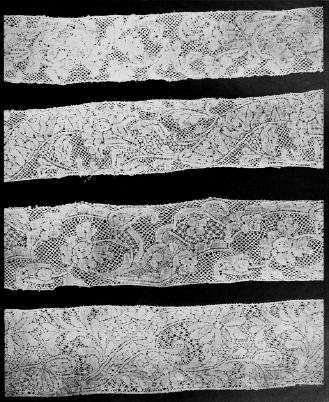
Plate CIII. FOUR SPECIMENS OF BOBBIN-MADE LACE, CALLED BINCHE LACE
The same threads are used for the whole width of the lace.
Together 6 ft. 6 in.
Binche, late 17th century
See larger version
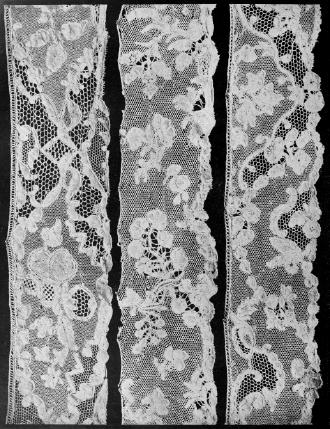
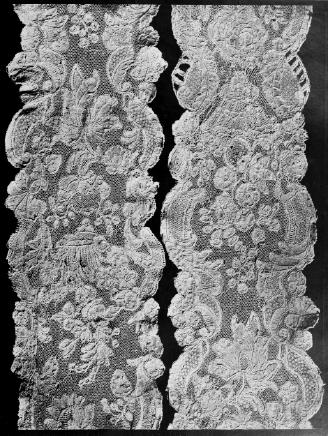
Plate CIV. THREE BORDERS OF BOBBIN-MADE LACE, À VRAI RÉSEAU DE BRUXELLES, CALLED POINT D'ANGLETERRE.
The toilé details were made separately and joined on the pillow by a réseau. The fillings are very varied and beautiful. These borders are worked from Louis XV. designs.
Together 8 ft. 8 in.
Brussels, 17th century
See larger version
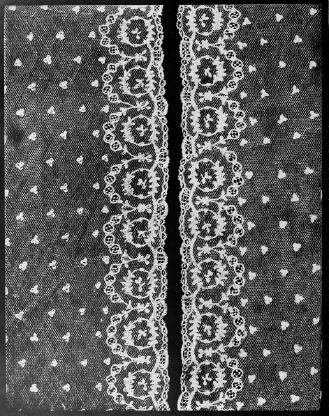
Plate CV. LAPPET OF BOBBIN-MADE LACE, CALLED POINT D'ANGLETERRE
Leafy, blossom and other shapes in toilé are arranged to form the outer waved edges between which are baskets of flowers, etc. The toilé forms are partially accentuated with a plaited cordonnet. The details of the pattern are made separately on the pillow, and then joined by a fine réseau, called vrai réseau de Bruxelles. The fillings are wonderfully fine.
4 ft. 10 in. × 3 in.
Brussels, 18th century
See larger version
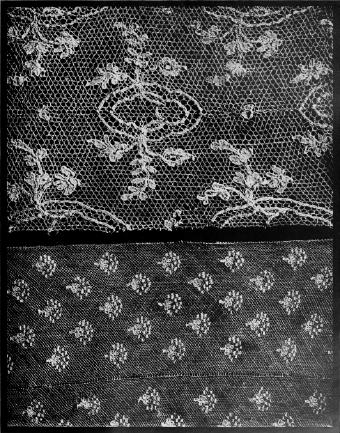
Plate CVI. TWO PARTS OF A BORDER OF BOBBIN-MADE LACE, CALLED BRUSSELS POINT
The flowers made separately and almost entirely of a plaited cordonnet are joined on the pillow by a fine vrai réseau de Bruxelles. The design is in the style of Louis XVI. point d'Alençon. The reverse of the lace is shown in No. 2. The thread of the réseau can be seen passing behind the patterns.
5 ft. 3 in. × 5 in.
Brussels, 18th century
See larger version
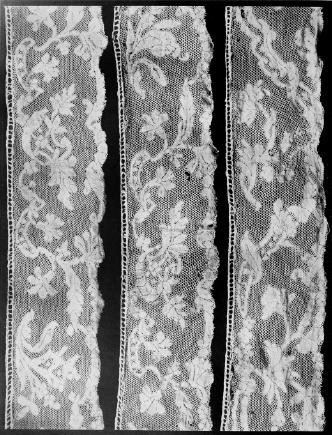
Plate CVII. (1) A SCARF. (2) A CAP
No. 1. A scarf of bobbin-made lace, called Antwerp lace, or Potten Kant or Pot Lace. The réseau is somewhat similar to that of the point de Paris, a variant of the cinq trous. The lace is made on the pillow in strips which are almost imperceptibly joined together. The toilé details are outlined with a stout thread cordonnet
12 ft. × 8 in.
Antwerp, late 18th century
No. 2. A cap of bobbin-made lace, called Lille lace. The lace is made on the pillow in strips, joined together. The réseau is of simply twisted threads.
11 in. × 11 in.
Lille, late 18th century
See larger version
Plate CVIII. THREE BORDERS OF BOBBIN-MADE LACE, CALLED VALENCIENNES POINT
This early Valenciennes has a round plaited mesh, in distinction to that of the later Valenciennes lace, which has a square mesh
Together 8 ft. 5 in.
Valenciennes, 18th century
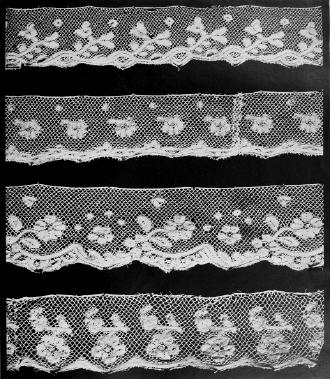
See larger version
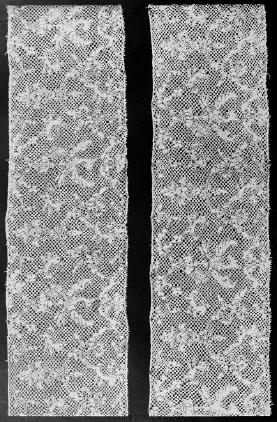
Plate CIX. FOUR BORDERS OF BOBBIN-MADE LACE, CALLED VALENCIENNES LACE, WITH SQUARE MESH RÉSEAU
Together 7 ft.
Yprès, 19th century
See larger version
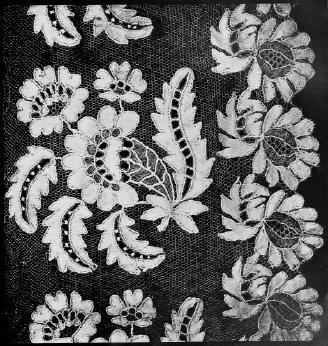
Plate CX. BORDER OF BOBBIN-MADE LACE, WITH A POINT DE PARIS RÉSEAU
An eagle, with shield, dogs and stags are repeated in the pattern. The réseau and the toilé are both made with the same thread.
4 ft. 10 in. × 3 in.
Paris, late 17th century
See larger version
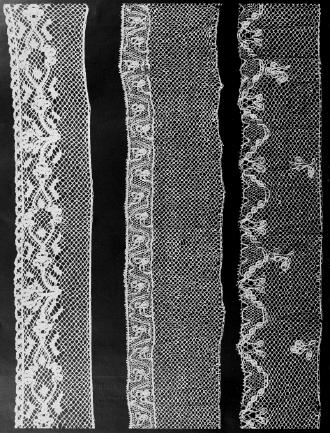
Plate CXI. FLOUNCE FOR A DRESS, OF BOBBIN-MADE SILK LACE
Pattern of repeated heavy flowers in sprays, forming a waved edge
Made at Chantilly, 1820-30
See larger version
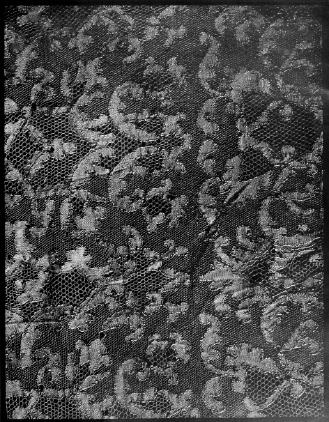
Plate CXII. THREE BORDERS OF BOBBIN-MADE LACE WITH A RÉSEAU OF MAGLIA DI SPAGNA
No. 1 is of linen thread with a heavy thread introduced, not as in some Flemish laces to outline the pattern, but to form strong leading lines in it.
Nos. 2 and 3 are bobbin-made silk lace, a coarser silk thread is introduced. These were the ruffles for a coat sleeve
Together 9 ft.
Spanish, late 18th century
See larger version
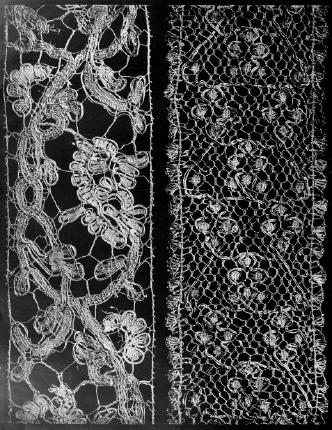
Plate CXIII. MANTILLA OR SCARF OF BOBBIN-MADE BLACK SILK LACE
Some of the fillings are of the point de Paris réseau, also called fond chant from Chantilly, where much of the so-called Spanish silk lace was made
9 ft. × 30 in.
Bought in Madrid in 1840
See larger version
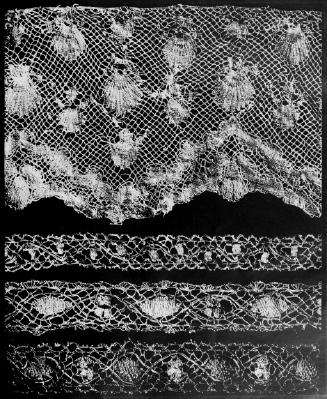
Plate CXIV. TWO EXAMPLES OF BOBBIN-MADE INSERTION
No. 1. Spanish bobbin-made insertion: the stems are of gold and the flowers of silver
16th century
No. 2. Genoese bobbin-made insertion of silver with shell pattern edge.
Together 3 ft. 6 in.
17th century
See larger version
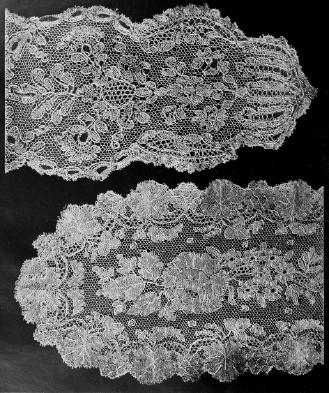
Plate CXV. FOUR PATTERNS OF ITALIAN GOLD AND SILVER BOBBIN-MADE LACE
Probably made at Lucca.
Together 11 ft. 6 in.
17th century
See larger version
Plate CXVI. TWO LAPPETS OF BOBBIN-MADE BLACK
No. 1. Lappet of bobbin-made black Bedfordshire silk lace
No. 2. Lappet of bobbin-made black Brussels silk lace
Together 7 ft.
About 1848
See larger version
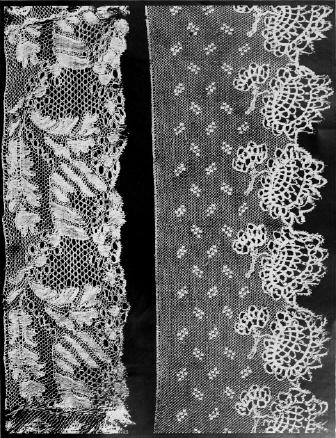
Plate CXVII. TWO BORDERS OF BOBBIN-MADE LACE
No. 1. Bobbin-made lace. The pattern of leaves is outlined in parts by a stout thread
No. 2. A large flower repeated forms the edge. The characteristic very simple réseau is spotted with groups of six small square dots
Together 4 ft. 10 in.
Bucks, 18th century
See larger version
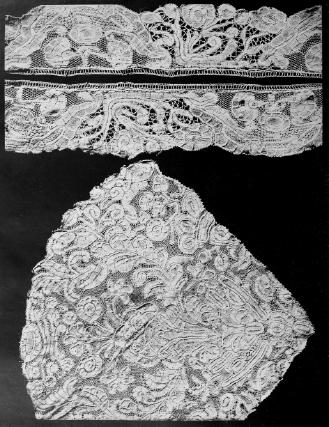
Plate CXVIII. BORDER AND CAP CROWN OF BOBBIN-MADE LACE
Of Devonshire make in the style of Point d'Angleterre or Brussels lace. The toilé details are made separately and joined partly by réseau and partly by brides picotées. The upper piece shows the back of the lace, with the threads from the réseau carried across the toilé of the pattern. The convolutions of the toilé in the blossoms are considered to be characteristic of Honiton lace.
3 ft. 4 in.
Honiton, 18th century
See larger version
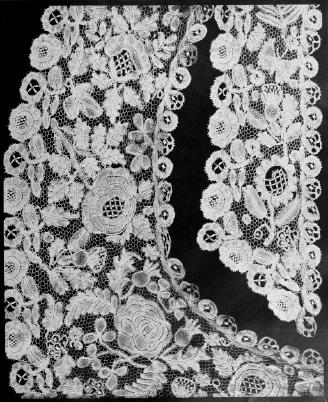
Plate CXIX. LAPPET OF BOBBIN-MADE LACE
The toilé flowers and leaves, chiefly rose, shamrock and thistle, are joined by an irregular mesh simple réseau made by hand. The original design was perhaps to celebrate the Union.
5 ft. × 5½ in.
Honiton, about 1840
See larger version
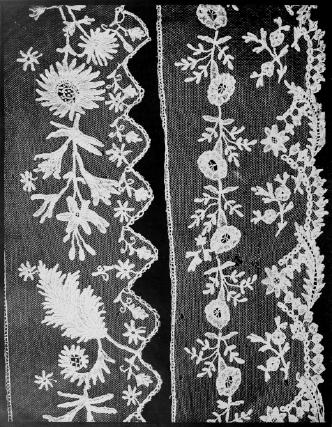
Plate CXX.TWO BORDERS OF APPLIQUÉ LACE, ONE WITH A VANDYKE EDGE AND ONE WITH A MITRED OR SCALLOPED EDGE
The flowers are of bobbin-made lace with accentuations of plaited cordonnet as in Point d'Angleterre, and then applied and sewn to machine-made net.
Together 4 ft. 5 in.
Devonshire (Honiton)