INTRODUCTORY REMARKS. (continued 2)
Reading edition

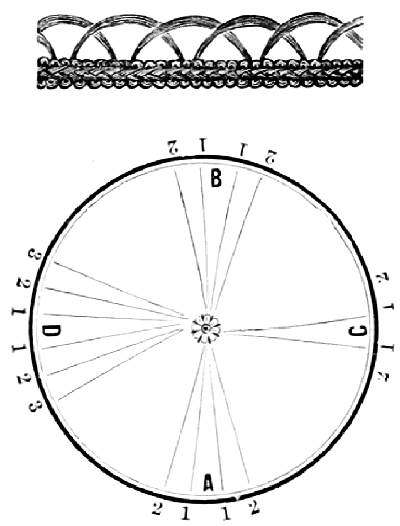
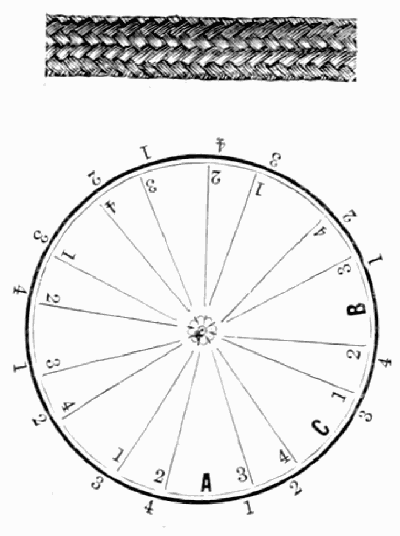
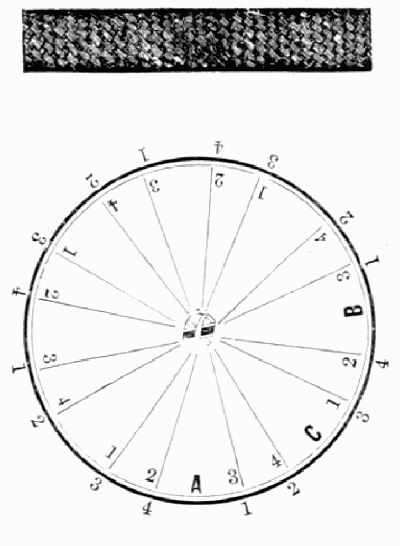
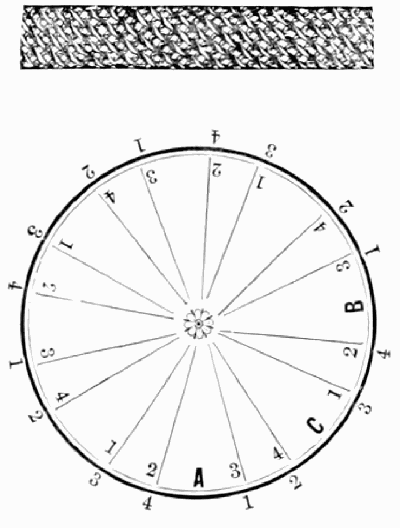
Take sixteen strands, fifteen hairs in a strand, and place on table like pattern. Commence at A, lift Nos. 2 across inside of Nos. 2 at B, and bring back Nos. 2 from B to A; then take Nos. 1 at A, lift across inside of Nos. 1 at B, and cross them, the one in right hand over the left, and bring back Nos. 1 from B to A, and cross the right over the left; then go to D, lift Nos. 1 across inside of Nos. 1 at C, cross the right over the left, and bring back Nos. 1 from C to D, and cross the right over the left; then repeat all from the beginning three times round the table. Then go to D, lift Nos. 3, cross the right over the left, and lay them outside of Nos. 1 at C; then go to A, lift Nos. 2 across inside of Nos. 2 at B, and bring back Nos. 2 from B to A; then take Nos. 1 at A, lift across inside of Nos. 1 at B, cross the right over the left, and bring back Nos. 1 from B to A, and cross them; then go to D, lift Nos. 1 across inside of Nos. 1 at C, cross the right over the left, and bring back Nos. 1 from C to D; then take Nos. 3 at C, and lay inside of Nos. 2 at D, and leave them there. Then you are through the braid, ready to commence at A, as at first.
See explanation on page 9.

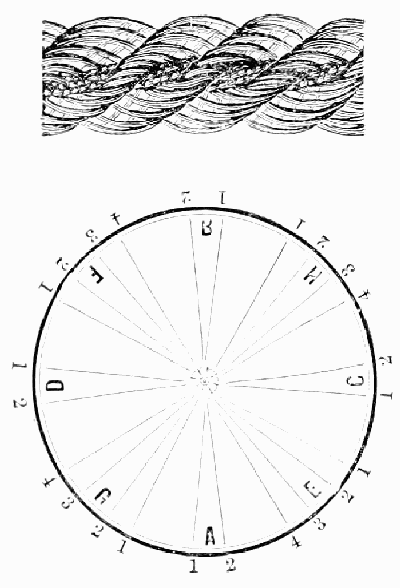
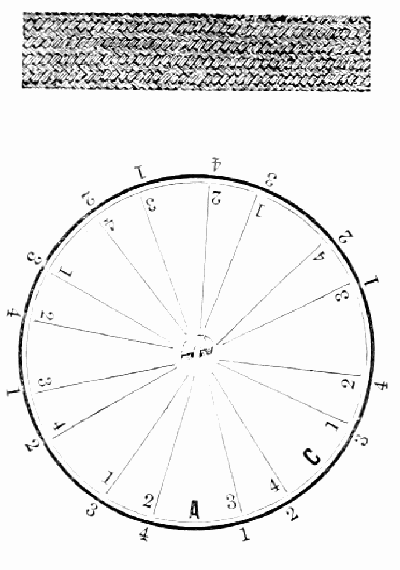
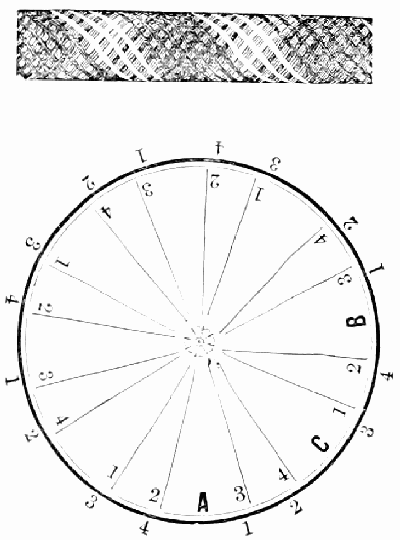
Take twenty-four strands, eighty hairs in a strand, and place on table like pattern. Commence at A, lift Nos. 1 and 2 across inside of Nos. 1 and 2 at B, and bring back Nos. 1 and 2 from B to A; then go to C, lift Nos. 1 and 2 across inside of Nos. 1 and 2 at D, and bring back Nos. 1 and 2 from D to C; then go to A and change the Nos. 1 and 2 from A to B the same as at first; then take Nos. 1 at E and F, swing round table to the left, and lay them down between Nos. 1 and 2 at A and B; then lay the Nos. 2 at A and B in place of Nos. 4 at E and F; then change the Nos. 1 and 2 at C across inside of Nos. 1 and 2 at D, and bring back Nos. 1 and 2 from D to C; then change the same at A and B; then change again at C and D the same; then take Nos. 1 at H and G, swing round table to the left, and lay them between Nos. 1 and 2 at C and D, and lay the Nos. 2 at C and D in place of Nos. 4 at H and G. Then you are through the braid, ready to commence at A, as at first.
Braid it over a strong cord, and when braided push it close together, tie the ends, and boil in water five minutes; then heat it in an oven until it is quite dry, and it is ready for use.

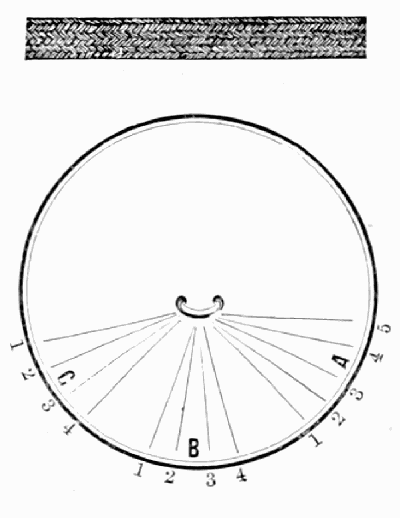
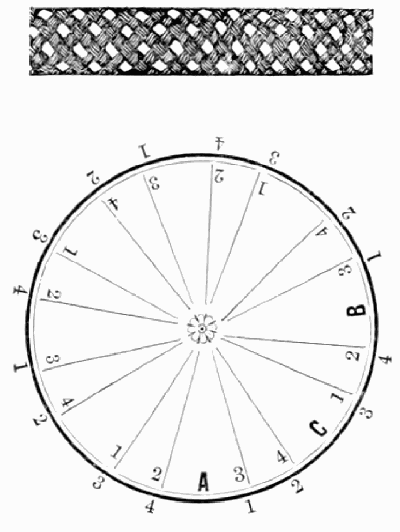
Take thirteen strands, fifteen hairs in a strand, and place on table like pattern. Commence at A, lift No. 5 over between Nos. 2 and 3 at A; then take No. 1 at A, and lift over between Nos. 2 and 3 at B; then take No. 1 at B, and lift over between Nos. 2 and 3 at C; then lift No. 1 at C over between Nos. 2 and 3 at C; then lift No. 4 at C over between Nos. 2 and 3 at B; then lift No. 4 at B over between Nos. 2 and 3 at A. Then you are through the braid, ready to commence as at first, and repeating until it is the required length. Then tie it out straight on a flat stick, boil it in water five minutes, then heat it in an oven as hot as it will bear without burning, until it is quite dry, and then it is ready for use.
The above directions, after braiding, will suffice for finishing all Ring Braids, unless other directions are given.
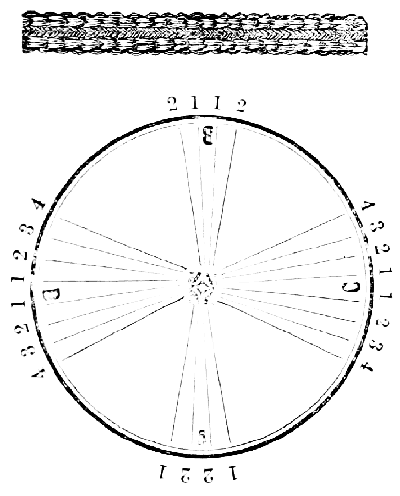
Take twenty-four strands, twenty hairs in the strands at C and D, and ten hairs in the strands at A and B, and place on table like pattern. Commence at A, take Nos. 1 and lift across table and lay inside of Nos. 1 at B, and bring back Nos. 2 from B and lay outside of Nos. 2 at A; then go to C, take Nos. 1, cross over and lay in between Nos. 1 at D, and bring back Nos. 1 from D to C; then take Nos. 3 at C, cross inside of Nos. 3 at D, and bring back Nos. 3 from D to C; then take Nos. 4 at C, cross over inside of Nos. 4 at D, and bring back Nos. 4 from D to C; then commence at A, and change them at A and B as at first; then go to C and commence with the Nos. 2. You must leave the Nos. 1 every other time and the Nos. 2 every other time, and braid it as at first.

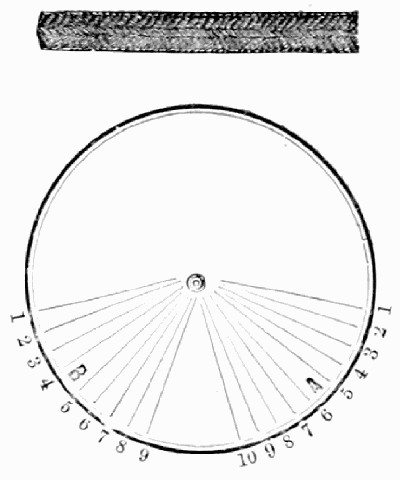
Take nineteen strands, twenty hairs in a strand, and place on table like pattern. Commence at A, take No. 1 and lift over Nos. 2 and 3, under 4 and 5, over 6, 7, 8, 9 and 10, and lay over to B; then take No. 1 at B, lift over Nos. 2 and 3, under 4 and 5, over 6, 7, 8, 9 and 10, and lay over to A; then you are through the braid, ready to commence at A, as at first,—first round to the left, and then to the right, and so on, repeating the changes as above, until the braid is finished. Then tie it out straight on a flat stick, boil in water five minutes, then heat it in an oven as hot as it will bear without burning until it is quite dry, and then it is ready for use.
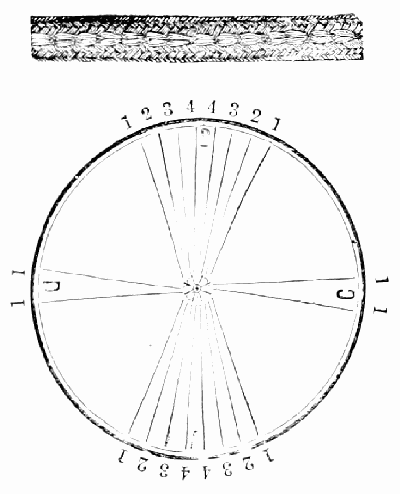
Take twenty strands, twenty hairs in a strand, and place on table like pattern. Commence at A, take the Nos. 1 and lift across the table and lay in place of Nos. 1 at B, and bring back Nos. 1 from B to A; then take the Nos. 2, 3 and 4, and change the same; then go to C, take the Nos. 1 and lift across the table and lay in place of Nos. 1 at D, and bring back Nos. 1 from D to C; then commence again at A, take Nos. 1 and lift over the table and lay in the place of Nos. 1 at B, and bring back the Nos. 1 from B to A; then change the Nos. 2 and 3 the same as the Nos. 1; then go to C and change the Nos. 1 over in the place of Nos. 1 at D, and bring back the Nos. 1 from D to C; then go to A, and take the Nos. 1, 2 and 3, and change the same as before; then go to C and change the same as before. Then you are through the braid ready to commence at A, as at first, and repeat until the braid is finished.

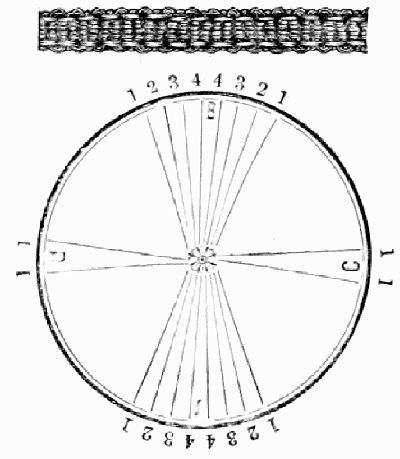
Take twenty strands, twenty hairs in a strand, and place on table like pattern. Commence at A, take Nos. 1 and lift over across the table, and lay in place of Nos. 1 at B, and bring back Nos. 1 from B and lay in place of Nos. 1 at A; then take Nos. 2, 3 and 4, and change their places the same as Nos. 1; then go to C, take Nos. 1 and lift over across the table and lay in place of Nos. 1 at D, and bring back Nos. 1 from D to C; then go to A, take Nos. 1 and lift them over the table and lay in place of Nos. 1 at B, and bring back Nos. 1 from B to A; then take Nos. 3 and 4 and change the same; then go to C, take Nos. 1 and lift them over the table and lay in place of Nos. 1 at D, and bring back Nos. 1 from D to C. Then you are through the braid, ready to commence at A, as at first, and repeat the changes until the braid is finished.
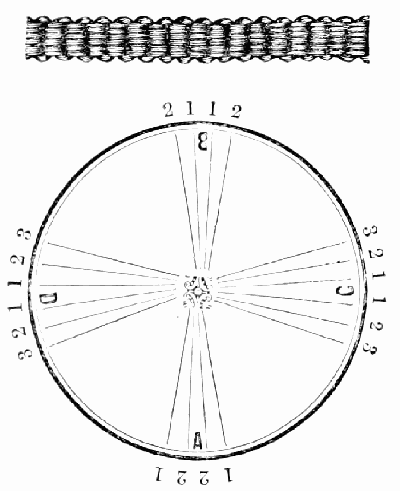
Take twenty strands, fifteen hairs in a strand, and place on table like pattern. Commence at A, take Nos. 1, lift across to B, and lay inside of Nos. 1, and bring back Nos. 2 from B and lay in between Nos. 2 at A; then go to C, take Nos. 1 and lift over inside of Nos. 1 at D, and bring back Nos. 1 from D to C; then take Nos. 2 at C, and cross over inside of Nos. 2 at D, and bring back Nos. 2 from D to C; then take Nos. 3 at C, cross over inside of Nos. 3 at D, and bring back Nos. 3 from D to C; then commence again at A, as at first, and repeat until it is braided the desired length.
When the braid is finished, tie it out straight on a flat stick, boil in water five minutes, and heat in an oven until perfectly dry, and then it is ready for use.

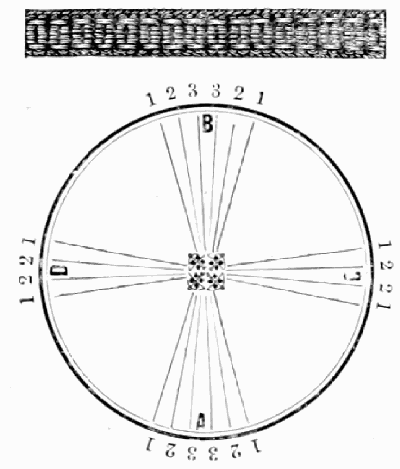
Take twenty strands, twenty hairs in a strand, and lay on table like pattern. Commence at A, take Nos. 1 and lift over table and lay in place of Nos. 1 at B, and bring back Nos. 1 from B to A; then take Nos. 2 and change the same; then the Nos. 3, and change the same; then go to C, take the Nos. 2 and lay outside of the Nos. 1; then go to D, and take the Nos. 2 and lay outside of the Nos. 1; then go to C, and take Nos. 2 and lift over table and lay in place of Nos. 2 at D, and bring back the Nos. 2 from D to C; then go to A, take Nos. 1 and lift across the table and lay in place of Nos. 1 at B, and bring back Nos. 1 from B to A; then take Nos. 3 at A, and lift across table in place of Nos. 3 at B, and bring back Nos. 3 from B to A; then go to C, take Nos. 2 and lay outside of Nos. 1; then go to D, take Nos. 2 and lay outside of Nos. 1; then go to C, take Nos. 2 and lift over table in place of Nos. 2 at D, and bring back Nos. 2 from D to C. Then you are ready to commence at A, as at first, and repeat until finished.
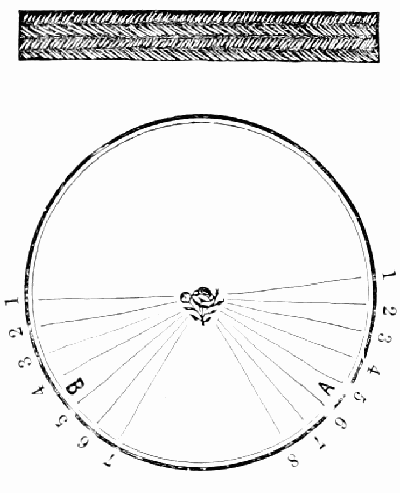
Take fifteen strands, twenty hairs in a strand, and place on table like pattern. Commence at A, by taking No. 1 and lifting it over Nos. 2, 3 and 4, under Nos. 5, 6, 7 and 8, and pass it over to B; then take No. 1 at B, lift over Nos. 2, 3 and 4, under 5, 6, 7 and 8, and pass it over to A; then you are through, ready to commence at A, as at first, and repeat until the braid is finished,—first round to the left, and then round to the right.
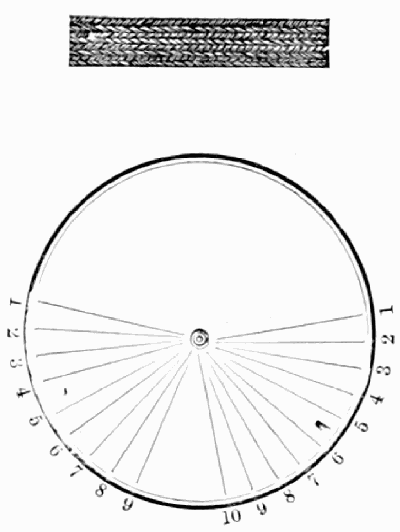
Take nineteen strands, ten hairs in a strand, and place on table like pattern. Commence at A, take No. 1 and lift over Nos. 2, 3 and 4, under 5 and 6, over 7 and 8, under 9 and 10, and pass it over to B; then take No. 1 at B, and lift over Nos. 2, 3 and 4, under 5 and 6, over 7 and 8, under 9 and 10, and lay it over to A; then go to A and commence at No. 1, as at first, and repeat over and over, first to the left and then to the right, and so on, until the braid is finished. Then tie it out straight on a flat stick, boil in water five minutes, and heat it in an oven as hot as it will bear without burning, until it is quite dry, and then it is ready for use.
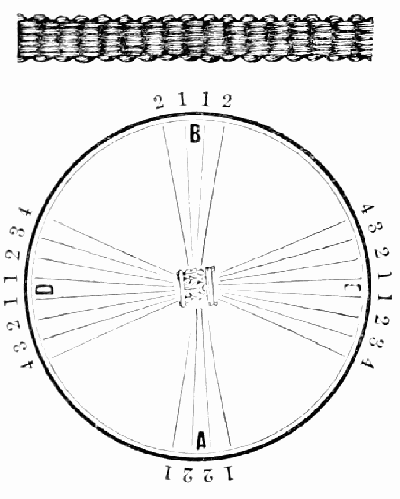
Take twenty-four strands, and place on table like pattern. Commence at A, take Nos. 1 and lift across inside of Nos. 1 at B, and bring back Nos. 2 inside of Nos. 2 at A; then go to C, and take Nos. 1 and cross over inside of Nos. 1 at D, and bring back Nos. 1 from D to C; then take Nos. 2 at C, and cross over inside of Nos. 2 at D, and bring back Nos. 2 from D to C; then take Nos. 3 at C, and cross over inside of Nos. 3 at D, and bring back Nos. 3 from D to C; then take Nos. 4 at C, and cross over inside of Nos. 4 at D, and bring back Nos. 4 from D to C; if you wish to reverse every other time, you may leave the Nos. 1 and not braid them; then you are ready to commence at A as at first.
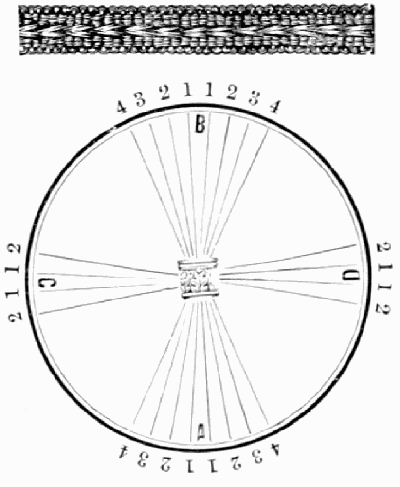
Take twenty-four strands, sixteen hairs in a strand, and place on the table like pattern. Commence at A, take Nos. 1 and cross over to B, lay in between Nos. 1 at B, and bring back Nos. 1 from B and lay in place of Nos. 1 at A; then take Nos. 2 at A, and change them the same way; then Nos. 3 the same; then Nos. 4 the same. Then take Nos. 1 at C and D, and lift over Nos. 2; then lift Nos. 1 at C over in place of Nos. 1 at D, and bring back Nos. 1 from D to C; then go to A, and take Nos. 2, cross over between Nos. 2 at B, and bring back Nos. 2 from B to A; then take Nos. 3 and change the same way; then take Nos. 4 and change the same. Then go to C and D, and lift Nos. 1 over Nos. 2, and then lift Nos. 1 at C over and lay in place of Nos. 1 at D, and bring back Nos. 1 from D and lay in place of Nos. 1 at C; then you are ready to commence as at first, at A, and repeat until the braid is finished. You will place double weight on the strands at C and D.
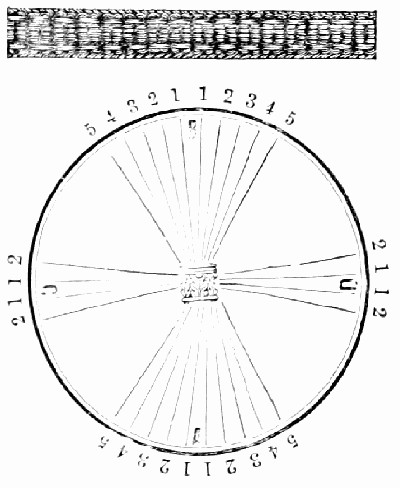
Take twenty-eight strands, of twelve hairs, and place on table like pattern. Commence at A, take Nos. 1 and cross over the table and lay in place of Nos. 1 at B, and bring back Nos. 1 from B to A; then change the Nos. 2 the same. Then take Nos. 4 at A, and lift over the table in place of Nos. 4 at B, and bring back Nos. 4 from B to A; then take Nos. 5 and change the same way. Then go to C and D, and lift the Nos. 1 over the Nos. 2; then take Nos. 1 at C, and lift them over the table inside of Nos. 1 at D, and bring back the Nos. 1 from D and lay in place of Nos. 1 at C; then go to A, and take Nos. 1 and cross over in place of Nos. 1 at B, and bring back Nos. 1 from B to A; then take Nos. 2, 3, 4 and 5, and change all the same. Then go to C and D, and lift Nos. 1 over Nos. 2; then lift Nos. 1 at C over the table, and lay them inside of Nos. 1 at D, and bring back Nos. 1 from D to C. Then you are through the braid, ready to commence at A, as at first, and repeat until the braid is finished. Place extra weight on the strands at C and D.

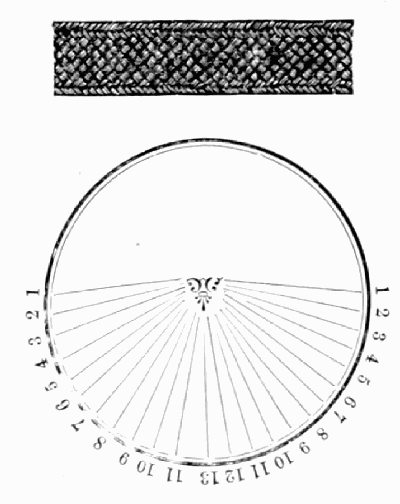
Take twenty-four strands, twenty hairs in a strand, and place on table like pattern, thirteen on the right side and eleven on the left. Take No. 1 at right hand, lift over Nos. 2 3 and 4, and under Nos. 5 and 6, and over No. 7; then take No. 1 again, in right hand, and lift over Nos. 2 3 and 4, and under Nos. 5 and 6; then take the same two that you have braided along, and lift over two strands, and under two, till you get to the center; then pass the same two strands across to the left side, and lay them down next to No. 11; then commence on the left side with No. 1, and braid the left side as you did the right; then the braid is through, ready to commence as at first, with No. 1 at right hand, and so on. Repeat till finished.
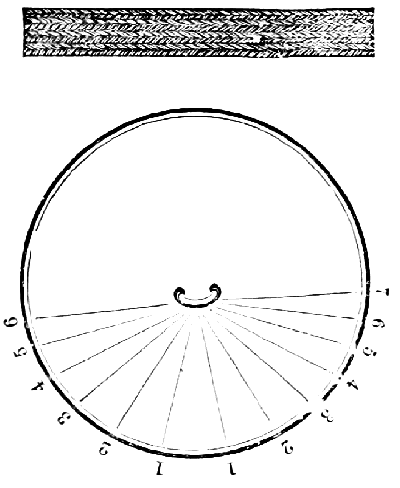
Take thirteen strands, twelve hairs in a strand, and place on table like pattern. Commence by lifting No. 7 over Nos. 6 and 5, and under Nos. 4 and 3, and over Nos. 2 and 1, and lay it next to No. 1 on the left side, making seven on the left side; then commence on the left side, take the outside one and braid it into the middle, over two and under two, till you get to the center, and lay it across on the opposite side; then you are through with the braid, and ready to commence as at first, with the No. 7 at right hand. You can have any odd number of strands you please.
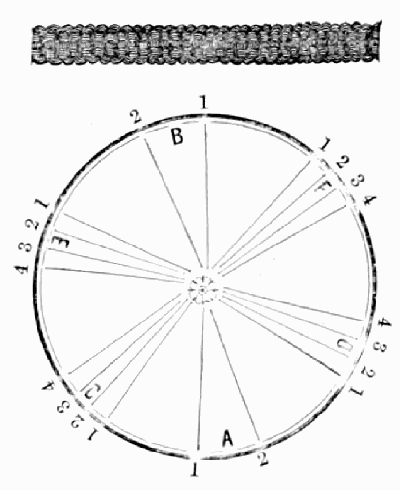
Take twenty strands, ten hairs in a strand, and lay on table like pattern. Commence at A, take No. 2 in right hand and swing it round the table to the right, and lay it across No. 2 at B, and bring back No. 2 from B to A; then take No. 1 at A in left hand, and swing it round the table to the left, and lay it across No. 1 at B, and bring back No. 1 from B to A. Then commence at C and D; take No. 1 at C in left hand, and No. 1 at D in right hand, and change places with them by passing the left hand over the right; then take Nos. 2 at C and D, and change the same way; then take Nos. 3 and change the same way; then take Nos. 4 and change the same way. Then go to B, and change the Nos. 1 at E and F as you did at C and D, by commencing at Nos. 1 first, then the Nos. 2, 3 and 4, in succession. Then you are through the braid, ready to commence as at first, at A. Braid it over a small wire.

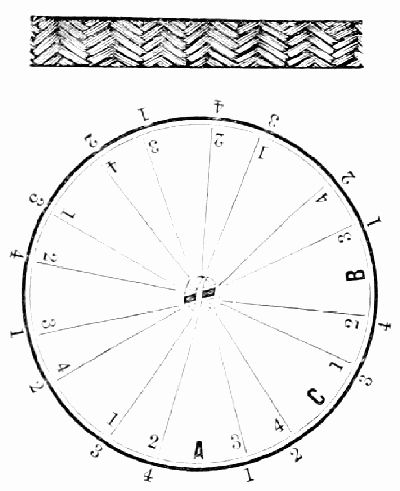
Take any number of strands that can be divided by four,—sixty being the usual number—fifteen hairs in a strand, and place on table like pattern. Commence at A, with the inside row of figures, lift No. 3 over No. 2, and Nos. 1 and 3 over Nos. 2 and 4, and so on round table to the left, till you get to A; then go to C, braid to the left, lift Nos. 1 and 2 over Nos. 3 and 4, and so on round to A; then commence at A and braid round to the right; lift No. 2 over No. 3, and Nos. 3 and 4 over Nos. 2 and 1, and so on round table to A; then go to C, braid round to the right, and lift Nos. 2 and 4 over Nos. 3 and 1, and so on round to A. Then you are through the braid, ready to commence as at first.
Braid this over a round stick, the size you want the braid for use, varying the number of strands according to the size of the stick; then slip the braid from the stick on to the mold you wish to use, tying it so it will fit the mold exactly, and then boil in water five minutes, and take it out and put it in an oven as hot as it will bear without burning, until it is quite dry. Then it is ready for use.

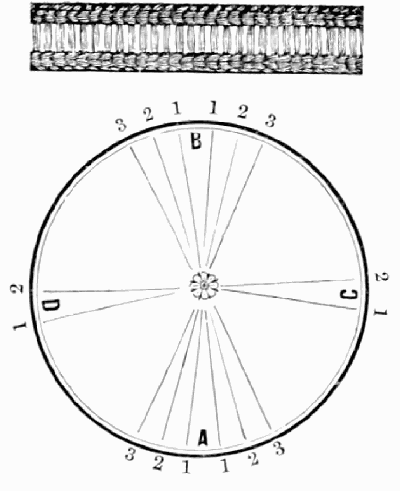
Take sixteen strands, thirty hairs in a strand, and place on the table like pattern. Commence at A, take the Nos. 1 and 2 and lay them over Nos. 3 right and left; then lay the Nos. 1 at A over Nos. 1 at C and D, and bring back the Nos. 1 from C and D and lay outside of Nos. 3 at A; then lay the Nos. 2 at A over Nos. 1; then go to B and repeat the same as at A, only change the Nos. 1 at B with the Nos. 2 at C, instead of the Nos. 1 at C; then lift the Nos. 1 at A over and lay between Nos. 1 at B, and bring back Nos. 1 from B to A; then go to C and lift Nos. 1 and 2 over between Nos. 1 and 2 at D, and bring back the Nos. 1 and 2 from D to C. Then you are through the braid, ready to commence at A, as at first. Braid this over a small wire, and place double weight on the strands at C and D, and Nos. 1 at A and B.

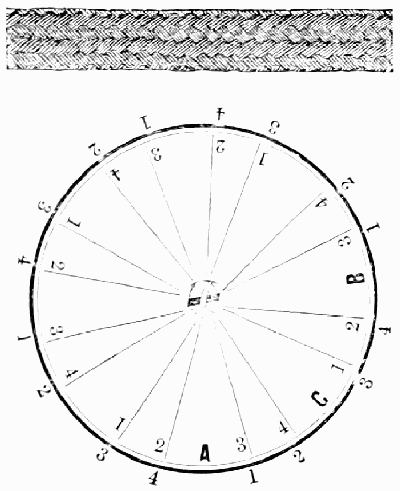
Take any number of strands that can be divided by four,—forty being the usual number for this braid—twelve hairs in a strand, and place on table like pattern. Commence at A, with the inside row of figures, and lift No. 3 over No. 2; then No. 1 over No. 2; then No. 4 over Nos. 3 and 2; then go to B and change the same way, and so on round the table to A. Then go to C, commence with the outside row of figures, and braid round to the left; lift No. 2 over No. 3; then No. 3 over No. 4; then No. 2 over No. 1; then No. 2 over No. 3, and so on round the table to A; then you will be through the braid, ready to commence as at first.
Braid this over a round stick, the size you want the braid for use, varying the number of strands according to the size of the stick; then slip the braid from the stick on to the mold you wish to use, tying the braid so it will fit the mold exactly, and then boil in water five minutes, and take it out and put it in an oven, as hot as it will bear without burning, until it is quite dry. Then it is ready for use.

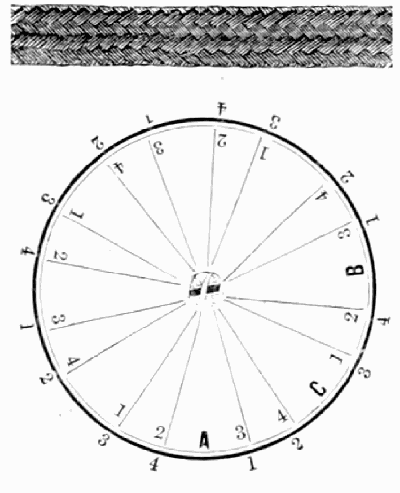
Take any number of strands that can be divided by four,—forty being the usual number for this braid—fifteen hairs in a strand, and place on table like pattern. Commence at A, with the inside row of figures, lift No. 2 in right hand, and put your left hand under the right hand, and take Nos. 3 and 4 and bring them back, and cross them over No. 1, and lay them all down; then go to B, and change the same way, and so on round the table to A. Then go to C, commence with the outside row of figures, and braid round to the left; lift No. 3 in left hand, and put your right hand under the left hand and take Nos. 1 and 2, bring them back, cross them over No. 4, and lay them all down, and so on round the table to A; then you will be through the braid, ready to commence as at first.
Braid this over a round stick, the size you want the braid for use, varying the number of strands according to the size of the stick; then slip the braid from the stick on to the mold you wish to use, tying the braid so it will fit the mold exactly, and then boil in water five minutes, and take it out and put it in an oven, as hot as it will bear without burning, until it is quite dry. Then it is ready for use.

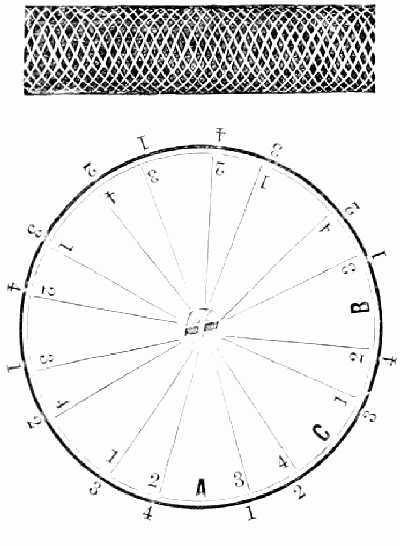
Take any number of strands that can be divided by four—sixty being the usual number for this braid—fifteen hairs in a strand, and place on table like pattern. Commence at A, with the inside row of figures, and braid round table to the right; lift No. 1 over No. 2, and No. 4 over Nos. 3 and 2; then repeat with the same strands, the No. 1 over No. 2, and No. 4 over Nos. 3 and 2. Then go to B and braid the same, and so on round table to A. Then go to C, commence with the outside row of figures, and braid round table to the left; lift No. 1 over No. 2, and No. 4 over Nos. 3 and 2; then repeat with the same strands, the same as you did at A and B, and so on round table to A. Then you are through the braid, ready to commence as at first. After it is braided turn the braid inside out.
Braid this over a round stick, the size you want the braid for use, varying the number of strands according to the size of the stick; then slip the braid from the stick on to the mold you wish to use, and push it tight together, tying it so it will fit the mold exactly, and then boil in water five minutes, and take it out and put it in an oven as hot as it will bear without burning, until it is quite dry. Then it is ready for use.

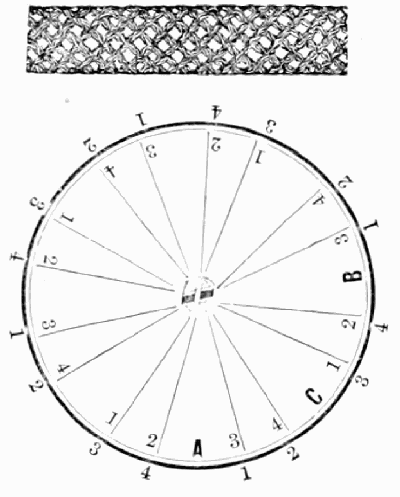
Take any number of strands that can be divided by four—sixty being the usual number for this braid—fifteen hairs in a strand, and place on table like pattern. Commence at A, with the inside row of figures; and braid round table to the right; cross No. 4 over No. 3, and No. 1 over Nos. 2 and 3; then repeat with the same strands. Then go to B, and braid the same, and so on round table to the right, until you get to A. Then go to C, and braid back round table to the left, by crossing No. 2 over No. 1, and No. 3 over No. 4, and No. 2 over No. 3; then repeat with the same strands, and so on round table till you get to A. Then you are through the braid, ready to commence as at first.
Braid this over a round stick, the size you want the braid for use, varying the number of strands according to the size of the stick; then slip the braid from the stick on to the mold you wish to use, and push it tight together, tying it so it will fit the mold exactly, and then boil in water five minutes, and take it out and put it in an oven as hot as it will bear without burning, until it is quite dry. Then it is ready for use.

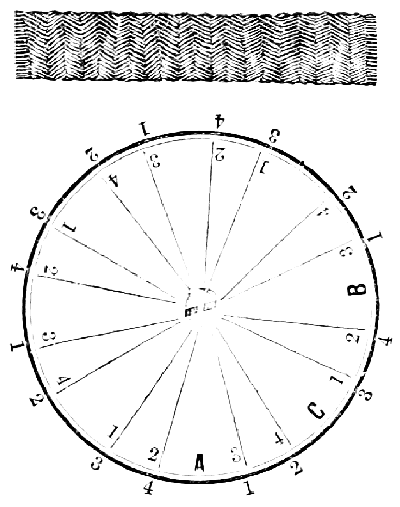
Take any number of strands that can be divided by four,—sixty being the usual number—fifteen hairs in a strand, and place on table like pattern. Commence at A, with the inside row of figures, lift No. 3 over No. 2, and Nos. 1 and 3 over Nos. 2 and 4; then go to B, and braid the same to the left until you get to A; then commence at C, with the outside row of figures, and braid round table to the left again; lift Nos. 1 and 2 over Nos. 3 and 4, and so on round table till you get to A. Then commence with the inside row of figures at A, and lift No. 2 over No. 3, and Nos. 2 and 4 over Nos. 3 and 1; then go to B, and braid the same to the right, and so on round table to A; then commence at C with the outside row of figures, and braid round to the right, lift Nos. 3 and 4 over Nos. 2 and 1, and so on round table to A; then you are through the braid, ready to commence as at first. Be sure and braid the first two times round table to the left, and the last two to the right.
Braid this over a round stick, the size you want the braid for use, varying the number of strands according to the size of the stick; then slip the braid from the stick on to the mold you wish to use, tying it so it will fit the mold exactly, and then boil in water five minutes, and take it out and put it in an oven as hot as it will bear without burning, until it is quite dry. Then it is ready for use. To have it elastic use elastic cord.

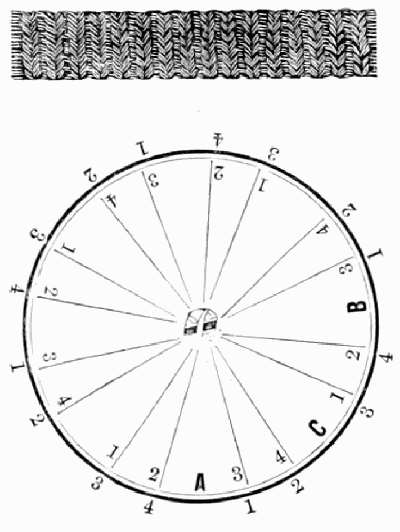
Take any number of strands that can be divided by four,—sixty being the usual number—fifteen hairs in a strand, and place on table like pattern. Commence at A, with the inside row of figures, lift No. 3 over No. 2, and No. 1 over No. 2, then No. 4 over Nos. 3 and 2; then go to B and change the same to the left, and so on round table to A; then go to C, braid to the left with the outside row of figures, lift Nos. 3 and 4 over Nos. 1 and 2, and so on round to A. Then commence again at A and braid round to the right; lift No. 2 over No. 3, then No. 2 over No. 1, and Nos. 2 and 3 over No. 4, and so on round table to A; then commence at C and braid to the right, lift Nos. 1 and 2 over Nos. 3 and 4, and so on round to A. Then you are through the braid, ready to commence as at first.
Braid this over a round stick, the size you want the braid for use, varying the number of strands according to the size of the stick; then slip the braid from the stick on to the mold you wish to use, tying it so it will fit the mold exactly, and then boil in water five minutes, and take it out and put it in an oven as hot as it will bear without burning, until it is quite dry. Then it is ready for use.

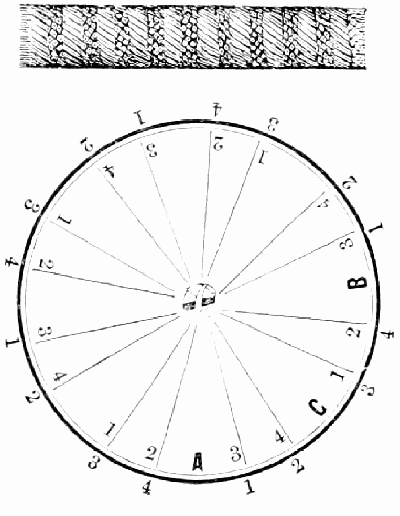
Take any number of strands that can be divided by four,—sixty being the usual number—fifteen hairs in a strand, and place on table like pattern. Commence at A, with the inside row of figures, lift No. 3 over No. 2, and No. 1 over No. 2, then No. 3 over No. 4, and No. 3 over No. 2; braid round table to the left till you get to A, then repeat the same at C with the outside row of figures. After braiding the second time round, commence again at A, with the inside row of figures, and braid round to the right; lift Nos. 3 and 4 over Nos. 1 and 2, and so on round to A; then repeat, at C, with the outside row of figures. Then you are through the braid, ready to commence as at first.
Braid this over a round stick, the size you want the braid for use, varying the number of strands according to the size of the stick; then slip the braid from the stick on to the mold you wish to use, tying it so it will fit the mold exactly, and then boil in water five minutes, and take it out and put it in an oven as hot as it will bear without burning, until it is quite dry. Then it is ready for use.

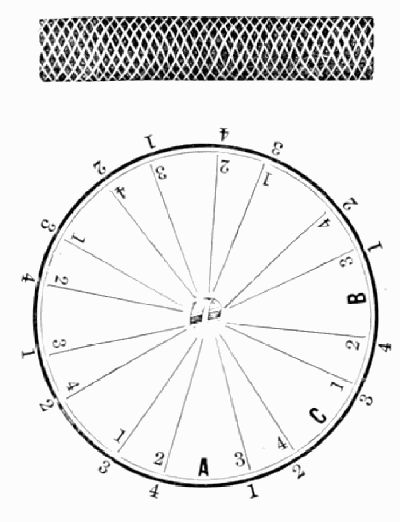
Take any number of strands that can be divided by four,—sixty being the usual number—fifteen hairs in a strand, and place on table like pattern. Commence at A, with the inside row of figures, lift No. 1 over No. 2, No. 4 over No. 3, No. 1 over No. 2, and No. 4 over No. 3; then No. 3 over No. 2, No. 1 over No. 2, and No. 4 over Nos. 2 and 3. Braid round table to the left till you get to A, then repeat the same at C, only braid the outside row of figures. Then you are through the braid, ready to commence as at first.
Braid this over a round stick, the size you want the braid for use, varying the number of strands according to the size of the stick; then slip the braid from the stick on to the mold you wish to use, tying it so it will fit the mold exactly, and then boil in water five minutes, and take it out and put it in an oven as hot as it will bear without burning, until it is quite dry. Then it is ready for use.
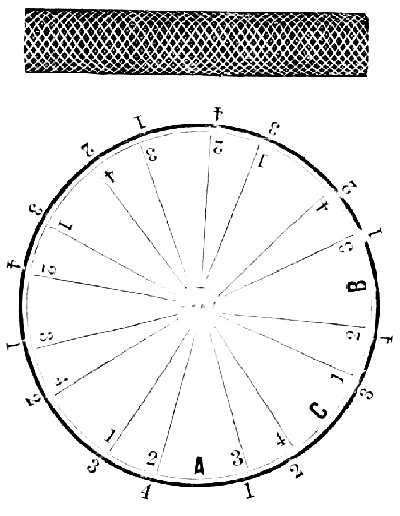
Take any number of strands that can be divided by four,—eighty being The usual number for this braid—four hairs in a strand, and place on table like pattern. Commence at A, with the inside row of figures, lift No. 2 over No. 3; then No. 2 over No. 1; then No. 2 over No. 3; then Nos. 2 and 3 over No. 4; then No. 2 over No. 1. Then go to B and change the same way, and so on round the table to A. Then go to C, and commence with the outside row of figures, and change the same as you did at A, and so on round the table, when you will be through the braid, ready to commence at A, as at first.
Braid this over a round stick, the size you want the braid for use, varying the number of strands according to the size of the stick; then slip the braid from the stick on to the mold you wish to use, tying the braid so it will fit the mold exactly, and then boil in water five minutes, and take it out and put it in an oven, as hot as it will bear without burning, until it is quite dry. Then it is ready for use.

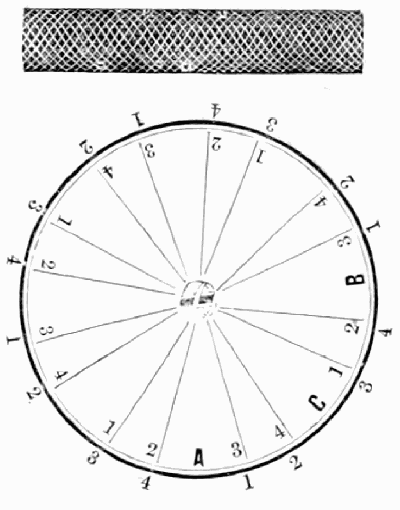
Take any number of Strands that can be divided by four,—eighty being the usual number for this braid—four hairs in a strand, and place on table like pattern. Commence at A, with the inside row of figures, lift No. 1 over Nos. 2, 3 and 4; then No. 3 over Nos. 2 and 1; then No. 2 over Nos. 3 and 4; then No. 2 over No. 1. Then go to B and change the same, and so on round the table to A. Then go to C, and commence with the outside row of figures, and change the same as you did at A, and so on round the table, when you will be through the braid, ready to commence at A, as at first.
Braid this over a round stick, the size you want the braid for use, varying the number of strands according to the size of the stick; then slip the braid from the stick on to the mold you wish to use, tying the braid so it will fit the mold exactly, and then boil in water five minutes, and take it out and put it in an oven, as hot as it will bear without burning, until it is quite dry. Then it is ready for use.

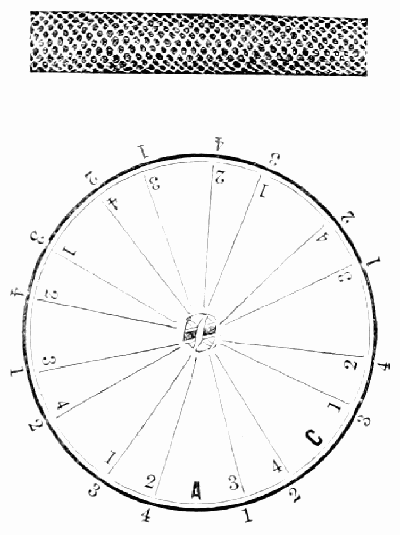
Take any number of strands that can be divided by four,—sixty being the usual number—fifteen hairs in a strand, and place on table like pattern. Commence at A, with the inside row of figures, lift No. 3 over No. 2, No. 3 over No. 4, No. 1 over No. 2, No. 3 over No. 2, and so on round the table to the left to A; then commence at C, lift No. 3 over No. 2, No. 3 over No. 4, No. 1 over No. 2, No. 3 over No. 2, No. 1 over No. 2 and No. 3 over No. 4. Then you are through the braid, ready to commence as at first.
Braid this over a round stick, the size you want the braid for use, varying the number of strands according to the size of the stick; then slip the braid from the stick on to the mold you wish to use, tying it so it will fit the mold exactly, and then boil in water five minutes, and take it out and put it in an oven as hot as it will bear without burning, until it is quite dry. Then it is ready for use.

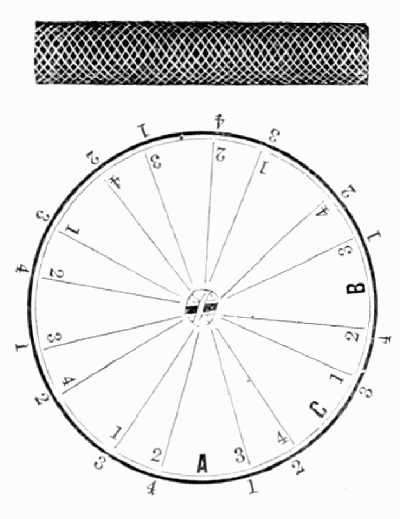
Take any number of strands that can be divided by four,—eighty being the usual number for this braid—four hairs in a strand, and place on table like pattern. Commence at A, with the inside row of figures, lift No. 3 over No. 2; then No. 3 over No 4; then No. 1 over No. 2; then No. 3 over No. 2; then No. 1 over No. 2; then No. 3 over No. 4. Then go to B and change the same way, and so on round the table to A. Then go to C, and commence with the outside row of figures, and change the same as you did at A, and so on round the table, when you will be through the braid, ready to commence at A, as at first.
Braid this over a round stick, the size you want the braid for use, varying the number of strands according to the size of the stick; then slip the braid from the stick on to the mold you wish to use, tying the braid so it will fit the mold exactly, and then boil in water five minutes, and take it out and put it in an oven, as hot as it will bear without burning, until it is quite dry. Then it is ready for use.

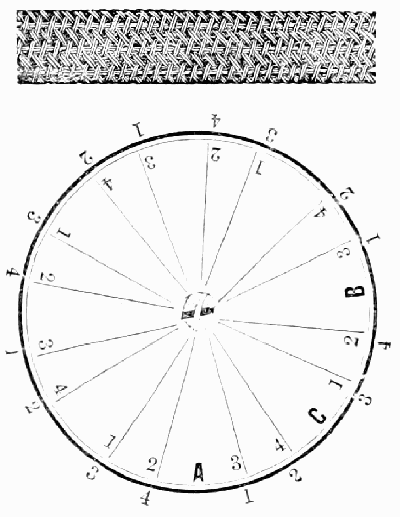
Take thirty-two strands, or any number that can be divided by four, fifteen hairs in a strand, and place on table like pattern. Commence at A, with the inside row of figures, and braid round the table to the left; lift No. 3 over No. 2, No. 1 over No. 2, and No. 3 over No. 4; then commence at C, with the outside row of figures, and braid round the table to the left; lift Nos. 1 and 2 over Nos. 3 and 4; then commence at A, as before, and braid round the table to the right; put No. 3 under No. 2, and lift No. 2 over No. 1, and No. 3 over No. 4; then commence at C, as before, and braid round the table to the right, and put Nos. 1 and 2 under Nos. 3 and 4. Then you are through the braid, ready to commence at A, as at first.
Braid this over a round stick, the size you want the braid for use, varying the number of strands according to the size of the stick; then slip the braid from the stick on to the mold you wish to use, tying the braid so it will fit the mold exactly, and then boil in water five minutes, and take it out and put it in an oven, as hot as it will bear without burning, until it is quite dry. Then it is ready for use.

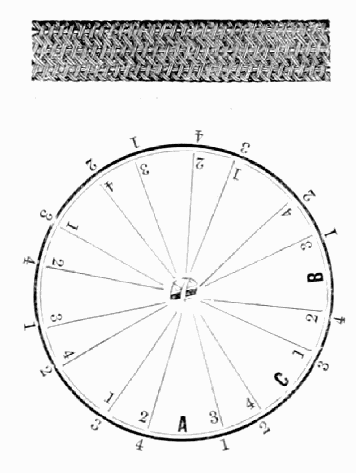
Take any number of strands that can be divided by four,—forty being the usual number—twelve hairs in a strand, and place on table like pattern. Commence at A, with the inside row of figures, and lift Nos. 1 and 2 over Nos. 3 and 4; then go to B and change the same way, and so on round table to A. Then go to C, commence with the outside row of figures, and braid round to the left; lift Nos. 3 and 4 over Nos. 1 and 2, and so on round the table to A. Then you will be through the braid, ready to commence as at first.
Braid this over a round stick, the size you want the braid for use, varying the number of strands according to the size of the stick; then slip the braid from the stick on to the mold you wish to use, tying it so it will fit the mold exactly, and then boil in water five minutes, and take it out and put it in an oven as hot as it will bear without burning, until it is quite dry. Then it is ready for use.

Take any number of strands that can be divided by four,—sixty being the usual number—fifteen hairs in a strand, and place on table like pattern. Commence at A, with the inside row of figures, lift No. 2 over No. 3, No. 4 over No. 3, No. 1 over No. 2, and No. 3 over No. 2, and so on round table to the right till you get to A; then commence at C, braid round to the right, lift Nos. 3 and 4 over Nos. 1 and 2, and so on round table to A. Then you are through the braid, ready to commence at A, as at first.
Braid this over a round stick, the size you want the braid for use, varying the number of strands according to the size of the stick; then slip the braid from the stick on to the mold you wish to use, tying it so it will fit the mold exactly, and then boil in water five minutes, and take it out and put it in an oven as hot as it will bear without burning, until it is quite dry. Then it is ready for use.

Take any number of strands that can be divided by four,—sixty being the usual number—fifteen hairs in a strand, and place on table like pattern. Commence at A, with the inside row of figures, lift No. 3 over No. 2, and Nos. 1 and 3 over Nos. 2 and 4, and so on round table to A; then commence at C with the outside row of figures, lift No. 2 over No. 3, No. 2 over No. 1, No. 2 over No. 3, Nos. 2 and 3 over No. 4, and No. 2 over No. 1, and so on round table to A. Then you are through the braid, ready to commence at A, as at first.
Braid this over a round stick, the size you want the braid for use, varying the number of strands according to the size of the stick; then slip the braid from the stick on to the mold you wish to use, tying it so it will fit the mold exactly, and then boil in water five minutes, and take it out and put it in an oven as hot as it will bear without burning, until it is quite dry. Then it is ready for use.

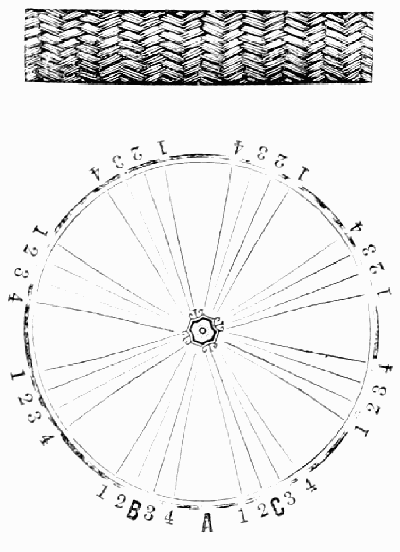
In this pattern you braid with eight strands, or with two groups of fours. Commence at B, lift No. 4 in left hand and lay down between Nos. 3 and 4 at C, and take No. 4 at C in right hand; then lift No. 3 at B over between Nos. 2 and 3 at C, and take No. 3 at C in right hand; then lift No. 2 at B over between Nos. 1 and 2 at C, and take No. 2 at C in right hand; then lift No. 1 at B over next to No. 1 at C, and take No. 1 at C in right hand, and then lift those in right hand over to B, and lay them all down. Braid round to the right till you get to A, then take the next eight strands, and braid round table to the left; lift No. 1 at C over between Nos. 1 and 2 at B, and take No. 1 at B in left hand; then lift No. 2 at C over between Nos. 2 and 3 at B, and take No. 2 at B in left hand; then lift No. 3 at C over between Nos. 3 and 4 at B, and take No. 3 at B in left hand; then lift No. 4 at C over next to No. 4 at B, and take No. 4 at B in left hand, and then lift those in left hand over to C and lay them all down, and so on round table, taking the next eight strands, till you get to A. Then you are through the braid, ready to commence as at first.
See explanation on page 100.

Take any number of strands that can be divided by four,—eighty being the usual number for this braid—four hairs in a strand, and place on table like pattern. Commence at A, with the inside row of figures, lift No. 3 over No. 2; then No. 3 over No. 4; then No. 1 over No. 2; then No. 3 over No. 2. Then go to B and change the same way, and so round the table to A. Then go to C, and commence with the outside row of figures, and change the same as you did at A, and so on round the table, when you will be through the braid, ready to commence at A, as at first.
Braid this over a round stick, the size you want the braid for use, varying the number of strands according to the size of the stick; then slip the braid from the stick on to the mold you wish to use, tying it so it will fit the mold exactly, and then boil in water five minutes, and take it out and put it in an oven as hot as it will bear without burning, until it is quite dry. Then it is ready for use.
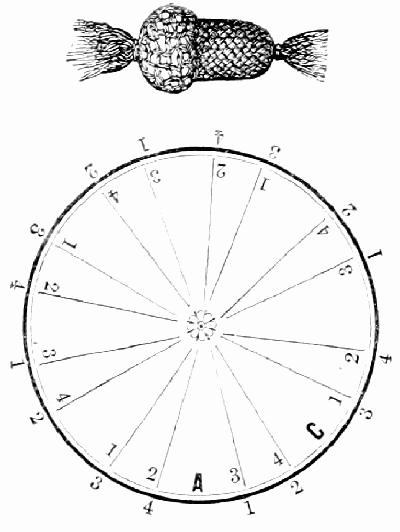
Take any number of strands that can be divided by four,—sixty being the usual number—fifteen hairs in a strand, and place on table like pattern. Commence at A, with the inside row of figures, lift No. 3 over No. 2, No. 3 over No. 4, No. 1 over No. 2, and No. 3 over No. 2, and so on round table to A; then go to C, take the outside row of figures, and make the same changes round to A, and repeat alternately at A and C, until the braid is long enough to cover the bottom of the acorn, and then commence at A with the inside row of figures; lift No. 3 over No. 2, No. 3 over No. 4, No. 1 over No. 2, No. 3 over No. 2, No. 1 over No. 2, and No. 3 over No. 4, and so on round to A; then go to C, take the outside row of figures, and make the same changes round to A; then repeat until the braid is long enough to make the top or bur of the acorn. Then you are through the braid, ready to commence as at first.
Braid this over a round stick, the size you want the braid for use, varying the number of strands according to the size of the stick; then slip the braid from the stick on to the mold you wish to use, tying it so it will fit the mold exactly, and then boil in water five minutes, and take it out and put it in an oven as hot as it will bear without burning, until it is quite dry. Then it is ready for use.

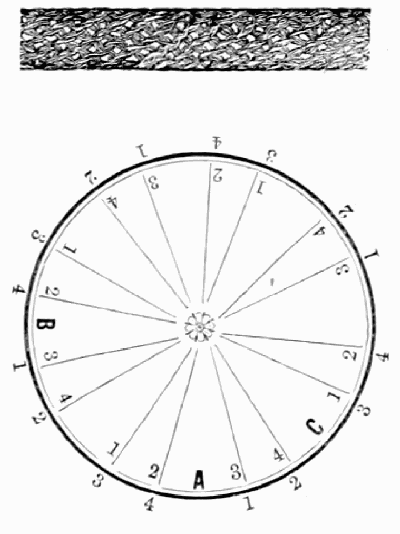
Take any number of strands that can be divided by four,—sixty being the usual number—fifteen hairs in a strand, and place on table like pattern. Commence at A, with the inside row of figures, lift No. 1 over between Nos. 2 and 3 at B; then lift No. 1 at B over between Nos. 2 and 3 of the next four strands, and so on round table to the left to A; then go to C, take the outside row of figures, lift No. 2 over No. 3, No. 2 over No. 1, Nos. 2 and 3 over No. 4; then No. 3 over No. 4, and No. 2 over No. 1, and so on round the table to the right, till the braid is finished.
Braid this over a round stick, the size you want the braid for use, varying the number of strands according to the size of the stick; then slip the braid from the stick on to the mold you wish to use, tying it so it will fit the mold exactly, and then boil in water five minutes, and take it out and put it in an oven as hot as it will bear without burning, until it is quite dry. Then it is ready for use.
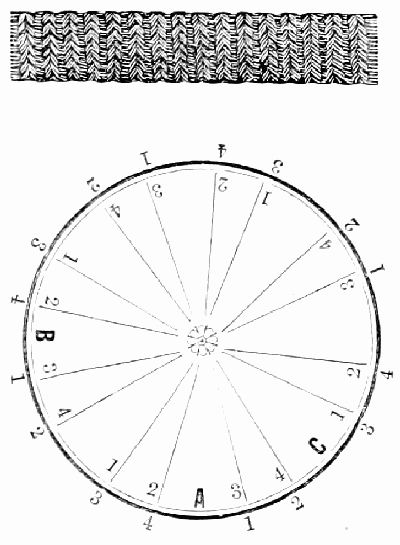
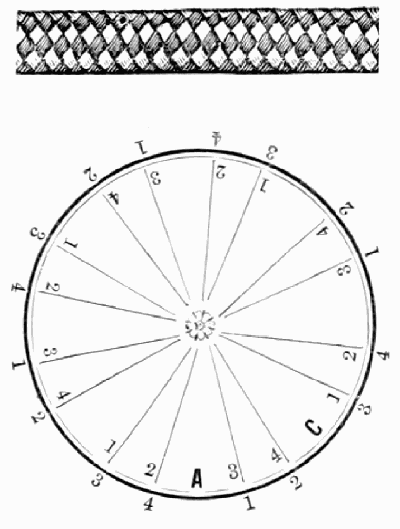
Take any number of strands that can be divided by four,—sixty being the usual number—fifteen hairs in a strand, and place on table like pattern. Commence at A, with the inside row of figures, braid to the right, lift No. 2 over Nos. 3 and 4, No. 1 over No. 2, and No. 3 over No. 2, and so on round to A; then go to C and repeat the same changes, with the outside row of figures, round to A; then commence at A with the inside row of figures, and braid to the left; lift No. 3 over Nos. 1 and 2, No. 4 over No. 3, and No. 2 over No. 3, and so on round to A; then go to C, and repeat the same changes, with the outside row of figures, round to A. Then you are through the braid, ready to commence as at first.
Braid this over a round stick, the size you want the braid for use, varying the number of strands according to the size of the stick; then slip the braid from the stick on to the mold you wish to use, tying it so it will fit the mold exactly, and then boil in water five minutes, and take it out and put it in an oven as hot as it will bear without burning, until it is quite dry. Then it is ready for use.

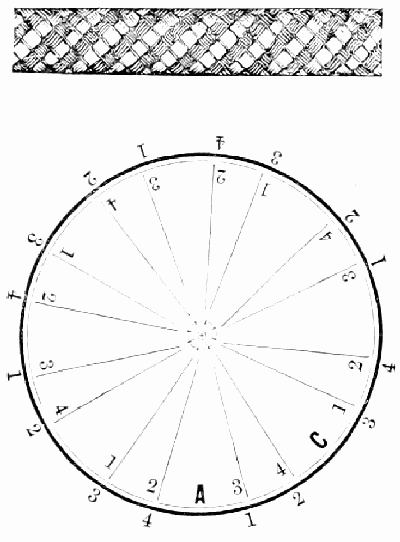
Take any number of strands that can be divided by four,—sixty being the usual number—fifteen hairs in a strand, and place on table like pattern. Commence at A, with the inside row of figures, and have Nos. 1 and 2 of white hair, and Nos. 3 and 4 of black hair; lift Nos. 1 and 2 over Nos. 3 and 4, and so on round table to the left, to A; then go to C, and braid round table to the right; lift Nos. 3 and 4 over Nos. 1 and 2, and so on round table to A. Then you are through the braid, ready to commence as at first.
Braid this over a round stick, the size you want the braid for use, varying the number of strands according to the size of the stick; then slip the braid from the stick on to the mold you wish to use, tying it so it will fit the mold exactly, and then boil in water five minutes, and take it out and put it in an oven as hot as it will bear without burning, until it is quite dry. Then it is ready for use.

Take any number of strands that can be divided by four,—sixty being the usual number—fifteen hairs in a strand, and place on table like pattern. Commence at A, with the inside row of figures, and have alternately four strands of white hair and four of black; braid round table to the left, lift Nos. 1 and 2 over Nos. 3 and 4, and so on round table to A; then go to C, braid round table to the right, lift Nos. 3 and 4 over Nos. 1 and 2, and so on round to A. Then you are through the braid, ready to commence as at first.
Braid this over a round stick, the size you want the braid for use, varying the number of strands according to the size of the stick; then slip the braid from the stick on to the mold you wish to use, tying it so it will fit the mold exactly, and then boil in water five minutes, and take it out and put it in an oven as hot as it will bear without burning, until it is quite dry. Then it is ready for use.

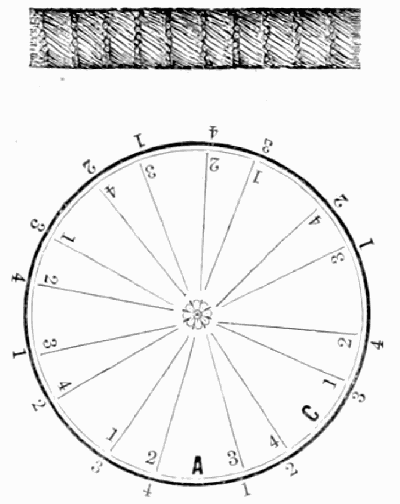
Take any number of strands that can be divided by four,—sixty being the usual number—fifteen hairs in a strand, and place on table like pattern. Commence at A, with the inside row of figures, lift No. 3 over No. 2, No. 1 over No. 2, No. 3 over No. 4, and No. 3 over No. 2; braid round table to the left till you get to A, then go to C, take the outside row of figures, and braid round to the right; lift Nos. 3 and 4 over Nos. 1 and 2, and so on round to A, and repeat with the inside row of figures, and then repeat again with the outside row; then you are through the braid, ready to commence at A, as at first. Commence at C every other time, for you only braid the first change of figures once, and the last change three times.
Braid this over a round stick, the size you want the braid for use, varying the number of strands according to the size of the stick; then slip the braid from the stick on to the mold you wish to use, tying it so it will fit the mold exactly, and then boil in water five minutes, and take it out and put it in an oven as hot as it will bear without burning, until it is quite dry. Then it is ready for use.

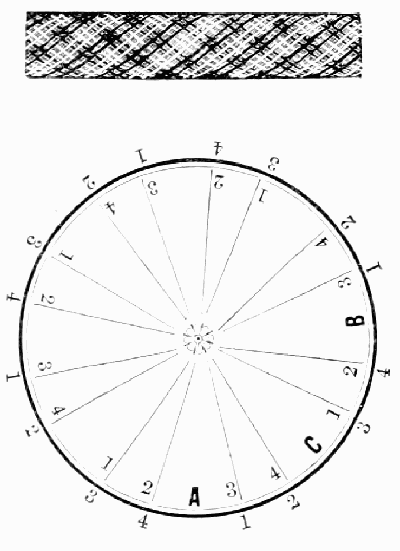
Take any number of strands that can be divided by four,—eighty being the usual number—four hairs in a strand, and place on table like pattern. Have one-half the strands white and one-half black, and place on table alternately, four white and four black. Commence at A, with the inside row of figures, lift No. 2 over No. 3, No. 2 over No. 1, No. 2 over No. 3, Nos. 2 and 3 over No. 4, and No. 2 over No. 1. Then go to B and change the same way, and so on round table to A. Then go to C, commence with the outside row of figures, and change the same as you did at A, and so on round the table; then you will be through the braid, ready to commence at A, as at first.
Braid this over a round stick, the size you want the braid for use, varying the number of strands according to the size of the stick; then slip the braid from the stick on to the mold you wish to use, tying it so it will fit the mold exactly, and then boil in water five minutes, and take it out and put it in an oven as hot as it will bear without burning, until it is quite dry. Then it is ready for use.

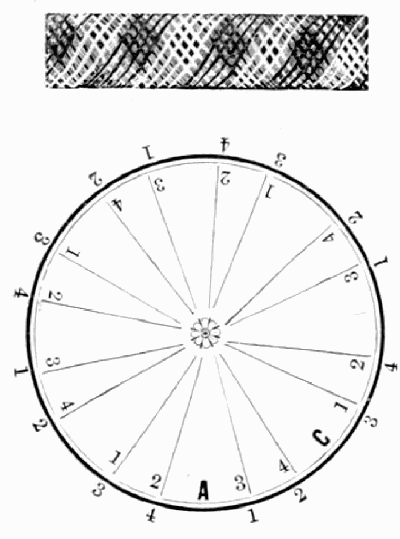
Take any number of strands that can be divided by four,—eighty being the usual number—four hairs in a strand, and place on table like pattern. Have one-third the strands white hair, one-third black, and one-third red, and place on table alternately, four white, four black, and four red. Commence at A, with the inside row of figures, lift No. 2 over No. 3, No. 2 over No. 1, No. 2 over No. 3, Nos. 2 and 3 over No. 4, and No. 2 over No. 1. Then go to B and change the same way, and so on round table to A. Then go to C, commence with the outside row of figures, and change the same as you did at A, and so on round the table; then you will be through the braid, ready to commence at A, as at first.
Braid this over a round stick, the size you want the braid for use, varying the number of strands according to the size of the stick; then slip the braid from the stick on to the mold you wish to use, tying it so it will fit the mold exactly, and then boil in water five minutes, and take it out and put it in an oven as hot as it will bear without burning, until it is quite dry. Then it is ready for use.

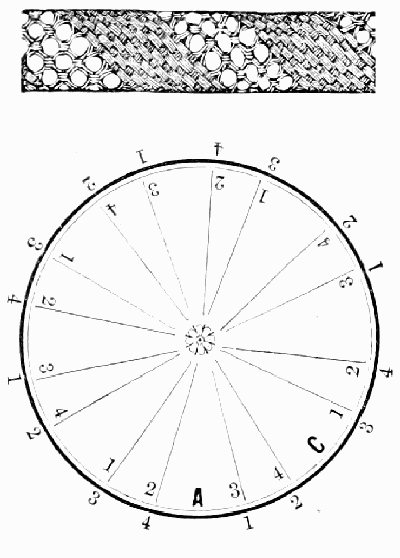
Take any number of strands that can be divided by four,—sixty being the usual number—fifteen hairs in a strand, and place on table like pattern. Commence at A, with the inside row of figures, lift No. 3 over No. 2, No. 3 over No. 4, No. 1 over No. 2, and No. 3 over No. 2; braid half way round the table, and then braid the last half by lifting No. 3 over No. 2, No. 3 over No. 4, No. 1 over No. 2, No. 3 over No. 2, No. 1 over No. 2, and No. 3 over No. 4, and so on round to A; then go to C and repeat the same. Then you are through the braid, ready to commence as at first.
Braid this over a round stick, the size you want the braid for use, varying the number of strands according to the size of the stick; then slip the braid from the stick on to the mold you wish to use, tying it so it will fit the mold exactly, and then boil in water five minutes, and take it out and put it in an oven as hot as it will bear without burning, until it is quite dry. Then it is ready for use.

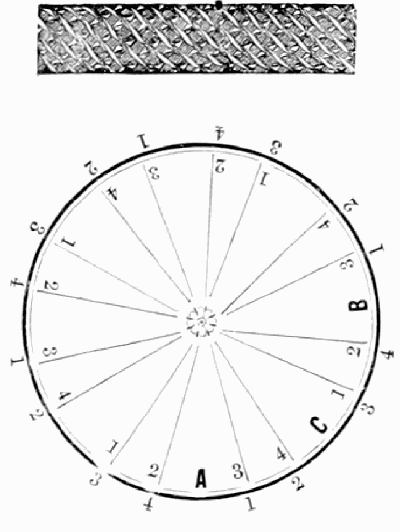
Take any number of strands that can be divided by four,—eighty being the usual number—four hairs in a strand, and place on table like pattern. Commence at A, with the inside row of figures, and have one-half the strands white hair, and one-half black, and place alternately one strand of white, and one strand of black; lift No. 2 over No. 3, No. 2 over No. 1, No. 2 over No. 3, Nos. 2 and 3 over No. 4, and No. 2 over No. 1. Then go to B and change the same way, and so on round table to A. Then go to C, commence with the outside row of figures, and change the same as at A, and so on round table; then you will be through the braid, ready to commence as at first.
Braid this over a round stick, the size you want the braid for use, varying the number of strands according to the size of the stick; then slip the braid from the stick on to the mold you wish to use, tying it so it will fit the mold exactly, and then boil in water five minutes, and take it out and put it in an oven as hot as it will bear without burning, until it is quite dry. Then it is ready for use.

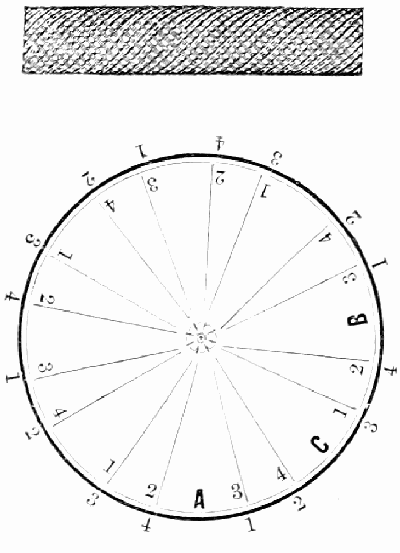
Take any number of strands that can be divided by four,—eighty being the usual number—four hairs in a strand, and place on table like pattern. Commence at A, with the inside row of figures, and have one-half of the strands white hair, and one-half black, and place alternately two strands of white and two of black; lift No. 2 over No. 3, No. 2 over No. 1, No. 2 over No. 3, Nos. 2 and 3 over No. 4, and No. 2 over No. 1; then go to B and change the same way, and so on round table to A. Then go to C, commence with the outside row of figures, and change the same as you did at A, and so on round table. Then you will be through the braid, ready to commence at A, as at first.
Braid this over a round stick, the size you want the braid for use, varying the number of strands according to the size of the stick; then slip the braid from the stick on to the mold you wish to use, tying it so it will fit the mold exactly, and then boil in water five minutes, and take it out and put it in an oven as hot as it will bear without burning, until it is quite dry. Then it is ready for use.

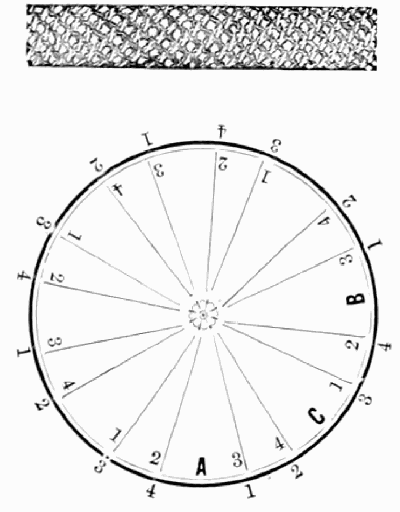
Take any number of strands that can be divided by four,—eighty being the usual number—four hairs in a strand, and place on table like pattern. Commence at A, with the inside row of figures, and have one-half the strands white hair, and one-half black, and place alternately two strands of white, and two strands of black; lift No. 3 over No. 2, No. 3 over No. 4, No. 1 over No. 2, No. 3 over No. 2, No. 1 over No. 2, and No. 3 over No. 4. Then go to B and change the same way, and so on round to A. Then go to C, commence with the outside row of figures, and change the same as you did at A, and so on round table; then you will be through the braid, ready to commence at A, as at first.
Braid this over a round stick, the size you want the braid for use, varying the number of strands according to the size of the stick; then slip the braid from the stick on to the mold you wish to use, tying it so it will fit the mold exactly, and then boil in water five minutes, and take it out and put it in an oven as hot as it will bear without burning, until it is quite dry. Then it is ready for use.

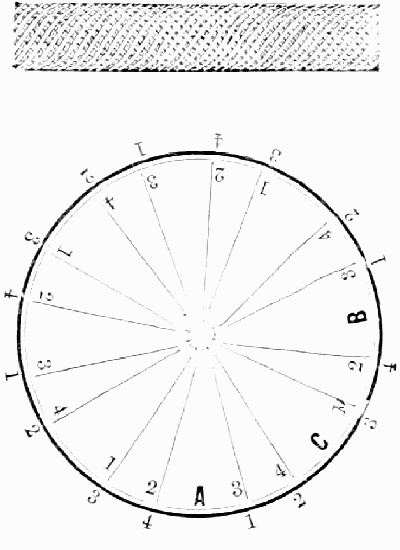
Take any number of strands that can be divided by four,—sixty being the usual number—fifteen hairs in a strand, and place on table like pattern. Commence at A, with the inside row of figures, and have one-half the strands white hair, and one-half black, and place alternately Nos. 1 and 2 of white, and Nos. 3 and 4 of black; lift No. 1 over No. 2, and No. 4 over Nos. 3 and 2; then repeat with the same strands, the No. 1 over No. 2, and No. 4 over Nos. 3 and 2. Then go to B and braid the same, and so on round table to A. Then go to C, commence with the outside row of figures, and braid round to the left; lift No. 1 over No. 2, and No. 4 over Nos. 3 and 2; then repeat with the same strands, the same as at A and B, and so on round to A. Then you are through the braid, ready to commence as at first. After it is braided, turn the braid inside out.
Braid this over a round stick, the size you want the braid for use, varying the number of strands according to the size of the stick; then slip the braid from the stick on to the mold you wish to use, tying it so it will fit the mold exactly, and then boil in water five minutes, and take it out and put it in an oven as hot as it will bear without burning, until it is quite dry. Then it is ready for use.

Take any number of strands that can be divided by four,—sixty being the usual number—fifteen hairs in a strand, and place on table like pattern. Commence at A, with the inside row of figures, and have one-half of the strands white hair, and one-half black, and place alternately one strand of white and one of black; lift No. 1 over No. 2, and No. 4 over Nos. 3 and 2; then repeat with the same strands, the No. 1 over No. 2, and No. 4 over Nos. 3 and 2. Then go to B and braid the same, and so on round table to A. Then go to C, commence with the outside row of figures, and braid round to the left; lift No. 1 over No. 2, and No. 4 over Nos. 3 and 2; then repeat with the same strands, the same as at A and B, and so on round to A. Then you are through the braid, ready to commence as at first. After it is braided, turn the braid inside out.
Braid this over a round stick, the size you want the braid for use, varying the number of strands according to the size of the stick; then slip the braid from the stick on to the mold you wish to use, tying it so it will fit the mold exactly, and then boil in water five minutes, and take it out and put it in an oven as hot as it will bear without burning, until it is quite dry. Then it is ready for use.

Take any number of strands that can be divided by four,—eighty being the usual number,—four hairs in a strand, and place on table like pattern. Commence at A, with the inside row of figures, and have one-fourth of the strands white hair, and three-fourths black, and place all the white strands on one side of the table, and all of the black on the other side; lift No. 2 over No. 3, No. 2 over No. 1, No. 2 over No. 3, Nos. 2 and 3 over No. 4, and No. 2 over No. 1. Then go to B and change the same way, and so on round table to A. Then go to C, commence with the outside row of figures, and change the same as at A, and so on round table; then you are through the braid, ready to commence as at first.
Braid this over a round stick, the size you want the braid for use, varying the number of strands according to the size of the stick; then slip the braid from the stick on to the mold you wish to use, tying it so it will fit the mold exactly, and then boil in water five minutes, and take it out and put it in an oven as hot as it will bear without burning, until it is quite dry. Then it is ready for use.

Take any number of strands that can be divided by four,—eighty being the usual number—four hairs in a strand, and place on table like pattern. Commence at A, with the inside row of figures, and have one-fourth of the strands white hair, and three-fourths black,—the Nos. 1 white, and the Nos. 2, 3 and 4 black; lift No. 3 over No. 2, No. 3 over No. 4, No. 1 over No. 2, and No. 3 over No. 2. Then go to B and change the same way, and so on round table to A. Then go to C, commence with the outside row of figures, and change the same as at A, and so on round table; then you are through the braid, ready to commence as at first.
Braid this over a round stick, the size you want the braid for use, varying the number of strands according to the size of the stick; then slip the braid from the stick on to the mold you wish to use, tying it so it will fit the mold exactly, and then boil in water five minutes, and take it out and put it in an oven as hot as it will bear without burning, until it is quite dry. Then it is ready for use.
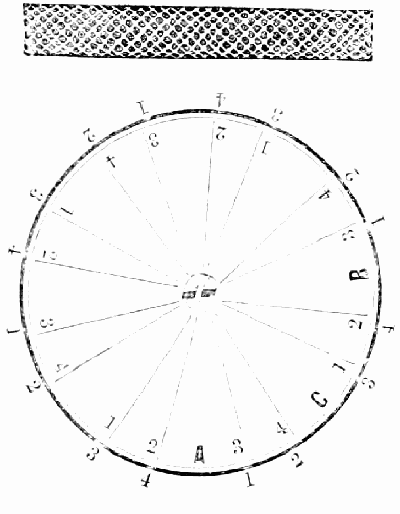
Take any number of strands that can be divided by four,—eighty being the usual number for this braid—four hairs in a strand, and place on table like pattern. Commence at A, with the inside row of figures, lift No. 3 over No. 2; then No. 3 over No. 4; then No. 1 over No. 2; then No. 3 over No. 2. Then go to B and change the same way, and so round the table to A. Then go to C, and commence with the outside row of figures, and change the same as you did at A, and so on round the table, when you will be through the braid, ready to commence at A, as at first.
Braid this over a round stick, the size you want the braid for use, varying the number of strands according to the size of the stick; then slip the braid from the stick on to the mold you wish to use, tying the braid so it will fit the mold exactly, and then boil in water five minutes, and take it out and put it in an oven, as hot as it will bear without burning, until it is quite dry. Then it is ready for use.

The hair to be used in braiding should be combed perfectly straight, and tied with a string at the roots, to prevent wasting. Then count the number of hairs for a strand, and pull it out from the tips, dip it in water and draw it between the thumb and finger to make it lie smoothly; then tie a solid, single knot at one end, the same as you would with a sewing thread.
THE BOBBIN.
To prepare the bobbin for the hair, wind it with white thread, as shown in the plate, and fasten it with a slip-knot over the knob, leaving an end of some three inches, with a solid knot tied at the end of it. To adjust the hair to the bobbins, take the prepared strands of hair and tie the knotted ends in a square knot to the ends of the strings on the bobbins. When each strand is thus prepared and tied to the bobbin strings, place them even, and tie the ends with a string to prevent their slipping.
See cut of Bobbins on another page.
HOW TO PLACE THEM ON THE TABLE-COVER FOR BRAIDING.
Place the strands across the table-cover, over the numbers, as shown in the diagram, and fasten a weight to the end of them, under the table, through the center of cover; then tie the mold or form to be braided, around in the center, and you are ready for braiding.
For further reference, see plate of table, with explanations.
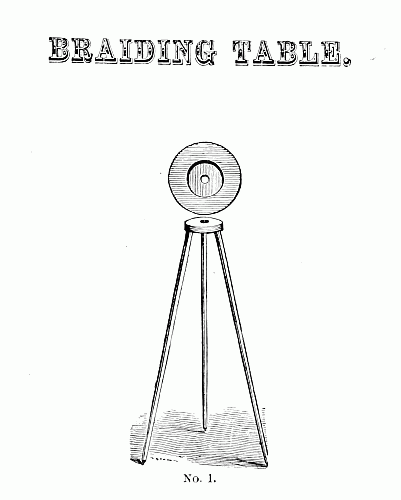
The Table Cover, as shown in diagram No. 1, represents the under side of the cover, showing the rim that fits over the cap, allowing the cover to revolve, for the convenience of the braider. The cavity through the cover and cap allows the braid, with the weight attached, to pass through as fast as braided.
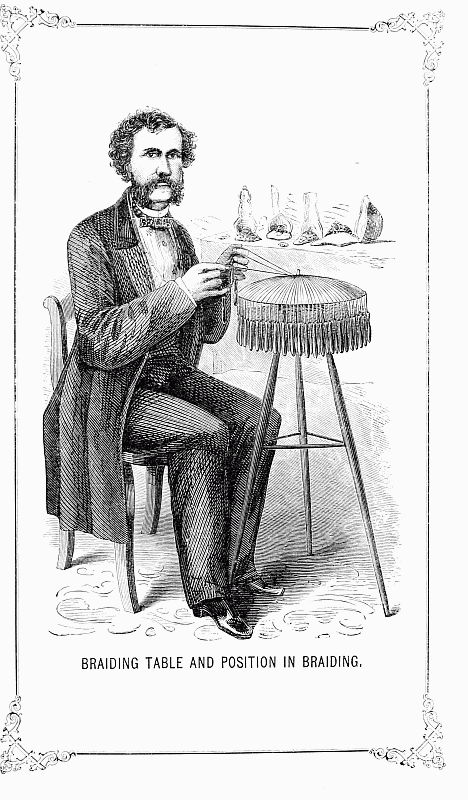
For reference see Braiding Table complete, with bobbins and weights attached, on page 124.
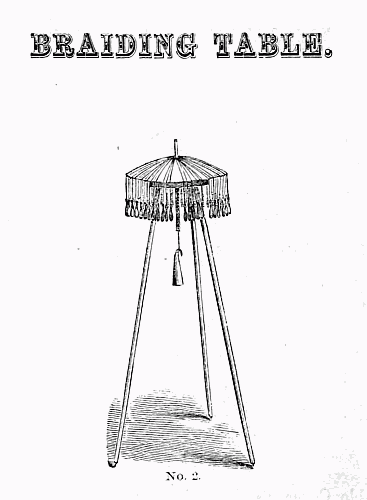
The above cut represents Braiding Table No. 2, complete, showing the strands over the cover, with Bobbins attached; also, the weight attached to the braid, showing the manner of its passing through the table.
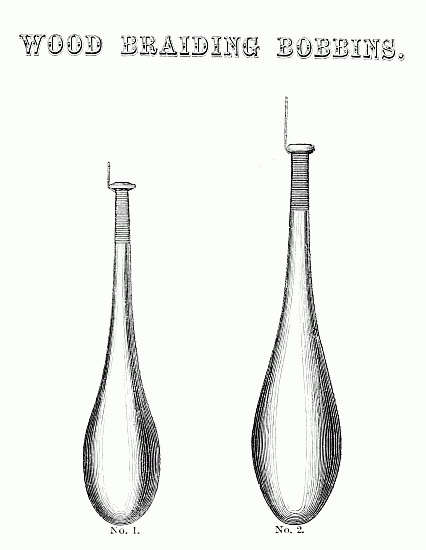
The above cut shows the Wood Bobbins, for fine open work or tight braids. No. 1 is used for braiding any pattern of from one to four hairs in a strand. No. 2 is used for braiding any pattern of from five to twenty hairs in a strand. To prepare the Bobbins for use, see explanations on page 121.
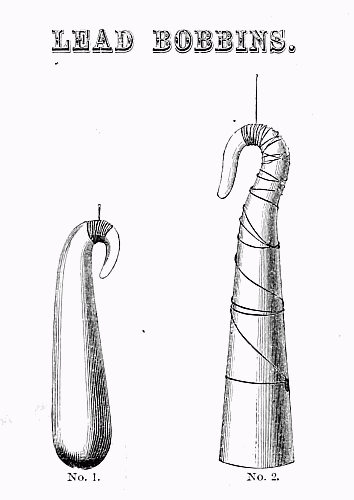
The above cut shows the size and shape of the Lead Bobbins. The No. 1 size is used for braiding Rings and Chains, that have but few hairs in a strand—from twenty to forty. No. 2 is used for braiding Chains that have from forty to one hundred hairs in a strand. Either size will answer for any pattern of Chain or Ring, but to vary the size of the Bobbin according to the number of hairs in a strand, gives it a nicer finish. To prepare the Bobbin, wind it with thread, as shown in the cut, leaving the thread some three inches long, with a solid knot tied at the end.
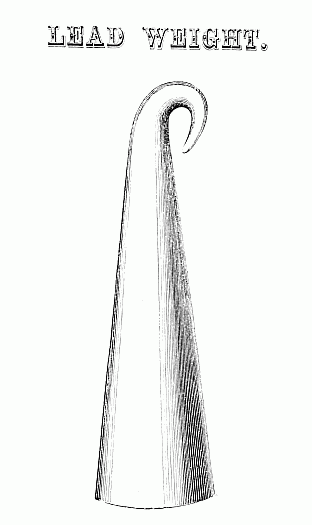
The above cut shows the weight used for drawing the work through the center of the table as fast as braided, and to balance the bobbins. Attention should be given to have the weight balance the bobbins properly, as too great a weight will make the braid loose, or too light a weight will leave it rough. Use any number of weights required to balance the bobbins.
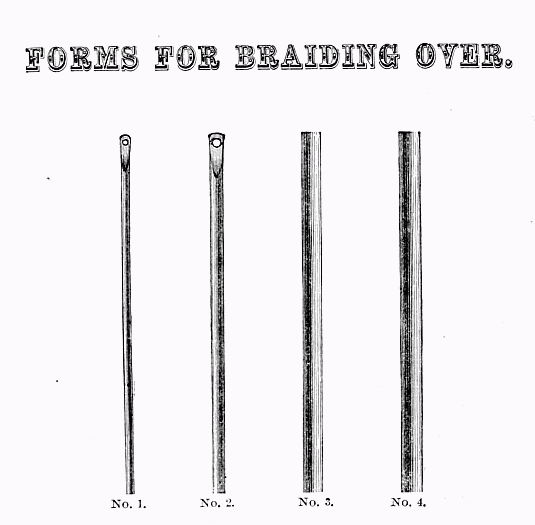
The above cuts are made of wire and wood, for braiding over. The Nos. 1 and 2 are for braiding chains over—the No. 1 for small chains, and the No. 2 for large sizes. No. 3 is used for braiding tight or open work braids, of from thirty to forty strands. No. 4 is used for the same braids, with from forty to sixty strands in a braid. The mold may be made any length, to accommodate the work.
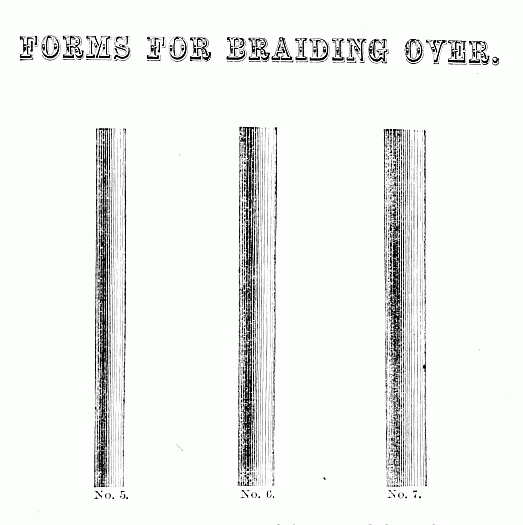
The above cuts show the size of forms used for tight or open work braids. The No. 5 is used for braids of from sixty to eighty strands, No. 6 of from eighty to one hundred, and No. 7 from one hundred to one hundred and twenty, according to the fineness of the braid.
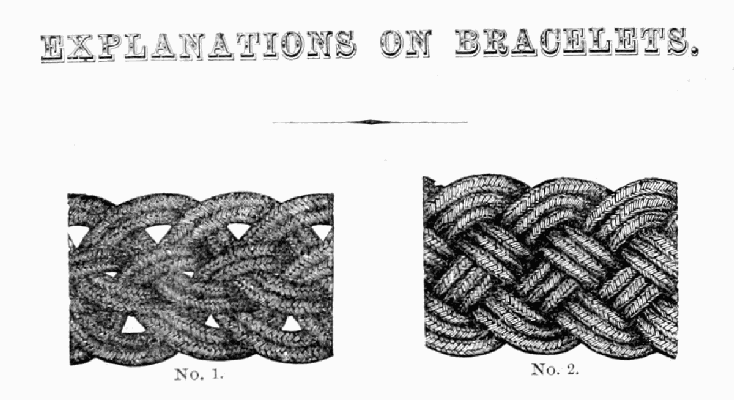
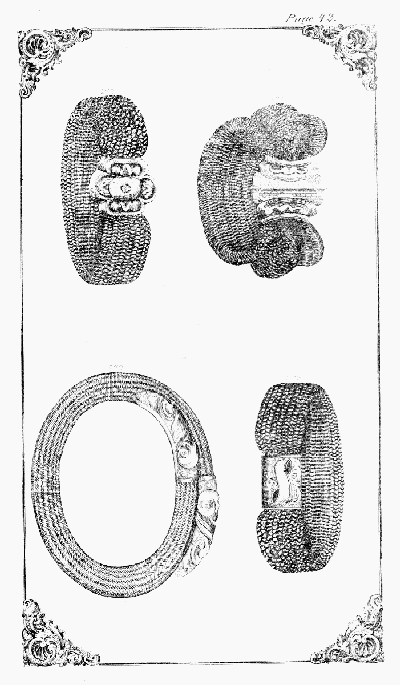
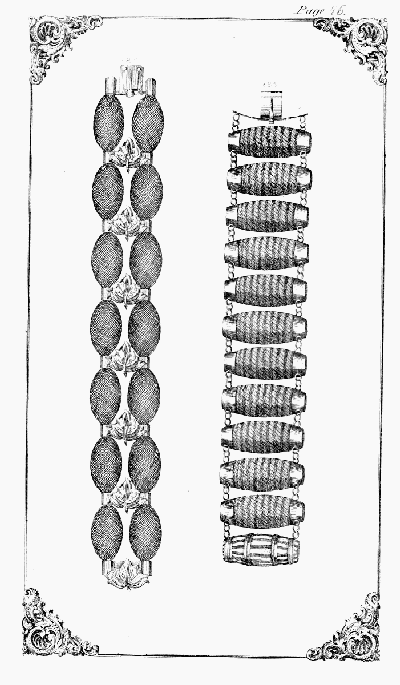
The above cuts represent the completed Bracelet Braid. The No. 1 is formed from fourteen small braids, braided according to diagram and explanation on page 104,—using, however, but thirty-two strands, instead of eighty.
After you have the small braids all completed and prepared, as required in the explanation, sew them together at one end, so they all lie smooth and flat, then divide them off in twos, using each two as one strand, and plait them together; commence at the right side, take one strand at a time, and lift over one and under two till you get to the center, then commence on the left side and braid the same way, and so on till finished. Then sew the ends well, trim them, and put on a little shellac to fasten them in the clasps.
No. 2 is from the same pattern, and is prepared and finished up in the same manner. For this Bracelet you use fifteen small braids, divide them into threes for each strand, and lift over one and under one, from each side to the center.
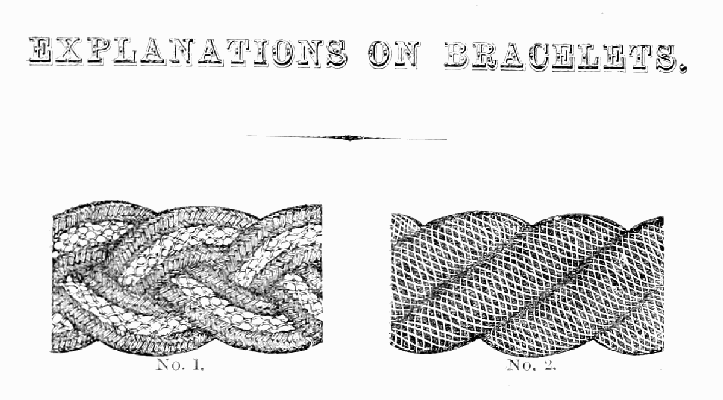
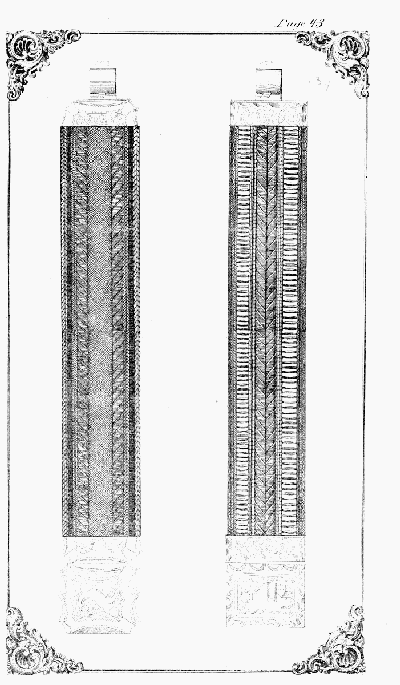
The No. 1 cut of the above Bracelet Braids, is formed from patterns on pages 87 and 97, and instead of using forty and sixty strands, use but thirty-two for each. Braid six small braids from pattern on page 87, and three from pattern on page 97. Sew them tight together at one end, divide them off in threes, with the open work braid between the two tight ones, use each three as one strand, and plait them together in a common three strand braid.
No. 2 is braided according to pattern on page 89. Have three of the braids, sew them fast at one end, and then twist them carefully and evenly together; then sew and fasten with shellac, and it is ready for being gold mounted.

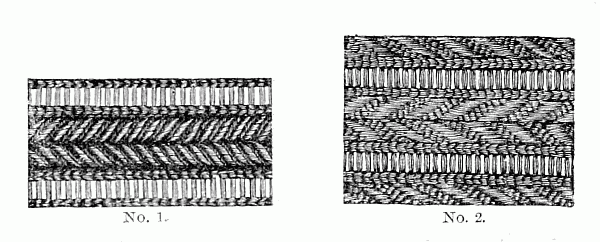
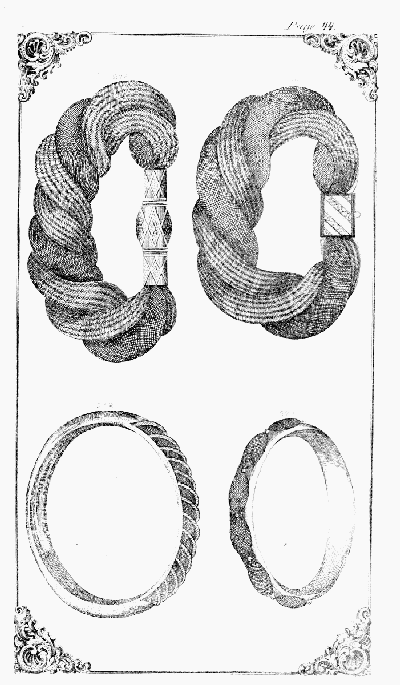
The No. 1 cut of the above Bracelet Braids, is formed from patterns on pages 26 and 86. Have two small braids from each of the patterns, lay them side by side, as in cut, and sew them firmly together, either with some of the hair, or with very fine silk of the same color. Then sew and trim the ends, and fasten with shellac.
No. 2 is braided from patterns on pages 18 and 86. Have four small braids like pattern on page 18, and two like pattern on page 86. Place them side by side, as in cut, and prepare and finish up the same as in the above.

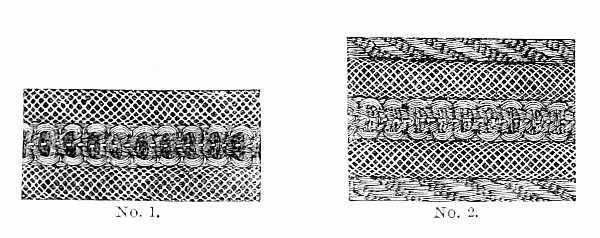
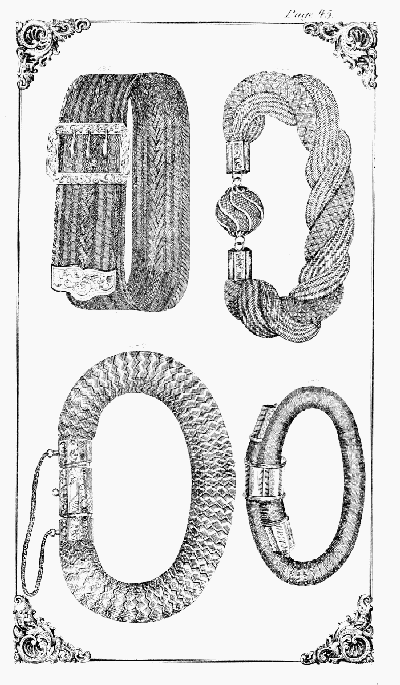
The patterns used for the No. 1, represented above, are found on pages 63 and 95. Have one braid from pattern on page 63, and two from that on page 95. Place them side by side, as in cut, sew the ends firmly together, either with some of the hair, or with very fine silk of the same color. Then sew and trim the ends, and fasten with shellac.
For the No. 2, use two small braids from pattern on page 18, one from pattern on page 63, and two from pattern on page 95. Place them as in cut, sew them together, and prepare the same as No. 1.

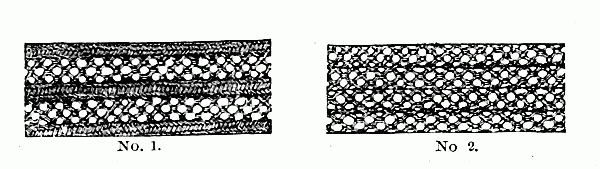
The No. 1 of the above Bracelet Braids, is made up of two small braids from pattern on page 97, and three from pattern on page 101, using, however, but thirty-two strands, instead of sixty. Place them side by side, as in cut, and sew them together with some of the hair, or with fine silk of the same color. Sew, trim and shellac the ends, and they are ready for the gold mounting.
No. 2 is formed of four small braids, from pattern on page 97, and is prepared, sewed and finished up the same as No. 1.

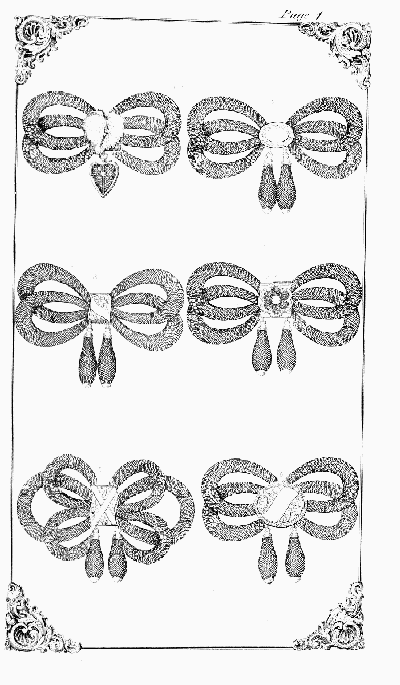
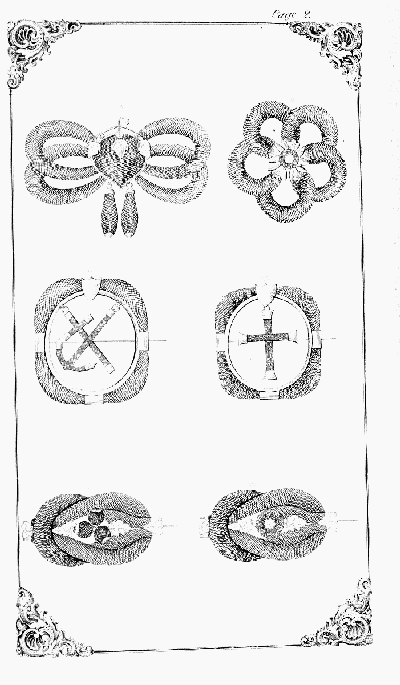
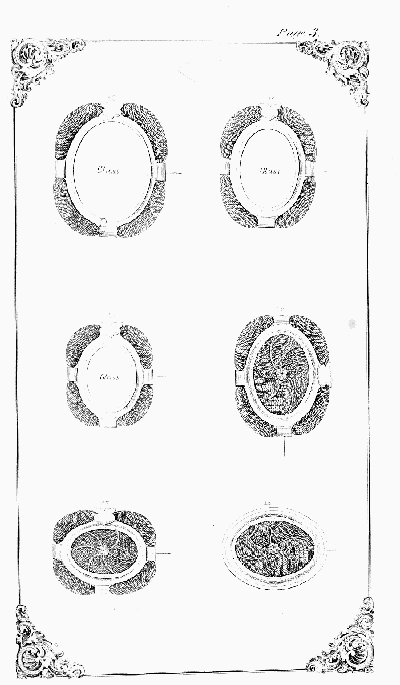
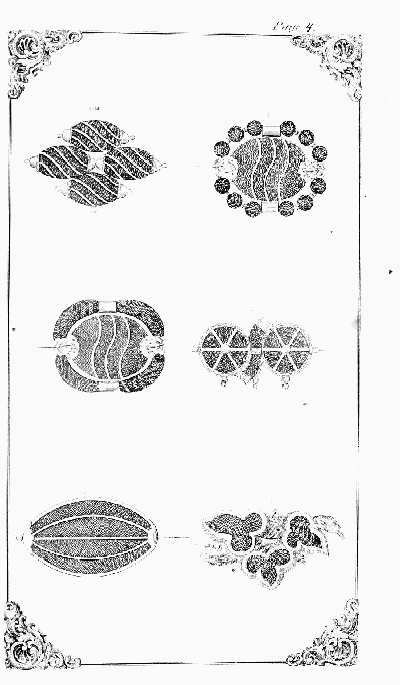
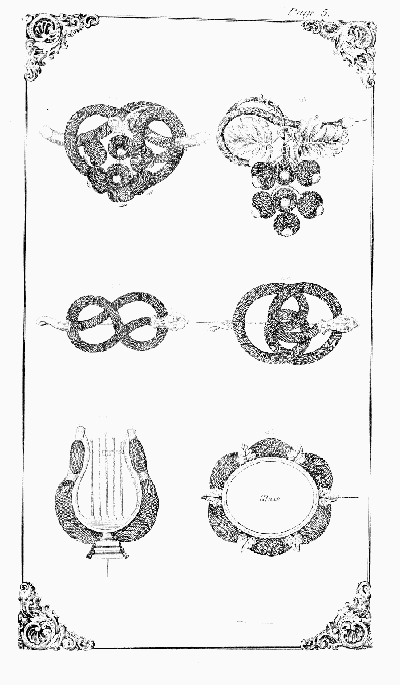
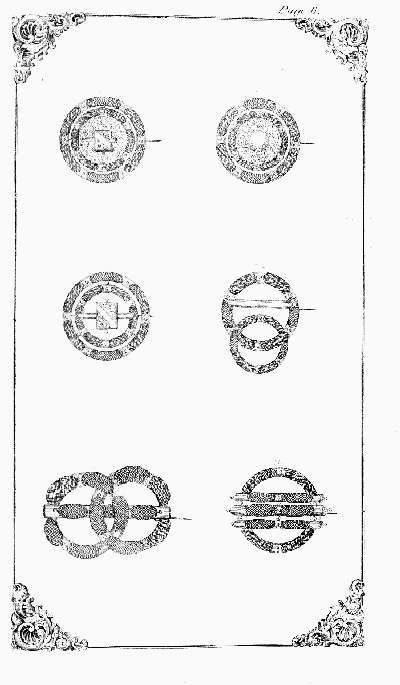
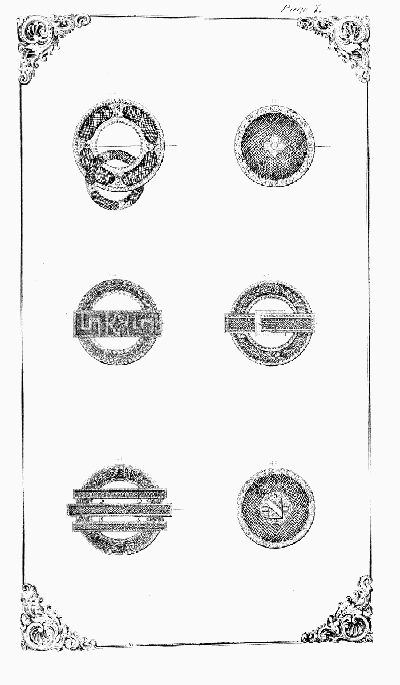
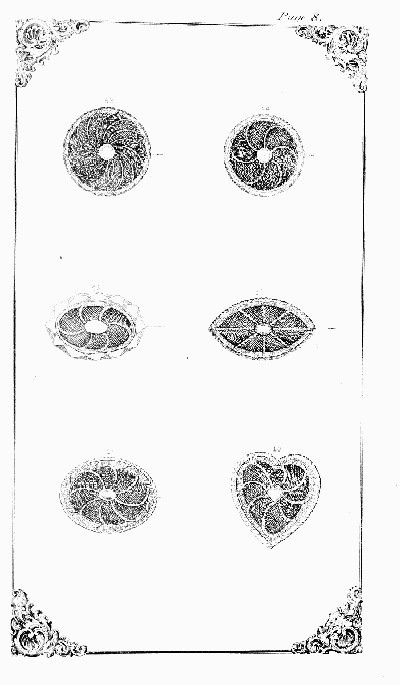
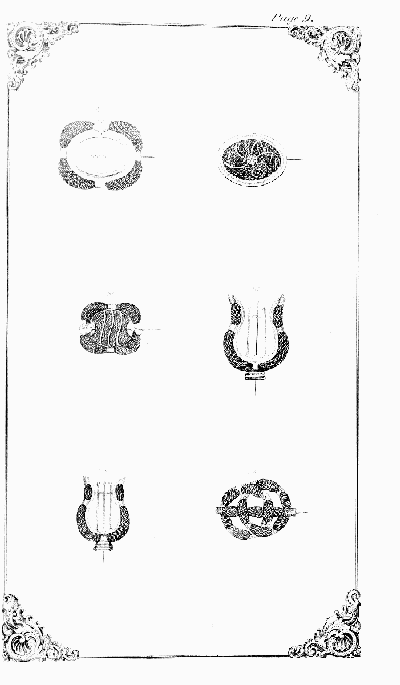
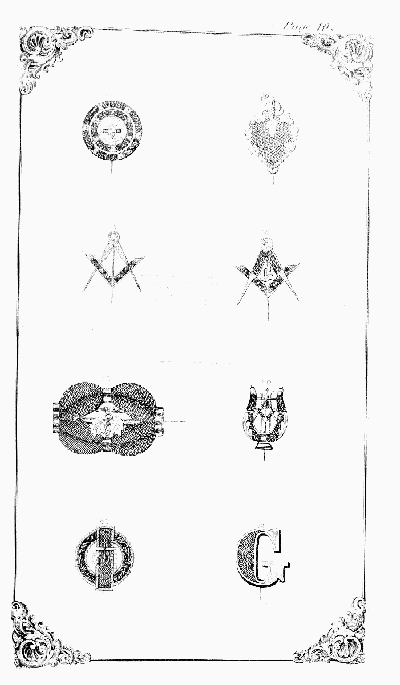
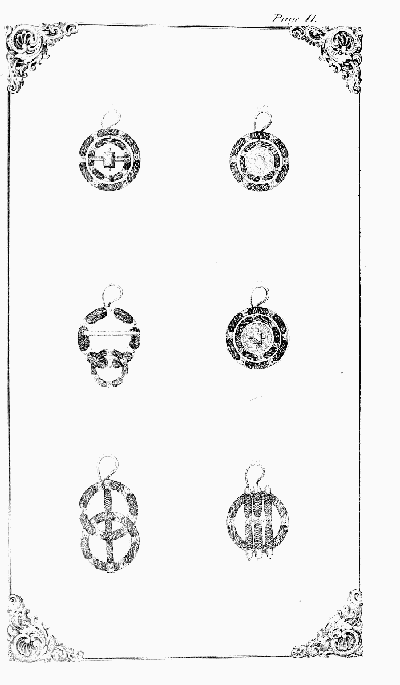
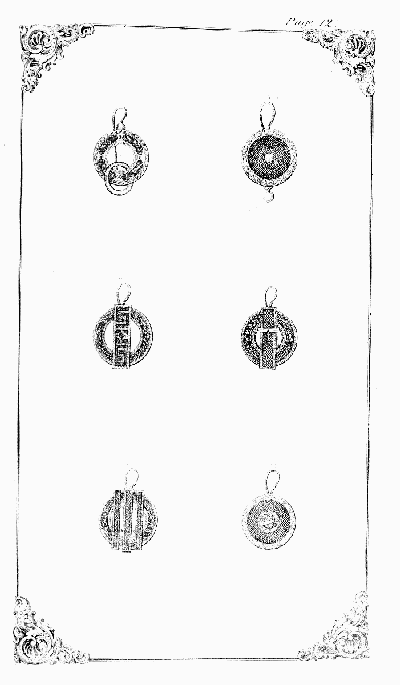
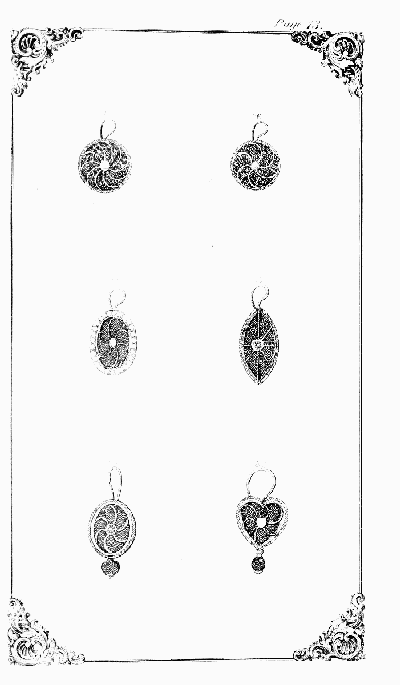
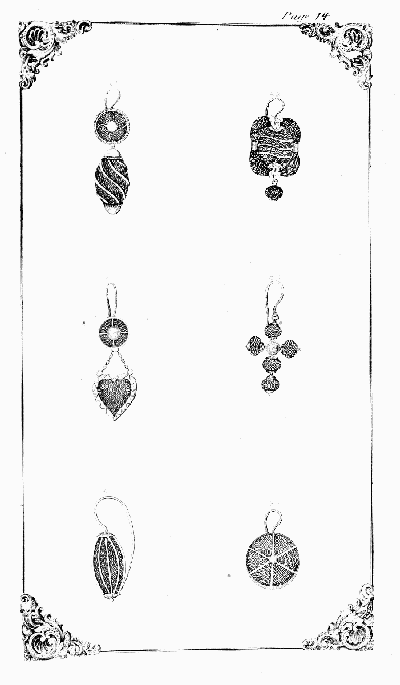
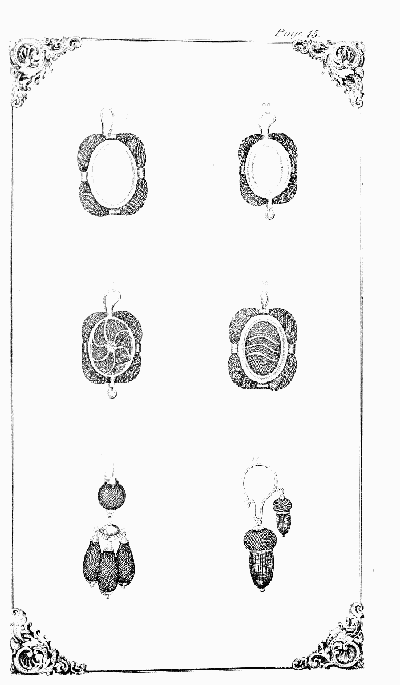
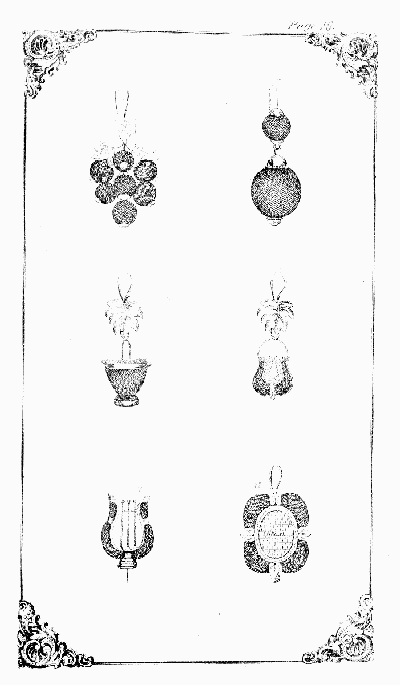
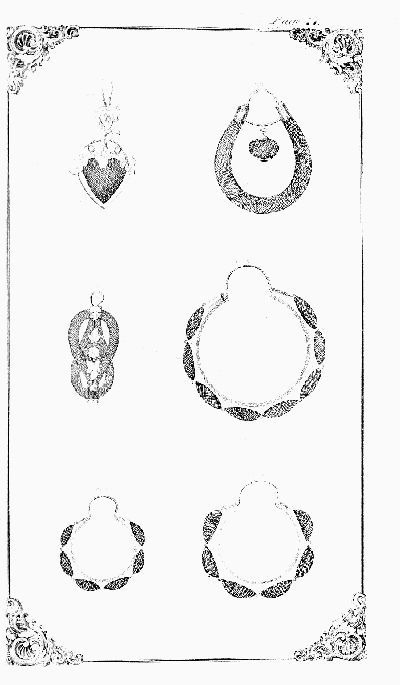
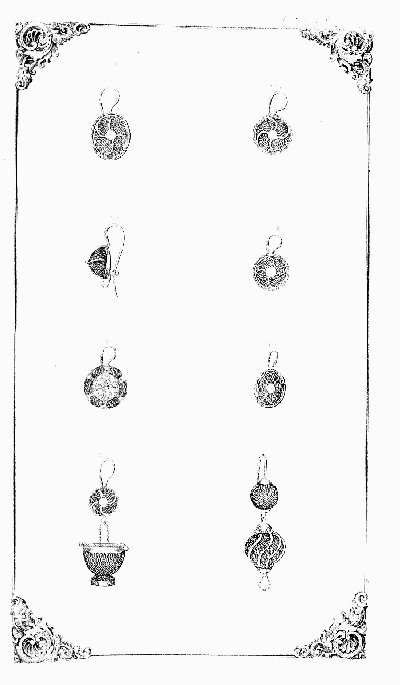
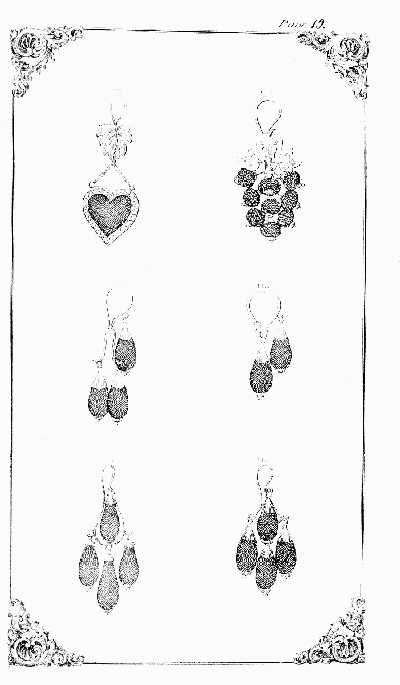
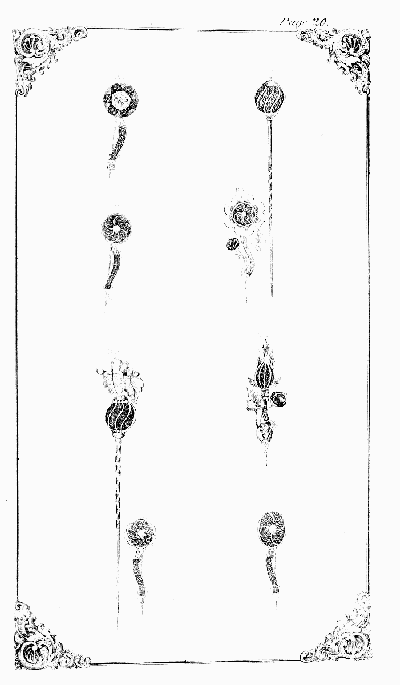
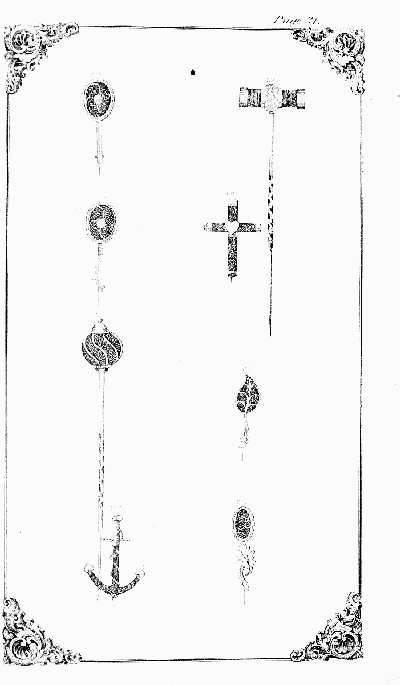
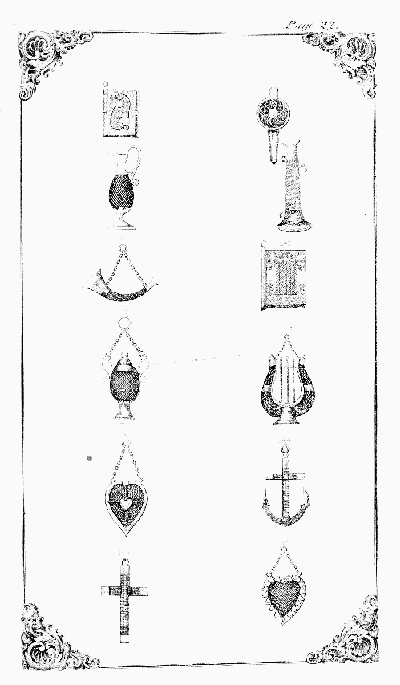
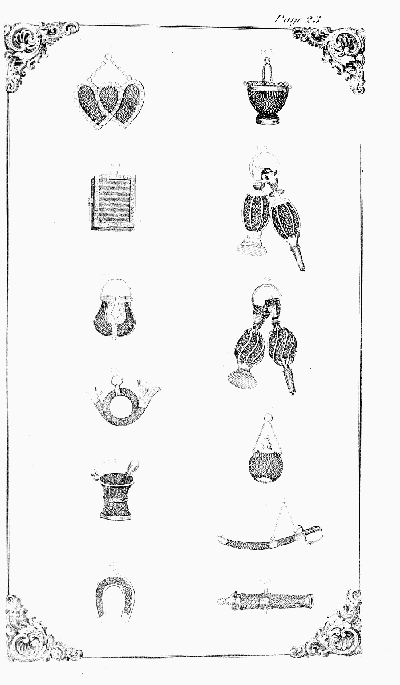
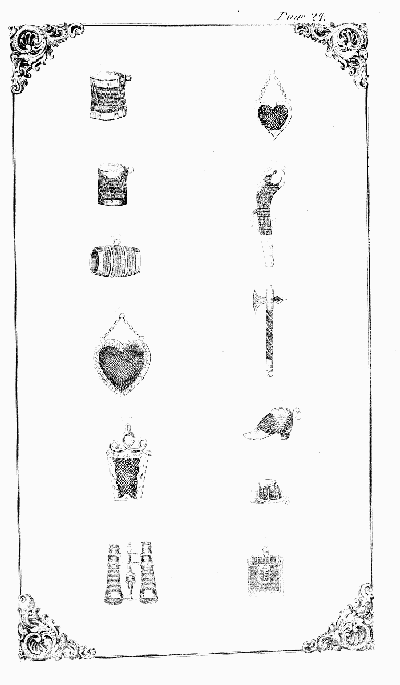
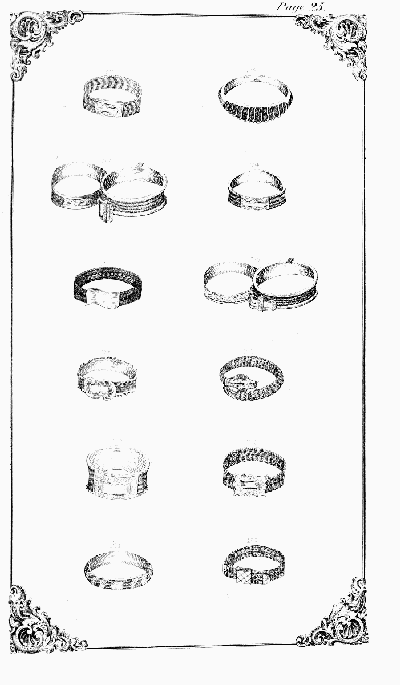
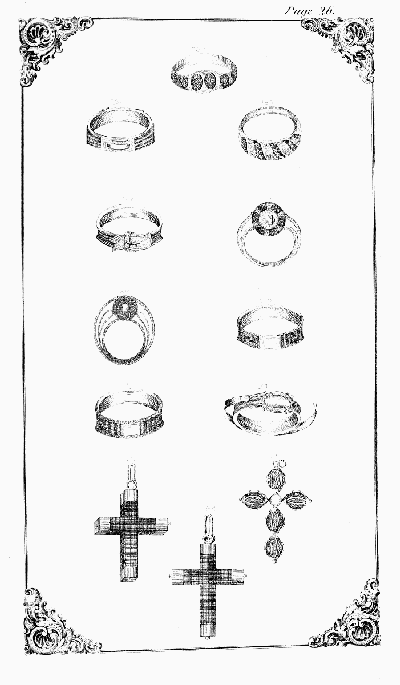
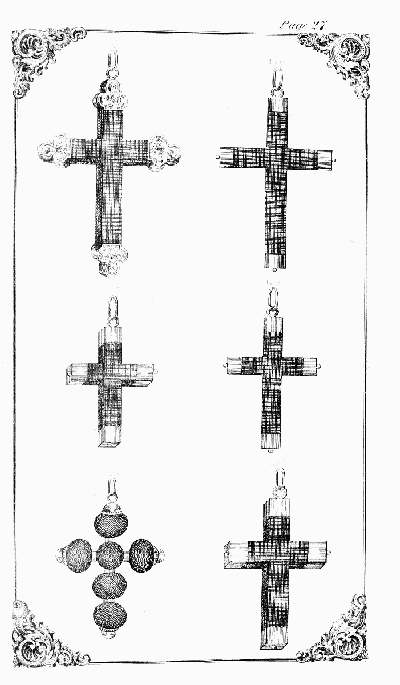
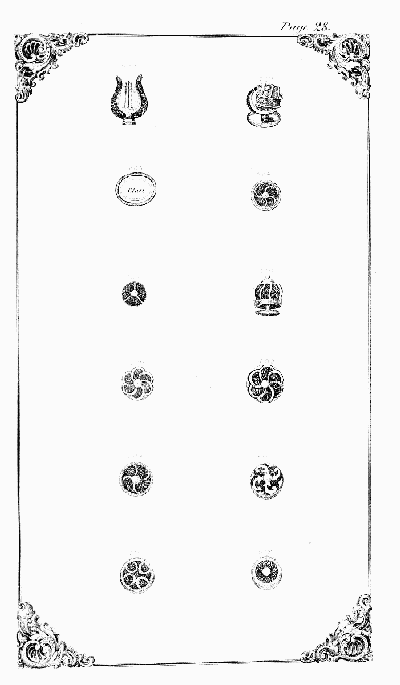
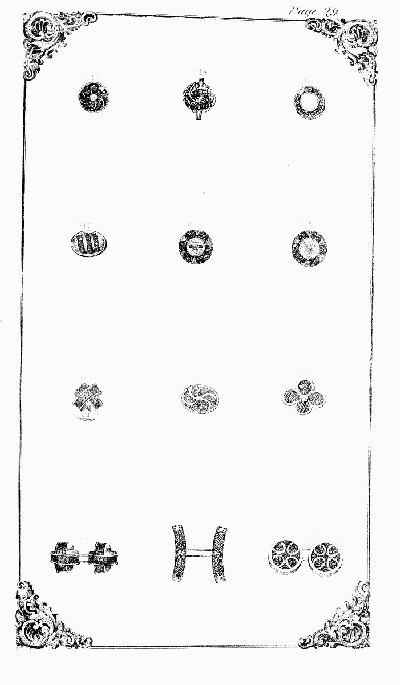
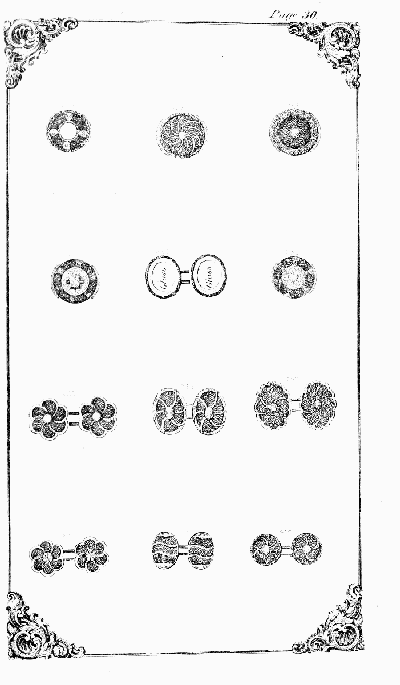
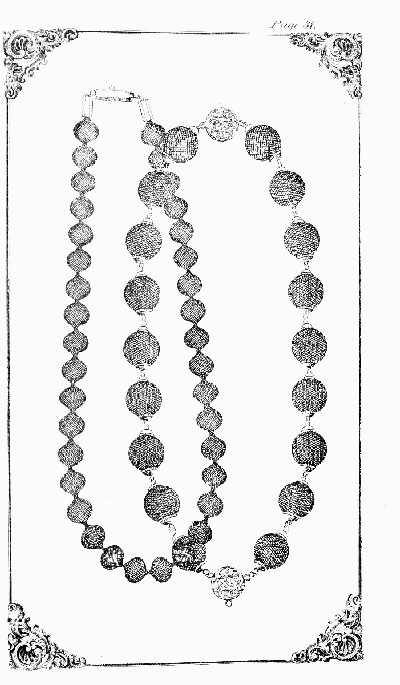
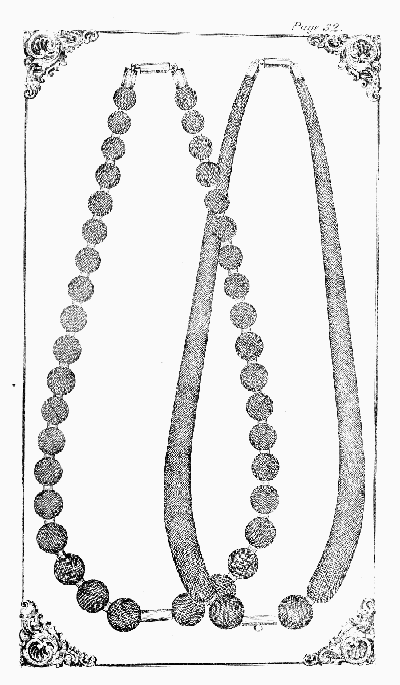
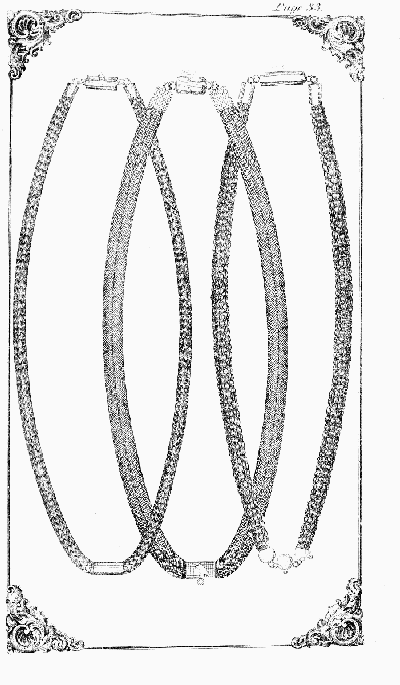
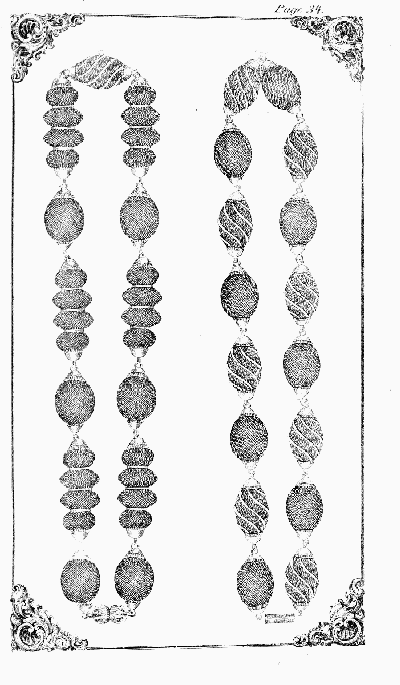
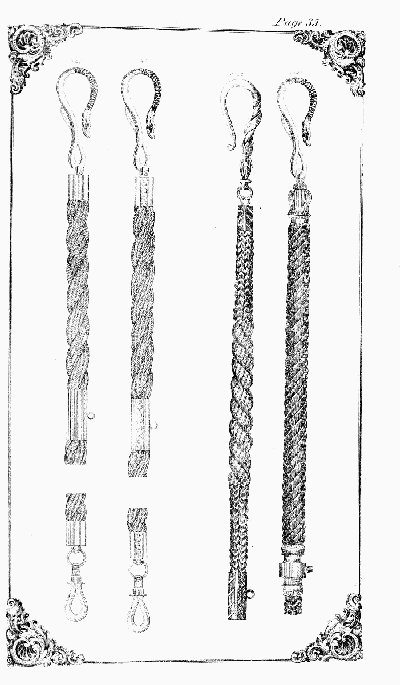
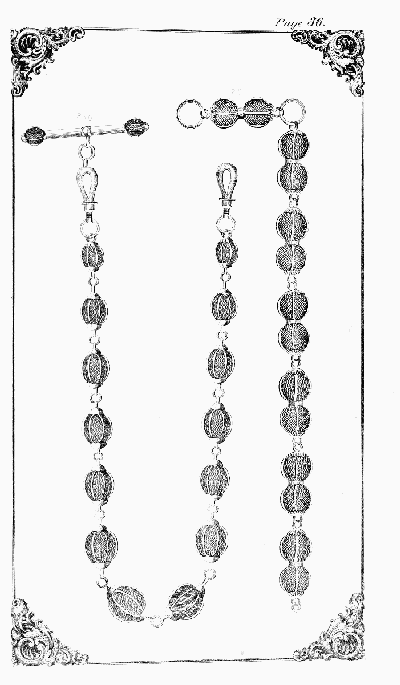
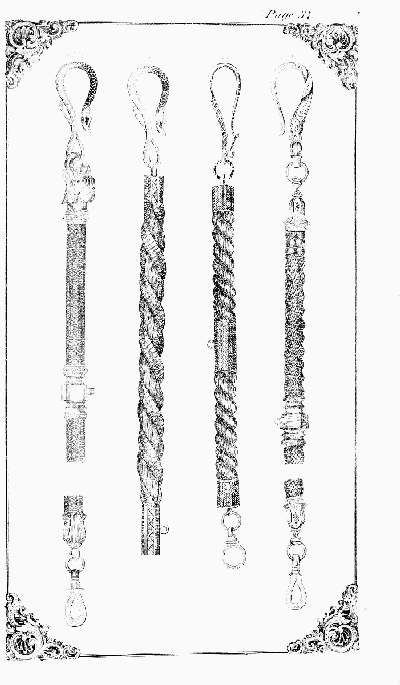
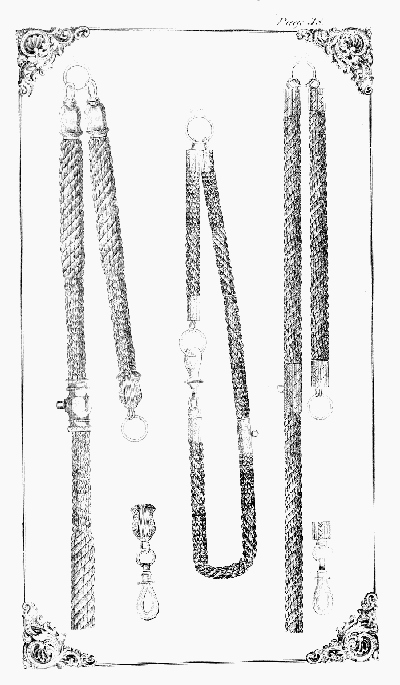
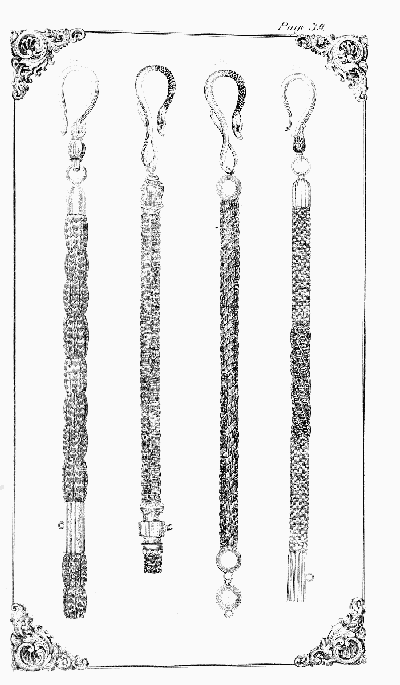
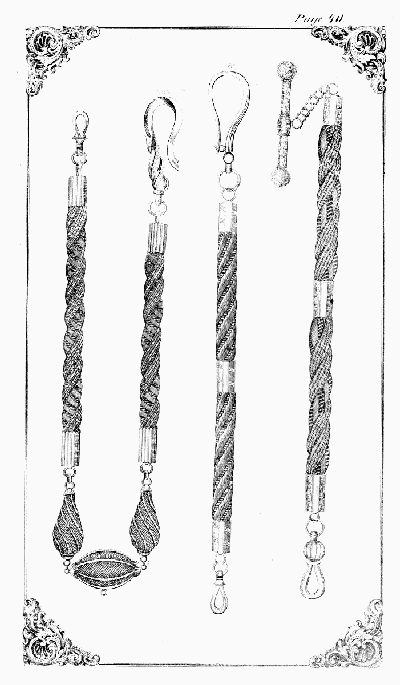
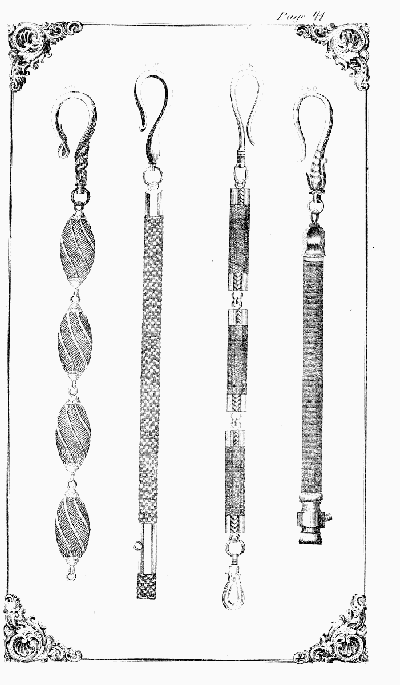
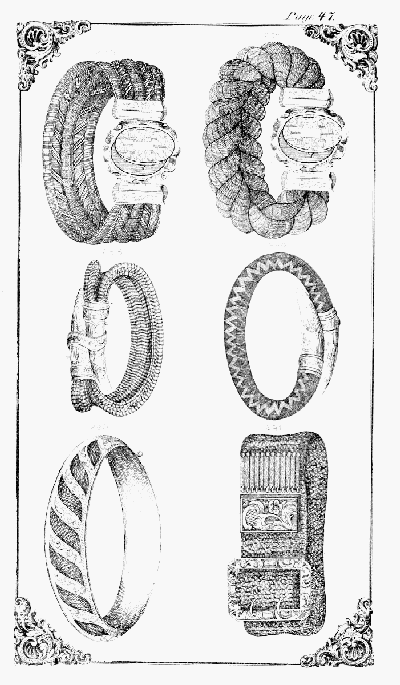
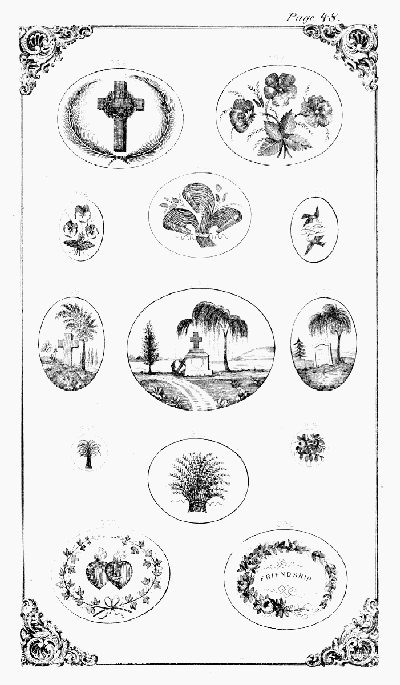
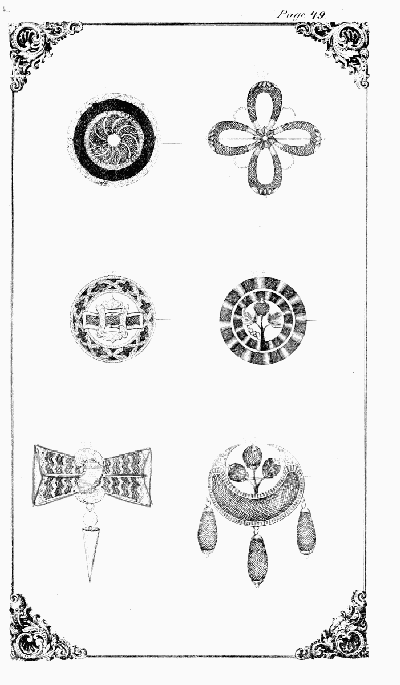
The following Lithographic designs of Hair Jewelry, Flowers and Pictures, are given for the purpose of showing a few of the many beautiful forms into which the human hair may be transposed. Each and every one of the devices on the following pages, with the exception of the flowers and pictures, can be braided from the diagrams and explanations given in the first one hundred and twenty pages of this book. Select any article you may wish to make, and by referring to the patterns, you can easily find the style and directions whereby to braid it. We might have given twice the number of patterns, or even more, but any person can, after a little experience, readily invent new and different styles of braids, and by so doing, each can satisfy their own peculiar taste.
The making of Hair Flowers is very simple, and yet, of course, every one has first to learn it. Supply yourself with as many different colors of hair as you can, and by applying Gum Tragacanth, it renders it capable of being cut in any shape you may wish—such as leaves, twigs, buds, &c., and by judiciously arranging the colors, the effect will be very pleasing. Pictures are made in the same manner, and any one possessing the least artistic skill, can make any flower or picture they may desire, and many pleasing adornments and lasting mementos may thereby be had.
All articles intended to be worn as jewelry, should, of course, be mounted with gold, and as this kind of work is not done in all jewelry establishments, I wish to say that my facilities for this branch of business is complete, and the work done is in the best possible manner. I can guarantee satisfaction in all cases, let the style desired be what it may. In sending braids to be mounted, draw on paper, as near as can be, the style or design you want.
WEAVING HAIR FOR SWITCHES.
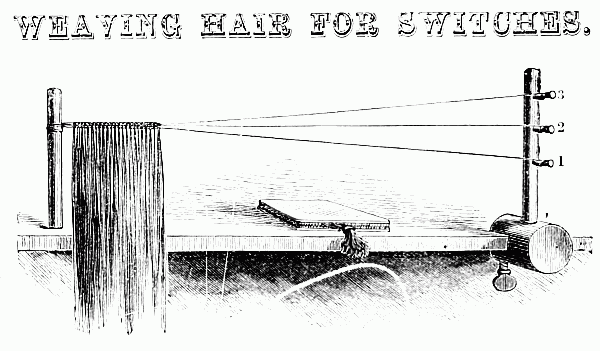
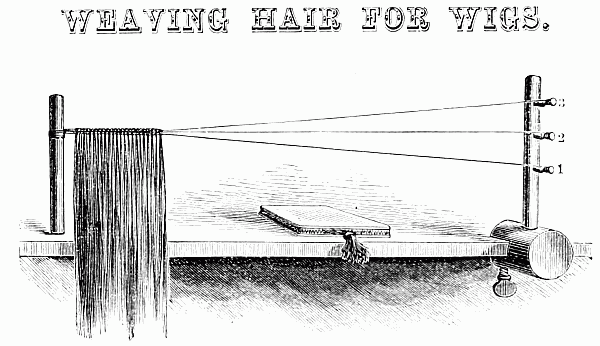
The above cut represents the apparatus used for weaving hair into Switches, Curls, Wigs, &c. It is a very simple arrangement, and can be easily constructed. Provide two straight sticks, about twelve inches long, and in one of them bore three small holes, two inches apart, in which to place as many thumb-screws, to be used for tightening or loosening the cords; in the other, have a single wooden pin or nail, to fasten the cords to. Place the sticks in a firm, upright position, about three feet apart, either by boring holes through a table, or by using mortised blocks, such as is plainly shown in cut, at the right end. After placing them in position, put on three cords, as shown in diagram, numbered 1, 2 and 3. For this weft use linen thread, at Nos. 1, 2 and 3.
In commencing to weave, place the hair between two cards, as shown in diagram, and draw out with the right hand, between the thumb and fore-finger, the quantity of hair required for the size of the weft; then change it into the left hand, and place it up to the threads, Nos. 1, 2 and 3, as shown in diagram; lay the strand over No. 1, under No. 2, over No. 3, around under No. 3, over Nos. 2 and 1, around under Nos. 1 and 2, over No. 3, around under Nos. 3 and 2, and over No. 1. Then push the strands together, as in cut.
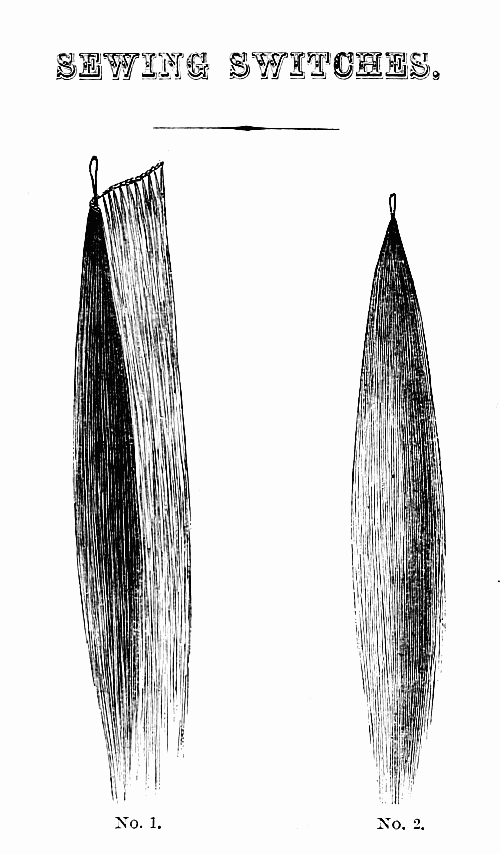
The No. 1 of the above cuts represents the winding and sewing of the switch after it is woven. For sewing a switch on points, after weaving, take Berlin cord, about one-sixteenth of an inch thick, and tie a solid knot at the end, and sew the end of the weft to the knotted end of the cord; then wind the weft around the cord, as shown in cut, the length of point desired, turning the end of the cord over to form a loop. Cut the weft according to the number of points desired in the switch. Cut No. 2 shows the switch all complete.
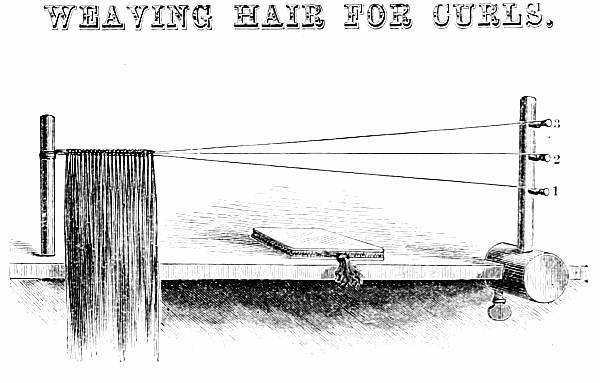
In commencing to weave, place the hair between two cards, or stiff brushes, as shown in diagram, pressing them tight together, so that in drawing out, it is perfectly free from tangles; draw out with the right hand, between the thumb and fore-finger, the quantity of hair required for the size of the weft; then change it into the left hand, and lift it up to the No. 1 cord, as shown in diagram; lay the strand over No. 1, under No. 2, over No. 3, around under No. 3, over Nos. 2 and 1, around under Nos. 1 and 2, over No. 3, around under No. 3, over No. 2, and under No. 1. Then push the strands together, as shown in diagram. For this weft use fine, strong linen thread.
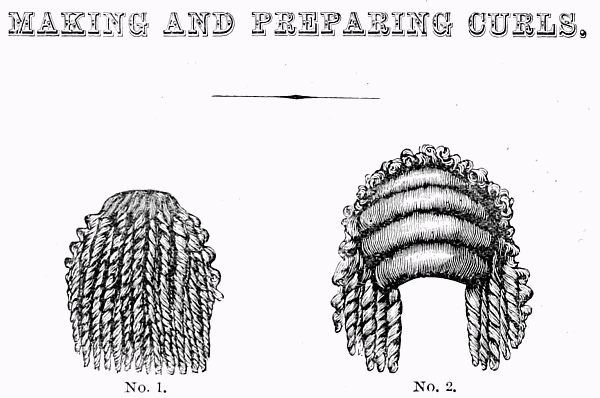
After weaving, according to directions on page 241, take a piece of ribbon an inch wide, the same color of hair, and as long as you wish the curls to be in width, and sew the weft to it back and forth. After that is done, pipe them, which is done in this manner: Dampen the hair, comb each curl out straight, and wind it tightly on a rattan stick about four inches long, having each curl on a separate stick, and commencing to wind at the tip end, tying them firmly to keep in place. Then boil in water for thirty minutes, and place in an oven as hot as they will bear without burning, until quite dry. When dry and perfectly cool, take them off the sticks, and smooth over a curling iron, the size you wish the curls. Side curls and frizzes should be prepared the same way.
Cut No. 2 represents a set of Curls and Puffs. For explanation of Puffs, see page 245.
In commencing to weave, place the hair between two cards, or stiff brushes, as shown in diagram, pressing them tight together, so that in drawing out, it is perfectly free from tangles; draw out with the right hand, between the thumb and fore-finger, the quantity of hair required for the size of the weft; then change it into the left hand, and lift it up to the No. 1 cord, as shown in diagram; lay the strand over No. 1, under No. 2, over No. 3, around under No. 3, over Nos. 2 and 1, around under Nos. 1 and 2, over No. 3, around under No. 3, over Nos. 2 and 1, around under Nos. 1 and 2, over No. 3 around under Nos. 3 and 2, and over No. 1. Then push the strands together, as shown in diagram. For this weft use sewing silk.
WEAVING HAIR FOR WATERFALLS AND BOWS
Prepare the same as above, and place the strand under No. 1, over Nos. 2 and 3, around under Nos. 3 and 2, over No. 1, around under Nos. 1 and 2, over No. 3, around under No. 3, and over Nos. 2 and 1. Aside from these changes, follow directions given above.
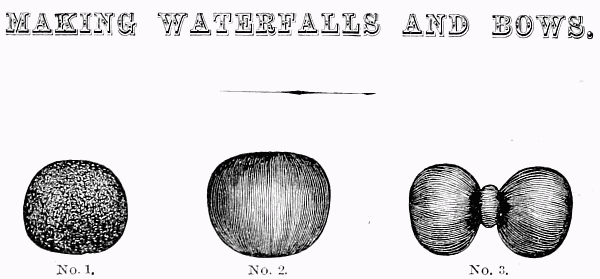
In making a Chignon, you have first to make the cushion. Take the combings or waste hair, which is of no other use, and place it between the cards or stiff brushes, the same as for weaving. Use the weaving apparatus, with two piping cords, instead of three small ones, and wind the hair all up, by passing over, between and under the cords. Boil and dry it, and then pull out the cord, which leaves it all crimped, ready to weave, according to directions on page 239. Then sew it on a cord, the same as a switch, and form it in any shape you desire, for a Waterfall, Bow or Puffs. This completes the cushion. Then weave the long hair for the covering, according to directions on page 243, and sew it to the top end of the cushion; comb it out smooth, cover the cushion, and tie a cord around it immediately at the bottom; then bring up the end of the hair, and pin it to the inside. Cut No. 1 is intended to represent the cushion, and No. 2 the complete Waterfall.
Cut No. 3 represents the Bow, which is made in the same manner, by using two small cushions, like cut No. 1, and placing between them a strand of smooth or braided hair.
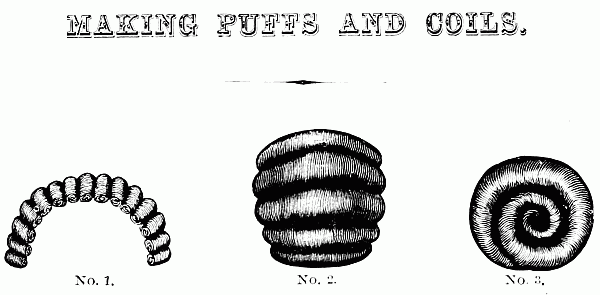
To make Puffs for front of head, from false hair, similar to cut No. 1, weave hair from eight to twelve inches long, according to directions on page 241; then take a ribbon, about one and a half inches wide, any length required, and tack it on a wig block, or straight piece of board, and sew the weft crossways a quarter of an inch apart, till the ribbon is entirely covered; then divide it off in as many puffs as desired, comb each out straight, and wind it over the two fore-fingers, close up to ribbon, and put in a hair-pin to retain it.
To make Puffs for back of head, cut No. 2, prepare the same way; make the foundation the shape and size you wish the puffs, and sew it on the same way you want the puffs to run. The puffs may be made over a cushion, formed of crimped hair the shape wanted, and wound over that instead of the fingers. Ladies not wearing false hair, can have her own hair dressed by following the above directions.
Cut No. 3 represents a coil, which is made from a switch, and wound over a long roll of crimped hair. They are much nicer, but more expensive, by being made altogether from a switch, as that can be twisted into a rope or braided, before coiling.

I herewith present, on the following pages, a number of engravings illustrative of a few of the many styles of Hair Dressing, accompanied with explanatory remarks as to their execution. They are the latest and most fashionable European and American styles, and will prove indispensable to every lady's toilet, as, from the explanations, they will be able, with very little practice, to dress their own hair in any desired style; and when any new style is inaugurated, after studying and practicing the directions given with each illustration, she will find it an easy matter to arrange it accordingly.
Any one learning Hair Dressing, should acquire perfectly the execution of the first pattern—the Promenade Head-Dress—as that is very easily arranged, and when you have once executed it in a perfect manner, the others will prove comparatively easy.
The manner of dressing the hair at the present day calls for much attention, and many inquiries are addressed us on the subject. It is plain, however, that what would correspond with the complexion and physiognomy of one, would certainly have a distasteful appearance on another; consequently, in answering inquiries, I can do nothing more than give the different styles worn. Before giving my illustrations on Hair Dressing, I have given instructions how to weave hair for chignons, curls, switches, &c., and how to put them in shape, and with the directions given with each illustration on Hair Dressing, it will certainly be an easy task to arrange the hair in any style that is now or may be in fashion.
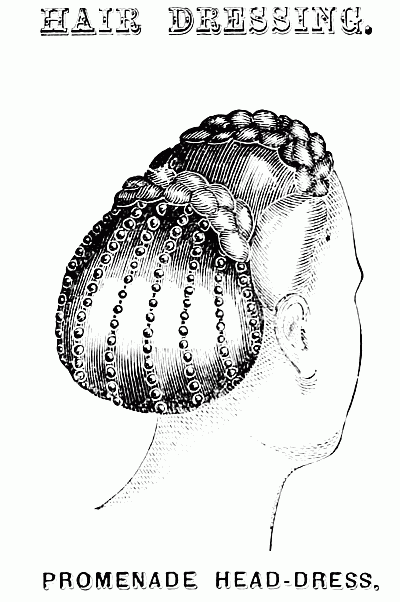
Our first cut represents the Promenade Head-Dress, but is worn as frequently in the drawing-room, and even at public and private assemblies—in fact, a common and very pretty style.
Explanation: Comb the front hair between the temples straight back, over a cushion of crimped hair, forming a Chignon; then make two braids of two small switches, and place one of them over the top of the Chignon, and the other across the forehead, forming a diadem, turning the ends under; then comb the hair from temples over the braids, and put back under the Chignon, and fasten. Place a net of pearl or gilt beads over the Chignon, as in cut. You can use false hair for covering cushion, if desired.
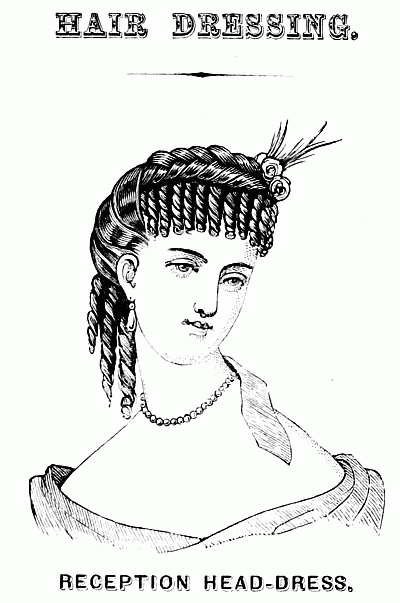
This Head-Dress is a most charming composition, and entirely new. It is adapted either for a brown or fair complexion, to be worn at grand dinners or receptions. Ornamented with pearl or gilt, it is in good taste for evening parties.
Explanation: Curl the hair across forehead, or use false curls, combing the hair straight back, and form a chignon of curls at the back. Place a diadem plait across forehead, and raise the hair from the temples over the plait. Trim with roses and ribbans, or to suit dress.
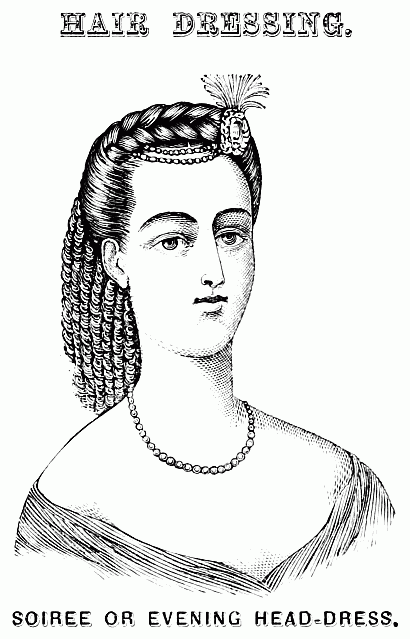
This cut illustrates the Soiree or Evening Head-Dress. It is a very unique and modern style, suited for almost any complexion, and very easily executed.
Explanation: Comb the hair straight back between the temples, tie it, and curl the ends, or use a set of long false curls. Place a diadem plait, made from a switch, across the forehead; then comb the hair back from the temples, over the ends of the plait, twist it, pass it back under the curls, and fasten firmly. Use a fancy back-comb on top of curls, and pin an ornament to diadem plait, with feather and chain attached, as in cut, or trim to suit dress.
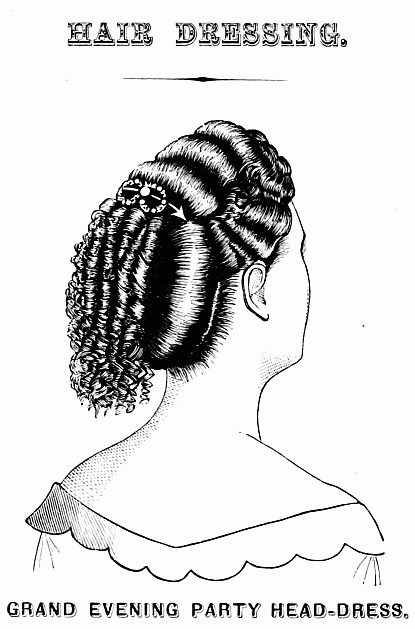
A very graceful Head-Dress, of a bold style, suited for a young lady of brown or fair complexion, and is in good taste to be worn at the theatre or Grand Evening Parties.
Explanation: Make a parting over the head, from ear to ear, two inches from front; on the forehead, between the temples, curl the hair in small friz curls, and from the temple to the ear, make loose puffs. Divide the hair in three partings over the head, and roll each in a large puff; then form a large puff of the back hair, round the nape of the neck, as in cut. Fasten a large set of loose curls over the puff, with a comb or other ornament. For reference, see page 245.
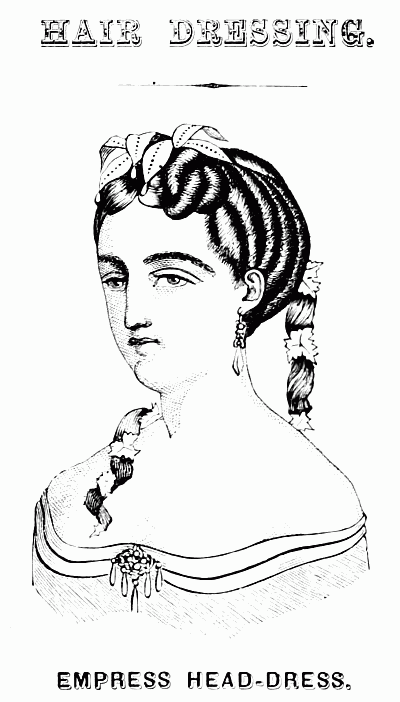
A charming Head-Dress, and entirely new, perfectly suiting a fair complexion. It may serve for the theatre or evening parties. When powdered it preferably suits a brown or brunette.
Explanation: Make a front parting, and a cross one from ear to ear. Divide each side into five parts; of the front parting make three puffs on each side. The remaining four make into long puffs, as in cut, according to explanations on page 245. The back hair may be arranged in the same style of puffs, or with a double Chignon, placing a single, long false curl or braid, back of each ear. Trim with orange leaves, or to suit dress.
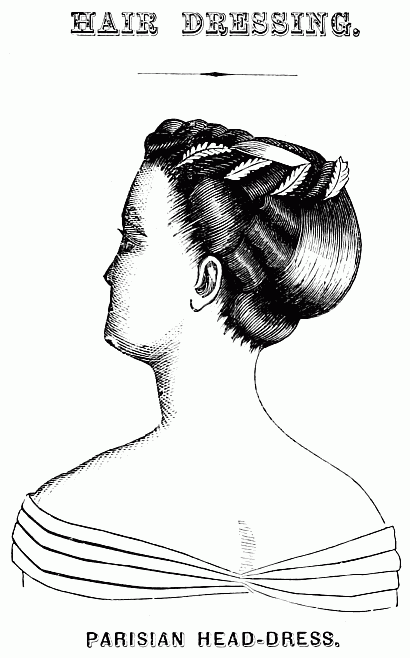
This Head-Dress, both bold and graceful, is suitable for any complexion or age, when the physiognomy allows it.
Explanation: Comb back the hair from the forehead between the temples, make a large puff on the temples, and three puffs above each ear. Place a cushion at the back of head, and comb the hair over it, forming a chignon; then place a diadem plait, or twist, made from a large switch, round on the top of head, trimmed with leaves or ribbon, as shown in cut.
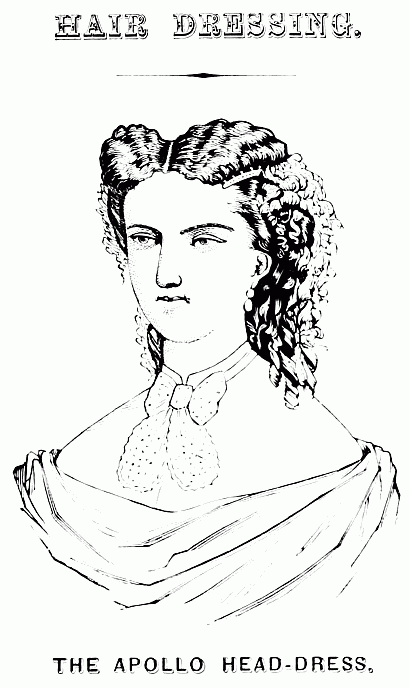
This Head-Dress is one of the most graceful styles. It was worn in the time of Louis XIVth, and well agrees with the fashion of the present day. With some modifications, it is suited to every complexion.