Chapter II · A Nest of Eagles
Reading edition
“So underneath the surface of To-day
Lies yesterday and what we call the Past,
The only thing which never can decay.”
Trustfully and sleepily Jane and Peripatetica, in the icy starlight of La Cava, boarded the express of European de Luxe. Drowsy with the long day’s rush through the wind, they believed that the train’s clatter would be a mere lullaby to dreams of golden temples and iris seas and “the glory that was Greece.” No robbers or barbarians nearer than defunct corsairs crossed their imaginings; the hoodoo had faded from mind, shaken off by the glorious swoop of Berliet, and they supposed it left behind at Naples, clinging bat-like under the gaudy frescoes of Room 13 to descend on other unwary travellers.
Half of their substance had been paid to the Compagnie Internationale des Wagon Lits for this night’s rolling lodging, and they begrudged it not, remembering that it entitled their fatigue to the comforts of a 46room to themselves in all the vaunted superior civilization and decencies of a European compartment car. Presenting their tickets in trusting calm they prepared to follow the porter to a small but cosy room where two waiting white beds lay ready for their weary heads. But the Hoodoo had come on from Naples in that very train. Compartments and beds there were, but not for them. The porter led on, and in a toy imitation of an American Pullman, showed them to a Lilliputian blue plush seat and a ridiculous wooden shelf two feet above that pretended it could unfold itself into an upper berth. This baby section in the midst of a shrieking babble of tongues, a suffocation of unaired Latin and Teutonic humanity, was their compartment room, “à vous seules, Mesdames!” telegraphed for to Rome and made over to them with such flourish by the polite agent at Naples!
If the car was Lilliputian its passengers were not. Mammoth French dowagers and barrel-like Germans overflowed all its tiny blue seats, and the few slim Americans more than made good by their generous excess of luggage. It was a very sardine box.
In a fury too deep for words or tears Peripatetica and Jane sank into the few narrow inches the porter managed to clear for them, and resigned themselves to leaving their own dear bags in the corridor.
“They will, of course, be stolen, but then we may never need them again. We can’t undress, and shall probably be suffocated long before morning,” remarked Peripatetica bitterly, with a hopeless glare at the imitation ventilators not made to open. Their fury deepened at the slow struggles of the porter to adjust the inadequate little partitions, at the grimy blankets and 47pillows on the little shelves, at the curtains which didn’t conceal them, the wash-room without water or towels and the cattle-train-like burden of grunts and groans and smells floating on the unbreathable atmosphere.
Morning dawned golden on the flying hills at last, and then deepest fury of all was Peripatetica’s, that passionate lover of fresh air, to find that in spite of everything she had slept, and was still breathing!
Calabria, lovely as ever, melted down to her glowing seas; one last swooping turn of the rails, and another line of faint hills rose opposite—and that was Sicily!
The train itself coiled like a weary serpent into a waiting steamer, which slipt smoothly by the ancient perils of Scylla and Charybdis; and nearer and nearer it rose, that gold and amethyst mountain-home of the Old Gods. The white curve of Messina, “the Sickle,” showed clear at the base of the cloud-flecked hills. Kronos, father of Demeter, enthroned on those very mountain peaks, had dropped his scythe at the sea’s edge, cutting space there for the little homes of men, and leaving them the name of his shining blade, “Zancle,” the sickle, through all Greek days. It was there, really there in actual vision, land of fire and myths; the place of the beginnings of gods and men.
Peripatetica and Jane burst from the car and climbed to the narrow deck above to get clearer view. The sea wind swept the dust from their eyes and all fatigue and discomfort from their memories. Their spirits rose to meet that Spirit Land where Immortals had battled and labored; had breathed themselves into man,—the divine spirit stirring his little passing life with revelation of that which passeth not; that soul 48of beauty and wisdom, and of poetry which should move through the ages. Their eyes were wide to see the land where man’s imaginings had brought the divine into all surroundings of his life, until every tree and spring and rock and mountain grew into semblance of a god. Oh, was it all a “creed outworn”? Here might not one perchance still see
“Proteus rising from the sea,
Or hear old Triton blow his wreathèd horn”?
In these very mountains before them had man himself been shaped; hammered out by Vulcan upon his forge in Ætna. Here, in this land he had been taught by Demeter to nourish himself from the friendly earth, taught how to shelter himself from the inclement elements by Orion, Hunter and Architect—a god before he was a star. There Zeus, all-conquering wisdom, had prevailed against his opponents and placed his high and fiery seat, this very Ætna, upon the bound body of the last rebellious Titan, making even the power of ignorance the pediment of his throne. There the fair maiden goddesses, Artemis and Minerva and Persephone, had played in flowery fields. There had Pluto stolen the fairest away from among the blossoms, the entrance to his dark underworld gaping suddenly among the sunny meadows. There had the desolate mother Demeter lit at Ætna the torch for her long and desperate search. There had demi-gods and heroes lived and loved and struggled. Its very rivers were transformed nymphs, its islands rocks tossed in Cyclop’s battles. There Ulysses had wandered and suffered; there Pythagoras had taught, Theocritus had sung. There—but man nor woman either is yet entirely spirit; 49and though it was in truth the actual land of their pilgrimage, of the birthplace of myth, of beauty and wonder, Persephone had not yet returned. The icy wind was turning all sentiment into shivers and they fled back to the Twentieth Century and its Pullman car.
Messina looked still more enticing when close at hand; both prosperous and imposing with its lines of stone quays and palaces on the sea front. Beyond these there were famous fountains they knew, and colourful marketplaces, and baroque churches with spires like fluted seashells, and interiors gleaming like sea caverns with all the rich colour and glow of Sicilian mosaics. In one of the churches was the shrine of a miracle-working letter from the Madonna, said to have been written by her own hand. There was besides an old Norman Cathedral, built of Greek ruins and Roman remains; much surviving Spanish quaintness, but to two unbreakfasted Wagon Lit passengers all this was but ashes in the mouth. They felt that the attractions of Messina could safely remain in the guide-books. They were impelled on to Taormina.... No prophetic vision warned them that in their haste they were losing the chance of ever seeing that doomed Sickle-City at all. In that placid, modern port, where travellers for pleasure rarely paused, there seemed nothing to stay them. No ominous shadow lay upon it to tell that it was marked for destruction by “the Earth-Shaker,” or that before the year had gone it would be echoing the bitter cry of lost Berytus:
“Here am I, that unhappy city—no more a city—lying in ruins, my citizens dead men, alas! most ill-fated of all! The Fire-god destroyed me after the 50shock of the Earth-Shaker. Ah me! From so much loveliness I am become ashes. Yet do ye who pass me by bewail my fate, and shed a tear in my honour who am no more. A tomb of tombless men is the city, under whose ashes we lie.”
Taormina, the little mountain town, crouched under Ætna’s southern side, not far from those meadows of Enna from which Persephone had been ravished away. There she would surely first return to the upper world, and Demeter’s joy burst into flowers and sunshine. So there they decided to seek her, and turned their grimy faces straight to the train. The only sight-seeing that appealed to them now was a vision of the San Domenico Hotel with quiet white monkish cells like to Amalfi’s to rest their weariness in, peaceful pergolas, large bathtubs, and a hearty table d’hôte luncheon.
So they stayed not for sights, and stopped not for stone—nor breakfast, nor washing, nor even for their trunks, which had not materialized, but sat in a dusty railway carriage impatient for the train to start.
“It was beautiful,” remarked Jane, thinking of the harbour approach to the city.
“Yes,” said Peripatetica, jumping at her unexpressed meaning as usual. “Messina has always been a famous beauty, and always will be. But she is, and always has been, an incorrigible cocotte,—submitting without a struggle to every invader of Sicily in turn. And she certainly doesn’t in the least look her enormous age in spite of having led a vie orageuse. Whenever the traces of her past become too obvious she goes and takes an earthquake shock, they say, and rises fresh and rejuvenated from the ruins, ready to coquette 51again with a new master and be enticing and treacherous all over again.”[1]
It was hard to imagine on her modern boulevards the armies of the past—all those many conquerors that Messina had herself called in, causing half the wars and troubles of Sicily by her invitations to new powers to come and take possession, and to do the fighting for her that she never would do for herself; betraying in turn every master, good or bad, for the excitement of getting a new one....
Greeks, Carthagenians, Mamertines, Romans, Arabs, Normans, Spaniards—where were the ways of their tramplings now? On that modern light-house point there was not even a trace of the Golden Temple in which Neptune sat on a crystal altar “begirt with smooth-necked shells, sea-weeds, and coral, looking out eastward to the morning sun?”
“If it were near the 15th of August I would stay here in spite of everything,” ventured Peripatetica, looking up from her book. “The Procession of the Virgin is the only thing really worth seeing left in Messina.” And in answer to Jane’s enquiring eyebrows Peripatetica began to read aloud of that extraordinary pageant of the Madonna della Lettera and her car, that immense float, dragged through Messina’s streets by hundreds of men and women; of its tower fifty feet high, on which are ranged tiers over tiers of symbolically dressed children standing upon all its different stories; poor babies with painted wings made to fly around on iron orbits up to the very top of the 52erection; of the great blue globe upon which stands a girl dressed in spangled gauze, representing the Saviour, holding upon her right hand—luckily supported by iron machinery—another child representing the Soul of the Blessed Virgin.
“Not real children—not live babies!” protested Jane.
“Yes, indeed, just listen to Hughes’ account of it.” Peripatetica read: “At an appointed signal this well-freighted car begins to move, when it is welcomed with reiterated shouts and vivas by the infatuated populace; drums and trumpets play; the Dutch concert in the machine commences, and thousands of pateraroes fired off by a train of gunpowder make the shores of Calabria re-echo with the sound; then angels, cherubim, seraphim, and ‘animated intelligences,’ all begin to revolve in such implicated orbits as to make even the spectators giddy with the sight; but alas for the unfortunate little actors in the pantomime; they in spite of their heavenly characters are soon doomed to experience the infirmities of mortality; angels droop, cherubim are scared out of their wits, seraphim set up outrageous cries, ‘souls of the universe’ faint away, and ‘moving intelligences’ are moved by the most terrible inversion of the peristaltic nerves; then thrice happy are those to whom an upper station has been allotted. Some of the young brats, in spite of the fracas, seem highly delighted with their ride, and eat their ginger-bread with the utmost composure as they perform their evolutions; but it not unfrequently happens that one or more of these poor innocents fall victims to this revolutionary system and earn the crown of martyrdom.”
Jane seized the book to make sure it was actually so written and not just one of Peripatetica’s flights of 53fancy, and plunged into an account of another part of the pageant—the giant figures of Saturn and Cybele fraternizing amiably with the Madonna; Cybele “seated on a large horse clothed like a warrior. Her hair is tied back with a crown of leaves and flowers with a star in front, and the three towers of Messina. She wears a collar and a large blue mantle covered with stars, which lies on the back of the horse. A mace of flowers in her right hand and a lance in her left. The horse is barded, and covered with rich trappings of red, with arabesques of flowers and ribbons.”...[2]
“What curious folk the Sicilians are! They accept new creeds and ceremonies, but the old never quite lose their place. Where else would the Madonna allow a Pagan goddess to figure in her train? And did you notice in this very procession they still carry the identical skin of the camel on which Roger entered the city when he began his conquest of Sicily? I wish it were near the 15th of August!”
“I wish it were near the time this train starts, if it ever does,” replied Peripatetica crossly.
And, as if but waiting the expression of her wish, the train did begin to stream swiftly along the deeply indented coast beside whose margin came that wild Norman raid upon Messina of the dauntless young hawks of de Hauteville. Roger, the youngest and greatest of the twelve sons, accompanied by but sixty knights and their squires, two hundred men in all, pouncing daringly upon a kingdom. A half dozen galleys slipped over from Reggio by night, and the 54morning sun flashed upon the dew-wet armour as they galloped through the dawn to Messina’s walls. The great fortified city was in front of them, a hostile country around them, and a navy on the watch to cut them off from reinforcements or return by sea. That they should succeed was visibly impossible. But determined faces were under the steel visors, the spirit of conquering adventure shining in their grey eyes. Every man of the host was confessed and absolved for this fight of the Cross against the Crescent and their young Commander was dedicated to a life pure and exemplary, if to him was entrusted the great task of winning Sicily to Christian dominion.
They did it because they thought they could do it; as in the old Greek games success was to the man who believed in his success. The Saracens fell into a panic at the sight of that intrepid handful at their gates, thinking from the very smallness of the band that it must be the advance pickets of a great army already past their guarding navy and advancing upon the city.
“So the Saracens gave up in panic, and Roger and his two hundred took all the town with much gold and many slaves, as was a conquering warrior’s due.”
The key of Messina was sent to Brother Robert in Calabria with the proud message that the city was his to come and take possession of. And the Normans went on with the same bold confidence; and always their belief was as a magic buckler to them as over all the island they extended their conquest. Seven hundred Normans routed an army of 15,000 Saracens, killing 10,000. And young Serbo, nephew of Roger, conquered 30,000 Arabs, attacking them with only one hundred knights.
55It was one of Jane’s pet romances, the career of this landless youngest son of a small French noble carving out with sword and brain “the most brilliant of European Kingdoms,” leaving a dominion to his successors with power stretching far beyond Sicily as long as they governed upon his principles. The young conqueror, unspoiled by his dazzling success, ruled with justice, mercy, and genius, making Sicily united and prosperous; the freest country in the world at that time; the only one where all religions were tolerated, where men of different creeds and tongues could live side by side, each in his own way; each governed justly and liberally according to his own laws—French statutes for Normans, the Koran for Mussulmen, the Lombard laws for Italians, and the old Roman Code for the natives.
“Peripatetica,” Jane burst out. “Roger must have been a delightful person—‘so good, so dear, so great a king!’ Don’t you think there is something very appealing in a king’s being called ‘so dear’? It is much easier for them to be ‘great.’”
“Normans are too modern for me now,” said Peripatetica, whose own enthusiasm was commencing to catch fire. “We are coming to the spot of all the Greek beginnings, where their very first settlement began—do you realize that?”
And Jane, who had been hard at work with her histories, could see it clearly. The little narrow viking-like boats of Theocles, the Greek merchant, driven before the sudden northeast storm they could not beat up against nor lie to, straight upon the coast of this dread land. It had always been a land awesome and mysterious to the Greeks. They had imagined half 56the dramas of their mythology as happening there. It was sacred ground, too sacred to be explored by profane foot; and was besides the home of fierce cannibals, as they believed the Sikilians to be, and of all manner of monstrous and half divine beings. But, desperately choosing before certain destruction at sea the unknown perils of the shore, Theocles had rounded the point and beached his boats safely on that strip of yellow sand that still fringes the cove below Taormina.
He and his companions, who feared to adventure no perils of the treacherous Mediterranean in their tiny crafts, but feared very much the monsters of their imagination in this haunted country, built to Apollo an altar of the sea-worn rocks, and sacrificed on it their last meal and wine, praying him for protection and help to save them from the Læstrygones, from Polyphemus, and Hephæstos at his nearby smoking forge. And Apollo must have found it good, the savour of that his first sacrifice on Sicilian land, for straightway succour came. The natives, drawn down from the hillsides in curiosity at that strange fire on the shore, were not raging cannibals but peaceful and friendly farmer folk, who looked kindly on the shipwrecked merchants, and gladly bartered food and rich dark wine for Greek goods. And through the days of the storm the Greeks lived unmolested on the shore, impressed by all that met their eyes; the goodness of that “fairest place in the world.” When at last came favourable winds and the Greeks could set sail again, Theocles vowed to return to that fertile shore, and if Apollo, protector of colonists and giver of victory, should favour his enterprise, to build there a shrine in his honour.
57But in Athens none would believe his accounts of the rich land and the mild natives. They said that even so it would be unwise to disturb Polyphemus, or to run the risk of angering Hephæstos, and that it was no proper site for a colony any way! Theocles did not falter at discouragement; he took his tale to other cities and over in Eubœa the Chalcydians were won to him. After the oracle of Apollo had promised them his protection and all good fortune, more Ionians and some Dorians joined them; and in the spring they set forth, a great fleet of vessels laden with all necessary things to found a colony. Theocles piloted them to the spot of his first sheltering; and there on the red rock horns of the point above the beach they founded Naxos, and built the great shrine of Apollo Archagates, founder and beginner, with that wonderful statue which is spoken of as still existing in the time of Augustus, 36 B.C.
Naxos itself had no such length of life. It knew prosperous centuries of growth and importance, of busy commerce and smiling wealth. Then came Dionysius, Tyrant of Syracuse, subdued the mother city to his jealous power and absolutely exterminated it, killing or carrying off into slavery all its population. “The buildings were swept away, and the site of Naxos given back to the native Sikilians. They never returned, and for twenty-two centuries no man has dwelt there.” Of all the shrines and palaces of Naxos not one stone remains upon another, not one surviving trace to identify now the exact site even of the Mother of all Greek cities in Sicily. But from her sprang Taormina.
Such of her population as managed to escape from 58Dionysius, climbed up to those steep rocks above and there, sheltering with the Sikilians, out of tyrants’ reach in that inaccessible mountain nest, Greek and Sikilian mingling produced a breed of eagles that with fierce strugglings has held fast its own on those peaks through all the centuries.
But these shipwrecks and temples and sieges grew dim behind the gritty cloud of railroad cinders. Jane felt the past melt away from her and fade entirely into the cold discomfort of the present. She subsided into limp weariness in a corner of the carriage, incapable of interest in anything, while Peripatetica’s spirits revived, approaching the tracks of her adored Greeks, and her imagination took fire and burst into words.
“Oh those wonderful days!” she cried. “If one could only have seen that civilization, that beauty, with actual eyes. Jane, wouldn’t you give anything to get back into the Past even for a moment?”
“No, I’d rather get somewhere in the now—and to breakfast,” grumbled Jane with hopeless materialism as she vainly tried to stay her hunger on stale chocolate. So Peripatetica saw visions alone, Jane only knowing dimly that miles and miles of orange groves, and of a sea a little paled and faded from its Calabrian blue, were slipping by.
A box of a station announced itself as Giardini-Taormina. A red-cheeked porter bore the legend “Hotel San Domenico” on his cap; and much luggage and two travellers fell upon him. But, ah, that hoodoo!
“Desolated, but the hotel was full. Yes, their letter had been received, but it had been impossible to reserve rooms,” said the cheerful porter heartlessly; “no doubt other hotels could accommodate them.” He 59didn’t seem to feel his cheerfulness in the least diminished by the dismay pictured in the dusty faces before him.
“Oh, well,” said Jane bravely, “picturesque monasteries are all very well, but modern comfort does count in the end. We will probably like the Castel-a-Mare, and if we don’t, there is the Timeo.”
A small man buzzing “Metropole, Metropole! Come with me, Ladies—beautiful rooms—my omnibus is just going!” hung upon their skirts, but they brushed him sternly aside, and permitted the rosy-cheeked porter to pile them and the mountains of their motoring-luggage into a dusty cab, and sing “Castel-a-Mare” cheerily to its driver.
“We will go there first as it’s nearest,” they agreed, “but if the rooms aren’t very nice, then the Timeo—the royalties all prefer the Timeo.”
The road was twisting up and up a bare hillside. They roused themselves to think that they were approaching Taormina, the crown of Sicily’s beauty, the climax of all earthly loveliness, the spot apostrophised alike with dying breath by German poets and English statesmen, as being the fairest of all that their eyes had beheld on earth, place of “glories far worthier seraph’s eyes” than anything sinful man ought to expect in this blighted world according to Cardinal Newman.
But where was it, that glamour of beauty? Underneath was a leaden stretch of sea, overhead a cold, clouded sky, jagged into by forbidding peaks. The grey road wound up and folded back upon itself, and slowly—oh dear departed Berliet, how slowly!—up they crawled. It was all grey, receding sea and rocky hillside, grey dust thick on parched bushes and plants, 60greyer still on grey olives and cactus, and what—those other dingy trees—could they be almonds!—those shrivelled and pallid ghosts of rosy bloom shivering in the icy wind? Was it all but a chill shadow, that for which they had left home and roaring fires and good steam heat?
A furry grey head surmounted a dust wave, a donkey and a small square cart emerged behind him, following a line of others even greyer and dustier. Jane looked listlessly at the forlorn procession until her eyes discerned colour and figures dim beneath the dirt on the cart’s sides, and underneath fantastic mud gobs what appeared to be carvings. Could these be the famous Painted Carts, the “walking picture books” of a romance and colour loving people, the pride of a Sicilian peasant, frescoed and wrought, though the owner lived in a cave—the asses hung with velvet and glittering bits of mirrors though he himself walked in rags? Was everything hoped for in Sicily to prove a delusion?
Up whirled the San Domenico porter in a cloud of dust, his empty carriage passing their laden one.
“You might try the ‘Pension Bellevue,’ ladies—beautiful outlook—opposite the Castel-a-Mare, if you are not suited there,” he called out as he rolled by.
They thanked him coldly, with spines stiffening in spite of fatigue.
A pension? Never! If they could not have ascetic cells at San Domenico or the flowery loggias of the Castel-a-Mare, then at least the chambers that had sheltered a German Empress!
Gardens and flowers began to appear behind the dust; a wave-fretted promontory ran into the sea below, a towering peak crowned with a brown rim loomed 61overhead. In a few more dusty twists of road the Castel-a-Mare was reached, and two large rooms with the best view carelessly demanded.
The Concierge looked troubled and sent for a bland proprietor. Rooms? He had none! wouldn’t have for a month—could give one room just for that very night—that was all!
To the Timeo then.
More dusty road, a quaint gateway, a narrow street with all the town’s population walking in the middle of it, a stop in front of a delightful bit of garden. A stern and decided concierge this time—No rooms!
In the mile and a half from the Castel-a-Mare at the end of one promontory, to the Internationale at the extreme end of the other, that dusty cab stopped at every hotel and, oh lost pride! at every pension in the town and out. The same stern refusal everywhere; no one wanted the weary freight. They felt their faces taking on the meek wistfulness of lost puppies vainly trying to ingratiate themselves into homes with bones.
“Does no one in the world want us?” wailed Peripatetica. “Can’t any one see how nice we really are and give us a mat and a crust?”
“The Metropole man did want us,” reminded Jane hopefully. “He even begged for us. Let’s go there!”
That had been the one and only place passed by, the Domenico porter had seemed so scornful of its claim at the station, but now they would condescend to any roof, and thought gratefully of that only welcome offered them in all Taormina.
How pleased the little porter would be to have them coming to his beautiful rooms after all! Their meek 62faces became proud again. They looked with approving proprietorship on the waving palm in front of the Metropole, and the old bell tower rising above it.
Peripatetica’s foot was on the carriage step ready to alight and Jane was gathering up wraps and beloved Kodak when out came a languid concierge and the usual words knelled in their ears—“No rooms!”
They refused to believe. “But your porter said you had.”
“Yes, an hour ago, but now they are taken.”
A merciful daze fell upon Peripatetica and Jane....
How they returned to the “Castel-a-Mare” and got themselves and their mountain of luggage into the one room in all Taormina they might call theirs for as much as a night, they never knew; when consciousness came back they were sitting in front of food in a bright dining-room, and knew by each other’s faces that hot water and soap must have happened in the interval.
Speech came back to Peripatetica, and she announced that she was never going to travel more, except to reach some place where she might stay on and on forever. Jane might tour through Sicily if she liked, but as for her, Syracuse and Girgenti and all could remain mere words on the map, and Cook keep her tickets—if she had to move on again on the morrow, she would go straight to Palermo and there stay!
Jane admitted to congenial feelings, and resigned all intervening Sicily without a pang. There would be no place in inhospitable Taormina for Persephone to squeeze into any way!
They went to question the Concierge of trains to Palermo. He took it as a personal grief that they must leave Taormina so soon. “The air of Palermo 63is not like ours.” They hoped it was not, as they shivered in a cold blast from the open door, and put it to him that they could hardly live on air alone, and that Taormina offered them nothing more. But he had something to suggest—furnished rooms that he had heard that a German shop-keeper wished to let. Peripatetica did not take to the suggestion kindly, in fact her aristocratic nose quite curled up at it. But she assented dejectedly that they might as well walk there as anywhere, and give the place a look.
Through the dust and shrivelled almond blossoms they trailed back into town. The sun was still behind grey clouds and an icy wind whipped up the dust.
“Too late for the almond bloom, too early for warmth. What is the right moment for Sicily?” murmured Peripatetica.
The mountains with their sweeping curves into the sea were undeniably beautiful; the narrow town street they entered through the battlemented gate was full of gay colour, but it left them cold and homesick for Calabria. A little old Saracen palace, with some delicate Moorish windows and mouldings still undefaced, held the antiquity shop of the Frau Schuler. Brisk and rosy she seemed indeed the “trustable person” of the Concierge’s description.
Yes, indeed, she had rooms and hoped they might please the ladies. Her niece would show them. A white-haired loafer was beckoned from the Square, and Peripatetica and Jane turned over to his guidance. Behind his faded blue linen back they threaded their way between the swarming tourists, children, panniered donkeys, and painted carts.
64Suddenly the old man vanished into a crack between two houses, which turned out to be an alley, half stair, half gutter, dropping down to lower levels. Everything no longer needed in the kitchen economy of the houses on either side had been cast into the alley—the bones of yesterday’s dinners, vegetable parings of to-day’s, the baby’s bath, the father’s old shoes lay in a rich ooze through which chickens clucked and squabbled. At the bottom of the crack a high wall and a pink gateway ... they were in a delicious garden, descending a pergola of roses and grapes. Violets and freesias, geraniums and heliotrope spread in a dazzle of colour and sweetness under gnarled olives and almonds and blossoming plums; stone benches, bits of old marbles, a violet-fringed pool and a terrace leading down to a square white house, a smiling young German girl inviting them in, and then a view—dazzling to even their fatigued, dulled eyes.
In front a terrace, and then nothing but the sea, 700 feet below, the surf-rimmed coast line melting on and off indefinitely to the right in great soft curves of up-springing mountains, a deep ravine, then the San Domenico point with the old convent and church rising out of its gardens. On the left the ruins of the Greek theatre hanging over their heads; and on the very edge of the terrace an old almond-tree with chairs and a table under it, all waiting for tea.
Fortunately the villa’s interior showed comfortable rooms, clean, airy, and spacious. But the terrace settled it. They would have slept anywhere to belong to that. No longer outcast tramps but semi-proprietors of a villa, a terrace, a garden, and a balcony, they returned beaming to the friendly Concierge.
65And all Taormina looked different now. The brocades and laces waved enticingly at the “antichita’s” doors, old jewels and enamels gleamed temptingly; mountains rose more majestic, the sea seemed less disappointingly lacking in Calabrian colour.... And as for the tourists, so disgustingly superior in the morning with their clean faces and unrumpled clothes, assured beds and table d’hôtes; now, how the balance had changed! They were mere tourists. What a superior thing to be an inhabitant, with a terrace all one’s own!
Life at the Villa Schuler was inaugurated in a pouring rain. But even that did not dim its charm; though to descend the Scesa Morgana—as the gutter-alley called itself—was like shooting a polluted Niagara, and the stone floors of the villa itself were damply chill, and American bones ached for once despised steam heat. Yet smiling little Sicilian maids, serving with an ardour of willingness that never American maid knew, with radiant smiles staggered through the rain bearing big pieces of luggage, carried in huge pitchers of that acqua calda the forestieri had such a strange passion for, and then, as if it were the merriest play in the world, pulled about heavy pieces of furniture to rearrange the rooms according to American ideas, which demanded that dressing-tables should have light on their mirrors, and sofas not be barriered behind the immemorial German tables.
Maria of the beaming smile, and Carola of the gentle eyes, what genius was yours? Two dumb forestieri, who had never learned your beautiful tongue, found that they had no more need of words to express their wants than a baby has to tell his to knowing mother 66and nurses. Did they have a wish, all they had to do was to call “Maria!”—smile and stutter, look into her sympathetic face, and somehow from the depths of their eyes she drew out their desire....
“Si, si, Signora!”
She was off and back again with a smile still more beaming.
“Questo?”
Yes, “questo” was always the desired article!
At first they did make efforts at articulate speech, and with many turnings over of dictionary and phrase-book attempted to translate their meaning. But that was fatal. Compilers of phrase-books may be able to converse with each other, but theirs is a language apart—of their own, apparently—known to no other living Italians. They soar in cloudy regions of politeness, those phrase-books, all flourishes and unnecessary compliments; but when it comes to the solid substantials of existence they are nowhere! Towels are not towels to them, nor butter, butter.
At first two trusting forestieri loyally believed in them, and book in hand read out confidently to Maria their yearnings for a clean table cloth, or a spoon. But a dictionary spoon never was a spoon to Maria—dazed for once she would look at them blankly until meaning dawned on her from their eyes; then “ah!” and she would exclaim an entirely different word from the dictionary’s, and produce the article at last.
But then according to Maria’s vocabulary “questo?” “qui!” were the only really vital and necessary words in all the Italian language. It merely depended upon how you inflected these to make them express any human need or emotion. “Questo” meant everything 67from mosquito-bars to vegetables; and the combination of the two words with a sprinkling of “si’s” and “non’s” were all one needed to define any shade of feeling—pride, surprise, delight, regret, apology, sadness. From the time Maria brought in the breakfast trays in the mornings to the hot-water bottles at night it rang through the villa all day long; for the intricacies of her duties, the demands of the lodgers, scoldings from the Fraulein, chatter with other maids, “questo! qui!” sounded near and echoed from the distance like a repeated birdnote.
No nurse ever showed more pride in a precocious infant’s lispings than did Maria when they caught up her phrases and repeated them to her—when the right words to express the arrangement of tub and dinner table were remembered and stammered out. She seemed to feel that there might be hope of her charges eventually developing into rational articulate beings, and “questo-ed” every article about to them, with all the enthusiasm of a kindergartner.
Next morning the sun had come out, and so had Ætna. There it suddenly was, towering over the terrace, a great looming presence dominating everything; incredibly high and white, its glittering cone clear cut as steel against the blue morning sky, rising far above the clouds which still clung in tatters of drapery about the immense purple flanks. Enceladus for once lay quiet upon his fiery bed; no tortured breathings of steam floated about the icy clearness of the summit. It was a vision all of frozen majestic peace, yet awesomely full of menace, of the times when the prisoned Titan turned and groaned and shook the earth with his 68struggles, and poured out tears of blood in floods of burning destruction over all the smiling orchards and vineyards and soft green valleys.
Suddenly, Germans armed with easels and palettes sprang up fully equipped at every vantage viewpoint. The terrace produced a fertile crop of them, solemnly reducing the wonderful vision to mathematical dabs of purple and mauve and grey upon yellow canvas. One felt it comforting to know that even if Ætna never pierced the clouds again all Germany might feast its eyes on the colored snap shots then being made of that morning’s aspect of the Great Presence amid a patronising chorus of “Kolossals” and “achs reizends.” But once seen, it remained impressed on sense and spirit, that vision—whether visible or not. It was always with one, dominating all imaginings as it did every actual circumstance of life at Taormina, the weather, the temperature, the colour of every prospect. Though the sky behind San Domenico might be a blank and empty grey, one knew it was there, that mysterious and wonderful presence. And when it stood out, a Pillar of Heaven indeed, all clear and fair in white garment of fresh-fallen snow, it was still a menace to the blossoming land below, whether from its summit were sent down icy winds and grey mists or shrivelling fire and black pall of lava.
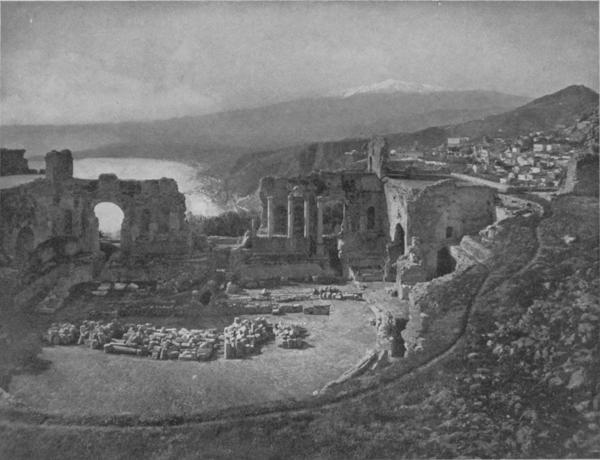
“A Place Where the Past Reveals Itself”
Equal in importance with this vision of Ætna was the appearance of Domenica—both events happening in the same day. Domenica too began as a bland outline. Small, middle-aged, and primly shawled; a smooth black head, gold earrings, and a bearing and nose of such Roman dignity and ability that two weary forestieri yearned at once to put themselves and their 69undarned stockings into the charge of her capable little hands. She respectfully asserted her willingness to serve them; they could make that out—but how tell her their requirements and the routine of the service they wished? It was seen to be beyond the powers of any phrase-book or even of Maria, presiding over the interview with beaming interest, and carefully repeating with louder tone and hopeful smile all Domenica’s words. No mutual understanding could be reached. They gave it up, and regretfully saw the shining black head bow itself out. But Domenica had to be. Their fancy clamoured for her, and all their poor clothes, full of the dust of travel and the rents of ruthless washerwoman, demanded her insistently. A more competent interpreter was found, and their needs explained at length. Domenica’s eyes sparkled with willing intelligence; she professed herself capable of doing anything and everything they asked of her; and mutual delight gilded the scene until the question of terms came up. What would the ladies pay? They mentioned a little more than the Frau Schuler had told them would be expected, and waited for the pleased response to their generosity—but what was happening? The grey shawl was tossed from shoulders that suddenly shrugged, and arms that flew about wildly; fierce lightnings flashed from the black eyes, a torrent of ever faster and shriller words rose almost into shrieks.
Peripatetica and Jane shrank aghast, expecting to see a stiletto plunged into the stolid form of their interpreter, bravely breasting the fury.
“What is the matter?” they cried.
“Oh nothing,” smiled the interpreter, “she is saying it isn’t enough; that the ladies at the hotels pay 70their maids more, and her husband wouldn’t permit her to take so little.”
Dear me, she need not! they certainly would not want such a fury.
The fury had subsided into tragic melancholy, and subdued after-mutterings of the storm rumbled up from the reshawled bosom.
“She says she will talk it over with her husband to-night,” said the gentle interpreter with a meaning wink. “She is really good and able; the ladies will find her a brave woman.”
They didn’t exactly feel that bravery was needed on her side as much as on theirs after that storm, but they had liked no other applicant, and again the imposing nose and capable appearance asserted their charm, and they remembered their stockings. Their offer still stood, they said, but it must be accepted or declined at once; they wanted a maid that very evening. Renewed flashes—she dared not accept such a pittance without consulting her husband.... Very well, other maids had applied, expecting less. A change of aspect dawned—she would like to serve the ladies, would they not give half of what she asked for? Consultation with the interpreter—ten cents more a day offered only—instant breaking out of smiles and such delighted bobbings and bowings as she departed that it seemed impossible to believe that furious transformation had ever really happened.
They felt a little uneasy. Had they caught a Tartar? Remembering all the tales of Sicilian temper it seemed scarcely comfortable to have a maid who might draw a stiletto should one give her an unpleasing order. They awaited the beginning of her service a bit doubtfully. 71But when that grey shawl was hung inside the villa door, the only fierceness its owner showed was in her energy for work. The black eyes never flashed again, until ... but that comes later. They beamed almost as happy and instant a comprehension of all needs as Maria’s. And her capacity for work was appalling. At first they watched its effects with mutual congratulations; such an accumulation of the dilapidations of travel as was theirs had seemed to them quite hopeless ever to catch up with, but now the great heaps of tattered stockings turned into neat-folded pairs in their drawers, under-linen coquetted into ribbons again, and all their abused belongings straightened into freshness and neatness once more. Domenica’s energy was as fiery as Ætna’s during an eruption, only unlike the mountains it never seemed to know a surcease. Dust departed from skirts instantly at the fierce onslaught of her brushings; things flew into their places; sewing seemed to get itself done as if at the wave of a magician’s wand. Accustomed to the dilatoriness of Irish Abigails at home, Peripatetica and Jane were quite dazzled with delight at first—but then incredibly soon came the time when there was nothing left undone; when the little personal waiting on they needed could not possibly fill Domenica’s days, and it became a menace, the sight of that little grey-clad figure asking with empty hands, “what next, Signora?”
“The Demon,” they began calling her instead of Domenica, and felt that like Michael Scott and his demon servant, they would be obliged to set her to weaving ropes of sand, the keeping her supplied with normal tasks seemed so impossible. It became almost 72a pleasure to find a gown too loose or too tight, that she might alter it, or to spot or tear one, and as for ripped skirt bindings or torn petticoat ruffles, they looked at each other in delight and cried exultantly, “a job for the Demon!” Tea-basket kettles to scour they gave her, silver to clean, errands to do, fine things to wash, their entire wardrobes to press out; yet still the little figure sat in her corner reproachfully idle, looking at them questioningly, and sighing like a furnace until some new task was procured her. Desperately they took to giving her afternoons off, and invariably dismissed her before the bargained time in the evening. But still to find grist for the mill of her industry kept them racking their brains unsuccessfully through all their Taormina days.
Home comforts and maid once secured they could turn to Taormina itself with open minds, and plunge into a flood of beauty and queernesses and history. Of the guide-books some say that Taormina was the acropolis of Naxos, an off-shoot of that first Greek town, others that it, like Mola, was a Sikilian stronghold long before the days of the Greeks. Jane’s private theory was that neither Greeks nor Sikilians had been its founders, that eagles alone would ever first have built on that dizzy windy perch!
On the very ridge of a mountain spine with higher peaks overhanging, Taormina twists its one real street, houses climbing up or slipping down hill as best they may, all clinging tight, and holding hands fast along the street to balance themselves there at all. Dark stairway cracks between lead up or down, and overhead flying arches or linked stories keep the clasp unbroken. 73Here and there a little street manages to twist off and find a few curves for itself on another level, or the street widens into a wee square, or a terrace beside an old church is edged with a stone-benched balustrade where ancient loafers may sun themselves and look down at the tiny busy specks of fishing boats in the sea far below.
Every hour of the day the Street is a variety show with the mixed life passing through it, and acting its dramas there. Flocks of goats squeezing through on their way to pasture; donkeys carrying distorted wine skins or gay glazed pottery protruding from their panniers; women going to the fountain, balancing slender Greekish water jars on their heads; the painted carts carrying up the tourists’ luggage; the tourists themselves in veils and goggles bargaining at enticing shop doorways, or peering into the windowless room of Taormina’s kindergarten, where a dozen or more infants are primly ranged, every mother’s daughter with knitting pins in hand and silky brown curls knotted on top of head like little old women, sitting solemnly in the scant light of the open door, acquiring from a gentle old crone the art of creating their own stockings. There the barber strums his guitar on a stool outside the “Salone” door while he waits for custom; the Polichinello man obstructs traffic with the delighted crowds of boys collected by Punch’s nasal chantings and the shrill squeaks of “Il Diavolo.” There come the golden loads of oranges and lemons; green glistening lettuces and feathery finochi; bread hot from the bakers in queer twists and rings; live chickens borne squawking from market, and poor little kids going to the butchers. The busy tide of every-day life never ebbed 74its colourful flow from the beginning of the street at the arch of one old gateway until its end at the arch of the other. Buying and selling, learning, working, and idling, the Present surged there, but a step aside into any of the backways, and one was instantly in the Past. Old women spinning in doorways with the very same twirling spindles as those of two thousand years ago. The very same old women, one had almost said, their hawk-like dried faces were so unimaginably far removed from youth, from all modernness.
The very names of the streets spell history and drama. History rises up and becomes alive.
In the Street of Timoleon one hears the clank of armour—the Great Leader and his Corinthians swing down the road. Only a few days ago they had landed at the beach of ruined Naxos in answer to the call of Andromachus, Taormenium’s ruler. They have been warmly entertained at his palace, have there rested, learning from him of the lay of the land and state of affairs; now they set out to begin the campaign. The staring people stand watching the march of these strong new friends, murmuring among themselves in awestruck whispers of the portents attending the setting forth of these allies. How great Demeter and Persephone herself had appeared to the servitors of their temple, promising divine assistance and protection to this expedition for the succour of their island—a rumour too that Apollo had dropped the laurel wreath of victory from his statue at Delphi upon Timoleon’s head; a marvel, not a rumour, for it was beheld with very eyes by some amongst themselves. How the ships bringing these deliverers had come in through the night to the harbour below with mysterious unearthly 75fires hovering in front of them and hanging in balls at the masthead, to light them on the way!
In the midst of the soldiers is a taller figure—or one that seems so—a face like Jupiter’s own, of such majesty and sternness and calm. The crowd surges and thrills and shouts with all its heart and soul and stout Sicilian lungs.
“Who is that?” ask the children.
“Timoleon! Timoleon, the Freer!” they are answered when the shouting is over. “Remember all your life long that you have seen him.”
And when years later those boys, grown to manhood in a free prosperous Sicily, hear of the almost divine honours that grateful Syracuse is paying to her adored deliverer, of the impassioned crowds thronging the theatre, mad with excitement at every appearance of the great old blind man, they too thrill to know that their eyes too have seen “The Liberator,” greatest and simplest of men.
It is the Street of the Pro-Consulo Romano. Here comes Verres, cruelest of tyrants, most rapacious of robbers. The people shrink out of the way, out of sight as fast as may be, at the first gleam of the helmets of the Pro-Consul’s guard, when “carried by eight stalwart slaves in a litter, lying upon cushions stuffed with rose leaves, clad in transparent gauze and Maltese lace, with garlands of roses on his head and round his neck, and delicately sniffing at a little net filled with roses lest any other odour should offend his nostrils,” the sybarite tyrant is borne along, passing the statue of himself he has just had erected in the Forum, on his way to the theatre.
The Street of Cicero; it is only necessary to close 76one’s eyes to see that lean, long-nosed Roman lawyer. A fixed, silent sleuth-hound on this same Verres’ track; following, following close, nose fixed to the trail, for all the cunning doublings and roundings of the fox, questing all over Sicily, gathering everywhere evidence, building up his case, silently, inexorably; until at last his quarry is cornered, no squirming tricks of further avail. Verres is caught by the throat, exposed, denounced; so passionately, that as long as man’s appreciation of logic and eloquence endures the great lawyer’s pleading of that case is remembered and quoted.
Children are playing in the Via Sextus Pompeius, but one sees instead a gleam of golden armour, of white kilts swinging from polished limbs—the proud figure of Pompey; splendid perfumed young dandy who, the fair naughty ladies say, is the “sweetest-smelling man in Rome.”
Here, with instinctive climb to the heights, he is desperately watching the surge of that great new power flooding, foaming, submerging all the world; rising up to him even here, the bubbling wave started by that other Roman dandy, the young man Julius Cæsar, who knotted his girdle so exquisitely....
The street from which the Villa Schuler’s pink door opened was that of the Bastiones, where the town’s fortified wall had once been. Corkscrewing dizzily down the sheer hillside among the cacti and rocks ran a narrow little trail. Jane had settled it to her own satisfaction that this was the scene of Roger’s adventure when besieging Taormina, then Saracen Muezza—last stronghold on the East coast to hold out against him; as it had two hundred years ago been one of the last in succumbing to the Moslems.
77Roger had completely surrounded the strong place with works outside its walls, and was slowly reducing it by starvation. Going the rounds one day, with his usual reckless courage almost unaccompanied, he is caught in a narrow way by a strong party of the enemy. The odds are overwhelming, even to Normans, on that steep hillside. Roger must retreat or be cut down. For attackers and pursued the only foothold is the one narrow path. Evisand, devoted follower of Roger, is quick to see the advantage of that—one man alone may delay a whole host for a few important minutes there, and he offers up his life to cover his master’s escape. Alone, on the narrow way he makes a stand against all the Moslem swarm, with such mighty wielding of sword that it is five minutes before the crooked Moslem blades can clear that impediment from their way. Roger, who has had time to reach safety before the brave heart succumbs to innumerable wounds, dashes back with reinforcements, wins the day, recovers his loyal servitor’s body, buries it with royal honours, and afterwards builds a church in memory of this preservation, and for the soul of his preserver. And Taormina, yielding to Roger and starvation, regains her name and the Cross....
Picking their way one morning up through the puddles and hens of their own alleyway, Peripatetica, raising her eyes an instant from the slime to look at the label on the house corner, said:
“Who could have been the Morgana this scandal of a street ever stole its name from? ... you don’t suppose....”
“What?”
“Why, that it could have been the Fata Morgana? 78Her island first appeared somewhere off the Sicilian coast.”
“Oh, Peripatetica! how could a fairy, lovely and enchanting, ever have become associated with this!”
Peripatetica had a fine newborn theory on her tongue’s tip, but ere she could voice it, a nervous hen above them suddenly decided there was no room on that road for two to pass on foot, and took to her wings with wild squawk and a lunge straight at Peripatetica’s face in an attempt to pass overhead. Peripatetica ducked and safely dodged all the succeeding hens whom the first dame’s hysteria instantly infected to like behaviour. By the time she caught her breath again in safety at the street’s level, the theory was lost, but another more interesting one was born to her as they proceeded.
“‘Street of Apollo Archagates,’—Jane, do you see meaning in that? The Greeks always put their greatest temples on the heights—Athens, Girgenti, Eryx, wherever there were hills the Great Shrine was on the Acropolis. Taormina must have been the Acropolis of those Naxos people—they certainly never stayed on the unprotected shore below without mounting to these heights. I believe Apollo’s temple stood up here, not below. Here they built it, dominating the city, shining far out to sea, a mark for miles to all their ships and to the sailormen worshipping Apollo, Protector of Commerce.”
“No one has ever suggested that,” said Jane.
“What if they haven’t? It’s just as apt to be true, though even tradition has left no trace of it now but the name of this dirty little street. I for one am going to believe it, and that was why the statue survived until the time of the Romans.”
79And so it was that every step they took stirred up wraiths of myth and history. Even on the Street in the midst of all its humming bustle, rotund German tourists and donkeys, all the modern life would suddenly melt away, and they would resurrect old St. Elio, attired only in chains and his drawers, kneeling in front of the Catania gate, exhorting the Byzantine soldiers to cleanse themselves from their sins before destruction came from the Saracens then raging like mad wolves outside the devoted town’s walls, in a fury that it alone—save Rometta—of all Christian Sicily should still hold out against them. Then the air would fill with the screaming and strugglings of those old fierce eagle fights, and the donkey boys’ cries of “A-ah-ee!” would change to the fierce triumphant shouts of “Allah Akbar!” with which Ibrahim’s cruel soldiery finally broke in to massacre garrison and townsfolk.
Although Taormina sat apart on her mountain eyrie with no epoch-making events finding room on her perch to happen, the stream of all Sicily’s history, from first Greek settlement to the revolts of modern days against King Bomba’s tyranny, have surged around and through her. An American living in Taormina did a kindness to her native cook, for which in grateful return the cook insisted on presenting her a quantity of old coins, which her husband had turned up through the years in their little garden. Showing them to the Curator of a Museum, “Madame,” he said to the fortunate recipient of the gift, “you have a complete epitome of all Sicilian history in these coins.”
All the different races and dynasties dominating Sicily from her beginning, all the great cities that rose into local power were represented in these treasure 80troves from the silt of the centuries, dug by a peasant from the soil of one little garden.
It was the Greek theatre which first revealed the Sicily of their dreams to Peripatetica and Jane; consoling for the vague disappointment of those first days of dust and rain by the glamour of its presentment of the loveliness of nature and the majesty of the past.
Greek that wonderful ruin still essentially is, for all its Roman remodelling and incrusting of brick. Only the Greeks could have so lovingly and instinctively combined with nature and seized so harmoniously all nature’s fairest to enhance their own creation. The place, the setting, the spirit of it is Greek; what matter if the actual material shape now is Roman, with the Greek form only glimmering through like a body of the old statuesque beauty cramped and hidden under distorting modern dress? Not that the theatre’s Roman clothing is ugly—the warm red brick, contrasting with the creamy marble fragments, has an undeniable charm, Greek and Roman together. It is an exquisite ruin of human conceivings, contrived to have blue sea and curving shore and Ætna’s snowy cone as the background of the open stage arches, and in the foyer, the arcaded walk back and behind the top tiers of the auditorium, all the differing panorama of beauty of the northern coast line.
Nature from the beginning did more than man for the building, and now she has taken it back to herself again, blending Greek and Roman in binding of vine and flower and moss; twining all the stone-seated tiers into an herb and flower garden, and putting the song of birds into the vaulted halls of the Greek Chorus.
An enchanting place, where the Past seems to reveal 81itself in all that it had most of beauty and splendour. Peripatetica and Jane thought themselves fortunate to live under its wings; actually in its shadow, and so be on intimate calling terms at any hour of the day, learning its beauty familiarly through every changing transformation of light, cool morning’s grey and glowing noon’s gold, fiery sunsets, blue twilights, and early moonrise—mountains and sea and wide-flung sky dissolving magically and mysteriously into ever different pictures.
They wandered through chorus halls and dressing-rooms, the obscure regions under the stage and the dizzy ones on top of it; strolled in the outside arcade on top of the auditorium, where the loveliness of the view was a fresh wonder every time it burst on them, sat in the top rows and the bottom ones on the flowery sod now covering all the seats, looking from every angle at that most charming of marble stage settings and most wonderful of all backgrounds, trying to imagine the times when the surrounding tiers had been filled with 4,000 eager spectators, and the walls had echoed to the tragedies of Æschylus, Sophocles, and Euripides.
Looking wonderingly at the curious drains and holes and underground passages below the stage, they wondered if Æschylus, that eminent stage manager as well as poet, had not himself perhaps contrived some of them on his visit to Sicily, to introduce new thrills of stage effects into the performances of his tragedies here. Æschylus, who was inventor of stage realism, first to introduce rich costuming, accessories, and stage machinery, the mutter of stage thunder, shrieks, and sounds from behind the scenes suggestive of the deeds 82considered too shocking to happen in the audience’s sight—inventor of the “Deus ex Machina,” that obliging god popping from out his trap-door to divinely straighten out a situation snarled past natural conclusion.
As one sat there in the calm splendour of the setting of earth and sky, sun, and great winds streaming overhead, it became easier to understand the spirit of the old Greek plays; how the drama had been to them not mere amusement but almost a form of religion, and an expounding of their beliefs, an attempt to “justify the ways of God to man.” If perhaps such settings had not instinctively formed the differing tendencies of their great play-writers; Æschylus to represent suffering as the punishment of sin; Sophocles to justify the law of God against the presumption of man; and in these spacious open-air settings if the great rugged elementary simplicity of their plays had not been necessary and inevitable.
“In the Greek tragedy the general point of view predominates over particular persons. It is human nature that is represented in the broad, not this or that highly specialized variation.... To the realization of this general aim the whole form of the Greek drama was admirably adapted. It consisted very largely of conversations between two persons representing two opposed points of view, and giving occasion for an almost scientific discussion of every problem of action raised in the play; and between these conversations were inserted lyric odes in which the chorus commented on the situation, bestowed advice or warning, praise or blame, and finally summed up the moral of the whole.”
More akin to an opera than to a play in our modern 83sense, the Greek drama had as its basis music. The song and stately dance of its mimetic chorus being the binding cord of the whole, “bringing home in music to the passion of the heart the idea embodied in lyric verse, the verse transfigured by song, and song and verse reflecting as in a mirror to the eye by the swing and beat of the limbs they stirred to consonance of motion.”
Sitting in the thyme-scented breeze Peripatetica and Jane read Euripides until they seemed to become a part of a breathless audience waiting for his tragedies to be performed before their eyes, waiting for the first gleam of the purple and saffron robes of the chorus, sweeping out from their halls in chanting procession. And it would all seem to take place once more on the stage in front of them, that feast for the eye and ear and intelligence at once. It became clear that across such great unroofed space the actors could not rely on “acting,” in our sense, for their results. It must be something bigger and simpler than any exact realism of petty actions; play of facial expression, subtle changes of voice and gesture would be ineffectually lost there. So, though at first the stage conventions of a different age seemed strange to these modern spectators, the actors raised above their natural height on stilted boots, their faces covered by masks, their voices mechanically magnified; yet in wonderful effects of statuesque posings the meaning came clear to the eye, and the chanting intonation brought out every beautiful measure of the rolling majestic verse which a realistic conversational delivery would have obscured. So the representation became “moving sculpture to the eye, and to the ear, as it were, a sleep of music between 84the intenser intervals of the chorus,” and the spectators found themselves “without being drawn away by an imitative realism from the calm of impassioned contemplation into the fever and fret of a veritable actor on the scene,” receiving all the beautiful lucid thought and sentiment of the text, heightened by the accompanying appeal to the senses of perfect groupings of forms and colours, of swaying dance, and song and recitative, until it all blended into one perfect satisfying whole—perhaps the most wonderful form of art production that has ever existed.
And then some German tourist would scream, “Ach Minna, komm mal her! ’s doch famos hier oben!” and they would be waked from their day dream of old harmonies into the shrill bustling present again.
“It is like all really great fresco painting,” said Peripatetica on one of these comings back, “kept in the flat. Anything huge has to be treated so as to make its meaning tell; it has to be done in flat outline to stay in the picture, to make the whole effective. All the great imposing frescoes are like that; when the seventeenth century tried to heighten its effects by moulding out arms and legs in the round, its pictures dropped to pieces; any idea it was trying to express became lost. One is conscious of nothing but the nearest sprawling realistic limb thrusting out at one. Oh, those delicious marvellous Greeks! everything that is beautiful and perfect they did first, and anything good that has ever been done since is only copying them.”
Jane had a deep respect for the Greeks herself, but she sometimes turned against too much laudation of them.
85“Do you suppose the æsthetic effect of their tragedies was really greater than that of a Wagner opera, well given? That the lament for Iphigenia could be more deeply thrilling than Siegfried’s funeral march?”
Peripatetica almost bounded from her seat.
“But that’s just it!” she cried. “Wagner operas are a revival of the Greek ideal! the only modern analogy of their drama! He had the same idea of painting on a huge canvas great heroic figures in the flat, keeping them in the picture without rounding out into petty realism. And he has attempted exactly what they did, to present his dramatic theme in a mingling of music, poetry, picture, and dance, every branch of art combined!”
“That’s interesting, and perhaps true, my dear, but if you discourse on about King Charles’ head, we shall get caught by that shower racing down the coast. There is just time to beat it to home and Vesuvius!”
Vesuvius was, after Domenica, their greatest acquisition, and the one that most soothingly spread about an atmosphere of home comfort. Until he came life had been a thing of shivers and sneezes, of days spent in ceaseless trampings to keep their chilled blood in circulation, and of evenings sitting swathed in fur coats and steamer rugs, with feet raised high above the cold drafts of the floor.
Fireplaces, or any means of artificial heating were unknown to the villa. They had waited patiently for the Southern sun to come and do his duty, but he didn’t; and a day came when Jane took to bed as the only hope of warmth, when even Domenica sneezed and said it was “molto freddo,” and then Peripatetica sallied forth determined to find some warmth nearer than 86Ætna. “Vesuvius” was the result of her quest. Not much was he to look at outwardly. Small was his round black form; oh, pitifully small he seemed at first view to those whose only hope he was. A mere rusty tin lantern on three little feet, he looked—but when his warm heart began to glow and to send delicious hot rays percolating through the holes of his sides and pointed lid, the charms of his fiery nature won respect at once. He made his small presence felt incredibly, from stone floor to high ceiling. Shawls and coats could be shed, feet lowered and at once frozen spines relaxed into long-forgotten comfort.
His breath was not pleasant to be sure, his charcoal fumes troubled at first, but when a Sicilian oracle had recommended the laying of sliced lemons on his head, all fumes were absorbed, he breathed only refreshing incense and became altogether a joy. Every day, except on rainy ones, when his company was called for earlier, he made his appearance at six of the evening—and how eagerly the sight of Maria bearing him in used to be waited for! Then with feet toasting and backs relaxing in delightful warmth, Peripatetica and Jane sat over his little glowing holes with quite the thrill and comfort of a real hearthstone.
Ardent fire worshippers they found themselves becoming in this supposedly Southern land. If Persephone had ever been as cold as they, they doubted if that enlèvement to Pluto’s warm, furnace-heated realm could have been so distasteful after all!
Paddling out in the rain to hotels for meals was at first a drawback to life in the Villa Schuler. To sit with damp ankles through the endless procession of 87table d’hôte meals, and afterwards have the odoriferous bespatterings of the Scesa Morgana as dessert, was not an enjoyable feature of local colour. Frau Schuler was implored to feed her lodgers.
“But we are simple people; our plain cooking would not satisfy the ladies,” she protested, distressed. But the ladies felt that a crust and an egg in their own sitting-room would be more satisfying than all the triumphs of hotel chefs out in the wet. And to bread and eggs they resigned themselves. Instead came a five-course banquet, served by beaming Butler Maria in a dazzling new grass-green bodice—soup and macaroni, meat and vegetables, perfect in seasoning and succulence, crisp salad from the garden, and with it the demanded poached eggs which were to have constituted the whole dinner, almond pudding with a wondrous sauce; dates, oranges, sugary figs beaded on slivers of bamboo, mellow red wine. It seemed a very elastic two lire which could cover all that, as Frau Schuler said it did! Truly the Fraulein Niece was an artist. Peripatetica and Jane thereafter dined at home in tea gowns and luxury—and the pudding sauces grew more bland and wonderful every night. Also eggs continued to give originality by the vagaries of their appearance. As Peripatetica said, “they just ran along anyhow, and jumped on at any course they took a fancy to!” And to see where they were going to land—in the soup, the vegetables, the salad, the stewed fruit of dessert—or what still other and stranger companionships they might form, lent a sort of prize-packet excitement to each succeeding course. Dinner at the Villa Schuler, with little Vesuvius glowing warmingly through all his fiery eyes and steaming out spicy 88incense of lemon and mandarin peel, the soft low lamplight, the gleam of Maria’s smile and green bodice, the blessed remoteness from all tourist gabble, was truly a cosy function. They took to making elaborate toilets in honour of it, adding their Taormina acquisitions of old lace and jewels to Maria’s round-eyed amazement. When Jane burst out in an Empire diadem, and Peripatetica not to be outdone donned a ravishing lace cap, their status as good republicans was forever lost in the villa. Maria spread the tale of this splendour abroad, firmly convinced that these lodgers were incognito members of the most exalted nobility of distant “Nuova Yorka.” The tongues which could not pronounce their harsh foreign names insisted on labelling them the “Big and Little Princess”—and no protests could bring their rank down lower than “the most gentle Countesses,” upon their washing-bills.
It amused them in fine weather to try the various hotels for lunch. In mid-town was the Hotel Victoria, the haunt of artists and gourmets, famous for its food and for its garden, which climbed the hillside in blooming terraces and loggias, all stairways, springing bridges, and queer little passages leading to buildings and courts on different levels. Peripatetica and Jane wandered into it almost by accident. They noticed the name over a dingy door as they were strolling aimlessly one day, and Peripatetica remembered having heard of a picturesque garden within. Penetrating through empty hall and up various winding stairways they came to a charming garden court. There appeared the proprietor, and in Parisian French treated their curiosity as a boon and a pleasure. A little man, the Padrone, with nothing large about him but the checks 89of his trousers and the soft black eyes which turned upon the gay colour about him with gentle melancholy. He did the honours of the place with all the courtesy and dignity of Louis XIV showing Versailles. When they admired the aviary of Sicilian and tropical birds, the budding roses clambering everywhere, the strange feathery-fringed irises like gaudy little cockatoos, the delicate bits of Moorish carving and arches built into the hotel walls, he accepted all their enthusiasm for the charms of his property with no sign of pride, but rather with the pensive melancholy of one whose soul was above such things, as of one who knew the hollowness of earthly delights. Courteously he exhibited everything, taking them to still higher and more glowing terraces where his laden orange trees were burnished green and gold, and his violets sheets of deepest, royalest purple underneath.
A pair of monkeys lived in cage up there, and while the Signor deftly fed them for the amusement of his visitors he warmed up into caustic philosophic comment upon human and monkey nature, comment not unspiced with wit. Peripatetica, always ready for philosophy, immediately plunged into the depths of her French vocabulary and responded in kind. The discussion grew warm and fluent, and the little Padrone became a new man. With kindling eye and a pathetic eagerness he kept the ball rolling in polished Voltairian periods, intoxicated apparently with the joy of mental intercourse. He snatched and clung to it, inventing new pretexts to detain them, new things to exhibit, while the talk rolled on.
But Peripatetica, whose next passion to Philosophy is Floriculture, broke off to exclaim at the violets as 90they passed a bed of purple marvels. Emperors they were among violets. The Padrone immediately proffered some, setting two contadini to picking more. Peripatetica contemplating gluttonously the wonderful spread of the deep purple calyx, the long firm stems of those in her hand, and at the profusion of others sweetening the air, cried from her heart, “Oh, Monsieur, what luxury to have such a garden! You should be one of the happiest creatures in the world to be able to grow such flowers as these!”
The Padrone, from his knees, picking more violets, glanced up, and gloom fell over him again.
“Madame,” he inquired bitterly, “does happiness ever consist in what one possesses of material things? Contentment, perhaps—but happiness? Not the most beautiful garden in the world can grow that,” and with dark Byronic mystery, “Ah, one can live amid brightness and yet be very miserable.”
They parted with much friendliness, the Padrone hoping the ladies would do his hotel the honour of visiting it again. Surely, yes, they said; they would give themselves the pleasure of lunching there some day.... Upon that it seemed as if his gloom grew darker, but he implied courteously that that would do him too much honour, but if they did venture as much he would do his best to content them. His was but a rough little place, but it had been wont to be the haunt of artists and “they, you know, are always ‘un peu gourmet!’”
“What do you suppose is the story of that man?” they asked each other; and amused themselves inventing romantic pretexts to explain his air of blighted hopes and poetic pain.
91Before long their curiosity impelled them to try the Victoria’s cuisine. They were a half hour before the time. No guests had yet gathered. They stood again in front of the aviary, but no polite philosopher made his appearance. A little yellow-haired maid in a frock as brightly purple as the violets, carrying decanters into the empty dining-room, was the only creature about. The sitting room offered them shelter from the wind, and for entertainment heaps of German novels and innumerable sketches of Sicilian scenery and types, which they hoped the Victoria’s artist patrons had not given in settlement of their hotel bills. A bell rang, and people streamed in until every seat in the clean, bare dining-room had its occupant. Not the artists Peripatetica and Jane were looking for, but types fixed and amusing, such as they had never before encountered in such numbers and contrasts. Rosy, bland English curates and their meek little wives; flashy fat Austrians, with powdered ladies of unappetizing look; limp English spinsters of the primmest propriety; seedy old men with dyed moustaches and loud clothes, diffusing an aroma of shady gambling-rooms. Scholarly old English professors; and Germans, Germans, Germans of all varying degrees of fatness, shininess, and loud-voicedness, but all united in double-action feeding power of knife and fork.
An expectant hush held them all for a while before empty plates. Then the little purple-gowned maid, and a sister one in ultramarine blue, with the same brilliant yellow hair knotted on top of her head, appeared with omelettes. Omelettes of such melting perfection as to explain the solemn expectancy of the waiting faces.
92Followed a meal in which every course—fish, vegetables, meat, and salad, in a land where the tourist expects to subsist alone on oranges and scenery—was of a deliciousness to have made a Parisian epicure compliment the chef of his pet restaurant.
The Germans were explained; lovers of feeding and of thrift, of course, they had come in their hordes to this modest Inn. And how they made the most of it! Back they called the little maids for two and three helpings of each delicious platter. Food was piled upon plates in mountains, but before Peripatetica and Jane could more than nibble at their own share, the German plates would be polished clean, and the little maids called for another supply. The caraffes of strong new Sicilian claret were emptied too, until Tedeschi faces grew very red, and tongues more than ever loud.
Peripatetica and Jane dared not meet each other’s eyes. Next to them sat an elderly maiden lady from Hamburg “doing” Sicily without luggage, prepared for any and every occasion in black silk bodice and cloth skirt, which could be made short or long by one of the mysterious arrangements of loops and strings the female German mind adores. With maiden shyness but German persistence she firmly insisted on human intercourse with the French commercial traveller across the table. He clung manfully to the traditional gallantry of his race, though the Hamburgian’s accent in his mother tongue threw him into wildest confusion as to the lady’s meaning. When he confided his wife’s confinement to bed with a cold, and his ineffectual struggles to get the proper drugs for her in Taormina, the German lady announced the theory 93that violent exercise followed by a bath was better cure for a cold than any drugs, “the bath the main point,” she said. “The exercise and the transpiration without that being of no use.”
“A bath! with a cold! Not a complete wash all over?” protested the startled Frenchman.
“Yes, indeed, one must wash one’s self entirely—though it might be done a bit at a time—but completely, all over, with water and soap,” insisted the German, which daring hygienic theory so convinced the Frenchman that its propounder’s reason must be unhinged that stammering and trembling he gulped down his wine and fled from the table without waiting for the sweets.
All this time Peripatetica and Jane had caught no glimpse of their friend, the Padrone. They wondered, but decided that his poetic nature soared above the materialities of hotel keeping.
The meal had reached the sweet course—a pudding of delectableness no words can describe. It inspired even the gorged Germans with emotion. Thoroughly stuffed as they already were they still demanded more of its ambrosia and the purple-frocked one flew back to the kitchen, leaving the door open.... Alas! their philosopher of the garden, in cook’s apron, was pouring sauce on more pudding for the waiting maid!
Ah, poor Philosopher! This the secret of his blighted being. The poet driven to cooking-pots, the artistic temperament expending itself in omelettes and puddings for hungry tourists. How wonder at the irony with which he had watched the monkeys feed!
Maria and Vesuvius were not the only possessors of 94ardent temperaments in the Villa. Another existed in a round soft ball of tan and white fuzz.
The Puppy!
He of the innocent grey eyes, black nose with pink tongue-trimming, and the most open and trusting heart in the world. On friends and strangers alike his smiles and warm licks fell. He bounded into every room all a-quiver of joy to be with such delightful people in such an altogether charming world. And never could it enter his generous thoughts that others might not equally yearn for his society; that Jane might object to having a liberal donation of fleas and mud left on the tail of her gown; that at 6 A.M. Peripatetica might not be enchanted to have a friendly call and a boisterous worry of her slippers all over the stone floor; or Fraulein might prefer the front of the stove entirely to herself during sacredest rites of cooking. He could not be brought to understand. He was cheerfully confident that every one loved him as much as he loved them, and that nothing could possibly be accomplished in that family without his valuable assistance. Many times a day loud wails rose to heaven, announcing that he had come to grief in the course of his labours; had encountered some one’s foot or hand, or had some door shut in his face; but in the midst of grief he would see in the distance something being accomplished without him—charcoal being carried in, the hall swept, or the garden watered—and he would rise from his tears and offer his enthusiastic assistance once more, all undaunted, and continue to give encouraging chews to the worker’s ankles, and stimulating barks of advice entirely undeterred by being called “an injurienza puppy!”
95Peripatetica claimed that his grey eyes showed that he was Norman descent, as Jane insisted they did in all the grey-eyed children of Taormina. But Fraulein, appealed to on that question, said he was of the colley race, and she revealed the dark and dreadful destiny laid upon him—that he was to grow up into a fierce and suspicious watch-dog; to live chained on the upper terrace, a menace to all intruders, a terror to frighten thieves from the garden plums!
And alas for natural bent of temperament when it must yield to contrary training. The grey-eyed one’s fate soon overtook him. Wild and indignant wails and shrieks woke Jane one sunny morning, and continued steadily in mounting crescendo all the while she clothed herself in haste to go to the rescue. Following the wails to the top of the garden she found the Puppy, a red ribbon around his soft neck, and from that a string attaching him to a pole. Nearby stood the Fraulein admonishing him that it was time his duties in life should begin, and he must commence to learn the routine of his profession without so much repining. In spite of Jane’s protests she insisted on leaving him there; and in vain all that quarter of Taormina rang with the wails of protesting indignation that welled from the confined one’s heart in the bewilderment of being left in loneliness, separated from all his friends and their doings. Every day after that he had to undergo his hour or two of schooling in the stern training of his grim profession. Soft-hearted Jane released him whenever she could, but Fraulein inexorably put him back, and even his playfellow Maria sternly held him to his duties. Between times 96he mixed with the family again on the old footing, but it was pathetic to see how soon nature was affected by the mould into which it was pressed, how soon he acquired the mannerisms and habits of his profession—curbing his exuberance of sociability, imposing on himself a post on the door mat, when strangers appeared, confining all welcome to his tail end, which would still wag friendlily though head did its duty in theatrical staccato growls.
In Taormina everything happens in the street. Houses are merely dark damp holes in which to take shelter at night, but life is lived outside them. Food is prepared in the street, clothes are mended there, hair is combed and arranged, neighbours gossiped with, lace and drawn-work made. The cobbler soles his shoes in the street, the tinsmith does his hammering and soldering there. It is the poultry run of hens and turkeys, the pasture grounds for goats and kids, the dance hall for light-footed children to tarantelle in, the old men’s club, the general living-room of all Taormina. Peripatetica and Jane found endless amusement there, though they seldom tarried in town. Like Demeter they wandered all day in meadow and mountain seeking Persephone, and found her not. Preparation for her beloved coming Mother Demeter seemed to be making everywhere; grass springing green when once the cold rain ceased, and carpets of opening blossoms spreading in orchards and fields for the little white feet to press. Every night they said, “She will come to-morrow,”—but still Demeter’s loneliness dissolved into cold tears hiding the face of the sun, and 97the chill winds told of nothing but Ætna’s snow, and the Lost One did not return.
But though they searched for her in vain in the setting of sunshine and blossom their fancy had pictured, Peripatetica and Jane found much else on their rambles—idyls of Theocritus still being lived, quaint little adventures, bits of local colour, new friends and old acquaintances among contadini, animals and flowers, and always and all about, the Bones of the Past. Everywhere obscured under the work-a-day uses of the Present, or rising out of them in beauty; half hidden among flowers in lonely fields or a part of squalid modern huts, they stumbled upon those remains of antiquity, debased and crumbled and inexplicable often, but beautiful with a lost strange charm, sad and haunting.
Taormina prides herself more on scenery than antiquities, but they found many of the latter in their scrambles on rough little mountain trails, learning all sorts of charms and secrets undreamed of by luxurious tourists rolling dustily in landaus along the one high road. Theirs was an unhurried leisure to take each day as it came. Without plans or guides they merely wandered wherever interest beckoned, until gradually they learned all the town and its setting of mountain and shore by heart.
They sallied forth untrammelled of fixed destination, ready to take up with the first adventure that offered—and one always did offer to adventurers of such receptive natures. They made plans only to break them; for inevitably they were distracted by something of interest more vital than the thing they had set out to see.
They might start, staff in hand, on a pilgrimage to the Madonna of Rocca Bella, whose brown shrine 98nestled dizzily on one of the strange peaks shooting their distorted summits threateningly above their own Villa, those peaks so vividly described by another Idle Woman in Sicily: “Behind, wildly flinging themselves upwards, rise three tall peaks, as of mountains altogether gone mad and raving.... The nearest peak of a yellow-grey, splintered and cleft like a lump of spar, and so upright that it becomes a question how it supports itself, is divided into two heads—one thrusting itself forward headlong over the town and crowned with the battlements of a ruined Saracenic-Norman castle; the other in the rear carrying the outline of a little church, and the vague vestige of a house or two; Saracenic-Norman castle and church (Madonna della Rocca) both so precisely the tint of the rock that it requires time and patience to disentangle each, and not to put the whole down as a further evidence of mountain insanity.”...
When Jane sat herself, muffled in furs and rugs, to read or sew in one of the quaint tile-encrusted arbours of the garden, those jagged peaks fell out of the sky overhead so menacingly, coming ever nearer and nearer to her shrinking head, that for all the sweetness of the flowers and birds she never could stay there long, but always, panic-struck, fled to the bare sea-terrace, and the prospect of calm and distant Ætna.
But to go back to Our Lady of Rocca Bella, which Peripatetica and Jane never managed to see, there were so many distractions on that path! Did they start with the firmest of pilgrim intentions, a new garden opened unexplored paths of sweetness, or a brown old sea-dog, Phrygian-capped, smiled a “buon giorno” on his bare-footed way up from the shore, showed 99them the strange sea creatures gleaming under the seaweed in his basket, and enticed them down to the shore. There on the golden beach of Theocles’ landing place, they embarked in a heavy boat pulled by their friend, and another old gold-earringed mariner, to the “grotte molto interessante” in the Isola Bella. They poked their heads between waves into coral caves where the light filtering through the bright water was dyed almost as intense an azure as in the famous Capri Blue Grotto, and the whole coast line of mountains came to them in a new revelation of beauty from the level of wide-stretching sea. And beside the queer bits of coral presented by the sea-dogs as souvenirs, they carried away salt-water whetted appetites of wonderful keenness, and pictures, bestowed safely behind their eyes, of deliciously moulded mountain sides rising straight from clear green seas, of wave-carved fantasies in sun-bathed coral rocks, of red nets being stretched on yellow sands by bare-legged, graceful fisher folk; memories they would not have exchanged for any wide map-like vista the Madonna could have given them from her high-perched eyrie.
It was the same story with the Fontana Vecchia. If they had persisted in reaching its clear spring they might have heard the nightingales singing in the wooded dell, but they would never have known Carmela and her sunny mountain meadow.
It was a day of shifting clouds and cold winds. Peripatetica was depressed. Her energies wilted in the cold, and she had only gone forth to walk because the salon was too icily vaultlike for habitation. Jane tried to cheer her with prospect of hot tea at the Fontana, but her spirit refused to respond to any material comforting. 100She complained of what had been troubling her for some time, a sense of feeling a mere ghost herself in these Past-pervaded spots; a cold and shivering ghost aimlessly blown about in the wind, pressed upon by all the thronging crowds of other ghosts haunting these places where through the centuries each succeeding throng of beings had struggled and laboured, laughed and suffered. Living among ghosts in these days of idleness, her own existence cut off from the real living and doing of the world, from the duties and responsibilities of her own place in life, from the warm clutching hands of the people dependent on her, she had come to seem to herself entirely vague and ineffectual. She felt a mere errant, disembodied spirit, she said, and it was a bleak and dreary feeling.
Jane said she thought a disembodied spirit, able to soar over the sharp cobbles of that road, an exceedingly enviable thing to be at that moment; but she quite understood, and was herself affected by the same sense of chill aloofness from actual, vital human living.
And then they saw Carmela—a little old Sibyl twirling her distaff at an open gate that looked out on the quiet road. Sitting in the sun with cotton kerchief, bodice, and apron all faded into soft harmonies of colour, she made such a picture through the arch of the gate’s break in the dull stone wall, with the green of the garden behind her, that they stopped a moment to look.
“Buon giorno”—the picture smiled, her little round face breaking into friendly wrinkles. She rose to her bare feet, and with graceful gesture invited them in—wouldn’t they like to see the farm? she asked. There was a molto bella vista beyond. Always welcoming the 101unexpected they at once accepted, and found themselves passing through olive and orange groves. The property was not hers, their hostess explained; she was merely a servant; it all belonged to a molto vecchia lady, Donna Teresa by name. Though owning no part of it, Carmela pointed out the old vines, the thriving newly planted young vineyard, the grafts on the almond trees, with proud proprietorship.
Donna Teresa made her appearance; a tiny bent crone, bare-footed like her maid and dressed in cottons as faded if not as patched, but showing traces of a refined type of beauty in the delicate features of her old face and the soft fine white hair curling still like grape tendrils about her well-shaped head. She accepted her maid’s explanation of the strangers’ presence, and proceeded to outdo her in hospitality. They must do more than see the vista—must pick some flowers too. With cordial toothless chatter, of which the friendly meaning was the only thing they could entirely understand, she led through the farmyard court where blue and white doves cooed on the carved stone well-head, and a solemn white goat, his shaggy neck hung about with charms and amulets, attached himself to the party and followed down the stone stairs to a lower terrace. There was a view entrancing indeed, also a strange little old round building resembling a Roman tomb. Carmela could tell no more than that it was cosa di molto antichita and very useful to store roots in. Under a sheltering wall was a purple bank of violets to which the old Donna led them with much pride, inviting them to pick for themselves. When they did so too modestly to suit her, she fell on her knees and gathered great handfuls, thrusting on them besides all the oranges 102and mandarins they could carry, until her lavishments became an embarrassment. For all her bare feet and poor rags there was that in the grace of her hospitality they felt they could not offer money to. All they could do was to press francs into the maid’s hand, offer the Donna, as curiosities from distant America, the maple sugar drops Jane had filled her pocket with before starting, and try to make smiles fill the gaps in thanks of their halting Italian.
Carmela showed redoubled friendliness from the moment America was mentioned. She still clung to them after her mistress bade them goodby at the gate, and offered to show them another vista still more beautiful. They would rather have continued their interrupted way, but the little round face falling sadly changed their protestations into thanks, and she trotted happily beside them, smiling at their compliments on the even thread she spun as she walked, confiding how much it brought her a hank, what she could spin in a day, and that Donna Teresa was a good mistress, but a little weakened in her head by age.