Volume 7 — THE CATHEDRAL[30]
Reading edition
THE CATHEDRAL[30]
BY HIPPOLYTE ADOLPHE TAINE
Desirous of seeing the beginnings of this Renaissance we go from the Palazzo-Vecchio to the Duomo. Both form the double heart of Florence, such as it beat in the Middle Ages, the former for politics, and the latter for religion, and the two so well united that they formed but one. Nothing can be nobler than the public edict passed in 1294 for the construction of the national cathedral.
"Whereas, it being of sovereign prudence on the part of a people of high origin to proceed in its affairs in such a manner that the wisdom no less than the magnanimity of its proceedings can be recognized in its outward works, it is ordered that Arnolfo, master architect of our commune, prepare models or designs for the restoration of Santa Maria Reparata, with the most exalted and most prodigal magnificence, in order that the industry and power of men may never create or undertake anything whatsoever more vast and more beautiful; in accordance with that which our wisest citizens have declared and counselled in public session and in secret conclave, to wit, that no hand be laid upon the works of the commune without the intent of making them to correspond to the noble soul which is composed of the souls of all its citizens united in one will."
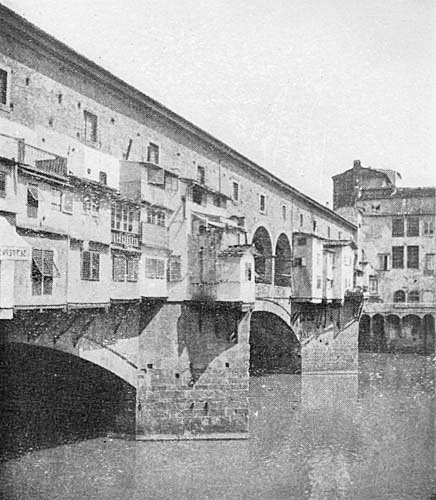
FLORENCE: BRIDGE ACROSS THE ARNO Courtesy John C. Winston Co.
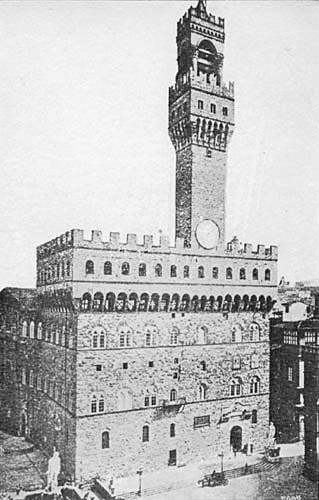
FLORENCE: THE OLD PALACE Courtesy John C. Winston Co.
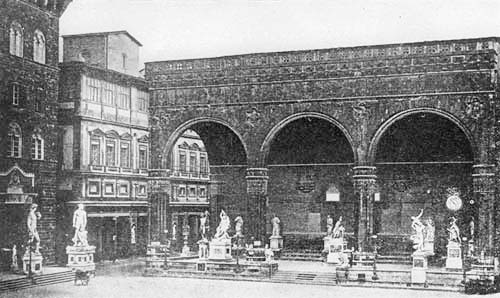
FLORENCE: THE LOGGIA DI LANZI Courtesy John C. Winston Co.
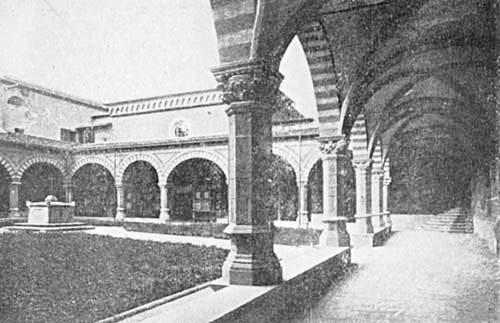
FLORENCE: CLOISTER OF SANTA MARIA NOVELLA Courtesy John C. Winston Co.
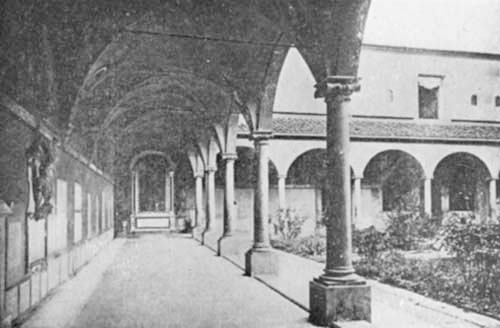
FLORENCE: THE CLOISTER OF SAN MARCO Courtesy John C. Winston Co.
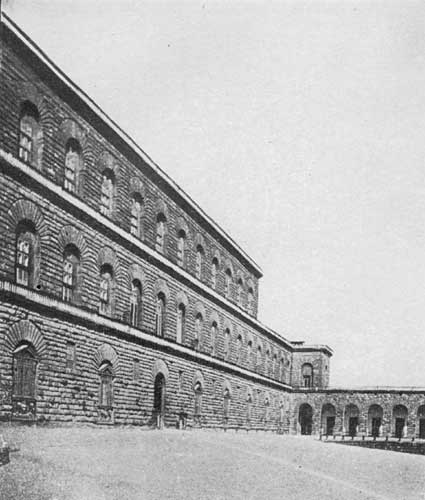
FLORENCE: THE PITTI PALACE Courtesy John C. Winston Co.
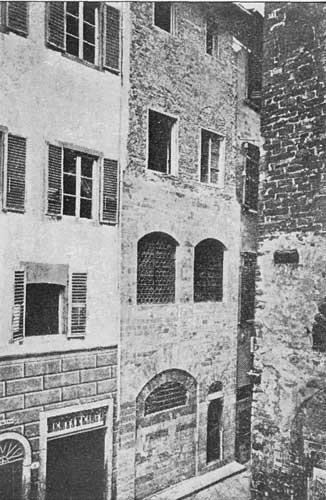
FLORENCE: THE HOUSE OF DANTE Courtesy John C. Winston Co.
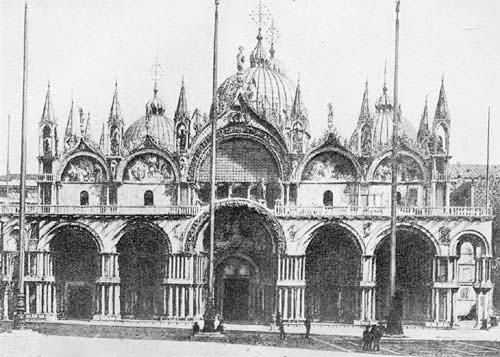
FRONT OF ST. MARK'S, VENICE Courtesy John C. Winston Co.
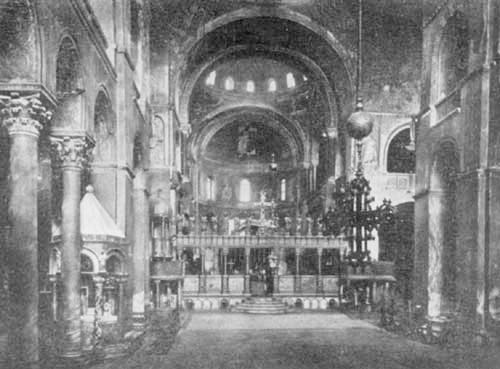
INTERIOR OF ST. MARK'S, VENICE Courtesy John C. Winston Co.
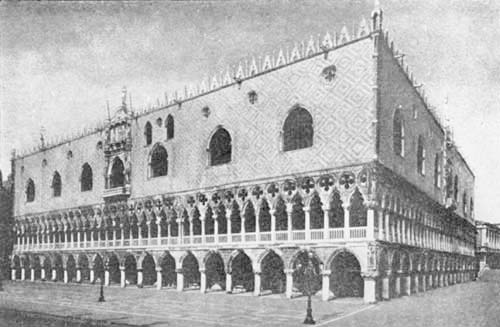
THE DUCAL PALACE, VENICE Courtesy John C. Winston Co.
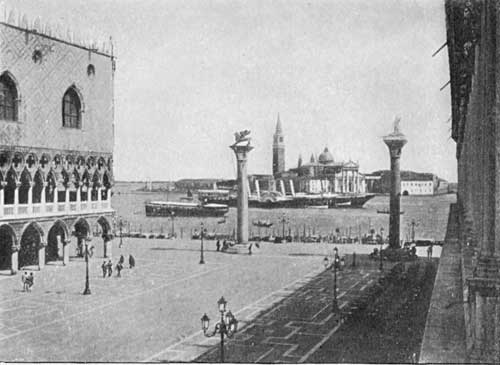
VENICE: PIAZZA OF ST. MARK'S, DUCAL PALACE ON THE LEFT Courtesy John C. Winston Co.
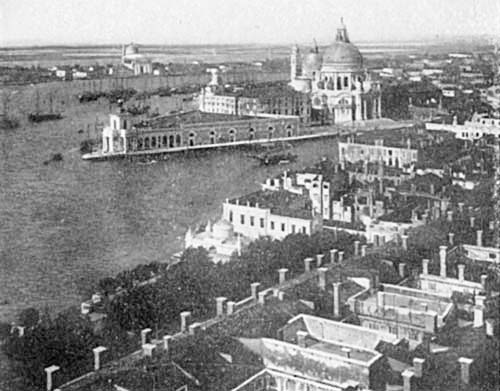
VIEW OF VENICE FROM THE CAMPANILE Courtesy John C. Winston Co.
In this ample period breathes the grandiose pride and intense patriotism of the ancient republics. Athens under Pericles, and Rome under the first Scipio cherished no prouder sentiments. At each step, here as elsewhere, in texts and in monuments, is found, in Italy, the traces, the renewal and the spirit of classic antiquity.
Let us, accordingly, look at the celebrated Duomo—but, the difficulty is to see it. It stands upon flat ground, and, in order that the eye might embrace its mass it would be necessary to level three hundred buildings. Herein appears the defect of the great medieval structure; even to-day, after so many openings, effected by modern demolishers, most of the cathedrals are visible only on paper. The spectator catches sight of a fragment, some section of a wall, or the façade; but the whole escapes him; man's work is no longer proportioned to his organs. It was not thus in antiquity; temples were small or of mediocre dimensions, and were almost always erected on an eminence; their general form and complete profile could be enjoyed from twenty different points of view.
After the advent of Christianity, men's conceptions transcended their forces, and the ambition of the spirit no longer took into account the limitations of the body. The human machine lost its equilibrium. With forgetfulness of the moderate there was established a love of the odd. Without either reason or symmetry campaniles or bell-towers were planted, like isolated posts, in front or alongside of cathedrals; there is one of these alongside of the Duomo, and this change of human equipoise must have been potent, since even here, among so many Latin traditions and classic aptitudes, it declares itself.
In other respects, save the ogive arcades, the monument is not Gothic, but Byzantine, or, rather, original; it is a creature of a new and mixed form like the new and mixed civilization of which it is the offspring. You feel power and invention in it with a touch of quaintness and fancy. Walls of enormous grandeur are developed or expanded without the few windows in them happening to impair their massiveness or diminish their strength. There are no flying buttresses; they are self-sustaining. Marble panels, alternately yellow and black, cover them with a glittering marquetry, and curves of arches let into their masses seem to be the bones of a robust skeleton beneath the skin.
The Latin cross, which the edifice figures, contracts at the top, and the chancel and transepts bubble out into rotundities and projections, in petty domes behind the church in order to accompany the grand dome which ascends above the choir, and which, the work of Brunnelleschi, newer and yet more antique than that of St. Peter, lifts in the air to an astonishing height its elongated form, its octagonal sides and its pointed lantern. But how can the physiognomy of a church be conveyed by words? It has one nevertheless; all its portions appearing together are combined in one chord and in one effect. If you examine the plans and old engravings you will appreciate the bizarre and captivating harmony of these grand Roman walls overlaid with Oriental fancies; of these Gothic ogives arranged in Byzantine cupolas; of these light Italian columns forming a circle above a bordering of Grecian caissons; of this assemblage of all forms, pointed, swelling, angular, oblong, circular and octagonal. Greek and Latin antiquity, the Byzantine and Saracenic Orient, the Germanic and Italian middle-age, the entire past, shattered, amalgamated and transformed, seems to have been melted over anew in the human furnace in order to flow out in fresh forms in the hands of the new genius of Giotto, Arnolfo, Brunnelleschi and Dante.
Here the work is unfinished, and the success is not complete. The façade has not been constructed; all that we see of it is a great naked, scarified wall similar to a leper's plaster.[31] There is no light within. A line of small round bays and a few windows fill the immensity of the edifice with a gray illumination; it is bare, and the argillaceous tone in which it is painted depresses the eye with its wan monotony. A "Pieta" by Michael Angelo and a few statues seem like spectres; the bas-reliefs are only vague confusion. The architect, hesitating between medieval and antique taste, fell only upon a lifeless light, that between a pure light and a colored light.
The more we contemplate architectural works the more do we find them adapted to express the prevailing spirit of an epoch. Here, on the flank of the Duomo, stands the Campanile by Giotto, erect, isolated, like St. Michael's tower at Bordeaux, or the tower of St. Jacques at Paris; the medieval man, in fact, loves to build high; he aspires to heaven, his elevations all tapering off into pointed pinnacles; if this one had been finished a spire of thirty feet would have surmounted the tower, itself two hundred and fifty feet high. Hitherto the northern architect and the Italian architect are governed by the same instinct, and gratify the same penchant; but while the northern artist, frankly Gothic, embroiders his tower with delicate moldings, and complex flower-work, and a stone lacework infinitely multiplied and intersected, the southern artist, half-Latin through his tendencies and his reminiscences, erects a square, strong and full pile, in which a skilful ornamentation does not efface the general structure, which is not frail sculptured bijou, but a solid durable monument, its coating of red, black and white marble covering it with royal luxuriance, and which, through its healthy and animated statues, its bas-reliefs framed in medallions, recalls the friezes and pediments of an antique temple.
In these medallions Giotto has symbolized the principal epochs of human civilization; the traditions of Greece near those of Judea; Adam, Tubal-Cain, and Noah, Daedalus, Hercules, and Antaeus, the invention of plowing, the mastery of the horse, and the discovery of the arts and the sciences; laic and philosophic sentiment live freely in him side by side with a theological and religious sentiment. Do we not already see in this renaissance of the fourteenth century that of the sixteenth? In order to pass from one to another, it will suffice for the spirit of the first to become ascendant over the spirit of the second; at the end of a century we are to see in the adornment of the edifice, in these statues of Donatello, in their baldness so expressive, in the sentiment of the real and natural life displayed among the goldsmiths and sculptors, evidence of the transformation begun under Giotto having been already accomplished.
Every step we take we encounter some sign of this persistency or precocity of a Latin and classic spirit. Facing the Duomo is the baptistery, which at first served as a church, a sort of octagonal temple surmounted by a cupola, built, doubtless, after the model of the Pantheon of Rome, and which, according to the testimony of a contemporary bishop, already in the eighth century projected upward the pompous rotundities of its imperial forms. Here, then, in the most barbarous epoch of the Middle Ages, is a prolongation, a renewal, or, at least, an imitation of Roman architecture. You enter, and find that the decoration is not all Gothic; a circle of Corinthian columns of precious marbles with, above these, a circle of smaller columns surmounted by loftier arcades, and, on the vault, a legion of saints, and angels peopling the entire space, gathering in four rows around a grand, dull, meager, melancholy Byzantine Christ. On these three superposed stories the three gradual distortions of antique art appear; but, distorted or intact, it is always antique art. A significant feature, this, throughout the history of Italy; she did not become Germanic. In the tenth century the degraded Roman still subsisted distinct and intact side by side with the proud barbarian....
Sculpture, which, once before under Nicholas of Pisa, had anticipated painting, again anticipated it in the fifteenth century; these very doors of the baptistery enable one to see with what sudden perfection and brilliancy. Three men then appeared, Brunelleschi, the architect of the Duomo, Donatello, who decorated the Campanile with statues, and Ghiberti, who cast the two gates of the baptistery, all three friends and rivals, all three having commenced with the goldsmith's art and a study of the living model, and all three passionately devoted to the antique; Brunelleschi drawing and measuring Roman monuments, Donatello at Rome copying statues and bas-reliefs and Ghiberti importing from Greece torsos, vases and heads which he restored, imitated and worshiped.