Chapter XXII · LEPANTO
Reading edition
How Ali Basha fought at the battle of Lepanto: his subsequent career—Conclusion.
Lepanto, the last battle of first-class importance in which the Sea-wolves bore a leading part, is memorable in many ways. It is one of the most sanguinary which was ever fought, the element of personal hatred between the combatants, to which we have alluded more than once, being singularly in evidence on this occasion. As we have said, this campaign was brought about at the initiative of the Venetians, and an incident which occurred not long before the battle exacerbated the feelings with which the Turks were regarded by the Christians to the point of madness. The city of Famagusta, in Cyprus, had been captured by that Mustafa of whom we heard so much at the siege of Malta. The Venetian defenders made an honourable capitulation, but when the four principal Venetian captains were brought before Mustafa, that general caused three of them to be beheaded on the spot; the fourth, a noble and gallant gentleman who had been responsible for the magnificent defence of the city entrusted to his charge, he caused to be flayed alive in the market-square. He then363 had the skin stuffed with straw, and, with this ghastly trophy nailed to the prow of his galley, returned in triumph to Constantinople. Bragadino, the defender of Famagusta, did not die in vain; his terrible fate excited such a passion of anger in the whole of the armada of Don John that each individual of which it was composed felt that the sacrifice of his own life would be but a small thing if it only led to the destruction of such fiends as those against whom they were arrayed.
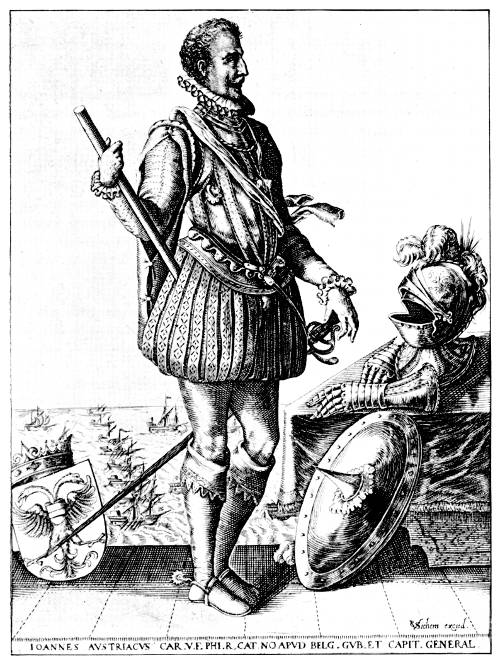
DON JOHN OF AUSTRIA.
Lepanto was a magnificent triumph for the arms of Christendom, and taught a much-needed lesson to Europe that the Ottoman Turk was not invincible upon the sea; it was not, however, an interesting battle from the point of view of the student of war and its combinations. Of all the high officers in command on that memorable day there was only one who displayed real generalship and a proper appreciation of the tactical necessities of the situation; that officer was Ali Basha, the leader of the Sea-wolves. The account of the battle is somewhat obscured by the fact that on the side of the Moslems the name of the Ottoman Commander-in-Chief was also “Ali”; in order to avoid confusion in this narration, we shall allude to the Basha of Algiers by the name given to him by the Christians, “Occhiali.”
It was on Sunday, October 7th, 1571, that the Christian fleet weighed anchor from Cephalonia and stood southwards along the Albanian coast, which is here fringed with rocky islets. The right wing was commanded by John Andrea Doria, the left wing by the Provéditeur Barbarigo, the centre, or “battle,” as it was called, by Don John in person, who had on the one side of him Mark Antony Colonna, the General of the Galleys of the Pope, and on the other that fiery veteran Sebastian Veniero, the commander of the Venetians. Here also were stationed the Prince of Parma, nephew to Don John, Admiral of Savoy; Duke Urbino, Admiral of Genoa; the Admiral of Naples, and the Commandeur of Castile. The reserve, under the command of the Marquis of Santa Cruz, consisted of thirty-five galleys. Immediately in rear of the Real, or royal galley of Don John, was that of the Grand Commander Requesens. The number of seamen, soldiers, officers, and galley-slaves in the fleet amounted to over eighty thousand persons; twenty-nine thousand infantry had been embarked, of which number nineteen thousand were Spaniards. Opposed to the Christians on this day was a Turkish fleet which had on board no less than one hundred and twenty thousand men embarked in two hundred and fifty galleys, without counting an innumerable host of smaller vessels.
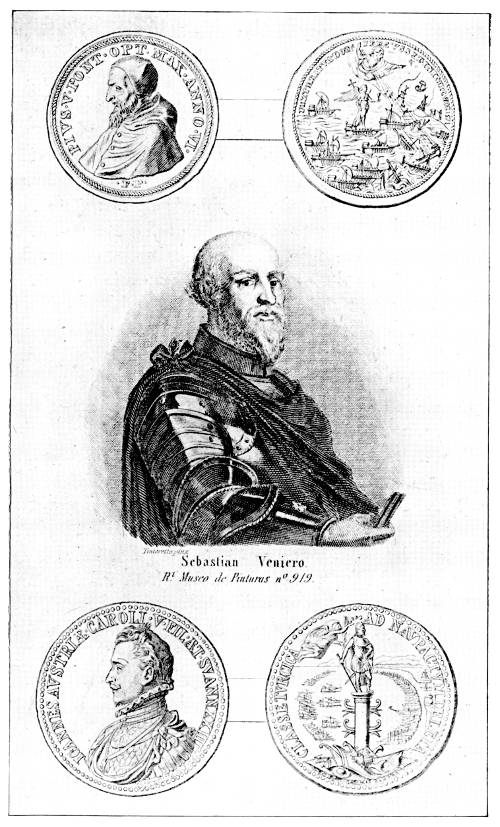
SEBASTIAN VENIERO. Inset, portraits of Don John and Pope Pius V. Heroic statue of Don John dominating Christian and Turkish Fleets. The breath of the Almighty destroying the Turkish fleet at Lepanto.
The authorities on whose accounts of the battle this description is based are Prescott, the famous historian; P. Daru, a member of the Académie Française, who wrote an exhaustive Histoire de Venise and Don Cayetano Rosell, member of the Spanish Academy, who is responsible for an exposition of the subject, known as Historia del combate naval de Lepanto. From a comparison of the works of these eminent men one fact emerges with great clearness, which is that the battle of Lepanto was an indiscriminate mêlée which was decided by some of the most desperate fighting ever recorded, but which depended hardly at all upon the tactical abilities of the men in chief command. It is true that we are told Don John issued written instructions to the commander of each ship, but we are left in the dark as to what these instructions were, while at the same time we discover that in his line of battle, which in the first instance appears to have been that of “single line ahead,” the galleys of all nationalities were inextricably mixed up; making it thereby impossible for the Papal, Spanish, and Venetian commanders to deal, as they should have done, exclusively with their own men. On the other hand, Occhiali kept together the squadron of the Sea-wolves; he outgeneralled and had all but defeated John Andrea Doria, when the end came and he was obliged to retreat.
We are, however, anticipating. Don John passed down his own line in a light “fregata” giving a few words of exhortation and advice to each ship under his command. If the bastard brother of the King of Spain did not exhibit any large measure of ability as a leader on this occasion, he was perhaps none the less the right man in the right place, as he had about him so winning a way, he was so striking and gallant a figure, that the hearts of all under his command went out to him. The seamen and soldiers of the great armada greeted him with enthusiastic shouts of delight as he bade them remember in whose cause it was that they fought. The last of the Knights-errant must have made a brave show as he passed down that line four miles in length, the sun shining on his damascened armour, and his yellow curls streaming out from beneath his helmet.
Soon after sunrise the Turkish fleet was descried sailing towards the Christians, in such apparently overwhelming force that several of the Spanish commanders represented to Don John that it would be imprudent to risk a battle. To his honour be it recorded that he replied he had come out to fight the Turks and that the time for talk was now over. He then hoisted all his banners, and the executive signal for the combat to begin was given by displaying at his mainmast head the sacred banner blessed by the Pope. As this standard floated out upon the breeze there went up a great shout in unison from all that were under the command of Don John. The scene of the combat was that area of the Ionian Sea which is enclosed on the east by the coasts of Albania and Morea and on the west by the islands of Ithaca and Cephalonia, Just to the northward, at the entrance to the Gulf of Arta, sixteen hundred years before had been fought the battle of Actium between Antony and Octavius; the same spot had witnessed, in 1538, the memorable battle of Prevesa between Andrea Doria and Kheyr-ed-Din Barbarossa.
From the point of view of the seaman, who is naturally anxious to discover the dispositions of their fleets made by the rival Commanders-in-Chief, Lepanto is an almost hopeless puzzle. As far as can be gathered, however, it was that the two armadas approached one another in what is known as “line ahead,” each ship being immediately astern of its next ahead in one long continuous line; and that, when they got within striking distance, these lines turned so that they formed “line abreast,” when each ship, having turned at right angles, simultaneously the line advances abreast, the ships forming it being broadside to broadside.
When the Turks discovered the allies they were issuing from between the islets and the shore. Seeing John Andrea Doria moving to the right, they judged that he was executing a turning movement with the object of escaping to the northwards, from whence he had come; they were, at the time, unable to see the rest of the fleet, which was hidden by the land. With sound tactical judgment they accordingly advanced to attack the allies before they should have time to issue from the strait. They were, however, too far off to accomplish this, and, by the time they arrived within striking distance, the Christian fleet had cleared the strait and was ready for them, “drawn up for battle,” says Monsieur Daru, which is somewhat vague in describing the disposition of a fleet. What is certain, however, is that in advance of the galleys of Don John were six great galeasses, which were armed with guns of immensely superior power to anything which could be mounted in galleys. As the Turks advanced to the attack these vessels opened fire, and did so much execution that Ali, the Turkish Commander-in-Chief, ordered his line to open out and thus avoid their fire. Whatever formation the fleet was in at the time—which was, as far as we can gather, “line abreast”—this opening-out process, to avoid the galeasses, threw it into hopeless confusion. The Turkish right wing, which was hugging the coast, and was the first to come into action, passed on in an endeavour to turn the left wing of the allies. While this manoeuvre was in progress Ali, the Capitan-Basha of the Turks, arrived in his vessel opposite to the royal galley of Don John. At the masthead of the galley of the Capitan-Bashaw floated the sacred standard of the Ottomans. This, the ancient banner of the Caliphs, was covered with texts from the Koran, and had upon it the name of Allah emblazoned no less than twenty-eight thousand nine hundred times in letters of gold. “It was,” says Prescott, “the banner of the Sultan, having passed from father to son since the foundation of the dynasty, and was never seen in the field unless the Grand Seigneur or his lieutenant was there in person.” Ali, the Commander-in-Chief, a favourite of the Sultan, had been entrusted with this most precious of all the possessions of the Padishah, as an incentive to him and all under his command to fight their hardest to do honour to the Prophet, and to prevent this symbol of their religion from falling into the hands of the Christian. Ali, like Don John, was young, and burning to distinguish himself; accordingly, as soon as the ships of the two leaders came opposite to each other neither regarded any enemy save his rival Commander-in-Chief. Ali drove his great galley straight on board of the vessel of Don John, and a most obstinate conflict ensued. Veniero and Colonna hastened to the assistance of their chief, who was sore beset.
The combat now became general, and, as has been said, was for the most part nothing but a melee, in which each ship sought out the nearest of her foes and closed with her. For some time the fight went hard with Don John; time and again the galley of the Moslem leader was boarded, but on each occasion the Spaniards were hurled back upon their own decks. Loredano and Malipier, two Venetian captains, fell upon seven Turkish galleys which were hastening to reinforce the attack on Don John, and sank one of them. They then fought with such fury and resolution with the six that remained that, although both captains were killed, it was conceded that they had saved their general, entirely altered the complexion of the battle in their neighbourhood, and facilitated the capture of the Turkish admiral. The determined conduct of the two Venetians allowed the Spanish division to close in on the Turkish flagship, which, after an heroic resistance, was captured, principally because there were practically none left alive to fight. The head of Ali was struck off by a Spanish soldier, the banner of the Moslems was replaced by the flag of the Cross, the head of Ali on a pike being exhibited in derision above it. The conquerors seem to have seen no incongruity in this performance. The lowering of the sacred standard of the Capitan-Basha had a disheartening effect upon the Turks; they knew by this that their Commander-in-Chief was dead and his ship captured, the result being that the resistance of the Ottomans began to weaken. Then thirty galleys took to flight from the neighbourhood of the Christian flagship; so hotly were they pursued that they ran on shore, the crews swimming or wading to the beach and making off inland.
On the right of the Christian line things had not been going so propitiously for them. Here Occhiali had managed, by his apparently persistent attempts to outflank John Andrea Doria, to decoy that commander away from his supports and from the main body of the Christians. This tactical manoeuvre of the corsair was successful; having drawn off some fifteen of the Christian galleys, he suddenly flung the whole of his greatly superior force into the gap and surrounded them. These galleys were Spanish, Venetian, and Maltese, and, although they offered a most vigorous resistance, they were mostly destroyed or captured. Doria, in spite of all his efforts, was on this day both outgeneralled and outfought: the Sea-wolves, under their grim leader, manoeuvring for position, obtaining it, and then falling like a thunderbolt on the foe. They were all brave men at Lepanto on this memorable October day; but few there were like the corsair king, in whom a heart of fire was kept in check by a brain of ice, who, during the whole combat, never gave away a chance, or failed to swoop like an eagle from his eyry when the blunders of his enemy gave him the opportunity for which he watched. It was the old story of “the veritable man of the sea” pitted against gallant soldiers fighting on an unfamiliar element. And yet it was against the best seaman on the Christian side that Occhiali pitted himself on this stricken field; and none can deny that with him rested such honour as was gained by the Turks on this day, the day which broke up for ever the idea of the invincibility of the Ottomans on the water. It needs not to say, to those who have read the story of the siege of Malta, how the Knights comported themselves in the battle; and yet Occhiali captured the Capitana, or principal galley of the Order, He was towing her out of action, a prize, when the Marquis of Santa Cruz bore down upon him with the reserve. By this time the battle was lost; the Moslems were in full retreat.
The corsair recognised that he could do no more: sullenly he cast off the tow, and, forming up some thirty of his galleys, still in a condition to navigate, stood boldly through the centre of where the battle had once raged, and escaped. The Capitana of Malta had been taken; and to the Sultan did Occhiali present the great standard of Saint John, as an earnest of his achievement.
Bernardino de Escalente, in his work Diálogos del arte militar, printed in Seville in 1583, says that the Captain Ojeda, of the galley Guzmana, recaptured the Capitana of Malta; and that, in recognition thereof, “the Religion” pensioned him for life. Ojeda, it is to be presumed, was under the orders of the Marquis of Santa Cruz during the battle.
There remains one incident connected with the battle of Lepanto which must be told. In the Marquesa galley, in the division of Doria, was lying in his bed sick of a fever a young man twenty-four years of age; a Spaniard of Alcala de Henares, “de padres hidalgos y honrados,” we are told, although these parents were poor. When this young man heard that a battle was imminent he rose from his bed and demanded of his captain, Francisco San Pedro, that he should be placed in the post of the greatest danger. The captain, and others, his friends, counselled him to remain in his bed. “Señores,” replied the young man, “what would be said of Miguel de Cervantes should he take this advice? On every occasion up to this day on which his enemies have offered battle to his Majesty I have served like a good soldier; and today I intend to do so in spite of this sickness and fever.” He was given command of twelve soldiers in a shallop, and all day was to be seen where the combat raged most fiercely. He received two wounds in the chest and another which cost him the loss of his left hand. To those to whom he proudly displayed them in after-years he was accustomed to say, “wounds in the face or the chest are like stars which guide one through honour to the skies.” Of him the chronicler says: “He continued the rest of his life with honourable memory of this wonderful occurrence, and, although he lost the use of his left hand, it added to the glory of his right.” How glorious was that right hand is known to all readers of El Ingenioso Hidalgo Don Quijote de la Mancha.
The losses at the battle of Lepanto are something so prodigious that imagination boggles at them. It is said that the Christians lost five thousand men and the Turks no less than thirty thousand. Enormous as these numbers are, they represent probably a very conservative estimate of the loss. The Turks lost two hundred vessels, and when we recollect the number of men embarked on board of the sixteenth-century galleys we can see that the numbers are by no means exaggerated, especially as no quarter was given on either side. When the Captain Ojeda recaptured the battered wreck which had been the Capitana of Malta, we are told that on board of her were three hundred dead Turks; if this were the cost of the capture of one galley we need not be surprised at the total.
With the results to Europe of this amazing battle we have nothing to do in this book. That which it demonstrated, as far as the Sea-wolves were concerned, was that they still remained the most competent seamen and sea-fighters in the Mediterranean, and that the legend of the invincibility of the Ottomans at sea rested on what had been accomplished during a long period of years by these insatiable pirates and magnificent warriors.
That which the fighting Pontiff, Pius V., said when he heard of the victory is in character with everything which history has told us of this remarkable occupant of the chair of Saint Peter. It was short but very much to the point, consisting of the one sentence, “Fuit homo misus a Deo cui nomen erat Joannes.”
In a collection of epitaphs printed in Colonia in 1623 (and edited by one Franciscus Swertius) is one in Spanish by an anonymous author on Don John of Austria. In this, which takes the form of question and answer, it is asked of him “who with so much real glory lies so humbly ’neath this stone,” what it is that Spain can do for him, what temple or what statue can she raise to his honour. To this the hero is made to reply that “My temple is found in my works, my statue has been my fame.” This is not only a pretty conceit, but it is very substantially true when we think of the place in history which this man attained.
It remains to speak of the future career of Ali Basha after his experiences at Lepanto. He now returned to Constantinople, where he found that the bitter complaints of the Janissaries concerning their lack of pay had preceded him; this must have been annoying, as by this time so insignificant a circumstance had probably escaped his memory. His old friend and patron Piali Basha was still in power; the Basha used his influence, and the corsair laid at the feet of the Sultan the great Standard of Saint John captured by him from the Knights—which was the only trophy which came to Constantinople from that disastrous battle; and in consequence we are told that “instead of reprimands he was loaded with caresses and applauses.”
There was in Ali the same dauntless quality of never knowing when he was beaten which had distinguished Kheyr-ed-Din Barbarossa. His exploits at Lepanto had secured him the high favour of the Sultan, which he used in a manner most grateful to that sovereign by approaching him with a request that he might be allowed to fit out another fleet to revenge himself on the Christians. The Sultan acceded to his request, and such diligence did he use that in June 1572, only eight months after the crushing defeat of the Turks, Ali took the sea with two hundred and fifty galleys besides smaller vessels. So powerful had he now become that Selim nominated him as his Admiralissimo, allowing him also to retain the Bashalic of Algiers. With his new fleet he sought out the allies once more, finding them at anchor in a port in the Morea. He lay outside the harbour defying them to come out, which they refused to do—“but they parted without bloody noses”—is Morgan’s comment. Haedo attributes this inertia on the part of the allies to dissension among their leaders; but, however that may have been, Ali gained almost as much favour with the Sultan as if he had defeated them in a pitched battle. “But these are the judgments of God and things ordered by His divine providence and infinite wisdom,” says Haedo. The connection is somewhat hard to establish.
In 1573 the Bashalic of Algiers passed into the hands of Arab Ahmed, and in this same year Don John of Austria recaptured Tunis from the Turks. Ali, with a fleet of two hundred and fifty galleys and forty smaller vessels, recaptured it again in a siege lasting forty days, and once more returned to Constantinople in triumph with thousands of Spanish captives. He was yet to live some years to harass the Christians, against whom he ever displayed a most inveterate rancour. In 1576 he set out from Constantinople with sixty galleys and ravaged the Calabrian coast, where he had been born. In 1578, the Janissaries of Algiers having assassinated Arab Ahmed the Basha, he was sent to chastise them, which he did with a heavy hand.
Ali was never married, and left no descendants; in the later years of his life he built himself a sumptuous palace some five miles from Constantinople, and no man in all the realm save the Sultan himself was so great a man as the Calabrian renegado, the unknown waif from Southern Italy who possessed neither name nor kindred. He was tall and robust in stature, but all his life suffered from “scald-head”; for a definition of which ailment we may refer the curious to the dictionary. He possessed, for a chieftain and a fighting man, the disadvantage of a voice so hoarse as to be inaudible at a few paces distant. In default of offspring he maintained at his charges five hundred corsairs, whom he called his children. He died in the year 1580, and with him what has been called the “Grand Period of the Moslem Corsairs” in this book may be said to have come to an end.
By the men whose deeds have been here chronicled the pirate States of Northern Africa were established; and, as we have seen, they maintained an unceasing warfare against all that was mightiest in Christendom, aided and abetted by the Sultans of Constantinople. In the sixteenth century the Sea-wolves had this at least to recommend them, that they feared neither King nor Kaiser, albeit these great ones of the earth were bent on their destruction. Villains as they were, they were none the less men to be feared, men in whom dwelt wonderful capabilities of leadership. Such, however, was not the case with those by whom they were succeeded; and the great and civilised nations of the world tolerated for centuries in their midst a race of savage barbarians whose abominable insolence and fiendish cruelty were only equalled by their material weakness and military impotence. Algiers, Tunis, and Tripoli became recognised States, and the Great Powers degraded themselves by actually accrediting diplomatic agents to the “Courts” of these people.
“The Algerines are robbers, and I am their chief,” was the remark made by the Dey of Algiers to the English Consul in 1641, and the man spoke the plain unvarnished truth. Yet at this time the Algerines had no more than sixty-five ships, and no organisation which could have held out for twenty-four hours against such attacks as had been successfully resisted on many occasions in the previous century.
On April 10th, 1682 (O.S.), “Articles of peace and commerce between the most serene and mighty Prince Charles II., by the Grace of God King of Great Britain, etc., and the most illustrious (sic) Lord, the Bashaw, Dey, and Aga, Governor of the famous city of Algiers in Barbary,” were concluded by “Arthur Herbert, Esquire, Admiral of His Majesty’s Fleet.” It need hardly be said that such a treaty as this was not worth the paper on which it was written; that the barbarians by whom it was signed were as ignorant as they were unprincipled, and that the only argument which they understood at that, or any other time, was that of the right of the strongest.
When we of the present day read of the deeds of the corsairs we are filled with horror, we fail to understand how such things could have been tolerated, we seek for some explanation. When we hear of a “League of Christian Princes,” and find that all its members could accomplish was to turn their arms the one against the other, we are even still more puzzled. What was it, then, that lay at the root of this problem? The answer would appear to be in the ethical standpoint of the sixteenth century. We are so accustomed in the present day to hear of the rights of man that we are apt to forget that, in the time of Barbarossa, of Dragut, of Charles V., and the Medicean Popes such a thing did not exist, and the only rights possessed by the common man were those vouchsafed to him by his sovereign lord. We have also to take another factor into consideration, which is that what we call “humanity” simply did not exist, the result being that the raids of the Sea-wolves were not judged by the great ones of the earth from the standpoint of the amount of suffering which they inflicted, but in what manner these proceedings affected the wealth and power of the lord of the territory which had been despoiled. So differently was society constituted in those days that the very victims acquiesced more or less meekly in their fate, each one unconsciously voicing that most pathetic saying of the Russian peasant that “God is high and the Czar is far away.”
The fact of the intolerable lot of the common man in these times helps us to understand one thing which otherwise would be an insoluble problem: which was, why did Christian soldiers so often become renegadoes and fight for the corsairs under the banner of those who were the fiercest and most irreconcilable foes of themselves and their kindred? The life of the common soldier or sailor did not offer many advantages; it was generally a short and anything but a merry one, and the thing by which it was most profoundly affected was capture by the corsairs.
When this happened he became either a “gallerian,” rowing out his heart on the benches of the Moslem galleys, or he festered in some noisome dungeon in Algiers, Oran, or Tlemcen. For him, however, there was always one avenue of escape open: he had but to acknowledge that Mahomet was the Prophet of God and the prison doors would fly open, or the shackles be knocked off the chain which bound him to the hell of the rower’s bench. Many of the Christian captives had really nothing to bind them to the faith of their fathers—neither home nor lands, wealth nor kindred, and they were doubtless dazzled by the amazing success which accompanied the arms of the leaders of the pirates. Is it wonderful, then, that such men in such an age should grasp at the chance of freedom and throw in their lot with their captors?
It was treachery, it was apostasy, and no amount of sophistry can prove it to have been otherwise; but the man who would sit in judgment in the present day must try to figure to himself what the life of a galley-slave meant—a life so horrible and so terrible that it is impossible, in the interest of decency, to set down a tithe of what it really was.
We who in the present day sit in judgment upon the virtues and vices of a bygone age can, in the ordered security of our modern civilisation, see many things which were hidden from our forefathers, even as in another three hundred years our descendants will be able to point the finger of scorn at the mistakes which we are now committing. We have seen how it was that the pirate States arose; we have seen also how, in future generations, they were allowed to abide. We cannot, in common honesty, echo the words already quoted of the historian that “these are the judgments of God, and things ordered by His divine providence and infinite wisdom,” neither can we acquit the heirs of the ages for that slackness which prevented them from doing their duty; we have, however, to ask ourselves this question, that, had it fallen to our own lot to deal with the problem of the extermination of the pirates, should we have done better?
One word in conclusion. That which they did has been set down here; the record, however, is not complete, as many of their acts of cruelty, lust, and oppression are not fitted for publication in the present day. It has been said, with truth, that no man is much better or much worse than in the age in which he lives; and to hold the scales evenly—if one were tempted to shock contemporary opinion by too literal a transcript of all that was done by the corsairs—it would also be necessary to cite the reprisals of their Christian antagonists. It has seemed better to leave such things unchronicled: to present, with as much fidelity as possible, the public lives and acts of these troublers of the peace of the sixteenth century. Looking back, as we do, over three hundred and fifty years, and judging as fairly as is possible, it would seem that there is little which can be said in their favour.
But we may at least concede that, no matter how infamous were the Barbarossas, Dragut, and Ali, they proved that in them dwelt one rare and supreme quality, which, in all the ages, has covered a multitude of sins. At a time when every one was a warrior and the whole world was an armed camp, men sought great captains in whose following to serve. Among the Moslems of Northern Africa, in ordered succession, there rose to the surface “veritable men of the sea,” in the wake of whose galleys ravened the Sea-wolves. When we consider how undisciplined and how stupidly violent these pirates were by nature, and how they were welded into a homogeneous whole by those of whom we speak, we are forced to the conclusion that seldom, in all the ages, have abler captains arisen to take fortune at the flood, to dominate the minds and the bodies of a vast host, to prove that they were, in deed and in truth, supreme as leaders of men.