Front matter (continued 2)
Reading edition
On the lid, or on a slip of paper or card placed at the head of your columns of trays, write the class and order, with its proper number (I., II., etc., as the case may be); then at the top of your left-hand column place the family and its number, and under it the name of the first genus. The species (one in each tray) come next, then the name of the next genus following it, succeeded by its species, and so on.
The object of the young collector should be to obtain examples of as many genera as possible, since a collection in which a great number of genera are represented is far more useful and instructive than one composed of a great many species referable to but few genera. He will also find it very convenient to separate the British Shells from his general collection, sub-dividing them for convenience into "Land and Fresh-water," and "Marine." Of these he should endeavour to get every species, and even variety, making the thing as complete as possible. Or a separate collection may be made of all those kinds which he can find within a certain distance of his own home. A collection of this sort possesses, in addition to its scientific worth, an interest of its own, owing to the local associations that invariably connect themselves with it.
TABLE OF SOME OF THE MORE IMPORTANT GENERA, SHOWING THE APPROXIMATE NUMBER OF SPECIES BELONGING TO EACH GENUS AND THEIR DISTRIBUTION.
CLASS I.—Cephalopoda.
Order I.—Dibranchiata.
Section A.—Octopoda.
Family. Genus.No. of Species. Distribution.
1.Argonauta4Tropical seas.
2.Octopus46Rocky coasts in temperate and tropical regions.
Section B.—Decapoda.
3.Loligo19Cosmopolitan.
4.Sepia30On all coasts.
5.Spirula3All the warmer seas.
Order II.—Tetrabranchiata
6.Nautilus3 or 4Chinese Seas, Indian Ocean, Persian Gulf.
CLASS II.—Gasteropoda.
Order I.—Prosobranchiata.
Division a.—Siphonostomata.
Family. Genus.No. of Species. Distribution.
1.Strombus60W. Indies, Mediterranean, Red Sea, Indian Ocean, Pacific—low water to 10 fathoms.
Pteroceras12India, China.
2.Murex180On all coasts.
Columbella200Sub-tropical regions, in shallow water on stones.
Mitra350Tropical regions, from low water to 80 fathoms.
Fusus100On all coasts.
3.Buccinum20Northern seas, from low water to 140 fathoms.
Eburna9Red Sea, India, Australia, China, Cape of Good Hope.
Nassa210World-wide—low water to 50 fathoms.
Purpura140World-wide—low water to 25 fathoms.
Harpa9Tropical—deep water, sand, muddy bottoms.
Oliva117Sub-tropical—low water to 25 fathoms.
4.Cassis34Tropical regions, in shallow water.
Dolium15Mediterranean, India, China, W. Indies, Brazil, New Guinea, Pacific.
Triton100Temperate and sub-tropical regions, from low water to 50 fathoms.
Ranella50Tropical regions, on rocks and coral-reefs.
Pyrula40Sub-tropical regions, in 17 to 35 fathoms.
5.Conus300Equatorial seas—shallow water to 50 fathoms.
Pleurotoma500Almost world-wide—low water to 100 fathoms.
6.Voluta100On tropical coasts, from the shore to 100 fathoms.
Cymba10West Coast of Africa, Lisbon, Straits of Gibraltar.
Marginella90Mostly tropical.
7.Cypræa150Warmer seas of the globe, on rocks and coral-reefs.
Ovulum36Britain, Mediterranean, W. Indies, China, W. America.
Division b.—Holostomata.
Family. Genus.No. of Species. Distribution.
8.Natica90Arctic to tropical regions, on sandy and gravelly bottoms, from low water to 90 feet.
Sigaretus26E. and W. Indies, China, Peru.
9.Cancellaria70W. Indies, China, S. America, E. Archipelago—low water to 40 fathoms.
10.Pyramidella11W. Indies, Mauritius, Australia, in sandy bays and on shallow mud-banks.
Odostomia35Britain, Mediterranean, and Madeira—low water to 50 fathoms.
Chemnitzia70World-wide—low water to 100 fathoms.
Eulima26Cuba, Norway, Britain, India, Mediterranean, Australia—5 to 90 fathoms.
11.Solarium25Sub-tropical and tropical—widely distributed.
12.Scalaria100World-wide—low water to 100 fathoms.
13.Cerithium100World-wide.
Potamides41Africa and India, in mud of large rivers.
Aporrhais3Labrador, Norway, Britain, Mediterranean—20 to 100 fathoms.
14.Turritella50World-wide—low water to 100 fathoms.
Vermetus31Portugal, Mediterranean, Africa, India.
15.Melania160S. Europe, India, Philippines and Pacific Islands—in rivers.
Melanopsis20Spain, Australia, Asia Minor, New Zealand—in rivers.
16.Paludina60Northern Hemispheres, Africa, India, China, etc.—in lakes and rivers.
Ampullaria50S. America, W. Indies, Africa, India—in lakes and rivers.
17.Litorina40On all shores.
Rissoa70World-wide—in shallow water on sea-weed to 100 fathoms.
18.Calyptrea50World-wide—adherent to rocks, etc.
Crepidula40West Indies, Mediterranean, Cape of Good Hope, Australia.
Pileopsis7Britain, Norway, Mediterranean, E. and W. Indies, Australia.
Hipponyx70W. Indies, Galapagos, Philippines, Australia.
Phorus9W. Indies, India, Javan and Chinese Seas—in deep water.
19.Turbo60On the shores of Tropical seas.
Phasinella30Australia, Pacific, W. Indies, Mediterranean.
Imperator20S. Africa, India, etc.
Trochus150World-wide—from low water to 100 fathoms.
Rotella18India, Philippines, China, New Zealand.
Stomatella20Cape, India, Australia, etc.
20.Haliotis75Britain, Canaries, India, Australia, California—on rocks at low water.
Stomatia12Java, Philippines, Pacific, etc.— under stones at low water.
21.Ianthina6Gregarious in the open seas of the Atlantic and Pacific.
22.Fissurella120World-wide—on rocks from low water to 5 fathoms.
Emarginula26Britain, Norway, Philippines, Australia—from low water to 90 fathoms.
23.Nerita116On the shores of all warm seas.
Neritina110In fresh waters of all warm countries, and in Britain.
Navicella24India, Mauritius, Moluccas, Australia, Pacific—in fresh water, attached to stones.
24.Patella100On all coasts—adhering to stones and rocks.
25.Dentalium30World-wide—buried in mud.
26.Chiton200World-wide—low water to 100 fathoms.
Order II.—Pulmonifera.
Division a.—Inoperculata.
Family. Genus.No. of Species. Distribution.
27.Helix1,600 68 650 ┐ ├ ┘World-wide—on land in moist places.
Succinea
Bulimus
Achatina120World-wide—burrowing at roots and bulbs.
Pupa 236World-wide—amongst wet moss.
Clausilia400Europe and Asia—in moist spots.
28.Limax22Europe and Canaries—on land in damp localities.
Testacella3S. Europe, Canaries, and Britain— burrowing in gardens.
29.Oncidium16Britain, Red Sea, Mediterranean—on rocks on the seashore.
30.Limnæa50Europe, Madeira, India, China, N. America—in ponds, rivers, lakes, etc.
Physa20America, Europe, S. Africa, India, Philippines—in ponds, rivers, lakes, etc.
Ancylus14Europe, N. and S. America—in ponds, rivers, lakes, etc.
Planorbis145Europe, N. America, India, China—in ponds, rivers, lakes, etc.
31.Auricula50Tropical—in salt marshes.
Siphonaria30World-wide—between high and low water.
Division b.—Operculata.
Family. Genus.No. of Species. Distribution.
32.Cyclostoma80S. Europe, Africa India, Philippines Philippines, New Guinea┐ ├ —on land. ┘
Cyclophorus100
Pupina80
33.Helicina150W. Indies, Philippines, Central America, Islands in Pacific—on land.
34.Acicula5Britain, Europe, Vanicoro—on leaves and at roots of grass.
Geomelania21Jamaica—on land.
Order III.—Opisthobranchiata.
Division a.—Tectibranchiata.
Family. Genus.No. of Species. Distribution.
35.Tornatella16Red Sea, Philippines, Japan—in deep water.
36.Bulla50Widely distributed—low water to 30 fathoms.
37.Aplysia40Britain, Norway, W. Indies—low water to 15 fathoms on sea-weed.
38.Pleurobranchus20Britain, Norway, Mediterranean.
Division b.—Nudibranchiata.
39-44. All shell-less.
Order IV.—Nucleobranchiata.
Family. Genus.No. of Species. Distribution.
45.Firola8Atlantic, Mediterranean.
Carinaria5Atlantic and Indian Oceans.
46.Atlanta15Warmer parts of the Atlantic.
CLASS III.—Pteropoda.
Order I.—Prosobranchiata.
Division a.—Thecosomata.
Family. Genus.No. of Species. Distribution.
1.Hyalea19 ┐
Cleodora12 ┘Atlantic, Mediterranean, Indian Ocean.
2.Limacina2Arctic and Antarctic Seas.
Division b.—Gymnosomata.
3.Clio, etc. Shell-less.
CLASS IV.—Lamellibranchiata.
Division a.—Asiphonida.
Family. Genus.No. of Species. Distribution.
1.Ostrea100World-wide—in estuaries, attached.
2.Anomia20India, Australia, China, Ceylon— attached to shells from low water to 100 fathoms.
Placuna4Scinde, North Australia, China—in brackish water.
3.Pecten176World-wide—from 3 to 40 fathoms.
Lima20Norway, Britain, India, Australia—from 1 to 150 fathoms.
Spondylus70Tropical seas—attached to coral-reefs.
4.Avicula25Britain, Mediterranean, India—25 fathoms.
Perna18In tropical seas—attached.
Pinna30United States, Britain, Mediterranean, Australia, Pacific—low water to 60 fathoms.
5.Mytilus70World-wide—between high and low water mark.
Modiola70British and tropical seas—low water to >100 fathoms.
6.Arca400In warm seas—from low water to 200 fathoms.
Pectunculus58West Indies, Britain, New Zealand—from 8 to 60 fathoms.
Nucula70Norway, Japan—from 5 to 100 fathoms.
7.Trigonia3Off the coast of Australia.
8.Unio420World-wide—in fresh waters.
Anodon100North America, Europe, Siberia—in fresh waters.
Division b.—Siphonida.
9.Chama50In tropical seas on coral reefs.
10.Tridacna7Indian and Pacific Oceans, Chinese Seas.
11.Cardium200World-wide—from the shore line to 140 fathoms.
12.Lucina70Tropical and temperate seas—sandy and muddy bottoms—from low water to 200 fathoms.
Kellia20Norway, New Zealand, California—low water to 200 fathoms.
13.Cyclas60Temperate regions—in all fresh waters.
Cyrena130From the Nile and other rivers to China—and in mangrove swamps.
14.Astarte20Mostly Arctic—from 30 to 112 fathoms.
Crassatella34Australia, Philippines, Africa, etc.
15.Cyprina1From Britain to the most northerly point yet reached—from 5 to 80 fathoms.
Circe40Britain, Australia, India, Red Sea—8 to 50 fathoms.
Isocardia5Mediterranean, China, Japan—burrowing in sand.
Cardita54Tropical seas—from shallow water to 150 fathoms.
16.Venus176 ┐ World-wide—buried in sand, from low water to 100 fathoms.
Cytherea113 ┘
Artemis100Northern to tropical seas—from low water to 100 fathoms.
Tapes80Widely distributed—burrowing in sand, from low water to 100 fathoms.
Venerupis20Britain, Canaries, India, Peru—in crevices of rocks.
17.Mactra125World-wide—burrowing in sand.
Lutraria18Widely distributed—burrowing in sand.
18.Tellina300In all seas—from the shore line to 15 fathoms.
Psammobia50Britain, Pacific and Indian Oceans—from the littoral zone to 100 fathoms.
Sanguinolaria20W. Indies, Australia, Peru.
Semele60Brazil, India, China, etc.
Donax68Norway, Baltic, Britain—in sand near low water mark.
19.Solen33World-wide—burrowing in sand.
Solecurtus25Britain, Africa, Madeira, Mediterranean—burrowing in sand.
20.Mya10North Seas, W. Africa, Philippines, etc.—river mouths from low water to 25 fathoms.
Corbula60United States, Britain, Norway, Mediterranean, W. Africa, China—from 15 to 80 fathoms.
21.Anatina50India, W. Africa, Philippines, New Zealand.
Thracia17Greenland to Canaries and China—from 4 to 120 fathoms.
Pandora18Spitzbergen, Panama, India—from 4 to 110 fathoms, burrowing in sand and mud.
22.Gastrochæna10W. Indies, Britain, Red Sea, Pacific Islands—from shore line to 30 fathoms.
Saxicava Arctic Seas, Britain, Mediterranean, Canaries and the Cape—in crevices and boring into limestone and rocks.
Aspergillum21Red Sea, Java, New Zealand—in sand.
23.Pholas 32Almost universal—from low water to 25 fathoms.
Xylophaga2Norway, Britain, S. America—boring into floating wood.
Teredo14In tropical seas—from low water to 100 fathoms.
SOME WORKS OF REFERENCE.
Mollusca in General.
"A Manual of Mollusca." By Dr. S. P. Woodward.
"Tabular View of the Orders and Families of the Mollusca." Published by the Society for Promoting Christian Knowledge.
"Cassell's Natural History," latest edition, article on the Mollusca. By Dr. Henry Woodward.
British Mollusca.
"A History of British Mollusca and their Shells." By Professor E. Forbes and S. Hanley.
"British Conchology." By J. G. Jeffreys.
"Common Shells of the Sea-shore." By Rev. J. G. Wood.
British Land and Fresh-water Mollusca.
"Land and Fresh-water Mollusca indigenous to the British Isles." By Lovell Reeve.
"A Plain and Easy Account of the Land and Fresh-water Mollusca of Great Britain." By Ralph Tate.
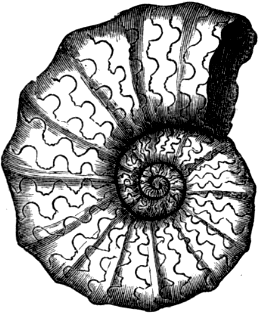
FOSSILS.
BY
B. B. WOODWARD.
Contents
SectionPage
INTRODUCTORY.65
THE CABINET.66
IMPLEMENTS REQUIRED WHEN COLLECTING.66
HOW TO USE YOUR IMPLEMENTS.69
HOW TO PREPARE THE SPECIMENS FOR THE CABINET.74
TABLE OF THE PRINCIPAL FOSSILIFEROUS STRATA.78
NOTES ON THE DIFFERENT FORMATIONS MENTIONED IN THE TABLE.79
TABLE OF THE PRINCIPAL DIVISIONS OF THE ANIMAL KINGDOM.94
FOSSILS.
INTRODUCTORY.
Geology is of all "hobbies" the one best calculated not only to develop the physical powers, but also, if pursued with any degree of earnestness, to train and extend the mental faculties. To study geology properly, the rocks themselves must be visited and carefully observed, their appearance noted, and the fossils, if any, which they contain, collected. This necessitates many a pleasant walk into the open country to quarries and cuttings, or rambles along the sea-shore to cliffs which may be worth investigating, whilst botany, entomology, or any other congenial pursuit, may be followed on the way; for natural science in its different branches has so many points of connection that it is impossible to study one of them without increasing one's interest in, and knowledge of, all the others. Again, in arranging, classifying, and studying at home the specimens collected on these expeditions, many an hour may be usefully spent; habits of exactitude and neatness are acquired; whilst in endeavouring to draw correct conclusions as to the way in which particular rocks were formed, and by what agencies brought to their present position, the reasoning faculties are exercised and developed.
The existence of fossil shells and bones in various strata of the earth's crust attracted attention at a very early date of the world's history; the Egyptian priests were aware of the existence of marine shells in the hills bounding the Nile valley, and from this fact Herodotus drew the conclusion that the sea formerly covered the spot. The bones of the larger mammalia (rhinoceros, elephant, etc.), were, however, thought by the ancients to be human, and hence arose the idea of a race of giants having existed at some previous period of the earth's history. It was not, however, until near the end of the last century that geology began to be recognised as a science, and the true bearing of fossils in relation to the rocks in which they were found was conclusively proved. William Smith in England, and Werner in Germany, while working independently of each other, both came to the same conclusion, viz. that the numerous strata invariably rested on each other in a certain order, and that this order was never inverted,[1] whilst William Smith in addition proved that each group of rocks, and even each stratum, had its own peculiar set of fossils, by which it might be recognised wherever it occurred. From that time forth the study of the various fossils began to be considered as a separate science apart from that of the beds containing them; this is now known as Palæontology, the study of the composition of the rocks themselves being termed Petrology.
At this moment, however, we are less concerned with the study of rocks and fossils than with the best and simplest way of collecting, preparing, and arranging specimens as a means to this study.
THE CABINET.
With regard to the cabinet for such specimens as you are able to collect, the same advice holds good as that given in a previous Manual (The Young Collector's Shell Book), namely, the simpler the cabinet the better, though of course card-board boxes would not as a rule be strong enough to stand the weight of the specimens, and hence it is advisable to have wooden ones. The boxes in which Oakey's Wellington Knife-powder is sent out (they measure about 15 in. × 10 in. × 3 in.) are on the whole the most convenient size, and are easily obtainable at any oil and colourman's. These, when painted over with Berlin Black, after first removing the external labels, look very neat. The inside may be papered according to taste, when the trays may be arranged in order ready for the reception of your specimens.[2]
IMPLEMENTS REQUIRED WHEN COLLECTING.
A certain amount of apparatus is needful in collecting geological specimens. It is necessary to break open the hard rocks in order to get at the fossils within, and for this purpose a strong hammer is required. One end of the hammer-head should be square, tapering, slightly, to a flat striking face; for when thus shaped the edges and corners are less likely to break off; the other side should be produced into a rather long, flat, and slightly curved pick, terminating in a chisel-edge at right-angles to the handle; the total length of the head should not exceed 9½ in., the striking face being 3 in. from the centre of the eye in which the handle (18 in. long) is inserted; the latter should be made of the toughest ash, American hickory, or "green-heart," and fixed in with an iron wedge ("roughed" to prevent its coming out again), taking care that ¼ in. of the handle protrudes on the other side. It is the usual practice, but a mistaken one, to cut it off level with the hammer head, which is likely, under these circumstances, to come off after it has been in use for a time, whereas, by leaving a small portion of the wedged-out end projecting, this mischance is avoided, and your weapon will not fail even when used to drag its owner up a stiff ascent. It is better to shape and fix the handle yourself, as by this means you can not only cut it to fit your hand, but may rely upon its being properly fastened in. By filing grooves around it an inch apart, it will serve to take rough measurements with, while a firm grasp may be insured by bees-waxing instead of polishing it. Another and much smaller hammer will also be necessary, chiefly for home use, to trim the specimens before putting them away in the cabinet; the head of this hammer must not be more than 2½ inches long, the handle springing from the centre; one end has a flat striking face, square in section, the other, instead of being formed like a pick, is wedge-shaped, the sharp edge being at right-angles to the handle. Next to a hammer, a cold chisel is indispensable to the collector, since without its aid many a choice specimen embedded in the middle of a mass of rock too large to break with the hammer would have to be left behind. There is one thing, however, to beware of in using this tool—it has sometimes to be hit with great force, and should you chance to miss it and strike your hand instead, the result may be more serious than even a severe bruise. To prevent this, procure from the shoe-maker or saddler a piece of thick leather, about 4 inches in diameter, having a hole cut in the centre through which to pass the shank of the chisel, and, thus protected, you may wield the hammer with impunity.
For digging fossils out of clay, an old, stout knife, such as the worn-down stump of a carver, is handy, and in sandy beds an ordinary garden trowel is very useful, whilst in a chalk-pit a small saw is sometimes of great aid in extricating a desirable specimen. The same may be said of an ordinary carpenter's wood-chisel. For picking up small and delicate specimens, a pair of forceps should be carried, whilst without a pocket lens no true naturalist ever stirs abroad. An ordinary stout canvas satchel, such as is commonly used by schoolboys, is the best thing for carrying home your specimens; this may be made much stronger by the addition of two short strips of leather stitched on the back and running, one from each ring, to which the strap passing over the shoulder is fastened, down to the bottom of the bag; by leaving a small portion unstitched near the bottom of each of these, wide enough for the shoulder-strap to pass through, the satchel may at a moment's notice be slung knapsackwise on the shoulders—a method of carrying it which is, as all who have tried it know, by far the most convenient when it is heavily laden or not in immediate requisition. A stout leather belt may be worn in which to carry all your hammers, supporting it on the side where the heavy hammer hangs by a band passing over the opposite shoulder. Before starting on an excursion, make a practice of seeing that you have everything with you, or when the critical moment comes, and some choice and fragile specimen is ready to be borne off, you may find that you are without the means necessary for taking it home. For ordinary hard specimens, newspaper well crumpled around them is without its equal, but some of the more delicate must be first wrapped in tissue paper or even cotton-wool, whilst the most fragile fossils should be packed in tins with bran or sawdust, the particles of which fill in all the corners and press equally everywhere, a useful faculty which cotton wool does not possess. When neither of these are to be obtained, dry sand will answer quite as well, though it is heavier to carry.
Although not absolutely necessary in the field, it is often useful to have a small bottle of acid in your pocket (nitric acid diluted to 1-12th with distilled water is the best) with which to test for limestones; a drop of acid placed on a rock will, if there be any carbonate of lime in it, immediately begin to fizz. Finally, every young collector should carry a note-book, and carefully record in it what he sees in each pit he visits, while, if it can be procured or borrowed, a geological map of the district you are exploring is a great help, for with its aid and that of a good compass you become practically independent of much extraneous assistance.
HOW TO USE YOUR IMPLEMENTS.
We will suppose by way of illustration that near us flows a river, on the rising ground above which is a pit that we propose to visit for the purpose of putting our apparatus into practical operation. When we have reached the floor of the pit, and stand looking up at the section before us, we are at first rather puzzled as to what the beds, which we see before us, are; for as the pit has not been worked for some time, its sides are partially overgrown with grass, and in places bits and pieces of the upper beds have fallen down and form a heap beneath which the lower ones lie buried. We must therefore make our way to those spots where the beds are left clear, and find out, if possible, what they are. By climbing up one of the heaps of fallen earth (talus) we reach the top, where, first of all, under the roots of the grass and shrubs, we find the mould in which these grow, and which is formed of the broken up (disintegrated) rocks forming the still higher ground above, and which the rains, frosts and snows, aided afterwards by the earthworms, have converted into mould. This, geologically speaking, is called surface soil, and is here about two feet deep. Just below it we find a layer of coarse gravel; the pebbles of which this is composed are of all sorts, sizes, and shapes, and are stained a deep brown by oxide of iron. Most of them are flints, and by diligent search you may find casts and impressions in these of sponges, shells, spines of sea urchins, etc. Flints, whether from gravel or their parent rock the chalk, are easiest broken by a light smart tap of the hammer, though when it is desired to shape them for the cabinet a soft iron hammer should be used, and the piece to be shaped placed on a soft pad on the knee, for when struck with a steel hammer flints splinter in all directions, and often through the very portion you most desire to preserve. In one spot we find a mass of sand included in the gravel; this mass is thickest in the middle, and tapers away towards each end, its total length being about fifty feet. Could we see the whole mass, we should probably find it to be a patch lying on the gravel and thinning out all around its edges; in other words it would be shaped like a lens—"lenticular" as geologists term it. When we examine this mass more closely, we find that the layers of sand do not run parallel with the bed, but are inclined in different directions, sometimes lying one way, sometimes another. This false bedding is due to the sand having been thrown down in waters agitated by strong currents that swept over the spot, now in one direction and now in another, scattering at one moment half the sand they had just piled up one way only to redeposit it the next minute in another. In the gravel also may be observed a similar though less marked arrangement, owing to the larger size of its constituents, which of course required a still stronger current action to wash them down.
Amongst the sand we now see some shells, and set to work to dig them out very carefully, for they are exceedingly brittle. The best specimens are to be obtained by throwing down masses of the sandy material and searching in it; but only the stronger and finer examples will bear such usage. We next notice that these shells are precisely similar to those still found with living occupants in the river below, only they are no longer of a brownish colour, but owing to the loss of the animal matter of the shell have an earthy, dirty-white appearance. To carry these home they should be packed in bran in one of your tins with a note as follows made on a piece of paper and placed just inside—"Sand in gravel: topmost bed —— pit, August 2nd, 188-." Then if you are not able to work them out at once on reaching home, you will not forget whence they came. From the appearance of these sands and gravels, and the presence in them of shells exactly like those in the river below, it may reasonably be inferred that they once formed a portion of the bed of that river long ago, before it had scooped out its valley to the present depth. There is, however, something else in this sand-bed—a piece of bone protruding; clear away the sand above it, and dig back until the whole is visible. It is broken through in one or two places, but otherwise is in fair condition; remove the pieces carefully one by one, and wrap them in separate pieces of paper, and then proceed to search for others. These bones, which are plentiful in some of our river valley gravel-beds, are the remains of animals that once roamed in the forests which at that time covered the country; they were probably either drowned in crossing the water, or got stuck in the mud on the banks on coming down to drink. A fine collection was made at Ilford by the late Sir Antonio Brady, and is now in the British Museum (Natural History) at South Kensington. Besides the bones of animals, you may expect to find examples of all, or nearly all, the different rocks in which the river has cut its valley, and samples of these may be picked out and taken home. Each specimen should be wrapped in a separate piece of paper to prevent its rubbing against others, care being taken to note the locality either by writing it on the paper or by affixing to the specimen a number corresponding to one in your note book against the description you have written of the bed. The gravel, with its accompanying bed of sand, may be traced down, by scraping away the surface, for about ten feet, when you will discover that it rests unevenly upon the beds below, which, instead of being horizontal, slope (dip) in a N.N.E. direction, making an angle of about 45° with the floor of the pit; the gravel therefore rests successively upon the upturned ends of the lower beds, and, geologically speaking, is "unconformable" to them. Now as these underlying rocks were of course originally deposited in an horizontal position, they must have been pushed up and the upper parts worn away (denuded) before the gravel was deposited on them, for the accomplishment of which process an amount of time must have elapsed that it would be impossible to reckon by years.
When we come to examine these lower beds, we find first a stratum of stiff dark-brown clay containing fossils disposed in layers: those near the outer surface have been rendered so brittle by the weather, that it is necessary to make use of the pick end of the hammer and dig a little way into the face of the section before we come upon some which will bear removal by cutting them out with a knife. Pack them in a tin with bran, or, where much clay still adheres to them, wrap them in paper.
The true top of this bed is not visible, being concealed beneath a heap of earth in the corner of the pit, but we can see and measure about six feet of it.
The next bed in order is a light brownish band of sandy clay that splits along its layers into thin pieces or "laminæ," whence we may describe it as a sandy, laminated clay. On the freshly split surface of one piece we see scattered a number of small darker brown fragments; an examination with a pocket lens clearly shows that these are little bits of leaves and stems, with here and there a more perfect specimen. These beds must have been deposited in the still waters just off the main stream of a large river which brought the plants floating down to this spot, where they became water-logged and sunk; so, too, if you examine the shells in the bed immediately above, you will see that they are very like though not the same as those which at the present day love to dwell in the mud off the estuaries of big rivers in warmer parts of the globe; hence we discover that at some far distant period a big river, but one which had no connection with that running close by, once flowed over this very spot. On tracing the leaf-bed down, we come all at once, at about three feet from its upper surface, upon a narrow band one or two inches thick of a substance composed of numerous bits of sticks and stalks closely matted together and partially mineralized. Vegetable matter in this form is known as lignite, and is one of the first stages towards the formation of coal out of plant remains. Below this lignite band we find our leaf-bed getting sandier and sandier, and losing all trace of the plants by degrees till it becomes almost pure sand. Here and there, however, it contains some curiously shaped masses, which, when broken through with the hammer, seem composed of nothing but the same grains of sand cemented together into a hard mass. In one there is, however, a curiously shaped hollow, which, upon examining it closely, you will see is a perfect cast of a small shell that has itself disappeared. A drop of acid on it fizzes away and sinks in between the grains of sand which in this spot become loose. A mass of sand or particles of clay thus cemented together, be it by iron, lime, or any other substance, is termed a "nodule" or "concretion," and in this particular instance has been formed as follows:—The rain-water falling on the sand where it comes to the surface sinks in and filters through the bed. Now there is always a certain amount of carbonic acid in rain-water, and this acid acted on the carbonate of lime of which the shell was composed, dissolving and dispersing it amongst the neighbouring grains of sand where it was re-deposited, cementing them together as we have seen. The bottom of this bed of sand we find to be just fifteen feet from the lignite band when measured at right-angles to the bed, and it is succeeded by a hard greyish rock, which requires a smart blow of the hammer to break it, but the surface of which, where it has been exposed to the weather, is much crumbled ("weathered"), and breaks readily into small pieces. It is easily scratched with the point of a knife, and therefore is not flint; moreover, it fizzes strongly when touched with acid—hence there is a great deal of carbonate of lime in it, and we know that it is limestone.
Limestones are very largely, sometimes almost entirely, made up of the calcareous portions of marine creatures, such as the hard parts of corals, the tests of sea-urchins, the shells of mollusca, etc., welded, so to speak, into one mass by the heat, pressure, and chemical changes which the bed has undergone since its deposition at the bottom of the sea. There would be every reason, therefore, one might suppose, to expect a number of fossils in this bed; but, alas! disappointment awaits the young explorer, for with the exception of chalk and a few other limestones, these rocks are generally of such uniform texture that on being struck with the hammer they split through fossils and all, the fractured surface only too frequently showing nought save a few obscure markings. But what we fail to accomplish in our impatience, nature effects by slow degrees, and if you will turn over the weathered pieces and blocks lying about, you will soon find plenty of fossils sticking out all over them; by a judicious use of hammer and chisel any of these may be detached and added to your stock, each being separately packed in paper and the locality written on the outside. Some seventy or eighty feet is all that is visible of this limestone; the rest is unexcavated.
Before leaving the pit, it will be as well to select such rock specimens as you wish to place in your cabinet, trimming them to the required size on the spot, for should you, as is not unlikely, spoil two or three, you can readily pick a fresh one. Having secured our specimens, we will take a look at our note-book, to see if we have noted all the details we require. If so, our entries should run something as follows:—First, we have made a rough sketch of the position of the beds, carefully numbering each one; then follow our notes on the individual beds, preceded by numbers corresponding with those in the sketch, thus:—
1.Surface Soil2 ft.
2.River Gravel, including a lenticular mass of┐ ┘ 10 ft.
3.Sand, with land and fresh-water shells and bones of animals
4.Stiff dark-brown clay, with estuarine shells6 ft. seen.
5.Light-brown sandy clay, with leaves and stems of plants3 ft.
6.Band of Lignite2 in.
7.Same as 5, passing into—┐ ┘ 15 ft.
8.Pure Sand, with layers of concretions containing casts of shells
9.Dark-Grey Limestone, with numerous fossils80 ft. seen.
Beds 4 to 9 dip at an angle of 45° to the N.N.E.
Our imaginary pit is of course only a sort of geological Juan Fernandez, but it will serve in some degree to illustrate the method of dealing with various rocks and fossils when met with in the field, and how they may best be collected and carried home. A few additional suggestions where to look for fossils may, however, be given here. To begin with, I never neglect to search the fallen masses, especially their weathered surfaces, or to look carefully over the heaps of quarried materials, whatever they may happen to be, piled on the floor of the pit. In working at the beds themselves, remember that fossils frequently occur in layers which of course represent the old sea-bottom of the period; to find these, it is necessary to follow the beds in a direction at right angles to their stratification, till you arrive at the sought-for layers, or zones.
Do not be surprised, when collecting from a formation you have never before studied, if the fossils are not at first apparent, though many are known to be present. The eye requires a few days in which to become accustomed to its fresh surroundings, and when the same spot has been carefully hunted over every day for a week, it is astonishing what a quantity of fossils are discernible where not one in the first instance was recognised.
HOW TO PREPARE THE SPECIMENS FOR THE CABINET.
The first thing to be done on unpacking our specimens is to pick out those which require the least attention, and get them out of the way. These will be your rock specimens, which, if they have been trimmed properly in the pit, will not need much further manipulation; a word or two, however, as to the best method of proceeding when it is desirable to reduce a specimen, will not be out of place. If you wish to divide it in two, or detach any considerable portion, the specimen may, while held in the hand, be struck a smart blow with the hammer; as, however, it not frequently happens that even with the greatest care the specimen under this treatment breaks in an opposite direction to that required, it is advisable to adopt a somewhat surer method, namely, to procure a block of tough wood, and in the centre bore a hole just large enough to receive the shank of the cold chisel, and thus hold it in an upright position with the cutting edge uppermost; placing the specimen on this, and then hitting it immediately above with the hammer, it may be fractured through in any required direction. To trim off a small projection, hold the specimen in your hand with the corner towards you and directed slightly downwards, then with the edge of the striking face of the hammer hit it a smart blow at the line along which you wish it to break off; the object of inclining the specimen is to make sure that the blow shall fall in a direction inclined away from the portion you wish to preserve, a modus operandi which it is necessary to bear well in mind if you would not spoil many a choice specimen. Anything beyond very general directions, however, it is impossible to give in such matters as this: experience, and a few hints from those who have themselves had practice in collecting and arranging specimens, are worth more than any written description, however lengthy and elaborate.
Having reduced your specimen to the required size and shape, the next thing to be done is to write a neat little label for it—the smaller the better—stating, first the nature of the specimen, secondly the geological formation to which it belongs, thirdly the locality from which it was procured, and fourthly the date when acquired, thus—
Limestone. Lower Carboniferous. Quarry, 1 mile N.W. of —— 21. 8. 8-.
ruling a neat line at the top and bottom (red ink lines give a more finished appearance than black). When the label is dry, damp it to render it more pliant, and gum it on to the flattest available surface of the specimen, pressing it well into any small inequalities that it may hold the firmer. A small quantity of pure glycerine (about an eighth part) should be added to the gum before use, in order to prevent its drying hard and brittle. The specimen is now ready to place in its tray and be put away in the cabinet.
In the next place, pick out the fossils which you obtained from the limestone. With the cold chisel set in its block of wood, and the trimming hammer, remove as much of the surrounding rock (matrix) as you can without damaging the fossil, and with a smaller chisel any pieces that may be sticking to and obscuring it. Fossils in soft limestone, such as chalk, are best cleaned with an old penknife, and needles fixed into wooden handles, and finished off by the application of water with a nail-brush. Should you have the misfortune to break any specimen in the process of trimming, it should at once be mended. The most effectual cement for this purpose is made by simply dissolving isinglass in acetic acid, or, where the specimen contains much iron pyrites, and there would be a danger in starting decomposition, shellac dissolved in spirits of wine. When, however, neither of these are handy, chalk scraped with a penknife into a powder, and mixed with gum to the consistency of a thick paste, answers admirably. Failing this, however, gum alone will frequently suffice.
The next thing is to place the like kinds together in their several trays, writing a label, as before, for each tray, but leaving a blank space at the top for the insertion of the name when ascertained. The commoner sorts may be named from the figures of them given in the text-books (see list at the back of the title page); but failing this, it will be the best plan to seek the help of any friends who have collections, or to take the fossils to some museum, and compare them with the named specimens there exhibited. The label may be laid at the bottom of the tray with the fossils loose on the top of it, each fossil being marked with a number corresponding to one on the label. Another plan is to fasten the label by one of its edges to the side of the tray; or, if the fossils are small and mounted on a piece of card fitting into the tray, it may be gummed with them to the card.
Now let us take the shells we obtained from the dark-blue clay, with those and the bones from the old river bed up above. Gently turn them out of the tins, in which they were packed in the quarry, on to a paper or the lid of a card-board box, and with a pair of forceps pick them carefully out of the bran, and place them in large shallow trays, taking care not to mix those from the different beds. As we found when collecting them, these shells are extremely brittle from loss of animal matter, and our first object is therefore to harden them by some process, so that they will bear handling. To accomplish this you must get a saucepan, one of those wire contrivances for holding eggs when boiling, or a big wire spoon, such as formerly was used for cooking purposes, a packet of gelatine, and some flat pieces of tin, which last are easily procured by hammering out an old mustard or other tin, having previously melted in a gas flame the solder wherewith it is joined. Half fill the saucepan with clean water, and put in as much gelatine as when cold will make a stiff jelly; melt this over the fire, placing the fossils meanwhile in a warm (not hot) corner of the fire-place; then when the gelatine is quite dissolved, pile as many of them, whole or in pieces, into the egg-boiler, or spoon, as it will contain, hold them for a second in the steam, and then lower them gradually into the hot gelatine until it completely covers them. Little bubbles of air will rise and float on the surface. As soon as these cease to appear, raise the fossils above the surface and allow them to drip; then pick them up one by one with the forceps, and spread them out on pieces of tin before the fire, but not too close to it. As soon as their exterior surfaces become dry, and before the gelatine gets hard, they should be taken up (they may be handled fearlessly now), and the superfluous gelatine sticking to the surface gently removed with a camel's-hair brush dipped in clean warm water; otherwise, when dry, they present an unnatural varnished appearance, and have a tendency, on small provocation, to become unpleasantly sticky.
Small bones may be treated in like manner, but for large ones, weak glue is to be preferred to gelatine, which is only suitable for the finer and more delicate objects. Where it is desired to harden only a few things, it is better to mix the gelatine in a gallipot, which can be heated when required by standing it in a saucepan of water on the fire. In any case the gelatine need never be wasted, as it will keep almost any length of time, and can therefore be put by for future use. In default of the egg-boiler or wire-net spoon, an equally useful plan is to make a strainer from a piece of perforated zinc by turning up the edges all around, and attaching copper wire to it by which to lower the fossils into the gelatine, and raise them again.
When the fossils are quite dry they can be sorted, and those which have come to pieces may be mended with diamond cement (i.e. isinglass dissolved in acetic acid), and then properly labelled and placed in trays, or mounted as previously described.
To the plant remains and Lignite there is little that can be done beyond trimming them to suit the trays. Should there be much iron pyrites in the Lignite, it is sure, sooner or later, to decompose, when all that can be done is to throw it away. In the case, however, of valuable fruits and seeds, such as those from the London Clay of Sheppey, it is worth while to preserve them, if possible, in almost the only way known, viz. by keeping them in glycerine in wide-mouthed stoppered bottles, or by saturating them with paraffin.
Having prepared the specimens for the cabinet, the next thing is to arrange them in proper order. There are several ways of doing this, but for those who have not had much experience the following plan will be found the best:—Group the specimens according to the formations to which they belong, and arrange these groups in proper sequence (vide Table, p. 78); then take each group, and arrange the specimens it comprises in columns. Beginning at the top of the left-hand corner, place first the specimens of the rock itself, and under it any examples of minerals, concretions, etc., found in that rock; next the fossil plants, if any; and finally, such animal remains as you have arranged according to their zoological sequence, beginning with the lower forms (vide Table, p. 94). Unless cramped for room, each formation should begin a new box, its name being written on a slip of paper and placed at the head of the columns of trays. A label setting forth its contents should be fixed outside each of the boxes, which can then be put away on your cupboard shelves.
TABLE OF THE PRINCIPAL FOSSILIFEROUS STRATA ARRANGED IN CHRONOLOGICAL ORDER.
Click on image to view larger sized. Click here to see a transcription of the above table.
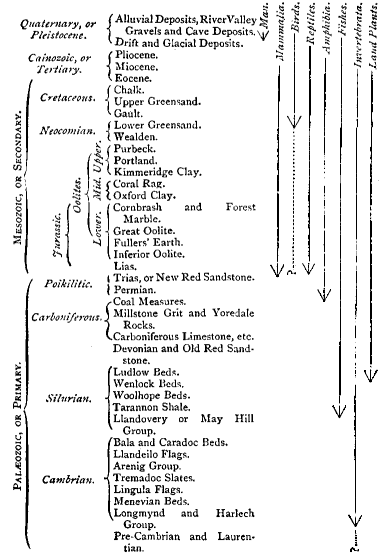
NOTES ON THE DIFFERENT FORMATIONS MENTIONED IN THE TABLE.
Recent.—The alluvial deposits of most river valleys and some estuaries still in course of formation, containing fossil shells and mammals, all of living species.
Quaternary, Post-Pliocene, or Pleistocene.—1. Including the raised beaches around the coast, the older gravels of river valleys and the cave deposits, in all of which the shells are identical with those living in the rivers and seas of to-day, whilst the animals are many of them extinct, only a few being now found living on the spot.
2. The glacial drifts that cover all England north of the Thames, and which consist of sands, gravels, and clays, full of big angular stones frequently flattened on one side, scratched and sometimes polished from having been fixed in moving ice and forced over other rocks. A very interesting collection of these "boulders," as they are called, can be easily made, for they belong to almost every formation in England, and have some of them been brought from great distances, whilst the number and variety obtainable from a single pit is astonishing.
Cainozoic, or Tertiary.—Beds of this age, in England at all events, are for the most part made up of comparatively soft rocks, gravels, sands, and clays, and are found in the eastern and south-eastern counties. They are divided into—
1. Pliocene, mainly consisting of a series of iron-stained sands, with abundant shell remains, and locally known as "crags." The shells are very partial in their distribution, the beds in places being almost entirely made up of them, whilst in others scarcely one is to be found. The great majority are of the same species as many still living. The Pliocene is subdivided into three groups:—
a. The Norwich Crag Series, sometimes called the "Mammaliferous Crag," as at its base the bones of mastodon, elephant, hippopotamus, rhinoceros, and some deer have been found. The shells in it are such as still abound on the beaches of the eastern coast to-day—whelks, scallop shells, cockles, periwinkles, etc.
b. The Red or Suffolk Crag, its two names indicating its characteristic colour (a dark red-brown) and chief locality. From the base are obtained the celebrated phosphatic nodules miscalled "Coprolites," whence is manufactured an artificial manure, and with them are found the rolled and phosphatized bones and teeth of whales, sharks, etc. Amongst the shells the Reversed Whelks (Fusus contrarius), Fecten opercularis, Pectunculus glycimeris, several kinds of Mactra and Cardium, etc., are the commonest. Walton-on-the-Naze, Felixstowe, and Woodbridge are the best known localities.
c. The White or Coralline Crag is generally of a pale buff colour, and is in places almost entirely composed of the remains of Polyzoa. These (formerly called Corallines, whence the name Coralline Crag) are beautiful objects for a low-power microscope, or pocket lens, and are easily mounted in deep cells on slides. The bits of shell and sand that stick to them should be carefully removed with the point of a needle. A very large number of shells occur in this crag: of bivalves, the Pecten is very abundant, and its valves are frequently thickly grown over with Polyzoa; Cyprina Islandica, Cardita Senilis are also plentiful; and of univalves, the genus Natica is common. The Coralline Crag is best seen in the neighbourhood of Aldborough, Orford, Woodbridge, and other places in Suffolk.
2. Miocene, possibly represented in the British Isles by a small patch of clays and lignites at Bovey Tracey.
3. Eocene, divided into—
a. Upper Eocene, consisting of a series of very fossiliferous sands, clays, and limestones, exposed in the cliffs at the eastern and western ends of the Isle of Wight and on the neighbouring coast of Hampshire. They are partly of freshwater origin, when they contain the remains of freshwater shells such as Limnœa Paludina, Planorbis, etc.; partly of marine origin, when shells belonging to such genera as Ostrea, Venus, etc., take their place; partly of estuarine, when the brackish water mollusca are found with bones and scutes of crocodiles and tortoises.
b. Middle Eocene, or the Bagshot Beds, composed of sands and clays. The beautiful coloured sands of Alum Bay, the sands of the Surrey and Hampstead Heaths, are familiar examples of the beds of this age. Very few fossils indeed have been found in them. The clay-beds on the contrary as seen at Barton and Hordwell on the Hampshire coast and again in the Isle of Wight, abound with shells belonging to genera such as Conus, Voluta and Venus, that inhabit warm seas. With them are the Nummulites, looking externally very like buttons, but on the inside divided into innumerable chambers in which the complex animal that formed the nummulite dwelt.
c. Lower Eocene, the well-known London clay, may almost be said to compose this division, for the underlying sands, gravels, and clays are in mass comparatively insignificant. The London clay contains plenty of fossils, only as they are disposed in layers (zones) at a considerable distance apart, they are not often hit upon. Layers of Septaria or cement-stones are of frequent occurrence. Sheppy is the great locality for London clay fossils, as the sea annually washes down large masses of the cliffs and breaks them up on the beach. A great many fossil fruits and seeds, remains of crabs, shells of Nautili, Volutes, and other mollusca, besides turtles, a species of snake, a bird with teeth, and a tapir-like animal, have at different times and in various places been found in this deposit, which sometimes attains a thickness of over 400 ft. The "Bognor Rock" is a local variety of the basement bed of this formation.
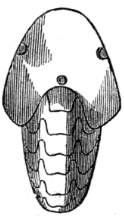
Aturia Zic-zac (from the London clay).
The Mesozoic or Secondary rocks embrace a series of limestone, clays, sands, and sandstones that on the whole are well consolidated. The main mass of them lies to the west of a line drawn across the map of England from the mouth of the Tyne, in Northumberland, southwards to Nottingham, and thence to the mouth of the Teign in Devonshire. In the south-eastern counties they underlie the tertiary rocks of the London and Hampshire basins, as they are called, at no great depth from the surface. Outlying patches of secondary rocks occur in Scotland, where they are found near Brora on the east coast, and in the islands of Skye and Mull on the west. In Ireland they are scantily represented round about the neighbourhood of Antrim. The secondary rocks are divided into—
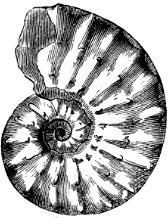
Ammonites various (from the chalk).
1. Cretaceous.
a. The Chalk is too well known to need description, though technically it may be described as a soft white limestone chiefly built up of the microscopic shells of Foraminifera, and characterized in its upper part by nodules and bands of flint. These flints frequently inclose casts of fossils (sponges, sea-urchins, etc.), and sometimes shells themselves. Fossils, too, are fairly abundant, scattered throughout the mass. Amongst the commoner may be noticed the sea-urchins, such as the "sugar loaf" (Ananchytes) and the heart-shaped Micraster, the Brachiopods or Lamp-shells (Terebratula, Rhynchonella), a "Thorny Oyster" (Spondylus spinosus), besides Ammonites, Belemnites (part of the internal shell of a kind of cuttle-fish), and the teeth of several species of sharks. Altogether the chalk is about 1,000 feet thick.
b. Upper Greensand is a series of greenish-grey sands and sandstones. The green colour, on close inspection, is seen to be due to the presence of innumerable small green grains of a mineral called glauconite. These are frequently casts of the chambers of the very same foraminifera that the chalk is so largely composed of.
Rhynchonella depressa (a Brachiopod, from the Upper Greensand).
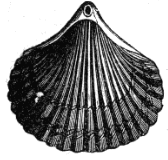
Nodules and layers of "chert" (an impure kind of flint) occur in it, whilst in places it forms a hard rock called "firestone." The commonest fossils are Brachiopods, very similar to those in the chalk, a scallop-shell with four strongly marked ribs on it (Pecten quodricostatus), an oyster with a curved beak (Exogyra columba), and a pear-shaped sponge (Siphonia pyriformis). The Upper Greensand is better seen at places in the southern part of the Isle of Wight, in cliffs on the Dorsetshire coast, in Wiltshire, at Sidmouth, and in some parts of Surrey.
Ammonites auritus (from the Gault).
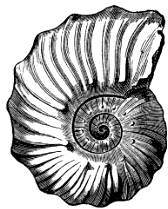
c. Gault, a stiff blue clay abounding in fossils: Ammonites often retaining their pearly shell; Belemnites, a bivalve with very deep furrows on it (Inoccramus sulcatus), and its first cousin (I. concentricus, p. 21), in which the ridge-like markings correspond with the lines of growth, besides many others, may be obtained in abundance from it. Layers of phosphatic nodules occur at irregular intervals. The gault is best studied at East Wear Bay, near Folkstone; it may also be seen in Dorsetshire, Wiltshire, and Cambridgeshire; lately it has been found as far west as Exeter.
2. Neocomian.
a. The so-called Lower Green Sand, named in contradistinction to the Upper Green Sand, includes a series of iron stained sands, sandstones and clays of great thickness. The clayey beds are seen at Atherfield in the Isle of Wight, and at Nutfield in Surrey, while the sandy beds are met with at Speeton, at Folkestone, and near Reigate. Besides brachiopods and oysters, these beds have furnished a species of Perna (P. Mulleti), an elongated mussel (Gervillia anceps), a pretty Trigonia (T. cordata), some Ammonites and Nautili, with the teeth and bones of big reptiles. The celebrated "Kentish Rag" and the sponge gravels of Farringdon are of this age.
b. Wealden. The main mass of these rocks occupies the area inclosed between the North and South Downs, and forms the Valley of the Weald, whence they take their name. They consist of a series of sands, sandstones, clays, and shelly limestones that were deposited in the delta and off the mouth of a big river. The shells in them belong to freshwater genera, Cyrena, Unio, Paludina, etc. Bones of a huge lizard that hopped along on his hind legs (Iguanodon), and those of crocodiles, etc., are from time to time brought to light. The Wealden rocks occur also on both eastern and western sides of the Isle of Wight, and in Dorsetshire.
Inoceramus concentricus (from the Gault).
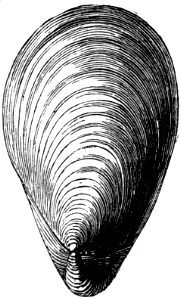
3. Oolites (or Roe-stones) are so named because the characteristic limestones of this formation resemble very much the roe of a fish. The small round grains, of which the typical examples are built up, when cut or broken through will be seen to be formed of numerous layers of carbonate of lime, disposed like the coats of an onion, around some central nucleus, generally a grain of sand, a fragment of coral, or the shell of one of the Foraminifera. They are divided into Upper, Middle, and Lower Oolites, and these again are subdivided as follows—
Upper Oolite.
a. Purbeck Beds, a series of fresh-water, with a few estuarine, or marine beds, which in point of fact connect the deposits we are next coming to with the Wealden just passed. They contain numerous fresh-water shells—Paludina, Physa, Limnæa, etc., with the microscopic valves of the little fresh-water crustacean Cypris, whose descendants are abundant in the rivers and lakes of to-day. An oyster occurs in the "Cinder Bed" and Plant remains in the "Dirt Beds." But the Purbecks are best known for the numerous remains of small mammals (Plagiaulax) allied to the kangaroo rat, at present living in Australia.
b. The Portland Stone and Sand, which come next in order, are largely quarried in the island whence they take their name. The quarrymen point out fossils in the stone, which they call "Horses'-heads" and "Portland screws." The former is the cast of a Trigonia shell; the latter, that of a tall spired univalve (Cerithium).
In Wiltshire, a coral (Isastrea oblonga) is found in the sandy beds, the original calcareous matter of which has been replaced by silex.
c. Kimmeridge Clay. This, by the pressure of the rocks subsequently deposited on it, has in greater part been hardened, and possesses a tendency to split in thin layers, and hence is termed by geologists a shale. It is seen at various points between Kimmeridge on the Dorsetshire coast and the Vale of Pickering in Yorkshire, and forms broad valleys. The principal fossils in it are Ammonites, a triangular-shaped oyster (Ostrea deltoidea), and one resembling a comma (Exogyra virgula).
Middle Oolites.
a. The Coral Rag, or Coralline Oolite, comprises a most variable set of beds, but principally a series of limestone, with fossil corals still in the position in which they grew, and resembling in form the reef-building corals of the Pacific. They rest on
b. Oxford Clay, a dark blue or slate-coloured clay without any corals, but containing a great many Ammonites and Belemnites. The Kelloway Rock, a sandy limestone at the base of the Oxford Clay, is well developed in Yorkshire, and furnishes amongst other fossils a large belemnite and an oyster (Gryphæa dilatata).
Lower Oolites.
a. Cornbrash, a very shelly deposit of pale-coloured earthy, and rubbly or sometimes compact limestone with plenty of fossils. The commonest are Brachiopods, Limas, oysters (Ostrea Marshii), Pholadomyas and Ammonites. It is best seen in Dorsetshire, Somersetshire, and near Scarborough in Yorkshire.
b. Forest Marble and Bradford Clay. The former is an exceedingly shelly limestone, often splitting into thin slabs. On the surfaces of some of the beds may be seen the ripple marks the sea made countless years ago, and the tracks of worms and crabs that dwelt in the mud or crawled on its surface at a time when it was soft mud. The Bradford clay is a very local deposit, taking its name from Bradford in Wiltshire, where it is most developed, and its characteristic fossil is the pear-shaped Encrinite or "stone-lily" (Apiocrinus Parkinsoni).
c. The Great or Bath Oolite, comprising a series of shelly limestones and fine Oolites, or freestones. The latter are largely quarried in the neighbourhood of Bath, and used for mantelpieces and the stone facings of windows. The great Oolite is rich in univalve mollusca, amongst which may be noted a limpet (Patella rugosa) and the handsome, tall-spired Nerinæa Voltzii, numerous bivalves belonging to the genera Pholadomya Trigonia, Ostrea (O. gregaria), and Pecten, besides Brachiopods (Terebratula digona, which looks very like a sack of flour, and T. perovalis, etc.).
At the base of the Great Oolite are the "Stonesfield slates," so-called—a series of thin shelly Oolites, etc., that split readily into very thin slabs. They are principally of interest to geologists on account of the discovery in them of the remains of small insect-feeding and possibly pouched mammals. With these are associated the bones of that big reptile the Megalosaurus; the flying lizards called Pterodactyles; fish teeth and spines; lamp shells; oysters, a Trigonia (T. impressa); and the impressions of insects, including a butterfly, and of plants.
d. Fullers' Earth, a clayey deposit occurring in the southwestern parts of England, but not in the north. It abounds with a small oyster (O. acuminata) and Brachiopods (e.g. Terebratula ornithocephala), etc.
e. Inferior Oolite (including the Midford Sands). As these beds are followed across the country from the south-west of England to Yorkshire, they are found to change greatly in character. Limestone and marine beds in the south are replaced by sandy and estuarine beds in the north. Amongst other fossils from beds of this age may be found several Echinoderms, a crinkly lamp shell (Terebratula frimbriata), and a spiny one (Rhynchonella spinosa), bivalves belonging to the Genera Ostrea, Trigonia, Pholadomya, etc., and some very handsome Ammonites (e.g. A. Humphresianus).
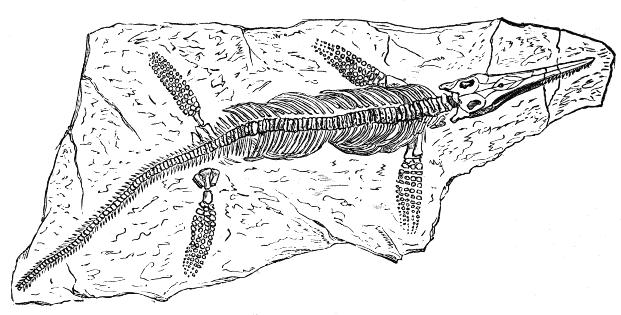
Ichthyosaurus, or Fish-lizard (from the Lias). Click on the above image to view larger sized.
Plesiosaurus (from the Lias). Click on the above image to view larger sized.
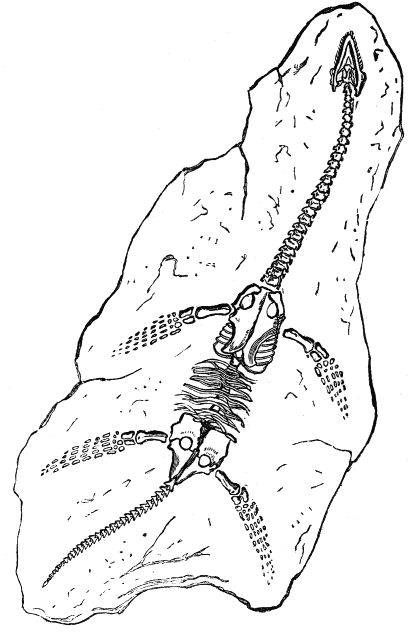
4. Lias.
This for the most part consists of very regular alternations of argillaceous (clayey) limestone and clay, or shale. It is of great thickness, and hence for convenience has been divided into (a) Upper Lias, (b) Middle Lias or Marl-stone, and (c) Lower Lias. A large number of fossils are to be found in it. Lyme Regis and Whitby are perhaps the best known localities; the former, on account of the great number of specimens obtained of the huge fish-lizard (Ichthyosaurus, p. 24), and long-necked Plesiosaurus (p. 25), besides numberless fish; whilst the latter is renowned for its jet (or fossilized wood) and its "snake-stones" (Ammonites), concerning which curious old stories are told. Ammonites are plentiful in the Lias, which has been subdivided into zones, or layers, named after the ammonite occurring in greatest numbers in that particular zone. There is one thin limestone band in the Marlstone composed entirely of the shells of Ammonites planicostatus. A curious kind of oyster (Gryphæa incurva), locally known as the devil's toenail, a huge Lima (L. gigantea), a magnificent Encrinite (Extracrinus Briareus), and numerous other fossils, are also to be obtained by patient search.
Belemnitas elongatus (from the Lias).

5. Rhætic, Penarth Beds, or White Lias.
These beds are not of any considerable thickness, but are very persistent, and of great interest, inasmuch as they yield the remains of the oldest known mammal (Microlestes), a small insect-feeder. They are composed of limestones, shales and marls (i.e. limey clays), and are best studied in Somersetshire and Dorsetshire. The "landscape marble" belongs to this formation, which also contains a bone bed, or thin layer made up of the bones and teeth, etc., of fish. Shells are not numerous, though the casts of one species (Avicula contorta) is plentiful.
6. Trias, or New Red Sandstone, a thick series of sandstones and marls, the great mass of which forms the subsoil of the western midland counties, Birmingham being nearly in the centre, thence they extend in three directions, one branch passing towards the north-west, through Cheshire, to the sea at Liverpool, reappearing on the coast line of Lancashire, Westmoreland, and Cumberland, where it also forms the Valley of the Eden. Another branch extends through Derby and York to South Shields, whilst the third may be traced southwards in isolated patches down into Devonshire.
There are scarcely any fossils in it, but in Worcestershire and Warwickshire the bivalve shell of a small crustacean (Estheria minuta) occurs in the upper beds; whilst now and again the teeth and bones of some strange amphibians (Labyrinthodon), or the impressions of their feet (Cheirotherium) where they crawled on the then soft mud of the foreshore, are found. The Trias is divided into Upper Trias or Keuper, and Lower Trias or Bunter. The middle beds (Muschelkalk), which are found in Germany, where they contain plenty of fossils, are wanting in this country. In the lower beds of the Keuper, layers of rock salt, sometimes of great thickness, occur, whilst casts (called pseudomorphs) of detached salt-crystals are found abundantly in the sandy marls. Northwich, Nantwich, Droitwich, and several other towns in Cheshire and Worcestershire, are famed for their salt works, the salt being either mined or pumped up as brine from these beds.
Ceratites nodosus (from the Muschelkalk).
Palæozoic or Primary.—Beds of this age generally possess a more crystalline and slaty structure than any of those already mentioned, are usually more highly inclined and disturbed, and form for the most part more elevated ground. They are the principal store-houses of our mineral wealth, containing as they do coal, iron, and other metals. The Palæozoic rocks are found in England to the north and west of the secondary series, beneath which they disappear when traced to the south-east. Wales, and the greater part of Scotland and Ireland, consist of beds of this age.
1. Permian. Under this term are included beds of red sandstones and marls, closely resembling those of Trias, and like them containing but few fossils, as well as a very fossiliferous limestone, known as the Magnesian Limestone, from the abundance of magnesia it contains. A pretty polyzoan (Fenestella retiformis), a spiny brachiopod (Productus horridus), various genera of fish, chiefly found in a marl state underlying the limestone, some Labyrinthodonts and plant remains, are the principal forms met with in this formation.
2. Carboniferous. This, from a commercial point of view, is the most important of all the formations, comprising as it does the coal-bearing strata. It is subdivided into—
a. Coalmeasures, a series of sandstones and shales with which are interstratified the seams of coal, varying in thickness from six inches to as much in one instance as thirty feet.
Coal is the carbonized remains of innumerable plants, chiefly ferns and gigantic clubmosses, that grew in swamps bordering on the sea-coast of the period. Each coal seam is underlain by a bed of clay called "under-clay," containing the roots of the plants that grew on it. Some of the best impressions of ferns, etc., are to be obtained in the shaley beds forming the roof of the coal seam; many good specimens, however, are to be got by searching the refuse heap at the pit's mouth. Besides plants, the remains of fish are abundant in some of the beds of shale. And in Nova Scotia the bones of air-breathing reptiles and land snails have been discovered. Cockroaches and other insects were also denizens of the carboniferous forests.
The following are the principal coalfields:—
Northumberland and Durham coalfield.
South Lancashire coalfield.
Derbyshire coalfield.
Leicestershire and Staffordshire coalfields.
South Wales coalfield.
Bristol and Somerset coalfields.
b. Millstone grit or Farewell-rock. The former term explains itself, the latter designation has been applied to it in the southern districts, because when it is reached, then good-bye to all workable coal-seams.
It consists of coarse sandstones, shales, and conglomerates with a few small seams of coal. Fossils are not very common in it.
c. Yoredale Rocks, a series of flagstones, gritstones, limestones and shales, with seams of coal, occurring in the northern counties. It is underlain by—
d. Carboniferous or Mountain Limestone, which in places is upwards of 1,000 feet thick, and full of fossils. The stems of encrinites, or "stone-lilies," corals, brachiopods (e.g. Productus, Orthis, etc.), and Mollusca, including some Cephalopods, like Goniatites and the straight Nautilus (Orthoceras), with fish teeth, etc., go to compose this tough, bluish-grey limestone which is largely quarried for marble mantlepieces, etc.
e. The Tuedian group in the north, and Lower Limestone Shale in the south, follow next, and consist of shales, sandstones, limestones, and conglomerates, varying greatly in different districts, and containing few fossils.
3. Devonian or Old Red Sandstone. To this age are assigned a perplexing series of strata, the principal members of which consist of (a) a thick limestone, well seen in the cliffs and marble quarries of south Devon, and full of fossil-corals (e.g. Favosites polymorpha [or cervicornis]) Brachiopods, and Mollusca, etc.
b. A series of sandstones, slates, and limestones in North Devon containing Trilobites (Phacops, Bronteus, etc.), Brachiopods, and other fossils.
c. The Old Red Sandstone of Wales, the North of England, and Scotland, consisting of red and grey sandstone and marly beds, with remains of fish.
These fish, unlike most now living, were more or less covered with hard external plates, and possessed merely a cartilaginous skeleton. In one set of individuals, indeed (Pterichthys), the armour plates formed quite a little box. These creatures propelled themselves by means of two arm-like flippers, rather than fins. They were but a few inches long, and appear pigmies in contrast to the strange half-lobster-like crustacean Pterygotus, that lived with them, and attained sometimes as much as five feet in length.
4. Silurian. Named by Sir Roderick Murchison after a tribe of Ancient Britons that dwelt in that part of Wales, where these rocks were first observed. Some of Murchison's Lower Silurian beds were included by Professor Sedgwick in his Cambrian, of which we shall have to speak next; and as these two geologists never could agree on a divisional line between their respective formations, and since succeeding observers have followed sometimes one and sometimes the other method of classification, considerable confusion has resulted. Here, however, for several reasons, we propose to follow Sedgwick's arrangement; and hence, under the term Silurian, retain only Murchison's Upper beds. They consist of a series of sandstones, gritstones, conglomerates, shales, limestones, etc.
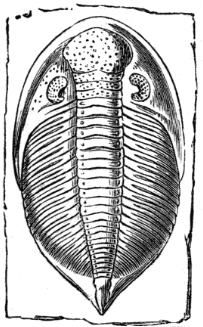
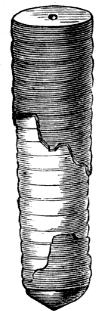
Amongst the more important fossils, which are very abundant in the limestones, are various corals (e.g. the Chain-coral Halysites), Star-fish, Crinoids, Trilobites (Phacops, etc.), Polyzoa, Brachiopods and Mollusca, especially Cephalopoda (Orthoceras, Nautilus, etc.).
These rocks occur principally in the border land between England and Wales, and the adjacent counties; but are also represented in Westmoreland, Scotland, and Ireland. Their principal subdivisions are given in the Table on p. 16.
Trilobite (Asaphus candatus), (from the Silurian).
Orthoceras subannulatum (from the Silurian).
5. Cambrian. Under this term, derived from the old name for Wales, are included many sandstones, grits, slates and flags, with here and there a limestone band. They form the greater part of the western counties of Wales, where they rise to a considerable height above the sea level. The highest hills of Westmoreland and more than half of Scotland are composed of beds of this age.
The fossils, save in the limestone bands, are not easy to find, but in places they are fairly abundant. Brachiopods are far more numerous than the Mollusca properly so-called. Of these, the genus Orthis was most abundant at about the close of this period. Certain beds of this age have received the name of Lingula Flags, owing this prevalence in them of the curious Brachiopod Lingula so like the species now living in some of the warm seas of the tropics. The Trilobites included several forms, and one species (Paradoxides Davidis) attained the length of nearly two feet. A few star-fish, some Hydrozoans (Graptolites), and the tubes and casts of Annelides and tracks of Trilobites, complete the list of more remarkable fossils. The subdivisions of the Cambrian rocks will be found in the table on p. 16.
6. Pre-Cambrian.—Near St. David's Head and some other places in Wales, in Anglesea, Shropshire, etc., some yet older rocks have been found. They are probably for the most part of volcanic origin, but they have been so much changed since they were first deposited, and as hitherto no fossils have been found in them, little is known concerning them.
Parts of the western coast of Northern Scotland and the Hebrides are composed of a crystalline rock called Gneiss, and supposed to be the oldest member of the British strata. No fossils have been found in it.
Skull of Deinotherium giganteum, a huge extinct animal, related to the elephants (from the Miocene of Germany).
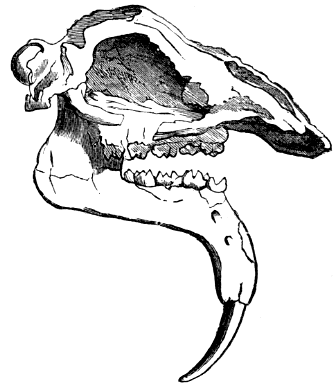
Volcanic Rocks. Although there are fortunately no volcanoes to disturb the peace of our country at the present day, there is abundant evidence of their existence in the past. Not only are some of the beds, especially those of Paleozoic age, composed of the dust and ashes thrown out of volcanoes, with here and there a lava flow now hardened into solid rock, but the stumps of the volcanoes themselves are left to tell the tale. The cones indeed are gone, carried off piecemeal by the rain and frosts, and other destructive agencies, in the course of countless ages: not so the once fluid rock within; that cooled down into Granite, and though originally below the surface, it now, owing to the removal of the overlying softer strata, forms raised ground overlooking the surrounding country. The granite masses of Cornwall, of Dartmoor, in the south-west of Mt. Sorrel; the variety called Syenite at Malvern and Charnwood Forest; the Basalts of the Cheviot Hills and of Antrim; the volcanic rocks of Arthur's Seat, Edinburgh, and of the islands of Skye and Mull, etc., are examples of this class of rock. They are of different ages, and belong to different periods of the earth's history, from early Palæozoic down to Miocene times.
TABLE OF THE PRINCIPAL DIVISIONS OF THE ANIMAL KINGDOM, TO SHOW THE ORDER IN WHICH THE FOSSILS SHOULD BE ARRANGED.
Invertebrata.
Foraminifera, minute chambered shells like the Nummulite.
Spongida, Sponges.
Hydrozoa, Graptolites, etc.
Actinozoa, Corals.
Echinodermata, Sea-urchins, Stone-lilies, Starfish, etc.
Annelida, Worm tracks.
Crustacea, Trilobites, Crabs, etc.
Arachnida, Scorpions and Spiders.
Myriapoda, Centipedes.
Insecta, Beetles, Butterflies, etc.
Polyzoa (Bryozoa) or Moss Animals.
Brachiopods, Lampshells.
Mollusca┐ ├ ┘ Lamellibranchiata, Bivalves. Gasteropoda, Univalves. Cephalopoda, Cuttlefish, Ammonites.
Vertebrata.
Pisces, Fish.
Amphibia, Labyrinthodonts, Frogs, and Newts.
Reptilia, Reptiles.
Aves, Birds.
Mammalia, Mammals.
WORKS OF REFERENCE.
FOR NAMING COMMON FOSSILS.
Tabular View of Characteristic British Fossils Stratigraphically Arranged. By J. W. Lowry. Soc. Prom. Christ. Knowledge. 1853.
Figures of the Characteristic British Tertiary Fossils (Chiefly Mollusca) Stratigraphically Arranged. By J. W. Lowry and others. London (Stanford). 1866.
PALÆONTOLOGY.
The Ancient Life History of the Earth. By H. A. Nicholson. 8vo. Edinburgh and London. 1877.
A Manual of Palæontology. By H. A. Nicholson. 2nd edition. 2 vols. 8vo. Edinburgh and London. 1879.
PETROLOGY.
The Study of Rocks. By F. Rutley. (Text Books of Science.) 8vo. London. 1879.
FIELD GEOLOGY.
A Text-Book of Field Geology. By W. H. Penning. With a Section on Palæontology, by A. J. Jukes-Brown. 2nd edition. 8vo. London. 1879.
GEOLOGY IN GENERAL.
The Student's Elements of Geology. By Sir Charles Lyell, Bart. 4th edition. 8vo. London. 1884.
The Principles of Geology. By Sir Charles Lyell, Bart. 12th edition. 2 vols. 8vo. London. 1875.
Phillip's Manual of Geology. 2nd edition. By Seeley and Etheridge. 2 vols., 8vo. London. 1885.
Tabular View of Geological Systems, with their Lithological Composition and Palæontological Remains. By D. E. Clement. London (Sonnenschein). 1882.
BRITISH GEOLOGY.
The Physical Geology and Geography of Great Britain. By Sir Andrew C. Ramsey. 5th edition. 8vo. London. 1878.
The Geology of England and Wales. By Horace B. Woodward. 8vo. London. 1876.
Geology of the Counties of England and Wales. By W. J. Harrison. 8vo. London. 1882.
POPULAR
Illustrated Scientific Books,
PUBLISHED BY
SWAN SONNENSCHEIN & CO.
UNIFORM WITH THIS VOLUME.
ALL FULLY ILLUSTRATED.
BRITISH BUTTERFLIES, MOTHS, AND BEETLES.
By W. F. Kirby (Brit. Mus.). Crown 8vo, cloth, 1s.
MOSSES, LICHENS, AND FUNGI.
By Peter Gray and E. M. Holmes. Crown 8vo, cloth, 1s.
ENGLISH COINS AND TOKENS.
By Llewellynn Jewitt, F.S.A.; with a chapter on Greek and Roman Coins, by Barclay V. Head, M.R.A.S. Crown 8vo, cloth, 1s.
FLOWERS AND FLOWER LORE.
By Rev. Hilderic Friend, F.L.S. Illustrated. Third Edition, demy 8vo, cloth gilt, 7s. 6d.
THE DYNAMO: How Made and How Used.
By S. R. Bottone. Numerous Cuts. Crown 8vo, cloth, 2s. 6d.
A SEASON AMONG THE WILD FLOWERS.
By Rev. H. Wood. Illustrated. Crown 8vo, cloth gilt, 2s. 6d.
HISTORY OF BRITISH FERNS.
By E. Newman, F.L.S. Fifth Edition, Illustrated. 12mo, cloth, 2s.
THE INSECT HUNTER'S COMPANION.
By Rev. J. Greene. Third Edition. Cuts. 12mo, boards, 1s.
TABULAR VIEW OF GEOLOGICAL SYSTEMS.
By Dr. E. Clement. Crown 8vo, limp cloth, 1s.
SWAN SONNENSCHEIN & CO., PATERNOSTER SQUARE.
Transcriber's Notes
As there appear to be section and subsections in the second and third units (Shells and Fossils) of this book, Tables of Contents were created for the electronic edition. A number of the images were moved where they split paragraphs. There is a reference to a Figure 24 for Ancylus; but no Fig. 24 was included. The reference to Fig. 26 for Bullidæ was assumed to be a reference to Fig. 14. Bulla ampulla.
With the exception of the following items, all page number references in the original text were retained. There are references to two tables on Page 77. The first was listed a "vide Table, p. 16" and the second as "vide Table, p. 32" which appear to refer to the tables on page 78 and 94 respectively. The page references were corrected.
Species name are assumed to be correct for the time of publication (ca. 1886). For example, Charychium is today listed as Carychium.
Typographical Corrections
Page Correction
14 fond => foot
27 it => if
27 pencil => brush
55 beak => peak
56 tis => its
60 Keilia => Kellia
73 inever => "I never"
91 crustucean => crustacean
Transcription of the image on
Page 78
:
TABLE OF THE PRINCIPAL FOSSILIFEROUS STRATA ARRANGED IN CHRONOLOGICAL ORDER.
_Land Plants._-----------+ _Invertebrata._--------+ | _Fishes._------------+ | | _Amphibia._--------+ | | | _Reptiles._------+ | | | | _Birds._-------+ | | | | | _Mammalia._--+ | | | | | | _Man._-----+ | | | | | | | | | | | | | | | | | | | | | | | {Alluvial Deposits, | | | | | | | | _Quaternary, { River Valley | | | | | | | | or { Gravels and | | | | | | | | Pleistocene._ { Cave Deposits. | | | | | | | | {Drift and Glacial | | | | | | | | { Deposits. V | | | | | | | | | | | | | | _Cainozoic, {Pliocene. | | | | | | | or {Miocene. | | | | | | | Tertiary._ {Eocene. | | | | | | | | | | | | | | { {Chalk. | | | | | | | { _Cretaceous._ {Upper Greensand. | | | | | | | { {Gault. | | | | | | | { | | | | | | | { _Neocomian._ {Lower Greensand. | V | | | | | { {Wealden. | : | | | | | { | : | | | | | MESO- { { {Purbeck. | : | | | | | ZOIC, { {_Upper._{Portland. | : | | | | | or { { {Kimmeridge Clay. | : | | | | | SECOND-{ { | : | | | | | ARY. { { _Mid._ {Coral Rag. | : | | | | | { { _Oo- { {Oxford Clay. | : | | | | | { {lites._{ | : | | | | | { { { {Cornbrash and | : | | | | | { { { { Forest Marble. | : | | | | | { _Jurassic._{ {_Lower._{Great Oolite. | : | | | | | { { { {Fullers' Earth. | : | | | | | { { { {Inferior Oolite. | : | | | | | { { | : | | | | | { { Lias. | : | | | | | | : | | | | | { {Trias, or New | : | | | | | { _Poikilitic._ { Red Sandstone. V ? V | | | | { {Permian. | | | | { | | | | { {Coal Measures. V | | | { {Millstone Grit | | | { _Carboniferous._ { and Yoredale | | | { { Rocks. | | | { {Carboniferous | | | { { Limestone, etc. | | | { | | | { Devonian and Old | | | { Red Sandstone. | | | PALÆO- { | | | ZOIC, { {Ludlow Beds. | | | or { {Wenlock Beds. | | V PRI- { _Silurian._ {Woolhope Beds. | | MARY. { {Tarannon Shale. | | { {Llandovery or May | | { { Hill Group. V | { | { {Bala and | { { Caradoc Beds. | { {Llandeilo Flags. | { {Arenig Group. | { _Cambrian._ {Tremadoc Slates. | { {Lingula Flags. | { {Menevian Beds. | { {Longmynd and | { { Harlech Group. V { : { Pre-Cambrian and : { Laurentian. ?
Click here
to return to Page 78.