SEA POWER IN ITS RELATIONS TO THE WAR OF 1812
Reading edition
BY
CAPTAIN A.T. MAHAN, D.C.L., LL.D.
United States Navy
AUTHOR OF "THE INFLUENCE OF SEA POWER UPON HISTORY, 1660-1783," "THE INFLUENCE OF SEA POWER UPON THE FRENCH REVOLUTION AND EMPIRE," "THE INTEREST OF AMERICA IN SEA POWER," ETC.
IN TWO VOLUMES
VOL. II
LONDON SAMPSON LOW, MARSTON & COMPANY Limited
From a Copley Print copyright 1899 by Curtis & Cameron, Publishers, Boston.
The ConstitutionToList
CONTENTS
CHAPTER IX The Winter of 1812-1813—Bainbridge's Squadron: Actions Between "Constitution" and "Java," "Hornet" and "Peacock"—Increasing Pressure on Atlantic Coast
Page
Bainbridge's squadron sails 1
His plans for the cruise 2
The "Essex" fails to join 3
Proceedings of "Constitution" and "Hornet" 3
Action between "Constitution" and "Java" 4
The "Constitution" returns to the United States 7
Proceedings of the "Hornet" 7
Action between the "Hornet" and "Peacock" 8
The "Hornet" returns 9
The Chesapeake and Delaware blockaded 9
Subsequent extension of blockade to the whole coast south of Newport 10
Three periods into which the War of 1812 divides 10
Difficulty of American frigates in getting to sea 11
Difficulty of manning the navy 12
Cruise of the "Chesapeake" 13
Gradual suppression of American commerce 14
Increasing stringency of the commercial blockade 15
British occupation of Delaware and Chesapeake Bays 16
Diminution of the coasting trade, and increase of land carriage 17
Effects upon prices 18
Abandoned condition of the western Atlantic 20
Diminution in number of prizes taken by Americans 20
Estimate of relative captures by the two belligerents 21
Relative captures no indication of relative immunity 23
American deprivation makes for the prosperity of Halifax and Canada 23
The blockade the chief offensive maritime operation of Great Britain, in 1813 24
No opposition longer possible to the American Navy 25
Strength of the British blockading divisions 25
Escape possible only by evasion 25
The brunt of the British naval operations falls upon the Chesapeake and Delaware 26
CHAPTER X Campaign of 1813 on the Lake Frontier, To the Battle of Lake Erie
The British naval service on the lakes under Warren's supervision 28
Sir James Yeo appointed to the local command 29
Appoints Captain Barclay to take charge of British vessels on Lake Erie 29
The Americans now superior on Ontario 29
Montreal the true American objective 29
Dearborn ordered to concentrate effort upon Lake Ontario 30
Chauncey's first plan, to capture Kingston 30
Dearborn and Chauncey ordered to proceed first against Kingston, then Toronto, then Niagara 31
Dearborn's objections 32
His reports obtain change of plan from the Government 33
Chauncey's new plan 33
The expedition leaves Sackett's Harbor 36
Capture of Toronto 36
Chauncey's anxiety for Sackett's Harbor 37
Capture of Fort George, and British retreat from Niagara 38
Effects of the American occupation of the Niagara peninsula 40
American naval vessels escape from Black Rock to Erie 41
British attack upon Sackett's Harbor 42
Premature firing of the naval yard and vessels 45
Consequent delay in Chauncey's preparations 45
Yeo takes the lake with his squadron 46
American reverse at Stony Creek 46
The army retreats upon Fort George 47
The British re-occupy the peninsula, except Fort George 47
Dearborn is relieved from command 48
Paralysis of the American forces at Niagara 48
Yeo in temporary control of Lake Ontario 49
Chauncey sails to contest control 51
Characteristics of the ensuing naval campaign 52
Predominant idea of Chauncey and Yeo 52
Relative powers of the two squadrons 53
Their encounter of August 10, 1813 56
Chauncey's extreme caution 59
The engagement of September 11 60
Expediency of a "general chase" under the conditions 61
CHAPTER XI The Campaign of 1813 on the Lakes and Northern Frontier—The Battle of Lake Erie
The American Navy on Lake Erie 62
Perry's eagerness for active operations 63
Coincidence of events on Lakes Erie and Ontario 64
Inferiority of Perry's crews in numbers and quality 64
Professional contrast between Chauncey and Perry 65
Personal difficulty. Perry applies to be detached 66
The Navy Department refuses 67
Position of the American army on the Maumee 67
Procter's attack upon Fort Meigs 68
Procter and Barclay plan attack on Erie 69
Re-enforcements of troops refused them 69
Barclay blockades Erie 70
Barclay visits Long Point 71
Perry's squadron crosses the bar at Erie 72
Procter attacks Fort Stephenson, and is repulsed 73
Barclay retires to Malden 74
Perry in control of the lake 74
Destitution of provisions in the British camp and fleet 75
Barclay goes out to fight 76
Composition and armament of the two squadrons 76
Controversy about the battle 78
Dispositions of the two commanders 80
Opening of the battle 81
Examination of the controversy between Perry and Elliott 82
Progress of the engagement 88
Second stage of the battle 89
The British surrender 94
Meritorious conduct of Captain Barclay 94
Question of credit on the American side 95
Comparison of the campaigns on Erie and on Ontario 99
Effect of the battle on the fate of the Northwest 99
Its bearing upon the peace negotiations of the following year 100
Influence of control of the water illustrated on the lakes 101
CHAPTER XII The Campaign of 1813 on the Lakes and Northern Frontier, After the Battle of Lake Erie
Perry's victory promptly followed up 102
General Harrison lands his army at Malden 103
Recovery of Detroit. Battle of the Thames, October 5, 1813 103
The Indians fall away from the British 103
Harrison's army transferred to Niagara 104
Perry detached from the lake service 104
Changed American plan of campaign on Ontario 104
General James Wilkinson replaces Dearborn 104
The Government designates Kingston as the objective 105
The embarkation begins at Niagara under cover of the navy 106
Yeo's squadron appears in the neighborhood 106
Encounter between the two squadrons, September 28, 1813 107
Criticism of Chauncey's management 108
Wilkinson's troops reach Sackett's Harbor 110
The British re-enforce Kingston 110
New change of American plan. The army to be directed on Montreal 111
Intended junction with the troops from Lake Champlain, under General Hampton 111
Wilkinson's army assembled within the mouth of the St. Lawrence 114
It proceeds down the river 114
Pursuit by a British detachment 114
American reverse at Chrystler's Farm 115
Hampton fails to join Wilkinson, and returns to Plattsburg 116
The expedition abandoned. Wilkinson goes into winter quarters at French Mills 116
Chauncey returns to Sackett's Harbor from the St. Lawrence 117
Transports Harrison's division from Niagara to Sackett's Harbor 117
Fleets lay up for the winter 117
Disastrous close of the campaign upon the Niagara 118
Americans evacuate Fort George and the peninsula 120
They burn Newark 120
Act disavowed by the American Government 120
Sir Gordon Drummond in command in Upper Canada 120
The British, under General Riall, cross the Niagara and capture Fort Niagara 121
Lewiston, Youngstown, and Manchester burned in retaliation for Newark 121
Buffalo burned, and three naval vessels at Black Rock 121
General failure of the campaign about Lake Ontario 122
Discussion of the causes 123
CHAPTER XIII Seaboard Maritime Operations, 1813
United States on the defensive on the seaboard 126
British reasons for partially relaxing severity of blockade 127
Reasons do not apply to armed vessels or coasting trade 127
American Navy powerless to protect commerce 127
To destroy that of the enemy its principal mission 128
Cruises of the "President" and "Congress" 128
Efficacy of the British convoy system 130
Its chief failure is near ports of arrival 131
This dictates the orders to Captain Lawrence 131
Importance of the service 132
Imperfect preparation of the "Chesapeake" 132
Efficiency of the "Shannon." Broke's professional merit 133
His challenge to Lawrence. Not received 134
The "Chesapeake" sails, purposely to fight 135
Account of the action 136
The "Chesapeake" captured 140
Analysis of the engagement 141
Decatur fails to get to sea with a squadron 148
Driven to take refuge in New London 148
Frigates confined there for the war 149
Particular anxiety of the British Government about American frigates 150
Expectations of the Admiralty and the country from Warren's fleet 151
Effects of the blockade of New London on local coasting 152
Evidence of the closeness of the whole blockade south of New London 153
Conditions at New York 154
British operations in the upper Chesapeake, 1813 156
Conditions in Delaware Bay 158
American precautions in Chesapeake and Delaware 159
Circumspect conduct of the British vessels in the Chesapeake 161
Warren brings a detachment of troops from Bermuda 162
Rencounters in and near Hampton Roads 163
British attack upon Craney Island. Fails 164
Attack upon Hampton. Ineffective 166
Further movements of the British in the Chesapeake 167
Movement of licensed vessels in Chesapeake Bay during these operations 170
Consequent recommendation of President to prohibit all exports during the blockade 173
Rejected by Senate. Enforced in Chesapeake by executive order 174
Glaring necessity for such action 175
Embargo law passed in December, 1813 176
Main British fleet quits the Chesapeake. Its failure in direct military operation 177
Efficacy of the blockade 177
Characteristics of the different sections of the United States, as affecting their suffering from blockade 178
Statistical evidences of its effects 181
Prices of great staples: flour and sugar 184
Dependence of Eastern and Southern States upon coasting, greater than that of Middle States 186
Captain Hull's reports on Eastern coasting 187
Action between the "Boxer" and "Enterprise" 188
Intermission of Eastern blockade during winter 192
Its resumption in increased vigor in 1814 192
Undefended conditions of the American coast 193
Conditions of Southern coasting trade 195
British blockade severs the mutual intercourse of the different sections of the United States 198
Remarks of Representative Pearson, of North Carolina 199
Message of the Governor of Pennsylvania 200
Rigors of the blockade shown by figures 201
Momentary importance of the North Carolina coast 203
Advocacy of an internal navigation system 204
Evidence of privation in the rebound of prices and shipping movement after peace 205
Exposition of conditions, in a contemporary letter by a naval officer 207
The experiences of the War of 1812 now largely forgotten 208
Lessons to be deduced 208
Pressure upon the British Government exerted, even by the puny contemporary American Navy 209
Advantage of the American position 211
Opinions of Presidents Washington and Adams as to the international advantage of a navy 212
Policy of President Jefferson 213
CHAPTER XIV Maritime Operations External to the Waters of the United States, 1813-1814
Commerce destruction the one offensive maritime resort left open to the United States 215
Respective objects of privateers and of naval vessels 216
The approaches to the British islands the most fruitful field for operations against commerce 216
Cruise of the "Argus" 217
Capture of the "Argus" by the "Pelican" 217
Significance of the cruise of the "Argus" 219
Great number of captures by American cruisers 220
Comparatively few American merchant ships captured at sea 221
Shows the large scale on which British commerce throve, and the disappearance of American shipping 221
Control of British Navy shown by American practice of destroying prizes 222
Successes of the privateers "Scourge" and "Rattlesnake" in the North Sea 223
The "Leo" and "Lion" off coast of Portugal 224
British army in southern France incommoded by cruisers off Cape Finisterre 224
American cruises based on French ports 225
The privateer "Yankee" on the gold-coast of Africa 226
Action between the American privateer "Globe" and two British packets, off Madeira 227
Captures in the same neighborhood by privateers "Governor Tompkins" and "America" 228
The West Indies as a field for warfare on commerce 229
Activity there of American cruisers 230
Stringency of the Convoy Act in the West Indies. Papers captured there by the "Constitution" 230
Indirect effects of the warfare on commerce 231
Cruise in the West Indies of the naval brigs "Rattlesnake" and "Enterprise" 232
Combat between the privateer "Decatur" and British war schooner "Dominica" 233
The "Comet" and the British ship "Hibernia" 234
The "Saucy Jack" and the British ship "Pelham" 235
The "Saucy Jack" with the bomb-ship "Volcano" and transport "Golden Fleece" 236
Remarkable seizure by the privateer "Kemp" 237
The cruises of the privateer "Chasseur" 237
Combat between the "Chasseur" and the British war schooner "St. Lawrence" 238
Contrasted motives of the ship of war and the privateer 241
Relative success of American naval vessels and privateers in the war upon commerce 242
Cruise of the frigate "Essex" 244
Arrival in Valparaiso of the "Essex," and of the British ships, "Phœbe" and "Cherub" 247
Action between the "Essex" and the "Phœbe" and "Cherub" 249
Cruise of the "Wasp" 253
Action between the "Reindeer" and "Wasp" 254
Action between the "Avon" and "Wasp" 256
Disappearance of the "Wasp" 257
Cruise of the "Peacock" 258
Action between "Epervier" and "Peacock" 259
Further cruise of the "Peacock" 261
Activity of American cruisers in British waters 262
Agitation in Great Britain 263
The effect produced due to the American people severally 265
Prostration of the Government in the United States, 1814 265
Determination to accept peace without relinquishment of impressment by Great Britain 266
Development of privateering 267
Adaptation of vessels to the pursuit 268
Practical considerations determining vessels to be employed 269
Secretary of the Navy recommends squadrons of schooners for action against commerce 270
Debate in Congress 271
Recommendation adopted 272
CHAPTER XV The Niagara Campaign, and Events on the Great Lakes, in 1814
British advantages of position on the Niagara line 274
Unusual mildness of winter 1813-1814 276
Effect on operations 276
British project against the vessels in Put-in Bay 277
Difficulty of maintaining British garrison at Mackinac 278
American army abandons cantonments at French Mills 278
Part goes to Lake Champlain, part to Sackett's Harbor 278
American project against Kingston 279
General Brown's mistake as to the Government's purpose 280
Carries his army to the Niagara frontier 281
Chauncey's fears for Sackett's Harbor 281
Wilkinson's expedition to La Colle. Failure 282
Wilkinson superseded by General Izard 283
Yeo obtains momentary superiority on Ontario 283
Importance of Oswego 284
British capture Oswego, and destroy depots 284
Yeo blockades Sackett's Harbor 285
Difficulty of American situation on Ontario 285
British naval disaster in attempting to intercept convoy from Oswego to Sackett's Harbor 286
Yeo abandons blockade of Sackett's Harbor 290
American plan of operations on northern frontier 291
Brown crosses the Niagara. Surrender of Fort Erie 294
Advance towards Fort George 294
Battle of Chippewa 295
Brown advances to Queenston 298
Chauncey's failure to co-operate 298
Consequent anxiety of the Government 299
Decatur ordered to relieve Chauncey 300
Chauncey's defence of his conduct 300
Discussion of his argument 301
British advantage through his inaction 304
Leads to the battle of Lundy's Lane 306
Battle of Lundy's Lane 309
Value to Americans of the battles of Chippewa and Lundy's Lane 311
Improvement in the militia through association with Brown's army 312
Brown unable longer to keep the field. Retires to Fort Erie 314
British assault upon Fort Erie. Disastrous repulse 314
British now embarrassed by Chauncey's blockade 315
American successful sortie from Fort Erie 316
Drummond abandons the siege, and retires to the Chippewa 317
Brown unable to follow him 317
Izard ordered from Lake Champlain to Brown's aid 318
His march 320
His corps arrives at the Niagara frontier 321
Strength of the British position on the Chippewa 322
Izard's hopelessness 322
Blows up Fort Erie and retires across the Niagara 323
Naval and military expedition against Mackinac 324
Unsuccessful, except in destroying British transports 324
British capture the American naval schooners "Tigress" and "Scorpion" 325
American schooners "Ohio" and "Somers" also captured, off Fort Erie 327
Loss of the "Caledonia" and "Ariel" 327
The Erie fleet lays up for the winter, after the British abandon the siege of Fort Erie 328
CHAPTER XVI Seaboard Operations in 1814. Washington, Baltimore, and Maine
Defensive character of the British northern campaign in 1814 329
Increase of vigor in their seaboard operations 330
Warren relieved by Cochrane 330
Intentions of the British Government 331
Retaliation for American actions in Canada 333
Prevost's call upon Cochrane to retaliate 334
Cochrane's orders to his vessels 334
Attitude of British officers 335
Early operations in Chesapeake Bay, 1814 336
Relations of Barney's flotilla to the British project against Washington 337
Assembling of the British combined forces in the Chesapeake 340
Condition of American preparations 342
British advance. Destruction of Barney's flotilla 344
Retreat of American forces 345
American position at Bladensburg 346
Battle of Bladensburg 347
Burning of Washington 349
Capture and ransom of Alexandria by British frigates 350
Failure of British attempt on Baltimore 351
British harrying of New England coast 352
Occupation of Castine, in Maine 353
Destruction of the American frigate "Adams" 354
CHAPTER XVII Lake Champlain and New Orleans
Arrival of large British re-enforcements in Canada 355
Objects of the British northern campaign of 1814 356
Previous neglect of lake Champlain by both belligerents 357
Operations on the lake in 1813 358
British attempt in spring of 1814 361
Macdonough in control of lake, in summer of 1814 362
British "Confiance" building to contest control 362
Instructions of British Government to Prevost 362
Prevost in August reports approaching readiness to move 363
Treasonable actions of American citizens about Lake Champlain 364
Izard, with four thousand troops, leaves Plattsburg for Sackett's Harbor 365
Consequent destitution of the Champlain frontier 365
British advance to Plattsburg 366
Relative positions of American squadron and land forces 367
Question of distance between squadron and land batteries 368
Opinions of Izard and Yeo as to the relations of the batteries to the squadron 370
Proper combination for Prevost 371
Backward state of "Confiance" upon Downie's taking command 372
Urgent letters of Prevost to Downie 373
Downie's expectations in attacking 375
Macdonough's dispositions 376
Downie's consequent plan of engagement 377
Naval battle of Lake Champlain 377
Decisive character of the American victory 381
Preoccupation of the British Government with European conditions 382
Episodical character of the New Orleans expedition 382
Negotiations of Admiral Cochrane for the co-operation of the Creek Indians 383
His measures for training them, and preparations for the expedition 384
Objects of the British ministry 385
Attack upon Fort Bowyer, Mobile Bay, by a British squadron 386
Previous occupation of West Florida to the Perdido, by the United States 387
Pensacola, remaining in Spanish hands, utilized by British 387
Seized by Jackson, and works destroyed 388
Arrival of British expedition in Mississippi Sound 388
Gunboat battle of Lake Borgne 390
British advance corps reaches the bank of the Mississippi 391
Night attack by American Navy and Jackson 391
Sir Edward Pakenham arrives from England 392
His preliminary movements 392
Particular danger of Jackson's position 393
Details of the final day of assault, January 8, 1815 394
The British withdraw after repulse 396
Capture of Fort Bowyer, Mobile Bay 397
Final naval episodes 397
Sailing of the "President." She grounds on the New York bar 398
Overtaken, and is captured, by the British blockading division 398
The "Constitution" captures the "Cyane" and "Levant" 404
Capture of the British sloop "Penguin" by the "Hornet" 407
CHAPTER XVIII The Peace Negotiations
Early overtures towards peace by the United States 409
Castlereagh refuses to entertain the project of abandoning impressment 410
Russia, in 1812, suggests negotiations for peace under mediation of the Czar 411
United States accepts, but Great Britain refuses 412
Great Britain, through the Czar, offers a direct negotiation, 1813 412
The United States accepts, and names five commissioners 413
The original instructions to the American Commission, 1813 413
Reduced, 1814, through pressure of the war 414
Confident attitude of Great Britain at the opening of the negotiations 415
Hostile spirit in Great Britain towards the United States 415
The instructions to the British Commission 416
The demand on behalf of the Indians 417
Faulty presentation of it by the British Commission 418
British claim concerning the Great Lakes and boundaries 419
Discussion of these propositions 419
Reasons for British advocacy of the Indians 421
Final reduction of British demand for the Indians and acceptance by American Commission 423
Concern of British ministry for the opinion of Europe 424
News received of the capture of Washington 424
Sanguine anticipations based upon reports from Cochrane and Ross 424
The British Government suggests the uti possidetis as the basis of agreement 425
The American Commission refuse, and offer instead the status ante bellum 426
News arrives of the British defeat on Lake Champlain 426
The political instructions to the commanders of the New Orleans expedition, to be communicated for the satisfaction of the continental powers 427
Urgency of the European situation 428
Dangerous internal state of France 428
Consequent wish of the British ministry to withdraw Wellington from Paris 429
He is pressed to accept the American command 429
Wellington thus brought into the discussion of terms 430
He pronounces against the basis of uti possidetis 431
The British ministry accept his judgment 431
The status ante bellum accepted by Great Britain 431
Subsequent rapid conclusion of agreement 432
Terms of the Treaty 432
Signed by the commissioners, December 24, 1814 434
Despatched to America by a British ship of war 435
Ratified by the United States, February 17, 1815 435
Gallatin's opinion of the effect of the war upon the people of the United States 436
INDEX 439
LIST OF ILLUSTRATIONS.
VOLUME TWO.
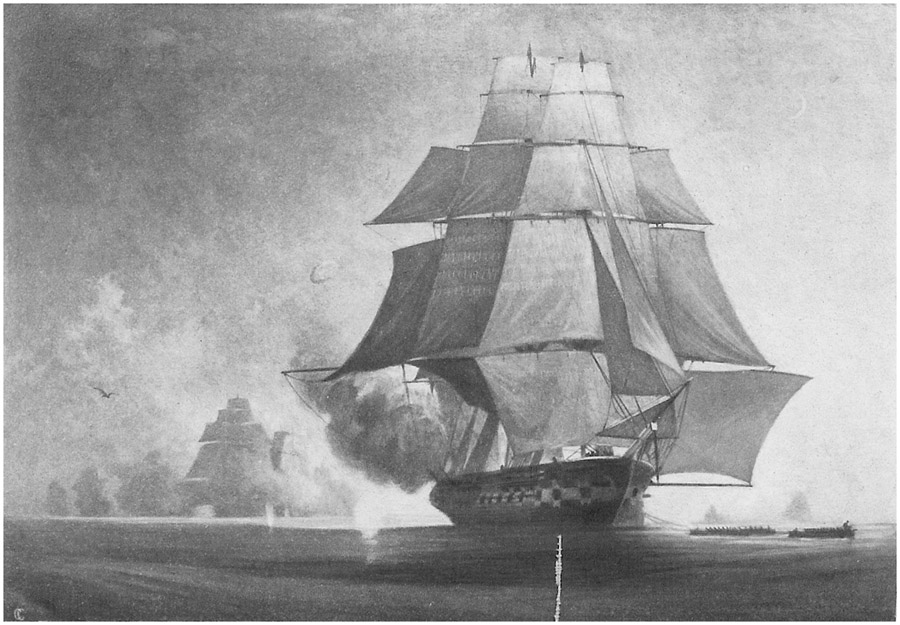
The Chase of the Constitution Frontispiece
From the painting by S. Salisbury Tuckerman.
The Quarterdeck of the Java Before the Surrender Page 6
From a drawing by Henry Reuterdahl.
The New Carrying Trade Page 18
From a drawing by Stanley M. Arthurs.
The Retreat of the British From Sackett's Harbor Page 44
From a drawing by Henry Reuterdahl.
The Fleets of Chauncey and Yeo Manœuvring on Lake Champlain Page 52
From a drawing by Carlton T. Chapman.
Captain Isaac Chauncey Page 60
From the engraving by D. Edwin, after the painting by J. Woods.
Captain Sir James Lucas Yeo Page 60
From the engraving by H.R. Cook, after the painting by A. Buck.
Captain Oliver Hazard Perry Page 66
From the painting by Gilbert Stuart, in the possession of O.H. Perry, Esq.
Perry Receiving the Surrender of the British at the Battle of Lake Erie Page 94
From a drawing by Henry Reuterdahl.
Captain Philip Bowes Vere Broke Page 134
From the mezzotint by Charles Turner, after the painting by Samuel Lane, in the possession of Lady Saumarez.
The Capture of the Chesapeake by the Shannon—The Struggle on the Quarterdeck Page 138
From a drawing by Henry Reuterdahl.
Captain James Lawrence Page 140
From the painting by Gilbert Stuart, in the possession of the New Jersey Historical Society, Newark, N.J.
The Burning of a Privateer Prize Page 222
From a drawing by Henry Reuterdahl.
Captain David Porter Page 244
From the painting by Charles Wilson Peale, in Independence Hall, Philadelphia.
Captain Thomas Macdonough Page 360
From the painting by Gilbert Stuart, in the Century Club, New York, by permission of the owner, Rodney Macdonough, Esq.
The Battle of Lake Champlain Page 380
From a drawing by Henry Reuterdahl.
MAPS AND BATTLE PLANS.
VOLUME TWO.
Plan of Engagement between Constitution and Java Page 4
Plan of Engagement between Hornet and Peacock Page 8
Map of Niagara Peninsula Page 38
Surroundings of Sackett's Harbor Page 43
Plan of Chauncey's Engagement, August 10, 1813 Page 58
Plan of Erie Harbor, 1814 Page 72
Diagram of the Battle of Lake Erie, September 10, 1813 Page 82
Chauncey and Yeo, September 28, 1813 Page 108
Chesapeake and Shannon Page 136
Outline Map of Chesapeake Bay and Rivers Page 156
Enterprise and Boxer Page 188
Argus and Pelican Page 218
Montague, Pelham, and Globe Page 228
Chasseur and St. Lawrence Page 238
Wasp and Reindeer Page 254
Sketch of the March of the British Army, under General Ross, from the 19th to the 29th August, 1814 Page 344
Tracing from pencil sketch of Battle of Lake Champlain made by Commodore Macdonough Page 368
Battle of Lake Champlain Page 377
The Landing of the British Army, its Encampments and Fortifications on the Mississippi; Works they erected on their Retreat; with the Encampments and Fortifications of the American Army Page 392