TELEPHOTOGRAPHY By Dwight L. Elmendorf Illustrated by the Author's Photographs
Reading edition
JUST when the telescope was invented is not known, but it is certain that Galileo was the first to direct his toward the heavens early in the seventeenth century. His instrument consisted of a long tube with a convex lens at one end and a concave ocular at the other. A modified form of this instrument still obtains in the ordinary opera and field glasses, which are binocular Galilean telescopes; and a single barrel of a field-glass is practically the telephoto lens of to-day.
Whenever anything is so far away that we cannot see it distinctly, we make use of a field-glass or telescope, which produces a magnified image of the object so that we are able to perceive what the unaided eye could not. In a similar manner the telephoto attachment enlarges the image formed by the ordinary lens in the camera. To produce on a photographic plate an image that fairly resembles what our eyes see, requires a lens of much longer focus than is generally used, and a camera that would permit the use of such a lens would be unwieldy and too cumbersome for a peripatetic photographer, and simply impossible for a mountain-climber. The telephoto lens overcomes this difficulty by producing the effect of a lens of long focus in a very compact camera.
It would be interesting to know who first applied this form of lens to a camera for the purpose of photographing distant objects. In 1890, while experimenting with the lenses from an old field-glass, I discovered that a dim yet distinct image of St. Patrick's Cathedral spires was formed in my camera, although the Cathedral was eighteen blocks away. After making several exposures with this combination of lenses I became convinced that with lenses of the best possible optical construction wonderful results might be attained. Having previously purchased a telescope with a three-and-a-half inch lens of sixty inches focus (with the idea of attaching it to a long box-camera as a photographic lens for the purpose of making photographs of distant terrestrial objects, as astronomers photograph heavenly bodies). I found that the field-glass combination of lenses yielded an image nearly as large as that produced by the telescope lens, and that too with a camera only one third the length of the other.
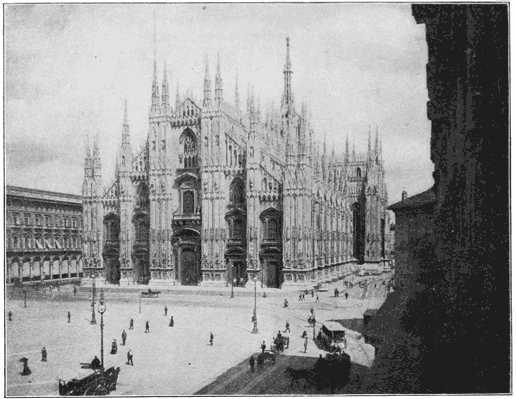
Milan Cathedral from Opposite Corner of Piazza.
Becoming deeply interested in this line of investigation I called upon a celebrated lens maker in London and learned that he had manufactured what he called a "Compound Telephoto Lens" consisting of a portrait lens with a small negative or concave lens adjusted at a suitable distance back of it. This instrument was too large and cumbersome for my small camera, and shortly afterward a negative lens, with a rack and pinion mounting, was manufactured of such a size that it could be attached to any fine rectilinear lens of suitable focus, although in some cases special corrections are necessary.
This is called the "Telephoto Attachment," and was employed in making the telephoto illustrations here shown. The tube is 3¼ inches long and 1½ inch in diameter. When this lens is attached to the ordinary lens the time of exposure is necessarily increased, because only a few of the rays of light which diverge from the positive or ordinary lens pass through the negative lens to the plate. This is a serious drawback, for it not only debars one from using it upon moving subjects, but also increases the liability of the image to be blurred by vibrations of the camera. In order to obtain the best results the camera must be very rigid. Most of the cameras and tripods of to-day are too light and unstable for telephotography.
The method of using the telephoto attachment is very simple, but requires very great care, particularly in the matter of focussing. Suppose that an exposure has been made in the ordinary way upon a certain object; the lens is then removed from the camera front and screwed into the tube of the telephoto attachment, forming a small telescope; the whole combination is then put back on the camera as if it were the ordinary lens. Upon the ground glass or focussing screen will be seen an enlarged image which may be made sharp or distinct by adjusting the focus by means of the rack and pinion movement on the telephoto tube, just as a field glass is adjusted to suit the eyes of the observer. If greater amplification be desired it is obtained by moving the front of the camera, holding the lenses farther from the ground-glass and then readjusting the focus as before. It will be seen from this that the attachment forms a lens of variable focus, changeable at the pleasure of the operator within the limits of the camera.
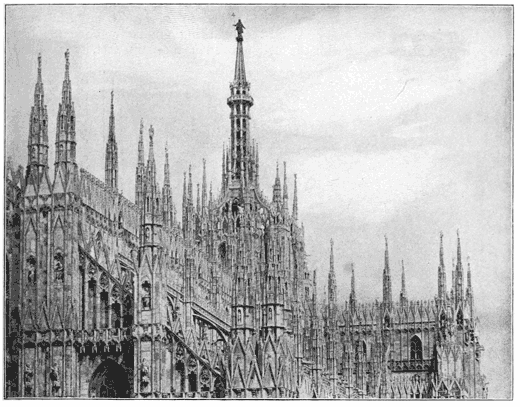
Roof and Dome, Milan Cathedral—Telephoto Lens, from Same Corner of Piazza.
Some of the attachments on the market require a camera with a very long bellows, because the difference between the foci of the negative and positive lenses is not great enough to give ample power unless the combination is several feet from the plate. With my own attachment, eight inches from the plate the image is equal to that formed by an ordinary lens of twenty-four inches focus; while at twenty-four inches from the plate it is equivalent to that of a lens of sixty-four inches focus.
The camera used in making the accompanying illustrations takes a plate measuring four by five inches, and the bed allows an extension of twenty-four; and when closed for transportation the box measures seven by seven by six-and-a-half inches.
Of all my experiences in photography none were so unsatisfactory as my attempts on mountain scenery with an ordinary lens. This was especially true of the photographs of the Alps made while tramping through that heavenly tramping ground, Switzerland. The small camera made the mountains look like little humps of rocks and snow, and all the views made from a great elevation seemed to be like photographs of the waves of the ocean, smoothed out flat. These results caused me to experiment in the direction of telescopic work with the camera.
It is often the case that grand mountains appear at their best only from some point so distant that the ordinary lens can produce little or nothing of the desired effect.
One of the most charming views in Switzerland is the evening view of the Jungfrau as seen from the Höheweg or promenade at Interlaken, about sixteen miles from the mountain. With her robes of dazzling white she rises majestically above the Lauterbrunnen Thal to a height of nearly fourteen thousand feet. Upon several former occasions I had endeavored to photograph this queen of the Bernese Oberland, but did not succeed until I used the telephoto attachment. The two illustrations of this view [pp. 462-63] were made from the same standpoint on the Hoheweg, one with the ordinary lens, the other with the telephoto attachment added to the lens, no change being made in the camera at all. It is a pleasure to note the wonderful detail in the telephotograph, and not only that, the mountain seems to rise, giving the impression of abruptness which rarely if ever is obtained with an ordinary lens. I suppose something of this result might have been obtained with the ordinary lens had I been up in a balloon at an elevation of about four thousand feet and about three miles from the Jungfrau. The pictures of this mountain taken from the Wengern Alp do not give this beautiful effect.
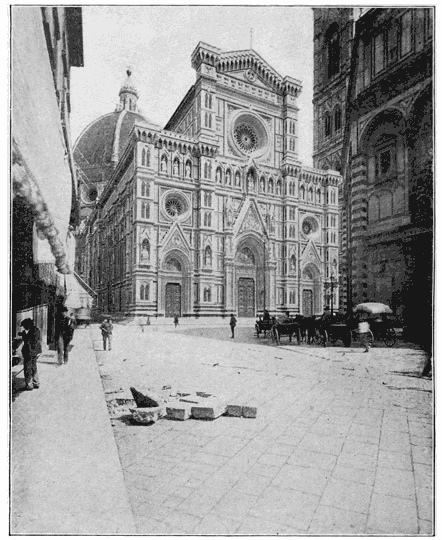
Façade of the Cathedral of Florence, from Sidewalk.
This is especially the case with Popocatepetl in Mexico, a beautiful volcanic cone rising gradually above the plateau about ten thousand feet, its snow-capped summit being over seventeen thousand feet above sea-level. Having tried in vain from several places near by, I finally succeeded in obtaining a fair view of it from the roof of the Hotel Jardin in the city of Puebla, about thirty miles or more from the peak [pp. 466-67]. Desiring to take the only train for Oaxaca, leaving Puebla at 5.30 in the morning, I was compelled to photograph the mountain rather early, and the atmosphere was not at that time in the best condition, so that the reader would have needed a field-glass to see the mountain clearly. To obtain good results with the telephoto attachment a clear atmosphere is a sine qua non.
Not only does this apply to mountain subjects but to many others alike. What remarkable pictures of the naval battle of Santiago, the chase of the Cristobal Colon, or the gallant rescue of the despairing Spaniards from their burning ships, might have been obtained from the battle-ship New York, with a lens of this description, even at long range! I believe it will be of inestimable value for the purpose of securing views of the batteries and fortifications of an enemy's harbor, which might be done at a safe distance from their guns.
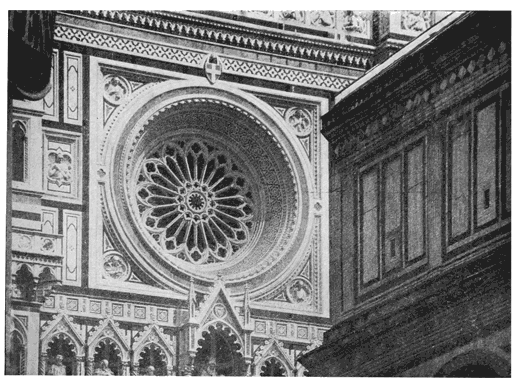
Central Rose Window, Cathedral of Florence, from Sidewalk—Telephoto Lens.
While this attachment is of great value in photographing things miles away, it is even more useful in obtaining photographs of choice bits of landscape which are on the opposite side of a river or lake, and are just beyond the working capacity of an ordinary lens. Odd things are always turning up at unexpected moments, and are frequently just out of reach.
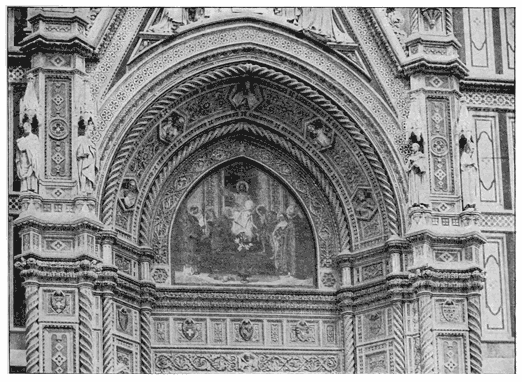
Mosaic over Central Door, Cathedral of Florence, from side of Baptistery—Telephoto Lens.
A particular instance of this kind is illustrated in the two views made of a stork's nest [p. 457] which I happened to see while sauntering along one of the picturesque old canals near Dordrecht in Holland. Of course the nest was on the wrong side of the canal, and a nearer approach was impossible without a ducking; so one view was made with a twelve-inch lens and then the telephoto was used, although not much was expected, for there was a stiff Holland breeze blowing, which is not conducive to perfect results, and moreover the storks seemed inclined to greater activity than well-behaved birds of this species generally exhibit. The exposure was almost instantaneous and the result a surprise to the operator.
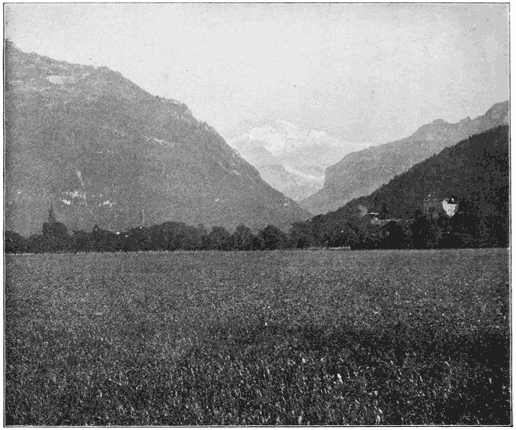
The Jungfrau from the Höheweg, Interlaken, Switzerland (sixteen miles distant).
Another example of the curious uses to which this lens may be put is seen in the illustration of the beautiful memorial column at West Point [p. 468]. The general view was taken at a distance of about three hundred feet in the ordinary way and then a telephoto was made of the bronze figure of Victory which surmounts the column.
Inaccessible parts of fine architecture offer an endless series of subjects for telephoto work, where remarkable results may be obtained. The cathedral at Milan, since the removal of the buildings which formerly obstructed the view, now appears to great advantage when viewed from the opposite side of the piazza. The two views of this beautiful structure [pp. 458-59] were made from a second story window on the opposite side of the piazza. I chose this point of view because of the enormous dimensions of the building. I first used the ordinary lens, obtaining the general view, and then telephotographed various portions of it.
The cathedral at Florence is so shut in by adjacent buildings that it must receive other treatment. The vast amount of work upon the façade is lost to the casual observer because of the propinquity of the baptistery, which completely destroys the effect of this wonderful mosaic. Standing on the sidewalk, as far from the façade as the other buildings would permit, I made the general view of it with a lens of four inches focus, then retreating still farther, till a corner of the baptistery began to interfere, I used the telephoto attachment on the central rose-window, the camera being about a hundred yards from it [pp. 460-61]. Then taking a position beside the baptistery I telephotographed the mosaic over the central door. It will be noticed that in the telephotographs there is less distortion than in the ordinary view, for although the rose-window is over a hundred feet above the pavement it was photographed from such a distance that only a slight inclination of the camera was necessary, and the picture appears as if taken from an elevation, whereas it was actually made from the sidewalk. The delicate carving and mosaic work about the central door are distinctly brought out, and it is one of the best examples of telephoto work the attachment has made.
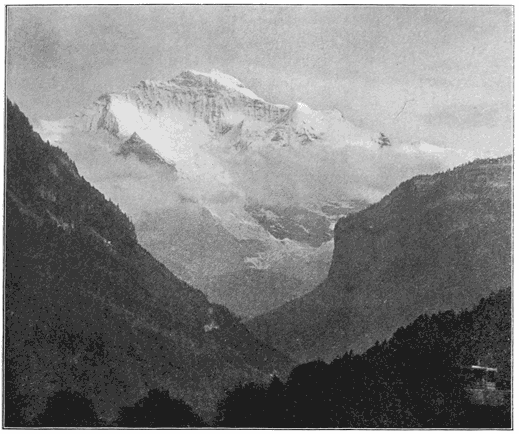
The Jungfrau from the same Standpoint (sixteen miles distant), Telephoto Lens.
At Venice one turns instinctively toward the grand Piazza, the Mecca of many a traveller as well as of the Venetians themselves. St. Mark's Cathedral offers many studies for the camera, and for many years the glass mosaics upon the upper part of the front of the building were a perplexing problem to me, for the balcony was too near and the pavement below was too far away for successful work with the ordinary lens; and if taken from a near position below they were so distorted as to be useless. The problem was not solved till the advent of the telephoto attachment, which procured the studies with ease. After making a picture of the whole front of the cathedral from the centre of the piazza in the ordinary way, the camera was moved a little to the right, so that one of the large flag-poles would not interfere, and the upper left-hand mosaic, representing the "Descent from the Cross," was telephotographed [pp. 466-67]. The result is about the same as that which might have been obtained in the ordinary way from the top of a scaffold fifty feet high and about forty feet from the mosaic.
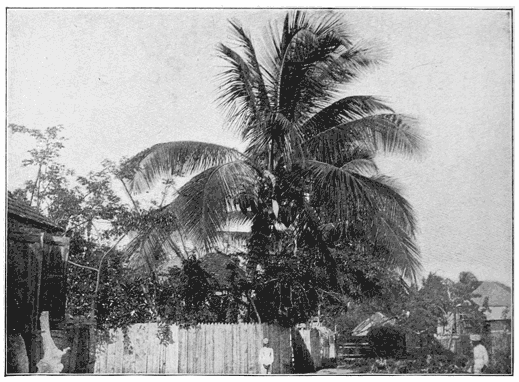
A Cocoanut-tree, St. Kitts, British West Indies.
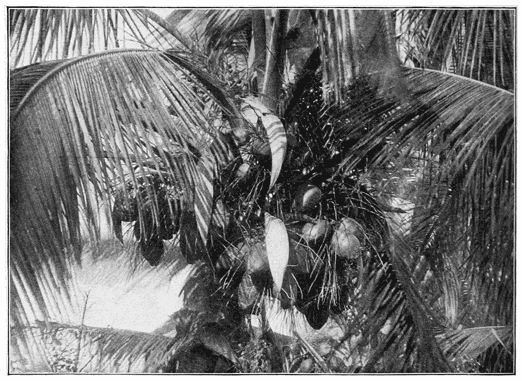
Cocoanuts on the Tree, St. Kitts, British West Indies—Telephoto Lens.
As all the illustrations mentioned were made with the idea of reproducing them as lantern slides, which are only about three inches square, they do not indicate the full power of the attachment in a single case. Therefore I placed my camera near a window in one of my rooms and photographed the row of dwellings across the back yards [p. 465]. The actual distance from the camera to the first dwelling is one hundred and thirty feet; to the chimney, one hundred and fifty-four feet. Then, after putting on the telephoto attachment and extending the front of the camera as far as the bellows would permit, I telephotographed one of the chimneys on the third house, the only change in the camera being a slight inclination so that the chimney would be in the centre of the plate. This picture, when compared with that taken with the ordinary lens, shows an enlargement of nearly sixteen diameters, which is considerably more than the capacity or power of a very large field-glass.
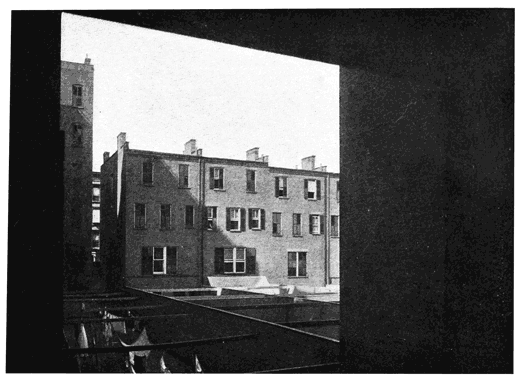
From My Window. (The house is 130 feet distant.)
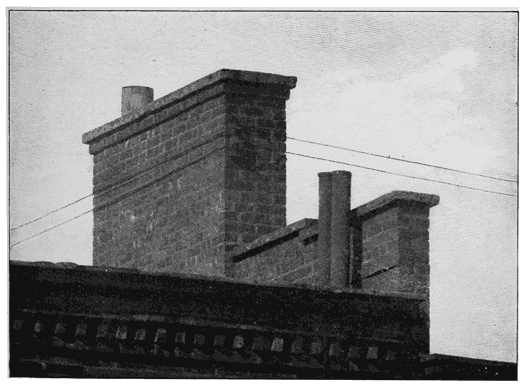
Chimney of Third House, 154 feet from My Window.—Telephoto Lens, full power, sixteen diameters.
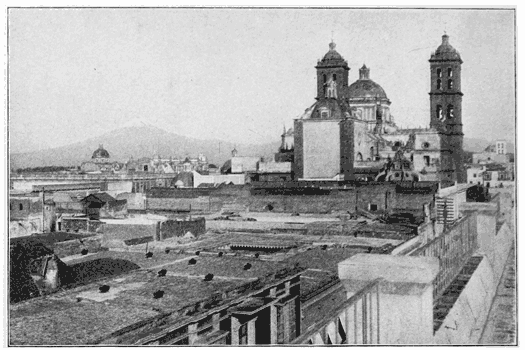
Popocatepetl, Thirty Miles from Hotel Jardin, Puebla, Mexico.
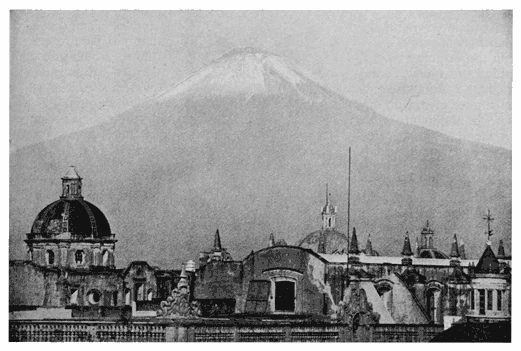
Popocatepetl from Same Point of View, Thirty Miles Distant—Telephoto Lens.
Although some of the detail is lost in half-tone reproduction, yet the vast difference between the ordinary photograph and the telephotograph is well shown. The telegraph wires and the other details which are not visible in the former are clearly brought out in the latter. The exposure with the ordinary lens was about one-thirtieth of a second, while that with the attachment was one-fourth of a second. One-fourth of a second may seem to be a very short period of time, but it is entirely too long for many subjects that are very desirable.
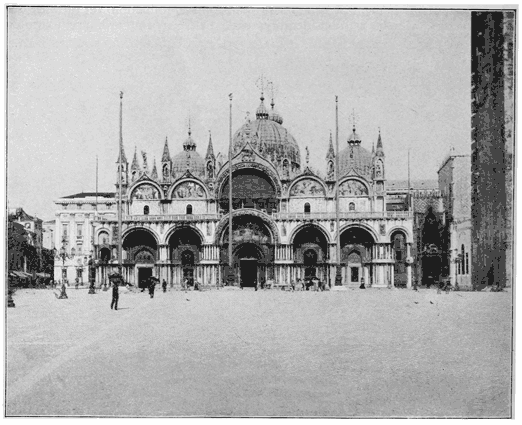
St. Mark's Cathedral, Venice.
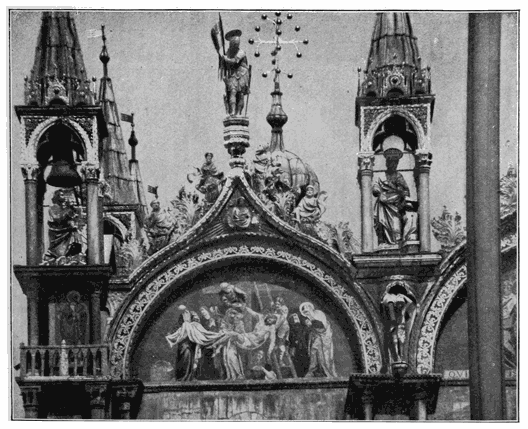
Left Mosaic of the Cathedral, Venice, from Piazza at a Distance of More than 200 Feet—Telephoto Lens.
The shortest exposure I have ever made with the attachment was upon a very fruitful specimen of the cocoanut-tree on the island of St. Kitts, one of the emerald gems of the Lesser Antilles, belonging to Great Britain. After making an instantaneous picture in the ordinary way, I used the attachment on the cocoanuts, making use of a drop-shutter giving an exposure of about one-tenth of a second. As the tree was swaying with the strong trade-wind a very quick exposure was necessary, and thanks to the intense light the plate responded to the application of a powerful developer [p. 464].
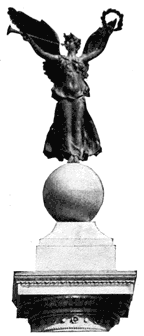
Telephoto of the Bronze Figure of Victory on Memorial Column at West Point. (Distance 100 Yards.)
With a new combination of very thin lenses now in process of construction, I hope to be able to diminish the time of exposure so that moving objects may be photographed without difficulty. If successful, this new lens will be invaluable for the purpose of obtaining pictures of birds and wild animals in their natural haunts, long before they become aware of the approach of their enemy. It would enable one to photograph domestic animals in their natural picturesque attitudes, which are almost always lost as soon as the camera is observed, and only too often the owner of the camera is compelled to beat a hasty retreat, sometimes with the loss of everything but honor.
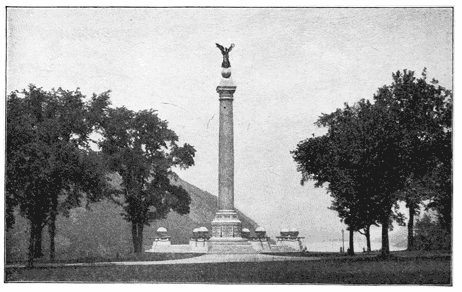
The Memorial Column, West Point. (Distance 100 Yards.)
The improvement in photographic lenses in the last few years has been very remarkable, and if the telephoto receives the attention it deserves of the best lens makers, the accompanying telephoto illustrations may be but harbingers of better things to come. Instead of being compelled to carry heavy unwieldy cameras and a battery of lenses, the wandering photographer will be able to accomplish even more with a compact camera and a little telephoto tube, no larger than the single barrel of a small field-glass.