Part 4 — CHAPTER IX. PATRIOTISM;
Reading edition
or,
Our Duties as Citizens.
CAMP FIRE YARN.—No. 26. OUR EMPIRE.
How it Grew—How it Must be Held.
HINTS TO INSTRUCTORS.
The use of a large Map of the Empire is very desirable for illustrating this. The Arnold Forster or the Navy League or the League of the Empire Map are very good, and we hope to issue one specialty designed for the Boy Scouts.
Look up the local history of your neighbourhood, and give your scouts the more interesting and dramatic bits of it, on the actual scene of the events if possible.
OUR EMPIRE.
Any of you who have travelled much about this country by train, going for your holidays and so on, know how two or three hours will take you a good long distance and six or eight hours will take you to the other end of England.
Well, if instead of hours you travelled for as many days, even six or eight days would take you a very little way over our Empire. It would get you into Canada, but you would want several more days—not hours—to get you across that country. Eighteen days' hard travelling day and night would get you to India or South 310Africa, but either of these are little more than half way to Australia. And all that distance off, across the seas, on the other side of the world, we have a British country into which you could put nine Great Britains and Irelands.
9 United Kingdoms = 1 Australia.
10 " = 1 Canada.
6 " = 1 India and Burma.
5 " = East Africa, Uganda,
and Soudan.
5 " = South Africa.
1 " = New Zealand.
1-1/2 " = Nigeria.
Then there are numbers of smaller Colonies or Dependencies, such as Guiana (nearly as big as the United Kingdom), North Borneo, New Guinea, Somaliland, Straits Settlements, Gold Coast, West Indies, Tasmania, etc., and numbers of islands in ever sea all over the world.
Our Colonies together are something like forty times the size of the United Kingdom at home.
Our fellow-subjects amount to four hundred millions, and comprise almost every known race. Almost every known species of wild animal occurs in British territory.
It is a magnificent Empire over which the Union Jack flies, but it is still only at the beginning of its development. The territories are there, but the people are only coming. The white population of all these Colonies only amounts to a little over a quarter of the population of our crowded little island. We have nearly forty-four millions here; they have among the colonies a little over eleven millions.
Many of you scouts, as you grow up, will probably become scouts of the nation, and will find your way to some of the Colonies to help to push them up into big prosperous countries. Your scout's training will come in very useful to you there. But when you go there you must be prepared to work, and to work hard, and to turn your hand to any kind of job.
311 HOW OUR EMPIRE GREW.
All those vast Colonies did not come to England of themselves. They were got for us by the hard work and the hard fighting of our forefathers.
America.—When we first got to America it took Sir Walter Raleigh, Captain John Smith, and other great pioneers four or five months to get there in their little cockleshells of ships, some of them only 30 tons measurement—no bigger than a Thames barge. Nowadays you can get there in five or six days, instead of months, in steamers of 30,000 tons.
Think of the pluck of those men tackling a voyage like that, with very limited supply of water and salt food. And, when they got to land with their handful of men, they had to overcome the savages, and in some cases other Europeans, like the Dutch, the Spaniards, and the French; and then they had hard work to till the ground, to build settlements, and to start commerce.
Hard sailoring, hard soldiering, hard colonising by those old British sea-dogs, Sir Francis Drake, Sir Walter Raleigh, Hawkins, Frobisher, and, best of all to my mind, Captain John Smith.
He left Louth Grammar School in Lincolnshire to become a clerk in an office, but he soon went off to the wars. After two years' fighting he returned home.
He admitted he had gone out as a "tenderfoot," and had not properly prepared himself as a boy for a life of adventure; so he set to work then and there to learn scouting. He built himself a hut in the woods, and learnt stalking game, and killing and cooking it for himself; he learnt to read maps and to draw them, and also the use of weapons; and then, when he had made himself really good at scoutcraft, he went off to the wars again.
He afterwards became a sailor, fought in some very tough sea-fights, and eventually, in 1607, he went with an expedition to colonise Virginia in America. They sailed from London in three ships, the biggest of which 312was only 100 tons, the smallest 30 tons. But they got there after five months, and started a settlement on the James River.
Here John Smith was captured by the Red Indians one day when out shooting (as you have seen by the play in Chapter I.), and they were proceeding to kill him when the King's daughter, Pocahontas, asked for him to be spared. After this the Red Indians and the Whites got on good terms with each other. Pocahontas became a Christian, and married Smith's lieutenant, Rolfe, and came to England. After many strange and exciting adventures in America, John Smith got much damaged by an accidental explosion of gunpowder, and came home ill. He eventually died in London.
He was a splendid character—and always did his duty in spite of all temptations to let it slide. He was a tremendous worker, very keen, and very brave. He was never defeated by any difficulty however great, because he was always cheery under the worst of circumstances. His motto was, "We were born not for ourselves, but to do good to others," and he acted up to it.
In South Africa we had to drive out the Dutch and then fight the natives for our foothold, which once gained we never let go—and though it has cost us thousands of lives and millions of money we have got it now.
Australia was got by our sailor-adventurers, like Captain Cook, outstripping all other nations in their plucky navigation of immense unknown oceans.
India was practically in possession of the French when Clive and Wellesley drove them out, and then in turn had to fight the hordes of fighting natives of the interior, and gradually, foot by foot, by dint of hard fighting, we have won that country for our Empire.
East Africa, Uganda, and the Soudan beyond Egypt, and Somaliland have also been fought for and won in quite recent times.
And now in all of these we are spreading the blessings of peace and justice, doing away with slavery and 313oppression, and developing commerce, and manufactures, and prosperity in those countries.
Other nations could formerly only look on and wonder, but now they too are pressing forward in the race for empire and commerce, so that we cannot afford to sit still or let things slide.
We have had this enormous Empire handed down to us by our forefathers, and we are responsible that it develops and goes ahead, and above all that we make ourselves fit and proper men to help it to go ahead. It won't do so of itself, any more than it would have become ours of itself. If we don't do this some other nation will take it from us.
If our island of England were attacked and taken, down comes our Empire like a house built of cards.
We have had this danger always, even before our Empire was a paying one and worth taking. Nowadays it is much more tempting for other people to take. We defeated determined attacks of the Dutch upon us in the old days. The Spaniards with their Armada attempted to invade us, when, largely thanks to a storm, we defeated them utterly. Then the French, after a long struggle to best us, had their invasion stopped by Nelson's victory at Trafalgar, and their harmfulness ended by Wellington at Waterloo. The French Emperor had been so sure of success that he had had medals got ready to commemorate the capture of England. And since helping in the defeat of the Russians in the Crimea we have been at peace with our Continental neighbours.
Let us hope that this peace will remain permanent.
HOW THE EMPIRE MUST BE HELD.
Peace cannot be certain unless we show that we are always fully prepared to defend ourselves in England, and that an invader would only find himself ramming his head against bayonets and well-aimed bullets if he tried landing on our shores.
The surest way to keep peace is to be prepared for 314war. Don't be cowards, and content yourselves by merely paying soldiers to do your fighting and dying for you. Do something in your own self-defence.
You know at school how if a swaggering ass comes along and threatens to bully you, he only does so because he thinks you will give in to him; but if you know how to box and square up to him he alters his tone and takes himself off. And it is just the same with nations.
It is much better that we should all be good friends—and we should all try for that—no calling each other names, or jeering; but if one of them comes along with the idea of bullying us, the only way to stop him is to show him that you can hit and will hit if he drives you to it.
Every boy should prepare himself, by learning how to shoot and to drill, to take his share in defence of the Empire, if it should ever be attacked. If our enemies saw that we were thus prepared as a nation, they would never dare to attack, and peace would be assured.
Remember that the Roman Empire 2000 years ago was comparatively just as great as the British Empire of to-day. And though it had defeated any number of attempts against it, it fell at last, chiefly because the young Romans gave up soldiering and manliness altogether; they paid men to play their games for them, so that they themselves could look on without the fag of playing, just as we are doing in football now. They paid soldiers to fight their battles for them instead of earning the use of arms themselves; they had no patriotism or love for their grand old country, and they went under with a run when a stronger nation attacked them.
Well, we have got to see that the same fate does not fall upon our Empire. And it will largely depend upon you, the younger generation of Britons that are now growing up to be the men of the Empire. Don't be disgraced like the young Romans, who lost the Empire of their forefathers by being wishy-washy slackers without any go or patriotism in them.
Play up! Each man in his place, and play the game! 315Your forefathers worked hard, fought hard, and died hard, to make this Empire for you. Don't let them look down from heaven, and see you loafing about with hands in your pockets, doing nothing to keep it up.
HINTS TO INSTRUCTORS.
Teach the words and choruses of:
"The Maple Leaf" (Canada), "The Song of Australia," and other Colonial songs.
"God Bless the Prince of Wales."
"Rule Britannia."
"Hearts of Oak."
"The Flag of Britain."
"God Save the King."
(J. S. Maddison, 32 Charing Cross.)
Apply to Secretary, League of the Empire, Caxton Hall, Westminster, S.W.
Explore Westminster Abbey, St. Paul's Cathedral, the Temple Church, etc., with following books:
BOOKS TO READ.
"St. Paul's Cathedral" and "Westminster Abbey," both by Mrs. Frewen Lord, 1s. (Published by Clowes and Son, Charing Cross.)
(Excellent short histories of our famous men and their deeds.)
"Travels of Captain John Smith," by Dr. Rouse. 6d. (Blackie.)
"The Story of Captain Cook." Edited by John Lang. 1s. 6d.
"Deeds that Won the Empire," by Fitchett.
"Heroes of Pioneering" (in America, India, Africa), by Sanderson. (Seeley.) 2s. 6d.
Excellent Lantern Slide Lectures can be got on hire from the League of the Empire, Caxton Hall, Victoria Street, London, on the history of our Colonies and Empire.
316 DISPLAY.
John Nicholson was one of the finest among many fine Britons who helped to rule India. On one occasion he had a meeting of a number of chiefs at a time when they were beginning to show some signs of mutiny. The most important one of these chiefs was called Mehtab Singh, and just before the meeting he told the others that he for one was not afraid of the Englishman, and that he meant to swagger into the room with his shoes on. (It is the custom in India for natives to take off their shoes on entering the presence of a superior just as in England you take off your hat on coming in.) And he did so. He walked in before them all with his shoes on.
Nicholson did not appear to take any notice of it and went on with the meeting; but at the end of it, just as they were all leaving, he suddenly stopped Mehtab Singh, and ordered the others to wait. He then reprimanded him for his insolence, and ordered him to take off his shoes then and there and to walk out with them in his hand before all the other chiefs. And so he had to go, hanging his head with shame, disgraced and humbled by the firmness of the British ruler.
This makes a good subject for a display.
Scene in a great tent or hall in India.
Nicholson (with a black beard), in a dark suit, sitting on a throne in the centre, with several British and native officers in red tunics grouped behind him. Native princes, seated in chairs in semi-circle to either side of him, all with white socks or bare feet, except Mehtab Singh, who has black shoes on, put out well before him for all to see.
Nicholson rises, signs to the chiefs that they may go.
All rise and bow to him, with both hands to the forehead.
As they turn to go he stops them.
"Stay, gentlemen, one moment. I have a matter with you, Mehtab Singh! Thou camest here intent to show contempt for me, who represent your Queen. But you forget that you are dealing with a Briton—one of that 317band who never brooks an insult even from an equal, much less from a native of this land. Were I a common soldier it would be the same; a Briton, even though alone, amongst a thousand of your kind, shall be respected, though it brought about his death. That's how we hold the world. To plot against your master brings but trouble on yourself. Take off those shoes."
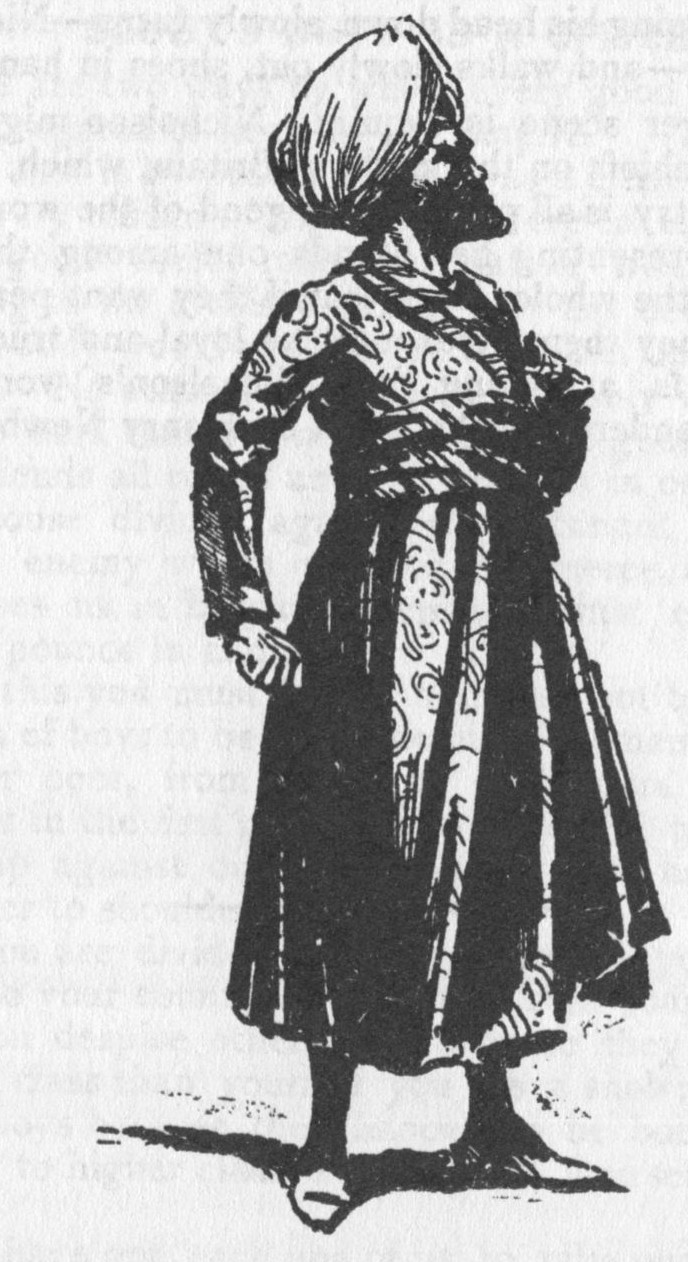
Mehtab Singh. Face—Dark rouge, not black. Dress—Big turban, coloured dressing gown and girdle, white socks, and black shoes.
318[Mehtab starts, draws himself up, and glares at Nicholson angrily.]
Nicholson [very quietly and deliberately]—"Take—off—those—shoes." [Points at them.]
A pause. Mehtab looks round as if for help, takes a step towards Nicholson, but catches his eye, and stops. He sinks slowly on one knee, head down, and slowly takes off his shoes.
Rises, keeping his head down, slowly turns—Nicholson still pointing—and walks slowly out, shoes in hand.
[If a longer scene is required Nicholson might then address the chiefs on the might of Britain, which, though a small country, is all powerful for good of the world, and so he, as representing her, stands one among them for the good of the whole. And that if they want peace and prosperity they themselves must be loyal and true to the hand that is arranging it. Nicholson's words are splendidly rendered in the poem by Henry Newbolt.]
319
CAMP FIRE YARN.—No. 27. CITIZENSHIP.
Duties of Scouts as Citizens—Duties as Citizen Soldiers—Marksmanship—Helping the Police.
SCOUT'S DUTY AS A CITIZEN.
There are two ways by which every good Briton ought to be prepared to keep up our Empire.
The first is by peaceful means as a citizen.
If every citizen of the Empire were to make himself a really good useful man, our nation would be such a blessing to the civilised world, as it has been in the past, that nobody would wish to see it broken up by any other nation. No other nation would probably wish to do it. But to hold that position we must be good citizens and firm friends all round among ourselves in our country.
A house divided against itself cannot stand. If a strong enemy wants our rich commerce and Colonies, and sees us in England divided against each other, he would pounce in and capture us.
For this you must begin, as boys, not to think other classes of boys to be your enemies. Remember, whether rich or poor, from castle or from slum, you are all Britons in the first place, and you've got to keep England up against outside enemies. You have to stand shoulder to shoulder to do it.
If you are divided among yourselves you are doing harm to your country. You must sink your differences.
If you despise other boys because they belong to a poorer class than yourself you are a snob; if you hate other boys because they happen to be born richer and belong to higher class schools than yourself, you are a fool.
We have got, each one of us, to take our place as we find it in this world and make the best of it, and pull together with the others around us.
320We are very like bricks in a wall, we have each our place, though it may seem a small one in so big a wall. But if one brick gets rotten, or slips out of place, it begins to throw an undue strain on others, cracks appear, and the wall totters.
Don't be too anxious to push yourself on to good billets. You will get disappointments without end if you start that way.
Work for the good of the State, or of the business in which you are employed, and you will find that as you succeed in doing this you will be getting all the promotion and all the success that you want.
Try and prepare yourself for this by seriously taking up the subjects they teach you at school, not because it amuses you, but because it is your duty to your country to improve yourself. Take up your mathematics, your history, and your language—learning in that spirit, and you'll get on.
Don't think of yourself, but think of your country and your employers. Self-sacrifice pays all round.
DUTIES AS CITIZEN-SOLDIER.
A cuttle-fish is an animal with a small, round body and several enormously long arms which reach out in every direction to hold on to rocks to enable it to keep its position and to get food.
Great Britain has been compared to a cuttle-fish, the British Isles being the body and our distant Colonies the arms spread all over the world.
When anyone wants to kill a cuttle-fish he does not go and lop off one of its arms; the other arms would probably tackle him and hold him for the cuttle-fish to eat. No, the way to kill a cuttle-fish is to suddenly stab him in the heart, and then his arms fall helpless and dead.
Well, we have many powerful enemies round about us in Europe who want very much to get hold of the trade in our great manufacturing towns, and of the vast farm-lands in our Colonies. If they tried to lop off one of our Colonies it would be like trying to lop off one of the 321arms of the cuttle-fish. All the rest would tackle him at once, as happened in the last war in South Africa.
Their only way—and they know it—is to stab suddenly at the heart of the Empire, that is to attack England. If they succeeded, the whole of the Empire must fall at once, because the different parts of it cannot yet defend themselves without help from home.
For this reason every Briton who has any grit in him will BE PREPARED to help in defending his country.
When Mafeking was attacked by the Boers, the boys of the town made themselves into a Cadet Corps, and did very useful work in the defence. It is quite likely that England will some day be attacked just as Mafeking was, unexpectedly, by a large number of enemies.
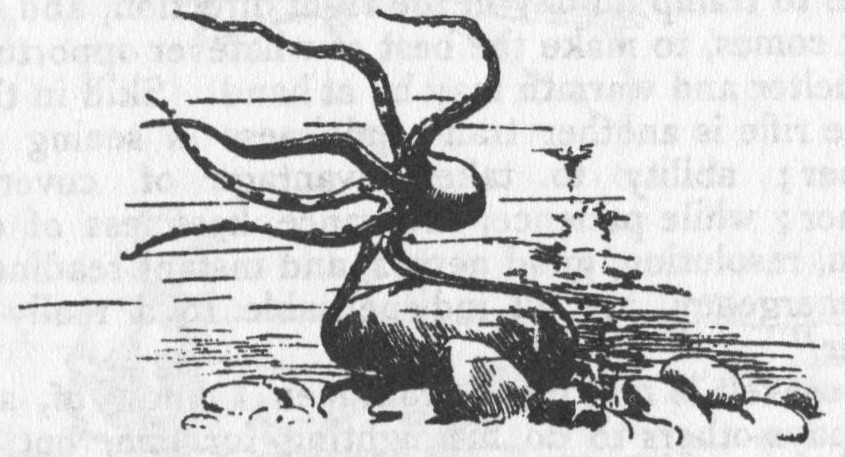
Cuttle Fish.
If this happens, every boy in the country should be prepared to take his place and help in the defence like those Mafeking boys did.
We don't think much of a fellow who is no good at cricket or football, and who only loafs about trying (without success) to look like a man by smoking cheap cigarettes. But we ought really not to think too much of any boy, even though a cricketer and footballer, unless he can also shoot, and can drill and scout.
That is the fellow who is going to be useful if England is attacked.
I hope that before long every eleven, whether football 322or cricket, will also make itself a good eleven for shooting and scouting and therefore useful for defence of our King and country when needed.
In the Colonies boys think more of their shooting than of their games, because the shooting is for their country, the games for themselves.
Mr. Roosevelt, President of the United States of America, writes:
"The qualities that make a good scout are, in large part, the qualities that make a good hunter. Most important of all is the ability to shift for one's self—the mixture of hardihood and resourcefulness which enables a man to tramp all day in the right direction, and, when night comes, to make the best of whatever opportunities for shelter and warmth may be at hand. Skill in the use of the rifle is another trait; quickness in seeing game, another; ability to take advantage of cover, yet another; while patience, endurance, keenness of observation, resolution, good nerves, and instant readiness in an emergency, are all indispensable to a really good hunter."
Roosevelt is not, like certain men I know of, a man who pays others to do his fighting for him, but, when America went to war with Spain about Cuba, he went to the front as a soldier—like many good Britons did in South Africa—and was of greatest value to his side because he had begun life as a scout.
So make yourselves good scouts and good rifle shots in order to protect the women and children of your country if it should ever become necessary.
MARKSMANSHIP.
Lord Roberts, who has seen more of war than almost anybody alive, knows how terrible a thing it would be if war came into England, and he urges everybody to join in preventing it by becoming a good marksman with the rifle. Thanks to him, all those who have patriotism in them are taking it up everywhere.
The value of non-smoking again comes in rifle shooting. I used to smoke myself as a youngster, but I had 323to do some rifle shooting, and when in training I found my eyesight was better when I did not smoke. So I gave up smoking altogether, and am very glad I did.
The boys of the International Anti-Cigarette League bind themselves not to smoke, in order to make themselves better men for their country—that is the best reason for doing it.
I heard another reason given the other day for not smoking, and that was that St. Paul did not smoke. I don't suppose he did. Tobacco wasn't invented in his time.
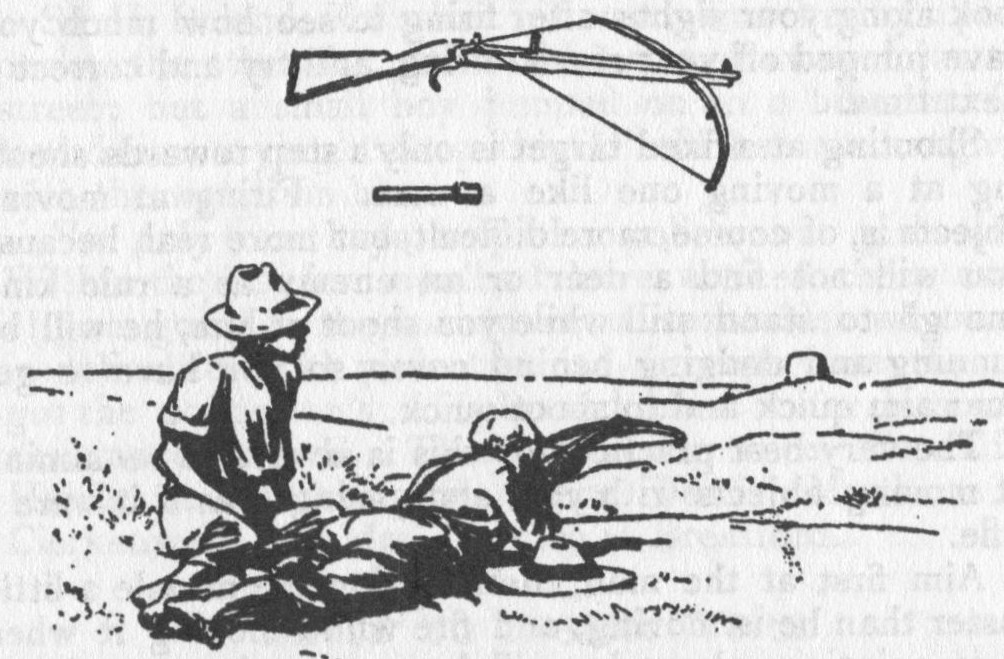
Boer Boys Shooting with Crossbows.
The Boers are all good shots, and so are the Swiss. In both countries the boys begin learning marksmanship at an early age by using crossbows. They have much the same action for the firer as the rifle, since they are aimed from the shoulder and fired by pulling a trigger when the aim is taken. Boys trained with the crossbow have no difficulty in shooting accurately with a rifle directly it is put in their hands.
To be able to shoot well, a great secret is to hold your rifle properly; if it leans over a little bit to one side or the other the bullet will fly low over to that side. Keep 324your left arm well underneath the rifle to support it, and hold it well into the shoulder with your left hand. The right hand should have the thumb on the top of the stock, and the forefinger as far round the trigger as you can get it; then in firing don't give a pull with your forefinger or you will pull the aim off the target just as you fire; you should squeeze the woodwork of the rifle between your thumb and forefinger, and that will fire it with steadiness.
Then when your rifle has gone off, don't throw up the muzzle in a hurry, but do like all old scouts, continue to look along your sights after firing to see how much you have jumped off your aim in firing, and try and correct it next time.
Shooting at a fixed target is only a step towards shooting at a moving one like a man. Firing at moving objects is, of course, more difficult, but more real, because you will not find a deer or an enemy as a rule kind enough to stand still while you shoot at him, he will be running and dodging behind cover, so you have to get your aim quick and to shoot quick.
The very best practice for this is always to be aiming at moving objects with your staff, using it as if it were a rifle.
Aim first at the man, then moving the muzzle a little faster than he is moving, and fire while moving it when it is pointing where he will be a second or two later, and the bullet will just get there at the same time as he does and will hit him.
HELPING POLICE.
Boy Scouts can be of special use in assisting the police in towns. In the first place every Boy Scout ought to know where the fixed police points are—that is, where a constable is always stationed, apart from the policemen on their beats. He ought also to know where to find the fire alarm; also where is the nearest fire brigade station, and the nearest hospital or ambulance station, and chemist.
On seeing an accident, if you cannot help at it you 325should run and inform the nearest policeman, and ask him how you can help him, whether you can call a doctor, a cab, and so on. If you hear a policeman's whistle sounding, run and offer to help him, it is your duty, as he is a King's servant. If you should happen to see a door or window left open and unguarded at night, it is as well to inform a policeman on that beat, but you should on no account attempt to do detective work by watching people or playing the spy.
If you find a lost child, or lost dog, or any lost property, you should take them at once to the police station.
Sir H. Poland, K.C., had his watch snatched by a pickpocket the other day. The thief darted away down the street; but a small boy jumped on to a bike and followed him, crying, "Stop thief!" till he was caught—with the watch on him.
Not only can boys help the police, but girls also. Within the last few months I have noticed three cases of girls going to the assistance of constables who were in difficulties with violent men. In each case the girl got the policeman's whistle and blew it for him until assistance arrived. These heroines were Miss Edith Harris at Southampton, Miss Bessie Matthews in Clerkenwell, and Mrs. Langley at Brentford.
HINTS TO INSTRUCTORS.
Marksmanship can be taught indoors with the Blanchette Air Gun Tube. Price four guineas with Air Rifle. Targets 10d. per 100.
Crossbow.—Scouts can make their own crossbows and learn marksmanship with them.
Get leave to use, or join, a Miniature Rifle Club range.
GAMES.
"Shoot Out."—Two patrols compete. Targets: Bottles or bricks set up on end to represent the opposing patrol. Both patrols are drawn up in line at about 20 to 25 yards from the targets. At the word "fire" they throw stones at the targets. Directly a 326target falls the umpire directs the corresponding man of the other patrol to sit down—killed. The game goes on, if there are plenty of stones, till the whole of one patrol is killed. Or a certain number of stones can be given to each patrol, or a certain time limit, say one minute.
"French and English," or "Tug of War."—One patrol against another.
The Storming OF Badajoz.—One patrol (French) mounts on a very strong kitchen-table, or bank, and holds it against all comers. The British attack, and try to gain possession of the fortress by pulling the defenders off. Defenders may have half their number on the ground behind the "rampart." If the defenders pull a Briton over the rampart on to the ground behind he is dead. No hitting or kicking allowed.
[Badajoz was a Spanish fortress held by 5,000 French and Spaniards. It was attacked, and stormed, and taken by the British, who lost 3,500 in the assault, on March 17th, 1812.]
BOOKS TO READ.
"The Boys' Book of Bravery." By Power Berry. (C. A. Pearson.)
"The Boys' Book of Battles." By Herbert Cadett. (C. A. Pearson.)
"Rules for Miniature Rifle Clubs." Secretary National Rifle Association, Bisley, Surrey.
327
CAMP FIRE YARN.—No. 28. UNITED WE STAND. DIVIDED WE FALL.
Our Fleet and Army—Our Union Jack—Our Government—Our King.
HINTS TO INSTRUCTORS.
Hoist the flag and salute it every morning when in camp, and on special days get up a show, or sports, or competitions, etc., on such as King's Birthday, Empire Day, May 24th, annually, or on the day of the Patron Saint of your Country: St. George, April 23rd; St. Patrick, March 17th; St. David, March 1st; St. Andrew, Nov. 30th.
Get up tableaux or small pageants by the scouts to illustrate scenes from history of your town, or of Britain, or of Greater Britain.
These interest the boys and impress the incident upon them, and they educate spectators, and bring in money for your funds.
Take scouts to see meeting of town council and how business is carried out.
If in London, take your boys to the Museum of the Royal United Service Institution, Whitehall, and show them the models of Waterloo and Trafalgar; the gun which we manufactured in Mafeking; the medals of different campaigns; and a hundred other interesting relics.
Take your scouts round and explain each statue in your town.
Hold debates on questions of the day.
OUR NAVY AND ARMY.
The British Navy and Army have made our Empire for us, and if it had not been for their help the Empire would have been broken up by our enemies long ago.
So we must be careful to keep those Services 328supplied with good men who, like the scouts, must Be Prepared to give their lives for their country at any time.
There are always members of Parliament who try to make the Navy and Army smaller, so as to save money. They only want to be popular with the voters in England so that they and the party to which they belong may get into power. These men are called "politicians." They do not look to the good of the county. Most of them know and care very little about our Colonies. If they had had their way before, we should by this time have been talking French; and if they are allowed to have their way in the future we may as well learn German or Japanese, for we shall be conquered by these.
But fortunately there are other better men in Parliament, who are called "statesmen"; these are men who look out for the welfare of the country, and do not mind about being popular or not so long as they keep the country safe.
The British Navy.—Every British boy should study the Navy as much as possible, and learn the history of the different ships, and their power and guns, etc. A collection of postcard portraits of all His Majesty's ships is a very interesting one to make.
You should know the badges of rank of the officers, because it is the duty of a scout to salute officers of His Majesty's service.
Badges of rank on the sleeve or shoulder-strap are these.
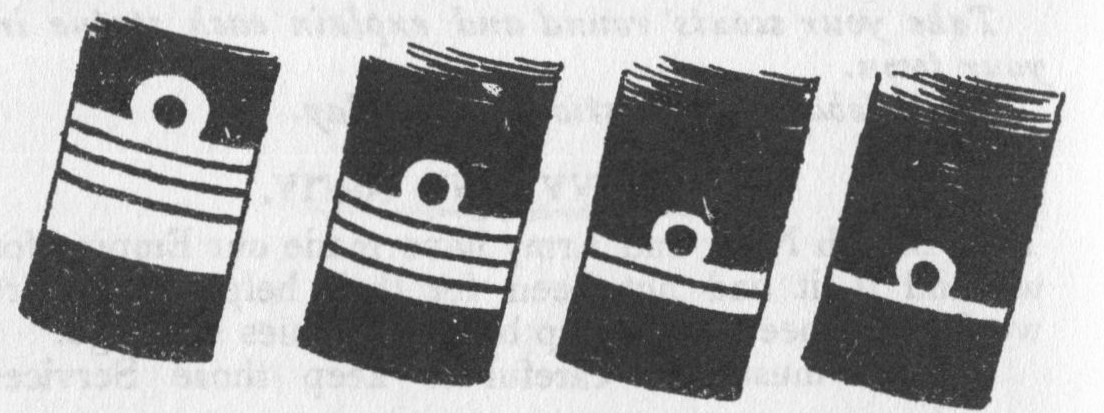
Admiral, Captain, Lieutenant, Sub-Lieutenant.
329Perhaps you may like to know some facts about the dress of the sailors.
The reason they wear that flap collar on their back is a relic of the time when they wore their hair in pig-tails. The grease used to come off and spoil their jackets, so they wore big linen flaps, which could be easily taken off and washed.
They wear a black silk tie round their neck as a mark of mourning for the death of Nelson at the battle of Trafalgar.
They wear three lines of white braid to commemorate Nelson's naval victories, The Nile, Copenhagen, and Trafalgar.
They wear baggy trousers so that they can easily roll them up above their knees when they want to wade.
Soldiers and sailors tattoo their arms with the idea that when they are killed in battle they can be identified the more easily.
The British Army.—The Army is made up of—
The Regulars or Active Army, which includes infantry, cavalry, artillery, engineers, and many other branches of both white and native soldiers.
The Militia at home are to help the Regulars in time of war.
The Militia exist also in most of our Colonies for their own defence.
The Territorial Force is made up of volunteers to protect the British Isles in case of the Active Army being called away for war in other parts.
In the Army, field-marshals and generals (including major-generals and lieutenant-generals) wear cocked hats, with long white cock's feather plumes, and red tunics or black frock-coats. Their swords are curved scimitars, with ivory handles. Colonels wear the uniform of their regiment with crown and star on the shoulder strap, or, in khaki, on the cuff; majors, one crown; captains, three stars; lieutenants, two stars.
You can tell what wars soldiers or sailors have been in by the colours of their medal ribbons. These I will show you later on.
330 OUR FLAG.
Scouts will always salute the colours (or standard) of a regiment when they pass. There are generally two such standards, one the "King's Colour," the other the "Regimental Colour."
Men-of-war carry a pennant, i.e., a long thin flag like a whip lash. You may remember that the Dutch fleet under Van Tromp, after defeating ours, carried a broom at their mastheads to show that they had swept us off the seas. But when we shortly after defeated them we put up a whip at the masthead to show that we had whipped the enemy, and this whip has been carried ever since by men-of-war.
The Royal Navy fly the White Ensign; no one else is allowed to except yachts belonging to the Royal Yacht Squadron. The White Ensign is a white flag with the Red Cross of St. George on it and a Union Jack in the corner. It is flown at the stern of the ship, a small Union Jack at the bow.
The mercantile navy flies the Red Ensign; or if the captain of the ship belongs to the Royal Reserve, the ship flies a Blue Ensign.
The Army and Government buildings fly the Union Jack. Private houses and individuals should only fly the Red Ensign.
The Royal Standard, which shows the Lions of England, the Harp of Ireland, and the Lion of Scotland, is only flown when the King is present.
The Union Jack is the national flag of England, and is made up originally of the flag of St. George, a red cross on a white ground. In 1606 King James I. added to it the banner of Scotland, which was a blue flag with a white St. Andrew's Cross diagonal, that is from corner to corner.
In 1801 the Banner of St. Patrick of Ireland was added to the flag; St. Patrick's Cross was a red diagonal cross on a white ground, so that the flag now means the union of England, Ireland, and Scotland.
But there is a right way and a wrong way of putting it up, which all of you ought to know and understand, 331because so very frequently one sees it hoisted the wrong way up, which literally means that you are in distress; but people put it that way by mistake or from ignorance. You will notice that the red diagonal arms of the flag have a narrow white band on one side of them and a broad one on the other. Well, the broad one should be to the top of the flag on the side nearest to the flagpost, that is the "hoist" of the flag, and towards the bottom of the flag in the loose end, or, as it is called, the "fly" of the flag. (See picture, Part 1, page 29.)
It was called a "Jack," either from "Jacques," the nickname of King James I., who first started it; or, more probably, from the "jack" or "jacket," which the knights used to wear over their armour to show which nation they belonged to. The English knights wore a white Jack with the red cross of St. George upon it. This was also their flag.
If the flag is flown upside down it is a signal of distress. If it is half-mast it is a sign of mourning.
On going on board a man-of-war, when you reach the quarter-deck—that is the upper stern deck—always salute the ensign.
In the Navy, flags are hoisted at eight o'clock and saluted. With the Boy Scouts when in camp the same practice will be observed.
Of course you will always rise and salute or take off your hat on hearing the National Anthem played.
The 24th of May, the birthday of the great Queen Victoria, is "Empire Day," and we all hoist the flag and salute in special honour of the Empire on that occasion.
Remember it is going to be the business of everyone of you to keep the old flag flying, even if you have to bleed for it—just as your forefathers did before you.
We have all got to die some day; a few years more or less of our own lives don't make much matter in the history of the world, but it is a very great matter if by dying a year or two sooner than we should otherwise do from disease we can help to save the flag of our country from going under.
Therefore think it over—Be Prepared to die for 332your country if need be; so that when the moment arrives you may charge home with confidence, not caring whether you are going to be killed or not.
If your enemy sees that you are bent on either killing or being killed, the probability is that he won't wait to oblige you.
Don't merely talk, like some gas-bags do, about shedding the last drop of your blood for your country—the difficulty with them, when the time comes, is to get them to shed the FIRST drop of their blood.
The Union Jack stands for something more than only the Union of England, Ireland, and Scotland—it means the Union of Great Britain with all our Colonies across the seas; and also it means closer comradeship with our brothers in those Colonies, and between ourselves at home. We must all be bricks in the wall of that great edifice—the British Empire—and we must be careful that we do not let our differences of opinion on politics or other questions grow so strong as to divide us. We must still stick shoulder to shoulder as Britons if we want to keep our position among the nations; and we must make ourselves the best men in the world for honour and goodness to others so that we may DESERVE to keep that position.
Unite the Empire; make it stand compact,
Shoulder to shoulder let its members feel
The touch of British Brotherhood, and act
As one great nation—strong and true as steel.
OUR GOVERNMENT.
Of all the different kinds of government in the world, ours is the easiest and fairest for everybody.
Some countries have kings who make their laws for them whether the people like the laws or not; other countries make their own laws, but have not a king or a head who can carry on dealings on equal terms with other foreign countries.
With us the wants of the people are made known through Parliament. The House of Commons is made 333up of men chosen by the people to make known their wants and to suggest remedies, and the House of Lords sees whether these are equally good for all and for the future of the country; and what they recommend the King makes into law.
When you grow up you will become voters and have a share in putting members into the House of Commons.
And you will many of you be inclined to belong to Conservative or Liberal or Radical or other parties, whichever your father or friends belong to. I should not if I were you. I should hear what each party has to say. If you listen to one party you will certainly agree that that is the only right one, the rest must all be wrong. But if you go and listen to another you will find that after all that one is quite right, and the first one wrong.
The thing is to listen to them all and don't be persuaded by any particular one, for they all tell fibs; they each want to get into power. And then be a man, make up your mind and decide for yourself which you think is best for the country and future of the Empire—not for some two-penny-halfpenny little local question—and vote for that one so long as it works the right way, namely, for the good of the country.
Many people get led away by some new politician with some new extreme idea. Never believe in one man's idea till it has been well considered from all points of view. Extreme ideas are seldom much good; if you look them up in history you will see almost always they have been tried before somewhere. The Socialists are right in wishing to get money more evenly distributed so that there would be no millionaires and no paupers, but everyone pretty well off.
But they go the wrong way to work; they want to fight all other people to get themselves up, instead of joining in with everybody in doing a great thing for the whole country by a way which is fair and good for all. They do not read history, which shows that their plans have been tried before, and failed, because they made 334life a kind of slavery for everybody, and left the country an easy prey to another stronger one.
More thrift rather than change of government will bring money to all. And a strong united Empire, where all are helpful and patriotic will bring us power, peace, and prosperity such as no Socialistic dream could do.
OUR KING.
The word Empire comes from an old Roman word "Imperium," which means "well-ordered rule."
And the title Emperor, or ruler of the Empire, comes from the Roman word "Imperator." The King signs himself "R. I.," which means "Rex," or King of England, and "Imperator" or Emperor of India and the Colonies.
Imperator comes from two Roman words, "Im" and "Parere," which together mean "To prepare for"—that is, to Be Prepared. An Emperor is one who has to be prepared to face any difficulty or danger that may threaten the country.
Scouts have in the same way to Be Prepared to help their country in any difficulty or danger; and, therefore, we are all working to back up our King.
God Save the King.
BOOKS TO READ.
"The Union Jack and How It Was Made." By F. Wintour. One penny. (St. Dunstan's Road, West Kensington, London, W.)
Leaflets at one penny from the Empire Day Association, 83, Lancaster Gate, London, W.
"History of the British Empire." By Arnold Forster. (Cassell.)
So great has been the success of this Handbook, "Scouting for Boys," that Lt.-Gen. Baden-Powell has decided to complete it with Part 6, and make arrangements instead for a weekly penny paper for young men, to be entitled:
THE SCOUT.
It will be first published on April 14th, and every Thursday following.
It will, primarily, be a paper for young men between the ages of fourteen and twenty-five. It will not be planned or conducted as a boys' paper. It will appeal to the Imperialistic spirit of the young men of Great Britain and will endeavour to educate them in a pleasant, easy, anecdotal way towards their future responsibilities in life as the head of a family and as good citizens.
The founder of "THE SCOUT" is Lt.-Gen. Baden-Powell, who will write in its pages each week. For three months Lt.-Gen. Baden-Powell has been lecturing in every great town in the Kingdom on the subject of Scouting for Boys, and at the present moment something between 500,000 and 700,000 young men are interested in his scheme, which will come into full swing about April.
Fuller particulars of
THE SCOUT
will be given later. Meanwhile all communications should be addressed to
Messrs. C. Arthur Pearson Ltd.,
17-18 Henrietta Street,
Strand, London, W.C.,
who will be the publishers.
Part VI. Price 4d. net.
SCOUTING
For Boys
BY B-P (LIEUT. GEN. BADEN POWELL C.B.)
Published by Horace Cox, Windsor House,
Bream's Buildings, London, e.c.
335
NOTES for INSTRUCTORS.
SUMMARY.
The Empire wants your help.
Bad citizenship, which ruined the Roman Empire, is creeping in among us to-day.
The future of our Empire will much depend on the character of the rising generation. For this too little is at present being done in the way of development.
Peace Scouting is suggested as an attractive means towards developing character and good citizenship.
Can be carried out by young men of all kinds without expense, each training a few boys.
Experiment has already been successful.
Hints to would-be instructors for carrying out the training.
Books to read on the subject.
PLAY THE GAME: DON'T LOOK ON.
Every Briton who is worth his salt would like to help his country:
Firstly, if he thought it was wanted.
Secondly, if he saw a way by which he could do it.
THE BRITISH EMPIRE WANTS YOUR HELP.
Our great Empire is to-day to the rest of the world very much what the Roman Empire was two thousand years ago. But the Roman Empire, great as it was, fell.
"The same causes which brought about the fall of the great Roman Empire are working to-day in Great Britain."
These words were lately spoken by one of our best-known democratic politicians, and they have been confirmed in a recent lecture at Cambridge by Mr. Warde 336Fowler, as also in various pamphlets and writings. That they are true is practically admitted by those who have studied and compared the general conditions of both countries.
FALL OF THE ROMAN EMPIRE WAS DUE TO BAD CITIZENSHIP.
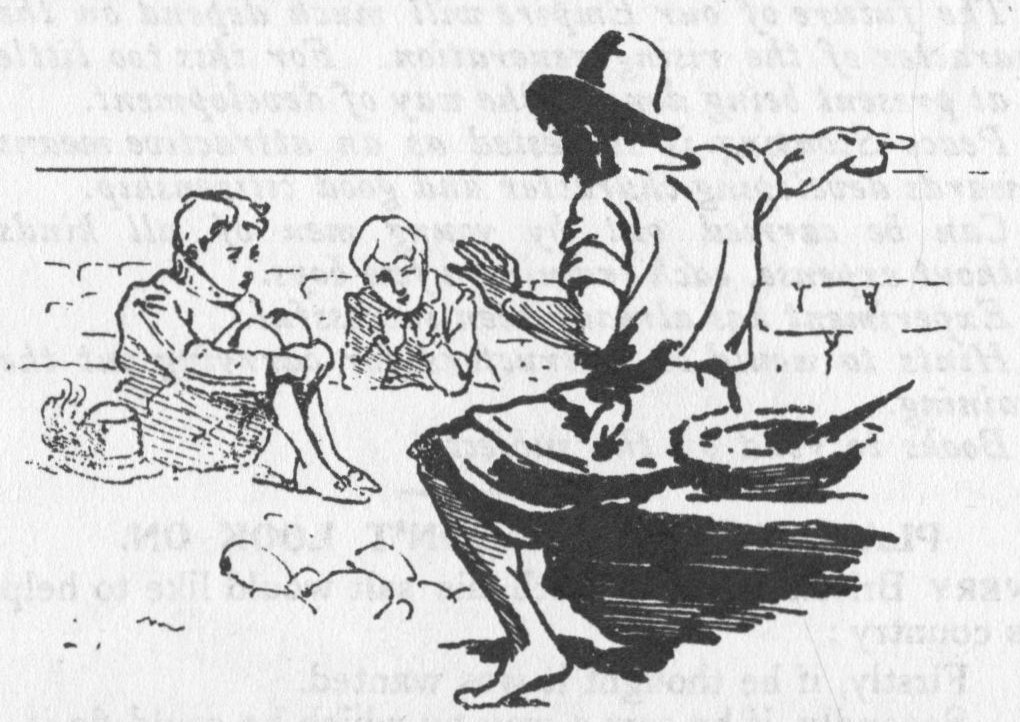
Instruction of Boy Scouts. "Boyhood of Raleigh," after Sir J. Millais. From such instruction was a great character formed.
The main causes of the downfall of Rome is similar to that which resulted in the downfall of other great empires, such as the Babylonian, Egyptian, Greek, Spanish, and Dutch, and that cause may be summed up in each case as the decline of good citizenship and the want of energetic patriotism. Each nation, after climbing laboriously to the zenith of its power, seemed then to become exhausted by its effort, and sit down in a state of repose, relapsing into idleness, studiously blind to the fact that other nations were gradually pushing up to destroy it. It is easy to push historical parallels too far, 337and whether or not these parallels are real or exaggerated, they give us food for reflection. The main point is for us to take the lesson to heart, and see, before it is too late, that our Empire also be not undermined by these defects.
I am not so pessimistic myself as to think with some people that we are already so far on the downward grade as to be in a hopeless condition. On the contrary, I think that we are only near to the parting of the ways where it becomes incumbent upon everyone of us who has the slightest patriotism in him to earnestly help, in however small a way, to turn the rising generation on the right road for good citizenship.
The aim may seem too big to attain, but most big things are only got by combination of small efforts. A coral island is erected by the work of myriads of sea-insects, the Pyramids of Egypt were the result of co-operation of thousands of workers.
BAD CITIZENSHIP IS BECOMING APPARENT IN THIS COUNTRY TO-DAY.
One form of bad citizenship among many is evident around us on the part of the people themselves, who, not having been taught to think of the future, or of their country, allow themselves to come under the despotic power of a few professional agitators whose living depends on agitating (whether it is needed or not); and, blinded by the talk of these men, they attack the hand that finds the money, till they force employers to spend fortunes, either in devising machinery that will take their place and not go on strike, or in removing their business to other countries, leaving the agitators fat and happy, and a mass of people unemployed and starving, and unable to provide for the crowds of children they continue improvidently to bring into the world.
FOOTBALL.
One of the causes of the downfall of Rome was that the people, being fed by the State to the extent of three-quarters 338of the population, ceased to have any responsibility for themselves or their children, and consequently became a nation of unemployed wasters. They frequented the circuses, where paid performers appeared before them in the arena, much as we see the crowds now flocking to look on at paid players playing football.
Football in itself is a grand game for developing a lad physically and also morally, for he learns to play with good temper and unselfishness, to play in his place and "play the game," and these are the best of training for any game of life. But it is a vicious game when it draws crowds of lads away from playing the game themselves to be merely onlookers at a few paid performers. I yield to no one in enjoyment of the sight of those splendid specimens of our race, trained to perfection, and playing faultlessly; but my heart sickens at the reverse of the medal—thousands of boys and young men, pale, narrow-chested, hunched-up, miserable specimens, smoking endless cigarettes, numbers of them betting, all of them learning to be hysterical as they groan or cheer in panic unison with their neighbours—the worst sound of all being the hysterical scream of laughter that greets any little trip or fall of a player. One wonders whether this can be the same nation which had gained for itself the reputation of being a stolid, pipe-sucking manhood, unmoved by panic or excitement, and reliable in the tightest of places.
Get the lads away from this—teach them to be manly, to play the game whatever it may be, and not be merely onlookers and loafers.
Indifferent citizenship is, and always has been, the progeny of indifferent government. With it there arises a crop of doctors to suggest remedies: faddists on feeding, faddists on Socialism, faddists like myself on scouting, and so on. Some may be right, some wrong; all mean well. A certain class of Socialist, for instance, has come to the fore lately. As a matter of fact we are all Socialists in that we want to see the abolition of the existing brutal anachronism of war, and of extreme poverty and misery shivering alongside of 339superabundant wealth, and so on; but we do not quite agree as to how it is to be brought about. Some of us are for pulling down the present social system, but the plans for what is going to be erected in its place are very hazy. We have not all got the patience to see that improvement is in reality gradually being effected before our eyes.
We have a parallel in London just now in the several railway stations, which, having been found to be out of date and inadequate for their increased traffic, are being reconstructed. The Man in the Street has demanded that they should be pulled down at once, and that afterwards something better should be devised and built up. But the management have been wiser; they have recognised the defects of the old, but before pulling down they have seen that it would be fatal to stop traffic during the alterations, and have therefore laid the new foundations outside the old; they have erected the new buildings over the effete ones, and have then pulled these away piecemeal, without interrupting the public convenience, trade, or routine for a moment.
It is easy to pull down; the difficulty is to do so without damage to the country. We ought to begin by building up on a sounder foundation before destroying the old.
OUR FUTURE CITIZENS.
That foundation seems to me to be in the rising generation. If the whole of our youth were taken in hand and taught good citizenship, we should have a solid foundation on which our nation could stand for a long time to come. But it does not exist at present.
We have at the present time in Great Britain two million boys, of whom one-quarter to one-half a million are under good influences outside their school walls.
(See Sir John Gorst's "Children of the Nation" and Dr. Macnamara's Report.)
2,000,000 boys.
270,000 under good influence.
—————
Remainder = 1,730,000 independent of such.
340The remainder are drifting towards "hooliganism" or bad citizenship for want of hands to guide them the right way towards being useful.
It is this remainder, nearly two million boys, that we want to tackle and reduce.
They are boys, full of spirit and enthusiasm, approaching the cross-road, where they take the turn, either to good or evil. In spite of the improved school teaching and of the good work of Boys' and Church Lads' Brigades, Y.M.C.A., and kindred associations, a large proportion of them are drifting, owing to their environments, to evil, that is, to becoming "hooligans" and ultimately "wasters" for the natural term of their lives; no good to themselves, worse than no good to their country, just from want of a guiding hand or two at the turning point of their career.
Cannot we find these guiding hands amongst us?
PEACE-SCOUTING.
Here is one suggestion, at any rate, for a remedy by which every young man can help his country. I believe that under the attractive term and practice of "Scouting," a large number of boys might be taken in hand in a practical way, by every young man, without expense in time or money.
By "scouting" I do not mean the military work as carried on on active service. The scouting we are considering has nothing to do with this. There is another form, which one might term "peace-scouting," such as is usual with frontiersmen of our Empire in every corner of the world. The pioneers of civilisation in Central Africa; the ranchmen, cowboys, and trappers of the West; the drovers and bushmen of Australia; the explorers of the Arctic and Asiatic regions; the hunters and prospectors of South Africa; missionaries in all parts of the uncivilised world; and the constabularies of North-West Canada, South Africa, etc., are all "peace-scouts," men accustomed to live on their own resources, taking their lives in their hands, brave and loyal to their employers, chivalrous and helpful to each other, unselfish 341and reliable; MEN, in fact, of the best type. These are the peace-scouts of the Empire, and there is no reason why we should not train a large number of boys to follow in their footsteps as regards character and manliness.
A small book which I published a short time ago on the subject of scouting for soldiers has been so freely taken up by schools and boys' clubs in England that I am encouraged to think a system organised for the special purpose of teaching boys would be acceptable, and I am still further encouraged in the idea by the fact that a somewhat similar organisation founded by Mr. Ernest Thompson Seton in America has had a full and widespread success.
MILITARISM.
Two or three prominent authorities have written deprecating my attempt to "foster among the boys of Britain a bloodthirsty and warlike spirit."
I can only fear that either these gentlemen have not read the handbooks very carefully, or that I have expressed myself very badly. The whole intention of the Boy Scouts' training is for peaceful citizenship.
Even if I had advocated training the lads in a military way (which I have not done), I am impenitent enough to see no harm in it. I have not noticed that ex-soldiers are more inclined than other people to commit murders; all that I see in them, as a rule, is that they have been taught self-discipline, to sacrifice themselves, if need be, for others, to obey orders, to be sober, clean, and active, to make the best of things as they find them, to be loyal to themselves and their officers. All of which appear to me to be valuable assets in character for a citizen, whatever may be his grade or trade.
The fact that industrial employers now prefer ex-soldiers in very many of their departments speaks to the peace value of a military training. But when an eminent public man wrote to me that I ought not to teach boys soldiering because, as he puts it, "he hates 342war like the devil," I felt bound to reply that had he actually seen anything of war himself, he would, like most soldiers, hate it worse than the devil. It is for that very reason that officers almost without exception urge upon their fellow countrymen to be prepared to defend their country. It is not that they wish to make the men bloodthirsty, but it is that they may avert from our own land that worst of all modern anachronisms—the horrors of war, brought on to our own homes, our women and children.
Those who preach shutting our eyes to what is quite patent to all who dare to look out will themselves be guilty of tempting the enemy on, of bringing war upon our country, and of the blood and ruin which will assuredly follow—if there is any truth in history.
With our rising generation brought up as good citizens, sensible of their responsibilities and duties in return for the benefits which they enjoy in a free country, there would be no danger for the State; but without manliness and good citizenship we are bound to fall.
Manliness can only be taught by men, and not by those who are half men, half old women.
HOW TO TEACH SCOUTING.
The first point is to get men to take up the instruction of the boys in the art of peace-scouting. The men I have in my mind as the best qualified and able to do this are schoolmasters, clergymen, members of the Y.M.C.A., Legion of Frontiersmen, officers of Cadet Corps, Boys' and Church Lads' Brigades, Rifle Clubs, country squires, ex-army officers, telegraph-masters, etc. These could carry out the training of a few boys apiece, with very little expense of time or money, by devoting, say, Saturday afternoons and Sundays to the work, which, I can promise them, they will find a pleasure rather than a labour in practice.
My suggestion to them would be for each to select a party of six or eight youths or smart boys, and carefully 343instruct them in the details of peace-scouting. These boys could then act as assistant instructors or "patrol leaders" in training each five or six more in the same art in the progressive course of instruction in this handbook.
The instruction is designed for boys of every class.
To help the lowest from drifting into hooliganism and to give them health, character, and aims.
To teach the middle class how to work well, and to be patriotic first and political second.
To teach the wealthier to be chivalrous and sympathetic with their less-favoured brothers, and ultimately to help in spreading the training.
One wants to bring all classes more in touch with each other, to break down the existing barriers, which are only artificial after all, and to teach them to give and take in the common cause instead of being at snarls of class against class, which is snobbery all round and a danger to the State.
The training is applicable to town or country, indoors as well as out.
Not in Opposition to Existing Organisations for Boys.
The scheme is not in any way intended to be in opposition to any existing organisation. On the contrary, we want amalgamation rather than rivalry, and scouting is only intended to be used as an additional attraction by those in charge of boys' organisations of any kind. If scouting is taken up by several it may prove a bond between all. Where such organisations do not already exist it can supply a particularly simple and effective one for catching a number of boys who would otherwise have no hand to guide them.
Experimental Camp.
I have already made a preliminary trial of the scheme with a camp of boys of all sorts, from Eton as well as from the streets, and the results were such 344as to encourage very great hopes as to the possibilities of the scheme when carried out on a larger scale. A large island was lent for the purpose by the late Mr. Charles Van Raalte, Brownsea Island, near Poole.
Patrol System.
The troop of boys was divided up into "Patrols" of five, the senior boy in each being Patrol Leader. This organisation was the secret of our success. Each patrol leader was given full responsibility for the behaviour of his patrol at all times, in camp and in the field. The patrol was the unit for work or play, and each patrol was camped in a separate spot. The boys were put "on their honour" to carry out orders. Responsibility and competitive rivalry were thus at once established, and a good standard of development was ensured throughout the troop from day to day. The troop was trained progressively in the subjects of scouting given on page 8. Every night one patrol went on duty as night picket—that is, drew rations of flour, meat, vegetables, tea, etc., and went out to some indicated spot to bivouac for the night. Each boy had his greatcoat and blankets, cooking pot and matches. On arrival at the spot, fires were lit and suppers cooked, after which sentries were posted and bivouac formed. The picket was scouted by patrol leaders of other patrols and myself, at some time before eleven p.m., after which the sentries were withdrawn and picket settled down for the night.
Method of Instruction.
We found the best way of imparting theoretical instruction was to give it out in short instalments with ample illustrative examples when sitting round the camp fire or otherwise resting, and with demonstrations in the practice hour before breakfast. A formal lecture is apt to bore the boys.
The practice was then carried out in competitions and schemes.
For example, take one detail of the subject, "Observation"—namely, tracking.
3451. At the camp fire overnight we would tell the boys some interesting instance of the value of being able to track.
2. Next morning we would teach them to read tracks by making foot-marks at different places, and showing how to read them and to deduce their meaning.
3. In the afternoon we would have a game, such as "deer-stalking," in which one boy went off as the "deer," with half-a-dozen tennis balls in his bag. Twenty minutes later four "hunters" went off after him, following his tracks, each armed with a tennis ball. The deer, after going a mile or two, would hide and endeavour to ambush his hunters, and so get them within range; each hunter struck with his tennis ball was counted gored to death; if, on the other hand, the deer was hit by three of their balls he was killed.
This was our principle for teaching most of the items.
Discipline was very satisfactory indeed. A "court of honour" was instituted to try any offenders against discipline, but it was never needed. In the first place, the boys were put "on their honour" to do their best; in the second place, the senior boys were made responsible for the behaviour of the boys forming their patrol. And this worked perfectly well.
Results of the Camp Experiment.
Since this experimental camp I am more than ever convinced of the possibilities which underlie the scouts' training as an educator for boys of all classes. Prepared as I was for enthusiastic endeavour on the part of the lads, I was surprised at the effect on their character, which became visible even in the few days we were at work. I have not trusted merely to my own observation, but have had reports from all the parents, bearing out this conclusion, and giving incidentally some very useful hints from the parents' point of view. That the boys enjoyed the training is evident from the letters which I have had from them, and some of them, at any rate, have remembered what they learnt. One of the boys—a working boy—writes: "The most important thing 346that a great many boys need to learn is to look at the bright side of things, and to take everything by the smooth handle. I myself found that a great lesson, and I shall never find words enough to thank you for teaching me it. I have already found it a great help even in everyday life."
AUTHORITIES WHO MIGHT FIND THE SCHEME USEFUL.
Lord Mayors and Mayors.—This scheme might suggest some useful forms of instruction for the newly-authorised vacation schools.
Schoolmasters and Teachers.—This scheme may, I hope, supply an additional means by which to get hold of the more unruly boys and to continue out of hours the practice of the theory which they have learnt in school. Unruly boys are often the best, once you have got the right side of them. A Commission on our schools has recently shown that there is an excess of book instruction in many of them; possibly if one day a week were devoted to scouting it would greatly benefit both the teachers and the scholars mentally and physically.
Clergymen.—Clergymen would, I think, find in scouting a good means of keeping the wilder spirits among their boys in some kind of order, and also of arousing the loafers among them into some sort of energy and interest in life.
Parents.—Parents might be apprehensive that this course would lead their sons to imbibe too much the spirit of adventure and romance, and those whose sons are wage-earners would fear for their getting unsettled and wasting their working hours on a useless fad. But to such I would point out that the course is purposely designed to teach the boys useful knowledge in a form that will attract them, and it can be carried out entirely on Saturday afternoons and Sundays as a counter-attraction to that Sunday loafing which is the ruin of so large a proportion of our young men.
347Ladies.—To ladies interested in the care and education of girls, I think this scheme might supply a suggestion for an attractive organisation and valuable training. The experiment of a somewhat similar camp for factory girls has been such an unqualified success as to lead one to hope that scouting camps might with advantage be employed for the rising generation of girls as well as boys.
Boys' Clubs and Brigades.—Officers of Boys' Clubs, Boys' Brigades, Church Lads' Brigades, University and Public Schools Missions, Cricket Clubs, and Cadet Corps, but most especially officers of Rifle Clubs, will, I hope, find in this scheme an additional means of attracting recruits and of maintaining their interest in their corps after the first glamour of it has worn off.
Legion of Frontiersmen.—The Legion includes many an old scout in its ranks who could at once take up the instruction of a few boys and youths and do really valuable work for the Empire, while reviving for himself many a delightful experience of camp and prairie life.
Ex-Army Officers.—Then there are a number of ex-Army officers, keen and capable, but without occupation, who would here have a great opportunity for the exercise of their special gifts and of their prestige among boys for doing a great national good with very little trouble and expense to themselves.
Country Squires.—Members of county families might do much among their tenants and villagers by making good Englishmen of their lads, somewhat on the old feudal lines, by means of scouting.
Y.M.C.A.—Everyone recognises the keenness and go-a-head manliness of the members of the Y.M.C.A. and Polytechnics in all parts of the kingdom, and I am convinced that if these men could see their way to do a good turn to the rising generation of their countrymen they would take it up with ardour, especially since this kind of work is becoming a part of their policy. It is 348these gentlemen that I have specially in my eye in suggesting this scheme, as being the men who can, if they wish, get hold of practically the whole of the British boyhood by means of scouting. If every member of the Y.M.C.A. took a friend as his second-in-command and six boys as pupils, each of them being required to bring in another recruit, and then acting as leaders and instructors to further patrols of six, there would at once be the commencement of a great "snowball" movement for good.
HINTS TO INSTRUCTORS.
I do not in these "Hints" propose to teach my grandmother to suck eggs, and, therefore, I only address them to those who have had no previous practice in teaching boys. They are merely a few notes from my own experience in that line, and tend to explain some of the arrangement of details in the Handbook.
When you are trying to get boys to come under good influence you are as a fisherman wishful to catch fish.
If you bait your hook with the kind of food that you like yourself it is probable that you will not catch many—certainly, not the shy, game kind of fish. You, therefore, use as bait the food that the fish likes.
So with boys, if you try to preach to them what you consider, elevating matter you won't catch them. Any obvious "goody-goody" will scare away the more spirited among them, and those are the ones you want to get hold of. The only way is to hold out something that really attracts and interests them. And I think you will find that scouting does this.
You can afterwards season it with what you want them to have.
To get hold of your boys you must be their friend; but don't be in too great a hurry at first to gain this footing until they have got over their shyness of you. Mr. F. D. How, in his "Book of the Child," sums up the right course in the following story:
"A man whose daily walk led him down a certain 349dingy street saw a tiny boy with grimy face and badly-developed limbs playing with a banana-skin in the gutter. The man nodded to him—the boy shrank away in terror. Next day the man nodded again. The boy had decided there was nothing to be afraid of, and spat at the man. Next day the little fellow only stared. The day after he shouted 'Hi!' as the man went on. In time the little fellow smiled back at the greeting which he now began to expect. Finally the triumph was complete when the boy—a tiny chap—was waiting at the corner and seized the man's fingers in his dirty little fist. It was a dismal street, but it became one of the very brightest spots in all that man's life."
"BE PREPARED."
In this book I suggest as subjects to teach your boys such things as Observation of Details and consequent ability to read character and thereby to gain sympathy, the value of patience and cheery good temper, the duty of giving up some of one's time and pleasure for helping one's country and fellow men, and the inner meaning of our motto "Be Prepared."
But as you come to teach these things you will very soon find (unless you are a ready-made angel) that you have to acquire them yourself before you can succeed with the boys, and when once this is accomplished the occupation is intensely interesting and improving.
You must "Be Prepared" yourself for disappointments at first, though you will as often as not find them outweighed by unexpected successes.
You must from the first "Be Prepared" for the prevailing want of concentration of mind on the part of boys, and if you then frame your teaching accordingly I think you will have very few disappointments. Do not expect them to pay great attention to any one subject for very long until you have educated them to do so. You must meet them half-way and not give them too long a dose of one drink—a short, pleasing sip of one kind and then off to another, gradually lengthening the sips till they become steady draughts.
350Thus a formal lecture on the subject which you want to practise very soon palls on them, their thoughts begin to wander and they get bored because they have not learnt the art of switching their mind where they want it to be and holding it there.
This making the mind amenable to the will is one of the important inner points in our training.
For this reason it is well to think out beforehand each day what you want to say on your subject and then bring it out a bit at a time as opportunity offers—at the camp-fire or in intervals of play and practice, not in one long set address.
The lectures in this book are broken up into sections for this purpose.
Frequent practical demonstrations and practices should be sandwiched in between the sections of the lectures to hold the attention of the boys and to drive home your theory.
CLUBROOM.
Half the battle is to get a room lent for certain nights in the week, or hired as a club for the scouts, even if they only consist of a patrol in a village.
It must be well lit and well ventilated to prevent depression and boredom. Pictures of incidents (not landscapes or old portraits) help to make attraction.
A bright fire in winter.
Interesting illustrated books and magazines.
This can generally be got, furniture, games, etc., being given in the first instance by well-wishers.
A coffee-bar, commencing on the smallest lines, will generally succeed, and if carefully managed may develop a regular income for the upkeep of the clubroom.
The scouts themselves must do the cleaning and decorating, and making furniture.
Discipline and good order should be kept inside the room, and neatness insisted on, Patrol leaders being made responsible, Patrols taking it in turn to be responsible for cleanliness and good order of the room for a week at a time.
351If a bit of ground, even waste ground or a backyard, is available as club ground so much the better. You want some place where the scouts can make huts, light fires, play basket-ball, make tracks, etc.
Make the boys themselves manage the club affairs, as far as possible, by committees, and putting boys in responsible charge of room, equipment, papers, etc. Sit back yourself and let them make their mistakes at first till they learn sense and responsibility. Committee and annual meetings are very useful for giving self-respect and responsibility to a number of boys.
In America small, self-managed boys' clubs are becoming exceedingly numerous and popular in all towns and villages. And the education authorities help them by allowing them the use of classrooms in the school buildings in the evenings. This might easily be done in England too.
At the same time, when you can get your own clubroom, no matter how small, it gives the boys more a sense of proprietorship and responsibility, especially if they have taken a hand themselves in making the furniture, putting up pictures, etc.
The clubroom must not be made cosy like a lady's boudoir, as the boys must be able to romp in it occasionally, or play handball or "Bang the Bear," etc. So you want furniture that will pack away into a corner, such as folding wooden chairs, small tables, and a cupboard in which to put away books, games, etc., when the romp comes on.
The ideal club is one of two rooms—one for quiet games, reading and talking; the other for romping, gymnastics, etc.
The boys must of course pay subscription towards rent, lighting, furnishing, etc., and the major expenses must be provided for by means of some joint work by them, such as garden produce, toys, displays or bazaars (as described in Appendix).
One penny weekly, paid strictly in advance, is sufficient as a membership subscription.
A Penny Savings Bank should be started to enable 352boys to put by money to pay for outings and eventually to start them in the practice of thrift.
A piano is of great help in a club, if you have some one who can play it, to help out songs, musical drill, war-dances, etc.
THE HANDBOOK.
The Handbook is merely intended to offer suggestions, not to tie instructors to one set course.
In such brief space it can only touch sketchily upon subjects whose detail as instructor you must fill in for yourself, according to your own imagination and resourcefulness, to suit your particular local circumstances.
I give with each lecture the titles of books bearing on the subject, to which you can probably get access in your public library, but you will also find every day as you read your newspaper fresh things worth cutting out to use in your lectures. Indeed, if you are ever hard up for a subject, take the leading news items of the past week, and explain them in an interesting way with maps, etc.
I have found the value of this also in dealing with grown-ups in men's clubs, hospitals, etc.
The "History of England" by H. O. Arnold-Forster will at all times give you useful subjects in most interesting form. For your own information read "Duty," by Samuel Smiles.
I have endeavoured to make the Handbook readable by the boy himself, since a boy should be encouraged to read for himself. The worst of it is that the literature to which as a rule he has access is the cheap and nasty press with little else than crimes and tragedies and big football matches to catch his attention.
He thus becomes educated downwards instead of being elevated by good examples to higher deeds.
The reading of such books as "Golden Deeds," "Deeds that Won the Empire," and so on, are the best of antidotes, especially if impressed by means of modern examples, illustrations and lantern slides, and acting the incidents.
353
COURSE OF INSTRUCTION.
I suggest the following scheme of work, to be altered according to local circumstances.
Give a week to each chapter of the book.
On Saturday evening give a lecture with practical demonstrations and, where possible, with lantern slides, on the subject of the following week's instruction.
Among the worst classes in our slums Sunday is, unfortunately, perhaps the most unholy day of the week, but by using it for instruction of the proposed kind I believe that a good proportion of these lads might be won and led to better things than the loafing and vice which are at present incidental to the day.
So, for such lads, I advocate using Sunday morning for teaching the minor practices, and the afternoon for the consequent scouting exercises.
It is true that this suggestion has been criticised in some quarters, but it has, in the end, been generally accepted on the plea that it makes for saving souls, for which work there need be no Sunday closing.
The details thus taught could then be carried out and perfected by the boys individually in their own time during the week, or by occasional parades when possible under their patrol leaders, till the following Saturday afternoon, when you could have a final competition or games on that subject before starting on the next chapter that evening.
This is only a suggestion on the supposition that you and your boys are at other work all the week. If you would thus devote eight Saturday afternoons and Sundays to this work you will have completed a course of instruction which will guide a number of boys for life, and will take them from that present school of loafing which is to be found, to our great disgrace, at the corner of every village street in England on Sunday afternoon.
If funds are then forthcoming amongst the boys a camp of a week or ten days, or for two or three week-ends in the summer, would complete their instruction and put it to a practical test, while serving as a great reward for good preliminary work. And it need not be 354very expensive if the boys work for it and save up, as suggested in Chapter IV.
As I have before remarked, the training laid down in this book is merely suggestive.
The instructor should use his own knowledge and imagination and enlarge upon it.
There is much useful technical knowledge which he might incidentally impart to his boys, either himself or by getting friends to come and demonstrate (I don't say "lecture") on such points as the principles of steam or petrol-engines, or electricity; the work of sailors, soldiers, firemen, police, and so on; pioneer work such as bridging with models, road making, building, etc., also carpentering, modelling, casting, plumbing, gardening, etc.
Excursions from town into country, and seeing farm life, mining, fisheries, etc.; or from country to town and visiting the Zoological Gardens, interesting portions of museums, picture-galleries, armouries, etc., would be valuable and popular.
With a carefully-laid programme of such items the scouts' training can be carried out indefinitely in an interesting way, and on lines that will be of use to them in their future career.
I even advocate taking the boys to a theatre to see something really good, as a very great inducement to them to save the money necessary to pay for their seats. It can be made the first step towards thrift.
METHOD OF INSTRUCTION.
The way to teach a language is not to bore your pupil at first with the dry bones of elementary grammar, but to plunge into fairly deep water with phrases and conversation; the grammar will then quickly follow of itself.
So also with most other subjects of instruction, including scouting. For instance, take tracking. After preparing the boys' minds with a few good tracking yarns and showing a few actual tracks and their meaning, don't wait till they get bored in trying to learn 355the elementary details, but take them for a real piece of practical tracking. After they have found out for themselves how weak they are at it, give them further "sips" of the elementary part.
356
IMAGINATION.
Boys are full of romance, and they love "make-believe" to a greater extent than they like to show.
All you have to do is to play up to this and to give rein to your imagination to meet their requirements. But you have to treat with all seriousness the many tickling incidents that will arise: the moment you laugh at a situation the boys are quick to feel that it is all a farce, and to lose faith in it forthwith and for ever.
For instance, in instructing a patrol to make the call of its tutelary animal (page 355), the situation borders on the ridiculous, but if the instructor remains perfectly serious the boys work at it with the idea that it is "business"—and once accomplished the call becomes a fetish for esprit de corps among the members of the patrol.
Bacon said that play-acting was one of the best means of educating children, and one can quite believe him.
It develops the natural power in them of imitation, and of wit and imagination, all of which help in the development of character; and at the same time lessons of history and morality can be impressed on their minds far better by their assuming the characters and acting the incidents themselves than by any amount of preaching of the same on the part of the teacher.
The recent craze for historical pageants is, in reality, one of the best ideas, educationally, that has come over us of late years. In places where pageants have been held, both old and young have learnt—and learnt for the rest of their lives—something of the history of their forefathers, their town, and their country.
Instructors will similarly find it a genuinely useful practice to make their scouts act scenes from history or of incidents with which they desire to impress them. Such, for instance, as "Wilson's last Stand," "The Wreck of the Birkenhead," "The Sentry at Pompeii," and so on.
For this reason a few suggestions for pageants are given in the Appendix.
It is also easy to get up real plays, such as To 357Parents and Guardians (See Messrs. Samuel French's List), for which the organisation, rehearsals, and performance are all good, useful practice, especially in the long winter evenings. Begin with a small play first, such as Box and Cox or Area Belle.
When these performances attain some degree of merit they might be used as a means of gaining funds.
RESPONSIBILITY TO JUNIORS.
The great thing in this scheme is to delegate responsibility—mainly through the patrol leaders.
Have, if possible, a good Second in Command to yourself to ensure continuity of instruction should you be unable on occasions to be present yourself, and to relieve you of many minor details of administration.
Give full responsibility and show full confidence in your patrol leaders. Expect a great deal from them, and you will get it.
This is the key to success in scout-training.
Foster the patrol spirit and friendly rivalry between patrols and you will get immediate good results in an improved standard of the whole. Don't try to do everything yourself or the boys will merely look on, and the scheme will flag.
DISCIPLINE.
Insist on discipline and strict obedience; let them run riot only when you give leave for it, which is a good thing to do every now and then.
A nation to be powerful and prosperous must be well disciplined, and you only get discipline in the mass by discipline in the individual. By discipline I mean patient obedience to authority and to other dictates of duty.
This cannot be got by repressive measures, but by educating the boy first in self-discipline and in sacrificing of self and selfish pleasures for the benefit of others. This teaching is largely effected by means of example, and by expecting it of him. There lies our work.
358Smiles gives in his book on "Duty" Baron Stoeffel's report comparing the discipline of the Germans and the French before the war, 1870-71, in which he foretold the victory of the Germans, on account of their superior discipline; and, in commenting on this, Mr. Smiles writes:
"Can it be that we are undergoing the same process in England as in France; that the ever-extending tide of democracy is bearing down the best points of a very vain-glorious people?
"We are a very vain-glorious people.
"We boast of our wealth, our naval and military strength, and our commercial superiority. Yet all these may depart from us in a very few years, and we may remain, like Holland, a rich and yet powerless people. The nation depends on the individuals who compose it; and no nation can ever remain distinguished for morality, duty, adherence to the rules of honour and justice whose citizens, individually and collectively, do not possess the same traits."
Sir Henry Knyvett, in 1596, warned Queen Elizabeth that the State which neglects to train and discipline its youth produces not merely rotten soldiers or sailors, but the far greater evil of equally rotten citizens for civil life; or, as he words it, "For want of true discipline the honour and wealth both of Prince and countrie is desperatlie and frivolouslie ruinated."
Discipline is not gained by punishing a child for a bad habit, but by substituting a better occupation that will absorb his attention and gradually lead him to forget and abandon the old one.
RELIGION.
An organisation of this kind would fail in its object if it did not bring its members to a knowledge of religion—but the usual fault in such cases is the manner in which this is done. If it were treated more as a matter of everyday life and quite unsectarian, it would not lose its dignity and it would gain a hold. It is often the best 359not to have religious instruction as a special feature, but to introduce it by "sips" here and there among other instruction, as I suggest in the chapter on "Chivalry" and elsewhere in this book.
CONTINENCE.
In the Handbook I have touched on many important items of a boy's education, but there is scarcely one more important than this, which, under advice, I have relegated from the body of the book to these "Notes for Instructors."
The training of the boy would be very incomplete did it not contain some clear and plain-spoken instructions on the subject of continence.
The prudish mystery with which we have come to veil this important question is doing incalculable harm.
The very secrecy with which we withhold all knowledge from the boy prompts him the more readily to take his own line, also secretly, and, therefore, injuriously.
I have never known a boy who was not the better for having the question put to him frankly and openly. It can quite well be done without indelicacy.
You can warn him that "indulgence" or "self-abuse" is a temptation more likely to assail him than any other vices, such as drinking, gambling, or smoking, and is more harmful than any of them, since it brings with it weakness of heart and head, and, if persisted in, idiocy and lunacy.
Show him that it is not even a manly vice, but is everywhere looked down upon with contempt; and that it can be overcome by determination and strength of will.
The temptation may arise from physical causes, such as eating rich foods, sleeping on the back in a soft bed with too many blankets on, or from constipation, or it may come from suggestion through pictures, stories, or dirty talk of others.
In any case, knowing their danger, these causes must 360be avoided, and the temptation met with a mental determination to fight it by substituting other thoughts, by washing in cold water, and by exercising the upper part of the body, with boxing or arm exercises, to draw away the blood, and so on.
The first occasion will be the difficult one, but once this is successfully overcome subsequent attacks will be more easy to deal with.
If the boy still finds difficulty about it he should come and speak quite openly to his officer, who can then advise him what to do.
But for an instructor to let his boys walk on this exceedingly thin ice without giving them a warning word, owing to some prudish sentimentality, would be little short of a crime.
HINTS TO INSTRUCTORS.
Priggishness or conceit is sure to come to some of your boys as they find themselves good at various games or branches of their work. These must be taken down by the skill and patience of the instructors. Don't get upset by having one or two of these to deal with, but, on the contrary, take it as a sporting adventure, and treat them as interesting subjects. It is far more satisfactory to turn one unruly character the right way than to deal with a dozen milk-and-water cases.
There are also boys who, though with other boys, are not of them. These need special individual study and special treatment, which will avail in almost every case.
Boys of rich parents need the training of a scout quite as much as any poor boy, and should, therefore, be taken in hand by those who are willing to deal with them.
In "The Boy Problem" it is shown how in the days of chivalry boys were pages to the esquires in order that they might learn knightly habits, and then they went to one of the young knight's castles to learn knightly ideas. In the same way boys of to-day need contact with chivalrous young men to make them into noble and courtly men.
361
FORMING CHARACTER.
Keep before your mind in all your teaching that the whole ulterior object of this scheme is to form character in the boys—to make them manly, good citizens.
For the individual it is useful, when describing a situation, to stop narration at the critical point and ask a boy what would be his action under the circumstances, in order to develop quick decision, and so on.
In the games it is of the greatest importance to so arrange that a boy imagines himself running a great danger in carrying out the mission given him. In this way he becomes accustomed to taking risks.
For the mass it is a useful practice frequently to give false alarms to see what they do and to accustom them to face sudden crises. Such alarms, for instance, as having smoke blown into the room and a sudden alarm of fire given, or getting a boy to rush in and report that Johnny Tomkins has fallen from a tree and hurt himself.