THE EFFECT ON FOWLS OF NITROGENOUS AND CARBONACEOUS RATIONS.1
Reading edition
THE EFFECT ON FOWLS OF NITROGENOUS AND CARBONACEOUS RATIONS.1
On July 2, 1889, ten Plymouth Rock hens, one year old, and as nearly as possible of uniform size, were selected from a flock of thirty-five. At the same time ten chickens, hatched from the same hens mated with a Plymouth Rock cock, were similarly chosen. The chickens were about six weeks old, healthy and vigorous and of nearly the same size. Up to the time of purchase both hens and chickens had full run of the farm. The hens foraged for themselves and were given no food; the chickens had been fed corn meal dough, sour milk and table scraps.
A preliminary feeding trial was continued for twenty-five days, during which time both hens and chickens were confined, all together, in a fairly well lighted and ventilated room, and fed a great variety of food, in order that all should go into the feeding trial as nearly as possible in the same condition. During this preliminary feeding both hens and chickens increased in live weight. The ten hens from a total of 44 lb. 12 oz. to 47 lb. 1.5 oz., or 3.75 oz. each, and laid 93 eggs. The chickens from a total of 9 lb. 15 oz. to 18 lb., or 12.9 oz. each.
Food, shells and water were kept constantly before the fowls. Basins which contained the food and water were kept within a box constructed of lath, so arranged that the fowls could reach between the slats and procure food and drink without wasting or soiling.
July 26th the hens and chickens were each separated into two lots of five each, as follows:
Hens, nitrogenous ration, weighed 23 lb. 8.5 oz. Hens, carbonaceous ration, weighed 23 lb. 9 oz. Chickens, nitrogenous ration, weighed 8 lb. 15 oz. Chickens, carbonaceous ration, weighed 9 lb. 1 oz.
The four lots were placed in separate pens where they remained during the entire experiment, which lasted 125 days. They were fed and watered once daily, and an account kept of the food eaten and water drank. At each feeding the food and water remaining were weighed back and deducted from the amount charged at the previous feeding.
The hens and chickens fed a nitrogenous ration were given daily all they would eat of the following mixture: 1/3 part wheat bran, 1/3 part wheat shorts, 1/3 part cotton seed meal, 2 parts skimmed milk, and will be designated Lot I.
The hens and chickens fed a carbonaceous ration were given daily all they would eat of a ration of cracked maize and maize dough, and will be designated Lot II.
Both groups were given a small amount of green clover as long as it lasted, and afterward cabbage.
For convenience the experiment was divided into five periods of twenty five days.
FOOD CONSUMED AND INCREASE IN LIVE WEIGHT.
During the first period all the fowls seemed in good health except the carbonaceous fed chickens; they, during this as in all succeeding periods, were restless and peevish, always moping or hunting for something to eat, though their trough was filled. When fed they would greedily take a few mouthfuls and then, with their hunger still unappeased, would leave the dish. They always ate ravenously the green food which was given them, as did the hens and chickens of Lot I. The hens of Lot II., on the contrary, seemed quite willing to squat about the pen and subsist on the maize diet, and strangely enough cared little for green food. The clear maize diet was accompanied by such ill effects that the chickens of each lot, after the first period, were given daily each one-fourth ounce of wheat, and the hens each one ounce. The wheat was increased during the fourth and fifth periods in the case of the chickens to one ounce each. During the second period one of the chickens fed nitrogenous food, and during the third period another of the same lot were taken ill and removed from the experiment. Both seemed to be suffering from impacted crops, as the stomach and gizzard in each case were found to be empty.
The fact that the sick chickens disliked the nitrogenous ration, and since the first period the amount of food eaten by the hens and chickens of Lot I had continually decreased, led to the belief that their food might be too nitrogenous, and as during the last days of the third period one of the hens in Lot I was also ill, it was decided to discontinue the use of cotton seed meal and to use linseed meal instead. The hen recovered soon after the change in food.
The supply of skim milk running short in the last two periods, water was used instead in mixing the ration of the lots fed nitrogenous food.
At the beginning of the fifth period one-half of the linseed meal in the ration of Lot I was removed, and cotton seed meal substituted. This combination seemed a happy one, for on this ration both hens and chickens made large gains.
At the end of the experiment little difference could be seen in the hens of the two groups; but the two lots of chickens were in striking contrast. While the chickens fed on nitrogenous food were large, plump, healthy, active, and well feathered, the chickens fed on a carbonaceous ration were in general much smaller, sickly, and in several cases almost destitute of feathers. Two of them had perfectly bare backs, and so ravenous were they for flesh and blood that they began eating one another.
The inability of the chickens fed on a carbonaceous diet to throw out new feathers and the ability of the chickens fed on a nitrogenous diet to grow an enormous coat of feathers is a splendid illustration of the effect of the composition of the food in supplying certain requirements of animal growth. It was plain to see that maize, even when assisted by a small amount of wheat and green clover, could not supply sufficient nitrogen for the growth of feathers.
It will thus be seen that while both lots of hens lost weight during the experiment, the loss was slightly greater with those fed nitrogenous food, but these produced by far the most eggs.
The chickens fed on nitrogenous food just about doubled in weight, while those fed carbonaceous food only added about one-third to their weight.
PRODUCTION OF EGGS.
During the first week the carbonaceous fed hens laid three eggs while the others laid two. The two groups were, therefore, practically evenly divided at the start as to the condition of the laying stage. At the end of the first period the nitrogenous fed hens had laid forty-three eggs and the carbonaceous fed hens had laid twenty. During the next twenty-five days the former laid thirty and the latter six; during the third period the former laid six and the latter not any. From this time on no eggs were received from either group. The decline in egg production was probably due in large part to the fact that the hens began to moult during the second period, and continued to do so during the rest of the experiment.
The eggs laid by the nitrogenous fed hens were of small size, having a disagreeable flavor and smell, watery albumen, an especially small, dark colored yolk, with a tender vitelline membrane, which turned black after being kept several weeks. While the eggs of the carbonaceous fed hens were large, of fine flavor, of natural smell, large normal albumen, an especially large, rich yellow yolk, with strong vitelline membrane, which was perfectly preserved after being kept for weeks in the same brine with the other eggs.
TOTAL FOOD CONSUMED DURING EXPERIMENT.
Lot. I.--Nitrogenous.Lot. II.--Carbonaceous.
Hens.*Chicks Hens.Chicks.
lb.lb. lb.lb.
Bran.29.9021.85Maize.82.1551.30
Shorts.29.9021.85Green clover.18.7518.75
Cotton seed meal.21.4813.24Cabbage.16.0016.00
Linseed meal.8.438.61Wheat15.6311.71
Skimmed milk.105.4961.33
Wheat.15.6311.71
Green clover.18.7518.75
Cabbage.16.0016.00
Total.245.58173.34 Total.132.5392.76
Nutritive ratio.1:3.11:3 Nutritive ratio.1:7.81:8
* Calculated for five chicks, based upon the amount eaten by the three after the two sick were removed.
EGGS LAID AND GAIN IN WEIGHT--HENS.
Lot I.Lot II.
Nitrogenous.Carbonaceous.
Live weight, July 26.23.5323.56
Live weight, November 27.21.3122.00
Loss.2.221.56
Number of eggs laid.79.0026.00
Weight of eggs laid lb.8.252.92
Average weight of eggs, oz.1.671.80
Gain in weight, including eggs, lb.6.031.36
GAIN IN LIVE WEIGHT--CHICKENS.
Lot I.Lot II.
Nitrogenous.Carbonaceous.
Live weight, July 26. 8.94 9.06
Live weight, November 27.17.8912.63
Gain, lb. 8.95 3.57
Gain, per cent. 100.1139.40
Samples of the eggs from each lot of fowls were privately marked and sold to a boarding house where the cook did not know that the eggs were undergoing a test. On meeting the cook several days later the following words were heard: "Do you expect me to cook such eggs as these! About every other one is spoiled." On examination of the ovaries after slaughtering, it was found that in the case of one of the carbonaceous fed hens the ovules were in a more advanced stage, but on the whole the nitrogenous fed hens were much nearer the laying period. With this single exception, the clusters of ovules in the carbonaceous fed hens were uniformly small. Neither group would have laid under any probability for several weeks. It would seem from these facts, together with the fact that during the experiment the nitrogenous fed hens laid more than three times as many eggs, that a nitrogenous ration stimulates egg production.
THE RESULTS OF SLAUGHTERING.
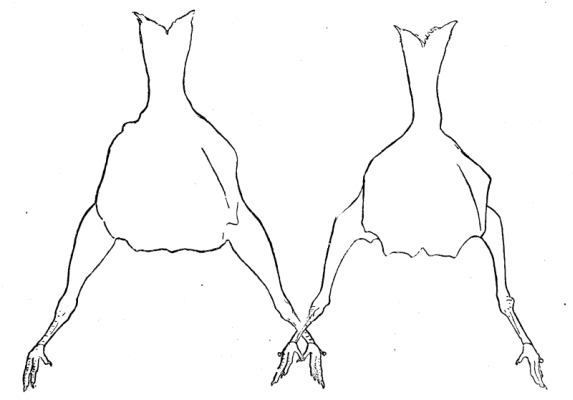
On November 27 the fowls were slaughtered. Each fowl was weighed, wrapped in a bag to prevent floundering, and killed by severing an artery in the roof of the mouth. The blood was caught in a glass jar. The fowls were then picked and the feathers weighed, after which the body was laid open longitudinally by cutting alongside the sternum and through the back bone. When all had been thus prepared, they were hung up in groups to be photographed, but the photographs were quite unsatisfactory so far as showing the relative proportions of fat and lean. The accompanying drawing made from the photograph shows the relative development of an average pair of chickens. Attention is particularly called to the thighs.
One-half of each fowl was tested by cooking for flavor, succulence, and tenderness. The other half was carefully prepared for chemical analysis by separating the meat from the bones. The flesh was thoroughly mixed and run through a sausage cutter, mixed again, and the process repeated three times. From different parts of this mixture a large sample was taken, from which the chemist took his samples for analysis. The right tibia of each fowl was tested for strength by placing it across two parallel bars and suspending a wire on its center, on which were placed small weights until the bone gave way.
DRESSED WEIGHT, INTERNAL ORGANS, ETC.
Hens.Chickens.
Lot I. Lot II.Lot I. Lot II.
Nitrogenous.Carbonaceous.Nitrogenous.Carbonaceous.
lb.lb.lb.lb.
Live weight21.3122.017.8912.63
Dressed weight.14.8615.0912.018.89
Dressed weight, per cent.69.768.667.170.5
Weight of blood.0.750.660.550.34
Weight of feathers.1.411.251.280.66
Weight of intestinal fat.0.591.980.340.66
Weight of offal.3.703.023.622.08
Weight of bones.3.473.633.182.69
Weight of flesh.11.3911.478.936.20
The breaking strain of the right tibia was as follows for the hens and chickens of the various lots:
Average hens,nitrogenous. 48.16
" carbonaceous. 51.74
Average chickens,nitrogenous. 46.64
"carbonaceous. 31.18
There was little difference in the strength of the bones of the hens, undoubtedly because the bones were mature before the feeding began, and were little affected by the feeding. We find, however, that the bones of the chickens fed on nitrogenous food were almost fifty per cent. (49.6) stronger than those fed carbonaceous food.
The difference in the composition of the flesh, as shown by the analysis of Mr. W.P. Cutter, is given below:
Hens.Chickens.
Lot I. Lot II.Lot I. Lot II.
Nitrogenous.Carbonaceous.Nitrogenous.Carbonaceous.
lb.lb.lb.lb.
Albuminoids. 43.8125.1352.0030.06
Fat.12.5920.765.5411.34
The flesh of each group was submitted to a number of persons for a cooking test, and the almost unanimous verdict was that the flesh of the fowls fed a nitrogenous ration was darker colored, more succulent, more tender, and better flavored, though on this last there was some difference of opinion.
CONCLUSIONS.
So far as it is warrantable to draw any conclusions from a single experiment of this kind, it would seem that:
Chickens fed on an exclusive corn diet will not make a satisfactory development, particularly of feathers.
The bones of chickens fed upon a nitrogenous ration are fifty per cent. stronger than those fed upon a carbonaceous ration.
Hens fed on a nitrogenous ration lay many more eggs but of smaller size and poorer quality than those fed exclusively on corn.
Hens fed on corn, while not suffering in general health, become sluggish, deposit large masses of fat on the internal organs, and lay a few eggs of large size and excellent quality.
The flesh of nitrogenous fed fowls contains more albuminoids and less fat than those fed on a carbonaceous ration, and is darker colored, juicier and tenderer.
I.P. ROBERTS, Director.