A FIVEFOLD COMET.
Reading edition
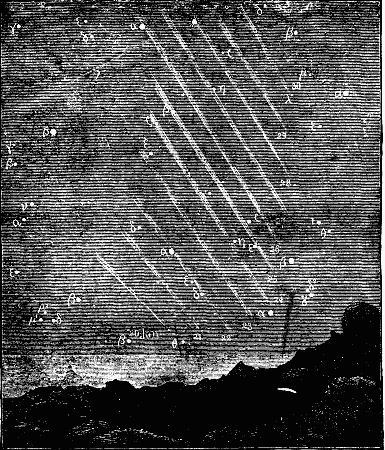
The figure illustrating this article is taken from L'Astronomie, and represents the remarkable southern comet of January, 1887, as drawn on successive days by Mr. Finlay, of Cape Town.
The comet was first seen by a farmer and a fisherman of Blauwberg, near Cape Town, on the night of January 18-19. The same night it was seen at the Cordoba Observatory by M. Thome. On the next Mr. Todd discovered it independently at the Adelaide Observatory, and watched it till the 27th. On the 22d Mr. Finlay detected the comet, and was able to watch it till the 29th. At Rio de Janeiro M. Cruls observed it from the 23d to the 25th; and at Windsor, New South Wales, Mr. Tebbutt observed the comet on the 28th and 30th. Moonlight interfered with further observations.
The comet's appearance was remarkable. Its tail, long and straight, extended over an arc of 30 degrees, but there was no appreciable condensation which could be called the comet's head. The long train of light, described as nearly equal in brightness to the Magellanic clouds, seemed to be simply cut off at that end where in most comets a nucleus and coma are shown.
This comet has helped to throw light on one of the most perplexing puzzles which those most perplexing of all the heavenly bodies, comets, have presented to astronomers.
In the year 1668 a comet was seen in the southern skies which attracted very little notice at the time, and would probably have been little thought of since had not attention been directed to it by the appearance and behavior of certain comets seen during the last half century. Visible for about three weeks, and discovered after it had already passed the point of its nearest approach to the sun, the comet of 1668 was not observed so satisfactorily that its orbit could be precisely determined. In fact, two entirely different orbits would satisfy the observations fairly, though one only could be regarded as satisfying them well.
This orbit, however, was so remarkable that astronomers were led to prefer the other, less satisfactory though it was, in explaining the observed motions of the comet. For the orbit which best explained the comet's movements carried the comet so close to the sun as actually to graze his visible surface.
Moreover, there was this remarkable, and, indeed, absolutely unique peculiarity about the orbit thus assigned: the comet (whose period of revolution was to be measured by hundreds of years) actually passed through the whole of that part of its course during which it was north of our earth's orbit plane in less than two hours and a half! though this part of its course is a half circuit around the sun, so far as direction (not distance of travel) is concerned. That comet, when at its nearest to the sun, was traveling at the rate of about 330 miles per second. It passed through regions near the sun's surface commonly supposed to be occupied by atmospheric matter.
Now, had the comet been so far checked in its swift rush through those regions as to lose one thousandth part of its velocity, it would have returned in less than a year. But the way in which the comet retreated showed that nothing of this sort was to be expected. I am not aware, indeed, that any anticipations were ever suggested in regard to the return of the comet of 1668 to our neighborhood. It was not till the time of Halley's comet, 1682, that modern astronomy began to consider the question of the possibly periodic character of cometic motions with attention. (For my own part, I reject as altogether improbable the statement of Seneca that the ancient Chaldean astronomers could calculate the return of comets.) The comet of 1680, called Newton's, was the very first whose orbital motions were dealt with on the principles of Newtonian astronomy, and Halley's was the first whose periodic character was recognized.
In 1843 another comet came up from the south, and presently returned thither. It was, indeed, only seen during its return, having, like the comet of 1668, been only discovered a day or two after perihelion passage. Astronomers soon began to notice a curious resemblance between the orbits of the two comets. Remembering the comparative roughness of the observations made in 1668, it may be said that the two comets moved in the same orbit, so far as could be judged from observation. The comet of 1843 came along a path inclined at apparently the same angle to the earth's orbit plane, crossed that plane ascendingly at appreciably the same point, swept round in about two hours and a half that part of its angular circuit which lay north of the earth's orbit plane, and, crossing that plane descendingly at the same point as the comet of 1668, passed along appreciably the same course toward the southern stellar regions! The close resemblance of two paths, each so strikingly remarkable in itself, could not well be regarded as a mere accidental coincidence.
The Constellations, though unnamed, can readily be identified, when it is noted that the Comet's course, as here represented, began in the constellation of the Crane.
However, at that time no very special attention was directed to the resemblance between the paths of the comets of 1843 and 1668. It was not regarded as anything very new or striking that a comet should return after making a wide excursion round the sun; and those who noticed that the two comets really had traversed appreciably the same path around the immediate neighborhood of the sun, simply concluded that the comet of 1668 had come back in 1843, after 175 years, and not necessarily for the first time.
It must be noticed, however, before leaving this part of the record, that the comet of 1843 was suspected of behaving in a rather strange way when near the sun. For the first observation, made rather roughly, indeed, with a sextant, by a man who had no idea of the interest his observation might afterward have, could not be reconciled by mathematicians (including the well-known mathematician, Benjamin Pierce) with the movement of the comet as subsequently observed. It seemed as though when in the sun's neighborhood the comet had undergone some disturbance, possibly internal, which had in slight degree affected its subsequent career.
According to some calculations, the comet of 1843 seemed to have a period of about thirty-five years, which accorded well with the idea that it was the comet of 1668, returned after five circuits. Nor was it deemed at all surprising that the comet, conspicuous though it is, had not been detected in 1713, 1748, 1783, and 1818, for its path would carry it where it would be very apt to escape notice except in the southern hemisphere, and even there it might quite readily be missed. The appearance of the comet of 1668 corresponded well with that of the comet of 1843. Each was remarkable for its extremely long tail and for the comparative insignificance of its head. In the northern skies, indeed, the comet of 1843 showed a very straight tail, and it is usually depicted in that way, whereas the comet of 1668 had a tail showing curvature. But pictures of the comet of 1843, as seen in the southern hemisphere, show it with a curved tail, and also the tail appeared forked toward the end during that part of the comet's career.
However, the best observations, and the calculations based on them, seemed to show that the period of the comet of 1843 could not be less than 500 years.
Astronomers were rather startled, therefore, when, in 1880, a comet appeared in the southern skies which traversed appreciably the same course as the comets of 1668 and 1843. When I was in Australia, in 1880, a few months after the great comet had passed out of view, I met several persons who had seen both the comet of that year and the comet of 1843. They all agreed in saying that the resemblance between the two comets was very close. Like the comet of 1843, that of 1880 had a singularly long tail, and both comets were remarkable for the smallness and dimness of their heads. One observer told me that at times the head of the comet of 1880 could barely be discerned.
Like the comets of 1668 and 1843, the comet of 1880 grazed close past the sun's surface. Like them, it was but about two hours and a half north of the earth's orbit place. Had it only resembled the other two in these remarkable characteristics, the coincidence would have been remarkable. But of course the real evidence by which the association between the comets was shown was of a more decisive kind. It was not in general character only, but in details, that the path of the comet of 1880 resembled those on which the other two comets had traveled. Its path had almost exactly the same slant to the earth's orbit plane as theirs, crossed that plane ascendingly and descendingly at almost exactly the same points, and made its nearest approach to the sun at very nearly the same place. To the astronomer such evidence is decisive. Mr. Hind, the superintendent of the "Nautical Almanac," and as sound and cautious a student of cometic astronomy as any man living, remarked, so soon as the resemblance of these comets' paths had been ascertained, that if it were merely accidental, the case was most unusual; nay, it might be described as unique. And, be it noticed, he was referring only to the resemblance between the comets of 1880 and 1843. Had he recalled at the time the comet of 1668, and its closely similar orbit, he would have admitted that the double coincidence could not possibly be merely casual.
But this was by no means the end of the matter. Indeed, thus far, although the circumstances were striking, there was nothing to prevent astronomers from interpreting them as other cases of coincident, or nearly coincident, cometic paths had been interpreted. Hind and others, myself included, inferred that the comets of 1880, 1843, and 1668 were simply one and the same comet, whose return in 1880 probably followed the return in 1843 after a single revolution.
In 1882, however, two years and a half after the appearance of the comet of 1880, another comet came up from the south, which followed in the sun's neighborhood almost the same course as the comets of 1668, 1843, and 1880. The path it followed was not quite so close to those followed by the other three as these had been to each other, but yet was far too close to indicate possibly a mere casual resemblance; on the contrary, the resemblance in regard to shape, slope, and those peculiarities which render this family of comets unique in the cometary system, was of the closest and most striking kind.
Many will remember the startling ideas which were suggested, by Professor Piazzi Smyth respecting the portentous significance of the comet of 1882. He regarded it as confirming the great pyramid's teaching (according to the views of orthodox pyramidalists) respecting the approaching end of the Christian dispensation. It was seen under very remarkable circumstances, blazing close by the sun, within a fortnight or three weeks of the precise date which had been announced as marking that critical epoch in the history of the earth.
Moreover, even viewing the matter from a scientific standpoint, Professor Smyth (who, outside his pyramidal paradoxes, is an astronomer of well deserved repute) could recognize sufficient reason for regarding the comet as portentous.
Many others, indeed, both in America and in Europe, shared his opinion in this respect. A very slight retardation of the course of the comet of 1880, during its passage close by the surface of the sun, would have sufficed to alter its period of revolution from the thirty-seven years assigned on the supposition of its identity with the comet of 1843 to the two and a half years indicated by its apparent return in 1882, and if this had occurred in 1880, a similar interruption in 1832 would have caused its return in less than two and a half years.
Thus, circling in an ever narrowing (or rather shortening) orbit, it would presently, within a quarter of a century or so perhaps, have become so far entangled among the atmospheric matter around the sun that it would have been unable to resist absolute absorption. What the consequences to the solar system might have been, none ventured to suggest. Newton had expressed his belief that the effects of such absorption would be disastrous, but the physicists of the nineteenth century, better acquainted with the laws associating heat and motion, were not so despondent. Only Professor Smyth seems to have felt assured (not being despondent, but confident) that the comet portended, in a very decisive way, the beginning of the end.
However, we were all mistaken. The comet of 1882 retreated on such a course, and with such variation of velocity, as to show that its real period must be measured, not by months, as had been supposed, nor even by years, but by centuries. Probably it will not return till 600 or 700 years have passed. Had this not been proved, we might have been not a little perplexed by the return of apparently the same comet in this present year. A comet was discovered in the south early in January, whose course, dealt with by Professor Kruger, one of the most zealous of our comet calculators, is found to be partially identical with that of the four remarkable comets we have been considering. Astronomers have not been moved by this new visitant on the well-worn track as we were by the arrival of the comet of 1882, or as we should have been if either the comet of 1882 had never been seen or its path had not been shown to be so wide ranging. Whatever the comet of the present year may be, it was not the comet of 1882 returned. No one even supposes that it was the comet of 1880, or 1843, or 1668. Nevertheless, rightly apprehended, the appearance of a comet traveling on appreciably the same track as those four other comets is of extreme interest, and indeed practically decisive as to the interpretation we must place on these repeated coincidences.
Observe, we are absolutely certain that the five comets are associated together in some way; but we are as absolutely certain that they are not one and the same comet which had traveled along the same track and returned after a certain number of circuits. We need not trouble ourselves with the question whether two or more of the comets may not have been in reality one and the same body at different returns. It suffices that they all five were not one; since we deduce precisely the same conclusion whether we regard the five as in reality but four or three or two. But it may be mentioned in passing as appearing altogether more probable, when all the evidence is considered, that there were no fewer than five distinct comets, all traveling on what was practically the selfsame track when in the neighborhood of the sun.
There can be but one interpretation of this remarkable fact—a fact really proved, be it noticed (as I and others have maintained since the retreat of the comet of 1882), independently of the evidence supplied by the great southern comet of the present year. These comets must all originally have been one comet, though now they are distinct bodies. For there is no reasonable way (indeed, no possible way) of imagining the separate formation of two or more comets at different times which should thereafter travel in the same path.
No theory of the origin of comets ever suggested, none even which can be imagined, could account for such a peculiarity. Whereas, on the other hand, we have direct evidence showing how a comet, originally single, may be transformed into two or more comets traveling on the same, or nearly the same, track.
The comet called Biela's, which had circuited as a single comet up to the year 1846 (during a period of unknown duration in the past—probably during millions of years), divided then into two, and has since broken up into so many parts that each cometic fragment is separately undiscernible. The two comets into which Biela's divided, in 1846, were watched long enough to show that had their separate existence continued (visibly), they would have been found, in the fullness of time, traveling at distances very far apart, though on nearly the same orbit. The distance between them, which in 1846 had increased only to about a quarter of a million of miles, had in 1852 increased to five times that space.
Probably a few thousands of years would have sufficed to set these comets so far apart (owing to some slight difference of velocity, initiated at the moment of their separation) that when one would have been at its nearest to the sun, the other would have been at its farthest from him. If we could now discern the separate fragments of the comet, we should doubtless recognize a process in progress by which, in the course of many centuries, the separate cometic bodies will be disseminated all round the common orbit. We know, further, that already such a process has been at work on portions removed from the comet many centuries ago, for as our earth passes through the track of this comet she encounters millions of meteoric bodies which are traveling in the comet's orbit, and once formed part of the substance of a comet doubtless much more distinguished in appearance than Biela's.
There can be little doubt that this is the true explanation of the origin of that family of comets, five of whose members returned to the neighborhood of the sun (possibly their parent) in the years 1668, 1843, 1880, 1882, and 1887.1
But it is not merely as thus explaining what had been a most perplexing problem that I have dealt with the evidence supplied by the practical identity of these five comets' orbits. When once we recognize that this, and this only, can be the explanation of the associated group of five comets, we perceive that very interesting and important light has been thrown on the subject of comets generally. To begin with: what an amazing comet that must have been from which these five, and we know not how many more, were formed by disaggregative processes—probably by the divellent action of repulsive forces exerted by the sun! Those who remember the comets of 1843 and 1882 as they appeared when at their full splendor will be able to imagine how noble an appearance a comet would present which was formed of these combined together in one. But the comet of 1880 was described by all who saw it in the southern hemisphere as most remarkable in appearance, despite the faintness of its head. The great southern comet of the present year was a striking object in the skies, though it showed the same weakness about the head. That of 1668 was probably as remarkable in appearance as even the comet of 1882. A comet formed by combining all these together would certainly surpass in magnificence all the comets ever observed by astronomers.
And then, what enormous periods of time must have been required to distribute the fragments of a single comet so widely that one would be found returning to its perihelion more than two centuries after another! When I spoke of one member of the Biela group being in aphelion when another would be in perihelion, I was speaking of a difference of only three and one-third years in time; and even that would require thousands of years. But the scattered cometic bodies which returned to the sun's neighborhood in 1668 and 1887 speak probably of millions of years which have passed since first this comet was formed. It would be a matter of curious inquiry to determine what may have been the condition of our sun, what even his volume, at that remote epoch in history.
[1]
It may be interesting to compare the orbital elements of the five comets above dealt with. They may be presented as follows; but it should be noticed that the determinations must be regarded as rough in the case of Comets I. and V., as the observations were insufficient for exact determination of the elements:
I.II.III.IV.V.
1668.1843.1880.1882.1887.
Perih. Passage.Feb. 29Feb. 27Jan. 27Sep. 17Jan. 11
Log. Per. Dist.7.67217.83957.77147.88958.1644
Long. Per.80° 15'73° 30' 46"74° 11' 13"55° 37' 29"89° 41'
Long. Node.357° 17'355° 46' 48"356° 17' 4"346° 1' 27"359° 41'
Inclination.125° 58'143° 1' 31"143° 7' 31"141° 59' 40"141° 16'
Eccentricity.0.99990.99910.99950.999......
Calculator.HendersonPlantamourMeyerKreutzFinlay