THE PRODUCTION OF OXYGEN BY BRIN'S PROCESS.
Reading edition
Considerable interest has been aroused lately in scientific and industrial circles by a report that separation of the oxygen and nitrogen of the air was being effected on a large scale in London by a process which promises to render the gases available for general application in the arts. The cheap manufacture of the compounds of nitrogen from the gas itself is still a dream of chemical enthusiasts; and though the pure gas is now available, the methods of making its compounds have yet to be devised. But the industrial processes which already depend directly or indirectly on the chemical union of bodies with atmospheric oxygen are innumerable.
In all these processes the action of the gas is impeded by the bulky presence of its fellow constituent of air, nitrogen. We may say, for instance, in homely phrase, that whenever a fire burns there are four volumes of nitrogen tending to extinguish it for every volume of oxygen supporting its combustion, and to the same degree the nitrogen interferes with all other processes of atmospheric oxidation, of which most metallurgical operations may be given as instances. If, then, it has become possible to remove this diluent gas simply and cheaply in order to give the oxygen free play in its various applications, we are doubtless on the eve of a revolution among some of the most extensive and familiar of the world's industries.
A series of chemical reactions has long been known by means of which oxygen could be separated out of air in the laboratory, and at various times processes based on these reactions have been patented for the production of oxygen on a large scale. Until recently, however, none of these methods gave sufficiently satisfactory results. The simplest and perhaps the best of them was based on the fact first noticed by Boussingault, that when baryta (BaO) is heated to low redness in a current of air, it takes up oxygen and becomes barium dioxide (BaO2), and that this dioxide at a higher temperature is reconverted into free oxygen and baryta, the latter being ready for use again. For many years it was assumed, however, by chemists that this ideally simple reaction was inapplicable on a commercial scale, owing to the gradual loss of power to absorb oxygen which was always found to take place in the baryta after a certain number of operations. About eight years ago Messrs. A. & L. Brin, who had studied chemistry under Boussingault, undertook experiments with the view of determining why the baryta lost its power of absorbing oxygen.
They found that it was owing to molecular and physical changes caused in it by impurities in the air used and by the high temperature employed for decomposing the dioxide. They discovered that by heating the dioxide in a partial vacuum the temperature necessary to drive off its oxygen was much reduced. They also found that by supplying the air to the baryta under a moderate pressure, its absorption of oxygen was greatly assisted. Under these conditions, and by carefully purifying the air before use, they found that it became possible to use the baryta an indefinite number of times. Thus the process became practically, as it was theoretically, continuous.
After securing patent protection for their process, Messrs. Brin erected a small producer in Paris, and successfully worked it for nearly three years without finding a renewal of the original charge of baryta once necessary. This producer was exhibited at the Inventions Exhibition in London, in 1885. Subsequently an English company was formed, and in the autumn of last year Brin's Oxygen Company began operations in Horseferry Road, Westminster, where a large and complete demonstration plant was erected, and the work commenced of developing the production and application of oxygen in the industrial world.
APPARATUS FOR MAKING OXYGEN.
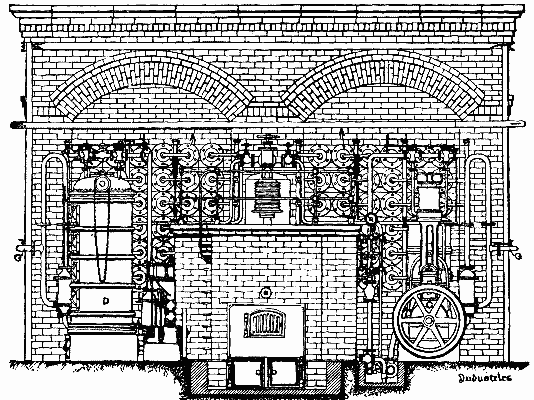
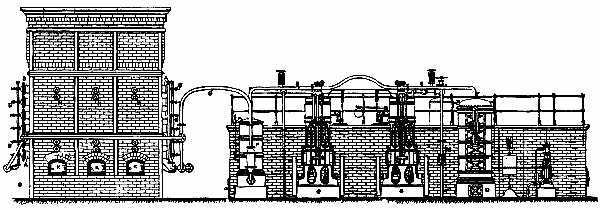
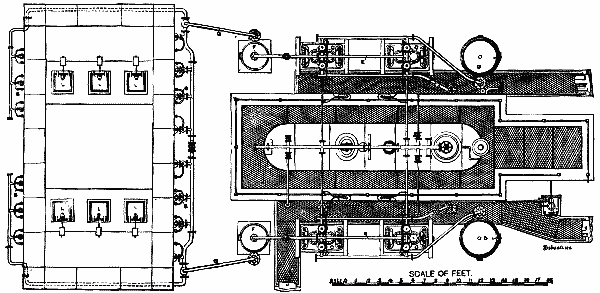
We give herewith details of the plant now working at Westminster. It is exceedingly simple. On the left of the side elevation and plan are shown the retorts, on the right is an arrangement of pumps for alternately supplying air under pressure and exhausting the oxygen from the retorts. As is shown in the plan, two sets of apparatus are worked side by side at Westminster, the seventy-two retorts shown in the drawings being divided into two systems of thirty-six. Each system is fed by the two pumps on the corresponding side of the boiler. Each set of retorts consists of six rows of six retorts each, one row above the other. They are heated by a small Wilson's producer, so that the attendant can easily regulate the supply of heat and obtain complete control over the temperature of the retorts. The retorts, A, are made of wrought iron and are about 10 ft long and 8 in. diameter. Experience, however, goes to prove that there is a limit to the diameter of the retorts beyond which the results become less satisfactory. This limit is probably somewhat under 8 in. Each retort is closely packed with baryta in lumps about the size of a walnut. The baryta is a heavy grayish porous substance prepared by carefully igniting the nitrate of barium; and of this each retort having the above dimensions holds about 125 lb. The retorts so charged are closed at each end by a gun metal lid riveted on so as to be air tight. From the center of each lid a bent gun metal pipe, B, connects each retort with the next of its series, so that air introduced into the end retort of any row may pass through the whole series of six retorts. Suppose now that the operations are to commence.
The retorts are first heated to a temperature of about 600° C. or faint redness, then the air pumps, C C, are started. Air is drawn by them through the purifier, D, where it is freed from carbon dioxide and moisture by the layers of quicklime and caustic soda with which the purifier is charged. The air is then forced along the pipe, E, into the small air vessel, F, which acts as a sort of cushion to prevent the baryta in the retorts being disturbed by the pulsation of the pumps. From this vessel the air passes by the pipe, G, and is distributed in the retorts as rapidly as possible at such a pressure that the nitrogen which passes out unabsorbed at the outlet registers about 15 lb. to the square inch. With the baryta so disposed in the retorts as to present as large a superficies as possible to the action of the air, it is found that in 1½ to 2 hours—during which time about 12,000 cub. ft of air have been passed through the retorts—the gas at the outlet fails to extinguish a glowing chip, indicating that oxygen is no longer being absorbed. The pumping now ceases, and the temperature of the retorts is raised to about 800° C. The workman is able to judge the temperature with sufficient accuracy by means of the small inspection holes, H, fitted with panes of mica, through which the color of the heat in the furnace can be distinguished. The pumps are now reversed and the process of exhaustion begins. At Westminster the pressure in the retorts is reduced to about 1½ in. of mercury. In this partial vacuum the oxygen is given off rapidly, and if forced by the pumps through another pipe and away into an ordinary gas holder, where it is stored for use. With powerful pumps such as are used in the plant under notice the whole of the oxygen can be drawn off in an hour, and from one charge a yield of about 2,000 cub. ft. is obtained. With a less perfect vacuum the time is longer—even as much as four hours. The whole operation of charging and exhausting the retorts can be completed in from three to four hours. As soon as the evolution of oxygen is finished, the doors, K, and ventilators, L, may be opened and the retorts cooled for recharging.
The cost of producing oxygen at Westminster, under specially expensive conditions, is high—about 12s. per 1,000 cub. ft. When we consider, however, that the cost should only embrace attendance, fuel, wear and tear, and a little lime and soda for the purifiers, that the consumption of fuel is small, the wear and tear light, and that the raw material—air—is obtained for nothing, it ought to be possible to produce the gas for a third or fourth of this amount in most of our great manufacturing centers, where the price of fuel is but a third of that demanded in London, and where provision could be made for economizing the waste heat, which is entirely lost in the Westminster installation. Moreover, in estimating this cost all the charges are thrown on the oxygen; were there any means of utilizing the 4,000 cub. ft. of nitrogen at present blown away as waste for every thousand cubic feet of oxygen produced, the nitrogen would of course bear its share of the cost.
The question of the application of the oxygen is one which must be determined in its manifold bearings mainly by the experiments of chemists and scientific men engaged in industrial work. Having ascertained the method by which and the limit of cost within which it is possible to use oxygen in their work, it can be seen whether by Brin's process the gas can be obtained within that limit.
Mr. S.R. Ogden, the manager of the corporation gasworks at Blackburn, has already made interesting experiments on the application of oxygen in the manufacture of illuminating gas. In order to purify coal gas from compounds of sulphur, it is passed through purifiers charged with layers of oxide of iron. When the oxide of iron has absorbed as much sulphur as it can combine with, it is described as "foul." It is then discharged and spread out in the open air, when, under the influence of the atmospheric oxygen, it is rapidly decomposed, the sulphur is separated out in the free state, and oxide of iron is reformed ready for use again in the purifiers. This process is called revivification, and it is repeated until the accumulation of sulphur in the oxide is so great (45 to 55 per cent.) that it can be profitably sold to the vitriol maker. Hawkins discovered that by introducing about 3 per cent. of air into the gas before passing it through the purifiers, the oxygen of the air introduced set free the sulphur from the iron as fast as it was absorbed. Thus the process of revivification could be carried on in the purifiers themselves simultaneously with the absorption of the sulphur impurities in the gas.
A great saving of labor was thus effected, and also an economy in the use of the iron oxide, which in this way could be left in the purifiers until charged with 75 per cent. of sulphur. Unfortunately it was found that this introduction of air for the sake of its oxygen meant also the introduction of much useless nitrogen, which materially reduced the illuminating power of the gas. To restore this illuminating power the gas had to be recarbureted, and this again meant cost in labor and material. Now, Mr. Ogden has found by a series of conclusive experiments made during a period of seventy-eight days upon a quantity of about 4,000,000 cub. ft. of gas, that by introducing 1 per cent. of oxygen into the gas instead of 3 per cent. of air, not only is the revivification in situ effected more satisfactorily than with air, but at the same time the illuminating power of the gas, so far from being decreased, is actually increased by one candle unit.
SIDE ELEVATION OF APPARATUS GENERAL PLAN OF APPARATUS THE PRODUCTION OF OXYGEN BY BRIN'S PROCESS.
So satisfied is he with his results that he has recommended the corporation to erect a plant for the production of oxygen at the Blackburn gas works, by which he estimates that the saving to the town on the year's make of gas will be something like £2,500. The practical observations of Mr. Ogden are being followed up by a series of exhaustive experiments by Mr. Valon, A.M. Inst. C.E., also a gas engineer. The make of an entire works at Westgate is being treated by him with oxygen. Mr. Valon has not yet published his report, as the experiments are not quite complete; but we understand that his results are even more satisfactory than those obtained at Blackburn.
In conclusion we may indicate a few other of the numerous possible applications of cheap oxygen which might be realized in the near future. The greatest illuminating effect from a given bulk of gas is obtained by mixing it with the requisite proportion of oxygen, and holding in the flame of the burning mixture a piece of some solid infusible and non-volatile substance, such as lime. This becomes heated to whiteness, and emits an intense light know as the Drummond light, used already for special purposes of illumination. By supplying oxygen in pipes laid by the side of the ordinary gas mains, it would be possible to fix small Drummond lights in place of the gas burners now used in houses; this would greatly reduce the consumption of gas and increase the light obtained, or even render possible the employment of cheap non-illuminating combustible gases other than coal gas for the purpose.
Two obstacles at present lie in the way of this consummation—the cost of the oxygen and the want of a convenient and completely refractory material to take the place of the lime. Messrs. Brin believe they have overcome the first obstacle, and are addressing themselves, we believe, to the removal of the second. Again, the intense heat which the combustion of carbon in cheap oxygen will place at the disposal of the metallurgist cannot fail to play an important part in his operations. There are many processes, too, of metal refining which ought to be facilitated by the use of the gas. Then the production of pure metallic oxides for the manufacture of paints, the bleaching of oils and fats, the reduction of refractory ores of the precious metals on a large scale, the conversion of iron into steel, and numberless other processes familiar to the specialists whose walk is in the byways of applied chemistry, should all profit by the employment of this energetic agent. Doubtless, too, the investigation into methods of producing the compounds of nitrogen so indispensable as plant foods, and for which we are now dependent on the supplies of the mineral world, may be stimulated by the fact that there is available by Brin's process a cheap and inexhaustible supply of pure nitrogen.—Industries.