THE SUNFLOWERS.
Reading edition
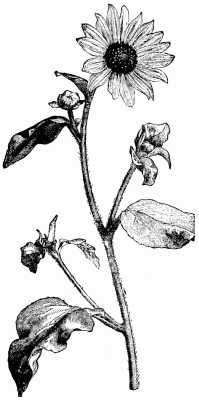
FLOWER OF HELIANTHUS ARGOPHYLLUS.
The genus Helianthus is almost entirely North-American, and for the distinction and limitation of its species we are indebted to the labor of Dr. Asa Gray, now universally recognized as the highest authority on North American plants. In the recently published second part of his "Synoptical Flora of North America" he has described thirty-nine species, six of which are annual. The synonyms and cross-naming adopted by previous authors have led to much confusion, which probably will not now be altogether cleared up, for Dr. Gray warns us that the characters of some of the species are variable, especially in cultivation. It may be added that some at least of the species readily form hybrids. There is always more or less difficulty with a variable genus in making garden plants fit wild specific types, but in the following notes I have described no kinds which I have not myself cultivated, selecting the best forms and giving them the names assigned severally by Dr. Gray to the species to which our garden plants seem to come nearest.
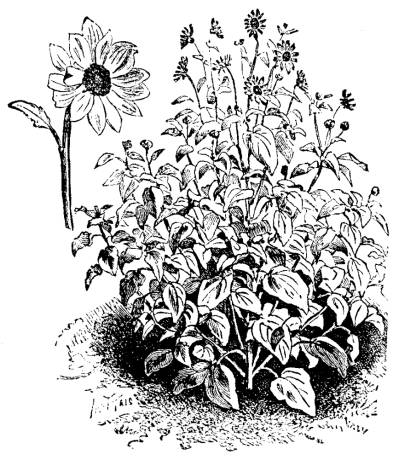
HELIANTHUS ARGOPHYLLUS, SHOWING HABIT OF GROWTH.
Helianthus multiflorus, or, according to Asa Gray, speaking botanically, H. decapetalus hort. var. multiflorus, is mentioned first, because it is the subject of the colored illustration. The name multiflorus is established by long usage, and perhaps was originally given in contrast to the few-flowered habit of H. annuus, for the type of the species is more floriferous than the variety of which Asa Gray says that it is "known only in cultivation from early times, must have been derived from decapetalus," a statement which gardeners would hardly have accepted on less indisputable authority, as they will all think the habit and appearance of the two plants widely different. The variety multiflorus has several forms; the commonest form is double, the disk being filled with ligules much shorter than those of the ray flowers, after the form of many daisy-like composites. In this double form the day flowers are often wanting. It is common also on old plants in poor soils to see double and single flowers from the same root. In the single forms the size of the flowers varies, the difference being due to cultivation as often as to kind. I have obtained by far the finest flowers by the following treatment: In early spring, when the young shoots are about an inch high, cut some off, each with a portion of young root, and plant them singly in deep rich soil, and a sheltered but not shaded situation. By August each will have made a large bush, branching out from one stalk at the base, with from thirty to forty flowers open at a time, each 5 inches across. The same plants if well dressed produce good flowers the second season, but after that the stalks become crowded, and the flowers degenerate. The same treatment suits most of the perennial sunflowers. The following kinds are mentioned in the order in which they occur in Asa Gray's book:
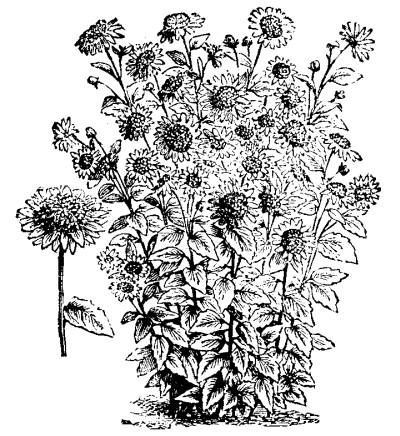
HELIANTHUS MULTIFLORUS, SHOWING HABIT OF GROWTH.
ANNUALS.
H. argophyllus (white-leaved, not argyrophyllus, silver-leaved, as written in some catalogues).—An annual with woolly leaves, neater and less coarse than H. annuus, with which it is said soon to degenerate in gardens if grown together with it.
H. annuus.—The well known sunflower in endless varieties, one of the most elegant having pale lemon-colored flowers; these, too, liable to pass into the common type if grown in the same garden.
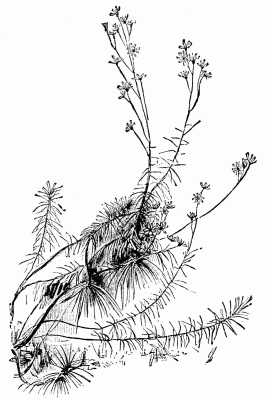
HELIANTHUS ORGYALIS, SHOWING HABIT OF GROWTH IN AUTUMN.
H. debilis var. cucumerifolius.—I have never seen the typical species, but the variety was introduced a few years ago by Mr. W. Thompson, of Ipswich, from whose seed I have grown it. It becomes 4 feet or 5 feet high, with irregularly toothed deltoid leaves and spotted stalks, making a widely branched bush and bearing well-shaped golden flowers more than 3 inches across, with black disks. It crosses with any perennial sunflower that grows near it, simulating their flowers in an annual form. I had a very fine cross with it and H. annuus, but the flowers of this produced no good seed.
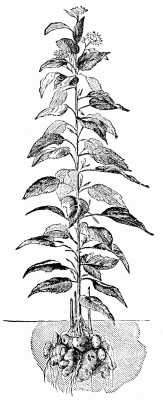
JERUSALEM ARTICHOKE (HELIANTHUS TUBEROSUS).
PERENNIALS.
H. orgyalis (the fathom-high sunflower).—The name is far within the true measure, which is often 9 feet or 10 feet. A very distinct species, increasing very slowly at the root and throwing all its growing efforts upward. The long linear ribbon leaves, often exceeding a foot, spreading in wavy masses round the tall stem, which has a palm-like tuft of them at the summit, are a more ornamental feature than the flowers, which are moderate in size and come late in the axils of the upper leaves.
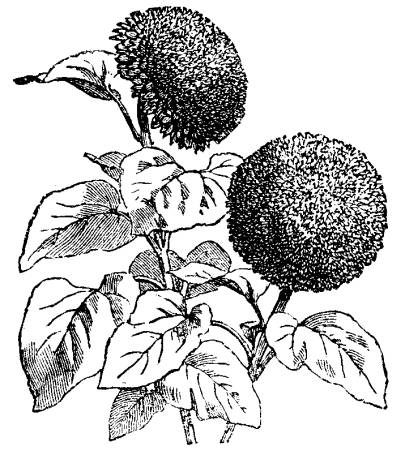
HELIANTHUS ANNUUS GLOBULUS FISTULOSUS.
H. angustifolius.—A neat and elegant species, which I first raised from seed sent by Mr. W. Thompson, of Ipswich. It has a very branching habit quite from the base like a well-grown bush of the common wallflower. The flowers are abundant, about 2½ inches across, with a black disk. The plant, though a true herb, never comes up in my garden with more than one stalk each year.
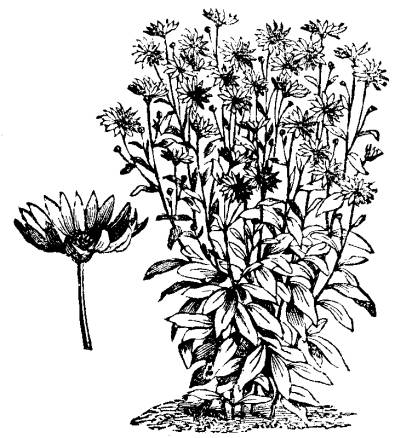
HELIANTHUS RIGIDUS (SYN. HARPALIUM RIGIDUM).
H. rigidus is well known as the best of the perennial sunflowers, and has many synonyms, the commonest Harpalium rigidum. It need not be described, but one or two things about it may be noted. The shoots, which come up a yard or more from last year's stalk, may be transplanted as soon as they appear without injury to the flowering, but if put back to the old center, the soil, which should be deep and light, ought to be enriched. The species is variable, and improved forms may be expected, as it produces seed in England. The number of ray flowers is often very large. I have one form which has several rows of them, nearly hiding the disk. A variety is figured in Botanical Magazine, tab. 2,668, under the name of H. atro-rubens. Another comes in the same series, tab. 2,020, as H. diffusus. Other synonyms are H. missuricus and H. missouriensis. Its native range extends across North America in longitude, and covers many degrees of latitude. It likes a dry soil. In wet soil and wet seasons the flower-stalk is apt to wither in the middle, and the bud falls over and perishes prematurely.
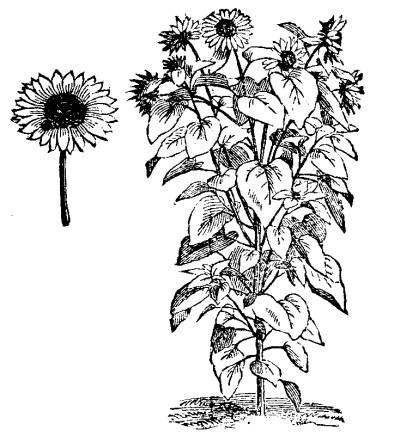
COMMON SUNFLOWER (H. ANNUUS) SHOWING HABIT OF GROWTH.
H. Lætiflorus.—Under this name we grow in England a tall, much-branched, late flowering kind, with smooth and very stout and stiff stalks, sometimes black, sometimes green. It increases at the base of the stalks; it makes close growth, and shows little disposition to run at the root. The flowers are rather small, not more than 9 inches across, but so durable and so well displayed by the numerous spreading branches as to make the plant very useful for late decoration. I own that I cannot identify this plant with the lætiflorus of Asa Gray, which he tells us resembles tall forms of H. rigidus, with rough stalks, and bears flowers with numerous rays 1½ inches long.
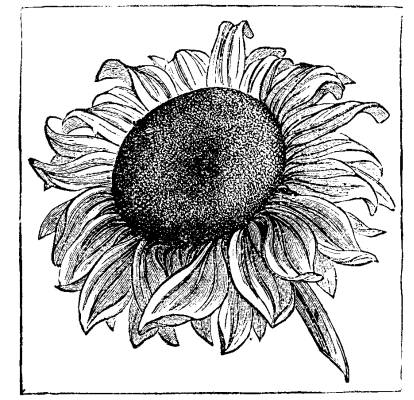
FLOWER OF HELIANTHUS ANNUUS.
H. occidentalis.—Recently introduced by Mr. W. Thompson, of Ipswich, who gave me the plant two years ago. It is a neat species, growing about 2 feet high, well branched, and producing at the end of July abundance of flowers about 2 inches across. The lower leaves are small and broad, with long stalks, ovate in form.
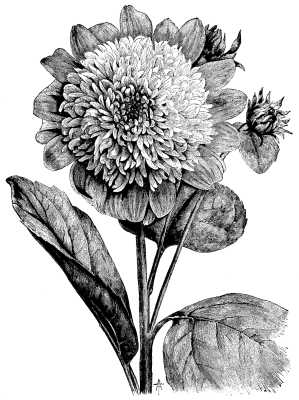
HELIANTHUS MULTIFLORUS FL-PL.
H. mollis, so called from the soft white down with which the leaves are covered, grows about 4 feet high. Leaves large, ovate, and sessile; growth of the plant upright, with hardly any branches; flowers pale yellow, about 3 inches across, not very ornamental. Cultivated at Kew, whence I had it.
H. giganteus grows 10 feet high; stem much branched and disposed to curve. Flowers about 2½ inches across, produced abundantly in August; rays narrow and pointed, cupped, with the ends turning outward; leaves lanceolate and sessile; rootstock creeping, forming tuberous thickenings at the base of the stems, which Asa Gray tells us were "the Indian potato of the Assiniboine tribe," mentioned by Douglas, who called the plant H. tuberosus.
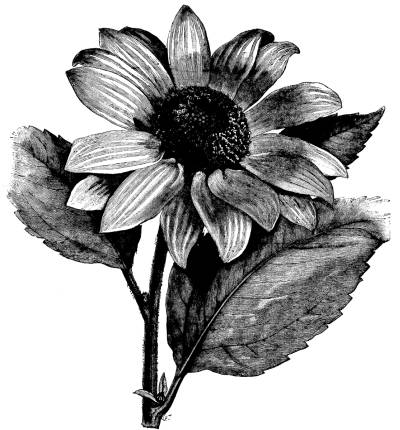
FULL SIZED FLOWER OF HELIANTHUS MULTIFLORUS.
H. maximiliani.—Half the height of the last, which it resembles, but the stem is stouter, the leaves larger, as are also the flowers, which are produced later. It is not so floriferous and ornamental as the last.
H. lævigatus.—Smooth stalked, very distinct, does not spread at the roots, which are composed of finer fibers than those of most of the genus; stalks slender and black, growing closely together, branched near the summit, 5 feet high; leaves narrowly lanceolate and acute; flowers plentiful and about 2 inches across; rays few, and disk small.
We are warned that the following species are "difficult of extrication," either confluent or mixed by intercrossing.
H. doronicoides.—I place this the third in merit among perennial sunflowers, H. rigidus and H. multiflorus being first and second. It is 6 feet or 7 feet high, upright in growth, with many stalks. Flowers 3½ inches across, produced from the end of July to the end of September, bright golden yellow; leaves large, ovate, tapering from the middle to both ends; stalk leaves sessile and nearly connate, that is, clasping the stalk by their opposite base. The plant spreads rapidly by running rootstocks, and ripens seed in abundance. Figured as H. pubescens in Botanical Magazine, tab. 2,778.
H. divaricatus resembles the last, but is inferior, being a smaller plant in all parts, especially in the flowers, which come out a month later. The cauline leaves are stalked and diverge widely, which habit gives its name to the plant. A casual observer would hardly notice the difference between this species and the last, but when grown together the superiority of doronicoides as a garden plant is at once evident.
H. strumosus.—Fully 6 feet high; growth upright; rootstock less spreading than the last two; leaves on very short stalks, broadest at the base, ovate tapering by a long narrow point; flower disk narrow, but rays large and orange-yellow; flowers showy, 3 inches across; they come out late in August. I had this plant from Kew. The shape of the leaves would have led me rather to refer it to H. trachelifolius, a closely allied species.
H. decapetalus.—Five feet high; flowers from end of July; makes a dense forest of weak, slender stalks, much branched at the top; spreads fast; leaves serrate, oblong-ovate, rather large; flowers abundant, pale yellow, about 2 inches across; rays nearly always more than ten, in spite of the name.
H. tuberosus.—The well-known Jerusalem artichoke; not a plant grown for ornament, being too coarse and late in flowering, but several things in its history may be mentioned, as Dr. Asa Gray has spent labor and study over it. It is believed to have been cultivated by the natives before the discovery of America, and the edible tubers are thought to be a development of cultivation. Forms of it without tuberous roots are found wild, but whether indigenous to the place or degenerate from cultivation was for long uncertain. Several species of Helianthus have a tendency to produce similar fleshy tubers at the top of the roots. Dr. Gray used to refer the origin of this species to H. doronicoides, but it is now believed by him to be a distinct species, though one of which it is difficult to identify with certainty the typical form.
I omitted to say that the word Helianthus is Greek for sunflower. After several years' careful observation, I believe the notion that the flowers keep their face to the sun is quite a delusion.
Edge Hall. C. WOLLEY DOD.
A QUICK FILTER.—The Druggists Circular recommends chamois skin, free from thin places; cut it of the desired size; wash it in a weak solution of sal soda, or any alkali, to remove the grease, and rinse thoroughly in cold water before using.
Tinctures, elixirs, sirups, and even mucilages are filtered rapidly. A pint of the thickest sirup will run through in four or five minutes. By washing thoroughly after each time of using, it will last a long time.