TERRESTRIAL MAGNETISM.
Reading edition
[Footnote: For a full account of experiments relating to magnetism on railways in New York city, see SCIENTIFIC AMERICAN, January 19,1884.]
To the Editor of the Scientific American:
An item has appeared recently in several papers, stating that New York is a highly magnetized city--that the elevated railroad, Brooklyn Bridge cables, etc., are all highly magnetized. As this might convey to the general reader the impression that the magnetism thus exhibited was peculiar to New York city, and as many of your subscribers look anxiously for your answers to numerous questions put for the elucidation of apparent, scientific mysteries, I have thought that perhaps a statement in plain language of experiments made at various times, to elucidate this subject, might, in conjunction with a diagram, serve to explain even to those who have not made a special study of science a few of the interesting phenomena connected with
TERRESTRIAL MAGNETISM.
Some of the first experiments I made, while professor at the Indiana State University, were detailed in the March and August numbers, 1872, of the Journal of the Franklin Institute, and I think showed conclusively that the earth, by induction, renders all articles of iron, steel, or tinned iron magnetic; possessing for the time being polarity, after they have been in a settled position for a short time.
In Dr. I. C. Draper's "Year Book of Nature" for 1873, mention is made of the experiments in which I found every rail of a N. and S. railroad exhibiting polarity.
The same statements were repeated in one of a series of articles sent by me to the Indianapolis Daily Journal, dated Jan. 20, 1877, in which I used the following language:
"Every article of iron or steel or tinned iron, by the earth's induction, becomes magnetic. Thus, if we examine our stoves, or a doorlock, or long vertical hinge, or even a high tin cup, by holding a delicate magnetic needle in the hand near those objects, we find the earth has, by induction, attracted to the lower end of the stove utensils, etc., the opposite magnetism from its own; and repelled to the upper end of the stove, etc., the same magnetism which exists in our northern hemisphere. Consequently, the bottom of the stove, or of the hinge, cup, etc., will attract the south (or unmarked end) of our needle; while the top of the stove, etc., attracts the north, or marked end of our magnetic needle. If we apply our needle to the T rails of a N. and S. railroad, we not only find that the lower flange of the rail attracts the S. end of our needle, while the upper flange attracts the N. end of our needle, but we also find, where the two rails come nearly together (say within two inches), that the N. end of the rail attracts the S. end of our needle, while the S. end of the rail attracts the N. (or marked) end of our magnetic needle."
MAGNETISM ON RAILWAYS.
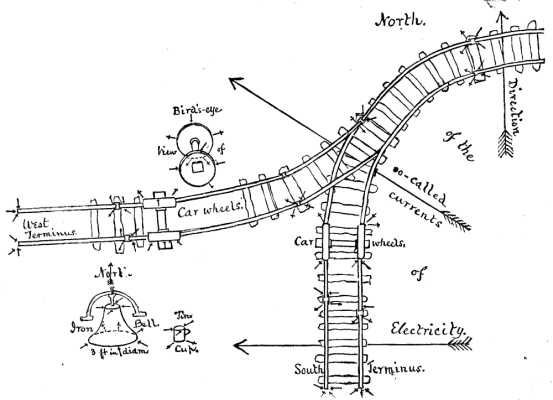
Quite recently, being anxious to see the effect produced on the needle by rails laid E. and W., I experimented on some recently laid here; starting from a S. terminus, in the town of New Harmony, and gradually curving northeast, until the road pursues a due east course to Evansville. There is, however, a branch road of about half a mile, which starts from the Wabash River, at a west terminus, and runs due east to join the other, near where that main track commences its northeast curve. The results (more readily understood by an inspection of the diagram) were as follows:
1. At the south terminus of the railroad, the rails on the east side of the track as well as those on the west side attracted at their south ends the marked end of a small magnetic needle, both at the upper and lower flange; the usual vertical induction being in this case overcome by the greater lateral induction. Whenever, on progressing north, the rails were at least about two inches apart, the upper flange of the north end of any rail would attract the unmarked, while the south end of its neighbor or any other of the north and south laid rails would attract the marked end.
2. The same results were obtained from rails laid all around the northeast curve, and even after they had acquired a due west to east course; showing that each rail acquired the same magnetic polarity which would be exhibited by any magnetic needle oscillating freely in our northern hemisphere, dipping also at its north end considerably downward if suspended at its center of gravity.
3. Applying the needle at the west terminus, a few anomalies were observed; but, especially nearer the junction, the rails all gave the normal result found on the main track.
4. The wheels of the cars standing on the north and south track followed the same law, exhibiting both vertical and lateral induction, so that the lower rims and the forward or north part of the periphery attracted the unmarked end of the needle, while the upper and rear, or south portions of the periphery of the wheel attracted the marked end.
5. The wheels of cars standing on the east and west road exhibited the following modification. The lowest rim of all the wheels, whether standing on the north rails or on the south rails of said track, in consequence of vertical induction attracted the unmarked end of the needle, and the upper rims attracted the marked end of the needle; but the middle portions of the periphery, both anterior and posterior, of the wheels standing on the north rail, attracted the unmarked end, while similar middle portions of wheels standing on south rails attracted the marked end; in consequence of horizontal induction, the wheels being connected by iron axles, and thus presenting considerable extension across the track, viz., from south to north.
Magnetite seems to have acquired its polarity in the same manner, namely by the earth's induction, when the ore contains a large enough percentage of pure iron. A large specimen (6 in. long by 3½ deep and weighing 5½ lb.) which I obtained from near Pilot Knob, Missouri, exhibits polarity, not only at its lateral ends, but also vertically, as the lower surface attracts the unmarked end of a needle, while the plane, which evidently occupied the upper surface in its native bed, attracts the marked end of the needle.
Iron fences invariably exhibit only the polarity by vertical induction; so also small buckets, bells, etc. But in the case of a bell about 3 ft. in diameter at its base, and over two feet deep, tapering to about a foot in diameter at the top, I found that although the top attracted the marked end of the needle, the bottom attracted the unmarked end of the needle only around the northerly half of the circumference, while the southern portion of this lower rim attracted the marked end in consequence of lateral induction, as in N. and S. rails.
Thus, upon a comparison of all these facts, it would appear that, if the magnetism induced by the earth is due to so-called currents of electricity, those currents must be underneath the rails, and must move from west to east, under the south to north rails, and from south to north under the west to east laid rails, as indicated by the arrows in the diagram.
This accords perfectly with what we should theoretically expect, in our northern hemisphere, if the electricity in the earth's crust is due to thermo-electrical currents from east to west, namely, from the more heated to the less heated portion, on any given latitude, while the earth revolves from west to east; as well as also from electrical currents trending from tropical to Arctic regions.
As the network of iron rails spreads from year to year more extensively over our continent, it will be interesting to observe whether or not any effect is produced, meteorological, agricultural, etc., by this diffusion of magnetism.
It may further interest some of your readers to have attention called to facts indicating
SYNCHRONOUS SEISMOLOGY.
The year recently closed furnishes interesting corroborative testimony of an apparent law regarding the propagation of earthquake movements most readily along great circles of our globe, as well as evidence that these seismic movements are frequently transmitted along belts (approximating to great circles) coincident sometimes with continental trends, at other times with fissures which emanate in radii at every 30°, around the pole of the land hemisphere in Switzerland, as described in one of my papers, read at the Montreal meeting of the A.A.A.S.
The terms synchronism or synchronous, as here used, are not designed to imply absolute simultaneity (although that is sometimes the case with disturbances 180° apart), but are rather intended to indicate the tendency presented by these phenomena to exhibit this internal activity, during successive days, weeks, or even months, along a given great circle of the earth, especially one or more of those connected with the land center; perhaps most of all along the great circle which forms the prime vertical, when the center of land is placed at the zenith.
In order to test the above, let us examine the record of the most prominent earthquakes or volcanic eruptions for the year 1883.
Late in Dec., 1882, and early in Feb., 1883, shocks occurred in New Hampshire; on Jan. 11, 1883, also at Cairo, Illinois, and about the same time at Paducah, Ky.; Feb. 27 at Norwich, Conn., and early in Feb. at Murcia, Spain.
These, by examination of any good globe, will be found on a belt forming one and the same great circle of the earth.
Late in March and during part of April the volcano of Ometeke in Lake Nicaragua was active (after being long dormant); Panama, portions of the U.S. of Colombia, and of Chili; also, in May, Helena, M.T.; and, in June, Quito (with Cotopaxi active) were all more or less shaken by earthquakes; and are all found on one belt of a great circle.
The principal record for the remainder of the year comprised:
An earthquake at Tabreez in North Persia, early in May, 1883.
The awful destruction in Ischia, July 29 (with Vesuvius active).
The fearful eruption in the Straits of Sunda, 25th Aug. and later.
Shocks in Sumatra and at Guayaquil, about same date or early in Sept.
Shocks at Dusseldorf, according to a Berlin paper of 5th Sept.
Shocks at Santa Barbara and Los Angeles, early in Sept.
Shocks at Gibraltar and Anatolia in October.
Shocks at Malta, Trieste, and Asia Minor in October.
Azram shaken late in Sept., and great destruction between Scios and Smyrna.
Lastly, the formation of a new island in the Aleutian Archipelago. Date of outburst, early in October, 1883.
Besides these, there were several other less severe disturbances, the records of which are chiefly obtained from Nature, and which will-be referred to below.
If the globe be so placed as to have the land center at the zenith, the exact position of the new island, near Unnok, will be found under the brazen meridian, while Agram, Tabreez, Sunda, Sumatra, Quito, and Guayaquil are all on the prime vertical.
Vesuvius and Hecla were both active early in the year, and they, with the ever restless Stromboli, are situated on the great circle which forms with the land center at Mount Rosa, the radius running S. 30° E., and which would embrace the chief disturbances up to the middle of the year, including as we go north Malta, Sicily, Rome, region of the Po, Bologna, and in the Western Continent, after passing Hecla, Helena in Montana Territory, reaching in Washington Territory and Oregon the belt of it. American volcanoes: Mounts Baker, Rainier, St. Helens, Hood, and Shasta.
Still another seismic belt, starting from the ever active Fogo, and passing through Teneriffe (at that time erupted), would include the regions disturbed in Oct. and Nov., namely, Cadiz, Gibraltar, Malaga (Murcia and Valencia somewhat earlier); it then traversed the center of land, caused the earthquakes at Olmutz in Moravia, and even tremors felt at Irkutsk, as the seismic war moved along said great circle to the volcanic region of S. Japan.
Again, the belt which covers the meridian of land center (about 8°-10° E. long) covers also the region of a disturbanced area in Norway, as well as that portion of Algeria, viz., Bona, in which a mountain 800 meters high, Naiba, is gradually sinking out of sight. About 100 geo. miles E. of Bona is where Graham's Island appeared in the Mediterranean, and a few months later disappeared in deep water.
Another highly seismic belt extends from the volcanoes of Bourbon, N. Madagascar, and Abyssinia to Santoria and the oft disturbed Scios, Smyrna, and Anatolia region; and along the same great circle were shaken Patra in Greece on the 14th Nov., and Bosnia on the 15th; while shocks had been felt at Trieste and Mülhouse about the 11th, and at Styria on the 7th, and disturbances at Dusseldorf in Sept. Finally, on the 28th Dec. S. Hungary (near the confluence of the Drave with the Danube) was visited by seismic movements along this same great circle, which passes through the extinct volcanic region of the Eifel, the oft shaken Comrie in Perthshire, Scotland, the volcanic Iceland, our National Park with its thousands of geysers, the cataclysmic region of Salt Lake and the Wahsatch Mountains (so graphically described by the geologists of the U.S. Geol. Survey), giving rise in Sept. to the earthquakes of Los Angeles and Santa Barbara, and finally reaching the volcanic islands of the Marquesas group.
Thus the seismic efforts of 1883 may be seen to have expended their force partly along the great backbone of the S. and N. American Cordillera, but more especially from the center of land E. and W. along its prime vertical from Sunda to Quito, also southwesterly by the E. coast of Spain, as well as due S. through Algeria, and S. 30° E. through Rome, Naples, Sicily, etc. Finally, the autumnal catastrophes at and near Scios, Anatolia, etc., seem to have been caused by a seismic wave, propagated along the great circle, which often agitates Janina, and produces earthquakes at Agram, where this great circle crosses the prime vertical.
RICHARD OWEN.
New Harmony, Ind., 27 Feb., 1884.