THE ZOOLOGICAL SOCIETY'S GARDENS.
Reading edition
The erection of the new house for the accommodation of the serpents, alligators, and other reptiles, which is shown in our illustration, must be commended as a valuable improvement of the Zoological Society's establishment in Regent's Park. This building, which has a rather stately aspect and is of imposing dimensions, constructed of brick and terracotta, with a roof of glass and iron, stands close to the south gate of the Gardens, entered from the Broad Walk of the Park. The visitor, on entering by that gate, should turn immediately to the left hand, along the narrow path beside the aviary of the Chinese golden pheasants, and will presently come to the Reptile House, which is too much concealed from view by some of the sheds for the deer. The spacious interior, represented in our view, is one of the most agreeable places in the whole precinct of these gardens, being well aired and lighted, very nicely paved, and tastefully decorated in pale color, with some fine tropical plants in tubs on the floor, or in the windows, and in baskets hanging from the roof. Three oval basins, with substantial margins of concrete, so formed as to prevent the reptiles crawling over them, while one basin is further protected by an iron grating, contain water in which the alligators, the infant crocodiles, and a number of tortoises, but none of the larger species, make themselves quite at home. One side of the house, with its windows looking into a pleasant airy vestibule, is occupied by many small glass cases for the smaller lizards, with boxes and pots of flowers set between them upon tables, which present a very attractive exhibition. The other three sides of the hall, which is nearly square, are entirely devoted to the large wall cages, with fronts of stout plate glass, in single sheets, rising about 14 feet to the roof, in which the serpents are confined--the huge pythons, anaconda, and boa constrictor, the poisonous cobras and rattlesnakes, and others well known to the visitors at these gardens. Each cage or compartment has a sliding door of iron behind, to which the keeper has access in a passage running along the back of the wall, and there are doors also from one compartment to another. The floor is of smooth slate, and the largest snake has ample space to uncoil itself, or to climb up the trunks and branches of trees placed there for its exercise and amusement.
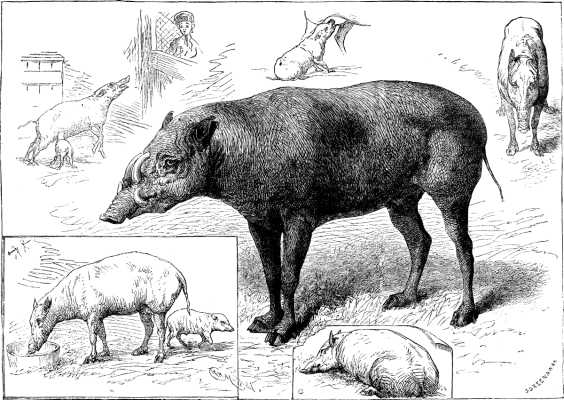
THE ZOOLOGICAL SOCIETY'S GARDENS. THE BABIROUSSA FAMILY.
THE BABIROUSSA.
We present, on the same page, a few sketches of the babiroussas, a male and two females, with a young one, recently presented to the society by Dr. F.H. Bauer. These animals, which are from Celebes, in the Malay Archipelago, have been placed temporarily in different stalls of the ostrich house, on the north side of the gardens. The babiroussa is a species of wild hog, peculiar to the islands of Eastern Asia, and remarkable, in the male animal, for the extraordinary growth and direction of the canine teeth. The upper pair of canine teeth, growing out through the upper jaw, curve backward and upward on the forehead, having somewhat the aspect of horns; while the lower canine teeth form a pair of crooked tusks in the under jaw. These teeth may be useful for defensive fighting, as a guard to the head, but could not serve for attack. The skull of a babiroussa, with the teeth fully developed, is in the possession of Mr. Bartlett, the able superintendent of the Zoological Society's collection.--Illustrated London News.
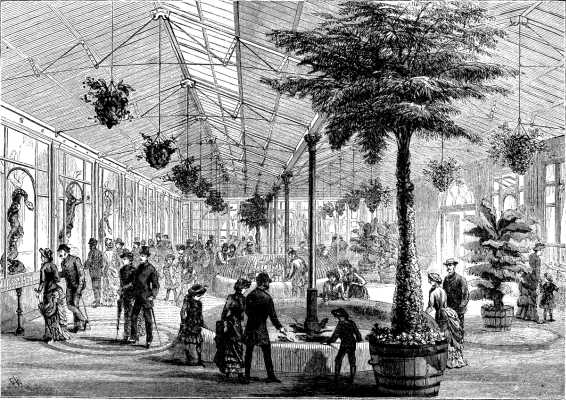
THE ZOOLOGICAL SOCIETY'S GARDENS. THE NEW REPTILE HOUSE.
Continued from SUPPLEMENT, No. 363, page 5797.