THE PLATINUM WATER PYROMETER.
Reading edition
By J. C. HOADLEY.
The following description of the apparatus used for the determination of high temperatures, up nearly to the melting point of platinum, is offered in answer to several inquiries on the subject:
The object to be attained is a convenient and reasonably accurate application of the method of mixtures to the determination of temperatures above the range of mercurial thermometers, say 500° F., up to any point not above the melting point of the most refractory metal available for the purpose, platinum.
A first requisite is a cup or vessel of convenient form, capable of holding a suitable quantity of water, say about two pounds avoirdupois. Berthelot decidedly prefers a simple can of platinum, very thin, with a light cover of the same metal, to be fastened on by a bayonet hitch. For strictly laboratory work this may be the best form; but for the hasty manipulation and rough usage of practical boiler testing something more robust, but, if possible, equally sensitive, is required. The vessel I have used is represented in section in the accompanying cut, Fig. 1.
The inner cell, or true containing vessel, is 4.25 inches in diameter; and of the same height on the side, with a bottom in the form of a spherical segment, of 4.25 inches radius. It is formed of sheet brass 0.01 inch thick, nickel-plated and polished outside and inside. The outer case is 8 inches diameter and 8.5 inches deep, of 16-ounce copper, nickel-plated and polished inside, but plain outside. There are two handles on opposite sides, for convenience of rapid manipulation. The top, of the same copper as the sides and bottom, is depressed conically. like a hopper, and wired at its outer edge, forming a lip all around for pouring out of. The central cell is connected with the outer case only by three rings of hard rubber (vulcanite), each 0.25 inch thick, the middle ring completely insulating the cell from its continuation upward, and from the outer case. A narrow flange is turned outward at the upper edge of the cell, and a similar flange is also turned outward at the lower edge of the cylindrical continuation of the walls of the cell upward. Between these two flanges, the middle ring of hard rubber is interposed, and the two parts, the cell and its upward continuation, are clamped together by the upper and lower rings of hard rubber, which embrace the flanges and are held together by screws. The joints between the flanges and the middle ring of hard rubber, which might otherwise leak a little, are made tight with asphaltum varnish.
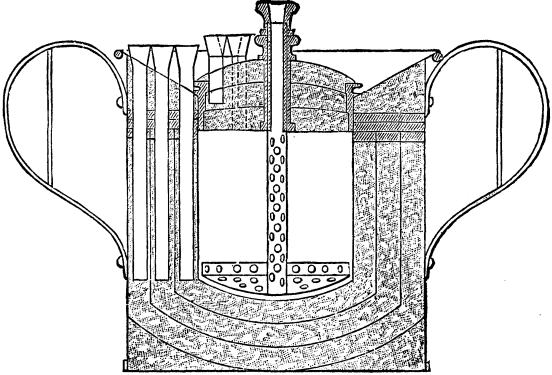
Fig. 1.
Fig 1 shows two partitions, dividing the space between the cell and the case into three compartments, and a concave false bottom. The cover is also seen to be divided into three compartments, by two partitions, and each compartment of the vessel and of its cover is provided with a small tube for inserting a thermometer. This construction was adopted in the first instruments made, for the purpose of observing the rate of heat transmission through the successive compartments, but these parts are without importance with respect to the practical use of the instrument, and may as well be omitted, as they considerably increase the cost, being nickel-plated and polished on both sides. The top and bottom plates of the cover are of 0.01 inch brass, nickel-plated and polished on both sides, both convex outward, the bottom plate but slightly, the top plate to 4.25 inches radius. A ring of hard rubber connects, yet separates and insulates these plates, and they are bound together with the ring into a firm structure by a tube of hard rubber, having a shoulder and knob at the top, and at the lower end a screw-thread engaging with a thin nut soldered to the upper side of the bottom plate. When the cover is in place, its lower plate is even with the top of the cell; and the contained water, which nearly fills the cell, is surrounded by polished, nickel-plated, brass plates 0.01 inch thick, insulated trom other metal by interposed hard rubber. The spaces between the cell and case (a single space if the partitions are omitted), the space above the hard rubber rings, and the space or spaces in the cover are all filled with eider-down, which costs $1.00 per ounce avoirdupois, but a few ounces are sufficient. Soft, fine shavings, or turnings of hard rubber, are said to be excellent as a substitute for eider-down. Heat cannot be confined by any known method. Its transmission can be in some degree retarded, and in a greater degree, perhaps, regulated. Some heat will be promptly absorbed by the sides, bottom, and cover of the cell, and by the agitator; but this does no harm, as its quantity can be accurately ascertained and allowed for. Some will be gradually transmitted to the eider-down, filling the spaces, and through this to the outer casing; but this can be reduced to a minimum by rapid and skillful manipulation, and its quantity, under normal conditions, can be ascertained approximately, so as not to introduce large errors. But varying external influences, such as currents of air, caused by opening doors, or by persons passing along near the apparatus during the progress of an experiment, which would introduce disturbing irregularities, can best be guarded against by such spaces as I have described, filled with the poorest heat-conductor and the lightest solid substance attainable. Air, although a poor heat-conductor, and extremely light, is diathermous, and offers no obstruction to the escape of radiant heat.
The agitator is an important part of the apparatus. Its object, in this instrument, is twofold. First, it serves to produce a uniform temperature throughout the body of water in the instrument; and secondly, it answers as a support to the heat-carrier of platinum or other metal, often intensely hot, which would injure or destroy the delicate metal of the bottom if allowed to fall on it. For this second purpose, no spiral revolving agitator, such as that commended by Berthelot, would suffice. The best form is such as I have shown in Fig. 1. A concave disk of sheet-brass, made to conform to the shape of the bottom of the cell, with a narrow rim turned up all around, of about 0.02 inch thickness, is liberally perforated with holes to lighten it, and to give free passage to water. The concave form causes the streams of water, produced by slightly raising and lowering the agitator, to take a radial direction downward or upward, so as to cross each other and promote rapid mixing. By a slight modification small vanes might be turned outward from the surface of the metal, which would produce mixing currents if the agitator were given a slight reciprocatory revolving motion, thus avoiding the alternate withdrawal and re-immersion of any part of the stem so strongly deprecated by Berthelot; but for several reasons I think an up and down motion of the agitator desirable in this instrument. The platinum heat carrier, sometimes at a temperature of 2,500° to 2,800° F., is thereby brought into more rapid and forcible contact with the water, steam or water in the spherical condition is washed away from its surface, and by cooling it more rapidly, the duration of the observation is lessened, and errors due to transmission of heat through the walls of the instrument are diminished. The upper part of the agitator stem is of hard rubber, and the brass portion, which terminates at the under side of the cover when the agitator is in its lowest position, suspended by the shoulder at the upper end, need never be lifted for the purpose of mixing out of the hard rubber tube at the cover, so that loss of heat from this cause must be very slight. The brass tube is very freely perforated with holes to admit water, streaming radially through the holes in the agitator, to contact with the thermometer. The hole in the stem at the top is flared, to receive a cork, through which the thermometer is to be passed. The bulb of the thermometer should be elongated, and very slightly smaller in diameter than the stem. After passing it through the cork, a very slight band--a mere thread--of elastic rubber should be put around the bulb, near its lower end, or a thin, narrow shaving of cork may be wound around and tied on, to keep it from contact with the brass tube, for safety; and a little tuft of wool, curled hair, or hard rubber shavings should be put in the bottom of the brass tube to avoid accidents. For the same purpose, a light, but sufficient fender of brass wire, say 0.03 inch diameter, might be judiciously placed around the brass tube at a little distance, to protect it and the thermometer inside of it from shocks from the platinum ball when hastily thrown in, as it must always be. I have had delicate and costly thermometers broken for want of such a fender. Thermometers cannot be too nice for this work. For accurate work at moderate temperatures, they should be about 14 inches long, having a "safe" bulb at the upper end, with a range of 20° F.--32° to 52°--in a length of 10 inches, giving half an inch to a degree F., and carefully graduated to tenths of a degree, so that they can be read to hundredths, corresponding to single degrees of the heat-carrier in the normal use of the instrument.
For the determination of the highest temperatures, up closely to 2,900° F., it will be convenient to have thermometers of greater range, say 32° to 82° F., 50° in a length of 12.5 inches, or a quarter of an inch to a degree F., also graduated to tenths, or at the least, to fifths of a degree. Such thermometers will be about 17 inches long.
It is very satisfactory to have two instruments and a good outfit of thermometers and heat-carriers, in order to take duplicate observations for mutual verification and detection of errors.
HEAT CARRIERS.
For these platinum is greatly to be preferred to any other known substance. Its rather high cost is the only objection to its use. Its heat capacity is low, by weight, but its specific gravity is great, and sufficient capacity can be obtained in moderate bulk, while its high conductivity tends to shorten the duration of each experiment or observation. A convenient outfit for each instrument consists of three balls, hammered to a spherical form, one 1.1385 inches diameter, weighing 4,200 grains=0.6 pound avoirdupois; one 0.9945 inch diameter, weighing 2,800 grains=0.4 pound; and one 0.7894 inch diameter, weighing 1,400 grains=0.2 pound.
These can be obtained at 1-2/3 cents per grain, and will cost, respectively, $70.00, $46.67, and $23.33, and collectively, $140.00. At the assumed specific heat of Pt=0.0333+, the heat capacity of the respective balls will be 1/100, 1/150, and 1/300 of 2 pounds of cold water, and the two smaller balls used together will be equal to the larger one. Corrections for varying specific heat of platinum may be conveniently made by the tables given in a previous article.[1] Corrections for varying specific heat of water are less important, but may be made by the following table:
Temperatures, Fahrenheit, and Corresponding Number of British Thermal Units Contained in Water from Zero Fahrenheit.
_______________________________________________________________ Deg | B.t.u. || Deg | B.t.u. || Deg | B.t.u. || Deg | B.t.u. | ----+--------++-----+--------++-----+---------++-----+---------+ 32 | 32.000 || 57 | 57.007 || 82 | 82.039 || 107 | 107.101 | 33 | 33.000 || 58 | 58.007 || 83 | 83.041 || 108 | 108.104 | 34 | 34.000 || 59 | 59.008 || 84 | 84.043 || 109 | 109.107 | 35 | 35.000 || 60 | 60.009 || 85 | 85.045 || 110 | 110.110 | 36 | 36.000 || 61 | 61.010 || 86 | 86.047 || 111 | 111.113 | 37 | 37.000 || 62 | 62.011 || 87 | 87.049 || 112 | 112.117 | 38 | 38.000 || 63 | 63.012 || 88 | 88.051 || 113 | 113.121 | 39 | 39.001 || 64 | 64.013 || 89 | 89.053 || 114 | 114.125 | 40 | 40.001 || 65 | 65.014 || 90 | 90.055 || 115 | 115.129 | 41 | 41.001 || 66 | 66.015 || 91 | 91.057 || 116 | 116.133 | 42 | 42.001 || 67 | 67.016 || 92 | 92.059 || 117 | 117.137 | 43 | 43.001 || 68 | 68.018 || 93 | 93.061 || 118 | 118.141 | 44 | 44.002 || 69 | 69.019 || 94 | 94.063 || 119 | 119.145 | 45 | 45.002 || 70 | 70.020 || 95 | 95.065 || 120 | 120.149 | 46 | 46.002 || 71 | 71.021 || 96 | 96.068 || 121 | 121.153 | 47 | 47.002 || 72 | 72.023 || 97 | 97.071 || 122 | 122.157 | 48 | 48.003 || 73 | 73.024 || 98 | 98.074 || 123 | 123.161 | 49 | 49.003 || 74 | 74.036 || 99 | 99.077 || 124 | 124.165 | 50 | 50.003 || 75 | 75.027 || 100 | 100.080 || 125 | 125.169 | 51 | 51.004 || 76 | 76.029 || 101 | 101.083 || 126 | 126.173 | 52 | 52.004 || 77 | 77.030 || 102 | 102.086 || 127 | 127.177 | 53 | 53.005 || 78 | 78.032 || 103 | 103.089 || 128 | 128.182 | 54 | 54.005 || 79 | 79.034 || 104 | 104.092 || 129 | 129.187 | 55 | 55.006 || 80 | 80.036 || 105 | 105.095 || 130 | 130.192 | 56 | 56.006 || 81 | 81.037 || 106 | 106.098 || 131 | 131.197 | ----+--------++-----+--------++-----+---------++-----+---------+
[Footnote 1: Journal for August, pp. 97, 98, and errata in Journal for September, p. 172.]
A composite heat-carrier, of iron covered with platinum, answers well for temperatures up to about 1,500° F. A ball of wrought iron 0.88 inch diameter will weigh 700 grains, and a capsule of platinum spun over it 0.048 inch thick, making the outside diameter 0.976+ inch, will also weigh 700 grains. Upon the assumption of 0.0333+ for the specific heat of Pt and 0.1666+ for that of Fe, the composite ball will have a heat capacity equal to that of 4,200 grains of Pt, and equal to 0.01 of that of 2 pounds of cold water. A patch, about 0.35 inch diameter, has to be put in to close the orifice where the Pt capsule is spun together, and a slight stain will show itself at the joint around this patch, from oxidation of the iron, but the latter will be pretty effectually protected. Difference of expansion, which will not exceed 0.007 inch in diameter, will not endanger the capsule of Pt. The interruption of conductivity at the surface contact of the two metals makes the process of heating and cooling a little slower, but not noticeably so.
Such composite balls can be obtained for $20 each, $50 less than the cost of an equivalent ball of solid platinum, which is preferable in all but cost. Iron balls could be used for a few crude determinations. Cast iron varies too much in composition, and wrought iron oxidizes rapidly. While the oxide adheres it gains in weight, and when scales fall off it loses; and the specific heat of the oxide differs from that of metallic iron. Whatever metal is used, care must be taken to apply the appropriate tabular correction for PtFe, or Pt and Fe.
MANIPULATION.
Small graphite crucibles with covers, as shown in section, in Fig. 2, serve to guard against losing the ball, to handle it by when hot, and to protect it against loss of heat during transmission from the fire to the pyrometer. To guard against overturning the crucibles, moulded firebrick should be provided to receive them, two crucibles being put into one brick, in the same exposure, whenever great accuracy is desired, each serving as a check on the other, and their mean being likely to be more nearly correct than either one if they differ. The firebrick cover is occasionally useful to retard cooling, if, by reason of local obstructions, some little delay is unavoidable in transferring the balls from the fire to the water of the pyrometer. With convenient arrangements, this may be done in three seconds. After observing the temperature of the water, make ready for the immersion of the heat carrier by raising the agitator until a space of only about 1.5 of an inch is left between its rim and the cover. An instant before putting in the heat carrier--"pouring" it from the crucible--lift the cover and agitator both together, so that the rim of the latter is level with the sloping top of the instrument. The agitator then receives the hot ball without shock, and no harm is done. If the ball goes below the agitator, it is likely to injure the bottom of the cup. If, on taking the temperature of the water before the immersion of the heat carrier, any change is observed, either rising or falling, the direction and rate of such change, and the exact interval of time between the last recorded observation and the immersion, should be noted, in order to determine the exact temperature of the water at the instant of immersion. The temperature of the water will continue to rise as long as the heat carrier gives out heat faster than the cell loses it. The rise will grow gradually slower until it ceases, and the maximum can be very accurately determined. Examples of the mode of using the tables, and of determining the true temperature of the heat carrier at the instant of immersion from the observations with the instrument, are given in the table on pages 170 and 171 of this Journal for September. A method of using the tables, by which a closer approximation to the true temperature may be reached, will be pointed out in a subsequent article.
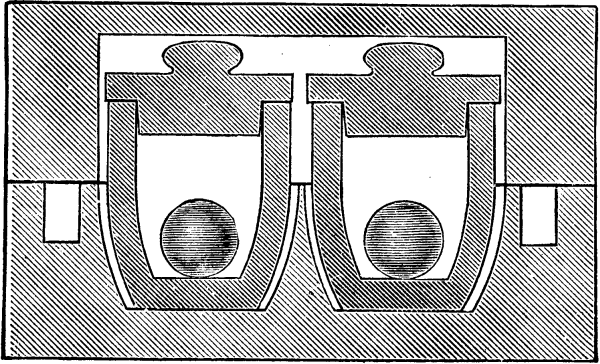
Fig. 2.
DETERMINATION OF THE CALORIFIC CAPACITY OF THE METALS OF THE PYROMETER, in terms of water, i.e., in British thermal units.
First. Weigh the cup, or cell, the lower plate of the cover and the metallic portion of the agitator, and compute their heat-capacity by the specific heat of the respective metals. Compute also the heat capacity of the thermometer; or, if it be long, of so much of it as is found to share nearly the temperature of the immersed portion. The result will be a minimum--indeed, in so small a vessel the inevitable loss by conduction and radiation will amount to more than one-third as much as the simple heat capacity of the metals.[1] The total must be ascertained by an application of the method of mixture. Ascertain the temperature of the interior of the instrument simply; pour in quickly but carefully a known quantity of water, say about two pounds, of known temperature, say about 100° F., and ascertain the temperature as soon after pouring as mixing can be properly performed. But a correction is necessary for loss of heat in the act of pouring. To ascertain the amount of this correction prepare a bath of tepid water, and bring all parts of the instrument--outside, inside, and interior portions, together with the vessel to pour from--exactly to one common, carefully ascertained temperature. Now take two pounds of the water and pour it into the cell in the same manner as before. Exposure of so thin a stream on two surfaces to the air of the room will produce a certain degree of refrigeration in the water, which is supposed to be warmer than the air, say at about 160° F. This effect will be due to conduction, by contact with the air, to radiation, and to evaporation; and by so much the refrigeration observed in mixing is to be diminished.
[Footnote 1: In our case the heat-capacity, thermometer included, was 0.0757; total, 0.1053; radiation, etc., 0.0296. Respectively, 71.9 per cent, and 28.1 per cent. of the total.]
Four experiments, carefully conducted, gave the following results:
Loss of temperature by pouring at 170° F., 0.81°, 0.86°, 1.00°, and 1.07° F.; mean, 0.935° F.
The following are values of the calorific capacity of my pyrometers, that is, of those parts of each which share directly the temperature of the inclosed water, including the thermometer to be used with the instrument, and the heat communicated to the eider-down and otherwise lost during an observation, expressed in decimals of a British thermal unit, or in decimals of a pound of cold water:
0.1048, 0.1052, 0.1077, 0.1008, 0.1028, and 0.1104.
Mean 0.1053 = 0 lb. 1 oz. 11 drms. Add water 1.8947 = 1 " 14 " 4 " ------ - -- -- 2.0000 = 2 " 0 " 0 "
This was the value used. The instrument, being put on delicate coin scales and counterbalanced, weights equal to 1.8947 lb. avoirdupois = 1 lb. 14 oz. 5 drms., were added to the counterbalancing weights, and cold water was poured in until the scales again balanced.
The pyrometer with its contained water was then just equal in heating capacity, while the temperature was not above 38° F. to two pounds of cold water. The two instruments were sensibly alike, but were numbered No. 1 and No. 2, and at each observation the one used was noted.
The process of preparation and testing appears long and tedious, and is indeed somewhat so; but the instruments once well made are durable, convenient in use, and with care reasonably accurate.
Compared with mercurial thermometers between 212° and 600° F., I believe them to be much more accurate, although less convenient.
For a range of temperatures from 212° to 900° F. they are certainly more trustworthy than anything save an air thermometer of suitable construction; and for all temperatures from 800° to 900° F. up nearly to the melting point of platinum they are without a rival, so far as I know.
For some situations the ball can best be inserted in the fire or other situation where an observation is desired, and withdrawn for immersion by means of long, slender tongs, with jaws resembling bullet moulds.
A word about the melting point of platinum. My balls certainly began to melt below 2,950° F., but I am by no means sure that they do not contain any silver, although their specific gravity gives assurance that they are at least nearly pure.--Franklin Journal.