APPARATUS USED IN BERLIN FOR THE PREPARATION OF GELATINE PLATES.
Reading edition
I.--MIXING APPARATUS FOR GELATINE EMULSION.
The mixing vessel--a porcelain kettle capable of containing twenty liters, made at the Royal Porcelain Factory at Berlin, whose products are unequaled for chemical purposes--is also the boiling vessel, and, therefore, fits tightly, by means of the tin ring with the wooden handles, on to a large water bath. The light-tight metal lid, which can be permanently affixed to the kettle, then supports a stirring arrangement of fine silver, which dips into the emulsion and has blades formed like a ship's screw.
The arrangements for injecting the silver vary. The simplest consists of a large glass vessel containing the silver solution, which is closed by a glass stopper, and terminates below in a funnel running to a fine point. This funnel-shaped bottle fits into an opening specially made for it in the lid of the kettle, and while revolving sends a fine stream into the gelatine. When it is wished to interrupt it, it is only necessary to raise the glass stopper in order to see the stream dry up after a short time.
Another arrangement consists of a contrivance constructed on the principle of the common India-rubber inhaling apparatus, and sends the silver solution into the gelatine in the form of the minutest air-bubbles. After the emulsion is boiled in such a kettle it is allowed to stand until cool, when the ammonia is added. With such a great quantity of emulsion and so large a water bath sufficient heat is retained as to allow the action of the ammonia to take place. As soon as the time set apart for that reaction has elapsed the water bath is emptied and filled with pieces of ice and iced water, and the kettle replaced in it.
If the stirring apparatus be now set in motion, even this large quantity of emulsion will stiffen in at least an hour and a half. It may be further remarked that, the outside of the kettle being black, the lid being light-tight, and all the apertures in it being firmly closed, nearly the whole process can be conducted by daylight, from the mixing to the stiffening, so that it is very convenient to be able to keep the emulsion in the same vessel during all these operations.
II.--DIGESTIVE APPARATUS.
It is very desirable that those who do not prepare their emulsion by boiling, but by prolonged digestion, should possess a regulator which will keep the temperature at a given point. Such an apparatus would also be very useful for warming the emulsion for the preparation of plates, as then one would have no further occasion to pay attention to the thermometer and gas stove. In the accompanying diagram a simple contrivance is shown. The gas which feeds the stove passes through a narrow glass tube, a b, into the wider tube, c d e, which is made air-tight at e. This latter tube has an exit tube at f, by which the gas is supplied to the gas stove. At e it is hermetically closed, and at its deepest part it contains mercury, upon which a little sulphuric ether floats in the hermetically-closed limb, e.g. Lastly, there is a minute opening in the narrowest tube at i. The whole apparatus, or, at least, the under part of it, is dipped into the water bath warmed by the gas boiler. It acts thus: As the temperature rises the ethereal vapor in the shorter limb expands and drives the mercury up the longer tube until it closes the opening of the narrow tube, a b, and thereby impedes the power of the stream of gas. Still, the Bunsen burner does not go out, being always fed by the small opening, i, with sufficient gas to support a small flame until the water bath has so far cooled as to leave the opening at b free, when the burner again burns with a strong flame. By removing the cork, c, from the tube the temperature of the water bath is raised, while by pushing it in it is lowered. The apparatus never goes wrong, and is very cheap. It was first made by Herr C. Braun, of Berlin.
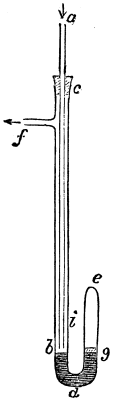
FIG. 1.
III.--TRITURATING APPARATUS.
The apparatus hereafter described is in general use, and was invented by Herr Paul Grundner, of Berlin. It is particularly adapted for finely dividing large quantities of emulsion. It consists essentially of a wooden lid, a b, fitting upon a large stone pot, to the under side of which two strong trapezoid pieces of wood, e d and e f, are fixed, in the under part of which semicircular incisions are cut and held together by two leather straps, supporting a strong, easily-removable iron transverse bar, g h. Through the center of the lid, and turned by the crank, m, passes the axle i, which ends under the lid in the long ring, n.
The stiffened emulsion is then placed in the bag, o p q r, made of fine but strong canvas, with meshes about 0.5 mm. (such as is used for working upon with Berlin wool). The iron rod, g h, is then slipped through the four loops at the bottom of the bag, the open end is slung upon the ring, n, and bound tightly to it by the ribbons, r1. The loops upon the iron bar are then pushed as close together in the middle as possible, and the stone vessel is filled with water until o p q r is completely covered. The crank is then turned, by which the bag is wrung, and the emulsion squeezed through the meshes immediately into the water. When this process is continued until the purse between n and g h feels like a metal rod, the best part of the emulsion has been squeezed through, and if one now take out the bag and dissolve its contents, it will be found that the loss of emulsion is almost nil.
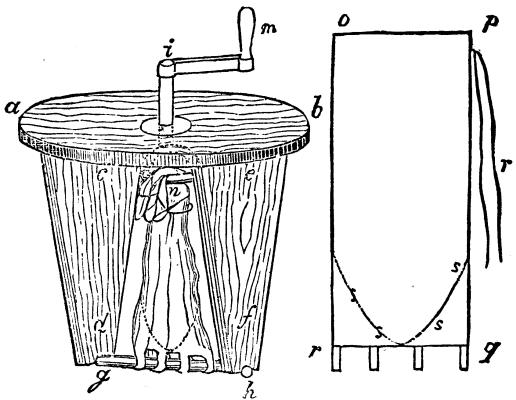
FIG. 2.
It may be remarked that the whole apparatus, with the exception of the crank, must be coated with asphalt varnish; also that the corners, r and q, must be separated off from the purse, as shown by the dotted line, s s s s, otherwise the emulsion would lodge there without being squeezed through. Instead of g h a strong glass rod may be used for small apparatus; but for large apparatus it is indispensable, as the power that requires to be exerted would be far too great for glass.
IV.--WASHING APPARATUS.
The fundamental idea of the apparatus shown in Fig. 3 first occurred to Herr Jos. Junk, of Berlin. In the present form all the subsequent improvements made by Herren Carl Such, Paul Grundner, and others are incorporated. It may be described as follows:
A tin vessel, the bottom of which sinks at e into the shape of a funnel, rests upon strong iron feet, f f, and is covered with a lid, having a double edge closing it light-tight. Through the center of the lid passes the tube, g h, by which the water enters. In the interior of the vessel upon iron hooks stands a wooden vessel saturated with paraffine, open at the ends, and over one end of which the finest hair cloth is stretched at o p. The water which enters the vessel runs off through the siphon. The proceedings are as follows: Turn the granulated gelatine and the water in which it is contained into the horsehair sieve, m n o p. Place the lid upon the apparatus and turn on the water. The whole apparatus fills with water until the siphon begins to act. If the diameter of the siphon be properly measured--one inch should be sufficient for the largest apparatus--and the cock by which the water is turned on properly adjusted, more water will run out by the siphon than runs in through the supply pipe, and the apparatus becomes completely empty.
The siphon has then performed its function, the apparatus fills again, and the play begins anew. The tube, g h, which reaches right down nearly to the bottom of the sieve, takes the water so deep into the vessel that, as long as the water in the apparatus stands high enough above o p, the gelatine nodules are in continuous motion. In order to prevent the finest particles of the emulsion from stopping up the pores of the sieve too much, and thereby incurring the danger of the water in the sieve overflowing its upper edge, thus occasioning loss of emulsion, the tube, g h, is now sometimes omitted and replaced by a supply pipe, represented in the diagram by the dotted lines, x y. In this way every possibility of loss is excluded, and yet a very careful washing provided. Then when, after being emptied by the siphon, the apparatus fills again, every particle of the emulsion which might have formerly been pressed down into the interstices of the sieve would now be driven up again by the upward pressure of the water entering from below, and thus the sieve would always be kept clear and open.
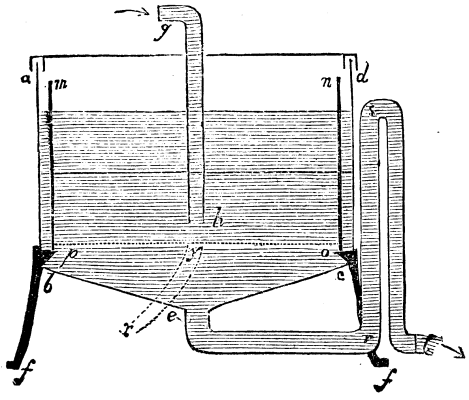
FIG. 3.
The great advantages of this apparatus are as follows: 1. From the moment the lid is closed one can work by daylight. 2. The method of washing in moving water is combined with that of complete change of water. 3. The emulsion never comes in contact with metal. 4. Whoever wishes to prepare dry gelatine only requires, when the washing is over and the vessel perfectly emptied, to leave the emulsion to drip for a time, and then to lift out the sieve and its contents and place it in a suitable vessel with absolute alcohol. The latter should be changed once, and when sufficient water has been extracted the sieve should be withdrawn from the vessel and the emulsion allowed to dry spontaneously. In this way all trouble occasioned by changing from vessel to vessel is avoided, and there is no loss of material.
This apparatus is principally valuable in dealing with large quantities, since it saves a great deal of labor, and affords perfect certainty of the emulsion being well washed. It may not be unnecessary to maintain that the difficulties of perfect washing--particularly if one do not wash with running water--increase at least in quadruple proportion to the quantity of emulsion manipulated.--Franz Stoke, Ph.D., in Br. Jour, of Photography.