AN ENGLISH STEAM FIRE ENGINE.
Reading edition
AN ENGLISH STEAM FIRE ENGINE.
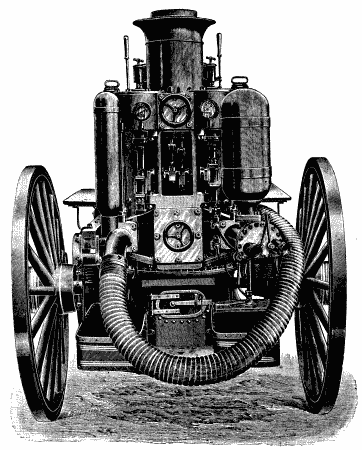
The machine which we illustrate has lately been constructed by Messrs. Merryweather & Sons, of Greenwich Road, with the view to combining the advantages of both horizontal and vertical steam fire engines. Hitherto the horizontal engine has been considered by some firemen to be less handy of access than the vertical, and the vertical engine has had the undoubted disadvantage of not being stoked from the footplate. By shortening the length of stroke and constructing a special pump, the makers have been able to keep the engine sufficiently high in relation to the boiler to enable the firedoor to be placed directly in the rear of the boiler and underneath the engine, thus enabling the boiler to be stoked en route, and allowing access from the footplate to the starting valve, the suction and delivery connections, the whole of the boiler fittings and feed arrangements. This enables one man to drive and stoke the engine, and to attend to the suction and delivery hoses, and it does not interfere at all with the stability of engine in traveling or at work, as the center of gravity is well below the top of the side frames. Another feature is the absence of a main steam pipe, a bracket being arranged on the cylinders containing the steam passages, to bolt directly onto the top of the boiler. The close proximity of the engine to the boiler renders it peculiarly suitable for cold climates, and times of frost, reducing the chances of the pump or feed arrangements being frozen up. The pump valves are arranged between the barrels, and are all accessible by the removal of one cover, which weighs but 12 lb. The engine, we understand, may be stopped, the cover removed, a damaged valve replaced, the cover put on again, and the engine restarted in two minutes. A slotted link is used with a crankshaft for regulating the length of stroke. All the bearings have large wearing surfaces, and substantial eccentric straps are used, the whole of the motion being simple and accessible. There are three different methods of feeding the boiler, viz., by feed pump driven by the crosshead of the main pump, by forcing water directly into the boiler from the main pump, and by an injector taking its water from a tank either supplied from the main pump or by a bucket when pumping dirty water. All the feed pipes are fitted with strainers where attached to the main pump. Drop feed lubricators are fitted on the cylinders, and an efficient system of lubrication is provided for the rest of the working parts. The carriage frame, hose box, etc., are of the same design as usually employed for engines of this class, with the exception of the fore carriage, which is fitted with a cross spring in the rear, as well as the two longitudinal springs. This arrangement makes the engine run more lightly, and removes much of the strain on the side frames when traveling rapidly on a rough road. The wheels are fairly light for the weight they have to carry, and have gun metal stock hoops with diamond pent rims to prevent the men slipping when mounting in a hurry. The engine and boiler work is brightly polished where-ever possible, and the whole machine has a handsome appearance.—Engineering.