CAERNARVONSHIRE. (continued 2)
Reading edition
WYNNSTAY.
The noble demesne of Wynnstay, the seat of Sir Watkyn Williams Wynne, Bart. is situated at the eastern extremity of the vale of Llangollen, in an open and level, though elevated district. The grounds owe much to the taste and magnificent ideas of its successive proprietors, and the embellishments, that have been added year after year present now a wonderful and beautiful association, their grandeur being accompanied, as the scenery of all private parks usually is, with an air of melancholy. The Hall is a spacious but not a regular building. It consists of an ancient mansion, to which a part only of a new and extensive design has been attached. The old house stands upon the site of a British palace, once the residence of Gryffydd ap Madoc Maelor, Lord of Bromfield and Yale, and founder of the abbey of Valle Crucis. The new house, part of a greater design, by Cockenell, was built by the first Sir Watkyn; it is a simple regular elevation, possessing the great merit of capaciousness, a quality indispensably requisite in the Hall of a family conspicuous through generations for the exercise of a liberal hospitality. The principal apartment or state drawing-room is seventy feet in length by thirty in breadth, lighted by six spacious windows, the piers being occupied by richly ornamented cabinets filled with curiosities of various descriptions. The ceiling, which is separated into sunk panels and beautifully finished with stucco and gilding, is sustained by pillars of porphyry corresponding with the elegant pilasters which adorn the side walls. In this splendid apartment are a few portraits by Sir Godfrey Kneller, Vandyck, Sir Joshua Reynolds, and Dahl, with a bust of the Great Sir Watkyn, as he is sometimes styled, by Rysbach; and two admirable busts by Nollekens, one of the present baronet, the other of Lord Grenville. A few good landscapes are hung in the different apartments, a portrait of Wilson by himself is a masterly performance, and an original three-quarter portrait of Flora Macdonald is both interesting and clever. The library contains the remains of a choice collection of manuscripts, the rest having unhappily been destroyed by an accidental fire; those that were preserved are chiefly biographical. In the dining-room stands a large silver font about three feet in length, supported by a pillar of the same height. This tribute of public merit was presented to the present Sir Watkyn by the gentry of his native county, Denbigh.
The extent, elegance, and beauty of the demesne are more than proportionate to the arrangements of the mansion. A spacious park well stocked with red and fallow deer surrounds the house, it is adorned with noble forest trees, and varied by well disposed artificial pieces of water. The quarter of the demesne, called the “Bath Grounds,” is a most gratifying specimen of landscape gardening. These delightful pleasure grounds, laid out by Mr. Evans, consist of shrubberies, walks, and bowers, disposed with admirable taste. A noble sheet of water occupies the centre of the wood; it is formed by the expansion of a little brook, artfully conducted over a rocky precipice at the extremity, where it is thrown into a pleasing and picturesque cascade. The Bath, which lends a distinguishing name to this part of the demesne, is a limpid fountain confined by an enclosure of cut stone. A beautiful Grecian temple, adorned with a portico of four columns, supporting an entablature and pediment, stands close by it, and is beautifully reflected in its smooth waters at the approach of evening. Near the entrance to the Bath Grounds a fluted column of one hundred feet in height, surmounted by a funeral urn, presents an interesting memorial of maternal affection, and a beautiful specimen of columnar architecture: it was designed by Mr. Wyatt. The entablature is surrounded by a gallery approached by steps concealed within the shaft, and the plinth is adorned with wreaths of oak leaves descending from the beaks of eagles. On the cenotaph is graven this brief but feeling epitaph—
Filio optimo, Mater, eheu! superstes.
In a demesne of such extent, the creation and combination of so many persons, years, events, &c. many beautiful and romantic rides may naturally be supposed to have been formed. The new approach, opened by the present Sir Watkyn, and commencing at the iron bridge, leads to the Hall by an avenue of three miles in length, through an amazing variety of sylvan scenery. But this is not the great boast of Wynnstay; the consummation of all its wonders and its beauties is reserved for the vale of Nant y Belan. [83] Here nature has profusely displayed her charms. Two steep banks, richly clothed with woods that dip into the torrent’s bed and wave upon either side, form a long vista of inexpressible grandeur. The winding Dee here pours her rapid flood along with awful murmurings and at a fearful depth, then throwing herself headlong into a deep dark pool, seems to rest, as if exhausted with the violence of the efforts by which it was attained. This grand picture forms but the foreground of an extensive landscape, wherein the middle distance is occupied by the happy scenery of Llangollen, and the remotest filled by the British Alps. Upon the rock from whence this panorama is beheld, Sir Watkyn has erected a circular temple, to the memory of his brave associates, his army of ancient Britons, who fell in the unhappy Irish rebellion of 1798.
The whole of this spacious demesne is enclosed by a stone wall nine miles in extent, and the principal entrance is through a straight avenue, one mile in length, overshadowed by aged oaks. Wattstay was the original name of this estate, so called from its situation upon Watt’s Dyke, but exchanged for Wynnstay by Sir John, when it became his property by marriage with Jane, daughter and heiress of Eyton Evans of Wattstay, Esq.
Sir Watkyn is of the ancient Gwydyr stock, and traces his descent to Owen Gwynedd, Prince of Wales. The Wynnstay branch has been united with some of the noblest families of England; the present baronet is married to the Lady Harriet, daughter of the Earl of Powis, and sister of the Duchess of Northumberland.
The manufacturing village of Ruabon, or Rhiwabon, lies immediately outside the demesne wall, and is inhabited by persons connected with the iron foundries and coal pits of this mineral district. On a conspicuous height above it, commanding a view of the vale of Llangollen, stands a handsome square embattled tower of two stories, erected by the present owner of Wynnstay to commemorate the event of the field of Waterloo.
The posthumous honours paid to this ancient family have employed the chisels of the ablest sculptors, and adorn a temple which their munificence has erected. The first Sir John of Wynnstay, who was the grandson of Sir John of Gwydyr, is interred in Rhiwabon church, beneath, as Mr. York calls it, perhaps for the exercise of a pleasant alliteration, “a mass and massacre of marble.” The monument of Lady Harriet Somerset, first wife of Sir Watkyn, who died in 1769, is one of Nollekens’ happiest designs; and on one side of the altar is a noble monument, by Rysbach, of the first Sir Watkyn, who was killed by a fall from his horse, on the 26th of September, 1749. The image of this eminent person’s mind has been as feelingly pourtrayed by the classic Dr. King, as the graces of his person are truly expressed by the chisel of the artist.
An elegant baptismal font, of white marble, and resting on a tripod of distinguished grace, was presented to the church and parish, along with the excellent organ in the gallery, by the second Sir Watkyn, in the year 1772.
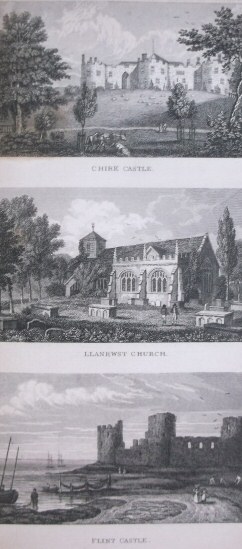
CHIRK CASTLE,
The seat of Mrs. Myddleton Biddulph, stands in a spacious and noble demesne, spreading over the sides and summit of a finely situated and isolated hill. It is an ancient building, uniting the castle with the mansion, in which strength and solidity have been consulted to the neglect or prejudice of grace and beauty. Its form is quadrangular, strengthened by a massive flanking tower at each corner, and a fifth projects from the principal front, through which a lofty archway passes, giving admission to a court within. The dimensions of the court yard are one hundred and sixty-five feet in length by one hundred in breadth, surrounded on all sides by various apartments, the windows of which, for the most part, open towards the enclosed area. A handsome arcade, which formerly occupied the basement on the east side, has been closed up and converted into habitable rooms. The dungeon said to be as deep towards Tartarus as the castle walls were reared towards Heaven, is still entire, still furnished with its dread machinery, and its floor is reached by a descent of two-and-forty steps. The great entrance of the castle was originally protected by handsome and lofty iron palisades, having statues of Hercules and Mars on either side; but the former have been removed, and set up at the western entrance to the park, and the statues are probably committed to the dungeon.
The principal apartments are both comfortable and elegant. The picture gallery, one hundred feet in length by twenty-two in breadth, is adorned with portraits of illustrious persons, and of different members of the Myddleton family; amongst them are those of the great Duke of Ormond and of his son the Earl of Ossory. This was the virtuous stoic who censured the corrupt age and court in which he moved by exclaiming on the early decease of his favourite son, “I would not exchange my dead son for any living one in Europe.” Besides portraits of Sir Thomas Myddleton, and his daughter the Countess of Warwick, there are some rare landscapes in the state rooms, painted by Wilson, and coloured on the spot from nature. They are chiefly views in Chirk-Castle Park, and are very reflections of the grayish tone of colouring so peculiar to Wales. Here is also a view of Pystil Rhaidar, in which the cataract appears falling into the sea, while a few ships are seen sailing past it. The cause of this singular misrepresentation is explained in this way: a foreign artist, not very familiar with the English language, was engaged to execute a painting of this noble waterfall; but, when his work was completed, one of the first persons to whom he exhibited it observed, that a few sheep at the foot of the fall would give animation to the whole. Willing to accept the advice, but mistaking the adviser, the artist immediately introduced a few ships (sheeps) with the natural and necessary accompaniment of the sea.
Castel Crogen, the original name of Chirk, was an ancient British fortress, and fell into the hands of Roger Mortimer, Justice of North Wales, in the following manner. John Earl of Warren and Roger Mortimer Earl of Wigmore, being appointed guardians over the sons of Gryffydd ap Madoc, a partisan of Henry the Third and Edward the First, put their wards to death and seized upon their estates, Mortimer taking Nanheuddwy and Chirk, the portion of the younger child, and Warren possessing himself of Bromfield, Yale, and Dinas Bran. A property held by so base a title required to be protected by powerful measures, and Mortimer thought it expedient to erect a strong castle at Chirk, on the site of the British fortress. The building was commenced in the year 1011, and completed in 1013. The crimes of Mortimer were punished by an ignominious death in the Tower of London, but Chirkland continuing in his family, was sold by his grandson, John, to Richard Fitz-Alan, Earl of Arundel, whose son was appointed governor of the castle with a continuation of the grant, whereby Chirkland was again annexed to Bromfield and Yale. Thomas Mowbray, Duke of Norfolk, having espoused a sister of Lord Arundel, the estate passed over to him, but was transferred to the Earl of Abergavenny, who had married another of the sisters of Lord Arundel, upon the Duke of Norfolk’s disgrace and banishment in 1397. By the marriage of Edward Nevil with the granddaughter of the last proprietor it passed into his family, in the reign of Henry the Sixth. Sir William Stanley appears to have been the next proprietor, upon whose untimely death it escheated to the crown. Elizabeth bestowed it upon the Earl of Leicester, at whose death it passed into the possession of Lord Bletso, from whose son it was purchased by Sir Thomas Myddleton, Knt. in 1595, and is now possessed by his descendant, Mrs. Myddleton Biddulph.
Previous to the year 1506 the castle was regularly garrisoned: during the usurpation it was besieged, and three of the towers battered down by Cromwell’s artillery. Sir Thomas Myddleton, the owner, defended himself gallantly, and was reimbursed by Charles the Second for his losses, amounting to thirty thousand pounds, accompanied by an offer of elevation to a peerage, which honour he very modestly declined.
The view from the high grounds of the park is amazingly extensive, commanding a prospect over seventeen different counties. A part of the grounds, distinguished by the name of the “Black Park,” derives its epithet from the death of a keeper, who, coming to the assistance of a young woman who was attacked by a stag, was himself gored to death by the ferocious animal. The village of Chirk lies at the foot of the hill on which the castle stands. It consists of a few cottages built from agreeable rustic designs, and presents a neat and cheerful appearance. The church is handsome, spacious, and adorned with a noble tower. The interior is ornamented with monuments of the Chirk-Castle family; the best and most interesting of which is erected to the memory of the famous Sir Thomas Myddleton.
The little river Ceiriog, which separates England from Wales, flows through the valley of Chirk, and is crossed by a handsome aqueduct conveying the waters of the Ellesmere canal. This extremity of the aqueduct is met by a tunnel passing under the hill, and carrying the line of navigation towards the aqueduct at Llangollen. A singular mound may be observed on the brow of the hill hanging over the Ceiriog, and at a little distance from the church, it is obviously artificial, and is doubtless a sepulchral barrow, such as are frequently found in other parts of the principality.
LLANRWST CHURCH.
The town of Llanrwst is situated on the eastern bank of the river Conway, in the beautiful and luxuriant vale to which it lends its name. The river is broad, smooth, and shallow, except when swollen by the mountain floods, which rise and fall with wonderful rapidity. One of the most celebrated objects here is the famous shaking bridge, built from a design of Inigo Jones. It consists of three arches, the centre sixty feet span, and, if the crowns of the arches were not too high, would be a light, beautiful, and ingenious work. The ceremony of shaking is performed by two persons upon the crown of the centre arch, first rocking themselves sufficiently to acquire a gentle momentum, and then falling back against the great centre stone of the battlements; a person leaning against the opposite battlement will feel the tremulous motion communicated through the whole masonry of the bridge. The view of Llanrwst vale from the bridge, and from the road leading to it on the Denbighshire side of the river is of unexampled beauty. The Gwydyr woods clothe a precipitous mountain on the west, for a length of five miles, through which a bold crag here and there is seen protruding with a fine effect. The opposite side is also finely wooded, and variegated with mansions, parks, meadow, corn-land, and all that enriches a landscape. This perspective of the vale presents a composition embracing grandeur and magnificence in a high degree, combined with scenes of great pastoral beauty.
The town possesses no architectural or other peculiar attractions, and from the lowness of its situation does not participate in the exquisite scenery with which it is surrounded. Its recommendations are of a less romantic though not less useful character, consisting in the excellence of its fairs and markets, and its convenient position for the conduct of a profitable inland trade. The town and market-hall, the free school, and the almshouses [91] are its most ancient institutions of a public class. The church is picturesquely placed on the bank of the river; and the view of the valley, with the famous bridge in the foreground, enjoyed from the churchyard, is eminently beautiful. The church is dedicated to Saint Rystyd or Rwst, archbishop of London in the year 361, and one of those who were present at the council of Arles. The ground on which it is built was given by Rhun ap Nefydd, in expiation of the foul murder of Prince Idwal, who was slain in Cwm Idwal, by order of his foster-father Nefydd Haradd. The chief object of interest here is the Gwydyr chapel, adjoining the church, of which Inigo Jones was the architect, A.D. 1663, the expense being defrayed by Sir Richard Wynne. The design is much admired, and its restitution by Lord Willoughby D’Eresby, representative of the ancient house of Gwydyr, is characteristic of a happy exertion of munificence and taste. The carved roof is not part of Jones’s design, it was brought hither from the dissolved abbey of Maenan, three miles from Llanrwst. In this mausoleum of the Wynnes are some curious monuments, illustrative of history, and no mean specimens of the progress of the arts at the period of their execution. A white marble tablet contains a pedigree of the family from the time of Edward the First down to the year in which the chapel was erected. Underneath this pedigree is an exquisite portrait, engraved on brass, of Dame Sarah Wynne, daughter of Sir Thomas Myddleton, of Chirk Castle, executed in a masterly style by William Vaughan in the year 1671. On the south side are two pyramidal columns of variegated marble adorned with military insignia, one to the memory of Meredyth; the other of Sir John Wynne, and his consort the Lady Sidney, daughter of Sir William Gerard, chancellor of Ireland; and between the columnar monuments is a simple tablet to John ap Meredydd who died in 1559.
A fine effigiated tomb, sunk in the floor, represents Howel Coetmore ap Gryffydd Vychan ap Dafydd Gam, in complete armour, his feet resting on a lion couchant. He was grandson of Gryffydd, [93] who lies interred in the church of Bettws-y-coed, and proprietor of the Gwydyr estates, which were purchased from one of his descendants by the Wynnes.
Here also is preserved the stone coffin in which the remains of Llewellyn the Great were deposited in the abbey of Conway; upon the dissolution of religious houses in Wales it was removed here. A singular Latin inscription, of which the following is a translation, appears on a monument in the pew belonging to the Davises of Cyffddû; it is dedicated to the memory of Gryffydd Lloyd of Bryniog, and is supposed to have been written by himself,
“Once the undeserving schoolmaster, Then the more undeserving lecturer, And last of all the most undeserving rector of this parish. Do not think, speak, or write any thing evil of the dead.”