Chapter VI
Reading edition
MEDIÆVAL TOWNS.
ediæval towns in England had one of four origins; some were those of ancient Roman foundation, which had lived through the Saxon invasion, like Lincoln, Chester, and Colchester. Others again grew up gradually in the neighbourhood of a monastery. The monastery was founded in a wilderness, but it had a number of artisans employed about it; travellers resorted to its hospitium as to an inn; it was perhaps a place of pilgrimage; the affairs of the Lord Abbot, and the business of the large estates of the convent, brought people constantly thither; and so gradually a town grew up, as at St. Alban’s, St. Edmundsbury, &c. In other cases it was not a religious house, but a castle of some powerful and wealthy lord, which drew a population together under the shelter of its walls—as at Norwich, where the lines of the old streets follow the line of the castle-moat; or Ludlow, on the other side of the kingdom, which gathered round the Norman Castle of Ludlow. But there is a third category of mediæval towns which did not descend from ancient times, or grow by accidental accretion in course of time, but were deliberately founded and built in the mediæval period for specific purposes; and in these we have a special interest from our present point of view.

There was a period, beginning in the latter part of the eleventh and extending to the close of the fourteenth century, when kings and feudal lords, from motives of high policy, fostered trade with anxious care; encouraged traders with countenance, protection, and grants of privileges; and founded commercial towns, and gave them charters which made them little independent, self-governing republics, in the midst of the feudal lords and ecclesiastical communities which surrounded them.
In England we do not find so many of these newly founded towns as on the Continent; here towns were already scattered abundantly over the land, and what was needed was to foster their growth; but our English kings founded such towns in their continental dominions. Edward I. planted numerous free towns, especially in Guienne and Aquitaine, in order to raise up a power in his own interest antagonistic to that of the feudal lords. Other continental sovereigns did the same, e.g. Alphonse of Poitiers, the brother of St. Louis, in his dominion of Toulouse. But in England we have a few such cases. The history of the foundation of Hull will afford us an example. When Edward I. was returning from Scotland after the battle of Dunbar, he visited Lord Wakes of Barnard Castle. While hunting one day, he was led by the chase to the hamlet of Wyke-upon-Hull, belonging to the convent of Meaux. The king perceived at once the capabilities of the site for a fortress for the security of the kingdom, and a port for the extension of commerce. He left the hunt to take its course, questioned the shepherds who were on the spot about the depth of the river, the height to which the tides rose, the owner of the place, and the like. He sent for the Abbot of Meaux, and exchanged with him other lands for Wyke. Then he issued a proclamation offering freedom and great commercial privileges to all merchants who would build and inhabit there. He erected there a manor-house for himself; incorporated the town as a free borough in 1299 A.D.; by 1312 the great church was built; by 1322 the town was fortified with a wall and towers; and the king visited it from time to time on his journeys to the north. The family of De la Pole, who settled there from the first, ably seconded the king’s intentions. Kingston-upon-Hull became one of the great commercial towns of the kingdom. The De la Poles rose rapidly to wealth and the highest rank. Michael de la Pole “builded a goodly-house of brick, against the west end of St. Mary’s Church, like a palace, with a goodly orchard and garden at large, enclosed with brick. He builded also three houses in the town besides, whereof every one hath a tower of brick.” Leland the antiquary, of the time of Queen Elizabeth, has left us a description and bird’s-eye plan of the town in his day, which is highly interesting. Of our English towns, those which are of Roman origin were laid out at first on a comprehensive plan, and they have the principal streets tolerably straight, and crossing at right angles. The great majority of the towns which grew as above described are exceedingly irregular; but this irregularity, so important an element in the picturesqueness of mediæval towns, is quite an accidental one. When the mediæval builders laid out a town de novo, they did it in the most methodical manner; laying out the streets wide, straight, at equal distances, and crossing rectangularly; appropriating proper sites for churches, town-halls, and other public purposes, and regulating the size and plan of the houses. It is to the continental towns we must especially look for examples; but we find when Edward I. was building his free towns there, he sent for Englishmen to lay them out for him. A similar opportunity occurred at Winchelsea, where the same plan was pursued. The old town of Winchelsea was destroyed by the sea in 1287, and the king determined to rebuild this cinque-port. The chief owners of the new site were a knight, Sir J. Tregoz, one Maurice, and the owners of Battle Abbey. The king compounded with them for their rights over seventy acres of land, and sent down the Bishop of Ely, who was Lord Treasurer, to lay out the new town. The monarch accorded the usual privileges to settlers, and gave help towards the fortifications. The town was laid out in streets which divided the area into rectangular blocks; two blocks were set apart for churches, and there were two colleges of friars within the town. Somehow the place did not flourish; it was harried by incursions of the French before the fortifications were completed, people were not attracted to it, the whole area was never taken up, and it continues to this day shrunk up into one corner of its walled area. Three of the old gates, and part of the walls, and portions of three or four houses, are all that remain of King Edward’s town.
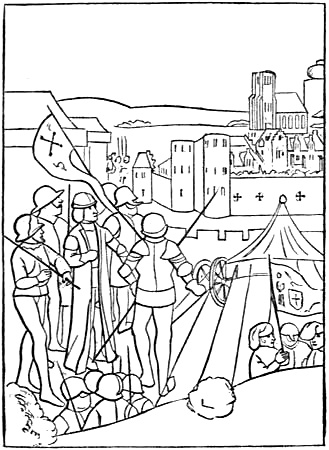
View of Jerusalem.
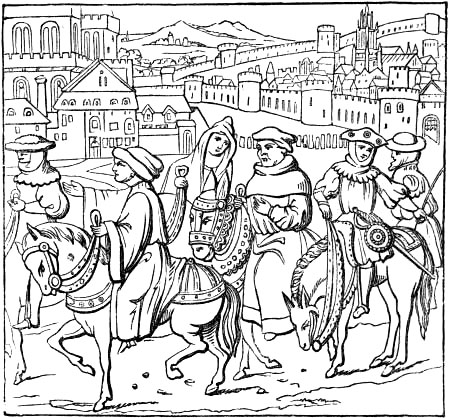
The Canterbury Pilgrims.
The woodcut on the preceding page, from a MS. of Lydgate’s “Storie of Thebes” (Royal 18 D. II.), gives a general view of a town. The travellers in the foreground are a group of Canterbury pilgrims.
In these mediæval times the population of these towns was not so diverse as it afterwards became; the houses were of various classes, from that of the wealthy merchant, which was a palace—like that of Michael de la Pole at Hull, or that of Sir John Crosby in London—down to the cottage of the humble craftsman, but the mediæval town possessed no such squalid quarters as are to be found in most of our modern towns. The inhabitants were chiefly merchants, manufacturers, and craftsmen of the various guilds. Just as in the military order, all who were permanently attached to the service of a feudal lord were lodged in his castle or manor and its dependencies; as all who were attached to a religious community were lodged in and about the monastery; as in farm-houses, a century ago, the labouring men lived in the house; so in towns all the clerks, apprentices, and work-people lodged in the house of their master; the apprentices of every craftsman formed part of his family; there were no lodgings in the usual sense of the word. In the great towns, and especially in the suburbs, were hostelries which received travellers, adventurers, minstrels, and all the people who had no fixed establishment; and often in the outskirts of the town without the walls, houses of inferior kind sprang up like parasites, and harboured the poor and dangerous classes.
The bird’s-eye views of the county towns in the corners of Speed’s Maps of the most famous Places of the World, are well worth study. They give representations of the condition of many of our towns in the time of Elizabeth, while they were still for the most part in their ancient condition, with walls and gates, crosses, pillories, and maypoles still standing, and indicated in the engravings. Perhaps one of the most perfect examples we have left of a small mediæval town is Conway; it is true, no very old houses appear to be left in it, but the streets are probably on their old lines, and the walls and gates are perfect—the latter, especially, giving us some picturesque features which we do not find remaining in the gates of other towns. Taken in combination with the adjoining castle it is architecturally one of the most unchanged corners of England.
We have also a few old houses still left here and there, sufficient to form a series of examples of various dates, from the twelfth century downwards. We must refer the reader to Turner’s “Domestic Architecture” for notices of them. A much greater number of examples, and in much more perfect condition, exist in the towns of the Continent, for which reference should be made to Viollet le Duc’s “Dictionary of Architecture.” All that our plan requires, and our space admits, is to give a general notion of what a citizen’s house in a mediæval town was like. The houses of wealthy citizens were no doubt mansions comparable with the unembattled manor-houses of the country gentry. We have already quoted Leland’s description of that of Michael de la Pole at Hull, of the fourteenth century, and Crosby Hall in Bishopsgate Street. St. Mary’s Hall, at Coventry, is a very perfect example of the middle of the fifteenth century. Norwich also possesses one or more houses of this character. The house of an ordinary citizen had a narrow frontage, and usually presented its gable to the street; it had very frequently a basement story, groined, which formed a cellar, and elevated the first floor of the house three or four feet above the level of the street. At Winchelsea the vaulted basements of three or four of the old houses remain, and show that the entrance to the house was by a short stone stair alongside the wall; under these stairs was the entrance into the cellar, beside the steps a window to the cellar, and over that the window of the first floor. Here, as was usually the case, the upper part of the house was probably of wood, and it was roofed with tiles. On the first floor was the shop, and beside it an alley leading to the back of the house, and to a straight stair which gave access to the building over the shop, which was a hall or common living-room occupying the whole of the first floor. The kitchen was at the back, near the hall, or sometimes the cooking was done in the hall itself. A private stair mounted to the upper floor, which was the sleeping apartment, and probably was often left in one undivided garret; the great roof of the house was a wareroom or storeroom, goods being lifted to it by a crane which projected from a door in the gable. The town of Cluny possesses some examples, very little modernised, of houses of this description of the twelfth century. Others of the thirteenth century are at St. Antonin, and in the Rue St. Martin, Amiens. Others of subsequent date will be found in the Dictionary of Viollet le Duc, vol. vi., pp. 222-271, who gives plans, elevations, and perspective sketches which enable us thoroughly to understand and realise these picturesque old edifices. Our own country will supply us with abundance of examples of houses, both of timber and stone, of the fifteenth century. Nowhere, perhaps, are there better examples than at Shrewsbury, where they are so numerous, in some parts (e.g. in the High Street and in Butcher Row), as to give a very good notion of the picturesque effect of a whole street—of a whole town of them. But it must be admitted that the continental towns very far exceed ours in their antiquarian and artistic interest. In the first place, the period of great commercial prosperity occurred in these countries in the Middle Ages, and their mediæval towns were in consequence larger and handsomer than ours. In the second place, there has been no great outburst of prosperity in these countries since to encourage the pulling down the mediæval houses to make way for modern improvements; while in England our commercial growth, which came later, has had the result of clearing away nearly all of our old town-houses, except in a few old-fashioned places which were left outside the tide of commercial innovations. In consequence, a walk through some of the towns of Normandy will enable the student and the artist better to realise the picturesque effect of an old English town, than any amount of diligence in putting together the fragments of old towns which remain to us. In some of the German towns, also, we find the old houses still remaining, apparently untouched, and the ancient walls, mural towers, and gateways still surrounding them. The illuminations in MSS. show that English towns were equally picturesque, and that the mediæval artists appreciated them. The illustrations in our last chapter on pp. 519, 520, give an idea of the houses inhabited by citizens in such a town as St. Alban’s. In the “Roman d’Alexandre,” in the Bodleian Library, Oxford, a whole street of such houses is rudely represented, some with the gable to the street, some with the side, all with the door approached by an exterior stair, most of them with the windows apparently unglazed, and closed at will by a shutter. We might quote one MS. after another, and page after page. We will content ourselves with noting, for exterior views, the Royal MS. 18 E. V. (dated 1473 A.D.), at 3 E. V., f. 117 v., a town with bridge and barbican, and the same still better represented at f. 179; and we refer also to Hans Burgmaier’s “Der Weise Könige,” which abounds in picturesque bits of towns in the backgrounds of the pictures. For exteriors the view of Venice in the “Roman d’Alexandre” is full of interest, especially as we recognise that it gives some of the remaining features—the Doge’s Palace, the Cathedral, the columns in the Piazzeta—and it is therefore not merely a fancy picture, as many of the town-views in the MS. are, which are supposed to represent Jerusalem,[418] Constantinople, and other cities mentioned in the text. This Venice view shows us that at that time the city was lighted by lanterns hung at the end of poles extended over the doors of the houses. It gives us a representation of a butcher’s shop and other interesting features.
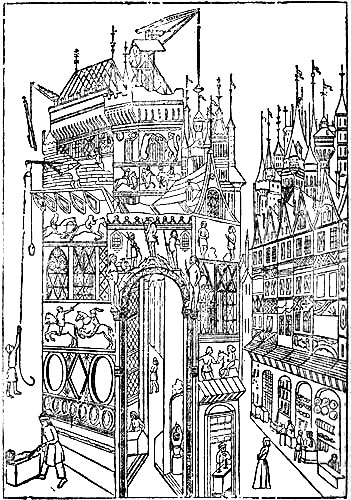
A Mediæval Street and Town Hall.
The illustration on the preceding page is also a very interesting street-view of the fifteenth century, from a plate in Le Croix and Seré’s “Moyen Age,” vol. Corporations et Metiers, Plate 8. Take first the right-hand side of the engraving, remove the forest of picturesque towers and turrets with their spirelets and vanes which appear over the roofs of the houses (in which the artist has probably indulged his imagination as to the effect of the other buildings of the town beyond), and we have left a sober representation of part of a mediæval street—a row of lofty timber houses with their gables turned to the street. We see indications of the usual way of arranging the timber frame-work in patterns; there are also indications of pargeting (e.g. raised plaster ornamentation) and of painting in some of the panels. On the ground-floor we have a row of shops protected by a projecting pent-house; the shop-fronts are open unglazed arches, with a bench across the lower part of the arch for a counter, while the goods are exposed above. In the first shop the tradesman is seen behind his counter ready to cry “what d’ye lack” to every likely purchaser; at the second shop is a customer in conversation with the shopkeeper; at the third the shopkeeper and his apprentice seem to be busy displaying their goods. Some of the old houses in Shrewsbury, as those in Butcher Row, are not unlike these, and especially their shops are exactly of this character. When we turn to the rest of the engraving we find apparently some fine building in which, perhaps, again the artist has drawn a little upon vague recollections of civic magnificence, and his perspective is not quite satisfactory. Perhaps it is some market-house or guildhall, or some such building, which is represented; with shops on the ground-floor, and halls and chambers above. The entrance-door is ornamented with sculpture, the panels of the building are filled with figures, which are either painted or executed in plaster, in relief. The upper part of the building is still unfinished, and we see the scaffolds, and the cranes conveying mortar and timber, and the masons yet at work. In the shop on the right of the building, we note the usual open shop-front with its counter, and the tradesman with a pair of scales; in the interior of the shop is an assistant who seems to be, with vigorous action, pounding something in a mortar, and so we conjecture the shop to be that of an apothecary. The costume of the man crossing the street, in long gown girded at the waist, may be compared with the merchants given in our last chapter, and with those in an engraving of a market-place at p. 499. The figure at a bench in the left-hand corner of the engraving may perhaps be one of the workmen engaged upon the building; not far off another will be seen hauling up a bucket of mortar, by means of a pulley, to the upper part of the building; the first mason seems to wear trousers, probably overalls to protect his ordinary dress from the dirt of his occupation. Of later date are the pair of views given opposite from the margin of one of the pictures in “The Alchemy Book” (Plut. 3,469) a MS. in the British Museum of early sixteenth-century date. The nearest house in the left-hand picture shows that the shops were still of the mediæval character; several of the houses have signs on projecting poles. There are other examples of shops in the nearest house of the right-hand picture, a public fountain opposite, and a town-gate at the end of the street. We see in the two pictures, a waggon, horsemen, and carts, a considerable number of people standing at the shops, at the doors of their houses, and passing along the street, which has no foot pavement.
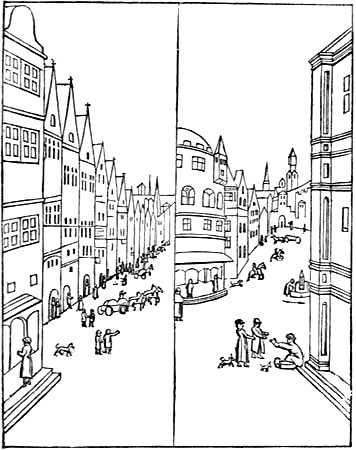
Mediæval Streets.
The accompanying cut from Barclay’s “Shippe of Fools,” gives a view in the interior of a mediæval town. The lower story of the houses is of stone, the upper stories of timber, projecting. The lower stories have only small, apparently unglazed windows, while the living rooms with their oriels and glazed lattices are in the first floor. The next cut, from a MS. in the French National Library, gives the interior of the courtyard of a great house. We notice the portion of one of the towers on the left, the draw-well, the external stair to the principal rooms on the first floor, the covered unglazed gallery which formed the mode of communication from the different apartments of the first floor, and the dormer windows.
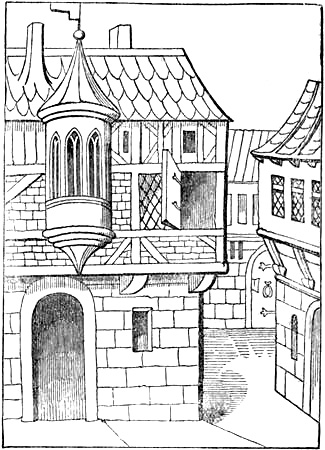
A Town, from Barclay’s Shippe of Fools.
A whole chapter might be written on the inns of mediæval England. We must content ourselves with giving references to pictures of the exterior of two country ale-houses—one in the Royal MS. 10 E. IV., at f. 114 v., which has a broom projecting over the door by way of sign; and another in the “Roman d’Alexandre” in the Bodleian—and with reproducing here two pictures of the interiors of hostelries from Mr. Wright’s “Domestic Manners and Customs of the Middle Ages.” They represent the sleeping accommodation of these ancient inns. In the first, from the “Quatre Fils d’Aymon,” a MS. romance of the latter part of the fourteenth century, in the French National Library, the beds are arranged at the side of the apartment in separate berths, like those of a ship’s cabin, or like the box beds of the Highlands of Scotland. It is necessary, perhaps, to explain that the artist has imagined one side of the room removed, so as to introduce into his illustration both the mounted traveller outside and the interior of the inn.
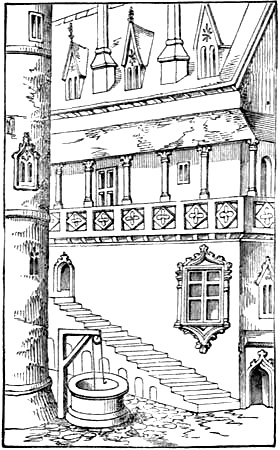
Courtyard of a House. (French National Library.)
In the next woodcut, from Royal MS. 18 D. II., the side of the hostelry next to the spectator is supposed to be removed, so as to bring under view both the party of travellers approaching through the corn-fields, and the same travellers tucked into their truckle beds and fast asleep. The sign of the inn will be noticed projecting over the door, with a brush hung from it. Many houses displayed signs in the Middle Ages; the brush was the general sign of a house of public entertainment. On the bench in the common dormitory will be seen the staves and scrips of the travellers, who are pilgrims.
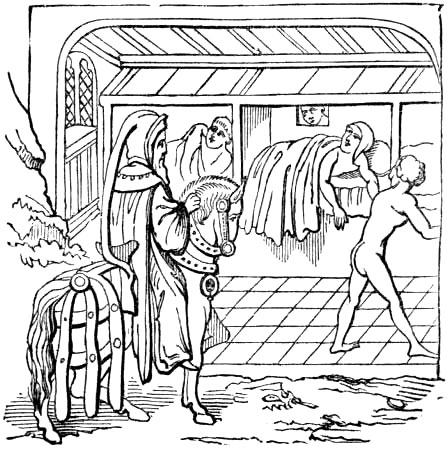
An Inn. (French National Library.)
A fragment of a romance of “Floyre and Blanchefleur,” published by the Early English Text Society, illustrates the mediæval inn. We have a little modernised the very ancient original. Floris is travelling with a retinue of servants, in the hope of finding his Blanchefleur:—
“To a riche city they bothe ycome, Whaire they have their inn ynome[419] At a palais soothe riche; The lord of their inn has non his liche,[420] Him fell gold enough to honde, Bothe in water and in lande, He hadde yled his life ful wide.”
i.e. he had travelled much, had great experience of life, and had gained gold both by sea and land. Besides houses entirely devoted to the entertainment of travellers, it was usual for citizens to take travellers into their houses, and give them entertainment for profit; it would seem that Floris and his servants had “taken up their inn” at the house of a burgess; he is called subsequently, “a burgess that was wel kind and curteis:”—
“This Child he sette next his side, Glad and blithe they weren alle So many as were in the halle; But Floris not ne drank naught, Of Blanchefleur was all his thought.”
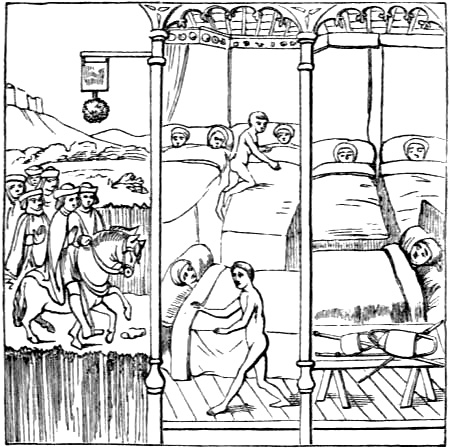
An Inn.
The lady of the inn perceiving his melancholy, speaks to her husband about him:—
“Sire takest thou no care How this child mourning sit Mete ne drink he nabit, He net[421] mete ne he ne drinketh Nis[422] he no marchaunt as me thinketh.”
From which we gather that their usual guests were merchants. The host afterwards tells Floris that Blanchefleur had been at his house a little time before, and that—
“Thus therein this other day Sat Blanchefleur that faire may, In halle, ne in bower, ne at board Of her ne herde we never a word But of Floris was her mone He hadde in herte joie none.”
Floris was so rejoiced at the news, that he caused to be brought a cup of silver and a robe of minever, which he offered to his host for his news. In the morning—
“He took his leave and wende his way, And for his nighte’s gesting He gaf his host an hundred schillinge.”
One feature of a town which requires special mention is the town-hall. As soon as a town was incorporated, it needed a large hall in which to transact business and hold feasts. The wealth and magnificence of the corporation were shown partly in the size and magnificence of its hall. Trade-guilds similarly had their guildhalls; when there was one great guild in a town, its hall was often the town-hall; when there were several, the guilds vied with one another in the splendour of their halls, feasts, pageants, &c. The town-halls on the Continent exceed ours in size and architectural beauty. That at St. Antoine, in France, is an elegant little structure of the thirteenth century. The Belgian town-halls at Bruges, &c., are well known from engravings. We are not aware of the existence of any town-halls in England of a date earlier than the fifteenth century. That at Leicester is of the middle of the fifteenth century. The town-hall at Lincoln, over the south gate, is of the latter half of the century; that at Southampton, over the north gate, about the same date: it was not unusual for the town-hall to be over one of the gates. Of the early part of the sixteenth century we have many examples. They are all of the same type—a large oblong hall, of stone or timber, supported on pillars, the open colonnade beneath being the market-place. That at Salisbury is of stone; at Wenlock (which has been lately restored), of timber. There are others at Hereford, Ross, Leominster, Ashburton, Guildford, &c. The late Gothic Bourse at Antwerp is an early example of the cloistered, or covered courts, which, at the end of the fifteenth century, began to be built for the convenience of the merchants assembling at a certain hour to transact business. The covered bridge of the Rialto was used as the Exchange at Venice.
None of our towns have the same relative importance which belonged to them in the Middle Ages. In the latter part of the period of which we write it was very usual for the county families to have town-houses in the county town, or some other good neighbouring town, and there they came to live in the winter months. When the fashion began we hardly know. Some of the fine old timber houses remaining in Shrewsbury are said to have been built by Shropshire families for their town-houses. The gentry did not in those times go to London for “the season.” The great nobility only used to go to court, which was held three times a year; then parliament sat, the king’s courts of law were open, and the business of the nation was transacted. They had houses at the capital for their convenience on these occasions, which were called inns, as Lincoln’s Inn, &c. But it is only from a very recent period, since increased facilities of locomotion made it practicable, that it has been the fashion for all people in a certain class of society to spend “the season” in London. As a consequence the country gentry no longer have houses in the provincial towns; even the better classes of those whose occupation lies in them live in their suburbs, and the towns are rapidly changing their character, physically, socially, and morally, for the worse. London is becoming rapidly the one great town in England. The great manufacturers have agencies in London; if people are going to furnish a house or to buy a wedding outfit they come up to London; the very artisans and rustics in search of a day’s holiday are whirled up to London in an excursion train. While London in consequence is extending so widely as to threaten to convert all England into a mere suburb of the metropolis of the British empire.