SCANDAL (continued 2)
Reading edition
It was with the feeling that she was leading lady in an extremely daring society drama, that she took what she inwardly called the stage, as much mistress of herself as she had been in the rooms of the portrait painter. When she turned up the shaded lights on her dressing-table and over the fireplace she did so with the rhythmic movement and the sense of time which would have been hers had she rehearsed the scene and been now playing it to a crowded house on the first night of a metropolitan production. She seemed to hear the diminuendo of the orchestra and to feel that curious nervous exhilaration that comes from the knowledge of being focused by thousands of unseen eyes. It was surely an almost uncanny sense of humor which allowed her to stand outside herself in this way and watch all her movements as though they were those of another person. But,—she knew her part. She had the confidence of one who has completely memorized her lines. Her triumph would be complete when she succeeded in making Franklin put the key back into the lock of her door and remove himself from her presence.
As Franklin examined the room in which he never imagined that he would find himself and had no desire to be his determination to get even with the spoiled girl who had used him to get herself out of a family fracas grew stronger and stronger. It seemed to him that the room,—almost insolent in its evidences of wealth,—was symbolic. It was not, he saw, the room of a young, healthy, normal girl so much as of a woman of the world, a highly finished, highly fastidious mondaine, who had won the right to live in an atmosphere of priceless tapestries, historic furniture, and a luxury that was quite Roman. He ran his eyes scornfully about and scoffed at the four-poster bed in which a French queen might have received, and probably did receive, the satellites and flatterers of her court; and saw through an open door not a mere bathroom, but a pool, marble-lined, with florid Byzantine decorations, discreetly lit. This thing angered him. It stood, he thought, as the reason for this girl's distorted idea of life—of her myopic point of view. It stood for many thousands of misplaced dollars which would, if sanely used, have provided much-needed beds for the accident wards of a hospital.
Not for the first time in his life, Franklin staggered at the sight of the abnormality of excessive wealth, and felt that he himself, like Beatrix, was nearer to lunacy than the ordinary human being because of the possession of it. The queer paradox of his having been made the instrument to bring this girl down from the false pedestal upon which she had stood ever since she was born, also struck him. He had never been much given to self-analysis or to the psychological examination of social conditions; but as he sat there in that large, lofty and extravagant, almost grotesquely furnished bedroom, more closely resembling that of one or other of the great courtezans than of an American girl in the first exquisite flush of youth, he came to the conclusion, with a savage sense of justice, that he would be doing something for civilization by bringing this millionaire's daughter face to face with the grim truth of things.
It was Beatrix who broke a silence which had only lasted a few minutes. "There are cigarettes at your elbow," she said. "Won't you smoke?"
Franklin looked up. The note of camaraderie in her voice surprised him. The last time he had heard her speak it was in a tone of agonized appeal. "No, thanks," he replied, "I've smoked enough."
"In training for one of your much-paragraphed athletic feats, perhaps," she said, a quizzical smile playing round her lips.
"I am," said Franklin. "Though I doubt whether this one will be as much advertised as the others." He looked steadily at her as he said this thing, caught the merest flick of her eyes and marked up to his credit the fact that she understood his meaning.
For several seconds these two eyed each other deliberately, like contestants in a prize ring. They measured each other up calculatingly without any attempt to hide the fact. It was with unwilling admiration that Franklin noted the girl's return to courage. He had to confess to himself that the fearless tilt of her chin and the superb grace of her attitude, which was as far from being self-conscious as though she were standing in the corner of a crowded drawing-room, pleased him. It was to be a fight, then. That was evident. The spirit of the huntsman rose in him as he realized this.
"Will you ring the bell for your maid?" he asked, making the first attack, "or shall I?"
She shook her head. "Pray don't trouble, there's plenty of time."
"I don't agree with you."
"Does that matter?"
"I think so."
"It's a free country."
She sat down in a chair which Louis XIV was popularly supposed to have used. The yellow light of a lamp on a silver pedestal fell upon her white shoulders.
Franklin got up. His blood raced through his veins. He didn't intend to stand any nonsense. He was going to show her precisely what it meant to be at the mercy of an impatient man. He went across to the door at the far end of the room and opened it. It disclosed a large and elaborate dressing-room lined with full-length mirrors, lighted like a theatre, and with a table covered with implements with tortoise-shell backs. There was another door beyond it. He turned the handle and threw it open. This was apparently a workroom, but much of it was in shadow. He saw a young, dark-haired woman kneeling on a chair with her shoulders rounded over a magazine spread out on a table. One black slipper had fallen off and lay on its side on the rug. A half-empty box of candies was near to her elbow. "Mrs. Franklin is ready for you," he said, and marched back again to his chair.
The maid, obviously French and with the characteristic Breton good-looks, followed him out, unable to disguise her amazement. She stood waiting for orders, with her hands clasped in front of her, in an attitude of rather serf-like humility,—a quiet, slight, black figure, touched with white at the collar and cuffs. Beatrix crossed her legs and settled herself more comfortably into her chair. "You may go back, Helene," she said. "I will call you presently."
The girl bowed and slipped quietly away. Then Beatrix turned to Franklin, with a most tantalizing air of intimacy. "I'm not tired," she said, "and although you are very thoughtful,—more so than most husbands, which is perfectly charming,—I'm all for a little bright conversation. I was rather bored during dinner and afterwards. Don't you think you might amuse me? You seem to be a very amusing person."
Franklin showed his teeth in a silent laugh. "You think so?"
"Well, the indications point to it."
"You have a very vivid imagination, my child."
"A man doesn't call his wife a child until he's been married to her at least ten years, and then is quarreling over her extravagances."
"You may be right," said Franklin, shortly. "You'll oblige me by ceasing to play the fool. I'm not in a mood for it. I'll do the maid's job if you don't want that girl in here."
He got up again and stood over her, apparently the very acme of importunity.
Beatrix only showed her fright by a slight distention of her nostrils. She burst out laughing. "Among your other achievements, then, you know how to unhook a frock."
"I do," said Franklin. "Stand up, will you, please?"
"My dear Mr. Franklin," she said, drawling ever so little, "I forget your Christian name,—isn't there something just a trifle Oriental in your tone?"
"Very likely," said Franklin.
Beatrix sat back and put up a smiling face. "How old are you?" she asked.
"Does that matter?"
"Oh, yes. I think so. I'm trying to piece you together like one of those picture puzzles that children and septuagenarians play with. It seems to me that you must have spent a certain number of years among the black races. When you speak I seem to hear the distant hollow noise of the tomtom and the quaint semi-religious nasal voices of half-clothed savages who stand cowed before you. Am I right, sir?" She laughed again, disguising her trepidation with the expertness of a finished actress.
Franklin turned away and helped himself to a cigarette. "You said that I could smoke."
"Of course."
With almost impish glee, Beatrix told herself that she had won the first round.
When a man pauses to smoke it is usually a sign either that he is tired or that he needs something to keep his nerves under control. Franklin lit a cigarette for the latter purpose. The girl's assumption of utter coolness made him want to take her roughly by the shoulders and shake her as he would a naughty child. Her air of enjoyment and mischief made him all the more determined to see the thing through to the logical end of it. He could see that she imagined she could mark time and possibly wear him out by the use of her wits, but that it did not occur to her how at any moment brute force might come into the argument. Ever since he had been old enough to go to school Franklin had resented being made a fool of, and any boy who had had the temerity to attempt to do so paid for it. He saw red on those occasions and could remember each one of them in every detail. He began to see red now. Not only had this young, wilful, uncontrolled child of wealth already made a most colossal fool of him, but there she was, calmer than he had ever seen her, treating him as though he were a green and callow youth, playing with him in order to break the monotony of a dull evening. His temper grew hotter.
"Listen!" he said. "It doesn't appear to be any use to treat you as an ordinary girl."
"Have you only just come to that conclusion?"
"I have broken in many thoroughbreds in my time, and unless you conform pretty quickly to the rules of the game that you have forced me to play, I shall have to use horse-breaking methods with you. Do you want me to put it plainer than that?"
"Before we go any further," said Beatrix, showing a most tantalizing flash of white teeth, "don't you think you ought to tell me what your Christian name is? I can't keep on saying 'My dear Mr. Franklin,' under these unconventional circumstances. It's so formal." She knew well enough, and he knew it.
"Get up!" said Franklin, thickly, keeping his hands off her with the greatest difficulty. "Either go to your maid, or call her in. I'm through."
With a little bow, Beatrix rose. It was perfectly evident to her that Franklin was rapidly becoming dangerous and that at any moment he might let himself go. What could she do? According to her family, this man was her husband and, as such, had the right to be in her room. To scream would only make her look ridiculous, unless she intended to give herself away, and this she was not prepared to do under any circumstances. She might be able to fence with Franklin a little longer and, as a last resource, to pursue the ordinary tactics of a woman cornered and throw herself on his mercy, with tears. Humiliation,—that was the thing she hated most. And as she faced Franklin again, with these things running rapidly through her mind, she felt once more a renewed sense of admiration for his grim determination to punish. She owned to herself with perfect frankness that this odd and neurotic fight was between the two most spoiled children of her country. The sense of humor which was her saving grace gave her the power to see it in the light of something which was not without value and meaning in her life. If she had actually to fight like a wild-cat, she intended that the morning should find her as she was at that moment.
"Will you call Helene, then?" she said.
Franklin went across the room to the door of the maid's cubby-hole and rapped.
Beatrix, seized with a new idea, followed Franklin and with a touch of masterly audacity stood at his side with her hand on his arm. "Don't you think we make a charming picture of connubial felicity?"
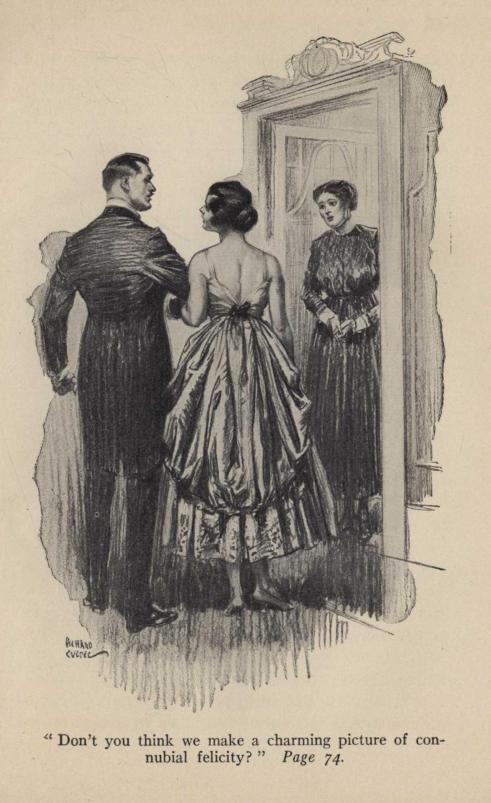
"Don't you think we make a charming picture of connubial felicity?"
"My God!" said Franklin.
The maid came out, and as she did so, Beatrix made a dart into her room. She had suddenly remembered that she could escape through it into the main part of the house, and that if she could get away and find shelter in the arms of her fluttering companion she would be safe for that night at any rate.
But Franklin was too quick for her. He caught her by the arm just as she was about to win the first round.
"Oh, no, you don't," he said, and picked her up in his arms, carried her back into the bedroom and dumped her down on a divan as though she were a bundle of feathers.
Then he turned to the maid. "Just lock your door and bring me the key." And when in a moment it was timidly handed to him, he added, sharply: "Now get Mrs. Franklin ready for the night."
Beatrix stopped the girl as she padded softly over to the dressing-room. "Wait a minute, Helene," she said, and turned towards Franklin. "This is the hour when I drink a glass of hot milk, oh, my lord and master! Have I your gracious permission to continue the habit to-night? If so, will you permit my handmaiden to go below and get it for me?"
Franklin held out the key. Helene took it, and he turned on his heel.
With an eel-like movement Beatrix slipped from the divan, made a dart at the French girl and in a quick whisper told her to go and fetch Mrs. Lester Keene at once. Whereupon, under the firm belief that this new manoeuvre made her top-dog, all her audacity and self-assurance returned. With Brownie there to protect her she could really begin to enjoy herself and make Franklin wish, not only that he had never entered her room, but that he had never been born. She could play with him as a cat plays with a mouse. She could make him sting and smart under her badinage, She could make him see that he had placed himself in a position in which he would look the most egregious idiot, and eventually rout him from the scene with her laughter ringing in his ears. "It will take a better man than Mr. Pelham Franklin," she told herself, "to break me in."
She began her new tactics at once. She strolled over to where Franklin was standing and sat on the arm of a chair. Her color had come back and her eyes were sparkling. She looked like one of Sir Joshua Reynolds' pictures of Lady Hamilton come to life. "Tell me," she said, "what's your opinion of York? We may as well have a little bright conversation while Helene has gone on her domestic errand, don't you think so?"
Franklin looked at the girl with a sort of analytical examination. He admitted her courage and her spirit. He admitted her overwhelming beauty and her inherited assurance. But he began to wonder whether,—in spite of the little piteous appeal which had come involuntarily from her lips when she found herself alone with him,—there was not a streak of callousness in her nature which put her well up among some of the almost degenerate young women of her class.
"I only know York by sight," he said. "That was enough."
"Don't you think you take things too seriously? His fur coat, Italian moustache and flamboyant tie do put one off, of course, but he's one of the comics of the city and, as such, well worth knowing. I wonder you haven't dropped in to see him sometimes. He's conveniently near to you,—luckily for me." She gave a low laugh as she added the last words.
Franklin stood with his back against one of the carved bed-posts, with his hands in his pockets. In various parts of the world he had met all sorts and conditions of women, from the red-cheeked coquettish daughters of mountaineers to the glum squaws of dilapidated Indian chiefs. Also he had come in contact with the rather cold and quizzical society women of England, the great ladies of Paris who have made immobility a fine art, the notorious cocottes of all nationalities and many of those unconsciously pathetic but perfectly happy little women who, as artists' models of the Latin quarter, live with exquisite though temporary morality in an atmosphere in which morals are as scarce as carpets and as little needed. His acquaintanceship with all these various types had been casual, but he had been interested enough in them to study their characteristics, their mannerisms and their tricks. But here, in Beatrix Vanderdyke, was a girl who didn't come under any of the six types of women. She didn't conform in any one way either to his preconceived ideas of herself. Even his brutality hadn't disturbed her. She was still as unruffled as a white fan-tailed pigeon. Her eyes still gleamed with mocking laughter and there was not one single sign of fear, or even of nervousness, in her easiness and grace. His interest in her grew with every moment of delay and her desirability became more and more obvious with every moment that passed. He might have been inclined to let her off had she shown any weakness. His anger might have grown cold had she let him see anything of outraged maidenly modesty. But her present attitude egged him on, added fuel to his fire and doubled his desire to break her will.
"What do you propose to do to-morrow and the day after?" she asked, as though she had been married to him for some time and wanted to make her plans.
The question startled Franklin. "Sufficient for the night," he said.
Beatrix gave one of the tantalizing little bows which were so annoying to her mother. "I see! Probably I shall take my estimable, but rather irritating companion to Europe by the first possible boat. As Mrs. Franklin, I shall be doubly welcomed in English society. The combined and much-paragraphed wealth of our two families will make me a very romantic figure even in England, where blood is wrongly supposed to weigh more than money-bags. It will be very refreshing to be a free agent at last. I wonder what sort of thrill you'll get when you see my face in the Sketch and Tatler among actresses and cabinet ministers' wives and trans-Atlantic duchesses! By this time, of course, the epoch-making news of our alliance,—as Aunt Honoria calls it,—will have been flashed to the far ends of the earth. What'll you do if any legal person asks to see our marriage lines?"
The sheer impertinence of this young woman left him wordless, until, followed by the French maid, Mrs. Lester Keene,—hastily dressed in a discreet Jaeger dressing-gown,—fluttered tremulously in, hurried over to the girl who was popularly supposed to be in her charge, and put her arms dramatically around her shoulders. Then he cursed ripely beneath his breath.
Mrs. Lester Keene was one of those numerous women whose sense of the romantic, whose belief in the lowness of human nature and whose relish for melodrama were the result of having lived a placid, uneventful, incompetent and wholly protected life. Like a boy who is a constant attendant at the movies and carries home with him a keen desire to murder his baby brother and brain his little friends with his father's wood-chopper, Amelia Keene had derived a distorted view of the life and people beyond her horizon from an absolutely quenchless thirst for sensational novels, which she drank in, firmly believing that they gave true pictures of men, women and events.
To Beatrix, who knew this kindly, ineffectual, ordinary little woman through and through, it was funny to see the manner in which she "believed the worst,"—to use one of her own favorite phrases,—of what she saw from a first quick glance. The lofty, museum-like chamber so little suggested the bedroom of a young girl or of any woman except a painted harridan who was accustomed to being surrounded, even in her most intimate moments with grotesque acquaintances, that the presence of Franklin there might have meant nothing. It was conceivable that he and Beatrix, who had the same royal way of disdaining the laws of convention if it suited their purpose to do so, might have arranged to meet there in order to be out of the family eye and to discuss the chaos in which they both stood. It was as unromantic a meeting place as the great echoing hall of the Grand Central Station or the foyer of the Metropolitan Opera House. But Amelia Keene, whose excitement since her few minutes' conversation with Beatrix before dinner had churned her into a condition almost approaching apoplexy, seized with instant avidity at the chance of adding drama to the scene in which she had been called upon to take a part.
"Oh, my darling! My darling!" she cried. "Thank God you sent for me! Am I in time?"
This was altogether too much for Beatrix. She threw one look at her unruffled reflection in the mirror and another at Franklin, the very epitome of self-control, and gave herself up to the enjoyment of a burst of laughter which left her utterly weak. Even Franklin, who was in no mood for hilarity, smiled at the obvious inanity of the remark.
Mrs. Lester Keene turned from one to the other with an air of comical indignation. She saw nothing to laugh at. If there had been any fun in all this, why had she been sent for? Her age and her position in that house gave her the right to protect her untamable charge. The mere fact, if such a fact could be mere, that a man was in the bedroom of this young girl was in itself a frightful shock to all her inherited ideas of propriety. To her, novel-fed as she was, Franklin could not be anything but a desperate character, a menace to virtue, a man of the world. He and Beatrix might look at it from the callous modern angle, but she had made up her mind that she was called upon to perform a great rescue and to stand as the representative of Chastity and Moral Goodness,—and like all the women of her type she consciously dignified these terms with capital letters. The only thing that she regretted was that she had done her hair for the night and had not given herself time to touch her face with a powder-puff.
As soon as Beatrix had recovered herself and was able to speak again, she unlaced herself from Mrs. Keene's plump, well-meaning arms and pushed her gently to the nearest chair. "Pull yourself together, Brownie dear," she said. "I hope I sha'n't have to keep you out of bed longer than a few minutes. I sent for you because you had very little opportunity of speaking to Mr. Franklin to-day and he's in a particularly brilliant mood. As you know, I like you to share my pleasures, Brownie, dear." She threw a look of triumph at Franklin, which said as plainly as spoken words, "My game, my friend!"
Franklin caught her meaning. He shot out a laugh and answered her aloud. "Don't you believe it. I have all night at my disposal." And after trying several chairs he sat down in one that had arms and a slanting back, made himself completely comfortable and eyed the newcomer with such interest that she bristled beneath his gaze.
Summing up the state of the game,—it was still in this way that she regarded this amazing episode inconceivable except when conducted by these two products of a social system peculiar to America,—Beatrix didn't like the look of things. It had seemed to her that the entrance of Mrs. Keene would reduce the position to one of such absurdity that Franklin would be only too glad to take himself off with as much dignity as he could muster up. His tenacity took her breath away. What sort of a man was this who intended to stick to his point even in the face of a witness?
Not having been endowed with as much humor as would slip through a sugar-sifter, Mrs. Lester Keene had the faculty of jumping in where angels fear to tread. Her love and admiration for Beatrix were the biggest things in her life,—far bigger than her nebulous marriage and her occasional social triumphs in suburban London. It gave her a sort of false courage and carried her over all conventional bunkers which her provincial up-bringing had erected between herself and the truth. There was therefore a touch of heroism in the way in which she turned upon Franklin. "How long have you been here?" she demanded.
"I'm not sure," said Franklin.
"Time flies when one is interested," said Beatrix, with a charming smile.
"What right have you to be here at all?"
"Ask my wife," said Franklin, drily.
"She isn't your wife, and you know it."
"I am the only man who does," said Franklin.
"And for that reason your behavior is inexcusable and unforgivable. It is not that of a gentleman. I am astounded that a man who bears such a name as yours could descend to these depths."
She had never spoken to anyone like this before, not even to the little servant who, far away in the past, had brushed her hair and mislaid her hair-pins. She was surprised at herself. She felt, with a thrill of curious excitement, that she was rising bravely to a great occasion. Franklin remained patient. He felt sorry for this obviously weak woman who was notoriously no more able to cope with Beatrix than could a canvas screen with a fifty-mile gale. She was doing her best and he respected her. It was not so much her fault as her misfortune that the result was farcical. He caught a look of amusement in the eyes of his antagonist, and waiving all feeling of enmity in a moment of sympathy, smiled back at her. He shrugged his shoulders and said nothing, and so Mrs. Keene, now oiled up, started off again.
"It doesn't require any imagination to know what your intentions are," she said, her choice of words becoming more and more high-flown and her rather fat chin quivering under her emotion. "You seek to take advantage of a young girl who has placed herself in a most dangerous position. I have no words in which to say how despicable—" Her voice broke.
Beatrix patted her shoulder. "There, there, Brownie dear! There, there! Don't take it so much to heart. The last half-an-hour has been full of fun and I've enjoyed it all enormously, and presently when Mr. Franklin comes to the conclusion that after all this is the twentieth century, he'll recover his chivalry and find some other way in which to pay me out."
"Then all I've got to say is this," said Mrs. Lester Keene: "the sooner he comes to that conclusion the better. You, my dear, ought to be in bed and asleep. And after my recent attack of lumbago, I don't think anyone has the right to keep me out of bed as late as this."
Franklin got up and held out his right arm. "I'm so sorry. Allow me to escort you to the door," he said.
"And you intend to go to your own room?"
Beatrix held her breath. On the answer to that question everything that she could see in the future depended.
"This is my room," said Franklin. And when the little lady drew back he went behind her chair, put his hands gently under her elbows, lifted her up and ran her, a perfect mass of impotent protest, to and through the door of the maid's room, which he locked. He knew that Mrs. Keene dared not make a fuss, and returned to face Beatrix once more, with a curious smile, "All square at the turn," he said.
"Well played, sir," replied Beatrix, generously.
A lugubrious clock that was somewhere in that unsuitable room struck twelve. Through the open windows came the raucous enthusiasm of the frogs on a close-by pond. Their imitation of the mechanical noises made by a factory in full blast was more exact than usual. A local cock flung out his throaty challenge to other barn-yard sheiks and was answered from near and far. A full moon in a sky that was very mosaic of stars laid a magic light upon the earth and water.
Beatrix heaved a little sigh. She was beginning to feel tired. Excitement was burning low, and Nature, whom she was in the habit of ignoring with characteristic imperiousness, demanded sleep. Franklin was not to be beaten by tricks, it seemed, or turned off by sarcasm. She must change her tactics and see how honesty would work.
"You'll go now, won't you?" she said quietly, with an offer of friendship that was usually irresistible.
Franklin shook his head and stood firm.
"No? Oh, I think so. There isn't any need to carry your strong man performance any farther. You've quite convinced me that education and all the advantages of civilization mean nothing to me. I'll take it for granted that they mean just as little to you. In a word, I'll own myself punished and give you the game. Will that do?"
"No," said Franklin. "That's not good enough."
Beatrix stood thoughtfully in front of him, with her hands behind her back, drooping a little like a flower in the evening. Her new and utter naturalness made her seem startlingly young and immature and different. Franklin hardly recognized in this Beatrix the brilliant, sparkling, insolent, triumphant creature who had turned the tables on her family and claimed his help as a sportsman without one iota of consideration for him or the future. But he refused to weaken. He realized that if he allowed himself to drift even into the approach of sympathy she would twist him round her little finger. She deserved no mercy. He would give her none. She had had the temerity to place him high up among the world's fools and she must pay the full price for the privilege.
"Perhaps you don't know," she said, "how much it costs me to retire from any sort of contest until the result is hopelessly against me. I've only done it once before, and that was in a tennis tournament at Palm Beach last winter, when I went on playing, with a sprained ankle, and fainted. I don't intend to faint now, but I'm very, very tired. Won't you let me give up?"
Franklin shook his head again. "This is not anything like the little games that you kill time with," he said. "I'm not Sutherland York, nor am I one of the green youths who help you to get through monotonous days. I have been just as spoiled as you have and this can't end until my vanity has been healed. You know that as well as I do."
"Oh, yes," she said frankly, "I understand. If I stood in your shoes I should feel as you do and be just as brutal in my desire for revenge. But put yourself in mine for a minute. You can if you will. You have imagination. The mere fact that you've been in my room for an hour and made me undergo the worst sort of humiliation before my maid and my companion ought to be sufficient to heal any ordinary type of vanity, however severe the wound. Come, now. I don't ask you to be fair. I don't deserve that. But be big and get off that awfully high horse. What d'you say? Shall I cry quits?" She held out her hand with the charming smile which had never failed since the time when she was the little queen of her big nursery.
Franklin compelled himself to ignore it. "No," he said. "I'm here to make you feel the spurs for the first time in your life, and I shall stay."
In a flash Beatrix changed back to the personality behind which she hid her best and undiscovered self. She threw back her head and squared her shoulders and brought her exquisite slim young body into an attitude of audacious challenge and ran her eyes over Franklin with an expression in which there was contempt and amusement.
"Then you may make up your mind to a long and arduous job," she said. "It'll take a better man than you to break me in."
"We'll see about that," he said.
She burst into a derisive laugh. Her blood was up. This man had frightened her, amused her, interested her. He had won her admiration, even a little of her sympathy. Now he bored her. He had stayed too long, harped on one subject too steadily. She might consent to play at something else, but this game was threadbare. She refused to entertain the possibility of his attempting to carry out his threat beyond taking possession of her room, which, in itself, was impertinent enough.
"What precisely do you imagine that you can do?" she asked, with the very essence of scorn.
Franklin's patience had almost run out, too. "I don't imagine that I can do anything. I know exactly what I'm going to do."
"Is that so? Do tell me."
"Conform in detail to the right you've given me," he said, "without any further argument."
"Beginning how, pray?"
"By tearing that frock off your back, unless you have your maid in right away."
"You wouldn't dare!" she said, scoffing at him.
That was the worst word she could have chosen. To dare Franklin to do a thing was to guarantee that it was done. With the blood in his head he laid instant hands on her and ripped the chiffon from one soft white shoulder.
There was an inarticulate cry, a brief, breathless struggle, and the next instant he received a blow on the face that made him see stars.
"You little tyrant!" he said, with a short laugh. "That's your spirit, is it?"
He made for her again, angrier than he had ever been in his life. But she darted away like a beautiful fish, and with her round shoulder gleaming in the moonlight stood close to an open window, her breasts rising and falling, her nostrils distended, her eyes like two great stars, her face as white as the feathers of a white dove.
"Touch me again and I'll jump out of this window!"
"I don't believe you," he said, but remained standing.
"I swear to God I will!"
He knew that she meant it. "You'd break every bone in your body," he said.
"That would be better than having your hands on me again."
He made a spring and caught her by the wrists. "Now jump!"
"Oh, very clever," she said, with superb sarcasm. "You've evidently made a hobby of fighting with women."
That stung Franklin. "I don't call you a woman," he blurted out. "There's been nothing of the woman in you since the day you knew enough words to order one of your nurses about. You're a hybrid, the production of a mixture of two species,—labor and wealth. The labor in you, inherited from the man who made your first millions, is tainted with revolt, the wealth with the damned despotism that creates it. You're no more a woman than this barrack is a home, or this absurd place a bedroom. You're a grotesque who has been brought up in a nightmare. You walk on a world that is too small for your feet. You're out of drawing like a woman in a fashion-plate. You're a sort of female Gulliver on an earth peopled with pigmies. You almost believe that you're Almighty and that when you raise your finger life must be reset like a chess-board. And you're perfectly right. It can and is and will be so long as money counts. I know it and do it, for you and I hold a piece each of the same wand. But you're up against me now, and you've used me as you might have used a trained servant, or an eager parasite, ready and willing to lick the blacking off your boots for the sake of what may fall unnoticed from your purse, and, by God, you're not going to get away with it."
He controlled her across to the door of the maid's room and pushed it open with his foot. "Come out," he said, "and get Mrs. Franklin ready for the night." Then he marched Beatrix to and into the dressing-room, followed by Helene. Reflected in the mirrors there were not three, but thirty people. "I'll give you fifteen minutes," he continued, "and for the sake of all concerned don't be longer. Is that agreed?"
Beatrix met his eyes. Her spirit was unbroken, her chin at the same tilt, her attitude not one whit less contemptuously assured, but he saw in the slight inclination of her golden head the acknowledgment that he held all the cards.
He turned on his heel and left the room, went over to an open window and drew in long breaths of air.
He and she, children of the same nightmare, as he had called it, had both used the word vanity about the thing which impelled him to punish. But as he looked out into the sane night, magic only from the moon's touch, it came to him that to dismiss it as vanity was to slur over the true meaning of that before which he was urged. It was the labor in him, the revolt against the despotism of wealth that had come back again in his fight with his fellow-hybrid, and once more labor was top-dog. How would he use his power?
For fifteen minutes he stood there with his heart thumping, his hands hot, the exhilaration of success running through his blood like alcohol. And then, to the second, came the sweet diaphanous figure, which, with the dignity of a brave but conquered enemy, crossed to the foolish bed.
Franklin watched her go, her gleaming hair all about her like a bridal veil, her head held high, her lovely face untouched by fear. He watched her pause while the maid opened up the bed, and then slip in. He called the French girl, gave her the key to her door and waited until she had gone. Then he walked to the foot of the bed and stood there silently until Beatrix raised her eyes.
"If you and I," he said, with extreme distinctness, "were the only two living people on a desert island and there was not the faintest hope of our ever being taken back to the world, I would build you a hut at the farthest end of it and treat you as a man."
He wheeled round, unlocked the door, went out into the passage and away.
Only by having seen the expression on Beatrix's face after he had gone would he have known how tremendously well he had revenged himself.
VIII
Franklin's bare statement to Malcolm Fraser that he was going to the Vanderdyke pastoral party merely to meet Ida Larpent left his friend interested and speculative. The lady's name was as familiar to Fraser as to the other men who dined at houses a little to the east and rather less than that to the west of Fifth Avenue. The lady's arresting face had often stirred his dormant sense of psychology, but he never had had the opportunity of saying more than "How do you do?" or "Good-bye" to her. He so obviously didn't count in the scheme of things as they appealed to Mrs. Larpent.
According to the Social Register, however, Mrs. Larpent lived in East Fifty-sixth Street and was the widow of Captain Claude Elcho Larpent of the 21st Lancers, a nephew of Field Marshal Viscount Risborough. That was all. If this precious volume, which is the vade-mecum of so many people who murmur the word society with a hiss that can be heard from one end of the town to the other, had attempted to do justice to the beautiful Ida, at least one-half of the volume would have been devoted to the story of her antecedents and career. Born at Paterson, New Jersey, the only daughter of a pushing and energetic little chemist named McKenna, who had married in a moment of the wildest kind of romance a little, slight, white-faced Russian girl who had left her country among a batch of unsavory emigrants and found employment in a button factory, Ida,—who can tell why?—was marked out from her tiniest years for the oldest profession in the world. One would have thought, to look at her parents,—the father a pugnacious, industrious, thrifty, red-headed Scotch-American, the mother a wistful, grateful, self-effacing little woman who, if there were any justice in this world, would several times have received the distinguished service order for her many acts of unnoticed heroism,—she would have been a bright, brave, practical and perhaps even pretty little girl. Instead of which, to everyone's astonishment and to the utter confusion of the chemist and his wife, Ida resembled nothing so much as a child of the aristocracy. She was thoroughbred from head to foot, perfectly made, with a small oval face and large wide-apart eyes, tiny wrists and ankles and black hair as fine as silk. The paradox of her having been born in the small common-place quarters above a second-rate store, amidst all the untidiness of a place in which the mother did her own housework, was not lost on the parents. They were proud of this fairy-like baby, but they were also frightened of her. They realized that she was in the nature of a freak. It seemed to them that she had come by accident; that, as a matter of fact, they had no right to her. They almost persuaded themselves into the belief, as the child grew up, that she was a changeling; that an unseen hand must have stolen their own sturdy, freckled and rampagious infant, and for some unaccountable reason slipped this exquisite little thing into her place.
There was, as time passed, an element of tragedy about this miracle or accident or mistake,—these words and others were used,—especially when Ida began to find her tongue and her feet. More and more she seemed to be an indignant hot-house plant in a little cabbage-patch. Her parents, poor souls, grew more and more awkward and unhappy in her presence. They had the uncanny feeling always that she was criticising them and their mode of speech and their slummachy way of life. The affection and love which they had been only too willing to give her after the shock of her early appearance wore away, turned into reluctant deference and a constant self-conscious desire to make their apartment and themselves more tidy for her. Even at the age of ten she turned her mother into a maid, quietly insisted that her hair should be brushed every night and saw to it that she was dressed and undressed, manicured and shampooed. She demanded bath salts and scent from the store and the best of soaps and powders. "Do this! Do that!" she would say, and if they were not done she raised her voice and stamped her foot, while a sort of flame seemed to come from her eyes. No one had ever seen her cry after she had learned to walk.
The McKenna circle of friends, consisting of fellow-storekeepers and the Austro-Hungarian musician who was the leader of the little orchestra at the Paterson Theatre, watched Ida's early years with almost breathless astonishment and a kind of disbelief. They accepted her much in the same way as they would, under the pressure of warm friendship, have accepted a pet marmoset or a cursing parrot or a dog with a cat's tail. They noticed, with many comments, that she grew up altogether without filial affection; that she treated her parents as though they were paid attendants, calling her father "Sandy," as his particular friends did, and her mother "Alla," and with the most startling self-assurance making them conform to all her wishes. It was most uncanny. Michlikoff, the bird's-nest-headed musician, who had a sneaking belief in the occult and who read up all that he could find on the subject of transmigration of souls, endeavored to persuade his friends, in voluble broken English, that Ida was a princess born again. With all those who came from places other than Missouri, he succeeded.
It was a perturbed and constrained household in which this unexpected child grew up,—a household that, to the little bandy Scot's never-quite-hidden disgust, was the subject of steady gossip in the town. His first ambition naturally was to see the list of his customers swell, but not at the expense of his pride and self-respect. Those two things, frequently mentioned, were very dear to him. It seemed to him, too, that the family affairs of a man who kept a drug-store should be out of the region of gossip. He and his still pretty wife were glad, infinitely glad, when the time arrived for their daughter to attend the public school. It was only while she was out of the apartment that the mother could go about her work in comfort and without being constantly called away from her domestic duties. The freckled, red-headed little chemist only felt happy when he saw this girl sail out with her books and turn down the street towards the school-house, with her chin held high and her astonishing eyes filled with a sort of scorn for all the passers-by. At school she was not a success. She didn't mix well. The other children held aloof from her. She was obviously out of place amongst them and they resented her presence in the class-rooms. The boys admired her from a distance, fell into self-conscious silence when she approached and whispered about her when she passed by. The girls were antagonistic. They were jealous of her pretty clothes, awed by her lofty silences and surprised at her proficiency with her books. On her seventeenth birthday Ida went to New York, saying that she would be back to supper. But with supper came a cold-blooded note which ran like this:
"Dear Sandy and Alla:
"I'm through with your one-eyed town and the drug-store and provincialism. I'm going to begin to live and dress as I ought to, and there's only one way to do it,—the easiest way. I applied for a job in the chorus of the Winter Garden for the new show and got it. It was easy. I looked very nice in my Sunday clothes and the stage manager said I was a peach. Rehearsals start to-morrow and I shall stay at a boarding-house with some of the other girls. So please send me thirty dollars to go on with and the rest of my things. The address is 302 West 46th Street. I will let you know when to send me more money. You will both be glad to get rid of me, but not so glad as I am to be out of Paterson. I am starting on the bottom rung of the ladder and I am going to climb to the top, whatever I have to pay for it. Judging from the way the men in the office look at me they will have to do most of the paying.
"IDA."
This was read by Mr. and Mrs. McKenna in horrified silence, but with a mutual deep sigh of relief, and put away in a secret place. The only time they ever saw her again was once when they made a pilgrimage to Manhattan and watched her from the balcony of what was once a show ring in Broadway, and saw her, almost nude, flitting like a butterfly in the glare of light.
One other note they received from this curious person, and this, enclosing a cheque for two hundred dollars, contained the news that Ida was going to England with a musical comedy company in which she was playing a small part. And that was the last they ever heard of her. She had come like a stranger and like a stranger she departed. The cheque they never used. With an odd sensation of having been insulted by it they put it in a drawer among receipts and specimens of patent medicines and left it there. And then, happy again, they returned to their habitual untidiness and the daily routine of hard work and endeavored to forget. They regarded it as a blessing that nature had punished them only once. And when eventually they removed themselves to a larger and more pretentious store they left a photograph of a little wide-eyed girl among their debris and felt as though a weight had been lifted from their shoulders.
If they had been able to watch the London newspapers, especially the Sketch and Tatler, they would have quivered at the sight of this strange girl in many graceful attitudes and in the scantiest of costumes as she appeared in almost weekly photographic studies, and they would have gasped if they had presently read the glowing accounts of the marriage of Ida McKenna to Captain Claude Elcho Larpent, nephew of Field Marshal Viscount Risborough, at St. George's, Hanover Square. The headings of these paragraphs had it that Society had once more made an alliance with the stage, but the gushing paragraphs that came beneath stated (how amazed the chemist would have been) that the bride came of one of the best American families, her father being a famous scientist whose country house was at Paterson, New Jersey, and her mother a distant connection of the Russian Chancellor.
Ida Larpent took her place in English society as though to the manner born. She became the beautiful Mrs. Larpent without turning a hair. She ran a little house in Mayfair on her husband's excellent income as though Mayfair had been her playground since childhood. She entertained the younger set and a sprinkling of duchesses with all the insouciance of minor royalty, and plunged her husband into debt in the same cold-blooded way that she had run up bills in her native town, from which on clear days one can see the Simelike unbelievable buildings of the great city.
Claude Larpent was passionately in love with his beautiful and expensive wife. With all the careless pride of a mere boy of twenty-six he gave her the reins, and so long as she made some return for his love never grumbled at her recklessness or her intimacy with men whom he, before marriage, would not have touched with the end of a barge-pole. He trusted her. She was his wife. She had chosen him from among all the men who would eagerly have knelt at her feet. In his weakness he stood lovingly by while she relentlessly ran him on the rocks and into bankruptcy. But it was not until one bad night when he discovered by accident that she had sold herself for diamonds to a most atrocious vieux marcheur that he confessed himself broken, exchanged from his crack regiment to the Houssa Police and disappeared to the West Coast of Africa, the white man's grave. It was exactly three years after the bells of St. George's had rung their merry peal that the obituary notice in the London papers contained a few lines to the effect that Claude Elcho Larpent had fallen a victim to black water fever. The truth was that this foolish young man had died of whisky and a broken heart, and had been buried in the bush mourned and respected by the sturdy little men whom he had treated with that mixture of firmness and camaraderie characteristic of the English officer. His widow, still in the first flush of youth and beauty, was left penniless, but bejewelled, and in the ordinary course of events,—men being awake to the fact that they need not marry her,—came under the protection of a wealthy railway man who planted her temporarily in a pleasant portion of Mayfair, rather sarcastically named Green Street, Berkeley Square. The beautiful Mrs. Larpent thereupon lost a certain amount of caste, but not very much. Duchesses dropped her, but semi-society drank her wines without a twinge and enjoyed many week-ends at her beautiful house on the banks of the Thames near Henley. Younger sons and the stage herded about her, accepting gladly enough her lavish hospitality. The only thing that Ida Larpent had inherited from her father was thrift. And before the railway magnate disappeared from his surroundings in an apoplectic fit, she had managed to put by a large enough sum of money to bring her in somewhere about six hundred pounds a year, and upon that, feeling the need of a change of air and surroundings, she returned to America.
When Franklin met her first, during one of his brief visits to New York, he found her very cosily ensconced in a tiny apartment, gracefully furnished, over a dressmaker's shop in East Fifty-sixth Street, from which, clothed to perfection, she drove forth nightly in her limousine to dine at the best houses. She had come to the United States to catch a husband. Her experience had taught her that a husband is a more permanent institution than a protector. She was determined to marry money. The need of it, in bulk, was essential to her comfort and peace of mind. In order to do so, she lived on her capital, thus conveying the impression that she was very well off. Time after time she could have marched fairly rich young men off to church by their ears, but she was very fastidious,—not so much in regard to them, as men, as to their bank accounts. She didn't intend to make a second mistake. Then she met Pelham Franklin at that sort of sham Bohemian supper at which all the women wear diamonds and all the men are clean and civilized. She fell in love with him before she found out who he was. His brown face and outdoor manner and the air he had about him of not carrying a superfluous ounce of flesh, his utter incompetency as a drawing-room man, which was proved by his not paying her a single compliment or saying anything personal, delighted her. She was sick of those others who all looked alike and said the same things and counted for nothing. Franklin came as a change. His masculinity appealed to her. For the first time in her life passion stirred and her self-complacency was shaken. Before the night was out she heard his name and gave thanks to all her gods for putting him in her way. He came at the moment when her money was running out and the greater part of her morning mail consisted of demands for payment from impatient and long-suffering trades-people. During the fortnight that Franklin remained in town she concentrated upon him, using all her wiles to bring him up to the scratch. Malcolm Fraser was not in town at that time, nor were any of the other men with whom Franklin was on terms of intimate friendship. Feeling lonely and at a rather loose end he saw a good deal more of Mrs. Larpent, under those circumstances, than he would have done in normal conditions. He took her to dinner at Sherry's and the Ritz, night after night, and was delighted at her readiness to do the theatres with him. It was too cold-blooded a business to see the plays alone. Several times, too, he spent a late hour after supper in her charming little drawing-room smoking and chatting. They knew many of the same people in London and Paris. He flirted a little with her—certainly. Why not? Her beauty was unique, her way of expressing herself quite brilliant and amusing, and that air of regal mystery that was all about her piqued curiosity. He had never the least intention of doing more than merely flirt, and not being a lady's man and being therefore without conceit it never occurred to him that his quick friendship could be misconstrued or his frank admiration could possibly lead her to believe that he nourished even the germ of an idea of following these pleasant evenings up with anything serious. He went away under the impression that he would be forgotten as quickly as he had been taken up, and was utterly and blissfully unaware of the fact that Mrs. Larpent had fallen in love with him. He would have roared with incredulous laughter at the mere suggestion.
Thus things had been left when Franklin felt the call of the sea and took Malcolm Fraser for a cruise in the yacht on which he spent the best hours of his life. He wrote a little letter to Mrs. Larpent on the morning he went out of town and thanked her warmly for her kindness and "looked forward tremendously to seeing her directly he got back." Into these few rather boyish and certainly sincere words Ida, making a most uncharacteristic blunder in psychology, read what she most wanted to read,—love, and, of course, eventually marriage. During his absence she marked time impatiently, but with a new smile on her red lips and a gentler manner towards those about her, keeping her tradesmen in a good temper by throwing out tiny hints of impending good fortune. It was solely to meet Franklin again that this sophisticated, ambitious, luxury-loving, unscrupulous woman became a member of the Vanderdyke house-party,—to see again the man who, alone among men, had touched her heart and awakened her passion. Like a girl from a Convent school, young and sweet and inarticulate, she went. Imagine her anger and distress at finding on her arrival at the Vanderdyke barrack that she was asked to add her congratulations to those of the family and their friends on the marriage of Franklin and that "damn girl," as she called her. Imagine it! The shock, the disappointment, the shattering of her one good dream——
IX
When Franklin left the bedroom in which he had gone through the strangest hour of his life, he went into the room which had been allotted to him and from which some of his things had been taken, and stood for a little while at an open window taking in long, deep breaths. His mind was in too chaotic a state to permit him to think patiently of going to sleep, and in the back of it, now that his anger had cooled, there was a growing feeling of self-disgust at the way in which he had treated Beatrix Vanderdyke. He was sorry that he had allowed himself to be carried in front of a wave of extreme indignation and he told himself, a little ruefully, that after all it wasn't for him to take the law into his own hands. He called himself, with unusual sarcasm, an egotist, an individualist, and cursed his vanity which rose up whenever anyone attempted to make a fool of him, and was aghast to discover how very little it took to make a man lose the effects and influence of civilization.
And when he endeavored to look into the future that was staring him in the face—the future all disturbed and upset by the unexpected entrance into his life of the girl who had treated him merely as a pawn upon her lightly considered chess-board, he found himself wholly unable to see through the maze that stretched out in front of him. He was no longer in the splendid position of a free lance. He was no longer able to pass through his days unencumbered with any sort of responsibility. He saw that he was to pay the full price for that moment of aberration during which he had permitted himself to fall in with Beatrix's daringly manufactured lie. It was with a feeling that gave him back something of his self-respect that he realized that it was impossible to give Beatrix away until he had her permission to do so. She had appealed to him as a sportsman and it was as a sportsman, as a man who stuck to the rules of whatever game he played, that he endeavored to report daily to the particular god that he worshipped.
Sick of himself, sick of his room, sick of everything, he went out presently into the passage,—a wide, dimly lit passage hung with old masters and carpeted with Persian rugs which were beautiful and rare enough to hang upon the walls of an art gallery,—and went slowly down-stairs into the hall. For some moments he paced up and down this deserted place asking himself how he was to kill the night. He had no patience for books,—he very rarely read anything except technical things on hunting and fishing,—but eventually he made his way to the library, the nicest and most reasonable room in that uncomfortable, luxurious house. He was aware immediately of the presence of someone standing at the window. The moonlight fell on a dark head and a tall, graceful figure. He turned up the lights and found himself looking into the reproachful and rather sarcastic eyes of Ida Larpent.
She was still in the noticeably simple and very perfect dress that she had worn at dinner,—a soft, black thing not cut slavishly to the existing fashion, but made to suit her peculiar beauty and slender, hipless lines. Cut down to the waist at the back, it seemed to retain its place in front by a miracle. One large, star-shaped brooch studded as closely with diamonds as a clear sky with stars was fastened between her breasts, and jet beads glinted here and there about the graceful skirt that hid her feet. A band of small pearls was placed like an aureola round her head, from which hung one large insolent diamond just where her hair was parted on her low forehead. She wore no rings.
She moved away from the window and leaned lightly against one of the pillars, running her eyes slowly up and down Franklin's tall, wiry figure. She might easily have been standing for an artist as the modern representation of Lucretia Borgia.
"Well!" she said, with a just perceptible upward inflection of her bell-like voice.
To Franklin she seemed to be symbolical of his lost freedom, the unconscious reminder of the good days when he could go and come at will, answer immediately to a whim and move to a fancy as a sail to a breeze. During the course of that afternoon and evening he had not attempted to do more than pass the time of day with her, and had forgotten, in the sudden whirlpool into which he had been dragged by Beatrix, that he had arranged to meet her under that roof to renew a very charming friendship. It was now easy enough to see from her expression and manner that he was to undergo a bad quarter-of-an-hour for his lack of attention. He deeply regretted to have hurt her feelings but was not sorry that he had gone into the room. If there was anything unpleasant to be faced it was his habit to face it and get it over. He did not suffer from moral cowardice.
"Well!" he said.
"I've just finished writing you a letter."
"That's very nice of you."
There was a kind of laugh. "I hope you'll think so after you've read it."
"I'll read it now, if I may," Said Franklin, holding out his hand.
"You may as well." But she tore the letter into small pieces and dropped them at her feet. "No. Why should I give you the pleasure of seeing how much you've made me suffer?"
The word suffer and the unconcealed break in the woman's voice puzzled and surprised Franklin. Was she acting? He saw no reason why she should. It never entered into the very recesses of his mind that there could be any sentiment on her part. Why should there be? "That wouldn't give me any pleasure," he said, with a sort of boyish sincerity.
She looked at him a little eagerly, saw that there was nothing in his eyes that she needed, nodded two or three times and shrugged her shoulders. It was a hard thing to be made to confess that this man who was so desirable had merely passed a few hours with her for the lack of a friend. A new thing, too, after her wide experience of men. Nevertheless, she had run through the last of her remaining money. This was no hour for pride. She stood in dire and urgent need of funds. It was impossible for him to be her husband, but well within the range of her ability to see that he became her banker.
"Did you know that I was in the library?" she asked, making one more effort to prove herself wrong in her quick intuition. This was probably, she told herself, a marriage of convenience.
"No."
"You just came in by accident?"
"Yes."
"I see. Well, then, as we're here and we're both obviously in no mood for sleep, shall we while away the time with a little discussion on the short memories of men,—some men?"
"Why not?" replied Franklin, and drew up a chair for her.
But Mrs. Larpent gave a sharp, eloquent gesture. The chair ought rightly to have wheeled itself into the darkest corner. "I'll stand, thanks. Oddly enough I feel volcanic like most women at the end of their tether who have been chucked."
The abrupt, descriptive colloquialism came strangely from her. She was so finished, so apparently fastidious. Also she spoke with the slight drawl and affectation that some English people acquire after much practice, and imagine to be smart.
"Chucked?" he echoed. "How? By whom?"
This gave Mrs. Larpent a double opportunity to get rid of her spleen and chagrin in an outburst of hysteria and to work on Franklin's sympathies by letting him see that she must have money or sell her jewels. It didn't matter to her what he thought of her now.
"By you! By you!" she said, her voice all broken with emotion. "You came into my life when I was most lonely, most in need of tenderness and kind treatment and on the very edge of a crumbling cliff. I didn't believe that you were playing the usual game with me. You didn't seem to be that kind of man. I thought,—yes, even I, who have grappled with life and am without much faith in human nature,—that you saw all that is good and decent in me and answered to the love that you had set alight in my heart. Why else, I asked myself, did you come day after day and night after night, in a city reeking with people who would have been eager to amuse you, and claim me in a loneliness that was almost equal to mine? Why else did you let me see the best of yourself and treat me with the respect that a man only shows to the woman whom he is going to ask to be his wife? Most of the men I meet are different. They only see in me an unattached woman living on a shoe-string, willing enough to sell her beauty for cash. But in you I thought I saw honesty and sincerity and chivalry, and whether you knew it or not you let me wander into a fool's paradise and dream of a home and a great love and peace. And on the strength of the little note you wrote before you sailed I saw the promise of security from dunning creditors and hope rising over my unhappy horizon. I blurt all this out now only because I'm still suffering from the shock of finding you married. You must forgive me."
She turned abruptly on her heel, with her hands over her face, and stood once more in the window silvered by the moon. Even with those tears on her face and that pain in her heart she was able to congratulate herself on having made the speech of her life.
Franklin was appalled. His knowledge of women was as small as that of most men whose lives are spent in the open. Of the Larpent type he was wholly ignorant. He believed that she was telling the truth and her confession, made with trembling lips and streaming eyes and a broken voice, hurt him. He had never listened to anything so painful or so horribly embarrassing. What could he do or say? How could he possibly explain that her beauty had only made a skin-deep impression and that he had only regarded her as a most delightful companion. And so he said nothing. It was too difficult. He just remained standing with his shoulders squared and his hands behind his back and willed that woman, for God's sake, to stop crying and tell him what he could do to make things easier for her. And the thing that he wished with all his soul was that he was back on his yacht, with the clean night air brushing across his face and the laughter of his intimate pals ringing in his ears.
During the curious, uneasy moments that followed he let his eyes wander about the huge room with its pseudo-Gothic ceiling and pillars, its book-lined walls and its numerous cases of old Bibles and first editions, collections of rare and wonderful bindings, and the assortment of deep arm-chairs and silky rugs which gave it the appearance of a room in a public library rescued from its cold formality by a lover of books, who saw no reason why they should not be enjoyed in comfort. Only one end of it was lit, and the rest was in shadow except for a shaft of silver light that pierced one of the high windows and spilt itself on the plinth of a pillar. He wondered what Mrs. Larpent would say next. He hadn't missed her hint of the need of money. He felt more than ever unhappy and uncomfortable. But on that point, at any rate, she could count on his help, difficult as it would be to put it into practice.
Mrs. Larpent gave another curious little laugh, turned and came back. Franklin glanced quickly at her. She moved closer and there was something about her mouth and nostrils that showed him that he was right in thinking that she had read his thoughts.
"What are you going to do about it?" she asked, taking advantage of the light so that the softness and whiteness of her body should not be lost. One of her smiles had never failed. She adopted it then. Even she retained her optimism.
"What you say goes," said Franklin.
"You mean that, Pelham?" Two or three steps took her within arm's reach. The light remained upon her. If this was merely a marriage of convenience he might make a suggestion that would, at any rate, give her a brief happiness.
"Of course. I only want you to—to tell me what I can do."
Optimism could not live under that suggestion, however generously meant and delicately put, of payment by cheque. Nevertheless, Ida Larpent sat down. It was bitter to see that her love was not to be returned, but good to feel that her diminished bank account was likely to be substantially refreshed. She felt like a woman who had swum out of her depth, lost her nerve, made a mighty effort and feels at last the sand against her knees. Metaphorically she drew herself wearily out of the water and with a renewed sense of confidence felt the warm sun upon her limbs.
There was something detestably cold-blooded in all this, and Franklin hated it. He had hitherto managed to keep himself free from women. They interfered with his pursuits. Why fate should have gone suddenly out of its way to plunge him into the midst of this woman stuff, as he impatiently called it, was more than he could understand.
He looked down at Ida Larpent. She was sitting in a low, red-leather chair,—the sort of thing that is supposed to belong to a room inhabited by men. Her amazing hair, as black as the wing of a crow, had been touched here and there with the tongs. It framed a face as white as marble,—a curiously small oval face,—with eyes remarkably wide apart and large and luminous; a small aristocratic nose, with sensitive nostrils which indicated passion as well as impatience, and a mouth whose lips were full and artificially red. Her small round white shoulders were more daringly bare than those of any woman he had seen, and her two fine hands looked like those in the old French pictures which hang in those houses in Paris that were spared by the Sans-Culottes. Indeed, the whole figure, from head to foot, looked like an oil painting of a period in French history when aristocracy had reached its acme. As a companion for a man of enforced leisure and unlimited means and no ties she had everything in her favor, physically and mentally. As Franklin stood looking at her, however, with all the admiration that was due to her, he found himself unconsciously comparing her,—this exotic—this most exquisite of rare orchids,—with the fresh, buoyant, healthy, clean, proud, spoilt girl who called herself his wife.
"Will you be honest with me?" she asked.
"I haven't got much to bless myself with except that," he answered.
"Were you married when you came to my apartment in March?"
"No."
"Well, that's something," she said. "When were you married?"
"Does that matter?"
"Perhaps not. The fact remains. I'm naturally interested and curious, so tell me this: Was it a sudden infatuation for that child who rules the roost here,—a sudden burst of sentimentality that doesn't seem part of you, or—what? I think I have the right to ask."
"You have," said Franklin. "It was all very sudden. That's all I can tell you about it."
"I see. And now that you are tied up and more than ever under the microscopic eye of the public—what?"
"Well—what?"
"Are you going to be a little careless in the matter of marriage vows, or carry them out to the letter?" She stretched herself a little and smiled up at him, still fighting for the dream that had made her for a little while so young and gentle and unworldly.
"I asked you to believe that I am honest," said Franklin, who had never in his life been so puzzled as to a choice of words.
And then Mrs. Larpent got up. "I see," she said, and held out her hand. "Well, I, at any rate, have not beaten about the bush, and you have spared my feelings with very real kindness. And so good night!"
"Good night!" said Franklin.
"You can think of nothing else that you would like to say?"
Franklin had something else to say,—the question of a certain sum of money. But, like a horse brought nose up to a high jump, he refused, shook his head, and immediately added, "Yes. I'm awfully sorry about all this. Please accept my humble apologies."
Mrs. Larpent bowed, but the gracious smile on her lips was contradicted by her eyes. They were full of pain and anger. And while she still held Franklin's hand she registered an oath that she would leave no stone unturned to make him forget his honesty before many months had passed and lead her willingly into a new and beautiful dream.
"How long are you staying here?" he asked.
"I'm leaving to-morrow," she said. "It isn't awfully amusing to go through the jealous agonies of hell."
"I'll write to your apartment," said Franklin, stumbling a little over the words.
"Thank you." She took his meaning and was certain of his generosity.
He watched her go, moving with a sort of medieval dignity, an almost uncanny suggestion of having stepped out of an old frame to return to it before the finger of dawn began to rub away the night.
X
It was eleven o'clock before Beatrix opened her eyes to a new day. For two hours Mrs. Lester Keene had hovered about the room like an elderly beetle, settling here and there for a moment or two and then continuing her aimless and irresolute flitting. Two or three times she had stood over the sleeping girl and gazed with a sort of amazement at a face that looked strangely childlike, with long lashes like fans upon her cheeks and lips a little parted. Then she would take a magazine to one of the windows, read a few lines here and there without taking in their meaning and gaze at the illustrations intently without knowing what they intended to represent. The truth was that the loyal and well-meaning lady was not herself. Her constitution, not of a very sound order, had been almost shattered by her experience the night before. She had kept watch and had seen Franklin leave the bedroom shortly after he had evicted her from it, and then, with inexpressible relief and thankfulness, gone to bed, but the terrible anxiety had told upon her. Hitherto she had never been called upon to undergo more nerve-strain than is endured by a hen in a well-regulated chicken run, seeing life and adventure and passion only through the eyes of her favorite novelists. She had, however, slept very little and given orders that she should be called at half-past seven, so that she might go early to Beatrix and give her the benefit of her advice. She still remained under the impression, poor little lady, that her advice was of the greatest assistance to the wilful, headstrong girl, even though she never made the merest pretence to follow it.
Beatrix awoke, finally, as a flower opens to the sun. "Oh! Hello, Brownie," she said, "ever-faithful! Heigh-ho! I've had such a lovely sleep. All in one piece without a dream. I feel about fifteen." She stretched herself lazily and put her arms behind her head. "Will you please tell Helene that I want a cup of tea at once,—at once, Brownie. If it doesn't come in five minutes it won't be of any use to me. You're a dear old thing to bother." She gave a little musical yawn as the fluffy-minded woman hurried to the maid's room and gave the order with that sort of mysterious urgency which is connected with embassies in moments of national crises and theatres during a dress rehearsal.
When she returned, which she did at once,—her mind being all astir with curiosity,—she saw that Beatrix was sitting up in bed with her hands clasped about her knees, her eyebrows meeting in a frown, her lips set tightly and her eyes full of anger. Mrs. Keene had never seen this expression on the girl's face before. If she had heard Franklin's parting remark she would have known the reason for it.
"It's very late, dear," said Mrs. Keene; "after eleven, and all the people have been rehearsing in the gardens for an hour."
"Oh, well, it's a charming morning. It will do them good. I wonder if the matinée idol has shaved himself! I understand that they don't do that thing until about four o'clock in the afternoon." And then she began to laugh, more to hide her feelings than anything else.
Not even to Brownie did she intend to show what she felt about the episode of the previous night, or how deeply she resented the humiliation to which Franklin had subjected her. Never in all her life would she forget that, or forgive,—never.
"We certainly may be said to be living on the top of a volcano, Brownie. No monotony about life just now, is there?" And then she suddenly slipped out of bed, alert and full of a new idea, "Go down and see what's happening," she added. "Be my secret agent and come back with a full report of what Franklin has been doing since breakfast. Be very discreet and smile,—smile all the time, bearing in mind that you are the closest friend of a girl who has just been happily married."
"Oh, my dear," cried Mrs. Keene, "don't talk like that! Please, please don't!"
Just for one instant Beatrix allowed her companion to get a glimpse of the strain under which she was laboring. "How else should I talk?" she said, sharply. "Do you think I'm going about with my tail down like a whipped dog——? Run along, Brownie, run along like a good little soul and do this thing for me. In the meantime I'll get up. I feel in my bones that things are going to happen to-day. Thank Heaven I'm on the top of my form, ready for anything and everybody, even Franklin. We do manage to live, you and I, don't we?"
She escorted the amiable, fluttering woman to the door and closed it upon her, quite certain that she would return with full information. If there was one thing in which Mrs. Lester Keene was really proficient it was in spying out the lay of the land.
While bathing in the pool whose hideous Byzantine decorations were never more inappropriate than when they made a background for that sweet, slim form, Beatrix ran her mind over the position. She felt convinced that Franklin, angry and disgusted as he was, would continue to play up until he had her permission to give away the game. She knew a sportsman when she saw one. But she knew also, instinctively, that he was a poor liar, and if,—as was quite likely,—Aunt Honoria and her mother had been pumping him during the morning as to when the marriage took place and for the other details of this great romance, he had probably made a very poor showing. There might have been inconvenient questions asked by her father as to settlements, and so forth. If so, she could imagine how badly Franklin had come out without her at his side to prompt and evade and put tangents into the conversation. She was anxious and owned to it.
When Mrs. Lester Keene returned to the bedroom, slipping into it with an air of almost comic mystery, she was surprised to find Beatrix fully dressed and swinging up and down the room impatiently like a boy.
"What news on the Rialto?" she cried, with a touch of burlesque in her voice.
There was a very serious and even scared look on Brownie's face. "My dear," she said, "listen! I fear that the worst has happened." In a sort of way, Mrs. Keene reveled in the drama of it all. "Mr. Franklin was the first guest in the breakfast-room. He was very quiet and short with the servants. He drank two cups of coffee and ate hardly anything. He was joined on the veranda by your father and they walked up and down together talking earnestly for thirty-six minutes. They were then sent for by Aunt Honoria. They have been closeted——"
"Closeted is excellent," said Beatrix. "Well done, Brownie! I thought so," she added mentally, with a sharp intake of breath.
"They have been in Miss Honoria's room,—your mother was there too,—until about ten minutes ago, when Mr. Franklin came out alone, hurried downstairs and out on the veranda, kicking one of the cane chairs on his way into the garden. My dear, God only knows what took place in that interview! Your father, Aunt Honoria and your mother are still talking. I don't understand—I really utterly fail to comprehend how you can stand there with that smile on your face, being in the midst of what seems to me to be a very terrible situation."
Beatrix whistled a little tune to keep up her courage, sat on the edge of a heavily carved table and swung her legs. "Well, what would you have me do?" she asked, with consummate coolness. "Stand on my head, wail like one of the fat ladies in Tristan and Isolde, or sink back on the sofa in an attitude of Early Victorian despair?" She got up and walked to one of the open windows and stood for a moment in the sun as though to get a little necessary warmth and sympathy. Then she went back to the table and looked rather eagerly and girlishly at her altogether useless but very faithful friend. "What d'you think it all means, Brownie dear?"
Mrs. Lester Keene gave the question her serious consideration. She was one of those women who looked most ludicrous when most worried. "If you ask me," she said, "I believe that Mr. Franklin has given you away and told the truth."
This answer came as rather a shock to Beatrix, but only for a moment. "Well, I don't," she said. "Shall I tell you why?"
"Indeed I wish you would."
"If Franklin had given me away he wouldn't have kicked that cane chair."
Brownie gave another gesture of despair. "If only you had it in you to take things seriously."
"Seriously! You dear old thing, I'm most serious. I have every reason to be. But that was a fine piece of deduction and my spirits have gone up with a rush. I'm now going to find Franklin, and I'll bet you a diamond bracelet that he has stood by me like a Trojan and is as angry as a caged hawk. Now, the all-important point is this: What hat shall I wear,—a simple, naïve, garden thing, or this sophisticated effort? I must please his eye."
"Wear the smart hat," said Mrs. Keene.
Beatrix wore the other. That almost went without saying.
She sang on her way down-stairs. She chose Santuzza's song from Cavalleria, which she ragged in the most masterly manner. She did this to give the impression, to anyone who might hear her, of light-heartedness. Her lithe, young, white-clad figure was reflected by many mirrors as she passed. She made sure that none of her people were in the hall, and then darted out to the veranda to look for Franklin. The members of the house-party had dispersed to pass the morning away in tennis and with the rehearsals for the pastoral. She could see a number of people under the trees to the left. She swung round the veranda, walking on the balls of her feet like a young Diana, singing as she went, but darting quick, anxious glances to the right and left. There was no sign of Franklin. She was about to make her way through the Dutch garden, all aflame with flowers, to the summer-house which overlooked the Sound shining beneath the sun, when a footman came out carrying one of her mother's petulant spaniels.
"Do you happen to know where Mr. Franklin is?" she asked, pulling up short.
"Yes, madam."
The word made her heart pump. "Well,—where?"
"Mr. Franklin ordered his car round ten minutes ago, madam, and has driven off to New York."
New York! Then he had given her away, after all, and left her in the lurch. What on earth was she going to do now?
XI
It was twenty minutes to one when Franklin brought his car to a stop at the Willow Tree Club in West Fifty-seventh Street. Malcolm usually dropped in to this rendezvous of writing men, artists and good fellows generally to read the papers, about midday. There was more than a chance that he might be lunching there.
The city lay weltering under a pall of humidity. As about a great hive the people moved like tired bees. Flags lay comatose around their posts, striped awnings hung limply above the windows of those unhappy souls who could not get away, and the buildings which reared their heads up to the sky seemed to perspire.
Franklin enquired for his friend at the office, was told that he had been in but had left half an hour before, murmured a mere second-grade oath, and being a member of the club himself, went into the reading room. He remembered that he needed certain things from Spaldings', especially flies, and knowing from long experience that he had better not trust to his memory, decided to write a brief letter, then and there.
A pale man was sitting within easy reach of the long magazine table. He looked up with the slightly antagonistic expression characteristic of men in clubs who have had a room to themselves, and wondered what sort of lucky creature the interloper was who could afford to achieve such a superb tan in a world of work and effort.
Franklin caught his eye, registered the fact that he had never seen him before and didn't much care if he never did again, and sat down at a writing table behind a book-case in the corner of the room.
After a few moments he was aware of the entrance of someone else because the pale man sang out a greeting, but he had concentrated on his list and what was said didn't reach him. He searched his brain for everything that he needed in the way of flies and tackle, endeavored to make his writing more legible than it usually was and was about to address the envelope when he caught the name of Vanderdyke. It was not so much the mention of the name that made him prick up his ears as the rather ribald tone in which it was said.
"I was surprised to read all that glorification in this morning's papers," he heard. "Gossip had it that you were very much in the running, York."
"I? Oh, no, my dear fellow. I had never entered in the matrimonial stakes for that girl."
"Why not? Beatrix Vanderdyke was worth winning, surely? Money to burn, beauty, youth,—what else do you want?"
"I'm not a marrying man. As they will be pretty certain to say in my obituary notices, I am 'wedded to my art.' Besides, my dear fellow, I have the fortunate knack of getting what I want without the consent of the parson." There was the kind of snigger that only comes from men who belong to the lady-killer tribe.
That, and the gross innuendo that preceded it, carried Franklin to his feet. The lust to hit had seized him. He stalked round the book-case into the middle of the room. His hands were clenched and he was breathing deeply like a man who had been running. He recognized in the tall, red-tied, flamboyant person the man with whom he had seen Beatrix that night when he had left the apartment house with Malcolm Fraser.
"I was luckily in a position to overhear your remark," he said quietly. "I'm Franklin. Miss Vanderdyke is my wife."
The pale man drew in his breath, and a look of excitement and pleasure flashed into his eyes. The one thing that made him feel that he had any blood was a fight.
Sutherland York recovered himself quickly. But for the slight suggestion of whiteness about his mouth he seemed to be perfectly at ease and nonchalant. "I'm glad that you're glad," he said, with a polite smile. "Permit me to offer my congratulations upon your very sudden and romantic marriage."
Franklin went a step or two nearer. "If you were not such a fat, unmuscular brute," he said, slowly, and with the most careful distinctness, "if I shouldn't be laying myself open to a charge of cruelty to animals, I'd thrash you until you blubbered for mercy." He put his hands in his pockets. "Even if I did, it would have very little effect, except to send you to the dentist and the beauty doctor. Your sort of liar is never properly cured."
He waited for a moment, obviously to give the famous artist a chance to revenge himself in some way for the insult that he had deliberately made as strong as he could.
And the pale man eyed York expectantly, eagerly.
But York still smiled, although the whites of his eyes took on a strange yellow tinge. "I regret that I do not possess the gift," he said, with a little bow, "of making suitable tu quoque to cave-men."
Whereupon Franklin burst into a laugh, turned and went out.
The pale man flung his magazine away. He resented being done out of legitimate excitement.
"A curiously uncivilized person," said York, putting a shaky hand up to his vivid tie. "Come to lunch, my dear fellow."
"Thanks, no; I'm lunching at the Biltmore," said the pale man, shortly.
It was when the portrait painter found himself alone that the veneer fell from him like the silver paper from a cheap cigar. His face swelled and grew red. "Curse these two autocrats," he cried inwardly. "I owed her something. Now he's added to the debt. Married, are they? By God, we'll see about that. Scandal? Ah, that's where I come in."
Franklin drove home, and gave his goggles to the chauffeur.
"Keep the car here," he said. "I shall probably want her again. But come up and get something to eat."
It was something to drink that O'Connor wanted, but he showed his excellent teeth in appreciation of the thought and made things ship-shape.
The over-uniformed elevator man in the hall of the apartment-house, which couldn't have been more pompous and imposing if it had been that of an embassy or a moving-picture palace, gave an exclamation of surprise at the sight of Franklin. "Didn't expect to see you here, sir," he said, with that nice touch of deferential camaraderie that is characteristic of all elevator men in apartment houses where rents are so prohibitive that they can boast of a waiting list.
"I didn't expect to be here," said Franklin.
"No, I s'pose not. Well, is this hot enough for you, sir?"
"I don't mind it. Do you know if Mr. Fraser is in?"
"Mr. Fraser? Yes, sir. I took him up awhile ago. He went out early."
Franklin nodded, got out and rang the bell. He had forgotten his latch-key as usual. The elevator man stood hesitating for a moment. His smile was so beaming that instinctively Franklin knew that if his door wasn't opened quickly he would be obliged to reply to very much undesired congratulations. The thing was all over the earth by that time, of course. The door opened at the psychological moment, however, and Franklin was spared. All the same, he turned before he went in, gave the man a nod, said, "Thanks, all the same," and exchanged a very human smile. Good fellows, both.