Chapter I · Down the Thames. (continued 2)
Otto von Wenckstern translation
The respect for public decency, which in England is sometimes carried to a ridiculous length, is, nevertheless, of great use for the morality of the Government. Corruption, indeed, is an important item in English electioneering tactics; money and drink are lavished on the voters; but this corruption, however shameless, is confined to the lower classes. Honourable members, who are very pathetic on the neglected education of the people, think very little of treating all the inhabitants of their borough to a preposterous quantity of drink, in order to ensure their re-election. But the corrupters themselves are not so corruptible as the men who for the last ten years—for it is not necessary to go back to an earlier date—held the reins of the government in France. The poor are now and then bought in England; more frequently they are intimidated; but in France—the very French confess it—all are venal, from the highest to the lowest. I am not an admirer of corruption in England; but I like it better than I do corruption in France. If rottenness there must be, it had better be partial and one-sided, than a general corruption of the body politic.
Certainly the small English boroughs, with their electioneering tactics and venality, are disgusting; but still there is some difference between the treating and bribing the peasants and small shop-keepers and that nauseous corruption of all classes of society which is so prevalent in France, more particularly since the reign of Louis Philippe. In England, the polling-days have from times immemorial been days of feasting, drinking, and fighting for the lower classes. The want of political cultivation, ignorance of the important questions at issue, the indifference, and, in many instances, the brutality of the lower classes, make it a matter of small moment to them, whether the barrel of beer from which they drink at an election is the gift of charity, or the devil’s retaining fee. No hustings without speechifying—no polling-place without swilling. The witnesses who have been examined by the Election Committees have generally confessed, that the candidate, according “to the old established custom,” behaved like a “gentleman”—that he treated the electors to ale and gin, shook hands with them, gave them money, and hired brass bands for their special gratification. A melancholy proof this of the neglected condition in politics and morals of the lower classes in England.
But far more saddening is the spectacle of corruption, which France has exhibited these many years past. It is not the rude and uncultivated mass which sins from ignorance of its own abandoned condition; corruption there extends its sway over the educated, the learned, the wealthy, the refined. It is the despotism of a cynism of venality, such as the world never saw since the days of the Roman emperors. The French aristocracy, the army, the bourgeoisie, the church, and the press, are all in the market. Eloquent morality solicits corruption with the most impudent eagerness, and drives the hardest bargains. In France corruption has become the fashion; it is the law, the essence of politics, and it has almost become a necessity for the attainment of even honest purposes. The poison pervades all the organs of the body politic; and ever since the commencement of the first revolution, the French nation has been convulsed, and caused convulsions among the neighbouring nations. But never at any one time—no, not among all her changes—was there a single period, however short, in which personal liberty obtained that respect which it commands in England. And although this fact is on record, and though it cannot be contradicted, yet there are German admirers of France (the majority of them know nothing of France except the boulevards of Paris), who believe that the French are the chosen people of liberty, the prophets of the nations, and martyrs for their political salvation. True, the history of France is instructive to those who take a warning from it. True the French are a chosen people; indeed, they are chosen to sound the trumpet of war into the ears of the nations. But there never was any fortress save one, which was conquered by the sounding of trumpets—Jericho, in the land and the age of miracles. Singleness of purpose, and honest perseverance, these alone can in our days ensure the victory of great principles. But the sons of France have always been strangers to those two qualities; and the glory which these can give, they have never coveted. They care not for substantial liberty, for it not only gives rights, but it imposes duties also. Freedom is a treasure which requires the most anxious care; he who neglects it, loses it. France obtained it three times, and thrice she lost it; and now the French say again—“Ça ne durera pas.” But, it is to be hoped, that the phrase will be flung back again, whenever they shall take it into their heads once more to sound the trumpet of alarm to the countries of Europe.
England, with all her political and social blemishes, has at least come to this, that any danger to the personal liberty of her citizens may almost be considered as an absurd impossibility, while the French are, as yet, so ignorant of the rudiments of national liberty, that they still wish for a strong government; that is to say, one which centralises all the resources, and absorbs all the powers of the State. The various parties are all agreed on this point; they differ only with respect to the person who is to preside over this “strong government.” The Legitamists vow that that person must be a Bourbon; the Bonapartists claim the right, as they have established the fact, in favour of a scion of the great Emperor; and the Republicans are eloquent in praise of an elective government; but every one of these partisans reserves to himself a large prospective share of the loaves and fishes, which, as all the world knows, are entirely at the disposal of a “strong government.” The ambition of free self-government, which characterises the English, is altogether unknown to the French. Hence they can die for liberty, but they cannot live for it.
In drawing a parallel between the darker sides of English and French politics, I ought not to forget mentioning one important point. In despite of her free press, the partial degradation of her masses, in despite of her civic self-government, England is the most aristocratic country in the world. Whatever modern reformers may strive for or assert, they cannot deny, nor can they root out, the traditional veneration of the middle and lower classes for everything and everybody connected with the nobility. An Englishman, even though he were a chartist, looks at a scion of the nobility with a very different eye, than at his neighbour, by the grace of God, citizen of London, or of Sheffield, or Manchester. A “lord’s” presence makes him respectful, even though the said “lord” had taken too much port wine, A “lady’s” toilette has a mysterious charm for English women, however bad that “lady’s” taste may be. On the continent, too, the aristocracy are looked up to and imitated and quoted, but not by any means to such an extent as in England. The continental nations want that ingenuousness of veneration, that amiable candour which frankly confesses that it “loves a lord.” Add to this that the adoration of a noble pedigree does not here, as on the continent, move in the sphere of trifles only, which after all, is, in a manner, excusable. For the wealthy aristocrat is a privileged person from his cradle; he is a landed proprietor, and he is not distracted with struggles for sustenance, favour, place, and fortune. Of course he has leisure to cultivate his taste and form his manners, and to imitate him in those respects would be a merit, even in a root and branch democrat. But the Englishman does not stop there. His desire to imitate the nobility, his craving for titles, make him what is commonly called “a snob.” He has greater respect for a cabinet of noblemen than for a cabinet of commoners; he cannot imagine a charitable institution unless it be under the presidency of the Duke of Dumman and the Earl of Tanitary; he judges the character of a Marquis very differently from that of any other man. It requires a very long residence in England and an intimate acquaintance with English society generally to understand and appreciate this weakness in all its bearings. But this weakness is the source of very remarkable monstrosities in the political and social life of England. Their most salient points and corners, indeed, have given way to the progressive tendencies of the age. That progress, though slow, is manifest, and its very slowness is a guarantee against the danger of a relapse.
CHAP. IV. Westminster.—The Parliament.
THE ABBEY.—THE HALL.—AN M.P.’S LIFE.—THE NEW HOUSES.—THEIR STYLE, CORRIDORS, AND LIBRARIES.—THE SUFFERINGS OF THE PUBLIC.—THE SPEAKER.—SIR JOHN AND DR. KEIF IN THE GALLERY.—LADIES AND REPORTERS.—THE TABLE OF THE HOUSE.—THE SERGEANT-AT-ARMS.—PARLIAMENTARY ETIQUETTE.—THE TWO HOUSES.—DISRAELI.—PALMERSTON.—SIR JOHN PRAISETH THE LATTER.—COLONEL SIBTHORP.—LORD JOHN RUSSELL.—PUBLIC SPEAKING IN ENGLAND.
TWO streets running in parallel lines lead from Whitehall to Westminster and the Houses of Parliament. One of these streets is narrow, dark, and gloomy. In it lived Edmund Spenser and Oliver Cromwell, and through it passed Elizabeth, Charles, and the Protector, whenever their presence was required in either of the two houses. The street was large enough for the royal processions of those days, but it became inconveniently narrow when the traffic of the metropolis extended to this point, and they built Parliament-street, one of the most crowded thoroughfares of western London. After passing through Parliament-street you emerge into a wide irregular place, which may justly be called the most venerable, important, and sacred spot in England—where, on your left, on the bank of the Thames, the new Houses of Parliament tower in their splendour, while before you, amidst broad grave-stones and fresh green plots and delightful trees stands the old Abbey. To the right, you see a perfect wilderness of narrow streets with a large gap broken right through them; it leads to Pimlico, Belgravia, St. James’s Park, and Buckingham Palace.
Westminster Abbey is among the grandest and loftiest monuments of ancient architecture; it need fear no comparison, with the vast gothic fanes, finished and unfinished, that stand by the rivers of Germany.
That the structure is completed in all its parts, that while we contemplate it we know that the idea of the architect has been carried out in all its details, that we are not shocked by the ruin-like appearance of an unfinished aisle, or choir, or tower, is the more pleasing to us Germans, since in our own country we have come to believe incompleteness to be inseparable from the idea of a large gothic “Dom.” That the reverse is the case in England is creditable to the architects and the nation. Their parliaments have readily granted the sums which were required for the completion of the abbey; and the architect deserves much praise for having, in his original plan, kept within the limits of the probable and possible. With all the liberality of the British nation, who knows whether Westminster Abbey would not still be unfinished, if the architect, instead of tracing a couple of modest though respectable towers, had indulged his fancy in designing two gigantic structures, mountains of stone and fret-work, like those which hitherto exhausted the resources and foiled the perseverance of the people on the other side of the channel.
It is a characteristic trait in the English nation, that here, where so many public buildings are found, they have all been completed. Parishes, landlords, bishops, and the nation itself, limited their building projects in proportion to their resources. They calculated the expense, and consulted their pockets quite as much as the vanity of the architects, who, after all, are not to be trusted in these things; they make the plan, but they are never called on to pay for it.
Westminster Abbey, the venerable, has been much admired for many centuries past. Thousands have believed, that within its walls the worn-out frame finds sweeter rest after the fitful fever of their earthly career; and to this day there are many whose ambition can only be satisfied by a grave and a monument in Westminster Abbey. The nation has set it apart as the pantheon of their illustrious dead. Many blame them for it; others again doubt whether a fitter or more convenient place could be found or created in these latter days. It is hardly necessary to mediate between these two conflicting opinions. A nation that can offer its great minds a fitting sphere of action, will also find the proper mode and manner of burying its great men, honourable to them and the country which gave them birth. The Huns buried their heroes on the field of battle on which they fell; it is quite natural that the religious sense of the English should prompt them to honour their illustrious dead in the most beautiful church of their island-empire.
Sacred as the Abbey itself, are the domains which surround it. Parliament-street is indeed a crowded thoroughfare; the crowds meet and contend in the crossing which leads to Westminster Bridge; carriages rattle along from morning till late at night; above a million and a half of horses go that way annually into Lambeth; but the Abbey stands at a convenient distance from the public road, amidst green grass-plots, shady trees, and broad grave-stones, and near it you feel as calm and peaceful as in the shadow of a village-church. Narrow foot-paths lead to its walls; fat sheep crop the grass; and iron railings protect the sanctuary from the inroads of horses and carriages.
These railings and the wide open street leading to the south, to Vauxhall Bridge, intervene between the Abbey and the Houses of Parliament. When these are completed in this direction, then will the place which holds them, and the Abbey, and other public and private buildings, assume a different and more satisfactory aspect. At present, the workmen are still occupied with the colossal Victoria tower, whose portal is among the grandest monuments of Gothic architecture. At present the northern tower is still incomplete, raw, and ugly, and the whole space in that direction is boarded up, and covered with loose earth, bricks, and mortar. But when all is completed, then will dust, smoke, and fog lend their assistance, and the new buildings will soon be in keeping with the venerable colouring of the old Abbey.
In front of the new, there is an old stone building, with quaint narrow windows, low doors, and curious turrets. It contains some Government Offices, and Courts of Justice, and the famous Westminster Hall, which is said to be the largest of all covered spaces in the world unsupported by pillars.
Here we find the last remains of the walls of old Westminster Palace, such as it was in the days of King Rufus of traditional and fabulous Norman hospitality. The kings of England resided here for 480 years. The conflagration of 1834 destroyed the last traces of the splendour of olden times, and Westminster Hall alone remained to give us an idea of the grand style of Gothic palaces. But it is only an approximating idea, for with the exception of the northern portal and the window above it, all we now see is a creation of later days. More especially since the Hall has been brought into connexion with the new houses, its character has been changed. On the southern side there are at present broad steps, leading to a sort of balustrade, communicating with the corridors and outer halls of the houses. The quaint old window over the chief portal, with its Gothic ornaments and gigantic dimensions, forms a strong contrast with the new window opposite. And in the evening, when the old house is lighted up with gas, the illumination produces a striking mixture of ancient and modern colouring, which, however, far from impairing the effect of the whole, shows parts of the massive ceiling to the greatest advantage.
While we have been looking at the hall, it has been invaded by about two hundred persons, who form in lines through the whole length of it. It is half-past four, the time at which the Members of Parliament make their appearance, and there are always crowds of idle and curious persons, who, whenever they cannot obtain admission to the gallery, will come and wait in the hall, that they may gaze upon the faces of some of the parliamentary grandees.
We are just in time, for the open place in front of Westminster Hall assumes an animated appearance. Half a dozen policemen come, I know not exactly from which quarter, and take up a position near the gate. Old and young representatives of the people arrive from all parts of the town; some dressed in yellow breeches, and black long-tailed dress coats, come in cabs. They carry ponderous club-like umbrellas. Others arrive in heavy coaches, with a retinue of powdered giants; some come on foot, and others on horseback. Some are dressed down to the laid idéal of quakerish plainness; and others are dressed out with a foppish sort of elegance. The majority drive themselves in two-wheeled vehicles to the temple of their eventual immortality. The latter—and, indeed, those who are on horseback—have their grooms to take care of the horses; and though the masters have the appearance of decent civilians, still the number of servants who assemble in front of the building, impart to the scene a tinge of aristocratic colouring. The difference between the English parliament and our defunct German chambers, is at once apparent, even before we enter the house. In Germany, there were but few servants and carriages. But the English parliament is chiefly composed of wealthy men; for not only do the “necessary expenses” of an election represent a large capital, but the members must also prove a property qualification of £300 per annum in land. This law alone would suffice to exclude men of humble resources, but such are still more effectually excluded by the expenses of that position in society which every member of parliament is compelled to assume. Whatever his profession may be, he must sacrifice it for the time being to his parliamentary duties, and that, too, without any pecuniary indemnification, since the English representatives are not paid, as was the case with their ephemeral colleagues in France and Germany. Life in London is expensive to every one, but the expense becomes serious in the case of temporary residents. Add to this, that every member is, in a manner, in duty bound to be attentive and hospitable to the influential among his constituents. Say, Mr. Jedediah Brown goes up to London for eight days or a fortnight; Mr. Jedediah Brown knows what is proper, and would not, on any account go back to St. Alban’s, or Canterbury, Blackburn, Birmingham, or Clitheroe, without calling on the honorable Mr. M. P., the member for the borough, for whom Mr. Jedediah Brown voted at the last election. Mr. Jedediah Brown is an influential person in his own borough; the name of his uncles, aunts, and cousins, is legion; and so is the name of his wife’s uncles, aunts, and cousins. The Brown interest is of the utmost importance at election times, and he who would stand well with the borough should, by all means, conciliate the Browns. There is no help for it. Mr. M. P. cannot do less than ask Mr. Jedediah Brown to dinner, drive him out in his carriage, and offer him a box at the opera. Well and good. Mr. Jedediah Brown cannot always remain in London, but he is followed by Mr. Ebenezer Smith, a wealthy man, and one whom the honourable and learned gentleman cannot afford to offend, for the Smith interest, too, is powerful, and the family very large. And after Mr. Ebenezer Smith, comes George Damson, the popular lecturer, and the Rev. Mr. Jones, Mrs. Jones, and the Misses Jones; and Mr. M. P., is compelled to have them all to dinner, and take them down to the house, and get them seats in the speaker’s gallery, and platform places at Exeter Hall. All this is very expensive. And, if Mr. M. P. is a married man, of course his wife insists on sharing with him the “gaieties” of the London season; she must go to routs, réunions, balls, and drawing-rooms, and these amusements, though innocent, are vastly expensive. Nor is Mr. M. P. allowed to imitate his Continental colleagues, and take his dinner in a chop-house, or at some cheap table d’hôte; the aristocratic laws of decency preclude him from adopting that course. He must dine at a club, or at a first-rate hotel. He is compelled to have a large house, or, at least, to inhabit one of those “splendid drawing-room floors,” which are advertised, as “suitable for members of Parliament and gentlemen of fortune.” In short, he must is in duty bound to be a gentleman of fortune. The income of £300, as required by law, is, after all, a mere formality; and Lord John Russell could, without any tendency to radical reform, move for the abolition of the property qualification, since no one, but a man in a perfectly independent position, would ever think of aspiring to the expensive honour of a seat in the House of Commons.
The interior of the Houses of Parliament is grander and more imposing than the exterior. This does not apply to the rooms where the sittings are held, but rather to the entrance hall and corridors. As you enter you come at once into a hall, long enough and high enough to suit any second sized Gothic dome. High Gothic windows, Mosaic floors, palm-tree ceilings, heavy brass candelabras in the old church style, and marble statues on ponderous blocks of stone—such are the chief characteristics of the corridor which leads to the interior of the sanctuary. Doors of solid oak, with massive plate-glass windows, heavy brass handles, and neat ornaments, open from this corridor into a round airy hall, with a number of other corridors opening into all the other parts of the building. This hall is, so to say, the centre of the whole; and the two Houses if we may say so, are on either side of it—the Commons to the north, and the Lords to the south. The other corridors communicate with sundry other parts of the building, with the refreshment-rooms, the library, etc. The Gothic style is adhered to, even in the minutest details, and contrasts strangely with the busy life of the nineteenth century.
The refreshment-rooms, of course, abound in all imaginable creature-comforts. But it is a strange fact, that the Restaurant is even more exorbitant in his charges than the common herd of London hotel-keepers. The legislators of England are shockingly imposed upon in their own house; they are far more effectually fleeced than is the case in the hotels on the Rhine, or in the Apennines. Every drop of sherry and every ounce of mutton is charged as if it were worth its weight in gold. There have been grievous complaints in the House, but the unpatriotic landlord sticks to his prices; he taxes the legislators with as little compunction as those gentlemen show in taxing him and the whole fraternity of licensed victuallers.
The libraries of the House—one for the Lords and one for the Commons—are splendid in all their appointments, and useful, comfortable, and elegant in their arrangements; large fires burning brightly in massive grates, and surmounted by gigantic marble chimneys. Sardanapalian arm-chairs that invite you to read, ponder, and doze; costly carpets; servants in livery waiting upon the Members; large tables covered with portfolios, paper, envelopes, and all imaginable writing materials; splendidly bound books in massive book-cases; and gas-lights most advantageously placed—all combine to make this the most desirable retreat. Two librarians preside over the rooms. Existence is more delightful in these reading-rooms than in the House itself. The debates are sometimes very long, and malicious persons say that now and then they are not very interesting. It is, therefore, but natural that many of the chosen of the people prefer the arm-chairs in their library to their seats on the stuffed benches of the House. Here they may sit and doze or write, even more comfortably than in their clubs; and if a member wishes to indite a letter to his constituents or creditors, he has the accommodation of a special parliamentary post-office within the walls of the building. All this shows that the honourable and learned gentlemen have very correct ideas, and an acute perception of what is truly comfortable.
But even perfection itself is imperfect in this world of ours. A small matter has been neglected in the building of this palace, which has already cost the nation above two millions of pounds. It is the old story. The Houses proper, the saloons in which the sittings are held, are altogether bad in the plan, in their arrangements and appointments, with respect to acoustics, optics, rheumatics, catarrh, and gout.
In the Lords these faults are less obtrusive. The architect’s task was easier, and there are in the Lords scarcely ever so many visitors, that the artist, as in the case of the Commons, had to provide for the accommodation of six hundred members, with galleries for ladies, reporters, and the ordinary and extraordinary public, while the room was required to be of moderate dimensions, and comfortable as the old-established domestic English parlour. In the House of Lords the red morocco seats are marvellously comfortable, even for those who cannot boast of a coronet. The high, small, and painted windows admit but of little light; but the men who meet in this room do not care much whether or not they see one another very distinctly. They meet after the sitting in the brilliant saloons of the Earl of Woburn, or the Marquis of Steyne, where they can contemplate one another to their hearts’ content. In some parts of the room you cannot very well hear what is said; but even that does not matter: in the first instance, because generally what is said is not worth hearing; in the second, because many noble lords cannot, or will not, speak distinctly; and, in the third, because the reporters help one another whenever they lose the thread of the debate, so that the speeches make quite a figure in the newspapers. Certain very modest lords rely greatly on the talents of the reporters; they mutter, and stutter, and leave out half sentences, and next morning at breakfast it is quite a pleasure to see what a lucid, reasonable, and consistent speech (thanks to the reporters!) they have managed to make in last night’s debate.
Twice in the course of the year, a great many persons are anxious to obtain admission to the Lords, and to see and hear everything that is done or said. This is on the occasion of the Queen’s opening and proroguing parliament. But on such days, the London sun, loyal throughout, volunteers some extra service, and the Queen speaks more deliberately and distinctly than the majority of the old gentlemen who, on ordinary days, are “but imperfectly heard.” And lastly, the Queen’s speech is usually printed before it is delivered. The optical and acoustical shortcomings of the room are, for these reasons, by no means striking. The saloon itself, with all its gilt carvings, looks splendid, if not tasteful.
Originally, it was the architect’s intention to execute the saloon in which the Commons sit in a very elaborate style; indeed, the ceiling was already covered with paintings and gilt ornaments, when the Commons proved contumacious, and opposed the plan. Speeches were made on that occasion, which would have done honour to an assemblage of Spartans. Indignant remonstrances, which savoured of Puritanism and democratic prudery, were hurled at the head of the unfortunate architect. All this was very natural. Ever since the burning of the old Houses of Parliament, the Commons had sat in some provisional locality. It was a wretched place, with narrow doors, and little windows; the floor was covered with an old carpet; the walls presented a mixture of yellow, grey and black; the stairs were narrow and ricketty; the galleries, corridors, and committee-rooms, impressed the beholder with the idea that they formed part of some very poor provincial theatre. In short, everything was exquisitely rough shabby, and dirty. We are all creatures of habit; and in the course of time we become attached, even to nuisances. The members of the old house felt comfortable in their ricketty provisional booth; they liked the stairs, the dark corridors, and the narrow cloak-room; they liked the benches—everything suggested reminiscences, and they clave unto the old house. But they had no choice left. It was impossible to promote their provisional abode to the rank of a permanent dwelling. But then, they insisted that the new house should not be much more splendid than the old.
The architect, in his turn, could not conveniently either create dirt, or erect a wooden booth in the centre of the Gothic palace. He adopted a middle course. He removed the more glaring among the ornaments and gildings; the saloon was grained in oak colour; the ceiling was laid in oak-panels; he shut out the light by narrowing and painting the windows; and he made a saloon which is neither old nor new; neither grand nor comfortable; neither modern nor antique; neither simple nor highly ornamental; and neither clean-looking nor dirty; a saloon, in fact, which looks as if it were made of gingerbread.
But the artist, foiled in his attempt at decoration, took his revenge secretly, but terribly. He ventilated the place. Towers were built, which would have served as church steeples, but which, in the present instance, were intended to conduct the atmospheric air upwards, to press it downwards, and finally, to smuggle it into the lungs of honorable members. A steam-engine was erected for the purpose of creating artificial currents of air. He built and pulled down, in order to build and pull down again. All this was very bad. The steam-engine was soon stopped, for the saloon, surrounded as it is by long corridors, has the advantage of such powerful currents of air, that they would serve to create colds, ague, and rheumatism, for all the inhabitants of the United Kingdom. The ceiling had to be brought down, because it interfered with the laws of acoustics. The artificial system of lighting the place had to be reduced to a more simple apparatus, for it endangered the safety of the members, and of the public in the galleries. The currents of air, through the artificial air-holes in the floor, were at once shut out, because they blew up the dust. In this manner, was the much vaunted system of ventilation demolished by bits, until nothing was left except the palpable uncheerfulness of the room itself. But let us enter, and pass the evening within its sacred precincts.
The grand corridor, which leads from Westminster-hall to the Central Hall shelters a great many persons, who sit, walk, or stand about. Many of them look weary and impatient. Who are they? They are the British public. They have orders to the gallery of the House, and wait until their turn comes. Each member is entitled to give an order. There are about six hundred members, and six hundred orders may be issued for every night. But the gallery cannot accommodate more than seventy or eighty persons. Those who come first are first admitted; and when the gallery is full, there is no help for it, the rest must wait. Their turn is, however, sure to come; sometimes much sooner than they had a right to expect. The debates are in many instances so dry and uninteresting that the galleries get emptied almost as soon as they are filled. But on an important night, when the leaders of the house are expected to speak, it may now and then happen that an unfortunate “stranger” waits from three P.M. until past midnight without gaining admission. It is, however, perfectly absurd that, in the construction of the new Houses, no adequate accommodation was made for the public.
As for ourselves, we are in no danger of waiting for admittance, because we had the good fortune to obtain orders for the Speaker’s gallery, a place in front of, and a little below, the stranger’s gallery. The right of admission to this place is confined to the Speaker; and since that dignitary is not too lavish in his favours, the lucky possessors of orders can be quite certain of ample and convenient accommodation.
It is five o’clock, and we take our seats. At the further end of the room, just opposite to us, we see the Speaker reclining in a comfortable leather-covered arm-chair with a case of solid wood, open in front, and bearing a strong resemblance to an academical pulpit. The Speaker is in his official costume, that is to say, he has a powdered wig and a black silk cloak. But in spite of these venerable attributes, he is by no means staid and majestic, and reclines with the greatest carelessness in his easychair, shutting his eyes as if he were going to sleep and again opening them and looking at papers, or talking to some of the members who have sauntered up to the chair. The whole house follows the Speaker’s example; the members stand in groups of twos and threes, talking, or they sit on the broad, stuffed benches, with their legs stretched out and their hats on their heads. They seem intent upon nothing but killing time. The sitting has commenced, but the fact is, that one of the clerks is reading a paper, the contents of which are pretty well known to every one, but which, according to the rules of the House, must be read.
Our friend, Dr. Keif, who, by some malicious contrivance of his own, has managed to get a full mastery over the English language, and who speaks that language with a correctness which is altogether scandalous in a ‘foreigner’—our friend Dr. Keif, I say, sits leaning over the gallery, with his hands behind his ears and his mouth wide open, anxious to know what the clerk is reading. But even he gives it up in despair.
“Impossible!” says he. “The men down below talk and laugh and chat as schoolboys do when the schoolmaster is away. What’s the good of that wigged fellow reading when no one listens to him? I’d like to throw my gloves down in order to awaken in those members some respect for the galleries. They are not by any means polite. I can’t say I like their manners. Am I indeed in an assembly of English gentlemen, most revered and respectable Sir John?”
Sir John is quite an habitué in the house, and as such, he informs the Doctor, that these are mere preliminaries, and that everybody will be quiet enough when the debate has once commenced. Very well. We must have patience. And while waiting, we shall have plenty of time to examine all the parts of the house.
We are, as has been mentioned, in the Speaker’s gallery. Behind us is a small and crowded place devoted to the English public, and at its side is the members’ gallery. The reporters’ gallery is opposite to us, and above it, something like a gilt cage, in the shape of a shut-up verandah, in which a couple of ladies have found a temporary asylum. We cannot see them, but Sir John will have it that one of them is Lady John Russell. A true John Bull is lynx-eyed in matters aristocratic. But what pleasure the ladies can take in being in that gallery, is a mystery to me. They cannot see, they cannot hear, and, what is much worse, they have no chance of being seen.
Dr. Keif cares not for the ladies. All his attention is devoted to the reporters. He is astonished to find them much graver and older-looking, and withal much more ennuyés than the reporters of our extinct German parliaments. There are among them men who have grown old and grey in the profession, and who are likely to belong to it as long as they can hold a pencil.
A few yards from the Speaker’s arm-chair there is a table. Who has not heard of that famous article of furniture? It is the table of the House, on which all parliamentary documents are laid. That table has no affinity to the Presidents’ bureaux, such as we have seen them in the chambers of Germany and France; it stands on the floor, like any common table, and is covered with green cloth. Seated at this table, their backs turned to the Speaker, are the clerks of the House. They are wigged and powdered, and have heaps of papers and petitions before them, together with some bulky volumes in leather bindings. In short, the table has the appearance of the common domestic writing-table of the study or office. But there is something on the table which at once distinguishes it from all similar articles of furniture, viz., a heavy golden mace or sceptre. So long as this sceptre remains in its place, it is considered that the sitting continues; its removal signifies that the House is adjourned or that it has resolved itself into a committee.
Look there! just by the door is an arm-chair, and seated in it a gentleman in a dark uniform-coat with embroidered collar, knee breeches, black silk stockings, and a small sword. He is the Sergeant-at-Arms, the only armed person in the House; in a manner, the warden and chief door-keeper of the House, whose duty it is to execute the Speaker’s warrants against members of Parliament and others who are guilty of a breach of privilege. Such persons are taken into custody by the Sergeant-at-Arms, who confines them in some very snug retreat within the precincts of the Parliamentary palace. While under his protection they are well taken care of, and provided with all the necessaries and luxuries of life, at prices which are by many considered exorbitant.
This man with the sword—whose income, by-the-bye, is about double the “gage” of a German general—has just risen from his comfortable seat. He is moving towards the table. On his arrival in the middle of the room, he stops and bows to the Speaker. He proceeds a few yards, and makes another bow—a few yards more, and bows again; and having thus arrived at the table, he makes a very low bow indeed.
Dr. Keif is quite flushed with excitement and curiosity. “What is that man after?” says he. “He dances and jumps about, as if he were asking the Speaker to join him in a minuet!”
The Sergeant, however, standing in front of the table, mutters a few words, which none but the initiated can understand. He takes the sceptre, removes it from the table, and puts it on something like a stool under it. Next, his face still turned towards the Speaker, he walks backwards, bowing at intervals, gains the door, and introduces two men with wigs on their heads, who, with many low bows, advance into the centre of the room. They are officers of the House of Lords, with some document or message, for which no one cares, because the majority of the members know all about it. Of course we take no interest in the message which has just been delivered to the Commons. The two Houses observe in their intercourse a great many ceremonial laws, the exact details of which are familiar to the older members, while no one else cares for them, but which, nevertheless, are observed by either House with a scrupulous punctilio. The two messengers from the Lords had to be duly announced; they were obliged to bow to the Speaker; they were not allowed to enter while the House was sitting, and for that reason the sitting was adjourned by the removal of the sceptre; they had to walk backwards to the door, looking at and bowing to the Speaker; and after the door had closed upon them, and not before, the Sergeant-at-Arms placed the sceptre again on the table, and the debate was resumed.
All these ceremonies strike a stranger as exquisitely comical; and they are enough to puzzle even an Englishman, who witnesses them for the first time, accustomed though he be to the quaint formalities and observances which are still prevalent in the Law Courts. Certain it is, that most of the continental states would long since have abolished all these traditional ceremonies. The Continentals would have been ashamed of the wigs and silk cloaks; they would have declared, that those old-fashioned attributes of official dignity were an insult to the spirit of the age, and they would have consigned them to the lumber-room; they would never for one moment have stopped to think that dangerous conflicts might possibly result from the condemnation of those insignificant and harmless formalities. Such things have happened in France, and in Germany, too. In the revolutions of either nation, much energy and valuable time has been wasted in an onslaught on mere outward forms and petty abuses, on diplomas of nobility, orders of knighthood, upper chambers, church privileges, and prerogatives of the crown. But there never was a compact majority, which, looking only at the chief points, sought to reconcile the lesser among the conflicting opinions, for the purpose of obtaining those results which every revolution should aim at—personal liberty, and the promotion of the national prosperity. These gained, the rest must follow. When every individual citizen and the nation altogether are interested in the maintenance of the liberties and improvements they have acquired, there can be no idea of a reaction. No person, no class is injured; and peaceful progress, and slow and sure reformatory action, are not only possible, but also necessary and unavoidable.
Even the radicals among the English have an instinctive appreciation of the above truths. The House of Commons has never made war upon the Lords, because the wives of the Lords wear coronets, or because the Queen performs the ceremony of opening and proroguing parliament in the House of Lords. Instead of attacking their harmless privileges, the Commons have driven the iron into the very heart of the Upper House—they have sapped its marrow, and reduced it to a mere shadow of its former self. Nor have the Commons ever attacked certain prerogatives which are essential to the crown, and which insure it its political position, its governmental functions, and its imperial splendour. Just the reverse. Not all the mailed knights and barons of olden times, nor gartered Dukes nor belted Earls, would have defended the dignity of the crown with so much zeal and devotion as the Commons have done for many years past. They are most anxiously scrupulous in their professions and marks of respect for the head of the state. They gave the king his due, freely and fully. But did they ever consent to a curtailment of their own rights? Have they resigned the smallest and least significant of their own prerogatives? Is not their vote the full and firm expression of popular opinion? And did they ever make concessions to the crown at the expense of the people’s rights? Never! Those who know the history of modern England, know also how marvellously the Commons have grown in strength, political ability, and power. Indeed, so great is their power, that, magnified by distance, it imposes upon the Continentals, who are led to believe that the head of the British empire is a mere Marionette figure. This opinion is altogether erroneous; for a large amount of power remains still in the hands of the crown. The monarchy of England stands on a firmer basis in 1853 than it did in 1753, when the cry for innovations had not yet been raised on the other side of the channel; it will always remain firm so long as it respects the balance of power among the various estates of the realm. The crown is aware of this, and keeps within its limits even in the face of temptation. And the people in their meetings, and in the press—two engines which are generally terrible to crowned heads—stand by the side of the throne as trusty monitors, but they are not opposed to it. The government avoids anything like a conflict with public opinion; the people do not make opposition for opposition’s sake, and the political engine works well from session to session and from year to year.
And, after all, what harm is there in the Speaker’s wig, or the Queen’s speech addressed to the Lords, and in all the quaint ceremonies and observances? What does it all matter? And why waste even a thought on the reform of such trifles, so long as reform is needed in matters of greater importance?
These arguments, which are strongly redolent of the German constitutionalists of Gotha, are in fact the property of Sir John, who threw them at Dr. Keif’s head, when that learned man ridiculed the sergeant-at-arms. They descended to Sir John as an heir-loom from his great grandfather. May they descend from him to his children and the children of his children!
The house has meanwhile got full. A man of elegant appearance has taken his seat to the right of the speaker on the front bench, next the table. He is neither tall nor is he short; he is rather thin than stout; his forehead is high, round, and smooth; he has black eyebrows; brown clear eyes; high cheek-bones; lips firmly set; a pointed chin and black curly hair, with one of the curls drooping right over his forehead. What Englishman but knows that curl which Doyle has so often caricatured in Punch? The possessor of that curl is Disraeli, Benjamin Disraeli, at the time we saw him the Right Honourable Benjamin Disraeli, her Majesty’s Chancellor of the Exchequer and Leader of the Commons.
Few portraits of this gifted man have hitherto been published; and Punch may claim the merit of having first introduced his face to the public at large. But Punch’s caricature, though clever, is apt to mislead one, and those are very much mistaken who imagine the real Disraeli as a hollow-eyed, round-backed, philosophically shabby-looking, Jewish youth. The real Disraeli has a refined and aristocratic appearance. His neckcloth may now and then be tied in a startling knot—the curl on his forehead, is somewhat romantic—but in all other respects Disraeli answers to the beau ideal of a well-dressed English gentleman. And there he sits, throwing his right leg over his left and now his left over his right, talking to his next neighbour, the Right Honourable Sir John Pakington, her Majesty’s Secretary of State for the Colonies, or turning to some member of the party behind him. There he sits, taking papers from his pockets or from the table, but generally busily engaged in trimming the nails of his white hands. Such as he sits, with his hat pulled over his face and to all appearance lost in deep thought; or, starting up, taking off his hat and answering a question in a smiling, cutting, sarcastic manner; or leaning over listening to a speech and taking notes:—such as he sits on the ministerial bench, this Right Honourable Benjamin Disraeli, of plebeian Jewish descent, but at present Minister, Chancellor of the Exchequer, and Leader of the House of Commons, must be an object of interest to every one, no matter whether he be a gifted sage or a gifted humbug.
His talents shine with transcendent brightness in opposition; and it is not too much to say, that he is the only capable man of whom his party can boast. He has compelled them to acknowledge him as their leader; he has left them no choice: they must either take him or perish. He is the great Protector of the Conservatives; and the Liberal party are free to confess, that they have suffered much from his antagonism. When Disraeli, rising from his seat, doffs his hat, and prepares to speak, the House is all silence and attention. The very reporters, who have just sat out their turn, hasten back to the gallery to hear him, for they all, even those attached to the liberal journals, feel a special interest in Disraeli, the author—the member of their guild. He is not an agreeable speaker. His voice is harsh and jarring; his manner is rather repulsive than winning; but his sneers, his sarcasms, his malicious attacks, are sure to tell, for he never aims at generalities, but hurls his scorn directly at certain men and sets of men in the House. At such moments, he looks in every direction but the one in which he has launched his arrow. Disraeli’s sarcasms have raised him a host of enemies, and justly too, as every one must confess, who reads his Parliamentary speeches since his first Arabian razzia upon Sir Robert Peel.
To be witty is not, after all, so very difficult for those who care not to what extent they wound the feelings of their adversaries. But look at the man on the Speaker’s left hand—there! on the further end of the first bench—he that holds a handkerchief in his hand. That man does these things with greater finesse. He is quite as witty as Disraeli, and he, too, has a telling answer to every question; but, withal, he does not get personal and offensive. That man is a general favourite, and every one is silent when he rises. That is Lord Palmerston, the notorious Lord Firebrand; he who, according to the opinion of the continental politicians, thinks of nothing but the most convenient means of overthrowing all the thrones in Christendom.
“This, then,” whispers Dr. Keif, imitating his great enemy Kappelbaumer, the spy of the imperial and royal police at Vienna—“this is that my Lord von Palmerston, the evil genius of all reasonable European Cabinets! That’s the man, with his white, innocent-looking little whiskers, his delicate features, the striped neckcloth, and the brown trousers, which, I dare say, were presented to him by Mazzini. But do tell me the truth, is it really that tall old gentleman, lying on the bench rather than sitting, and talking to his neighbours, exactly as if he were in the ale-house? Well, by Metternich! this Herr von Palmerston has such a pleasing appearance, that I could never have believed in his atrocious wickedness, if I had not been a reader of the German newspapers these many years past. What astonishes me most is, that those people down there have not the decency to avoid talking to him, for, after all, he is a convicted rebellion-monger, whom no well-disposed citizen of Vienna or Berlin would like to be seen with in the street. But no, as I said before, there’s nothing in the appearance of the man to frighten one. Really, there’s nothing exciting, or rebellious, or conspiratory, that I can see! And only think, what a mass of very uncivil notes he has written!”
“That’s because he is a great diplomatist!” rejoins Sir John, with marvellous unction. “For the very reason that you hate him we like him. He is exactly what a Foreign Secretary ought to be, popular at home and unpopular abroad. Eh, sir! catch that man standing up to advocate the cause of a continental despot, or conduct himself in a manner which would justify his enemies in calling him the minister of such and such a king or emperor at the court of St. James’s. Why, sir, what’s a chief of the Foreign Office good for, if he does’nt do the bull-dog’s duty—barking and showing his teeth, to frighten the housebreakers and such like wretches! And was’nt Lord Palmerston a capital bull-dog? Did’nt he bark with a loud voice, to the terror of the whole neighbourhood? And was there any one bitten by him? Certainly not, he merely offered to bite—showed his teeth—and the Continentals knew what it meant. But, of course, they don’t like him any the better for it.”
“I do wish he’d make us a speech,” said Dr. Keif. “How does he speak?”
“Just as I like it!” responded Sir John. “His is a frank and open address—no pathos, no excitement—reasonably, intelligibly, mannerly, as an English gentleman should speak. It’s his nature; he could’nt be rude, even if he were to try, excepting, always, when he sits down to correspond with the foreign powers. In the House, he never on any account is guilty of a personal attack; but he is so clever, that he can with the greatest ease provoke a laugh at the expense of those who ask idle and impertinent questions.”
Sir John, thus singing the praises of Lord Palmerston, is interrupted by shouts of laughter proceeding from the body of the House. What is the matter? Colonel Sibthorp has come in, and, after bestowing a look of sublime contempt on Mr. Roebuck, who entered at the same moment, the gallant colonel, though scarcely above a minute in the House, has taken part in the debate, and uttered one of those profound and gentle remarks, the fame of which will be for ever connected with his name. Colonel Sibthorp’s portrait in “Punch” is true to the life; in his short speeches, there is a good deal of common sense and natural shrewdness; but there is a comicality in his diction which makes them rather amusing than impressive. His remarks on this particular occasion are for the benefit of Lord John Russell, who is just speaking of the Militia. Colonel Sibthorp intimates to the noble Lord, that certain persons know nothing whatever of certain matters; but the ex-premier is not to be put out of countenance by such like soft impeachments, accustomed as he is to hear them from the lips of the gallant colonel. The House, too, after laughing at the sally, gives its undivided attention to the great orator. For Lord John is generally allowed to be a good speaker; his friends assert it, and his enemies do not deny it. In Paris he would make fiasco; in England he commands admiration. His mode of speaking is simple, pointed, and reasonable. He talks as a man of business to men of business; his exposition is practical; he enters largely into details, and provokes contradiction. He is a little broad-shouldered man, with clever eyes, wrinkled cheeks and forehead; he has a short neck and high shirt-collars, thin lips, and a sallow complexion; little boots, tight checked trousers, and holds his preposterously large hat in his hand. So he stands before us, with one of his hands stuck into his trousers’ pockets.
His speech will be found in the parliamentary intelligence of the morning papers. It is one o’clock, A.M., and no one seems yet to think of adjourning the debate. Sir John would have no objection to see the debate close; but Dr. Keif reminds him of the family who are waiting at home. “We shall have no chance of a cup of hot tea,” says he, “unless we go at once.” Thus exhorted, we return home, take our tea by the parlour fire, and talk at great length of English speeches and orators, and of the parliamentary system generally.
There is a good deal of peculiarity about public speaking in this country. A certain monotony, and an utter absence of passionate emotion, are among the chief qualities of a good parliamentary orator. Such a speaker appears cold and dry in the eyes of a foreigner; but whenever he does not succeed in remaining unimpassioned, whenever he gets violent, the impression he produces is decidedly disagreeable. The same may be said of the action of the hands. Every Englishman who takes the platform at a meeting, every member who rises from his seat in Parliament to address the House, shows at once that he is firmly resolved to make no movements with his hands and arms. He secures his hands to keep them out of harm’s way; and the positions he takes for that purpose are not by any means æsthetic or pathetic. One man puts his hands in his trousers’ pockets; another hooks his thumbs in the arm-holes of his waistcoat; some put their hands behind their backs; and others cross their arms over their chests à la Napoléon. In this manner do they begin their speeches; but since the speeches are long, it stands to reason that the speaker cannot always remain in the same position. Besides, as he proceeds with his subject, he warms to it, and then commences the most astonishing action of the arms and the body generally. One man moves his hand up and down as if he were the leader of a band presiding over the performance of a gallopade; another stands with his hands clenched, and makes a rowing motion; and the third moves his right hand in circles, each circle ending with a sort of push at the audience. Others—for instance, Lord Dudley Stuart—beat time on the table; and others—for instance, Lord Palmerston—swing their bodies to and fro in imitation of a pendulum.
All these attitudes are not by any means elegant; but it is customary in England for public speakers to conduct themselves with all possible nonchalance, and to address their hearers as merchants do in a conversation on mercantile affairs. Besides, there is no tribune in the House of Commons, and it is, therefore, quite natural that the members are at a loss what to do with their hands. Public speaking, in fact, is by no means an easy matter; and to be an efficient Member of Parliament requires the whole of a man’s time and energies. Committees in the morning, debates from four o’clock in the afternoon until after midnight, the speaking and the listening to speeches, surely these fatigues are enough to shake a man’s health. Who would find fault with the most conscientious Member of Parliament for his desire to escape from town in August, and recruit his strength in the Highlands? And then think of the Ministers, who, besides attending the sittings, have to superintend their offices and departments. Dr. Keif is right when he says, “I’d rather be impelled into Germany than be a minister in England. Sir John! Vivat Germania! Germany for ever!”
CHAP. V. The Periodical Press—Its Mechanism and Distribution.
THE ENGLISH PRESS GENERALLY.—THE “TIMES” AND THE OTHER JOURNALS.—THE EVENING PAPERS.—THE PUBLICATION OF THE MORNING PAPERS.—ANTICIPATION OF NEWS.—SPECIAL TRAINS.—PUBLICATION OF WEEKLY PAPERS.—THE READING PUBLIC.—ADVANTAGES OF WEEKLY PAPERS.—THE PROVINCIAL PRESS.—WHY IT CANNOT FLOURISH.—TRANSMISSION OF NEWSPAPERS.—THE NEWSVENDERS.—A SCENE IN THE “GLOBE” OFFICE.—YOUNG HOPEFUL, THE NEWSBOY.—MR. SMIRKINS, THE PARTY-MAN.—THE NEWSVENDER’S EXCHANGE.
THE Germans have, at all times, professed great respect for the English press; and justly, too, considering the excellence of its political articles, its miraculous versatility, the conscientiousness of its reports, the general usefulness of its contents, the enormous geographical sphere into which it finds its way, the grave and manly tone of its language, and especially its thoroughly independent position, and with it, its stupendous moral power. The English press is more concentrated in its means than the German; it is more sober, versatile, and honorable than the French; and it can be more relied upon, and is more decent in its tone, than the American press. It surpasses all three by the grand solidity of its deportment. It may well be said, that no nation on earth, old or new, could ever boast of such a political press as that of which the English nation can boast.
In one point only, the English political press is over-estimated. Its issues and its profits are generally considered to be much larger than they really are. It is not difficult to discover the grounds of this erroneous view. People think mostly of the Times, because it is best known and most frequently quoted. The condition of the English journalistic press is estimated after this, its most important representative. The premises are false, and so is the conclusion. We do not here propose to open the ledgers of the English newspaper offices, and to take down the number of copies sold. A great deal of falsehood, and a great deal of truth, has been published in Germany on this subject. We will here only say, that the Times prints daily from 40,000 to 50,000 copies, and that the other journals together have an issue of the same amount. This is enough to show, that no conclusions can be drawn from the statistics of the Times to the statistics of the other great morning papers. These numbers prove also, that English journalism has fewer readers than journals in Germany or France, though certainly its geographical diffusion is by far greater. But it were equally wrong to draw conclusions from the number of copies sold to the number of readers. The position of the periodical press to the public is so peculiar in this country, that a detailed account is necessary for its proper understanding. We propose to give that account in the following pages, and begin by stating the well-known fact, that the English political papers are divided into morning, evening, and weekly papers, into monthlies and quarterlies, and into metropolitan and provincial journals. The essential difference between the morning and evening papers, is to be found in the time of publication. The first edition of the latter is published at four, or half-past four, in the afternoon; a second edition is published at six o’clock; and, on important occasions, a third edition, containing the parliamentary intelligence of the evening, badly reported, and in execrable style, is published at seven o’clock. Some of the evening papers, too, are cheaper than the morning papers, and they are all half a sheet in size; but they have the advantage of giving the contents of the day-mails, and the accounts of the money-market. The evening papers generally contain much less matter than the morning papers. Their sale too is small, and with the exception of the Globe and the Sun, they are none of them independent, but form part of the property of certain morning papers. The Standard, for instance, is but a later edition of the Morning Herald; the same is the case with the Express, which belongs to the Daily News; with the Evening Mail, which belongs to the Times; and the Evening Journal, which is a satellite of the Morning Chronicle. The sale of these papers is limited, and their expense is not generally thought to be very large.
The morning papers are published in time for the early railway trains. The first few thousands of the copies printed, are at once despatched into the provinces, and the copies which are destined for metropolitan circulation, reach the readers generally about nine o’clock, when a great many Londoners are at breakfast. The Morning Post alone is in the habit, as it appears, of receiving very important intelligence, such as “Elopements in High Life,” or “the last odds against Black Doctor,” between the hours of six and eight in the morning, for this fashionable journal appears frequently at the break of day, with the exciting heading, “Second Edition!” The first edition, it seems, was sold in the course of the night; perhaps between one and three, A.M. The less important papers publish their second edition at twelve o’clock, and in it their foreign correspondence, which has arrived with the morning mails. In the case of any extraordinary event, they publish a third edition at three o’clock.
It is impossible to speak too highly of the despatch and correctness of the printing in the English newspaper offices. Where so much praise is due, there has, as a matter of course, been some exaggeration likewise; and the newspaper offices are the subjects of many a popular myth, which it is worth while to reduce to simple truth. Both Englishmen, and the foreigners that are within their gates, will now and then, at eight o’clock in the morning, read “our own correspondent’s” letter in the Times, and be struck with some remarkable piece of intelligence it contains. An hour or so afterwards, perhaps, the postman brings them a letter from some continental friend, and lo! that letter contains the very news which they have read, printed in large type, in the morning paper. Now, however expeditious compositors, printers, and newsmen may be, the setting up of matter, the striking it off, and distributing it through the various channels of trade, to the farthest ends of the town, require a certain amount of time. How, then, is it possible, since my private letter and the Times correspondence came by the same mail—how, in the name of all that is strange, does it happen, that the paper prints the news so much sooner than I receive it through the Post Office? Why it looks “nae cannie,” as a Scotchman would say!
Still the result is brought about by the most natural and simple means. The morning papers have their continental correspondence sent by mail, but the letters are not directed to London, but to an agent in Dover. That agent, who is generally connected with the railroad or the Post Office, receives his parcels immediately after the arrival of the steamers from Calais and Ostend. He directs them to his principals in London, and sends them off with the express train. Of course the mail letter-bags reach London by the same train; but the mail-bags have to go to the Post Office, where the letters are taken out and sorted, and distributed among the various district offices, which, in their turn, distribute them among the letter-carriers. The letters cannot, therefore, reach their various destinations before eight o’clock, though it frequently happens that they come at a much later hour. But the parcels sent direct from Dover are emancipated from the necessary delays of the Post Office. A messenger receives them as the train dashes into London Bridge Station; they are at once hurried away to the printing offices, set up, printed, and despatched to all the news-shops of London. And while this is going on in the printing office, the Post Office clerks are opening the mail-bags, and sorting and stamping the letters for the regular delivery. A certain portion of time, say a few hours, are necessarily lost at the Post Office; and this loss of time to the public, and the advantage to which the newspapers turn it, has puzzled many persons, particularly strangers. All the popular tales of special trains and steamers are mere fables. The Times, with all its power of capital, cannot have faster vessels than the mail steamers that run between Calais and Dover; and if at Dover it were to engage a special train, that train could not go faster than the express. But even if greater speed were attainable, the experiment would be too costly for daily use.
On important occasions, indeed, in the case of unexpected arrivals of interesting continental news, or when large and important meetings are being held in the provinces, and the intelligence to be conveyed to town is too heavy for the telegraph, the great London journals do not shrink from the expense of special trains, which convey to them the reports of the proceedings, as taken down by their correspondents. But in the transmission of mere news—of those “facts,” to which Mr. Cobden would confine the newspapers—the telegraph is at once cheaper and more expeditious.
A few years ago, when there were no railroads, and when the steamers were neither frequent in their passages nor punctual in their arrivals, the Times had organised its own system of couriers, and for a long time it competed with the Morning Herald as to the greatest expedition in the conveyance of the Overland Mail from Marseilles to London. At one time the Times had the best of it; on another occasion the couriers of the Times were beaten by the couriers of the Herald; the agents of the papers sowed their money broad-cast on the route between Marseilles and Calais; they outwitted one another in retaining all the post-horses, until these expensive manœuvres were finally rendered unnecessary by the railway service and the submarine telegraph. In this respect, too, the most fabulous stories have long been current in Germany, where, it is generally believed, that the Times has its score or so of special trains steaming away on all the railroads of England from year’s-end to year’s-end. The English newspaper service is by this time established on a firm, expeditious, and economical basis; and extraordinary means are resorted to only on extraordinary occasions.
The weekly political papers are published on Saturday, and some of them on Sunday morning, while a few publish a second edition on Monday morning. They live on the news of the daily papers; the better class among them have a single correspondence, a weekly Paris letter, but they have not the telegraphic despatches, nor do they maintain a staff of correspondents and reporters. They simply condense the news as given by the morning journals, while some of them spice the abstract with an original remark or two for the convenience of a peculiar class of readers. Besides these they have a few leading articles, and “Letters to the Editor.” These letters are, in many instances, more interesting than any other part of the paper, and under an able editor their moral effect is greater even than that of the leading articles. This department has been utterly neglected by German journalism, though there can be no doubt of its being eminently suited to the capabilities and necessities of the German public.
We have no intention of discussing the literary and political merits of the various “Weeklies.” Their importance and popularity, too, is not a theme for us. These things are, moreover, well known in Germany. But in our opinion, it is worth while to inquire into the circumstances to which the weekly press in England owes its circulation and popularity, while it never prospered either in France or in Germany. A combination of causes produces this result. The morning papers are too expensive and too voluminous for the middle classes, especially in the country. Their price is a high one, not only according to the German, but also to the English mode of reckoning. But in the present state of the law, it is impossible to produce a daily paper which can compete with the other journals at a lower price. It has been proved to the satisfaction of Parliamentary Committees, that what with the paper, stamp, and advertisement duty, a great journal can only pay if it has an immense circulation. Still more strikingly has this been shown in the struggles and sufferings of the Daily News. That paper was set up in opposition to the Times. The Manchester men advanced a large capital, à fonds perdu, and the competition commenced with an attempt at underselling. The “Daily News” was sold at threepence per number; and the consequence was, that the funds of the party were really and truly “perdu.” The price was raised to fourpence; still the concern was a losing speculation. Finally the Daily News condescended to take fivepence, as the other journals do, and it is now more prosperous.
But fivepence is a high price for a paper, even according to English ideas. It is very silly to say, that in England a sovereign is to the Englishman what a florin or a thaler is considered to be to the German. The remark may hold good in the case of the favoured few—the dukes, cotton-lords, and nabobs; but among the middle classes, the relative value of a sovereign and a thaler assumes a very different aspect. The middle class forms the bulk of newspaper readers; it is not so easy for that class to pay six pounds per annum for the “Times” or “Daily News,” as the payment of six thalers (the average price of a Zeitung) is to the middle classes in Germany.
Besides being too dear, the morning journals are too large for the majority of the public. Many persons cannot spare the time to read all the parliamentary intelligence, and the police and law reports, and the railway and mining articles; others are too lazy, while the majority of provincial readers combine the two objections with a third. They are too busy, lazy, and generally too indifferent. They would take a comfortable view of the events. They are not over curious, and will not be compelled to swallow a daily dose of news. They are not so hot-blooded as a French portier, who cannot think of going to sleep without a look at least at the evening papers; and in politics they enjoy a greater degree of phlegm than all the continental nations together. They say, and are justified in so saying, “We live in a quiet country, where everything and everybody has his place. Nothing whatever can happen that we are any the worse off for knowing a few days later. A dissolution perhaps? Why let them dissolve the parliament, there will be a general election—that’s all. Resignation of ministers? There are as good fish in the sea as ever came out of it. A foreign war? Very well, we’ll pay for it, but they wont invade us, thanks to the sea and the wooden walls of England. All of which proves that a man need not be in a confounded hurry to know the last news!”
And as for the working classes they want money, time, and, indeed, they want the mind, for the daily press. Weeklies are cheaper and more palatable. Their news is more condensed; it is more popular; they contain a deal of demonstration and furnish useful reading all the week through.
It is therefore not at all astonishing that the weekly press should have experienced an enormous increase within the last few years, while the few daily papers that were started in that period, proved utter failures; while the majority of even the old established papers were far from being prosperous. Hence, too, the enormous sale of the weeklies, whose prices range from three-pence to nine-pence. First and foremost in prosperity is the Illustrated London News, whose sale is said to amount to 100,000 copies. The Weekly Dispatch, selling from 60,000 to 80,000 copies, comes next. It is a radical paper, though I doubt whether any German reader would ever discover its radicalism. The Weekly Dispatch is the favourite of the lower classes. The Examiner and the Spectator, though superior in point of style and political ability, are less read than the Germans generally believe; but Punch (for Punch too is essentially a political paper), is prosperous, easy, comfortable, and influential, as indeed it fully deserves to be.
The non-political papers, the monthlies and quarterlies, the clerical journals whose name is legion, the critical papers, the penny weekly papers which fatten on stolen property, the military and naval gazettes, the papers devoted to banking, architecture, gas-lighting, agriculture, mining, railways, colonial affairs, and all imaginable professions and branches of industry, these we mention only to say that we must leave them to scientific and professional travellers. But we add a few words on the provincial press of England.
It is insignificant. Any interest it may possess springs from local causes, as is the case with the Glasgow, Manchester, and Liverpool papers. This applies also to the Irish journals, whose tone, generally speaking, bears traces of more genius and less conscience than the tone of the English press.
The English provincial press in particular can advance no claims to Irish genius. It wants originality, unless it be original deliberately and with speculation aforethought to say the thing which is not true; to bring news of ministerial changes, which is news indeed to the officials of Downing-street, and to perpetuate the fiction of a highly distinguished omnipresent and omniscient “London Correspondent,” who is a member of all the clubs; who passes every one of his evenings in all the theatres and at all the fashionable parties, and who is on terms of the most bewildering intimacy with all the great men of the day. A great many of these papers drag out a weary and unprofitable existence, while others make much money. The expenditure of most of them is confined to the cost of the paper and printing; the taxes due to the state and the outlay of a modest capital on scissors and paste.
There is no possibility of improvement in this respect, since in England a political paper cannot thrive unless it be established in London. The owners of the provincial newspapers cannot help it; they have no control over the political and geographical circumstances which determine the fortune of the English press.
Not only does it stand to reason that a metropolitan journal is in a more favourable position than a provincial journal, since the national life and action radiates and is concentrated in the mighty heart of the country; but London, with its population of two millions and a half, is not merely the capital of a vast empire, it is also an imperium in imperio, a kingdom in itself. Many kingdoms have a less population than London has, and many countries furnish not half the amount of matter for journalism which London supplies. And though they had the matter it would be divided over a vast area, and its instant collection and publication would be impossible. Concentration has incalculable advantages for the daily press, as is plainly shown by the great journals of Paris and London.
In another respect, too, the London papers are favoured by circumstances. The geographical extent of England is so small compared to its political power, the country is so completely covered with a network of railroads and telegraphs, that space is lessened in a marvellous degree. Thus is the London press enabled to collect intelligence in all parts of the country in less than no time, as the English say, to gather it by centripetal attraction and send it forth by centrifugal radiation. Sitting on the banks of the Thames, a short railway journey from the narrowest portion of the channel and thus, of all the large towns, most near to the Continent, London is the most efficient mediatrix and exchanger of news between the Continent and England and the Continent and America. As capital of England, of a country which has always carried the mails of all the nations and parts of the world to all the nations and parts of the world, London is the great political, mercantile, and scientific storehouse of the world. No other periodical press can boast of such favourable circumstances; and the London press is safe from the competition of the periodical journals of the seaport-towns, because distance in England is of very little moment in the communication of intelligence, and, because favoured as it is, it can afford to pay, and occasionally to pay largely too for extra means of speed and priority of information.
Let us now turn to the mechanical means and contrivances by which the London papers are distributed among the public.
The transmission of newspapers in Germany is a government monopoly: it belongs to the post. The post-offices in Germany accept subscriptions to the various newspapers and forward them to the subscribers. The English post-office has nothing whatever to do with newspaper subscriptions. It forwards newspapers exactly as it forwards other parcels, whenever they are posted, but it does not undertake to obtain them from the publishing-office. The newspaper-offices, too, know nothing of the continental system of abonnement; they sell their papers over the counter, and for cash, exactly as all other wholesale dealers do. Under these circumstances, the public want retail shops, and such retailers are to be found in the newsvenders.
Generally speaking, the newsvenders occupy small shops in or near some of the principal streets, where they frequently carry on the business of stationers as well. They supply their London customers with papers; they send papers to their customers in the provinces, and they lend papers by the hour or day. For success in the various branches of his business, the newsvender wants a good connexion and a small capital. His connexion once established, he can make a guess at the numbers of each paper he is likely to want, and for these he sends to the various publishing-offices. The news-boys are the chief “helps” and props of his trade.
In the dawn of morning, even before the publication of the great journals has commenced, the newsvender, represented by his boy, is at his post in the outer room of the publishing-office. These plenipotentiaries of the various newsvending firms sit and gape and rub their eyes, or warm their hands by the fire, until the first batch of papers is hurried into the room. A thin, sleepy man, who has hitherto been hid in a kind of cage, gets up from his office chair and takes charge of the bulky parcel. The boys at once make a rush towards the cage, and the taller ones elbow their way up to it, while the small boys must be content to wait until their turn comes. “Fifty copies!” “One hundred copies!” “Two hundred copies!” Each bawls out the number he wants, puts down his money, and runs off through the moist, cold, morning air to another newspaper-office, or back to the shop, where the various numbers are put into wrappers as fast as it is possible for human hands to perform that operation, and despatched by rail to the various country customers. All this is done at express speed; and the newsvender’s boy, though gifted with a leaning to politics, can hardly find the time to stop by a street lamp and read the last “Submarine from Paris.”
He is hard at work all the morning. When the parcels have been despatched into the provinces, he is at once compelled to devote himself to the other important section of his daily duties, and provide for his master’s town customers, of whom there are two classes, purchasers and hirers of newspapers. The former receive their papers about nine o’clock through the medium of the news-boy. The latter receive their papers at various times according to the terms of the contract. Some keep a paper two hours, some keep it three or four, and the terms are, for the short period, 6d., and for the longer, 1s. per week. It is the newsboy’s business to know all the various customers of this kind, and to call with the paper, and for it, at the exact time desired by each individual reader.
He is less occupied between the hours of eleven and three. If not compelled to “mind the shop,” the newsboy, if gifted with a correct estimation of his political position, will devote these leisure hours to the perusal of the various journals within his reach. If not of an intellectual turn, he indulges in a comfortable fight with some sympathetic printer’s devils, in some quiet square or court. Duty calls him again at three o’clock. He has to call for the newspapers which are “out,” and he has to secure the supply of evening papers at the moment of their publication—all for that evening’s country mail. The publishing-offices of almost all the London papers are to be found in the line of road and the parts that thereunto adjacent lie, from the Strand to St. Paul’s, where journals of diametrically opposite tendencies reside in dangerous proximity to one another. In this quarter of the town they are near to the Exchange, the post-office, and the chief railway-stations; and the chief newsvenders, too, live generally in the narrow lanes and alleys which run out of the principal streets.
Those who wish to study the natural history of the news-boy, should take their stand in the publishing office of an evening paper, at half-past three or four o’clock in the afternoon. A small apartment, divided into two smaller apartments by means of a wooden partition, and the outer half dusty and dirty to the last degree, and crowded with boys, who there wait for the paper, which is just going to press. It happens, now and then, that the publication is delayed for half an hour, or so; on such occasions, the youths in attendance display a remarkable amount of ingenuity in their praiseworthy efforts to kill the time. The innate street-boyism of these small creatures is tinged with a literary colouring. The little “devils” are evidently inspired with the devilries of the newspapers which they sell. Some are free-traders, others are protectionists; not from conviction, but from the urgent desire of their nature to have a good and sufficient reason for wrangling and fighting. We watched their proceedings on one occasion, at the time when Lord Derby and Mr. Disraeli were “in,” as a very ragged boy said, in so sententious a manner, that it would have done honour to a very old member of the House of Commons.
“Eh, Jim!” cried a diminutive boy, with black eyes, red cheeks, and fuzzy brown hair. “Eh, Jim! sold no end of
THE NEWSPAPER BOYS. p. 215.

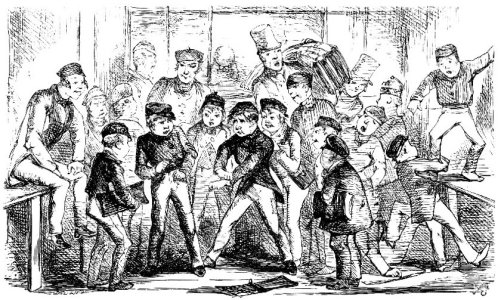
Heralds, I dare say. You’re in, you know; clodhoppers that you are!” “Herald’s a ministerial paper; beats the Times hollow, don’t it? Kick’s it into the middle of next week, eh? Well, I hope it’ll do your master some good, but it don’t do you no good, Jim, my boy; you’re as lean as a bone, you are!”
To which, Jim, a light-haired, spare-made, freckled youth, replies:
“You’re the parties as gets fat, so you are. Them as is ’onest people, never gets fat! How’s the Globe? eh! Don’t you think one publication a week is more than enough? You’ve got no news, noways, now that we are in.”
Saying which, he takes off his cap—the beak of it went a long time ago, on the battle-field of Holywell-street—and flings the dirty missile into Tom’s face; and Tom, who would parry it, puts his fist into Dan’s face; whereupon, Dan, starting back, kick’s Jack’s shins; and Jack gives it to Dan, and Dan to Tom, and Tom to Jim, and there is a general melée. The quarrel is finally settled by the armed intervention of four tall boys, who for some length of time watched the chances of the fight from a bench in the furthest corner of the room. A few blows and kicks, the combatants are separated, and the publishing office is tranquil. At this juncture, the inner door is opened, and a man with spectacles, and a large parcel of wet Globes makes his appearance. The four tall youths rush up to the wooden partition, to the exclusion, the manifest disgust of the smaller fry of boys. All their movements betray the consciousness of their Flegeljahr dignity. Mr. Smirkins, the publishing clerk, who has just entered, treats them with marked distinction. He greets them with a smile; tells them it is “rather wet to-day;” and goes the length of inquiring after the state of their health. One of them, a genteel youth, with very stiff shirt collar, and a very new hat, is quite a favorite with Mr. Smirkins. That gentleman has, for the last years, devoted his time and talents to the Globe office, and has come to consider himself, not only as an integral part of that Whig paper, but also as an important link in the heavy chain of the Whig party. He mentions the Whigs, as “our party;” and in speaking of the Globe, he says, “we.” The advent of the Derbyites to power, has been a severe trial to Mr. Smirkins’ feelings; he is less fat and jovial now, than he was under Lord John Russell. He looks care-worn. A faithful servant of his party, he grieves to see the Globe neglected by those high in office.
“How many copies?” says he to the youth with the shirt-collars. “Ten? Here they are. I dare say you take a good many Standards since we——”
No! the truth is too harsh for Mr. Smirkins. He cannot conclude the sentence, so tries another mode of expression.
“The Standard’s looking up, I dare say?”
But the youthful newsvender has all the discretion of a London man of business. He replies to Mr. Smirkins’ question with a few “Hem’s and Hah’s”; and Mr. Smirkins, foiled in his attempts to obtain intelligence of the prosperity of the other party, goes on distributing his papers among the boys; and the boys, rushing out to distribute them all over the town, make great haste, that they may be in time at the newsvenders Exchange.
These boys, strange though it may appear, have their own exchange where they meet at five o’clock. Not indeed in colonnade and marble halls, not even in a tavern parlour, but in the open air, at the corner of Catherine-street, Strand. There they meet, shouting, squabbling and fighting in hot haste, for they have not much time to lose. All the papers must be posted by six o’clock. Here spare copies of the Herald are exchanged for spare copies of the Daily News, the Times is bartered against the Post, according to the superfluities and necessities of the various traders. The exchanges, of course, are made on the spot, the papers are posted, and the newsvender’s business is over for the day. On Saturdays, however, many of their shops are kept open till long after midnight, for the accommodation of the working classes and the sale of the Sunday papers. Tom and Jim and Dan and Jack have received their week’s wages, and take a stroll in Clare Market or join their friends, the baker’s and fishmonger’s boys, in some bold expedition to distant Whitechapel.
CHAP. VI. The Bank.
APPEARANCE OF THE BANK.—WANT OF RESPECT IN THE PRESENCE OF PUBLIC FUNCTIONARIES.—THE PUBLIC AT THE BANK.—MYSTERIOUS COMFORTS.—ENGLISH TASTE.—THE WONDERS OF MACHINERY.—A STRANGE LIBRARY.—PRINTING THE NOTES.—HIDDEN PALACES.—THE TREASURY.—BAD SOVEREIGNS.—DR. KEIF; AND WHY THE ENGLISH KNOW NOTHING WHATEVER OF THE AFFAIRS OF GERMANY.
WE have already, on a former occasion, looked at two of the city temples—the Mansion-house and the Exchange. We now return to the Capitoline mart of the city, to inspect the third of its temples—the Bank of England.
Its outward appearance is mysterious. Half wall and half house, it is neither the one nor the other; and yet either at one and the same time. For a wall there are too many niches, blind windows, columns, and finery; for a building it wants presence; it is too low, and has not even window openings. But it appears from the architect’s plan that this strange façade is meant for a wall, and, having the artist’s word for it, we believe, though see we do not, and sit down satisfied.
Standing free on all sides as the Exchange, the Bank is divided from the latter by a thoroughfare called Threadneedle-street. Its western limit is Princes-street; in the north intervenes Lothbury, and in the south Bartholomew-lane, between the Bank and the neighbouring houses. It forms a square; and yet people say it demonstrates the squaring of the circle, the grand problem of modern philosophy.
We enter. The gate does not strike one as solemn and imposing as might be expected in a gate leading to the laboratory of a great wizard. No Druid’s foot on the threshold; no spectral bats such as abound in nursery tales of treasure-seeking. No! not even a couple of grenadiers, who, in our dear fatherland are a necessary appendage to every public building; really everything looks worldly, business-like, and civil. A red-coated porter answers our questions, and tells us which way to go. He is an elderly man, and certainly not strong enough to arrest a mere lad of a communist, if such a one would attempt to divide the property of the British nation. A shocking idea, that!
We cross a small court-yard, and mount a few steps (why should’nt we?) and, all of a sudden, we are in a large saloon. This saloon is an office—it matters very little what particular office it is—but it makes not a disagreeable impression as our German offices do where everything is official and officious, oppressive, and calculated to put people down. On the contrary, there’s a vast deal of good society in this office: at least a hundred officials and members of the public. The officials have no official appearance whatever; they are simple mortals, and do their business and serve their customers as if they were mere shopboys in a grocery shop. There is in them not a trace of dignity! not an atom of bureaucratic pride! It is exactly as if to serve the public were the sole business of their lives. And the public too! Was such a thing ever heard of in a public office? Men, women, and boys, with their hats on! walking arm in arm as if they were in the park. They change money, or bring it or fetch it, as if they had looked into a neighbour’s shop for the purpose. Some of them have no business at all to transact. They actually talk to one another—stand by the fire in the centre of the room, and warm their backs! The impertinent fellows! Why, they have no respect whatever! They forget that they are in a public office. How dare you stand there you dolt? How dare you scratch your head, and hold your pipe in your hand? I should’nt wonder if it was lighted—it would be like your impertinence! Get out as fast as you can; if you dont the police will make you! Really not a trace of respect! It’s no wonder they say we are near doomsday.[F]
Ranged in long rows along the walls, the Bank clerks sit writing, casting-up accounts, weighing gold, and paying it away over the counter. In front of each is a bar of dark mahogany, a little table, a pair of scales, and a small fraction of the public; each waiting for his fare. The business is well-conducted, and none of them are kept waiting for any length of time.
The saloon just by is more crowded. We are in the middle of the year, and the interest on the three per cents. is being paid. What crowding and sweeping to and fro. At least fifty clerks are sitting in a circle in a high vaulted saloon, well provided with a cupola and lanterns. They do nothing whatever but pay and weigh, and weigh and pay. On all sides, the rattling of gold, as they push it with little brass shovels across the tables. People elbowing and pushing in order to get a locus standi near the clerks; the doors are continually opening and shutting. What crowds of people there must be in this country who have their money in the three per cent. Consols!
Strange figures may be seen in this place. An old man with a wooden-leg sits in a corner waiting, and Heaven knows how long he has been waiting already. Of course, a wooden leg is rather an encumbrance than otherwise in a crowd. The old man seems to be fully aware of the fact. He looks at his large silver watch—it is just twelve—puts his hand to the pocket of his coat, and pulls out a large parcel, something wrapped up in a stale copy of the Herald. What can the parcel contain? Sandwiches! He spreads them out, and begins to eat. He likes them too. He takes his ease, and makes himself perfectly at home. I dare say it is not the first time he has waited for his dividends.