Introductory material (continued 2)
George A. Raper translation
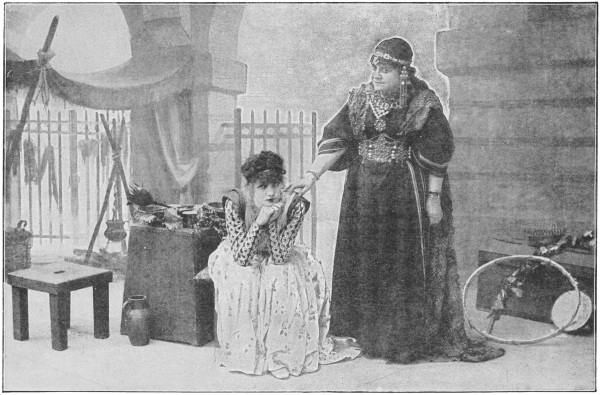
Scene from Théodora. Mme. Sarah Bernhardt. Mme. Marie Laurent.
In the meantime, gossip, the inevitable companion of the capricious artiste, was not idle. At Rio de Janeiro the Noirmont scandal occurred. Mme. Noirmont, intermittently an actress, but better known in a certain circle of society as “la grande Marthe,” was a member of the company. What was the quarrel between the actress and her manageress? History sayeth not, but the fact remains that during a rehearsal one day Mme. Noirmont “went for” Sarah, and gave her a resounding smack, to the accompaniment of much strong language. Sarah promptly hauled Mme. Noirmont off to the nearest police-station, where a summons was duly issued against the offender. But this was not enough for Sarah, and one evening, when the curtain had only just fallen on the second act of Adrienne Lecouvreur, Sarah seized a horsewhip and paid off all outstanding scores. Result: a second visit to the police-station, and a second scandal. Later on, while the company was at Santiago, another story got into circulation. In April 1878 the American papers announced the marriage of Mme. Sarah Bernhardt and M. Angelo, a member of her troupe. The New York Morning Journal added that the marriage was kept secret because the divorce proceedings against M. Damala were still in progress. The report was promptly denied, and Sarah sent the following telegram to the Figaro—
The news of my marriage with Angelo is absurd, because he is married already, and so am I. Please contradict this mischievous story. Thanks in advance.
Sarah Bernhardt.
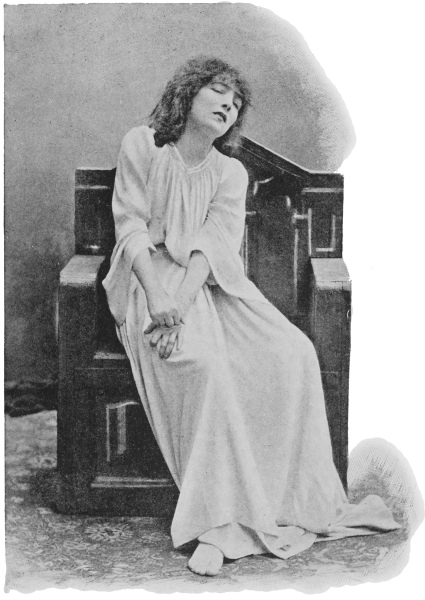
As Lady Macbeth.
After thirteen months’ absence Sarah at length returned to Europe. The total receipts during her American tour were a million dollars, of which her own share was £60,000. She landed in England on May 6th, not, as might be supposed, to rest, but to start off again on another tour, under the management of Mr. Mayer, through England, Scotland, and Ireland. On August 10th she started for Cauterets, and begun to prepare for her return to Paris. She re-opened with La Tosca on November 24, 1887, and long and loud was the applause that greeted her. M. Sarcey alone withheld unstinted praise, and took exception, not to the artiste’s talents but to her use of them, and indulged in criticisms of the play itself. M. Sardou responded in a letter addressed to a third person, in which he took advantage of the opportunity to make a hit at the critics of his work—
Monsieur,
You ask for my opinion on Sarah Bernhardt. It is simply that she is an admirable artiste, and that, in La Tosca, she has far exceeded anything that has been done in our generation by Georges, Dorval, or Rachel. As for Sarcey, who knows nothing about painting, music, architecture, or sculpture, and to whom Nature has harshly denied all sense of the artistic, it is not surprising that he should be not merely indifferent but even hostile to any attempt to reproduce the past by means of scenery, costume, and the representation of former customs. He showed this feature by his treatment of La Haine, but it would be unjust to blame him for this defect in his intellect. If he likes to play the part of the fox who lost his tail, by all means let him do it.
Cordially yours, V. Sardou.
This time M. Sardou was on the right side. La Tosca was performed one hundred and twenty-nine times, and was not taken off the boards until March 25, 1888. Ten days later, Sarah was playing La Dame aux Camélias and La Tosca at Bordeaux. Thence she went on to Lisbon and Madrid. Next the indefatigable traveller began a French tour, under the management of M. Emile Simon, at Caen. In July she was in London playing Francillon, at the Lyceum, with indifferent success. She was soon off again, her life being now one incessant round of travel with brief stoppages in Paris. M. Maurice Grau was once more her manager, and she opened in October at Antwerp, after which she visited Liège, Amsterdam, the Hague, Rotterdam, Utrecht, Arnheim, Brussels, Vienna, Prague, Budapest, Bucharest, Constantinople, Cairo, and Alexandria. La Tosca was as great a favourite as it had been in Paris, but at the Hague the Huguenot scruples of the Dutch bourgeois led to the performance of the play being forbidden, on the ground that it contained attacks on Roman Catholicism which might prove offensive to persons of that religion. At Bucharest Sarah was received by Queen Natalie, who, living as she was in strict retirement, had been unable to attend any public performance in spite of her great desire to see the artiste. Sarah accordingly performed a scene from La Dame aux Camélias for her at the palace. When the actress uttered the words, “Shall fallen greatness never rise again?” Queen Natalie, who applied them to her own case, burst into tears. Every one present, including Sarah Bernhardt, shared the poor Queen’s emotion, and the performance had to be interrupted.
From Bucharest Sarah went on to Italy, Russia, and Scandinavia, returning to Paris on the 21st March. Three weeks afterwards, without taking time for rest, she appeared at the Variétés in Léna, a piece adapted from the English by M. Pierre Berton, and in which she added another to the numerous kinds of death already on her list. The piece, however, was merely an ephemeral success, and was not a great triumph for its principal interpreter. M. Jules Lemaître says—
Mme. Sarah Bernhardt played the earlier acts in a rather offhand style. Her delivery was sometimes childish and lisping, and sometimes hard and guttural.
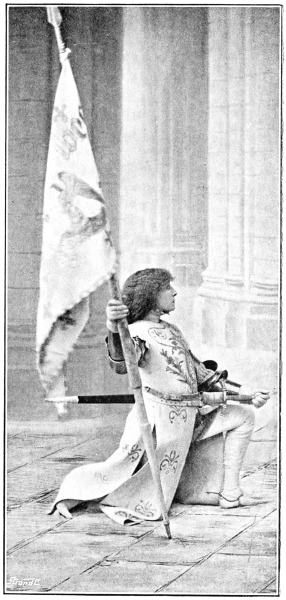
As Jeanne d’Arc.
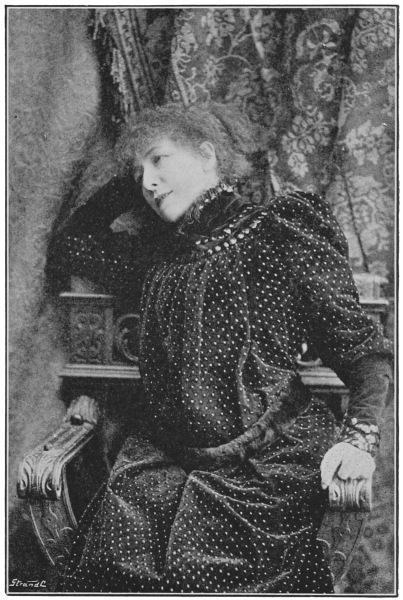
Mme. Sarah Bernhardt on one of her tours.
On the 16th May, Sarah revived La Dame aux Camélias at the Variétés. In July she went to London, where she was received with the customary enthusiasm, and, the summer at an end, she re-appeared on the 4th September at the Porte St. Martin theatre in La Tosca, in which she had triumphed two years before. A month later came another revival, Théodora, which furnished M. Sarcey with one more opportunity for lamenting—as, in fact, he had never ceased to do since Sarah’s desertion of the Comédie Française—the injury her foreign tours had done her. Regardless of criticism and case-hardened by experience against the opinions of the Press, Mme. Sarah Bernhardt was devoting all her energies to the rehearsals of Jeanne d’Arc. Perhaps, however, she was not really far from agreeing with M. Sarcey. On the eve of one of her tours she remarked—
Really, I seem to be intended for the export trade! Success abroad is very nice, but success in France is still better.
She produced M. Jules Barbier’s Jeanne d’Arc at the Porte St. Martin, on the 3rd January, 1890. The result was unanimously admitted to be all that could be desired. M. de Lapommeraye observed—
The entire performance was one continued triumph for Mme. Sarah Bernhardt, who sent a thrill of the noblest emotion and the keenest admiration through every heart.
According to M. Henry Bauer, “her success increased with every act and culminated in a brilliant triumph.” “This woman has a power within her,” exclaimed M. Jules Lemaître. “It is impossible to see her without being moved to tears,” said M. Sarcey. M. Vitu wrote—
She chiefly surprised every one, including her warmest admirers as well as her most prejudiced critics, by the extraordinary, passionate, irresistible force she imparted to the patriotic outbursts of the heroine. But everything, even praises, must have an end. What I have said is merely a summary of the expressed opinions of the entire audience last night, of what Paris will say in a few days, and of what every one will say in a few months when Paris and the world will have seen and applauded Sarah again and again in this the finest of all the fine creations of her career.
In July she was playing in London, and on the 23rd October she appeared at the Porte St. Martin in Cléopâtre, by MM. Sardou and Moreau. “What a wonderful actress she is!” exclaims M. de Lapommeraye. “She appears, she is seen and heard, and she triumphs.”
“What a pity it is,” regretfully says M. Bauer, “that her prodigious gifts, her art, and her powers of perception and expression should ever be wasted on M. Jules Barbier’s verses, or on brigand stories in prose!”
M. Albert Wolff simply quivers with enthusiasm—
I have long felt that this rare artiste is not merely a great actress, but the only one of our time. She stands without a rival in the world. I have never seen Rachel, whose fame still excites Mme. Sarah Bernhardt to greater efforts even in the hour of her greatest triumphs, but I do not see how it can be possible for any one to have more talent than Sarah. Her evening ended in a perfect ovation.
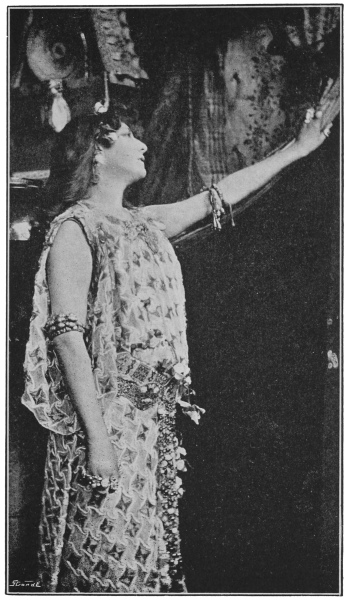
As Cleopatra.
She played Cléopâtre until the beginning of January 1891, and on the 23rd she set off for America and Australia, I went to see her a few days before her departure. I had already paid several visits about this time to her delightful sanctum in the Boulevard Pereire. She had been suffering from an affection of the larynx, and was hardly able to speak, and I had called to inquire after her health. To pass away the time while she disposed of her dressmakers, doctors, attorneys, and what not, I strolled up and down the well-known hall on the ground-floor—a hall quite unlike any other that I have ever seen. In the course of my many journalistic visits to the houses of Paris celebrities I have soon become indifferent to the cold and hollow display of official salons, to M. Renan’s plain walnut-wood furniture, to M. Zola’s somewhat discordant profusion of decoration, to Edmond de Goncourt’s art-treasures, and to the solemn comfort of academic homes. I have viewed, without faltering, the gorgeous and imposing ceilings of the Hôtel d’Uzès, the pompous display of multi-millionaire financiers, the faintly pretentious coquetry of the popular actress’s home, the frills and furbelows and knock-me-down eccentricities of our celebrated painters; but every time I enter what Sarah Bernhardt calls her studio, I am immediately struck by an indefinable something, infinitely pleasing, and not to be met with elsewhere. No doubt the sensation is partly physical and partly mental; it must arise from a combination of the perfumed atmosphere of the place, the ideally artistic arrangement and extraordinary diversity of everything, the muffled footfalls on the thick carpet, the subdued twittering of birds hidden in the foliage of rare and costly plants, the intoxicating play of colour on silk and velvet, the silent welcome of familiar animals, and above all, the voice and presence of the mistress of the house when she makes her appearance. But she is not yet here, and I resume my investigations. At the first glance it is difficult to see anything more than a delightful chaos of light and colour, an odd but harmonious profusion of the Oriental and the modern. Gradually the eye begins to distinguish surrounding objects. On the walls, which are hung with Turkey-red cotton, with a pattern of graceful plumes, are all sorts of queer weapons, Mexican sombreros, feather parasols, and trophies of lances, daggers, sabres, clubs, quivers and arrows, surmounted by hideous nightmare-like war-masks. Scattered about are bits of old pottery, Venice mirrors with wide frames of pale gold, and pictures by Clairin, some representing Sarah lying on a couch at full length, half hidden among her furs and brocaded coverings, others, her son Maurice and her big white greyhound.
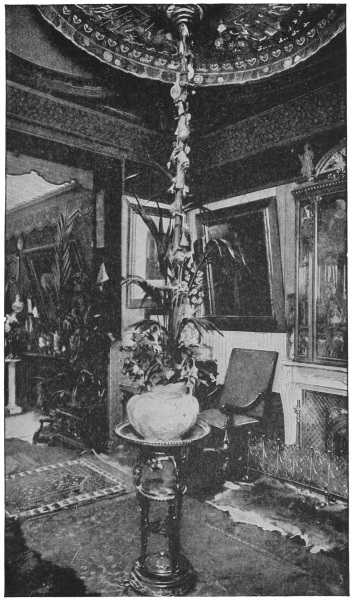
Vestibule of Mme. Sarah Bernhardt’s studio.
Scattered about on stools, on settles, and on the edges of sundry small articles of furniture are swarms of Buddhas, Japanese monsters, rare Chinese curios, bits of pottery, enamel, lacquer, and ivory work, miniatures, ancient and modern bronzes. In a special case is a collection of valuable souvenirs: gold vases, drinking-cups, liqueur-flasks, pyxes, beautifully carved golden wreaths, and exquisitely artistic gold and silver filigree. Flowers are on all sides: bunches of white lilac, Spanish lilies-of-the-valley, and mimosa, bouquets of roses and chrysanthemums, mingled with palms reaching to the glass ceiling. At the further end of the room is the big cage originally made for Tigrette—a tiger-cat brought home by Sarah from one of her voyages—and afterwards occupied by two lion-cubs, Scarpia and Justinian, reared in freedom but despatched to the menagerie immediately they displayed an intention of providing their own food. At present the wild animals’ cage, with its closely-set bars, serves as an aviary. In it birds of brilliant plumage sing and disport themselves on the branches of an artificial tree. In the corner opposite the cage and on the right-hand side of the fire-place with its wrought-iron dogs, is a most magnificent, barbaric, disconcerting couch—an immense divan made out of a heap of white bear, beaver, eland, tiger, jaguar, buffalo, and even crocodile skins. The walls of this lair are also formed of thick furry skins, falling in luxuriant, enticing curves over the foot of the couch. Piles of faintly-tinted silk cushions lie scattered over the furs. The light falls from above through a canopy of colourless silk, embroidered with faded flowers and supported by two dragon-head standards. The floor is covered from end to end with Oriental carpets thickly strewn with skins. Jackals’ and hyenas’ heads and panthers’ paws meet the visitor at every step.
A servant interrupts my reflections and announces that Madame is waiting for me. I go up-stairs to the study, and find the illustrious actress in an ample cream cashmere peignoir trimmed with lace.
“I have just come out of my bath, and you must excuse me for keeping you waiting,” she says, with an outstretched hand and a smile. “I can talk a little better to-day. What is it you want to know?”
“To begin with,” I reply, “I should like to know the date of your departure and the extent of your tour?”
“You will find it all on this paper. I am sure I could not tell you all these things. On my tours I often take the train or steamer without even asking where I am going. What does it matter to me?”
I read as follows—
“Leave Paris, 23rd January, and Havre, 24th; arrive at New York, 1st February. New York, 1st February to 14th March; Washington, 16th to 21st March; Philadelphia, 23rd to 28th March; Boston, 30th March to 4th April; Montreal, 6th to 11th April; Detroit, Indianapolis, and St. Louis, 13th to 18th April; Denver, 20th to 22nd April; San Francisco, 24th April to 1st May. Leave San Francisco for Australia, 2nd May. Stay in Australia about three months. Open at Melbourne, 1st June; visit Sydney, Adelaide, and Brisbane, completing engagements at end of August. Return to San Francisco, 28th September. Principal cities of the United States, then Mexico and Havana. Return to New York about 1st March, 1892. If business then better in South America, take the Argentine Republic, Uruguay, and Brazil in June, July, August, September, and October, 1892; London, January 1893; then Russia and European capitals.”
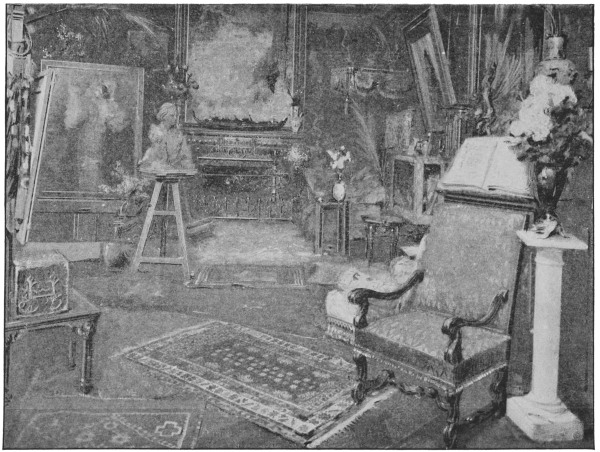
Mme. Sarah Bernhardt’s drawing-room.
“Two years!” I said. “Don’t you feel sorry to think of leaving Paris for two years?”
“Not at all,” replied the Bohemian genius. “Far from it; it is just the same thing as going to the Bois de Boulogne or the Odéon. I love travelling. I am delighted to be off, and full of joy to get back again. There is genuine and healthy excitement in moving from place to place and getting over so much ground. It never bores me, and then I haven’t time to be bored. Just think—I have never stayed more than a fortnight in any one place! At the end of these two years I shall have gone half round the world. I know North America already, and I have been there twice; but this time we are going to Australia, which will be quite new to me. We shall stop at the Sandwich Islands and play before Queen Pomaré, at Honolulu. There’s a novelty for you!”
“Won’t you miss your home, your comforts, and your friends?”
“I shall have them all again when I come back, and my delight will be all the greater for being so long deprived of them. And as for comfort, we travel like princes. Very often we have a special train for ourselves and our baggage. There is a big car, called the ‘Sarah Bernhardt,’ containing a fine bedroom, with a four-post bed, bath-room, drawing-room, and kitchen, all for me, and there are about thirty beds for the rest of the troupe. You see how convenient it is; and as the train is our own, we can stop when we like. When we come to a specially nice neighbourhood we leave the train, play ball games on the prairie, have pistol practice, and amuse ourselves generally. If we don’t care to get off the train, we turn the beds up against the sides and have dancing with a piano. There is plenty of room, as we have three long cars joined together. You see, we don’t suffer from ennui!”
“How do you spend your time on these long sea-voyages?”
“I play chess, draughts, and nain jaune. I don’t care much for cards, but sometimes I play Chinese bezique, because it is very long, and passes the time. I am a very bad player, and I hate to lose—it enrages me. This is ridiculous and silly, I know, but there it is! I can’t bear to be beaten!”
“What do you think of American scenery?”
“I don’t like it. Everything is so big—too big in fact—nothing but mountains with tops that you can’t see; steppes that stretch away to the horizon, immense trees and plants, and skies that look ten times as high as ours. All these things have a supernatural effect, and when I come back Paris looks like a dear little trinket in a miniature case.”
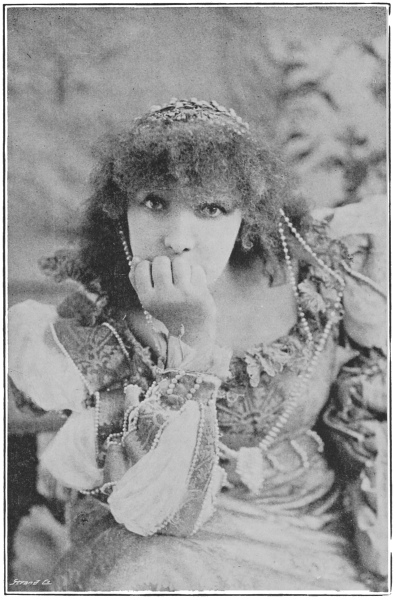
In La Dame de Chalant.
“And the public?”
“I can’t call them anything but delightful! They adore me! In the principal American cities, every one of a certain class understands French, and as the prices are, of course, very high, the audience is largely composed of this class. In some places I have regular first-night audiences, who note the smallest effects and shades of diction.”
“What about those who don’t understand French?”
“They buy books containing the French text with the translation opposite. This has a curious effect; everybody turns over at the same time, and it sounds like a shower of rain a second long.”
All these details, and the manner in which they were told, were very amusing. I could have gone on asking questions all night, but as it was becoming late I hastened to put my most inquisitive queries.
“How much baggage do you take?”
“About eighty trunks.”
“Eighty?”
She laughed at my astonishment.
“Yes,” she added, “there are at least forty-five cases of theatrical costumes. We take nearly two hundred and fifty pairs of shoes, and they fill one entire trunk. There is one for linen, one for flowers, and one for perfumery, and others for my dresses, hats, etc. I really don’t know how my maid manages to find what she wants!”
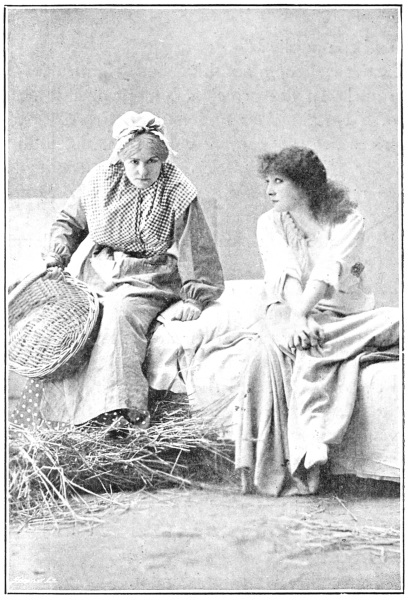
As Pauline Blanchard.
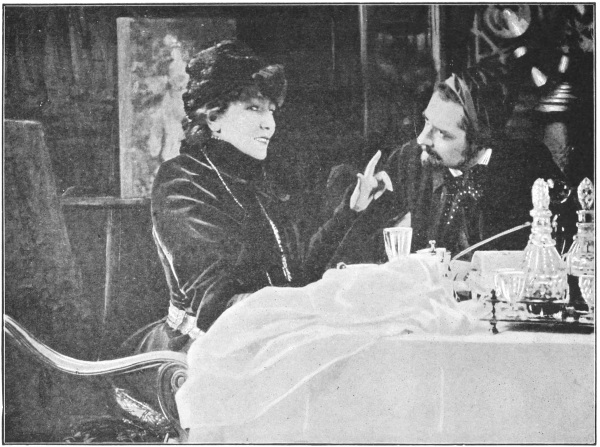
Mme. Sarah Bernhardt and the painter Clairin.
“Would it be indiscreet to ask what payment you are to receive?”
“Not at all; there is no mystery about it. I get £120 for every performance, plus one-third of the receipts, which makes on the average a total of £240. Oh! I was forgetting: I am allowed £40 a week for hotel expenses.”
In accordance with her programme, Sarah left on January 23 for her second tour in America. She followed the route given above, with the exception of Mexico and Havana, which she omitted. She was enthusiastically applauded almost everywhere. In Australia the excitement rose to a frenzy. Sydney was decorated with flags in her honour; she was received by members of the Colonial Cabinet; the horses were taken out of her carriage, she was borne in triumph, and official receptions were organized for her. At Sydney she appeared for the first time in Pauline Blanchard, by MM. Darmont and Humblot. On this occasion she also played La Dame de Chalant—a piece that has not yet been seen in France.
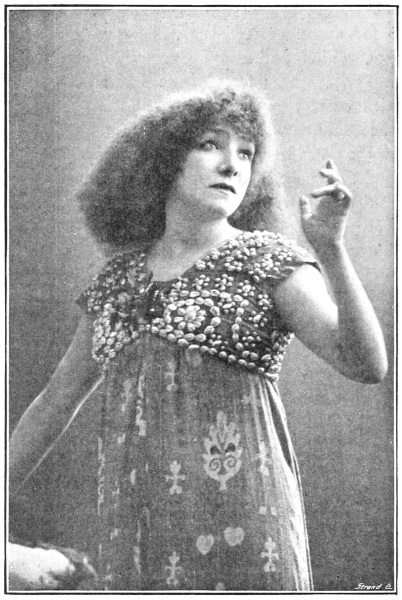
As Izeïl.
During her absence there was some talk of her returning to the House of Molière for the creation of La Reine Juana, by M. Parodi, the author of Rome Vaincue, in which she had scored so many triumphs. Her own plans, however, were different. She wanted to make her dream a reality: to be her own mistress and to work on her own account. Thus, barely a month after her return to Paris in May 1892, she set off for London, returned to France, and started again on a tour through Russia and the Continental cities, such as Vienna, Copenhagen, Christiania, etc. It would take too long to record the triumph she scored in this wild gallop across Europe. Back in Paris in March 1893, she immediately began to prepare for another tour in South America. On the 28th May she played Phèdre at the Vaudeville in aid of the funds of the Pouponnière, a charitable organization under the presidency of Mme. Georges Charpentier, wife of the well-known publisher. On the 24th May, through her American impresarii, Messrs. Abbey and Grau, she purchased the Renaissance theatre. Then came her tour through South America; dazzling success, big takings, and back to Paris.
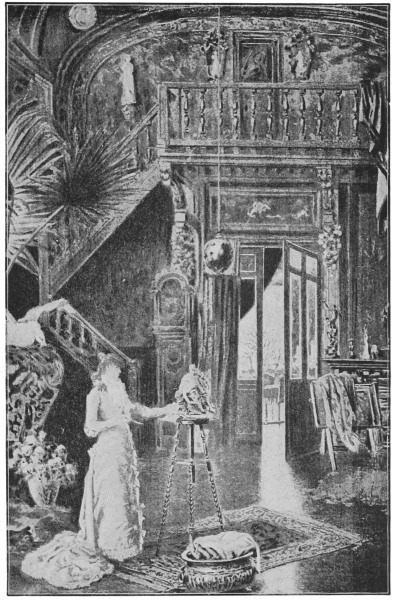
Mme. Sarah Bernhardt in her entrance-hall.
Sarah Bernhardt was now at length installed in her own theatre, which she was to make her own in every sense, and which was destined to be for several years to come the scene of the finest experiments in dramatic art in all Paris—experiments carried out with a lavish disregard for everything except the interests of art. On the 6th November she opened the Renaissance with a four-act drama by M. Jules Lemaître, Les Rois.
As one critic expressed it, the Renaissance was not a shop but almost a temple!
At last, exclaims M. Sarcey, we have seen the great and only Sarah again, and the Renaissance, under her management, has opened its doors with Les Rois. How splendid she was, and how she reminded us of the Sarah of her best days!
She re-appeared in La Dame aux Camélias on the 16th December, and, according to the Figaro—
The interpretation of the play was admirable as far as Mme. Sarah Bernhardt was concerned. The performance was one of the great artiste’s best.
M. Sarcey indulged in reminiscences—
I well remember the first occasion on which I saw Mme. Sarah Bernhardt as Marguerite Gauthier. It was in London, in 1881. She played the part on several consecutive evenings, and every time I was there, interested, delighted, and enthusiastic! The notices I wrote then were simply brimming over with admiration. The Parisians thought me slightly mad!
On the 24th January, 1894, Izeïl, by MM. Sylvestre and Morand, was brought out. Every act elicited enthusiastic applause from the public. Referring to Sarah, M. Jules Lemaître wrote in the Journal des Débats—
We owe to her one of the strongest artistic impressions we have ever experienced. Is it a fact that, for reasons which MM. Sylvestre and Morand know as well as I, and which the reader can doubtless guess, her creative has had still more play than her artistic talent?
M. Sarcey says—
In this delightfully picturesque play she is herself the most delightful and most picturesque spectacle. She does not look thirty! The audience was at first quite overcome. Then there was a furious outburst of applause, and the house rose at her. What a triumph!
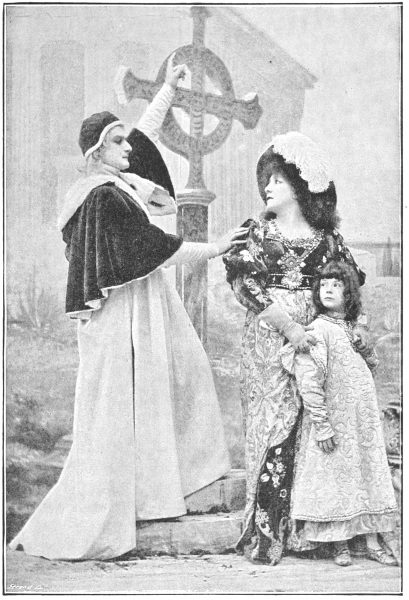
As Gismonda.
These extracts, which might be multiplied ad infinitum, show Sarah Bernhardt at her apogee. From this point her supremacy was undisputed, and any show of criticism was always tempered by admiring reservations. This was the attitude henceforth adopted by the entire Press in regard to her creations. Fédora was revived on the 3rd April, 1894. M. Lemaître remarks on it—
I am not quite sure whether Mme. Sarah Bernhardt can say “How do you do?” like any ordinary mortal. To be herself she must be extraordinary, and then she is incomparable.
Off to London in June, she played Izeïl with tremendous success. On her return she gave La Femme de Claude on the 19th September. Gismonda, which she produced on the 1st November, elicited another poetical outburst of admiration in the Press. The Figaro speaks of her as attaining the perfection of her art. M. Bauer, in the Echo de Paris, calls Gismonda the most wonderful of all her creations. M. Lemaître, in the Journal des Débats, says that “as all the laudatory adjectives have already been used up in her service, it is difficult to express the adoration evoked by every fresh appearance of this extraordinary woman.” M. Sarcey alone was rather reserved in his praise, and described her as having been applauded with more Italian than French exaggeration; but he amply atoned for this when Sarah revived Phèdre on the 24th December of the same year (1894).
What can I tell you of Sarah that you do not know already? Her acting is the summit of art. Our grandfathers used to speak with emotion of Talma and Mlle. Mars. I never saw either the one or the other, and I have barely any recollection of Rachel, but I do not believe that anything more original and more perfect than Mme. Sarah Bernhardt’s performance on Wednesday has ever been seen in any theatre.
On the 11th February, 1895, came the revival of Amphitryon, with Coquelin, who unfortunately remained with her for only a brief period. M. Sarcey considered the performance wanting in life. The other critics treated it as a success for Sarah and Coquelin, but there was no enthusiasm. On the 15th February, Magda, by the German writer Sudermann, was produced. All the critics described her as admirable. On the 5th April, La Princesse Lointaine, by M. Edmond Rostand, proved an equally great success for poet and actress. To London and Scotland again, with Gismonda, Izeïl, La Princesse Lointaine, La Tosca, Magda, and La Femme de Claude. Then she made arrangements to produce Amants, by M. Maurice Donnay, for which she engaged Mme. Jeanne Granier. In the meantime what does Sarah do? Rest? Not at all. On the 5th January the Figaro announced her departure on that day for America, where she was to give a series of performances. She was back on the 4th July, 1896. She took two months’ rest at Belle-Isle, and on the 30th September she revived La Dame aux Camélias with phenomenal success. On the 8th October she recited before the Tsar and Tsaritsa at Versailles. Lorenzaccio, adapted by M. Armand Dartois from Musset’s poem, was produced on the 3rd December, and enabled Sarah to score yet another triumph.
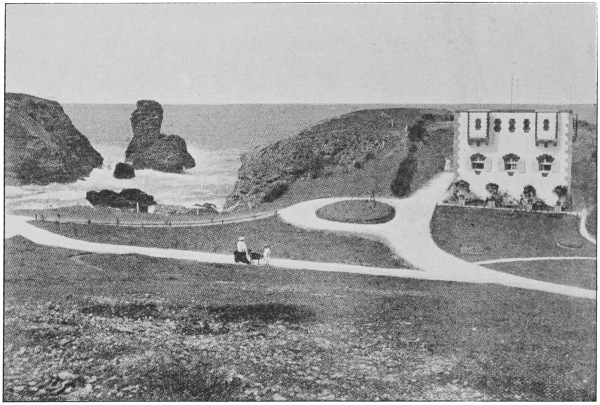
The Fort-aux-Poulains, Belle-Isle, Mme. Sarah Bernhardt’s country residence.