Introductory material
Reading edition
SANDY
THE STOWAWAY
An English mist was rolling lazily inland from the sea. It half enveloped the two great ocean liners that lay tugging at their moorings in the bay, and settled over the wharf with a grim determination to check, as far as possible, the traffic of the morning.
But the activity of the wharf, while impeded, was in no wise stopped. The bustle, rattle, and shouting were, in fact, augmented by the temporary interference. Everybody seemed in a hurry, and everybody seemed out of temper, save a boy who lay at full length on the quay and earnestly
He was ragged and brawny and picturesque. His hands, bronzed by the tan of sixteen summers, were clasped under his head, and his legs were crossed, one soleless shoe on high vaunting its nakedness in the face of an indifferent world. A sailor's blouse, two sizes too large, was held together at the neck by a bit of red cambric, and his trousers were anchored to their mooring by a heavy piece of yellow twine. The indolence of his position, however, was not indicative of the state of his mind; for under his weather-beaten old cap, perched sidewise on a tousled head, was a commotion of dreams and schemes, ambitions and plans, whose activities would have put to shame the busiest wharf in the world.
"It's your show, Sandy Kilday!" he said, half aloud, with a bit of a brogue that flavored his speech as the salt flavors the sea air. "You don't want to be a bloomin' old weather-vane, a-changin' your mind
The answer, instead of coming, got sidetracked by the train of thought that descended upon him when he was actually face to face with his decision. All sorts of memories came rushing pell-mell through his brain. The cold and hungry ones were the most insistent, but he brushed them aside.
The one he clung to longest was the earliest and most shadowy of the lot. It was of a little white house on an Irish heath, and inside was the biggest fireplace in the world, where crimson flames went roaring up the big, dark chimney, and where witches and fairies held high carnival. There was a big chair on each side the hearth, and between them a tiny red rocker with flowers painted on the arms of it. That was the clearest of all. There were persons in the large chairs, one a silent Scotchman who, instinct told him, must have been his father, and the other—oh, tricky memory that faltered when he wanted it to be so clear!—was
After that came a succession of memories, but none of them held the silent father and the merry mother and the little white house on the heath. They were of new faces and new places, of temporary homes with relatives in Ireland and Scotland, of various schools and unceasing work. Then came the day, two years ago, when, goaded by
For three weeks he had been hanging about the docks, picking up jobs here and there, accommodating any one who wanted to be accommodated, making many friends and little money. He had had no thought of embarking until the big English liner Great Britain arrived in port after breaking all records on her homeward passage. She was to start on her second trip to-day, and an hour later her rival, the steamship America, was to take her departure. The relative merits of the two vessels had been the talk of the wharf for days.
Sandy had made it a rule in life to be on hand when anything was happening. He had viewed cricket-matches from tree-tops, had answered the call of fire at midnight,
"Takin' the rest-cure, kid?" asked a passing sailor as he shied a stick at Sandy's shins.
Sandy stretched himself and smiled up at the sailor. It was a smile that waited for an answer and usually got it—a smile so brimming over with good-fellowship and confidence that it made a lover of a friend and a friend of an enemy.
"It's a trip that I'm thinkin' of takin'," he cried blithely as he jumped to his feet. "Here's the shillin' I owe you, partner, and may the best luck ye've had be the worst luck that's comin'."
He tossed a coin to the sailor, and thrusting his hands in his pockets, executed a brief but brilliant pas seul, and then went whistling away down the wharf. He swung along right cheerily, his rags fluttering, his
The sailor looked after him fondly. "He's a bloomin' good little chap," he said to a man near by. "Carries a civil tongue in his head for everybody."
The man grunted. "He's too off and on," he said. "He'll never come to naught."
Two days later, the America, cutting her way across the Atlantic, carried one more passenger than she registered. In the big life-boat swung above the hurricane-deck lay Sandy Kilday, snugly concealed by the heavy canvas covering.
He had managed to come aboard under cover of the friendly fog, and had boldly appropriated a life-boat and was doing light housekeeping. The apartment, to be sure, was rather small and dark, for the only light came through a tiny aperture where the canvas was tucked back. At this end Sandy attended to his domestic duties.
There were some drawbacks, naturally, especially to an energetic, restless youngster who had never been in one place so long before in his life. It was exceedingly inconvenient to have to lie down or crawl; but Sandy had been used to inconveniences all his life, and this was simply a difference in kind, not in degree. Besides, he could steal out at night and, by being very careful and still, manage to avoid the night watch.
The first night out a man and a girl had come up from the cabin deck and sat directly under his hiding-place. At first he
When they were gone he crawled out to stretch his weary body. On the deck he found a book which they had left; it was a green book, and on the cover was a golden castle on a golden hill. All the rest of his life he loved a green book best, for it was through this one that he found his way back again to that enchanted land that lay behind the peat-flames in the shadowy memory. Early in the morning he read it, with his
It was all about gallant knights and noble lords, of damsels passing fair, of tourneys and feasts and battles fierce and long. Story after story he devoured, until he came to the best one of all. It told of a beautiful damsel with a mantle richly furred, who was girt with a cumbrous sword which did her great sorrow; for she might not be delivered of it save by a knight who was of passing good name both of his lands and deeds. And after that all the great knights had striven in vain to draw the sword from its sheath, a poor knight, poorly arrayed, felt in his heart that he might essay it, but was abashed. At last, however, when the damsel was departing, he plucked up courage to ask if he might try; and when she hesitated
And it was not until then that Sandy knew that he had had no dinner, and that the sun had climbed over to the other side of the steamer, and that a continual cheering was coming up from the deck below. Cautiously he pulled back the canvas flap and emerged like the head of a turtle from his shell. The bright sunshine dazzled him for a moment, then he saw a sight that sent the dreams flying. There, just ahead, was the Great Britain under full way, valiantly striving to hold her record against the oncoming steamer.
Sandy sat up and breathlessly watched the champion of the sea, her smoke-stacks black against the wide stretch of shining waters. The Union Jack was flying in insolent security from her flagstaff. There America gained upon her, until they were bow and bow. The crowd below grew wilder, cheers went up from both steamers, the decks were white with the flutter of handkerchiefs. Suddenly the band below struck up "The Star-Spangled Banner." Sandy gave one triumphant glance at the Stars and Stripes floating overhead, and in that moment became naturalized. He leaped to his feet in the boat, and tearing the blouse from his back, waved the tattered banner in the face of the vanquished Great Britain, as he sent up yell after yell of victory for the land of his adoption.
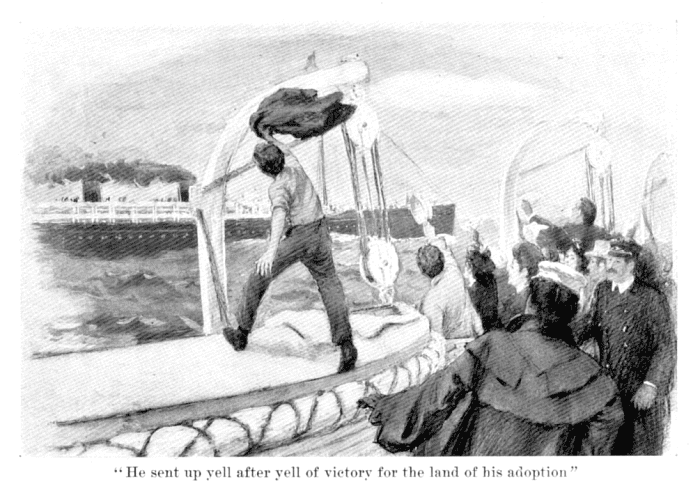
Then he was seized by the ankle and jerked roughly down upon the deck. Over him stood the deck steward.
"You`re a rum egg for that old boat to hatch out," he said. "I guess the cap'n will be wantin' to see you."
Sandy, thus peremptorily summoned
As it was, he led him ruthlessly down the narrow steps, past the long line of curious passengers, then down again to the steerage deck, where he deposited him on a coil of rope and bade him stay there until he was sent for.
Here Sandy sat for the remainder of the afternoon, stared at from above and below, an object of lively curiosity. He bit his nails until the blood came, and struggled manfully to keep back the tears. He was cold, hungry, and disgraced, and his mind was full of sinister thoughts. Inch by inch he moved closer to the railing.
Suddenly something fell at his feet. It was an orange. Looking up, he saw a slender little girl in a long tan coat and a white tam-o'-shanter leaning over the railing. He
Sandy ate the orange and took courage. Life had acquired a new interest.