Introductory material (continued 4)
Reading edition
Wall, I begun the subject carefully, but straight to the pint, as my way is, by tellin' him that Ralph S. Robinson wuz a-layin' at death's door, and his life depended on his gettin' sleep, and we wuz afraid the bells in the mornin' would roust him up, and I had come to see if he would omit the ringin' of 'em in the mornin'.
“Not ring the bells!” sez he, in wild amaze. “Not ring the church bells on the Sabbath day?”
His look wuz skairful in the extreme, but I sez—
“Yes, that is what I said, we beg of you as a Christian to not ring the bells in the mornin'.”
“A Christian! A Christian! Advise me as a Christian to not ring the Sabbath bells!”
I see the idee skairt him. He wuz fairly pale with surprise and borrow. And I told him agin', puttin' in all the perticilers it needed to make the story straight and good, how Ralph S. Robinson had labored for the good of others, and how his strength had gin out, and he wuz now a-layin' at the very pint of death, and how his girl and his sister wuz a-breakin' their hearts over him, and how we had some hopes of savin' his life if he could get some sleep, that the doctors said his life depended on it, and agin I begged him to do what we asked.
But the Deacon had begin to get over bein' skairt, and he looked firm as anybody ever could, as he sez: “The bells never hurt anybody, I know, for here I have lived right by the side of 'em for 20 years. Do I look broke down and weak?” sez he.
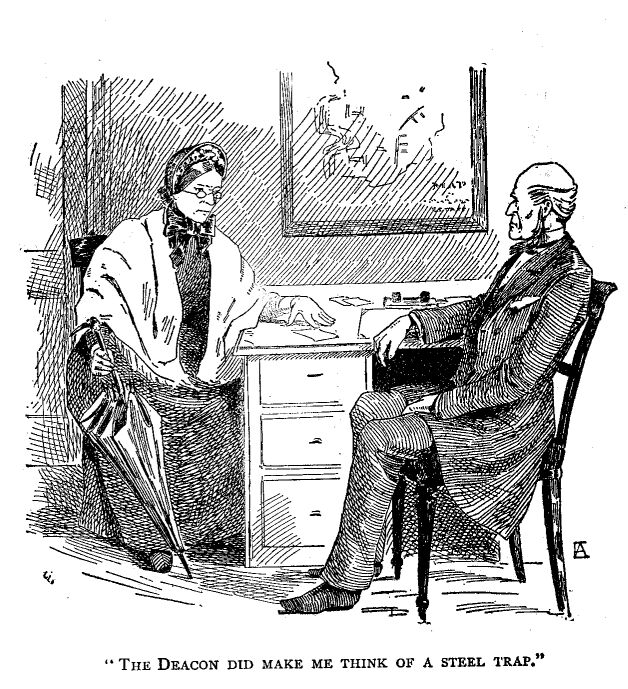
“No,” sez I, honestly. “No more than a grannit monument, or a steel trap.”
“Wall,” sez he, “what don't hurt me won't hurt nobody else.”
“But,” sez I, “folks are made up different.” Sez I, “The Bible sez so, and what might not hurt you, might be the ruin of somebody else. Wuz you ever nervous?” sez I.
“Never,” sez he. And he added firmly, “I don't believe in nerves. I never did. There hain't no use in 'm.”
“It wuz a wonder they wuz made, then,” sez I. “As a generel thing the Lord don't make things there hain't no use on. Howsumever,” sez I, “there hain't no use in disputin' back and forth on a nerve. But any way, sickness is so fur apart from health, that the conditions of one state can't be compared to the other; as Ralph S. Robinson is now, the sound of the bells, or any other loud noise means torture and agony to him, and, I am afraid, death. And I wish you would give orders to not have 'em rung in the mornin'.”
“Are you a professor?” sez he.
“Yes,” sez I.
“What perswaision?” sez he.
“Methodist Episcopal,” sez I.
“And do you, a member of a sister church, which, although it has many errors, is still a-gropin' after the light! Do you counsel me to set aside the sacred and time honored rules of our church, and allow the Sabbath to go by unregarded, have the sanctuary desecrated, the cause of religion languish—I cannot believe it. Think of the widespread desolation it would cause if, as the late lamented Mr. Selkirk sung:
“'The sound of the church-going bells, These valleys and hills never heard.'”
“No church, no sanctuary, no religius observances.”
“Why,” sez I, “that wouldn't hinder folks from goin' to church. Folks seem to get to theatres, lectures, and disolvin' views on time, and better time than they do to meetin',” sez I. “In your opinin' it hain't necessary to beat a drum and sound on a bugle as the Salvation Army duz, to call folks to meetin'; you are dretful hard on them, so I hear.”
“Yes, they make a senseless, vulgar, onnecessary racket, disturbin' and agrivatin' to saint and sinner.”
“But,” sez I, “they say they do it for the sake of religion.”
“Religion hain't to be found in drum-sticks,” sez he bitterly.
“No,” sez I, “nor in a bell clapper.”
“Oh,” sez he, “that is a different thing entirely, that is to call worshippers together, that is necessary.”
Sez I, “One hain't no more necessary than the other in my opinion.”
Sez he, “Look how fur back in the past the sweet bells have sounded out.”
“Yes,” sez I candidly, “and in the sweet past they wuz necessary,” sez I. “In the sweet past, there wuzn't a clock nor a watch, the houses wuz fur apart, and they needed bells. But now there hain't a house but what is runnin' over with clocks—everybody knows the time; they know it so much that time is fairly a drug to 'em. Why, they time themselves right along through the day, from breakfast to midnight. Time their meals, their business, their pleasures, their music, their lessons, their visits, their visitors, their pulse beats, and their dead beats. They time their joys and their sorrows, and everything and everybody, all through the week, and why should they stop short off Sundays? Why not time themselves on goin' to meetin'? They do, and you know it. There hain't no earthly need of the bells to tell the time to go to meetin', no more than there is to tell the time to put on the tea-kettle to get supper. If folks want to go to meetin' they will get there, bells or no bells, and if they don't want to go, bells hain't a-goin' to get 'em started.
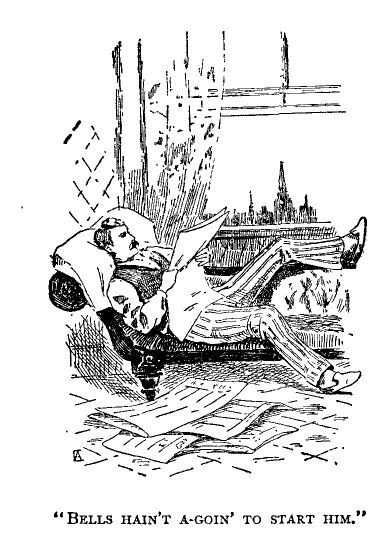
“Take a man with the Sunday World jest brung in, a-layin' on a lounge, with his feet up in a chair, and kinder lazy in the first place, bells hain't a-goin' to start him.
“And take a woman with her curl papers not took down, and a new religeus novel in her hand, and a miliner that disapinted her the night before, and bells hain't a-goin' to start her. No, the great bell of Moscow won't start 'em.
“And take a good Christian woman, a widow, for instance, who loves church work, and has a good handsome Christian pasture, who is in trouble, lost his wife, mebby, or sunthin' else bad, and the lack of bells hain't a-goin' to keep that women back, no, not if there wuzn't a bell on earth.”
“Oh, wall, wavin' off that side of the subject,” sez he (I had convinced him, I know, but he wouldn't own it, for he knew well that if folks wanted to go they always got there, bells or no bells). “But,” sez he wavin' off that side of the subject, “the observance is so time honored, so hallowed by tender memories and associations all through the past.”
“Don't you 'spoze, Deacon Garven,” sez I, “that I know every single emotion them bells can bring to anybody, and felt all those memorys and associations. I'll bet, or I wouldn't be afraid to bet, if I believed in bettin', that there hain't a single emotion in the hull line of emotions that the sound of them bells can wake up, but what I have felt, and felt 'em deep too, jest as deep as anybody ever did, and jest es many of 'em. But it is better for me to do without a upliftin', soarin' sort of a feelin' ruther than have other people suffer agony.”
“Agony!” sez he, “talk about their causin' agony, when there hain't a more heavenly sound on earth.”
“So it has been to me,” sez I candidly. “To me they have always sounded beautiful, heavenly. Why,” sez I, a-lookin' kinder fur off, beyond Deacon Garven, and all other troubles, as thoughts of beauty and insperation come to me borne out of the past into my very soul, by the tender memories of the bells—thoughts of the great host of believers who had gathered together at the sound of the bells—the great army of the Redeemed—
'Some of the host have crossed the flood, and some are crossin' now,'
thinks I a-lookin' way off in a almost rapped way. And then I sez to Deacon Garven in a low soft voice, lower and more softer fur, than I had used to him,
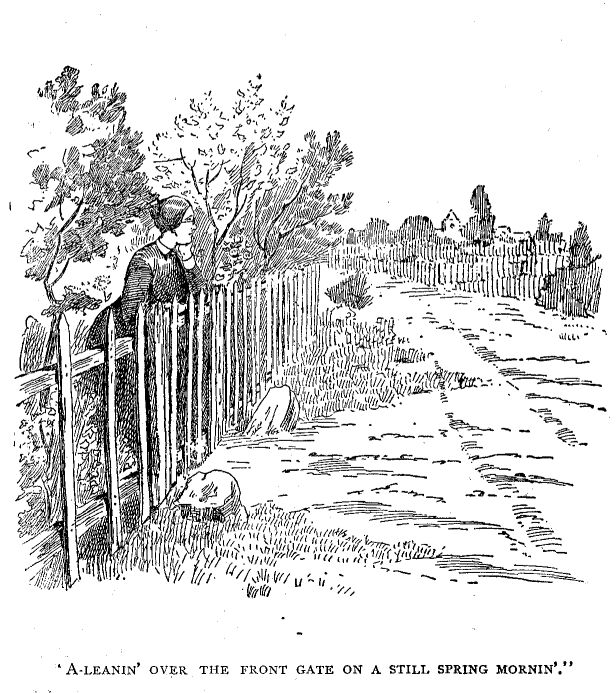
“Don't I know what it is to stand a-leanin' over the front gate on a still spring mornin', the smell of the lilacs in the air, and the brier roses. A dew sparklin' on the grass under the maples, and the sunshine a-fleckin' the ground between 'em, and the robins a-singin' and the hummin' birds a-hoverin' round the honeysuckles at the door. And over all and through all, and above all clear and sweet, comin' from fur off a-floatin' through the Sabbath stillness, the sound of the bells, a-bringin' to us sweet Sabbath messages of love and joy. Bringin' memories too, of other mornin's as fair and sweet, when other ears listened with us to the sound, other eyes looked out on the summer beauty, and smiled at the sound of the bells. Heavenly emotions, sweet emotions come to me on the melody of the bells, peaceful thoughts, inspirin' thoughts of the countless multitude that has flocked together at the sound of the bells. The aged feet, the eager youthful feet, the children's feet, all, all walkin' to the sound of the bells. Thoughts of the happy youthful feet that set out to walk side by side, at their ringin' sounds. Thoughts of the aged ones grown tired, and goin' to their long dreamless sleep to their solemn sound. Thoughts of the brave hero's who set out to protect us with their lives while the bells wuz ringin' out their approval of such deeds. Thoughts of how they pealed out joyfully on their return bearin' the form of Peace. Thoughts of how the bells filled the mornin' and evenin' air, havin' throbbed and beat with every joy and every pain of our life, till they seem a part of us (as it were) and the old world would truly seem lonesome without 'em.
“As I told you, and told you truly, I don't believe there is a single emotion in the hull line of emotions, fur or near, but what them bells have rung into my very soul.
“But such emotions, beautiful and inspirin' though they are, can be dispensed with better than justice and mercy can. Sweet and tender sentiment is dear to me, truly, near and dear, but mercy and pity and common sense, have also a powerful grip onto my right arm, and have to lead me round a good deal of the time.
“Beautiful emotion, when it stands opposed to eternal justice, ort to step gently aside and let justice have a free road. Sentiment is truly sweet, but any one can get along without it, take it right along through the year, better than they can without sleep.
“You see if you can't sleep you must die, while a person can worry along a good many years without sentiment. Or, that is, I have been told they could. I don't know by experience, for I have always had a real lot of it. You see my experience has been such that I could keep sentiment and comfort too. But my mind is such, that I have to think of them that hain't so fortunate as I am.
“I have looked at the subject from my own standpoint, and have tried also to look at it through others' eyes, which is the only way we can get a clear, straight light on any subject. As for me, as I have said, I would love to hear the sweet, far off sound of the bells a-tremblin' gently over the hills to me from Jonesville; it sounds sweeter to me than the voices of the robins and swallers, a-comin' home from the South in the spring of the year. And I would deerly love to have it go on and on as fur as my own feelins are concerned. But I have got to look at the subject through the tired eyes, and feel it through the worn-out nerves of others, who are sot down right under the wild clamor of the bells.
“What comes to me as a heavenly melody freighted full of beautiful sentiment and holy rapture comes to them as an intolerable agony, a-maddenin' discord, that threatens their sanity, that rouses 'em up from their fitful sleep, that murders sleep—the bells to them seem murderus, strikin' noisily with brazen hands, at their hearts.
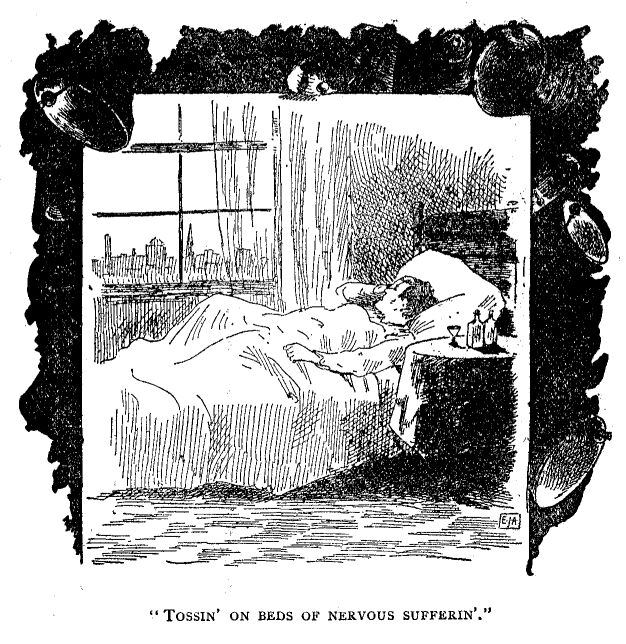
“To them tossin' on beds of nervous sufferin', who lay for hours fillin' the stillness with horror, with dread of the bells, where fear and dread of 'em exceed the agony of the clangor of the sound when it comes at last. Long nights full of a wakeful horror and expectency, fur worse than the realization of their imaginin's. To them the bells are a instrument of torture jest as tuff to bear as any of the other old thumb screws and racks that wrung and racked our old 4 fathers in the name of Religion.
“I have to think of the great crowd of humanity huddled together right under the loud clangor of the bells whose time of rest begins when the sun comes up, who have toiled all night for our comfort and luxury. So we can have our mornin' papers brought to us with our coffee. So we can have the telegraphic messages, bringing us good news with our toast. So's we can have some of our dear ones come to us from distant lands in the morning. I must think of them who protect us through the night so we can sleep in peace.
“Hundreds and hundreds and hundreds of these, our helpers and benafacters, work all night for our sakes, work and toil. The least we can do for these is to help 'em to the great Restorer, sleep, all we can.
“Some things we can't do; we can't stop the creakin' sounds of the world's work; the big roar of the wheel of business that rolls through the week days, can't be oiled into stillness; but Sundays they might get a little rest Sunday is the only day of rest for thousands of men and wimmen, nervous, pale, worn by their week's hard toil.
“The creakin' of the wheels of traffic are stopped on this day. They could get a little of the rest they need to carry on the fight of life to help support wife, child, father, husband; but religeon is too much for 'em—the religeon that the Bible declares is mild, peacible, tender. It clangs and bangs and whangs at 'em till the day of rest is a torment.
“Now the Lord wouldn't approve of this. I know He wouldn't, for He was always tender and pitiful full of compassion. I called it religeon for oritory, but it hain't religeon, it is a relict of old Barberism who, under the cloak of Religeon, whipped quakers and hung prophetic souls, that the secrets of Heaven had been revealed to, secrets hidden from the coarser, more sensual vision.”
Sez Deacon Garven: “I consider the bells as missionarys. They help spread the Gospel.”
“And,” sez I, for I waz full of my subject, and kep him down to it all I could, “Ralph S. Robinson has spread the Gospel over acres and acres of land, and brung in droves and droves of sinners into the fold without the help of church or steeple, let alone bells, and it seems es if he ortn't to be tortured to death now by 'em.”
“Wall,” he said, “he viewed 'em as Gospel means, and he couldn't, with his present views of his duty to the Lord, omit 'em.”
Sez I, “The Lord didn't use 'em. He got along without 'em.”
“Wall,” he said, “it wuz different times now.”
Sez I, “The Lord, if He wuz here to-day, Deacon Garven, if He had bent over that form racked with pain and sufferin' and that noise of any kind is murderous to, He would help him, I know He would, for He wuz good to the sick, and tender hearted always.”
“Wall, I will help him,” sez Deacon Garven, “I will watch, and I will pray, and I will work for him.”
Sez I, “Will you promise me not to ring the bells to-morrow mornin'; if he gets into any sleep at all durin' the 24 hours, it is along in the mornin', and I think if we could keep him asleep, say all the forenoon, there would be a chance for him. Will you promise me?”
“Wall,” sez he kinder meltin' down a little, “I will talk with the bretheren.”
Sez I, “Promise me, Deacon Eben Garven, before you see 'em.”
Sez he, “I would, but I am so afraid of bringin' the Cause of Religeon into contempt. And I dread meddlin' with the old established rules of the church.”
Sez I, “Mercy and justice and pity wuz set up on earth before bells wuz, and I believe it is safe to foller 'em.”
But he wouldn't promise me no further than to talk with the bretheren, and I had to leave him with that promise. As things turned out afterwuds, I wuz sorry, sorry es a dog that I didn't shet up Deacon Garven in his own smoke house, or cause him to be shet, and mount a guard over him, armed nearly to the teeth with clubs.
But I didn't, and I relied some on the bretheren.
Ralph wuz dretful wild all the forepart of the night. He'd lay still for a few minutes, and then he would get all rousted up, and he would set up in bed and call out some words in that strange tongue. And he would lift up his poor weak right arm, strong then in his fever, and preach long sermons in that same strange curius language. He would preach his sermon right through, earnest and fervent as any sermon ever wuz. I would know it by the looks of his face. And then he would sometimes sing a little in that same singular language, and then he would lay down for a spell.
But along towards mornin' I see a change, his fever seemed to abate and go down some—very gradual, till just about the break of day, he fell into a troubled sleep—or it wuz a troubled sleep at first—but growin' deeper and more peaceful every minute. And along about eight o'clock he wuz a-sleepin' sweet for the first time durin' his sickness; it wuz a quiet restful sleep, and some drops of presperation and sweat could be seen on his softened features.
We all wuz as still, almost, as if we wuz automatoes, we wuz so afraid of makin' a speck of noise to disturb him. We kep almost breathless, in our anxiety to keep every mite of noise out of his room. But I did whisper to Rosy in a low still voice—
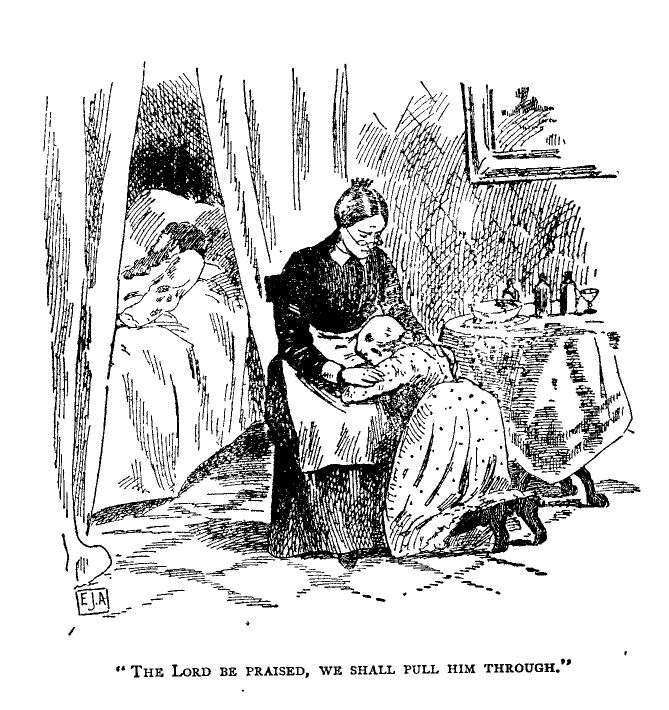
“Your father is saved, the Lord be praised, we shall pull him through.”
She jest dropped onto her knees, and laid her head in my lap and cried and wept, but soft and quiet so's it wouldn't disturb a mice.
Miss Timson wuz a-prayin', I could see that. She wuz a-returnin' thanks to the Lord for his mercy.
As for me, I sot demute, in that hushed and darkened room, a-watchin' every shadow of a change that might come to his features, with a teaspoon ready to my hand, to give him nourishment at the right time if he needed it, or medicine.
When all of a sudden—slam! bang! rush! roar! slam! slam! ding! dong! bang!!! come right over our heads the wild, deafening clamor of the bells.
Ralph started up wilder than ever because of his momentary repose. He never knew us, nor anything, from that time on, and after sufferin' for another 24 hours, sufferin' that made us all willin' to have it stop, he died.
And so he who had devoted his hull life to religeon wuz killed by it. He who had gin his hull life for the true, wuz murdered by the false.
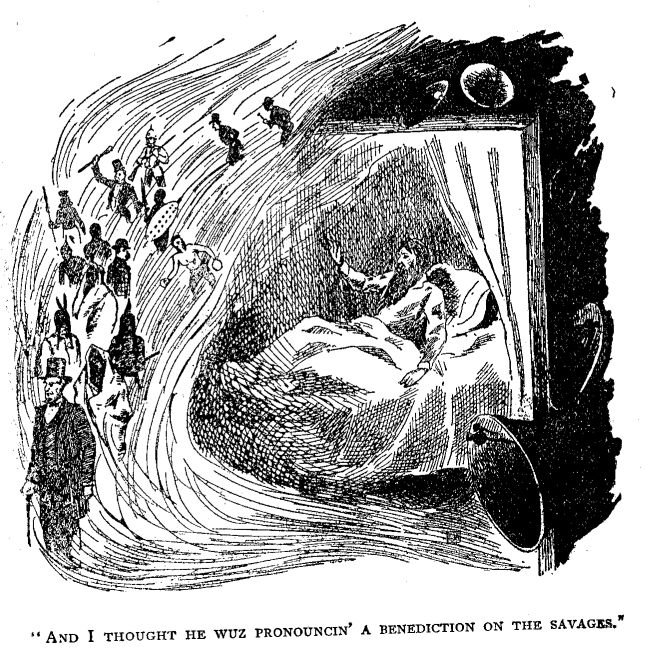
His last move wuz to spread out his hands, and utter a few of them strange words, as if in benediction over a kneelin' multitude. And I thought then, and I think still, that he wuz pronouncin' a benediction on the savages. And I have always hoped that the mercy he besought from on High at that last hour brought down God's pity and forgiveness on all benighted savages, and bigoted ones, Deacon Garven, and the hull on 'em.
CHAPTER XXV.
The very next day after I got home from Miss Timson'ses, we wimmen all met to the meetin' house agin as usial, for we knew very well that the very hardest and most arjuous part of our work lay before us.
For if it had been hard and tuckerin' to what it seemed the utmost limit of tucker, to stand up on a lofty barell, and lift up one arm, and scrape the ceilin', what would it be, so we wildly questioned our souls, and each other, to stand up on the same fearful hites, and lift both arms over our heads, and get on them fearful lengths of paper smooth.
I declare, when the hull magnitude of the task we had tackled riz before us, it skairt the hull on us, and nuthin' but our deathless devotion to the Methodist meetin' house, kep us from startin' off to our different homes on the run.
But lovin' it as we did, as the very apples in our eyes, and havin' in our constant breasts a determinate to paper that meetin' house, or die in the attempt, we made ready to tackle it.
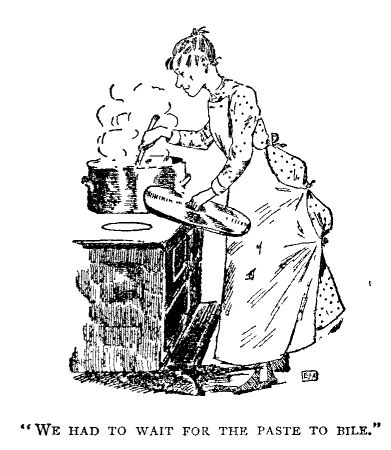
Yet such wuz the magnitude of the task, and our fearful apprehensions, that after we had looked the ceilin' all over, and examined the paper—we all sot down, as it were, instinctivly, and had a sort of a conference meetin' (we had to wait for the paste to bile anyway, it wuz bein' made over the stove in the front entry). And he would lift up his poor weak right arm, strong then in his fever, and preach long sermons in that same strange curius language. He would preach his sermon right through, earnest and fervent as any sermon ever wuz. I would know it by the looks of his face. And then he would sometimes sing a little in that same singular language, and then he would lay down for a spell.
But along towards mornin' I see a change, his fever seemed to abate and go down some—very gradual, till just about the break of day, he fell into a troubled sleep—or it wuz a troubled sleep at first—but growin' deeper and more peaceful every minute. And along about eight o'clock he wuz a-sleepin' sweet for the first time durin' his sickness; it wuz a quiet restful sleep, and some drops of presperation and sweat could be seen on his softened features.
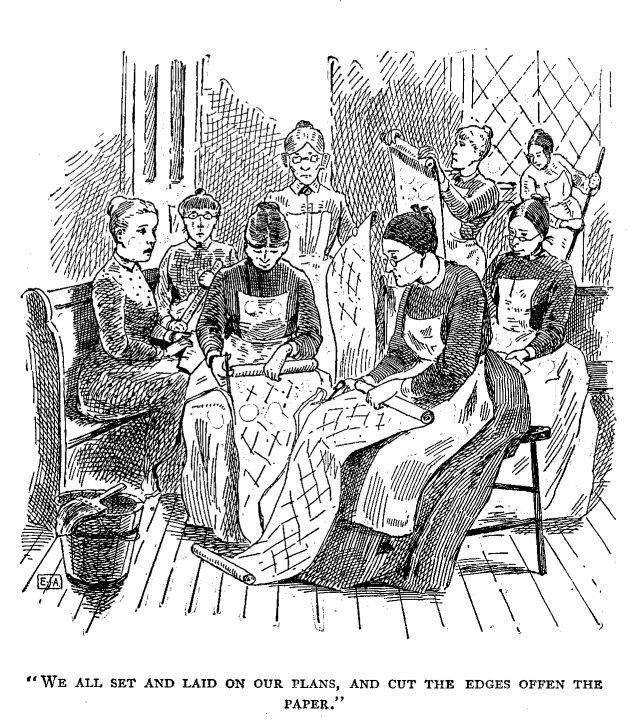
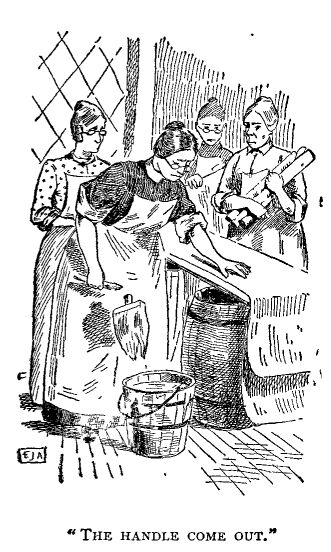
We all wuz as still, almost, as if we wuz automatoes, we wuz so afraid of makin' a speck of noise to disturb him. We kep almost breathless, in our anxiety to keep every mite of noise out of his room. But I did whisper to Rosy in a low still voice—it middlin calm, and Miss Gowdy offered to be the one to carry it back to Jonesville, and change it that very afternoon—for we could not afford to buy a new one, and we had the testimony of as many as twenty-one or two pairs of eyes, that the handle didn't come out by our own carelessness, but by its own inherient weakness—so we spozed he would swap it, we spozed so. But it wuz arrainged before we disbanded (the result of our conference), that the next mornin' we would each one on us bring our offerin's to the fair, and hand 'em in to the treasurer, so's she would know in time what to depend on, and what she had to do with.
And we agreed (also the result of our conference) that we would, each one on us, tell jest how we got the money and things to give to the fair.
And then we disbanded and started off home but I'll bet that each one on us, in a sort of secret unbeknown way, gin a look on that lofty ceilin', them dangerus barells, and that pile of paper, and groaned a low melancholy groan all to herself.
I know I did, and I know Submit Tewksbury did, for I stood close to her and heard her. But then to be exactly jest, and not a mite underhanded, I ort mebby to say, that her groan may be caused partly by the fact that that aniversery of hern wuz a-drawin' so near. Yes, the very next day wuz the day jest 20 years ago that Samuel Danker went away from Submit Tewksbury to heathen lands. Yes, the next day wuz the one that she always set the plate on for him—the gilt edged chiny with pink sprigs.
But I'll bet that half or three quarters of that low melancholy groan of her'n wuz caused by the hardness of the job that loomed up in front of us, and the hull of mine wuz.
Wall, that night Josiah Allen wuz a-feelin' dretful neat, fer he had sold our sorell colt for a awful big price.
It wuz a good colt; its mother wuz took sick when it wuz a few days old, and we had brung it up as a corset, or ruther I did, fer Josiah Allen at that time had the rheumatiz to that extent that he couldn't step his foot on the floor for months, so the care of the corset come on me, most the hull on it, till it got big enough to run out in the lot and git its own livin'.
Night after night I used to get up and warm milk for it, when it wuz very small, for it wuz weakly, and we didn't know as we could winter it.
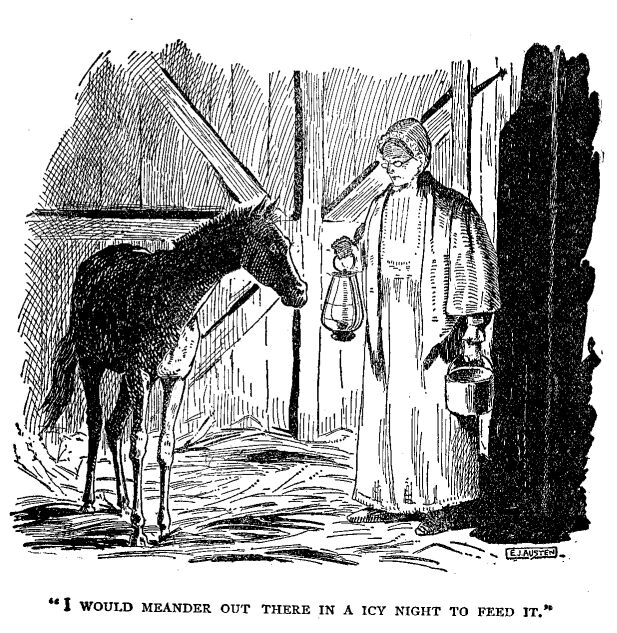
We kep it in a little warm shed offen the wood house for quite a spell, but still I used to find it considerable cold when I would meander out there in a icy night to feed it. But jest as it is always the way with wimmen, the more care I took on it, the more it needed me and depended on me, the better I liked it.
Till I got to likin' it so well that it wuzn't half so hard a job for me to go out to feed it in the night as it would have been to laid still in my warm bed and think mebby it wuz cold and hungry.
So I would pike out and feed it two or three times a night.
That is the nater of wimmen, the weaker it wuz and the humblier it wuz, and the more it needed me, the more I thought on it.
And as is the nater of man, Josiah Allen didn't seem to care so much about it while it wuz weak and humbly and spindlin'.
He told me time and agin, that I couldn't save it, and it never would amount to anythin', and wuzn't nothin' but legs any way, and lots of other slightin' remarks. And he'd call it “horse corset” in a kind of a light, triflin' way, that wuz apt to gaul a woman when she come back with icy night-gown and frosty toes and fingers, way along in the night.
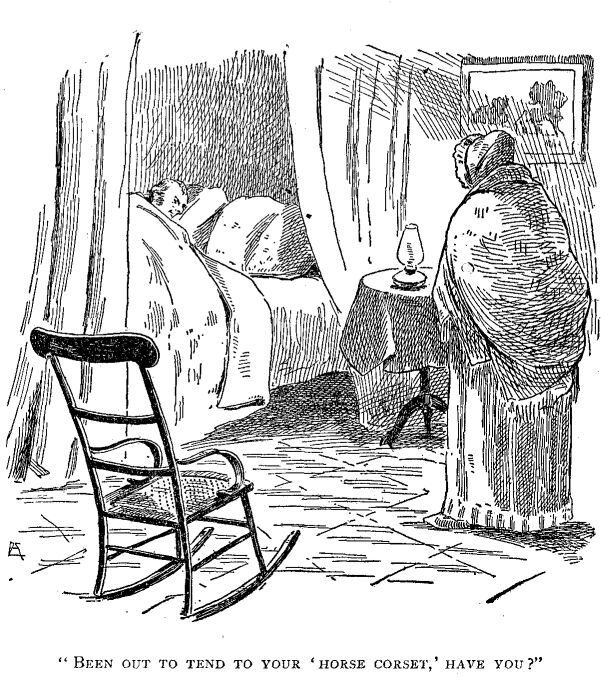
He'd wake up, a-layin' there warm and comfortable on his soft goose feather piller and say to me: “Been out to tend to your 'horse corset,' have you?”
“Horse corset! 'Wall, what if it wuz?”
Such language way along in the night, from a warm comfortable pardner to a cold one, is apt to make some words back and forth.
And then he'd speak of its legs agin, in the most slightin' terms—and he'd ask me if didn't want its picter took—etc., etc., etc.
(I believe one thing that ailed Josiah Allen wuz he didn't want me to get up and get my feet so cold).
But, as I wuz a-sayin', though I couldn't deny some of his words, for truly its legs did seem to be at the least calculation a yard and a half long, specilly in the night, why they'd look fairly pokerish.
And though I knew it wuz humbly still I persevered, and at last it got to thrivin' and growin' fast. And the likelier it grew, and the stronger, and the handsomer, so Josiah Allen's likin' for it grew and increased, till he got to settin' a sight of store by it.
And now it wuz a two-year-old, and he had sold it for two hundred and fifteen dollars. It wuz spozed it wuz goin' to make a good trotter.
Wall, seem' he had got such a big price for the colt, and knowin' well that I wuz the sole cause of its bein' alive at this day, I felt that it wuz the best time in the hull three hundred and sixty-five days of the year to tackle him for sunthin' to give to the fair. I felt that the least he could do would be to give me ten or fifteen dollars for it. So consequently after supper wuz out of the way, and the work done up, I tackled him.
CHAPTER XXVI.
He wuz jest a-countin' out his money prior to puttin' it away in his tin box, and I laid the subject before him strong and eloquent, jest the wants and needs of the meetin' house, and jest how hard we female sisters wuz a-workin', and jest how much we needed some money to buy our ingregiencies with for the fair.
He set still, a-countin' out his money, but I know he heard me. There wuz four fifty dollar bills, a ten, and a five, and I felt that at the very least calculation he would hand me out the ten or the five, and mebby both on 'em.
But he laid 'em careful in the box, and then pulled out his old pocket-book out of his pocket, and handed me a ten cent piece.
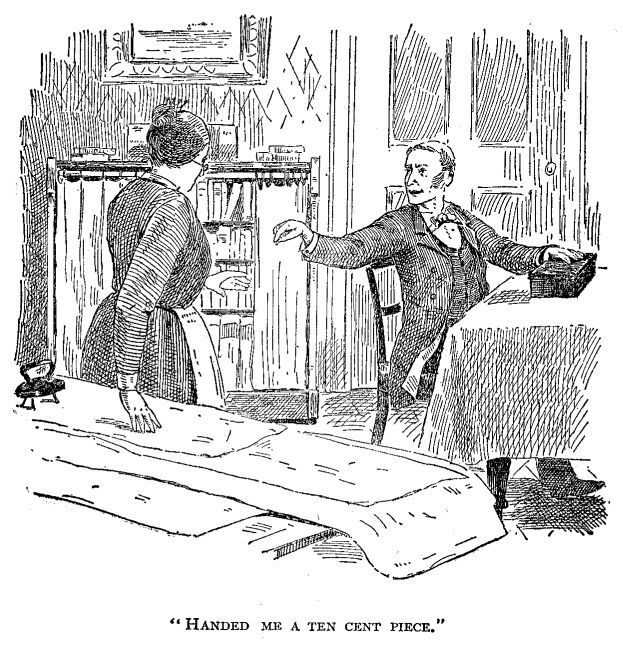
I wuz mad. And I hain't a-goin' to deny that we had some words. Or at least I said some words to him, and gin him a middlin' clear idee of how I felt on the subject.
Why, the colt wuz more mine than his in the first place, and I didn't want a cent of money for myself, but only wanted it for the good of the Methodist meetin' house, which he ort to be full as interested in as I wuz.
Yes, I gin him a pretty lucid idee of what my feelin's wuz on the subject—and spozed mebby I had convinced him. I wuz a-standin' with my back to him, a-ironin' a shirt for him, when I finished up my piece of mind. And thought more'n as likely as not he'd break down and be repentent, and hand me out a ten dollar bill.
But no, he spoke out as pert and cheerful as anything and sez he:
“Samantha, I don't think it is necessary for Christians to give such a awful sight. Jest look at the widder's mit.”
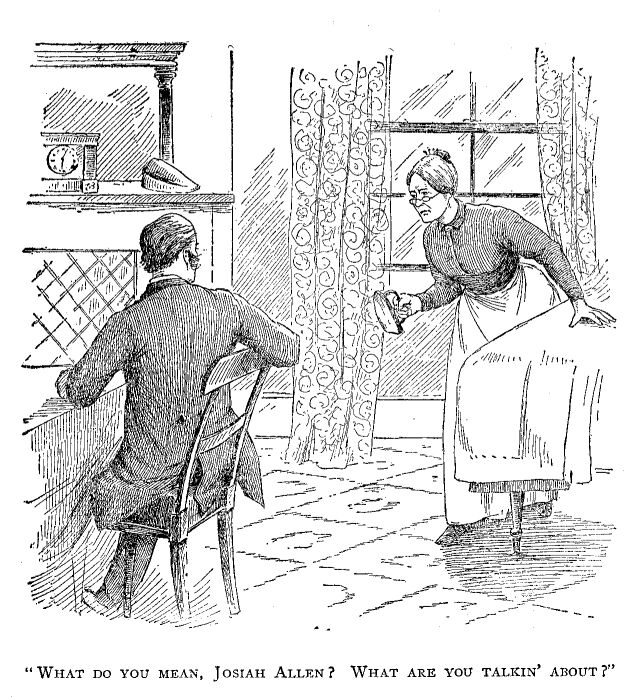
I turned right round and looked at him, holdin' my flat-iron in my right hand, and sez I:
“What do you mean, Josiah Allen? What are you talkin' about?”
“Why the widder's mit that is mentioned in Scripter, and is talked about so much by Christians to this day. Most probable it wuz a odd one, I dare persume to say she had lost the mate to it. It specilly mentions that there wuzn't but one on 'em. And jest see how much that is talked over, and praised up clear down the ages, to this day. It couldn't have been worth more'n five cents, if it wuz worth that.”
“How do you spell mit, Josiah Allen?” sez I.
“Why m-i-t-e, mit.”
“I should think,” sez I, “that that spells mite.”
“Oh well, when you are a-readin' the Bible, all the best commentaters agree that you must use your own judgment. Mite! What sense is there in that? Widder's mite! There hain't any sense in it, not a mite.”
And Josiah kinder snickered here, as if he had made a dretful cute remark, bringin' the “mite” in in that way. But I didn't snicker, no, there wuzn't a shadow, or trace of anything to be heard in my linement, but solemn and bitter earnest. And I set the flat-iron down on the stove, solemn, and took up another, solemn, and went to ironin' on his shirt collar agin with solemnety and deep earnest. “No,” Josiah Allen continued, “there hain't no sense in that—but mit! there you have sense. All wimmen wear mits; they love 'em. She most probable had a good pair, and lost one on 'em, and then give the other to the church. I tell you it takes men to translate the Bible, they have such a realizin' sense of the weaknesses of wimmen, and how necessary it is to translate it in such a way as to show up them weaknesses, and quell her down, and make her know her place, make her know that man is her superior in every way, and it is her duty as well as privilege to look up to him.”
And Josiah Allen crossed his left leg over his right one, as haughty and over bearin' a-crossin' as I ever see in my life, and looked up haughtily at the stove-pipe hole in the ceilin', and resoomed,
“But, as I wuz sayin' about her mit, the widder's, you know. That is jest my idee of givin', equinomical, savin', jest as it should be.”
“Yes,” sez I, in a very dry axent, most as dry as my flat-iron, and that wuz fairly hissin' hot. “She most probable had some man to advise her, and to tell her what use the mit would be to support a big meetin' house.” Oh, how dry my axent wuz. It wuz the very dryest, and most irony one I keep by me—and I keep dretful ironikle ones to use in cases of necessity.
“Most probable,” sez Josiah, “most probable she did.” He thought I wuz praisin' men up, and he acted tickled most to death.
“Yes, some man without any doubt, advised her, told her that some other widder would lose one of hern, and give hers to the meetin' house, jest the mate to hern. That is the way I look at it,” sez he “and I mean to mention that view of mine on this subject the very next time they take up a subscription in the meetin' house and call on me.”
But I turned and faced him then with the hot flat-iron in my hand, and burnin' indignation in my eys, and sez I:
“If you mention that, Josiah Allen, in the meetin' house, or to any livin' soul on earth, I'll part with you.” And I would, if it wuz the last move I ever made.
But I gin up from that minute the idea of gettin' anything out of Josiah Allen for the fair. But I had some money of my own that I had got by sellin' three pounds of geese feathers and a bushel of dried apples, every feather picked by me, and every quarter of apple pared and peeled and strung and dried by me. It all come to upwerds of seven dollars, and I took every cent of it the next day out of my under bureau draw and carried it to the meetin' house and gin it to the treasurer, and told 'em, at the request of the hull on 'em, jest how I got the money.
And so the hull of the female sisters did, as they handed in their money, told jest how they come by it.
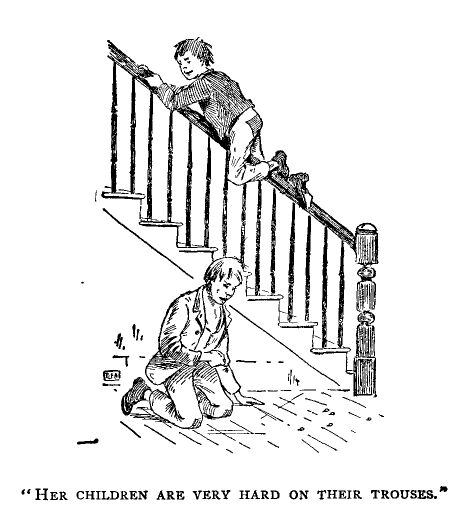
Sister Moss had seated three pairs of children's trouses for young Miss Gowdy, her children are very hard on their trouses (slidin' down the banesters and such). And young Miss Gowdy is onexperienced yet in mendin', so the patches won't show. And Sister Moss had got forty-seven cents for the job, and brung it all, every cent of it, with the exception of three cents she kep out to buy peppermint drops with. She has the colic fearful, and peppermint sometimes quells it.
Young Miss Gowdy wuz kep at home by some new, important business (twins). But she sent thirty-two cents, every cent of money she could rake and scrape, and that she had scrimped out of the money her husband had gin her for a woosted dress. She had sot her heart on havin' a ruffle round the bottom (he didn't give her enough for a overshirt), but she concluded to make it plain, and sent the ruffle money.
And young Sister Serena Nott had picked geese for her sister, who married a farmer up in Zoar. She had picked ten geese at two cents apiece, and Serena that tender-hearted that it wuz like pickin' the feathers offen her own back.
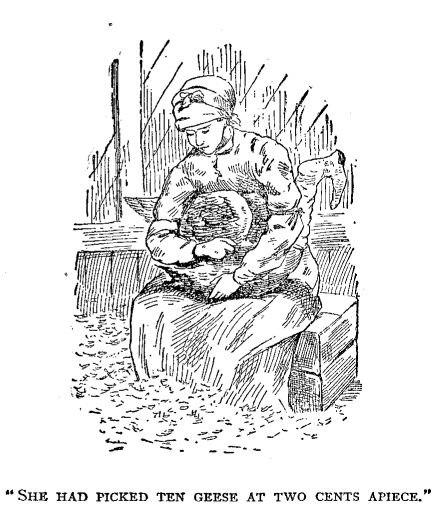
And then she is very timid, and skairt easy, and she owned up that while the pickin' of the geese almost broke her heart, the pickin' of the ganders almost skairt her to death. They wuz very high headed and warlike, and though she put a stockin' over their heads, they would lift 'em right up, stockin' and all, and hiss, and act, and she said she picked 'em at what seemed to her to be at the resk of her life.
But she loved the meetin' house, so she grin and bore it, as the sayin' is, and she brung the hull of her hard earned money, and handed it over to the treasurer, and everybody that is at all educated knows that twice ten is twenty. She brung twenty cents.
Sister Grimshaw had, and she owned it right out and out, got four dollars and fifty-three cents by sellin' butter on the sly. She had took it out of the butter tub when Brother Grimshaw's back wuz turned, and sold it to the neighbors for money at odd times through the year, and besides gettin' her a dress cap (for which she wuz fairly sufferin'), she gin the hull to the meetin' house.
There wuz quite dubersome looks all round the room when she handed in the money and went right out, for she had a errent to the store.
And Sister Gowdy spoke up and said she didn't exactly like to use money got in that way.
But Sister Lanfear sprunted up, and brung Jacob right into the argument, and the Isrealites who borrowed jewelry of the Egyptians, and then she brung up other old Bible characters, and held 'em up before us.
But still we some on us felt dubersome. And then another sister spoke up and said the hull property belonged to Sister Grimshaw, every mite of it, for he wuzn't worth a cent when he married her—she wuz the widder Bettenger, and had a fine property. And Grimshaw hadn't begun to earn what he had spent sense (he drinks). So, sez she, it all belongs to Sister Grimshaw, by right.
Then the sisters all begin to look less dubersome. But I sez:
“Why don't she come out openly and take the money she wants for her own use, and for church work, and charity?”
“Because he is so hard with her,” sez Sister Lanfear, “and tears round so, and cusses, and commits so much wickedness. He is willin' she should dress well—wants her to—and live well. But he don't want her to spend a cent on the meetin' house. He is a atheist, and he hain't willin' she should help on the Cause of religeon. And if he knows of her givin' any to the Cause, he makes the awfulest fuss, scolds, and swears, and threatens her, so's she has been made sick by it, time and agin.”
“Wall,” sez I, “what business is it to him what she does with her own money and her own property?”
I said this out full and square. But I confess that I did feel a little dubersome in my own mind. I felt that she ort to have took it more openly.
And Sister Grimshaw's sister Amelia, who lives with her (onmarried and older than Sister Grimshaw, though it hain't spozed to be the case, for she has hopes yet, and her age is kep). She had been and contoggled three days and a half for Miss Elder Minkley, and got fifty cents a day for contogglin'.
She had fixed over the waists of two old dresses, and contoggled a old dress skirt so's it looked most as well as new. Amelia is a good contoggler and a good Christian. And I shouldn't be surprised any day to see her snatched away by some widower or bachelder of proper age. She would be willin', so it is spozed.
Wall, Sister Henn kinder relented at the last, and brung two pairs of fowls, all picked, and tied up by their legs. And we thought it wuz kinder funny and providential that one Henn should bring four more of'em.
But we wuz tickled, for we knew we could sell 'em to the grocer man at Jonesville for upwerds of a dollar bill.
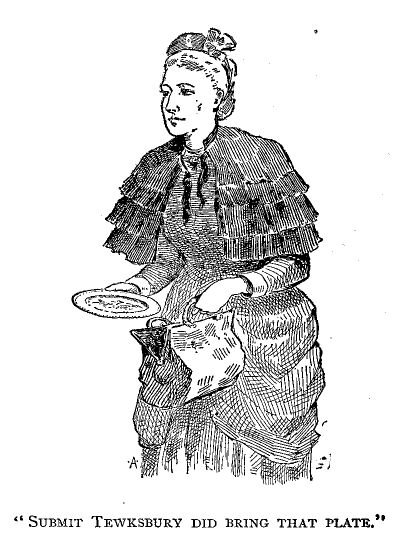
And Submit Tewksbury, what should that good little creeter bring, and we couldn't any of us hardly believe our eyes at first, and think she could part with it, but she did bring that plate. That pink edged, chiny plate, with gilt sprigs, that she had used as a memorial of Samuel Danker for so many years. Sot it up on the supper table and wept in front of it.
Wall, she knew old china like that would bring a fancy price, and she hadn't a cent of money she could bring, and she wanted to do her full part towerds helpin' the meetin' house along—so she tore up her memorial, a-weepin' on it for hours, so we spozed, and offered it up, a burnt chiny offerin' to the Lord.
Wall, I am safe to say, that nothin' that had took place that day had begun to affect us like that.
To see that good little creeter lookin' pale and considerble wan, hand in that plate and never groan over it, nor nothin', not out loud she didn't, but we spozed she kep up a silent groanin' inside of her, for we all knew the feelin' she felt for the plate.
It affected all on us fearfully.
But the treasurer took it, and thanked her almost warmly, and Submit merely sez, when she wuz thanked: “Oh, you are entirely welcome to it, and I hope it will fetch a good price, so's to help the cause along.”
And then she tried to smile a little mite. But I declare that smile wuz more pitiful than tears would have been.
Everybody has seen smiles that seemed made up, more than half, of unshed tears, and withered hopes, and disappointed dreams, etc., etc.
Submit's smile wuz of that variety, one of the very curiusest of 'em, too. Wall, she gin, I guess, about two of 'em, and then she went and sot down.
CHAPTER XXVII.
And now I am goin' to relate the very singulerist thing that ever happened in Jonesville, or the world—although it is eppisodin' to tell on it now, and also a-gettin' ahead of my story, and hitchin', as you may say, my cart in front of my horse. But it has got to be told and I don't know but I may as well tell it now as any time.
Mebby you won't believe it. I don't know as I should myself, if it wuz told to me, that is, if it come through two or three. But any way it is the livin' truth.
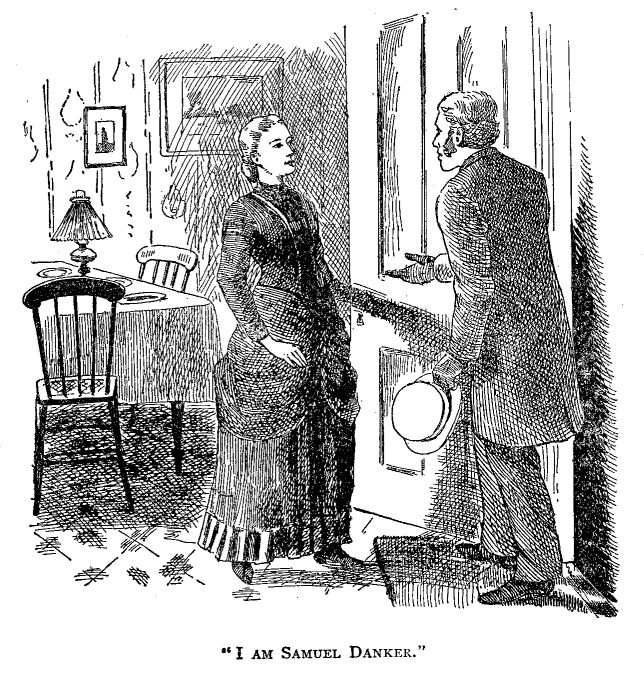
That very night as Submit Tewksbury sat alone at her supper table, a-lookin' at that vacent spot on the table-cloth opposite to her, where the plate laid for Samuel Danher had set for over twenty years, she heard a knock at the door, and she got up hasty and wiped away her tears and opened the door. A man stood there in the cold a-lookin' into the warm cosy little room. He didn't say nothin', he acted strange. He gin Submit a look that pierced clear to her heart (so they say). A look that had in it the crystallized love and longin' of twenty years of faithfulness and heart hunger and homesickness. It wuz a strange look.
Submit's heart begun to flutter, and her face grew red and then white, and she sez in a little fine tremblin' voice,
“Who be you?”
And he sez,
“I am Samuel Danker.”
And then they say she fainted dead away, and fell over the rockin' chair, he not bein' near enough to ketch her.
And he brung her to on a burnt feather that fell out of the chair cushion when she fell. There wuz a small hole in it, so they say, and the feather oozed out.
I don't tell this for truth, I only say that they say thus and so.
But as to Samuel's return, that I can swear to, and so can Josiah. And that they wuz married that very night of his return, that too can be swore to. A old minister who lived next door to Submit—superanuated, but life enough in him to marry 'em safe and sound, a-performin' the ceremony.
It made a great stir in Jonesville, almost enormus.
But they wuz married safe enough, and happy as two gambolin' lambs, so they say. Any way Submit looks ten years younger than she did, and I don't know but more. I don't know but she looks eleven or twelve years younger, and Samuel, why they say it is a perfect sight to see how happy he looks, and how he has renewed his age.
The hull affair wuz very pleasin' to the Jonesvillians. Why there wuzn't more'n one or two villians but what wuz fairly delighted by it, and they wuz spozed to be envius.
And I drew severel morals from it, and drew 'em quite a good ways too, over both religous and seckuler grounds.
One of the seekuler ones wuz drawed from her not settin' the table for him that night, for the first time for twenty years, givin' away the plate, and settin' on (with tears) only a stun chiny one for herself. How true it is that if a female woman keeps dressed up slick, piles of extra good cookin' on hand, and her house oncommon clean, and she sets down in a rockin' chair, lookin' down the road for company.
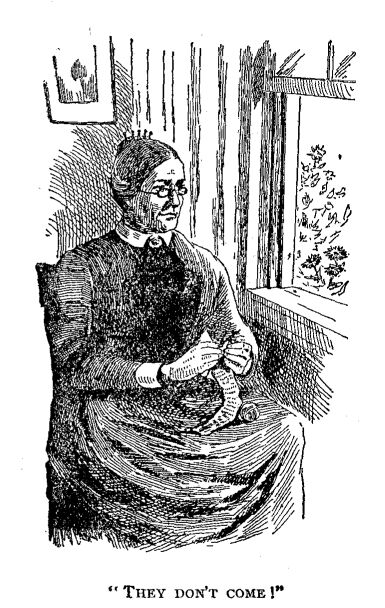
They don't come!
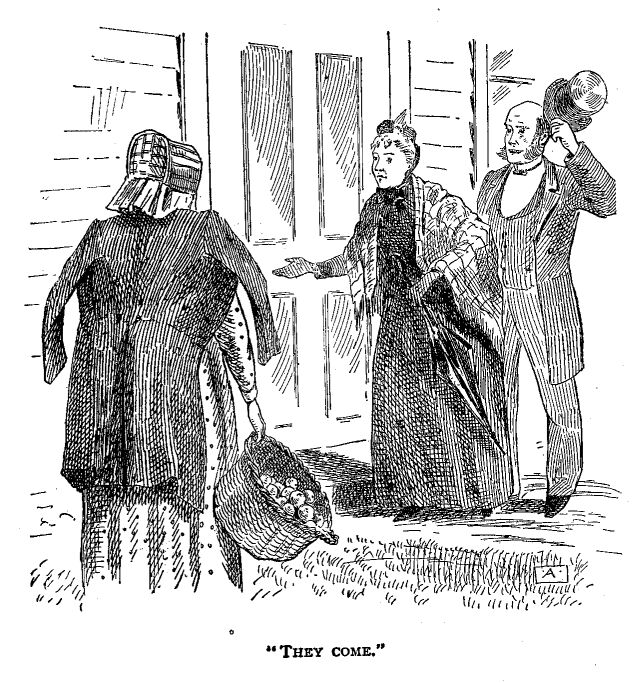
But let her on a cold mornin' leave her dishes onwashed, and her floors onswept, and put on her husband's old coat over her meanest dress, and go out (at his urgent request) to help him pick up apples before the frost spiles 'em. She a-layin' out to cook up some vittles to put on to her empty shelves when she goes into the house, she not a-dreamin' of company at that time of day.
They come!
Another moral and a more religeus one. When folks set alone sheddin' tears on their empty hands, that seem to 'em to be emptied of all hope and happiness forever. Like es not some Divine Compensation is a-standin' right on the door steps, ready to enter in and dwell with 'em.
Also that when Submit Tewksbury thought she had gin away for conscience' sake, her dearest treasure, she had a dearer one gin to her—Samuel Danker by name.
Also I drew other ones of various sizes, needless to recapitulate, for time is hastenin', and I have eppisoded too fur, and to resoom, and take up agin on my finger the thread of my discourse, that I dropped in the Methodist meetin' house at Jonesville, in front of the treasurer.
Wall, Submit brought the plate.
Sister Nash brought twenty-three cents all in pennys, tied up in the corner of a old handkercif. She is dretful poor, but she had picked up these here and there doin' little jobs for folks.
And we hadn't hardly the heart to take 'em, nor the heart to refuse takin' 'em, she wuz so set on givin' 'em. And it wuz jest so with Mahala Crane, Joe Cranes'es widder.
She, too, is poor, but a Christian, if there ever wuz one. She had made five pair of overhawls for the clothin' store in Loontown, for which she had received the princely revenue of fifty cents.
She handed the money over to the treasurer, and we wuz all on us extremely worked upon and wrought up to see her do it, for she did it with such a cheerful air. And her poor old calico dress she had on wuz so thin and wore out, and her dingy alpaca shawl wuz thin to mendin', and all darned in spots. We all felt that Mahala had ort to took the money to get her a new dress.
But we dasted none on us to say so to her. I wouldn't have been the one to tell her that for a dollar bill, she seemed to be so happy a-givin' her part towerds the fair, and for the good of the meetin' house she loved.
Wall, Sister Meachim had earned two dollars above her wages—she is a millinner by perswasion, and works at a millinner's shop in Jonesville. She had earned the two dollars by stayin' and workin' nights after the day's work wuz done.
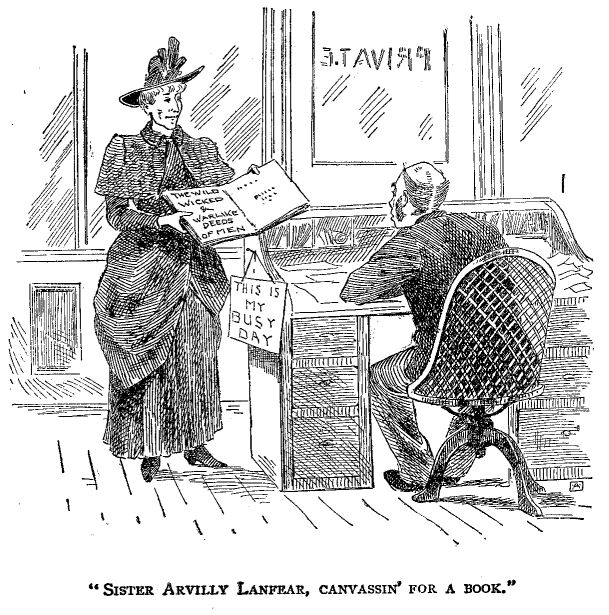
And Sister Arvilly Lanfear had earned three dollars and twenty-eight cents by canvassin' for a book. The name of the book wuz: “The Wild, Wicked, and Warlike Deeds of Man.”
And Arvilly said she had took solid comfort a-sellin' it, though she had to wade through snow and slush half way up to her knees some of the time, a-trailin' round from house to house a-takin' orders fer it. She said she loved to sell a book that wuz full of truth from the front page to the back bindin'.
As for me I wouldn't gin a cent for the book, and I remember we had some words when she come to our house with it. I told her plain that I wouldn't buy no book that belittled my companion, or tried to—sez I, “Arvilly, men are jest as good as wimmen and no better, not a mite better.”
And Arvilly didn't like it, but I made it up to her in other ways. I gin her some lamb's wool yarn for a pair of stockin's most immegictly afterwerds, and a half bushel of but'nuts. She is dretful fond of but'nuts.
Wall, Sister Shelmadine had sold ten pounds of maple sugar, and brought the worth on it.
And Sister Henzy brung four dollars and a half, her husband had gin her for another purpose, but she took it for this, and thought there wuzn't no harm in it, as she laid out to go without the four dollars and a halt's worth. It was fine shoes he had gin the money for, and she calculated to make the old ones do.
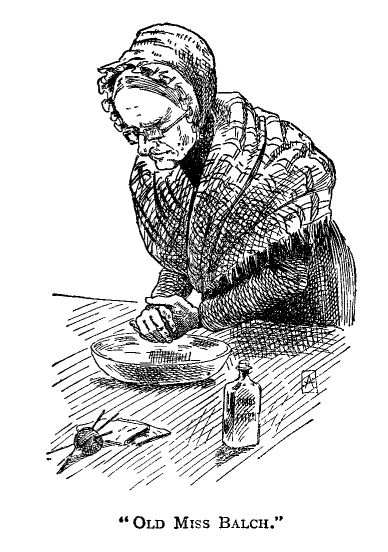
And Sister Henzy's mother, old Miss Balch, she is eighty-three years old, and has inflamatery rheumatiz in her hands, which makes 'em all swelled up and painful. But Sister Henzy said her mother had knit three pairs of fringed mittens (the hardest work for her hands she could have laid holt of, and which must have hurt her fearful). But Miss Henzy said a neighbor had offered her five dollars fer the three pairs, and so she felt it wuz her duty to knit 'em, to help the fair along. She is a very strong Methodist, and loved to forwerd the interests of Zion.
She wuz goin' to give every cent of the money to the meetin' house, so Sister Henzy said, all but ten cents, that she had to have to get Pond's Extract with, to bathe her hands. They wuz in a fearful state. We all felt bad for old Miss Balch, and I don't believe there wuz a woman there but what gin her some different receipt fer helpin' her hands, besides sympathy, lots and lots of it, and pity.
Wall, Sister Sypher'ses husband is clost, very clost with her. She don't have anythin' to give, only her labor, as well off as they be. And now he wuz so wrapped up in that buzz saw mill business that she wouldn't have dasted to approach him any way, that is, to ask him for a cent.
Wall, what should that good little creeter do but gin all the money she had earned and saved durin' the past year or two, and had laid by for emergincies or bunnets.
She had got over two dollars and seventy-five cents, which she handed right over to the treasurer of the fair to get materials for fancy work. When they wuz got she proposed to knit three pairs of men's socks out of zephyr woosted, and she said she was goin' to try to pick enough strawberrys to buy a pair of the socks for Deacon Sypher. She said it would be a comfort for her to do it, for they would be so soft for the Deacon's feet.
Wall, Sister Gowdy wuz the last one to gin in dress gin to her by her uncle out to the Ohio. It wuz gin her to mourn for her mother-in-law in.
And what should that good, willin' creeter do but bring that dress and gin it to the fair to sell.
We hated to take it, we hated to like dogs, for we knew Sister Gowdy needed it.
But she would make us take it; she said “if her Mother Gowdy wuz alive, she would say to her,
“Sarah Ann, I'd ruther not be mourned for in bombazeen than to have the dear old meetin' house in Jonesville go to destruction. Sell the dress and mourn fer me in a black calico.”
That Sister Gowdy said would be, she knew, what Mother Gowdy would say to her if she wuz alive.
And we couldn't dispute Sarah Ann, for we all knew that old Miss Gowdy worked for the meetin' house as long as she could work for anything. She loved the Methodist meetin' house better than she loved husband or children, though she wuz a good wife and mother. She died with cramps, and her last request wuz to have this hymn sung to her funeral:
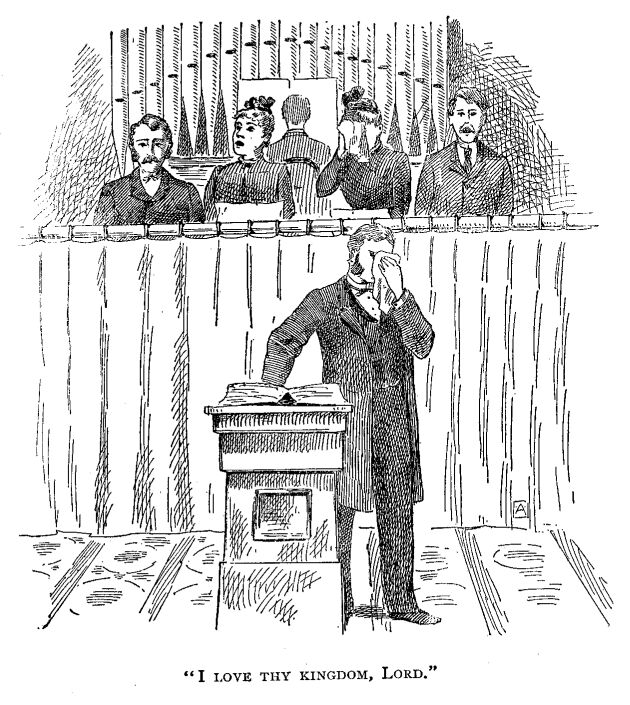
“I love thy kingdom, Lord, The house of thine abode, The church our dear Redeemer bought With His most precious blood.”
The quire all loved Mother Gowdy, and sung it accordin' to her wishes, and broke down, I well remember, at the third verse—
“For her my tears shall fall, For her my prayers ascend, For her my toil and life be given, Till life and toil shall end.”
The quire broke down, and the minister himself shed tears to think how she had carried out her belief all her life, and died with the thought of the church she loved on her heart and its name on her lips.
Wall, the dress would sell at the least calculation for eight dollars; the storekeeper had offered that, but Sarah Ann hoped it would bring ten to the fair.
It wuz a cross to Sarah Ann, so we could see, for she had loved Mother Gowdy dretful well, and loved the uncle who had gin it to her, and she hadn't a nice black dress to her back. But she said she hadn't lived with Mother Gowdy twenty years for nothin', and see how she would always sacrifice anything and everything but principle for the good of the meetin' house.
Sister Gowdy is a good-hearted woman, and we all on us honored her for this act of hern, though we felt it wuz almost too much for her to do it.
Wall, Sister Gowdy wuz the last one to gin in her testimony, and havin' got through relatin' our experiences we proceeded to business and paperin'.
CHAPTER XXVIII.
Sister Sylvester Bobbet and I had been voted on es the ones best qualified to lead off in the arjeous and hazerdous enterprize.
And though we deeply felt the honor they wuz a-heapin' on to us, yet es it hes been, time and agin, in other high places in the land, if it hadn't been fer duty that wuz a-grippin' holt of us, we would gladly have shirked out of it and gin the honor to some humble but worthy constituent.
Fer the lengths of paper wuz extremely long, the ceilin' fearfully high, and oh! how lofty and tottlin' the barells looked to us. And we both on us, Sister Sylvester Bobbet and I, had giddy and dizzy spells right on the ground, let alone bein' perched up on barells, a-liftin' our arms up fur, fur beyond the strength of their sockets.
But duty wuz a-callin' us, and the other wimmen also, and it wuzn't for me, nor Sister Sylvester Bobbet to wave her nor them off, or shirk out of hazerdous and dangerous jobs when the good of the Methodist Meetin' House wuz at the Bay.
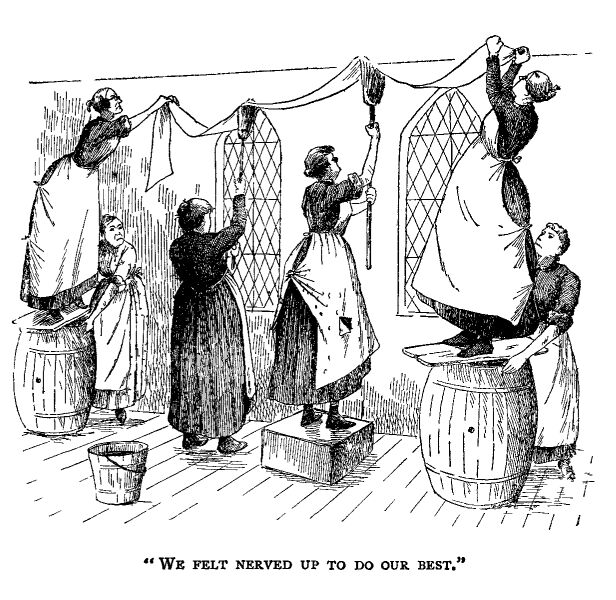
No, with as lofty looks as I ever see in my life (I couldn't see my own, but I felt 'em), and with as resolute and martyrous feelin's as ever animated two wimmen's breasts, Sister Sylvester Bobbet and I grasped holt of the length of paper, one on each end on it, Sister Arvilly Lanfear and Miss Henzy a-holdin' it up in the middle like Aaron and Hur a-holdin' up Moses'ses arms. We advanced and boldly mounted up onto our two barells, Miss Gowdy and Sister Sypher a-holdin' two chairs stiddy for us to mount up on.
Every eye in the meetin' house wuz on us. We felt nerved up to do our best, even if we perished in so doin', and I didn't know some of the time but we would fall at our two posts. The job wuz so much more wearin' and awful than we had foreboded, and we had foreboded about it day and night for weeks and weeks, every one on us.
The extreme hite of the ceilin'; the slipperyness and fragility of the lengths of paper; the fearful hite and tottlin'ness of the barells; the dizzeness that swept over us at times, in spite of our marble efforts to be calm. The dretful achin' and strainin' of our armpits, that bid fair to loosen 'em from their four sockets. The tremenjous responsibility that laid onto us to get the paper on smooth and onwrinkled.
It wuz, takin' it altogether, the most fearful and wearisome hour of my hull life.
Every female in the room held her breath in deathless anxiety (about thirty breaths). And every eye in the room wuz on us (about fifty-nine eyes—Miss Shelmadine hain't got but one workin' eye, the other is glass, though it hain't known, and must be kep).
Wall, it wuz a-goin' on smooth and onwrinkled—smiles broke out on every face, about thirty smiles—a half a minute more and it would be done, and done well. When at that tryin' and decisive moment when the fate of our meetin' house wuz, as you may say, at the stake, we heard the sound of hurryin' feet, and the door suddenly opened, and in walked Josiah Allen, Deacon Sypher, and Deacon Henzy followed by what seemed to me at the time to be the hull male part of the meetin' house.
But we found out afterwerds that there wuz a few men in the meetin' house that thought wimmen ort to set; they argued that when wimmen had been standin' so long they out to set down; they wuz good dispositioned. But as I sez at the time, it looked to us as if every male Methodist in the land wuz there and present.
They wuz in great spirits, and their means wuz triumphant and satisfied.
They had jest got the last news from the Conference in New York village, and had come down in a body to disseminate it to us.
They said the Methodist Conference had decided that the seven wimmen that had been stood up there in New York for the last week, couldn't set, that they wuz too weak and fraguile to set on the Conference.
And then the hull crowd of men, with smiles and haughty linements, beset Josiah to read it out to us.
So Josiah Allen, with his face nearly wreathed with a smile, a blissful smile, but as high headed a one as I ever see, read it all out to us. But he should have to hurry, he said, for he had got to carry the great and triumphant news all round, up as fur as Zoar, if he had time.
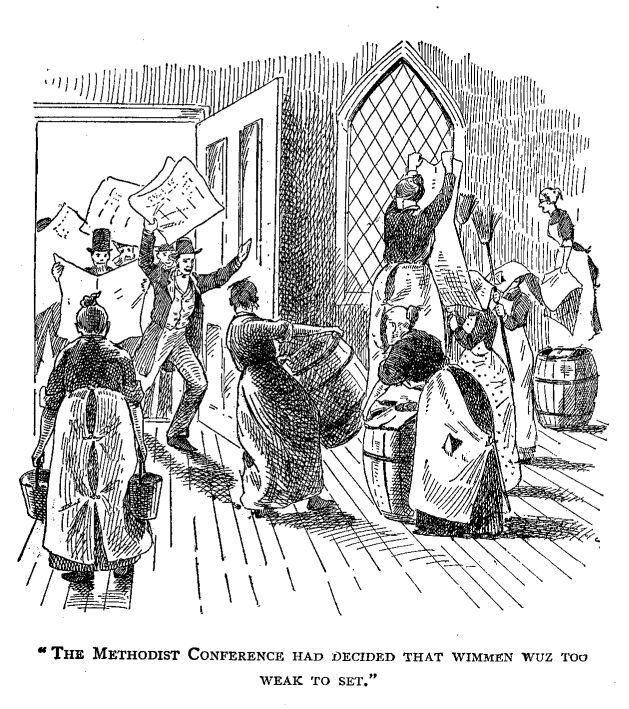
And so he read it out to us, and as we see that that breadth wuz spilte, we stopped our work for a minute and heard it.
And after he had finished it, they all said it wuz a masterly dockument, the decision wuz a noble one, and it wuz jest what they had always said. They said they had always known that wimmen wuz too weak, her frame wuz too tender, she was onfitted by Nater, in mind and in body to contend with such hardship. And they all agreed that it would be puttin' the men in a bad place, and takin' a good deal offen their dignity, if the fair sex had been allowed by them to take such hardships onto 'em. And they sez, some on 'em, “Why! what are men in the Methodist meetin' house for, if it hain't to guard the more weaker sect, and keep cares offen 'em?”
And one or two on 'em mentioned the words, “cooin' doves” and “sweet tender flowerets,” as is the way of men at such times. But they wuz in too big a hurry to spread themselves (as you may say) in this direction. They had to hurry off to tell the great news to other places in Jonesville and up as fer as Loontown and Zoar.
But Sister Arvilly Lanfear, who happened to be a-standin' in the door as they went off, she said she heard 'em out as fer as the gate a-congratilatin' themselves and the Methodist Meetin' House and the nation on the decesion, for, sez they,
“Them angels hain't strong enough to set, and I've known it all the time.”
And Sister Sylvester Gowdy sez to me, a-rubbin' herachin' armpits—
“If they are as beet out as we be they'd be glad to set down on anything—a Conference or anything else.”
And I sez, a-wipin' the presperatin of hard labor from my forwerd,
“For the land's sake! Yes! I should think so.”
And then with giddy heads and strainin' armpits we tackled the meetin' house agin.