SALLY COCKSURE (continued 2)
Reading edition
"Kind of her! I'm sure. It is I who ought to be in tears, 300 lines of 'Morte d'Arthur' for my sins."
"And you have done them already?"
Trina Morrison took off her hat, and flapped it at her questioner.
"My friend, am I not always a slave to duty? Rest assured that they will be done. I think I may safely say that Little Arthur's barge has pushed off from the bulrushes towards Avilion, by now."
"Yes—but it is not you who are pushing the barge, but Sally Brendan."
There was much criticism in Violet Tremson's tone; and criticism of Peter's actions was so rare in the Lower Fifth that Trina raised her eyebrows while the rest stared.
"My good child, why be a purist? Did I lay claim to be the moving spirit?"
"No—but you didn't say, either, that Sally wasn't able to go to cricket yesterday, or to-day, because she is doing your lines, as well as her own. Doris Forbes is mad with her; and thinks she doesn't bother to turn up and practise, because there are no matches. If she loses her place in the Second Eleven, it will be your fault."
Violet Tremson was on her feet now, her usually calm eyes bright with indignation; but Trina merely shrugged her shoulders and settled herself more comfortably against her tree.
"Sally the Martyr," she said pleasantly. "Such a shy gentle soul, that she always needs mothering and persuading to make her do what she wishes."
Everyone laughed, except Violet, who made an impatient movement with her foot.
"I wish you would leave her alone, Peter. You are not playing fair by her—messing up her chances at cricket, etc."
At this point there was a general shout of "Oh, shut up, Violet. What business is it of yours?" And then Sally appeared, very inky and rather breathless.
"Just look, Peter," she said, producing some sheets of closely written foolscap, and pressing them into Trina's hand. "I don't believe anyone but a Scotland Yard detective could see the difference between them and the lines you gave me."
The elder girl sat up, and after examining them carelessly, patted the younger on the back.
"You will have to look out, kid, or if the habit grows on you it will be a case of spending your days in prison for forgery."
"Then you do think them awfully good, don't you?"
Sally couldn't resist angling for further praise. She wished she had not done so, as she met Peter's mocking glance.
"Oh, they are certainly good enough to take in an ass like Poppy; if no one here has an attack of conscience, and gives the show away."
Cries of—"Of course we won't, Peter—Rather not!" arose on all sides.
Sally stood shifting from one leg to the other, her face sullen. No one had taken any notice of her, or looked at her handiwork, except Peter, who had not even thanked her. All her pride rose in arms.
"I think it's a frightfully good copy, myself," she said at last, defiantly.
"I wouldn't go so far as that," retorted Trina calmly; "you have scarcely done the dots over my 'i's' justice, for instance, or the fashionable curve of my 's'. Still, I daresay it's quite a good effort for a youngster." And she yawned.
There was a roar of laughter that made Sally go hot with rage.
"If the lines are not good enough for you, I won't ask you to make use of them," she said furiously.
Trina Morrison's eyes had closed; but now she half-opened them languidly, and her voice, when she spoke, had a cold edge to it.
"Take them back if you want," she said curtly, "and clear out, do." There was silence while Sally stood, her hands clenched, fighting a battle between her pride and newly proffered loyalty. Were pride to conquer, she knew it would be an end of all friendship between herself and Peter; and could she bear this? There was entreaty in the glance with which she looked at last at the elder girl, but the other's eyes were shut again, and she realised there was to be no half-way house of mercy.
"I ... I don't want the lines, Peter. You know I did them for you."
The words were so halting—her voice so humble—that she hardly recognised it. Now, perhaps, Trina would speak a few words of thanks, but she did not; and after a fresh tussle with her pride, that urged her to pick up the foolscap and tear it into little pieces, Sally left it on the grass, and, turning on her heel, walked away across the playing-fields.
"I suppose they are all jeering at me," she told herself miserably. "Now they will despise me as soft, besides hating me." With difficulty she choked back tears, and hurried along, that she might not catch the echo of Fifth Form laughter. Had she known it, the group she had left, instead of laughing at her, was quite silent, until Violet Tremson said:
"You are a prize beast, Peter."
And though Mabel Gosson told her to shut up, and not be a prig, and someone else muttered, "It will do the little ass good to be taken down a peg," no one looked quite comfortable about it.
Trina Morrison might be a joy to the Lower Fifth, but even her admirers did not always understand her.
"Of course she has her nasty side; most people have," they would explain her lapses from their ordinary code; and perhaps part of her fascination lay in the uncertainty of what she would do and say on different occasions.
Now she made no visible effort to combat criticism, or justify herself. As the school-house bell rang, she got up leisurely and gathered the lines from "Morte d'Arthur" together.
"There goes Poppy, so I may as well get rid of these at once," she said, and strolled off after the prefect.
The Lower Fifth could see her slip her arm through Poppy's and hear her friendly laugh, as she handed over the sheets of foolscap.
"And she'll have that fat idiot purring before they have gone the length of the playing-fields," said Mabel Gosson, with an admiring sigh. "Peter is a wonder, you know. Why, anyone else who went on as she does, would have been expelled long ago."
"I wish she was expelled," said Violet Tremson angrily. "She is just pushing the school downhill as hard as she can. You all know she is a rotter, and yet you let her trample on you and take the lead—even some of the Sixth do too, like Poppy."
"You were keen enough on her yourself, when you first came—as much a slave to her as any of us."
"I know I was; and it hurt me frightfully when I found out she wasn't straight, and ... and what a selfish beast she really is. That is why I hate to see the way she is carrying on with a kid like Sally Brendan."
"Oh, do leave off crabbing Peter; after all, she is my friend," said Mabel Gosson crossly. "If you keep on any more, Violet, everyone in the school will say you are jealous because she dropped you, and surely that prickly hedgehog of a child can look after herself. You should have seen her shake Peter the other afternoon on the beach."
"Of course she can. I wonder Peter ever took any notice of her at all, after that."
"It was really frightfully good of someone Peter's age to go on an adventure with a little ass of her sort."
"Rather! and I say, we never heard what Peter did.... She is a sport. We must get it out of her."
By the time the Lower Fifth group had reached the school, all Peter's admirers had recovered the full extent of their admiration. Only Violet Tremson was silent, her usually calm face perplexed by a struggle waging in her mind between two sets of inclinations.
One decision would be, to leave Sally alone to work out her fate. It wasn't even as though she were the type of girl to need a champion, or had shown any wish to be friendly. She was cheeky, conceited, self-sufficient; and wouldn't really mind being expelled, if what she boasted were true.
Violet was well aware of all this, and wondered at her own reluctance to accept the obvious conclusion that Sally's affairs were no business of hers.
"And yet I should hate her to be expelled," she told herself. "She has such lots of brains and pluck. One day, if she stops on here, she will be head of the school and games—ever so much better at running both than Doris Forbes, because she has more imagination."
Violet Tremson was still arguing with herself when she went in to supper. Sally, she could see, had been crying, and now, left in Coventry by her neighbours, made merely a pretence of swallowing her bread and jam. Trina Morrison, on the contrary, surrounded by her friends, was making so much noise that every now and then an exasperated prefect demanded silence from that end of the table.
"She is a beast," said Violet of Peter; and marvelled at the wave of indignation that, for the moment, swept her. Why should she care if a girl who had been persistently rude to her was snubbed and humiliated? It was a difficult question to answer, because the demands of friendship, as of love, are independent of argument and common sense. If Sally craved for Trina's affection, Violet knew in her heart that she would have liked the chance of winning Sally's.
"I suppose one can't help likes and dislikes," she told herself at last, "and if Trina wasn't here, I might make something of her."
CHAPTER THE NINTH A BROAD HINT
Sally Brendan had spent so much time and care over her imitation of Peter's handwriting that she was a day late in finishing her own lines.
"I couldn't manage to get them done quicker," she muttered sullenly as, giving them in, she was met by an angry glance instead of the curt acknowledgment she felt they at least deserved.
"Why on earth not? Because you didn't choose, you lazy little beast, I suppose? And the writing is hardly legible, as it is."
Sally shifted from one foot to the other, her hands clenched. She hated and despised Poppy Bristow, and it was a great effort to submit to her bullying words in silence. The elder girl, on the other hand, found, for the first time, a little relief for her wounded vanity in being able to abuse someone else in safety. Lashed by the tongues of fellow-prefects, she had not dared to accuse or condemn the real culprit, and had suffered in secret, till now, like a flood released, her indignation poured itself out over the unpopular new girl, who had helped Trina Morrison to humiliate her before the Juniors.
"It's a perfect disgrace, the way the rules are broken nowadays at Seascape House," she concluded her harangue; "and I, at any rate, don't intend that prefects' orders shall be disregarded in future. I said if you didn't get those lines done by Wednesday, I would have to report you to Miss Cockran, and Heaven knows that I have a good mind to do it. It would serve you right."
Sally had borne a great deal, more than she had ever stood from those in authority before; but now her patience gave way, and she laughed aloud mockingly.
"Then I suppose it would serve Peter right as well? ... Miss Cockran will find out about Peter coming in late, if I am sent to her. You can bet your money on that: and I don't know if that will please you—it will make Peter mad all right."
Poppy flushed a deep purple. "What do you mean?" she demanded. "What does it matter to me how mad Trina Morrison may get?"
Sally smiled slightly, as if that answered the question, before she added: "Well, do you want me to go to Miss Cockran?"
The prefect gripped her by the shoulders, and Sally thought she would have shaken her or struck her; but with a great effort she partly preserved her self-control.
"You—you impudent little b-beast," she stammered; "I don't know what you mean—b-but I won't be t-talked to like this. You will do me another 300 lines by the end of the week. 'Ev-v-angeline' ... they are long ones. See?"
"Yes," said Sally sullenly, "all right."
It had suddenly occurred to her that, after all, she herself did not wish to go to Miss Cockran and betray Peter; and that Poppy Bristow, if goaded too far, might send her there without calculating the cost. The only thing was to give in, with as good a grace as possible; but again, as many times since she had come to Seascape House, the new girl wished she had held her tongue, and not been such a fool as to burden herself with more "lines" and a new enemy. She guessed that the wound she had given to Poppy Bristow's pride would not be forgiven easily.
"Not that I care, of course," she muttered, as she pulled down a copy of Longfellow from the library shelf, and carried it to her desk.
The worst of it was, she did care. As she sat scribbling wearily, she could see Trina Morrison walking in the garden below, arm in arm with Mabel Gosson and Cathy Manners. They looked so utterly care-free that, for the moment, Sally was tempted to tip her inkpot over them, out of the open window, as they strolled below.
"It would serve them right, selfish cads," she said; but did not act on the impulse, as she would have done a few months ago at home. She was beginning to learn that her second thoughts were sometimes best.
The lines were finished by tea-time on Saturday, and Poppy received them with a grudging: "Is that 300? It doesn't look more than two."
"Three hundred—yes. It was what you wanted, wasn't it?" asked Sally politely.
The prefect gave a grunt—whether of disgust, or assent, it was difficult to say. It was obvious that she would have liked to return the lines for correction; but the younger girl, foreseeing this, had taken pains to make them both tidy and clear.
"If they are all right, I suppose I can go?" she said at last; and as the other turned her back without answering, made off across the quadrangle after Trina Morrison, whom she saw in the distance.
"I have just had to do 300 more lines, for cheeking Poppy, you know."
There was slight importance in her tone, and Trina Morrison's eyebrows lifted.
"Was it worth it?"
"Hardly, I suppose; but she is such an ass that I couldn't resist pulling her leg."
"My dear child, if you start cheeking every ass in the school you will have your work cut out."
"Oh, well—I shan't do it any more—not till next time."
They had reached the gymnasium by now, and conversation showed signs of languishing. Sally looked hurriedly round to see that they were alone, then caught her friend's arm.
"Peter," she said, "look here. I ... I didn't mean to boast that other evening. It was just, I had taken such a lot of trouble to hit off your handwriting exactly; and it's not an easy job, really, truly, it isn't."
The other laughed.
"Why, kid, of course it isn't. I believe forgers must take a special university course in handwriting, and I was uncommonly grateful—all that sort of thing. It was just, I couldn't resist ragging you—I always rag my friends—but you are such a tinder-box. Mabel Gosson, now, is like an indiarubber ball—in, when you poke, and out again—none the worse."
Sally's eyes glowed. So Peter did number her amongst her friends. Nothing else mattered, at the minute.
"I didn't mind a bit really, from you," she said valiantly. "It was the others standing round and laughing I couldn't bear. It made me mad angry."
"Turkey-Cock-sure. Isn't that what Doris Forbes calls you? It is quite smart of her, considering she is one of the worst asses this house boasts."
Sally secretly liked Doris, and began, rather half-heartedly, to object to this sweeping criticism.
"Why, she is awfully good at cricket, you know."
"And so are you, aren't you? You have often told me so, and sometimes street boys are; and lunatic asylums, I believe, produce quite creditable elevens." The younger girl flushed. "I daresay cricket for girls is all very well, just while one is at school. Personally, I like tennis much better, don't you? It often makes a good excuse for parties."
This was so novel an idea that Sally opened her eyes wide.
"I don't understand you sometimes. Why, tea-parties are awful rot—sitting about in best clothes, I mean."
"Oh, yes, in best school-clothes, of course."
This was equally baffling; but while Trina stood laughing, without attempting to explain her meaning, Mabel Gosson appeared.
"I want to talk to you, Peter," she said, and glared coldly at Sally.
"All right. Come to our Form sitting-room. So long, kid. Don't get any more lines, or you will have a red nose from leaning over the ink-pot."
"But you will let us have a talk again some time soon? I have just heaps to say to you."
"Yes, of course."
There was a hint of impatience in Peter's tone, and Sally dared not keep her longer, but wandered off, rather forlornly, to the cricket ground. They were just picking up sides for the Eagles when she arrived, but though she walked up and down close to the pitch, Doris Forbes took no notice of her; and when the sides were finally chosen, she was forced to go away.
"Try shrimping!" jeered one of those to whom she had once offered unsought advice; and as she turned her back, pretending that she did not hear, she came face to face with Violet Tremson.
"Hullo!" said Violet quickly. "Doing anything now?"
"No."
"Well, you said you would practise me at the nets one evening."
Sally hesitated. Last time they had spoken had been in the sea, and she herself had been violently rude.
"Do you want to play, really?" she mumbled, somewhat suspicious that there was a trap set to catch her, and make a fool of her, though she could not quite detect it at the moment.
"Rather. I seem to be stuck in the Wolves and Bears for life, and batting is quite my worst show. Doris Forbes says my style is simply awful; but then I have no brothers to coach me, you see."
"It was my Uncle Frank who taught me at the beginning. He used to play for Yorkshire."
Sally's face brightened as she spoke, and by the time they reached the nets they were both discussing the averages of their favourite champions. Then they fell to work, and it was with regret that they heard the school bell ring, and went to pick up their coats.
"You will do quite well if you hit out a bit more," said Sally. "I am too rash, and you are too careful. You rather poke at balls, you know."
"Well, if I try to slog, the ball always gets me middle stump and that damps my courage—especially when someone calls out: 'How could you be so careless? Who do you think you are? W. G. Grace, or Plum Warner?'"
The other laughed.
"A short life and a merry one is my motto, and like the old miller, 'I don't care for nobody'—nor what 'nobody says to me.'"
They had reached the school-house by now, and passed Trina Morrison standing in the hall. Sally waved to her, and she stared at them with a faint smile, but did not speak.
"Isn't Peter frightfully clever?" said the younger girl; "and such a sport—not afraid of anyone. I think she's the bravest person I ever met."
"Do you?"
At her dry tone, Sally turned in surprise. It was so unlike Violet Tremson's usual cheerful kindliness.
They were at the foot of the stairs that led to the upper floor, where conversation was forbidden, and both of them stopped involuntarily, facing each other.
"Of course she is brave. Do you mean you don't agree?"
Violet Tremson hesitated: then said very slowly:
"I don't care for Trina Morrison. I used to, you know—as you do. I admired her very much, but ... well, later, I couldn't help seeing that she wasn't what I thought."
"You mean, you think I will change about her?"
"Yes—I hope you will. She is rather a rotter."
It was out now; and Violet accepted silently, though her face flushed, the indignant denial that she had expected. Any explanation of her point of view, or Sally's, was, however, cut short by the appearance of Miss Castle, who demanded why they were waiting about when the dressing bell had rung.
"You will be late for supper unless you hurry. Be off now, the pair of you."
They fled to their rooms; and while Sally changed, she meditated on Violet Tremson's verdict, deciding that she felt as she did because she was naturally "a slow old thing." Probably Peter hadn't bothered to know her, and she was hurt; though it was true that it didn't seem easy to hurt or annoy her. Sally suddenly remembered the scene in the water, and wished she had apologised for her rudeness. She had meant to do so, put it off, and then forgotten it. Now the opportunity was past.
"Anyhow, I'll make up for it by being really decent to her now," she said. "She can't help being a cousin of Mrs. Musgrave, and she has been jolly decent to me."
CHAPTER THE TENTH THE BREACH WIDENS
It was nearing the end of the summer term, and continued measles at Seascape House had put an end to all hopes of a cricket season that included the outside world. In consequence, "Games" enthusiasm burned with so low a flame that Doris Forbes, for all her patriotic efforts, was quite unable to arouse any interest in matches between English v. Celts, Oxford v. Cambridge, or Lancastrians v. Yorkists. The matches were played—because, after all, something must be done to pass the time on Saturdays—but not even the yawning teams cared who won, or lost.
Sally Brendan cared least of anyone in the school, for Doris Forbes had continued to ignore her existence where the Eagles were concerned, and had not Violet Tremson drawn her into the struggle of Wolves and Bears, she might have been reduced once more to shrimping.
"I had rather do anything than play with those horrible little beasts again," she said to Peter one Saturday afternoon, as they lay on a rug under the oak trees; and her companion smiled lazily.
"Rather be expelled?"
"Much. I wouldn't mind being expelled from this place, as I said before. Would you?"
"I may be reduced to it for a new experience. This leper sort of isolation is getting on my nerves."
"Well, you are luckier than I am, for you can play tennis almost any evening—and you quite like that."
It was, indeed, the one game that Trina Morrison treated with any kind of toleration; and when she chose to exert herself, she had a good eye and a steady wrist that made her quite an average player. Thanks to her friends amongst the seniors, who controlled the use of the courts, she could count on a set almost any evening; and what made Sally marvel was the little joy or interest she took in such opportunities.
This afternoon, for instance, just because she knew Miss Rogers had gone away for a week-end, and could not therefore force them to take some exercise, she had refused to join in an American tournament, preferring to recline instead under the trees with a novel.
Sally was surprised but pleased, because it meant that she could go and sit with her, while she waited for her innings as a Wolf, in a not very exciting tussle with the languid Bears.
Violet Tremson, also a Wolf, was batting at the moment, playing steadily and carefully, but with more "dash" than earlier in the season, and the younger girl watched her with approval.
"She's a lot better since I took her in hand, isn't she?" Sally said at last.
"Who?"
"Why, Violet Tremson. We have been practising at the net, and now she stands up to my bowling quite well. Some day she will be in one of the elevens."
Peter yawned. She was reading a letter that lay between the pages of her book, and did not look up.
Sally pulled her suddenly by the arm.
"Peter, do leave that letter for a minute, and pay attention—I want to know something. What do you really think of Violet Tremson?"
"I never think of her at all."
"Yes, but if you did? I want to know badly, please."
"Well, then, I would probably think her a good little girl—almost too good to be true."
At the obvious sneer the younger girl's look of curiosity deepened.
"That means you dislike her; and she doesn't like you either—and yet I like you both. Isn't that odd?"
"Well, which do you care for most?"
The tone was lazy, but there was a gleam of interest in the half-closed eyes. Trina was not quite as indifferent to admiration as she often seemed.
"Oh, Peter. Can you ask? You, of course. You were my first friend here. Violet is a good sort, but when I'm with her I feel as if I was drinking just ordinary water, while you are like something that's exciting, and fizzes—ginger ale, perhaps."
"Say champagne—it's not so cheap."
"But I don't like champagne. Uncle Frank used to give it to me when I lived with him, and it's all dry—and burns."
"You don't know but that I may turn out like that. I'm not at all a good friend for you, kid."
"Rot!"
Sally looked so indignant that the other laughed.
"Well, your dear Violet told me so—in fact she asked me to leave you alone."
"What?"
"Oh, I endured quite a sermon on the subject of corrupting the young, I assure you. She told me I wasn't being fair to a child like you, and seemed to think I was dragging you into mischief."
"You didn't drag me. Why, it was I who suggested going to Parchester that afternoon—and anyhow, it is none of her business."
"She seemed to think so. I suppose the poor thing has the missionary spirit, and can't help herself. She sees you going to the dogs, for instance, and must start off with a chain to drag you back."
Again there was the sneer, but this time Sally was too angry to notice it. Her cheeks were hot with humiliation at the idea of being "taken up" for her good by Violet, and "saved."
"I call it the most frightful cheek I ever heard," she said at last.
"On the contrary, it is painstaking and unselfish with such a thornbush as you are. In time, she may turn you into a respectable member of the school, with high ideals of duty—like Doris Forbes."
"I don't want to be respectable, or done good to." Sally's eyes were flashing now. She sprang to her feet, and dug viciously at the ground with her bat, to relieve her feelings.
"You ought to have told me before," she said. "When you saw us beginning to make pals. You know I wouldn't stand her jawing at you about me, as if she were my godmother—or someone odious and interfering like that.... I ... just won't stand it. It's beastly cheek."
"It may have been cheek, my child, but she was probably right. I don't know that I mean to stay here much longer."
"Peter, tell me, are you planning anything risky?"
Sally had seen her glance again at her letter, as she spoke, and had a sudden intuition that some new adventure was on foot.
Trina Morrison smiled.
"Almost as clever as Sherlock Holmes, and too clever for Seascape House. Well, what if I am?"
"I want to come too ... I must."
"I daresay; but I shan't take you, all the same. Violet may be a sanctimonious prig, but she's right about you and me. You are too young for more adventures at present."
The elder girl lay back and watched the other with teasing eyes as she spoke—only shaking her head at the furious protestations her announcement aroused.
In the midst of them Violet Tremson appeared, tranquil as usual.
"I made twenty-three," she said, "and then fell to a catch—a neat little donkey-drop sort, of beast—straight into Hilda Collet's hands. I came to say you are next in, after Maisie."
Sally said nothing; then, as the other waited, answered gruffly, turning her back: "All right—but I'm talking to Peter now."
Violet flushed, and her eyes as they met Trina Morrison's showed a little flame of anger.
"Don't go," said Trina sweetly. "We were just discussing you. I was just telling Sally that I thought you had gone out of your way to take a lot of trouble about her, and that she wasn't nearly grateful enough."
"What do you mean, Trina?"
"She means," broke in Sally furiously, "that you have been trying to patronise me, and do me good. I suppose that old toad, Mrs. Musgrave, put it on your conscience before I came."
"She didn't, Sally. Don't be an ass."
"Well, anyway, you tried to break off my friendship with Peter, and that was none of your business."
Violet Tremson pushed the younger girl aside, and stood looking down at the elder with contempt and indignation in her eyes.
"So you have been telling her what I said, have you?"
"Certainly. Since you preached to me before the whole Lower Fifth, I imagine it wasn't meant to be private."
"How dared you talk about me before all those cads?" Sally was trembling with rage; and Violet, it was evident, was having some trouble to keep down her own temper.
"Be quiet, Sally," she said; "you don't understand."
"But I do—and I don't want ever to be patronised by you again, thank you—I'll choose my own friends."
Trina Morrison, who had risen lazily to her feet, laughed.
"Turkey-Cock-sure, aren't you? You may be proud of her friendship some day," she said mockingly. "One never knows. Anyhow, stop gobbling, do, and go and bat. Maisie has just been bowled, and the whole field seems yelling for you."
"I don't care—they can burst if they like. I want Violet to understand what I feel."
"I think she does. You look wrathful enough to register displeasure and scorn in a cinema film. Anyhow, do go and bat, and I'll settle your final account with our mutual friend here."
Sally looked from one to the other, and with a great effort moved away towards the pitch.
"Don't imagine I want ever to make it up again," she called over her shoulder, and again Trina Morrison laughed; but her eyes were no longer amused, only shallow and hard.
"Well?" she asked, briefly.
Violet's hands were clenching and unclenching round the handle of her bat.
"I'm not clever enough to answer you," she said at last, in a low voice; "but you know what I think of you, and what a dirty game you have just played—poisoning Sally's mind. One day you will be expelled, and——"
"Probably, and the school saints will sing anthems of joy over one sinner cast into outer darkness."
"It will be for the good of the school—yes."
"And for the good of your darling Sally too, eh? We were talking about her, I think?"
Violet moved a little closer. "What I am afraid of is—that she may be expelled too. She is not the first child you have done your best to ruin, by dragging her into rows. If you do, just remember this, I shall go to Miss Cockran and tell her how much is your fault, and not Sally's. She would run straight if you let her alone."
"You will turn sneak, in fact—is that it? My dear girl, you will make yourself popular."
"I know—I hate sneaks; but sometimes things have to be stopped, and Doris Forbes' brain works so slowly that she doesn't see them."
"Well, it will be amusing to hear how Old Cocaine welcomes you. I don't fancy it will be with approval. Not even a prefect, are you?"
Trina laughed as she spoke, and picked up her hat.
"Tut, tut. What a fuss, and all about a little whippersnapper in the Remove. I'm quite exhausted. Do get out of my way. Oh, bother! There's the child herself coming; she must have been bowled at once."
Violet did not stir. "I'm not just fussing, Trina," she said, "I mean it. Leave Sally alone, or I shall spoil your game."
They looked straight into one another's eyes, and then Violet turned and walked off, without a glance at the younger girl, who, bat in hand, had come rushing up to join them.
"What have you both been saying? Tell me, Peter.... I sent a catch at once, when I saw you were still talking."
Trina Morrison shrugged. There was a smile round her mouth, but it lacked its usual charm; and her eyes were hard, under brows drawn together in a frown.
"Let us forget your missionary," she said petulantly, at last. "She goes nearer to making me lose my temper than anyone else in this place. Dull as water, you call her—I say, as 'ditchwater.'"
"Then give me—some champagne."
Sally looked significantly at the letter crumpled up in the elder girl's hand; and Trina, following her glance, hesitated perceptibly.
"Well, why not?" she said. "Since Violet has dared me and it's your risk, remember—my adventure, at least, was planned for myself alone."
"Oh, Peter, do tell me quick."
They were moving towards the house now, and Trina Morrison's frown had cleared away.
"It's from Austin—the letter—" she said. "He and the others want to meet me at Parchester Fair next Wednesday."
"How scrumptious! I love a Fair. But what time? They will spot we are up to something at once, if we don't go to prep., won't they?"
"Silly! this is an evening affair, when good little school-girls are in their beds. Why, anything of that sort is no fun in the day. Besides, there is to be a dance.... I forgot that... you are rather young for a dance. It's with some friends of Austin, in Parchester."
"I can either dance or look on," said Sally calmly. "You promised you'd take me, Peter. I won't be a nuisance."
"I believe it would be best, if you didn't go—all the same," muttered the other. "I should be leaving here in two terms, anyhow, you see; but it's different for you."
It was difficult to tell from her expression whether a belated attack of conscience or a fear that the younger girl might indeed be in the way was troubling her most.
Sally slipped her arm through Trina's ingratiatingly. "Don't worry about my being expelled," she said; "I don't want to stay here when you are gone."
In the excitement of the moment, she believed this true, and, touched by the passion of affection in her voice, Peter slipped her arm round her.
"Nice kid," she said; "but you know it is a mistake to put all your eggs in one basket. I never do."
"You have so many friends," said Sally, a trifle wistfully, "and I have so many enemies"; adding, in her usual tone of bravado, "but of course I don't care about that."
"No?" said the other, a little mockingly. "Are you quite sure? If not, it would be a pity to get expelled."
"I tell you, I don't care," answered Sally obstinately. "And I'm going to the Fair. What about plans?"
They went into the house discussing them.
CHAPTER THE ELEVENTH A NIGHT ADVENTURE
It was Wednesday evening. Sally Brendan lay in her bed, with her eyes closed, and the sheet drawn up almost to her nose. Yet she was very far from being asleep; and had anyone turned back the clothes they would have seen that, instead of a nightdress, she wore gym. knickers, and a jersey that belonged to one of her brothers, which she had insisted on packing in a corner of her trunk because it was certain to come in useful.
She giggled softly to herself, as she thought of her appearance, and Peter's last whispered instructions as they came out of Chapel:
"For Heaven's sake, child, remember that whatever you wear, it must be something that doesn't give us away! I don't want anybody at the Fair saying that you came from Seascape House."
"Right oh! Old Cocaine herself would hardly know me," she had whispered back, and hurried off, for fear her friend should question her further and raise objections: she might even at the last minute refuse to take her.
Trina Morrison had been in a very uncertain mood since the scene between them on the cricket field; for the most part, irritable and impatient. Several times she had hinted that, on reflection, she felt sure it would be wiser for Sally not to come; and when that young lady had maintained, "But I am going anyhow—it's no use trying to stop me now," she had warned her that she might have to return alone.
"You see, you are much too juvenile for this sort of a dance, really, and I can't be bothered to act nursemaid. Why, I never meant to bring you into the show at all, until that ass Violet Tremson began to threaten me, and then I felt I must—just to annoy her."
"To threaten you with what?"
"Why, expulsion, of course. She said if I didn't reform my ways, especially with regard to you, she would expound my sins to Old Cocaine."
"What a sneaking cad she is!"
In her heart Sally Brendan found it difficult to apply this description to Violet Tremson, but she was still sore and angry with her. It is said that any stick is good enough with which to beat a dog: besides, it seemed to mollify Peter.
"I dare say you wouldn't be happy here with this crowd when I am gone, and that's a matter of two terms more at most," she had said, in a more friendly tone; and Sally had answered:
"Of course not—I have told you so. I always meant to get expelled, from that first day on the beach."
If not strictly true, the sentiment sounded well, and allowed Trina to put away, with a shrug of her shoulders, any responsibility she might ever have felt.
"All right, then—9.45 sharp—at the landing window; and remember, I shan't hang about for you."
It was for the clock to strike 9.30 that the girl now anxiously waited.
Seascape House went to bed early. The Matron had made her last round of the passages, and Decima Pillditch was snoring heavily, when Sally at last stole out of bed. By pulling to one side the curtain of her cubicle, she could focus the moonlight full on her looking-glass; and without delay she started on the final stage in her make-up.
It was quick and drastic: nothing less than the hacking off of the red curls that had made a fuzzy halo round her small freckled face. When it was completed, she was no longer bobbed, but shorn, and in her costume of knickers and jersey presented a very good picture of a street Arab of eleven or twelve.
The effect was magnificent, but something of a shock in its transformation—even to Sally herself; and she began to wonder how Peter would approve of the disguise—completed by a large hole in the back of her stocking, which she suddenly discovered, and had no time to draw together.
"I will keep on my cap and coat until we leave the garden," she told herself, rather guiltily; and thus wrapped up, opened the door, stole along the passage, and down the back stairs to the landing window.
It was open, and at first she thought that her friend had gone without her; but as she peered out, she heard a voice whisper:
"Come! Do be quick."
And climbing through the opening, she found herself alongside Trina, on the flat roof of the corridor, that ran round three sides of the gymnasium.
Without looking at her, Trina inserted a large wedge of wood between the window and the sash, then pulled the lower pane down to meet it.
"No one is likely to notice that, and we shall be able to lift it all right when we return," she whispered. "But now, follow me and be quiet. We have to crawl along just below the mistresses' windows, stooping, in case they are there—but I think they are all in the sitting-room at this hour. When we come to Miss Castle's, there's a pipe down to the ground, and two bricks out in the wall, where one can put one's feet."
She started off, pulling her dark coat tight round her, and Sally followed, her eyes dancing with excitement. Most of the mistresses' windows were shut, but Miss Castle's was half open, with a curtain blowing slightly in the wind, though there was no light showing.
Trina made a grimace at the blank space, and shook her fist playfully; then began to lower herself over the edge of the roof. Her feet scraped along the pipe before they found their foothold, and Sally, at the noise, caught her breath; but there was no sound from the room above.
"She is not in there yet," the girl decided; and seeing the light in Miss Cockran's study at the end of the passage, wondered idly if she had gone along there.
"Jawing about us in our little beds to Old Cocaine," she said, and giggled as she began her own descent. It was hastened by a sudden flash of electric light in Miss Castle's room, just as she found her first foothold, and thereupon she lowered herself with a rapidity that nearly sent Trina Morrison, just below her, backwards into a flower bed.
"Young ass!" whispered Trina. "You will make me dirty my evening dress."
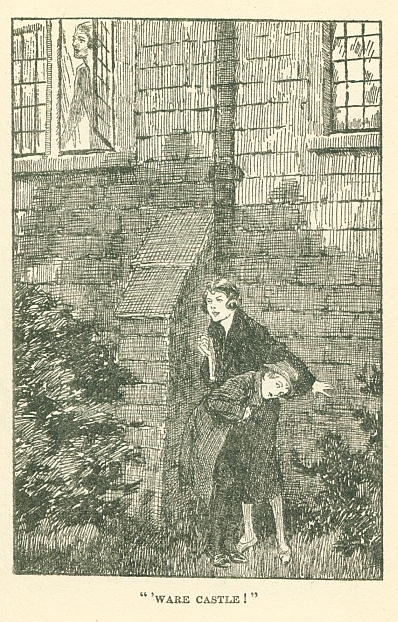
"'Ware Castle!" Sally returned, and they flattened themselves against the wall in the shadows, as they heard a voice from above call sharply,
"Who's there?"
"'WARE CASTLE!"
Again the question was repeated, and as if in response two cats emerged from a bush and fled across the grass, one of them miawing loudly.
This seemed to satisfy Miss Castle, for she partially closed her window, and they heard the curtain drawn across. Keeping to the shadows, they crept along the flower beds till they turned the corner of the house, and came out on the grass of the tennis lawns, from whence they made their way into the shrubberies. No word was said until they had climbed into the tree, with branches overhanging the wall, that Sally knew from her previous adventure.
"I'd better leave my things here, hadn't I?" she whispered. "It's frightfully warm, and my overcoat is a school one"; but the elder girl, without answering beyond a nod of agreement, was already scrambling down the rough stonework, with the aid of a rope she had pulled out of the trunk and hung over a strong branch.
Sally followed her as quickly as she could, but with her shorter legs the drop was not so easy to manage, and Trina was walking rapidly down the road by the time she reached the ground.
"Are you going at that pace all the way to Parchester?" she panted, as she caught her up. "Anyhow, it's no good—we shan't be there before midnight."
"No, silly! The Fair is on the heath, on this side of the town, and anyhow, I have ordered a car at the Black Cull."
There was something very impressive to Sally's ears in the carelessness of her companion's tone, and as she undid her coat in the warm night air, and it fell back, revealing a pretty silk dress, the younger girl gave a gasp of admiration and distress.
"Why, you are most frightfully smart," she said. "I don't know whatever you will think of me."
"Good Golliwogs!"
Trina had turned her round towards the moon, and was staring at her, her own face in the shadows, so that Sally could not tell what she felt.
"You told me to disguise myself," she said half defiantly, expecting anger or scorn—anything but her companion's sudden outburst of laughter.
"My good child! Well, you have cut the painter—you are done for now with Old Cocaine."
"Lost by a narrow shave, instead of escaped by it," said Sally, greatly relieved. "Anyhow, no one at the Fair could possibly recognise me, could they?"
"I should say your own mother wouldn't—when you are returned to her, to-morrow."
Sally's rising spirits received a dash of cold water at the rejoinder. In a flash she suddenly remembered how Mrs. Brendan had begged her not to get expelled, and how she had promised she would try to stop at school. Standing outside the private door of the Black Bull, while Trina Morrison hammered with the knocker, she shuffled her feet uncomfortably, and tried to put out of her mind her mother's eyes, and her consciousness of the furious superior glance that Cecilia would give her, when she turned up once more like a bad penny. After all, she decided, there was no need for them to be caught. Peter had done this kind of thing before, quite safely, and cutting off one's hair was not an unpardonable crime, taken by itself.
"Oh, shut up shuffling, do," she heard the elder girl say. "I want to listen. They are all asleep, or I shall have to go to the public bar, and find someone. It's perfectly disgusting."
At this moment the door flew open, and a man with a red face appeared. He was in his shirt sleeves, with a coat over his arm, which he began to put on while he spoke—leering at them with a disagreeably familiar smile.
"All right, Missie. I booked the order true enough, but I tell you straight I don't fancy it. Thinking it over, after the young gentleman had bin here, I says to myself, 'It will as good as get me sacked, it will, if I'm found out—and that's not exactly a cheering sort of notion for a poor man.'"
"My cousin arranged with you to drive me to the opening of the Fair for ten shillings—an order is an order, isn't it?"
"That's what he said, Miss, and I'm never one to overcharge, especially a young lady like yourself; but it's so risky, I don't see as how I can, for the money. 'Don't you have nothing to do with it,' says my wife, 'or that there female up at the school-house will get you sacked.'"
"Nonsense!" said Trina angrily. "Why, it is ridiculous to talk of 'sacking.' How could Miss Cockran do it? She has never employed your cars for years—said you were impudent, or something—so you won't even lose her custom."
The man's smile was not so affable now, and there was an angry glint in his eyes, though his tone was still oily.
"You seem to know the ways of my business better than I do, Missie—leastways, it's the first I've ever heard of being impudent—but just you think of this now; I ain't out skylarking like you and that young boy, if he belongs to your party, but earning of my living—and I don't take no risks."
"How much do you want, and are you prepared to start at once? I must be there by 10.15."
Trina looked impatiently at her wrist-watch in the moonlight, and the man continued to smile, but with his hand half over his mouth, as though to conceal what was almost a grin.
"Not to disappoint a young lady, Missie, I'd go at—say, thirty shillings, I would."
They fixed it finally at a pound—Trina stamping angrily on the step as she concluded, saying:
"Well, be quick, can't you? I don't want to waste the whole evening."
He vanished, and as her glance fell on Sally, she frowned—no longer amused by her companion's ragamuffin appearance.
"Why, you look worse and worse," she said petulantly. "You ought to be picking up pennies on a London kerb."
"I shall do all right for a Fair, then, shan't I?"
"Yes—but not for a dance—and that's what I'm really going to."
"Well, I'm not. I expect I'll trot back, after I have had enough of the Fair. I said I probably should, so you needn't worry."
Sally saw the elder girl was ashamed of her, and felt hot and angry—especially at the look of relief with which her suggestion was received.
"I daresay that would be best. You'll be able to get up the wall by the rope, and the rest is quite easy."
At this moment the car rattled into view. It was very dusty and smelly, and took a great deal of winding up before it consented to crawl away along the road towards the heath. By the time it arrived, Trina, who glanced at her wrist-watch whenever a patch of moonlight allowed, was in a state of exasperated nerves with both driver and car, while Sally was secretly wishing herself back in bed.
This was not at all the joyous adventure she had imagined as she lay waiting for the clock to strike.
CHAPTER THE TWELFTH SALLY AT THE FAIR
The taxi pulled up on the outskirts of a large crowd, chiefly composed of men and boys. Sally, as she put her head out of the window, could see their dark figures outlined against a row of flaring lights.
The Fair was held in a field, surrounded on three sides by a thick hedge, on the other, by a canvas wall, eight or nine feet high. From inside rose the droning jangle of merry-go-rounds and the raucous voices of showmen and hawkers.
"Walk up, ladies! Walk up, gentlemen! Don't miss the most celebrated moving picture of the age," etc., etc.
Entranced by the interest of the scene before her, the girl stood as she had alighted from the car, and did not even notice it drive off, nor that her companion, after calling to her sharply, had moved away alone. When the jerk of someone's elbow in her ribs woke her at last from her dream of contemplation, it was to find herself engulfed in a group of Parchester rowdies, who were fighting their way towards the turnstile. Here, a negro with a red nose, and spots of white paint on his cheeks and forehead, stood beating a drum.
Nearly swept off her feet, Sally was thankful when she arrived inside; but her heart sank, as she saw no sign of Trina Morrison, who, she had fully imagined, would be waiting for her there.
"She knows I can take care of myself—and, of course, I can."
This was the first explanation she offered herself, cleverly turning neglect into a compliment; but it did not completely satisfy her judgment all the same. Rather a voice in another part of her brain kept whispering:
"It was beastly of her not to wait—I shall tell her so." But when, after a few minutes' desultory staring at the booths, she came upon Trina and her friends, she did not do so. Instead, she hung back in the shadow of a tent, overcome by shame as she realised the contrast between herself and this group of civilised merry-makers.
Girls in evening dresses, with light cloaks trimmed with fur; young men in black suits, with starched white shirt-fronts, and shining hair plastered across their foreheads—such were Trina's friends: while she, shock-headed and freckled, in her rough jersey, gym. knickers and torn stockings, belonged obviously to the little group of ragamuffin boys who were trying to insert their heads under the flaps of tents, or secure a ride on the merry-go-rounds for nothing.
At school, Sally had thought her costume a joke. Peter had laughed at it too, when she first saw her in the road, though later, when waiting outside the Black Bull, she had frowned—Peter's moods were dreadfully uncertain. It would be horrible if she, Sally, were to step out and join the group, and then her friend were merely to stare at her, and say something uncomfortable in her cool drawl, that would make them all laugh.
"Stuck-up toads! I hate the lot of them!" the girl muttered, clenching her fists as she watched them throwing Houp-la rings. It seemed to her that Austin, as he handed the rings to his cousin, was staring beyond her mockingly, recognising the unwanted guest, but determined to cut such a disreputable-looking waif, at all costs.
In reality, Sally knew that he could not possibly distinguish her, at the distance she stood, from amongst the boys who leaped and screamed around her, in and out of the shadows made by the tents and booths; but the true soreness lay in the thought that Peter had probably forgotten to mention her at all, so that none of her companions was prepared either to welcome or to scorn her.
"I don't care—not a scrap!"
With the shrug of her shoulders that had often exasperated Mrs. Musgrave as the answer to a snub, Sally strolled away from the Houp-la. It was a silly game, she decided, that only won for the successful hideous china vases and trumpery brooches; she would go, instead, to a moving picture show.
The flaring lights on the platform outside one large tent showed parties of Japanese contortionists, black cats, and men struggling in mines, while a hideous bat, of monster size, flapped over their heads.
Sally was so thrilled by the bat that, for the moment, she forgot Trina, and even the school. It was fun to be a boy out on an adventure, and to wriggle her way through the crowd, with exasperated women tapping her on the head for her impudence, and old men abusing her as she trod on their toes. It was not such fun, however, when, nearing the entrance, she became wedged, just below the platform, between a very stout woman and a bony soldier, who dug his elbows almost into the back of her neck.
The soldier's companion had a blue and yellow tickler, and thought it a great joke that the little crop-headed boy in front objected to having his face washed with it, and lost his temper when she persisted.
"Shut up!" said Sally fiercely.
To which the woman replied with a cheerful wink at her neighbours:
"None of your lip, Charlie, my boy, or my pal there will fetch you one on the mug—see if he don't."
"S'truth I will," said the soldier, with an air of great ferocity. "I'll spoil your beauty for you—there's not a few noses as I've laid flat with their faces, in my time."
And he dug with his elbows so sharply into Sally's neck that she became alarmed. After this, she endured the tickler in silence until they reached the foot of the steps up to the platform. It was as she struggled up there towards the tent doorway, past the man with the drum, that she discovered she had no money: someone in the crowd had picked her pocket.
"Pocket picked, you young varmint? You mean you'd like to wriggle in for nothing—I know your kind," said the man at the door, scowling, as a wave of people threw Sally almost on top of him, and he rose and thrust her roughly back.
Had not a clown, who had been turning somersaults on the platform to the accompaniment of the drum, caught her arm and pulled her into safety beside him, she would have fallen backwards down the steps, and probably have been trodden underfoot by those still fighting their way up.
The very thought made Sally feel sick, but it evidently struck the clown as a good joke, for he asked her loudly if she knew what happened to the grasshopper who chose to cross the road in front of a steam engine.
"It's not my fault—let me go," she said angrily. "I'm off home."
The clown, instead, picked her up and swung her to and fro in the air while he executed a clog dance.
"By, Baby Bunting," he chanted, while the man with the drum, and the Columbine, who stood on either side of him, laughed at this unrehearsed exhibition till the tears ran down their faces.
The humiliation was dreadful. Sally could not imagine how she would ever survive it if Trina and her party were to recognise her in such a position; but when at last the stream of people entering the tent had ceased, she was thankful, as she tore herself from the clown's grasp, that there was at least no sign of them.
Her one desire now was to get back to the school as quickly as she could. Keeping to the shadows, she made her way to the entrance, and with a sigh of relief found herself in a few minutes on the patch of heath outside.
Here, as she paused, uncertain in the darkness which way to turn, she was startled by a yelp of pain, and a puppy came running towards her. It was a mongrel, mainly rough-haired terrier, with ridiculously long ears and a tufted tail. One of the ears was bloodstained, and the tail had a can tied to it, filled with stones.
"You poor little thing," said Sally, who loved animals; and she drew it close, while she bent down and began to untie the string.
"Garn!—leave it alone, can't yer? We are going a-hunting with it"—broke in an angry voice, and a big lad of fifteen, followed by a lot of smaller boys, crowded round her threateningly.
Sally finished untying the string, and looked up. She was trembling nearly as much as the dog, but she said quietly:
"No—you shan't do it any more. He is only a puppy—how can you be so cruel?"
"Quite the little gentleman," sneered one of them, in mock admiration of Sally's voice; while a boy about her own age came up to her, and, doubling his fists, brought one nearly under her nose.
"Cruel! What d' yer mean? 'e's my pup. Can't I drown 'im or tease 'im, if I likes?"
The others laughed and jeered, as, involuntarily, the girl drew back. There were shouts of:
"Go it, Stan!—You're the bruiser. Give the little cad a black eye."
Sally went very pale. She had boxed a little with her brothers, but this was quite a different proposition.
"Let him go, please," she faltered. "He is so frightened."
"Scared as you," retorted Stan briefly. "I'll tie the can on to you as well as 'im, if you don't clear off." And he bent to seize the puppy by its rope collar.
Sally could feel the terrier tremble against her legs, and as she heard it yelp in sudden pain, her fear vanished, and only burning anger remained. Leaning across the dog, she hit Stan hard on his nose, sending him reeling backwards in surprise.
"Take that, you cowardly brute," she said.
In an instant a ring was formed, and Sally found she had partisans as well as enemies. There was an encouraging shout of "Go it, Carrots!" as she warded off a slashing blow from Stan and landed one herself on his jaw; but this was the utmost of her triumph. What the girl knew of boxing was not enough to defend her from a windmill attack of arms and legs that admitted kicking and stamping amongst its tactics.
But for the timely appearance of a policeman, attracted from the gateway by the noise, she would have fared badly indeed. As it was, when the rest had fled, and he laid his hand on her shoulder, one eye was already closed, while she stood trying to stem with bleeding knuckles the tears that flowed from the other.
"Silly young hass, to start fighting at your age," said the policeman reprovingly, but with good-natured sympathy.
"'Ome you go now, sonny, and tell your ma to put raw beef on it. That's the stuff."
"The puppy?" gasped Sally, between her tears. "I tried to save him—the brutes were hurting him."
"There weren't no sign of a puppy as I came up, so I guess he legged it all right," said the man, glancing at her curiously; then:
"Where's your 'ome, sonny?"
Sally's voice was strangely unlike that of the other urchins, whose pranks had made his evening duty at the Fair a burden; and a suspicion began to dawn that she might belong to a preparatory school in Parchester. This was more than confirmed, when "sonny," twisting out of his grasp, made off without returning any answer.
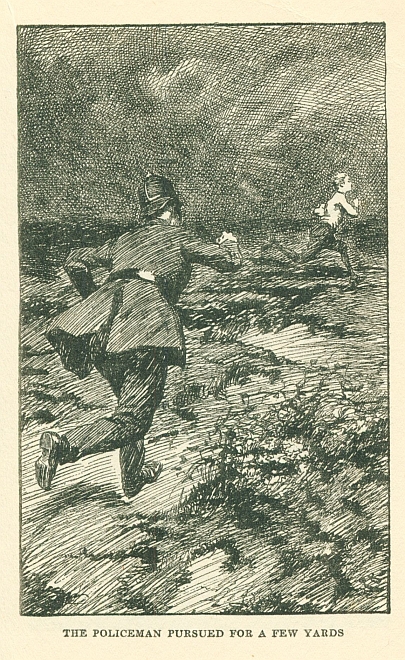
The policeman pursued for a few yards, but he was "fat and scant of breath," the heath had numberless gorse bushes to act as cover and the night was very dark.
THE POLICEMAN PURSUED FOR A FEW YARDS
"Drat the young brute!" he muttered at last, and stalked back towards the entrance of the Fair, with an air of dignified contempt, as though the quarry he had pursued was quite beneath his notice.
In the meantime "the young brute," bleeding from her eye and knuckles, lay and panted between two bushes, stifling her sobs as well as she could, until she was sure that the search after her had ceased. Ignominious as it must be in any case to return to Seascape House a figure of dirt and fun, it would have been beyond all words of horror to arrive in charge of a policeman. Cecilia had prophesied that her career would end in a reformatory; and Sally had a secret dread that this might indeed be her fate if once the police began to take an interest in her adventures.
For the moment, as the constable's broad back disappeared into the darkness, this immediate danger was removed; and Sally wept unrestrainedly, almost as much with relief as with pain.
Her head ached and her body felt a mass of bruises, but at least she was free, and had, as her brothers would have called it, "kept her end up," in the matter of the puppy. Their approving eyes seemed to rest upon her as at last she stifled her sobs and, pulling herself stiffly to her feet, began to look around her.
The moon was behind the clouds, and in both directions the road lay like a white ribbon, cutting the darkness of the heath, save where the flaring gas-jets of the Fair flamed across it in a yellow patch. As she peered one way she saw a halo of light edging the horizon, and knew that this was Parchester and that she must turn her back on it to reach Seascape House.
Utter blackness, but for the ribbon of road, lay the other way, and with a little shiver at the prospect, Sally, skirting the furze bushes and digging her hands deep into her pockets, began to run across the heath parallel with the road along which she and Trina had so lately driven.
CHAPTER THE THIRTEENTH "JUST SILLINESS"
The road across the heath, when Sally joined it, lay white and clear for about half-a-mile; then scattered firs—wind-blown and bitten—began to appear, and after these a series of pine plantations that as the moon peeped from behind clouds threw their shadows across the sky like the vaulting in some great church.
So far, since she left the neighbourhood of the Fair, the girl had met no one save a solitary car that passed her with blinding lights; but it seemed to her that the wood was alive with strange night birds that brushed the branches above her head, or beasts that ran scurrying through the undergrowth. It was this feeling of being watched, while she could not see, that kept her, in spite of her bruises, running at almost breathless speed; but, exhausted at last, she sank down on a bank beside a ditch, where the road lay open and clear between two clumps of pines.
At once she became conscious of how much her eye had swollen, and putting her poor bruised hands together over it, she sat huddled up, with her elbows resting on her knees. How long she remained there she did not know; but suddenly she rose to her feet and screamed—something had touched her, something soft and wet.
She looked down, and saw it was the mongrel dog, to whose rescue she had come at the Fair. Now, almost as frightened as she had been, he crouched at her feet, slowly wagging his tufted tail, and begging with abject eyes that she would not kick him or send him away. He had lovely brown eyes (mongrels often have) and Sally, forgetting her own hurts, drew him up into her arms, and began to kiss him, while he responded with frantic licks and little whines of satisfaction.
"I love you, puppy, I love you," she whispered, and became indifferent to the loneliness of her surroundings. With what was almost a swagger she put him down at last, and continued her homeward road—this time at a pleasant stroll. She even found courage to laugh at the predicament in which she had landed herself—made worse as it was by this new witness to her naughtiness.
"Friend pup," she said, as he ran joyously beside her, leaping occasionally to lick her hand—"Friend pup, I very much fear that I am in the soup, and you will put the lid on that soup. Never mind, life is no longer dull, and we shall make a fine exit from Seascape House together."
This boast brought her thoughts back with a jerk to Trina Morrison and her friends. How long had she herself lain among the gorse bushes? Perhaps the dance was over, and Austin having already dropped his cousin at the school wall, she was safe in her bed.
If so, would she think of Sally and wonder what had become of her and whether she had also returned in safety?
It was a difficult question to answer, and the girl shuffled over facing it. In her heart, she knew it was quite possible Peter would continue to forget her if it was inconvenient to remember; but she pushed that thought away with a sop to her vanity.
"Anyhow, she knew I was the kind of person who could take care of myself; besides, she warned me of all the risks, so it's not her fault, whatever may happen to me."
This seemed the best conclusion of the matter. If you are faintly conscious that your idol's feet are clay, it is best to leave them decently covered; so Sally gave up speculating about Trina, and began to wonder instead, as she drew near Seascape House, how she should make her entrance, and explain either her own appearance, or the dog. She did not look forward to a cross-examination on how she had spent the evening, by Old Cocaine.
Turning down the lane, she stood for a few minutes gazing irresolutely at the high wall, under the hanging tree. There was the rope that would help her up—within reach, if she jumped—but she knew that her bruises would not let her do this, even if she could solve the problem of how afterwards to lift up the dog.
No, she must turn back, and enter boldly by the front avenue, as though that were the way by which she had left; and thus, when stopped (as she surely would be, and questioned), she would not be in danger of betraying Trina's secret.
This decision made, she called to the puppy, and returned once more to the high road, where a few yards' further walking revealed a new obstacle. The gates were locked, and their iron spikes rose mockingly above her, as she gazed through the bars at the drive.
"I suppose it will be a case of waking 'Ma Jakes' at the lodge," she muttered; but at this minute the puppy, who quite realised his new mistress's desire to enter the forbidden garden, discovered a way in for himself by a ditch at the side of the raised drive. That it was not a large enough opening for Sally, he, however, failed to grasp, and began to whine and bark encouragingly from the other side, only raising his voice a little louder when she whispered to him to be quiet.
"That settles it," said the girl, and with a sudden impulse not to be caught begging for an entrance, began to climb the iron-work; but the exertion was so great that by the time she had pulled herself over the spikes, the sweat was running down her face. Trembling all over at the strain, she rested before she began the descent, and suddenly heard the dog growl.
As she looked over her shoulder, she saw a light approaching down the drive.
With a little cry of panic, she hastened her movements, caught her foot between the bars, released it, and then fell to the ground, doubling it beneath her. The pain this time was far worse than her swollen eye, or any of her bruises; and as the puppy ran to lick her face, she pushed him away—moaning a little.
"Who are you? What are you doing here? Why—it is a boy and a dog."
Sally opened the eye that was not swollen, and saw by the light of an electric torch, Miss Castle, her Form mistress, bending over her. In a flash she remembered the open window as they climbed down from the roof, and a voice calling out to them. It was evident they had aroused Miss Castle's suspicions, and that at the sound of a dog barking she had come out to see what was wrong.
"Oh, I'm so glad it is you," the girl whispered. "You won't be angry with the puppy, will you? It is not his fault."
The other stared at her, at first blankly amazed, and then with dawning surprise and horror.
"Sally!" she said. "Sally Brendan?" And then—"Oh, my poor child, what has happened to you?"
"My foot ... the pain...."
Sally tried to move as she spoke, and fainted. When she was able to realise her surroundings again, she was lying on two chairs in the lodge kitchen; and "Ma Jakes," a fat woman with her hair in curlers, was trying to blow the embers into a blaze. Miss Castle was writing a note at the table.
"Take this to the sanatorium at once," she said as she finished to a man in the doorway, who, Sally knew, must be Jakes, the gardener—only he looked so odd in a shabby dressing-gown, with the legs of his pyjamas falling over his boots, and his matted hair standing wildly on end.
"Where is the puppy?" asked Sally, as Miss Castle came towards her, and at this minute he made his presence known by a yelp, as he retreated under the table before a large angry cat.
"Eating the poor thing's supper, 'e was," said Mrs. Jakes resentfully; "'e ought to be drowned, 'e ought."
She was angry at being dragged out of her bed, "because," so she put it to herself, "of the mischieviousness of one of them dratted noosances of girls."
"It's just—he's so terribly hungry," said Sally. And her voice trembled because her foot hurt her so much, and her swollen eye nearly as badly.
"I ... fought a boy to save him from being hurt, and I don't want him scolded or drowned."
She looked entreatingly at Miss Castle, who seemed to understand, for she drew the dog over and patted him gently.
"All right, Sally—he shan't be hurt, and I will get him some food myself. Don't try to talk any more, child."
She slipped her arm behind the cushion on which the girl's head was resting and raised her a little. Sally lay quite still, and gazed at the tin canister on the mantel-piece in which Mrs. Jakes kept her tea. She found herself concentrating on its shininess, and wondering how it had got its two dents, because she knew she must think of something, or the pain would become unendurable, and she would cry like a baby. It was no use at all to consider explanations or what it was best to say to Miss Cockran, for her head was altogether too stupid to form a connected story.
When at last she did see the Headmistress, it was only for a minute, in what afterwards seemed a kind of dream, with a white-capped nurse standing in the background.
Sally found herself saying, "I'm sorry," as she met the searching grey eyes, and though they did not smile they were quite kind as they gazed down at her.
"That's right. I am glad you are sorry," Miss Cockran said. "But I don't want you to talk now, just to try to sleep. Later on you shall tell me everything."
She was turning away when Sally clutched at her arm.
"Miss Cockran," she said; "Please ... the puppy ... he is such a darling, and it's not his fault—you will be kind to him?"
This time the Headmistress smiled.
"He has just had a large bowl of bread and milk, and Miss Castle and Nurse Baker are putting some ointment on his ear. He is quite happy; so lie quiet, child, and don't worry any more about him."
Sally tried to lie quiet, but her foot was very painful, and her whole body ached. Even when she fell asleep she did not seem able to forget the pain; but woke up in a panic, dreaming that boys were pelting her with stones.
"You have had a slight touch of fever, but you will be all right now, if you are good," the white-capped nurse told her some days later, but when Sally demanded leave to get up she shook her head.
"Why, you will have to keep that sprained ankle of yours up for some time—there's a nasty swelling."
Sally had very rarely been "laid up." On the few occasions when it did occur, the whole of her family had combined to amuse her and keep her quiet; because her mother said it would be bad to allow her to become over-excited. Even so, she had been peevish and not particularly grateful.
Now, convalescence took on a very different note. For some days Sally saw no one but the Matron of the sanatorium, her nurse, and the old doctor who came to look at her ankle. Occasionally she could hear the voices of those recovering from measles; but they were in another passage, and all communication with them was forbidden. Sally did not even know if they were aware of her presence in the building.
It was obvious that she was in disgrace—"a leper"—as she told herself bitterly, turning the pages of some magazines, which, with some Patience cards, were almost her sole means of passing the time. Occasionally Matron read to her; but her choice of books bored the girl, and she refused to be drawn on to school topics.
"Miss Cockran will tell you anything she wishes, when she has time to see you," was her final answer to Sally's frequent entreaties, and the girl's heart sank.
Left to herself, she lay and brooded over Trina Morrison's remark that, were they to run away and be caught, they would not be allowed to provide the school with even a few minutes' peep-show.
"I suppose it means expulsion," she told herself—and longed to know if Peter had escaped detection. It was maddening to think that when she did see Miss Cockran she could not inquire after her for fear of arousing suspicion.
It was a very sulky girl, outwardly calm, but really a good deal shaken, who faced her interview with the Headmistress. The account she gave of her adventures was of the barest.
"I heard there was a Fair—and I wanted to go. So I got out of the house and went: and as I was coming away, some boys were illtreating the puppy—and afterwards he followed me."
"Haven't you missed out that you fought the boys?" asked Miss Cockran quietly.
Sally flushed. Something had kept her from her usual boasting: indeed, when she remembered the fight, her feeling was rather of shame than pride.
"I put up a simply rotten show," she muttered.
"You fought pluckily, at any rate—and in a good cause. I am proud of that."
The girl found the tears rising to her eyes at this praise, and her sullenness began to vanish.
"I ... I'm sorry about the rest now—I wasn't before ... but ... it's been horrible at school, and I didn't care——"
"You wanted to be expelled, you mean?"
Sally crumpled the edge of the counterpane between her hot hands.
"I did at one time. I'm not doing any good here that I can see."
"You have a good form record—top every week, I think. On the other hand, I hear you are untidy in the dormitory, and often rude to Matron, and Decima Pillditch."
There was no answer for some minutes, and then the girl said:
"I like the class work—it's interesting—I could do stiffer stuff."
"I know. You would have been moved up next term."
Sally's heart sank at that "would have been."
"Are you going to expel me?" she demanded suddenly.
Miss Cockran had been sitting very still on her chair beside the bed; but now she rose, and after looking down at the girl with her clear grey eyes for a few seconds, turned and paced the room.
"I don't know, Sally," she said, stopping at last. "Frankly, I can't decide. I hate expelling girls. It means such a stain on their career for always, and you are so young to start with that. Yet what you have done is quite impossible, and fully deserves the worst punishment school life knows."
Sally had begun to grow sulky again, and almost involuntarily her usual formula of disdain sprang to her lips:
"I don't care——"
The Headmistress had walked to the window, and was looking out, but she wheeled sharply as she caught the words.
"Do you mean it, child? If so, there is, of course, nothing more to be said—you will leave directly your foot is well enough, and not come back here. But have you thought what expulsion stands for?"
"I've only been here one term, and..."
"Yes—one term—and that will be the end of your school life, at any rate, in England, I fear. Other schools will not be anxious to take you. Is it because you preferred home work so much, and living with your family, that you have done this reckless thing?"
There was so much real anxiety in Miss Cockran's voice as she asked the question, and her eyes, though grave, were so kind, that Sally felt the last of her outposts of defiance break down. At the same moment, she caught a vision of the schoolroom at home, and the boredom of lessons alone there, for all the years, until she grew up.
"It wasn't true, what I said just now," she burst out suddenly. "I do care—the other girls are hateful to me, and I'm very unpopular; but I like the work and the games, when I'm given a chance at them. I'd like to get a scholarship, and go on to College—Oxford—I know I could do it."
Miss Cockran nodded as if she understood.
"Then why ... why this mad escapade?" she said at last; "I don't understand."
Sally flushed a deep red. It seemed as if Trina Morrison's share in the adventure was not known, and she, at least, had come back all right, undetected. Her spirits rose at the thought.
"It was just ... just silliness——" she said at last. "I do mad things sometimes."
"Ah," said the Headmistress, "just silliness, ... and it might have wrecked your life. If I had thought it deliberate naughtiness, and not, well—just silliness—I would have had no hesitation in thinking it my duty to expel you. A school cannot be run without discipline, any more than a ship."
Sally shifted her bad foot uncomfortably. She hated apologies, and usually skimmed over them as airily as possible; but something told her that nothing but complete submission would be of any use on this occasion. With a great effort, she forced herself to look Miss Cockran in the face as she spoke.
"I ... I'm really sorry, and would like to stay, if you'll have me—and I'll try to keep straight—keep the rules, I mean—in future. And ... and I don't think it will do the discipline any harm if I stop, because everyone hates me so much that I couldn't have persuaded them to go to the Fair with me, even if I had wanted to—I mean, I'm not a bad influence—I'm just no influence at all."
In spite of herself, the Headmistress smiled at the last part of this confession.
"Poor Sally," she said. "There's a lot to learn at school besides lessons, isn't there?"
"No one gives me a chance ... they all hate me ... and——"
Miss Cockran put up her hand.
"Hush, Sally—think very carefully before you speak when you begin to say anything like that. Just remember this—that I am going to give you a chance now—suppose you give the others a chance next term."
She bent, kissed the girl and went quickly from the room.
CHAPTER THE FOURTEENTH AUTOLYCUS
Sally Brendan saw no one belonging to the school during the remainder of her convalescence except Miss Cockran occasionally, and once Miss Castle, who came to tea with her. It was a red-letter afternoon, for Sally had been allowed up for the first time, with a crutch under her arm, to take the weight off her injured foot, and was able to establish herself in a cosy armchair in the window, from which she could command a view of the distant lodge and drive.
Down below, she could see some of the convalescents from measles walking arm in arm, or playing crazy croquet, on a lawn that was all bumps and slopes. The sound of good-natured squabbling, interspersed with many giggles and shouts, rose continuously; but though bored by her own society, the girl made no attempt to follow what was happening, or to attract attention. Rather, she pulled the curtain slightly forward so as to leave herself in the shadow.
A glance had told her that Peter, at any rate, had not found her way to the sanatorium group, and there was no one else in the school in whom she took the faintest interest: besides, when she hobbled across the room, she had passed a looking-glass, and, though vanity formed no part of Sally's conceit, the sight had given her something of a shock.
Her head might speak to a phrenologist in bumps of brains and determination, but to the ordinary observer it was, at the present moment, frankly ugly, with the short hair, that should have crowned it in curls, cut roughly, in odd, shaggy lengths. The injured eye was no longer swollen, but still rainbow-coloured; in fact, as Sally honestly told herself, she was a figure of fun, and when Miss Castle entered the room she looked up anxiously to detect a smile.
The smile was there; but it was friendly—not malicious—and Sally quickly forgot all about her own appearance when she saw the second visitor. For the moment she scarcely recognised the dirty cowering mongrel she had rescued in the well-brushed, rather self-assertive puppy who hurled himself on her knee and began frantically to lick her face.
"Why, he's quite handsome," she said, and Miss Castle laughed.
"I've told them so in the Common Room, but they won't believe me—except Miss Cockran—and she quotes, 'handsome is as handsome does,' because he caught a rat in the cellar last night."
"Oh, did he?—the angel! He is an angel dog, isn't he, Miss Castle?"
"I haven't found his wings yet—I fear he is a thief and a rascal—but he is a very attractive rascal, and has made me take more exercise in the last few days than in all the rest of the term, Sally."
Sally looked up quickly: she was amusing the puppy with the end of her dressing-gown tassel, and as she tried to prevent him from barking she said anxiously:
"Miss Castle, what is going to happen to him? I have not been allowed to get letters, or write home, but I know I can make Mother keep him, if I take him back with me; though if I ask her through the post my sister Cecilia will tell her to say 'No.' You see we have two dogs already."
"I sympathise with Cecilia, three dogs are too many in most houses."
"Well, you see, there are the boys and I who can always exercise them."
"Perhaps—in the holidays—but what about term time?"
Sally looked a little sulky. People always saw Cecilia's point of view: she was so dreadfully reasonable.
"Still, I shall take him home, all the same," she said obstinately. "When you rescue someone like that you can't just shut him out of your life, and forget him, as if he came to you in an ordinary way."
"No—I see that."
Miss Castle was sitting in the window seat and had drawn the puppy down on her knee, with her hand over his nose to make him be quiet.
"What do you say to his stopping here?" she added.
"Oh, Miss Castle! ... What, in school?"
"No, Sally, I don't mean that. Why, if one girl started a pet we should have a menagerie—cats, rabbits, tortoises and monkeys—Oh, Heaven forbid!"
Sally laughed, in spite of her anxiety.
"Well, I don't understand, then. Matron wouldn't have him in the san.: she's much too particular. The other day she told me cats were nasty dirty things that carried infection."
"I expect Miss Cockran would keep him, if you liked to give him to her."
"Miss Cockran?"
Miss Castle threw back her head and laughed at the open-eyed astonishment with which her suggestion was received.
"Oh, Sally, you girls are funny sometimes. Do you think mistresses are a race apart with no ordinary affections and weaknesses?"
The girl got very red.
"No, of course not—at least, I suppose not. You are quite different, at any rate. But Miss Cockran looks ... oh, and Miss Cheeseman, you know ... well, not silly, like us."
As she floundered, trying to find the words she wanted, Miss Castle, bending to kiss the puppy, who lay sprawled across her knee, examined her with twinkling eyes.
"I'm glad I'm silly," she said at last; and then as the girl began to expostulate indignantly that she hadn't meant that, of course, the other stopped her:
"I know what you mean, so don't apologise or explain—just remember it's not always safe to judge people by their appearances—Autolycus, for instance...."
"Auto!—what? Do you mean the puppy?"
"Yes—I have christened him that because he was picked up at a Fair, and there's no doubt he's a rascal—Shakespeare met, or invented, a gentleman of that name who was a pedlar, habitually attending Fairs. Anyhow, we'll call him 'Tolly' for short, except at School Commemoration."
"And Miss Cockran says he may stay here?"
"Yes—she is even prepared to adopt him, if you will pass on the ownership. You see, about a year ago she had a Yorkshire terrier, 'Gyp,' whom she loved very much, and he was lost down a rabbit burrow. She says she never meant to have another dog, because she suffered so much when 'Gyp' disappeared; but 'Tolly' seems to have been sent to her, and he's very fond of her already."
"How splendid!"
"Yes—we are all fond of him. Even Miss Cheeseman will be converted to him in time, I hope, though she doesn't really care about animals."
"She wouldn't," muttered Sally, who disliked the thin, dark, rather precise little mistress, who was second in command at Seascape House, and took her Form in English Composition.
Miss Castle appeared not to hear this remark, unless the slight puckering of her brows showed she was displeased at it.
"I'm going to take Tolly away now," she said, "or he will begin to eat the cushions; but I will come back for some tea in about half-an-hour."
"Oh, thank you, Miss Castle—it's awfully decent of you."
They had a very jolly tea, and discussed everything except Seascape House: such topics as County Cricket, Napoleon's character, haunted houses, and even how to make stick-jaw toffee.
"I think I'll have a toffee party next term," said Miss Castle as she rose to go; "and you shall come and be kitchen-maid."
"May I be taster-in-chief as well, please?"
"Ah, I don't know about that. There will be so much competition for the office, I shall have to hold an examination, I expect, and charge an entrance fee."
She bent and kissed Sally as she spoke, and stood looking down at her for a minute, before she went.
"You will try to make friends here next term, won't you, child? It's the great thing that comes out of school life, I always think."
"But I have friends here," said the girl; "one at least and she is splendid."
After Miss Castle had gone she pulled out a pencil and block from under her pillow, and went on with the long letter she had been writing to Trina Morrison ever since her eye had been well enough to let her look continuously at the paper.
She intended to post this as soon as she had left Seascape House; not before—since she was afraid of drawing attention to any connection between herself and the elder girl which might involve the latter in her disgrace. To some nine or ten pages written earlier in the week she now added five or six more in praise of Miss Castle, and, more doubtfully, of Miss Cockran.
Peter had not admired Old Cocaine. She said she was stuffy and inhuman, like a mummy in the British Museum, that had dried up years ago, and ought to be kept on a shelf.
"But you see she is human, after all," wrote Sally, as she told about the Yorkshire terrier and the adoption of Autolycus.
In the end, the letter was so long that Sally had to ask Matron for a large envelope, pretending that she wanted it to hold part of a story that she was writing; and when she had got this, she addressed it to Trina at her uncle's house, with "Please Forward" in the corner.
It was very nearly holiday time now, and all who had had measles before, and seemed in no danger of getting it again, were sent home early, along with the convalescents.
Seascape House became quieter and quieter, save for the barking of Autolycus, who nearly wore himself out chasing sea-gulls, or hunting wildly for rabbits, amongst the furze bushes along the top of the cliff. He had to be washed twice a week by the indignant Jakes, who pretended that he would like to put a rope round his neck, attached to a big boulder, and sink him in the sea.
"He won't be allowed to do it, will he?" said Sally anxiously to Miss Cockran, when she went to say good-bye, just before starting for home.
"Certainly not! Autolycus is the school watch-dog. I am going to trust him to see no one comes in or out after dark."
Was there a twinkle in the grey eyes? Sally was not sure, and felt uncomfortable under their scrutiny.
"Good-bye," she said gruffly. "And ... and I'm sorry, you know, about it all——"
"That's all right. We start fresh next term, child— Don't think of what's behind you, but of what's in front. And for goodness' sake, don't go and play tennis on that foot of yours, or do anything foolish for the next six weeks."
She shook hands briskly, and Sally hobbled out to the taxi in which Matron was taking her to the station. Her first term at Seascape House was over.
CHAPTER THE FIFTEENTH WILL SHE COME?
"Sally has improved in many ways—and I don't think, Cecilia, you are being quite fair to her when you complain she is so troublesome."
Mrs. Brendan spoke plaintively. Like many another mother, she wished her daughters agreed better, but did not know how to make them do so. During the term, Cecilia had been sweet-tempered and apparently happy; now, since Sally's return, she was continually ruffled and even snappy—so that the atmosphere of the house had become quite tense.
"There is nothing much to choose between Sally and the boys," went on their mother. "They all expect to do exactly what they like, in the holidays," and she sighed for the selfishness of youth.
"Oh, the boys!" broke in Cecilia impatiently; "that's quite different."
She did not explain, perhaps she did not realise, that the difference lay in her own attitude towards them. She had long ago ceased to try to control her brothers, but Sally's case was another matter. Cecilia felt she should behave at home like a junior at school in the presence of a senior, and if Seascape House could not teach her this elementary piece of manners in the course of a term it had certainly failed in its task.
"I expect the school is not what it used to be when I was there," she continued, jumping from the subject of the boys to what was chiefly occupying her mind, and heedless of the fact that schools, like newspapers, never are what they used to be.
"Why, in my time, no kid of Sally's age would think of cheeking an elder girl, or of speaking to her in the way she does to me."
"You continually find fault with her, Cecilia."
"It would be continuous, if I were to point out even half her sins. That foot of hers, she was told to rest—what care does she take of it? Miss Cockran ordered her to avoid tennis, and all she says is, 'Well, I am doing that,' and then goes and rushes madly round at 'Bumble-Puppy' with Roger."
"She is very fond of Roger."
"She is even fonder of herself, little wretch! ... I suppose she had a shocking report? We have never heard exactly what she did to twist her ankle; but it was over some piece of mischief."
"It was not a very good report, I fear, except for her work—but Miss Cockran says she has promised to do better next term, and that other mistress she likes—Miss Castle—writes that her behaviour was good in form."
Cecilia snorted. "It's my belief, from what she has let drop, that she was very nearly expelled."
At this moment Roger appeared with rather an anxious expression on his round and usually cheerful face.