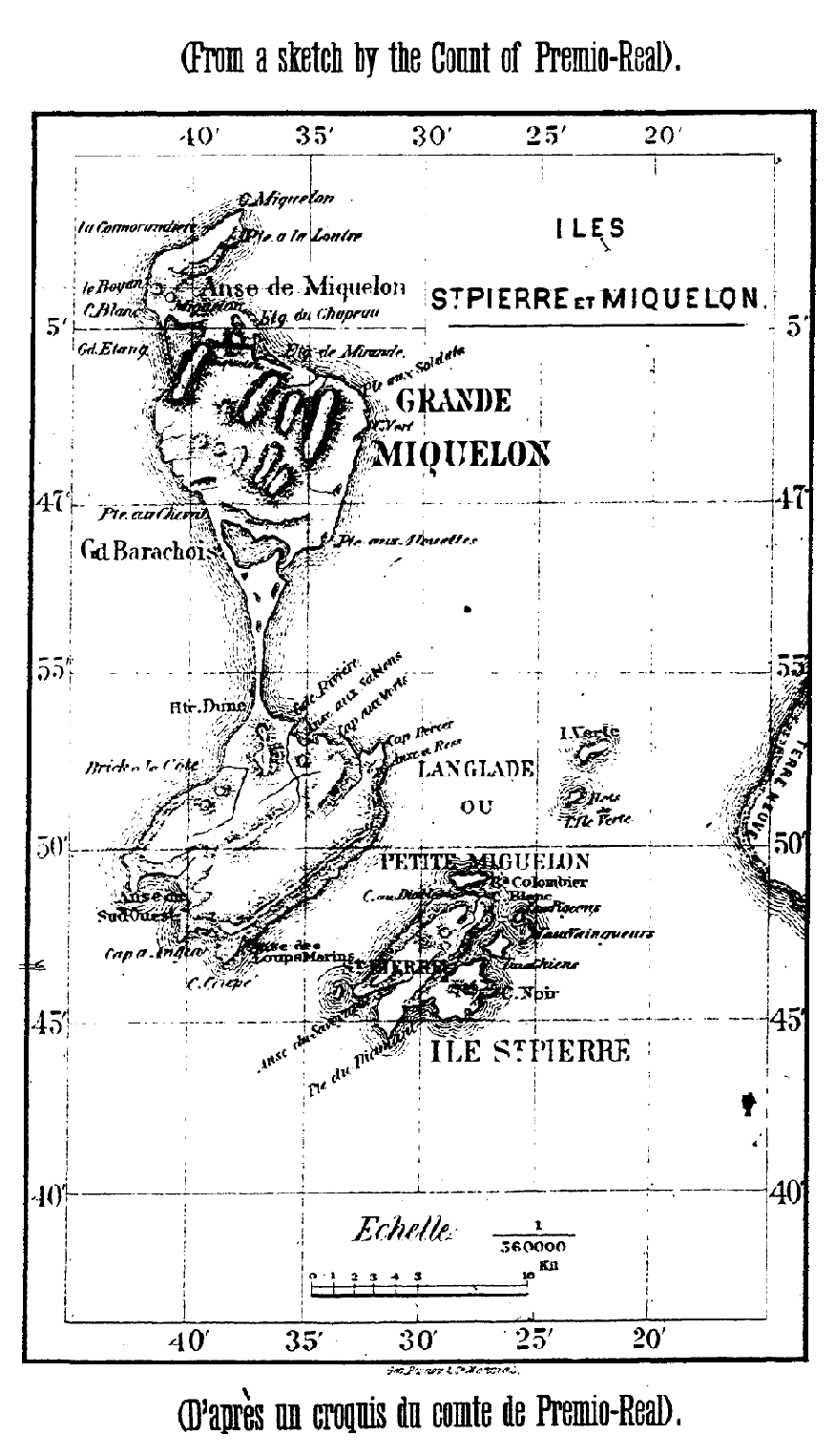
THE ISLANDS OF SAINT-PIERRE AND MIQUELON.
Reading edition
(Notes of a lecture given at the Institut Canadien, before the Quebec Geographical Society on the 29th April, 1880, by His Excellency the Count of Premio-Real, Consul General for Spain.)
Translated by Crawford Lindsay, chief English Translator, Legislative Assembly, Quebec.
How many persons in Europe and in America, even amongst those who lay claim to a certain amount of knowledge, are ignorant of the very names of those little islands, lost to sight on the coast of New-Foundland, that colossus of which they are the humble attendants.
How many Frenchmen are there to whom their name is unknown, and in whose minds they give rise but to vague and hardly realized ideas: like unto the distant murmur of ocean waves which barely reaches the ears of those who dwell away from the sea-shore.
And yet these islets are the wreck of an immense empire, which once stretched from the Polar regions to the mouths of the Mississipi, the great Father of Waters. They once formed but an infinitesimal portion of that vast domain, which the sons of St. Louis made fruitful with their labor and hallowed with their blood but which, after having opened up to civilization, they allowed to be taken from them by a vigilant and practical adversary.
These humble rocks under the shadow of the tri-color are inhabited by quite a little world of fishermen rendered hardy by the icy breath of Arctic breezes. This little corner of the world, which, at first sight, would be deemed unfit for habitation is surrounded with inexhaustible natural riches, by shoals of cod and herring, more precious than mines of silver and gold, such as those which endowed a small country, Holland, in the first place with the means of existence, then with wealth and finally, during a certain period of its history, with power.
The flowery style of this introduction should not surprise any one. Before the islands of St. Pierre and Miquelon, have passed all the celebrated navigators who discovered or explored Canada. From their waters France derives an important portion of its food supply. To their ports Spain yearly sends enormous quantities of salt for preserving the precious gifts of the sea. In their waters, during the proper season, hundreds of vessels and fishing-boats and thousands of French fishermen repair for the double purpose of collecting an ever abundant harvest for their country and of training themselves in the arduous duties of a sailor's life.
When we consider all this, what matters it that during one-half of the year their shores are buried in snow or hidden in dense fogs; what matters it that they are beaten by the thundering waves of that terrible Northern Ocean whose green waters, laden with sea-weed and wreckage of every kind, dash upon them and seem, in their wild fury, to desire to wash them off the map of the world?
A livelihood is there provided, not only for the inhabitants, but also for thousands and thousands who live beyond the Atlantic. The sea, that rough foster-mother opens its bosom to all who fear not the never ceasing motion of its waters.
There, are to be found none of those dreadful cases of hardship, those famine-stricken creatures which exist in large centres of population, in the very midst of all the resources of civilization.
The hardy and weather beaten seamen, have never any cause to dread famine. A constantly renewed manna is ever rising from the depths of the sea. It would seem as if God wished to show his power and point out to man the vanity of worldly wealth by causing life and natural riches to teem along these shores which, at first sight, seem devoted but to misery and death.
Notwithstanding the above considerations, the choice of my subject may have surprised you. Not long ago Professor Bell came before you and related his personal experiences, his explorations of a field so vast and grand as Hudson's Bay and its neighborhood, and it seems like an abuse of your good nature to come and speak of three little islands which, from a physical point of view, have no extraordinary interest. But I have a special affection for them, which may perhaps be due to the smallness of their dimensions. Canada, with its unlimited extent, inspires me with a feeling of admiration. But it is easier to concentrate our affection on a smaller object which the mind can embrace without effort. Burke in his celebrated work "On the sublime and beautiful" points out that, as a rule, objects of a grand or terrible nature excite admiration, whilst those which are comparatively small and pleasant, give rise to love.
As I have already stated, the Islands of St. Pierre and Miquelon are all that remain to France of an empire which comprised the present British Possessions in North America and the Valley of the Mississipi or, in other words, one-half of the North American Continent. The fleurs-de-lys had to withdraw successively from New-Foundland in 1713, from Cap Breton and Prince Edward's Island in 1745, from Canada and Nova Scotia in 1763, as well as from the territory to the west of the Mississipi and the British Lion left to the old French monarchy only the right to fish on the coast of New Foundland, with the Islands of St. Pierre and Miquelon.
These islands are situated at the entrance of Fortune Bay which extends to a great depth into the southern coast of New Foundland, near the bank of St. Pierre which is frequented by cod-fish and not far from the Grand Banks of New-Foundland. They are distant 135 miles from Cape Ray and Cape Race, which respectively form the south-western and south-eastern extremities of what the Spaniards call the land of the Bacalaos.
They are 6,470 kilometres from Brest the nearest point in the mother country. According to the French geographer, Onezime Reclus, the Islands of St. Pierre and Miquelon have a superficial area of 21,000 hectares and a resident population of 3,000 inhabitants. That, was 10 or 15 years ago. But, at present, according to the report of my able subordinate in those islands, the population amounts to 5,000 souls. The little archipelago is composed, on the north, of Grande-Miquelon, situate about 47° 4' north latitude and 56° 20' west longitude, on the south, of Petite-Miquelon or Langlade and, to the south-east of the latter, of St. Pierre which is much smaller but has a population three times greater than the two former.
It is hardly necessary to mention a few insignificant islets, which are nothing but bare granite rocks with no vegetation and uninhabited. Since 1783 the Grande and Petite Miquelon have been united by a sand-bank.
Saint Pierre contains the chef-lieu or capital of the same name where resides the governor of the whole group. This modest town is surrounded by low hills covered with dwarf resinous trees, which barely reach to the height of a child's shoulder. In the busy season, the floating population of fishermen and seamen from France and other countries greatly exceeds the number of the residents. The movements of the ships, the fishing and curing, then give a great animation to these poor islands, whose soil is sterile and whose climate is severe but very healthy.
A very small portion of St. Pierre and Miquelon is under cultivation; a few potatoes and cabbages and a little hay are all that a farmer can find. Vegetation is generally stunted. The hills in certain places are 500 feet high; in the lower portions are many swamps and morasses. Fishing is the chief if not the exclusive occupation of the inhabitants. Owing to the scarcity of wood the fuel is coal which comes principally from Nova Scotia and Cap Breton. The climate greatly resembles that of the ports of the Gulf of St. Lawrence. The shores are frequently covered with dense fogs, which arise suddenly and hang over them for several days. St. Pierre on the north-east side of the island of the same name has an excellent harbor capable of containing a large number of vessels, with a very good anchorage. Sometimes as many as 60 fishing vessels are there at a time. The other harbours of the group offer neither the same advantages nor the same security. When certain winds blow, vessels which are anchored in them have to go out to sea to avoid being dashed by the gales upon the rocks.
To conclude these data upon the Islands of St. Pierre and Miquelon I may say that Nature seems to have specially intended them for excellent fishing stations.
The waters around St. Pierre and Miquelon teem with numbers of various kinds of fish. Herring is often found in great shoals, but as the French fishermen who go there fish almost exclusively for cod, I will only speak of the latter.
Naturalists call it gadus morrhua; its chief characteristics are three dorsal fins, two anal fins and a wattle or bunch of filaments attached to the lower jaw. It is a malacopterygian or soft-finned fish. There are several species of this. The best known is the common cod. Its length varies from 70 centimetres to a metre. Its head is large and pointed, its mouth enormous, its eyes large and veiled with a transparent membrane, its scales are gray on the back and white on the belly with golden spots, and its fins are yellow and gray.
Such are the chief external characteristics of this denizen of the deep. If to this be added teeth simply imbedded in the flesh and which can be moved at will by the fish, a very capacious stomach, a voracious appetite and prodigious fecundity, you will have an idea of the hecatombs of small fish which the cod devours before it becomes the prey of that terrible destroyer, that omnivorous being, called man.
The cod sometimes attains the weight of one hundred pounds; but, large or small, heavy or light, it is always a precious treasure and a wholesome food for human beings. I alluded just now to its fecundity; you may judge of this for yourselves. The females carry from 4 to 8 millions of eggs: what romancer's dream can be compared to this living reality? One of those savants, who respect nothing and who compel nature to unveil the most mysterious of its hidden secrets, calculates the number of animalculae in the milt of a single male cod at 150,000,000. This species abounds in all the northern seas of Europe and America, in the entrance to the channel and on the coast of Ireland. On the latter and on those of Sweden, Norway and Scotland, it gives occupation to many fishermen but it is on the Banks of New Foundland or in their neighborhood that fishing is carried on on a large scale.
The season runs from February to November. At the Grand Banks of New-Foundland it begins in May. When the cod is taken it is salted or dried. In the first case it is gutted, the liver and eggs removed after cutting off the head and tongue which are put to one side. It is then known as green cod-fish. It is highly important to have on board each vessel a man who is skilful in opening the fish and cutting off the heads. White cod is that which is salted but dried quickly and on which the salt leaves a kind of whitish crust. To complete the drying it is exposed to the sun, and afterwards smoked; it is then known as dry cod-fish. It is sometimes confounded under the name of stock fish (merluche), with the sea-fish prepared in the same manner on the shores of Provence. Cod fishing is carried on either on rocky shores or on sand banks where the largest fish are taken at depths varying from 25 to 50 fathoms.
It is impossible to find exactly how cod fishing originated. Some endeavor to give the credit to the Portuguese Gaspar Corterreal, at the beginning of the 16th century; but it is thought, with far more reason, that the Basque fishermen, while in pursuit of whales, discovered the grand and lesser Banks of New-Foundland a century before the expedition of Christopher Columbus. These hardy fishermen had explored the coast of Canada and assuredly knew New-Foundland, the land of the Bacalaos as they called it, before the great Genoese navigator cleaved the Caribbean sea with the prow of a European vessel. The Dutch and English appear also to have engaged in cod fishing as early as the 14th century, the latter on the coast of Iceland, and the fishermen of La Rochelle and Brittany had cast their lines in the waters of the Gulf of St. Lawrence long before Jacques-Cartier had unfurled the standard with the golden fleurs-de-lys, to the astonished gaze of the Hurons of Stadacona.
Cod may be caught in various ways, with ordinary and deep sea lines, seines and large nets. But the first of these means, while productive of excellent results, is the best as regards the future of the fisheries, and this is established by many facts. However prolific the cod might be, man's blind avidity would succeed, if not in destroying the species, at least in considerably lessening the value of the fisheries, if a wise legislation did not by far-seeing enactments oppose the insatiable cupidity of those who think only of the present. It is a fact well-known in this country that the fishermen from the United States, after having, like prodigals, wasted their own cod fisheries, would have done the same with those in Canada if they had not been prevented. How could it be otherwise, when some of the boats had from 4 to 6 deep sea lines with 1,000 hooks to each. The American fishermen have by this means destroyed several species in Canadian waters. As was stated in the famous speech delivered on the 3rd May, 1879, in the House of Commons at Ottawa, by the Honorable Mr. Pierre Fortin the member for Gaspé, the first president of this Geographical Society, and one whom I have the honor of counting among my personal friends, these interminable deep-sea lines kill off the female fish. Seining is equally prejudicial, for, with the larger fish, there are caught numbers of small fry which have to be thrown back into the sea, where their remains frequently poison the waters or supply such a quantity of food to the fish that they for a long time disdain the bait of more conscientious fishermen.
The flesh of the cod-fish is not the only portion of it which is used. Amongst other things, its liver yields the celebrated oil which is so useful to science and industry.
It is obtained chiefly from the common cod gadus morrhua of which we have spoken. In addition to Newfoundland the principal places where it is manufactured are Dieppe, Dunkirk, Ostend, England, Holland and the Loffoden Isles. The processes vary and produce oils of different qualities; they maybe reduced to two: 1. Preparing the oil by means of putrefaction and the heat of the sun or artificial heat; 2. Preparing it exclusively by means of artificial heat. In New-Foundland the livers taken from the fish are thrown into large vats in the bottom of which numerous holes are pierced and which serve to drain off the oil as well as the blood and serum into other vats which are placed beneath. The oil which rises to the surface is then collected, in large barrels.
There are five varieties of cod-liver oil: 1°. The light coloured; 2°. The brown; 3°. The black; 4°. The pale; 5°. The golden green. The first is a golden yellow with a very faint smell; it at first tastes sweet but afterwards has a sharp taste. The second is of the color of brown ochre, has a strong fishy smell similar to that of salt herring and a fishy taste. The third is of a dark brown, almost black, color with a nauseating smell, bitter and empyreumatic in taste. The fourth is yellowish with no particularly pronounced smell and taste. The fifth is transparent, golden green in color, sweet to the taste and smell. Ordinary cod-liver oil is that prepared with perfectly fresh livers with a soft, dry heat, kept free from contact with the air, in jars of earthenware or crockery. According to the chemists Delattre, Girardin and Riégel, its composition is as follows:
Oleine 988.700
Margarine 8.760
Chlorine 1.122
Iodine 0.327
Bromine 0.043
Phosphorus 0.203
Sulphur 0.201
Phosphoric acid 0.108
Sulphuric acid 0.236
Loss 0.300
——
Total 1,000,000
Cod-liver oil is the object of much adulteration. The oils, which are substituted in its stead, are generally: refined fish oil, either alone or mixed with iodine or, iodides; cod-liver oil itself mixed with ordinary fish-oil; olive oil or the oil of poppyseed and even sometimes with colza oil. Chemists have sought in vain for the proper means of discovering these various kinds of adulteration, or at least they have all arrived at different conclusions which do not give the desirable scientific certainty. The only real result that has been obtained is that the presence or absence of cod-liver oil in any given oil can be ascertained. The test employed is concentrated sulphuric acid. If a few drops are poured into a small quantity of cod-liver oil spread on a piece of glass laid upon white paper, a violet ring will form which soon becomes crimson and in a few minutes brown.
There are some who consider iodine to be the active principle of this therapeutic agent and their preference of one kind over another is due to the greater or less quantity of that principle which may be present.
Cod-liver oil is used in medicine for all kinds of diseases, scrofulous and tuberculosis affections, softening of the bones, rheumatism, gout and affections of the nervous system.
As to the theory of the therapeutic action of this powerful medical agent it is beyond my province.
Tanners and chamois-dressers use cod-liver oil to make leather soft and bright.
Substitutes for cod-liver oil or substances which have the same medical properties, are numerous; they are taken from the cetacea, from fish, amphibia, mammals, birds, reptiles, crustacea and even from the vegetable kingdom. I will only mention the best known: such as the oil derived from the liver of the ray, from the shark and herring; whale and seal oil; milk, suet, neats-foot oil; yolks of eggs; snake-oil; oil of poppy seed, linseed, nuts and sweet almonds. I leave to the disciples of Hippocrates, both present and future, the task of deciding what amount of confidence must be given to these various substitutes for cod-liver oil and I make way for them with the pleasant satisfaction of a man who has not felt the necessity of making use either of this famous remedy or of its substitutes.
I have already stated that France derives the greater portion of the codfish which it consumes from the islands of Saint Pierre and Miquelon.
In order to understand why the French fishermen are so anxious to come to such distant waters, one must have an idea of the profits to be realized and one or two examples will suffice to show this. On the banks of Newfoundland some fishermen have been known to take from 400 to 550 cod in 10 or 11 hours. On one occasion 8 men took, in one day, 80 score on the Dogger bank.
Besides, there is another inducement. The French government which, from the very outset, has been fully alive to the importance of these fisheries, gives to each vessel a bonus in proportion to the amount of its take. These bonuses vary from 16 to 20 francs per metric quintal according to destination. Moreover, each fishing-boat gets fifty francs for every member of its crew, for fishing and curing, either on the coast of New Foundland, at St. Pierre and Miquelon or on the Grand Banks, while many vessels if they be at all fortunate may make more than one trip to Europe during the same season, as it commences in May and ends in November.
The part of the sea reserved for French fishermen is very extensive. Towards the north it stretches to within three miles from the coast of New-Foundland.
The average annual value of all the French fisheries is £3,500,000 or 87,000,000 francs. In 1876 they yielded 88,990,591 francs or 16 millions of dollars. 21,263 vessels or fishing boats, manned by 79,676 men, were employed in the various fisheries.
The catch of cod in the colony of Saint Pierre and Miquelon according to official returns averaged, during the five years ending in 1871, 15,425,086 kilogrammes. The same returns show that for the five years ending in 1874, the average number of vessels employed was 76 and of boats 590, the total tonnage of which was 12,386 and the number of men employed 5,335.
The French take yearly 25,000,000 kilogrammes of cod and sometimes more, over three fifths, sometimes four fifths, come from the waters of Saint Pierre and Miquelon and this is not only for recent years. If we go back to 1863 we find 25,349,681 kilogrammes of cod representing 12,281,073 francs, imported into France. In 1864 there was an increase and the catch gave 27,795,392 kilogrammes representing a value of 19,733,700 francs.
In conclusion, I may add that in the Iceland seas the French catch more fish than the Icelanders themselves and bring to France each year cod-fish to the amount of £270,000 or 6,750,000 francs. They have a fleet of 290 vessels manned by 4400 men, the average tonnage of each vessel being 90 tons.
The fishermen of the Iceland seas as well as those of New-Foundland, receive bonuses. You will, thus see, Ladies and Gentlemen, that a country invests its money wisely when it spends it in developing an industry of this kind. In saying this, I only refer to pecuniary benefit, but we must not overlook the fact that fishing develops the sea-going instincts of a maritime population and by its stern apprenticeship makes excellent seamen for the navy of a State.
Since some years attempts have been made in England and even in Canada to contest the rights of France to the New-Foundland fisheries. But, if we examine the various treaties between England and France, we find full confirmation of the latter's rights, which it has never ceased to claim on all occasions and with the same persistence. The treaty of Utrecht in 1713 compelled His Most Christian Majesty to cede New-Foundland to the English but it confirmed his right to the fisheries on the coast and in the bays of that Island.
The treaty of Utrecht, in so far as the fisheries were concerned, was confirmed by article 5 of the treaty of Paris in 1763, Art. VI of which cedes to France in addition, the Islands of St. Pierre and Miquelon to "serve as a shelter to the French fishermen."
A pamphlet published in Quebec, in 1876, and intituled: "The New Foundland fisheries." Les Pêcheries de Terre-Neuve, bears the following sub-heading. "The rights of France set forth, in reply to the assertions of the Colonial Institute." Droits de la France exposés en réponse aux assertions de l'Institut Colonial. This carefully prepared treatise successfully establishes the rights of the French.
The convention of 1857 shows that England, through the organ of its government and of its official transactions, has admitted the claims of France as founded.
KEY.
To assist those who wish to study the history of the right of fishing in the waters of Saint Pierre and Miquelon.
The treaties and articles of treaties upon which France bases its claims are the following:
Treaty of Utrecht, 1713—Art. 13. Treaty of Paris, 1763—Art. 5. Treaty of Versailles, 1783—Arts 4, 5, 6. Treaty of Amiens, 1802—Art. 15. Treaty of Paris, 1814—Arts 8 and 13. Treaty of Paris, 1815—Art. 11.
The great difficulty in the question of the fisheries is to know whether the French have the exclusive right to fish on that part of the Newfoundland coast assigned to them by the treaties.
As my position requires me to be strictly impartial, I will now cite the articles upon which is based the opposition to the claims of France by the British Colonial Institute.
Treaty of 1783. Art. 3. Convention of 1818 between Great Britain and the United States.
I will not speak of the most ordinary uses of salt nor of the usefulness of this condiment, which is indispensable for the preservation of food. I will not deal at length with the industrial applications of salt which serves to make artificial soda, and prepare chlorine and sal ammoniac and to varnish certain kinds of earthen-ware. Neither will I plunge into the darkness of the past to show how salt was employed in religious worship. By the Jews and Pagans it was used in sacrifices to purify and consecrate the victim. The lustral water was salted, as is the holy water of our days, which proves, as Solomon said, that there is nothing new under the sun. But there is a subject of the highest importance for this very country, which I cannot pass by without devoting a few words to it; I refer to the use of salt in agriculture. Mixed with a certain proportion of soot, it improves lands under cultivation and increases the fertility of wild lands. It is an effectual remedy against rust and, when mixed with seeds, it preserves them against the ravages of insects. It promotes the vegetation of oily seeds and particularly flax, that flax which is used in making fine fabrics.
Salt also increases the amount of fodder in pasture lands and meadows; it improves the quality of hay, renders coarse forage more nutritious and damp food less injurious to cattle and horses. It preserves animals from disease, makes their flesh more palatable and increases the yield of milk in cows and goats. Moreover, salt, if used as a fertilizer, can change the climate. The inhabitants of Canada may, if they wish, raise the temperature of their shores and shorten their winters. They will not, in all probability have an Andalusian sky, for the effects of chloride of sodium can hardly go so far. But seriously speaking, the cold may be made less intense in the following way. Some soils absorb salt and become heated by it. But there are others which do not absorb it completely; the salt washed by the rains is carried to the waters of lakes and rivers and after a certain number of years when it accumulates in sufficient quantities, it prevents and delays the freezing of the waters. Now, it must be admitted that all these watery surfaces made solid by frost and which are scattered all over fair Canada's bosom are famous ice-houses which contribute to no slight degree to bring down the thermometer to 40° below zero.
Finally, it is a well known fact that salt exists in large quantities throughout the world, either in beds of greater or lesser thickness in the bowels of the earth (known as rock salt) or in solution in the waters of the sea, of certain lakes and springs. In Spain, Aragon and Catalonia have considerable deposits of rock-salt. Sea-water contains about 3 per cent of salt which is obtained by evaporating the water in extensive basins hollowed out on the sea-shore and known as salterns. As a rule they are composed: 1° of a vast reservoir placed in front of the saltern proper, deeper than them and communicating with the sea by a canal closed by a sluice. It is filled at high tide, and is intended to keep the water until the impurities it contains settle at the bottom and to feed the other basins, as the water they contain is evaporated; 2°. Of the salterns proper, situate behind the reservoir and divided into a multitude of compartments separated by small dykes, which are intended to increase the exposed surfaces so as to hasten evaporation and to receive the waters as they become more and more condensed. These compartments communicate with each other, but in such a manner that the water goes from one to the other, only after having passed through a long series of canals.
When the water begins to redden, it is a sign that the salt will soon crystallize; the water then becomes covered with a salt film which falls to the bottom. The salt is drawn up on the small dykes which separate the compartments and it is then drained oft. This process is repeated two or three times a week from the month of May to the month of October.
Salt means life to a great many men and a very large proportion of the whole amount used comes from my country.
It is the chief article of commerce between Spain and the islands of Saint Pierre and Miquelon.
The lecturer then gave detailed information on the following subjects:
The trade between the Islands of St. Pierre, and Miquelon, and Spain, and France; The trade with Canada and New Foundland; The nature and value of the exports to St. Pierre and Miquelon, by each of the provinces of Canada and expecially by the Province of Quebec; Navigation.
He then concluded in these terms:
I thought you would not be sorry to hear something of that corner of the world, the last remnant of French grandeur in North America and as my noble friend, Lord Dufferin, so eloquently says when speaking of Iceland in his "Letters from high latitudes" translated into French by your fellow countryman, Mr. Bedard, the modest archipelago of which I have spoken, "shares with the Dominion of Canada the Aurora's ruby affluence and is wrapped in the same silver mantle." For you, French Canadians in particular, the subject cannot be altogether devoid of interest. Your forefathers, before landing on the shores of the St. Lawrence, all passed close to the rocks of St. Pierre and Miquelon, and they would have then been greatly surprised if they had been told that they would one day be the last and only sentinel of their mother country in these waters, over which sailed all those gallant cavaliers who founded Canada or defended it, Cartier, Champlain, d'Iberville, &c., Sic transit gloria mundi. But another conquest did not arrest in their flight the prolific seeds which were to give birth to a numerous posterity. The 60,000 colonists sent to this country by France multiplied in an almost miraculous manner, and there is every reason to believe that she will one day be represented on the American continent by a great people which will speak her language and be proud to trace back its origin to her.
And how could it be otherwise! Never was a nobler cradle given to a young nation. How can one describe that majestic river, those stately forests, and glorious sites which make of Canada one of the finest countries in the world! Your winters are severe, but they cannot but develop strong constitutions which defy the coldness of the weather. Your dazzling sheets of snow contain no miasma to undermine health and in your extensive fields the lungs inhale the purest air to be found under the sun. In summer, luxuriant vegetation and foliage enable you to breathe your fill of oxygen, while the resinous trees diffuse a health-giving aroma all around them.
Extensive tracts of land well suited for cultivation, await but willing hands to return a hundred-fold what is confided to them. May you therefore grow, youthful branch of the grand Latin race, may you flourish in this land of far-distant horizons and become in turn a powerful tree deep-rooted in a glorious past, whose crown will point to a brilliant future.