Chapter IX · THE FORE-AND-AFT RIG AND ITS DEVELOPMENTS; COASTERS, FISHING BOATS, YACHTS, ETC.[116]
Reading edition
CHAPTER IX. THE FORE-AND-AFT RIG AND ITS DEVELOPMENTS; COASTERS, FISHING BOATS, YACHTS, ETC.[116]
So far we have, with the exception of the primitive lateen, dealt exclusively with the square-rigged sailing ship. We have seen that this was the earliest and has continued to be the most universal sail of the ship. The Egyptian and other early races possessed it, and likewise the Greeks, Romans and Vikings. In the most modern full-rigged ship it is to-day seen as conspicuous as ever. For ocean, deep-sea sailing it has no peer, but in course of time with the growth of the coasting and fishing shipping, of pilotage and yachting, a rig that was suitable for deep-sea sailing was found to be not altogether ideal for the new demands. And so, gradually, side by side with the squaresail, has grown up another development which we may divide into two sections: first, the fore-and-aft rig, and secondly, the compromises that have been made between the fore-and-aft and the squaresail.
It would be quite impossible here to trace in such complete detail the history and development of the fore-and-afters as we have done of the larger sailing ships; that, indeed, demands a separate volume to itself. But we can show here, what, as far as I am able to ascertain, has never been attempted by any previous writer, in outline, at least, the story of the rise of the fore-and-after, and link it up to that larger ship that sets her sails at an angle athwart the keel instead of parallel with it. We shall thus complete our study in connecting the present with the past, and in showing how the latest Shamrock is related to the early Egyptian ship, and how on the one hand she has inherited certain family characteristics of her fore-parent, yet on the other hand, through coming under new influences and acquiring new habits, she has altered some of the features by which her ancestors were especially distinguished.
In an earlier chapter we mentioned that it was in Holland during the sixteenth century that the fore-and-aft rig originated. At first it was only used for quite small sailing boats, but it was not long before craft of fifty tons and more adopted it. We must remember that about this time the Dutch were more advanced in maritime matters than any other nation. With them shipbuilding and naval architecture were much nearer to being an art and a science than elsewhere. The vast number of miles open to inland navigation, the shallowness of their channels and coasts naturally encouraged and stimulated them to study the problem of smaller ships. What the Tigris and Euphrates and Nile had been to the ancients the inland waterways were to the Dutch. The squaresail rig was out of the question. It was far too clumsy for tacking in and out of the small harbours of the Zuyder Zee and German Ocean. It would not sail close enough to the wind to allow the little craft just to lay her course in a straight narrow channel, while at the same time the Mediterranean lateen rig with its enormous yard was not suitable for the boisterous, squally North Sea. So the Dutchman, appreciating the virtues which the lateen shape possessed, just preserved this same triangular form, but cut it in two for convenience and handiness, though at the sacrifice of speed. Let the reader take his pencil and draw a vertical line to represent a mast. Across this let him draw a triangle with the apex well over to one side of the mast and the rest of the triangle and base to the other. This is roughly the shape of the Mediterranean and Eastern lateen as one can see by comparing Figs. 102 and 103. Now rub out from the drawing that part which is forward of the mast, and there remains a rectangular figure which is the germ of the first mainsail the cutter, or, more properly, the sloop-rigged boat had. In actual practice the sail was made much squarer at the top. A sprit was then stretched diagonally across the sail, with the peak on nearly the same level as where the throat now is. This sprit was supported just as in the Thames barge to-day, by a yard-tackle coming down from the throat to the sprit. It was thus, as we see from the engravings of the contemporary record of the first Dutch voyage to the North Pole in 1599, that the little craft that brought the ill-fated members home was rigged. Similarly the staysail, working on the forestay, as to-day, was in shape and size roughly equivalent to that part which in the triangular sketch just now would project forward of the mast. Vangs came down from the peak, and a bonnet being in use on the contemporary full-rigged ships, was naturally enough used for the smaller ships, too. Thus the sprit is really the old lateen yard modified, and the fore-and-aft rig is in its earliest days but the dhow rig cut in two. I have made a close study of the earliest Dutch engravings and paintings, and have little doubt in my mind as to the stages of development here indicated.
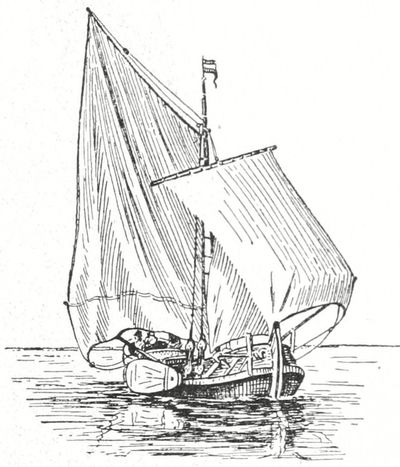
Fig. 82. From “River Scene with Sailing Boats,” by Jan Van der Cappelle.
The next change came when the last relic of the lateen yard disappeared, for in place of the sprit a tiny gaff was added at the top and a boom at the bottom of the sail. The sail was, of course, loose-footed and very baggy, and was kept to the mast by lacing, wooden hoops being still unknown. Then a long clumsy bowsprit was given, so that forward of the staysail a jib might be introduced. Thus it is not the foresail that was added to the jib, but vice versâ. Originally the foresail was the fore sail in fact as well as in name, until the jib was introduced. Then topsails were added. These were copied from those on the contemporary full-rigged ships, were square in shape, were set athwart the ship and not parallel like the modern topsails. Before long, we find that not content with one square topsail, some of the bigger craft set a square topgallant sail also. The topsail was goared out considerably and the foot was cut in a deep curve upwards, but a “barren” yard like that of the old cro’jack was retained. In light winds, the triangular spinnaker not being yet invented, the Dutchman set a large squaresail for running. This was similar to the lower course of the full-rigged ship and was set below the topsail when the ship was large enough to carry the former. This lower course extended from the hounds, was hoisted outside the forestay and, if she was a large sized ship and possessed a bowsprit, the sail extended right down to the furthest end of the latter. If she had no bowsprit then it came down to the stem. This latter instance will be seen in Fig. 82, which has been sketched from the picture by Van der Cappelle in the National Gallery (No. 964; Van der Cappelle painted from 1650 to 1680). We find in the paintings and engravings of this time that the Dutch were immensely fond of booming out these sails with a light spar. One is seen in this illustration, but sometimes, besides such a one as this, they would set another boom one-third of the way up the sail, so that it might catch every breath of wind. In the present illustration the staysail is seen set, but one often finds it rolled round and round the forestay. So, too, with the mainsail, if it should happen to be a spritsail, then the foot was boomed out, in running, with a light spar also. It was thus, I believe, that the introduction of a boom and gaff mainsail came—the boom first and the necessary spar at the top to correspond thereto. Then, not infrequently, one finds in the Dutchmen of about 1700 that they dispense with the boom but retain the gaff. The brails, in the case of the spritsails, were plentifully used, sometimes with the addition also of reef-points. As to the hulls, they were tubby, bluff-bowed, but excellent sea-boats, if slow. Being of light draught, they had leeboards. Until about 1840-1850, we in this country continued to model our fishing and small sailing craft generally upon the lines of these Dutchmen (notice the cutter shown in Turner’s painting reproduced in Fig. 71). But whilst we have gone ahead from improvement to approximate perfection, from ignorance to knowledge, the ships of the Low Countries remain but little altered since the days of Tromp, when the Dutch were at the height of their maritime progress. The Dutch schuyt, such as may be seen any day lying at her buoy off Billingsgate, is shown in Fig. 83. The Viking influence is written largely over the ships of Holland, but breadth has taken the place of the length beloved of the Northerner.
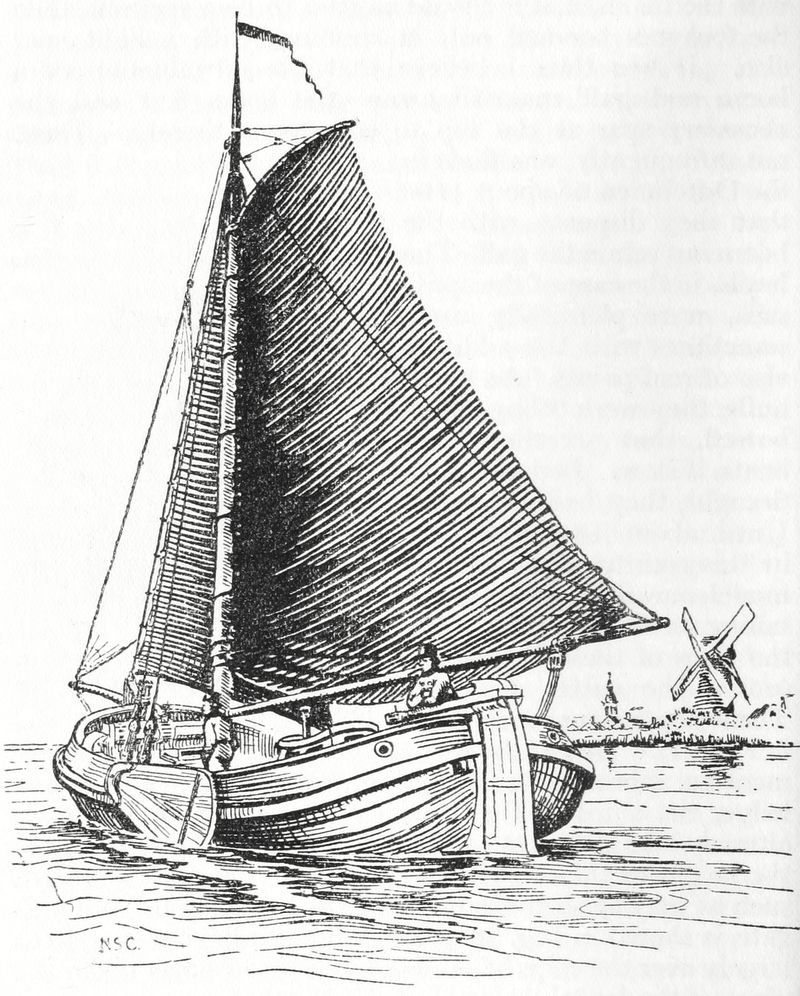
Fig. 83. A Modern Dutch Schuyt.
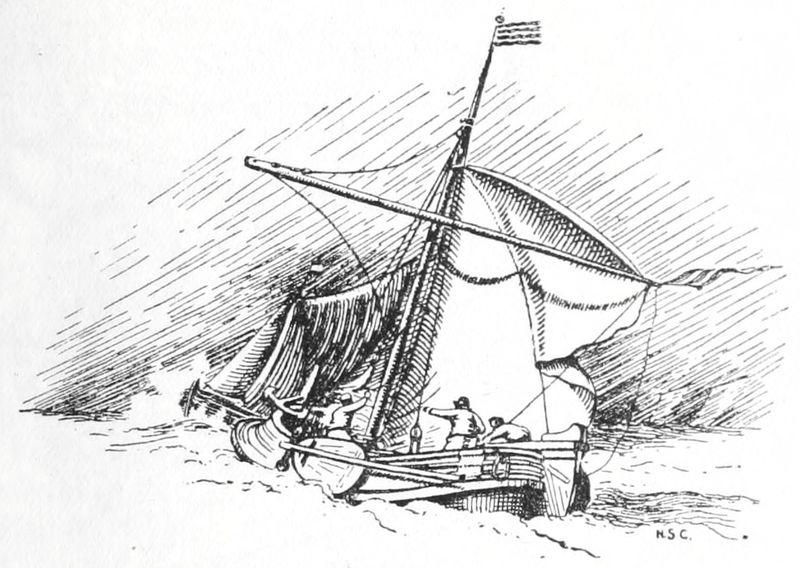
Fig. 84. “A Fresh Gale at Sea.”
After the painting by W. Van der Velde, No. 150 in the National Gallery.
If we compare the last-mentioned sketch of a modern Dutchman with that in Fig. 84, which has been copied from the exquisite little Van der Velde in the National Gallery, we shall see how little the hulls of their ships have altered. Van der Velde (the younger) lived from 1633 to 1707, so that he saw the Dutch ships at their very best. As Macaulay says, the Van der Veldes, father and son, produced, when they came over to Greenwich as painters to Charles II., some of the finest sea-pieces in the world. The title given to the present picture is A Fresh Gale at Sea (No. 150). It is extremely interesting to us for its indication of the rig. The ship in the foreground on the port tack will collide with the other if both stand on. But to avoid this she has resolved to bear up. The reader will notice the helm has been put hard over as the other ship is seen staggering out of the squall and mist. Easing off her sheet she has also lowered her peak by slacking off the tackle at the foot of the sprit. In another of Van der Velde’s paintings in the same gallery (No. 149, A Calm at Sea) the same peculiar method of lowering sail is seen. We see a ship at anchor in a calm. She has slacked off the tack in the same way, so that the spar comes right across the mast. English ships of the eighteenth and nineteenth centuries possessing this characteristic will be found in the paintings of Turner and other contemporary artists.
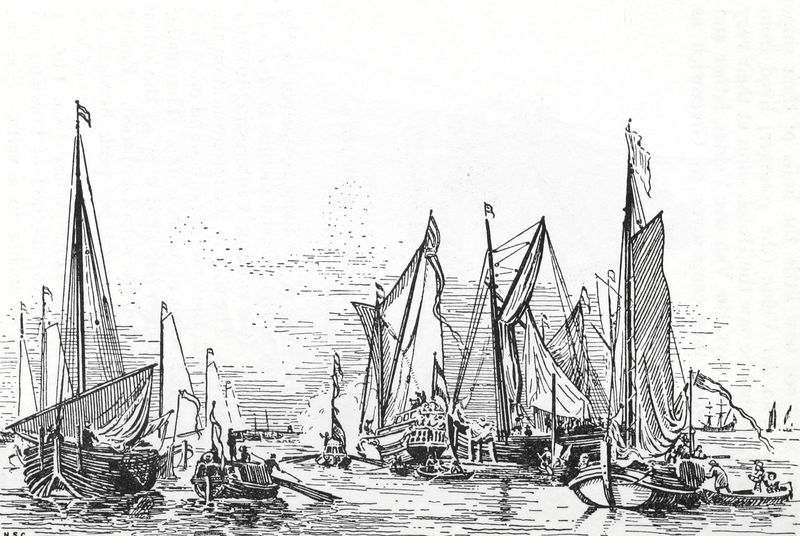
Fig. 85. “River Scene.”
After the painting by W. Van der Velde. No. 978 in the National Gallery.
For many years, though the Dutch had changed their rig for small craft, yet they still felt the influence of the bigger squaresail ships, notably in the design of the sterns. Thus the familiar decoration and the sheer to a high poop will be noticed in the vessel that occupies the centre of Fig. 85, which is rigged with a spritsail. This has been copied from another Van der Velde in the same gallery (No. 978). I have selected this picture expressly for the purpose of indicating, as Van der Velde has done, as many of the prevailing types of Dutch seventeenth-century craft as possible in a small space. The short gaff, the spritsail furled by means of its brails, the large squaresail for spinnaker work seen on the ship to the left of the picture, the high stempost (relic of the Vikings) on the ship to the right—these will all be found deserving of notice. It was no doubt a ship very similar to the high-pooped yacht in the centre of this picture that was sent to Charles II. in 1660 by the Dutch. The vessel was called the Mary, and was the first yacht ever owned in this country.
In England the revenue and other sailing cutters of the seventeenth and eighteenth centuries were rigged with the square topgallant sail and “goared” topsail below, with a hollow foot. Old prints of the beginning of the eighteenth century (1717) show British cutters sailing with the jack flying from the staff at the end of the bowsprit just clear of the jib. The bowsprit is steeved remarkably high and is very long. In a like manner were rigged also the yachts of this period. So the cutters continued until the ’forties and ’fifties, when the bluff bows and rough rig gave way to a larger, cleaner lined, and more scientific production than the slavish copying of a seventeenth century Dutch type could produce. Now the old-fashioned square topsail has utterly disappeared in fore-and-afters, and one of more or less triangular shape has taken its place. But since it is in the building and rigging of yachts that the most complete changes have occurred during the nineteenth and twentieth centuries we shall postpone the further progress of the cutter until later in the chapter.
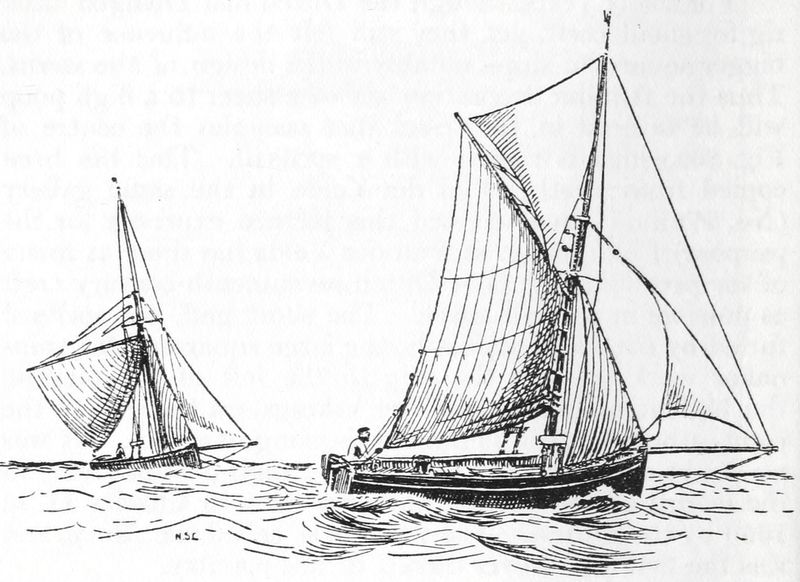
Fig. 86. The Bawley.
No modification of the cutter rig in England is so thoroughly Dutch as the bawley (Fig. 86). Not even the least observant of passengers on the Margate steamer can have failed to notice these little ships off the Nore or cruising somewhere up and down the Thames estuary. Off Southend and Whitstable they are as common as flies in summer, and bigger children of the same family are to be seen brought up in the Stour abreast of Harwich. The bawley inherits the Dutch ancient mainsail, with brails that can speedily shorten canvas, and without a boom to be kicking about from side to side as the ship rolls in the trough of the nasty seas that can get up off the entrance to our great waterway. With their transom stern and easily brailed and triced mainsail these bawleys are excellent bad-weather boats.
Some of the finest cutters in the country are the Brixham Mumble Bees, trawlers of about 27 tons. They have their mast stepped well aft, so that they are able to set an enormous foresail. Here especially the long bowsprit has survived, and without a bobstay to support it. The Plymouth hooker, with her mast stepped well amidships, with her square stern, no boom to her mainsail, and pole-mast, cannot be said altogether to have escaped Dutch influence, although it is said that the Devonshire men in Elizabeth’s time possessed cutters of their own.
The illustration in Plan 1 shows the sail and rigging plan of the Gjöa. The vessel is shown here because in combining much that is old and new she is one of the most interesting cutters afloat. Her tonnage is 70, length over all 69 feet, beam 20·66 feet, depth 8·75 feet, draught 7·5 feet. In June 1903 she set out from Christiania, and three and a half years later she had navigated the North-West Passage and reached San Francisco. Obviously built for the hard service of the Arctic regions, her hull is bluff and strong. The bowsprit is more that of an old-fashioned full-rigged ship than of a modern cutter, and the squaresail, whose yard and braces will be noticed, has come back from the times of the old Dutchmen, being, as already mentioned, of inestimable value for running across vast expanses of ocean. But in spite of her old-fashioned bow and stern and rigging she is fitted with a heavy-oil motor, as will be seen from Plan 2. This was found very useful, giving the ship a speed of 4 knots per hour; and it was the first time a motor-propelled ship had been so far north. Plan 3 gives an adequate idea of Gjöa’s deck arrangement.
Pass we now to trace the progress of the schooner. It is a common error to suppose that this rig was derived direct from the cutter by merely adding another mast and sail of the same shape as the mainsail. Such a statement is pure guess-work, and entirely contrary to fact. The schooner originated quite independently of the cutter and much later, though the shape of her mainsail and foresail was obtained from the former. About the beginning of the seventeenth century a craft far from uncommon among the Dutch was the sloop. Now in order to clear the ground, let us carefully separate the three distinct kinds of craft to which this name belonged at that time. The word sloop, or more properly sloepe, was applied less to the rig than to the size of the craft, denoting a somewhat small tonnage. Thus it was primarily applied to a ship’s big boat, such as was used to run out the kedge anchor and for fetching provisions and water from the shore. The same name was also given to the Dutch vessels of about 55 feet long and 12½ feet beam which sailed to the Cape Verde Islands. More familiar to us was the custom of applying it to the early cutter-like craft which carried a triangular foresail yet no jib. But not one of these is the sloop we are looking for. This is found in that kind of sailing craft which was about 42 feet overall and with 9 feet beam. She was rigged with two pole masts, the mainmast being 24 feet long. On each she had just such a sail as we see in Fig. 83 of a modern schuyt, with loose foot and with both gaff and boom, but the most important fact is that she had neither bowsprit nor headsails of any kind, while her foremast was stepped right as far forward as it could get. There are plenty of contemporary prints and paintings in existence to show such a vessel, which usually had an enormous sheer coming up from bow to stern. This, then, was not a schooner but a sloop, and you may search high and low in all the seventeenth century dictionaries, marine and otherwise, but you will not find such a word as “schooner” in existence. We come, then, to the early part of the eighteenth century, and we cross to North America. When in 1664 the British, during the war with Holland, seized the Dutch colony of the New Netherlands and changed the name of New Amsterdam to New York in honour of Charles II.’s brother, most of the Dutch settlers who had come out from Europe remained. So, like those early people who trekked westwards across the Syrian desert to Egypt, the Dutch had also brought with them their ideas and practical knowledge of shipbuilding, included in which was that of making sloops. It was at Gloucester, Massachusetts, still to-day famous for the finest schooners and the very finest schooner-sailors that ever tasted brine on their lips, that in 1713 the first genuine schooner with a triangular headsail was built. To add the latter to the two-masted sloop was but the easiest transition. Not till the first vessel of this now enormous class was actually making its first contact with water was the name schooner bestowed on it. As she was leaving the stocks some one remarked “Oh, how she scoons.” “Very well, then,” answered her proud builder, “a scooner let her be.” And so she has remained ever since.
For the next century and a half Gloucester went ahead building these beautiful creatures, more stately than a cutter, less ponderous than a full-rigged ship, until 1852, when the famous America still perpetuated in the America Cup came across to the English waters and so wiped the slate that every rich owner of yachts desired to turn them into the same rig as this Yankee. We will say no more about her at present as we shall presently make her acquaintance anew when we come to deal entirely with yachts.
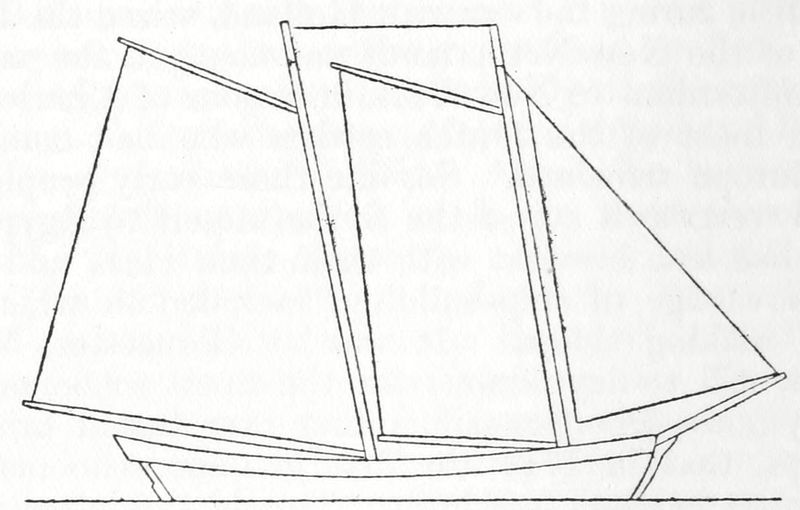
Fig. 87. The Schooner “Pinkie” (1800-50).
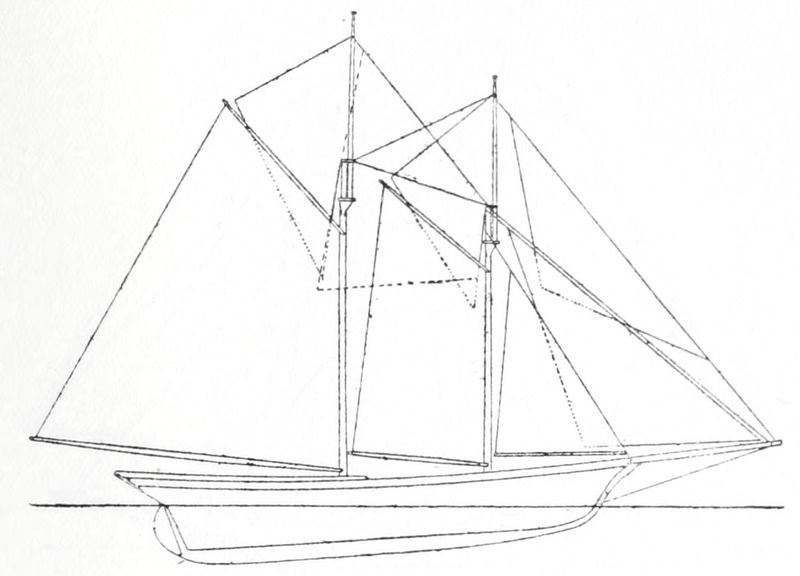
Fig. 88. The “Fredonia.” Built in 1891.
But to return to the more commercial schooner; for whatever else Gloucester, Massachusetts, may yet become famous, it will always be associated with that wonderful fleet of fishing schooners which those who have read Kipling’s “Captains Courageous,” and Mr. J. B. Connolly’s “The Seiners,” already know. The origin of this wonderful Gloucester breed may be traced to the Dutch fly-boat, or flibot, of the eighteenth century. The next step in the evolution of the Gloucester schooner is seen in Fig. 87, the Pinkie, engaged in the fishery industry between 1800 and 1850. Although the sail plan belongs to a smaller boat than the one just indicated, yet we see the first step in the introduction of the single headsail to the old two-masted “sloepe,” with the foremast even now stepped very far forward. Impelled by the demands for a ship that would be able to carry its fish to market with the utmost despatch, but which would be able to endure being caught in the terrible seas off the Newfoundland Banks; and subsequently encouraged to progress through the popularity which such craft were obtaining among the American pilots who used to come out enormous distances into the Atlantic in those days to meet the incoming liners, the builders and designers went on improving the design and rig, giving them fine hollow lines, adding jibs and standing bowsprits, greater draught and speed, larger spars with a vast square measurement of canvas. The Fredonia, seen in Fig. 88, was one of the famous schooners of the ’nineties and is so still. She was designed by W. Burgess in 1891, and with her cut-away fore-foot and finer lines is a great improvement on the old Dutch models. This vessel measures 114 feet 2 inches long, with 25 feet beam, drawing 12 feet 8 inches. Her displacement is 188 tons, and her sail area is the enormous extent of 7542 square feet. Fig. 89 represents one of the earliest of the twentieth-century productions, and is designed by the famous Crowinshield. Her fore-foot is cut away more like that of a Solent racing schooner-yacht. Indeed, many of these Gloucester schooners are far more entitled to be called yachts than any other name. I have watched them turning up the Hudson in the winter, threading their way through the ice-blocks and the crowd of fussy tugs and mammoth liners in New York harbour with the handiness of a small rater. The most modern example of this ideal ship is that seen in Fig. 90. She is only a 53-tonner with an overall length of under 70 feet, and is fitted with a 25-horse-power motor. But in many cases the internal combustion engine has been adopted by the American sailing ships only to be rejected as not worth while.
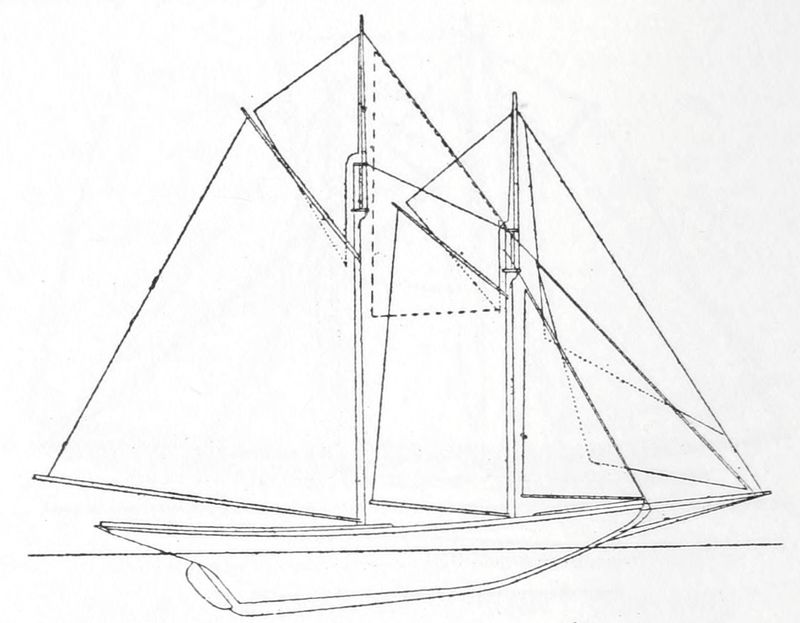
Fig. 89. Gloucester Schooner,
A.D.
1901.
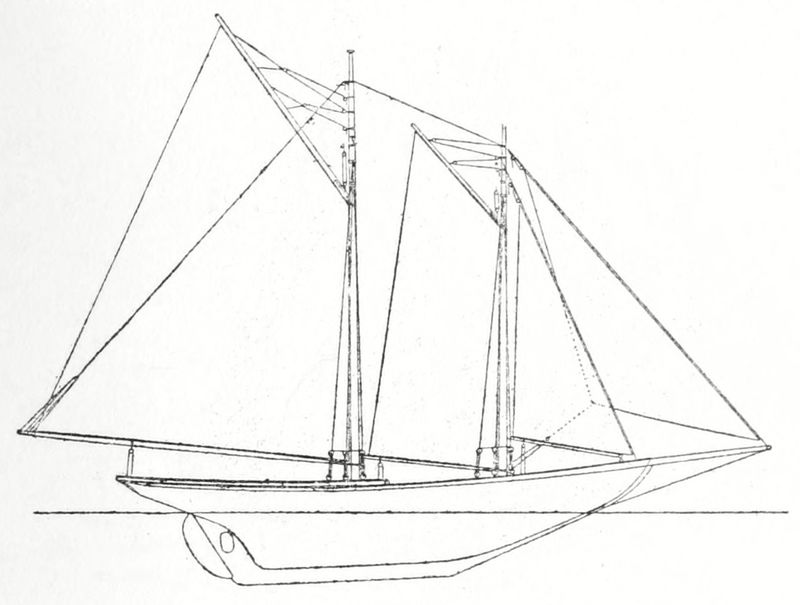
Fig. 90. Gloucester Schooner,
A.D.
1906.
The coasting trade of the United States of America is not done in the ketches and topsail schooners and barquentines that we use. It is done exclusively, where sailing ships are used, in fore-and-aft schooners which have arisen directly or indirectly from Gloucester. Two masts have become three, three have become five, and even as many as seven have been used. Perhaps the most notable of these was the seven-masted Thomas W. Lawson, which foundered off the Scillies on December 14, 1907. Remarkable for the ease with which it can be handled, a three-masted schooner of about 400 tons requires only a dozen hands aboard. In tacking, a couple of hands work the head-sheets, and these with a man at the wheel can work her in and out of narrow channels, for which the rig is more suited than any modification of the squaresail. For labour-saving “gadgets” the American schooner has reached the furthest limit. Thus the anchor and sails are raised by steam force; there is steam steering gear as well as steam capstan, and the biggest ships of all have been fitted even with electric light. The illustration in Fig. 91 of a four-master will give one some idea of the extent to which the American schooner has developed.
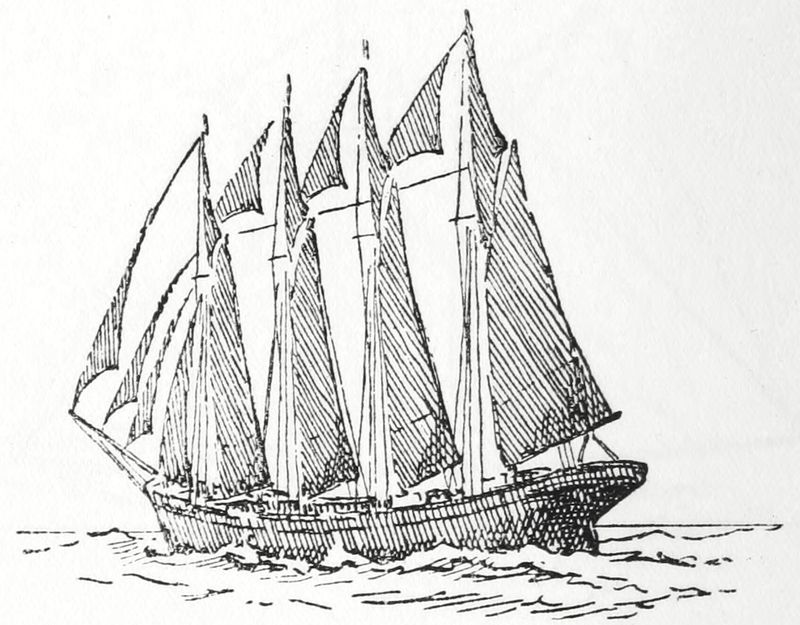
Fig. 91. An American Four-masted Schooner.
Coming back to European waters, besides the pure fore-and-aft schooner we have also the topsail schooner and the two-topsail schooner. No better instance of the former could be found than in the illustration in Fig. 116 of Lord Brassey’s famous auxiliary yacht the Sunbeam, of which we shall give further details on a later page, among the yachts. But we may now call attention to the square fore-topsail and smaller t’gallant sail on this ship. Sometimes, too, one finds a royal added also to the foremast. The braces, clew-garnet, lifts, and other rigging are so well shown in this photograph as to require no further comment. A two-topsail schooner carries a square topsail and t’gallant sail at the main as well as the fore. The topsail schooner is perhaps the best known of our coasting types. Most of our trading schooners are “butter-rigged,” that is to say, that whereas the topsail schooner has a standing t’gallant yard set up with lifts, the butter-rigged sets her t’gallants’l flying by hoisting the yard every time.
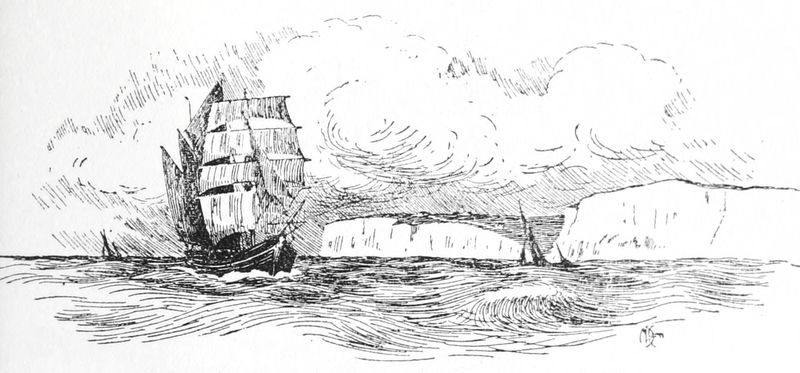
Fig. 92. A Barquentine off the South Foreland.
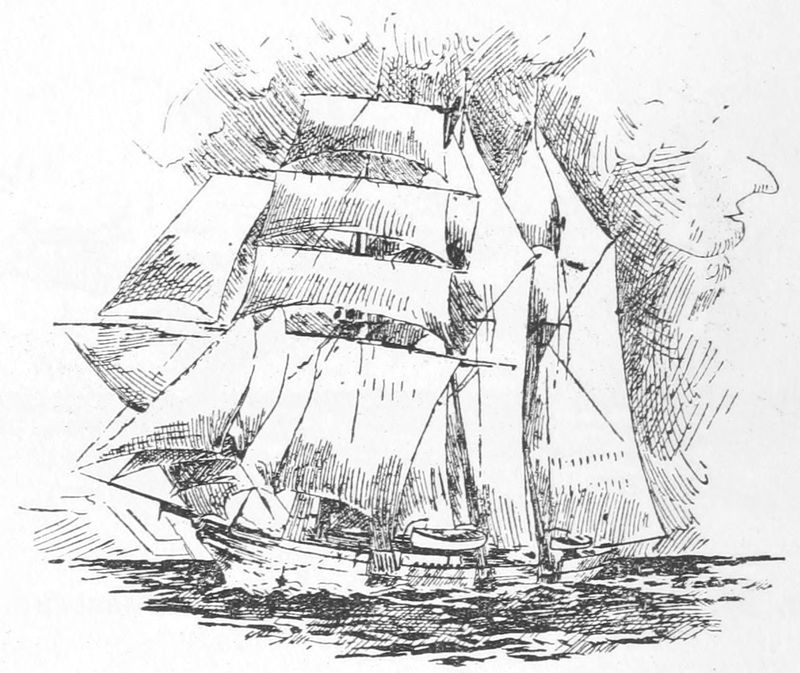
Fig. 93. Barquentine with Stuns’ls.
The illustrations in Figs. 92 and 93 represent barquentines, although one of them is seen with the now obsolete stun’s’ls. A barquentine is square-rigged on the foremasts, but fore-and-aft rigged on the main and mizzen. The difference between the barquentine and the three-masted schooner is that the former has a regular brigantine’s foremast. The three-masted schooner does not carry a fore-course, but in place of it a large squaresail, only used when running free in moderate weather, only differing from the fore-course in that it is not bent to the yard.
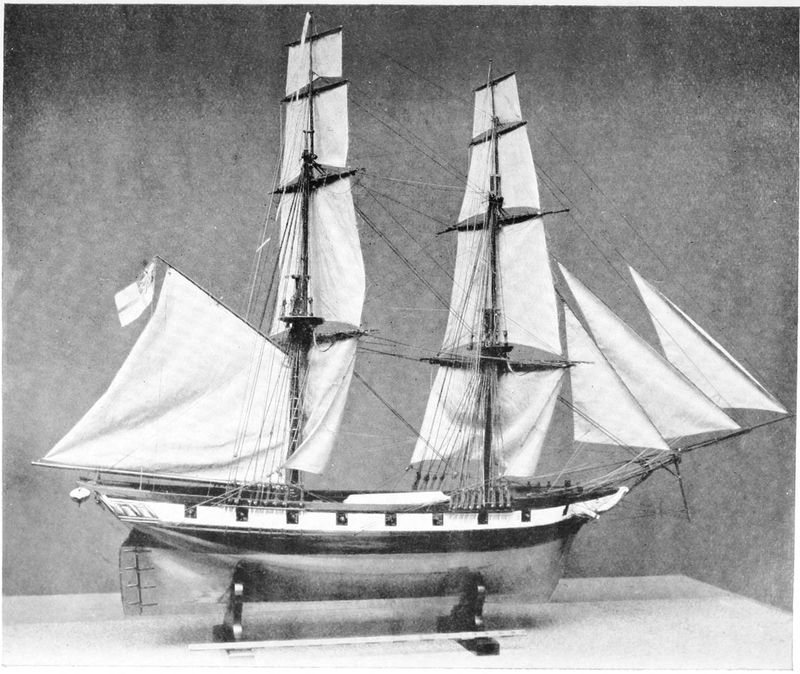
Fig. 94. The “Fantôme,” 18-ton Brig. Launched 1838.
The illustration shown in Fig. 94 represents the 18-ton brig Fantôme. She was designed by Sir W. Symonds and launched about 1838. Her armament consisted of eighteen 32-pounders, and her complement was 148 officers and men. Her tonnage was 726, her breadth 37·7 feet, length 120 feet, and depth of hold 18 feet. This is from a photograph of the model in the South Kensington Museum. Fig. 95 is a photograph of the training brig Martin, actually afloat. The brig was the last sailing ship to disappear from the British Navy, and her final abolition is so recent that her picturesqueness still lingers in the imagination of Solent yachtsmen and others. The Martin was launched in 1836. As will be seen from the photograph, which obtains even greater interest when compared with the model just mentioned, she carried single topsails, t’gallants and royals. Stun’sails will be noticed on the foresail, fore-topsail, fore-topgallant sail as well as on her main topgallant sail. As we shall never see these sailing brigs again, the photograph is of more than ordinary interest.
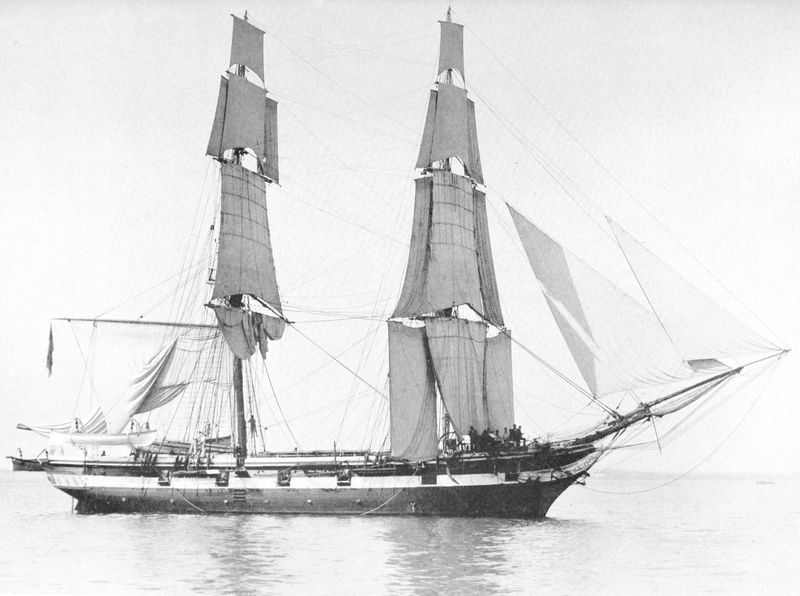
Fig. 95. H.M.S. “Martin,” Training Brig. Launched 1836.
In olden days the brig was a favourite rig for small coasters. In the marine paintings of Turner and the early part of the nineteenth century one sees them frequently. In the eighteenth century, and even as late as the nineteenth, the brig was used for the coal-carrying trade. The nineteenth-century brigs often carried, besides the sails seen in the two illustrations, an enormous fore-topgallant staysail. But both the handiness of schooners and ketches began to oust her, and the coming of the steam collier finally did for her in the mercantile marine as, at a later date, she was abolished from the Royal Navy.
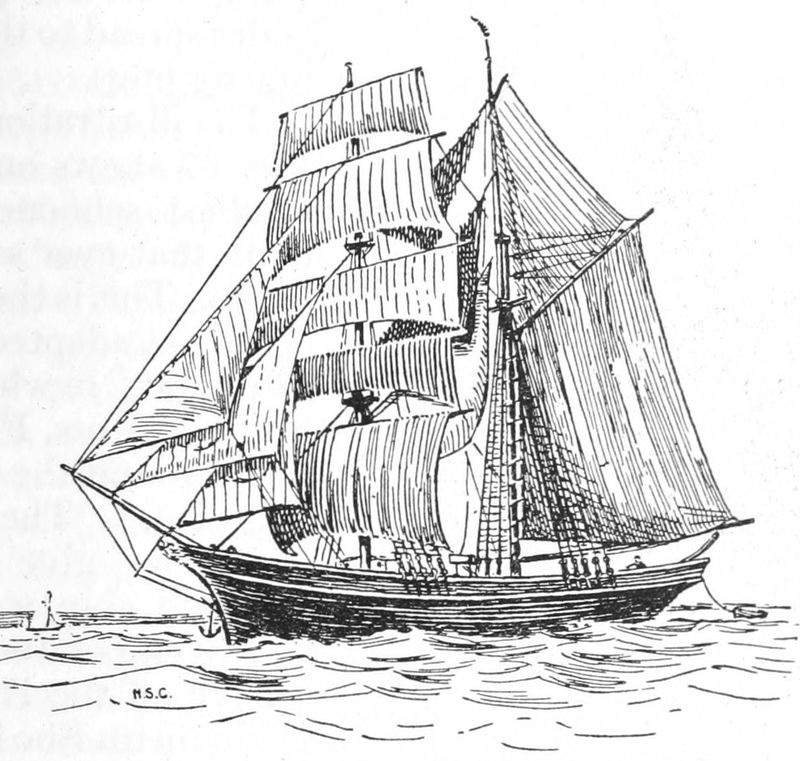
Fig. 96. A Hermaphrodite Brig, commonly but erroneously called a Brigantine.
I have intentionally introduced the brig at this point, notwithstanding that she is essentially a square-rigged ship, in order that we may compare her the more easily with that compromise between the square rig and fore-and-aft vessel, the brigantine. Strictly speaking, the brigantine is square-rigged at her foremast, but differs from the Hermaphrodite brig in carrying small squaresails aloft at the main. She differs also from the full-rigged brig in having no top at the mainmast and in carrying a fore-and-aft mainsail and sometimes a main-staysail instead of a square mainsail and try-sail. (The fore-and-aft sail at a brig’s mainmast is called a try-sail.) The illustration in Fig. 96 represents a Hermaphrodite brig, commonly and erroneously called a brigantine. The Hermaphrodite brig, or brig-schooner, is square-rigged at her foremast like a brig, but without a top forward, and carrying only a fore-and-aft mainsail and gaff topsail on the mainmast. And here it may not be out of place to mention another subtlety: while a barque has three masts, being square-rigged at her fore and main like a ship, and differing from a ship-rigged vessel in having no top at her mizzen, but carrying a fore-and-aft spanker and gaff topsail, yet what is known among sailormen as the “Jackass” barque resembles a barque proper, but has no crosstrees, does not spread lower courses and has no tops. (Tops are the platforms placed over the heads of the lower masts, while the crosstrees are at the topmast heads, being used for giving a wider spread to the standing rigging).
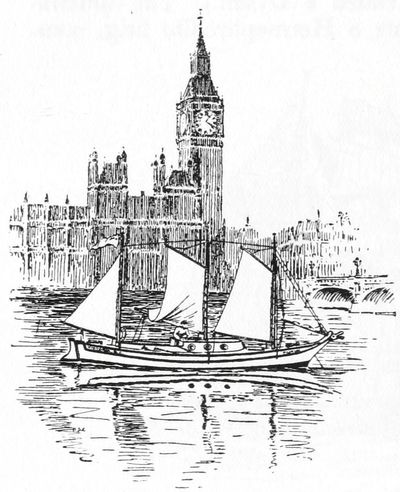
Fig. 97. The “Tillikum,” Schooner-rigged “Dug-out,” which sailed round the World.
The illustration seen in Fig. 97 shows one of the smallest schooner-rigged craft that ever sailed the ocean. This is the famous Tillikum, adapted from a “dug-out,” in which Captain J. C. Voss, F.R.G.S., sailed round the world to England. The sketch which we give here of this odd ship was made in November 1906, while she lay off the Houses of Parliament. She has since changed ownership and been fitted with a motor, and in her green paint is a familiar sight to those who bring up in the Orwell off Pin Mill.
The origin of the ketch is also Dutch, although the word is in old French quaiche and in Spanish queche. We frequently find the influence of the bomb-ketch in old pictures and engravings, in which the mizzen is close up against the mainmast, and the latter is stepped well abaft of amidships, so as to allow the shot fired to clear the rigging, leaving a large fore-triangle. (See Fig. 62, the galiote à bombe.) This influence is felt even as late as the second half of the eighteenth century. The ketch is descended from the Dutch galliot, which, besides having a gaff mizzen, had a sprit mainsail like the barge, and with no boom, but three brails and one row of reef-points. The usual vangs led down aft from the peak, and she also had lee-runners. But, besides her triangular headsails, consisting of a fore(stay)sail and a couple of jibs, she carried also a small t’gallant sail, with big topsail below, and often a large lower course below that—all these last three being square, as on a full-rigged ship, and to this day many Baltic ketches continue to be rigged in like manner. At the close of Charles II.’s reign we find that among the 173 ships in the British Royal Navy there were three ketches, but before this date, in his “Seamen’s Dictionary” of 1644, Sir Henry Manwayring defines them simply as “a small boate such as uses to come to Belinsgate with mackrell, oisters, &c.” From the time of Charles I. the Dutch have had the privilege of mooring three of their fish-carrying craft off Billingsgate in recognition of “their straightforward dealings with us,” and any day the reader likes to go down in the vicinity of London Bridge he will see two or three Dutch schuyts swinging to their moorings. In an eighteenth century work on naval architecture it is curious to see the galliot also called a galleasse. In this case the mainsail has discarded the sprit and taken on a small gaff with boom and loose foot. Two rows of reef-points are also added, and the squaresails are still there. An old English engraving also shows a close similarity to the former bomb-ketch. But in the course of time all the squaresails were abolished, the mainmast brought further forward, and the mizzen sail enlarged so as to be not much smaller than the mainsail. Nowadays nowhere is the modern ketch rig so prominent as on the east coast of England, from as far north as Whitby to as far south as Ramsgate, and even Brixham. The billy-boy, with her long raking bowsprit, setting almost as many jibs as a full-rigged ship, and whose general design bears the most remarkable likeness to the ship in the seal of Dam in Fig. 40, is the Yorkshire adaptation of the old Dutch galliot, and, with her leeboards and ketch rig, is well known in the North Sea. In the ’seventies our East Coast fishermen were almost all rigged with the lug-sail, but now some of the finest ketches will be found in the fishing fleets of Yarmouth, Lowestoft, and Ramsgate. For powerful, seaworthy craft, able to heave-to comfortably, and with the capacity of riding out gales that few modern yachts with their cut-away bows could survive, there is nothing on the sea, size for size, to beat these ketches. In Fig. 98 we give an illustration of a Lowestoft “drifter.” With her boomless mainsail and raking mizzen, setting a jackyard topsail over both main and mizzen, she sets also in light winds a large reaching jib.
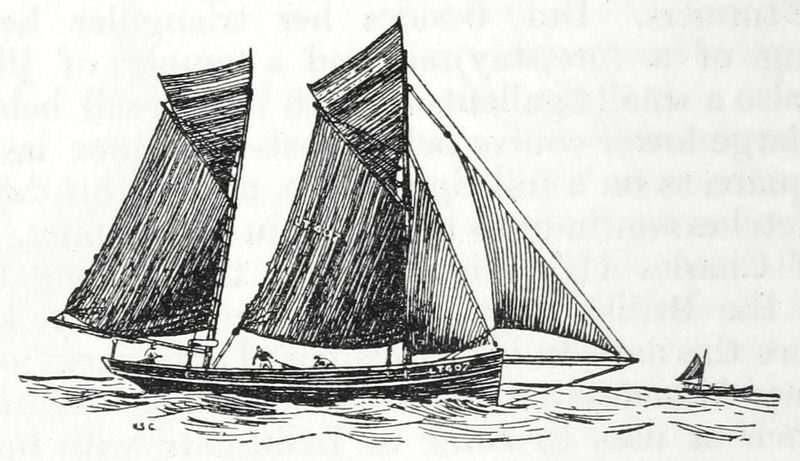
Fig. 98. Lowestoft Drifter.
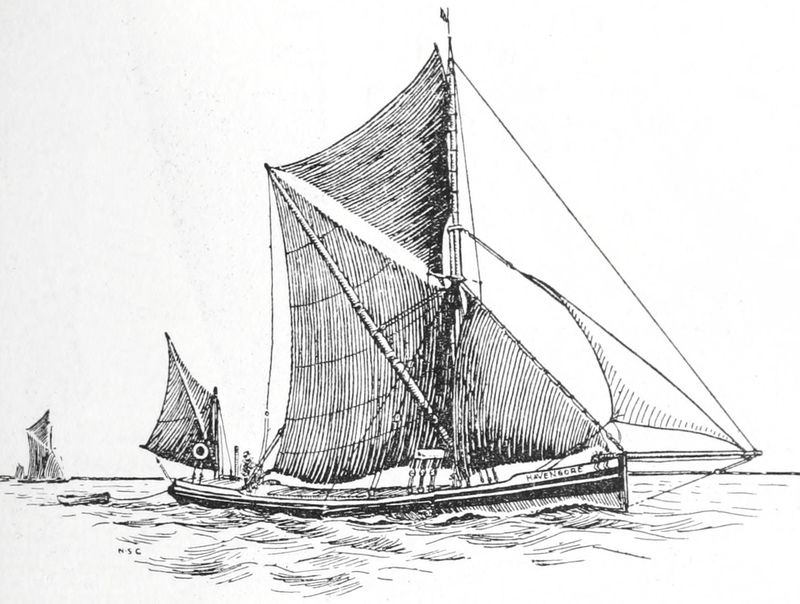
Fig. 99. Thames Barge.
We come next to the yawl. Correctly speaking this word has reference not to rig but to shape. The Scandinavian yol was a light vessel, clinker-built and double-ended, like the Viking shape. The Yarmouth yawls that we shall consider presently, were correctly called yawls with their bow and stern alike. But the word has now come to refer to a later adaptation of the ketch, in which the mainsail has grown bigger and the mizzen smaller. In a ketch the mizzen mast is stepped forward of the rudder-head; in the yawl the mizzen mast is abaft the rudder-head. The Jullanar, for instance, in Fig. 117, is a yawl. But to the Londoner no more familiar example could be found of a yawl than the Thames barge, of which the illustration in Fig. 99 is a fair specimen. Still inheriting her Dutch-like spritsail and brailing arrangement, she has also the vangs that were first attached to the peak in the sixteenth century. The old-fashioned topsail is a cross between a modern jackyarder and the old Dutch square topsail. Aft she carries another small spritsail on the diminutive mizzen. Smaller types of barge, called “stumpies,” have only pole-masts and neither bowsprit nor jib nor topsail. But the larger type of barge, carrying topmast and setting a big jib-headed topsail, known as topsail barges, with their red-ochred canvas and the untanned jib, always known by bargemen as the “spinnaker,” have grown to such sizes that they go right down to the west end of the English Channel. Yet these are rather ketches than yawls. But even in the Thames barges developments have not ceased. Obviously Dutch, as they strike one in a moment, the old Dutch bluff bows have been replaced by the straight bow as seen in the sketch. A whole book could be written about the barge and her ways, her history, her leeboards, her lengthy topmast, and the wooden horse on which the staysail works; but we must pass on.
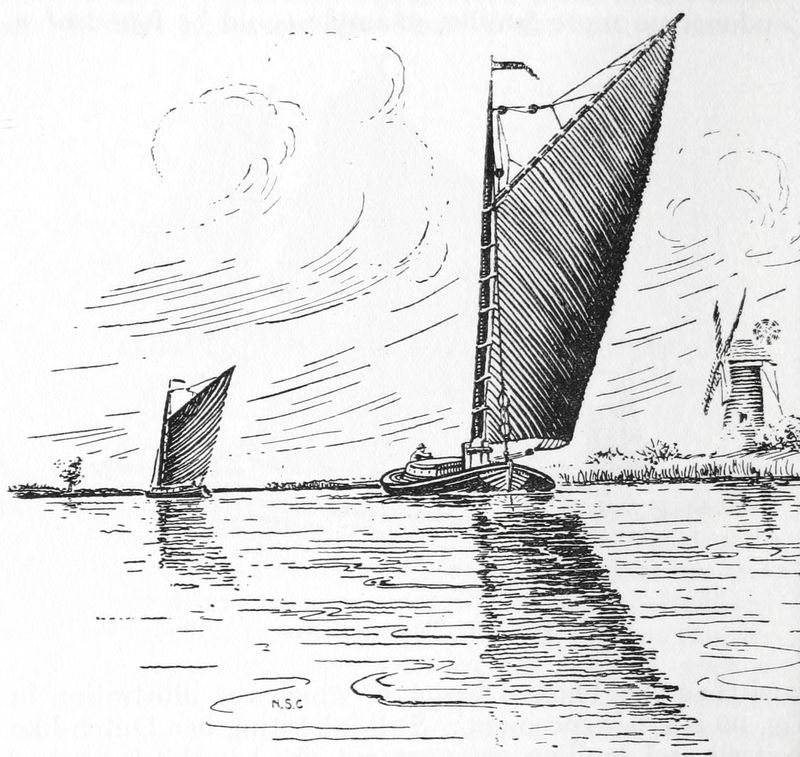
Fig. 100. Norfolk Wherry.
Curiously Dutch-like, too, is the Norfolk wherry seen in Fig. 100, with her one enormous sail, her mast fitted in a tabernacle for ease in lowering, unsupported by shrouds or rigging of any sort other than the forestay by which the mast is eased down. Only one halyard is required for both peak and throat, which are raised by means of a winch forward of the mast. She has no leeboards, nevertheless she draws under three feet of water: although I have heard her sweepingly condemned as defying all existing rules, yet the way she can sail right close into the wind is incredible to those who have not seen her. In running with her bonnet off and her sail close reefed she gripes badly and is a veritable handful as she comes sailing into Great Yarmouth from across Breydon Water or tearing through the rushes of Barton Broad and down the tortuous and narrow Ant. Within recent years, now that the Norfolk and Suffolk waterways have become a tourist resort, the wherry has changed her face a little and become smarter, and the tanned sail is often allowed to remain white, while the hatches have been taken away and a cabin roof, allowing plenty of head-room with ladies’ saloons, pianos and other luxuries, have come in. But all the time the wherry remains as a useful cargo boat for bringing coals and timber from the ports of Lowestoft and Yarmouth inland to Norwich and the East Anglian villages, returning with eels, or marsh hay for thatching. Sometimes one notices them, in settled weather, with a fair wind steal quietly out from Lowestoft harbour and make a sea passage round to Yarmouth, but as Mr. Warington Smyth well says in his “Mast and Sail,” “in the smallest wind and sea the wherry loses her head entirely and develops a suicidal tendency to bury herself and crew.”
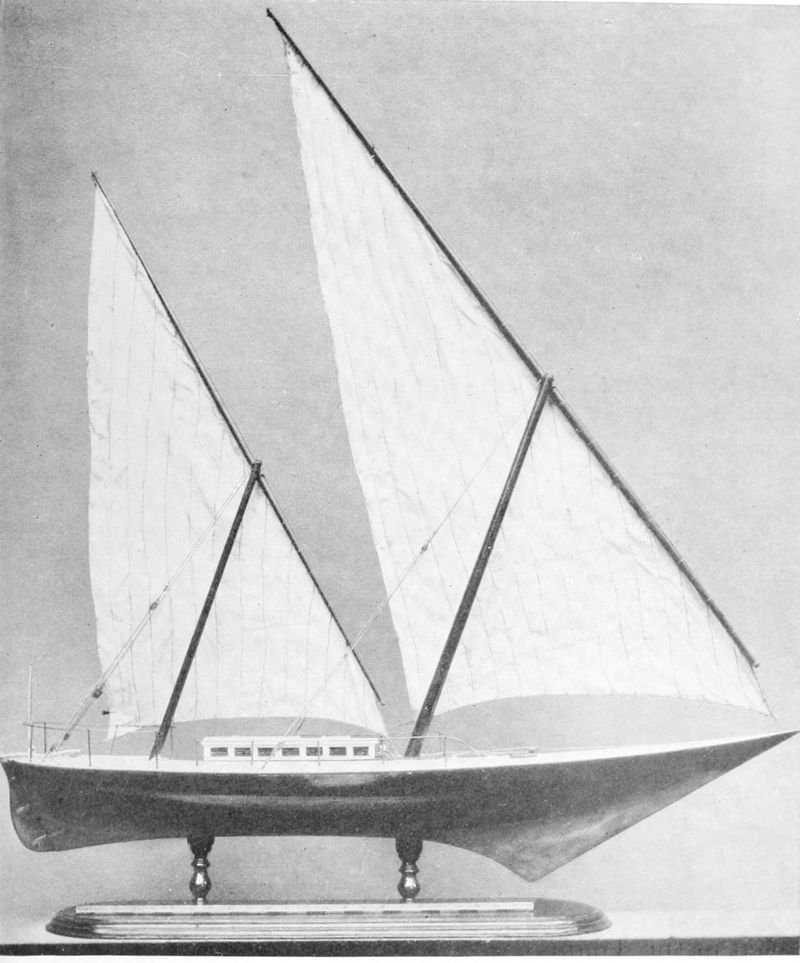
Fig. 101. Dhow-rigged Yacht.
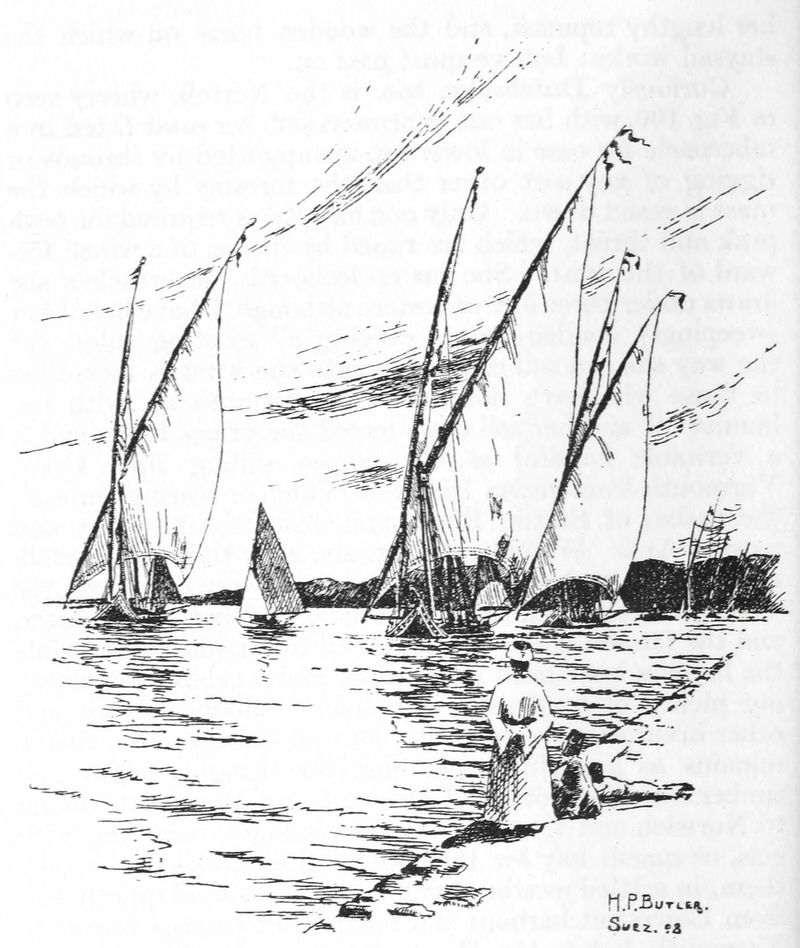
Fig. 102. Suez Dhows, with a Sibbick Rater.
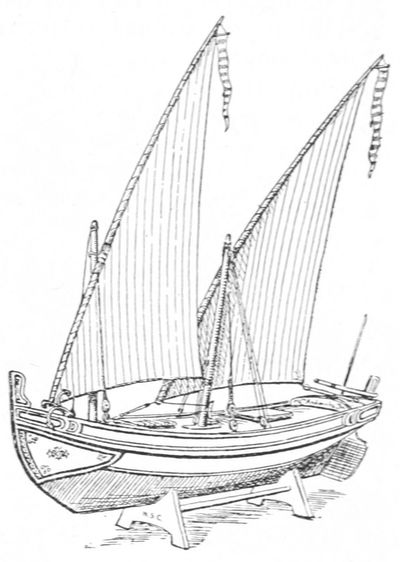
Fig. 103. Mediterranean Felucca.
From the model in the South Kensington Museum.
After the squaresail had for so many centuries held sway among the earliest dwellers of the earth, the lateen began stealthily to assert itself as we saw in the first chapters. Although Holland set the example in the sixteenth century of cutting up the lateen shape into the cutter rig, yet in the Mediterranean, along the East Coast of Africa and in the Indian Ocean generally, the lateen has refused to be made obsolete. The illustration in Fig. 101 represents a Bombay yacht of the second half of the nineteenth century rigged with a couple of lateens, and masts that rake forward at a considerable angle. Every tourist to Egypt is familiar with the picturesque lateens and lofty yards of which Fig. 102, showing a fleet of these with a small Sibbick rater in between, affords a study in contrast between the conservative East and the progressive West. The sketch was made at Suez. The felucca in Fig. 103 is a well-known lateen type in the Mediterranean, with her white and green, her square stern and single deck. The sketch here shown has been made from a charming little model in the South Kensington Museum, and represents one of the familiar two-masters seen off the Spanish coast. The tack and sheets and rigging are shown so clearly that we need not stop to indicate them. In old paintings and prints we see that the felucca type in the Mediterranean developed into vessels of considerable tonnage with three masts. The Venetians and Greeks and Genoese, as well as the piratical Moors and the other Mediterranean inhabitants, used them both as cargo carriers and ships of war. They are in fact the lineal descendants of the ancient galleys. Further modifications include the addition of a jib, though the Southerner has not followed the universal Northern practice of transforming his lateen into a mainsail. Sometimes we find old prints showing a felucca with the addition also of a mizzen spritsail similar to that on the modern barge. The French signified by the word brigantin a two-masted lateen-rigged galley with oars as auxiliary. But there came into use that compromise between lateen and squaresail that in Northern Europe we have seen to exist between the pure fore-and-after and the square-rigger. Thus, for instance, one finds ships rigged with a large lateen on the foremast, the mainmast being square-rigged with mainsail, topsail and t’gallant, while the mizzen has a lateen with square topsail. The reader who wishes to see the different varieties of lateen and lateen-plus-square rig is referred to Mr. Warington Smyth’s interesting volume “Mast and Sail,” while for details as to design and rigging he will find some valuable information in Admiral Paris’ “Souvenirs de Marine.”
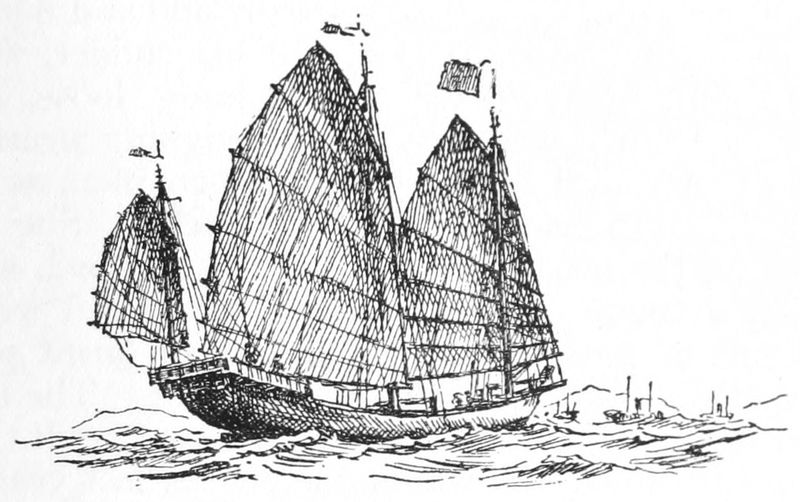
Fig. 104. Hailam Junk.
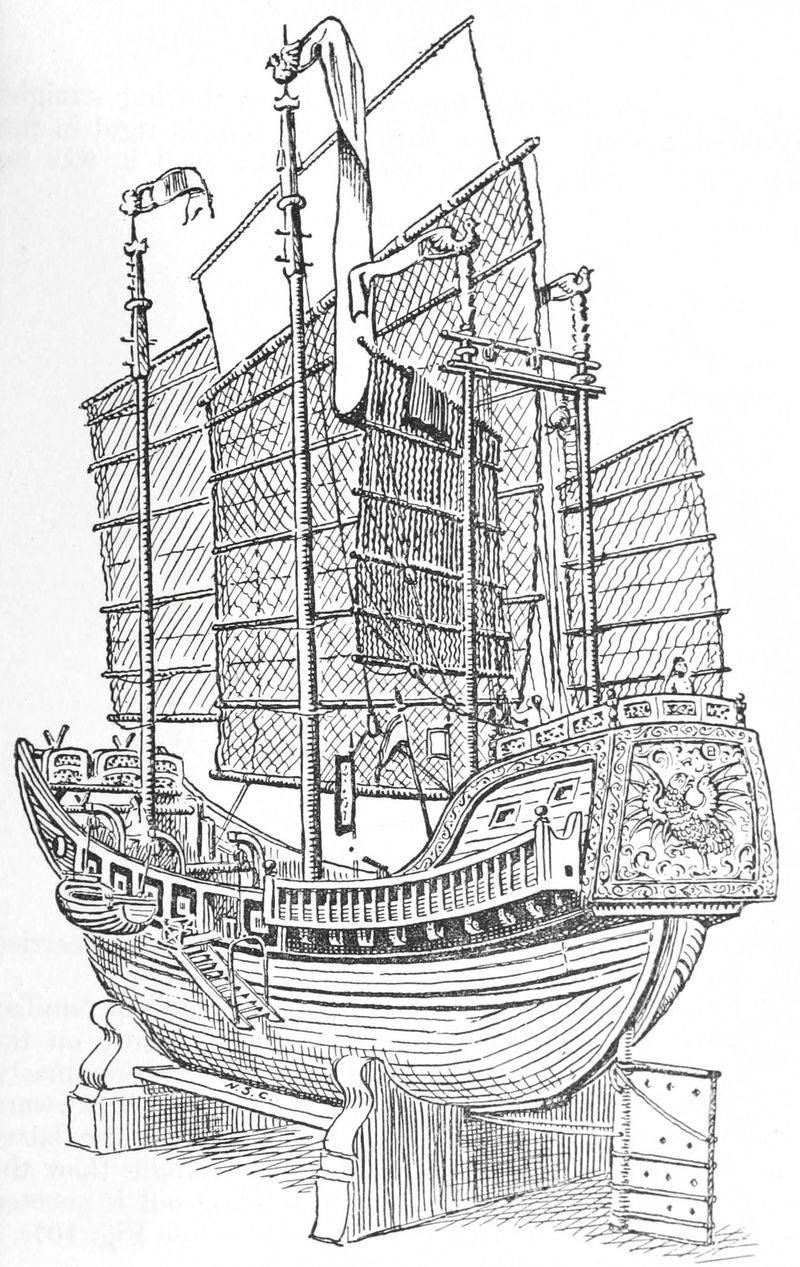
Fig. 105. Chinese Junk.
From the model in the South Kensington Museum.
The Chinese in their own independent way went on developing from the early Egyptian models and have been not inaptly called the Dutchmen of the East in their nautical tendencies. They developed quickly but then remained at a standstill, whilst the European has gone on by slow steps of progression. Adopting rather the sail of the lugger than the old Egyptian squaresail, the Chinese made it into a balance-lug and stiffened it with bamboo-battens. The illustration in Fig. 104 was sketched by Mr. Warington Smyth (through whose courtesy it is here reproduced) near Kaw Sichang, and represents a Hailam junk. The sail of the Chinaman is hoisted up a pole-mast, the halyard passing through a large double block attached to the yard and a treble block at the masthead, a hauling parrel keeping yard to mast and helping to peak the sail when reefed. Reefing with the Chinese consists simply in letting go the halyard, when the weight of sail and battens brings the sail into the topping lifts: two or more battens are bunched together along the boom. The illustration in Fig. 105 will show in further detail the rigging of a Chinese junk. This has been specially sketched from a fine model in the South Kensington Museum. Built of soft wood, she has a full bottom and water-tight compartments. The mizzen mast will be noticed to be in duplicate, one on each quarter, only the leeward one being used under way, the sails being of matting. The rudder is remarkable, unwieldy, and projecting deep into the water, but capable of being raised by means of a windlass when in shallows. The windlass in the bows raises the three anchors, which are made of hard wood, the flukes being tipped with iron, whilst the stock is in the crown instead of in the top of the shank as in European anchors. Very similar to this model was the famous Chinese junk Keying, which caused some sensation by sailing from Canton to the Thames in 1847-8. These craft, owing to their light draught and bulky tophamper, are not much good going to windward, so that one is not surprised that the Keying took 477 days on the voyage to England. In crossing China seas they usually take advantage of the favourable monsoons. Their enormous crescent-shaped sheer makes them excellent bad weather ships. Their tonnage varies between 300 and 800. The Keying came round the Horn, and her rudder, when let down, drew 22 feet of water. It hung loose, as seen in the model, and was perforated, weighing nearly eight tons. Under way it necessitated fifteen men, as well as a luff-tackle purchase, to work the helm. She had no keelson, and the mast, instead of being stepped, was supported by a toggle. The seams of the vessel were paid with a kind of putty-cement made out of burnt pounded oyster shells and oil from the chinam-tree. The mainsail weighed no less than nearly nine tons, and took the crew two hours to hoist. Towards the end of last year (1908) the Australian Customs officials saw with amazement the arrival in their waters of another Chinese junk, the Whang-Ho. This craft, which was over a hundred years old, and was previously a pirate ship, set out from China for a voyage to San Francisco. Afterwards she sailed for the eastern side of America, but in making an attempt to round the Horn was less fortunate than the Keying, a wave carrying away her huge rudder; but she eventually reached Australia. She had previously touched at Tahiti, and nothing was heard of her until she reached Thursday Island, 100 days out.
Returning now to Northern Europe, we find the lug-sail surviving especially in fishing craft for which it possesses certain peculiar advantages. In Fig. 106 we have the sail plan of a Blankenberg boat. Those who are acquainted with the coast-line around Ostend cannot have failed to notice these craft with their leeboards raised, hauled up the sandy beach. Here the standing lug is set after the French style, the old mediæval bowline being still preserved from the squaresail to set the lug straight when on a wind. Notice that the foresail is right in the eyes of the ship, so that the rig looks as if it was no distant relative of the vessel with the artemon that carried St. Paul on his voyage.
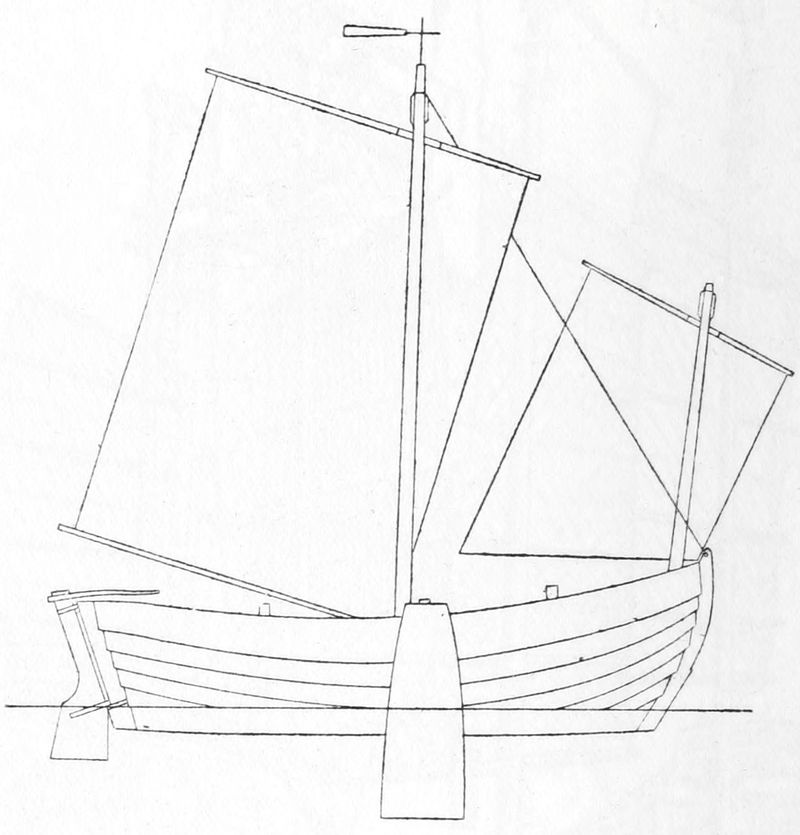
Fig. 106. Blankenberg Boat.
Every one who has cruised down Channel is familiar with the French Chasse-Marée, a curious figure on the sea-line, with her lug-sails and three crazy-looking masts. Over the mainmast she sets a square topsail, while forward she carries a long bowsprit with a small jib, the latter being in shape more of an equal-sided triangle than the modern English jib, while the French lug-sail is sheeted very high, as will be seen from the sketch (see Fig. 107).
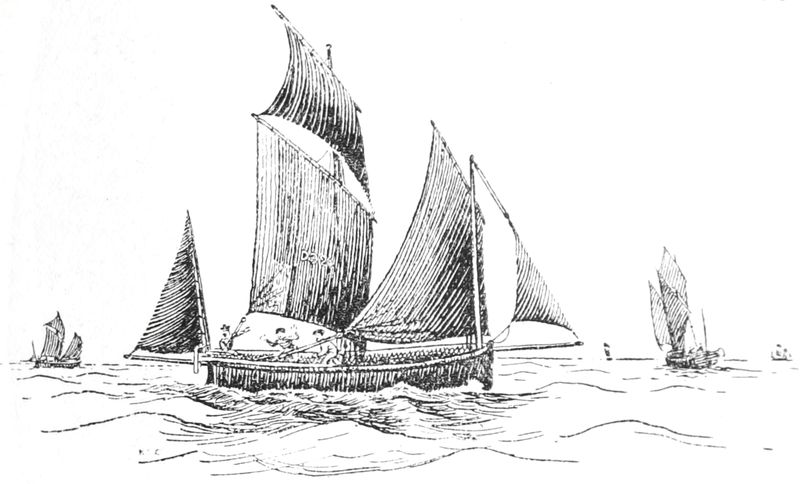
Fig. 107. French “Chasse-Marée.”
At one time Norfolk was famous for its beach yawls. Those who have visited Great Yarmouth will have noticed these very large open boats painted white with (if I remember correctly) a riband of green running along the gunwale. Double-ended, they are now usually rigged cutter fashion and used as pleasure boats. Clinker-built, they have a very fine entrance and a clean run, and sometimes measure 50 feet in length and 10 feet beam. They used to carry three lug-sails and jib owing to French influence. In the days when sailing ships were more frequent than to-day, Yarmouth Roads were usually a crowded anchorage, and these yawls would be launched almost every day during the winter to assist a vessel that had been picked up by the shoals. Nowadays one still sees them used for bringing pilots ashore, but it is at the Yarmouth and Lowestoft regattas that one is able to realise alike their enormous speed on a reach and the dexterity of each crew, numbering about twenty. The three-masted lug rig of olden days has now given way to a two-master with a dipping lug for the main and standing mizzen, besides a small jib forward.
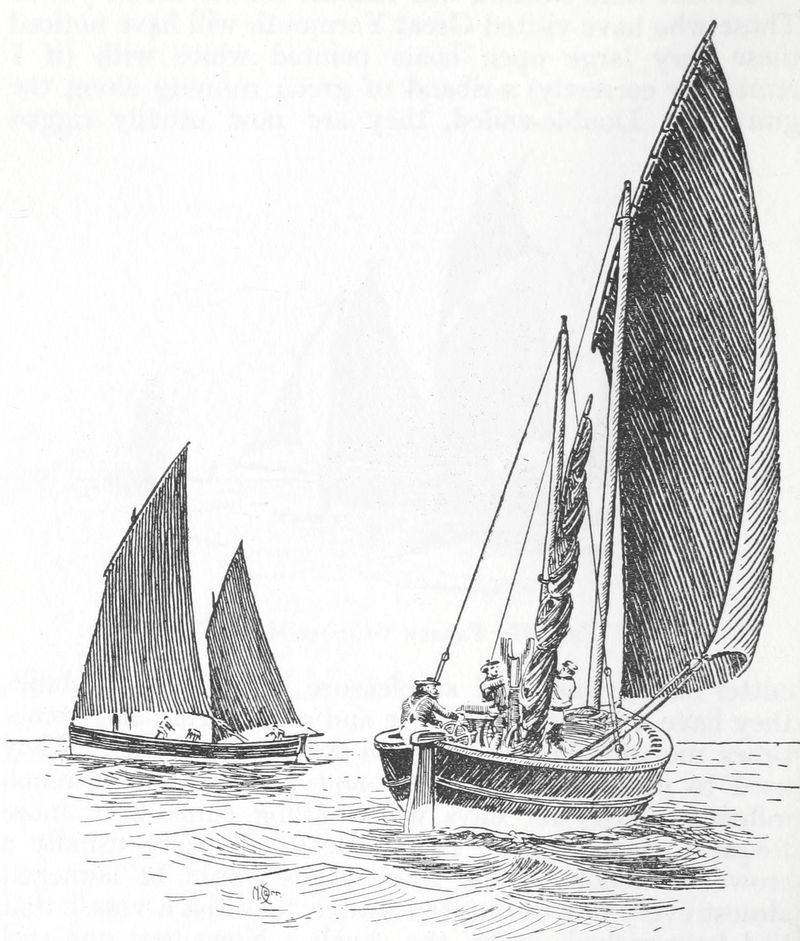
Fig. 108. Scotch “Zulu.”
Until about 1860 the Scotch fishing boat was entirely influenced by Norway, and even to-day no one could deny that this influence is altogether wanting. But at last the fisherman began to seek the herring further out to sea, and so a bolder, decked ship was evolved, and clinker-build gave way to carvel, and the design was given finer lines and greater draught. I have watched a fleet of such vessels as in Fig. 108 running into Scarborough Bay with an onshore breeze in the soft light of a September afternoon, with their yacht-like lines and their fine massive hulls suggesting an ideal combination of strength and beauty. Most of these large “Zulus,” as they are called, carry steam capstans for getting in the heavy nets, hoisting sail and warping into harbour. Within the last few years they have been fitted with steering wheels instead of helms. They are good boats to windward, and are able to carry their enormous lugs longer than most vessels could keep aloft a similar area of sail.
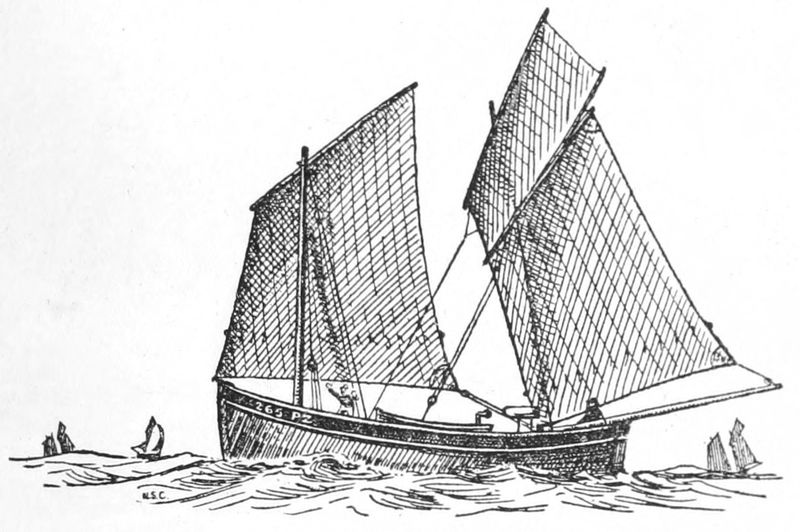
Fig. 109. Penzance Lugger.
The Cornish lugger is able to carry a larger mizzen but a smaller lug forward than his Scotch cousin. Fig. 109 is an example of a Penzance lugger. She draws also more water aft than the “Zulu.” The Penzance luggers are famous all over England for their seaworthiness and easy lines. They are usually about fifteen or twenty tons, have in proportion to their size very high bulwarks to encounter the Atlantic seas, and an exaggerated outrigger over the stern unsupported by stays and cocked up at an angle to clear the sea when the ship is pitching. Her mizzen is longer than her mainmast, and rakes forward at a great angle. Sometimes they set a topsail, as seen in the sketch over the mizzen: and at times they also run out a bowsprit and jib.
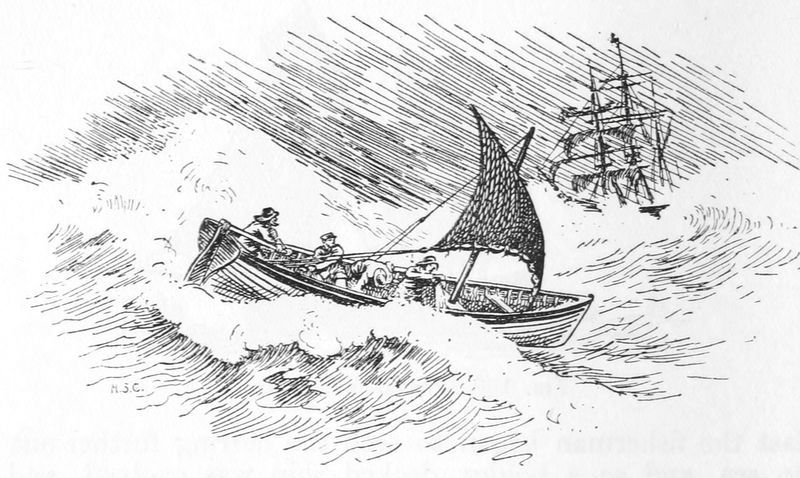
Fig. 110. Deal Galley Punt.
We could not close our list of characteristic luggers without including that brave little ship the Deal galley-punt (see Fig. 110). Chapman in his “Architectura Navalis Mercatoria,” published in 1768,[117] shows a Deal lugger (or as she is called then a Deal cutter) with three spritsails, the mizzen having a bumpkin, whilst a jib is set on a bowsprit forward: but this type has become obsolete. In those days they were engaged in taking out from the shore heavy anchors and cables to vessels in the Downs which stood in need of them. With the advent of steam and improved holding gear their days of usefulness departed. But a smaller type, the Deal lugger, of which we now speak, is still a feature of the sailing craft at the eastern end of the Channel as she goes about her business “hovelling” or hovering on the look-out for such odd jobs as taking pilots ashore or attending on shipping between Dungeness and the North Foreland. Never a ship gets picked up by the treacherous Goodwins but the Deal lugger comes running out in any weather, ready for a salvage job and a third of its value as a reward. Even whilst these lines are passing through the press, they have been busy standing by the Mahratta liner stranded on the Goodwins, and hurrying ashore with the passengers and cargo of tea salved from the hold of the big steamer. These little craft sail very close to the wind and are out in the worst of weathers, and require considerable skill in handling. The one lug-sail has to be lowered and hoisted at each tack, but they are wonderfully quick both under sail and when rowed. Any sailing man will tell you how excellent a sail for lifting a boat the lug-sail is, and well the little Deal galley needs it. The yard of the sail hooks on to a traveller and is hoisted by halyards up the mast, a purchase being used to “sweat” it down taught. The rudder is made easily detachable, supported on pintles with a rope-strop attached. It is her length in proportion to her beam that gives her such speed. Clinker-built, the Deal lugger is about thirty feet long. Her mast is placed some distance from the bows, and is very stumpy, but in spite of this the Deal galley punt is a wonderful little ship on a reach.
Having shown the directions in which the development of smaller ships has taken place, and especially in the trading and fishing craft, let us now turn our attention to that very modern development, the yacht. As we set out not to write a history of yachting but of sailing ships, we shall consider not the marvellous growth of the queen of sports, but the influence which that has had in developing a particular species of ship used entirely for the purpose of pleasure and racing. We alluded in an earlier chapter to King Edgar, whose “sommer progresses and yerely chiefe pastimes were the sailing round about this whole Isle of Albion.” He at least showed the real spirit of a yachtsman, and had he lived in later times he might have established the sport on a sound footing many years before it began to prosper.
But let us make no mistake about this word yacht. Of Dutch derivation, and related to the Norwegian jaegt, the word in the seventeenth century signified a transport for royalty or some individual of distinguished rank. In that way we could include those esneccas mentioned earlier in this volume which were prepared for carrying British royalty across from these shores to France. But it was not until the early part of the seventeenth century that the yacht as a special type of vessel, distinct from one temporarily adjusted for a short voyage, was produced. As other fore-and-afters first saw light in Holland at this time, so it was but natural that the yacht should originate there. From old paintings and prints we see them rigged after the manner of those Dutch fore-and-afters which we mentioned as to be seen there in previous pages of this chapter. Especially popular for yachts was the sloepe rig with the two masts and sails but no headsails, although the boomless but gaff mainsail, fitted with brails not unlike the rig of the bawley, was also found. The high sterns, square and much decorated with carving and gilt, the comparatively low bluff bows and the pair of leeboards were the most conspicuous features. The rig was usually cutter or sloop (in the sense of having one mast mainsail and foresail, but without jib). Later on we find ketches being favoured.
In 1660 the Dutch presented Charles II. with a yacht called the Mary, “from whence,” writes Sir Anthony Deane to Pepys, “came the improvement of our present yachts; for until that time we had not heard of such a name in England.” This Mary was of a hundred tons and was the first yacht to appear on our Navy list. She was lost in 1675 near Holyhead. From this model Christopher Pett in 1661 built the Anne at Woolwich, her tonnage, beam, and length of keel being the same as those of the Mary, but she drew three feet less water. In the same year Charles was presented with another but smaller yacht of only 35 tons, called the Bezan, which also came from the Dutch. From the arrival of the Mary various sized yachts began to be built in England, of which the tonnage gradually increased. The Katherine, built in 1661, was captured by the Dutch in 1673. So far had this new departure progressed in our country that in 1674 a design was made for two yachts to be built at Portsmouth for the King of France in imitation of Charles II.’s. But the largest built about this time was the new Mary, to replace the first one lost. Of 166 tons, she was launched in 1677. The smallest yachts were the Minion of 22 tons, and the Jemmy of 25 tons, and the Isle of Wight of a like tonnage. Incidentally we find in the Naval MSS. of the time that the dimensions of the biggest yacht’s mast of the year 1683 were: length 20 yards, “bigness” (i.e., thickness) 20 inches.
It was during the reign of that apostle of hedonism, Charles II., that the yacht became not merely the vessel of state but of pleasure. He introduced into England yacht racing, although the Dutch had for a long time delighted in regattas and naval sham fights with yachts. In 1661 Charles sailed in a match from Greenwich to Gravesend and back. One impulse that had been given to the Dutch to build so-called yachts with finer lines and high capabilities of speed was the trade carried on to the East by their Dutch East India Company, and it was this company that had made Charles the present of the first yacht he ever possessed. During the eighteenth century yachting began to be a new sport for noblemen and wealthy gentlemen, especially in the neighbourhood of Cork. By the end of the century the Solent was becoming the cruising ground for a large number of English yachts, and in 1812 a yacht club was started at the Medina Hotel, East Cowes. In 1817 this newly-formed yacht club was joined by the Prince Regent, who used to cruise between the Wight and Brighton in the Royal George.[118] George III. had also patronised yachting, and the illustration in Plan 4 gives some idea of his yacht the Royal Sovereign. Launched at Deptford in 1804 she drew 9 feet forward and a foot more aft. She was copper-bottomed with a streak of yellow painted above, with another streak of blue above that, while her stern was ornamented with medallions of the cardinal virtues. Neptune presided over the stern, while the figurehead represented her Majesty. It will be seen at once how similar in colouring and decoration she was to the type of ships prevalent in Charles II.’s time. She was said to have been very fast and beautifully decorated, as well inside as out. She was 96 feet 1 inch long on deck with a breadth of 25 feet 7 inches. Her tonnage was 280 18 94 . She was ship-rigged and carried royals and stuns’ls, judging from a print of 1821. In the external decoration of this yacht we can see the influence which is still manifested in the royal steam yachts of this country to-day. The lavish display of gold leaf, the heavy stern and general clumsiness—all vile inheritances from the days of Charles II. when naval architects knew no better—were all reproduced in the old Victoria and Albert and have been perpetuated even in the newest royal yacht the Alexandria.
It is only with the nineteenth century that yachting really begins, but it was not till after the Crimean War that the sport began in earnest. At the beginning of the nineteenth century the cutters were built on the lines of the revenue cutters, which as we saw just now, owed much to Dutch influence. The reader who wishes to see what clumsy creatures they were has only to look at Turner’s pictures (see, for example, the cutter in Fig. 71). In such a painting as Charles Brooking’s The Calm, numbered 1475 in the National Gallery, we readily see the square topsails above the fore-and-aft mainsail and headsails. Brooking lived from 1723 to 1759, but fifty years later the cutter had remained much the same. The spars these yachts carried were enormous, and they were built of such strength that they were up to the Government standard. Although the cutters were of large dimensions, sometimes having a tonnage of 150, yet they were very tubby, round creatures, their proportions being three beams in length and heavily ballasted after the mediæval manner with gravel, yet sometimes also with iron ore. But as match sailing became commoner, naturally a means was sought for making the cumbersome craft less heavy. The heavy ballast remained, but both timbers and planking were of less thickness. Hitherto of clinker build, this gradually gave way to carvel-work. One of the most famous yachts of the first quarter of the century was the Arrow, built clinker fashion in 1822 and still in existence.
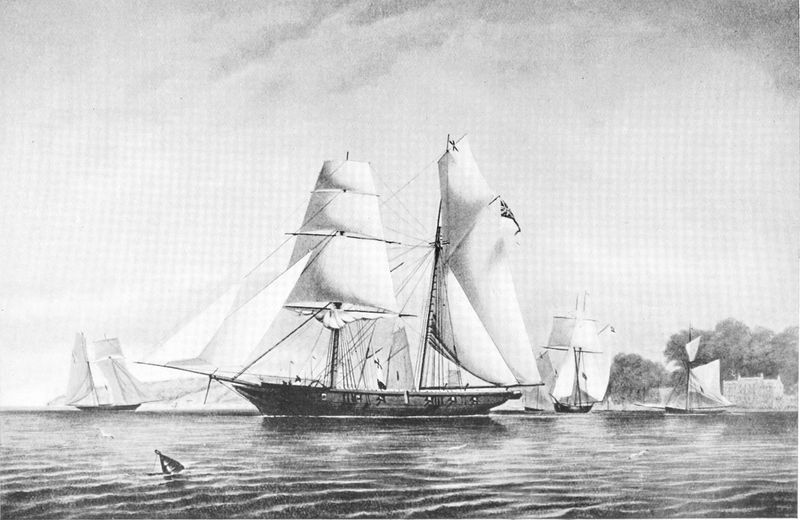
Fig. 111. The Yacht “Kestrel,” 202 Tons. Owned by the Earl of Yarborough, Commodore of the R.Y.S.
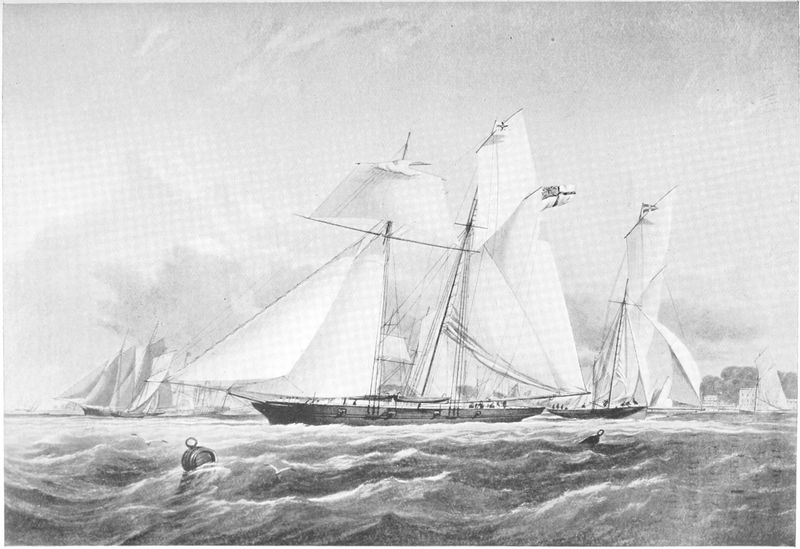
Fig. 112. The Yacht “Xarifa.” Owned by the Earl of Wilton.
The illustration in Fig. 111 represents the Kestrel, 202 tons, belonging to the Earl of Yarborough, Commodore of the Royal Yacht Squadron. In the early ’forties she was a well-known ship. She is rigged as a Hermaphrodite brig, that is to say she is brig-rigged on her foremast but schooner-rigged on her main. She also carries a tier of guns. The influence, indeed, of the Royal Navy on these early yachts is notable. The cutters were influenced by the Government revenue cutters and the bigger yachts by the Naval brigs. Fig. 112 also shows a yacht of this period. This is the Xarifa which belonged to the second Earl of Wilton. She is rigged as a topsail schooner and also carries guns. The rigging of yachts at this time was chiefly of hemp, but, as will be seen from the accompanying illustrations, the sails were very baggy.
In the ’fifties racing between yachts went rapidly ahead. The crack cutters of the south coast were the Arrow, 84 tons, the Lulworth, 82 tons, the Louisa, 180 tons, and the Alarm 193 tons. A general improvement was taking place. The old-fashioned gravel ballast was thrown out and lead was slowly but surely introduced in spite of the criticism that it would strain the ship and cause her to plunge badly in a seaway. Next, instead of inside the lead was put outside below the keel. Finally the tubby proportions vanished and yachts were given greater length, greater depth but narrower beam. Early in the ’fifties Thomas Wanhill of Poole introduced the raking sternpost. Instead of the Dutch-like bow the long clipper bow, now famous among the mercantile ships, was coming into popularity.
But a new force was to come from across the Atlantic which had far-reaching effects on the yachts of this country. Let us return once more to Massachusetts. The theory of the advantage possessed by a sharp entrance and hollow water-lines had been proved, in the case of the Gloucester fishing and pilot schooners, to be sound and correct. Then it was decided to build a yacht on similar but improved lines: so in 1851 was launched the famous America, costing £4000. She was sailed across to England and on August 22, 1851, was the winning yacht for the special cup offered by the Royal Yacht Squadron. In the race round the Isle of Wight she beat the pick of our cutters and schooners so handsomely as to make yachtsmen and yacht-builders, designers and sail-makers open their eyes in amazement. The cup was afterwards presented by the owners of America to the New York Yacht Club as a perpetual challenge trophy to be raced for by yachts of all nations. The reader is well aware that in spite of various plucky attempts we have not yet succeeded in bringing it back to the country where it was manufactured.
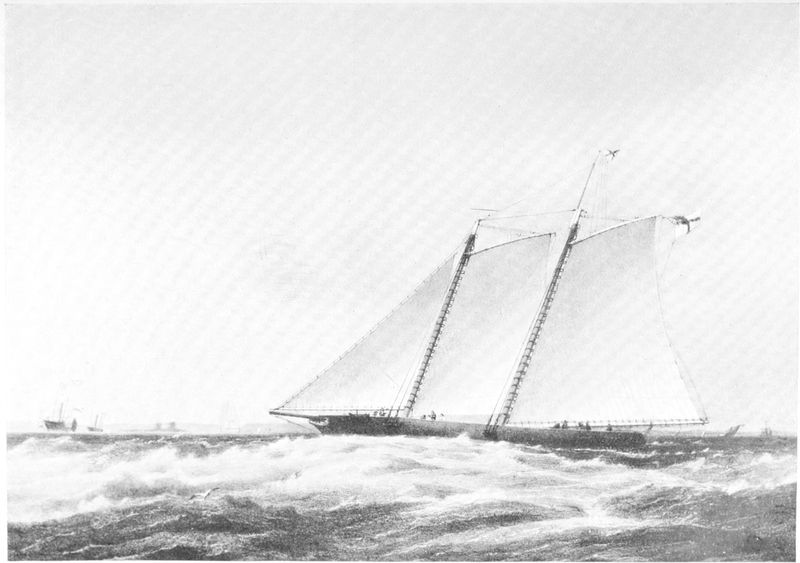
Photo. West & Son.
Fig. 113. The Schooner “Alarm” as she appeared when rebuilt in 1852.
From a contemporary print, by kind permission of the Royal Victoria Yacht Club, Ryde.
After the success of America a change was made in the old type of yacht. The Alarm which had been built in 1834 as a cutter of 193 tons, was in 1852, consequent on America’s victory, lengthened 20 feet by the bow and converted into a schooner of 248 tons. The illustration in Fig. 113, which is reproduced by kind permission of the Royal Victoria Yacht Club, Ryde, shows the Alarm after she had been rigged after the manner of America with one headsail, having its foot laced to a boom, with a foresail having gaff but no boom, and with a mainsail with both gaff and boom. As here seen she justified the alterations made in her and remained for many years the fastest schooner of the fleet. But not only in rig and design did America make a complete revolution. Hitherto our sails had been mere wind-bags, but the America had her sails made so as to lace to the spars, while ours had been loose-footed on the boom. The American yacht’s canvas thus set flatter and she could hold a better wind than our craft. Henceforth English sail-makers adopted the new idea. Schooners at least took to the new shape at once but the cutters were a little time before they followed the lead thus given to them. It was to America, therefore, that the last existing relic of mediævalism in British ships was banished off the face of the waters for ever.
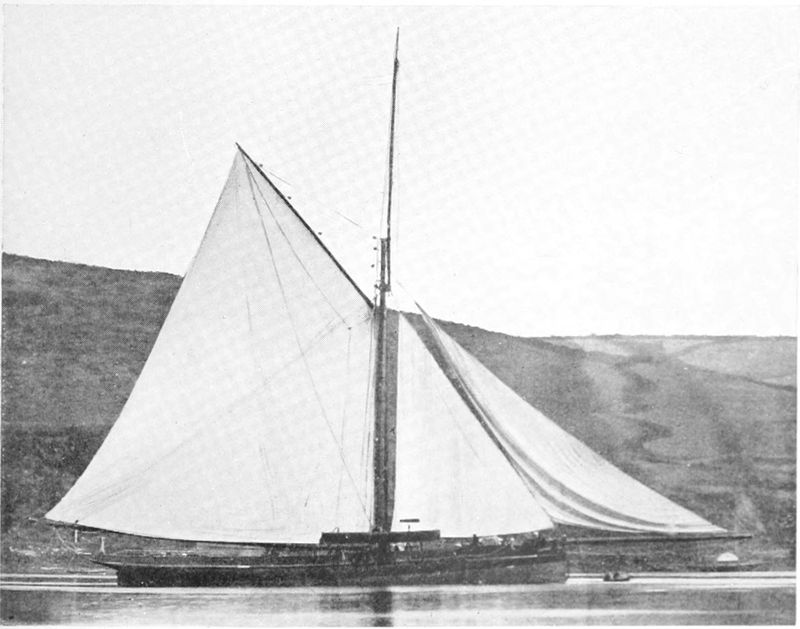
Fig. 114. The “Oimara.” Built in 1867.
In 1852 the famous cutter Arrow, for the same reason as had transformed the Alarm, was rebuilt. Her previous length when she was first built as far back as 1823 was only 3·35 times her beam. In 1852, also, Mr. William Fife of the famous “Fife of Fairlie” firm came into prominence with the Cymba. Sail-making in the hands of Lapthorn & Ratsey proceeded along scientific lines, and eventually cotton was used instead of flax. In the ’sixties, following the example set by the builders of the clipper-ships, iron framework was used in combination with wooden skin, and from the early ’seventies to the ’eighties the clipper-bow had attained such success on big ships that it became of great popularity on yachts. But during the ’sixties the old straight-stem cutters were at the height of their fame. The Oimara, seen in Fig. 114 with the long bowsprit of the period, was a famous racing craft of the south coast. Built in 1867 by Mr. William Steele of Messrs. Robert Steele & Co., Greenock, the well-known builder of clipper-ships, her tonnage was 163. She sailed a memorable race round the Isle of Wight in August of the following year against the American schooners Sappho, Aline and others. Going east about, Oimara led the fleet until the Needles were rounded, but running back to Cowes against the ebb tide, she was beaten by the schooners. This fine ship is still afloat in Poole harbour above the bridge, and is used as a houseboat.
The Aline just mentioned was another beauty of her day. Built by Messrs. Camper & Nicholson of Gosport in 1860, she was the first yacht to get away from the raking mast so well seen in the illustration of the Alarm. In the Aline the mast was stepped almost upright and she was also given a running bowsprit and jib. Another fast ship was the famous Egeria, 153-ton schooner, built by Wanhill at Poole. She was at her prime during the ’sixties, and beat Aline during the former’s maiden race in 1865.
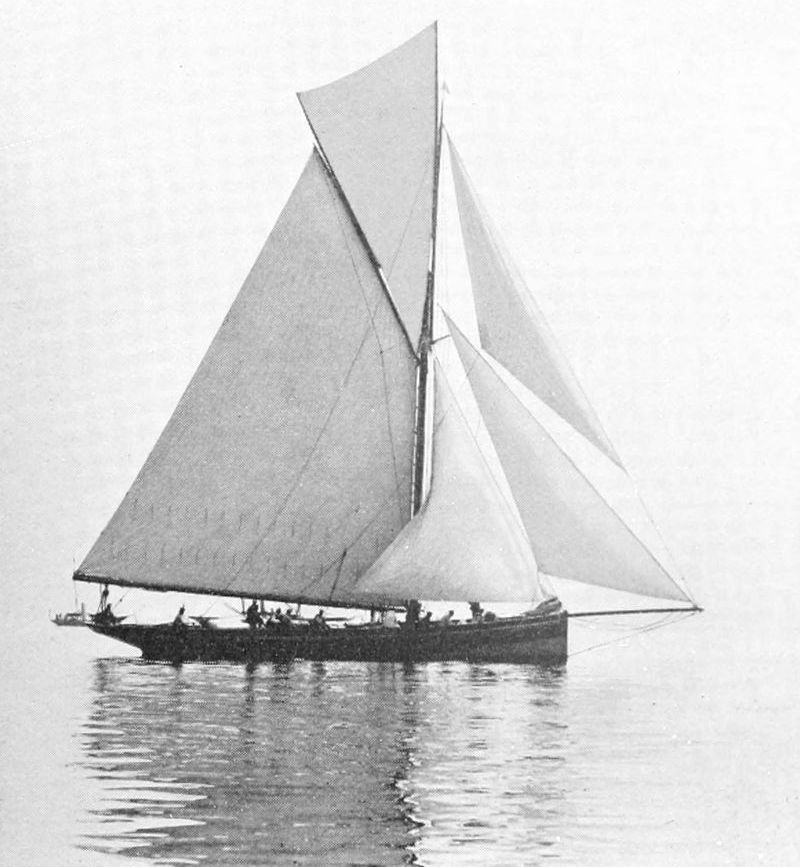
Fig. 115. The “Bloodhound.” Built in 1874.
During the ’seventies and till the ’eighties, the tendency was to build yachts whose dimensions were still deeper, narrower and longer. Beam was thought deserving of little consideration and altogether undervalued until the year 1886, when an entire change of feeling came. The illustration in Fig. 115 shows the wonderful old Bloodhound. She was built by Mr. William Fife of Fairlie in 1874 for the Marquis of Ailsa and was one of the famous class of 40-tonners which flourished during the ’seventies and into the ’eighties. During the six years she belonged to her first owner she won about £2500 worth of prizes, and afterwards changed hands. Last year, however, Lord Ailsa re-purchased her, and with new sails the old ship showed that her marvellous turn of speed had not deserted her. She did remarkably well during Cowes week until she had the misfortune to be sunk in collision with L’Esperance, and lay for some time at the entrance to Cowes fairway, a sad sight, with her masts showing above water and her crew at work salving what they could. She has since been raised, and this year is again racing with surprising success.
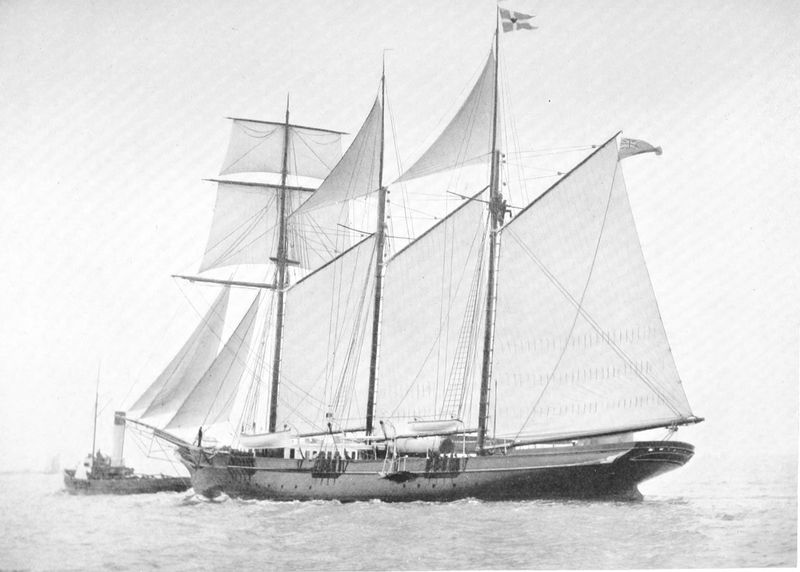
Photo. West & Son.
Fig. 116. The Auxiliary Topsail Schooner-Yacht “Sunbeam.”
Registered Tonnage, 227. Owned by Lord Brassey.
Few yachts, perhaps, are so well-known in name, at least, to the general reader, as the Sunbeam, in Fig. 116. Built in 1874, and owned by that enthusiastic yachtsman and experienced navigator Lord Brassey, the Sunbeam is an auxiliary topsail-yard schooner. She was designed by Mr. St. Clare Byrne and is built of teak with iron frames. Her length over all is 170 feet; beam 27½ feet; depth 13¾ feet. Her displacement is 576 tons; her registered tonnage 227; her draught 13½ feet; while her sail area as now altered is 7950 square feet. She has cruised round the world, and been into almost every port where she could get. She raced across the Atlantic in 1905 to the Lizard, with the Valhalla among the competitors, although it was not to be expected that she would come in first against such an extreme type as the Atlantic. In her time she has covered as her best run under canvas, 299 knots from noon to noon, whilst her highest speed, also under sail alone, was 15 knots. She is still happily with us, and is a familiar sight at Cowes, where she fits out.
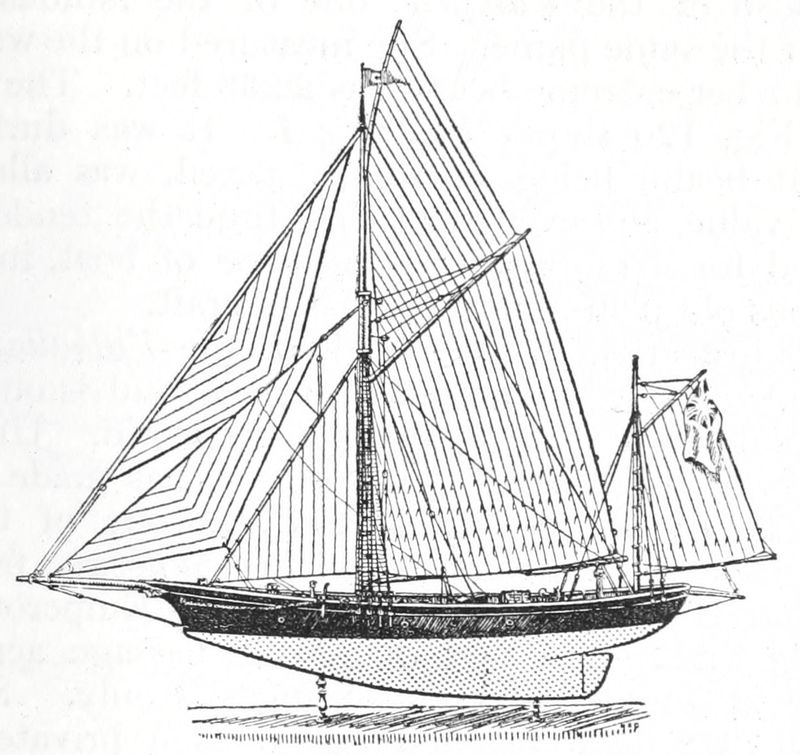
Fig. 117. The Yawl “Jullanar.” Built in 1875.
During the ’seventies, thanks to Mr. William Froude and others, experiments of the highest educative value were made to discover the laws which governed the resistance of water to bodies moving through it. This led to a scientific basis on which to model the lines of yachts’ hulls. But suddenly and unexpectedly, from Maldon, on the Blackwater, in a remote corner of Essex, a Mr. E. H. Bentall, not a professional naval architect but an agricultural implement maker, who had received but little training in naval architecture, designed and had built the now famous yacht the Jullanar, in 1875. Since length means speed, he gave her much of this, whilst for stability she was given a fairly deep draught. But getting right away from existing conventions, he had the courage to dispense with the old-fashioned straight stem and stern, and cut away all dead-wood from both. And so the Jullanar, with her easy lines, and rigged as a yawl, came into being. She had a tonnage of 126 (Thames measurement); length over all 110½ feet; beam 16·6 feet; and a draught of 13½ feet. She immediately displayed such remarkable speed and was so successful as a racer that her lines considerably influenced the late Mr. G. L. Watson, the famous yacht architect of the nineteenth century, in designing the Thistle, although this ship did not come into being until 1887. The sketch in Fig. 117, showing the hull and rigging of the Jullanar, has been made from the fine little model in the South Kensington Museum.
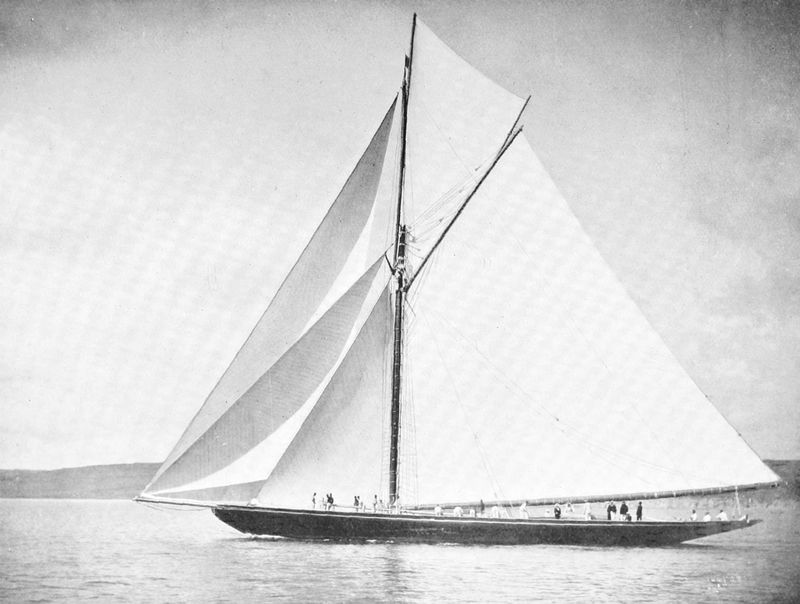
Photo. West & Son.
Fig. 118. The “Satanita.” Built in 1893.
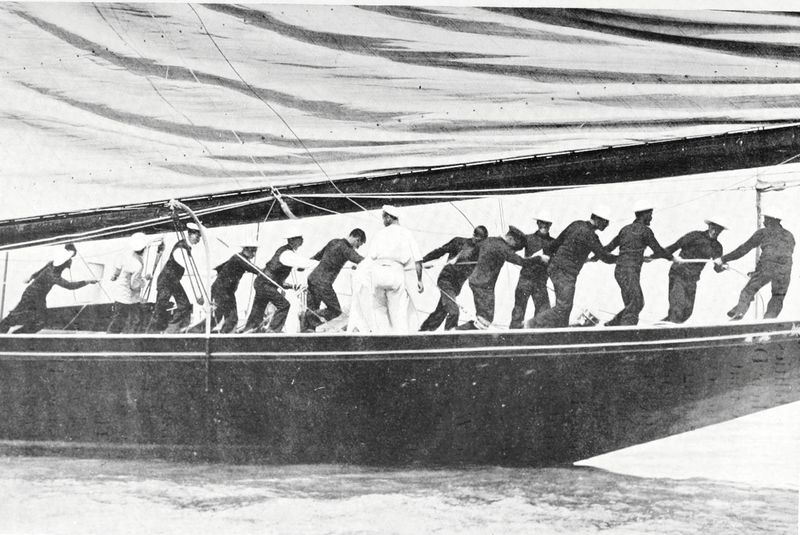
Photo. S. Cribb.
Fig. 119. King Edward VII.’s Cutter “Britannia,” launched 1893, showing the Mainsail being hoisted by Fourteen of the Crew.
Yacht-design has been considerably modified by contemporary existing measurement rules. Thus, when in the ’eighties the only taxed dimensions were, not length over all, but length on water-line and sail area, the temptation to introduce overhang both at bow and stern was irresistible. In Jullanar the germ of the idea existed, but it developed to its fullest extent during the ’nineties, and so by a curious fatality one becomes witness of still another revival, more strange and curious than all the others, the revival of that which was indeed one of the most characteristic features of the Egyptian craft in the early dynasties, the overhanging bow and stern. In 1893 was built the Satanita, in which this last-mentioned feature is well shown. (See Fig. 118.) This powerful beauty has on the water-line 97·7 feet, and an extreme beam of 24·7 feet, and a draught of 16·5 feet. Her sail area (Y.R.A.) was in her Solent days 9923 square feet. The beautifully-fitting sails seen in the accompanying illustration are in wonderful contrast to those hollow bags used in the pre-America days. In the same year was launched King Edward’s (then Prince of Wales’) Britannia, which with Captain Carter at her helm, won both fame and a considerable number of prizes during the ’nineties. Her length on the water-line is 87·8 feet; her extreme beam 23·66 feet; and draught 15 feet. The illustration in Fig. 119 of the counter of Britannia has been specially included to give the reader some idea of the weight of her mainsail, which, as will be noticed, is being hoisted by no less than fourteen hands on the halyard, including the ship’s cook and steward. The year 1893 was made memorable by the launch also of the Valkyrie, one of the famous trio of yachts of the same name. She measured on the water-line 86·8 feet; her extreme beam was 22·33 feet. The illustration in Fig. 120 shows Valkyrie I. It was during this year that beam, being no longer taxed, was allowed to show its value, and ever since that time the tendency has continued for a more wholesome type of boat, instead of the vicious old plank-on-edge class of craft.
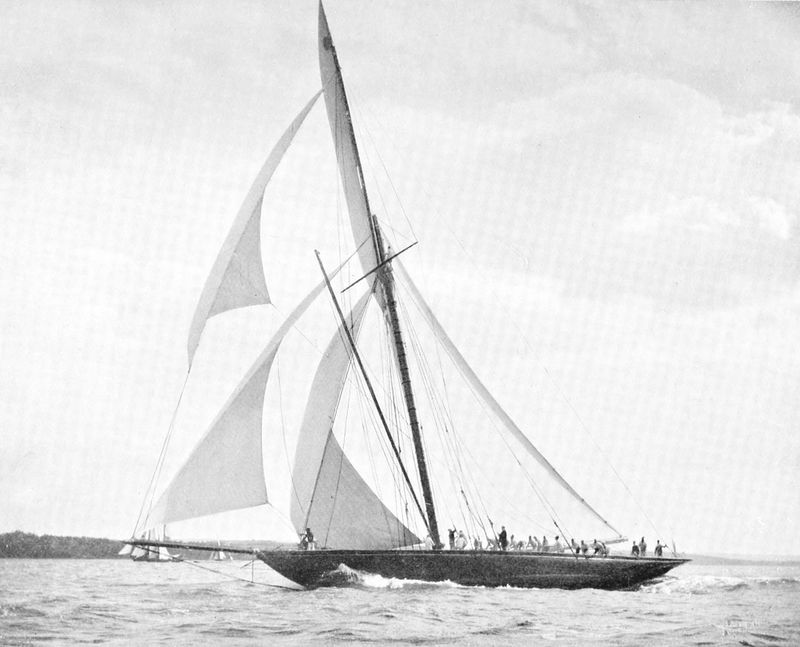
Photo. West & Son.
Fig. 120. The “Valkyrie I.” Owned by the Earl of Dunhaven.
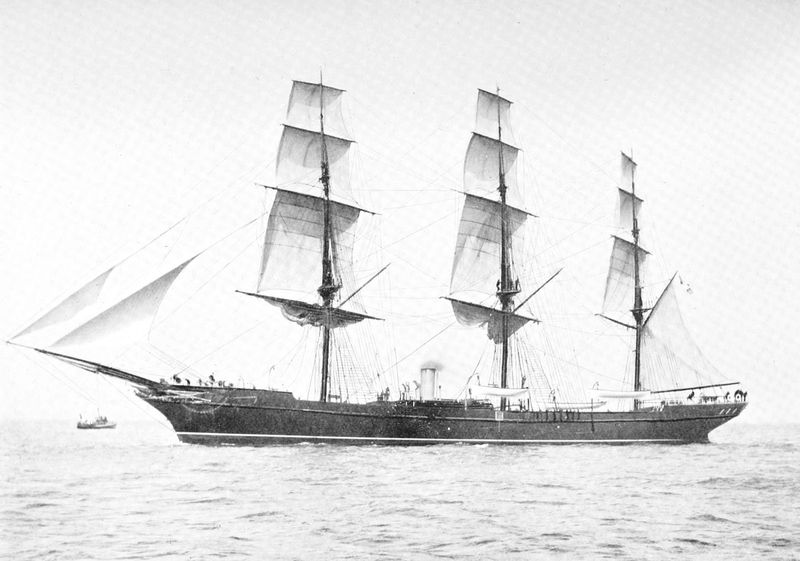
Photo. West & Son.
Fig. 121. The Auxiliary Ship-rigged Yacht “Valhalla.” 1490 Tons. Built in 1892.
The illustration in Fig. 121 is of the Valhalla, which, like the Sunbeam, has auxiliary engines and is one of the largest and finest sailing yachts in the world. Under the ownership of the Earl of Crawford she has made lengthy voyages to distant countries, and was one of the fleet which raced in company with the Sunbeam from the U.S.A. to the Lizard for the German Emperor’s Cup, obtaining third prize, and doing the passage across the Atlantic in 14 days 2 hours, using sail only. She was built in 1892, and was first rigged as a privateer of a hundred years ago with stun’s’ls. She even had her ward-room, gun-room and armoury after the manner of the naval ships of a century ago. In the accompanying illustration she is seen with courses, topsails, t’gallants and royals. But when she came into the hands of Lord Crawford the stun’s’ls were abolished, and she was given double topsails instead of single so as to facilitate her being worked with less labour. The old-fashioned deck arrangement below was also entirely changed. This handsome 1490-ton yacht has recently been sold, and left English waters to become an American training-ship.
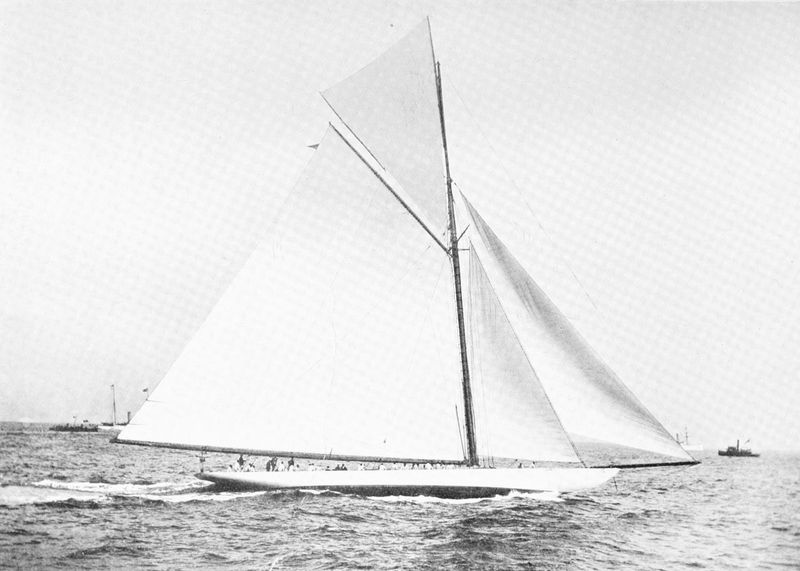
Photo. West & Son.
Fig. 122. The American Cup Defender “Columbia.” Launched in 1899.
Although American yachting existed long before the races for the America Cup, yet these contests have given an enormous fillip in the United States to the building of cutters as apart from their fast schooners. Such vessels, built to defend the Cup, as the Defender, launched in 1895, the Columbia in 1899 (see Fig. 122), the Constitution in 1901, and the Reliance in 1903, are about 90 feet on the load water-line, and carry about 13,500 square feet of canvas; though when Reliance beat Shamrock III., the former carried over 16,000 square feet. But the most popular American large racing cutters are the 70-footers. In build the Americans have been accustomed to use lighter scantlings than we on this side of the Atlantic. Meteor, in Fig. 123, the well-known schooner belonging to the German Emperor, was the product of an American yard. The photograph here reproduced was taken while she was racing for the King’s Cup inside the Isle of Wight.
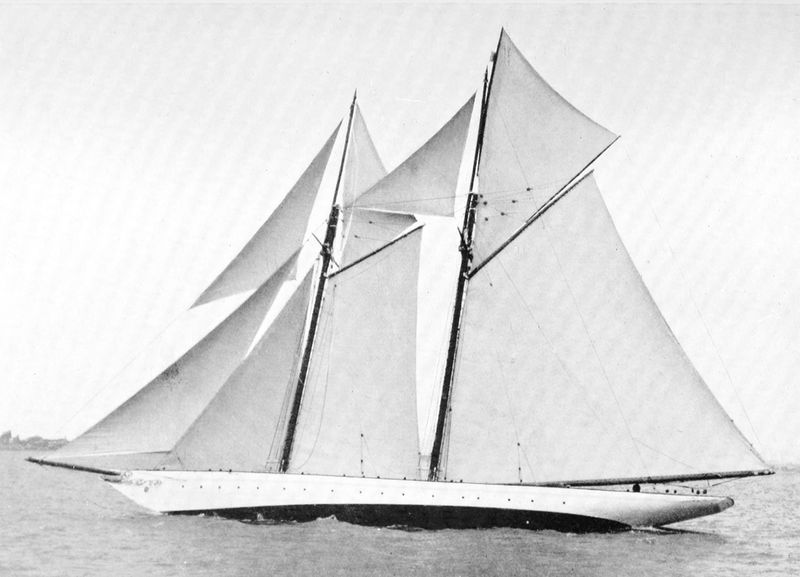
Photo. S. Cribb.
Fig. 123. The Schooner-Yacht “Meteor.” Owned by His Majesty the German Emperor.
Some sensation was caused in the Solent last summer by the arrival and success of the Germania, a remarkably fast and pretty schooner, notable as showing the ability to which German yacht designers and builders have now attained. That we can in England still build cruising as well as racing schooners is proved by two such different examples as the Elizabeth and the Pampas. The sail plan of the former will be found in Plan 5. Launched in 1906 from the yard of Messrs. White Brothers of Cowes from designs by Mr. H. W. White, her tonnage (Thames measurement) is 236, her length over all 132 feet, but on the water-line 93½ feet. Her draught is 12½ feet, and her sail area 7938 square feet. She is also fitted with a motor that can be run on either paraffin or petrol with a two-bladed propeller, giving a mean speed under motor alone of six miles per hour. The deck plan and longitudinal section showing motor installation will be found in Plans 6 and 7.
The Pampas is one of the most interesting yachts of 1908. In her will be found the very last word in schooner designing and building. The requirements were that she should be suitable to go to any part of the world in comfort and with speed. In order therefore that she might not be handicapped in the Doldrums she was fitted with a 60-horse-power motor giving a speed of six knots in smooth water. Designed by Mr. C. E. Nicholson, and built by Messrs. Camper & Nicholson for Señor Aaron de Anchorena, of Buenos Ayres, she has considerably more overhang than the Elizabeth, and has shown herself to be very fast under sail alone. The sail and rigging plan in Plan 8 will explain itself, whilst from the other plans the general internal arrangement of this most modern of yachts will be realised. She has between her two masts a sunken deck-house, a feature that has recently become very popular on sailing yachts. The two large cabins athwart the ship are fitted in satinwood, and other accommodation is in ivory white. Electric light and ventilating fans are also found on her, and she is classed twenty years A1 at Lloyd’s.
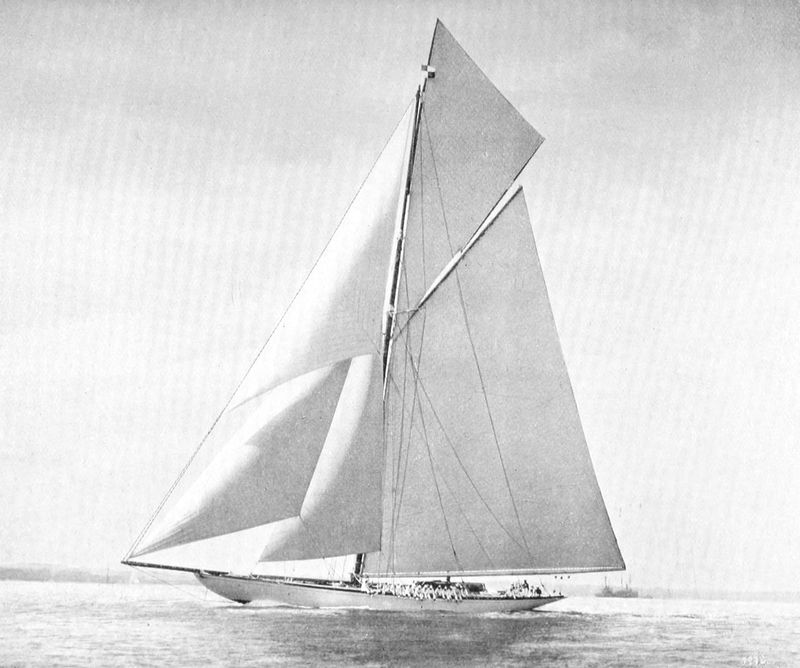
Photo. West & Son.
Fig. 124. “White Heather II.,” 23-Mètre Cutter.
To return to the English cutters, one of the most interesting of modern yachts is that seen in Fig. 124, which represents White Heather II. For size and sweet lines, with her bold bows and white graceful hull, her lofty mast and her mountain of canvas, she is an imposing sight if one comes across her on the Solent. She is at her best in a strong wind; in light winds she used to be no match for the latest Shamrock. But during the past winter White Heather has had some structural alterations made to improve her power in light winds.
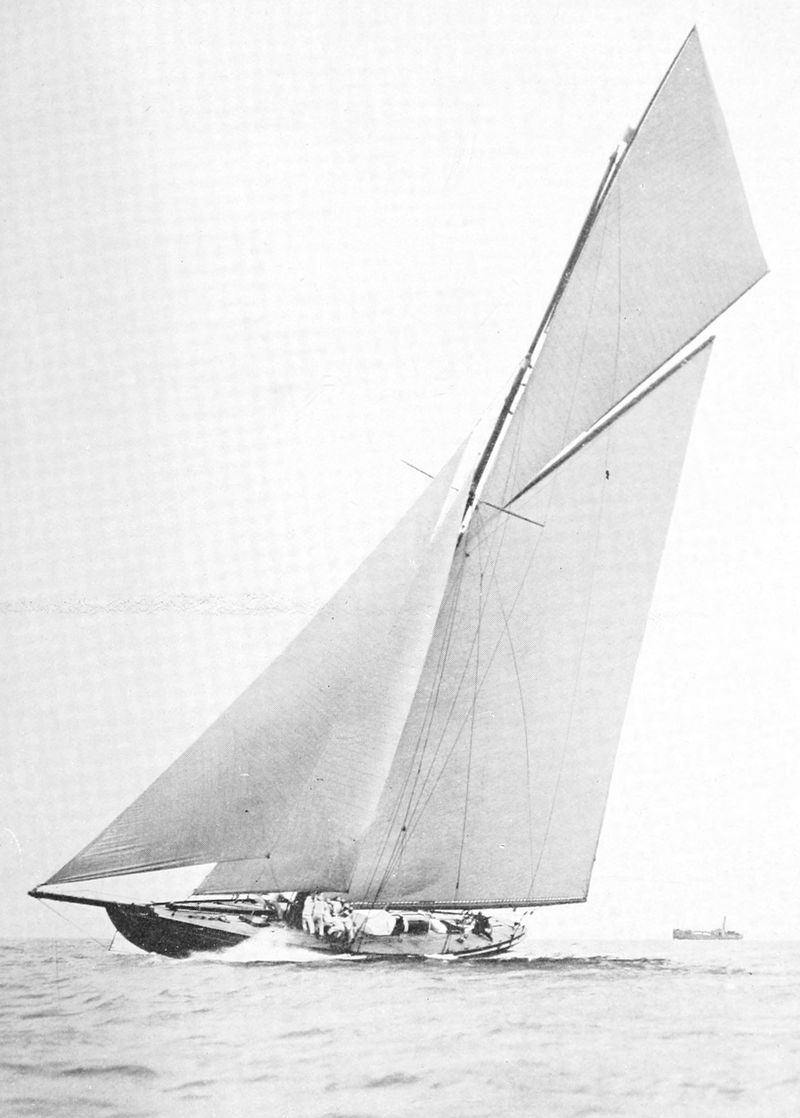
Photo. West & Son.
Fig. 125. “Shamrock IV.,” 23-Mètre Cutter. Owned by Sir Thomas Lipton. Launched 1908.
An important step was taken in 1906, when an international conference was held to devise such an international rule as would be acceptable to the whole of yachting Europe. During the last fifteen years various rating rules had been in force at different times. It was now felt that something should be done to prevent the success of the racing-machine and skimming-dish type, and recent rating rules had indeed tended to produce a wholesome cruiser that was nevertheless good for racing. The conference therefore formulated a new rule based on that which had produced such recent healthy types as Nyria; but a premium was placed on freeboard and a check on clumsy overhangs, in order that a thoroughly healthy type of sea-going yacht might be evolved that should be good as well for cruising as for racing. Care was taken also to ensure the requisite strength in construction. The rule came into force on January 1, 1908. Under this rule, Shamrock IV., seen in Fig. 125, was built, and during her maiden season last year she showed that in light weather there was nothing of her size to catch her. In spite of adverse criticisms the new rule has in it much that is likely to be an influence for good; and since it is to be in force for ten years, it will certainly add to the prosperity of yachting by introducing to an extent hitherto unknown the element of international racing.
Shamrock, the fourth of that name owned by Sir Thomas Lipton, belongs to the 23-metre class. She was designed by Mr. William Fife and built by Messrs. William Fife & Son of Fairlie. She is of composite construction, her planking being of mahogany and her frames of steel. In yachting, as in the biggest sailing ships, wire rigging has now ousted the old-fashioned hemp. Runners, topping lifts, bobstay falls, outhauls, halyards—all are of wire. Racing boats and many cruisers now have rigging screws too, while the custom as to ballast is to bolt most of it outside the keel.
But our limit is at length reached. We have watched the primitive ship evolve from the tree; we have seen how she has been changed and revived, degenerated and improved, made larger or smaller, tubbier or more graceful according as it has pleased the hand of man. Now that we have shown, however imperfectly, with however many omissions, her noble and illustrious pedigree, her ancestry reaching back through the centuries into the first blush of the dawn of the world’s creation, perhaps we shall regard her with an interest, a respect and affection at once greater and deeper because we have become better acquainted with the reasons that have caused each of these developments.
THE END.