FOREWORD (continued 2)
Reading edition
September 26th.
I went to church at St. Saviour’s, the big church beyond the bridge, which was built with the private money of the Tsar as a thanksgiving for deliverance from Napoleon. It has five gold domes which are a beacon to me when I am lost. A service was going on and we mingled with the crowd, which had an amazing preponderance of men. The richness of the church with its golden and crimson robed priests seemed to throw into relief the poverty of the people with their faces so full of sadness. What absurdly stupid things animate one’s thoughts in the most precious moments: for instance, when the priest made the sign of the Cross with the three branched candlesticks in each hand, I instinctively looked to see if he had dropped candle-grease on the carpet—he had! When the contribution plate began to circulate I watched an old peasant next to me. He drew out his pocket-book, and fumbled for a few roubles. He held five of these like a card-hand and fingered them hesitatingly. It was obvious that he was trying to make up his mind whether he could afford to part with them all, or only with some of them. In the end he put them all into the plate, a little act of sacrifice which I am sure will not pass unblessed.
The choir singing without accompaniment was
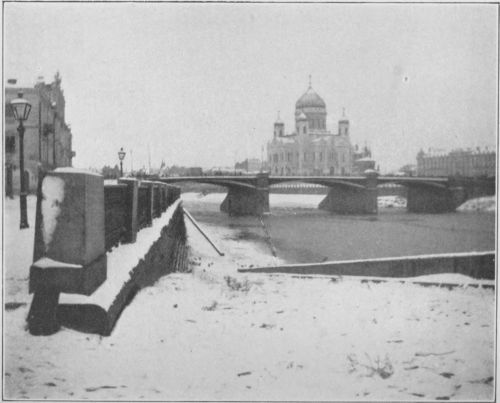
SAINT SAVIOUR’S.
p. 82.
very beautiful. The masses seemed to be very fervent, one could see Faith and Hope in all their faces. It is surely the deep religious feeling in Russia that has sustained these people through all their years of privation, and prevented a greater chaos.
After church we walked along, rejoicing in the sun, to the Tretiakovskaya Gallery, full of various schools of painting. Among the pictures is the famous one of Ivan the Terrible killing his son, but everything that I saw was obliterated by the memory of three modern busts, the work of Konenoff, the sculptor I met at the Strogonoff School. These busts are carved out of blocks of wood. They are indescribable masterpieces in conception, composition and carving. I remained for sometime in admiration and wonderment over this modern work, and then went away, as I could not look at anything else.
At 3 o’clock I hurried to the Kremlin, as Kameneff had telephoned telling me to expect Zinoviev. I waited until four and then he arrived, busy, tired and impatient, his overcoat slung over his shoulders as though he had not had time to put his arms through the sleeves. He flung off his hat and ran his fingers through his black curly hair, which already was standing on end. He sat restlessly looking up and down, round and out and beyond; then he read his newspaper, every now and again flashing round with an imperative look at me to see how I was getting on. He seemed to me an extraordinary mix-up of conflicting personalities. He has the eyes and brow of the fighting man, and the mouth of a petulant woman.
Little by little he became more tractable, and when he had finished reading we talked a little. At moments he threw his head back and seemed to be dreaming. Then he looked like a poet. He is only thirty-eight. It is amazing how young all these Revolutionaries are. I gleaned from him the news that Millerand is the new President of the French, to which he shrugged his shoulders and said that it made no difference, and that the British strike fixed for to-morrow has been postponed for a week. Before he left he said he was pleased with the start of his bust, and that I must do Lenin.
I walked home in face of a lovely sunset; the fiery ball was reflected in the gold dome of St. Saviour’s. I sang as I walked, because I have begun work at last, but people looked at me, although they had never looked at me before. I suppose it was peculiar to hear anyone sing.
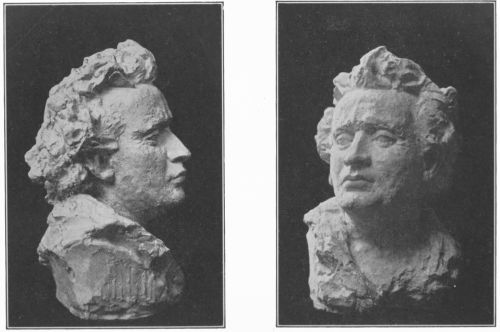
BUST OF ZINOVIEV.
p. 83.
September 27th.
Things begin to move more rapidly now, and my patience is being rewarded. To-day Dzhirjinsky came. He is the President of the Extraordinary Commission, or as we should call it in English, the organiser of the Red Terror. He is the man Kameneff has told me so much about. He sat for an hour and a half, quite still and very silent. His eyes certainly looked as if they were bathed in tears of eternal sorrow, but his mouth smiled an indulgent kindness. His face is narrow, with high cheek bones and sunk in. Of all his features his nose seems to have the most character. It is very refined, and the delicate bloodless nostrils suggest the sensitiveness of over-breeding. He is a Pole by origin.
As I worked and watched him during that hour and a half he made a curious impression on me. Finally, overwhelmed by his quietude, I exclaimed: “You are an angel to sit so still.” Our medium was German, which made fluent conversation between us impossible, but he answered: “One learns patience and calm in prison.”
I asked how long he was in prison. “A quarter of my life, eleven years,” he answered. It was the Revolution that liberated him. Obviously it is not the abstract desire for power or for a political career that has made Revolutionaries of such men, but a fanatical conviction of the wrongs to be righted for the cause of humanity and national progress. For this cause men of sensitive intellect have endured years of imprisonment.
Being Monday there is no theatre, as that is the night the artists have free—on Sundays they work for the enjoyment of the people—so I dined with Mr. Vanderlip, who told me many things which I may not at this juncture write down or repeat. I have not sought his confidence, so I thought it rather unjustifiable when at the end of the evening, having found me a sympathetic listener, he said: “You know too much now, I shall see that you do not leave the country before I do.” Although he likes the people with whom he has come in business contact, he is frankly a capitalist, and glories in it. He is like the Englishman abroad who is conscious of being different to everyone else, and derives from it a smug feeling of superiority.
After dinner he was sent for by Tchicherin, and I spent the evening with Michael Borodin. Michael Markovitch, as Borodin is called, lives in our house. He is a man with shaggy black hair brushed back from his forehead, a Napoleonic beard, deep-set eyes, and a face like a mask. He talks abrupt American-English in a base voice. I have not seen much of him as he works half the day and all the night, like the other Foreign Office officials. He is usually late for meals, eats hurriedly and leaves before we have finished. As soon as Vanderlip had gone Borodin switched out all the drawing-room lights that Vanderlip had put on, except one. I asked him why he did this, and he looked round the garish room and gave a slight shudder: “It is parvenu,” he said; then sinking back into his chair he looked at me intently, and asked: “What is your economic position in the world?” It is the first time he has talked to me, and I found myself answering as if my life depended on my answers. Happily no one in this country knows anything about my family, up-bringing, or surroundings. I have not got to live down my wasted years. I can stand on my own feet and be accepted on my own merits. Borodin mystifies me, I cannot make out, when all his questions have been answered, what he thinks.
September 28th.
Dzhirjinsky came at 10 a.m. for an hour. He is leaving Moscow for a fortnight, so that I can get no more sittings, but seeing how keen I was, he stayed on and on, doling out ten minutes and quarter-hours as so much fine gold. He sits so well that two sittings are worth four of Zinoviev’s.
When the Savonarola of the Revolution left, I felt a real sadness that I may never see him again. Zinoviev sat again in the afternoon, and brought with him Bucharin and Bela Kun. They seemed to approve of Dzhirjinsky’s bust, and insisted on looking through all the photographs of my work. The “Victory” is what really interests them.
I was frightfully disappointed in Bela Kun. I had imagined a romantic figure, but he looks most disreputable. Bucharin is attractive with his trim, neat little beard and young face.
This afternoon, after all had left, three soldiers brought a gilt Louis XVI sofa and a Turkestan carpet to my workroom. These had been ordered to help to make it more habitable and to dispel the severity. I had to laugh, the sofa looked so absurdly refined and out of place. I wondered whose drawing-room it once furnished, and to what little tea-time gossips it had listened. At that moment a sculptor called Nicholas Andrev came in and introduced himself to me. He was sent by Kameneff and mercifully speaks French. A big man with small laughing eyes and a red-grey beard, typically Russian. After we had talked for awhile he described to me the difficulties
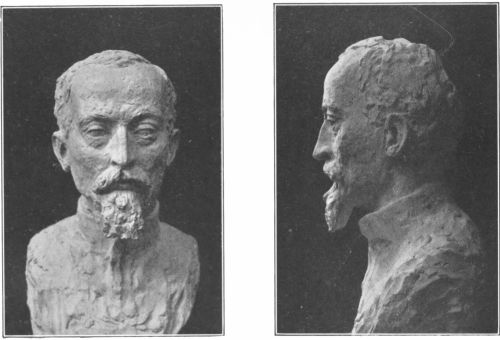
BUST OF DZHIRJINSKY.
p. 87.
under which he had tried to do Lenin in his office, and while he was working. He said that portraiture was not Art. I could not but agree with him, as the difficulty always in doing portraits is that sittings are always too few and too short, but said that one had to put up with it, and do the best one could, breaking one’s heart over it all the time.
He said he had given up sculpture for the time being because of the difficult conditions, and had taken to drawing instead. I said that for the present I was intent on portraits, and that Art would have to wait until later. His attitude is characteristic of the sculptor species. They are all so d—— d proud, and if they cannot get all the sittings they need and work under ideal conditions, they do not think it worth while trying. I consider that there are a few people in the world who are worth any effort to do, even if they do not give one a chance to do one’s best work. Andrev laughed and said that that was journalism in Art.
When I got home I found that the water had been heated for baths. This was a great joy: I had not had one for eight days. Once a week is our allowance, and it should be on Saturdays, but something went wrong with the pipe, and we have been disappointed each evening, so that in fact I had given up hope. How one has learned to appreciate the most ordinary things that one never thought of being thankful for before. But since I have been here I have had to wash in cold water; nor am I called, but I wake up quite mechanically every morning at eight. It will be wonderful to have scrambled eggs one day for breakfast, but I am getting used to just black bread and butter, and sometimes cheese.
I wonder a good deal about my family and friends. It is so strange to have left them without a word, and to get no letters and not to be able to write any. Mamma especially—bless her, who always says “good-night” as if it were “good-bye-for-ever”—I wonder what she feels about my going off without telling her. I wonder if Papa is anxious about me, or indifferent and resentful! When I think about Dick and Margaret I feel a sadness. I can get on without most people in the world, but not without those two, and they must wonder why they do not get letters from me. It it rather dreadful to think that they might believe that my silence means forgetfulness.
This evening we went to the “Coq d’Or.” I thought I was back in London until I looked away from the stage.
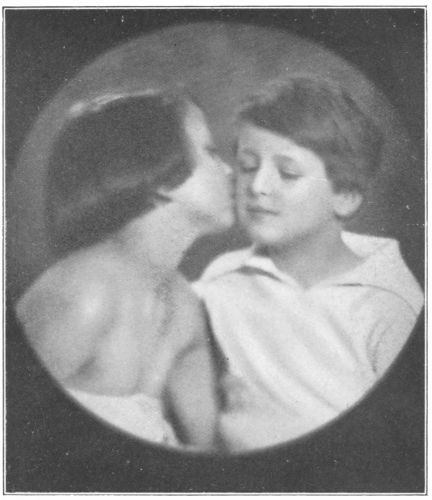
Marcus Adams.
MARGARET AND RICHARD BRINSLEY SHERIDAN.
p. 90.
September 30th.
Kameneff came to see me in the morning with his watch in his hand, he had twenty minutes. It was paralysing, one cannot talk under such conditions. I confined myself to presenting him with a list of things I want done! Small wonder he comes so seldom to see me. When he does come everyone in the house knows it, and one by one they come to my door and ask to see him, each wanting something of him, while his car which waits at the door is borrowed for an errand. It is very discouraging for him.
Borodin took me to “Prince Igor” this evening, it combined the opera with the ballet. In the box next to us was a party of Afghans and with them a Korean. Down in the stalls one man was in a smoking coat and evening shirt, the first I have seen. He was very conspicuous.
October 1st.
Nicholas Andrev met me at the Kremlin at 1 o’clock. Kameneff had placed a car at our disposal for the afternoon. We went to several galleries, beginning with the Kremlin. The palace of a Grand Duchess (opposite the big bell) has been converted into a working people’s club. It was quite clean and cared for, but only the Empire Swan furniture suggested it had ever been a private habitation. We went downstairs to a private chapel, painted in black and gold. This had been made into a modelling school, and there were some very good things being done from life. The Spirit of the Holy Ghost descending as a dove from above, and the golden rays of a carved sun made a strange background. My bourgeois prejudice was just for a moment shocked, until I remembered that in our own old fourteenth century chapel at home Papa typewrites on the altar step. It has been longer in disuse it is true, but still, one must be consistent. From there we drove in the car to the house of Ostrouckof, who showed me his room full of Ikons, one of which came out of St. Sofia. Some date back to the fifth and sixth centuries. They were beautiful in design and colour, and most interesting when he explained them to me. Downstairs he had a modern motley collection. He showed us a Mattisse given to him by Mattisse himself; it was a curious contrast after Ikons.
We drifted into some art schools, where soldiers and sailors were working from life models, and the work they were doing was extremely good. One of these schools was in the large house of a rich merchant. The Soviet Government are pretty shrewd in the selection of houses for various purposes. Although some of the big houses are
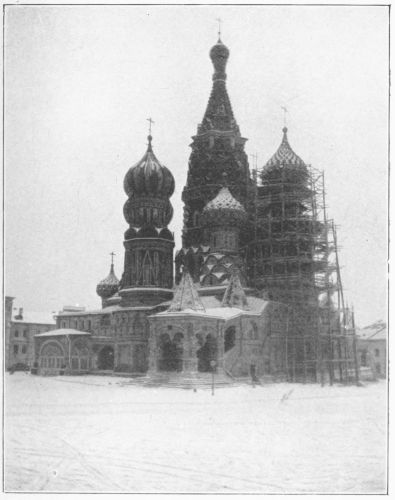
THE CHURCH OF SAINT BASIL AND THE RED SQUARE.
p. 95.
THE CHURCH OF SAINT BASIL AND THE RED SQUARE.
p. 95.
often given over for clubs or workplaces, only a really vulgar, over-decorated house in impossibly bad taste is used for rough or dirty work.
The exhibitions of proletarian art are very interesting, and deeply imbued with the modern movement. There are crude drawings that show an appreciation of form, and there is sculpture in wood that is often very effective, and may lead to something good.
One of these exhibitions was in an exquisite house of beautiful architecture that stood back from the street, in a garden that had run to seed. The house had once belonged to the Princess Dolgorouki, but it had passed into the hands of a Countess somebody, who had died. The daughter héritière had been turned out, but it was said that she was still living in the basement. The ground floor consisted of a series of small, beautifully proportioned rooms, with painted ceilings and carved doors. One was a Chinese room and all were in exquisite taste. There were some lovely Empire bronzes and old Dorée, and other objects of art.
The house seemed to be open to anyone who chose to come in. The old cherry-satin upholstery of the French chairs was in limbo. I never felt a place so small and full of ghosts. Perhaps, because it was so small, it had the feeling of having been someone’s intimate home, not a blatant place of entertaining.
As we wandered round a man joined us and, speaking to us in French, asked if we were from France. His cap was drawn well over his eyes, and the collar of his overcoat turned up over his ears. One could only see a well-bred nose pinched with cold. He knew about the house and its history, and which were the best bits of furniture. He was evidently a cultured man, and but for the presence of Andrev, who always laughs at me, I would have talked to him about himself. He was rather like a ghost haunting a place he knew, and I imagine he was no Bolshevik, but one who had known prosperous days.
I came away filled with sadness, and when Kameneff came to see me this evening, I tried to tell him about it, and begged him to have the house taken care of. He says that there is a committee that looks after all the houses, but I think they have passed this one by.
Coming back from our wanderings we passed, in one of the squares, a statue of Gogol, the Russian writer. I thought it a very fine piece of work. Gogol, half wrapped in a cloak, looks down scrutinizingly in bronze from his rough granite seat, and Andrev laughed at me for liking it, and said that in Moscow it was scorned and had brought coals of fire down on the artist’s head.
I was very surprised, and thought to myself that the standard of Russian art must be very high: but in spite of this ridicule, I stuck to my opinion. I even said that in London we had not a single statue as good as that one. Later he admitted that he was the author of it.
October 2nd.
Hearing that there was a review of troops in the Red Square at 11 o’clock, I went to see what I could see. Everyone else seemed busy, and Michael Markovitch, whom I wanted, was not to be found. If he had come with me I should have taken my kodak, but I have not a permit and did not feel like risking a controversy alone. Arrived in the Red Square, I was not allowed to get anywhere near, and I did so want to see and hear Trotsky addressing the troops. Soldiers kept the onlookers absolutely out of the square, and I stood on the steps of the wonderful church of St. Basil. The soldiers certainly were very amiable, and, when I wandered rebelliously from my steps out into the road, a bayonet was levelled smilingly at me; I made a gesture of not understanding, and said helplessly in English “Where do you want me to go?” Whereupon the soldier laughed and allowed me to stand by his side. The crowd was very quiet and apathetic, one certainly was not near enough to get excited. In the dim distance one could hear Trotsky’s voice, punctuated by cheers from the soldiers. After awhile the crowd broke forward to where I stood with the soldier. Some mounted detachments came towards us, very decorative indeed with bright coloured uniforms and lances with fluttering pennons. Suddenly a man at my side said to me in French: “Madame, does this please you?” I was very glad to have someone to speak to; the man was young, and, though ill-shaved, was well-dressed in uniform. He could speak German also, but English he said he had forgotten, though he had at one time spent three months in England. Waving a hand contemptously towards the scene before us, he said: “C’est du théâtre, Madame—that is all it amounts to.” I ventured to say that a theatrical display was not much use unless there were spectators. In England, I assured him, we had our military pageants for the benefit of the people, but what was the use of this if we were not allowed anywhere near? He replied that it was a necessary precaution for the protection of Trotsky. I laughed: “We are three gunshots away, at least.” Then to my amazement the man began to discuss and criticise, and talk what seemed to me pure Counter-Revolutionary stuff. From all one has ever heard about Russian conditions (Tsarist as well as Revolutionary) it seemed to me that he was strangely indiscreet, and I asked him: “Are you not mad to talk like this in a crowd? Anyone may understand French.” He shrugged his shoulders: “One has lived so long now side by side with death that one has grown callous.” He then asked if I would care to go for a walk. I felt rather selfconscious of walking away in front of the crowd with a man whom they had seen me so obviously “pick-up.” However, in Russia there are no conventions, it was only my bourgeois blood rushing to the surface again that made it seem peculiar.
We went down to the river and leaned against the railing and talked for a long time. He was certainly very interesting and amazingly indiscreet. Happily I have nothing with which to reproach myself. I adopted a perfectly good Bolshevik point of view, and argued in my usual way about wars and blockades, and urged him to have imagination and to look further ahead than to-day and to-morrow. We talked about idealists, reviewed a few Tsarist items, and made comparisons, but everything I said provoked him to further extreme utterances. He wished finally that he might have an opportunity of showing me “the other side.” He invited me to go to a factory with him. I asked what use that would be as I cannot speak a word of Russian. He said he would like to present to me his father and his uncle, but as they were both “known” he would have to be very careful. Finally we exchanged my name and address for his telephone number. He said that if I would telephone him to-morrow, Sunday night, he would meet me outside my front gate at 11 on Monday morning, but he would not dare to come into the house.
At 1 o’clock a.m. (I have adopted the Russian habit of not going to bed) I saw Michael Markovitch, when he returned from the Commissariat, and told him about it. He said that he must be the queerest sort of Counter-Revolutionary he had ever heard of, and advised me to leave him alone.
October 3rd.
I have been five days out of work. It seems much longer. I am told that there are people in Moscow who have been waiting six months to accomplish the business they came for. Lenin seems to me further away than he did in London. There is nothing to do here unless one has work. Never could one have imagined a world in which there is absolutely no social life and no shops. There are no newspapers (for me) and no letters, either to be received or written. There are no meals to look forward to, and comfort cannot be sought in a hot bath. When one has seen all the galleries, and they are open only half a day, and some of them not every day, and when one has walked over cobblestones until one’s feet ache, there is nothing more to be done. One must have work to do. Perhaps I should be calmer if I had already accomplished Lenin, but my anxiety is lest I should have to wait weary weeks. Return to London without his head I cannot. Michael took me for a walk, and it was extremely cold. We went to St. Basil, as I wanted to see it inside, but it is locked after 3 o’clock. Outside it is wonderful, painted all over in various designs and colours. I cannot understand how it stands the climate. Inside I am told that there is not much to see; Napoleon stabled his horses in it. One has heard so much about Bolshevik outrages, but they have done nothing like that. Napoleon distinguished himself in several ways while he was here. For instance, he ordered the destruction of the beautiful Spassky Gate of the Kremlin; the barrels of powder were placed in position and the matches were lit as the last of the French rode out. The Cossacks galloped up in time to put the matches out at the risk of their lives.
On our way home we passed by St. Saviour’s church and looked in, really impelled to seek refuge from the cold. In a side chapel where the light was dim, a priest, with his long hair and beard and fine features, was preaching to a congregation which sat fervently absorbed. The heads of the women looked Eastern in their shawl swathings. I listened for some time to the strange musical tongue, of which I could not understand a word. The priest looked so amazingly like the traditional pictures of Christ that I felt I was listening to the great Master teaching in the Temple.
October 4th.
When I came down to breakfast at 10 my strange Counter-Revolutionary was sitting in the hall. How he ever got there or why he came as I had not telephoned to him, I shall never understand. I expressed my astonishment and told him I was sorry I could not go out with him, as I had someone coming to see me. I promised to telephone to him later. He seemed a little disappointed, said he was “entièrement a mon service,” and departed. In the dining-room I found Michael breakfasting and told him, and he got up quickly to see, but I laughed and said that naturally I had sent him away, before telling anyone he was there. Michael looked at me with a cold look. He is like the others, one feels instinctively that however much they may like one as a woman, they would sacrifice one in a minute if it were necessary for the cause.
At lunch time H. G. Wells arrived from Petrograd with his son; they are lodged in our house. It was a great pleasure to find an old friend and to be able to talk of things and people familiar to us. He was, as usual, laughing and extremely humorous about the condition of life in Petrograd. On his account we were a big party for lunch, and there was an effort to make a spread, but this was frustrated by Michael Borodin. When I asked for some of the beautiful apple cake I had seen on the side-table, Michael made grimaces at me: he had sent it back to the kitchen. The perfect Communist in him revolted against the inequality of H. G. having a special cake, considering that neither Vanderlip nor Sheridan had had one on arrival. The household call me Sheridan, like a man. One has quite lost the habit of prefixing Mr. or Mrs., in fact one cannot do it, it sounds so absurd and affected. I have not yet been honoured to the extent of being called Tovarisch (Comrade), but some people ball me Clara Moretonovna (Clare, daughter of Moreton).
After lunch I went for a walk with Michael; he had tip-toed out of the room at lunch time, and I asked him why. He was not very communicative, and said that he hated people collectively and he disliked H. G., though for no reason that I could make out. I sat up far into the night. One felt quite sleepless with excitement over the evening’s discussions.
October 5th.
H. G. had an hour’s interview with Lenin. He told me that he was impressed by the man, and liked him. Lenin apparently told him all about the Vanderlip business, the Kamschatka concessions and the Alliance against Japan. This will greatly upset Vanderlip, who did not want the news to leave the country until he did. But I expect Lenin’s indiscretion is the indiscretion of purpose. H. G. talked to me at some length about the advisability of my going home. He, too, is discouraging about my prospects of doing Lenin or Trotsky. He says that Kameneff has “let me down” badly. I could only say in Kameneff’s defence that he has not “let me down” yet. But H. G. had something else in the back of his head that he did not tell. I gathered that he thinks there will be trouble here in a few weeks. What the conditions are in Petrograd I do not know, but here one feels as safe as a mountain and as immovable. H. G. may learn a lot of facts about schools and factories and things, but it is only by living a life of dull routine and work, even of patient inactivity and waiting, that one absorbs the atmosphere. Inactivity is forced upon me, I have to wait. I am waiting neither patiently nor calmly it is true, but all the while I realise that I am gaining something, and that some understanding is subconsciously flowing to me. I see no danger signals. A winter of hardship and sacrifice for these people, yes, but no disorder. The machine is slowly, very slowly, working with more competence and freedom. Of course one dislikes cold baths in cold weather, and bad food, and all the discomforts to which a pampered life has made one unaccustomed, but these need not blight one’s outlook. They are not necessarily indicative of a disruption.
After the Ballet “Sadko,” I walked home with Michael Borodin. We had supper together of cabbage-soup and tepid rice, and talked until 2 a.m. Michael always says that the food is eatable, even if it is not. He never complains, he just pretends to eat it, sometimes I see his pretence. This evening he talked to me about my work. He wants me to think about a statue interpreting the Soviet idea, and told me a good deal about the Third International, as representing a world brotherhood of workers. The plan of the Third International is very fine: “Workmen of the world unite.” If they did unite they could hold the peace of the world for ever. But unity is hard to attain; I wonder if it is not unattainable. Everything that one hears and sees here stirs the imagination—my mind is seething with allegories with which to express them, but they are so big that I should have to settle for life on the side of a mountain, and hew out my allegories from the mountain side. To-night, in his big Gothic room, I paced back and forth, my arm through Michael’s, talking abstractedly, until his calmness calmed me. He knows that I have been going through a period of waiting, not unmixed with despair and anxiety. I understand so little about the Russian temperament, and hear such conflicting reports, that it is difficult to know what to expect. He has encouraged and cheered and tolerated me. He reminds me sometimes of Munthe,[6] in his adhesion to his convictions, and his demand that one should live up to one’s idealism.
October 6th.
Spent the morning darning my stockings and reading Rupert Brooke. I was depressed to the point of resignation. It is always blackest before dawn: at 2 o’clock the Commandant of the house walked in with a telephone message: “Greetings from Comrade Kameneff, and all is prepared for you to go and do Lenin in his room to-morrow, from 11 till 4 o’clock.”
It was marvellous news. I went directly to the Kremlin, and with the help of someone from the Foreign Office, got my stands and clay moved from my studio to Lenin’s room. I happily had him built up, ready to work on as soon as the order should come.
October 7th.
Borodin accompanied me to the Kremlin. On the way he said to me: “Just remember that you are going to do the best bit of work to-day that you have ever done.” I was anxious, rather, about the conditions of the room and the light.
We went in by a special door, guarded by a sentry, and on the third floor we went through several doors and passages, each guarded. As I was expected, the sentries had received orders to let me pass. Finally, we went through two rooms full of women secretaries. The last room contained about five women at five tables, and they all looked at me curiously, but they knew my errand. Here Michael handed me over to a little hunchback, Lenin’s private secretary, and left me. She pointed to a white baize door, and I went through. It did not latch, but merely swung behind me.
Lenin was sitting at his desk. He rose and came across the room to greet me. He has a genial manner and a kindly smile, which puts one instantly at ease. He said that he had heard of me from Kameneff. I apologised for having to bother him. He laughed and explained that the last sculptor had occupied his room for weeks, and that he got so bored with it that he had sworn that it never should happen again. He asked how long I needed, and offered me to-day and to-morrow from 11 till 4, and three or four evenings, if I could work by electric light. When I told him I worked quickly and should probably not require so much, he said laughingly that he was pleased.
My stand and things were then brought into the room by three soldiers, and I established myself on the left. It was hard work, for he was lower than the clay and did not revolve, nor did he keep still. But the room was so peaceful, and he on the whole took so little notice of me, that I worked with great calm till 3.45, without stopping for rest or food.
During that time he had but one interview, but the telephone was of great assistance to me. When the low buzz accompanied by the lighting up of a small electric bulb, signified a telephone call, his face lost the dullness of repose and became animated and interesting. He gesticulated to the telephone as though it understood.
I remarked on the comparative stillness of his room, and he laughed. “Wait till there is a political discussion!” he said.
Secretaries came in at intervals with letters. He opened them, signed the empty envelope, and gave it back, a form of receipt I suppose. Some papers were brought him to sign, and he signed, but whilst looking at something else instead of at his signature.
I asked him why he had women secretaries. He said because all the men were at the war, and that caused us to talk of Poland. I understood that peace with Poland had been signed yesterday, but he says not, that forces are at work trying to upset the negotiations, and that the position is very grave.
“Besides,” he said, “when we have settled Poland, we have got Wrangel.” I asked if Wrangel was negligible, and he said that Wrangel counted quite a bit, which is a different attitude from that adopted by the other Russians I have met, who have laughed scornfully at the idea of Wrangel.
We talked about H. G. Wells, and he said that the only book of his he had read was “Joan and Peter,” but that he had not read it to the end. He liked the description at the beginning of the English intellectual bourgeois life. He admitted that he should have read, and regretted not having read some of the earlier fantastic novels about wars in the air and the world set free. I am told that Lenin manages to get through a good deal of reading. On his desk was a volume by Chiozza Money. He asked me if I had had any trouble in getting through to his room, and I explained that Borodin had accompanied me. I then had the face to suggest that Borodin, being an extremely intelligent man who can speak good English, would make a good Ambassador to England when there is Peace. Lenin looked at me with the most amused expression, his eyes seemed to see right through me, and then said: “That would please Monsieur Churchill wouldn’t it?” I asked if Winston was the most hated Englishman. He shrugged his shoulders, and then added something about Churchill being the man with all the force of the capitalists behind him. We argued about that, but he did not want to hear my opinion, his own being quite unshakable. He talked about Winston being my cousin, and I said rather apologetically that I could not help it, and informed him that I had another cousin who was a Sinn Feiner. He laughed, and said “that must be a cheerful party when you three get together.” I suppose it would be cheerful, but we have never all three been together!
During these four hours he never smoked, and never even drank a cup of tea. I have never worked so long on end before, and at 3.45 I could hold out no longer. I was blind with weariness and hunger, and said good-bye. He promised to sit on the revolving stand to-morrow. If all goes well, I think I ought to be able to finish him. I do hope it is good. I think it looks more like him than any of the busts I have seen yet. He has a curious Slav face, and looks very ill.
When I asked for news of England, he offered me the three latest “Daily Heralds” he had, dated September 21, 22 and 23. I brought them back and we all fell upon them, Russians and American alike. As for me, I have spent a blissful evening reading about the Irish Rebellion and the Miners’ dispute, as if it were yesterday’s news, and the Irene Munro and Bamberger cases. Goodness, one feels as though one had looked through a window and seen home on the horizon.
How tired I was; I had eaten nothing since 10 a.m. and dinner was not until 9 p.m. In between I ate some of my English biscuits.
October 8th.
Started work again in Lenin’s room. I went by myself this time, and got past all the sentries with the pass that I had been given. I took my kodak with me, although I had not the necessary kodak permission. I put a coat over my arm, which hid it.
I don’t know how I got through my day. I had to work on him from afar. My real chance came when a Comrade arrived for an interview, and then for the first time Lenin sat and talked facing the window, so that I was able to see his full face and in a good light.
The Comrade remained a long time, and conversation was very animated. Never did I see anyone make so many faces. Lenin laughed and frowned, and looked thoughtful, sad, and humorous all in turn. His eyebrows twitched, sometimes they went right up, and then again they puckered together maliciously.
I watched these expressions, waited, hesitated, and then made my selection with a frantic rush—it was his screwed-up look. Wonderful! No one else has such a look, it is his alone. Every now and then he seemed to be conscious of my presence, and gave a piercing, enigmatical look in my direction. If I had been a spy pretending not to understand Russian, I wonder whether I should have learnt interesting things? The Comrade, when he left the room, stopped and looked at my work, and said the only word that I understand, which is carascho, it means “good,” and then said something about my having the character of the man, so I was glad.
After that Lenin consented to sit on the revolving stand. It seemed to amuse him very much. He said he never had sat so high. When I kneeled down to look at the glances from below, his face adopted an expression of surprise and embarrassment.
I laughed and asked: “Are you unaccustomed to this attitude in woman?” At that moment a secretary came in, and I cannot think why they were both so amused. They talked rapid Russian together, and laughed a good deal.
When the secretary had gone, he became serious and asked me a few questions. Did I work hard in London? I said it was my life. How many hours a day? An average of seven. He made no comment on this, but it seemed to satisfy him. Until then, I had the feeling that, although he was charming to me, he looked upon me a little resentfully as a bourgeoise. I believe that he always asks people, if he does not know them, about their work and their origin, and makes up his mind about them accordingly. I showed him photographs of some of my busts and also of “Victory.” He was emphatic in not liking the “Victory,” his point being that I had made it too beautiful.
I protested that the sacrifice involved made Victory beautiful, but he would not agree. “That is the fault of bourgeois art, it always beautifies.”
I looked at him fiercely. “Do you accuse me of bourgeois art?”
“I accuse you!” he answered, then held up the photograph of Dick’s bust. “I do not accuse you of embellishing this, but I pray you not to embellish me.”
He then looked at Winston. “Is that Churchill himself? You have embellished him.” He seemed to have this on the brain.
I said: “Give me a message to take back to Winston.”
He answered: “I have already sent him a message through the Delegation, and he answered it not directly, but through a bitter newspaper
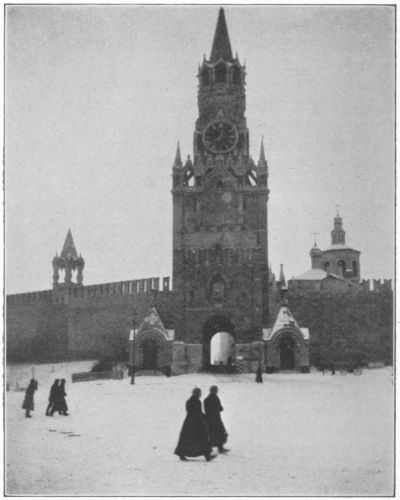
SPASSKY ENTRANCE TO THE KREMLIN.
p. 99.
article, in which he said I was a most horrible creature, and that our army was an army of puces. How you say puces in English? You know the French puces? Yes, that is it, an army of fleas. I did not mind what he said; I was glad. It showed that my message to him had angered him.”
“When will Peace come to Russia? Will a General Election bring it?” I asked.
He said: “There is no further news of a General Election, but if Lloyd George asks for an Election it will be on anti-Bolshevism, and he may win. The Capitalists, the Court, and the Military, all are behind him and Churchill.”
I asked him if he were not mistaken in his estimate of the power and popularity of Winston, and the importance and influence of the Court.
He got fiery. “It is an intellectual bourgeois pose to say that the King does not count. He counts very much. He is the head of the Army. He is the bourgeois figurehead, and he represents a great deal, and Churchill is backed by him.” He was so insistent, so assured, so fierce about it, that I gave up the argument.
Presently, he said to me: “What does your husband think of your coming to Russia?”
I replied that my husband was killed in the war.
“In the capitalist-imperialist war?”
I said: “In France, 1915; what other war?”
“Ah, that is true,” he said. “We have had so many, the imperialist, the civil war, and the war for self-defence.”
We then discussed the wonderful spirit of self-sacrifice and patriotism with which England entered upon the war in 1914, and he wanted me to read “Le Feu” and “La Clarté” of Barbusse, in which that spirit and its development is so wonderfully described.
Then the telephone gave its damnable low buzzing. He looked at his watch. He had promised me fifteen minutes on the revolving stand and given me half an hour. He got down and went to the telephone. It did not matter: I had done all I could. I had verified my measurements, and they were correct, which was a relief, and so, it being 4 o’clock and I mighty hungry, I said good-bye.
He was very pleased, said I had worked very quickly, called in his secretary and discussed it with her, said it was carascho. I asked him to give orders to have it removed to my studio, Room 31. Two soldiers arrived and carried it out. I asked Lenin for his photograph, which he sent for and signed for me.
I hurried after the two panting soldiers with their load. We passed through the rooms of the astonished secretaries, out into the corridors, past the bored and surprised sentries, and got through to the main building. Two or three times they had to pause and deposit “Lenin” on the floor, to the interest of the passers-by. At last he was safely in Room 31, and they returned to Lenin’s room for the stands. It was a good long way, and they were tired and dripping with sweat when their job was done.
To my intense embarrassment, they refused money, though I offered them stacks of paper notes. They refused very amiably, but firmly. I made signs of imploration and signs of secrecy, but they laughed and just pointed to their communist badges, and offered me their cigarettes which were precious, being rationed.
At 4 Kameneff walked in, very surprised at Lenin being finished and already back in my room. He had come in from a conference next door. He went back and fetched in the Conference; eight or more men came in, some with interesting heads, others just ordinary-looking workmen.
They all talked at once. One was Kalinin, whom I had seen in Lenin’s room at an interview. Kalinin is the President of the Republic, and is a peasant elected by the peasants. He was charming and promised to sit for me, but is off to the front to-night for ten days, and offered to take me with him. He told Kameneff that as I worked so rapidly I should find some interesting heads to do there, especially General Budienny.
I said I thought it would be wonderful to do this work within sound of the guns. Kameneff promised to ring me up at 9 o’clock to tell me if I was to start at 10. Alas! It turned out to be a troop train, and not possible for a woman.
October 9th.
Started off in a motor with Mr. Vanderlip and someone from the Foreign Office. We went to a textile factory, a huge place, and pronounced by Mr. Vanderlip to have the best and latest machinery, but there were 240 workers where there had been 2,500, and there were acres of machinery lying idle, the reason being lack of fuel. Mr. Vanderlip, with that unfailing American “spread-eagle,” said that 50 experienced American workers could have done the work of those 240. It is true there was a good deal of idling going on. This may have been due either to lack of sufficient work, or to the Communist system by which each man or woman is as good as another, and there is none to oversee the work. But what had been done was well done.
From there we went to one of the big fur stores which before the Revolution belonged to a private firm, but to-day is the property of the Government. There were rooms full of huge hampers packed with sable skins for export, and of course, as I was the only woman present, they dangled bunches of sable skins before me. Now sables don’t say much to me if they are not made up, but silver foxes are different, and they cruelly put round my neck some silver foxes.
October 10th.
Kameneff came at midday to say good-bye to me; he is off to the front to-morrow for an indefinite time. He brought with him a young man with close-cropped hair and clear-cut features, calling himself Alexandre. Kameneff thinks Alexandre may be able to take care of me during his absence. I certainly need someone, as Michael Borodin goes to Madrid on Tuesday, and then I do not know what will become of me. Kameneff discussed with me about the Government buying the Russian copyright of my heads. He then asked me to make a list of things I wanted, and that he could do for me before he goes. I had several wants: for one thing, I am extremely cold. The coat I arrived in is only cloth—now there is snow on the ground, and the river begins to freeze. I have to wrap my rug round my shoulders when I go out. The peasants are far better off, they have all appeared in sheepskin coats, the fur they wear inside, and the leather, which is usually stained deep orange or rust colour, is a very decorative exterior. The bourgeois women have brought out their former remains of splendour, and although they may have only felt or canvas shoes on their feet, and a shawl over their heads, some of them wear coats that one would turn round to look at in Bond Street. I headed my list of requirements with the request for a coat—as well as caviare, Trotsky, and a soldier of the Red Army whom I want to model. Trotsky is expected back from the front in a few days. It is a bore that Kameneff is going away, but Alexandre promised to arrange sittings for me.
October 11th.
In the morning I accompanied Michael Borodin to the headquarters of the Third International. It is a beautiful house, formerly the German Embassy, and where Mirbach was murdered.
I came away in a car with Madame Balabanoff, of whom I had often heard. She is small, past middle age, with a crumpled-up face, but intelligent. I did not find her any too amiable on our way to the Kremlin, where she dropped me.
She told me that it was absurd that any bust
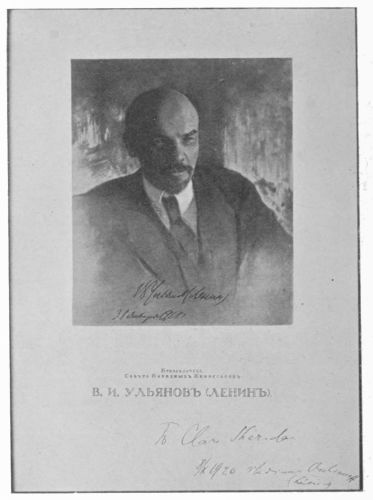
LENIN, FROM A PHOTOGRAPH.
p. 114.
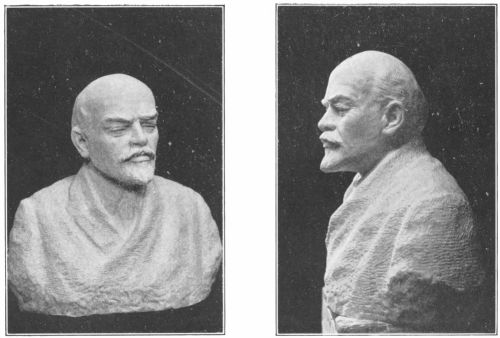
BUST OF LENIN.
p. 114.
of Lenin or any one else should be done, the theory being that the cause, not the individuals, should count. The humblest person who suffers privation for the cause is equally as important as any of the legislators, she explained, and proceeded to assure me that no picture or bust of herself existed, nor ever should. Happily I had not asked her to sit for me. She practically told me that I was doing Lenin’s head to take back to England to show to the idle curious. I corrected her by saying that, so far as the public was concerned, I only wished to enable those who had him at present represented by a photograph, to substitute a bust. She was equally vehement about the photograph. Perhaps she expects to alter human nature.
Before I got out of the car, she assured me that her tirade was in no way personal and would I, please, not misunderstand her.
October 14th.
Michael Borodin found me after breakfast, miserably wrapped in my rug, shivering with cold and depression, and with tears irrepressibly streaming down my face. I had several grievances which had been accumulating for some days, and at last my patience had come to a head. The fact is I had heard of a courier having arrived yesterday from London, and no one had taken the trouble to find out if there were any letters for me. Ever since I left England on September 11th I have not had one word of news, nor answers to two telegrams that Kameneff sent for me asking after the children. Secondly, I had not been given the coat that Kameneff had ordered for me, so it was impossible to go out as it was too cold.
Michael for the first time seemed really moved. He wrapped me round in his fur coat, went off to the garden and fetched up a load of wood for me (I had never known him do such a thing before), and lit my fire himself. Then he telephoned to the Foreign Office. There were no letters for me, but some bundles for Kameneff. He also got hold of Comrade Alexandre on the telephone to know when I was going to have the promised coat, and altogether was very helpful. His journey to Madrid has been delayed daily, but he is to start to-morrow. It seems to me that in Russia one only knows about ten minutes beforehand what one is going to do! They are divinely vague.
October 15th.
I went to the Kremlin to meet Comrade Alexandre there at midday: he was to bring me a soldier as a model. Not feeling brave enough to go and review a platoon and make my own selection, I had described exactly what I wanted: not the bloodthirsty savage Bolshevik of English tradition, but the dreamy-eyed young Slav who knows what he is fighting for, and such as I passed every day on the parade ground. I waited in my studio impatiently till 2 o’clock, and then Alexandre arrived accompanied by a soldier who was typically neither Russian, nor military, nor intellectual, nor even fine physically. He was small, white, chétif, and had a waxed moustache. It was a bad moment. I tried to hide my disappointment and my amusement. I missed lunching in order to work on him, and began something that was not in the least like my model, but was the product of my imagination. At 5 I came home tired and hungry and cold. I lay down on my sofa and watched the dusk crawl up behind the Kremlin. At 8.30 I was called down to the telephone, which is in the kitchen. It was Borodin speaking from the Foreign Office. He said “good-bye” in his abrupt manner. “This is the right way,” he said. “This is the way it should be.” The maid was throwing her broom around the kitchen, making as much noise as possible, and a strange man glared at me out of the gloom. I found it difficult to concentrate my attention. Michael knows that I do not believe in “futures,” but nevertheless we said “someday,” and I wonder very much if that strange Communist-Revolutionary, with his mask-like face and deep voice, will ever cross my path again. To-night I regret him, but then I am lonely for the moment—friendless, and this is a place where one needs friends.
At 9 o’clock, not having eaten since 10 a.m., I went downstairs to round-up some food. There, to my surprise, I met Litvinoff, who had been in Moscow since the day before yesterday. Our pleasure at seeing each other again was mutual and spontaneous. He is coming to stay at our house, and will occupy the vacated room of Borodin.
October 16th.
Comrade Alexandre came to see me at 9 p.m., to tell me that he could not arrange with Trotsky for sittings. I gathered that Trotsky had been emphatic and brusque in his refusal, but after all, I have done Lenin, and he is the one who counts most. I can go back to England without the head of Trotsky, but I could not have gone without the head of Lenin. I have accomplished what I came for, and so to hell with Trotsky!
Alexandre said he could only stay ten minutes, but he left at midnight. He talked Communism the whole time. Now Borodin unfurled his Communist spirit to me slowly, because he knew me, and to what I belonged, and he realised that the thing hurled at me in a crude mass would stagger me. He led me up to it with great caution. Alexandre, on the other hand, with no understanding or sympathy, took all my inborn prejudices and just broke them, stamped on them, metaphorically spat on them, and gave me a big feed of unadulterated Communism. He is a fanatic, and left me breathless and wondering. All was well until we got to the children part: he said that his wife had to work, so their baby, who is six weeks old, has to go by day to the Crèche.
“Are you satisfied with the care it gets at the Crèche?” I asked him. He shrugged his shoulders, said that collectively they could not receive the same attention as they would if they were cared for individually. He then volunteered the information that of course the baby was more liable to get ill and even die if it was in the Crèche, but that it was a chance, and after all his wife’s life was not going to be reduced to feeding, washing, and dressing a baby. That was no sort of existence, and so, what alternative was there except the Crèche?
It was the cold, dispassionate way in which he said it that gave me the creeps.
“What is your wife’s work?” I said.
“Politics, same as mine,” he said.
“Are you fond of your baby?”
“Yes.”
“Is your wife fond of it?”
“Yes.”
I thought to myself that she has not had to pray for a baby, and weep because the months went by. She has not had to wait, and wait—it is not infinitely precious to her, her baby.
He then counter-questioned me:
“What did you do with your children when you became a widow and had no home?”
“My parents took them.”
“And if you had had no parents who could take them? How could you have worked?”
It is true that there must be thousands of women who earn their living and have no family in the background on whom to plant the baby. What happens in a country where there is no paternal State? In Russia the State will clothe, feed and educate them from birth until fourteen years of age. They may go to the Crèche for the day or permanently. Children may go to the State school for the half day, whole day, or to board. Their parents may see them, or give them up for ever, as they choose, and there is no difference made between the legitimate and
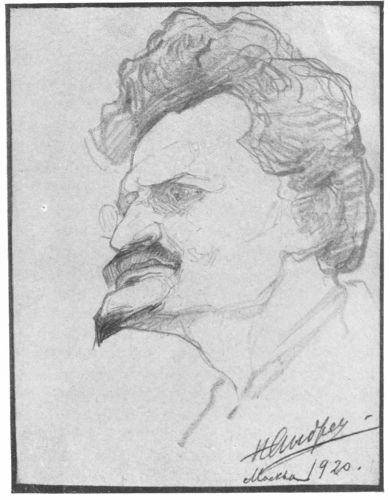
TROTSKY, FROM A DRAWING.
p. 129.
the illegitimate child. Moreover, according to the labour laws, no woman may work for eight weeks before the baby is born, nor for eight weeks after birth. She is sent away to a resthouse in the country, always of course at the State’s expense. On application she is given the necessary layette for the new born. It is difficult to preserve one’s maternal sentimentality in the face of this Communistic generosity.
October 17th.
I stayed in bed all day as I felt ill, and there was nothing better to do. Litvinoff came in to see me in the afternoon and was surprised that I had not begun to work on Trotsky. I explained to him that, through Comrade Alexandre, Trotsky had flatly refused to let me do him. Litvinoff could not understand this, but said he had seen Trotsky last night. It was then decided that Litvinoff would see Trotsky again during the day, and telephone to me what arrangements he could make. He then left me, to come back again in a few minutes bringing something preciously in both hands. It was a hen’s egg. As I have not seen one since I have been in Moscow, I stifled my instinctive aversion to accepting valuable presents from men and had the egg fried for dinner.
October 18th.
Trotsky’s car came for me punctually at 11.30 a.m. (usually the cars that are ordered are an hour late, and people keep their appointments two hours late. Trotsky and Lenin are, I hear, the only two exceptions to the rule). I made Litvinoff come and tell the chauffeur that he was first to go to the Kremlin with me to fetch my things. When we got to the big round building in the Kremlin in which I have my studio, I took the chauffeur to the pass office and explained by signs by showing my own pass that I required one for the chauffeur. This was done. It is satisfactory to have arrived at the stage when I get the pass for someone else, instead of someone else getting it for me. Kameneff told me the other day that I walk into the Kremlin with the air of one who belonged to it.
Trotsky’s chauffeur, myself, and the plaster moulder who was there working, carried the things down to the car, and I was driven to a place some way off, the War Ministry, I think. Getting in was not easy, as I had no pass, and there was an altercation with the sentry. I understood the chauffeur explaining: “Yes, yes, it’s the English sculptor,” but the sentry was adamant. He shrugged his shoulders, said he didn’t care, and made a blank face. I had to wait until a secretary came to fetch me. He took me upstairs, through two rooms of soldier-secretaries. In the end room there was a door guarded by a sentry, and next to that door a big writing table from which someone telephoned through into the next room to know if I could come in. Unlike Lenin’s, not even his secretaries go in to see Trotsky without telephoning first for permission. It was not without some trepidation, having heard how very intractable he is, and knowing his sister,[7] that I was ushered in—I and my modelling stand and my clay together.
I had instantly the pleasurable sensation of a room that is sympathetic, big, well-proportioned and simple.
From behind an enormous writing table in one corner near the window came forth Trotsky. He shook hands with me welcomingly, though without a smile, and asked if I talked French.
He offered courteously to assist me in moving my stand into the right place, and even to have his mammoth table moved into some other position if the light was not right.
The light from the two windows was certainly very bad, but although he said: “Move anything and do just whatever you like,” there was nothing one could do that would help. The room, which would have made a beautiful ballroom, loomed large and dark. There were huge white columns which got in my way and hampered the light. My heart sank at the difficulties of the situation. I looked at my man, who was bending down, writing at his desk. Impossible to see his face. I looked at him and then at my clay, in despair. Then I went and knelt in front of the writing table opposite him, with my chin on his papers. He looked up from his writing and stared back, a perfectly steady, unabashed stare. His look was a solemn, analytical one, perhaps mine was too. After a few seconds, realising the absurdity of our attitudes, I had to laugh, and said: “I hope you don’t mind being looked at.” “I don’t mind,” he said. “I have my revanche in looking at you, and it is I who gain.”
He then ordered a fire to be lit because he thought it was cold for me. It was not cold, it was overheated, but the sound and sight of the fire were nice. A matronly peasant-woman with a handkerchief tied round her head came and lit it. He said he liked her because she walked softly, and had a musical voice. Curious that he should admire in another what is so characteristic of himself; his voice is unusually melodious.
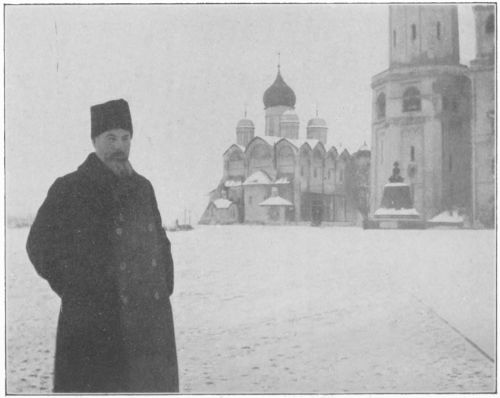
NICHOLAS ANDREV.
Seeing that he was prepared to be amiable, I asked him if I could bother him with measurements. “Tout ce que vous voudrez,” he said, and pointed out to me how unsymmetrical his face is. He opened his mouth and snapped his teeth to show me that his underjaw is crooked, and as he did so he reminded me of a snarling wolf. When he talks his face lights up and his eyes flash. Trotsky’s eyes are much talked of in Russia, and he is called “the wolf.” His nose also is crooked and looks as though it had been broken. If it were straight he would have a very fine line from the forehead. Full-face he is Mephisto. His eyebrows go up at an angle, and the lower part of his face tapers into a pointed and defiant beard. As I measured him with calipers, he remarked: “Vous me caressez avec des instruments d’acier.” He talks very rapid, and very fluent French, and could easily be mistaken for a Frenchman. I dragged my modelling stand across the room to try for a better light on the other side. He watched me with a weary look, and said: “Even in clay you make me travel, and I am so tired of travelling.” He explained to me that he is not as desperately busy as usual because there is Peace with Poland, and good news from the South. I told him that I had nearly gone to the Southern front with Kalinin, who wanted to take me, but that Kameneff wouldn’t let me go because it was a troop train. Without hesitating a moment he answered:
“Do you want to go to the front? You can come with me.”
He was thoughtful for awhile, and then asked me: “Are you under the care here of our Foreign Office?”
I said I was not.
“But who are you here with? Who is responsible for you?”
“Kameneff,” I said.
“But Kameneff is at the front.”
“Yes.”
“Then you are alone? H’m, that is very dangerous in a revolutionary country. Do you know Karahan, Tchicherin’s secretary?”
“Yes; he is living in our house, so is Litvinoff.”
“Ah, Litvinoff, I will ring him up.”
He did ring him up, but what he said I could not understand. Litvinoff told me later that Trotsky had asked him if I was all right, and if it would be indiscreet or not to show me the front. Litvinoff gave me a good character.
At 4 o’clock he ordered tea, and had some with me. He talked to me about himself, and of his wanderings in exile during the war, and how, finally, at the outbreak of the Revolution, he sailed on a neutral ship from the United States to return to Russia; how the British arrested him and took him to a Canadian concentration camp. He was detained a few months, until the Russian Government succeeded in obtaining his release.
He was particularly incensed at the British interfering with the movements of a man who was not going to Britain, nor from a British colony, nor by a British ship: “But I had a good time in that camp,” he said. “There were a lot of German sailors there, and I did some propaganda work. By the time I left they were all good revolutionaries, and I still get letters from some of them.”
At 5 I prepared to leave. He said that I looked tired. I said I was tired from battling with my work in such a bad light. He suggested trying by electric light, and we agreed on 7 o’clock the next evening. He sent me home in his car.
October 19th.
Trotsky’s car came at 6.30. Nicholas Andrev had been having tea with me, and I offered to give him a lift, as he lives somewhere near the War Ministry. It was snowing hard and there was a driving wind, which lifted up the frozen snow and blew it about like white smoke. The car had a hood, but no sides. In the Red Square we punctured. For some time we sat patiently watching the passers-by falling down on the slippery pavement, and the horse-carts struggling up the hill. Winter has come very suddenly and one month too soon. The horses have not yet been shod for the slippery roads, consequently they can hardly stand up. This morning I counted four down all at the same moment. In London a fallen horse attracts a good deal of attention, and a crowd collects, but here no one even turns his head to look. I have been much laughed at because I stop to watch, but the method of getting the horse up amuses me. The driver (man or woman, as the case may be) gets behind and pushes the cart. The horse, so weak that he has no resisting power, impelled forward by the shafts, struggles to his feet in spite of himself. No unharnessing is necessary. This evening, when I became too cold to be interested any longer by the passers-by falling in the square, I asked the chauffeur if he had nearly finished. He answered “Sichas” which literally translated is “immediately,” but in practice means to-morrow, or next week! So I pulled up the fur collar of my inadequate cloth coat, put my feet up lengthways on the seat, and let Andrev sit on them to keep them warm. I arrived at Trotsky’s at 7.30. He looked at me and then at the clock. I explained what had happened. “So that is the reason of your inexactitude,” he said; an inexactitude which could not in the least inconvenience him as he did not have to wait for me. He kissed my frozen hand, and put two chairs for me by the fire, one for me and one for my feet. When I had melted and turned on all the lights of the crystal candelabra he said: “We will have an agreement, quite businesslike; I shall come and stand by the side of your work for five minutes every half hour.” Of course the five minutes got very enlarged, and we talked and worked and lost all track of time. When the telephone rang he asked: “Have I your permission?” His manners are charming. I said to him: “I cannot get over it, how amiable and courteous you are. I understood you were a very disagreeable man. What am I to say to people in England when they ask me: ‘What sort of a monster is Trotsky?’” With a mischievous look he said: “Tell them in England, tell them——” (but I cannot tell them!) I said to him: “You are not a bit like your sister.” The shadow of a smile crossed his face, but he did not answer.
I showed him photographs of my work and he kept the ones of the “Victory.” Among the portraits he liked “Asquith” best, and said that that one was worked with more feeling and care than any of the others. He took for granted that Asquith must like me, which is not necessarily the case, and said half-laughingly: “You have given me an idea—if Asquith comes back into office soon (there is a rumour that he might bring in a Coalition with Labour, and recognise Russia) I will hold you as a hostage until England makes peace with us.” I laughed: “What you are saying humorously is what a British official told me seriously, only he said it à propos of Winston. As a matter of fact, I’d be proud if I could be of any use in the cause of Peace. But if you said you would shoot me, Winston would only say ‘shoot,’”—which is, to my mind, the right spirit, and exactly the spirit that prevails among the Bolsheviks. They would not hesitate to shoot me (some of them have told me so) if it were necessary, even if they liked me as a woman. Winston is the only man I know in England who is made of the stuff that Bolsheviks are made of. He has fight, force and fanaticism.
Towards the end of the evening, as Trotsky said nothing more about the project of my going to the front, I asked him if he had decided to take me or not. He said: “It is for you to decide if you wish to come—but I shall not start for three or four days.” It was getting late and he looked very tired. He was standing in front of the clay with his back to it, so that I had the two profiles exactly in line. His eyes were shut and he swayed. For a moment I feared he was going to faint. One does not think of Trotsky as a man who faints, but anything may happen to a man who works as he does. My thought was of my work, and I said to him: “Do not fall backward, or you fall on my work.” He answered quickly: “Je tombe toujours en avant!” I asked him to order the motor, having realised that unless he sends for it I have to wait outside in the cold or look for it in the garage. While the car was coming round he sent for a reproduction of a portrait of himself by an artist friend of his, to show me that the same difficulties that I am having with his jaw and chin, were experienced also by the draughtsman who only succeeded in this, the last of a great many sketches. It is evidently one that Trotsky likes, for it is reproduced in colour in almost every office one goes into. I told him I wanted it and he wrote upon it “Tovarisch,” which means Comrade “Clare Sheridan,” and signed it. This has its effect on the Bolsheviks who have been into my room and seen it.
October 20th.
Comrade Alexandre telephoned that he would fetch me at 1 o’clock to go to the fur store. I suppose the intense cold had at last moved either his pity or his anxiety for me. Before I left Vanderlip said that if there were any choice, and I was fool enough not to choose a sable coat, he would never speak to me again. The threat left me unmoved. It is only on occasions of necessity, when we exchange valuable presents (say a new tooth brush for a box of pills), that we have an armistice. On the way to the fur store Alexandre picked up another man, unknown but very nice, with whom I talked a mixture of English and German. We went to one of the biggest store-houses in Moscow, which, like all the rest, had been a private firm, but has been requisitioned by the Government. It was a cave-like building, dark and stone cold. We went up in a cage lift to what seemed to be the attic. It was low and long and dark, and an arc-light barely lit up the corner. Coats hung from the ceiling like so many hundred Bluebeard wives.
I took off mine to try on. An old man who looked like Moses and spoke German showed me the best and told me to make my choice. Alexandre looked on with a grim smile, and asked if I were the proverbial woman, or whether I would make my choice within reasonable limits of time. It was not easy. The coats dated back three years, and some were even too old-fashioned for Moscow. I liked a brown Siberian pony lined with ermine, but the moth had got into the pony. I liked a broadtail, but it was thin as cloth; they offered to have it fur-lined for me, but my need was immediate. There was a mink, but it had an old-fashioned flounce. There were astrachans, but everyone in Moscow has astrachan, it seemed too ordinary. I felt bewildered. My attention then wandered to a row of shubas: big sleeveless cloaks of velvet, that wrap around one, and descend to one’s feet. There was a dream lined with blue fox, and another with white. My friends put one round my shoulders, it was lined with sable: light as a feather, and warm as a nest. I despairingly voiced the fact that I could not walk about the streets of Moscow in a wine coloured velvet and sable cape. They said I could, but then they were wrong. “I look much too bourgeoise, I shall be shot!”
“You won’t be shot, and sable is good enough for a good worker.” I showed a sable stole to Alexandre and told him it was the blackest and most beautiful bit of sable one could find. He shrugged his shoulders with perfect indifference, and said he knew nothing about it. Finally I walked out in a very practical black Siberian pony lined with grey squirrel, divinely warm, though rather heavy, and Alexandre said to me: “Now you can say that you have shared in the Government distribution of bourgeois property to the people.”
At 7.30 pm. Trotsky sent his car for me, but a soldier stopped us before we even reached the block where the War Ministry is. The whole bit of road was being especially guarded. The reason for this is that foreign papers have announced an impending counter-Revolution, but if there is any such plot their warning has been given most obligingly in time, and steps have been taken to deal with it. The town is placarded with notices that inhabitants must not be out after midnight. It gave one just a small thrill, and there have been none so far. This evening when I arrived Trotsky stood by the fire while I was warming, and I asked him for news. He says that the German workers have voted in favour of joining the Moscow International which is very important. “England is our only real and dangerous enemy,” he said. “Not France?” I asked. “No, France is just a noisy, hysterical woman, making scenes: but England—that is different altogether.” He talked about the persistence of the foreign Press in decrying the stability of the Soviet Government. All the governments of Europe, he said, had undergone changes in the last three years, he pointed to France, Italy, the Central Powers, Turkey, and finally Poland. The British Government was holding out longer than any other, but that was pretty rocky, and its ministers were constantly changing their posts. The Soviet Government was the oldest government in Europe, and the only one in which the ministers retained their posts and displayed any unity, and this is spite of every effort on the part of the world to dislodge them.
He then busied himself at his table with papers. I worked for an hour and we never spoke, but he never disregarded me as Lenin did. I could walk round Lenin and look at him from all sides, he remained absorbed in his reading, and apparently oblivious of my presence. Whenever I go near Trotsky he looks up from his work sharply with piercing eyes and I forget which part of his face I was intent upon. Towards the end of the evening, when even my tiptoe stalking had aroused him, he asked me: “Avez vous besoin de moi.” I replied yes, as always. He came and stood by the clay, but he is very critical, and watches it and me all the time, and makes me nervous. I undid and did over again a good deal. The room was hot, and the clay got dry, it was uphill work. Never have I done anyone so difficult. He is subtle and irregular. At one moment the bust looked like Scipio Africanus, and I could see he was dissatisfied, then when I had altered it and asked him what he thought he stood for some time in silence with a suppressed smile before he let himself go: “It looks like a French bon bourgeois, who admires the woman who is doing him, but he has no connection with Communism.”
Happily the peasant woman came in with tea, and I sat down wearily with my head in my hands, utterly dispirited and discouraged. Only the fierce determination to make it come right roused me and I went at it again. He said, as he watched me: “When your teeth are clenched and you are fighting with your work, vous êtes encore femme.” I asked him to take off his pince-nez, as they hampered me. He hates doing this, he says he feels désarmé and absolutely lost without them. It seemed akin to physical pain taking them off—they have become part of him and the loss of them completely changes his individuality. It is a pity, as they rather spoil an otherwise classical head.
While he was standing there helplessly with half-closed eyes, he remarked on my name being
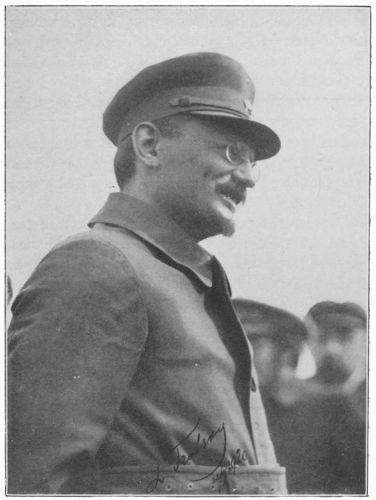
TROTSKY AT THE FRONT.
spelt in the same way as that of the playwright. I explained that I had married a direct descendant. He was interested and said, “The School for Scandal” and “The Rivals,” had been translated and were occasionally acted here in Russian. He then got on to Shakespeare. I wish I could recall the words in which he described his appreciation, exclaiming finally: “If England had never produced anything else, she would have justified her existence.” We disagreed as to Byron and Shelley. He, like others I have met here, preferred Byron, and insisted in spite of my assertions to the contrary that Byron was the greater Revolutionary of the two. He was surprised that I loved Swinburne. He said he would have thought me too much of this world to love the spirituality of Swinburne. I said: “One has one’s dreams.” He gave a sigh. “Yes,” he said, “we all have our dreams——”
When, at the end of the evening, I was dissatisfied with my work and feeling suicidal I asked him:
“May I come back and work to-morrow night?”
“And the night after,” he answered, and added laughing, that he would rig the place up as a studio for me, and that I could do General Kameneff after I’d finished him. General Kameneff (who is no relation to Leo Kameneff) is the Commander-in-Chief, and was a very distinguished Tsarist officer. I hear that he strongly warned the War Ministry against advancing too far towards Warsaw, and foretold the débâcle that has since been fulfilled. But he was not listened to, perhaps because of his Tsarist tradition. Probably his opinion is more respected now. Trotsky asked me if I would like to do Tchicherin, and I explained that never before had I worked under such difficult conditions, and that although I had made efforts for Lenin and himself I did not feel like doing it again for anyone else. He was quite indignant and said: “What difficulty have you had in working here?” True it was a perfectly good room and excellent light, but Tchicherin would not move out of his Commissariat and that would mean new conditions to adapt oneself to, nor does anyone understand the difficulties of moving the finished work back to the Kremlin. Trotsky swept my excuses aside: “Of course you must do Tchicherin—it is almost a diplomatic obligation on his part to be done.”
It was a quarter to midnight when I prepared to stop work and looked desperately at the clock: “What about this order—how am I to be home
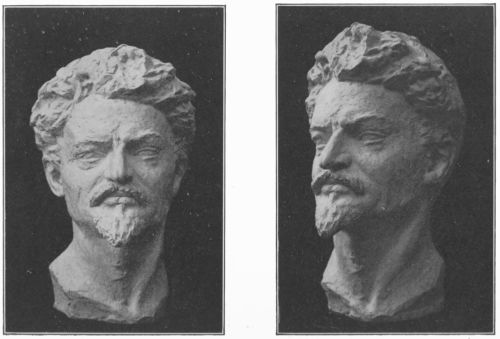
BUST OF TROTSKY.
p. 147.
at midnight?” I asked. He said, “I will take you myself.” At about half after midnight we left. A man in uniform joined us and sat next to the driver. He had in his hands a very big leather holster. We started off by going in the opposite direction to the right one, and I had to try and describe the way to them. We turned back, and crossing the bridge we were stopped by five soldiers. The man with the holster had to show our papers by the light of the car lamp. It delayed us several minutes. I said to Trotsky: “Put your head out of the window and say who you are.” “Taisez-vous,” said Trotsky peremptorily. I sat rebuked and silent until we were able to pass on unrecognised. He explained afterwards that he did not want them to hear a woman’s voice in the car talking English. I was talking French as we always do together, and did not see that it mattered to anyone in this country whether there is a woman in a Government car or not—but I did not argue.
October 21st.
I did very little during the day, so as to be fresh for my night’s work, though I went to see my friend the plaster-moulder who is working for so many thousand roubles a day in my studio. He is making piece moulds of the busts, so that I can leave duplicates when I go. I asked Andrev why he had to be paid so much. Andrev explained that he is the only moulder in Moscow, so he can ask what he likes: “He says he will work for this and not for that,” and Andrev held a thousand rouble note in one hand and a hundred rouble note in the other. “But it is all the same really, only it is a different pattern,” and he laughed. Certainly money has no value here, and no meaning. At 8 o’clock I went back again to the War Commissariat in Trotsky’s car. On arrival I told him that I had got to get this work right to-night, and that he was not to be critical and look at it all the time and make me nervous.
He was surprised; said that he had no idea that he had that effect on me, that all he wanted was to help: “Je veux travailler cela avec vous.” His criticism, he said, was caused by intense interest, and that for nothing in the world would he be discouraging. He promised, however, to be good, and offer no opinion until asked. It was a better night for work; I felt calmer and it went pretty well.
The worst difficulties were surmounted. Trotsky stood for me in a good light and dictated to his stenographer. That was excellent. His face was animated and his attention occupied. I got all one side of his face done. Then came the question of the other side. He laughed, suggested another dictation, offered to stand in another position, and called back his stenographer. When we were alone again he came and stood close beside the clay and we talked while I went on working. We talked a little about myself.
He said I should remain in Russia awhile longer, and do some big work, something like my “Victory.” An emaciated and exhausted figure, but still fighting; that is the allegory of the Soviet.
I answered him that I could get no news of my children, and therefore must go back.
“I must return to my own world, to my own conventional people whose first thought is always for what the world will think. Russia with its absence of hypocrisy and pose, Russia with its big ideas, has spoilt me for my own world.”
“Ah! that is what you say now, but when you are away——” and he hesitated.
Then suddenly turning on me, with clenched teeth and fire in his eyes, he shook a threatening finger in my face: “If, when you get back to England, vous nous calomniez as the rest have, I tell you that I will come to England et je vous——” He did not say what he would do, but there was murder in his face.
I smiled: “That is all right. Now I know how to get you to England.” Then (to fall in with his mood): “How can I go back and abuse the hospitality and the chivalrous treatment I have received?”
He said: “It is not abusing, but there are ways of criticising even without abuse. It is easy enough here to be blinded par les saletés et les souffrances and to see no further than that, and people are apt to forget that there is no birth without suffering and horror, and Russia is in the throes of a great accouchement.”
He talks well, he is full of imagery and his voice is beautiful.
We paused for tea, and I talked to him of things I had heard about the schools. In reply he said he had heard no adverse reports of the co-education scheme for boys and girls. There might be an individual case of failure, though even of such a case he had not heard. He then compared the present system with that of boy colleges of his own day, and he said that his own boy of fourteen had nicer ideas about girls, and far less cynicism, than he had at the same age. The boy apparently confides in his mother, so he knows something about it.
To-night he sent me home alone in his car; he excused himself, saying it was the only time it was possible for him to walk. He kissed my dirty hand and said that he would always preserve a memory of “une femme avec une auréole de cheveux et des mains très sales.”
October 22nd.
Finished!
I worked until half after midnight. I think it is a success. He said so; but it has been such a struggle.
About half way through the evening, the electric lights went out. A secretary lit four candles. On the telephone Trotsky learnt that the lights had gone out all over the town.
I asked him hopefully if it could possibly be the outburst of a counter-Revolution.
He laughed and asked if that was what I wanted.
I said that I thought it would break the monotony.
Until the lights went on I read the leading article on Bolshevism in The Times of, I think, October 4th. He had several English papers on his desk and we read together with much amusement that he (Trotsky) had been wounded, and that General Budienny had been court-martialled. There were even descriptions of barricades in the streets of Moscow: someone must have mistaken the stacks of fuel that the tramcars are bringing in and unloading every day. When the lights went on I worked hectically until half after midnight, with the desperation of knowing it was the last sitting.
At midnight he was standing by the side of the work, rather tired and very still and patient, when suddenly I had the thought of asking him to undo his collar for me. He unbuttoned his tunic and the shirt underneath, and laid bare a splendid neck and chest. I worked like a fury for half an hour which was all too short. I tried to convey into my clay some of his energy and vitality. I worked with the desperation that always accompanies last moments. When I left he said to me: “Eh bien! on ira ensemble au front?” But something tells me that we shall never meet again. I feel that it is almost worth while to preserve the impression of our hours of individual work, collaboration and quietude, silently guarded by a sentry with fixed bayonet outside the door. To let in the light of day would be to spoil it.
There is a French saying: “On n’est pas toujours né dans son pays.” It equally follows that all are not born in their rightful sphere. Trotsky is one of these. At one time, in his youth, what was he? A Russian exile in a journalist’s office. Even then I am told he was witty, but with the wit of bitterness. Now he has come into his own and has unconsciously developed a new individuality. He has the manner and ease of a man born to a great position; he has become a statesman, a ruler, a leader. But if Trotsky were not Trotsky, and the world had never heard of him, one would still appreciate his very brilliant mind. The reason I have found him so much more difficult to do than I expected, is on account of his triple personality. He is the cultured, well-read man, he is the vituperative fiery politician, and he can be the mischievous laughing school-boy with a dimple in his cheek. All these three I have seen in turn, and have had to converge them into clay interpretation.
October 23rd.
I went in the morning to fetch away the bust and take it to my room in the Kremlin. I went at 11, before Trotsky had got there. His motor was at my disposal and three men to convey the precious work away. These are the moments that take years off my life! It arrived, however, undamaged, which was little short of a triumph. When my plaster-moulder saw it he exclaimed with pleasure. Apparently it is very like, and everyone is pleased. As Trotsky is adored, I take it as a great compliment to my work that it is considered good enough.
The relief of having accomplished him as well as Lenin is indescribable. I wake up in the night and wonder if it is true or a dream. Now I am completely happy. I have achieved my purpose. I have proved myself to these people, and they in return have proved their belief in me by their trouble and courteousness. I am no longer harassed by anxieties and fears. Those who discouraged me in the early days treat me now with respect, consideration and even admiration. I am happy, I am happy! I sing when I wake in the morning, I sing when I wash in cold water, I come down to my breakfast of black bread with a lighter step!
I breakfast every morning with Litvinoff. By coming down at 11 the others have finished, so we can talk. If Rothstein is present the conversation becomes Russian. If Vanderlip is there he talks all the time about America (he usually leaves the room with boredom if conversation is on any other subject). It is the fashion in Europe to vilify Litvinoff and to regard him as a terribly dangerous man. I suppose that he is an astute diplomatist. Whatever he is, he is better than he pretends, and though he gets no credit for it, he has done a good deal for the British prisoners here. He has unfortunately an abrupt manner, and a way of refusing to do things by pretending that they are no concern of his, but straightway he will go off and do a kindness to the very people who are damning him for having refused. To me he is charming, frank, outspoken, and always ready to help.
October 24th.
We have all been very much saddened by the death from typhus of John Reed, the American Communist. Everyone liked him and his wife, Louise Bryant, the War Correspondent. She is quite young and had only recently joined him. He had been here two years, and Mrs. Reed, unable to obtain a passport, finally came in through Murmansk. Everything possible was done for him, but of course there are no medicaments here: the hospitals are cruelly short of necessities. He should not have died, but he was one of those young, strong men, impatient of illness, and in the early stages he would not take care of himself.
I attended his funeral. It is the first funeral without a religious service that I have ever seen. It did not seem to strike anyone else as peculiar, but it was to me. His coffin stood for some days in the Trades’ Union Hall, the walls of which are covered with huge revolutionary cartoons in marvellously bright decorative colouring. We all assembled in that hall. The coffin stood on a daïs and was covered with flowers. As a bit of staging it was very effective, but I saw, when they were being carried out, that most of the wreaths were made of tin flowers painted. I suppose they do service for each Revolutionary burial.