KIEF, THE CITY OF PILGRAMAGE
Reading edition
J. BEAVINGTON ATKINSON
Kief, the Jerusalem of Russia, is by nature marked for distinction; she rises like an Etruscan city from the plain; she is flanked by fortifications; she is pleasantly clothed by trees, and height beyond height is crowned by castle or by church. Fifty thousand pilgrims annually, many of whom are footsore from long and weary journeying, throw themselves on their knees as they see the sacred city from afar: her holy places shine in the sun as a light set upon a hill which cannot be hid. Three holy shrines which I can recall to mind—Kief, Assisi, and Jerusalem—are alike fortunate in command of situation; the approach to each is most impressive. In Kief particularly the natural landscape is heightened in pictorial effect by the picturesque groups of pilgrims, staves in hand and wallets on back, who may be seen at all hours of the day clambering up the hill, resting under the shadow of a tree, or reverently bowing the head at the sound of a convent bell.
Kief is not one city, but three cities, each with its own fortification. The old town, strong in position, and enclosing within its circuit the Cathedral of St. Sophia and the Palace of the Metropolitan, was in remote ages a Sclavonian Pantheon, sacred to the Russian Jupiter and other savage gods. The new town, separated from the old town by a deep ravine, stands on a broad platform which rises precipitously from the banks of the Dnieper. The walls are massive, the fort is strong, and the famous monastery, the first in rank in Russia, with its gilt and coloured domes, shines from out the shade of a deep wood. The third division, "the Town of the Vale," situated between the hills and the river, is chiefly devoted to commerce. Without much stretch of fancy it might be said that Kief, like Rome, Lisbon and some other cities, is built on seven hills. And thus the pictorial aspect changes almost at every step; a winding path will bring to view an unsuspected height, or open up a valley previously hid. The traveller has in the course of his wanderings often to feel thankful that a kind providence has planted sacred places in the midst of lovely scenery. The holy mountain at Varallo, the sacred hill at Orta, are, like the shrines of Kief, made doubly pleasant for pilgrimage through the beauties of nature by which they are surrounded. It is said that at the monastery of the Grande Chartreuse the monks do not permit themselves to look too much at the outward landscape, lest their hearts should by the loveliness of earth be estranged from heaven. I do not think that Russian priests or pilgrims incur any such danger. When they are neither praying nor eating they are sleeping; in short, I did not among the motley multitude see a single eye open to the loveliness of colour in the sky above, or to the beauty of form in the earth beneath. It is singular how obtuse these people are; I have noticed in a crowded railway carriage that not a face would be turned to the glory of the setting sun, but if a church tower came into view on the distant horizon, every hand was raised to make the sign of the cross. While taking my observations among the pilgrims at Kief I was struck with the fact, not only that a superstitious faith, but that a degraded art blinds the eye to the beauty of nature. It is one of the high services of true art to lead the mind to the contemplation, to the love and the better understanding, of the works of creation. But, on the contrary, it is the penalty of this Byzantine art to close the appointed access between nature and nature's God. An art which ignores and violates truth and beauty cannot do otherwise than lead the mind away from nature. This seemed one of the several lessons taught by Kief, the city of pilgrimage.
Sketchers of character and costume will find excellent studies among the pilgrims of Kief. The upper and educated classes, who in Russia are assimilating with their equals in other nations, and are therefore not tempting to the pencil or the brush, do not, as we have already seen, come in any numbers to these sacred shrines. It is the lower orders, who still preserve the manners and customs of their ancestors, that make these church festivals so attractive to the artist. The variety of races brought together from afar—a diversity only possibly within an empire, like Russia, made up of heterogeneous materials—might serve not only to fill a portfolio, but to illustrate a volume; the ethnologist equally with the painter would find at the time of great festivities curious specimens of humanity. I remember some years ago to have met with the French artist, M. Théodore Valerio, when he had brought home the Album Ethnographique from Hungary, Croatia, and the more distant borders of the Danube. It was quite refreshing, after the infinite number of costume-studies I had seen from Italian peasantry, to find that art had the possibility of an entirely new sphere among the Sclavonic races. A like field for any painter of enterprise is now open in Russia. The large and famous composition, The Butter Week (Carnival) in St. Petersburg, by C. Makowski, may serve to indicate the hitherto undeveloped pictorial resources of the empire. When the conditions are new there is a possibility that the art may be new also. The ethnology, the physical geography, the climate, the religion, the products of the animal and vegetable kingdoms, so far as they are peculiar to Russia, will some day become reflected into the national art. It is true that the painter may occasionally feel a want of colour, the costumes of the peasant are apt to be dull and heavy, yet not unfrequently rags and tatters bring compensation by picturesque outlines and paintable surface-textures. At Kief, however, the traveller is sufficiently south and east to fall in with warm southern hues and Oriental harmonies, broken and enriched, moreover, among the lower orders by that engrained dirt which I have usually noted as the special privilege and prerogative of pilgrims in all parts of the world. The use of soap would seem to be accounted as sacrilege on religious sentiment. What with dust, and what with sun, the wayfarers who toil up the heights leading to the holy hill have gained a colour which a Murillo would delight in. The face and neck bronzed by the hot sun tell out grandly from a flowing mass of hair worthy of a patriarch.
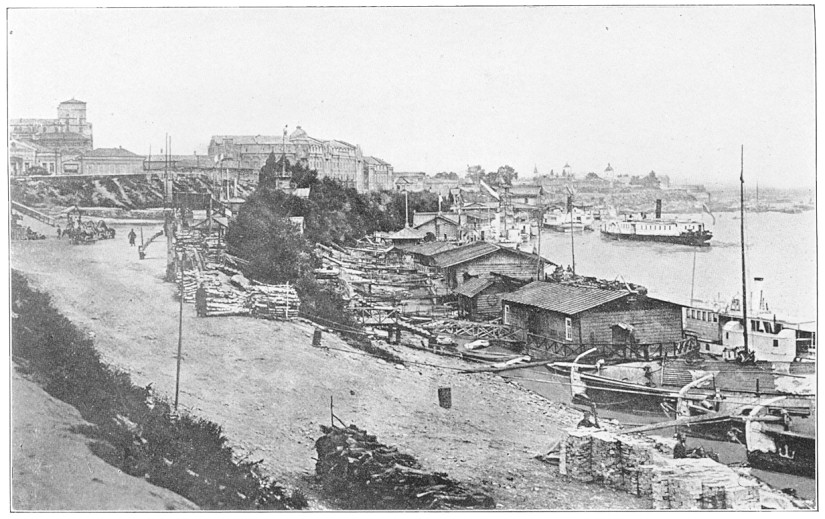
THE DNIEPER AT KIEF.
Beggars, who in Russia are as thick about the churches as the pigeons that pick up crumbs in front of St. Mark's, are almost essential to the histrionic panoramas at these places of pilgrimage. I have never seen so large or so varied a collection of professional and casual mendicants as within and about the sacred enclosures of Kief. Some appeared to enjoy vested rights; these privileged personages would as little endure to be driven from a favoured post as with us a sweeper at a crossing would tolerate a rival broom. Several of these waiters upon charity might be termed literary beggars; their function is to read aloud from a large book in the hearing of the passers-by. They are often infirm, and occasionally blind, but they read just the same. Another class may be called the incurables; in England they would be kept out of sight, but here in Russia, running sores, mutilated hands and legs, are valuable as stock-in-trade. Loathsome diseases are thrust forward as a threat, distorted limbs are extortionate for alms; it is a piteous sight to see; some of these sad objects are in the jaws of death, and come apparently that they may die on holy ground. Another class may be called the pious beggars; they stand at the church doors; they are picturesque and apostolic; long beards and quiet bearing, with a certain professional get-up of misery and desolation, make these sacred mendicants grand after their kind. Such figures are usually ranged on either side of the chief entrance; they are motionless as statues, save when in the immediate act of soliciting alms; indeed I have sometimes noticed how beggars standing before a church façade are suggestive of statuary, the want of which is so much felt in the unsculpturesque architecture of Russia. Pilgrims and beggars—the line of demarcation it is not always easy to define—have an Oriental way of throwing themselves into easy and paintable attitudes; in fact posture plays a conspicuous part in the devotions of such people; they pray bodily almost more than mentally,—the figure and its attendant costume become instruments of worship.
The Cathedral of St. Sophia, which dates back to the Eleventh Century, is of interest from its resemblance to St. Mark's, Venice, in the plan of the Greek cross, in the use of domes and galleries, and in the introduction of mosaics as surface-decorations. I saw the galleries full of fashionable worshippers; the galleries in St. Mark's on the contrary, are always empty and useless, though constructed for use. In the apse are the only old mosaics I have met with in Russia; it is strange that an art which specially pertains to Byzantium was not turned to more account by the Greco-Russian Church. There is in the apse, besides, a subject composition,—a noble female figure, colossal in size, the arms upraised in attitude of prayer, the drapery cast broadly and symmetrically. In the same interior are associated with mosaics, frescoes, or rather wall-paintings in secco. On the columns which support the cupola are frescoes which, though of no art value, naturally excited curiosity when they were discovered some few years since, after having been hid for two or more centuries by a covering of whitewash. Some other wall-pictures are essentially modern, and others have been restored, after Russian usage, in so reckless and wholesale a fashion as to be no longer of value as archæologic records. In the staircase leading to the galleries are some further wall-paintings, said to be contemporaneous with the building of the cathedral; the date, however, is wholly uncertain. These anomalous compositions represent a boar-hunt and other sports, with groups of musicians, dancers, and jugglers, intervening. In accord with the secular character of the subjects is the rude naturalism of the style. Positive knowledge as to date being wanting, it is impossible to speak of these works otherwise than to say that they cannot be of Byzantine origin. If of real antiquity they will have to join company with other semi-barbaric products in metal, etc., which prove, as we have seen, that Russia has two historic schools, the Byzantine, on the one hand, debilitated and refined, as of periods of decline, and, on the other, a non-Byzantine and barbarous style, strong and coarse as of races still vital and vigorous. A like conflict is found in the North of Italy between the Byzantine and the Lombard manner; and even in England the west front of Wells Cathedral presents the same unresolved contradictions. It would seem that over the greater part of Europe, Eastern as well as Western, these two hostile arts were practiced contemporaneously; at all events the same buildings are found to display the two opposite styles. It would appear probable, however, that the respective artists or artisans belonged to at least two distinct nationalities.
The Pecherskoi Monastery, or Kievo-Pecherskaya Lavra, at Kief, the Kremlin in Moscow, and the grand monastery of Troitza, have this in common, that the situation is commanding, the site elevated. Also, these three venerable sanctuaries are strongholds, for though the holy places at Kief are not on all sides fortified, yet the approach from the old city, which is the most accessible, lies along bastions and walls. In fact, here we have again a semblance to the ancient idea of a church, a citadel, and a palace united, as in an acropolis—the Church and the State being one; the arm of the flesh sustaining the sword of the spirit,—a condition of things which has always given to the world its noblest art. The walk to this most ancient monastery in Russia passes pleasantly by the side of a wood; then opens a view of the vast plain beneath, intersected by the river Dnieper, over which is flung the great suspension-bridge built by the English engineer, Charles Vignolles, at the cost of £350,000. The immediate approach is lined with open shops or stalls for the sale of sacred pictures, engravings of saints, and other articles which pilgrims love to carry back to their homes. Within the enclosure trees throw a cool shade, under which, as in the courtyards of mosques in Constantinople, the hot and weary may repose.
The cathedral dedicated to the ascension of the Virgin, has not the slightest pretence to external architecture. The walls are mostly whitewashed, and some of the windows have common square heads crowned by mean pediments; the intervening pilasters and floral decorations in relief, and all in the midst of whitewash, are of the poorest character. The seven gilded cupolas or domes may be compared to inverted cups surmounted by crosses. The form resembles the cup commonly combined in the fantastic towers and spires of Protestant churches in Germany, where, however, it has been supposed to signify that the laity partake of the chalice. These domes are made further decorative at the point of the small circular neck which connects the cupola with the upper member or finial; around this surface is painted a continuous series of single saints standing; the effect of these pictures against the sky, if not quite artistic, is striking. Other parts of the exterior may indicate Italian rather than Oriental origin, but the style is far too mongrel to boast of any legitimate parentage. Here, as in the Kremlin, are external wall-paintings of saints, some standing on solid ground, others sitting among clouds; the Madonna is of course of the company, and the First and Second Persons of the Trinity crown the composition. The ideas are trite and the treatment is contemptible—the colours pass from dirty red into brown and black. These certainly are the worst wall-paintings I have ever met with, worse even than the coarsest painted shrines on the waysides of Italy; indeed no Church save the Greek Church would tolerate an art thus debased. A year after my journey to Kief I travelled through the Tyrol on my way from the Ammergau Passion Play. The whole of this district abounds in frescoes, many being on the external walls of private dwellings. This village art of the Bavarian Highlands, though often the handiwork of simple artisans, puts to shame both the external and the internal wall-paintings at Kief, Troitza, and the Kremlin. Yet this contrast between Russia and Southern nations does not arise so much from the higher ability of the artists, as from the superiority of the one school to the other school. The pictorial arts fostered by the Western Church are fundamentally true, while the arts which the Eastern Church has patronized and petrified are essentially false and effete.
The scene which strikes the eye on entering this parti-coloured Cathedral of the Assumption, though strange, is highly picturesque. To this holy shrine are brought the halt, the lame, and the blind, as to the moving of the waters. Some press forward to kiss the foot of a crucifix, others bow the head and kiss the ground, a servile attitude of worship, which in the Greco-Russian Church has been borrowed from the Mohammedans. The groups which throng the narrow, crowded floor, are wonderfully effective; an artist with sketch-book in hand would have many a good chance of catching graphic heads and costumes, and all the more easily because these pilgrims are not so lively as lethargic. Still, for grand scenic impression, I have never in Russia witnessed any church function so striking as the piazza in front of St. Peter's on Easter Day, when all Rome flocks to receive the Pope's blessing from the balcony. Yet the whole interior of this cathedral is itself a picture, or rather a countless succession of pictures; as to the architecture there is not the minutest space that has not been emblazoned by aid of a paint-pot.
But the greatest marvel in this Cathedral of the Assumption is the iconostas, or screen for the sacred pictures, a structure indispensable to all Russian churches, of which I have withheld the description till now, when I find myself in front of a large and more astounding erection than can be found in St. Petersburg, Moscow, or Troitza. In small churches these sacred placards, bearing the character of drop-scenes, are apt to be paltry, indeed the irreverent stranger may even be reminded of painted caravans at village fairs. But in large cathedrals the screen which stands between the people in the nave and the priests in the holy of holies, presents a vast façade, upon which are ranged, in three, four, or five stories, a multitude of sacred pictures covered with gold and decked with jewels. These elaborate contrivances correspond to the reredos in Western churches, only with this important difference, that they are not behind the holy place but in front of it. They might, perhaps, with more correctness be compared to the rood-screens which in our churches stand between the altar and the people. The sacred screen now before me mounts its head into the dome, and presents an imposing and even an architectonic aspect, but certain details, such as classic mouldings of columns, and a broken entablature, pronounce the edifice to be comparatively modern. The summit is fitly crowned by a crucifix, almost in the flat, in order not to evade the law of the Russian Church, which prohibits statues in the round; the figure of Christ is silver, the cross and the drapery of gold or silver-gilt. On either side of the crucifix stand in their prescriptive stations the Madonna and St. John. On the story beneath comes the entombment, all covered with gold and silver, in a low-relief which indicates the forms of the figures beneath; the heads, which are not in relief but merely pictorial, are the only portions of the picture actually visible.
These altar-screens, which in Russia are counted not by tens but by hundreds and thousands, are highly ornate. Silver and gold and jewellery are conjoined with painting after the nursery and doll-like fashion approved in the South of Spain and at Naples. Only in the most corrupt of Roman Catholic capitals does ecclesiastical art assume the childish forms common in Russia. Resuming the description of the above altar-screen, we find next in range below the entombment a large composition, comprising God the Father surrounded by cherubs, with two full-grown seraphs, encircled by six gold wings, standing on either side. Again, the only parts of the picture permitted to be seen are the heads, crossed hands, black legs and feet. Christ with the open book of judgment is another conspicuous figure; also a companion head, gigantic in size, is the Madonna, directly Byzantine in type, though its smooth and well-kept surface gives little sign of age. The Christ, too, must be accounted but as modernized Byzantine; here is none of the severity or of the tenuity of the early periods. The type is poor though refined, debilitated though ideal. The hair, parted on the forehead, falls thickly on the shoulders. The face is youthful, not more than thirty, and without a wrinkle; the cheeks are a little flushed, the prevailing expression is placidity. The accessories of glory, drapery, and open book are highly decorative; here embossed patterns on the gold coverings enhance the richness of the surface-ornament. Once again the Russians appear supreme in metal-work, especially in the elaboration of decoration in the flat. Most of the pictures above mentioned are evidently supremely holy; they are black and highly gilded; moreover, they move most deeply all sorts and conditions of men, women, and children.
I may here again mention that one purpose of my Russian journey was to discover whether there were heads of Christ in the possession of the Russian Church older or nobler than the ivory carvings, the frescoes, or easel pictures which are found in Italy and other Southern or Western nations. And I was, I confess, disappointed not to meet with any data which could materially enlarge or enrich this most interesting of subjects. As to priority of date, it seems to be entirely on the side of the Roman catacombs and the Latin Church; moreover, in Russia, as I before frequently remarked, chronology is untrustworthy, inasmuch as comparatively modern works assume and parody the style of the most ancient. The heads of Christ in Russia, one of which has been just described, are, as already said, more or less servile reproductions of Byzantine types. Still the typical form is found under varying phases; the general tendency in these replicas of anterior originals would appear to be towards the mitigation of the asperities in the confirmed Byzantine formulas. Thus the more recent heads of the Saviour in the churches of St. Petersburg, Moscow, Troitza and Kief, assume a certain modern manner, and occasionally wear a smooth, pretty and ornamental aspect. In these variations on the prescriptive Eastern type, the hair usually flows down upon the shoulders, as with the Greek and Russian Priests in the present day. As to the beard, it is thick and full, or short and scant, but the cheeks are left uncovered, and show an elongated face and chin.
These Russian heads of the Saviour in softening down the severe and aged type common to Byzantium, assume a physiognomy not sufficiently intellectual for the Greatest of Teachers. These "images" in fact inspire little reverence except with blind worshippers; they are mostly wrought up and renovated, so as to fulfil the preconceived conditions of sanctity: undefined generality, weakness, smoothness, and blackness, are the common characteristics of these supposititious heads of the Saviour. It will thus again be easily understood how opposite has been the practice of the Eastern and Western Churches; it is a striking fact that at the time when, in Italy, under Leonardo da Vinci, Raphael and others, the mystery of a God manifest in the flesh had been as it were solved by a perfected art, this Russian Church was still under bondage to the once accepted but now discarded notion that the Redeemer ought to be represented as one who had no form or comeliness. Art in the Western world gained access to the beautiful, the perfect, and the divine, as soon as it was permitted to the painter or the sculptor to develop to uttermost perfection the idea of the Man-God. All such conceptions of the infinite, whether it be that of Jupiter in pagan periods, or of Christ under our divine dispensation, have always been the life and inspiration of the arts. But in Russia ignoble heads of Christ convinced me that such life and inspiration were denied. And I look upon the head of Christ as the turning point in the Christian art of a nation. If that head be conceived of unworthily there is no possibility that prophets, apostles, martyrs, shall receive their due.
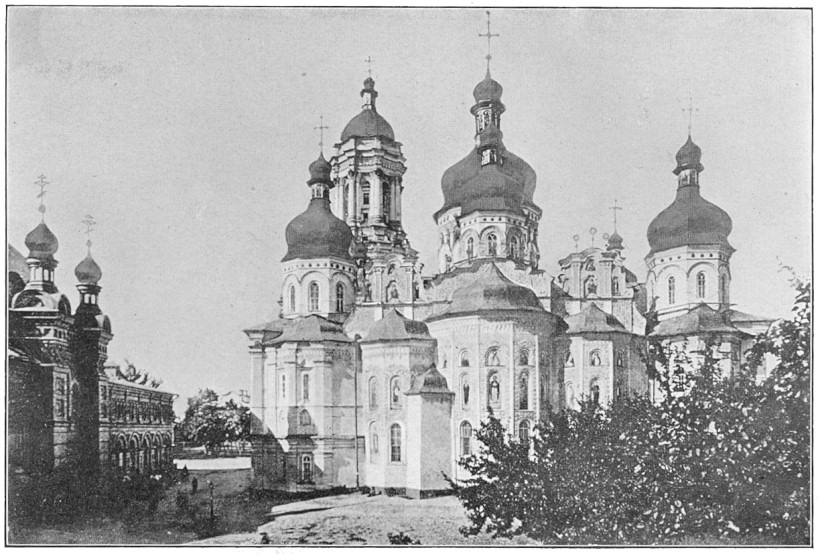
LA LAVRA, KIEF.