Front matter (continued 2)
Reading edition
In good time I revived, and I could taste it even then—that one teaspoonful of cold beer on the end of my swollen tongue, and, recalling the incident, "The green-eyed spig!" I says. "Is it any wonder they have revolutions every other week or so in their God-forsaken land?"
And what did I hear then but a voice calling me, and what did I see when I turned my head but my young friend with his head in the lap of the lovely Marguerite, and the rest I knew without being told, for Marguerite's stern mother was pouring water onto her lace handkerchief and applying the same to a lump topside of the youth's ears!
A large hearty-looking party was tending to my case. McWarrish was his name, and he was Marguerite's mother's brother, who managed a silver or lead (or was it a gold?) mine on that same Hot Coast, which, according to the ship's library, was likewise rich in oil, rubber, pepper, tabasco sauce, palm-leaf fans, and all manner of vegetable and mineral resources: a fertile and auriferous country that needed only the intelligence and energy of the superior northern races to make of it a marvellous commercial asset.
I did not have to tell McWarrish about the fight. He had seen it with the ladies from the veranda of the plaza hotel. And at dinner at the hotel, where in what was left of my uniform I sat in state, it developed that McWarrish and myself were of the one mind concerning Bobbie Burns. He poured six or eight or maybe a dozen libations to the memory o' rantin' Robbie, and says McWarrish then: "Mon, mon," he says, "but 'tis inspirin' tae meet wi' sich rare friendliness," and leads me down to where he had his motor-boat ready to take me out to the ship.
"Would ye no like tae ha' been there," says McWarrish, "the rainy nicht Robbie cam' ridin' on his horse frae the tavern wi' fower or five, or eight or ten it micht be, guid measures o' usquebaugh under his shirt tae keep him wet inside, wi' his cloak doon ower his shouthers tae keep him dry ootside, the whiles he composed the grandest song ever writ by the hond o' mon? Listen!" And he rolls out:
"Scots wha hae wi' Wallace bled, Scots wham Bruce has aften led—"
He was a large-boned man, McWarrish, with a voice that left no idle spaces in the air about him, and I am myself no dwarf, nor weak of lung; and singing in and out among the fleet we went, while marine guards looked over top-rails and bluejackets rolled out of their blankets to give us a cheerful word in passing and sailors on anchor watch warned us in a friendly way not to run 'em down and sink 'em—from one battleship after another—when in the silvery night they would loom surprisingly up before McWarrish, who was steering.
"Wull I gae aboard wi' ye, brither," he says to me when by and by we made my ship, "tae explain the reason o' your delay?"
"Thank you, friend," I said, "but there'll be trouble enough as it is." And I climbed up the side the while he shoved off for the beach again.
"What," says Mr. Trench, who had the deck, "shall I set down in the log for your overstaying your liberty after you were so strictly warned?"
"Yes," says Regulations, bobbing up behind him, "what's the alibi this time?"
And I gives them the log of the day from first to last, even as I've told it here, omitting, of course, the personal allusions, and all gravely and respectfully, as befitted an enlisted man to his officers.
"M—m—," says Regulations, and considered the case. "You say you bought tickets to the bull-fight, eh? And didn't use them? M—m—m—then you must have the tickets yet. Where are they?"
From the inside of my cap I pulls out two yellow tickets, and passes them to him. No great evil, as I've said, in the make-up of Regulations, and doubtless, in good time, by reason of advanced age and taking no mad chances, he will rise to be commander-in-chief of the fleet.
He looks at the tickets under the deck light. "H—m," he sniffs; "h—m," and leaves the deck.
"Just as well, Cohalan," says Mr. Trench, "you saved those two tickets."
"If I hadn't, sir," I says, "there was a hatful of them to be had for the picking up in the plaza when the battle was over. And they're to be married next Tuesday, and I'm invited."
Mr. Trench was my division officer, and this was not our first cruise together. "I'll recommend you for shore liberty," says Mr. Trench—"providing there's no bull-fight the same day."
And I'm passing on when I hear the whispering voice of Monaghan.
"I was listening to you," says Monaghan, "and thinking while I listened of what you said one day. 'Nothing like poetry,' says you, 'to develop the imagination.'"
"More beautiful than the flowers of the imagination," I says to that, "are the rocks of eternal truth. You were saying only this morning how when yourself and myself were apprentice lads together, 'twas paroquets and blue monkeys 'stead o' picture post-cards as in these degenerate days we would be sending home to show the family and neighbors how we'd been in foreign parts. And that's true, but such are only the temporary frivolities of the human creature and not to be measured as important. I tell you, Monaghan, that in its potentials human nature has not changed—not yet."
"Not yet?" says Monaghan. "How much longer of this mechanical age will you be giving it?"
"That," I said, "is to be determined. But 'tis my belief, Monaghan," I says, "that let the drums beat and the banners wave and the gonfalons and the various other palladiums and symbols of our liberty be carried in marching columns before us, and, barrin' the shell-makers and the spellbinders and the owners maybe of newspapers with increasin' circulations, 'tis my belief we would march forth to war as cheerfully and rampageously as any band of red Indians that ever danced around a red fire in the full of an autumn moon."
"If all you say is true," says Monaghan, "then it must 'a' been a grand place for an hour or two—that plaza this day. And yourself and myself and that husky bridegroom-elect standin' elbow to elbow this day—man, but 'tis talkin' of us in the cantinas they would be for a full generation to come. And, 'stead o' that, here was I, a man of my tonnage an' speed under forced draft, lyin' here useless as an old cruiser in ordinary."
From the little motor-boat, the same being navigated in devious ways back to the pier, I could hear McWarrish:
"Oh, my luve's like a red, red rose, That's newly sprung in June; Oh, my luve's like the melodie—"
Always, or so I've thought, there's something disposing to romance, or maybe melancholy, in the quiet that lies o'er great waters, and something, it may be, softening to large voices.
Anyway, 'twas a lovely, moonlit tropic night—fitting close to a blessed day.
A Bale of Blankets
They were holding what was almost a public reception in the ward-room of the Missalanna. The Honorable J. J. Flavin, having appeased his hunger and slaked his thirst, signalled the Filipino mess-boy for a smoke; and having decided as to what was the most expensive cigar on the tray, he took two, and moved on to where, through a shining air-port, a fresh sea-breeze might find its cooling way to his beaded brow, for it was a warm summer's day and at trencher-play the Honorable Flavin had been no laggard.
As the Honorable J. J. smoked, so did he take the time to observe; and, observing, he vouchsafed the opinion to a thin-faced, high-shouldered young fellow who happened to halt near him: "These navy fellows must have a fat time of it, huh, Carlin?"
Carlin flashed a glance on Flavin. "How do you figure that?"
"Why, look at the swell feed—and the champagne here to-day. And look!" He slid off for inspection the band of the cigar he was smoking. "I paid three for a dollar for that same cigar the other day at a big hotel in Washin'ton. They must have money to throw overboard to be givin' that kind away."
Carlin knew the brand. He also knew that only two, or it might be three, officers of that ward-room mess could afford to smoke that make of cigar regularly; but he did not tell Flavin that. "They get those cigars for twelve cents apiece—buying 'em by the hundred—in Cuba, J. J.," he suggested mildly.
"And the dealers stick us thirty-five cents for em up here! Anyway, a fat time they have swelling 'round in uniforms given 'em by the gover'ment for the ladies to admire 'em."
Two years of political reporting in his home city and two more as Washington correspondent for the paper of most vital circulation in that same home city had not made of Carlin a politician, and it is to be doubted if ten times four years in a political atmosphere would have so made him; because ancestrally implanted in Carlin's breast was an inextinguishable desire to speak what he thought, and usually as soon as he thought it.
He said now—sharply: "What do you know about naval officers or navy life, J. J.?"
The Honorable J. J. Flavin had never, not even when he was only ward leader and therefore much more disposed to humility than now, been able to reconcile Carlin's unworshipful tongue with his own sense of what was due a man of importance in the political world. And Judas priest, he had a tongue of his own if it came to that! "Of course, you know all about it!" he retorted.
"No, I don't," replied Carlin promptly and placidly. "But I probably know more than do you or almost anybody else who has never had the chance to live aboard ship and see some of it. This afternoon the officers of this ship are spreading themselves according to service traditions to give you and me and all aboard here a good time. To-morrow they'll be to sea and on the job, a simple-living, busy crowd—working hard, taking chances, and making no talk about it."
Flavin whoofed a funnel of doubting cigar smoke into the teeth of the air-port breeze. "Taking chances! How? And where?"
"Everywhere. Day and night—battleships, destroyers, in submarines and aeroplanes. Thirty men and officers killed in one turret explosion only last month."
"Taking chances—huh! Foolish chances!"
"Anybody who isn't living to see how long he can live takes a foolish chance once in a while. That turret crew were on the battle-range trying to make big-gun records."
"And did they make 'em?"
"They did. And their seven-inch batteries made 'em, too. Single guns and broadsides at ten thousand five hundred yards."
"I didn't hear about that," growled Flavin.
"No? That's a shame, J. J. The department ought to 've wired you about it."
Flavin eyed Carlin sidewise. No use—he would never change. Would he never get on to himself? Flavin wondered. Carlin ought to have been one of the best-advertised men in his line in the country, as everybody around Washington said, but a fellow liable to hop out any time and bat somebody that could be of use to him over the eye, how could anybody go boosting him?
"They must 'a' treated you pretty well, Carlin?" he hazarded slyly.
"They treated me well—yes," snapped Carlin. "And they're treating you pretty decently now, aren't they?"
"I'd like to see 'em treat me, or any member o' Congress, any other way!"
"A member of Congress—that's right. And as a member of Congress you're drawing down how much, J. J.?"
"Seventy-five hundred a year—and allowances," replied Flavin, looking around the wardroom and not caring particularly who might hear the figures.
"And before you were sent to Washington you never made more than fifteen dollars a week in your life," thought Carlin. Aloud he said, in as gentle a tone as he could on short-order muster: "And did you ever stop to think, J. J., that while you're being paid that seventy-five hundred a year—and allowances—the captain of this ship, with ten or eleven hundred lives and a twelve-million-dollar war-machine to look out for, gets less than five thousand a year—and that only after thirty-odd years of professional study and practice? And that almost all of these other officers you see standing around here will regularly have to go up on the bridge and take full charge of this ship and all on her, and let 'em, some night or day, make a mistake, lose their nerve, or close their eyes for an instant and—bing! All off with the ten or eleven hundred lives, not to mention the twelve-million-dollar plant! And these officers under the captain have had all the way from seven or eight to thirty years of continuous professional study and practice, and yet some of them are getting less than one-third of the money you get."
To which the Honorable J. J. responded blandly: "Well, what of it? Their pay and my pay is fixed by the same gover'ment. If they don't pay more, it's because the people who regulate their pay and my pay think they ain't worth any more."
"Fine!" said Carlin—"seeing that Congress regulates them both!"
"Huh!" Flavin hadn't foreseen that. "Here, you!" he roared to the mess-boy with the tray of cigars; and the little brown boy, with no inclining admiration for stout-waisted, loud-voiced men in splendid new gray trousers and frock coats, but always well drilled, floated himself and his tray respectfully, if not over-hurriedly, across the ward-room deck to Flavin.
"If you worked for me I'd soon learn you to move faster," growled Flavin. He began to paw through the tray. "Where's that cigar I had before? This it?" He read the name on the band. "Yes, that's it. Twelve cents apiece in Cuba, did y' say, Carlin? I wonder couldn't I get somebody to get me some of 'em? Here, ain't you having one?"
"No, I've smoked enough."
"Enough?—and swell smokes like this kind being passed round!" He took two.
Suddenly, smoking anew, Flavin cast a suspicious glance at the newspaper man. "What you getting at, Carlin—trying to drive into me all this talk about the navy? Is it because I'm a member of Congress?"
"I don't know that I've been trying to drive anything into you," retorted Carlin. "But you made a crack about the navy, and after you've been in Washington awhile longer somebody will be sure to tell you that my favorite monologue is the navy. They'll probably tell you, too, that if I couldn't get anything more intelligent to listen I'd hold up a row of trolley-poles and pump it into 'em. And so long as we are at it—take the officers' case again. As a member of Congress, J. J., you ought to know these things. When from out of his pay an officer deducts the cost of his grub and uniforms, not to speak of other items——"
"Huh!" Flavin was thinking of a new speech. Its theme was to be the soft times of certain pampered government servants, this for the undistinguished and unterrified voter of his district; but this item of grub and clothes was disturbing. "The gover'ment don't furnish 'em grub and clothes?"
"It doesn't. And the special full-dress coat of that officer standing there, or any of those younger officers, happens to cost nearly one-half of one month's pay—just the coat. And being naval officers, they have to live up to a certain standard aboard ship, as do their families, if they have any, ashore. And a lot of other items. Take this reception this afternoon—they have to pay for it out of their own pockets."
Flavin whoofed two, three funnels of smoke thoughtfully toward the air-port. That speech would sure have to be given up, or vamped up in some new way, or saved for prudent delivery before closed secret organizations—that was sure. An impressive speech, too, he could have made of it. Confound Carlin butting in with his inside information! And Carlin not being a politician either, what could a fellow do with him?
Carlin waited for the words of wisdom to flow. They flowed. "Y' know, Carlin, there's nothing to be gained in my district by voting for any naval bill."
"Is there anything to be lost?"
"Suppose I could swap a vote with somebody for a federal building or something in my district for something in his district?"
"Go ahead and swap it!" barked Carlin. "And keep on swapping till your district wakes up to you and swaps you for somebody else!"
Flavin shook his head in triumphant prophecy. "They won't—not in my district, Carlin. It's too solid. A nomination is an election in my district, and the machine says who'll be nominated. But I tell you what, Carlin—a man like you in Washin'ton could help me out a lot through your paper up home." He eyed Carlin narrowly to see how he took that. Carlin said nothing. Flavin continued: "You weren't born in the bushes yesterday, Carlin, for all you're no pol. You know enough about the game to know there's nobody giving somethin' for nothing in politics. And——"
Carlin raised a warning palm. "Pull up, pull up! You don't have to do any trading in this thing. You want to remember, J. J., that I'm a newspaper man even before I'm a navy man, and whatever you do you'll get what's coming to you from me."
The Honorable Flavin, not without doubt in his eyes, stared out of the air-port. Presently he said: "I'll take a look over the ship, I guess. See you later."
The eyes of Carlin, searching the ward-room for such officers of the ship as he had not yet greeted, encountered the quizzical and questioning glance of "Sharkey," otherwise Lieutenant Trench, United States Navy. "Who is your large and sonorous friend?" queried Trench. Being a host he did not put it in words, but being human he could not help looking it.
The spoken answer to the unspoken question would probably have horrified the Honorable Flavin. "He's a man from up my way who made himself useful to the machine, and so they sent him to Washington. He's pretty raw, Sharkey, but I suppose he could be worse. At least we know where he will always be found."
"And where, Carl, will he always be found?"
Carlin smiled with Trench. "Where the votes are. That's his idea of supreme political genius—playing for the votes of the moment. I was talking up the navy to him, with an increased navy-pay bill in mind for this session. But I don't suppose that interests you, Sharkey."
"Thanks to the thrift and thoughtfulness of an acquisitive ancestry," smiled Trench, "I suppose I could worry along if there was never a pay-day in the service. But most of the rest of the fellows would surely be interested. There's Pay Totten now. He'd——"
"Where is Pay? I haven't seen him since I came aboard."
"Nor you won't for some time again, unless you carry a longer than regulation glass, for Pay's by this time on the high seas and southward bound. That's why I spoke of him. But come into my room."
From a pigeonhole in his desk in his room Trench pulled out several typewritten pages. "Ever hear, Carl, of Pay's bale of blankets?"
"Nope."
"Ah-h—yours shall be the joy of hearing the tale from the lips of the poet-author himself. You may elevate your high literary eyebrows at the construction, but recalling that you, or some other competent critic, told me once that construction was, after all, subordinate—that is, physical, not psychological, construction—I venture to tell this story in my own way. Hark, now!" He smoothed out his sheets of paper and read:
"She was the war-ship Missalanna, which lay out in the stream Of a port in Chinese waters which translated means Cold Cream. A wireless comes from the admiral—he flew two stars on blue— And the message read: 'At once cast free and join me in Chee Foo. But bring along all packages, all bundles, and all mail Our need is great, the fleet does wait, come forced draft, do not fail.'
"And says the Missalanna's commander: 'Whatever shall I do? 'Tis a two days' Chinese holiday, don't they know that in Chee Foo? And a thousand tons of coal we'll need, and merchandise in dock Fills half the tin-clad warehouse, and immovable as rock Are sampan men and coolies when they've knocked off for the day— And now 'tis snow and hail and sleet and a two days' holiday!' "But he wakes up good old Totten Sleeping soundly in his bed, And showing the admiral's wireless, Mutters: 'This is what he said.'"
Trench looked over the top of his first page. "How's it so far, Carl?"
"They've put men in the brig for less. But go ahead."
"Thanks. I proceed:
"'I was dreaming,' says good old Totten, 'I was writing to my wife Of Chinese native customs and the joys of navy life. But two hundred coolie men we'll need and a score of sampans wide To get that coal aboard the ship and sail by morning tide. No night for honest men to roam, but be sure ashore I'll go— Mayhap in a shack on the water-side I'll find my friend Jim Joe.'
"Pay found his old-time Chinese friend and tells him what's to do. 'A thousand tons of coal I want and I'm putting it up to you.' But Joe he looks at his Melican flend and he says: 'Me no can do— To-night good Chinese mens they go and burn the joss-sticks—so— And bad Chinese mens, my flend,' says Joe, with a wink or two, 'They play fan-a-tan, low-lee and mot.' Says Joe: 'Me no can do.'
"And saying the last part over again— With another wink or two, 'They play fan-a-tan, low-lee and mot.' Says Joe: 'Me no can do.'
"Then Pay, with a grip of Joe's pigtail, 'You mind the time—you do?— When I pulled you out from a gunboat's snout?—and you now say: "No can do"? Two hundred coolie boys I want and twenty sampans wide, And twice five hundred tons aboard, so we sail by morning tide. When I left the ship the skipper says: "Now, Pay, it's up to you!"' Pay gives Joe's tail a gentle twitch—'Now, Joe, you must can do!'
"And Joe, with queue curled all anew, in the sleet and hail he goes And twoscore crews of coolie boys he drags out by their toes. 'Two hundled coolie boys me want and twenty sampans wide, And tice fi' hundled tlons on ship so she sail by morning tlide.' And some he tore from their honest beds and some from loud wassail, But all came out, for Joe was stout, into the sleet and hail.
"And two hundred lusty coolie boys With twenty sampans wide, Laid twice five hundred tons to where The ship in stream did ride."
Trench laid down the sheets.
"That's not the end, Sharkey?"
"No, no. But that's the end of the Jim Joe part, which was hailed as so masterly a performance on Pay's part—getting those sampan men and coolies out of their beds on a night like that and to work at coaling ship for us—that I, the uncrowned poet laureate of the Asiatic squadron, was commissioned to do it in verse, which I proceeded to do one night; and got that far, swinging along fine and dandy, when the messenger called me for the mid-watch."
"And you never finished it?"
"I couldn't—not in rhyme. After that four hours' night-watch the rhymes were all gone from me. It was a rough night. A monsoon made out of the southeast——"
"Omit the professional jargon, Sharkey, and your professional troubles, and remember the first law of story-telling is to tell the story."
"Wizz!" murmured Sharkey. "But, thus encouraged, I proceed. Well, getting Jim Joe started with his twenty sampans and his two hundred coolies was only part of Pay's job that night. The big warehouse, where goods for our fleet and other craft were stored, was in charge of a Chinaman we called Hoo Ling, and he knew less English than Joe, and appreciated even less than Joe the need of quick action. The admiral's wireless message looked just like any other wireless message to this big chink, Hoo Ling. But it's a great thing to be a student of the Chinese and of Chinese customs and of Chinese mental processes. Pay wheedled Ling a little, bluffed him a little, touched on past friendships a little, on possible future business a lot, painted a picture of our warlike forces over to Chee Foo, touched—not too casually—on the so much greater love which the officers and men of the United States Navy bore for China than for Japan, and such other little subtleties as he could invoke or invent. At last the old fellow was moved to open up and let Pay pick out what packages were for the fleet.
"And so, with four yeomen of the ship roused from restful hammocks to make memoranda of the addresses as fast as he pried them loose from the main pile and called them out, and with twelve able seamen of the watch to hustle the packages along as fast as the yeomen recorded them, and with forty other bustling bluejackets to load them into the boats, Pay tore into that pile of freight, which was about as high and twice as long and wide as a three-apartment house. There were probably four or five thousand packages of various kinds to be overhauled, and they were addressed in four languages—English, German, French, and Chinese. If Pay was the only white man in that part of China who could have charmed that impassive old storekeeper out of his bamboo bed that time of night, he was probably likewise the only white man in port that night who could read those Chinese shopkeepers' addresses.
"Dry goods, wet goods, hardware, grocery stuff, butcher's stuff, jeweller's stuff, ship's stores, bales of cotton, bales of silk, curios, souvenirs, bicycles, sewing-machines, sacks of rice, sacks of coffee, sacks of potatoes, barrels of flour and of gasolene, auto tires, boxes of tea, quarters of beef and of mutton, cases of breakfast-food and of oil, packages all the way from the size of a finger-ring to packages the size of an auto-truck. You know what a big, husky chap Pay Totten is? Imagine him on a slushy, snowy night, stripped to the waist, wading into that pile—feet, shoulders, knees, hands, elbows, with his teeth almost—tearing out those packages, and from addresses in English, French, German, and especially Chinese, picking out flying such as were for our ships."
Trench paused. A reminiscent smile was parting his lips.
"Hurry up. Did you sail on time next morning?" demanded Carlin.
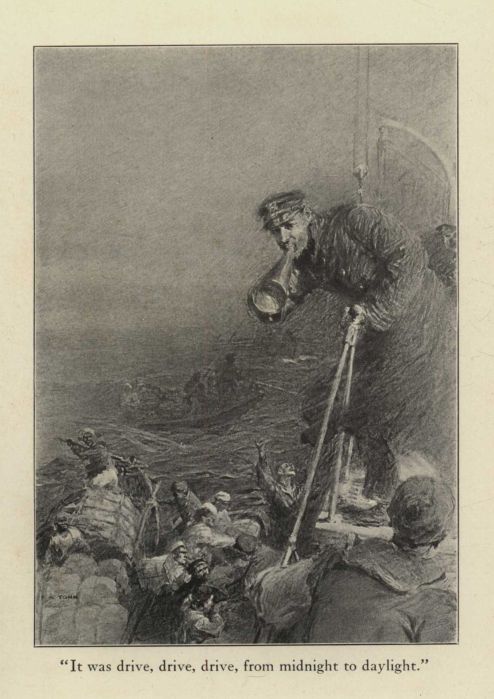
"We did. With our coal aboard and the packages for the fleet, we made a record run and arrived in Chee Foo hours before the admiral was looking for us. And it was the day before Christmas, and our coming made the whole fleet happy for Christmas week, and our skipper got 'Well done!' from the flag-bridge, but—" Trench looked at Carlin and smiled ruefully. "There's so often a but, isn't there, to the otherwise happy tale? Among the seven hundred and odd packages receipted for by Paymaster Totten it seems there was missing one bale of blankets. What happened to the bale of blankets? they queried Paymaster Totten, and 'Lord!' says poor Pay, 'how do I know? It might 've been stolen on the wharf, or dropped overboard between the wharf and one of the ship's boats, or lost in rowing out to the ship or hoisting it over the ship's side. There were a dozen ship's boats and two hundred ship's men coming and going, and half a mile between the ship and shore; and it was a black, blustering night of sleet and hail, and there were also hundreds of coolies and dozens of sampans on the coal. It was drive, drive, drive, from midnight to daylight—how do I know what happened to one lone bale of blankets?'
"It was drive, drive, drive, from midnight to daylight."
"However, Pay nor anybody else worried much about the blankets at the time. Our skipper recommended, in view of Paymaster Totten's extraordinary exertions on that night, that the bale of blankets be not charged against his accounts. And the admiral, when he heard all the story, approved and passed it along to Washington. But it came back. And by and by it was sent on to Washington again. And by and by it came back.
"And forth from us it went in due time, and for the last time, we thought, on leaving for home by way of Suez and Guantanamo. In the Mediterranean we picked up the European squadron and with them enjoyed several gala occasions, notably at Alexandria, Naples, Villefranche, and Gibraltar, at each of which ports we deemed it incumbent upon the service to spread itself a little. And during these festivities Pay was there with the rest of us, but between the gala-days going without his bottle of beer with lunch, his cigar after dinner, in order that on the great days he might be able to contribute his share toward these receptions and yet not impair that sum—three-quarters of his pay it was—which he sent home monthly, in order that Mrs. Pay and the five little Pays might have food, lodging, clothes, and otherwise maintain the little social standard of living imposed upon a naval officer's family.
"'Thank God,' says Pay on our last day in the Mediterranean, 'we are leaving here to-morrow!' and he hauls out his aged special full-dress suit, and looks it over, and says with a sigh: 'I'm afraid I'll have to lay you away, old friend; but a few thrifty months in West India winter quarters and I may be able to replace you with a grand new shining fellow, and so come up the home coast the gayly apparelled, dashing naval officer of tradition.'
"And we went on to the West Indies and put in the rest of the winter there, with Pay forgetting all about the bale of blankets, until the night before we were to go north. On that night a steamer from New York puts into where the fleet is, and in her mail for us is our old friend the letter of the indorsements as to the loss of the blankets, and now with one more indorsement since we'd last seen it, to wit: the department saw no reason to change its original ruling as to the responsibility for the loss of the bale of blankets, and Paymaster Totten's accounts would be charged with the loss thereof."
Trench paused to allow a swift hot blast from Carlin to sweep through the room. "The archaic bureaucrats!" concluded Carlin fervently.
"Yes," agreed Trench, "and yet, Carl, from their point of view——"
"A point of view which impairs high service is criminal."
Trench knitted his brows. "Maybe you're right, Carl, but—recalling your advice about story-telling—Pay Totten, foreseeing a battleship cruise along the North Atlantic coast this summer, with certain pleasant but expensive ports in sight, could see where it might well behoove him to ask for a change of venue—that is, if he ever hoped to settle for that bale of blankets. It was costing him thirty dollars on the ship for his grub, which, as you know, didn't include any smokes or an occasional bottle of beer, nor the laundry for fifteen white suits—a fresh one every day in the tropics—and a few other sundry items, not to mention other minor but inescapable items.
"So Pay thought it all over, and on his way north he put in his request, and two days ago he got his orders; and yesterday he left us. And this morning—look!"—from the pile of letters atop of his desk Trench selected one. "This came. Listen:
"DEAR SHARKEY:
"We're sailing to-day for the West African coast to look into Liberian matters. And in that country, where you're likely any time to fall in with a member of the cabinet sitting barefooted in the middle of the road peeling potatoes, the wear and tear on uniforms won't probably be over-heavy. And if there should happen to be any recherché affairs when we move onto the Congo coast, I am only hoping that the natives won't inspect too closely any special full-dress paymaster's coat which should be blue but, as it happens, is green in the region of the seams. And after the West African sojourn we are bound for a little jaunt of a thousand miles or so up the Amazon, where I learn—and I've taken some trouble to learn—we won't have to wear full dress at all, not even when calling upon the tribal high chiefs. I'll come home yet with that old full-dress standby—if it isn't blown off my back during some tropical typhoon.
"It's a great thing, Sharkey, the being allowed two months' advance pay on leaving for foreign service. For me it means that Mrs. Totten and the children can have their little place and their one little maid at the little beach which did them all so much good last summer, and, if they're economical, maybe an occasional trip to the movies.
"And so I am leaving almost happy. Of course, the good-by and that two years made me feel a bit lumpy and lonesome leaving them, but the race would be too easy if we didn't carry some little extra weight, wouldn't it? As to the bale——"
Trench looked up. "There's something else, personal stuff, which doesn't concern the story." He laid down the letter and looked up. "I couldn't help hearing a word or two of what your friend the congressman was saying to-day—half the ward-room also heard it, I guess. There's a case for him, Carl, if he's the right kind—a special bill to reimburse Totten."
Carlin jumped to his feet. "You're right, Sharkey. And he isn't the worst in the world. I'll put it up to him right now, if he's still aboard."
Congressman Flavin was still aboard, but also was bursting with something to tell. "What d'y'know, Carlin—nine hundred and odd sailors aboard this ship and not home once in ten years to vote."
"Why——"
"And you ask me to vote for bills for a lot of people that ain't ever home to vote. I wouldn't 'a' known only I was speaking to a couple of 'em happened to live in my district, and they told me."
"That's all right, J. J., but forget that voting stuff for a minute and listen to me." And briefly, rapidly, and not without art, Carlin retold the story—retold it in prose entirely—of Paymaster Totten and the bale of blankets. When he had done he added: "Now, J. J., what do you think of a man doing a good job like that and losing out by it?"
"Always the way, Carlin—always," replied the Honorable Flavin briskly. "What most of these fellows on these ships need is a little course in practical politics. Why didn't that paymaster sit tight in his bunk, the time his captain came to him with that hurry-up message, and tell him he couldn't get any coolies or sampans? If he'd just rolled over in his bunk and said, 'Captain, it can't be done,' or if he'd gone ashore and made a bluff it couldn't be done, he wouldn't 'a' had any bale of blankets to pay for—see? This doing things you don't have to do, and nothing in it for yourself when you do do 'em—that's kid's work."
"All fine, J. J., but how about Christmas for the fleet?"
"Christmas? Let 'em look out for their own Christmas! He'd be getting his pay envelope every week just the same, wouldn't he?"
"Fine again—and as beautifully practical as you always are, J. J. But how about doing what Totten thought was his duty?"
"Duty? That ain't duty—that's foolishness. Duty's doing what you got to do, not doing something just to make a good fellow of yourself."
Slowly Carlin began to count: "One, two, three——"
"What's the matter?" demanded Flavin.
"A dream I had is taking the count—eight, nine, ten, out! Say, Flavin, did it ever occur to you that your duty included knowing something about your business—who can vote, for instance, among a thousand other things, and who can't?"
"The mistake you make and all you wise high-brows make, Carlin"—and the Honorable Flavin fixed him with a knowing eye—"is in thinking I don't know my job. My job ain't in being in Congress. A hell of a lot they'll know at home what I'm doing in Washin'ton after I get there. My job is being elected to Congress. And getting elected means to be able to get votes, and getting votes means being with the people who'll give you the votes. And your paymaster friend"—the Honorable Flavin favored Carlin with a wink and another knowing smile—"and his push, they don't swing any votes. But o' course that's for them. With you it's different. Now, you being in Washin'ton with a string o' newspapers—huh?"
Carlin had walked off.
"There he goes," muttered Flavin, "pluggin' the game of a lot of people who can never do a thing for him."
Trench was shaking his head, half-sadly and half-smilingly, at Carlin. He replaced Totten's letter on the pile on his desk. "One of the jokes of the mess is to accuse me of having so much money that I could publish my own books of foolish rhymes if I felt like it, but I haven't enough to pay for that bale of blankets for Pay Totten. Aboard ship Pay has just as much money as I have. But no matter—I'm one of those who believe that nobody beats the game in the long run. The eternal laws are against it. The people get everybody pretty near right in time. And fellows like Pay will get what's due them some time. And your congressional friend, too, I hope. But"—Trench stood up—"what d'y'say, Carl, if we get out into the ward-room country again? It's been a long watch since you and I clinked glasses together."
And outside, in the mess-room, standing almost under the air-port which opened out to sea, Trench held his glass up to Carlin's, saying: "There was a boson's mate I knew one time, named Cahalan. I used to absorb most of my philosophy from him. I was on the bridge one night, and in one of the wings was Cahalan and another lad of the watch. They were evidently having an argument about something, and Cahalan was trying to convince him. I couldn't hear what his watch-mate said, but from out of the dark all at once I heard Cahalan. Said Cahalan: 'When a man does a good job and gets rated up for it, he's a lucky geezer; when he does a good job and don't get rated up for it, he mayn't be a lucky geezer, but what th' hell, he's done a good job just the same, hasn't he?' So, Carl, what d'y'say?—to Pay Totten, sailing lonesome through the Trades—a poor politician, but a damn good officer!"
Breath o' Dawn
It was an admiral of a great navy returning a call, and hundreds of bluejackets were peeking out from the superstructure.
"Here he comes—spot me Lord Admiral, fellows!"
"Three ruffles of the drum, three pipes o' the boson's whistle——"
"—six boys an' thirteen guns——"
"—and he swellin' out like an eight-inch sponson comin' over the side, as if it was himself and not his job the guns are for!"
Young apprentice boys' voices those.
There came an older voice: "You kids talk as if it was in admirals and at sea alone. And ashore any day are bank presidents, head floor-walkers, chairmen of reception committees—yes, and bishops of the church—any of them on their great days stepping high to the salutations, as if 'twas something they had done, and not the uniform or the robe or the job they held."
Carlin had a look at the owner of the voice. Later he hunted up Trench—Lieutenant Trench—and to him he said: "Glory to the man who can wear his uniform without tempering hot convictions or coining free speech to the bureaucratic mint! But greater glory to the man who can divest high office of its shining robes and see only the man beneath. Who's your big, rangy gunner's mate with the gray-flecked, thick black hair and what the apprentice boys call go-to-hell eyes?"
"That's easy—Killorin."
"And what's his history?"
"When I first knew him—on the China station—he was stroke of the ship's racing crew, the best football player I ever saw, and among the men he had the name of being an all-big-gun ship in a fight. A medal-of-honor man, too. Later he went in for booze-fighting and hellraising generally and made a first-class job of that, too. I liked him—all the officers did—and when I was having my first dreams of the day when I should be commanding the latest dreadnought, it was Killorin, settled down and steady, who was to be my chief gunner. I told him as much one night on watch.
"'A warrant-officer and wear a sword and be called Mister?' says Killorin. 'And will you tell me, sir, what's being a warrant-officer and wearing a sword and being called Mister to being all alive when my youth is still with me?'
"I couldn't tell him; and as we grew more friendly many another question he asked me in the quiet of the night-watches I couldn't answer. He could talk the eye out of a Chinese idol himself."
Carlin peered down at Killorin. "Did you ever ask him how—despite the being all alive and having his youth—he is to-day only a gunner's mate?"
"And have him, in ten perfectly respectful words, put me back in my place? I did not—not that I wouldn't like to know."
"I think I half know," said Carlin.
That was in a tropic port. That same night Carlin found it too hot to sleep below. He rolled off his bunk, had another shower-bath, dressed lightly, and went on deck, where his friend Trench was on watch.
He patrolled the deck with Trench. The men were sleeping everywhere around the top deck. The tall form of Killorin rolled out from under the overhang of a turret and sat up. Trench's walk brought him abreast of Killorin.
"Pretty hot?" asked Trench.
"It is hot—yes, sir."
"These young lads"—Trench waved a hand toward the stretched-out shapes all around—"they don't seem to mind it."
"They're young, sir."
"Young? I didn't think there was a tougher man, young or old, in the navy than you."
"A man's body," said Killorin, "can take comfort atop of a hot galley stove—or a cold one. A man's mind—'tis not so simply eased."
"Trench," said Carlin, when they had left Killorin, "when I was a boy there was a great hero in our school. Half the girls I knew carried his picture on their bureaus. And most of the other half were suspected of hiding one away. One of those athletic heroes, a husky Apollo—this Killorin makes me think of him. But suddenly he disappeared from the middle of his glory."
"Any crime?"
"No, no crime. Wild, but straight. His name was Delaney."
"Killorin's right name," said Trench after a while, "is Delaney."
Carlin left Trench and walked around deck, in and out among the sleeping forms. Here was one in a hammock, here one on a cot, but mostly they slept on the bare deck in their blankets. Every odd corner and open space held them. They were tucked in against hatchways, under turrets, inboard of boats, outboard of boats, next the smoke-pipes, in the lee of gypsies, of winches, cook's galley. Everyhow and everywhere they slept—on their backs, their stomachs, on their sides, curled up and stretched out. Some whistled, some groaned, some snored, but mostly they slept like babes.
It was hot, as sometimes it seems to be hotter in the night than ever it can be in the day, even in the tropics.
A young bluejacket under a cluster of deck-lights tossed, rolled, tossed, sat up. A restless lad near him also sat up. Between them they produced the makings and rolled a cigarette. They lit up, inhaled, began to talk.
"How about Bar Harbor, or Rockport, or some other little place off the New England coast a night like this, with a cool, fresh breeze sweeping in from the Atlantic?" asked the first one.
"What's the matter with the little old North River?" said the other, "or the East River, with the Brooklyn trolleys clangin' and the train to Coney and a few dollars in your pocket after a visit to the paymaster? ... And your best girl, o' course," he added after a moment.
They snuffed out their cigarettes and rolled back into their blankets. Killorin was still sitting up wide awake.
"And your best girl?" repeated Carlin to Killorin.
"Yes," responded Killorin, "as if that didn't go, like an anchor to a ship, without saying."
"Isn't it always a girl?" said Killorin presently. "Whatever drives the most of us to whatever it is we do, good or bad beyond the ordinary, but a woman stowed away somewhere to see what we do at the time or read of it later?"
The Killorins of the world are not standing and delivering to men they never saw before; and so it was not that night, nor the next; but on another hot night, and the ship headed up the Gulf, with the men sleeping anyhow and everywhere about the deck, that Killorin sat outboard of the sailing-launch and, looking out over the dark waters, said:
"Progresso astern and Veracruz ahead—always a port astern and another ahead, isn't it? And so you knew old Dan Riley that kept the candy store up home? ... And Mary Riley?" he asked; and, after a while, began to talk of things that had been.
Lovely Mary Riley! No thought ever I had that girls were made for boys to notice till I saw you!
Five blocks out of my way from school her father's store was, but four times I walked past that store window the day after the first time I saw her, and more than four times many a day later—to see her again. It was three months before I got courage to go nearer to her. And then it had to be a night with snow on the ground and sleigh-bells to the horses, and in the faces of men and women a kinder look and in the heart of a boy maybe a higher hope than ordinary.
Christmas eve it was and the store all decorated—candy canes, big and little, hanging among the bright things in the window. There were other people before me, but she nodded and smiled by way of letting me know that she saw I was waiting. She nodded in the same smiling way to a poor child and a rich man of the neighborhood.
"How much for a cane?" I asked when it came my turn, and I that nervous I exploded it from me.
"Canes?" She turned to the window. They were all prices, but I didn't hear what she said. I was listening to her voice and trembling as I listened.
There was a great big brute of a cane, tied with blue ribbons and hanging from a gas fixture. "How much for that one?" I asked.
"That?" She had violet eyes. She opened them wide at me. "That is two dollars."
"Let me have it," I said.
Her thin red lips opened up and the little teeth inside them shined out at me. "But you don't want to be buying that," she said; "we keep that more for show than to sell."
To this day a thing can come to my mind and be as if it happened before my eyes. "She thinks I'm one who can't afford to spend two dollars for that cane, and she's going to stop me," I says to myself. "She thinks I am a foolish kind who would ruin himself to make a show." If there had been less truth in what she thought, maybe I would have been less upset. "I'll take it," I said. "I want it for a Christmas tree for my little nephew."
There was no nephew, little or big, and no Christmas tree, and that two dollars was every cent I had to spend for Christmas. But her eyes were still wide upon me, and I paid and walked out with the cane—without once turning at the door or peeking through the window in passing, for fear she would be looking after me, and I wouldn't have her think that a two-dollar candy cane wasn't what I could buy every day of my life if it pleased me.
I hoped she would remember me, but took care not to pass the store for a week again, for fear she would see me and think I was courting her notice because I had bought the big cane.
I was going to high school then. One Saturday afternoon there came high-school boys from all that part of the country to compete for prizes in a great hall near by. I wasn't in them. I liked to run and jump and put the shot well enough, but to go in training, to have a man tell me what time to go to bed and what time to get up, and what to eat and what not to eat, and after a couple of months of that to have to display yourself before crowds of people—that was like being a gladiator in the Colosseum I used to read about, and performing for the pleasure of the mob—patricians and the proletariat alike!
I would spend hours in the alcove of the school library reading of belted knights in the days of tourneys and crusades—but that was different. I could see myself addressing the kings of the land and the queens of the court of beauty, the while the heralds all about were proclaiming my feats of valor. A knight on a great charger in armor and helmet, with my lance stuck out before me—never anything less glorious could I be than that.
But all loyal sons of our school took a ticket for the games. I went to them; and there I saw Mary Riley waving her banner and cheering a gangling-legged young fellow that lived in the same street as myself. No special looks did he have, and no more brains than another, but he was winning a hurdle race and she was cheering him. And there came another, the winner of the high jump, and she cheered him, too.
To see a girl you are night and day thinking of—to see and hear her cheering some one else—! I went in for winning prizes. And when the season came around I played football. And my picture used to be in the papers, those same papers saying what a wonder I would be when I went to college. And all the time I wondering was she seeing the pictures and reading the words of me.
My people had no money to send me to any college, but from this college and that came men to explain to me how the money part could be arranged. And so to college I went. I paid enough attention to my studies to get by—no great attention did it take—but I paid special attention to athletics, and before long my picture was sharing space in the papers with presidents and emperors and the last man to jump off the Brooklyn Bridge. And is there any surer way to spoil a nineteen-year-old boy's perspective of life than to keep telling him that well-developed muscles—whether they be in his back or his legs or inside his head—will make a great man of him?
I came home from college for the summer. I'd seen Mary a few times since that Christmas eve, but made no attempt to get acquainted. Maybe I was too shy. Maybe I was too vain, or overproud—waiting for the day when I would be of some account, when the notice of neither men nor women would I have to seek—they would be coming to me.
But pride is a poor food for heart hunger. I went to have a look into her store on my first night home. I had a wild idea that I would go in and introduce myself and she would know of me, and maybe I would walk home with her.
There was a young fellow in a navy uniform—a chief petty officer's coat and cap—leaning on the counter talking to her, and he had a red rose in the buttonhole of his uniform coat. By and by, when her father came to close up the store, the young fellow walked home with her. Standing on the opposite corner, I watched them pass. It was something serious they were talking about—no smile to either of them.
I stood on the corner after they had passed for as long as I could stand it. Then I walked up to where I knew she lived. They were standing at the steps of her house. It was a quiet street, and the sound of my footsteps caused them both to turn. The young fellow stood up straight and strong on the lowest step, but she stepped into the shadow of the doorway. I saw her eyes looking out on me as I passed. Her hat was off and there was a red rose in her hair—and none in his coat.
Some pictures fade quick, some never. The picture of Mary Riley in that doorway, with his rose in her hair—that hasn't faded yet.
They had been talking before I reached them, but as I passed on I could feel the silence between them. For many steps after I passed on I could feel that silence and their eyes following me up the street.
Next day there was an outdoor bazaar for the benefit of some flood sufferers. There was an athletic programme and I was the star of the meet, with my picture on the bill-boards.
I went. Surrounding the athletic field and track were tables for the sale of this thing and that, and behind the tables were women and girls using every female guile to coax money from men's pockets.
There were big tables and little tables. At one of the little tables was Mary Riley. Sidewise out of my eyes I saw her, standing atop of a chair behind the table to look out on the games. When the games were over and I was dressed up in my street clothes again, I walked over to her table. My three first-prize cups in their three chamois bags were carried behind me by a multi-millionaire's son named Twinney. He was an athletic rooter, with an ambition to be known as the friend of some prize-ring or football or sprinting champion. In my coat pocket were two gold prize watches.
Mary Riley was standing behind her table. The young chief petty officer was there, too—in front of the table. They were auctioning the last of the things off. With a smile and a word of thanks Mary would hand over the things as they were bought. But she wasn't taking in too much money. She was the daughter of a man of no great importance in the community, and she didn't have the grand articles that the women at the other tables had. Her little stock was made up of things that she had begged or made herself.
The auctioneer was a whiskered old man with a great flow of gab. He holds up a piece of lace—to put on a bureau or a dresser it was—made, as he put it, by beautiful Miss Riley herself. And she was beautiful! Violet eyes and blue-black hair, and—I've seen Chinese ivory since that her face was the color of, only no Chinese ivory that ever would take on the warmer waves of color as I looked at it.
"How much for this lovely lace cover?" the auctioneer was asking, and "Two dollars," some one said. And right away the chief petty officer said "Five!"
I looked at him then—for the first time fairly. He was one of those quiet-looking, thoughtful kind—of good height, well made and well set up—maybe twenty-two years old.
There was another chief petty officer with him; and this one began telling a bystander how that young fellow who'd just bid was Jack Meagher the gun-captain—the same Meagher, yes, that the papers had been talking about—who'd dropped from his turret to his handling-room and in through a fire and shut himself up in a magazine and maybe saved the ship and the whole crew from being blown up. He'd got burnt, pretty bad—yes, but was all right now.
"He's got his medal of honor for it, but he's not one to carry it around and show it," said Meagher's friend.
Meagher was bidding—some one had said six dollars for the lace. Meagher had said ten, and Mary Riley's violet eyes were glowing. I had five dollars—no more—in my pocket. But there was Twinney with his tens-of-thousands allowance in the year. He always carried plenty of money around with him.
"Twinney," I said, "how much money have you?"
"Oh, a couple of hundred or so," and pulled it out and began to count it.
"I'll bid on the lace piece," I said, "and you pay for it."
"Ten dollars I'm offered for this lovely piece of lace," the auctioneer was drooning. "Do I hear——?"
"Twenty," I said.
Meagher looks over at me and a light comes into his eyes. "Forty," says Meagher.
"Sixty," I said.
"Eighty," says Meagher.
The fat auctioneer looked from one to the other of us. He had not had a chance to speak since the bidding was at ten dollars. He was about to open his mouth now when——
"One hundred dollars!" I said and looked over at Meagher.
Meagher turns to his chum. Before he could speak the chum was emptying his pockets to him. When he had it all counted—his chum's and his own——
"Two hundred fifty dollars," he said; "we might as well throw in the change—two hundred and sixty-five dollars," and laid it down on the table before Mary Riley.
Gold of angels, but there was class to the way he did it. No millionaire's money, but the savings of an enlisted man's pay.
I turned to Twinney. "He's through—make out your check for three hundred and give to me."
"Three hundred dollars," he says, "for that piece of lace! Three hundred—why, five dollars would be enough for it!"
"Make out your check for three hundred, Twinney, and those cups you've got and the two watches in my pocket, every medal and cup I've got at home, my championship gold football—they're yours to keep."
"But three hundred dollars!"
"Yes, and three thousand if I had your money!"
"But what do you want it for?"
"Gr-r-r—!" I snarled, and shoved my spread hand into his face. He landed on his back ten feet away. The C.P.O. friend of Meagher's started to smile at me, but before he could get the smile well under way I wiped it off. He fell where he stood. Meagher looked at me and I at him.
"That wasn't right," said Meagher.
"I'll make it right," I said, "with you or him or whoever else doesn't like it, now or later."
He went white; and the kind that go white are finish fighters. And he was a good big man with more than muscle under his coat.
"Make it right now," he said. "But not here—some place where the crowd won't be."
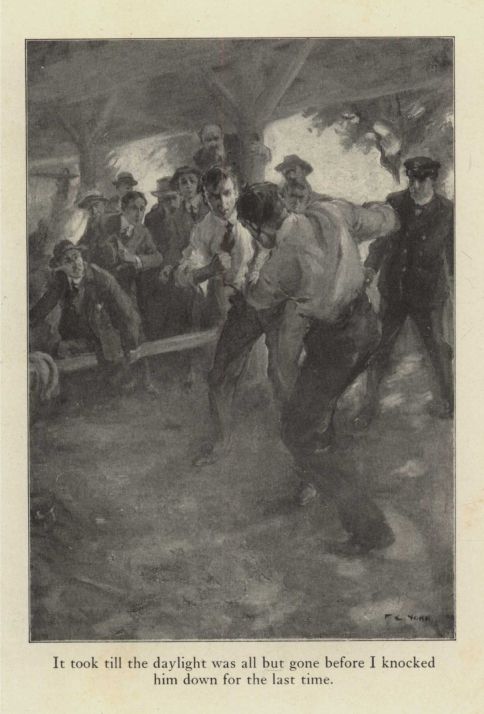
We moved over to under the grand stand. That was at half past five o'clock and it was a long summer's day, but it took till the daylight was all but gone before I knocked him down for the last time.
It took till the daylight was all but gone before I knocked him down for the last time.
He couldn't talk; he couldn't get to his feet. His C.P.O. friend—a game one, too—shook his fist at me across his body. "Only a week out of the hospital and you had to beat him up. But, beaten or not beaten—go ahead, smash me again if you want to, you big brute—he's still a better man than you are or ever will be!"
A score of people had found their way in under the seats. None who cared to know but would hear a word of every blow that was passed in that fight. Going home after the fight it was borne in on me that less than ever was I the hero I was wishful to make myself out to be.
I slept little that night, and in the morning—nothing within the four walls of a house suited me any more—I slipped out into the sun and walked along the docks; and walking the docks I reached the gates to the navy-yard. I went in.
A ship!—'tis like nothing else in the world. Ships! In the romances I'd been reading since ever I could read, there had been tales of ships and of the sea. Phoenician galleys, Roman triremes, the high-prowed boats of the Vikings, carved Spanish caravels—they had carried the men who made history. Great ships were they, and yet here were ships that could take—any one of them here—could take a score, a hundred, of the ancient craft with all their shielded men at arms and stand off—a mile, two miles, ten miles off—and with one broadside blow them from the face of the waters. Dreams of what had been and what might be—what use were they? Things as they are—that was it!
What most people, maybe, would call common sense was coming to me; and maybe something finer than all the common sense in the world was flying from me. So I've often thought since of that morning.
I enlisted in the navy. And it was good for me. To look out on the wide 'waters—day or night—'tis to calm a man's soul, to widen his thought.
I had no ambition to rise. The blazing life of the four quarters of the world was soaking into me. My eyes, perhaps, were seeing too much, and my mind pondering on what I saw too much, to be breaking any ship records for efficiency.
But I was getting my rating when it was time and I was forgetting old shore troubles, when there was a warrant-officer came to our ship. His name—no matter his name—he's no longer in the navy. He was the— But you've seen the little man on the big job?—the sure sign of it being the pompous manner and the arrogant word. There he was, licking the boots of those above him and setting his own boots on the necks of those below! He strutted like a governor-general. Maybe you know what sort of talk is passed along the gun-decks when such a one is parading by!
The ridiculousness of him was too wide a target for any man with an eye in his head to miss. I was never short of an eye, nor oil for the trunnions of my tongue, and no ship's company ever lacked a messenger to carry the disturbing word. For the fun I poked at him my bold superior had me spotted for his own target later.
There was a chest of alcohol on the lower flag bridge and there was a marine sentry standing by it night and day. As much for the devilment as for the drink, four or five of the lads in our gun crew one night rushed the ladder to the bridge, stood the sentry on his head, broke open the chest, grabbed the alcohol, and got away.
My warrant-officer says he saw me among 'em. 'Twas a hot night, like to-night, and in the tropics too, and he couldn't sleep, he said, and had to leave his room and come on deck. And so it was he happened to be where he could see me. He couldn't name the others. Indeed, he would not care to name others when he was not positive, and so do possibly innocent men an injustice, and so on. But he was positive about me.
I was called. The sentry looked me over. He wouldn't swear it was me, but there was one man in the party about my height and build, and, like me, he was a very active man, judging by the way he went down the bridge ladder.
Now, I knew who did it—I had been invited to be of the party, and I wasn't a bit too good for it; but I didn't feel like going and I didn't go. The man the sentry took for me was the man who had been the heavyweight slugger of the ship before I was drafted to her. We had already had the gloves on, and I had beaten him at a ship's smoker long before this. I waited to see would he speak up. He didn't, and I took my sentence—disratement and thirty days in the brig, ten of it on bread and water.
I didn't mind the disrating, nor the brig and the bread and water; but I did mind being made out a liar.
The first liberty I made after that—in Hong Kong—I caught my boxing rival ashore. I gave him a proper beating. He took it as something coming to him, without complaint. The next liberty I made—in Nagasaki it was—I caught my warrant-officer ashore.
He was not on duty and so not in uniform, and, pretending to mistake him for somebody else, I gave him a grand beating. Six or eight of their little ju-jutsu policemen clung to my legs and back, but that didn't stop me from finishing my job on him. I left him in such a ridiculous fix that he was ashamed to complain, but the Japanese authorities weren't satisfied. I spent a night in one of their jails, and aboard ship next day I was masted and once more disrated—this time with a sermon from the captain on my disorderly ways.
I didn't mind the captain's lecture—I had rated that—but I did mind being drafted to another ship with a record as a disturber. I had not taken more than four or five drinks in my time up to then, and then more out of curiosity than desire, but on my next liberty—in Manila—I took a drink. I didn't like the taste of it—I don't yet—but there's never any use in half-doing a thing—I took another, and more than another. From then on I began making liberty records.
Officers were good to me. It is only a skunk of an officer who will take pride in crowding an enlisted man, and I've met few skunks among our officers. So long as I could hold my feet coming over the gang-plank, a friendly shipmate buckled to either side of me and I able to answer "Here!" to the roll-call—so long as I could do that, there were deck officers who looked no further. 'Twas a friendly way, but bringing no cure to me.
By and by Meagher was assigned to our ship. He had married Mary, and this was maybe a year later. He was a warrant-officer—had been for five years—a chief gunner, wearing his sword and being called Mister. And wearing it with credit—all the gun crews spoke well of him.
He never let on that he remembered me, until one day the handling-room was cleared of all but the two of us, and then it was me who spoke to him. "I'd like to have a word with you, Mr. Meagher," I said, "if you don't bear too much of a grudge."
"Why should I bear you a grudge?" he said. "You licked me, and licked me good. You left no argument as to who won that fight. If I ever bear you any grudge, it will be for the drinking and brawling record you're making, with never a thought of the manhood you're wasting."
"It's easy for you to talk so—you that won what I'd die ten times over to get."
"Die? You die? Give up your life? Why, you haven't even the courage to give up your consuming pride!"
He looked at me and I at him. I was all but leaping for him. "Go ahead," he says, "beat me up again!"
"You're my officer," I said.
"Cut the officer stuff!" He threw his cap on the deck. He took off his coat and threw that on the deck. "Now I bear no mark of the officer—come on now and beat me up! And you'll have to beat me till I can't speak or see again—and then you can leave me here, and I'm telling you now no one will ever know who did it. You're many pounds heavier and half as strong again as when you licked me before, but go ahead and turn yourself loose at me. There's no alibi left you now—go ahead, turn yourself loose at me!"
I was all that he said—a brute that felt equal to ripping the three-inch planking off the quarterdeck, and he wasn't himself near the man he had been when I fought him before—he had never got well over the burning in the handling-room fire; but he stood there telling me what some one should have told me long before.
"Jack Meagher," I said, "Mary Riley made no mistake—you're a better man than I am." And I left him and ran up the ladder—up to where winds were blowing and seas singing and the stars rolling their eternal circles. All night long I walked the deck.
It did me good—what he had said to me. But a man doesn't change his ways overnight. I stopped maybe to have a backward look more often than I used to, and friendly deck officers maybe didn't have so often to look hard at the liberty lists; but being in the same ship with Meagher did me good.
I used to take to watching him, to studying his ways—the ways of the man Mary Riley had married.
He used to come out of the after turret and look out on the sea, when maybe he'd finished up his work for the afternoon. He was there one afternoon late; and we were in the China Sea, a division of us, bound up to Cheefoo for a liberty. A monsoon was blowing, and there we were, pitching into it, taking plenty of water over ourselves forward, but so far very little aft.
Meagher was in rain-coat and rubber boots, leaning against a gypsy-head, when this big sea rolled up over our quarter-deck. She had a low quarter, our ship, and the solid water of this sea rolled turret-high. When it had passed on, Meagher and four others were gone.
I was in the lee of the superstructure. I ran onto her quarter-deck. I saw an officer's cap and took a running high jump over the rail. While I was still in the air I said to myself: "You're gone! Her starb'd propeller will get you—you're gone! ...
"And if I am, what of it?" I recalled later saying to myself; but before my head was fairly under I was kicking out hard from the ship's side.
Meagher was the only man of the five to come up. When I saw him he was struggling to unhook the metal clasps of his rain-coat. I reached him and kicked out for the life-buoy that the marine sentry had heaved over. We made the buoy and I shoved him up on it—he still trying to clear himself of his heavy rain-coat.
"I kicked off my rubber boots right away, but the buckles of this thing they don't come so easy." That was Meagher's first word, and—heavy-spoken because of weariness—he said it by way of apology for causing so much trouble. "But I'd never got clear in time—you saved me from going, that's sure." Not till then did he have a chance to look at me. When he saw who it was he went quiet.
"You're surprised, Jack Meagher?" I said.
"Yes," he said.
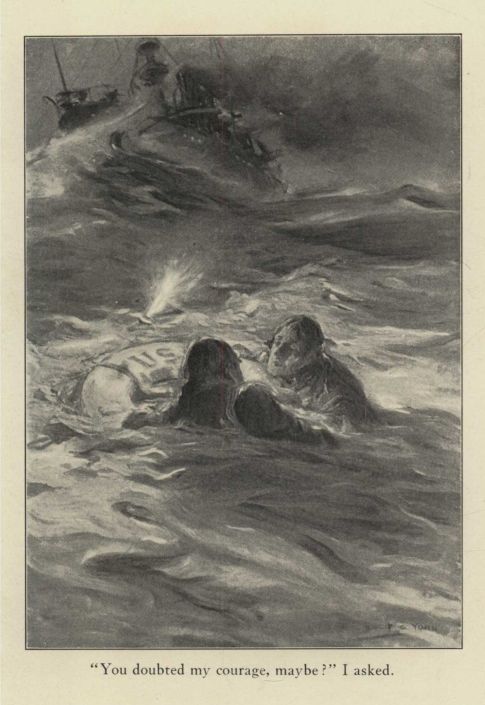
"You doubted my courage, maybe?" I asked.
"You doubted my courage, maybe?" I asked.
"No," he said to that, "not your courage—never your courage. But your good intentions—yes."
We were lying with our chests across the buoy, and we could easily see the ship, and we knew that the ship could see us so long as our buoy light kept burning—her whistles were blowing regularly to let us know that. But she would have to have a care in manoeuvring because of the other ships so near, and it was too rough to lower a boat for us.
Then at last the blue light of our buoy burned itself out, for which we were almost thankful—it smelled so. And then night came, and darkness.
Tossing high up and then down, like a swing in the sea, we went, lying on our chests across the buoy one time and hanging on by a grip of our fingers another time. And when the sea wasn't washing over my head I would shout; though I doubt if, in the hissing of the sea and the roaring of the wind, my voice carried ten feet beyond the buoy.
By and by a search-light burned through the dark onto us. Meagher was by then in tough shape. For the last half-hour I'd been holding him onto the buoy, and it was another half-hour before they could launch a boat. We had been three hours in the water, and I was glad to be back aboard. It is one thing not to mind dying; it is another thing to fight and fight and have to keep on fighting after your strength is gone. When a man's strength goes a lot of his courage goes with it.
Meagher's courage was still with him. He protested against being taken to the sick bay, but there they took him; and when he left the sick bay, it was to take a ship for home. I went to see him the last day. On my leaving him, he said: "I'm taking back a lot I said to you. If you had been washed over I doubt if I'd gone after you."
He would have gone after me—or anybody else. And I told him so, my heart thumping as I said it, for I'd come to have a great liking for him.
"I still doubt it," he said. "Anyway, I owe my life—what there is left of it—to you."
"If you think you owe me anything," I said, "then don't tell your wife anything about me. Don't tell her where I am or what my name is now."
"I won't tell her or anybody else where you are or what your name is, but I will tell her how you saved my life."
I never saw him again. I heard they gave him a shore billet when he was discharged from the hospital; I heard, too, that within a year he was retired on a pension. But that he was dead—I never knew that till you told me to-night.
Killorin had come to a full stop.
Carlin recalled the last time he had seen Meagher—when they both knew he had not long to live. "She has been a wonderful wife to me. Not much happiness I have had that she has not made for me," Meagher had said.
"I don't doubt he told her of my going over the side after him in the gale—he wasn't a man to lie," said Killorin.
"He told her," said Carlin. "And he told me something more. That night you passed them on the steps he had proposed to her. He thought she was going to say yes. She had stuck his rose into her hair and was about to say the word—so he thought—and then you came by. And it was six years again before she said the word. If you had not left home——"
"Thank God," said Killorin, "I left home! Thank God on her account. The consuming pride—it had to burn itself out in me."
It was still dark night, but ahead of the ship a cluster of pale yellow lights could be seen.
"Veracruz?" asked Carlin.
"Veracruz, yes—the port ahead. And how was she when you saw her last?"
"A lonesome woman—more lonesome and weary than a good woman should be at her age. Her eyes are still violet and her cheeks like ivory, but the color doesn't come and go in them now."
"I had to leave home to learn," said Killorin, "that the bright color coming and going like a flood means the blood running high in the heart. Men should have a care for such. Such natures feel terribly—either joy or sorrow."
It had been night. In a moment the red sun rose up from the oily sea, and it was day. There was a moment of haze and vapor, and then emerged a city ahead—a pink-and-white city, with here and there a touch of cream and blue.
"Beautiful!" murmured Carlin.
"They're all beautiful," said Killorin, "in the dawn."
A faint breeze was stealing over the Gulf. Through the black sea little crests of white were breaking—pure white they were, and a whiff of pure air was coming from them. The sleepers around the deck began to stir, to roll over, to sit up, and, with thankful sighs, to inhale the fresh, sweet air.
"The breath o' dawn!" murmured Killorin—"like a breath o' heaven after the hot tropic night.... As you say, that port ahead is beautiful. But when that port is astern and some other one ahead! That will be the sight, man—New York harbor after all these years! The breath and the color o' dawn then—'twill be like a bride's blush and her whisper stealing over the waters o' New York Bay."
Peter Stops Ashore
The Pentle place had been closed up and the servants were gone; but Mrs. Pentle's car was still waiting at the gate, and Mrs. Pentle herself—old John Ferguson, on his way to the lookout, could see Mrs. Pentle perched up on her flat rock and looking out on Gloucester harbor and the sea.
There was a fishing-schooner sailing out. John put his glasses on her and was entering her in his book when he heard some one's step on the ladder leading to his tower, and then the hatch sliding back. It was Mrs. Pentle.
"I've heard of your book, John. May I look at it?"
"Surely, ma'am, surely." He passed it to her. "For seventeen years now I've been keeping it—the account o' the fishing-vessels sailin' out o' Gloucester, ma'am. A column for the day o' departure, one for the name o' the vessel, one for the master, and one for the day she comes back home."
She was turning the pages.
"So many never come back home, do they?"
"Nacherally—they bein' fishermen, ma'am."
"Ah-h, here's the year!" She ran her finger down the page. "And here!" and read: "'Valorous—sailed December seventeenth—and never returned.'"
"I mind her, ma'am, with the proud name—George's handlin'."
"I know. My father was one of her crew.... But here"—she stopped in her turning of the pages—"isn't this the entry of one they've just given up for lost?"
"That's her, ma'am—the Conqueror. It's queer what bad luck goes with those proud names, ma'am. Peter Crudden was master of her."
"Peter Crudden! I played with Peter Crudden when we were children together. And he's lost?"
"When they print the names o' the crew in the Gloucester papers, it's a hundred to one they're gone, ma'am. A married sister o' Peter's is a neighbor o' my married daughter's up in Boston, and they're cryin' their heart out a'ready, she writes me—Peter's sister an' her children."
Mrs. Pentle closed the book.
"We live such sheltered lives here ashore, most of us, don't we, John? And we complain at the smallest little discomfort—many of us, I mean. And those brave men sail out to the dangerous waters in their little boats, where the best of it is hardship and death comes so often. It must be born in me—I just can't help feeling different toward those fishermen from what I do toward the men I meet in my business in the city."
She left; and, watching her swing down the ladder, John Ferguson was thinking that for a woman of her build—full-bosomed and no slimling—she was cert'nly light on her feet, and wondering why a young and good-looking widow as she was—dang good-looking—why more o' those wealthy young men she must know hadn't hooked her afore that. "Must be," mused John, "none of 'em's used the right bait."
John turned, just naturally to have another look out to sea, and—"Well, you old gadabout!" muttered John and hurried to point his glasses at what he saw wabbling in.
"Dang me if she c'n be!" cried John. "Dang me, but she is!"
It was the Conqueror—her foremast gone half-way to the deck, her mainmast gone clean to the deck, and her bowsprit broken off at the knight-heads. And she was a foot thick, or more, in ice; and in her jury-rigging was her flag—at half-mast.
"That's one, ye ravenous sea, dang ye, ye didn't get!" muttered John. "And she'll have a tale to tell!" And wondering how many of 'em were gone, and who they were, he entered the month and day of her return.
The Conqueror had fitted out at Duncan's; and Duncan's wharf and store had not changed in twenty years. Mr. Duncan did not like changes.
The old shelves of canned goods in Duncan's, the long packages of blue-papered macaroni, the little green cartons of fish-hooks, the piled-up barrels of flour and boxes of hardtack—they were all of the same old reliable brands. And the woollen mitts in strings! And in back was an area of kegs of red lead and hanks of tarred ground-line and coils of stout rope, and oilskins and sou'-westers, and rubber boots and the heavy leather redjacks—the smell of them was all over Duncan's.
Fred Lichens, who had kept books for thirty years for Mr. Duncan, was looking down the wharf at the Conqueror warping into the slip when Mrs. Pentle arrived in her car. Her arrival was not surprising. She had half a dozen small charities in Gloucester, and she came regularly to Mr. Duncan's for advice about them.
Fred knew all this exactly, because he kept the books for the Gloucester end of these things—drawing a few extra dollars a month therefor—and he had known Mrs. Pentle since she was a little girl and used to come with her mother, and without her as she grew older, to Mr. Duncan's to draw, against whatever would be her father's share, the stores which the family needed to keep them alive while the father was out to sea.
Fred remembered when the girl who was now Mrs. Pentle left high school to go to work in Boston. She was a bouncingly pretty girl, and within two years married Pentle, the millionaire department-store man.
Fred dusted a chair for Mrs. Pentle and set it in her favorite spot, which was beside a window in Mr. Duncan's own office looking out on the harbor. Sitting there, she saw an iced-up wreck of a vessel and some of her crew leaping up onto the wharf, where a crowd was surrounding them. She asked what vessel it was, and Fred told her—the Conqueror, Peter Crudden; and she said No! and Fred said Yes, ma'am, it was.
"I wonder if I should know him now," she said; and then: "Which is Peter Crudden?"
"Captain Crudden," said Fred, "is the one Mr. Duncan is bending toward to hear better."
The crowd was moving up toward the store. Mrs. Pentle jumped up on her chair so as to be able to look over the glazed lights of glass between the private office and the store as they came in.
Peter Crudden was a hard-looking figure of a man, coming into Duncan's store that day. He had not shaved for days, and his thick hair looked enormous—it was so tangled. He had not slept in a week; and when he took his seat on the long store bench and let his head settle wearily back against the wall he looked old.
He was telling about the big gale coming on and how her spars went, which maybe saved her from going into the shoals and being lost right there, and how they worked her way clear o' the shoals under jury-rig, how they were lookin' for a little ease and comfort, when aboard comes this unlucky sea, with no more warning than a shooting star out of the sky, and sweeps—cleaner than ever you could sweep the floor o' the store—her deck and all, everything. And atop o' that a sea to fill her cabin full. Four of 'em makin' for the deck were thrown back into the cabin again—smashed afoul o' the stove one, and atop o' the lockers and into a looard bunk another; and how they picked themselves up and made the deckhand when they got there—as if a clean-swept deck warn't hard luck enough—there was Dave Elwell that was to the wheel, his breast smashed again' the wheel spokes and he dead.
"And the two on the deck gone—gone, sir, so quick that we never even got a sight o' them or a smothered hail from them goin'," concluded Peter. "An' cold! And ice! And—" But once more he let his head fall back against the wall.
Fred was so wrapped up in Peter's story that he forgot Mrs. Pentle till he found her beside him and heard her saying in a low voice:
"When I was a little girl I listened to fishermen on that same bench, with their stories of toil and death. And I remember how I would linger, making believe to retie my packages into a tighter bundle, to hear more of what they had to say. It was a man sitting on that bench, Mr. Lichens, in just that way, not knowing who I was, who brought word of my father's vessel gone down—and all hands with her."
"I cal'late the hard tales told from that same bench would fill more books than was ever writ about Gloucester, an' there's been a many—an' some foolish ones among 'em," said Fred.
"Those two men washed overboard"—Peter was speaking again—"some one has got to tell their people how they come to be lost. And poor Dave in the ice-house aboard the vessel—some one has got to 'tend to him."
"I'll 'tend to Dave," said Mr. Duncan.
"That'll help," said Peter. "And now—I'm through with fishin'—through with goin' to sea! I'm goin' to stop ashore!"
It was then Mrs. Pentle ran from beside Fred and into the store. "Captain Crudden——"
"This is Mrs. Pentle, captain," said Mr. Duncan.
"Celia Curtin that was," explained Mrs. Pentle. "I knew you as a boy."
"I know," said Peter. And then he almost smiled: "And no girl in Gloucester ever better able to take care of herself!"
"If I could get you something to do in my store, would you take it, captain? If it was fit work, I mean, for a man?"
"It wouldn't have to be fit—I'll trim bonnets for ladies before I go back to fishin'," said Peter, "and thank you for the chance."
Peter passed out with his crew.
Mrs. Pentle turned to Mr. Duncan.
"So that's settled! I shall telephone you, Mr. Duncan, about Captain Crudden's place in my store—the work will not be disagreeable."
Mr. Duncan and Fred watched Mrs. Pentle's car racing up the street; and then Fred said:
"Mr. Duncan, Peter didn't look like any magazine cover of a hero I've seen lately, but—sitting there on that bench awhile ago—did you take a look at Mrs. Pentle's face while he was telling the story of that wreck?"
Mr. Duncan looked at his old bookkeeper.
"Reef down your imagination, Fred. She's a woman who likes to manage things and to do good; but what I'm afraid she'll do now will be to ruin the makings of a smart young skipper with her soft job ashore."
Mr. Henston, the manager of Pentle's, brought Peter Crudden to Flaxley, the head shipper.
"Flaxley, you are to break in this man," said Henston, "and he's to go on the pay-roll at twenty dollars per week."
Flaxley wondered why a new man, who was to be only a shipper's helper, should go on the payroll for twenty dollars a week; and he wondered yet more why Henston should be telling him about the pay-roll, which was made up in the office and not in the shipping-room. He wondered, too, why the manager himself should take the trouble to introduce the new man.
"You needn't make it easy for him on my account," whispered Henston, going out.
Flaxley had seen a lot of things happen in Pentle's, where he had been so long that, when Mrs. Pentle wanted to know about anything that went back beyond the memory of even the ancient cashier Herrick, she would send down for Flaxley.
He was no older than Herrick, but he had started to work in the store younger.
Flaxley was like something that went with the store. He had privileges; and he did not like Henston and would not have minded telling him so, but that he had great respect for Mrs. Pentle and thought—what many more in the store thought—that Henston was dressing his windows so as to catch Mrs. Pentle's eye, and some day—you can't tell about women, especially young widows—some day Henston might marry her.
Flaxley looked Peter over and rather liked his make-up, and pointed out a big dry-goods case and told him what he wanted done. Flaxley saw the new man hook into the box, which weighed eight hundred pounds, up-end it, claw-hammer it, and toss the heavy bolts of cloth out onto the long table.
"Jeepers!" said Flaxley. "He did that while some o' the other young fellows here would be peeking around for help!" He studied Peter for two days more, and from then on wearied the head shippers of other emporiums, whenever he met one, with his tales of the strength and niftiness of the new man he'd "picked up."
Peter took his lunch in the basement where he worked, the same being put up by his married sister in a package made to look like a camera-box.
He had bought this lunch-box in Pentle's—he remembered it was sold to him by a pretty girl with a pleasant manner. It was just the thing for lunch—she had said—all the girls in Pentle's carried 'em; and there was ten per cent off for employees. It was the first time in his life that Peter ever got anything off on anything he'd ever bought, and he said so; and the salesgirl looked at him again and then smiled.
"You're not a city man?" she said. Peter said he wasn't; and then his change came and he went off.
It was his third day in Pentle's. He sat on a stool by the door leading into a passageway, to eat his lunch. Just across the passageway was the door into the girls' rest-room, where there were lounges and chairs and a big heater on which they set their cans of coffee to warm up.
"My new helper, girls—height five feet eleven, weight a hundred ninety, thirty-two teeth in his head and not married—look him over," said old Flaxley, making Peter blush. "And now warm his coffee for him—he's been too shy to ask," and Flaxley handed Peter's coffee across the passageway.
They looked him over, some of them saucily. And hearing Flaxley call him Peter, in a week or so some of them were calling him Peter and offering him pickles and doughnuts from their lunch-boxes; and there were always three or four ready to take his coffee from him when he reached it across the passageway to be heated.
One day a group of them, with their heads bunched in the doorway as usual, chaffed him across the passageway. Peter was looking at a lovely white neck and dark little head, back of the row of heads in the door, and wondering where he had seen that girl before. And biting into a thick corned-beef sandwich, he remembered where—it was the girl who had sold him the lunch-box.
"Ten per cent off for employees," shouted Peter; "all the girls carry 'em!" and held up the lunch-box. The others caught the idea and laughed uproariously—except the one who had sold it. She only blushed scarlet and disappeared, and did not come back.
"She must 'a' thought I was tryin' to get acquainted," said Peter later to old Flaxley, "and didn't like it."
That same afternoon Mrs. Pentle looked into the shipping-room. It was one of those warm days in winter and, of course, the steam was on. Peter was wearing only a sleeveless white jersey above his belt. Peter was wide-shouldered and trim-waisted, with the easy lines of the man who is quick as well as powerful in action.
Flaxley saw Mrs. Pentle in the doorway. Henston was with her and, because Henston was with her, Flaxley stepped quickly over to the door. If Mr. Henston had anything to say about Peter he wanted to be there to hear it.
Mrs. Pentle was watching Peter at work.
"He doesn't look like the same man," said Mrs. Pentle. "When I last saw him his jaws were set like steel, his eyes like hard lights back in his head, and his voice was rough. And his skin was like something worn raw by the beating of hammers on it. He looked like a middle-aged man then, and now—why, he doesn't look twenty-two now!"
"He ain't much more," said Flaxley.
Just then Peter up-ended a big dry-goods case, ripped off a boarded side, tore away a layer of thick paper, and tossed onto a table ten feet away a bolt of cloth that Mrs. Pentle knew weighed fifty pounds; and he did not even bend his knees to do it.
"A powerful brute," said Henston.
"Brute?" said Mrs. Pentle.
"I mean—" said Henston; but Mrs. Pentle had stepped inside the shipping-room door.
Peter was whistling; but he had to up-end another case. It took a little effort, this one, and he stopped his whistling.
"Up—up—upsie boy!" cooed Peter. It did not up. He set himself and tugged. He grew impatient. "Come here, you loafer!" he shouted, and braced and heaved. The case came up.