Part 2 — APPENDICES.
Reading edition
APPENDIX I. CONDENSED RULES FOR AN AUTHOR AND TITLE CATALOG.
PREPARED BY THE COÖPERATION COMMITTEE OF THE AMERICAN LIBRARY ASSOCIATION. [70]
ENTRY.
Books are to be entered under the: Surnames of authors when ascertained, the abbreviation “Anon.” being added to the titles of anonymous works. (1a Initials of authors’ names when these only are known, the last initial being put first. (1b Pseudonyms of the writers when the real names are not ascertained. (1c Names of editors of collections, each separate item to be at the same time sufficiently catalogd under its own heading. (1d Names of countries, cities, societies, or other bodies which are responsible for their publication. (1e First word (not an article or serial number) of the titles of periodicals and of anonymous books, the names of whose authors are not known. And a motto or the designation of a series may be neglected when it begins a title, and the entry may be made under the first word of the real title following. (1f
Commentaries accompanying a text and translations are to be entered under the heading of the original work; but commentaries without the text under the name of the commentator. A book entitled “Commentary on . . . ” and containing the text should be put under both. (1g
The Bible, or any part of it (including the Apocrypha), in any language, is to be entered under the word Bible. (1h
The Talmud and Koran (and parts of them) are to be entered under those words; the sacred books of other religions are to be entered under the names by which they are generally known; references to be given from the names of editors, translators, etc. (1i
The respondent or defender of an academical thesis is to be considered as the author, unless the work unequivocally appears to be the work of the praeses. (1j
Books having more than one author to be entered under the one first named in the title with a reference from each of the others. (1k
Reports of civil actions are to be entered under the name of the party to the suit which stands first on the title-page. Reports of crown and criminal proceedings are to be entered under the name of the defendant. Admiralty proceedings relating to vessels are to be put under the name of the vessel. (1l
Noblemen are to be entered under their titles, unless the family name is decidedly better known. (1m
Ecclesiastical dignitaries, unless popes or sovereigns, are to be entered under their surnames. (1n
Sovereigns (other than Greek or Roman), ruling princes, Oriental writers, popes, friars, persons canonized, and all other persons known only by their first name, are to be entered under this first name. (1o
Married women, and other persons who have changed their names, are to be put under the last well-known form. (1p
A pseudonym may be used instead of the surname (and only a reference to the pseudonym made under the surname) when an author is much more known by his false than by his real name. In case of doubt use the real name. (1q
A society is to be entered under the first word, not an article, of its corporate name, with references from any other name by which it is known, especially from the name of the place where its headquarters are established, if it is often called by that name. (1r
References.—When an author has been known by more than one name, references should be inserted from the name or names not to be used as headings to the one used. (1s
References are also to be made to the headings chosen: from the titles of all novels and plays and of poems likely to be asked for by their titles; (1t from other striking titles; (1u from noticeable words in anonymous titles, especially from the names of subjects of anonymous biographies; (1v from the names of editors of periodicals, when the periodicals are generally called by the editor’s name; (1w from the names of important translators (especially poetical translators) and commentators; (1x from the title of an ecclesiastical dignitary, when that, and not the family name, is used in the book catalogd; (1y and in other cases where a reference is needed to insure the ready finding of the book. (1z
HEADINGS.
In the heading of titles, the names of authors are to be given in full, and in their vernacular form, except that the Latin form may be used when it is more generally known, the vernacular form being added in parentheses; except, also, that sovereigns and popes may be given in the English form. (2a
English and French surnames beginning with a prefix (except the French de and d’) are to be recorded under the prefix; in other languages under the word following; (2b
English compound surnames are to be entered under the last part of the name; foreign ones under the first part; (2c
Designations are to be added to distinguish writers of the same name from each other; (2d
Prefixes indicating the rank or profession of writers may be added in the heading, when they are part of the usual designation of the writers. (2e
Names of places to be given in the English form. When both an English and a vernacular form are used in English works, prefer the vernacular. (2f
TITLES.
The title is to be an exact transcript of the title-page, neither amended, translated, nor in any way altered, except that mottoes, titles of authors, repetitious, and matter of any kind not essential, are to be omitted. Where great accuracy is desirable, omissions are to be indicated by three dots (...). The titles of books especially valuable for antiquity or rarity may be given in full, with all practicable precision. The phraseology and spelling, but not necessarily the punctuation, of the title are to be exactly copied. (3a
Any additions needed to make the title clear are to be supplied and inclosed by brackets. (3b
Initial capitals are to be given in English: (3c to proper names of persons and personifications, places, bodies, noted events, and periods (each separate word not an article, conjunction, or preposition, may be capitalized in these cases); (3d to adjectives and other derivatives from proper names when they have a direct reference to the person, place, etc., from which they are derived; (3e to the first word of every sentence and of every quoted title; (3f to titles of honor when standing instead of a proper name (e. g., the Earl of Derby, but John Stanley, earl of Derby); (3g In foreign languages, according to the local usage; (3h In doubtful cases capitals are to be avoided. (3i
Foreign languages.—Titles in foreign characters may be transliterated. The languages in which a book is written are to be stated when there are several, and the fact is not apparent from the title. (3j
[For the A. L. A. transliteration report, see pp. 108–114.]
IMPRINTS.
After the title are to be given, in the following order, those in [ ] being optional:— the edition; (4a the place of publication; (4b [and the publisher’s name] (these three in the language of the title); (4c the year as given on the title-page, but in Arabic figures; (4d [the year of copyright or actual publication, if known to be different, in brackets, and preceded by c. or p. as the case may be]; (4e the number of volumes, or of pages if there is only one volume; (4f [the number of maps, portraits, or illustrations not included in the text]; (4g and either the approximate size designated by letter (see Library journal, 3: 19–20), or the exact size in centimeters; (4h the name of the series to which the book belongs is to be given in parentheses after the other imprint entries. (4i
After the place of publication, the place of printing maybe given if different. This is desirable only in rare and old books. (4j
The number of pages is to be indicated by giving the last number of each paging, connecting the numbers by the sign +; the addition of unpaged matter may be shown by a +, or the number of pages ascertained by counting may be given in brackets. When there are more than three pagings, it is better to add them together and give the sum in brackets.
These imprint entries are to give the facts, whether ascertained from the book or from other sources; those which are usually taken from the title (edition, place, publisher’s name, and series) should be in the language of the title, corrections and additions being inclosed in brackets. It is better to give the words, “maps,” “portraits,” etc., and the abbreviations for “volumes” and “pages,” in English. (4k
CONTENTS, NOTES.
Notes (in English) and contents of volumes are to be given when necessary to properly describe the works. Both notes and lists of contents to be in a smaller type. (5a
MISCELLANEOUS.
A single dash or indent indicates the omission of the preceding heading; a subsequent dash or indent indicates the omission of a subordinate heading, or of a title. (6a
A dash connecting numbers signifies to and including; following a number it signifies continuation. (6b
A ? following a word or entry signifies probably. (6c
Brackets inclose words added to titles or imprints or changed in form. (6d
Arabic figures are to be used rather than Roman; but small capitals may be used after the names of sovereigns, princes, and popes. (6e
A list of abbreviations to be used was given in the Library journal, 3: 16–20. (6f
ARRANGEMENT.
The surname when used alone precedes the same name used with forenames; where the initials only of the forenames are given, they are to precede fully written forenames beginning with the same initials (e. g., Brown; Brown, J.; Brown, J. L.; Brown, James). (7a
The prefixes M and Mc, S., St., Ste., Messrs., Mr., and Mrs., are to be arranged as if written in full, Mac, Sanctus, Saint, Sainte, Messieurs, Mister, and Mistress. (7b
The works of an author are to be arranged in the following order:— 1. Collected works. (7c 2. Partial collections. (7d 3. Single works, alphabetically by the first word of the title. (7e
The order of alphabeting is to be that of the English alphabet. (7f
The German ae, oe, ue, are always to be written ä, ö, ü, and arranged as a, o, u. (7g
Names of persons are to precede similar names of places, which in turn precede similar first words of titles. (7h
THE RULES OF THE ENGLISH LIBRARY ASSOCIATION.
The cataloguing rules of the Library Association of the United Kingdom, as revised in 1883, and published in the Library Chronicle of February, 1885, differ from the A. L. A. rules in the following points:
1. The order of the imprint is to be: edition, number of volumes, if only one volume, the number of pages, the number of separate illustrations, maps, or portraits, the size, the place of publication, the place of printing when different from that of publication, the publisher’s name, and the year.
2. All anonymous works to have the abbreviation “Anon.” added.
3. Entry under the chief subject-word of the titles of anonymous books, with a cross-reference, where advisable, under any other noticeable word.
4. Service and Prayer books used by any religious community are to be placed under the head of Liturgies, with a subhead of the religious community.
5. Names of translators, commentators, editors, and preface writers, if they do not occur in the title-page, may be added within square brackets, a cross-reference being made in each case. {104}
6. It should be noticed that sometimes the respondent and defender of a thesis are joint authors.
7. All persons generally known by a forename are to be so entered, the English form being used in the case of sovereigns, popes, ruling princes, Oriental writers, friars, and persons canonized.
[This is like the A. L. A., but differently expressed.]
8. [References are required to be always made to the first word under which a society is entered] from the name of the place where its headquarters are established.
9. Individual works to be arranged under an author in alphabetical order of titles, under the first word, not an article or a preposition having the meaning of “concerning.”
10. The German ä, ö, ü, are to be arranged as if written out in full—ae, oe, ue.
THE BODLEIAN LIBRARY RULES.
The Bodleian rules differ from the A. L. A. in the following points [71]:
1. All omissions to be indicated by a group of three dots (...). The name of the author or editor, if it occur on the title-page in the same form as in the heading, may be omitted if no ambiguity be occasioned thereby.
3. Does not capitalize titles of honor when standing instead of a proper name.
6. Puts number of volumes before place of publication. Does not give number of pages, maps, etc. In the case of books of the 15th and 16th centuries or of special value or rarity, the names of the publisher and printer are to be added after the place.
Books are to be entered: 10. Under the surnames of authors, when stated on the title-page or otherwise certainly known, followed by the forename and other necessary prefixes in round brackets. 11. When only the initials or pseudonym of an author occur in the book, it is to be regarded for the purpose of headings as anonymous; and a cross-reference is to be made from the initials or pseudonym to the first heading, the last initial being placed first, followed by the others in round brackets. 12. Under the pseudonyms of the writers, unless the book be already entered under two headings, in which case a cross-reference is to be made from the pseudonym to the first heading. 13. Under the names of editors of collections, and under the catch-titles of such collections; the parts are to be at the same time sufficiently catalogued under their own headings. 15. Under the chief word or words of the titles of periodicals. 16. Under the first striking word or words of the titles of anonymous {105} works, with a cross-reference, where advisable, from any other noticeable word or catch-title. If the name of a writer occur in a work but not on the title-page, the work is also to be regarded for the purpose of headings as anonymous.
17. Commentaries with the text, editions of the text, and translations are to be entered (1) under the heading of the original work, and (2) under the name of the commentator, editor, or translator; commentaries without the text are to be entered under the same two headings, the second being placed first.
18. Editions of the entire Bible, with or without the Apocrypha, are to be entered under the word Bible: editions of parts of the Bible comprising more than one book under the words Testament (Old), Apocrypha, Testament (New), or lesser divisions such as Pentateuch, Historical books, Hagiographa, Prophets, Gospels, Paul the apostle, Epistles (General).
21. Service and prayer books of the Church of England are to be entered under the names by which they are commonly known, such as Prayer (Book of Common), Baptism (Order of), Communion (Holy), etc.: those of the Church of Rome in like manner under Missal, Breviary, Hours, etc., with a subheading of the use. Service-books of other religious communities are to be entered under the head of Liturgies, with a subheading of the religious community.
22. Separate musical compositions, accompanied by words, are to be entered under the names of the authors and translators of the words (unless these are taken from the Bible or a public service-book) as well as under those of the authors and editors of the music.
24. In the case of an academical thesis the praeses is to be considered as the author, unless the work unequivocally appears to be the work of the respondent or defender.
26. Catalogues are to be entered under the name of the compiler; also, as circumstances require, under the names of one or more of the institutions or persons now or formerly owning the collection, and, where desirable, under the name of the collection itself.
32. English and French surnames beginning with a prefix or prefixes are to be recorded under the first prefix, and surnames in other languages under the word following the last prefix—except that French names beginning with de or d’ are to be entered under the word following de or d’.
33. English compound surnames, not connected by an hyphen, are to be entered under the last part of the names [A. L. A.—under first part]: foreign ones, with or without hyphens, under the entire compound name, cross-references being given in all instances.
35. A society is to be entered under the leading word or words of its corporate name.
37. Dashes or asterisks in names and titles are to precede letters of the alphabet. {106}
39. The works of an author, and other books capable of similar treatment, are to be arranged in the following order, an index or conspectus of the entire article being prefixed when expedient: (1) General cross-references. (2) Collections of all the works of the author in the original language, whether including or excluding fragments, and whether with or without translations or commentaries. (a) Dated editions in chronological order. (b) Editions without date and without conjecturally supplied date; but if known to be of the 15th century they are to precede the dated editions. But new editions of a work by the same editor are to succeed the first entry of the edition. (3) Translations without the text, of collected works, in alphabetical order of languages, cross-references being inserted in this series to all editions which contain the original text as well as a translation. Polyglot editions are to precede all others. (4) Commentaries without the text, on collected works, in chronological order. Scholia are to precede all other commentaries. (5) Selections from collected works. (6) Collections of two or more works of the author, in alphabetical order of the general title of the collection; or, if there be none, of the first work of the collection. In special cases entries which would in strictness fall under this division may be placed in the succeeding paragraph, with a cross-reference. (7) Separate works, or entire parts of a separate work, in chronological order of the first issues of the works; in any difficult cases an alphabetical or other special arrangement is to be made. (8) Fragments of the author; but when a work exists only in fragments it may be entered under preceding paragraphs. (9) (a) Lexicons, (b) Indexes and concordances. (10) Dissertations, treatises, imitations, etc., which do not fall under preceding heads, in chronological order. (11) Biographies. (12) Bibliographies.
N. B. The principles of arrangement in the preceding paragraphs are to be used where applicable, in other articles.
40. Biographies are to be entered under the subjects of them, as well as under the writers.
41. The order of alphabetization is to be that of the English alphabet, except that, in general, I and U before a vowel are to be arranged as J and V, and J and V before a consonant as I and U, with such cross-references as may be necessary.
42. Headings composed of more than one separate word are not to be regarded for purposes of arrangement as a single word. {107}
45. The German ä, ö, ü are to be arranged as if written out in full, ae, oe, ue.
46. Arabic figures are to used rather than Roman; but Roman figures may be used after the names of ruling princes and popes, or to designate the number of a volume or chapter when followed by a page [or division] number in Arabic figures.
50. Word-books, grammars, and alphabets are to be entered under the names of the languages to which they relate, as well as under the names of their compilers and editors—except that, where a word-book relates to two languages, or dialects, of which one is modern literary English, no separate entry needs be made in respect of the latter.
51. Long and important articles are to have an index prefixed, and subheadings may be added to the main heading in the same line, for convenience of reference.
52. Gives a list of 28 abbreviations allowable in ordinary entries.
53. The general rule regulating the use of brackets is that round brackets include notes derived from the work itself, while square brackets include notes of which the matter or form is independent of the work.
54. Single sermons are to have a note of the text added.
MR. DEWEY’S RULES FOR A CARD CATALOGUE.
Mr. Dewey’s Rules for a card catalogue, printed in No. 2 of the Library notes, pp. 111–124, and reprinted as Columbia catalog rules, Boston, 1888, and again as Library School rules, Boston, 1889, “except for the enlargements, differ from the A. L. A. rules,” he says, “only in the following points: We enter always under real name, omitting the exception that some books may go under pseudonyms. [Not Eliot, G., but Lewes or Cross.] (1e We follow the rule recommended as best in Cutter’s rules No. 40, putting under the name of the place local and municipal societies, though the corporate name may not begin with that word. (1s We give cities in their vernacular form instead of in English. [Wien, not Vienna.] (2f We do not capitalize common nouns in German, but follow the rule of the Library of Congress. [Wahrheit und dichtung.] (5m We give place and date at the end of the imprint entries instead of after edition, thus following the L. A. U. K. and Bodleian rules, the A. L. A. minority report, and the Library of Congress in putting those most important items in the most prominent place, instead of burying them back of minor items. We give edition in English rather than in the language of the title, [Ed. 2, not 2e Aufl.] (4c We use Arabic figures for all numerals, unless Roman are used on the title after names of rulers and popes.” [Charles 1, Leo 13.] (9b
APPENDIX II.
REPORT OF THE TRANSLITERATION COMMITTEE.
[See § 36. This Report was made to the American Library Association in 1885, and printed in the Proceedings of the Lake George Conference, and in the Library journal, 10: 302–8.]
In determining the principles of transliteration it must be remembered that a catalogue is not a learned treatise intended for special scholars, and bound to an erudite consistency, at whatever cost of convenience. It is simply a key to open the doors of knowledge to a partly ignorant and partly learned public, and it is very important that such a key should turn easily. A good catalogue, therefore, will be a compromise between the claims of learning and logic on the one hand, and of ignorance, error, and custom on the other. Speaking generally, that form of name must be chosen with which people now are, and in the future will be, most familiar. This reference to the future is important. The catalogue must not be in advance of its age; but, on the other hand, it will not be well that it should be behind the next generation. If, therefore, there is an evident current of progress in any direction the makers of the catalogue will do well to be a little before the present practice, in the hope that the world will soon catch up with them, not to pass them before the catalogue itself has been superseded by another. The larger the catalogue, therefore, and the less likely to be soon reprinted, the more may it venture to be ahead of the times. Nevertheless the maker will do well to remember that the future is very uncertain.
One evident current of progress there is,—in favor of adopting the continental value of the vowels, representing the ou sound, for instance, not by ou nor by oo (as does Dr. Thomas), but by u; writing, therefore, Butan, not Boutan, nor Bootan, Turgenef and not Tourgueneff; using also a and not ah for the sound of a in father, papa (I speak as a New Englander); using the i for the English e sound; and giving what are unfortunately called the corresponding short sounds by doubling the following consonant; thus Nānā would be spelt with one n, but Nanny with two. This tendency, which has been gathering strength for some time, has at last received the sanction of an influential body, the Royal Geographical Society, and can be followed with safety.
The following notes are taken mostly from Mr. Heilprin’s articles in the Nation:
1. For ancient Greek names use the Latin forms, e. g., Homerus not Homeros, Plato not Platon, Philippus not Philippos. But where two forms are in common use choose that which is nearest the Greek.
2. For Egyptian names known to us through the Greek, both the Greek and the Egyptian form (as Cheops and Shufu) should be given, with a reference from the one which is not chosen for the main entry.
3. Biblical names are to be written as we find them in the English Bible, and the names of post-Biblical Jews, if derived from the Scriptures, should retain their Anglicized form. On the other hand, a strict transliteration is demanded of rabbinical and other more or less pure Hebrew names which are not taken from Scriptures, and therefore have no popular English forms, to which, again, there is an exception in the case of a few celebrated Jewish authors, as Maimonides, where an un-Hebrew form has been fully adopted in English literature.
East Indian names have such long accepted forms that it might well be doubted whether it will do to use any others. Cashmere, Mooltan, Jellaleddin, Punjaub, have taken their places in literature and in the popular mind. Nevertheless, as the better system which writes Kashmir, Multan, Jalal ud Din, Panjab, is now adopted in most histories, in all official documents, among others in Hunter’s great statistical dictionary of Bengal, it is evident that it is the coming method, and, in accordance with the {109} principles already laid down, we are inclined to recommend this spelling rather than the clumsy English fashion of the last generation.
All other Asiatic and African names should be transliterated according to the rules of the Royal Geographical Society, which we quote here from their Proceedings for August, 1885 (pp. 535, 536).
The Council of the Royal Geographical Society have adopted the following rules for such geographical names as are not, in the countries to which they belong, written in the Roman character. These rules are identical with those adopted for the Admiralty charts, and will henceforth be used in all publications of the society:—
1. No change will be made in the orthography of foreign names in countries which use Roman letters: thus, Spanish, Portuguese, Dutch, etc., names will be spelt as by the respective nations.
2. Neither will any change be made in the spelling of such names in languages which are not written in Roman character as have become by long usage familiar to English readers: thus, Calcutta, Cutch, Celebes, Mecca, etc., will be retained in their present form.
3. The true sound of the word, as locally pronounced, will be taken as the basis of the spelling.
4. An approximation, however, to the sound is alone aimed at. A system which would attempt to represent the more delicate inflections of sound and accent would be so complicated as only to defeat itself.
5. The broad features of the system are, that vowels are pronounced as in Italian and consonants as in English.
6. One accent only is used—the acute—to denote the syllable on which stress is laid.
7. Every letter is pronounced. When two vowels come together each one is sounded, though the result, when spoken quickly, is sometimes scarcely to be distinguished from a single sound, as in ai, au, ei.
8. Indian names are accepted as spelt in Hunter’s Gazetteer.
The amplification of the rules is given below:
Letters. Pronunciation and remarks. Examples.
a ah, a as in father Java, Banána.
e eh, e as in benefit Tel-el-Kebír, Oléleh, Yezo, Medina, Levúka, Peru.
i English e; i as in ravine; the sound of ee in beet. Thus not Feejee, but Fiji, Hindi.
o o as in mote Tokio.
u long u, as in flute; the sound of oo in boot. Thus, not Zooloo, but Zulu, Sumatra.
All vowels are shortened in sound by doubling the following consonant. Yarra, Tanna, Mecca, Jidda, Bonny.
Doubling of a vowel is only necessary where there is a distinct repetition of the single sound. Nuulúa, Oosima.
ai English i as in ice Shanghai.
au ow as in how. Thus not foochow, but Fuchau.
ao is slightly different from above. Macao.
ei is the sound of the two Italian vowels, but is frequently slurred over, when it is scarcely to be distinguished from ey in the English they. Beirút, Beilúl.
b English b.
c is always soft, but is so nearly the sound of s that it should be seldom used. (If Celebes were not already recognized it would be written Selebes.) Celebes.
ch is always soft as in church. Chingchin.
d English d.
f English f. ph should not be used for the sound of f. Thus, not Haiphong but Haifong, Nafa.
g is always hard. (Soft g is given by j.) Galápagos.
h is always pronounced when inserted.
j English j. Dj should never be put for this sound. Japan, Jinchuen.
k English k. It should always be put for the hard c. Thus, not Corea, but Korea
kh the Oriental guttural Khan.
gh is another guttural, as in the Turkish. Dagh, Ghazi.
l,m,n as in English.
ng has two separate sounds, the one hard as in the English word finger, the other as in singer. As these two sounds are rarely employed in the same locality, no attempt is made to distinguish between them.
p as in English.
q should never be employed; qu is given as kw. Kwangtung.
r,s,t,v,w,x,y as in English Sawákin.
y is always a consonant, as in yard, and therefore should never be used as a terminal, i or e being substituted. Thus, not Mikindány but Mikíndáni.
not Kwaly, but Kwale.
z English z Zulu.
Accents should not generally be used, but when there is a very decided emphatic syllable or stress, which affects the sound of the word, it should be marked by an acute accent. Tongatábu, Galápagos, Paláwan, Saráwak.
A few points need to be emphasized. Of course the consonantal sound in itch should never be expressed in transliteration by the Polish cz, nor by the German tsch. Tch has been much used for this sound; but the t is hardly necessary if, as the Geographical Society recommend, ch is always used with this sound only and never with the sound sh. Of course there is no reason why ch should be used in foreign names with the sound sh any more than j with the sound zh. All that was needed to prevent ambiguity was for some competent authority to make a rule; and these rules of the Geographical Society will no doubt soon be copied into all manuals and followed by the majority. In this connection we express our regret that a new edition of Dr. Thomas’s excellent Dictionary of Biography continues to give his support to what we believe is an obsolescent system of transliteration.
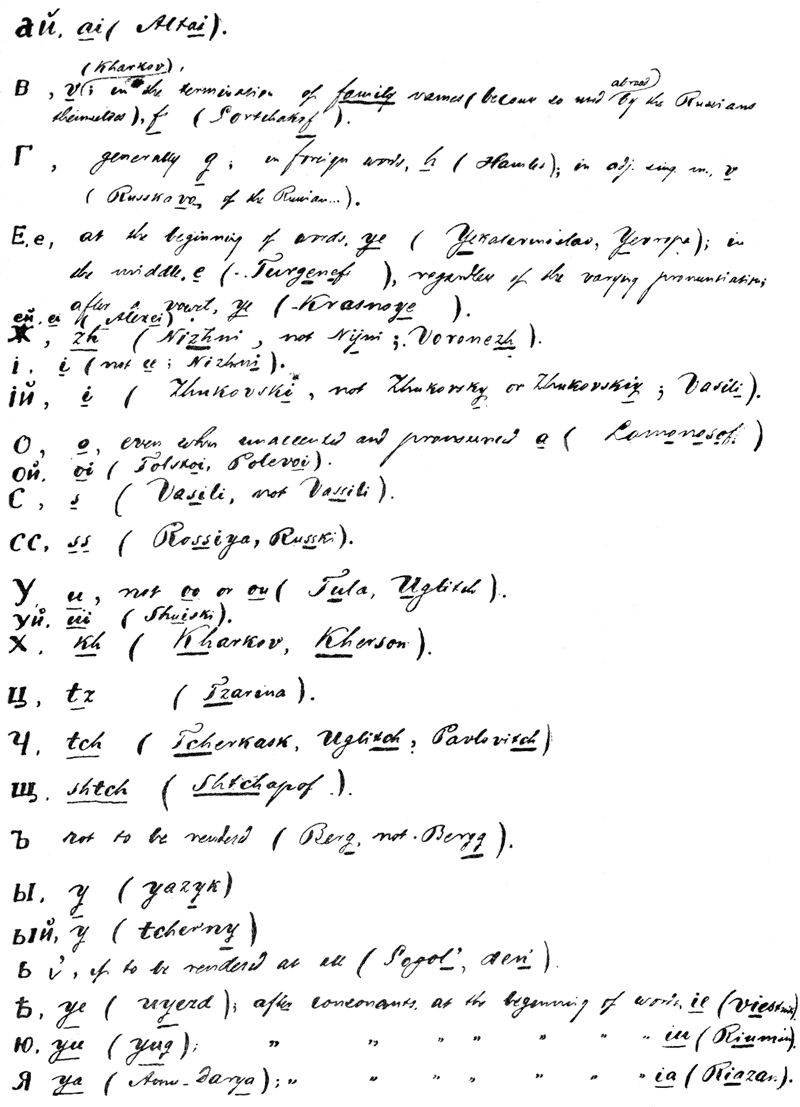
Nor should the consonantal sound in judge be rendered by the English dg, nor the French dj, nor the German dsch, but by j alone. Likewise the consonantal sound in she is not to be written after the French style, ch, or as the Germans do, sch. The sound which the French transliterate by j we must express by zh (e.g., Nizhni Novgorod). Tz is best to use in Semitic and Slavic names, and ts in Japanese and Chinese. For the Semitic “yod” y is the proper equivalent, and not the German j. But after a consonant in the same syllable it is usual to change the y to i (Biela not Byela), and in Russian names ai, ei, oi, ui are used instead of ay, ey, oy, uy (Alexei not Alexey). After i the y is dropped (Dobni not Dobniy). W is to be used rather than i in Arabic names (e. g., Moawiyah). But the Russian, Serb, Bulgarian, and Wallach contain no such sound or letter as w, and we must write Paskevitch, Vasili, not as do the Germans, Paskewitch, Wasili. In the last syllable of names of places (Azov, Kiev) ev and ov are to be used, because the Russians used the corresponding letter, though they pronounce ef and of (in the nominative cases). But in the last syllable of family names, similarly pronounced, of and ef may be used, because the Russians sign their names off and eff when using Roman characters. The last f, which they use, may be omitted as being plainly not required to express the sound, and not corresponding to the Russian character. Kh represents the full guttural, which the Germans make ch and the Spanish j in Slavic and Oriental names. H answers to the softer guttural as well as to the Hebrew he. K answers to the Semitic Kaph and Koph.
The use of ei for the sound of a in fate, ea in great, ai in trait, is not altogether satisfactory. It is not easy to see why e was not used to represent this sound, and {111} the short e, like the short a, i, o, and u, indicated by doubling the following consonant, as Yeddo, Meddina.
The general rule, then, is to use the consonants with their English value, the vowels with their continental, or, to speak more exactly, their German and Italian value, for the French value of u should never be used, and the short French a requires of us a doubled consonant after it. Their ou and our oo is quite unnecessary to express the sound of the last syllable of Timbuctu or Khartum.
C: A. CUTTER. C. B. TILLINGHAST. W: C. LANE. MICHAEL HEILPRIN.
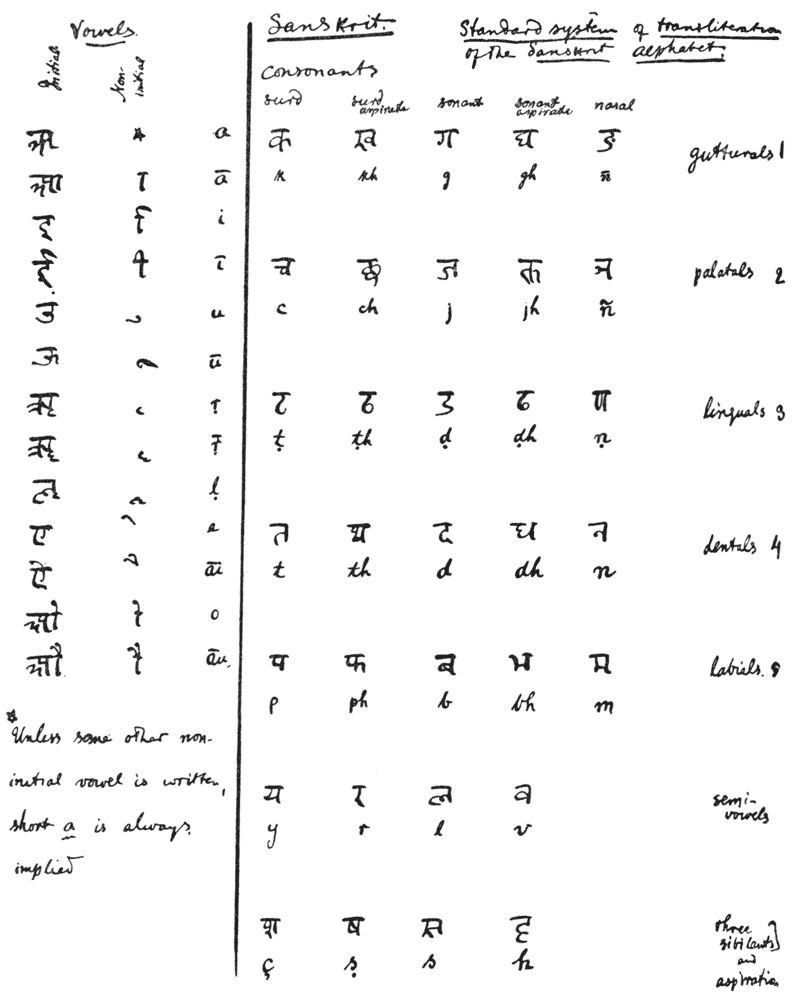
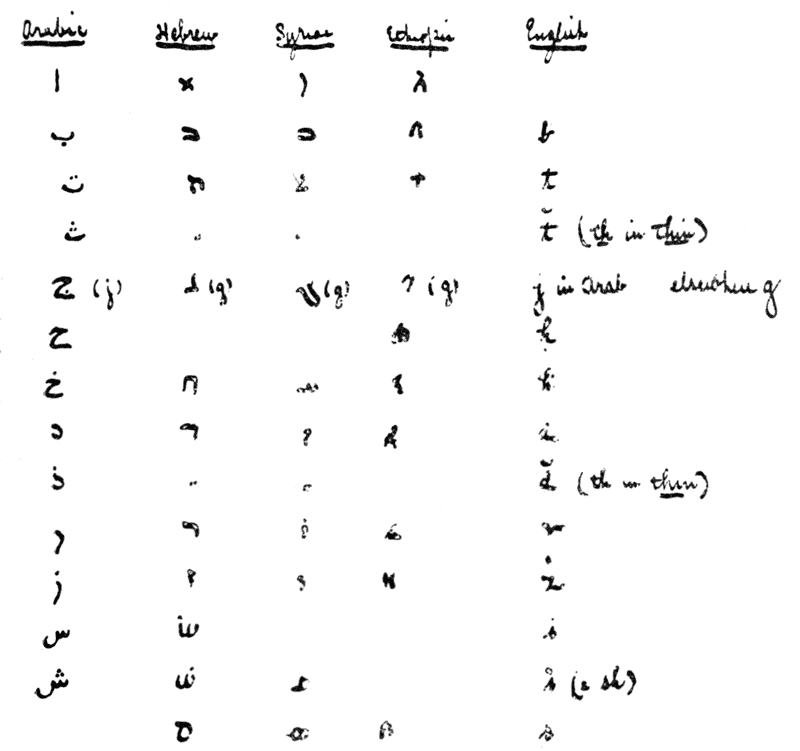
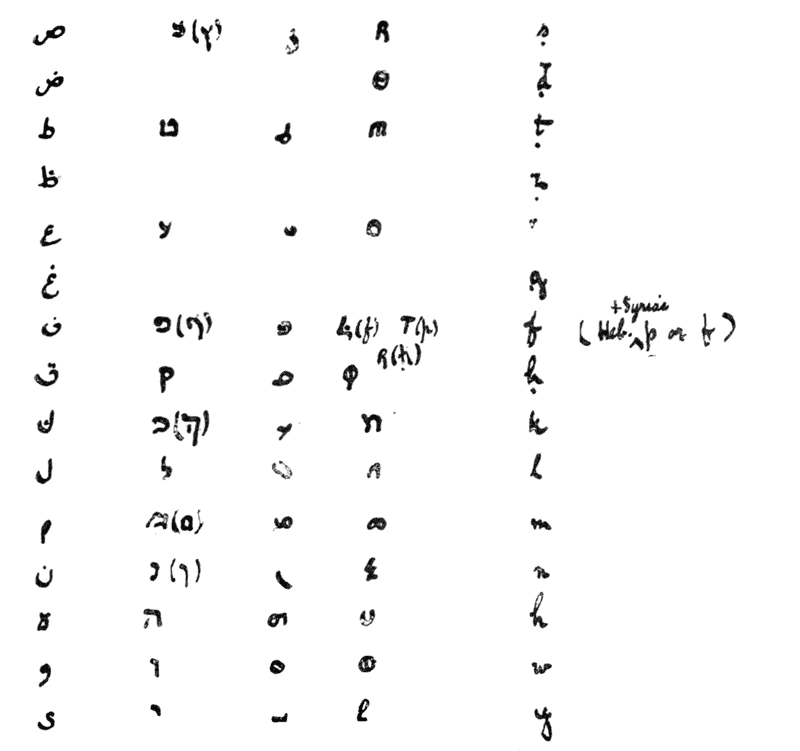
Professor Toy, of Harvard University, furnished to the committee a transliteration table for Semitic languages, Professor Lanman, of the same University, one for Sanskrit, and Mr. Heilprin, of the committee, one for Russian.
Professor LANMAN remarked on his table:
1. It will be observed that each of the five rows numbered 1 to 5 consists of five letters; the second and fourth in each, i. e., the aspirates, are often written, especially in older works, thus, k῾, g῾, c῾, j῾, ῾, ῾, t῾, d῾, p῾, b῾; that is, the rough breathing takes the place of the h.


2. Write long vowels with a macron, thus, ā, ī, ū, , and not with a circumflex.

3. Wherever you find the combination i, with a dot under the , reduce it to simple , since it is a simple unitary sound.

4. The palatals (row 2) are often written by means of the gutturals and an accent: thus, we find k´ k´h g´ g´h ; for c ch j jh and in some German books c (which has the sound of ch in church) is written tsch, and j (= j in judge) in like manner dsch. Further, c and ch are written in some English works as ch and cch, a useless waste of labor.
5. When the third palatal is written by , it is common among the Germans to write the first semi-vowel by j. The last semi-vowel is often written w (instead of v).

6. The transliteration of the first two sibilants is very fluctuating. My ç, is written , by Monier Williams in his dictionary.

The second sibilant is often written sh, sometimes š, by me as , like the other linguals.

7. Finally an s at the end of a Sanskrit word is converted into an aspiration called risarga, and written thus : , and in transliteration is written in this manner, . The nasality of a vowel is marked by or which appears in the Sanskrit as a dot above the body of the consonant.


For a brief and lucid discussion of these matters and a defense of the system of Professor Whitney, of Yale, which is followed in his grammar and in Lanman’s Reader, see The Proceedings of the American Oriental Society, October, 1880, p. xvii.
Sanskrit Transliteration Report.
Semitic Transliteration.
Russian Transliteration.
APPENDIX III. REPORT ON BOOK SIZES.
A Special Committee on Book Sizes of the American Library Association reported (Library journal, 3: 19, 20) the following rule:
Give the outside height in centimeters, using fractions (decimals) where extreme accuracy is desired. For books of special forms, prefix sq., ob., or nar., to indicate square, oblong, or narrow, or else give the actual width after the height. Add a small “h” to the figures giving the height, except when followed by the width. In the latter case connect height and width with the ordinary symbol ×, always giving the height first. If fractious are not used, give the first centimeter above, e. g., all books between 18 and 19 mark 19h, because they fall in the 19th centimeter. For the width, measure the board from the hinge to the edge, not including the round. If desirable to give the size of the paper or letter-press, prefix the measurement with p(aper) or t(ype), including in the type neither folio nor signature lines.
For those preferring to use the common designations, the following-rule was unanimously recommended:
Designate each size by its initial letter or letters (followed, if preferred by the cataloguer, by its final letter “o,” superior “º”) assigning the size by the following table, and prefixing sq., ob., nar., if the books be square, oblong, or narrow. Give the exact measurement of all size-curiosities, whether very large or very small.
Numerical symbol formerly used. Abbreviation to be used. Limit of outside height, centimeters.
48º Fe 10
32º Tt 12.5
24º T 15
16º S 17.5
12º D 20
8º O 25
4º Q 30
fº F 40
fº F⁵ 50
fº F⁶ 60
fº F⁷ 70
fº etc. etc.
Any cataloguer desiring to use the term E (18º) may do so by calling the smaller S (16º). This causes no confusion, for either E or S is between 15 and 17½ cm. in height. Books from 20 to 40 cm. high may be called sm. Q, Q, and l. Q when of the square form, but O, l. O, and F, or sm. F, when of the ordinary form. Books smaller than 20 cm., and of the quarto form, are marked sq. D, etc. * * *
The plan of giving the height in centimeters has the advantage that, once stated, it will never be forgotten. By it the size is more easily {116} determined, more quickly recorded, much more definite in its description, and, most important of all, is understood by all users of catalogues after the first time, while the other systems are intelligible only to those familiar with books. The committee therefore recommends the plan of indicating the size by giving the size.
APPENDIX IV. MR. EDMANDS ON ALPHABETICAL ORDER.
Mr. J. Edmands, in “Rules for alfabeting,” read at the meeting of the American Library Association in August, 1887, and published in the Library journal, 12: 326–341, discussed the subject carefully. A committee of the Association was directed to prepare a code of rules, to be reported in the Library journal; for their report see 14: 273–274. Their code coincides with mine (§§ 214–239), except (1) that they adopt my former order, “person, place, title, subject (except person and place), form,” and not the present rule (§ 214), “person, place, followed by subject (except person and place), form and title,” an arrangement which probably was not proposed to the committee; and (2) that when two or more names are spelled exactly alike except for the umlaut in names in which the German ä, ö, or ü may occur, the committee put all the names having the umlaut last, e. g., all the Müllers after the Mullers. I arrange by the forenames.
Mr. Edmands correctly states as the principle of alphabeting “Something follows nothing; or, conversely, Nothing before something; thus in
Art of living
Arthur
In clover
Incas
the art, in the first case, and the in, in the second, ar followed by a space, i. e., by nothing, and so precede the single word in which the t and the n are followed by a letter; i. e., by something.”
His Rules agree with those stated or implied in § 214 and following sections, with three exceptions. The first is this:
“A word used independently as a subject heding should precede the same word used in connection with another. And if this word is coupled with another word to form a compound subject heding, it should follow the simple heding. And if this word used as a simple heding is also used a substantiv to form a different subject heding, and is also used adjectivly before a noun, the substantiv use should precede the adjectiv use. And so we hav this order:
Art
Art and artists
Art of conversation
Art amateur
“The reasons for it ar clear and strong. A substantiv should precede an adjectiv, as being the more important word, and as being less closely connected with the following than an adjectiv. In uttering the frases Art applied to industry, Art of conversation, there is a perceptible suspension of the voice after the word Art, which does not occur in the case of Art journal, art amateur.”
The reason is not strong enough to justify interfering with the alphabetical order, which demands that amateur shall precede and. It is needless to compel the searcher to stop and think whether the word “art” in the phrase he is hunting for is a noun {117} or an adjective; indeed, it is not only a useless refinement, but positively dangerous, as likely occasionally to lead him to overlook an entry which is out of its alphabetical order.
The same objection applies to the practice of some cataloguers of putting the plural immediately after the singular, even when the alphabet demands that it should precede (as Charities, Charity), or when many entries might come between (as between Bank and Banks). This practice Mr. Edmands condemns.
The second exception is this:
“A single ful name should precede a double initial, i. e., a surname with one Christian name should stand before the same surname with two Christian names; thus,
John,
J. M.,
not
J. M.
John.
This plainly contradicts the principle “nothing before something.” A period is too trifling a matter to arrange by, and neglecting that
J followed by nothing J
should precede J followed by o, John.
The third exception is this:
A book written by a single author should precede one written by him and another.
(See the argument in the note to § 240.)
The rules which agree are in substance as follows:
New. Titles with the initial word New used as a proper adjective followed by a common noun, and those in which it forms a part of a compound place name should be arranged in one series, alfabeting by the last part. (New Amsterdam, new boat, New Canaan, new life.) Single words beginning with new, whether names of persons, places, or things, should be arranged in a following alfabetical series.
The hyfen is best disregarded, words connected by it being arranged as two words.
If an article, which belongs before a word used as a heding, is inserted after it, it is not to be taken account of in alfabeting.
The plural in s should follow the singular. The possessive case singular should follow the singular and precede the plural in s. The sequence, however, may not in either case be immediate. Several entries may intervene. Plurals in ies of words ending in y should precede the singular, tho not necessarily in immediate connection.
Common and proper nouns. In the case of words used sometimes as common and sometimes as proper nouns, the true order is person, place, and thing.
Surnames. Whenever a single name. Charles, Henry, William, is used as the sole designation of a person, this should precede the same word used as a surname. If several ranks are represented by one name, precedence should be given to those bearing the highest rank in this order, pope, emperor, king, noble, saint. If these represent different nationalities they should be groupt in the alfabetical order of the countries; and numerically under each country, as John I., John II. {118}
Family names that hav the same sound, but a different spelling, must be separated, but the reader should be aided as much as we can by a free use of cross references.
In names beginning with La, Le, and De—not French names—written separately, it is better to disregard the separation, and arrange these words as if they were written solidly.
Abbreviations. Names beginning with M’, Me, St, and Ste should be arranged as if written out in ful, as Mac, Saint, and Sainte, for the reason that they ar uniformly so pronounct, and often so written. And for the same reason entries beginning with Dr., M., Mme., Mlle., Mr., and Mrs. should be treated as if they were written in ful, as Doctor, Monsieur, Madame, Mademoiselle, Mister, and Mistress.
Forenames. When Christian names ar given in ful, the arrangement should be in strict alfabetical order, following the surname. And use should be made of all the helps which the cataloger has given for distinguishing two or more persons whose names ar identical.
Titles, such as Gen., Don., Sir, ar to be allowed to stand, but not to affect the arrangement.
Numerals occurring as hedings should be treated as if written out in letters. The novel “39 men for one woman” should be entered under t.
Initials. If the cataloger has simply followed the title-page and given only initials of Christian names, the only safe course is to treat every initial as a name; and, on the axiom “Nothing before something,” the initial should precede the ful name. Thus J. precedes James even tho, as may afterwards be learned, the J. stands for Jehoshaphat.
Dash. In order to save space in printing, and for distinctness to the eye, it is wel to use a dash to represent a word or group of words that might otherwise hav to be repeated; or to inset the words that come under the general heding. Care should be taken to make clear what the dash stands for, and to confine its use within proper bounds.
It may be used when we hav several books written by one person; but it should not be used to cover another person of the same surname.
It may be used to represent a word or group of words that indicate a definite subject, as heat, moral science, socialists and Fourierism, society for the diffusion of useful knowledge. But it should not be used to represent a part of a compound subject-heding, nor a part of a title; e. g., in the entries Historical portraits, Historical reading, the word Historical should be spelled out in each case.
APPENDIX V. ABBREVIATIONS.
The list of abbreviations originally given on p. 57, § 116, was enlarged in the report of the committee on catalogue rules of the American Library Association (Library journal, 3: 16–19). It there included the abbreviations for the most usual forenames formed by the initial followed by a colon for men and by two periods for women (as J:=John, M..=Mary), devised by C: A. Cutter and first published in the Library journal, 1: 405 and 5: 176. It was republished, classified, but with many omissions and additions, by Melvil Dewey in Library notes, 1: 206–211, and also on a convenient card. It is here reprinted in full with his additions.
A list of abbreviations used in describing bindings, prepared by E. H. Woodruff, was published in the Library journal for May, 1887.
FORENAMES.
Aaron Aar.
Abraham Ab.
Adam Ad.
Adelbert Adlb.
Adolf Adf.
Adrian Adr.
Aegidius Aeg.
Albert Alb.
Albrecht Albr.
Alexander, Alexandre Alex.
Alfonso Alf.
Alfred Alfr.
Alphonse Alph.
Amadeus Amad.
Ambrose, Ambrosius Amb.
Anastasius Anast.
Andreas, Andrew And.
Anna A..
Anselm Ans.
Anthony, Antoine, Anton Ant.
Archibald Arch.
Arnold Arn.
Arthur Arth.
August, Augustus A:
Augusta A: a
Augustin A: in
Augustinus A: inus
Aurelius Aur.
Austin Aust.
Baldwin Bald.
Balthasar Balt.
Baptiste Bapt.
Barbara Barb.
Barnard Barn.
Bartholomäus, Bartholomew Bart.
Basilius Bas.
Beatrice B..
Beatrix Bx.
Belinda Bel.
Benedict Bened.
Benjamin B:
Bernard Bern.
Bernhard Bernh.
Barthold Brth.
Bertram Bert.
Boniface Boni.
Bruno Bru.
Burchard Bch.
Cadwallader Cadwal.
Caleb Clb.
Calvin Calv.
Camillus Cam.
Camilla Cma.
Carl, Carlo, Charles C:
Caroline Caro.
Casimir Cas.
Caspar Cap.
Catharine Cath.
Charlotte C..
Christian Chr.
Christlieb Chli.
Christoph Cp.
Clarence Clar.
Claude Cl. {120}
Claudius Cls.
Clemens, Clement Clem.
Conrad Conr.
Constantin Const.
Cordelia Cord.
Cornelius Corn.
Crispian, Crispin, Crispus Crsp.
Daniel Dan.
David D:
Deborah Deb.
Detlev Dtl.
Delia D.
Diana Di.
Dietrich Dt.
Dominicus Dom.
Donald Don.
Dorothy Dor.
Duncan Dunc.
Ebenezer Eb.
Eberhard Ebh.
Edgar Edg.
Edmund Edm.
Edouard, Eduard, Edward E:
Edwin Edn.
Egbert Egb.
Ehrenfried Ehrfr.
Elias El.
Elijah Elij.
Elizabeth E..
Emanuel Em.
Ephraim Eph.
Erdmann Erdm.
Erhard Erh.
Eric, Erich Er.
Ernest, Ernst Ern.
Eugen, Eugene Eug.
Eusebius Eus.
Eustace, Eustachius Eust.
Evelina Evel.
Ezechiel Ezech.
Ezra Ez.
Fanny F..
Felix Fel.
Ferdinand Fd.
Fitz William Fitz W.
Flavius Flav.
Florence Flo.
Francis Fs.
Frances Fcs.
Frank Fk.
Franz Fz.
Frederic, Friedrich F:
Fürchtegott Fchtg.
Gabriel Gbr.
Gamaliel Gam.
Gasparo Gsp.
Gaston Gast.
Gebhard Gbh.
Geoffrey Geof.
Georg, George, Georges G:
Gerald Ger.
Gerhard Gh.
Gershom Gersh.
Gertrude Gert.
Giacomo Giac.
Giam Battista Gi. bat.
Gian Giacomo Gi. Giac.
Gian Pietro Gi. P:
Gideon Gid.
Gilbert Gilb.
Giovanni Gi.
Giuseppe Giu.
Godfrey Godf.
Gottfried Gf.
Gotthard Gthd.
Gotthelf Ghf.
Gotthold Ghld.
Gottlieb Gli.
Gottlob Glo.
Gottschalk Gk.
Grace G..
Gregor, Gregory Greg.
Guillaume Guil.
Günther Gth.
Gustav, Gustavus Gst.
Hannah Ha.
Hans Hs.
Harold Har.
Harriet Ht.
Hartmann Htm.
Hartwig Htw.
Hector Hect.
Hedwig Hedw.
Heinrich, Henri, Henry H:
Helen H..
Herbert Herb.
Herrmann Hm.
Hezekiah Hzk.
Hieronymus Hi.
Hippolyte Hip.
Horace Hor.
Hubert Hub.
Hugh Hu. {121}
Hugo Hg.
Humphrey Hum.
Ignatius, Ignaz Ign.
Immanuel Im.
Innocenz Inn.
Isaac I:
Isabella I..
Israel Isr.
Jacob Jac.
Jakob Jak.
James Ja.
Jane J..
Jasper Jasp.
Jedediah Jed.
Jemima Jem.
Jeremiah, Jeremias, Jeremy Jer.
Joachim Joac.
Joel Jl.
John, Johann, Jean, masc. J:
Johannes Js.
Jonathan Jona.
Joseph Jos.
Josepha Josa.
Josephine Jose.
Joshua Josh.
Jószef Jósz.
Jules, Julius Jul.
Julia Jla.
Juliet Jlt.
Justin, Justus Just.
Karl K:
Kaspar Ksp.
Katharine K..
Konrad Konr.
Laurence Laur.
Lawrence Lawr.
Lazarus Laz.
Leberecht, Lebrecht Lbr.
Lemuel Lem.
Leonard Leon.
Leonhard Lh.
Leopold Lp.
Lewis Lew.
Louis, Ludwig L:
Louise L..
Lobegott Lbg.
Lorenz Lor.
Lothar Lth.
Louisa L..
Ludolf Ldf.
Malachi Mal.
Marcus Mcs.
Margaret Marg.
Maria Mar.
Marc, Mark M:
Martin Mt.
Mary M..
Mathäus, Matthew Mat.
Matilda Mta.
Maurice Maur.
Max, Maximilian Mx.
Mehitabel Mehit.
Melchior Mlch.
Michael Mich.
Moriz Mor.
Moses Mos.
Nancy N..
Napoleon Nap.
Nathan Nat.
Nathaniel Natl.
Nehemiah Neh.
Nepomuk Np.
Nicodemus Nicod.
Nicolas, Nicolaus, Nicole N:
Noah No.
Norman Norm.
Obadiah Ob.
Octavius Oct.
Octavia Octa.
Oliver Ol.
Olivia O..
Orlando Orl.
Oscar Osc.
Oswald Osw.
Ottmar Ottm.
Otto O:
Patrick Pat.
Paul Pl.
Pauline P..
Peter, Pierre P:
Philip Ph.
Phineas Phin.
Priscilla Pris.
Rachel Ra.
Raimund, Raymond Rmd.
Raphael Rapl.
Rebecca R..
Reginald Reg.
Reinhard Rhd.
Reinhold Rhld.
Reuben Reub. {122}
Richard R:
Robert Rob.
Rodolph Rod.
Roger Rog.
Roland Rol.
Rudolf Rud.
Rufus Ruf.
Rupert, Ruprecht Rup.
Salomon Sal.
Salvator Salv.
Samuel S:
Sarah S..
Severen Sev.
Sebastian Seb.
Siegfried Siegf.
Sigismund Sgsm.
Sigmund Sigm.
Simeon, Simon Sim.
Solomon Sol.
Sophia So.
Stanislas Stan.
Stephen Ste.
Susan Su.
Tabitha Tab.
Temperance Temp.
Thaddeus Thad.
Theobald Thbd.
Theodor Thdr.
Theophilus Thph.
Theresa T..
Thomas, Tomas, Tomaso T:
Tiberius Tib.
Timotheus, Timothy Tim.
Titus Tit.
Tobias, Tobiah Tob.
Traugott Trg.
Ulrich U:
Ursula U..
Valentine Val.
Veit Vt.
Victor Vet.
Victoria V..
Vincentius Vinc.
Virginia Virg.
Volkmar Volkm.
Waldemar Wald.
Walther, Walter Wa.
Washington Wash.
Wenzel Wz.
Werner Wr.
William, Willem, Wilhelm W:
Wilhelmina W..
Winfred Winf.
Winifred Winif.
Woldemar Wold.
Wolfgang Wolfg.
Xaver, Xavier X:
Xenophon Xen.
Xerxes Xerx.
Zacharias, Zachary Zach.
Zebadiah, Zebedee Zeb.
Zechariah Zech.
Zenobia Z..
Zephaniah Zeph.
COLON ABBREVIATIONS FOR FORENAMES.
A: Augustus. A.. Anna.
B: Benjamin. B.. Beatrice.
C: Charles. C.. Charlotte.
D: David. D.. Delia.
E: Edward. E.. Elizabeth.
F: Frederick. F.. Fanny.
G: George. G.. Grace.
H: Henry. H.. Helen.
I: Isaac. I.. Isabella.
J: John. J.. Jane.
K: Karl. K.. Katharine.
L: Louis. L.. Louise.
M: Matthew. M.. Mary.
N: Nicholas. N.. Nancy.
O: Otto. O.. Olivia.
P: Peter. P.. Pauline.
R: Richard. R.. Rebecca.
S: Samuel. S.. Sarah. {123}
T: Thomas. T.. Theresa.
U: Uriah. U.. Ursula.
V: Victor. V.. Victoria.
W: William. W.. Wilhelmina.
X: Xavier.
Z: Zenas. Z.. Zenobia.
Here C: is used both for Charles and Carlo, H: for Henry, Henri, and Heinrich, and so on. Mr. Dewey for greater distinctness advises the following:
Where : and .. is used in English names, use ; and ., for the German form, and ; and ,. for the French.
FOR HEADINGS.
abridger abr.
afterwards aftw.
annotater annot.
born b.
collector col.
company co.
commentator comment.
compiler comp.
continuer contin.
died d.
department dept.
editor ed.
Great Britain Gr. Br.
pseudonym pseud.
publisher pub.
superintendent supt.
translator tr.
United States U. S.
veuve vve.
wittwe wwe.
include maiden name of married woman. ( )
include words or parts of words supplied. [ ]
probably, perhaps ? after a word.
Use also the common abbreviations for political, military, professional, and honorary titles.
FOR IMPRINTS AND NOTES.
Auflage, Ausgabe Aufl., Ausg.
Band Bd.
Bohn’s scientific library B. S. L.
calf cf.
cloth cl.
copyright e. g., 1882 [c. ’80]. c.
edited, -ion, -or ed.
fac-similes fac-sim.
folios f.
group of portraits gr. of por.
Harper’s family library H. F. L.
illustrated, -ions il.
leaves l.
morocco mor.
mutilated mut.
no date of pub. n. d.
no place of pub. n. p.
no title-page n. t. p.
page, pages p.
pamphlet, pamphlets pam.
paper pap.
photographs phot.
portrait of group por. of gr.
portrait, portraits por.
Roxburgh rxb.
sheep sh.
square sq.
tables tab.
title-page t.-p.
title-page mutilated, wanting t. p. m., t. p. w.
unbound unbd.
unpaged unp.
vellum vel.
volume, volumes v. (in the imprint), Vol. (in the title). [72]
with (before words) w.
wanting (after words) w.
In notes the abbreviations in all these lists may be used.
FOR BOOK TITLES.
abridged abr.
abbreviations abbr.
account acct.
additional, -ons add.
American Amer. or Am.
analysis, -tical anal.
anonymous anon.
appended, -ix app.
aus dem Lateinischen a. d. Lat.
born b.
biblical, bibliographical, bibliotheca, etc. bibl.
biographical, -phy biog.
book bk.
Christian Chr.
chronological chron.
classical class.
collected, -ions, college, colored col.
commerce, -ial, committee com.
compiled, -er comp.
concerning conc.
containing, contents, continued cont.
copy, copyrighted cop.
corrected cor.
crown, size of book cr.
cyclopædia cyc.
Danish Dan.
died d.
department dept.
domestic dom.
elementary, -ts elem.
encyclopædia encyc.
English Eng.
engraved, -er, -ings eng.
enlarged enl.
fiction fict.
folios, i. e., leaves ff.
from fr.
French Fr.
geography geog.
geology geol.
geometry geom.
German Germ.
gesammelte, gesammt ges.
Geschichte Ges. or Gesch.
grammar, -tical gram.
great gr.
Greek Gr.
half hf.
historical, -y hist.
homœopathic homœop.
herausgegeben hrsg.
illustrated, -ions il.
imperfect imp.
improved impr.
including incl.
increased incr.
intorno int.
introduction, -ory introd.
Italian Ital.
juvenile juv.
Latin Lat.
library lib.
literary, -ture lit.
medical, -ine med.
memoir mem.
miscellaneous misc.
manuscript, -ts ms., mss.
national, natural nat.
new series n. s.
nouvelle nouv.
number, -s no., nos.
oblong obl.
preface, -ed, prefixed pref.
pseudonym, -ous ps.
part pt.
published, -er pub.
recensuit, record rec.
relating, relative rel.
report rept.
review, revised, -ion rev.
Roman Rom.
Russian Rus.
sämmtlich sämm.
science, scientific sci.
selected, -ions sel.
separate sep.
series s. or ser.
small sm.
society soc.
supplement, -ary, -ing sup.
Swedish Swed.
theology theol.
transactions trans.
translated, -or, traduit, tradotto, etc. tr.
übersetzt übers,
und u.
vocabulary vocab.
von v.
van to be given in full.
in, contained in ( ) {125}
words added to title [ ]
to and included in, or continued —
matter omitted ...
probably, perhaps ?
end of line on title-page |
transition to another title-page ||
vo, mo, to, in octavo, duodecimo, quarto º
FOR PLACES OF PUBLICATION.
Use first form on cards. In accession and all official records use shortest form.
Albany Alb.
Amsterdam Amst.
Baltimore Balt.
Berlin Ber.
Boston B. or Bost.
Braunschweig Brns.
Cambridge Camb. or Cb.
Chicago Chic. or Ch.
Cincinnati Cin.
Copenhagen Copng.
Edinburgh Edin. or Ed.
England Eng.
Firenze Fir.
France Fr.
Germany Germ.
Glasgow Glasg. or Gl.
Gotinga Got.
Göttingen Göt.
Kjöbenhavn Kjöb.
London L. or Lond.
Leyden Ley.
Leipzig Lpz.
Lugduni Batavorum Lug. Bat.
Milano Mil.
München Mün.
New Orleans N. O.
New York N. Y.
Oxford Oxf.
Paris P. or Par.
Philadelphia Ph. or Phil.
St. Louis St. L.
St. Petersburg St. Pet. or St. P.
San Francisco San Fran. or S. F.
Stuttgart Stut.
Torino Tor.
United States U. S.
Venice Ven. or V.
Washington W. or Wash.
Also the common abbreviations for the States. Use for all languages when the equivalent name contains these letters.
TITLES, STATES, ETC.
bachelor of arts A. B.
archbishop abp.
year of our Lord A. D.
adjutant adjt.
admiral adm.
Alabama Ala.
Master of Arts A. M.
American Am. or Amer.
associate of the Royal Academy A. R. A.
attorney atty.
bachelor of arts B. A.
baronet bart.
before Christ B. C.
bishop bp.
brigadier general brig. gen.
California Cal.
captain capt.
Colorado Col.
Confederate States of America or C. S. army C. S. A.
C. S. navy C. S. N.
Connecticut Ct.
MONTHS. Ja. F. Mr. Ap. My. Je. Jl. Ag. S. O. N. D.
DAYS. Su. M. Tu. W. Th. F. St. {126}
SIZE NOTATION.
Fold symbol. Never use for size. Size letter. Never use for fold. Outside height. In centimeters.
48º Fe Up to 10
32º Tt 10 – 12.5
24º T 12.5 – 15
16º S 15 – 17.5
12º D 17.5 – 20
8º O 20 – 25
4º Q 25 – 30
fº F 30 – 35
F⁴ 35 – 40
F⁵ 40 – 50
Prefix nar. if width is less than height.

Prefix sq. if width is more than ¾ height.
Prefix ob. if width is more than height.
For all books over 35cm high the superior figures show in which 10cm of height the book falls, e. g., F⁸ is between 70 and 80cm high.
Actual size method.
Give all sizes in cm (for greater accuracy adding decimals), leaving the old symbols and names, 8º and Octavo to indicate fold only. Give height first, followed by h, or by × and width, e. g., 23h or 23 × 14. 23h means between 22 and 23, i. e., in 23d cm. All measures are taken outside the cover. Width is from hinge to edge not including the round. To measure paper or letter-press, prefix p(aper) or t(ype) to figures, including in type neither folio nor signature lines.
APPENDIX VI.
So far we have been considering only the catalogue by which the library communicates with the public; but a librarian needs several others for library service: (1) The Catalogue of books ordered; (2) The Accessions catalogue; (3) The Periodical-and continuation-book; (4) The Shelf-list; (5) The Catalogue of books missing; (6) The Tract-catalogue; (7) The Catalogue of duplicates to be sold; (8) The Catalogue of duplicates sold or exchanged.
(2) and (8) are necessary for the preservation of the history of the library and important in its financial management.
(6) is a modification of (5). It is a list of the tracts contained in bound volumes, by which the abstraction of any particular tract can be ascertained, or the extent of the loss if the whole volume disappears. All this might be entered on the shelf-list, but it is more convenient to keep the record of the tract-volumes together. Sometimes part of a tract-list is inserted in the public catalogue. You may see collections of pamphlets on various subjects by various authors recorded under a made-up heading Tracts, or Pamphlets, a style of entry that is nearly useless. The whole of the Prince catalogue of 1846 was made in this absurd way. A number of tracts by a single author may indeed for economy be catalogued under him in one mass like a “contents,” and the same may be {127} done for tracts on a single subject, though there are objections even to this; but to catalogue the writings of several authors under an arbitrary heading (as Plays, Speeches, French Revolution), to which references merely are made under the authors, is to be economical at altogether too great an expense of trouble to the public,—to say nothing of the incongruity of a form or subject heading for an author-entry.
(4), the shelf-list, ought to be so made (a) that the entry of each book in the catalogue can be readily found from it; (b) that the book can be readily identified with the entry on the shelf-list; (c) that at the annual examination or taking account of stock the shelf-reader shall know at once what book is meant as each title is read by the list-reader. For these reasons the list should contain the author’s name (or first word, etc., if the book is anonymous), part of the real title, the binder’s title (which will generally be the same as the real), and the place and date of printing. If the author’s name, or any part of the title, is not on the back of the book it should be inclosed in parentheses.
Ex.
Appuleius. Metamorphoses, tr. Head. L. 1851. 1
(Reinhardt. Artist’s journey.) Bost. 1872. 1
A briefer shelf-list can be made by merely entering the book’s number and the accessions number, so that the full title can be found if needed by referring to the accessions-book.
(2), (3), and (8) are best kept in books; (4) and (6) on separate sheets of paper; (1), (5), and (7) on cards. When the catalogue is kept on cards (5) can be made by merely separating the cards of such books as are missing.
(1). After some experiments I have preferred the following method of keeping the order-list. The titles of books proposed for purchase are type-written on ruled slips of stiff paper 12½ cm. long by 5 cm. wide. If approved by the committee a check is made at the left of the title. A searcher then ascertains whether the library already has the book; if it has, the card is destroyed or sent with this information to the person who asked for the book; if not, the searcher puts her initials and the date in the lower left-hand corner. The cards are then sorted into parcels for the English, French, or German agents; and an order is written, the writer first making sure, by looking among the cards of previous orders, that none of the books has already been sent for. In the order a running number is given to each title and a corresponding number is put on the card.
The name of the author is entered in a book opposite the running number, and the date is put there against the first number of each order. [73] The cards are then all stamped on the left with the date, and put away in a drawer alphabetically with other cards of books ordered. When a {128} box of books comes, the corresponding cards are picked out and stamped on the right with the date. They receive the accessions-number when the books are entered on the accessions-catalogue, the class-number when the books are placed, and are corrected when the books are catalogued; for, having usually been written from advertisements, these cards are often incorrect. When a number have accumulated they are sorted in the order of class-numbers and the entry on the class-catalogue is made from them. They are then put away alphabetically in drawers accessible only to the library-attendants, and form the index of the accessions-book. When a duplicate volume is exchanged or sold the date, its price, and receiver are noted on the order card.
The system is economical. One card serves many purposes and with little writing answers all the questions likely to come up: Has this book been proposed to the Book Committee? (Books rejected are kept in a separate drawer.) Has it been approved? Ordered? When? From whom? Who is responsible for the error if it turns out a duplicate? When was it received? Where is it entered in the Accessions-catalogue (that we may ascertain its price and condition)? Where was it first located? If any one of the questions is not to be asked then the corresponding process can be dispensed with. The list, of which an example is given in the note below, is not necessary but convenient.
[Specimen.]
Darwin, Charles.
IXHZ Coral reefs. 2d ed. London, 1874. 8º.
.D35
[On the back of the card is]
2915 [the order No.] [Stamp, with date of order.] [Stamp, with date of receipt.] 39625 [the accession No.]
APPENDIX VII. SOME WORKS OF REFERENCE.
I have set down here chiefly those works which I find to be of constant use in cataloguing. One occasionally needs many more, even for a short investigation. A complete and systematic view of bibliographical literature is given in Petzholdt’s “Bibliotheca bibliographica. Leipzig, 1866,” and many of the more modern works may be found in Vallée’s Bibliographie des bibliographies, Paris, 1883, and supplement, 1887. Powers’ “Handy-book about books. London, 1870,” contains a useful list, which is reprinted, with additions, in Sabin’s “American bibliopolist.” C: H. Hull’s “Help’s for cataloguers in finding full names” in the Library journal, Jan., 1889, gives an excellent classified list with descriptive notes. {129}
BALLHORN. Grammatography. Lond., 1861. O. 7s. 6d.
BRUNET. Manuel. 5e éd. Paris, 1860–65. 6 v. O. 120 fr., and Supplement. Par Deschamps et Brunet. Paris, 1878–80. 2 v. O.
HŒFER. Nouvelle biographie générale. Paris, 1852–66. 46 v. O. 184 fr.
HORNE. Introd. to bibliography. Lond., 1814. 2 v. O. Antiq. 18s.
JOECHER. Allgem. Gelehrten-Lexikon. Lpz., 1850–51. 4 v., Q., and Fortsetzung. Bremen, 1784–1819. 6 v. Q. Antiq. 40 fl.
LAROUSSE. Dictionnaire universel. Paris, 1866–89. 15 v. and 2 suppl. O. 635 fr.
MEN of the time. 12th ed. Lond., 1887. D. 15s.
MICHAELIS. Vergleichendes Wörterbuch der gebräuchlichsten Taufnamen. Berl., 1856. O. 15 Ngr.
OETTINGER. Moniteur des dates. Dresde, 1866–68. 6 v. Q. 35 Thlr. Supplément. Lpz., 1873–82. 3 v. Q. 90 M.
ROSSE. Index of dates. Lond., Bohn, 1858. 2 v. O. $2.50.
SANDERS. Celebrities of the Century. Lond., 1887. O. 21s.
THOMAS. Universal dict. of biography and mythology. Phila., 1870. 2 v. O. $22, or 1 v. $15.
TOWNSEND. Manual of dates. 5th ed. Lond., 1877. O. 18s.
VAPEREAU. Dict. des contemporains. 5e éd. Paris, 1880. O. 25 fr.
The catalogues of the following libraries: ADVOCATES’, ASTOR, BOSTON ATHENÆUM, BRITISH MUSEUM, PEABODY INSTITUTE (Baltimore), are the most useful.
AMERICAN. ALLIBONE. Dict. of Eng. literature. Phila., 1858–71. 3v. O. $22.50. CUSHING. Anonyms. Camb., 1889. 2 pts. [A–Main]. O. CUSHING. Initials and pseudonyms. N. Y., 1885. O., and 2d series. N. Y., 1888. O. DRAKE. Dict. of Amer. biog. Rev. ed. Bost., 1875. O. $6. HARRISSE. Biblioth. Amer. vetustissima; works rel. to Amer. pub. 1492–1551. N. Y., 1866. O. $20. LEYPOLDT. American catalogue; books in print July 1, 1876. N. Y., 1880–81. 2 v. F.—1876–84. N. Y., 1885. 2 v. F. SABIN. Dict. of books rel. to Amer. N. Y., 1868, etc. Q. $5 per vol. SPRAGUE. Annals of the American pulpit. N. Y., 1857–69. 9 v. O. $36. THOMAS. History of printing in America. 2d ed. Albany, 1874. 2 v. O. $8
The following may sometimes be of use: ROORBACH’S Biblioth. Amer., 1820–61. 4 v. O., and KELLY’S Amer. catalogue, 1861–71. N. Y., 1866–71. 2 v. O; and the general catalogues of colleges. {130}
ANONYMS AND PSEUDONYMS.
The most useful books are mentioned under their respective languages, American (CUSHING), English (HALKETT and LAING), French (BARBIER and QUÉRARD). A list of new discoveries is published each month in the Library Journal.
ART. MEYER. Allgemeines Künstler-Lexikon. 2. Aufl. von Nagler’s Künstler-Lexikon. 1.–3. Bd.: A–Bez. Lpz., 1872–85. O. NAGLER. Die Monogrammisten. München, 1858–79. 5 v. O. POLLEN. Universal catal. of books on art. Lond., 1858–77. 2 v. and suppl. sq. O. 29s. THIES. Catalogue of the engravings bequeathed to Harvard College by F. C. Gray. Camb., 1869. Q.
BELGIAN. BRUSSELS. ACAD. ROY. DE BELGIQUE. Biographie nationale [A-H]. Brux., 1866–87. 9 v. O.
DANISH. BRICKA. Dansk. biog. Lex. 1. Bind [A–Bea]. Kopenh., 1887. O.
BOTANY. PAXTON. Botanical dictionary. New ed. London, 1868. O. 25s.
DUTCH. KOBUS and RIVECOURT. Biog. handwoordenboek. Zutphen, 1854–61. 3 v. O. About $4. Convenient; for fuller details use AA. Biog. woordenboek. Haarlem, 1852–78. 21 v. O.
ENGLISH. ALLIBONE. Dict. of Eng. literature. Phila., 1858–71. 3 v. O. $22.50. A continuation is in preparation. BURKE. Dormant and extinct peerages. New ed. Lond., 1866. O. 42s. BURKE. Landed gentry. 7th ed. Lond., 1886. 2 v. O. BURKE. Peerage and baronetage. 51st ed. Lond., 1888. O. 38s. COLLIER. Bibliog. account of the rarest works in English. Lond., 1868. 2 v. O., or N. Y., 1868. 2 v. O. $16. DARLING. Cyclopædia bibliog.: Authors. Lond., 1854. O. 52s. 6d. Chiefly English theol. works. {131} DOYLE. Official baronage of England. Lond., 1886. O. 8º. 105s. HALKETT and LAING. Dict. of the anon. and pseudon. lit. of Gr. Britain. Edin., 1882–88. 4 v. O. 168s. HAYDN. Book of dignities. Lond., 1851. O. 25s. LOWNDES. Bibliog. manual of Eng. literature. New ed., enl. by H. G. Bohn. Lond., 1857–64. 6 v. D. 33s. NICOLAS. Historic peerage. Lond., 1857. O. 30s. STEPHEN. Dict. of national biography. Vol. 1–20: A–Garner. Lond., 1885–89. 20 v. O. THOMAS. Handbook of fictitious names; by Olphar Hamst [pseud.]. Lond., 1868. O. 7s. 6d. WALFORD. County families. New ed. Lond., 1888. O. 50s. WARD. Men of the reign. Lond., 1885. D. 15s. WATT. Bibliotheca Britannica. Edin., 1824. 4 v. Q. Antiq. £4 15s.
The following may sometimes be of use: LOW’S English catalogue, 1835–80. Lond., 1864–82. 3 v. O. 117s., and LOW’S [Subject] index to the British catalogue, 1837–80. Lond., 1858–84. 3 v. O. 86s.
Crockford’s Clerical directory, the Medical directory of Great Britain, the Army list, and similar registers afford assistance.
FRENCH. BARBIER. Ouvrages anonymes. 3e éd. Paris, 1872–79. 4 v. O. 60 fr. LORENZ. Catal. gén. de la librairie française, depuis 1840. Paris, 1867–88. 11 v. O. 330 fr. POTIQUET. L’Institut National de France. Paris, 1871. O. 8 fr. QUÉRARD. La France littéraire. Paris, 1827–39. 10 v. O. 120 fr. QUÉRARD. Supercheries littéraires. 2e éd. Paris, 1869–70. 3 v. O. 60 fr. QUÉRARD and others. La littérature française contemporaine. Paris, 1842–57. 6 v. O. 96 fr.
GEOGRAPHY. THOMAS and BALDWIN. Lippincott’s gazetteer. New ed. Phila., 1882, l. O. $12.
GERMAN. HEINSIUS. Allgem. Bücher-Lexikon; Verzeichniss aller von 1700 bis 1879 erschienenen Bücher. Lpz., 1812–82. 16 v. Q. KAYSER. Vollständ. Bücher-Lexikon, 1750–1886. Lpz., 1834–87. 24 v. Q. About $60, but now reduced to 140 marks.
The following are also often useful The Brockhaus’ Konversations-Lexikon, 13. Anfl., Lpz., 1882, etc.; Pierer’s Universal-Lexikon; the Allgemeine deutsche Biographie, Lpz., 1875–89, which has reached R in its 28th vol.; Zedler’s Grosses vollst. Univ.-Lex. 1732–54, 68 v. fº (for 17th and 18th century writers); and Wurzbach’s Biog. Lexikon des Kaiserthums Oesterreich. Wien, 1856–86. 54 v. O. {132}
GREEK AND ROMAN. SMITH. Dict. of Gr. and Rom. biography and mythology. Lond., 1849. 3 v. O. 115s. 6d., or Bost. $30.
For subject-cataloguing, the Dictionary of the Bible, the Dict. of Greek and Roman antiquities, and the Dict. of Greek and Roman geography are of prime importance.
HEBREW. BRITISH MUSEUM. Catal. of Hebr. books. Lond., 1867. O. 25s. FUERST. Biblioth. Judaica. Lpz., 1849–63. 3 v. O. 14 Thlr.
INCUNABULA. BERJEAU. Early German, Dutch, and English printers’ marks. Lond., 1866. O. 10s. 6d. HAIN. Repertorium bibliogr. Stuttg., 1826–38. 2 v. O. 20 Thlr. PANZER. Annales typogr., 1457–1536. Norimb., 1793–1803. 11 v. Q. Antiq. 42 Thlr.
ITALIAN. GUBERNATIS. Dizionario biog. degli scrittori contemp. Firenze, 1879. l. O. MELZI. Diz. di opere anon. e pseud. Milano, 1848–59. 3 v. O. 30 fr. TIRABOSCHI. Storia della lit. ital. Milano, 1822–26. 16 v. O.
LANGUAGE, PHILOLOGY. ECKSTEIN. Nomenclator philologicus. Lpz., 1871. S. VATER. Litteratur der Grammatiken, Lexika, u.s.w. 2. Aufl. Berl., 1847. O. 3 Thlr.
LAW. BOUVIER. Law dictionary. 15th ed. Phila., 1884. 2 v. O.
MEDIÆVAL. CHASSANT. Dict. des abréviations lat. et françaises. 3e éd. Paris, 1866. D. 6 fr. CHEVALIER, C. U. J. Répertoire des sources hist. du Moyen Age. Paris, 1877–86. O., and Suppl., 1888. O. FRANKLIN, A. Dict. des noms, surnoms, et pseudonymes latins, 1100–1530. Paris, 1875. O. 10 fr. GRAESSE. Orbis Latinus; Verzeichniss d. latein. Benennungen der Städte, u.s.w. Dresden, 1861. O. 1½ Thlr. POTTHAST. Biblioth. historica Medii Aevi. Berlin, 1862. O., and supplement, 1868. O. 9 Thlr.
MEDICINE. DUNGLISON. Medical lexicon. N. Y., 1873. O. $6.50. U. S. SURGEON-GENERAL. Index-catalogue of the library. Vol. 1–10: A-Pfeutsch. Wash., 1880–89. 10 v. l. O. {133}
MUSICIANS. FÉTIS. Biog. univ. des musiciens. 2e éd. augm. Paris, 1860–65. 8 v. O. 64 fr. Supplément. Paris, 1878–80. 2 v. O. GROVE. Dict. of music and musicians. Lond. and N. Y., 1879–87. 4 v. O. MENDEL. Musikalisches Conversations-Lexikon fortg. von A: Reissman. 2e Ausg. Berl., 1880–82, 11 v. O, and Ergäuzungsband. Berl., 1883. O.
PORTUGUESE. BARBOSA MACHADO. Bibliotheca lusitana. Lisboa, 1741–59. 4 v. F. SILVA. Dic. bibliog. portuguez. Lisboa, 1858–62. 7 v., and Suppl. 1867–70. 2 v. O.
QUAKERS. SMITH. Biblioth. anti-Quakerana. Lond., 1873. O. 15s. SMITH. Descr. catal. of Friends’ books. Lond., 1867. 2 v. O.
SCIENCE. POGGENDORF. Biog.-literar. Handwörterbuch zur Gesch. d. exacten Wissenschaften. Lpz., 1863. 2 v. O. 10⅔ Thlr. ROYAL SOCIETY OF LONDON. Catal. of scientific papers, 1800–63. Lond., 1867–72. 6 v. Q. £6.
SPANISH. ANTONIO. Bibliotheca Hispana vetus, ad a. C. MD. Matriti, 1788. 2 v. F. Antiq. 40 à 50 fr. ANTONIO. Same. Bibliotheca Hispana nova, 1500–1684. Matriti, 1783–88. 2 v. F. Antiq. 40 à 50 fr. BARRERA. Catal. bibliog. y biog. del teatro ant. esp. hasta med. del siglo 18. Madrid, 1860. l. O. BOSTON PUBLIC LIBRARY. Catalogue of the Spanish and Portuguese books bequeathed by G. Ticknor; by J. L. Whitney. Boston, 1879. Q. LATASSA Y ORTIN. Bibl. ant. de los escritores aragoneses. Zaragoza, 1796. 2 v. Q. LATASSA Y ORTIN. Bib. nova, 1500–[1802]. Pamplona, 1798–1802. 6 v. Q. TICKNOR. Hist. of Span. lit. 4th ed. Bost., 1872. 3 v. l. O. $10.
WOMEN. HALE. Woman’s record. N. Y., 1853. l. O. $5.
N. B.—An INDEX, in which the foregoing rules are given in full in an alphabetical arrangement, is in preparation.