NO. XXXVIII.—THEBES.
Reading edition
The glory of Thebes belongs to a period, prior to the commencement of authentic history. It is recorded only by the divine light of poetry and tradition, which might be suspected as fable, did not such mighty witnesses remain to attest the truth. A curious calculation, made from the rate of increase of deposition by the Nile, corroborated by other evidence, shows however that this city must have been founded four thousand seven hundred and sixty years ago, or two thousand nine hundred and thirty before Christ. There are the ruins of a temple, bearing an inscription, stating that it was founded by Osymandyas, who reigned, according to M. Champollion, two thousand two hundred and seventy years before Christ.
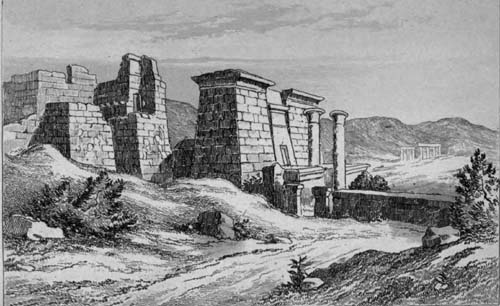
THEBES.
Thebes was called, also, Diospolis, as having been sacred to Jupiter; and Hecatompylos, on account, it is supposed, of its having had a hundred gates.
“Not all proud Thebes’ unrivall’d walls contains, The world’s great empress, on the Egyptian plain; That spreads her conquests o’er a thousand states, And pours her heroes through a hundred gates— Two hundred horsemen, and two hundred cars, From each wide portal issuing to the wars.” Homer’s Iliad; Pope.
“This epithet Hecatompylos, however,” says Mr. Wilkinson, “applied to it by Homer, has generally been supposed to refer to the hundred gates of its wall of circuit; but this difficulty is happily solved by an observation of Diodorus, that many suppose them ‘to have been the propylæa of the temples,’ and that this expression rather implies a plurality, than a definite number.”
Historians are unanimously agreed, that Menes was the first king of Egypt. It is pretended, and not without foundation, that he is the same with Misraim, the son of Cham. Cham was the second son of Noah. When the family of the latter, after the attempt of building the Tower of Babel, dispersed themselves into different countries; Cham retired to Africa, and it was, doubtless, he who afterwards was worshipped as a god, under the name of Jupiter Ammon. He had four children, Chus, Misraim, Phut, and Canaan. Chus settled in Ethiopia, Misraim in Egypt, which generally is called in Scripture after his name, and by that of Cham, his father. Phut took possession of that part of Africa which lies westward of Egypt; and Canaan, of the country which has since borne his name.
Misraim is agreed to be the same as Menes, whom all historians declare to be the first king of Egypt; the institutor of the worship of the gods, and of the ceremonies of the sacrifices.
Some ages after him, Busiris built the city of Thebes, and made it the seat of his empire. This prince is not to be confounded with the Busiris who, in so remarkable a manner, distinguished himself by his inordinate cruelties. In respect to Osymandyas, Diodorus gives a very particular account of many magnificent edifices raised by him; one of which was adorned with sculpture and paintings of great beauty, representing an expedition against the Bactrians, a people of Asia, whom he had invaded with four hundred thousand foot, and twenty thousand horse. In another part of the edifice was exhibited an assembly of the judges, whose president wore on his breast a picture of Truth, with her eyes shut, and himself surrounded with books; an emphatic emblem, denoting that judges ought to be perfectly versed in the laws, and impartial in the administration of them. The king, also, was painted there, offering to the gods silver and gold, which he drew from the mines of Egypt, amounting to the sum of sixteen millions.
So old as this king’s reign, the Egyptians divided the year into twelve months, each consisting of thirty days; to which they added, every year, five days and six hours. To quote the words of a well-known writer, (Professor Heeren,) “its monuments testify to us a time when it was the centre of the civilisation of the human race; a civilisation, it is true, which has not endured, but which, nevertheless, forms one of the steps by which mankind has attained to higher perfection.”
Although Thebes had greatly fallen from its former splendour, in the time of Cambyses the Persian it was the fury of this lawless and merciless conqueror that gave the last blow to its grandeur, about 520 years before the Christian era. He pillaged its temples, and carried away the ornaments of gold, silver, and ivory. Before this period, no city in the world could be compared with it in size, beauty, and wealth; and according to the expression of Diodorus—“The sun had never seen so magnificent a city.”
The next step towards the decline and fall of this city was, as we learn from Diodorus, the preference given to Memphis; and the removal of the seat of government thither, and subsequently to Sais and Alexandria, proved as disastrous to the welfare, as the Persian invasion had been to the splendour, of the capital of Upper Egypt. “Commercial wealth,” says Mr. Wilkinson, “on the accession of the Ptolemies, began to flow through other channels. Coptos and Apollinopolis succeeded to the lucrative trade of Arabia; and Ethiopia no longer contributed to the revenues of Thebes; and its subsequent destruction, after a three years’ siege, by Ptolemy Lathyrus, struck a death-blow to the welfare and existence of this capital, which was, thenceforth, scarcely deemed an Egyptian city. Some few repairs, however, were made to its dilapidated temples by Evergetes II., and some by the later Ptolemies. But it remained depopulated; and at the time of Strabo’s visit, was already divided into small and detached villages.”
Thebes was, perhaps, the most astonishing work ever performed by the hand of man. In the time of its splendour, it extended above twenty-three miles; and upon any emergency could send into the field seven hundred thousand men, according to Tacitus; but Homer allows only that it could pour through each of its hundred gates two hundred armed men, with their chariots and horses, which makes about forty thousand men, allowing two men to each chariot.
Though its walls were twenty-four feet in thickness, and its buildings the most solid and magnificent; yet, in the time of Strabo and of Juvenal, only mutilated columns, broken obelisks, and temples levelled with the dust, remained to mark its situation, and inform the traveller of the desolation which time, or the more cruel hand of tyranny, can assert over the proudest monuments of human art.
“Thebes,” says Strabo, “presents only remains of its former grandeur, dispersed over a space eighty stadia in length. Here are found great number of temples, in part destroyed by Cambyses; its inhabitants have retired to small towns, east of the Nile, where the present city is built, and to the western shore, near Memnonium; at which place we admired two colossal stone figures, standing on each side, the one entire, the other in part thrown down, it has been said by an earthquake. There is a popular opinion, that the remaining part of this statue, towards the base, utters a sound once a day. Curiosity leading me to examine this fact, I went thither with Ælius Gallus, who was accompanied with his numerous friends, and an escort of soldiers. I heard a sound about six o’clock in the morning, but dare not affirm whether it proceeded from the base, from the colossus, or had been produced by some person present; for one is rather inclined to suppose a thousand different causes, than that it should be the effect of a certain assemblage of stones.
“Beyond Memnonium are the tombs of the kings, hewn out of the rock. There are about forty, made after a marvellous manner, and worthy the attention of travellers. Near them are obelisks, bearing various inscriptions, descriptive of the wealth, power, and extensive empire of those sovereigns who reigned over Scythia, Bactriana, Judæa, and what is now called Ionia. They also recount the various tributes those kings had exacted, and the number of their troops, which amounted to a million of men.”
We now proceed to draw from Diodorus Siculus:—
“The great Diospolis,” says he, “which the Greeks have named Thebes, was six miles in circumference. Busiris, who founded it, adorned it with magnificent edifices and presents. The fame of its power and wealth, celebrated by Homer, has filled the world. Never was there a city which received so many offerings in silver, gold and ivory, colossal statues and obelisks, each cut from a single stone. Four principal temples are especially admired there: the most ancient of which was surpassingly grand and sumptuous. It was thirteen stadia in circumference, and surrounded by walls twenty-four feet in thickness and forty-five cubits high. The richness and workmanship of its ornaments were correspondent to the majesty of the building, which many kings contributed to embellish. The temple still is standing; but it was stripped of its silver and gold, ivory, and precious stones, when Cambyses set fire to all the temples of Egypt.”
The following account of the tomb of Osymandyas is also from Diodorus:—
“Ten stadia from the tombs of the kings of Thebes, is the admirable one of Osymandyas. The entrance to it is by a vestibule of various coloured stones, two hundred feet long, and sixty-eight high. Leaving this we enter a square peristyle, each side of which is four hundred feet in length. Animals twenty-four feet high, cut from blocks of granite, serve as columns to support the ceiling, which is composed of marble slabs, twenty-seven feet square, and embellished throughout by golden stars glittering on a ground of azure. Beyond this peristyle is another entrance; and after that a vestibule, built like the first, but containing more sculptures of all kinds. At the entrance are three statues, formed from a single stone by Memnon Syncite, the principal of which, representing the king, is seated, and is the largest in Egypt. One of its feet, exactly measured, is about seven cubits. The other had figures supported on its knees; the one on the right, the other on the left, are those of his mother and daughter. The whole work is less valuable for its enormous grandeur, than for the beauty of the sculpture, and the choice of the granite, which, though so extensive, has neither flaw nor blemish on its surface. The colossus bears this inscription: ‘I am Osymandyas, king of kings; he who would comprehend my greatness, and where I rest, let him destroy some one of these works.’ Beside this, is another statue of his mother, cut from a single block of granite, thirty feet high. Three queens are sculptured on her head, intimating that she was a daughter, wife, and mother of a king. After this portico is a peristyle, still more beautiful than the first; on the stones of which is engraved, the history of the wars of Osymandyas, against the rebels of Bactriana. The façade of the front wall exhibits this prince attacking ramparts, at the foot of which the river flows. He is combating advanced troops; and by his side is a terrible lion, ardent in his defence. On the right wall are captives in chains, with their hands and genitals cut off, as marks of reproach for their cowardice. The wall on the left contains symbolical figures of exceedingly good sculpture, descriptive of triumphs and sacrifice of Osymandyas returning from this war. In the centre of the peristyle, where the roof is open, an altar was erected of a single stone of marvellous bulk and exquisite workmanship; and at the farther wall are two colossal figures, each hewn from a single block of marble, forty feet high, seated on their pedestals. This admirable peristyle has three gates, one between the two statues, and the others on each side. These lead to an edifice two hundred feet square, the roof of which is supported by high columns; it resembles a magnificent theatre; several figures carved in wood, represent a tribunal administering justice. Thirty judges are seen on one of the walls; and in the midst of them the chief justice, with a pile of books at his feet, and a figure of Truth, with her eyes shut, suspended from his neck; beyond is a walk, surrounded by edifices of various forms, in which were tables stored with all kinds of delicious viands. In one of these, Osymandyas, clothed in magnificent robes, offers up the gold and silver which he annually drew from the mines of Egypt to the gods. Beneath, the amount of this revenue, which was thirty-two million minas of silver, was inscribed. Another building contained the sacred library, at the entrance of which these words were read: ‘Physic for the soul.’ A fourth contained all the deities of Egypt, with the king offering suitable presents to each; and calling Osiris and the surrounding divinities to witness, he had exercised piety towards the gods, and justice towards men. Beside the library stood one of the finest of these edifices, and in it twenty couches to recline on, while feasting; also the statues of Jupiter, Juno, and Osymandyas, whose body, it is supposed, was deposited here. Various adjoining apartments contained representations of all the consecrated animals of Egypt. Hence was the ascent to the sepulchre of the king; on the summit of which was placed a circle of gold, in thickness one cubit, and three hundred and sixty-five in circumference, each cubit corresponding to a day in the year; and on it was engraved the rising and setting of the stars for that day, with such astrological indications as the superstition of the Egyptians had affixed to them. Cambyses is said to have carried off this circle, when he ravaged Egypt. Such, according to historians, was the tomb of Osymandyas, which surpassed all others as well by its wealth, as by the workmanship of the skilful artists employed.”
In the whole of Upper Egypt, adjacent to each city, numerous tombs are always found excavated in the neighbouring mountains. The most extensive and highly ornamented are nearest to the base; those of smaller dimensions, and less decorated, occupy the middle; and the most rude and simple are situated in the upper parts.
Those adjacent to Thebes are composed of extensive galleries, twelve feet broad and twenty high, with many lateral chambers.
They are ornamented with pilasters, sculptures, stucco, and paintings; both ceilings and walls are covered with emblems of war, agriculture, and music; and, in some instances, with shapes of very elegant utensils, and always representing offerings of bread, fruit, and liquors. The colours upon the ceilings are blue, and the figures yellow. We must, however, refer to a fuller account:—that of Belzoni.
“Gournou is a tract of rocks about two miles in length, at the foot of the Lybian mountains, on the west of Thebes, and was the burial-place of the great ‘city of the hundred gates.’ Every part of these rocks is cut out by art, in the form of large and small chambers, each of which has its separate entrance; and, though they are very close to each other, it is seldom that there is any communication from one to another. I can truly say, it is impossible to give any description sufficient to convey the smallest idea of these subterranean abodes and their inhabitants; there are no sepulchres in any part of the world like them; and no exact description can be given of their interior, owing to the difficulty of visiting these recesses. Of some of these tombs many persons cannot withstand the suffocating air, which often causes fainting. A vast quantity of dust rises, so fine, that it enters into the throat and nostrils, and chokes to such a degree, that it requires great power of lungs to resist it, and the strong effluvia of the mummies. This is not all; the entry, or passage where the bodies are, is roughly cut in the rocks, and the falling of the sand from the ceiling causes it to be nearly filled up:—so that in some places, there is not a vacancy of much more than a foot left, which must be passed in a creeping posture on the hands and knees. Alter getting through these passages, some of them two or three hundred yards long, you generally find a more commodious place, perhaps high enough to sit: but what a place of rest! Surrounded by bodies, by heaps of mummies in all directions, which, till I got accustomed to the sight, impressed me with horror. After the exertion of entering into such a place through a passage of sometimes six hundred yards in length, nearly overcome, I sought a resting-place, found one, and contrived to sit; but when my weight bore on the body of an Egyptian, it crushed it like a band-box. I naturally had recourse to my hands to sustain my weight, but they found no better support; so that I sank altogether among the broken mummies with a crash of bones, rags, and wooden cases, which raised such a dust as kept me motionless for a quarter of an hour, waiting till it subsided again. Once I was conducted from such a place to another resembling it, through a passage about twenty feet in length, and no larger than that a body could be forced through; it was choked with mummies, and I could not pass without putting my face in contact with that of some decayed Egyptian; but, as the passage inclined downwards, my own weight helped me on, and I could not avoid being covered with bones, legs, arms, and heads; rolling from above. The purpose of my researches was to rob the Egyptians of their papyri, of which I found a few hidden in their breasts, under their arms, in the space above their knees, or on the legs, and covered by the numerous folds of cloth that envelop the body.
“Nothing can more plainly distinguish the various classes of people, than the manner of their preservation. In the many pits that I have opened, I never saw a single mummy standing, and found them lying regularly in horizontal rows, and some were sunk into a cement which must have been nearly fluid when the cases were placed on it. The lower classes were not buried in cases: they were dried up, as it appears, after the usual preparation. Mummies of this sort were in the proportion of about ten to one of the better class, as nearly as I could calculate from the quantity of both I have seen; the linen in which they are folded is of a coarser sort and less in quantity; they have no ornaments about them of any consequence, and are piled up in layers, so as to fill, in a rude manner, the caves excavated for the purpose. In general these tombs are to be found in the lower grounds, at the foot of the mountains; they are entered by a small aperture arched over, or by a shaft four or five feet square, at the bottom of which are entrances into various chambers, all choked up with mummies, many of which have been rummaged and left in the most confused state. Among these tombs we saw some which contained the mummies of animals intermixed with human bodies; these were bulls, cows, sheep, monkeys, foxes, bats, crocodiles, fishes, and birds. Idols often occur, and one tomb was filled with nothing but cats, carefully folded in red and white linen, the head covered by a mask made of the same, and representing the cat. I have opened all these sorts of animals. Of the bull, the calf, and the sheep, there is no part but the head, which is covered with linen with the horns projecting out of the cloth; the rest of the body being represented by two pieces of wood eighteen inches wide and three feet long, with another at the end, two feet high, to form the breast. It is somewhat singular, that such animals are not to be met with in the tombs of the higher sort of people, while few or no papyri are to be found among the lower order; and if any occur, they are only small pieces stuck on the breast with a little gum or asphaltum, being probably all that the poor individual could afford to himself. In those of the better classes other objects are found. I think they ought to be divided into several classes, and not confined to three, as is done by Herodotus in his account of the mode of embalming. In the same pit where I found mummies in cases, I have found others without, and in these, papyri are most likely to be met with. I remarked that those in cases have none. It appears to me that those that could afford it had a case to be buried in, on which the history of their lives was painted; and those who could not afford a case, were contented to have their lives written on papyri, and placed above their knees. The cases are made of sycamore, some very plain, some richly painted with well-executed figures; all have a human face on the lid: some of the larger contain others within them, either of wood or plaster, and painted; some of the mummies have garlands of flowers and leaves of the acacia, or Sunt-tree, over their heads and breasts. In the inside of these mummies are often found lumps of asphaltum, sometimes weighing as much as two pounds. Another kind of mummy I believe I may conclude to have belonged exclusively to the priests: they are folded in a manner totally differing from the others, and with much more care; the bandages consist of stripes of red and white linen intermixed, and covering the whole body, but so carefully applied, that the form of the trunk and limbs are preserved separate, even to the fingers and toes; they have sandals of painted leather on the feet, and bracelets on their arms and wrists. The cases in which these mummies are preserved, are somewhat better executed than the rest.
“The tombs containing the better classes are of course superior to the others; some are also more extensive than others, having various apartments adorned with figures. It would be impossible to describe the numerous little articles found in them, which are well adapted to show the domestic habits of the ancient Egyptians. It is here the smaller idols are occasionally found, either lying on the ground, or on the cases. Vases made of baked clay, painted over, from eight to eighteen inches in size, are sometimes seen, containing embalmed entrails; the covers represent the head of some divinity, bearing either the human form, or that of a monkey, fox, cat, or other animal. I met with a few of these made of alabaster, in the tombs of the kings, but they were unfortunately broken: a great quantity of pottery and wooden vessels are found in some of the tombs; the ornaments, the small works in clay in particular, are very curious. I have been fortunate enough to find many specimens of their manufactures, among which is leaf-gold, nearly as thin as ours; but what is singular, the only weapon I met with was an arrow, two feet long.
“One day while causing the walls of a large tomb to be struck with a sledge-hammer, in order to discover some hidden chambers, an aperture, a foot and a half wide, into another tomb, was suddenly made: having enlarged it sufficiently to pass, we entered, and found several mummies and a great quantity of broken cases; in an inner apartment was a square opening, into which we descended, and at the bottom we found a small chamber at each side of the shaft, in one of which was a granite sarcophagus with its cover, quite perfect, but so situated, that it would be an arduous undertaking to draw it out.”
Among the many discoveries of the enterprising Belzoni, was that of the Tombs of the Kings:—
“After a long survey of the western valley, I could observe only one spot that presented the appearance of a tomb: accordingly I set the men to work, and when they had got a little below the surface, they came to some large stones; having removed these, I perceived the rock had been cut on both sides, and found a passage leading downwards, and in a few hours came to a well-built wall of stones of various sizes, through which we contrived to make a breach; at last on entering, we found ourselves on a staircase, eight feet wide and ten high, at the bottom of which were four mummies in their cases, lying flat on the ground, and further on four more: the cases were all painted, and one had a large covering thrown over it like a pall. These I examined carefully, but no further discoveries were made at this place, which appears to have been intended for some of the royal blood.
“Not fifteen yards from the last tomb I described, I caused the earth to be opened at the foot of a steep hill, and under a torrent which, when it rains, pours a great quantity of water over the spot: on the evening of the second day, we perceived the part of the rock which was cut and formed the entrance, which was at length entirely cleared, and was found to be eighteen feet below the surface of the ground. In about an hour there was room for me to enter through a passage that the earth had left under the ceiling of the first corridor, which is thirty-six feet long and eight or nine wide, and when cleared, six feet nine inches high. I perceived immediately, by the painting on the ceiling, and by the hieroglyphics in bas-relief, that this was the entrance into a large and magnificent tomb. At the end of the corridor, I came to a staircase twenty-three feet long, and of the same breadth as the corridor, with a door at the bottom, twelve feet high; this led to another corridor thirty-seven feet long, and of the same width and height as the former one, each side, and the ceiling sculptured with hieroglyphics and painted; but I was stopped from further progress by a large pit at the other end, thirty feet deep and twelve wide. The upper part of this was adorned with figures, from the wall of the passage up to the ceiling; the passages from the entrance, all the way to this pit, were inclined at an angle of about eighteen degrees. On the opposite side of the pit, facing the passage, a small opening was perceived, two feet wide, and two feet six inches high, and a quantity of rubbish at the bottom of the wall; a rope, fastened to a piece of wood that was laid across the passage, against the projections which form a kind of door, appears to have been used for descending into the pit, and from the small aperture on the other side hung another, for the purpose, doubtless, of ascending again; but these and the wood crumbled to dust on touching them, from the damp arising from the water which drained into the pit down the passages. On the following day we contrived a bridge of two beams to cross the pit by, and found the little aperture to be an opening forced through a wall, which had entirely closed the entrance, and which had been plastered over and painted, so as to give the appearance of the tomb having ended at the pit, and of there having been nothing beyond it. The rope in the inside of the wall, having been preserved from the damp, did not fall to pieces, and the wood to which it was attached was in good preservation. When we had passed through the little aperture, we found ourselves in a beautiful hall, twenty-seven feet six inches by twenty-five feet ten inches, in which were four pillars, three feet square. At the end of this room, which I shall call the entrance hall, and opposite the aperture, is a large door, from which three steps lead down into a chamber with two pillars, four feet square, the chamber being twenty-eight by twenty-five feet; the walls were covered with figures, which, though in outline only, were as fine and perfect as if drawn only the day before. On the left of the aperture a large staircase of eighteen steps, descended from the entrance-hall into a corridor, thirty-six feet by seven wide; and we perceived that the paintings became more perfect as we advanced further; the figures are painted on a white ground, and highly varnished. At the end of this ten steps led us into another, seventeen feet by eleven, through which we entered a chamber, twenty feet by fourteen, adorned in the most splendid manner by basso-relievos, painted like the rest. Standing in this chamber, the spectator sees himself surrounded by representations of the Egyptian gods and goddesses. Proceeding further, we entered another large hall, twenty-eight feet square, with two rows of pillars, three on each side, in a line with the walls of the corridors; at each side is a small chamber, each about ten or eleven feet square. At the end of this hall we found a large saloon, with an arched roof or ceiling, thirty-two feet by twenty-seven; on the right was a small chamber, roughly cut, and obviously left unfinished; and on the left there is another, twenty six by twenty-three feet, with two pillars in it. It had a projection of three feet all round it, possibly intended to contain the articles necessary for the funeral ceremonies; the whole was beautifully painted like the rest. At the same end of the room we entered by a large door into another chamber, forty-three feet by seventeen, with four pillars in it, one of which had fallen down; it was covered with white plaster where the rock did not cut smoothly, but there were no paintings in it. We found the carcass of a bull embalmed with asphaltum, and also, scattered in various places, an immense quantity of small wooden figures of mummies, six or eight inches long, and covered with asphaltum to preserve them; there were some others of fine baked earth, coloured blue, and highly varnished. On each side of the two little rooms were some wooden statues, standing erect, four feet high, with a circular hollow inside, as if to contain a roll of papyrus, which I have no doubt they once did. In the centre of the saloon was a SARCOPHAGUS of the finest oriental alabaster, nine feet five inches long, and three feet seven wide; it is only two inches thick, and consequently transparent when a light is held within it; it is minutely sculptured, both inside and out, with several hundred figures, not exceeding two inches in length, representing, as I suppose, the whole of the funeral procession and ceremonies relating to the deceased. The cover had been taken out, and we found it broken in several pieces in digging before the first entrance: this sarcophagus was over a staircase in the centre of the saloon, which communicated with a subterraneous passage, leading downwards, three hundred feet in length. At the end of this we found a great quantity of bats’ dung, which choked it up, so that we could go no further without digging; it was also nearly filled up by the falling in of the upper part. One hundred feet from the entrance is a staircase, in good preservation, but the rock below changes its substance. This passage proceeds in a south-west direction through the mountain. I measured the distance from the entrance, and also the rocks above, and found that the passage reaches nearly half-way through the mountain to the upper part of the valley. I have reason to suppose that this passage was used as another entrance; but this could not be after the person was buried there; for, at the bottom of the stairs, under the sarcophagus, a wall had been built, which entirely closed this communication; hence it should appear, that this tomb had been opened again with violence, after all the precautions mentioned had been taken to conceal the existence of the greater part of it; and as these had been carefully and skilfully done, it is probable that the intruder must have had a guide who was acquainted with the place.”
The rich alabaster sarcophagus, mentioned above, is now in the Soane Museum, Lincoln’s-inn-fields, London, and remains altogether unrivalled in beauty and curiosity. How it came there is thus described by Sir John Soane:—
“This marvellous effort of human industry and perseverance is supposed to be at least three thousand years old. It is of one piece of alabaster, between nine and ten feet in length, and is considered of pre-eminent interest, not only as a work of human skill and labour, but as illustrative of the customs, arts, religion, and government of a very ancient and learned people. The surface of this monument is covered externally and internally with hieroglyphics, comprehending a written, language, which it is to be hoped the labour of modern literati will one day render intelligible. With no inconsiderable expense and difficulty this unique monument was transferred from Egypt to England, and placed in the British Museum, to the trustees of which it was offered for two thousand pounds. After which negotiation, the idea of purchasing it for our national collection was relinquished; when it was offered to me at the same price, which offer I readily accepted, and shortly after I had the pleasure of seeing this splendid relic of Egyptian magnificence safely deposited in a conspicuous part of my museum.”
“On entering the sepulchral chamber,” says a writer, giving an account of the Soane collection, “notwithstanding intense anxiety to behold a work so unique and so celebrated as the Belzoni sarcophagus, I confess that the place in which this monument of antiquity is situated became the overpowering attraction. Far above, and on every side, were concentrated the most precious relics of architecture and sculpture, disposed so happily as to offer the charm of novelty, the beauty of picturesque design, and that sublimity resulting from a sense of veneration, due to the genius and the labours of the ‘mighty dead.’ The light admitted from the dome appeared to descend with a discriminating effect, pouring its brightest beams on those objects most calculated to benefit by its presence.
“The more,” says the same writer, speaking of the sarcophagus itself, “we contemplate this interesting memorial of antiquity and regal magnificence, the more our sense of its value rises in the mind. We consider the beauty and scarcity of the material, its transparency, the rich and mellow hue, the largeness of the original block, the adaptation of its form to the purpose, which was unquestionably to receive a body inclosed in numerous wrappings, and doubly cased, according to the custom of the Egyptians. We then examine the carving of innumerable figures, doubting not that the history of a life fraught with the most striking events is here recorded; gaze on the beautiful features of the female form sculptured at the bottom of the sarcophagus, and conclude it to be that of the goddess Isis, the elongated eye and the delicate foot closely resembling those drawings of her, given by the learned Montfaucon; and repeat the exclamation of Belzoni, when he declared that the day on which he found this treasure was the happiest of his life.
“Viewed by lamp-light, the effect of this chamber is still more impressive; for, seen by this medium, every surrounding object, however admirable in itself, becomes subservient to the sarcophagus. The ancient, the splendid, the wonderful sarcophagus is before us, and all else are but accessories to its dignity and grandeur. A mingled sense of awe, admiration, and delight pervades our faculties, and is even oppressive in its intensity, yet endearing in its associations.”
In respect to the tomb, in which this splendid monument was discovered, Belzoni, on his arrival in England, constructed and exhibited a perfect facsimile of it, which many of our readers will, doubtless, remember having seen.
“The ‘Tombs of the Kings,’ as their name implies268, are the sepulchres in which are deposited the earthly remains of the ancient Egyptian monarchs who reigned at Thebes; they are called by some Babor, or Biban el Molook—a traditional appellation, signifying the Gate or Gates of the Kings, which is by others applied to the narrow gorge at the entrance of the valley in which they are situated. This valley, as Champollion remarks, ‘is the veritable abode of death; not a blade of grass, or a living being is to be found there, with the exception of jackals and hyænas, who, at a hundred paces from our residence, devoured last night the ass which had served to carry my servant Barabba Mohammed, whilst his keeper was agreeably passing the night of Ramazan in our kitchen, which is established in a royal tomb entirely ruined.’
“It would be unnecessary, were it possible, to give a detailed account of these tombs, or of the sculptures which they contain, and of which our interpretation is very limited, because they often refer to Egyptian mysteries of which we have but a scanty knowledge. The tomb, which of all others stands preeminently conspicuous, as well for the beauty of its sculptures as the state of its preservation, is undoubtedly that discovered and opened by Belzoni. It has been deprived within a few years of one of its chief ornaments. ‘I have not forgotten,’ says Champollion, in his twenty-second letter, ‘the Egyptian Museum of the Louvre in my explorations; I have gathered monuments of all sizes, and the smallest will not be found the least interesting. Of the larger class I have selected, out of thousands, three or four mummies remarkable for peculiar decorations, or having Greek inscriptions; and next, the most beautiful coloured bas-relief in the royal tomb of Menephtha the First (Ousirei), at Biban-el-Molouk; it is a capital specimen, of itself worth a whole collection: it has caused me much anxiety, and will certainly occasion me a dispute with the English at Alexandria, who claim to be the lawful proprietors of the tomb of Ousirei, discovered by Belzoni at the expense of Mr. Salt. In spite, however, of this fine pretension, one of two things shall happen; either my bas-relief shall reach Toulon, or it shall go to the bottom of the sea, or the bottom of the Nile, rather than fall into the hands of others; my mind is made up on that point!’”
No dispute, however, took place, and the bas-relief is now in the museum for which it was destined.
“Nearly two thousand years ago, these tombs were an object of wonder and curiosity, and used to attract visiters from different parts of the earth as they now do. It was the practice even then for many of those who beheld them to leave some memorial of their visit behind, in the shape of an inscription commemorating the date at which they ‘saw and wondered,’ to use the expression which is commonly found among them. Some of these inscriptions are curious: one of them is to the following effect: ‘I, the Dadouchos (literally Torch-bearer), of the most sacred Eleusinian mysteries, Nisagoras of Athens, having seen these syringes (as the tombs were commonly called), a very long time after the divine Plato of Athens, have wondered and given thanks to the God and to the most pious King Constantine, who has procured me this favour.’ The tomb in which this was written seems to have been generally admired above all others, though, as Mr. Wilkinson tells us, one morose old gentleman of the name of Epiphanius declares that ‘he saw nothing to admire but the stone,’ meaning the alabaster sarcophagus. There are many other inscriptions: some afford internal evidence of their dates, and among them are four relating to the years 103, 122, 147, and 189 of our era.
“A great many of the painted sculptures, which are found in these tombs, relate to the idolatrous worship of the ancient Egyptians, and the rites and ceremonies which they practised in connexion with it269. But besides these, there are others which afford us a vast quantity of interesting information upon the subjects of their domestic usages and every-day life. In one chamber are depicted the operations of preparing and dressing meat, boiling the cauldron, making bread, lighting the fire, fetching water, &c. Another presents scenes in a garden, where a boy is beaten for stealing fruit; a canal and pleasure boats; fruit and flowers; the mechanical processes of various arts, such as sculpture, painting, the mixing of colours, &c. In the Harper’s Tomb, (so called from there being among the bas-reliefs figures of a man playing upon an instrument resembling a harp,) which was first visited by Bruce, there are some curious illustrations of the furniture which was in use among the Egyptians; tables, chairs, and sideboards, patterns of embossed silk and chintz, drapery with folds and fringe are there to be seen, precisely such, we are told, as were used in our own country some years ago when Egyptian furniture was in fashion.
“The ‘Tombs of the Kings’ bring many allusions of Scripture to the mind, as is remarked by Mr. Jowett, as in the passages of Mark v. 2, 3, 5, and particularly of Isaiah xxii. 16. ‘What hast thou here, and whom hast thou here, that thou hast hewed thee out a sepulchre here, as he that heweth him out a sepulchre on high, and that graveth an habitation for himself on a rock?’
“Another passage of the same prophet might be applied to the pride which the tenants of these magnificent abodes took in resting as magnificently in death as they had done in life; he tells us (xiv. 18), ‘All the kings of the nations, even all of them, lie in glory, every one in his own house.’
“The mystical sculptures upon the walls of the chambers within these sepulchres, cannot be better described than in the words of Ezekiel, (viii. 8, 10): ‘Then said he unto me, Son of man, dig now in the wall: and when I had digged in the wall, behold, a door; and he said unto me, Go in, and behold the wicked abominations that they do here. So I went in, and saw; and, behold, every form of creeping things, and abominable beasts, and all the idols of the house of Israel, pourtrayed upon the wall round about.’
“‘The Israelites,’ remarks Mr. Jowett, ‘were but copyists; the master sketches are to be seen in all the ancient temples and tombs of Egypt.’ These are the places in which the dead bodies of the inhabitants of ancient Thebes were deposited many ages ago; and notwithstanding the havoc which, during many years, has been made among them, the stores of mummies which they contain would almost appear to be inexhaustible; indeed, as a modern writer expresses it, it would scarcely be an exaggeration to say that the mountains are merely roofs over the masses of mummies within them. The coffins, which are made of sycamore-wood, serve as fuel to the Arabs of the whole neighbourhood. ‘At first,’ says Mrs. Lushington, ‘I did not relish the idea of my dinner being dressed with this resurrection wood, particularly as two or three of the coffin lids, which were in the shape of human figures, were usually to be seen standing upright against the tree under which the cook was performing his operations, staring with their large eyes as if in astonishment at the new world upon which they had opened.’
“The miserable beings who have fixed their dwellings in these cavern tombs, are as little civillized as could be expected; our female traveller describes them as having a wild and resolute appearance. ‘Every man was at this time (1828) armed with a spear, to resist, it was said, the compulsory levies of the Pacha, who found it vain to attack them in their fastnesses. I, who was so delighted with the beauty and peace of our new abode, felt quite disturbed to discover that the very spot where we encamped four years before, witnessed the massacre of many hundreds of Arabs, then in resistance against this recruiting system, and who were blown from guns, or shot, while endeavouring to make their escape by swimming across the river. The poor people, however, behaved with civility to us, and I felt no apprehension at going among them with a single companion, or even alone. To be sure we were obliged to take especial care of our property, for which purpose the chief of Luxor assisted us by furnishing half-a-dozen men to watch by night round the encampment. Nevertheless, once after I had gone to sleep, I was awakened by the extinguishing of the light, and felt my little camp-bed raised up by a man creeping underneath; he fled on my crying out, and escaped the pursuit, as he had the vigilance, of our six protectors.’
“The feelings occasioned by the sight of the numerous fragments of mummies which are to be found scattered in every direction in the neighbourhood of these tombs, must be to one of a reflective cast of mind peculiarly affecting. The Rev. Mr. Jowett, after speaking of his ascent to the top of the Libyan mountains, ‘which command a magnificent view of the winding of the Nile, and the plain of the hundred-gated Thebes,’ says, ‘as we were descending the other side of the mountain, we came suddenly on a part where thirty or forty mummies lay scattered in the sand,—the trunk of the body filled with pitch, and the limbs swathed in exceeding long clothes. The forty days spent in embalming these mortal bodies, (Genesis 1. 3.) thus give us a sight of some of our fellow-creatures who inhabited these plains more than three thousand years ago. How solemn the reflection that their disembodied spirits have been so long waiting to be united again to their reanimated body! and that this very body which, notwithstanding its artificial preservation, we see to be a body of humiliation, will on its great change become incorruptible and immortal.’”
The following observations are by Mr. Browne:—
“The massy and magnificent forms of the ruins that remain of ancient Thebes, the capital of Egypt, the city of Jove, the city with a hundred gates, must inspire every intelligent spectator with awe and admiration. Diffused on both sides of the Nile, their extent confirms the classical observations, and Homer’s animated description rushes into the memory:—‘Egyptian Thebes, in whose palaces vast wealth is stored; from each of whose hundred gates issue two hundred warriors, with their horses and chariots.’ These venerable ruins, probably the most ancient in the world, extend for about three leagues in length along the Nile. East and west they reach to the mountains, a breadth of about two leagues and a half. The river is here about three hundred yards broad. The circumference of the ancient city must therefore have been about twenty-seven miles. In sailing up the Nile, the first village you come to within the precincts is Kourna, on the west, where there are few houses, the people living mostly in the caverns. Next is Abu-Hadjadj, a village, and Karnak, a small district, both on the east. Far the largest portion of the city stood on the eastern side of the river. On the south-west Medinet-Abu marks the extremity of the ruins; for Arment, which is about two leagues to the south, cannot be considered as a part.
“In describing the ruins, we shall begin with the most considerable, which are on the east of the Nile. The chief is the Great Temple, an oblong square building, of vast extent, with a double colonnade, one at each extremity. The massy columns and walls are covered with hieroglyphics, a labour truly stupendous. 1. The Great Temple stands in the district called Karnak. 2. Next in importance is the temple at Abu-Hadjadj. 3. Numerous ruins, avenues marked with remains of sphinxes, &c. On the west side of the Nile appear, 1. Two colossal figures, apparently of a man and woman, formed of a calcareous stone like the rest of the ruins. 2. Remains of a large temple, with caverns excavated in the rock. 3. The magnificent edifice styled the Palace of Memnon. Some of the columns are about forty feet high, and about nine and a half in diameter. The columns and walls are covered with hieroglyphics. This stands at Kourna. 4. Behind the palace is the passage styled Bibân-el-Molûk, leading up the mountain. At the extremity of this passage, in the sides of the rock, are the celebrated caverns known as the sepulchres of the ancient kings. Several of these sepulchres have been described by Pococke, with sufficient minuteness; he has even given plans of them. But in conversation with persons at Assiût, and in other parts of Egypt, I was always informed that they had not been discovered till within the last thirty years, when a son of Shech Hamâm, a very powerful chief of the Arabs, who governed all the south of Egypt from Achmîm to Nubia, caused four of them to be opened, in expectation of finding treasure.
“They had probably been rifled in very ancient times; but how the memory of them should have been lost remains to be explained. One of those which I visited exactly answers Dr. Pococke’s description; but the other three appear materially different from any of his plans. It is, therefore, possible that some of those which he saw have been gradually closed up by the sand, and that the son of Hamâm had discovered others. They are cut into the free-stone rock, in appearance, upon one general plan, though differing in parts. First, a passage of some length, then a chamber; a continuation of the first passage turns abruptly to the right, where is the large sepulchral chamber, with a sarcophagus of red granite in the midst.
“In the second part of the passage of the largest are several cells or recesses on both sides. In these appear the chief paintings, representing the mysteries, which, as well as the hieroglyphics covering all the walls, are very fresh. I particularly observed the two harpers described by Bruce; but his engraved figures seem to be from memory. The French merchants at Kahira informed me that he brought with him two Italian artists; one was Luigi Balugani, a Bolognese, the other Zucci, a Florentine.”
The edifice at Luxor270 was principally the work of two Egyptian monarchs,—Amunoph the Third, who ascended the throne 1430 years before the Christian era, and Rameses the Second—the Great, as he is surnamed,—whose era has been fixed at 1500 or 1350 B. C. The Amenophium, as the more ancient part erected by the former is called, comprises all that extends from the river on the south up to the great court; a colonnade, together with a propyla which bound it on the north, is thus a portion of it. The great court itself, with the propyla forming the grand entrance into the whole building, and the obelisks, colossal statues, &c., was the work of Rameses the Second, and is sometimes called the Rameseium; under this appellation, however, it must not be confounded with the great monument of the same monarch on the western side of the river. As this great edifice is very near the bank of the river where it forms an angle, the soil is supported by a solid stone wall, from which is thrown out a jetty of massive and well-cemented brick, fifty yards in length, and seven in width. Mr. Wilkinson says that it is of the late era of the Ptolemies, or Cæsars, since blocks bearing the sculpture of the former have been used in its construction; and the same gentleman communicates the unpleasant intelligence that the river having formed a recess behind it, threatens to sweep away the whole of its solid masonry, and to undermine the foundations of the temple itself. This jetty formed a small port, for the convenience of boats navigating the river. Mr. Hamilton says that its ruins very much resemble the fragments of the bridge called that of Caligula in the Bay of Baiæ; which is now generally believed to have been a pier for the purposes of trade. Dr. Richardson considered the workmanship of the embankment to be entirely Roman; and he suggests that the temple at Luxor was probably built on the banks of the Nile for the convenience of sailors and wayfaring men; where, without much loss of time they might stop, say their prayers, present their offerings, and bribe the priests for promises of future success.
“The entrance,” says Denon, “of the village of Luxor affords a striking instance of beggary and magnificence. What a gradation of ages in Egypt is offered by this single scene! What grandeur and simplicity in the bare inspection of this one mine! It appears to me to be at the same time the most picturesque group, and the most speaking representation of the history of those times. Never were my eyes or my imagination so forcibly struck as by the sight of this monument. I often came to meditate on this spot, to enjoy the past and the present; to compare the successive generations of inhabitants, by their respective works, which were before my eye, and to store in my mind volumes of materials for future meditations. One day the sheik of the village accosted me, and asked if it was the French or the English who had erected these monuments, and this question completed my reflections.”
Every spot of ground, intervening between the walls and columns, is laid out in plantations of corn and olives, inclosed by mud walls.
“We have little reason to suppose271, that when Egypt formed a part of the Eastern empire, its former capital was at all raised from its fallen condition; and we have, unfortunately, but too much reason to conclude, that under the dominion of the Arabian caliphs, it sank yet deeper into desolation, and the destruction of its monuments was continued still by the same agency which had all along worked their ruin,—the hand of man. Though we have no distinct account of the injuries inflicted on it in this period, we may infer their extent, and the motives which operated to produce them, from the following remarks of Abdallatif, an Arabian physician of Bagdad, who wrote a description of Egypt in the fourteenth century. He tells us, that formerly the sovereigns watched with care over the preservation of the ancient monuments remaining in Egypt; ‘but, in our time,’ he adds, ‘the bridle has been unloosed from men, and no one takes the trouble to restrain their caprices, each being left to conduct himself as to him should seem best. When they have perceived monuments of colossal grandeur, the aspect of those monuments has inspired them with terror; they have conceived foolish and false ideas of the nature of these remains of antiquity. Every thing, which had the appearance of design, has been in their eyes but a signal of hidden treasure; they have not been able to see an aperture in a mountain, without imagining it to be a road leading to some repository of riches. A colossal statue has been to them but the guardian of the wealth deposited at its feet, and the implacable avenger of all attempts upon the security of his store. Accordingly, they have had recourse to all sorts of artifice to destroy and pull down these statues; they have mutilated the figures, as if they hoped by such means to attain their object, and feared that a more open attack would bring ruin upon themselves; they have made openings, and dug holes in the stones, not doubting them to be so many strong coffers filled with immense sums; and they have pierced deep, too, in the clefts of mountains, like robbers penetrating into houses by every way but the doors, and seizing eagerly any opportunity which they think known only to themselves.’ This is the secret of much of the devastation which has been worked among the monuments of ancient Egypt.”
The village of Luxor272 is built on the site of the ruins of a temple, not so large as that of Karnac, but in a better state of preservation, the masses not having as yet fallen through time, and by the pressure of their own weight. The most colossal parts consist of fourteen columns, of nearly eleven feet in diameter, and of two statues of granite at the outer gate, buried up to the middle of the arms, and having in front of them the two largest and best preserved obelisks known. They are rose-coloured, are still seventy feet above the ground, and to judge by the depth to which the figures seem to be covered, about thirty feet more may be reckoned to be concealed from the eye; making in all one hundred feet for their height. Their preservation is perfect; and the hieroglyphics with which they are covered being cut deep, and in relief at the bottom, show the bold hand of a master, and a beautiful finish. The gravers, which could touch such hard materials, must have been of an admirable temper; and the machines to drag such enormous blocks from the quarries, to transport them thither, and to set them upright, together with the time required for the labour, surpass all conception.
The temple is very near the river, says another writer, and there is a good ancient jetty, well built of bricks. The entrance is through a magnificent gateway facing the north, two hundred feet in front, and fifty-seven feet high, above the present level of the soil. Before the gateway, and between the obelisks, are two colossal statues of red granite; from the difference of the dresses, it is judged that one was a male, the other a female, figure. They are nearly of equal sizes. Though buried in the ground to the chest, they still measure twenty-one or twenty-two feet from thence to the top of the mitres.
The gateway is filled with remarkable sculptures, which represent the triumph of some ancient monarch of Egypt over an Asiatic enemy; and which we find repeated both on other monuments of Thebes, and partly, also, on some of the monuments of Nubia. This event appears to have formed an epoch in Egyptian history, and to have furnished materials both for the historian and the sculptor, like the war of Troy to the Grecian poet. The whole length of this temple is about eight hundred feet.
In speaking of the gate of this temple, which is now become that of the village of Luxor, Denon remarks:—“Nothing can be more grand, and, at the same time, more simple, than the small number of objects of which this entrance is composed. No city whatever makes so proud a display at its appearance as this wretched village; the population of which consists of two or three thousand souls, who have taken up their abode on the roofs and beneath the galleries of this temple, which has, nevertheless, the air of being in a manner uninhabited.”
The following observations, in regard to the sculptures at Luxor, are from the Saturday Magazine:—
“On the front of the great propyla, which form the principal entrance at Luxor, are a series of sculptures which have excited the wonder of all who have ever seen them. They are spoken of as being entitled to rank very high among works of ancient art; as Mr. Hamilton remarks in his admirable description of them, they far surpass all the ideas which till they were examined had been formed of the state of the arts in Egypt at the era to which they must be attributed. They are cut in a peculiar kind of relief, and are apparently intended to commemorate some victory gained by an ancient monarch of Egypt over a foreign enemy. The moment of the battle chosen, is when the hostile troops are driven back in their fortress, and the Egyptians are evidently to be soon masters of the citadel.
“The conqueror, behind whom is borne aloft the royal standard, in the shape of the Doum, or Theban palm-leaf, is of colossal size: that is, far larger than all the other warriors, standing up in a car drawn by two horses. His helmet is adorned with a globe with a serpent on each side. He is in the act of shooting an arrow from a bow which is full stretched; around him are quivers, and at his feet is a lion in the act of rushing forward. There is a great deal of life and spirit in the form and attitude of the horses, which are in full gallop, feathers waving over their heads, and the reins lashed round the body of the conqueror. Under the wheels of the car, and under the horses’ hoofs and bellies, are crowds of the slain; some stretched on the ground, others falling. On the enemy’s side, horses in full speed with empty cars,—others heedless of the rein, and all at last rushing headlong down a precipice into a broad and deep river which washes the walls of the town. The expression is exceedingly good; and nowhere has the artist shown more skill than in two groups, in one of which the horses having arrived at the edge of the precipice, instantly fall down; and the driver clinging with one hand to the car, the reins and whip falling from the other,—his body, trembling with despair, is about to be hurled over the backs of the horses. In the other, the horses still find a footing on the side of the hill, and are hurrying forward their drivers to inevitable destruction; these throw themselves back upon the car in vain. Some that are yet unwounded pray for mercy on their knees, and others in their flight cast behind a look of anxious entreaty; their limbs, their eyes, and their hands, sufficiently declare their fears. The breathless horses are admirable,—whether fainting from loss of blood, or rearing up and plunging in the excess of torture. Immediately in front of the conqueror are several cars in full speed for the walls of the town; but even in these the charioteers and men-of-war are not safe from the arrows shot from his unerring bow, and when wounded they look back on their pursuer as they fall. Further on, more fortunate fugitives are passing the river; in which are mingled horses, chariots, arms, and men, expressed in the most faithful manner, floating or sunk. Some have already reached the opposite bank where their friends, who are drawn up in order of battle, but venture not to go out to the fight, drag them to the shore. Others, having escaped by another road, are entering the gates of the town amid the shrieks and lamentation of those within. Towers, ramparts, and battlements, are crowded with inhabitants, who are chiefly bearded old men and women. A party of the former are seen sallying forth, headed by a youth whose different dress, and high turban, mark him out as some distinguished chieftain. On each side of the town are large bodies of infantry, and a great force of chariots issuing out of the gates, and advancing seemingly by different routes to attack the besiegers.
“The impetuosity, with which the hero of the picture has moved, has already carried him far beyond the main body of his own army, and he is there alone amid the dying and the slain—victims of his valour and prowess. Behind this scene, the two lines of the enemy join their forces, and attack in a body the army of the invaders, which advances to meet them in a regular line. ‘Besides the peculiarities of the incidents recorded in this interesting piece of sculpture,’ says Mr. Hamilton, ‘we evidently traced a distinction between the short dresses of the Egyptians and the long robes of their Oriental enemies; whether Indians, Persians, or Bactrians; the uncovered and the covered heads; the different forms of the cars, of which the Egyptian contains two, and the others three warriors; and above all, the difference of the arms.’
“At one extremity of the west wing of the gateway, the beginning of this engagement appears to be represented; the same monarch being seen at the head of his troops, advancing against the double line of the enemy, and first breaking their ranks. At the other extremity of the same wing the conqueror is seated on his throne after the victory, holding a sceptre in his left hand, and enjoying the cruel spectacle of eleven of the principal chieftains among his captives lashed together in a row, with a rope about their necks: the foremost stretches out his arms for pity, and in vain implores a reprieve from the fate of his companions: close to him is the twelfth, on his knees, just going to be put to death by the hands of two executioners. Above them is the captive sovereign, tied with his hands behind him to a car, to which two horses are harnessed; these are checked from rushing onward by the attendant, till the monarch shall mount and drag behind him the unfortunate victim of his triumphs. Behind the throne different captives are suffering death in various ways; some held by the executioner by the hair of their head; others dragged by chariots or slain by the arrow or the scimitar. There is then the conqueror’s camp, round which are placed his treasures, and where the servants prepare a feast to celebrate his victory.
“We have described these sculptures at length, because they are undoubtedly one of the greatest of the many wonders of Thebes, and because in no other manner could we convey to our readers a proper notion of their merits.”
The following observations are by Lord Lindsay:—
“We visited the Temples of Luxor and Carnac. The former is a most magnificent pile, architecturally considered, but otherwise the least interesting of the four great temples of Thebes. You originally entered between four gigantic statues of Rameses the Great, and two superb obelisks, of which one only remains;—the French have carried off his brother, and every lover of antiquity must regret their separation. The obelisks, statues, and pyramidal towers, were additions by Rameses to the original edifice, founded by Amunoph the Third. From the propyla and obelisks of this temple an avenue, guarded by sphinxes, facing each other, extended northwards, to the great temple of Jupiter Ammon at Carnac; meeting it at right angles, the latter extending from west to east. The road we followed lay nearer the river, and led us through a comparatively small temple of Isis, that would have detained us longer in a less attractive neighbourhood, into the great court of Jupiter Ammon’s temple, the noblest ruin at Thebes. A stupendous colonnade, of which one pillar only remains erect, once extended across this court, connecting the western propylon or gate of entrance, built by Sesostris, with that at its eastern extremity, leading to the grand hall of Osirei, and the sanctuary. We ascended the former;—the avenue of sphinxes, through which the god returned, in solemn procession, to his shrine at Carnac, after his annual visit to the Libyan suburb, ascends to it from the river,—the same avenue traversed age after age by the conqueror, the poet, the historian, the lawgiver, the philosopher,—Sesostris, Cambyses, Homer, Herodotus, Thales, Anaxagoras, Solon, Pythagoras, Plato,—and now the melancholy song of an Arab boy was the only sound that broke the silence; but that poor boy was the representative of an older and a nobler race than that of the Pharaohs. Long did we gaze on the scene around and below us—utter, awful desolation! Truly, indeed, has NO been ‘rent asunder!’ The towers of the second or eastern propylon are mere heaps of stones, ‘poured down’—as prophecy and modern travellers describe the foundations of Samaria—into the court on one side, and the great hall on the other;—giant columns have been swept away like reeds before the mighty avalanche, and one hardly misses them. And that hall, who could describe it? Its dimensions, one hundred and seventy feet by three hundred and twenty-nine,—-the height of the central avenue of columns sixty-six feet, exclusive of their pedestals,—the total number of columns that supported its roof one hundred and thirty-four. These particulars may give you some idea of its extent; but of its grandeur and beauty—none. Every column is sculptured, and all have been richly painted. The exterior walls, too, are a sculptured history of the wars of Osirei and Rameses. Except those at Beit Wellee I have seen nothing in Egypt that would interest so much. In one corner, of especial interest, are represented the Jews captured by Shishak, and their king Rehoboam, with the hieroglyphical inscription ‘Jehouda Melek,’ the king of the Jews. This is the only reference to the Israelites found in Egyptian sculpture. Many have wondered at finding no allusions to their residence in Egypt; but I think without cause; for, except the pyramids, the tombs in their vicinity, those of Beni Hassan, and a few other remains, of but little interest, I do not believe that any monuments exist, coeval with Moses and the Exodus.”
The remains of this temple are thus described by Denon:—
“Of the hundred columns of the portico alone, the smallest are seven feet and a half in diameter, and the largest twelve; the space occupied by the circumvallation of the temple contains lakes and mountains. In short, to be enabled to form a competent idea of so much magnificence, the reader ought to fancy what is before him to be a dream; as he who views the objects themselves rubs his eyes to know whether he is awake. The avenue leading from Karnac to Luxor, a space nearly half a league in extent, contains a constant succession of sphinxes and other chimerical figures to the right and left, together with fragments of stone walls, of small columns, and of statues.”
“The most ancient remains,” says Mr. Wilkinson, “now existing at Thebes, are unquestionably in the great temple of Karnac, the largest and most splendid ruin273 of which, perhaps, either ancient or modern times can boast; being the work of a number of successive monarchs, each anxious to surpass his predecessor, by increasing the dimensions and proportions of the part he added.
“It is this fact which enables us to account for the diminutive size of the older parts of this extensive building; and their comparatively limited scale offering greater facility, as their vicinity to the sanctuary greater temptation, to an invading army to destroy them, added to their remote antiquity, are to be attributed their dilapidated state; as well as the total disappearance of the sculptures executed during the reigns of the Pharaohs, who preceded Osirtesen I., the cotemporary of Joseph, and the earliest monarch whose name exists on the monuments of Thebes274.”
Speaking of this magnificent edifice, and of the vast sphinxes and other figures, Belzoni says:—“I had seen the temple of Tentyra, and I still acknowledge that nothing can exceed that edifice in point of preservation, and the beauty of its workmanship and sculpture. But here I was lost in a mass of colossal objects, every one of which was more than sufficient of itself to attract my whole attention. How can I describe my sensations at that moment? I seemed alone in the midst of all that is most sacred in the world; a forest of enormous columns from top to bottom; the graceful shape of the lotus, which forms their capitals, and is so well proportioned to the columns; the gates, the walls, the pedestals, the architraves, also adorned in every part with symbolical figures in low-relief, representing battles, processions, triumphs, feasts, and sacrifices, all relating to the ancient history of the country; the sanctuary wholly formed of fine red granite; the high portals, seen at a distance from the openings, of ruins of the other temples, within sight;—these altogether had such an effect upon my soul, as to separate me, in imagination, from the rest of mortals, exalt me on high above all, and cause me to forget entirely the trifles and follies of life. I was happy for a whole day, which escaped like a flash of lightning.”
Here stood, and does now stand, a fragment of the famous vocal statue of Memnon, which, many writers attest, sent forth harmonious sounds, when first touched of a morning by the rays of the sun. The circumstance being attested by Strabo, Pliny, Juvenal, Pausanias, Tacitus, and Philostratus, it is assuredly not to be doubted. The first injury this statue received was from Cambyses; who ordered it to be sawed in two, in order to get at the secret. It was afterwards thrown down by an earthquake.
Some have supposed, that the sounds alluded to were produced by the mechanical impulse of the sun’s light. Others that, being hollow, the air was driven out by the rarefaction of the morning, which occasioned the elicitation of a murmuring sound. But some assert, that it saluted the morning and evening sun differently;—the former with animating sounds; the latter with melancholy ones. Darwin, in the true spirit of poetry, describes this statue as sending forth murmurs of indignation at the ravages of Cambyses:—
Prophetic whispers breathed from sphinx’s tongue; And Memnon’s lyre with hollow murmurs rung.
In another passage, equally poetical, he makes it view with delight the waters of the Nile, rushing from the cataracts of Ethiopia:—
Gigantic sphinx the circling waves admire; And Memnon bending o’er his broken lyre.
In many parts of the East the custom still remains of proclaiming the sun by the sounding of instruments. That similar signals were given in Egypt is not to be doubted, since the custom is almost as old as solar adoration itself. That the sun was worshipped in that country, is equally established: both being rendered the more certain by the ceremony of sounding harps, at sunrise, having been introduced into Italy by Pythagoras, who had long sojourned with the Egyptian magi. The sounding of Memnon’s statue, then, might have been an artifice of the priesthood; to effect which many methods might have been adopted. Either the head of Memnon contained wires, like the strings of an Æolian harp; or the sounds might have been produced by the touching of a stone275.
The real cause of the sound has lately been discovered by Mr. Wilkinson:—“In the lap of the statue is a stone, which, on being struck, elicits a metallic sound, that might still be made use of to deceive a visitor, who was predisposed to believe its powers; and from its position, and the squared space cut in the block behind, as if to admit a person, who might thus lie concealed from the most scrutinous observer in the plain below, it seems to have been used after the restoration of the statue; and another similar recess exists beneath the present site of the stone, which might have been intended for the same purpose, when the statue was in its mutilated state.”
This statue has frequently been mistaken for the statue of Osymandyas. Strabo says, that it was named Ismandes. These words were derived from Os-Smandi, to give out a sound; a property possessed, it was said, by this statue at the dawn of day and at sunset. Its true name was Amenophis. It was visited by Germanicus. On its legs are to be seen Greek and Roman inscriptions, attesting the prodigy of the harmonious sounds emitted by this colossus.
After the temples at Karnac and Luxor, the next grand building at Thebes was the Memnonium; that is, the tomb or palace of one of the Pharaohs, whom the Greeks suppose to be the same as Memnon. In the middle of the first court was the largest figure ever raised by the Egyptians,—the statue of the monarch, seventy-five feet high.
“The name Memnonium276 is used by Strabo to designate some part of ancient Thebes lying on the western side of the river. Some modern travellers have applied it to a mass of ruins at a little distance to the north of Medeenet-Habou, which are by others identified with the palace and tomb of Osymandyas, described by Diodorus. The dimensions of the building are about five hundred and thirty feet in length, and two hundred in width: it is chiefly remarkable for the magnificent colossal statues which have been discovered within it. The ‘Memnon’s head,’ which forms so valuable an object in the collection of Egyptian antiquities contained in the British Museum, formerly belonged to one of these statues. It is generally supposed that the French, during their celebrated expedition, separated the bust from the rest of the figure by the aid of gunpowder, with the view of rendering its transport more easy. They were compelled, however, from some cause or other, to leave it behind, and it was brought away by Belzoni.
“Close to the spot where the Memnon’s head was found, lie the fragments of another statue, which has been called the largest in Egypt. It was placed in a sitting posture, and measures sixty-two or sixty-three feet round the shoulders; six feet ten inches over the foot. The length of the nail of the second toe is about one foot, and the length of the toe to the insertion of the nail is one foot eleven inches. This enormous statue, formed of red granite, has been broken off at the waist, and the upper part is now laid prostrate on the back: the face is entirely obliterated, and next to the wonder excited at the boldness of the sculptor who made it, as Mr. Hamilton remarks, and the extraordinary powers of those who erected it, the labour and exertions that must have been used for its destruction are most astonishing.
“The mutilation of this statue must have been a work of extreme difficulty: Hamilton says that it could only have been brought about with the help of military engines, and must then have been the work of a length of time; in its fall it has carried along with it the whole of the wall of the temple which stood within its reach.
“We have remarked that this edifice, called the Memnonium, is by many travellers identified with that described by Diodorus, under the name of the monument of Osymandyas; his description is the only detailed account which we have in the ancient writers of any great Egyptian building. There is no one now at Thebes to which it may be applied in all its parts, or with which it so far agrees, as to leave no doubt concerning the edifice to which it was intended to apply by its author; and Mr. Hamilton expresses his decided opinion that Diodorus, in penning this description of the tomb of Osymandyas, either listened with too easy credulity to the fanciful relations of the Greek travellers, to whom he refers; or that, astonished with the immensity of the monuments he must have read and heard of as contained within the walls of the capital of Egypt, and equally unwilling to enter into a minute detail of them all, as to omit all mention of them whatever, he set himself down to compose an imaginary building, to which he could give a popular name. In this he might collect, in some kind of order, all the most remarkable features of Theban monuments, statues, columns, obelisks, sculptures, &c. to form one entire whole that might astonish his reader without tiring him by prolixity or repetition, and which at the same time gave him a just notion of the magnificent and splendid works which had immortalised the monarchs of the Thebaid. It is evident that there is no one monument in Thebes which answers in all its parts to the description of Diodorus; yet it is urged that there is scarcely any one circumstance that he mentions that may not be referred to one or other of the temples of Luxor, Karnak, Goorno, Medeenet-Habou, or the tombs of the kings among the mountains. Others think that Diodorus used his best endeavours to describe a real place; and the chief agreements with that now called the Memnonium are in the position of the building and its colossal statues, which are supposed to outweigh the exaggerations of dimension; these being set down as faults of memory or observation. On the colossal statue mentioned by Diodorus as the largest in Egypt, was placed, as he tells us, this inscription:—‘I am Osymandyas, king of kings: if you wish to know how great I am, and where I lie, surpass my works!’ He speaks also of certain sculptures representing battle scenes; and of the famous sacred library, which was inscribed with the words, ‘Place of cure for the soul!’ Yet from this conclusion we learn that he has been describing what the tomb of Osymandyas was, ‘which not only in the expense of the structure, but also in the skill of the workmanship, must have surpassed by far all other buildings.’”
The following observations and history are taken from an exceedingly learned and agreeable work, “Egyptian Antiquities:”
“Those who visit the British Museum cannot fail to have observed, in the room of Egyptian antiquities, a colossal statue of which only the head and breast remain. It is numbered 66 in the catalogue and on the stone. Though this statue is commonly called the ‘Younger Memnon,’ a name to which for convenience we shall adhere, there is no reason in the world for calling it so, but a mistake of Norden, a Danish traveller, who visited Egypt in 1737. He then saw this statue in its entire state, seated on a chair, in precisely the same attitude as the black breccia figure, No. 38, but lying with its face on the ground; to which accident, indeed, the preservation of the features is no doubt mainly due. Several ancient writers, and among them the Greek geographer Strabo, speak of a large temple at Thebes on the west side of the Nile, to which they gave the name of the Memnonium, or Memnon’s temple. Norden fancied that the building, amidst whose ruins he saw this statue, was the ancient Memnonium: though he supposed, that another statue of much larger dimensions than this in the Museum, and now lying in numerous fragments in the same place, was the great Memnon statue, of which some ancient writers relate the following fact:—That at sunrise, when the rays first struck the statue, it sent forth a sound something like that of the snapping of the string of a lute.
“It is now generally admitted, that the real statue of Memnon is neither the large one still lying at Thebes in fragments, nor this statue in the Museum, which came out of the same temple—but another statue still seated in its original position on the plain of Thebes, and showing by numerous Greek and Latin inscriptions on the legs, that it was the statue of which Strabo, Pausanias, and other ancient writers speak. The entire black statue, No. 38, is also a Memnon statue, for it resembles in all respects the great colossus with the inscriptions on its legs, and it has also the name of Memnon written on it, and enclosed in an oblong ring, on each side of the front part of the seat, and also on the back. If this colossus in the Museum (No. 66) was entire in 1737, it may be asked how came it to be broken? We cannot say further than the following statement:—Belzoni went to Egypt in 1815, intending to propose to the Pasha some improved mechanical contrivances for raising water from the river in order to irrigate the fields. Owing to various obstacles, this scheme did not succeed, and Belzoni determined to pay a visit to Upper Egypt to see the wonderful remains of its temples. Mr. Salt, then British Consul in Egypt, and Lewis Burckhardt, commissioned Belzoni to bring this colossal head from Thebes. Belzoni went up the river, and, landing at Thebes, found the statue exactly in the place where the Consul’s instructions described it to be.277 It was lying ‘near the remains of its body and chair, with its face upwards, and apparently smiling on me at the thought of being taken to England. I must say, that my expectations were exceeded by its beauty, but not by its size. I observed that it must have been absolutely the same statue as is mentioned by Norden, lying in his time with the face downwards, which must have been the cause of its preservation. I will not venture to assert who separated the bust from the rest of the body by an explosion, or by whom the bust has been turned face upwards.’ It will be observed that the left shoulder of this figure is shattered, and that there is a large hole drilled in the right shoulder. We believe both are the work of the French who visited Thebes during the occupation of Egypt by the French army in 1800; and there is no doubt that Belzoni, in the above extract, means to attribute to them the separation of the head and shoulders from the rest of the body. In the magnificent work on Egyptian Antiquities, which has been published at Paris, there is a drawing of this head, which is pretty correct, except that the hole and the whole right shoulder are wanting. It seems that they drew the colossal bust in that form which it would have assumed, had they blown off the right shoulder. From what cause it happened we do not know, but they left the colossus behind them; and Belzoni, alone and unaided, accomplished what the French had unsuccessfully attempted.
“All the implements that Belzoni had for removing this colossus were fourteen poles, eight of which were employed in making a car for the colossus, four ropes of palm-leaves, four rollers, and no tackle of any description. With these sorry implements and such wretched workmen as the place could produce, he contrived to move the colossus from the ruins where it lay to the banks of the Nile, a distance considerably more than a mile. But it was a no less difficult task to place the colossus on board a boat, the bank of the river being ‘more than fifteen feet above the level of the water, which had retired at least a hundred yards from it.’ This, however, was effected by making a sloping causeway, along which the heavy mass descended slowly till it came to the lower part, where, by means of four poles, a kind of bridge was made, having one end resting on the centre parts of the boat, and the other on the inclined plane. Thus the colossus was moved into the boat without any danger of tilting it over by pressing too much on one side. From Thebes it was carried down the river to Rosetta, and thence to Alexandria, a distance of more than four hundred miles: from the latter place it was embarked for England.
“The material of this colossus is a fine-grained granite, which is found in the quarries near the southern boundary of Egypt, from which masses of enormous size may be procured free from any split or fracture. These quarries supplied the Egyptians with the principal materials for their colossal statues and obelisks, some of which, in an unfinished form, may still be seen in the granite quarries of Assouan. There is considerable variety in the qualities of this granite, as we may see from the specimens in the Museum, some of which consist of much larger component parts than others, and in different proportions; yet all of them admit a fine polish. The colossal head, No. 8, opposite to the Memnon, No. 2, commonly called an altar, will serve to explain our meaning.
“This Memnon’s bust consists of one piece of stone, of two different colours, of which the sculptor has judiciously applied the red part to form the face. Though there is a style of sculpture which we may properly call Egyptian, as distinguished from and inferior to the Greek, and though this statue clearly belongs to the Egyptian style, it surpasses as a work of art most other statues from that country by a peculiar sweetness of expression and a finer outline of face. Though the eyebrows are hardly prominent enough for our taste, the nose somewhat too rounded, and the lips rather thick, it is impossible to deny that there is great beauty stamped on the countenance. Its profile, when viewed from various points, will probably show some new beauties to those only accustomed to look at it in front. The position of the ear in all Egyptian statues that we have had an opportunity of observing is very peculiar, being always too high; and the ear itself is rather large. We might almost infer, that there was some national peculiarity in this member, from seeing it so invariably placed in the same singular position. The appendage to the chin is common in Egyptian colossal statues, and is undoubtedly intended to mark the beard, the symbol of manhood; and it may be observed not only on numerous statues, but also on painted reliefs, where we frequently see it projecting from the end of the chin and not attached to the breast, but slightly curved upwards. Osiris, one of the great objects of Egyptian adoration, is often thus represented; but the beard is generally only attached to the clothed figure, being, for the most part, but not always, omitted on naked ones. The colossal figures, No. 8 and 38, have both lost their beards. There is a colossal head in the Museum, No. 57, that is peculiar in having the upper margin of the beard represented by incisions on the chin, after the fashion of Greek bearded statues. It is the only instance we have seen, either in reality or in any drawing, of a colossus with a genuine beard. There is more variety in the head-dresses of colossal statues than in their beards. No. 8, opposite the Memnon, has the high cap which occurs very often on Egyptian standing colossi, which are placed with their backs to pilasters. No. 38 has the flat cap fitting close to the head and descending behind, very much like the pigtails once in fashion. The Memnon head-dress differs from both of these, and has given rise to discussions, called learned, into which we cannot enter here. On the forehead of this colossus may be seen the remains of the erect serpent, the emblem of royalty, which always indicates a deity or a royal personage. This erect serpent may be traced on various monuments of the Museum, and perhaps occurs more frequently than any single sculptured object.
“Our limits prevent us from going into other details, but we have perhaps said enough to induce some of our readers to look more carefully at this curious specimen of Egyptian art; and to examine the rest of the ornamental parts. The following are some of the principal dimensions:—
ft. in.
The whole height of the bust from the top of the head-dress to the lowest part of the fragment measured behind 8 9
Round the shoulders and breast, above 15 3
Height of the head from the upper part of the head-dress to the end of the beard 6 0½
From the forehead to the chin 3 3½
“Judging from these dimensions, the figure in its entire state would be about twenty-four feet high as seated on its chair: which is about half the height of the real Memnon, who still sits majestic on his ancient throne, and throws his long shadow at sun-rise over the plain of Thebes.”
Many pages have been written in regard to the time when the arch was first invented. It is not known that the two divisions of the city were ever connected by any bridge.
“A people,” remarks Heeren, “whose knowledge of architecture had not attained to the formation of arches, could hardly have constructed a bridge over a river, the breadth of which would even now oppose great obstacles to such an undertaking. We have reason to believe, however, that the Egyptians were acquainted with the formation of the arch, and did employ it on many occasions. Belzoni contends that such was the case, and asserts that there is now at Thebes a genuine specimen, which establishes the truth of his assertion. No question exists, it should be observed, that arches are to be found in Thebes; it is their antiquity alone which has been doubted. The testimony of Mr. Wilkinson on this point is decisive in their favour. He tells us that he had long been persuaded that most of the innumerable vaults and arches to be seen at Thebes, were of an early date, although unfortunately, from their not having the names of any of the kings inscribed on them, he was unable to prove the fact; when, at last, chance threw in his way a tomb vaulted in the usual manner, and with an arched door-way, ‘the whole stuccoed, and bearing on every part of it the fresco paintings and name of Amunoph the First,’ who ascended the throne 1550 years B. C. We thus learn that the arch was in use in Egypt nearly three thousand four hundred years ago,—or more than twelve hundred years before the period usually assigned as the date of its introduction among the Greeks.”
At Thebes have lately been found, that is, about fifteen years ago, several papyri; one of which gives an ancient contract for the sale of land in this city. The following is a translation:—
“‘In the reign of Cleopatra and Ptolemy her son, surnamed Alexander, the gods Philometores Soteres, in the year XII, otherwise IX; in the priesthood, &c. &c., on the 29th of the month Tybi; Apollonius bring president of the Exchange of the Memnonians, and of the lower government of the Pathyritic Nome.
“‘There was sold by Pamonthes, aged about 45, of middle size, dark complexion, and handsome figure, bald, round-faced, and straight-nosed; and by Snachomnenus, aged about 20, of middle size, sallow complexion, likewise round-faced, and straight-nosed; and by Semmuthis Persineï, aged about 22, of middle size, sallow complexion, round-faced, flat-nosed, and of quiet demeanour; and by Tathlyt Persineï, aged about 30, of middle size, sallow complexion, round face, and straight nose, with their principal, Pamonthes, a party in the sale; the four being of the children of Petepsais, of the leather-cutters of the Memnonia; out of the piece of level ground which belongs to them in the southern part of the Memnonia, eight thousand cubits of open field; one-fourth of the whole, bounded on the south by the Royal Street; on the north and east by the land of Pamonthes and Boconsiemis, who is his brother,—and the common land of the city; on the west by the house of Tages, the son of Chalome; a canal running through the middle, leading from the river; these are the neighbours on all sides. It was bought by Nechutes the Less, the son of Asos, aged about 40, of middle size, sallow complexion, cheerful countenance, long face, and straight nose, with a scar upon the middle of his forehead; for 601 pieces of brass; the sellers standing as brokers, and as securities for the validity of the sale. It was accepted by Nechutes the purchaser.