Chapter IV · MINOR ENGLISH ANTIQUITIES. (continued 2)
Reading edition
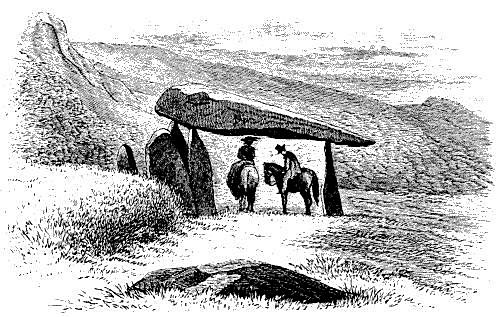
49. Dolmen at Pentre Ifan. From 'Archæologia Cambrensis.'
Almost all the so-called dolmens in the Channel Islands are of this class. One has already been given (woodcut No. 11), and it may safely be asserted that all chambers which were wainscoted with slabs, so as to form nearly perfect walls, and all that had complicated quasi-vaulted roofs were, or were intended to be, covered with mounds—more especially those that had covered passages leading to them. There is, however, a very wide distinction between these sepulchral chambers and such a monument as this at Pentre Ifan, in Pembrokeshire.[195] The top stone is so large that it is said five persons on horseback have found shelter under it from a shower of rain. Even allowing that the horses were only Welsh ponies, men do not raise such masses and poise them on their points for the sake of hiding them again. Besides that, the supports do not and could not form a chamber. The earth would have fallen in on all sides, and the connexion between the roof and the floor been cut off entirely, even before the whole was completed. Or, to take another example, that at Plas Newydd, on the shore of the Menai Strait. Here the cap stone is an enormous block, squared by art, supported on four stone legs, but with no pretence of forming a chamber. If the cap stone were merely intended as a roofing stone, one a third or fourth of its weight would have been equally serviceable and equally effective in an architectural point of view, if buried. The mode of architectural expression which these Stone men best understood was the power of mass. At Stonehenge, at Avebury, and everywhere, as here, they sought to give dignity and expression by using the largest blocks they could transport or raise—and they were right; for, in spite of their rudeness, they impress us now; but had they buried them in mounds, they neither would have impressed us nor their contemporaries.
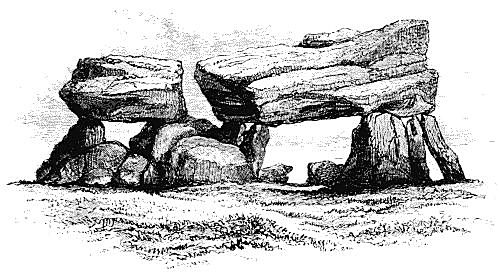
50. Dolmen at Plas Newydd. From 'Archæologia Cambrensis.'
As before mentioned, however, the great argument against the theory of their having been always covered up is the impossibility of accounting for the disappearance of the tumuli. If they had been situated on fertile plains where the land was valuable for agricultural purposes, it might be assumed that a civilized people with highly cultivated antiquarian tastes might have been at the trouble and expense of removing the tumuli for the sake of the land, and of preserving the dolmens for their historical value. But that the rude peasantry of Cornwall and Wales should have done this is inconceivable, more especially as by far the greater number of these monuments are situated on bleak moorlands of no agricultural value whatever. Still more inconceivable is it that they should have done it so neatly and so carefully that no trace of the mound can now be found either around the stones or in the neighbourhood.
If any history were attached to these Western dolmens, or any remains had been found under them which would enable us to fix their dates, even approximately, or to arrange them in any intelligible sequence, it might be worth while recapitulating their names or illustrating their forms. Nothing of the sort, however, has yet been attempted; and apparently no materials exist from which any such series could be elaborated.
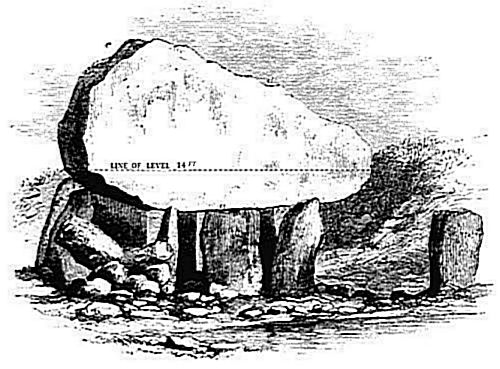
51. Arthur's Quoit, Gower. From a drawing by Sir Gardner Wilkinson.
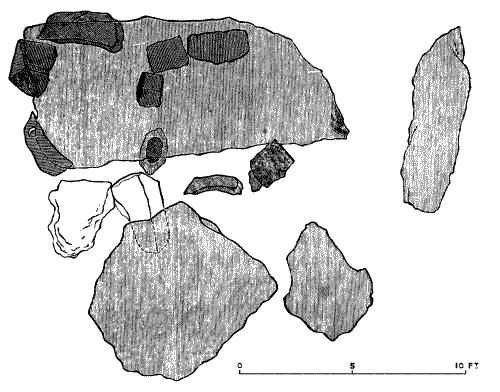
52. Plan of Arthur's Quoit.
Only one dolmen in Wales, so far as I know, bears a name; but it is the illustrious one of King Arthur. The dolmen bearing his name is situated in the peninsula of Gower, on the northern slopes of the bleak Bryn Cefn, about ten miles west from Swansea.[196] It forms the centre of a very extensive group of monuments—eighty cairns, at least, are still to be counted in an area less than half a mile in length, by a quarter of a mile in width. These are mostly small, 12 to 15 feet in diameter; one, 20 feet across, was opened by Sir Gardner Wilkinson, but proved to contain no interment. The largest is 68 feet in diameter, but has not been opened. About 350 feet from this is the dolmen. The cap stone is 14 feet 6 inches in length, 7 feet 5 inches in height, and 6 feet 8 inches in breadth even now, but a very large piece has been broken off, and now lies beside it, measuring upwards of 3 feet in thickness; and another piece seems to have been broken off on the other end, so that when complete it must have weighed between 35 and 40 tons. It rested originally on ten or eleven upright stones, two of which, however, have fallen, and only four now touch the cap stone. Sir Gardner is of opinion that it once was covered with a tumulus; but this appears very doubtful. The slight mound, backed up with large stones, that now surrounds it, with a diameter of 73 to 74 feet, seems an enclosure more like that of Hob Hurst's House (woodcut No. 53) than the remains of a tumulus, and till some further evidence is adduced, we must be allowed to doubt whether any cap stone on legs was ever so treated. Sir Gardner traced, doubtfully, an avenue, of which, however, only five stones now remain, extending to about 500 feet in a direction that would have passed the dolmen on the north, as that at Shap did the circle at its front, or the lines at Merivale Bridge, the circle still found there; Sir Gardner also points out some small circular enclosures, which, from the analogy of those found on Dartmoor, he assumes to be hut-circles.
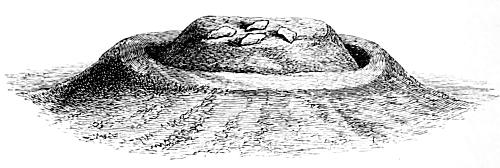
53. Hob Hurst's House, on Baslow Moor, Derbyshire. From a drawing by Thomas Bateman.[197]
What, then, is this group of monuments? Sir Gardner assumes that it is a cemetery of the ancient Britons; but, if so, why are not other cemeteries found in the fertile valleys and plains in South Wales? Why did they choose one of the barest and bleakest hillsides, and one farthest removed from their habitations as a place in which to bury their dead? Why did they not, like the inhabitants of Salisbury Plain, disperse their graves pretty equally over an area of 30 miles by 10? Why crowd them into less than half-a-mile? Without reverting to my previous suggestion of a battle-field, I do not see how these questions can be answered; and if so, I do not think we have far to go to look for its name? As hinted above, Arthur's eighth battle must have been fought in Wales. The name of the place is written Guin (Gwyn), Guinon, Guinnon, Gunnion,[198] which certainly is Welsh; and when we find it immediately preceding the battle of Caerleon on the Usk, and the principal monument still bearing Arthur's name, we may fairly, I think, adopt the suggestion till, at least, a better is offered.
Be this as it may, I think all antiquaries will agree with Sir Gardner Wilkinson in assuming that this is the stone of Cetti[199] mentioned in the Welsh triads. 'The 84th Triad' speaks of the Cor of Emmrys in Caer Caradawg (another name for Salisbury), and the 88th of the three mighty achievements of the Isle of Britain, the raising of the stone of Cetti, the building of the work of Emmrys, and the heaping of the pile of Cyvragnon.[200] The work of Emmrys (Ambrosius) is generally admitted to be Stonehenge. If this is the stone of Cetti, which I see no reason for doubting, it only remains to identify the third. Most antiquaries suggest Silbury Hill; and, if I am correct in placing these three monuments so near one another in date, this seems also extremely probable, and so far as it goes, is a satisfactory confirmation of what has been advanced above from other sources.
From my ignorance of the Welsh language I am not in a position to say what amount of reliance should be placed in the evidence of these triads. But Herbert and other competent scholars consider it undoubted that Emmrys is Ambrosius, and the 'Work' referred to certainly Stonehenge. If this is so, it fixes its date beyond question, and as the other two are mentioned in the same breath it is probable they were not distant in date. All this may be, I believe certainly is so, but the circumstantial evidence adduced above seems to me so much clearer and so much more to be relied upon, that it derives very little additional force from the utterance of the Welsh bards. It is, however, no doubt satisfactory that their evidence coincides with everything that has been brought forward above, as bearing directly or indirectly on their age or use.
Before proceeding, it may be as well to revert for one moment to Hob Hurst's House. It is quoted here to show how a tumulus, with a dolmen on the top of it, may be connected with a low rampart so as not to conceal it, exactly, I believe, as is the case with Arthur's Quoit. But the name of the place where it is situated may afford a hint which may lead to something hereafter. It will be recollected that Arthur's sixth battle was fought "super flumen quod vocatur Bassas." This mound is situated on "Bas" Moor, the Low being merely the name of the mound itself. These nominal similarities are too treacherous to be relied upon; but the more the whole group is looked at the more does it appear that there are coincidences of name, or form, or purpose, between those monuments here called Arthurian, which cannot all be accidental. Individually they may not be able to resist hostile criticism, but in their cumulative form they appear to me to make up a very strong case indeed.
If any of the other dolmens in the West had even so good a title to a date as Arthur's Quoit, it might be possible to arrange them in a series; but as none have even traditional dates, all we can now do is to suggest that the dolmen at Plas Newydd (woodcut No. 50) is of about the same age as Arthur's Stone: perhaps something more modern, as it is more carefully squared; but this may arise from the one being a battle-stone, the other a peaceful sepulchre. In like manner it would seem that such an exaggerated form as Pentre Ifan (woodcut No. 49) is a "tour de force" of a still more modern date; and if we could get one certainly older than any of these, a tentative scheme could be constructed which might lead us to satisfactory results.
I by no means despair of being able eventually to construct such a scheme of classification, and, even before this Work is concluded, to make it tolerably clear that the thing is possible, and then it will only remain, if one or two fixed or probable dates can be ascertained, to bring the whole within the range of historical investigation.