1809. (continued 2)
Reading edition
1809. A Glee. How shall we Mortals Spend our Hours? In Love! in War! in Drinking! Published by T. Tegg.—Three figures, represented as seated at table, with all the appointments and accessories incidental to the brewing of punch, carry out the spirit of the quotation. The lover, a smart young buck, in top-boots, is rapturously clasping his hands, after a toast, in inward contemplation of the perfections of his mistress. An old Commodore illustrates the idea of a life spent in warfare—although minus an eye and a leg, he is tough and hearty, and is seemingly content with his pipe and bowl. The brutalising results of hours devoted to mere bestial intoxication are realised in the person of a slovenly and imbecile sot.
1809. Rowlandson's Sketches from Nature. Drawn and etched by Rowlandson. Stadler, aquatinta. Published by T. Tegg.
A View in Camelford, CornwallSept. 1,1809.
The Seat of M. Mitchell, Esq., Hengar, CornwallSept. 1"
A Cottage in the Duchy of CornwallSept. 1"
Village of St. Udy, CornwallSept. 1"
Fowey, CornwallSept. 30"
A View near RichmondOct. 4"
A View in DevonshireOct. 4"
Taunton Vale, SomersetshireNov. 25"
View near Newport, Isle of WightNov. 25"
Temple at Strawberry HillNov. 25"
White Lion Inn, Ponders End, MiddlesexNov. 25"
STERNE'S 'SENTIMENTAL JOURNEY.'
CALAIS.
The Coach-yard of Monsieur Dessein's Inn.—'This certainly, fair lady,' said I, raising her hand up a little lightly as I began, 'must be one of Fortune's whimsical doings: to take two utter strangers by their hands—of different sexes, and perhaps from different corners of the globe—and in one moment place them together in such a cordial situation as Friendship herself could scarce have achieved for them, had she projected it for a month.'
'And your reflection upon it shews how much, monsieur, she has embarrassed you by the adventure.' In saying this she disengaged her hand with a look which I thought a sufficient commentary upon the text.
The triumphs of a true feminine heart are short upon these discomfitures. In a very few seconds she laid her hand upon the cuff of my coat, in order to finish her reply.
I fear, in this interval, I must have made some slight efforts towards a closer compression of her hand, from a subtle sensation I felt in the palm of my own—not as if she was going to withdraw hers, but as if she thought about it—and I had infallibly lost it a second time, had not instinct more than reason directed me to the last resource in these dangers—to hold it loosely, and in a manner as if I was every moment going to release it of myself; so she let it continue, till Monsieur Dessein returned with the key; and in the meantime I set myself to consider how I should undo the ill impressions which the poor monk's story, in case he had told it her, must have planted in her breast against me.
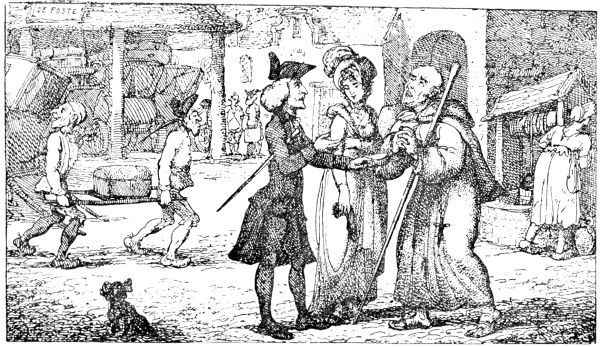
YORICK AND FATHER LORENZO.
The Snuffbox.—The good old monk was within six paces of us, as the idea of them crossed my mind, and was advancing towards us a little out of the line, as if uncertain whether he should break in upon us or no. He stopped, however, as soon as he came up to us, with a world of frankness; and having a horn snuffbox in his hand, he presented it, open, to me. 'You shall taste mine,' said I, pulling out my box (which was a small tortoiseshell one), and putting it into his hand. ''Tis most excellent,' said the monk. 'Then do me the favour,' I replied, 'to accept of the box and all; and, when you take a pinch out of it, sometimes recollect it was the peace offering of a man who once used you unkindly, but not from his heart.'
The poor monk blushed as red as scarlet. 'Mon Dieu!' said he, pressing his hands together, 'you never used me unkindly.' 'I should think,' said the lady, 'he is not likely.' I blushed in my turn, but from what movements I leave to the few who feel to analyse. 'Excuse me, madame,' replied I, 'I treated him most unkindly, and from no provocations.' ''Tis impossible,' said the lady. 'My God!' cried the monk, with a warmth of asseveration which seemed not to belong to him, 'the fault was in me, and in the indiscretion of my zeal.' The lady opposed it, and I joined with her in maintaining it was impossible that a spirit so regulated as his could give offence to any.
I knew not that contention could be rendered so sweet and pleasurable a thing to the nerves as I then felt it. We remained silent, without any sensations of that foolish pain which takes place when in such a circle you look for ten minutes in one another's faces without saying a word. Whilst this lasted, the monk rubbed his horn box upon the sleeve of his tunic; and as soon as it had acquired a little air of brightness by the friction, he made a low bow and said 'twas too late to say whether it was the weakness or goodness of our tempers which had involved us in this contest; but be it as it would, he begged we might exchange boxes. In saying this he presented his to me with one hand as he took mine from me in the other, and having kissed it, with a stream of good nature in his eyes, he put it into his bosom—and took his leave.
I guard this box, as I would the instrumental parts of my religion, to help my mind on to something better: in truth, I seldom go abroad without it; and oft and many a time have I called up by it the courteous spirit of its owner to regulate my own, in the jostlings of the world: they had found full employment for his, as I learnt from his story, till about the forty-fifth year of his age, when, upon some military services ill requited, and meeting at the same time a disappointment in the tenderest of passions, he abandoned the sword and the sex together, and took sanctuary, not so much in his convent as in himself.
I feel a damp upon my spirits as I am going to add, that in my last return through Calais, upon enquiring after Father Lorenzo, I heard he had been dead near three months, and was buried, not in his convent, but, according to his desire, in a little cemetery belonging to it, about two leagues off. I had a strong desire to see where they had laid him—when, upon pulling out his little horn box, as I sat by his grave, and plucking up a nettle or two at the head of it, which had no business to grow there, they all struck together so forcibly upon my affections, that I burst into a flood of tears. But I am as weak as a woman; and I beg the world not to smile, but pity me.
MONTRIUL.
The Bidet.—When all is ready, and every article is disputed and paid for in the inn, unless you are a little soured by the adventure, there is always a matter to compound at the door, before you can get into your chaise; and that is with the sons and daughters of poverty, who surround you. Let no man say, 'Let them go to the devil'—'tis a cruel journey to send a few miserables, and they have had sufferings enow without it. I always find it better to take a few sous out in my hand; and I would counsel every gentle traveller to do so likewise: he need not be so exact in setting down his motives for giving them—they will be registered elsewhere.
Having settled all these small matters, I got into my postchaise with more ease than ever I got into a postchaise in my life; and La Fleur having got one large jack-boot on the far side of a little bidet (post-horse), and another on this (for I count nothing of his legs), he cantered away before me, as happy and as perpendicular as a prince.
But what is happiness! What is grandeur in this painted scene of life! A dead ass, before we had got a league, put a stop to La Fleur's career—his bidet would not pass it; a contention arose betwixt them, and the poor fellow was kicked out of his jack-boots the very first kick.
La Fleur bore his fall like a French Christian, saying neither more or less upon it than Diable! so presently got up and came to the charge again—then this way—then that way: and, in short, every way but by the dead ass. La Fleur insisted upon the thing—and the bidet threw him.
'What's the matter, La Fleur,' said I, 'with this bidet of thine?' 'Monsieur,' said he, 'c'est un cheval le plus opiniatre du monde.' 'Nay, if he is a conceited beast, he must go his own way,' replied I. So La Fleur got off him, and giving him a good sound lash, the bidet took me at my word, and away he scampered back to Montriul. 'Peste!' said La Fleur.
Le Diable! which is the first and positive degree, is generally used for ordinary emotions of the mind, where small things only fall out contrary to your expectation, such as—the throwing one's doublets—La Fleur's being kicked off his horse, and so forth—cuckoldom, for the same reason, is always—Le Diable!
But in cases where the cast has something provoking in it, as in that of the bidet's running away after—and leaving La Fleur aground in jack-boots—'tis the second degree. 'Tis then Peste!
As there was no hunting down a frightened horse in jack-boots, there remained no alternative but taking La Fleur either behind the chaise or into it.
I preferred the latter, and in half an hour we got to the post-house at Namport.
NAMPORT.
The Dead Ass.—'And this,' said he, putting the remains of a crust into his wallet, 'and this should have been thy portion,' said he, 'had'st thou been alive to have shared it with me.' I thought by the accent it had been an apostrophe to his child; but it was to his ass, and to the very ass we had seen dead in the road, which had occasioned La Fleur's misadventure. The man seemed to lament it much; and it instantly brought into my mind Sancho's lamentation for his; but he did it with more true touches of nature.
The mourner was sitting upon a stone bench at the door, with the ass's pannel and its bridle on one side, which he took up from time to time—then laid them down—looked at them, and shook his head. He then took his crust of bread out of his wallet again, as if to eat it; held it some time in his hand, then laid it upon the bit of his ass's bridle—looked wistfully at the little arrangement he had made, and then gave a sigh.
The simplicity of his grief drew numbers about him, and La Fleur among the rest, whilst the horses were getting ready; as I continued sitting in the postchaise, I could see and hear over their heads.
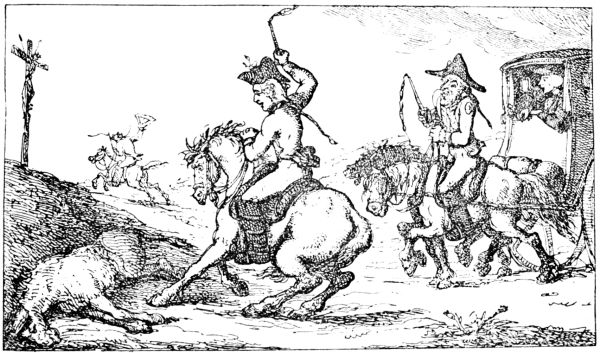
LA FLEUR AND THE DEAD ASS.
He said he had come last from Spain, where he had been from the farthest borders of Franconia, and had got so far on his return home, when his ass died. Everyone seemed desirous to know what business could have taken so old and poor a man so far a journey from his own home.
It had pleased heaven, he said, to bless him with three sons, the finest lads in Germany; but having, in one week, lost two of them by the smallpox, and the youngest falling ill of the distemper, he was afraid of being bereft of them all; and made a vow, if heaven would not take him from him also, he would go, in gratitude, to St. Jago, in Spain.
When the mourner got thus far in his story he stopped to pay Nature her tribute, and wept bitterly.
He said heaven had accepted the conditions, and that he had set out from his cottage with this poor creature, who had been a patient partner of his journey—that it had eat the same bread with him all the way and was unto him as a friend. Everybody who stood about heard the poor fellow with concern. La Fleur offered him money. The mourner said he did not want it—it was not the value of the ass, but the loss of him. The ass, he said, he was assured loved him—and upon this told them a long story of mischance upon their passage over the Pyrenean mountains, which had separated them from each other three days: during which time the ass had sought him as much as he had sought the ass, and that they had neither scarce eat or drank till they met.
'Thou hast one comfort, friend,' said I, 'at least in the loss of thy poor beast: I am sure thou hast been a merciful master to him.' 'Alas!' said the mourner, 'I thought so when he was alive, but now he is dead I think otherwise. I fear the weight of myself and my afflictions together have been too much for him—they have shortened the poor creature's days, and I fear I have them to answer for.' 'Shame on the world!' said I to myself, 'did we love each other as this poor soul but loved his ass, 'twould be something.'
1809. Butler's Hudibras, in three parts, written in the time of the late wars, corrected and amended, with large annotations and preface, by Zachary Grey, LL.D. Embellished with engravings by T. Rowlandson, Esq. London: Printed for T. Tegg, 111 Cheapside. W. Hogarth, inv.; Rowlandson, sc.
1. Frontispiece. Hudibras and Ralpho in the Stocks.
2. Setting out.
Then did Sir Knight abandon dwelling, And out he rode a-colonelling.
3. The Battle.
The scatter'd rout return and rally, Surround the place; the Knight does sally, And is made pris'ner.
4. The Knight and Ralpho consult the Gymnosophist.
The Knight with various doubt posses't To win the lady goes in quest Of Sidrophel, the Rosy-Crucian, To know the Dest'nies' resolution; With whom b'ing met, they both chop logic About the science astrologic; 'Till falling from dispute to fight, The conj'rer's worsted by the Knight.
5. Sidrophel and Whacum consulting the firmament.
This said, he to his engine flew, Plac'd near at hand in open view, And rais'd it 'till it levell'd right Against the glowworm tail of Kite, Then peeping thro', Bless us (quoth he) It is a planet, now I see, And, if I err not, by his proper Figure, that's like tobacco stopper, It should be Saturn.
1809. Surprising Adventures Of the Renowned Baron Munchausen. Containing singular travels, campaigns, voyages, and adventures. Embellished with numerous engravings by T. Rowlandson. London: Printed for T. Tegg, 111 Cheapside.
Frontispiece.—Baron Munchausen's extraordinary flight on the back of an eagle, and supported by a second eagle, from Margate over the continents of Europe, South and North America, the Polar regions, and back to Margate, within thirty-six hours.
The Baron arrives at Ceylon, combats and conquers two extraordinary opponents (a lion and a crocodile).
The snow having melted, the Baron discovers his horse in the air, secured by the bridle to the church steeple; the Baron proves himself a good shot, cuts the bridle in two, and resumes his journey.
Is presented with a famous horse by Count Przolossky, with which he performs many extraordinary feats; the horse is cut in two by the portcullis of Oczakow, which the Baron only discovers when he leads his spirited steed to drink at the fountain, and the water flows out at the rear of the severed half.
Bathes in the Mediterranean, is swallowed by a fish, from which he is extricated by dancing a hornpipe.
The Baron jumps into the sea with a Turkish piece of ordnance on his shoulders (which fires a marble ball of three hundred pounds weight) and swims across the Simois.
The ship, driven by a whirlwind, a thousand leagues above the surface of the waters; the Baron discovers the inhabitants of the moon, with some traders from the Dog Star.
Travelling in the South Sea they lose their compass; their ship slips between the teeth of a fish unknown in this part of the world.
The Baron crosses the Thames without the assistance of a bridge, ship, boat, balloon, or even his own will; being blown out of one of the Tower guns in which he had fallen asleep, and the cannon is unexpectedly fired to celebrate an anniversary.
1809. The Beauties of Sterne; comprising his humorous and descriptive Tales, Letters, &c. Embellished by caricatures by Rowlandson, from original drawings by Newton. Published by T. Tegg, Cheapside.
Frontispiece. The Dance at Amiens, &c.
1809. Poetical Magazine. Dedicated to the lovers of the Muse by the Agent of the goddess, R. Ackermann. Published November 1, 1809, at R. Ackermann's Repository of Arts, 101 Strand.
Introduction to The Schoolmasters Tour. Vol. 1.—'In the Tour, with the first part of which we here present our readers, the author carries his hero through a great variety of whimsical adventures, to the Lakes and back again. As tours are a fashionable article in the literature of the present day, we trust that the poetical peregrinations of Doctor Syntax will come in for some share, at least, of the public applause, to which we conceive it to be entitled. The lovers of humour will not be displeased to be informed that it will be accompanied with a considerable number of illustrative engravings.'
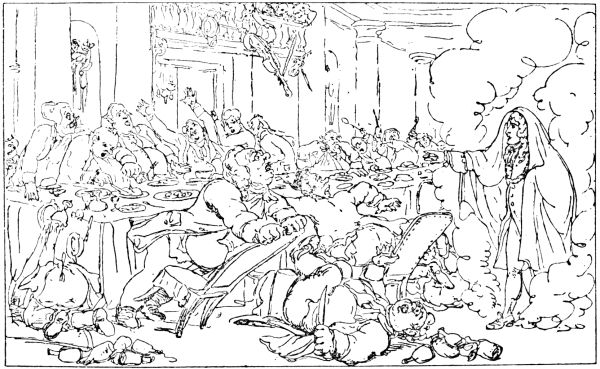
THE MANSION HOUSE MONITOR.
CARICATURES SUPPLIED BY ROWLANDSON TO THE POETICAL MAGAZINE.
Volume I.
1. Doctor Syntax setting out on his Tour to the LakesMay 1,1809.
2. The Mansion House MonitorJune 1"
3. Doctor Syntax losing his wayJune 1"
4. Doctor Syntax stopped by HighwaymenJune 1"
6. Doctor Syntax bound to a Tree by HighwaymenJuly 1"
8. Doctor Syntax disputing his Bill with the LandladyAug. 1"
The Last Drop. A Woodcut. (Death striking the Drinker). (See April 5, 1811) Aug. 1 "
10. Doctor Syntax copying the wit on the WindowSept. 1"
12. Doctor Syntax entertained at CollegeOct. 1"
13. Doctor Syntax pursued by a BullOct. 1"
Volume II.
2. Doctor Syntax mistakes a gentleman's house for an InnNov. 1"
4. Doctor Syntax meditating on the Tombstone Dec. 1"
5. An illustration to 'Edwin and Matilda, or the Beach King.' A legendary tale, in four cantos Dec. 1"
The Baron addressing the Harpists at the banquet to Earl Edwin:— 'Cease, caitiffs! nor further insult with your noise The ears of our noble young guest. Hence, away! and bear with you those coarse thrumming toys!' The minstrels departed,—when, raising his voice, The Baron Earl Edwin address'd.
6. Doctor Syntax tumbling into the WaterJan. 1,1810.
7. Illustration to 'Edwin and Matilda' Jan. 1"
The Beach King discovering himself to Matilda:— A truncheon of coral he grasp'd in his hand, Which, tho' pond'rous, with ease he could swing: Thus array'd was the monster so fear'd thro' the land; Thus horribly form'd, by Matilda did stand The mighty, enormous Beach King.
8. Doctor Syntax losing his money on the Raceground at York Feb. 1, 1810.
10. Doctor Syntax at a Review March 1"
12. Doctor Syntax with my Lord April 1"
13. Doctor Syntax made free of the Cellar April 1"
Volume III.
1. Doctor Syntax sketching the LakeMay 1"
3. Doctor Syntax sketching after Nature June 1"
5. Doctor Syntax robbed of his Property July 1"
7. Doctor Syntax sells Grizzle Aug. 1"
9. Doctor Syntax and Rural Sports Sept. 1"
11. Doctor Syntax and the Dairymaid Oct. 1"
Volume IV.
1. Doctor Syntax at LiverpoolNov. 1"
3. Doctor Syntax reading his Tour Dec. 1"
5. Doctor Syntax PreachingJan. 1,1811.
7. Doctor Syntax and the BooksellerFeb. 1"
9. Doctor Syntax at Covent GardenMarch 1"
11. Doctor Syntax returned from his TourApril 1"
13. Doctor Syntax taking possession of his LivingMay 1"
The intermediate plates are landscapes, after anonymous artists, engraved in aquatint by Hassell and others.
1809. Beresford (James). An Antidote to the Miseries of Human Life. 8vo.
1809. Rowlandson's Sketches from Nature. Twelve views, drawn and etched by T. Rowlandson. Aquatinted by Stadler.
1809. The Art of Ingeniously Tormenting. Republished by Tegg. Plates by Woodward. 12mo.
1809. Annals of Sporting. By Caleb Quizem, Esq., and his various Correspondents. Published by T. Tegg.
The Courtier is thrown in pursuit of his game, The Poet's too often laid low, Who, mounted on Pegasus, rides after Fame, With 'Hark forward! Huzza! Tally-ho!'
1809. The Trial of the Duke of York. In 2 volumes. Published by T. Tegg.
1809. Annals of Sporting. By Caleb Quizem. Republished by Tegg. Plates by Woodward. 12mo.
Frontispiece. The Bucephalus Riding Academy for Grown Gentlemen. H. Bunbury del., Rowlandson sc.
Titlepage. Vignette; the Author thrown from his Pegasus. Designed and etched by T. Rowlandson.
Introduction. Caleb Quizem, Esq. Woodward del., Rowlandson sc.
The Maid of Mim.
Hounds.—1. Rugged and Tough. The Lion Hound. 2. The Black Straddler. The Short-legg'd Stag Hound. Woodward del., Rowlandson sc.
Game Wigs.—1. A Long Bob. A Short Bob. A Black Scratch. A Physical Tie. A Sir Cloudesley Shovel. A Three Tier. 2. A Cauliflower. A Full Bottom. A Short Queue. A Long Queue. A Rose Bag. A Full Bag.
Costume of Hog's Norton.—1. A back-front view of Miss Dickinson's New Dress. 2. The Morning Dress of a Lady and Gentleman of Hog's Norton.
Fashionable Furniture at Hog's Norton.—1. Chimney Ornaments. Improved Trencher. Hogs Norton Recess. Fashionable Looking-glass. Fashionable Clock. 2. The Stocking Sweep. Colonnade of Streets. Fashionable Table. Cobweb Frieze. Sarcophagus, Cellaret, Coal-scuttle. Fashionable Chair.
How a Man may Shoot his own Wig.
The Bailiff's Hunt:—
1. Going out in the Morning.
2. In Full Scent.
3. Breaking Cover.
4. The Pursuit.
5. At Fault.
6. The Second Escape.
7. Double and Squat.
8. The Seizure.
The True Method of Sitting a Horse, Mathematically Delineated.
1. Mathematical Horsemanship.—Mr. Ralph Marrowbone, forming an obtuse angle. 2. Tom Timorous, forming an acute angle. 3. Dickey Diaper, forming a right angle. 4. Mr. Robert Rasp, letting fall a perpendicular from his saddle. 5. Mr. Benjamin Buckskin and his horse performing their evolutions within the circumference of a circle.
How to Vault from the Saddle.
1809. Advice to Sportsmen, selected from the notes of Marmaduke Markwell. Republished by Tegg. Plates by Woodward, 12mo.
1809. Advice to Sportsmen, rural or metropolitan, noviciates or grown persons; with anecdotes of the most renowned shots of the day, exemplified from life, including recommendatory hints on the choice of guns, dogs, and sporting paraphernalia. Also characters, costume, and correspondence. Selected from the original notes of Marmaduke Markwell, Esq., with sixteen illustrations by Thomas Rowlandson:—
But a bold pheasantry, their country's pride, When once destroyed, can never be supplied.
'Dedication.—To the most enlightened Sportsman in the metropolis of the British Empire; equally keen in pursuit of the hare, the haunch, the partridge, pheasant, woodcock, wild fowl, black or red game; devourer of the amphibious turtle, and terror of the Dutch; dead shot at a patriot; a marksman whose brilliant and sporting elocution can start a Jubilee in the worst of times, whose merry jokes can create sport, and are the cause of sport to others: To Sir William Curtis, Bart., M.P. &c., &c., &c., these effusions of a City Sportsman are with all respect inscribed by his most devoted and obedient servant,
'Marmaduke Markwell. 'Turn-again Lane, September 1, 1809.'
Frontispiece.The Cockney's first attempt at shooting flying.
Illustrations.Rat-hunting. How to twist your neck. Night. Noon. Morning. The dangerous consequences of sporting. Miss Spitfire's encounter. Advantage of coupling sporting dogs. Finishing a gamekeeper. How to come in at the death. How to cool your courage. A duck hunt in Bartholomew Lane. Neck or nothing. A shooting parson or pot-hunter. Evening.
1809. The Pleasures of Human Life. By Hilari Benevolus & Co., with five plates by Rowlandson, &c. Published by Longmans.
1809. The Pleasures of Human Life. Investigated cheerfully, elucidated satirically, promulgated explicitly, and discussed philosophically, in a dozen dissertations on male, female, and neuter pleasures. Interspersed with various anecdotes and expounded by numerous annotations by Hilari Benevolus & Co. (Fellow of the London Literary Society of Lusorits). (Mottoes from Milton, Dibdin, and Peter Pindar.) Embellished with five illustrations and two headpieces. London: Longmans & Co. Crown 8vo.
Front engraved by W. Bond, after W. Satchwell. Physiognomical vignette on title-page engraved by W. Bond, from Bell's Anatomy of Expression.
Of Rowlandson's illustrations the author observes, in his preface: 'The five illustrative commendatory etchings do not require any verbal explanation.'
Five prints by Rowlandson:—
1. Christopher Crabtree in the Suds.
2. Mr. Ego's marvellous Story.
3. Connoisseurs, or Portrait Collectors!
(The 'collector' in question is slily pocketing a print while the shopman's attention is diverted.)
4. A Brace of Full-grown Puppies, or my Dog and me.
5. Pleasures of Bond Street, or Fashionable Driving.
1809. T. Smollett: Miscellaneous Works. Twenty-six illustrations by Rowlandson. 5 vols. 8vo. Edinburgh.
1809. Gambado. An Academy for Grown Horsemen, &c. 8vo. Published by T. Tegg. (See 1808.)
1809. Beauties of Tom Brown. Frontispiece and illustrations by T. Rowlandson. Published by T. Tegg. 12 mo.
1809. Views in Cornwall, Devon, Somerset, Isle of Wight, &c.
1809. Scandal: Investigation of the Charges brought against H.R.H. the Duke of York by G. L. Wardle, Esq., M.P. for Devon, with the Evidence and Remarks of the Members. Containing fourteen scarce portraits by Rowlandson, amongst which are Mrs. M. A. Clarke, Sir F. Burdett, Duke of York, Colonel Wardle, &c. 2 vols., 12mo.