INTERLUDE
Reading edition
"I'm afraid it's all up, doctor."
Day had just broken. Lieutenant Underhill, standing rifle in hand at his post in a corner of the barricade, addressed Dr. Thesiger Smith, who had come to relieve him.
"You think we can't hope for relief?" replied the doctor.
"Yes. The boat must have foundered, or got lost, or perhaps has fallen into the hands of the savages. We've come to our last tin of biscuits; we've hardly ten rounds of cartridges among us."
"What can we do then?"
"Either fight till we drop, or give in; there's nothing else. The end will be the same either way, but the first would be the quicker."
The doctor stroked his beard with his thin hand. His son joined them; not the ruddy, clean-shaven youth that had landed from the wreck twelve days before, but a gaunt man whose hollow cheeks were dark with a stubby beard.
"Underhill gives up hope at last," said his father.
"Then I'm ashamed of him," said Tom cheerfully. "Never say die. Go and have a sleep, old man; it's enough to give any one the blues, keeping watch in the dark. You'll feel better after a nap. Had any trouble?"
"No, they haven't made a sound. I almost wish they had. Anything would be better than this eternal keeping watch for an enemy that's afraid to come on."
"Well, not being a fighting man, I prefer for my part to keep a whole skin as long as I can. Go and sleep, and the pater and I will talk things over."
Underhill, who was tired out, withdrew to the centre of the camp, and throwing himself on a tarpaulin, was soon plunged in an uneasy slumber.
It was twelve days since the wreck, ten since the boat had put off to seek assistance. When the storm had subsided, the castaways, drenched to the skin, had taken stock of their situation. It was a wild and desolate spot, far from the track of ships; months might pass before a vessel came in sight. They had only a small store of food, barely sufficient, even if husbanded with the utmost care, to last a fortnight. From their position at the foot of rugged cliffs it was impossible to tell what sustenance the island afforded, and the evil reputation of the natives did not give promise of peaceful exploration. While not actually head hunters, like the inhabitants of the New Georgian group to the south, they were said to be treacherous and vindictive. At the southern end of the island, as Underhill knew, there was a Wesleyan mission station, placed in a somewhat inaccessible spot, and at Tulagi, on Florida Island to the south, was a Government station and the seat of the Resident. It might be possible to reach one or the other of these, but even so they would be compelled to wait indefinitely, there being no telegraphic communication between either and a civilized port.
Reflections like these did not tend to cheer the castaways; but, now that the sun shone once more out of a clear sky, the invincible optimism of the British sailorman displayed itself, and the men began to scramble up the cliffs with almost light-hearted eagerness. At the top they found themselves at the edge of a dense and tangled forest. Underhill sent some of the crew to search for a likely camping place, while the remainder hauled up the boat's cargo. A comparatively clear space, about a hundred and fifty yards square, was discovered within a short distance from the cliffs. A stream running through the midst ensured a good supply of water, and here Underhill determined to make his camp.
Great havoc had been wrought in the forest by the storm. Many trees had been snapped off or uprooted; the ground was strewn with broken branches; and when the whole party were assembled at the spot, and the arms and provisions had been covered with a tarpaulin, Underhill sent all hands to collect broken timber for forming a breastwork. Fortunately, a good number of tools had been brought from the vessel, and as the men came in with their loads, Rumbold, the ship's carpenter, set to work, with the assistance of two or three, to surround the enclosure with a rough fence. Underhill ordered them to avoid the use of hammers and axes, the noise of which, carrying far in these solitudes, might attract the attention of the natives, who, for all he knew, had a village in the neighbourhood. There was no lack of tough creepers which were serviceable for binding the logs together, and a great number of cactus-like plants were cut down to form a defensive lining to the barricade.
In the course of three or four hours the whole encampment had been roughly fenced. It would not, in its present condition, prove a very formidable obstacle to a determined attack; but the day had become very hot, and Underhill was anxious to avoid overworking the men. The barricade could be strengthened next day.
Just before nightfall the company ate a spare supper of tinned meat and biscuit, and then, in a little group apart from the rest, Underhill, with his officers and the Smiths, held a council to decide on a course of action. They determined, after brief discussion, that next day four of the men should take the boat and try to make their way to Tulagi. The loss of the second boat had rendered it impossible for the whole party to embark; but no doubt the Resident at Tulagi would have boats of some sort at his disposal, and in these the castaways could be taken off. When once at Tulagi, they would have to wait until the first vessel touched at the island. Four men, including Venables, volunteered to make the voyage, and were ready to start that night; but every one was exhausted by the adventures and fatigues of the day, and Underhill thought it best that they should have a night's rest before they set off. Having arranged for watches to be kept as on board ship, he gave the order to turn in, and their clothes and the ground having been well dried by the afternoon sun, they passed a comfortable and undisturbed night.
Up at daybreak, they first of all occupied themselves with completing the barricade; then, about eleven o'clock, when they were preparing to escort the four men to the boat, which had been anchored at the foot of the cliff, some one cried out that he saw brown men advancing through the woods. Underhill instantly ordered the barricade to be manned, and served out arms and ammunition as far as they would go round. There were only a dozen rifles, however, among twenty men; the rest armed themselves with tools and implements of various kinds.
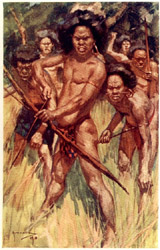
They suddenly darted forward with a wild whoop.
Soon a large body of brown-skinned, fuzzy-headed natives, armed with spears, clubs, and bows and arrows, came slowly towards the camp. Their attitude was apparently friendly, but, remembering their reputation for treachery, Underhill did not trust them, and refused to leave the shelter of the barricade in answer to their invitation, expressed by signs, to come forth and palaver with them. It was well he refrained, for when they were within a few yards of the camp they suddenly darted forward with a wild whoop. Underhill ordered his men to fire a volley over their heads, hoping to scare them away without bloodshed; but the reports of the rifles did not make the astounding impression it usually produced upon savages, and Underhill could not but believe that they were not wholly unacquainted with the use of firearms. They advanced with the more ferocity, and it was not until several had fallen to another volley from behind the barricade that they drew back to the shelter of the woods.
It would clearly be unsafe to attempt to reach the boat while the savages were in view. As time went on they appeared to increase in numbers, and every now and then they sent a flight of arrows into the camp. But the garrison kept out of sight behind the barricade nearest to the enemy, and their missiles either stuck in it, or fell harmlessly within the enclosure.
So the day passed. The fact that trouble had come so soon impressed Underhill with the necessity of sending for assistance without delay. The prospect of a siege, with only a limited supply of ammunition to repel assaults, and a scarcely greater supply of food, was very disturbing. He had little fear of being able to beat off attack so long as ammunition lasted, but when it was all spent, the savages must overpower the white men by sheer weight of numbers. Venables now wished to recall his undertaking, and remain in the fighting line; but Underhill decided that he must go in command of the other men. Accordingly, at nightfall, the four crept through a small gap made in the seaward face of the barricade, and clambered down the cliff. Underhill listened anxiously for a time, wondering whether the men had been discovered, or whether they had safely reached the boat; but after an hour of silence he concluded that either the enemy had not been watching in that quarter, or that the boat had slipped away unobserved in the darkness.
The night was undisturbed, but with dawn the natives reappeared. The lesson of the previous day had not proved effectual; they came resolutely up to the barricade in a vast yelling horde. Underhill ordered his men to reserve their fire until the enemy was within a few yards of the enclosure; then two rapid volleys with repeating rifles and revolvers opened a great gap in the throng, and the survivors, scared by their losses, once more betook themselves to the woods. Several times during the day they returned to the attack, pushing it home each time with more determination, and towards evening with a rage and frenzy that could only be due to the stimulation of strong liquor. At this last onset the defenders were almost overwhelmed, repeated volleys seeming only to inflame the fierce warriors. For some minutes there was a hand-to-hand fight as they made desperate endeavours to scale the barricade, and only when a score of their number lay dead and wounded did they relinquish the contest. They took away the wounded, but left the dead where they lay, and in the night the garrison had the gruesome task of carrying the bodies to the edge of the cliff and casting them into the sea. For some time Dr. Smith was kept busy in attending to the wounded among his own party, and next day one of the stokers, struck by a poisoned arrow, succumbed to blood-poisoning, and his comrades, at dead of night, gave him sailor's burial.
Some days passed, and no serious attack was made, though the garrison had to be very wary to avoid the arrows which flew at intervals into the enclosure. One evening, soon after sunset, one of the men on watch noticed a small light approaching the barricade, and thought at first it was one of the phosphorescent insects which abounded in the woods, and which the garrison had seen every night like little lamps among the trees. But as it came nearer he perceived that it grew larger and brighter, and moved from side to side with more regularity than was probable with an insect, and at length he saw that it was a smouldering torch held by a native, who was waving it to and fro to cause a flame. Evidently he was coming to fire the barricade. A well-directed shot brought him down, but to guard against any more attempts of the same kind Underhill had the barricade constantly drenched with water from the stream, a fatiguing job, but one that was welcome to the men, in that it gave them something to do.
Day after day went by. It was clear that the enemy were trusting to famine to accomplish their end. Luckily, it never entered their heads to hasten the inevitable by damming up the stream before it entered the enclosure. If they had done this the garrison could hardly have held out for a day. In that hot climate a constant supply of water was a prime necessity. But water without solid food would not keep them alive, and as the stock of provisions diminished, and no help came, they saw the horrors of starvation looming ever nearer. Underhill and Tom Smith assumed a false cheerfulness before each other and the men, but on the morning of the twelfth day Underhill was unable to keep up the pretence any longer.
"I didn't want to show Underhill," said Tom to his father, when the lieutenant had gone; "but we're just about done, I think."
"I'm afraid so, Tom. Poor Jenkins had a touch of delirium in the night, and we are all getting so weak that we shall go off our heads."
"Well, I've got an idea. I thought I'd mention it to you before I spoke to Underhill. The blacks haven't been near us for a day or two, but you may be sure they are not far off. I fancy they've got a camp or a village in the woods yonder. They must have food there, and I don't see why we shouldn't try a night attack on them, and run away with all we can lay hands upon. If we must, perish, better perish fighting than starving."
"Yes, but it would be folly to attempt it unless we saw a chance of success, and I see none. We don't know where their camp is; they may be constantly on the watch, and could take us in the rear and occupy our camp before we could get back. Besides, we might have to go a long way, and how could we find our way back again?"
"One difficulty at a time, Father. As to finding our way back, we could light small fires at intervals, which would serve as guide-posts."
"And betray us to the enemy."
"But I shouldn't undertake it unless we discover that the course is clear. I don't believe these natives ever keep watch by night; we have seen no sign of them at night since they tried to burn us. The chief difficulty is that we don't know the exact direction of their camp, but why shouldn't I go out to-night and locate it?"
"Very dangerous, my boy."
"There's danger anyway," replied Tom, with a shrug. "I should take my pocket compass; two or three of those insects would be enough to light it."
"I think we had better remain all together, Tom. Help may yet come. Why should you imperil your life, perhaps in vain?"
"Well, Father, I think I ought to chance it. I'll be careful! if I'm seen I can make a bolt for it; and I fancy I can pick up my heels quicker than the fuzzy-wuzzies, even though they don't wear boots."
Dr. Smith was still loth to acquiesce in the proposal, but Tom returned to it more than once during the day, and at last obtained his father's consent. It was scarcely easier to win over Underhill; but with him Tom cut the matter short.
"You command the men," he said, with a smile. "My father commands me—in a sense, for I'd have you know I am over age. I'm going to have a try. Get the men ready to make a dash when I come back, for if I succeed the sooner we set about it the better."
The knowledge of his intended expedition had a wonderful effect on the spirits of the men. Their faces brightened: they threw off the lethargy of despondence which had settled upon them, and discussed with some animation the chances of success.
An hour after nightfall, having first looked and listened for any sign of the enemy, Tom was let out through a gap in the barricade. He caught two or three light-giving insects in the bushes just beyond, and set off in the direction in which the natives had always retreated when their attacks were beaten off.
It was pitch dark in the belt of forest. Night insects hummed around; sometimes Tom heard the rustle made by some small animal as it darted through the undergrowth; there was no other sound. He was able to determine his general direction by means of the compass, but as the forest grew thicker he began to fear that he would find more difficulty than he had anticipated in retracing his course. The damp warm air was oppressive; now and then he struck his head against a low branch, stumbled over a stump or a fallen bough, or found his feet entangled in the meshes of some creeping plant. He was soon bathed in perspiration; every new sound made him jump; and with every stumble he waited and listened with beating heart, wondering if he had betrayed his presence to the enemy. He thought ruefully that his speed as a sprinter would avail him little on ground like this; he had his revolver, but that would be useless against numbers; discovery would mean death.
Amid so many obstructions his progress was terribly slow. It was seven o'clock when he started; when it occurred to him to look at his watch he was startled to find that two hours had passed. He could not tell how far he had come, nor guess how far he had yet to go. He hesitated; should he go back? Was there any use in struggling further? What chance was there in this dense forest of finding what he sought? Might he not even miss the savages' camp altogether, go beyond it, leave it either on his right hand or his left, or perhaps stumble upon it suddenly, and be discovered before he had a chance to flee? But he put these questions from his mind. He had set out to find the camp; no harm had befallen him. There was a strain of doggedness in his nature; he had won his scholarships at school and at Cambridge by sheer grit; his tutor had declared that Tom Smith was certainly not brilliant, but he was much better: he was sound and steady; and the same qualities that had won him successes which more brilliant men envied, came out in these novel circumstances in which he was placed. Tom decided to go on.
Presently he came to a break in the woodland; he saw the stars overhead. He was very wary now, and waited at the edge of the clearing for a long time, peering all round, turning to listen on every side, before he crossed and entered another belt of forest beyond. Again he had to struggle through darkness and dense entanglements, then suddenly he started; far ahead he thought he discerned amid the blackness the dull glow of a fire. With infinite caution he picked his way through the thinning undergrowth; the glow increased; and at length he found himself on the edge of a wide open space in the midst of which there was a camp fire, and around it the rude grass huts of the savages. He saw no one, heard no sound; all were asleep.
Stealthily he crept round the encampment. Here and there he saw cooking-pots, and caught the faint odour of roasted flesh. Had the savages any store of food, he wondered. If not, his journey was vain. The fire did not give light enough for him to see anything very clearly. At last, however, when he had almost made the circuit of the camp, he saw a man move out from one of the huts towards the fire, on which he cast some logs that lay beside it. A flame shot up. As the man returned to his hut, he put his hand into one of the cooking-pots and drew out the limb of a small animal, from which he tore the flesh with his teeth. Tom was satisfied. No doubt each of the pots contained a quantity of food. Surely if he brought his comrades to the spot, and they fell upon the camp suddenly, with loud cries and the noise of firearms, they might strike panic into the savages, and at least have time to possess themselves of the contents of the pots.
He looked at his watch. It was past ten o'clock.
He could return more quickly than he came, and, if he did not lose his way, would regain his camp within half-an-hour after midnight. There would be plenty of time for the whole party to reach the savages' encampment before the dawn rendered it dangerous. Moving away slowly until he was out of earshot, he then walked as quickly as he could back through the forest. But he was not a mariner, and even a mariner would have been at fault in tracking his course by compass through dense forest. He judged his general direction accurately, but he swerved a little too far to the right, and suddenly found himself on the brink of the cliff. He dared not go back into the forest, lest he should lose more time in wandering, so he decided to keep as close to the sea as possible, thinking that he must in time arrive at his camp. His path was tortuous; once he had to strike inland to avoid a deep, wooded ravine; but presently he heard the sound of falling water, and, quickening his steps, came almost suddenly upon the barricade.
The whole company were awake. They had almost given him up for lost. It was one o'clock. Underhill sternly checked a cheer from the sailors, when Tom ran up. He told what he had seen.
"Hadn't we better wait till to-morrow night?" suggested Dr. Smith.
"To-night! to-night!" cried the men eagerly. The knowledge that food was within reach of them was too much for famishing men. Who knew if they would have strength or sanity for the task after another sweltering day? Underhill could not refuse them; he gave orders for the whole company to march at once.
None was left to guard the camp; the little company of sixteen could not be divided. They set off in single file, Tom leading the way, not because he had any hope of treading in his former course, but because he alone had traversed the forest, and he alone had a compass.
The plan of lighting fires to guide them on the return journey was given up. The forest was so dense that such fires would have been of little use; further, they might cause an immense conflagration which, though it would effectually scare the enemy, would destroy what the famished men so urgently needed, food.
Their progress was even slower than Tom's had been. They had to stop frequently to make sure that all were together, and, as ill luck would have it, Tom found that he was leading them through a part of the forest where the entanglements were more intricate and less penetrable than those he had formerly encountered. But he plodded on doggedly, speaking to no one of his anxiety when a glance at his watch told how time was fleeting. If they did not reach the camp of the savages before dawn their toil and fatigue would be wasted, and their peril greater than it had ever been.
Here and there, where the trees grew less close together, he felt a slight breeze blowing in his face, and at length he detected a faint smell of wood smoke. He halted, and told the rest, in a whisper, that they were approaching a settlement. From this point they advanced still more slowly and cautiously. Then, with a suddenness that took them aback, they came to the edge of a clearing. At first Tom was not sure whether it was the same that he had seen before. He had indeed approached it from a different direction. But a glance around satisfied him on this point, and the party stood within the shelter of the trees while Underhill gave his orders. They were to fire one shot, then rush forward with loud shouts, seize what food they could lay hands on, and flee back in all haste. There was no time to be lost, for the sky already gave hint of dawn.
Underhill had scarcely finished speaking when there was a cry from a point near at hand. They had approached the camp from the wind-yard side; the breeze had carried either some murmur of Underhill's voice, low as he had spoken, or some faint scent which the natives, as keen in their perceptions as wild animals, had detected. Instantly the camp was in commotion: the dusky warriors poured forth from their little huts, and swept, a wild, yelling horde, upon the weary company.