ROOSEVELT IN THE KANSAS CITY STAR
Reading edition
DR. FITZSIMONS’S DEATH[1]
September 17, 1917
The first name on the casualty list of the American army in France is that of Dr. William T. Fitzsimons, of Kansas City, killed in a German air raid on our hospitals. Dr. Fitzsimons had already served for some time in a French hospital. As soon as this Nation went to war he volunteered for service abroad.
There is sometimes a symbolic significance in the first death in a war. It is so in this case. To the mother he leaves, the personal grief must in some degree be relieved by the pride in the fine and gallant life which has been crowned by the great sacrifice. We, his fellow countrymen, share this pride and sympathize with this sorrow. But his death should cause us more than pride or sorrow; for in striking fashion it illustrates the two lessons this war should especially teach us—German brutality and American unpreparedness.
The first lesson is the horror of Germany’s calculated brutality. As part of her deliberate policy of frightfulness she has carried on a systematic campaign of murder against hospitals and hospital ships. The first American in our army to die was killed in one of these typical raids. We should feel stern indignation against Germany for the brutality of which this was merely one among innumerable instances. But we should feel even sterner indignation towards—and fathomless contempt for—the base or unthinking folly of those Americans who aid and abet the authors of such foul wickedness; and these include all men and women who in any way apologize for or uphold Germany, who assail any of our allies, who oppose our taking active part in the war, or who desire an inconclusive peace.
The second lesson is our unpreparedness. We are in the eighth month since Germany went to war against us; and we are still only at the receiving end of the game. We have not in France a single man on the fighting line. The first American killed was a doctor. No German soldier is yet in jeopardy from anything we have done.
The military work we are now doing is work of preparation. It should have been done just three years ago. Nine tenths of wisdom is being wise in time.
FOOTNOTES:
BLOOD, IRON, AND GOLD
September 23, 1917
Bismarck announced that his policy for Germany was one of blood and iron. The men who now guide, and for some decades have guided, German international policy have added gold as the third weapon in Germany’s armory.
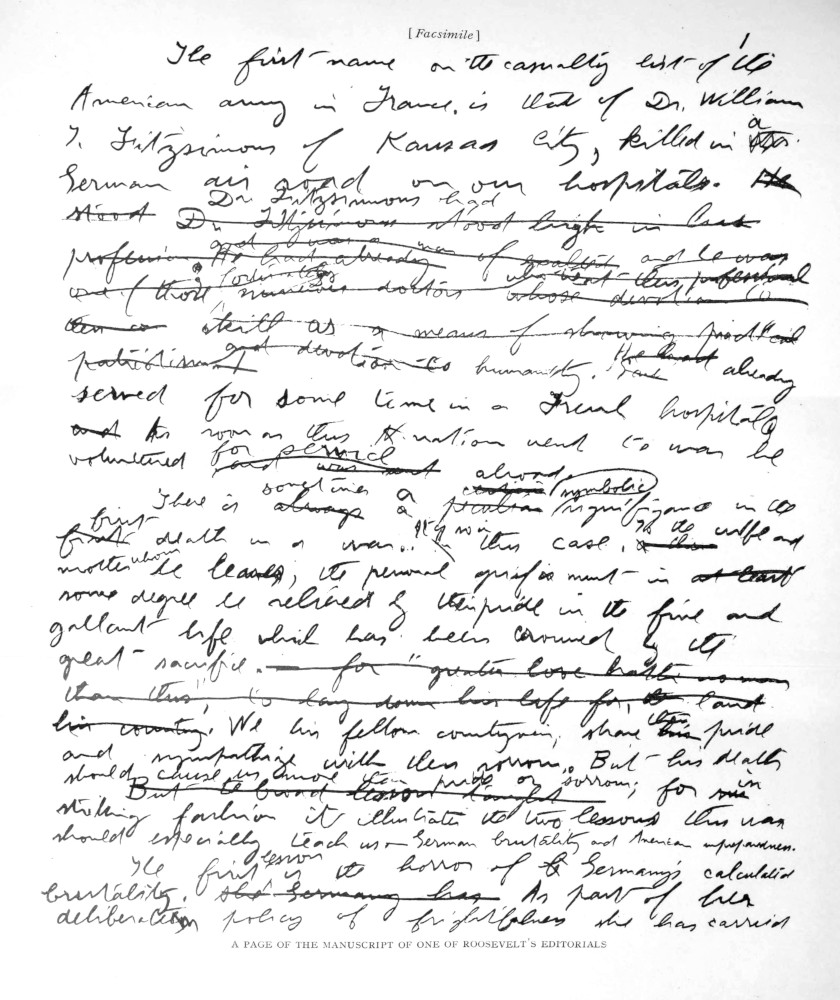
A PAGE OF THE MANUSCRIPT OF ONE OF ROOSEVELT’S EDITORIALS
To a policy based on callous disregard of death and suffering, and the brutal use of force, they have added the habitual and extensive employment of corruption as a means for weakening their foes and bending other nations to their service.
The Administration at Washington recently made public the proof that Ambassador Bernstorff, on behalf of the German Government, was, up to the very last moment of his stay, engaged in efforts to bribe with German money American organizations or individuals who could be used to further Germany’s purpose by protesting against war, demanding peace at any price, opposing the measures necessary for war, denouncing the Allied nations, praising unpreparedness, or by some other of the methods habitual with pro-German Senators, Congressmen, editors, heads of peace societies and the like.
No well-informed man was surprised at the revelation. Every reasonably well-informed man, who has known about matters at Washington, has known that for nearly three years German money and governmental power has been used for the corruption of American newspapers and pacifist organizations and for the pay of German, and the bribery of native, scoundrels to wreck our industries with dynamite and in all ways debauch our political life. The Government, from the highest official down, knew all these facts over two years ago. The New York World published the names of some of the editors and other individuals who had received money, and the amounts received. The Austrian Ambassador, Dumba, and two of the German attachés, Boy-Ed and Von Papen, were dismissed for inspiring and countenancing the intrigues. It was absolutely impossible that what they did was not ordered and supervised by Bernstorff, under the direction of the Berlin Government. It was deeply to our discredit that we did not then show the courage and manliness to break at once with Germany, instead of hiding our heads in the sand so as to avoid seeing the guilt of the German Government, and punishing the minor instruments of wrongdoing who, under no conceivable circumstances, would or could have acted save as their superiors bade them act. Germany has hitherto been able to do but little against us with blood and iron; gold has been her weapon, and her agents have been the foes of our own household.
Every man in this country who is now playing the pro-German game should be made to feel that he must overcome a presumption of guilty motive. There are misguided pro-Germans who are uninfluenced by corrupt motives, just as there were in the Civil War copperheads who were merely misguided and not conscious wrongdoers. But these men are in mighty unpleasant company!
The pacifist, the man who wishes a peace without victory, the supporter of Senator La Follette or Senator Stone, the man who in any way now aids Germany, may be honest; but he stands cheek by jowl with hired traitors, and he is serving the cause of the malignant and unscrupulous enemies of his country.
THE GHOST DANCE OF THE SHADOW HUNS
October 1, 1917
Ten days ago a ghost dance was held in St. Paul under the auspices of the Non-Partisan League, with Senator La Follette as the star performer. We have the authority of the German Kaiser for the use of the word Hun in a descriptive sense, as representing the ideal to which he wished his soldiers in their actions to approximate. It is therefore fair to use the word descriptively as a substitute for the German in this war. It is also fair to use it descriptively of the German sympathizer in this country, of the man who aids and abets Germany by condoning the German offenses against us, by seeking to raise class division in this country, with, of course, the attendant benefit to Germany; by screaming against the war, or in favor of an inconclusive peace; or by belittling or sneering at or declaring inopportune the effort to arouse the spirit of Americanism. The Americans who thus serve Germany deserve the title of Shadow Huns.
It was to me a matter of sincere regret to have the Non-Partisan League play the part it did at St. Paul in connection with the meeting which Senator La Follette addressed. They held what was in effect a disloyalty day festival. When the Non-Partisan League movement was first started, I was inclined to hail it, because I am exceedingly anxious to do everything in my power to grapple with and remedy every injustice or wrong or mere failure to give ample opportunity to the farmer. With most of the avowed objects and with some of the methods of the Non-Partisan League I was in entire sympathy, although there were certain things it did which I felt should be condemned, and certain ways of achieving its objects which I believed to be mischievous. But when the League, on the disloyalty day in question, ranged itself on the side of the allies of Germany and the enemies of this country, it became necessary for every loyal American severely to condemn it. Morally, although doubtless not legally, it thereby came perilously near ranging itself beside the I.W.W., the German-American Alliance, and the German Socialist party machine in America.
When I spoke in Minneapolis three men spoke from the same platform with me. One was that fine and loyal American, Governor Burnquist, of Swedish ancestry. One was a blacksmith, born in Sweden, a former member of the Socialist party, who left the party within the last six months when he became convinced that it was the tool or ally of German autocracy. The third was another working-man, of German birth.
At the meeting in Wisconsin I was on the platform with the Mayor of Racine, an American citizen of German birth. My companions throughout the trip were Judge Harry Olson, of Swedish parentage, and Mr. Otto Butz, of German parentage, both of whom represent that kind of Americanism to which we all must subscribe if we are to be good Americans.
The Americanism of all these men is the Americanism I profess, and it is the exact antithesis of the attitude of the Shadow Huns, who, under the lead of native-born Americans like Messrs. La Follette and Townley, by their utterances, stir dissensions among our own people and weaken us in the prosecution of the war.
The two working-men of whom I speak, the man born in Sweden and the man born in Germany, spoke with rugged emphasis of their devotion to this country, and of their sense of the duty of every man fit to be called an American in this crisis. They emphasized the fact that Germany’s social system was based upon the duty of the average man to cringe before the insolence of his superiors and his right himself to behave with insolence to his inferiors. It is for this system of cringing abasement before the powerful, and of brutal insolence to the weak for which the Shadow Huns in this country stand when they directly or indirectly talk against our Government for going to war or talk against any step which it takes for the efficient waging of the war; and, above all, when they directly or indirectly apologize for or champion Germany.
It is the duty of every American citizen fearlessly, but truthfully, to criticize not only his Government but his people, for wrongdoing, or for failure to do what is right. It is his duty to obey the injunction of President Wilson by insisting upon pitiless publicity of inefficiency, of subordination of public to private considerations, or of any other form of governmental failure to perform duty. Such criticism is absolutely indispensable if we are to do our duty in this war, and if we are to adopt a permanent policy of preparedness which will make this Nation safe. But the men who oppose the war; who fail to support the Government in every measure which really tends to the efficient prosecution of the war; and above all who in any shape or way champion the cause and the actions of Germany, show themselves to be the Huns within our own gates and the allies of the men whom our sons and brothers are crossing the ocean to fight.
I do not admire these Shadow Huns. But least of all do I admire those among them, whether Senators, Congressmen, or public officials of any other kind who, although on Uncle Sam’s pay-roll, nevertheless seek to stab Uncle Sam in the back.
SAM WELLER AND MR. SNODGRASS
October 2, 1917
Readers of “Pickwick,” if such there still be, will recall the time when Mr. Pickwick was arrested and some of his followers resisted arrest. Sam Weller made no boasts; but he spoiled the looks of various opponents. Mr. Snodgrass began ostentatiously to take off his coat, announcing in a loud voice that he was going to begin. But he gave no further trouble.
Over eight months have elapsed since Germany went to war with us, and we severed relations with Germany as the first move in our sixty days’ stern foremost drift into, not going to, war, but admitting that we were already at war. During those eight months we have paid the penalty for our criminally complete failure to prepare during the previous three years by not having yet to our credit one single piece of completed achievement. The Administration has unwisely striven to cover this past failure to prepare, and present failure to achieve, by occasional grandiloquent pronunciamentos as to the wonderful things we are going to do in the future; and usually the language used is designed to convince ignorant people that these things have already been done.
One day it is announced that we have discovered an infallible remedy against submarine attacks; and the next day it is announced that the toll by submarines is heavier than during any previous month. We read that the British drive is successful, but stubbornly resisted; that some thousands of prisoners have been taken; and that the losses have been terribly heavy. We read at the same time that we are going to have an immense army of aircraft—some time next spring. And actually there is less boasting over the former statement than over the latter! We read of the valor and suffering of the French in some heroic assault; and the Administration proudly announces that, after eight months, the drafted men are beginning to assemble in their camps—and omits to mention that they have neither guns nor uniforms, are short of blankets and sweaters.
So far the Sam Wellers who have done things are our allies. Uncle Sam is still complacently engaged in taking off his coat, like Mr. Snodgrass. Under such circumstances it is unwise for him to announce overloudly what he is going to do when at last he begins. Let him wait until he has done it; and meanwhile bend all his energies to doing it, and doing it soon. Brag is a good dog. But Holdfast is a better.
BROOMSTICK PREPAREDNESS
October 4, 1917
At present we Americans have two prime duties.
The first is to make the best of actual conditions; to prepare our army, navy, merchant marine, air service, munition plants, agriculture, food conservation, and everything else as speedily as possible, so as to fight this war to a completely victorious conclusion.
The second is not to fool ourselves, but to face the fact of our complete and lamentable unpreparedness. And to inaugurate a policy of permanent preparedness which will prevent our ever again being caught in such a humiliating condition.
The men of the national guard and of the drafted army are of admirable type. I do not believe that any other great nation can produce quite their equals on such a scale as we can; the zeal, energy, and adaptable intelligence with which they are doing all they can in the various camps must be a matter of pride for all Americans. There is all the more reason why such first-class material should be given a first-class chance for speedy and efficient action. It has not been given that chance. The steps we as a nation are now taking ought to have been taken three years ago. Failure to take them then has meant broomstick preparedness now. Failure to take them as a permanent policy now means broomstick preparedness in some future vital crisis when we may not have allies willing and able to protect us while we slowly prepare to meet the enemy.
The Ordnance Bureau of the War Department admits that we have not rifles for our national army, but attempts to excuse matters by saying that it is of no consequence because we shall have rifles a few months hence when our men are ready to go abroad. The admission is correct. The excuse is not. Even for training, it is better to arm infantrymen each with the weapon he is to use rather than to give each man a broomstick or to give every four men an antiquated rifle which cannot be used in service, and most of our artillery regiments at present either have no guns or wooden guns or, in rather rare cases, old-style guns which cannot be matched against any present-day artillery. Moreover, and this is the vital point, we now have the time to prepare only because the English and French fleets and armies protect us. Eight months have passed since Germany openly went to war with us. As yet we have not rifles for our infantry. As yet we have not guns for our artillery. It will be at least a year after we were dragged into the war before our army will have received the weapons with which we are to wage the war.
This is broomstick preparedness, and there is not the slightest use in trying to justify or excuse broomstick preparedness.
THE BONDHOLDERS AND THE PEOPLE
October 7, 1917
Not many years ago one of the favorite cries of those who wished to exploit for their own advantage the often justifiable popular unrest and discontent was that “the people were oppressed in the interest of the bondholders.” The more ardent souls of this type wished to repudiate the national debt, to “wipe it out as with a sponge,” in order to remove the “oppression.” The bondholders were always held up as greedy creatures who had obtained an unfair advantage of the people as a whole.
Well, the Liberty Loan now offers the chance to make the people and the bondholders interchangeable terms. The bonds are issued in such a way that the farmer and the wage-worker have exactly the same chance as the banker to purchase and hold as many or as few as they wish. No matter how small a man’s means, he can get some part of a bond if he wishes. The Government and the big financiers are doing all they can to make the sale as widely distributed as possible. Some bankers are serving without pay in the effort to put all the facts before the people as a whole, and so make the loan in very truth a people’s loan. It rests with the people themselves to decide whether it shall be such.
The Government must have the money. It is a patriotic duty to purchase the bonds. And they offer an absolutely safe investment. The money invested is invested on the best security in the world—that of the United States; of the American Nation itself. The money cannot be lost unless the United States is destroyed, and in that case we would all of us be smashed anyhow, so that it would not make any difference. The people can, if they choose, now make themselves the bondholders. If they do not so choose, and if they force Wall Street to become the largest purchaser of the bonds, which must be bought somehow, then they will have no right in the future to grumble about the bondholders as a special class. We can now, all of us, join that class if we wish.
FACTORIES OF GOOD CITIZENSHIP
October 10, 1917
The training camps for the drafted men of the national army are huge factories for turning out first-class American citizens. Not only are they fitting our people for war; they are fitting them for the work of peace. They are making patriotism, love of country, devotion to the flag, and a sense of duty to others living facts, instead of unreal phrases. The public schools are laboratories of Americanism for our children; the training camps are laboratories of Americanism for our young men.
I have just seen a party of drafted men from the East Side of New York City start for Camp Upton with a band playing, an American flag flying. And two of their number in front, one dressed as Uncle Sam, and the other as the Kaiser, dragged along in manacles. There is no fifty-fifty Americanism in men with such spirit. A captain at this camp, a Plattsburg man, told me that his company of East Side New Yorkers showed all the intelligence and the zealous desire to learn which the fine young college graduates at Plattsburg have shown. Another captain told me that one of his men, a young Jew, had come to him and said that at first the East Siders had hated coming, not knowing what was ahead of them, but that now they felt that they were in a University of American Citizenship. A surgeon in the camp told me that men also, proved physically lacking after a week’s trial, were in most cases bitterly chagrined at being sent away. A colonel from a Southern camp has reported that already his country boys from the remote farms are straightening and broadening morally, mentally, and physically, and that the improvement is really incalculable. From every camp we hear of the eagerness with which the men are doing their duty, of their resourcefulness and of the real patriotism which is being rapidly learned. All this means not merely good soldiers in war, but good citizens in peace; it means an immense growth in the spirit of Americanism.
The young men are learning to be efficient, alert, self-respectful and respectful of others; they are learning to scorn laziness, slackness, and cowardice. All are serving on a precise equality of privilege and of duty and are judged each only on his merits. The sons of the foreign-born learn that they are exactly as good Americans as any one else, and when they return to their home their families will learn it, too.
Let all good Americans insist that now, without delay, we make this state of affairs our permanent national policy by law. We have built the camp, we have encountered the failures to provide army uniforms and blankets and all the other exasperating delays which are inevitable when a nation like ours has foolishly trusted to broomstick preparedness. We shall avoid all these things for the future if we continue these camps, as permanent features of the life of all our young men, and change the selective draft unto a system of universal obligatory military training for all our young men of nineteen and twenty, it being understood that they are not to go to war until they are twenty-one. We are now suffering, and the whole world is now suffering, from the effects of our broomstick preparedness. Let us do away with broomstick preparedness for the future and substitute real preparedness.
PILLAR-OF-SALT CITIZENSHIP
October 12, 1917
When Lot’s wife was journeying to safety, she could not resist looking back to the land she had left and was thereupon turned to a pillar of salt. The men from the Old World who, instead of adopting an attitude of hearty and exclusive loyalty to their land, try also to look backward to their old countries, become pillars-of-salt citizens, who are not merely useless, but mischievous members of our commonwealth.
The dispatches of the German Government, just published by the State Department, give us an illuminating glimpse, not only of German methods and of German conduct towards this country, but also of certain phases of our own citizenship. The German Government proposed to use this country as a basis of operations for wrecking the Canadian railway. It also proposed to use and pay its agents and certain of our citizens for “sabotage in every kind of American factory for supplying munitions of war,” and for “a vigorous campaign to secure a majority in both houses favorable to Germany.” The German staff, in issuing these directions and in naming certain American citizens as tools for the treacherous work, insisted that the embassy should not be compromised and that “similar precautions must be taken in regard to Irish pro-German propaganda.”
Good citizens who have been misled by false counsel must now clearly see that the campaign of dynamite against our industries, with the attendant wreckage and murder, was a deliberate act of secret war by the German Government; that the attempt by Americans to secure an embargo on sending munitions to the Allies was an effort to aid Germany in thus making war on the United States; that the Irish pro-German movement in this country was financed and guided from Germany, and that our citizens, whether of foreign or native birth, whether of native American or German or Irish origin, who took part in pushing these movements, were doing substantially the same kind of work that Benedict Arnold once tried to do.
Some of them were doubtless paid, others were doubtless not paid, but the paid and the unpaid alike were serving Germany against the United States. These matters are now all of public record. The excuse of ignorance can no longer avail any one. Henceforth the citizens of German or Irish birth who take part in such activities as those of most of the German-American alliances and the like, are at best standing in the position of pillar-of-salt citizenship; at worst they, and above all their native American associates, who now indulge in pacifist movements or demand a peace without overwhelming victory or ask for a referendum on the war, or in any other way serve the brutal and conscienceless ambition of Germany, stand unpleasantly near the lonely eminence occupied by Benedict Arnold.
BROOMSTICK APOLOGISTS
October 14, 1917
The chief of the Ordnance Bureau of the army, in commenting on the shortage of rifles, has said that it is of no consequence, because “every soldier will be supplied a rifle when he starts for France.”
Of course he will, otherwise he cannot start. One of the leading papers of New York backs up the statement by saying that the “drilling in the camps without rifles is ended now” and that “General Crozier delayed the work so as to get rifles with the same ammunition our allies are using.”
Neither statement is correct. The last is the reverse of truth. On October 2 in one camp there were still only one hundred rifles for twenty thousand men and other camps were scarcely better off, and the delay in getting rifles during the last eight months has been due primarily to the refusal of the Ordnance Department to get rifles using the ammunition of our allies.
If during the two years preceding our entry into the war the Government factories had been run full speed, we would have had over two million of Springfield rifles instead of under one million. Our shortage was due solely to our policy of dawdle. Our factories produced a mere dribble of rifles and no big field guns until the inevitable happened.
War came. Having no rifles of our own for the new army, the War Department decided to adopt the English rifle, the Enfield, which was being built in this country at the rate of nearly nine thousand a day in private plants, and by speeding them up the number could have been immediately increased to fourteen thousand a day. But the authorities insisted that the Enfields should be changed to take our ammunition, and that certain parts should be standardized and made interchangeable. As regards this excuse, it is sufficient to point out that in the first place it was a very grave error, while making the parts of our Enfields interchangeable, at the same time to make their ammunition not interchangeable with that of the British Enfields, for the number of Springfields on hand was negligible compared to the millions of rifles we would ultimately need, and in the second place the delay even for this purpose was wholly inexcusable. The German submarine note came on January 31. An alert War Department would have had its rifle programme minutely mapped out within two weeks. The delay in furnishing final specifications to the factories was such that they could not begin on the complete rifle until the latter part of August. Six months is a “perfectly endurable delay” only if we are content to accept the speed standards in war of Tiglath-Pileser and Pharaoh Necho. The United States must learn to adopt the war speed standards of the Twentieth Century, A.D., instead of those of the Seventh Century, B.C.
If in April we had been ready to proceed with the Enfield rifle, we would now have about two million of the new rifles instead of about one-fiftieth of that number. General Crozier says that we have only had to wait “two or three months—a perfectly endurable delay.” Surely if there is anything this war teaches it is the vital importance of time. Two or three months’ waiting in order to get a rifle which does not carry the ammunition of our allies represents not merely an undesirable delay but grave unwisdom.
General Crowder handled the draft to perfection because he appreciated that the difference between sending a telegram at 5 or at 4:45 might be of momentous consequence. General Crozier has bungled the rifle situation because of the attitude which makes him regard two or three months as “a perfectly endurable delay.”
For two years and a half before entering the war we relied upon broomstick preparedness. For the first eight months of the war we have followed the same policy as regards the vital matter of rifles for our troops.
THE LIBERTY LOAN AND THE PRO-GERMANS
October 16, 1917
Mr. Victor Berger, the Socialist leader of Milwaukee, is reported in the press as sneering at the Liberty bonds, berating the Administration for, as he says, appointing thirty-three wealthy capitalists on the National Council of Defense, and in effect seeming to persuade his hearers that they ought, at this crisis of foreign war, to be hostile to those of their countrymen who are “capitalists” instead of the Kaiser.
This is natural. The Socialist party machine in this country is run by Germans. Socialists, who were sincerely desirous of social betterment and who were sincere in this hatred of tyranny and wrongdoing, have left the Socialist party. Those who remain in it have turned it into a mere tool of the brutal militaristic autocracy which now threatens the world. These men are completely dominated by the Germans, and German Socialists in America have shown in this crisis that they are Germans first, Socialists a long way second, and not Americans at all. In fact, they are venomously hostile to the country in which they dwell and claim citizenship, and are eagerly ready to sacrifice Socialism itself to the interests of the Germany of the Hohenzollerns. They stand well to the front among the Shadow Huns who, within our gates, are the allies of the Huns without our gates.
While in Wisconsin I was told that the German-American Alliance, in its efforts to persuade American citizens to betray their citizenship in the interests of Germany, had relatively as many adherents among the Socialists as among the two great parties.
When the Socialists under such leadership oppose or sneer at the Liberty Loan, it is proof positive that all patriotic citizens should buy Liberty bonds up to the limit of their ability. The Socialists attack the Liberty Loan in order to hurt America and help Germany. The domination of “American capitalism” is a mere blind to obscure the service they are trying to render to the capitalists and militarists of Germany.
For the composition of the National Council of Defense, I am sorry that more labor men and farmers are not on it, but I wish they could be put on in addition to, not as substitutes for, the men of means who are on it, for these men of means, taken as a whole, have at much cost to themselves rendered devoted and invaluable service to the Nation. Their absence would be a general calamity to America and a great aid to Germany, and all true lovers of America should recognize this fact. I know some of these men personally, and those whom I know have sacrificed time, effort, and money in order to be of help to the Nation at this juncture. In fact, I have never known more devoted public service than that they rendered at this crisis.
It is unpatriotic at this time to attack good Americans because they have capital and are trying to make this capital of service in the war. Capital is necessary to business and industry, and in this war industrial efficiency is almost as necessary as military skill. The factories at home are almost as important as the armies in the field. Wise war taxation of capital and profits is eminently necessary, but it must not go to an extent that will interfere with production and the forward movement of business, or widespread calamity would result.
We are a great Nation, engaged in a stupendous war. Let us use dollars as we use the loaded shells, and each can do its best work only under the leadership of the ablest man: the business man in one case, the military man in the other. By all means let the people be masters of the capital of the country at the present time. The surest way to do this is for the people themselves to buy the Liberty bonds and not leave them to Wall Street. They are the one absolutely safe investment, both for men of small means and men of large means.
A DIFFICULT QUESTION TO ANSWER
October 18, 1917
A correspondent in Pueblo, Colorado, writes me as follows:
By what logic are we “at peace” with Austria, when she is furnishing troops or artillery to Germany to fight and kill our soldiers on the western front? The same question might apply to Turkey. Remember, too, that we are furnishing money and supplies to Italy, our ally, in her struggle with Austria. The Western folks are looking to you to answer hard questions of this sort for us which we don’t understand.
Neither I nor any one else can satisfactorily answer the question. A limited liability war in which we fight Germany ourselves and pay money to Italy and Russia to enable them to fight Austria and Turkey, with whom we are at peace, savors of sharp practice and not of statesmanship. It is a good rule either to stay out of war or to go into it, but not to try to do both things at once.
Moreover, this matter squarely tests our sincerity when we announced that we went to war to make the world safe for democracy. The phrase must have been used in a somewhat oratorical fashion, anyhow, because we have ourselves within the last year or two made the world entirely unsafe for democracy in the two small and weak republics of Haiti and San Domingo. Therefore, the phrase must have meant that we intended to make the world safe for well-behaved nations, great or small, to enjoy their liberty and govern themselves as they wished. If it did not mean this, the phrase was much worse than an empty flourish, for it was deliberately deceitful. If it did mean this, then we are recreant to our promise unless we at once go to war with Austria and Turkey.
Both these nations are racial conglomerates, in which one or two nationalities tyrannize over other subject nationalities. The world will not and cannot be safe for democracy until the Armenians, the Syrian Christians, and the Arabs are freed from Turkish tyranny, and until the Poles, Bohemians, and Southern Slavs, now under the Austrian yoke, are made into separate, independent nations, and until the Italians of Southwest Austria are restored to Italy and the Rumanians of Eastern Hungary to Rumania.
Unless we propose in good faith to carry out this programme, we have been guilty of a rhetorical sham when we pledged ourselves to make the world safe for democracy. The United States must not make promises which it has no intention of performing. We are breaking this promise and incidentally are acting absurdly every day that we continue at nominal peace with Germany’s fellow tyrants and subject allies, Austria and Turkey.
NOW HELP THE LIBERTY LOAN
October 20, 1917
The concrete services to the United States which every decent American not fortunate enough to be a soldier can now render, is to buy as many Liberty bonds as he can afford.
The Treasury Department has set forth in the public press the facts about the campaign which the pro-Germans in the United States are waging against the Liberty Loan. The campaign is being waged by trying to prevent banks from handling the Liberty Loan, and by the publication in certain newspapers of articles tending to discourage people from investing in the bonds. Senator La Follette’s speeches, which are to the same effect, are also being circulated with a view to check popular subscriptions. Senator La Follette, by the way, represents exactly the type which tries to prevent the people from owning the bonds and, nevertheless, will in the future probably rail at the purchasers of the bonds as having, somehow or other, obtained an improper and excessive profit.
Inasmuch as the enemies of the Liberty Loan are of this type, all patriotic Americans should strain every nerve to make the sale a success. Moreover, this happens to be one of those rare cases where the performance of a patriotic duty is a first-class financial investment. The patriot is rendering a great service to the Nation while he is also making a capital investment for himself. If the people do not take the bonds, they will be taken by the big capitalists. The people have the first call, and while it is desirable in the interest of everybody to make this a people’s loan, it is more desirable from the standpoint of the people themselves. The investment is absolutely safe. The men and women who fail to take advantage of it are not standing by the country and they are not standing by their own interests. Every man, from the day laborer to the bank president, should, according to his means, invest in the Liberty bonds.
A SQUARE DEAL FOR THE TRAINING CAMPS
October 21, 1917
The Playgrounds and Recreation Association of America has undertaken a capital work in pushing the War Camp Community Committee, of which Mr. John N. Willys, of Toledo, is chairman. The War Camp Committee work for Missouri, Kansas, Oklahoma, Texas, Arkansas, and Colorado has made Mr. I. R. Kirkwood chairman, and has begun an active drive to get the three-quarter of a million dollars allotted to this district out of the total of four million to be raised in the country.
The movement should receive the heartiest backing. It represents much more even than the very important work of providing amusements for the hundreds of thousands of enlisted men in the various camps, for it also has to deal with the moral and sanitary surroundings, not only in camps, but in the neighboring towns and cities. In former wars the number of men incapacitated by diseases contracted in the camps often surpassed the number incapacitated by the sickness due to the hardships and exposure at the front. This was because of lax supervision of the neighborhood moral and sanitary conditions, and also from failure to instruct the soldiers that it is a shameful and unsoldierly thing to expose themselves to disease due to indulgence in vice.
The committee is working not only in the interests of national morality and decency. It is also working in the interest of military efficiency, for it will save scores of thousands of soldiers from being shamefully incapacitated before reaching the front, and the gain to the Nation from the economical as well as the moral standpoint, after the war, will be very great.
The work of the committee will be carried on outside the camps in the adjacent communities acting in coöperation with churches, clubs, and organizations of public-spirited men and women. It will be wholly different from the work inside the camps, which is done by the Y.M.C.A., the Knights of Columbus, the Y.M.H.A., and similar bodies. In many places the local authorities already have done much work along the lines sketched by the national committee, and wherever this is the case, the national committee will surely aid the local bodies.
All good and patriotic men and women should heartily back this work to keep Uncle Sam’s soldiers clean, decent, and self-respecting; to make them better citizens and more formidable fighting men.
THE PASSING OF THE CRIPPLE
October 23, 1917
If men are alert, resolute, and energetic, they can usually secure some compensation from any calamity. This dreadful war, attended by the killing and crippling of men on a scale hitherto unknown, has brought as a compensation a determined move to do away with the cripple; that is, to cease the mere effort to keep a crippled man alive and, instead, to endeavor by reconstructive surgery to restore him to himself and to the community as an economic asset.
Surgeon-General Gorgas and his associates have worked out, and are ready practically to test, an organized system under which any seemingly crippled man is to be kept under the guidance of the medical branch of the army until either the usefulness of the damaged part has been restored or else until he has been trained in other ways so as to enable him measurably to overcome the handicap. In almost every case something will be done to make the cripple less of a burden to himself and others, and in most cases, the army medical service confidently believes, the cripple will once more become a useful and therefore a happy citizen. In all our special hospitals that are now being planned, the curative workshop is part of the plant. The effort is to be not only for the physical development and physical reëducation of the wounded part, but also for any intellectual training necessary to produce new forms of effective ability which will offset any loss in physical ability. The aim is not merely to save the life of, and then turn loose, a crippled pensioner who can be little but a burden on the community; it is to take care of the wounded man until the very best of which he is capable has been developed, so that when once more in the outside world he will be a real asset to the Nation. This is a fine thing for the Nation, and is of incalculable consequence from the standpoint of the self-respect and happiness of the man.
This represents the complete reversal of the old point of view, which was that the cripple was turned loose with a pension for less than what if sound in body he would have earned, and a burden on the community. The purpose of Surgeon-General Gorgas and his associates is that the Government shall stand behind the man and invest money in him so as to develop all his latent resources, fitting him to make good as a citizen and expecting him thus to make good. There will be, where necessary, a money compensation for the injury, but the great compensation will be the return to useful life of the man himself.
The far-reaching effect of such a policy is evident. The purpose is to insist that every man, no matter how maimed, shall be made of further use in the world. If once the army acts on this theory, the great industries will follow suit. The cripple, in the sense of being a helpless or useless cripple, will largely be eliminated, and out of this war will have come another step in the slow march of mankind towards a better and more just life.
THE PEACE OF COMPLETE VICTORY
October 23, 1917
It is stated in a press report from Washington that the Allies wish the United States to stop sending men abroad and use its ships for food and munitions instead, but that the Administration will not agree to the plan, and furthermore that the Administration is determined that there shall be no peace until Germany is completely beaten. If the report is correct, the Administration is absolutely right on both points.
As to the first point, we can well understand, in view of the steady U-boat campaign, how greatly the Allies desire food and munitions, and we regret with bitter shame the folly of our Government in dawdling and delaying for six vital months after the German note of January 31 last before seriously beginning the work of building big, swift cargo boats. But this cannot alter the fact that for the sake of our honor and our future world usefulness we must ourselves fight and not merely hire others to fight for us. If we do not follow this course, our children’s heads will be bowed with humiliation. With proper energy we could already have had some hundreds of thousands of men in the firing line, and we should send our troops over as rapidly as possible, with the purpose to put at least two million men against the German lines next year, an entirely possible programme if the Government will lend its energies with a single mind to the task.
As regards the second point, every decent citizen should make the pacifist and the home Hun realize that agitation for a premature peace, for a peace without victory, is seditious. Shame on every man, and above all on every public servant and every leader of public opinion, who endeavors to weaken the determination of America to see the war through and at all costs secure an overwhelming triumph for the principles for which we contend. If Germany is left unbeaten, the Western Hemisphere will stand in cowering dread of an assault by Germany’s ruthless and barbarous autocracy. The liberties of the free peoples of the world are at stake.
We must now fight with all our might on European soil beside our allies or else fear the day when we will have to fight without allies beside our burning homes. While this war lasts, the cause of our allies is our cause, their defeat would be our defeat, and whoever assails them or defends Germany is a traitor to the United States. There must be no negotiated peace. Belgium is entitled to an enormous indemnity and France to annexation of Alsace and Lorraine. By her marine murders and her shore raids and her utter treachery and abominable cruelty, Germany has made herself the outlaw among nations, and with her we should negotiate only through the mouths of our cannon. All who now advocate a negotiated peace with her are seeking to betray civilization in the interest of brute force and international outrage. The United States owes her entrance into this war almost as much to the American pacifist as to the German militarist, and now the former is meanly eager once more to serve the latter by securing an unjust peace. Let every brave and patriotic American spurn the base counsels of the pro-Germans and pacifists, and insist that this country, at whatever cost, fight steadfastly until the war closes with Germany’s complete overthrow.
FIGHTING WORK FOR THE MAN OF FIGHTING AGE
October 25, 1917
The Y.M.C.A. is one of the most powerful agencies for good in our military camps here at home and with our armies abroad. It would be a veritable calamity not to have it do this work. The women and the elderly men who have gone abroad under present conditions are rendering a patriotic service of high value, but every young man of fighting age who has gone abroad for the Y.M.C.A. at this time is a positive damage to the work and should be instantly sent home. It is an ignoble thing for an able-bodied man to be in such a position of bodily safety where his example must naturally excite contempt and resentment among the men who, unlike him, are risking their lives and have left their families for the sake of a great ideal. Of course, no man of draft age should be sent over, but this is not enough. The draft represents merely the minimum performance of duty. No man of age to permit his entering the army abroad or at home should be sent over. If any such man is not in the army, it should be either because he has been turned down by the army authorities for physical reasons or because his work at home either for his family or for the Government imperatively demands his presence here. If he is able to go abroad at all, he should go abroad in the army. The fact that he is abroad for the Y.M.C.A. is proof positive that he has no business to be there.
An officer in high command in France recently wrote home a letter, which I have seen, describing the experiences of the junior officers of his command with some of the young able-bodied Y.M.C.A. representatives. He began by an emphatic testimony to the admirable work the Y.M.C.A. had done and to its great importance, and by an emphatic statement that it had a thoroughly bad effect on the enlisted men to see a young man of their own age engaged in such work. He then illustrated its effect on the young officers with whom these Y.M.C.A. men messed, writing:
Two young Y.M.C.A. men have been at two of the battalion messes. They are of the age whose presence here is an annoyance to the army because they seem to have been exempted from the draft. They have obtained bullet-proof jobs and their presence here is a bad example to all the young men in the army. Last night at one mess the officers were so disgusted with the Y.M.C.A., who was actually wearing a uniform with an officer’s belt on, that they began to chaff him, telling him that they were married men and were entitled to play safety first themselves and thought they would apply for jobs in the Salvation Army. The Y.M.C.A. had to stand for this because he was the only unmarried man there, and it is said that his mother persuaded him that he owed her a duty not to go in a dangerous place. He evidently feels his duty keenly. The other young fellow from the Y.M.C.A. was a real man and he left the soft job and has enlisted as a private.
The Y.M.C.A. is so very useful an organization that it is profoundly to be regretted that it should in any way damage its usefulness. Its work with the armies abroad should be done exclusively by women and elderly men. No able-bodied man under forty-five should represent the Y.M.C.A. in the war zone or with the army camps.
WISE WOMEN AND FOOLISH WOMEN
October 27, 1917
There are wise and foolish women just as there are wise and foolish men, and in any great crisis the welfare of this country depends upon the extent to which the wise and patriotic men and the wise and patriotic women can offset or overcome the folly of the foolish.
The woman who bravely and cheerfully sends her men to battle when the country calls takes her place high on the national honor roll. She stands beside the mothers and wives of the men of ’76 and of the men who wore the blue and the gray in the Civil War. Where would this country now be if Washington’s mother had not raised her boy to be a soldier for the right?
But the women who do not raise their boys to be soldiers when the country needs them are unfit to live in this republic. The women who at this time try to dissuade their husbands or sons who are of military age from entering the army or navy are thoroughly unworthy citizens. The kind of affection which shows itself by refusing to allow the boy to face hard work when it is his duty to do so, the mother who brings up her boy to be a worthless idler, because she is too fond of him to see him suffer the discomfort of hard work, and the mother who desires her boy to play the coward or the shirk, in time of war, are not merely foolish; they are poor citizens. They are the real enemies of their sons, for there can be no more dangerous enemy than the human being, man or woman, who teaches another human being to lose his soul in order to save his body. The wise mother is the best of all good citizens and the foolish mother stands almost at the other end of the scale. I wish every mother in the land could read Theodosia Garrison’s poem, recently sent out by that stirring body of patriots, the Vigilantes. It describes the youth of twenty years, eager to play a manly part while his mother seeks to hold him from the post of danger and duty, and two of the verses run:
Mother of his twenty years, who holds against his will The eager heart, the quick blood, and bids them to be still, What of the young untrammeled soul you seek to blunt and kill? You would save the body stainless and complete, Fetters on the hands of it, shackles on the feet; And in the crippling of them make soul and body meet.
WHY CRY OVER SPILT MILK?
October 28, 1917
Nice, short-sighted persons, when the evil effects of our folly in failing to prepare are pointed out, sometimes ask, “Why cry over spilt milk?” The answer is that we wish to be sure that we do not spill it again, and, unfortunately, the nice persons who bleat against any one who points out our shortcomings in preparedness or who excuse and champion those responsible for this unpreparedness, are doing all they can to invite future disaster for the Nation.
The bleat assumes different expressions in different localities. Recently the Mayor of Abilene, Texas, expressed his disapproval of my pointing out that we, as a Nation, had wholly failed to prepare, by saying that I was “a seditious conspirator who ought to be shot dead,” and that the editor of the newspaper publishing the article “should be tarred and feathered.” Although differing in method of expression, this slightly homicidal bleat of the gentle-souled (and doubtless entirely harmless) Mayor of Abilene, Texas, is exactly similar in thought to the utterances of all these sheeplike creatures who raise quavering or incoherent protests against every honest and patriotic man who points out the damage done by our failure to prepare.
These persons cannot deny one fact I state. Nine months have passed since, on January 31, Germany sent us a note which was practically a declaration of war. We have only just put troops in the trenches; many of the troops of our draft army training at home have until recently only had broomsticks, and now only have one old Spanish War rifle for every eight soldiers; most of the artillery regiments in these camps either have no guns or wooden guns. After nine months we are still wholly unable to defend ourselves or to render efficient military aid to our allies, and we owe safety from invasion only to the protection of the fleets and armies of the war-worn and weary nations to whose help we nominally came. No man can truthfully deny these statements, no man can seriously regard this situation as satisfactory. To try to cover up the truth by bluster and brag and downright falsehoods may possibly deceive ourselves, but will deceive no one else, whether friend or foe. Is such foolish deceit worth while?
Nine tenths of wisdom is being wise in time. We were not wise in time. Let us learn from our past folly future wisdom. Our first duty is to win this war, and therefore the Shadow Hun within our gates is our worst internal foe. Our next and equally important duty is to prepare against disaster in the future, and therefore our next worst internal foe is the sheeplike creature who invites national disaster for the future by bleating against the telling of the truth in the present.
SAVE THE FOODSTUFF
October 30, 1917
Mr. Hoover has been appointed as the man to lead us of this Nation in the vitally important matter of producing and saving as much food as we possibly can in order that we can send abroad the largest possible amount for the use of our suffering allies and for the use of our own gallant soldiers. Mr. Hoover’s preëminent services in Belgium pointed him out as of all the men in this country the man most fit for the very position to which he has been appointed. Let us give him our most hearty and loyal support.
In this great and terrible war the slaughter, starvation, and exhaustion are on a scale never before known. They are nation-wide. Therefore every individual of every nation engaged must do his full part or else must be held to have failed in his duty. The man of fighting age must fight. The man with especial business capacity or mechanical skill must produce arms or equipment or ammunition. And every man, woman, or child must help produce food if possible, and in any event must help economize it.
Mr. Hoover has asked us during this week to devote ourselves to getting all our people voluntarily to pledge themselves to certain forms of food economy,—which are of great consequence from the standpoint of sending abroad the foodstuffs needed by our Allies and by our own troops. There are certain foods which are easily transported which are nourishing and which are peculiarly suited for the use both of our allies and of our troops in the field. Mr. Hoover’s plan is that we shall all of us voluntarily limit along strict lines our consumption of these food products and replace them by other foods which are not suitable for sending abroad, and that we shall rigidly avoid waste. Full particulars are given in the pamphlets sent out by Mr. Hoover from his Washington Bureau of Food Conservation.
What Mr. Hoover asks entails not the slightest real hardship on any of us. It merely requires each of us to exercise a little self-control and perhaps to make some trivial sacrifice of personal preference in what we eat. Surely this is a very, very small service to be rendered by us stay-at-homes in support of our sons and brothers who have gone or are going to risk their lives in battle for us and mankind.
ON THE FIRING LINE
October 31, 1917
Our men are now actually on the firing line, and while, of course, they are as yet there primarily for purposes of instruction, nevertheless, they are there. They are at times under fire. They are at any moment liable to death in upholding the honor of their country, of your country, my reader, and of mine.
General Pershing’s original division under his direction and the direction of his lieutenants, such as Major-General Sibert, Brigadier-General Duncan, and their associates, has evidently been trained to a high point of efficiency. The accounts show that the infantry effected their entrance to the trenches with the precision of veterans. Evidently the artillery is being handled with similar efficiency. Apparently, from the account, our artillerymen are using French guns.
All Americans must feel a glow of pride as he reads of the soldierly manner in which our American troops have made their entry into the fire zone. But we must not confine ourselves merely to feeling pride in our fellow countrymen who are at the front risking their lives in doing their duty on behalf of all of us. We must back them up. We must support the Government in every movement taken efficiently to put the strength of this Nation behind our soldiers, and we must vigilantly insist upon the efficiency including the speed absolutely indispensable. We must support the Liberty Loans, conserve food, cheerfully pay taxes, and tolerate neither improper profit-making out of the war by capitalists or strikers,—nor slackness and malingering which interferes with our military efficiency by laboring men. Every American civilian should now do his work with the same sense of duty as is shown by the soldiers in the field.
And now let good patriots keep in mind that the Huns within our gates from this time on are the allies of the Huns who are actually doing battle against our soldiers at the front. The men who directly or indirectly advise people not to take Liberty bonds, the men who clamor for an early peace, an inconclusive or negotiated peace, the men who condone the offenses of Germany directly or indirectly, the men who say we have not ample cause for war against Germany, the men who attack our allies or seek to breed dissension between them and us, are each and every one to a greater or less degree acting as friends of Germany and therefore as enemies of the United States. Every patriotic American should now clearly understand what is really implied in the attitude taken during the last nine months by the Stones and La Follettes, the Hearsts and Hillquits. These men are out of place in America. It is sincerely to be regretted that they cannot be put where they belong—under the Hohenzollerns.
NINE TENTHS OF WISDOM IS BEING WISE IN TIME
November 1, 1917
A few days ago I expressed in The Star the regret and uneasiness felt by all men with knowledge of international matters at the failure of this country to declare war on Austria and Turkey. Various Administration, and, of course, the leading pro-German, newspapers took exception to this statement and announced that the procedure advocated would be unwise or improper. Since then the great defeat of the Italian army by the Germans and Austrians has occurred, and among the Italians there has been much bitter criticism of our failure to help them, although we have now for many months been at war, at least in theory, with Germany.
A leading Administration newspaper of high standing, the Brooklyn Eagle, accurately states the case as follows:
Italy’s defeat is shocking and alarming. Only its unexpectedness excuses the failure of Italy’s allies, including ourselves, to meet it. This Government cannot evade responsibility if Italy is lost, for we have been up to the present, quite as indifferent as the rest of the Entente to Italy’s fate. Italy suffers and is endangered by our own negative attitude. We have loaned her money, but we are not at war with Austria, and we have failed to give Italy such whole-hearted support as her critical position demands. No time should be lost in reversing this policy. Italy is fighting our battles as well as her own. She is a valuable ally; her cause is just. No effort should be spared to save her. There is no time to compromise or equivocate. Our own soldiers in Europe will have to pay in blood for every hour’s delay in throwing all possible help to Italy.
This is the exact truth. I call attention to the fact that it is from a strong supporter of the Administration and that it takes the view I have for months been taking, and which various well-meaning but sheeplike creatures have bleated against on the ground that it implies criticism of the Administration. I was merely advocating before the event the course, which, after the event, all will agree ought to have been followed. It is in this matter precisely as it was in regard to our building ships to meet the terrible U-boat menace. We should, with the utmost energy and speed, have begun to build them within a week, within a day, of the German note of January 31. Instead of this we dawdled and wrangled for six months before seriously beginning. In the one case as in the other foolish creatures did immense harm by protesting against pointing out our blunders on the ground that we must not speak of spilt milk, whereas, of course, we can only stop future spilling by showing where it has been spilt in the past.
Nine tenths of wisdom is being wise in time, is the lesson as taught afresh by the Italian disaster and the shortage of cargo ships. Let us at last profit by it.
WE ARE IN THIS WAR TO THE FINISH
November 2, 1917
The disaster to our Italian ally should make every American worth calling such awake to the real needs of the hour and should arouse in him the inflexible purpose to see that this war is fought through to a victorious conclusion, no matter how long it takes, no matter what the expense and loss may be.
Our first troops are now actually in the trenches; American infantry and American artillerymen are under fire; blood has been shed. Our sons and brothers have begun the trench life of wearing fatigue, of cold, of inconceivable hardship and exposure and of cruel danger. A few women at home suffer as much. Otherwise, no civilians outside the regions conquered by the Germans can begin to realize the terrible strain to which constantly increasing numbers of our soldiers will be exposed as additional divisions are trained for and put into the actual fighting.
We who stay at home must back up those men in every way. We must stand by and energetically support every effort of the Government to add to their efficiency and to back them up, including the sending over of constantly increasing numbers of soldiers to the aid of the men already there. We must back up the loans and taxes necessary in order to supply them with arms, munitions, equipment, food, hospitals. We must hold to the strictest accountability before the bar of public opinion any Government official responsible for needless delay, or for shortage in shipping, clothing, or material, or for deficient ammunition, or faulty gas-masks, or for any other shortage which exposes our men at the front to needless danger and hardship. We must make their effort and their suffering avail by highly resolving that the whole power of this Nation, and all its resources in men and in wealth, shall be used to bring the peace of complete and overwhelming triumph over Germany and over Germany’s subject allies, Austria and Turkey.
Finally, every brave and patriotic American owes it to the men at the front to make the lash of scorn felt by the Hearsts and La Follettes and by all others like them. These men have given or now give aid and comfort to Germany, and therefore show themselves enemies to the soldiers in the American uniform by opposing the war, or by asking for an inconclusive peace, or by assailing the allies of the United States, or by condoning or keeping silent concerning the hideous atrocities which have made the Prussianized empire of the Hohenzollerns the arch enemy of every liberty-loving and self-respecting civilized nation on the face of the globe.
SINISTER ALLIES
November 3, 1917
There are well-meaning, but not overwise, persons who bleat against any sincere and truthful effort to make us more efficient in this war by protesting against grave shortcomings. These worthy persons should realize that they are acting against the interest of the United States and in the interest of Germany. If they doubt this, they have only to ponder the fact that in their attitude they stand beside such sinister allies as German papers like the New York Staats Zeitung and Illinois Staats Zeitung and the various papers of Mr. Hearst.
These papers have opposed our going to war, or have assailed our allies, or have condoned or passed over in silence the brutal infamy of Germany. They have opposed the Government in its actions against Germany. In so doing they have been the enemies of America. And they have been no less the enemies of America when they have eagerly defended the Government from criticism for shortcomings which impair our efficiency and therefore tell in favor of Germany. Exactly as they once opposed preparedness, or excused the murderous sinking of the Lusitania, or protested against our going to war, so they now zealously exhibit a sham loyalty of the most hurtful kind by denouncing honest and truthful men because they tell the truth.
In order really to serve this country, it is necessary to point out the dreadful damage done by our failure to prepare; of the evil effect of trying to train our troops with broomsticks and wooden guns; the worse than folly of failing to declare war on Austria and Turkey, and the harm done by the delays, including the dawdling for six months before we began the vitally necessary work of shipbuilding. To cover up such shortcomings deceives no one but ourselves. Germany knows all about them. We help her to find out by our failure to treat her spies with drastic severity. And the men who suffer know all about them; the artillerymen with only a wooden cannon, or the sentry in a cotton uniform on a cold night stands in no need of enlightenment on the subject. When these pro-German papers with loud professions of loyalty protest against telling our people the truth about such matters, they are merely serving Germany against the United States.
Loyalty to the Nation demands that we subscribe to the Liberty Loans; that we practice food conservation; that we ardently support sending our soldiers abroad until we have millions of men on the firing line; that we stand for universal obligatory military training and service; that we heartily uphold our allies and condemn as traitors to America all who attack them; that we insist on prosecuting the war to complete victory and condemn as false to this country all who seek an inconclusive peace. Loyalty to the Nation no less demands that we make our people understand the lasting harm done by our failure to prepare during the two and a half years before the war broke out and the grave damage now caused by needless delay, by irresolution, by the appointment or retention of inefficient men, and by any and all types of half-heartedness in waging the war.
THE NEW YORK MAYORALTY ELECTION
November 8, 1917
The triumph of Tammany in New York City and the large Socialist vote have in some quarters been hailed as showing that New York City is for peace at any price and that it is against the Administration. Neither statement is warranted by the facts.
The Socialist vote was about one-fifth of the total vote. It included most of those who wished the war stopped at once, this number being made up of professional pacifists, of red flag Anarchists, and of poor, ignorant people who pathetically believed that a Socialist mayor would somehow bring peace at once. But it also included its professional Socialists and poor, ignorant people who did not think of the war, but who pathetically believed that a Socialist mayor would somehow give them five-cent milk. The voters in New York City who wish immediate peace without any regard to national honor, or to what future horrors such a peace would bring, are certainly less than a fifth of the whole.
The vote was not anti-Administration. A far larger proportion of the supporters of the Administration voted for Mr. Hylan than for Mr. Mitchel, and officially the Administration was neutral between the two. A goodly number of pro-Germans supported Mr. Hylan, but he was also supported by a large number of entirely loyal men, and he himself, unlike the Socialist candidate, Mr. Hillquit, was avowedly for America against Germany, and for the prosecution of the war. The election in actual fact turned directly on local issues. New York occasionally witnesses an occasional insurrection of virtue, but the city has never in fifty years given a good administration a second term. The insurrection of virtue at one election is followed by a Tammany revival at the next.
The result of the election in New York City was not heartening to patriotic persons, but right next door, in the Connecticut congressional district which includes Bridgeport, a contest for a vacant congressional seat resulted in a way that speaks well for the Republic. The Republican candidate, Schuyler Merritt, a man of high probity and capacity, with a forward look in international affairs, came out in bold and straightforward fashion, saying he would support the President in all measures for the efficient prosecution of the war until victory came, that he would do all he could to prevent our again falling into the condition of shameful unpreparedness we had for three years occupied, and that he was for universal obligatory military training for our young men. He won by a majority much greater than that which his predecessor received at the time of the presidential election last year.
GERMAN HATRED OF AMERICA
November 13, 1917
There have recently been published various books by Americans who, during the Great War, have officially represented this country in Germany and in Belgium, when the Germans conquered it. Ambassador Gerard is one writer. Mr. Gibson, secretary of our legation at Brussels, is another. Mr. Curtis Roth, until recently vice-consul at Plauen, Saxony, is a third. Their testimony is of profound significance because of their official position and personal standing.
Two facts leap to the eye from their writings. The first is that the German people have stood practically united behind their Government in upholding and insisting upon the systematic infliction of hideous brutality upon their foes. With deliberate purpose the German Government has carried on a war of horror, a war of obscene cruelty, of wholesale slaughter, of foul treachery and bestiality, a war in which civilians, including women, children, nurses, doctors, and priests, as well as wounded soldiers, have been murdered wholesale. The German people have enthusiastically supported and approved their acts. Our war is as much with the German people as with their Government, and we should regard with loathing all Americans, whether men or women, who any way attempt to justify or defend Germany’s action. The Americans who so act are traitors to their country and to humanity at large.
The second fact is the extreme malevolence of hatred with which Germany regards America, a hatred which blossomed into full growth before we went to war, and which was immensely aggravated because of the contempt inspired by our tame submission to outrage for over two years. Mr. Roth’s testimony is peculiarly interesting. He shows that the Berlin Government actively stimulated the campaign of hatred and revenge against America, that the German people eagerly accepted the view that Americans were cowardly, avaricious, and effeminate, and that in Germany it was constantly announced that, sooner or later, there would be a day of reckoning when America would have to pay a huge indemnity or suffer the fate of Belgium.
Mr. Roth shows that the German people think exactly as their leaders think. They now hate and despise us Americans as they hate others of their foes. Says Mr. Roth:
They are resolved to make our country drink to the dregs out of the bitter cup of humiliation. Nothing do they find more despicable than our talk about peace, which they attribute to cowardice and flabbiness. They look on the American pacifist as a weakling, as a God-given tool in the hands of German interest.... The Germans, if possible, feel more bitterly towards Americans of German extraction than towards Americans of other lines of descent.
Germany has definitely decided on America’s ruin. She has definitely decided that there must be an intense anti-American spirit in both Government and people. She may bide her time, and she will doubtless try to separate us from our allies, but her purpose towards us is both relentless and ruthless.
If we are true to ourselves, if we prepare our armed strength and keep it prepared, if we show farsightedness and valor of soul, we can be sternly indifferent to this foul and evil hatred. But we must keep steadily in mind that Germany respects nothing whatever except courage and prepared strength and that the pacifists and pro-Germans, the Huns within our gates, the Hearsts and the La Follettes, are playing the game of our German foes, and if they have their way will bring shame and disaster to our land.
START THE SYSTEM OF UNIVERSAL MILITARY TRAINING AT ONCE
November 17, 1917
Lieutenant-General S. B. M. Young, U.S.A., retired, gave long, faithful, and efficient service to this country, from the beginning of the Civil War, for nearly half a century. But he never has rendered greater service than by his steady insistence upon the immediate introduction by law in this country of the system of obligatory universal military training as our permanent policy. This should be done at once; and all the young men from nineteen to twenty-one should be called out as soon as there are means of training them. They need not fight until they are twenty-one. But they are least needed as economic assets; they are most needed as military assets; and it is cruelty to them not to train them in advance.
The selective draft was far better than nothing. But let us never forget that it represented doing imperfectly after the event that which ought to have been done thoroughly long before the event. We have been at war three quarters of a year, and the drafted men, admirable material though they are, are only just beginning to be trained and as yet are not even armed and properly clothed. We are trying to train our soldiers to perform the duties of soldiers after the war has begun; and we can attempt the experiment at all only because the English and French protect us from our enemies while we make it. Hereafter let us train the man to perform the tasks of a soldier before he is called to be a soldier in war. Only thus can we be just both to him and to the country.
The present economic disturbance in the Nation was inevitable, in view of our failure at the outset of the Great War to introduce the system of universal, obligatory military training; and this failure is also responsible for the fact that our national army, nine months after our entry into the war, has only begun training, instead of being already trained. Let us now at least provide for the future. The amendment to the law above outlined, as advocated by the National Association for Universal Military Training, of which General Young is president, would add nearly two million men to our army, would cause the minimum of interference with our economic life, and would not necessitate any additional expense for training quarters.
The men thus trained will be immensely benefited from the standpoint of their success in civil life; for universal training would be of immense economic benefit to the Nation. As Cardinal Gibbons has well said, “The legislation proposed will benefit youths from nineteen to twenty-one years, morally as well as physically, and help to prepare them for their work in peace as well as for the sterner needs of war.”
This is the only democratic system. General Young himself rose from being an enlisted man in the ranks to being the lieutenant-general of the army of the United States. Under universal training let all candidates for West Point and all other candidates for commissions be chosen with absolute fairness from among the men who have served a year in the field with the colors. And in the navy let all candidates for Annapolis be chosen from enlisted men of the navy who have served at least a year as such and who are still serving.
A FIFTY-FIFTY WAR ATTITUDE
November 20, 1917
The attitude of the United States at this moment toward Germany’s three vassal allies, Austria, Turkey, and Bulgaria, is a fifty-fifty attitude between peace and war. It is not honest war, neither is it honest neutrality. It is the attitude of the backwoodsman, who, seeing a black animal in his pasture at dusk and not knowing whether it was a bear or a calf, fired so as to hit it if it was a bear and miss it if it was a calf. Such marksmanship is never happy.
Bulgaria is now simply the tool of Germany and Turkey. I was formerly a stanch champion of Bulgaria, and would be again if she returned to her senses. But she now serves the devil, and shame be upon us if we do not treat her accordingly. No one can doubt that the Bulgarian Legation is an agency for German spies in this country. The Administration has published reports showing that for over a year, previous to our entry into the war, the German Embassy was the center of the spies and dynamiters with whom Germany was already waging war against us. These papers show that Germany’s allies are her mere tools and that Germany is withheld by no scruple from the commission of every conceivable treacherous intrigue and brutal outrage against us. Under these conditions it is a grave offense against our allies not to declare war on all of Germany’s allies.
Turkey has been and is the tool of Germany, but Germany has permitted her on her own account to perpetrate massacres on the Armenian and Syrian Christians which renders it little short of an infamy now to remain at peace with her. It is hypocritical to express sympathy with the Armenians and appoint messages to be read in the churches about them and yet refuse to do the only thing that will permanently help them which is to declare war on Turkey.
With Austria our present relations are less definable than our relations with any other power. No one can truthfully say exactly whether our attitude is one of peace or war. We have not declared war on Austria and yet we are furnishing money, coal, and munitions to Italy in order to enable her to fight Austria. If we really are at peace with Austria, we are flagrantly violating our duty as a neutral and we ought to be condemned in any international court. But if we are really at war, then we are committing the cardinal crime of hitting soft. If we had gone to war with Austria when we broke with Germany and had acted with proper energy, the disaster to Cadorna would probably not have occurred.
We are now taking part in the general council of our allies. The only way in which to make our part in the war thoroughly effective and our leadership felt to the utmost is whole-heartedly to throw ourself into the war on the side of all our allies and against all their and our enemies.
THE GERMANIZED SOCIALISTS AND PEACE
November 26, 1917
The American Socialist party at the present time is a thoroughly Germanized annex of the Prussianized militaristic and capitalistic autocracy of the Hohenzollerns. Honest social reformers have left it. No patriotic American ought longer to stay in it. It is purely an aid to the capitalist and militarist Hohenzollern party of Germany. It is a bitter enemy of the United States and a traitor to the cause of liberty throughout the world. Its leaders are the supporters of an alien autocracy and are seeking to secure a peace which would immensely benefit this Prussian autocracy. They stand beside the Bolsheviki, whose antics have made Russia at this moment a by-word, both of derision and hope to every believer in despotism and every opponent of liberty throughout the world.
Any man who feels that there is the slightest exaggeration in the above statements would do well to read the articles in which the New York Tribune has recently set forth the connection of Mr. William Bayard Hale with the pro-German propaganda in this country, with the Hearst papers and with the Socialist campaign in New York on behalf of Mr. Hillquit and a peace satisfactory to Germany. These articles should be published in permanent form and circulated as a tract among all decent Americans who still believe that the Germanized Socialist party in America to-day is anything except the foe of America, the foe of democratic liberty throughout the world, and the tool and ally of the autocrats, the capitalists, and the brutal and unscrupulous military chiefs of the Prussianized Germany of the Hohenzollerns.
Exactly as the reactionary is in the end the worst foe of order; exactly as the conscienceless and greedy man of wealth is in the end the worst foe of property and of honest and duty-performing holders of property, so the Anarchist and the wild Socialist, whose doctrines when applied necessarily lead to Anarchy and the I.W.W., and the crack-brained professional pacifists inevitably themselves are the worst enemies of freedom, of true democracy, and of righteousness. It is natural that in this terrible and melancholy world crisis these men should have struck hands with the sordid tools of German intrigue in this country. The masters of Germany find all these men, whatever their nominal differences, united in the evil bond of a common subserviency to German purposes. The German rulers, who at home trample on the Socialists and dragoon the labor organizations and bully the leader of democratic thought, cynically profit by aiding in other countries the men who in the name of social reform seek to overthrow orderly liberty and thereby show themselves the sinister allies of tyranny and despotism.
MOBILIZE OUR MAN POWER
December 1, 1917
It has been announced from Washington that, in view of the shortage of labor on the farms, there will be an effort in Congress to permit the importation for temporary use on the farms of Chinese coolies. I do not believe the effort will be successful, and if it were successful it would be one of the greatest calamities that could befall the American people.
Never under any condition should this Nation look at an immigrant as primarily a labor unit. He should always be looked at primarily as a future citizen and the father of other citizens who are to live in this land as fellows with our children and our children’s children. Our immigration laws, permanent or temporary, should always be constructed with this fact in view. No temporary advantages from the importation of Chinese coolies would offset the far-reaching ultimate damage it would cause.
Neither ought we to approve the plan, sometimes set forth by zealous and high-minded men, to get the Government to open up vast tracts of land and farm it with wage labor. This is a proposal to substitute a wage-earning agricultural proletariat for a farming population which owns the land it tills. It is a move in exactly the wrong direction. We ought by law to do everything possible to put a stop to the growth of an absentee landlord class and of huge estates worked by tenant farmers. Methods identical with or similar to those advocated by me, in my recent book, “The Foes of Our Own Household,” point the way to the proper permanent solution of the question.
As a war measure, rather than adopt either of the proposals above enumerated, let us deal boldly with the situation created by the existence of such vast numbers of men in good physical condition, who are not being utilized. The best war asset and labor asset in this country is the mass of young men from eighteen to twenty-one. This draft law explicitly and unjustifiably excepts this class, although in the Civil War most of the soldiers entered the army when they were under twenty-one. Let us proclaim as our policy that while this war lasts no man shall be excused from doing the full duty which the Nation finds it necessary to demand from him. Make all the young men from eighteen to twenty-one immediately liable to service, permit no exceptions for any men, no matter how wealthy, who are not already in the army. Use as many of the men thus taken as are necessary to fill the camps when the present drafted men of the national army leave them. Use all the others, and use these men, too, until the camps are ready for them, as labor which the Nation shall mobilize for farm work or any other work which it is imperative to do, and mobilize all the alien labor now in the country in similar fashion.
THE LANSDOWNE LETTER
December 2, 1917
Lord Lansdowne’s proposal is for a peace of defeat for the Allies and of victory for Germany. Such a peace would leave oppressed peoples under the yoke of Austria, Turkey, and Bulgaria. Such a peace would leave the liberty-loving nations of mankind at the ultimate mercy of the triumphant militarism and capitalism of the German autocracy.
It merely makes such a peace worse to try to hide the shame of the defeat behind the empty pretense of forging a league of nations, including Germany, to secure future peace. Such a peace would mean that Germany saw her unspeakable brutality and treachery crowned by essential triumph and therefore would put a premium upon her repeating the brutality and treachery at the earliest convenient moment. It is mere hypocrisy to promise to put a stop to wrongdoing in the future unless we are willing to undergo the labor and peril necessary to stop wrongdoing in the present. In our own country nothing but harm was done by the worthy persons who, a couple of years ago, formed a league to enforce peace in the future, while at the same time they nervously declared that they would have nothing to do with enforcing peace by stopping international wrong in the present. Lord Lansdowne’s proposal to hide the admission of present defeat behind the camouflage of pretended international peace agreements for the future is unworthy of his distinguished services and reputation.
Our people ought never to forget that Germany respects nothing but strength and the readiness and ability to use it. Germany has made a fetish of able brutality. She regards with utter derision the pacifists and pro-Germans in this country. She will use them as her tools and pay them when necessary, but if through this aid she was able to conquer this country after previously separating us from our allies, she would with utter indifference break these tools and throw them on the scrap-heap with the rest of the American people.
There is but one safe course to follow, and that is to fight this war through to victory at no matter what cost. This Nation should declare war on Austria, Turkey, and Bulgaria, this week. Let us definitely announce that our aims include restoring and indemnifying Belgium, giving back Alsace and Lorraine to France, creating a Poland which shall include all the Poles and a greater Bohemia and a great Jugo-Slav commonwealth and restoring Rumanian Hungary to Rumania, and Italian Austria to Italy, and driving the Turk from Europe and freeing Armenia and Syria and Arabia. After victory let us join in any arrangement to increase the likelihood of future international peace, but let us treat this as an addition to, and never as a substitute for, the preparedness which is the only sure guarantee against either war or measureless disaster. Therefore let us at once introduce as our permanent national policy the system of universal obligatory military training of all our young men.
THE PRESIDENT’S MESSAGE
December 5, 1917
The President has in admirable language set forth the firm resolve of the American people that the war shall be fought through to the end until it is crowned by the peace of complete victory. He states unequivocally that our task is to win the war, that nothing shall turn us aside from it until it is accomplished, and that every power and resource we possess will be used to achieve this purpose. He states that there shall be no peace until the war is won. He says that this peace must deliver, not only Belgium and Northern France, but the peoples of Austria-Hungary, of the Balkan Peninsula, and of Turkey in Europe and Asia from “the impudent and alien dominion of the Prussian military and commercial autocracy.” He emphatically states that we have no purpose to wrong the German people or subject them to oppression, but merely to prevent others from being oppressed by them. He states that if Germany persists in adherence to her present rulers and their policies, it will be impossible, even after the war, to treat her as other nations are treated, but that, although we intend to right the wrongs inflicted by Germany on other nations, we have no intention to inflict similar wrongs on Germany in return. He says that the mind of the Russian people has been poisoned by the rulers of Germany, exactly as the latter have poisoned the minds of their own people.
To all of this the heart of the American people will answer a devout amen. The message is a solemn pledge on behalf of this Nation that we shall use every energy we possess to win the war, and that we shall accept no peace not based on the complete overthrow of Germany. The American people must now devote themselves with grim resolution and whole-hearted purpose to the effective translation of this pledge into action, for, of course, the sole value of such a promise lies in the manner in which it is actually made good. The people must back the Government in every step to carry into effect this pledge and must tolerate no failure in any official charged with the duty of carrying it into effect.
I shall shortly discuss the proposals of the President in reference to Austria, Turkey, and Bulgaria. But in this editorial I wish merely, as one among the countless Americans to whom the honor and welfare and high ideals of America are dear, to say amen to the President’s expressed purpose to wage this war through to the end with all our strength and to accept no peace save that of complete victory.
FOUR BITES OF A CHERRY
December 7, 1917
In his recent message to Congress President Wilson stated that in order “to push our great war of freedom and justice to its righteous conclusion we must clear away with a thorough hand all impediments to success,” and added, “The very embarrassing obstacle that stands in our way is that we are at war with Germany, but not with her allies.” He recommended that we declare war on Austria, and added, “The same logic would lead also to a declaration of war against Turkey and Bulgaria.” But inferentially and for reasons not apparent he advised against such action.
The President is entirely right in stating that our failure hitherto to declare war on the allies of Germany has been a very embarrassing obstacle to our success, and he is entirely right in advising a declaration of war against Austria. Incidentally I wish to point out that this is precisely what I insisted upon in these columns two months ago, and what I had elsewhere advocated six months ago, and it is worth while remembering that the Administration papers then assailed me for urging the course which, although there has not been the slightest change in the situation, the President now urges.
There was no justification whatever for failure to declare war on Austria when we declared war on Germany, and there is now no justification for failure to declare war on Bulgaria and Turkey when we declare war on Austria. There is no use in making four bites of a cherry. There is no use in going to war a little, but not much. The President has sent a message pledging support to Rumania, but it is worse than an empty form to send such a message unless we forthwith declare war on Bulgaria. The President has appointed a Sunday for the special expression of sympathy with Armenia, but such expression of sympathy is utterly meaningless unless we go to war with Turkey. The Austro-Hungarian and Turkish empires must be broken up if we intend to make the world even moderately safe for democracy. There must be a revived Poland, taking in all the Poles of Austria, Prussia, and Russia; a greater Bohemia, taking in Moravia and the Slovaks; a great Jugo-Slav commonwealth, including Serbia, Croatia, Bosnia, and Herzegovina, while the Rumanians in Hungary should become part of Rumania and the Italians in Austria part of Italy. The Turk must be driven from Europe and Christian and Arab freed. Only in this manner can we do justice to the subject peoples tyrannized over by the Germans, Magyars, and Turks. Only in this way can we remove the menace of German aggression, which has become a haunting nightmare for all civilizations, especially in the case of small, well-behaved, liberty-loving peoples.