JOHN HABBERTON (continued 5)
Reading edition
BLIZZER'S WIFE.
The mining-camp of Tough Case, though small, had its excitements, as well as did many camps of half a dozen saloon-power; and on the first day of November, 1850, it was convulsed by the crisis of by far the greatest excitement it had ever enjoyed.
It was not a lucky "find," for some of the largest nuggets in the State had been taken out at Tough Case. It was not a grand spree, for all sprees at Tough Case were grand, and they took place every Sunday. It was not a fight, for when the average of fully-developed fights fell below one a fortnight, some patriotic citizen would improvise one, that the honor of his village should not suffer.
No; all these promoters of delicious and refreshing Tumult were as nothing to the agitation which, commencing three months before, had increased and taken firmer hold of all hearts at Tough Case, until to-day it had reached its culmination.
Blizzer's wife had come out, and was to reach camp by that day's boat.
Since Blizzer had first announced his expectation, every man in camp had been secretly preparing for the event; but to-day all secrecy was at an end, and white shirts, standing collars, new pants, black hats, polished boots, combs, brushes and razors, and even hair-oil and white handkerchiefs, so transformed the tremulous miners, that a smart detective would have been puzzled in looking for any particular citizen of Tough Case.
Even old Hatchetjaw, whose nickname correctly indicated the moral import of his countenance, sheepishly gave Moosoo, the old Frenchman, an ounce of gold-dust for an hour's labor bestowed on Hatchetjaw's self-asserting red hair.
Bets as to what she looked like were numerous; and, as no one had the slightest knowledge on the subject, experienced bettists made handsome fortunes in betting against every description which was backed by money. For each man had so long pondered over the subject, that his ideal portrait seemed to him absolutely correct; and an amateur phrenologist, who had carefully studied Blizzer's cranium and the usually accepted laws of affinity, consistently bet his last ounce, his pistol, hut, frying-pan, blankets, and even a pack of cards in a tolerable state of preservation.
Sailors, collegemen, Pikes, farmers, clerks, loafers, and sentimentalists, stood in front of Sim Ripson's store, and stared their eyes into watery redness in vain attempts to hurry the boat.
A bet of drinks for the crowd, lost by the non-arrival of the boat on time, was just being paid, when Sim Ripson, whose bar-window commanded the river, exclaimed:
"She's comin'!"
Many were the heeltaps left in glasses as the crowd hurried to the door; numerous were the stealthy glances bestowed on shirt-cuffs and finger-nails and boot-legs. Crosstree, a dandyish young sailor, hung back to regard himself in a small fragment of looking-glass he carried in his pocket, but was rebuked for his vanity by stumbling over the door-sill—an operation which finally resulted in his nose being laid up in ordinary.
The little steamer neared the landing, whistled shrilly, snorted defiantly, buried her nose in the muddy bank in front of the store, and shoved out a plank.
Several red-shirted strangers got off, but no one noticed them; at any other time, so large an addition to the population of Tough Case would have justified an extra spree.
Sundry barrels were rolled out, but not even old Guzzle inspected the brand; barrels and bags of onions and potatoes were stacked on the bank, but though the camp was sadly in need of vegetables, no one expressed becoming exultation.
All eyes were fixed on the steamer-end of the gang-plank, and every heart beat wildly as Blizzer appeared, leading a figure displaying only the top of a big bonnet and a blanket-shawl hanging on one arm.
They stepped on the gang-plank, they reached the shore, and then the figure raised its head and dropped the shawl.
"Thunder!" ejaculated Fourteenth Street, and immediately retired and drank himself into a deplorable condition.
The remaining observers dispersed respectfully; but the reckless manner in which they wandered through mud-puddles and climbed over barrels and potato-sacks, indicated plainly that their disappointment had been severe.
After another liquid bet had been paid, and while sleeves but lately tenderly protected were carelessly drying damp mustaches, an old miner remarked:
"Reckon that's why he left the States;" and the emphatic "You bet!" which followed his words showed that the Tough Caseites were unanimous on the subject of Mrs. Blizzer.
For she was short and fat, and had a pug nose, and a cast in one eye; her forehead was low and square, and her hair was of a color which seemed "fugitive," as the paper-makers say. Her hands were large and pudgy, her feet afforded broad foundations for the structure above them, and her gait was not suggestive of any popular style. Besides, she seemed ten years older than her husband, who was not yet thirty.
For several days boots were allowed to grow rusty and chins unshaven, as the boys gradually drank and worked themselves into a dumb forgetfulness of their lately cherished ideals.
But one evening, during a temporary lull in the conversation at Sim Ripson's, old Uncle Ben, ex-deacon of a New Hampshire church, lifted up his voice, and remarked:
"'Pears to me Blizzer's beginnin' to look scrumptious. He used to be the shabbiest man in camp."
Through the open door the boys saw Blizzer carrying a pail of water; and though water-carrying in the American manner is not an especially graceful performance, Blizzer certainly looked unusually neat.
Palette, who had spoiled many canvases and paintbrushes in the East, attentively studied Blizzer in detail, and found his hair was combed, his shirt buttoned at the collar, and his trowsers lacking the California soil which always adorns the seat and knees of orthodox mining pantaloons.
"It's her as did it," said Pat Fadden; "an' 'tain't all she's done. Fhat d'ye tink she did dhis mornin'? I was a-fixin' me pork, jist as ivery other bye in camp allers does it, an' jist then who should come along but hersilf. I tuk off me pork, and comminced me breakfast, when sez she to me, sez she, 'Ye don't ate it widout gravy, do ye?' 'Gravy, is it?' sez I. 'Nobody iver heard of gravy here,' sez I. 'Thin it's toime,' sez she, an' she poured off the fat, an' crumbled a bit of cracker in the pan, an' put in some wather, an' whin I thought the ould thing 'ud blow up for the shteam it made, she poured the gravy on me plate—yes, she did."
There were but a few men at Tough Case who were not willing to have their daily fare improved, and as Mrs. Blizzer did not make a tour of instruction, the boys made it convenient to stand near Mrs. Blizzer's own fire, and see the mysteries of cooking.
As a natural consequence, Sim Ripson began to have inquiries for articles which he had never heard of, much less sold, and he found a hurried trip to 'Frisco was an actual business necessity.
As several miners took their departure, after one of these culinary lessons, Arkansas Bill, with a mysterious air, took Fourteenth Street aside.
"Forty," said he, in a most appealing tone, "ken you see what 'twas about? She kep' a-lookin' at my left han' all the time, ez ef she thort there wuz somethin' the matter with it. Mebbe she thort I was tuckin' biscuits up my sleeves, like keerds in a live game. Ken you see any thin' the matter with that paw?"
The aristocratic young reprobate gave the hand a critical glance, and replied:
"Perhaps she thought you didn't know what buttons and buttonholes were made for."
"Thunder!" exclaimed the miner, with an expression of countenance which Archimedes might have worn when he made his famous discovery.
From that day forward the gentleman from Arkansas instituted a rigid buttonhole inspection before venturing from his hut, besides purchasing a share in a new clothesbroom.
"'Pears to me I don't see Blizzer playin' keerds with you fellers ez much ez he wuz," remarked Uncle Ben one evening at the store.
"No," said Flipp, the champion euchre-player, with a sad face and a strong oath. "He used to lose his ounces like a man. But t'other night I knocked at his door, and asked him to come down an' hev a han'. He didn't say nothin', but she up an' sed he'd stopped playin'. I reely tuk it to be my duty to argy with her, an' show her how tough it wuz to cut off a feller's enjoyment; but she sed 'twas too high-priced fur the fun it fetched."
"That ain't the wust, nuther," said Topjack Flipp's usual partner. "There wuz Arkansas Bill an' Jerry Miller, thet used to be ez fond of ther little game ez anybody. Now, ev'ry night they go up thar to Blizzer's, an' jest do nothin' but sit aroun' an' talk. It's enough to make a marble statoo cuss to see good men spiled that way."
"Somethin' 'stonishin' 'bout what comes of it, though," resumed the deacon. "'Twas only yestiddy thet Bill was kerryin' a bucket of dirt to the crick, an' jest ez he got there his foot slipped in, an' he went kerslosh. Knowin' Bill's language on sech occasions ain't what a church-member ort to hear, I was makin' it convenient to leave, when along come her, an' he choked off ez suddin ez a feller on the gallers."
Day by day the boys dug dirt, and carried it to the creek, and washed out the precious gold; day by day the denizens of Tough Case worked as many hours and as industriously as men anywhere. But no Tough Caseite was so wicked as to work on Sunday.
Sunday at Tough Case commenced at sunset on Saturday, after the good old Puritan fashion, and lasted through until working-time on Monday morning. But beyond this matter of time the Puritan parallel could not be pursued, for on Sunday was transacted all the irregular business of the week; on Sunday was done all the hard drinking and heavy gambling; and on Sunday were settled such personal difficulties as were superior to the limited time and low liquor-pressure of the week.
The evening sun of the first Saturday of Mrs. Blizzer's residence at Tough Case considered his day's work done, and retired under the snowy coverlets the Sierras lent him. The tired miners gladly dropped pick, shovel, and pan, but bedclothing was an article which at that moment they scorned to consider; there was important business and entertainment, which would postpone sleep for many hours.
The express would be along in the morning, and no prudent man could sleep peaceably until he had deposited his gold dust in the company's strong box. Then there were two or three old feuds which might come to a head—they always did on Sunday. And above all, Redwing, a man with enormous red whiskers, had been threatening all week to have back the money Flipp had won from him on the preceding Sunday, and Redwing had been very lucky in his claim all week, and the two men were very nearly matched, and were magnificent players, so the game promised to last many hours, and afford handsome opportunities for outside betting.
Sim Ripson understood his business. By sunset he had all his bottles freshly filled, and all his empty boxes distributed about the room for seats, and twice as many candles lighted as usual, and the card-tables reinforced by some upturned barrels. He also had a neat little woodpile under the bar to serve as a barricade against stray shots.
The boys dropped in pleasantly, two or three at a time, and drank merrily with each other; and the two or three who were not drinking men sauntered in to compare notes with the others.
There were no aristocrats or paupers at Tough Case, nor any cliques; whatever the men were at home, here they were equal, and Sim Ripson's was the general gathering-place for everybody.
But in the course of two or three hours there was a perceptible change of the general tone at Sim Ripson's—it was so every Saturday night, or Sunday morning. Old Hatchetjaw said it was because Sim Ripson's liquor wasn't good; Moosoo, the Frenchman, maintained it was due to the absence of chivalrous spirit; Crosstree, the sailor, said it was always so with landsmen; Fourteenth Street privately confided to several that 'twas because there was no good blood in camp; the amateur phrenologist ascribed it to an undue cerebral circulation; and Uncle Ben, the deacon, insisted upon it that the fiend, personally, was the disturbing element.
Probably all of them were right, for it seemed impossible that the Sunday excitements at Sim Ripson's could proceed from any single cause—their proportions were too magnificent.
Drinking, singing, swearing, gambling, and fighting, the Tough Caseites made night so hideous that Uncle Ben spent half the night in earnest prayer for these misguided men, and the remainder of it in trying to make up his mind to start for home.
But by far the greater number of the boys, on that particular night, surrounded the table at which sat Redwing and Flip. Both were playing their best, and as honestly as each was compelled to do by his adversary's watchfulness.
Each had several times accused the other of cheating; each had his revolver at his right hand; and the crowd about them had the double pleasure of betting on the game and on which would shoot first.
Suddenly Redwing arose, as Flipp played an ace on his adversary's last card, and raked the dust toward himself.
"Yer tuk that ace out of yer sleeve—I seed yer do it. Give me back my ounces," said Redwing.
"It's a lie!" roared the great Flipp, springing to his feet, and seizing Redwing's pistol-arm.
The weapon fell, and both men clutched like tigers. Sim Ripson leaped over the bar and separated them.
"No rasslin' here!" said he. "When gentlemen gits too mad to hold in, an' shoots at sight, I hev to stan' it, but rasslin's vulgar—you'll hev to go out o' doors to do it."
"I'll hev it out with him with pistols, then!" cried Redwing, picking up his weapon.
"'Greed!" roared Flip, whose pistol lay on the table. "We'll do it cross the crick, at daylight.
"It's daylight now," said Sim Ripson, hurriedly, after looking out of his window at the end of the bar.
He was a good storekeeper, was Sam Ripson, and he knew how to mix drinks, but he had an unconquerable aversion to washing blood stains out of the floor.
The two gamblers rushed out of the door, pistols in hand, and the crowd followed, each man talking at the top of his voice, and betting on the chances of the combatants.
Suddenly, above all the noise, they heard a cracked soprano voice singing with some unauthorized flatting and sharping:
"Another six days' work is done, Another Sabbath is begun. Return, my soul, enjoy thy rest, Improve the day thy God has blessed."
Redwing stopped, and dropped his head to one side, as if expecting more; Flipp stopped; everybody did. Arkansas Bill, whose good habits had been laid aside late Saturday afternoon, exclaimed:
"Well, I'll be blowed!"
Bill didn't mean anything of the sort, but the tone in which he said it expressed precisely the feeling of the crowd. The voice was again heard:
"Oh, that our thoughts and thanks may rise, As grateful incense to the skies; And draw from heaven that sweet repose Which none but he that feels it knows."
Redwing turned abruptly on his heel.
"Keep the ounces," said he. "Ther's an old woman to hum that thinks a sight o' me—I reckon, myself, I'm good fur somethin' besides fillin' a hole in the ground."
That night Sim Ripson complained that it had been the poorest Sunday he had ever had at Tough Case; the boys drank, but it was a sort of nerveless, unbusinesslike way that Sim Ripson greatly regretted; and very few bets were settled in Sim Ripson's principal stock in trade.
When Sim finally learned the cause of his trouble, he promptly announced his intention of converting Mrs. Blizzer to common sense, and as he had argued Uncle Ben, first into a perfect frenzy and then into silence, the crowd considered Mrs. Blizzer's faith doomed.
Monday morning, bright and early, as men with aching heads were taking their morning bitters, Mrs. Blizzer appeared at Sim Ripson's store, and purchased a bar of soap.
"Boys heard ye singin' yesterday," said Sim.
"Yes?" inquired Mrs. Blizzer.
"Yes—all of 'em delighted," said Sim, gallantly. "But ye don't believe in no sich stuff, I s'pose, do ye?"
"What stuff?" asked Mrs. Blizzer.
"Why, 'bout heaven an' hell, an' the Bible, an' all them things. Do ye know what the Greek fur hell meant? An' do ye know the Bible's all the time contradictin' itself?" I can show ye—"
"I tell you what I do know, Mr. Ripson," said the woman; "I know some things in my heart that no mortal bein' never told me, an' they couldn't be skeered out by all the dictionaries an' commentators a-goin; that's what I know."
And Mrs. Blizzer departed, while the astonished theologian sheepishly admitted that he owed drinks to the crowd.
While the ex-deacon, Uncle Ben, was trying to determine to go home, he found quite a pretty nugget that settled his mind, and he announced that same night, at the store, that all his mining property was for sale, as he was going back East.
"I'll go with you, Uncle Ben," said Fourteenth Street.
The crowd was astounded; men of Fourteenth Street's calibre seldom had pluck enough to go to the mines, and their getting away, or their doing any thing that required manliness, was of still more unfrequent occurrence.
"I know it," said the young man, translating the glances which met his eye. "You fellows think I don't amount to much, anyway. Perhaps I don't. I came out here because I fell out with a girl I thought I loved. She acted like a fool, and I made up my mind all women were fools. But that wife of Blizzer's has shown me more about true womanliness than all the girls I ever knew, and I'm going back to try it over again."
One morning a small crowd of early drinkers at Sim Ripson's dropped their glasses, yet did not go briskly out to work as usual. In fact, they even hung aloof, in a most ungentlemanly manner, from Jerry Miller, who had just stood treat, and both these departures from the usual custom indicated that something unusual was the matter. Finally, Topjack remarked:
"He's a stranger, an' typhus is a bad thing to hev aroun', but somethin' 'ort to be done for him. 'Taint the thing to ax fur volunteers, fur it's danger without no chance of pleasin' excitement. We might throw keerds aroun', one to each feller in the camp, and him as gets ace of spades is to tend to the poor cuss."
"I think Jerry ought to go himself," argued Flipp.
"He's been exposed already, by lookin' in to the feller's shanty, an's prob'bly hurt ez bad as he's goin' to be."
"I might go," said Sim Ripson, who, in his character of barkeeper, had to sustain a reputation for bravery and public spirit, "but 'twouldn't do to shut up the store, ye know, an' specially the bar—nobody'd stan' it."
"Needn't trouble yerselves," said Arkansas Bill, who had entered during the conversation; "she's thar."
"Thunder!" exclaimed Topjack, frowning, and then looking sheepish.
"Yes," continued Bill; "she stopped me ez I wuz comin' along, an' sed she'd jist heerd of it, an' was a-goin'. I tol' her ther' wuz men enough in camp to look out fur him, but she said she reckoned she could do it best. Wants some things from 'Frisco, though, an' I'm a-goin' for 'em."
And Arkansas Bill departed, while the men at Sim Ripson's sneaked guiltily down to the creek.
For many days the boys hung about the camp's single street every morning, unwilling to go to work until they had seen Mrs. Blizzer appear in front of the sick man's hut. The boys took turns at carrying water, making fires, and serving Mrs. Blizzer generally, and even paid handsomely for the chance.
One morning Mrs. Blizzer failed to appear at the usual hour. The boys walked about nervously—they smoked many pipes, and took hurried drinks, and yet she did not appear. The boys looked suggestingly at her husband, and he himself appeared to be anxious; but being one of the shiftless kind, he found anxiety far easier than action.
Suddenly Arkansas Bill remarked, "I can't stan' it any longer," and walked rapidly toward the sick man's hut, and knocked lightly on the door, and looked in. There lay the sick man, his eyes partly open, and on the ground, apparently asleep, and with a very purple face, lay Mrs. Blizzer.
"Do somethin' for her," gasped the sick man; "give her a chance, for God's sake. I don't know how long I've been here, but I kind o' woke up las' night ez ef I'd been asleep; she wuz a-standin' lookin' in my eyes, an' hed a han' on my cheek. 'I b'lieve it's turned,' sez she, still a-lookin'. After a bit she sez: 'It's turned sure,' an' all of a sudden she tumbled. I couldn't holler—I wish to God I could."
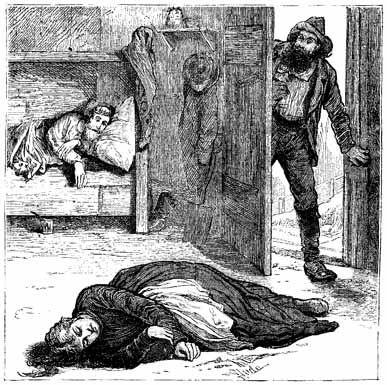
Arkansas Bill knocked lightly on the door, and looked in. There lay the sick man, his eyes partly open, and on the ground, apparently asleep, and with purple face, lay Mrs. Blizzer.
Arkansas Bill opened the door, and called Blizzer, and the crowd followed Blizzer, though at a respectful distance. In a moment Blizzer reappeared with his wife, no longer fat, in his arms, and Arkansas Bill hurried on to open Blizzer's door. The crowd halted, and didn't know what to do, until Moosoo, the little Frenchman, lifted his hat, upon, which every man promptly uncovered his head.
A moment later Arkansas Bill was on Sim Ripson's horse, and galloping off for a doctor, and Sim Ripson, who had always threatened sudden death to any one touching his beloved animal, saw him, and refrained even from profanity. The doctor came, and the boys crowded the door to hear what he had to say.
"Hum!" said the doctor, a rough miner himself, "new arrival—been fat—worn out—rainy season just coming on—not much chance. No business to come to California—ought to have had sense enough to stay home."
"Look a' here, doctor," said Arkansas Bill, indignantly; "she's got this way a-nussin' a feller—stranger, too—that ev'ry man in camp wuz afeard to go nigh."
"Is that so?" asked the doctor, in a tone considerably softened; "then she shall get well, if my whole time and attention can bring it about."
The sick woman lay in a burning fever for days, and the boys industriously drank her health, and bet heavy odds on her recovery. No singing was 'allowed anywhere in camp, and when an old feud broke out afresh between two miners, and they drew their pistols, a committee was appointed to conduct them at least two miles from camp, before allowing them to shoot.
The Sundays were allowed to pass in the commonplace quietness peculiar to the rest of the week, and men who were unable to forego their regular weekly spree were compelled to emigrate. Sim Ripson, though admitting that the change was decidedly injurious to his business, declared that he would cheerfully be ruined in business rather than have that woman disturbed; he was ever heard to say that, though of course there was no such place as heaven, there ought to be, for such woman.
One evening, as the crowd were quietly drinking and betting, Arkansas Bill suddenly opened the door of the store, and cried: "She's mendin'! The fever's broke—'sh-h!"
"My treat, boys," said Sim Ripson, hurrying glasses and favorite bottles on the bar.
The boys were just clinking glasses with Blizzer himself, who, during his wife's absence and illness, had drifted back to the store, when Arkansas Bill again opened the door.
"She's a-sinkin', all of a sudden!" he gasped. "Blizzer, yer wanted."
The two men hurried away, and the crowd poured out of the store. By the light of a fire in front of the hut in which the sick woman lay, they saw Blizzer enter, and Arkansas Bill remain outside the hut, near the door.
The boys stood on one foot, put their hands into their pockets and took them out again, snapped their fingers, and looked at each other, as if they wanted to talk about something that they couldn't. Suddenly the doctor emerged from the hut, and said something to Arkansas Bill, and the boys saw Arkansas Bill put both hands up to his face. Then the boys knew that their sympathy could help Blizzer's wife no longer.
Slowly the crowd re-entered the store, and mechanically picked up the yet untasted glasses. Sim Ripson filled a glass for himself, looked a second at the crowd, and dropping his eyes, raised them again, looked as if he had something to say, looked intently into his glass, as if espying some irregularity, looked up again, and exclaimed:
"Boys, it's no use—mebbe ther's no hell—mebbe the Bible contradicts itself, but—but ther is a heaven, or such folks would never git their just dues. Here's to Blizzer's wife, the best man in camp, an' may the Lord send us somebody like her!"
In silence, and with uncovered heads, was the toast drank; and for many days did the boys mourn for her whose advent brought them such disappointment.
A BOARDING HOUSE ROMANCE.
I keep a boarding-house.
If any fair proportion of my readers were likely to be members of my own profession, I should expect the above announcement to call forth more sympathetic handkerchiefs than have waved in unison for many a day. But I don't expect anything of the sort; I know my business too well to suppose for a moment that any boarding-house proprietor, no matter how full her rooms, or how good pay her boarders are, ever finds time to read a story. Even if they did, they'd be so lost in wonder at one of themselves finding time to write a story, that they'd forget the whole plot and point of the thing.
I can't help it, though—I must tell about poor dear Mrs. Perry, even if I run the risk of cook's overdoing the beef, so that Mr. Bluff, who is English, and the best of pay, can't get the rare cut he loves so well. Mrs. Perry's story has run in my head so long, that it has made me forget to take change from the grocer at least once to my knowledge, and even made me lose a good boarder, by showing a room before the bed was made up. They say that poets get things out of their heads by writing them down, and I don't know why boarding-house keepers can't do the same thing.
It's about three months since Mrs. Perry came here to board. I'm very sure about the time, and it was the day I was to pay my quarter's rent, and to-morrow will be quarter-day again; thank the Lord I've got the money ready.
I didn't have the money ready then, though, and the landlord left his temper behind him, instead of a receipt, and I was just having a little cry in my apron, and asking the Lord why it was that a poor lone woman who was working her finger-ends off should have such a hard time, when the door-bell rang.
"That's the landlord again. I know his ways, the mean wretch!" said I to myself, hastily rubbing my eyes dry, and making up before the mirror in the hat-tree as fierce a face as I could. Then I snatched open the door, and tried to make believe my heart wasn't in my mouth.
But the landlord wasn't there, and I've always been a little sorry, for I was looking so savage, that a wee little woman, who was at the door, trembled all over, and started to go down the steps.
"Don't go, ma'am," I said, very quickly, with the best smile I could put on (and I think I've been long enough in the business to give the right kind of a smile to a person that looks like a new boarder). "Don't go—I thought it was—I thought it was—somebody else that rang. Come in, do."
She looked as if I was doing her a great honor, and I thought that looked like poor pay, but I was too glad at not seeing the landlord just then to care if I did lose one week's board; besides, she didn't look as if she could eat much.
"I see you advertise a small bedroom to let," said she, looking appealing-like, as if she was going to beat me down on the strength of being poor. "How much is it a week?"
"Eight dollars," said I, rather shortly. Seven dollars was all I expected to get, but I put on one, so as to be beaten down without losing anything. "I can get eight from a single gentleman, the only objection being that he wants to keep a dog in the back yard."
"Oh, I'll pay it," said she, quickly taking out her pocketbook. "I'll take it for six weeks, anyhow."
I never felt so ashamed of myself in my life. I made up my mind to read a penitential passage of Scripture as soon as I closed the bargain with her, but, remembering the Book says to be reconciled to your brother before laying your gift on the altar, I says, quick as I could, for fear that if I thought over it again I couldn't be honest:
"You shall have it for seven, my dear madame, if you're going to stay so long, and I'll do your washing without extra charge."
This last I said to punish myself for suspecting an innocent little lady.
"Oh, thank you—thank you very much," said she, and then she began to cry.
I knew that wasn't for effect, for we were already agreed on terms, and she had her pocketbook open showing more money that I ever have at a time, unless it's rent-day.
She tried to stop crying by burying her face in her hands, and it made her look so much smaller and so pitiful that I picked her right up, as if she was a baby, and kissed her. Then she cried harder, and I—a woman over forty, too—couldn't find anything better to do than to cry with her.
I knew her whole story within five minutes—knew it perfectly well before I'd fairly shown her the room and got it aired.
They were from the West, and had been married about a year. She hadn't a relative in the world, but his folks had friends in Philadelphia, so he'd got a place as clerk in a big clothing factory, at twelve hundred dollars a year. They'd been keeping house, just as cozy as could be in four rooms, and were as happy as anybody in the world, when one night he didn't come home.
She was almost frantic about him all night long, and first thing in the morning she was at the factory. She waited until all the clerks got there, but George—his name was George Perry—didn't come. The proprietor was a good-hearted man, and went with her to the police-office, and they telegraphed all over the city; but there didn't seem to be any such man found dead or drunk, or arrested for anything.
She hadn't heard a word from him since. Her husband's family's friends were rich—the stuck up brutes!—but they seemed to be annoyed by her coming so often to ask if there wasn't any other way of looking for him, so she, like the modest, frightened little thing she was, staid away from them. Then somebody told her that New York was the place everybody went to, so she sold all her furniture and pawned almost all her clothes, and came to New York with about fifty dollars in her pocket.
"What I'll do when that's gone I don't know," said she, commencing to cry again, "unless I find George. I won't live on you, though, ma'am," she said, lifting her face up quickly out of her handkerchief; "I won't, indeed. I'll go to the poorhouse first. But—"
Then she cried worse than before, and I cried, too, and took her in my arms, and called her a poor little thing, and told her she shouldn't go to any poorhouse, but should stay with me and be my daughter.
I don't know how I came to say it, for, goodness knows, I find it hard enough to keep out of the poorhouse myself, but I did say it, and I meant it, too.
Her things were all in a little valise, and she soon had the room to rights, and when I went up again in a few minutes to carry her a cup of tea, she pointed to her husband's picture which she had hung on the wall, and asked me if I didn't think he was very handsome.
I said yes, but I'm glad she looked at the tea instead of me, for I believe she'd seen by my face that I didn't like her George. The fact is, men look very differently to their wives or sweethearts than they do to older people and to boarding-house keepers. There was nothing vicious about George Perry's face, but if he'd been a boarder of mine, I'd have insisted on my board promptly—not for fear of his trying to cheat me, but because if he saw anything else he wanted, he'd spend his money without thinking of what he owed.
I felt so certain that he'd got into some mischief or trouble, and was afraid or ashamed to come back to his wife, that I risked the price of three ribs of prime roasting beef in the following "Personal" advertisement:
George P.—Your wife don't know anything about it, and is dying to see you. Answer through Personals.
But no answer came, and his wife grew more and more poorly, and I couldn't help seeing what was the matter with her. Then her money ran out, and she talked of going away, but I wouldn't hear of it. I just took her to my own room, which was the back parlor, and told her she wasn't to think again of going away; that she was to be my daughter, and I would be her mother, until she found George again.
I was afraid, for her sake, that it meant we were to be with each other for ever, for there was no sign of George.
She wrote to his family in the West, but they hadn't heard anything from him or about him, and they took pains not to invite her there, or even to say anything about giving her a helping hand.
There was only one thing left to do, and that was to pray, and pray I did, more constantly and earnestly than I ever did before, although, the good Lord knows there have been times, about quarter-day, when I haven't kept much peace before the Throne.
Finally, one day Mrs. Perry was taken unusually bad, and the doctor had to be sent for in a hurry. We were in her room—the doctor and Mrs. Perry and I—I was endeavoring to comfort and strengthen the poor thing, when the servant knocked, and said a lady and gentleman had come to look at rooms.
I didn't dare to lose boarders, for I'd had three empty rooms for a month, so I hurried into the parlor. I was almost knocked down for a second, for the gentleman was George Perry, and no mistake, if the picture his wife had was to be trusted.
In a second more I was cooler and clearer-headed than I ever was in my life before. I felt more like an angel of the Lord than a boarding-house keeper.
"Kate," said I, to the servant "show the lady all the rooms."
Kate stared, for I'd never trusted her, or any other girl, with such important work, and she knew it. She went though, followed by the lady, who, though she seemed a weak, silly sort of thing, I hated with all my might. Then I turned quickly, and said:
"Don't you want a room for your wife, too, George Perry?"
He stared at me a moment, and then turned pale and looked confused. Then he tried to rally himself, and he said:
"You seem to know me, ma'am."
"Yes," said I; "and I know Mrs. Perry, too; and if ever a woman needed her husband she does now, even if her husband is a rascal."
He tried to be angry, but he couldn't. He walked up and down the room once or twice, his face twitching all the time, and then he said, a word or two at a time:
"I wish I could—poor girl!—God forgive me!—what can I do?—I wish I was dead!"
"You wouldn't be any use to anybody then but the Evil One, George Perry, and you're not ready to see him just yet," said I.
Just then there came a low, long groan from the backroom, and at the same time some one came into the parlor. I was too excited to notice who it was; and George Perry, when he heard the groan, stopped short and exclaimed:
"Good God! who's that?"
"Your wife," said I, almost ready to scream, I was so wrought up.
He hid his face in his hands, and trembled all over.
There was half a minute's silence—it seemed half an hour—and then we heard a long, thin wail from a voice that hadn't ever been heard on earth before.
"What's that?" said Perry, in a hoarse whisper, his eyes starting out of his head, and hands thrown up.
"Your baby—just born," said I. "Will you take rooms for your family now, George Perry?" I asked.
"I sha'n't stand in the way," said a voice behind me.
I turned around quickly, just in time to see, with her eyes full of tears, the woman who had come with George go out the door and shut the hall-door behind her.
"Thank God!" said George, dropping on his knees.
"Amen!" said I, hurrying out of the parlor and locking the door behind me.
I thought if he wanted to pray while on his knees he shouldn't be disturbed, while if he should suddenly be tempted to follow his late companion, I shouldn't be held at the Judgment day for any share of the guilt.
I found the doctor bustling about, getting ready to go, and Mrs. Perry looking very peaceful and happy, with a little bundle hugged up close to her.
"I guess the Lord will bring him now," said Mrs. Perry, "if it's only to see his little boy."
"Like enough, my dear," said I, thanking the Lord for opening the question, for my wits were all gone by this time, and I hadn't any more idea of what to do than the man in the moon; "but," said I, "He won't bring him till you're well, and able to bear the excitement."
"Oh, I could bear it any time now," said she, very calmly, "It would seem just as natural as could be to have him come in and kiss me, and see his baby and bless it."
"Would it?" I asked, with my heart all in a dance. "Well, trust the Lord to do just what's right."
I hurried out and opened the parlor-door. There stood George Perry, changed so I hardly knew him. He seemed years older; his thick lips seemed to have suddenly grown thin, and were pressed tightly together, and there was such an appealing look from his eyes.
"Be very careful now," I whispered, "and you may see them. She expects you, and don't imagine anything has gone wrong."
I took him into the room, and she looked up with a face like what I hope the angels have. I didn't see anything more, for my eyes filled up all of a sudden, so I hurried up-stairs into an empty room, and spent half an hour crying and thanking the Lord.
There was a pretty to-do at the dinner table that day. I'd intended to have souffle for desert, and I always make my own souffles; but I forgot everything but the Perrys, and the boarders grumbled awfully. I didn't care, though; I was too happy to feel abused.
I don't know how George Perry explained his absence to his wife; perhaps he hasn't done it at all. But I know she seems to be the happiest woman alive, and that he don't seem to care for anything in the world but his wife and baby.
As to the woman who came with him to look at a room, I haven't seen her since; but if she happens to read this story, she may have the consolation of knowing that there's an old woman who remembers her one good deed, and prays for her often and earnestly.
RETIRING FROM BUSINESS.
What the colonel's business was nobody knew, nor did any one care, particularly. He purchased for cash only, and he never grumbled at the price of anything that he wanted; who could ask more than that?
Curious people occasionally wondered how, when it had been fully two years since the colonel, with every one else, abandoned Duck Creek to the Chinese, he managed to spend money freely, and to lose considerable at cards and horse-races. In fact, the keeper of that one of the two Challenge Hill saloons which the colonel did not patronize was once heard to absentmindedly wonder whether the colonel hadn't a money-mill somewhere, where he turned out double-eagles and "slugs" (the Coast name for fifty-dollar gold-pieces).
When so important a personage as a barkeeper indulged publicly in an idea, the inhabitants of Challenge Hill, like good Californians everywhere, considered themselves in duty bound to give it grave consideration; so, for a few days, certain industrious professional gentlemen, who won money of the colonel, carefully weighed some of the brightest pieces and tested them with acids, and tasted them and sawed them in two, and retried them and melted them up, and had the lumps assayed.
The result was a complete vindication of the colonel, and a loss of considerable custom to the indiscreet barkeeper.
The colonel was as good-natured a man as had ever been known at Challenge Hill, but, being mortal, the colonel had his occasional times of despondency, and one of them occurred after a series of races, in which he had staked his all on his own bay mare Tipsie, and had lost.
Looking reproachfully at his beloved animal failed to heal the aching void of his pockets, and drinking deeply, swearing eloquently and glaring defiantly at all mankind, were equally unproductive of coin.
The boys at the saloon sympathized most feelingly with the colonel; they were unceasing in their invitations to drink, and they even exhibited considerable Christian forbearance when the colonel savagely dissented with every one who advanced any proposition, no matter how incontrovertible.
But unappreciated sympathy grows decidedly tiresome to the giver, and it was with a feeling of relief that the boys saw the colonel stride out of the saloon, mount Tipsie, and gallop furiously away.
Riding on horseback has always been considered an excellent sort of exercise, and fast riding is universally admitted to be one of the most healthful and delightful means of exhilaration in the world.
But when a man is so absorbed in his exercise that he will not stop to speak to a friend; and when his exhilaration is so complete that he turns his eyes from well-meaning thumbs pointing significantly into doorways through which a man has often passed while seeking bracing influences, it is but natural that people should express some wonder.
The colonel was well known at Toddy Flat, Lone Hand, Blazers, Murderer's Bar, and several other villages through which he passed, and as no one had been seen to precede him, betting men were soon offering odds that the colonel was running away from somebody.
Strictly speaking they were wrong, but they won all the money that had been staked against them; for within half an hour's time there passed over the same road an anxious-looking individual, who reined up in front of the principal saloon of each place, and asked if the colonel had passed.
Had the gallant colonel known that he was followed, and by whom, there would have been an extra election held at the latter place very shortly after, for the colonel's pursuer was no other than the constable of Challenge Hill, and for constables and all other officers of the law the colonel possessed hatred of unspeakable intensity.
On galloped the colonel, following the stage-road, which threaded the old mining camps on Duck Creek; but suddenly he turned abruptly out of the road, and urged his horse through the young pines and bushes, which grew thickly by the road, while the constable galloped rapidly on to the next camp.
There seemed to be no path through the thicket into which the colonel had turned, but Tipsie walked between trees and bushes as if they were but the familiar objects of her own stable-yard.
Suddenly a voice from the bushes shouted:
"What's up?"
"Business—that's what," replied the colonel.
"It's time," replied the voice, and its owner—a bearded six-footer—emerged from the bushes, and stroked Tipsie's nose with the freedom of an old acquaintance. "We hain't had a nip sence last night, an' thar' ain't a cracker or a handful of flour in the shanty. The old gal go back on yer?"
"Yes," replied the colonel, ruefully—lost ev'ry blasted race. 'Twasn't her fault, bless her—she done her level best. Ev'rybody to home?"
"You bet," said the man. "All ben a-prayin' for yer to turn up with the rocks, an' somethin' with more color than spring water. Come on."
The man led the way, and Tipsie and the colonel followed, and the trio suddenly found themselves before a small log hut, in front of which sat three solemn, disconsolate-looking individuals, who looked appealingly at the colonel.
"Mac'll tell yer how 'twas, fellers," said the colonel, meekly, "while I picket the mare."
The colonel was absent but a very few moments, but when he returned each of the four men was attired in pistols and knives, while Mac was distributing some dominoes, made from a rather dirty flour-bag.
"'Tain't so late as all that, is it?" inquired the colonel.
"Better be an hour ahead than miss it this 'ere night," said one of the four. "I ain't been so thirsty sence I come round the Horn, in '50, an' we run short of water. Somebody'll get hurt ef thar' ain't no bitters on the old concern—they will, or my name ain't Perkins."
"Don't count yer chickings 'fore they're hetched, Perky," said one of the party, as he adjusted his domino under the rim of his hat. "'S'posin' ther' shud be too many for us?"
"Stiddy, Cranks!" remonstrated the colonel. "Nobody ever gets along ef they 'low 'emselves to be skeered."
"Fact," chimed in the smallest and thinnest man of the party. "The Bible says somethin' mighty hot 'bout that. I disremember dzackly how it goes; but I've heerd Parson Buzzy, down in Maine, preach a rippin' old sermon from that text many a time. The old man never thort what a comfort them sermons wus a-goin' to be to a road-agent, though. That time we stopped Slim Mike's stage, an' he didn't hev no more manners than to draw on me, them sermons wus a perfec' blessin' to me—the thought uv 'em cleared my head ez quick ez a cocktail. An'—"
"I don't want to disturb Logroller's pious yarn," interrupted the colonel; "but ez it's Old Black that's drivin' to-day instid of Slim Mike, an' ez Old Black ollers makes his time, hedn't we better vamose?"
The door of the shanty was hastily closed, and the men filed through the thicket until near the road, when they marched rapidly on parallel lines with it. After about half an hour, Perkins, who was leading, halted, and wiped his perspiring brow with his shirt-sleeve.
"Far enough from home now," said he. "'Tain't no use bein' a gentleman ef yer hev to work too hard."
"Safe enough, I reckon," replied the colonel. "We'll do the usual; I'll halt 'em, Logroller'll tend to the driver, Cranks takes the boot, an' Mac an' Perk takes right an' left. An'—I know it's tough—but consid'rin' how everlastin' eternally hard up we are, I reckon we'll have to ask contributions from the ladies, too, ef ther's any aboard—eh, boy?"
"Reckon so," replied Logroller, with a chuckle that seemed to inspire even his black domino with a merry wrinkle or two. "What's the use of women's rights ef they don't ever hev a chance of exercisin' 'em? Hevin' ther purses borrowed 'ud show 'em the hull doctrine in a bran-new light."
"They're treacherous critters, women is," remarked Cranks; "some of 'em might put a knife into a feller while he was 'pologizin'."
"Ef you're afeard of 'em," said Perkins, "you ken go back an' clean up the shanty."
"Reminds me of what the Bible sez," said Logroller; "'there's a lion on the trail; I'll be chawed up, sez the lazy galoot,' ur words to that effect."
"Come, come boys," interposed the colonel; "don't mix religion an' bizness. They don't mix no more than—Hello, thar's the crack of Old Black's whip! Pick yer bushes—quick! All jump when I whistle!"
Each man secreted himself near the roadside. The stage came swinging along handsomely; the inside passengers were laughing heartily about something, and Old Black was just giving a delicate touch to the flank of the off leader, when the colonel gave a shrill, quick whistle, and the five men sprang into the road.
The horses stopped as suddenly as if it was a matter of common occurrence, Old Black dropped his reins, crossed his legs, and stared into the sky, and the passengers all put out their heads with a rapidity equaled only by that with which they withdrew them as they saw the dominoes and revolvers of the road-agents.
"Seems to be something the matter, gentlemen," said the colonel, blandly, as he opened the door. "Won't you please git out? Don't trouble yourselves to draw, cos my friend here's got his weapon cocked, an' his fingers is rather nervous. Ain't got a han'kercher, hev yer?" asked the colonel of the first passenger who descended from the stage. "Hev? Well, now, that's lucky. Jest put yer hands behind yer, please—so—that's it." And the unfortunate man was securely bound in an instant.
The remaining passengers were treated with similar courtesy, and then the colonel and his friends examined the pockets of the captives. Old Black remained unmolested, for who ever heard of a stage-driver having money?
"Boys," said the colonel, calling his brother agents aside, and comparing receipts, "'tain't much of a haul; but there's only one woman, an' she's old enough to be a feller's grandmother. Better let her alone, eh?"
"Like enough she'll pan out more'n all the rest of the stage put together," growled Cranks, carefully testing the thickness of case of a gold watch. "Jest like the low-lived deceitfulness of some folks, to hire an old woman to kerry ther money so it 'ud go safe. Mebbe what she's got hain't nothin' to some folks thet's got hosses thet ken win 'em money at races, but—"
The colonel abruptly ended the conversation, and approached the stage. The colonel was very chivalrous, but Cranks's sarcastic reference to Tipsie needed avenging, and as he could not consistently with business arrangements put an end to Cranks, the old lady would have to suffer.
"I beg your parding, ma'am," said the colonel, raising his hat politely with one hand, while he reopened the coach-door with the other, "but we're a-takin' up a collection fur some very deservin' object. We wuz a-goin' to make the gentlemen fork over the hull amount, but ez they hain't got enough, we'll hev to bother you."
The old lady trembled, and felt for her pocketbook, and raised her vail. The colonel looked into her face, slammed the stage-door, and, sitting down on the hub of one of the wheels, stared vacantly into space.
"Nothin'?" queried Perkins, in a whisper, and with a face full of genuine sympathy.
"No—yes," said the colonel, dreamily. "That is, untie em and let the stage go ahead," he continued, springing to his feet. "I'll hurry back to the cabin."
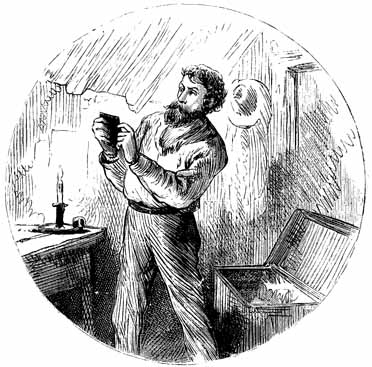
And the colonel dashed into the bushes, and left his followers so paralyzed with astonishment, that Old Black afterward remarked that, "ef ther'd ben anybody to hold the hosses, he could hev cleaned out the hull crowd with his whip."
The passengers, now relieved of their weapons, were unbound, and allowed to re-enter the stage, and the door was slammed, upon which Old Black picked up his reins as coolly as if he had merely laid them down at the station while horses were being changed; then he cracked his whip, and the stage rolled off, while the colonel's party hastened back to their hut, fondly inspecting as they went certain flasks they had obtained while transacting their business with the occupants of the stage.
Great was the surprise of the road-agents as they entered their hut, for there stood the colonel in a clean white shirt, and in a suit of clothing made up from the limited spare wardrobes of the other members of the gang.
But the suspicious Cranks speedily subordinated his wonder to his prudence, as, laying on the table a watch, two pistols, a pocket-book, and a heavy purse, he exclaimed:
"Come, colonel, bizness before pleasure; let's divide an' scatter. Ef anybody should hear 'bout it, an' find our trail, an' ketch us with the traps in our possession, they might—"
"Divide yerselves!" said the colonel, with abruptness and a great oath. "I don't want none of it."
"Colonel," said Perkins, removing his own domino, and looking anxiously into the leader's face, "be you sick? Here's some bully brandy I found in one of the passengers' pockets."
"I hain't nothin'," replied the colonel. "I'm a-goin', an' I'm a-retirin' from this bizness for ever."
"Ain't a-goin' to turn evidence?" cried Cranks, grasping the pistol on the table.
"I'm a-goin' to make a lead-mine of you ef you don't take that back!" roared the colonel, with a bound, which caused Cranks to drop his pistol, and retire precipitately backward, apologizing as he went. "I'm goin' to tend to my own bizness, and that's enough to keep any man busy. Somebody lend me fifty, till I see him again?"
Perkins pressed the money into the colonel's hand, and within two minutes the colonel was on Tipsie's back, and galloping on in the direction the stage had taken.
He overtook it, he passed it, and still he galloped on.
The people at Mud Gulch knew the colonel well, and made it a rule never to be astonished at anything he did; but they made an exception to the rule when the colonel canvassed the principal bar-rooms for men who wished to purchase a horse; and when a gambler, who was flush, obtained Tipsie in exchange for twenty slugs—only a thousand dollars, when the colonel had always said that there wasn't gold enough on top of the ground to buy her—Mud Gulch experienced a decided sensation.
One or two enterprising persons speedily discovered that the colonel was not in a communicative mood, so every one retired to his favorite saloon, and bet according to his own opinion of the colonel's motives and actions.
But when the colonel, after remaining in a barber-shop for half an hour, emerged with his face clean shaven and his hair neatly trimmed and parted, betting was so wild that a cool-headed sporting man speedily made a fortune by betting against every theory that was advanced.
Then the colonel made a tour of the stores, and fitted himself to a new suit of clothes, carefully eschewing all of the generous patterns and pronounced colors so dear to the average miner. He bought a new hat, put on a pair of boots, and pruned his finger-nails, and, stranger than all, he mildly but firmly declined all invitations to drink.
As the colonel stood in the door of the principal saloon, where the stage always stopped, the Challenge Hill constable was seen to approach the colonel, and tap him on the shoulder, upon which all men who had bet that the colonel was dodging somebody claimed the stakes. But those who stood near the colonel heard the constable say:
"Colonel, I take it all back, an' I own up fair an' square. When I seed you git out of Challenge Hill, it come to me all of a sudden that you might be in the road-agent business, so I followed you—duty, you know. But after I seed you sell Tipsie, I knowed I was on the wrong trail. I wouldn't suspect you now if all the stages in the State was robbed; an' I'll give you satisfaction any way you want it."
"It's all right," said the colonel, with a smile. The constable afterward said that nobody had any idea of how curiously the colonel smiled when his beard was off. "Give this fifty to Jim Perkins fust time yer see him? I'm leavin' the State."
Suddenly the stage pulled up at the door with a crash, and the male passengers hurried into the saloon, in a state of utter indignation and impecuniosity.
The story of the robbery attracted everybody, and during the excitement the colonel slipped quietly out, and opened the door of the stage. The old lady started, and cried:
"George!"
And the colonel, jumping into the stage, and putting his arms tenderly about the trembling form of the old lady, exclaimed:
"Mother!"
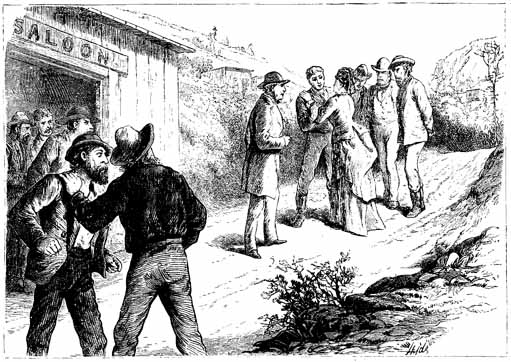
The old lady cried, "George!" and the Colonel exclaimed, "Mother!"
THE HARDHACK MISTAKE.
Excitement? The venerable Deacon Twinkham, the oldest inhabitant, said there had not been such an excitement at Hardhack since the meeting-house steeple blew down in a terrible equinoctial, forty-seven years before.
And who could wonder?
Even a larger town than Hardhack would have experienced unusual agitation at seeing one of its own boys, who had a few years before gone away poor, slender and twenty, come back with broad shoulders, a full beard, and a pocketful of money, dug out of the ugly hills of Nevada.
But even the return of Nathan Brown, in so unusual a condition for a Hardhackian to be found in, was not the fullness of Hardhack's excitement, for Nathan had brought with him Tom Crewne and Harry Faxton, two friends he had made during his absence, and both of them broad-shouldered, full-bearded, and auriferous as Nathan himself.
No wonder the store at Hardhack was all the while crowded with those who knew all about Nathan, or wanted to—no wonder that "Seen 'm?" was the passing form of salutation for days.
The news spread like wildfire, and industrious farmers deliberately took a day, drove to town, and stood patiently on the door-steps of the store until they had seen one or more of the wonderful men.
The good Deacon Twinkham himself, who had, at a late prayer-meeting, stated that "his feet already felt the splashin' of Jordan's waves," temporarily withdrew his aged limbs from the rugged banks famed in song, and caused them to bear him industriously up and down the Ridge Road, past Nathan's mother's house, until he saw all three of the bearded Croesuses seat themselves on the piazza to smoke. Then he departed, his good face affording an excellent study for a "Simeon in the Temple."
Even the peaceful influences of the Sabbath were unable to restore tranquillity to Hardhack.
On Sunday morning the meeting-house was fuller than it had been since the funeral services of the last pastor. At each squeak of the door, every head was quickly turned; and when, in the middle of the first hymn, the three ex-miners filed decorously in, the staring organist held one chord of "Windham" so long that the breath of the congregation was entirely exhausted.
The very pulpit itself succombed to the popular excitement; and the Reverend Abednego Choker, after reading of the treasures of Solomon's Temple, and of the glories of the New Testament, for the first and second lessons, preached from Isaiah xlvi. 6: "They lavish gold out of the bag and weigh silver in the balance."
But all this excitement was as nothing compared with the tumult which agitated the tender hearts of the maidens at Hardhack.
Young, old, handsome, plain, smart and stupid, until now few of them had dared to hope for a change of name; for, while they possessed as many mental and personal charms as girls in general, all the enterprising boys of Hardhack had departed from their birthplace in search of the lucre which Hardback's barren hills and lean meadows failed to supply, and the cause of their going was equally a preventive of the coming of others to fill their places.
But now—oh, hope!—here were three young men, good-looking, rich, and—if the other two were fit companions for the well-born and bred Nathan—all safe custodians for tender hearts.
Few girls were there in Hardhack who did not determine, in their innermost hearts, to strive as hard as Yankee wit and maiden modesty would allow for one of those tempting prizes.
Nor were they unaided. Rich and respectable sons-in-law are scarce enough the world over, so it was no wonder that all the parents of marriageable daughters strove to make Hardhack pleasant for the young men.
Fathers read up on Nevada, and cultivated the three ex-miners; mothers ransacked cook-books and old trunks; Ladies' Companions were industriously searched for pleasing patterns; crimping-irons and curling-tongs were extemporized, and the demand for ribbons and trimmings became so great that the storekeeper hurried to the city for a fresh supply.
Then began that season of mad hilarity and reckless dissipation, which seemed almost a dream to the actors themselves, and to which patriotic Hardhackians have since referred to with feelings like those of the devout Jew as he recalls the glorious deeds of his forefathers, or of the modern Roman as, from the crumbling arches of the Coliseum, he conjures up the mighty shade of the Cæsarian period.
The fragrant bohea flowed as freely as champagne would have done in a less pious locality; ethereal sponge-cakes and transparent currant-jellies became too common to excite comment; the surrounding country was heavily drawn upon for fatted calves, chickens and turkeys, and mince-pies were so plenty, that observing children wondered if the Governor had not decreed a whole year of special Thanksgiving.
Bravely the three great catches accepted every invitation, and, though it was a very unusual addition to his regular duties, the Reverend Abednego Choker faithfully attended all the evening festivities, to the end that they might be decorously closed with prayer, as had from time immemorial been the custom of Hardhack.
And the causes of all these efforts on the part of Hardhack society enjoyed themselves intensely. Young men of respectable inclinations, who have lived for several years in a society composed principally of scoundrels, and modified only by the occasional presence of an honest miner or a respectable mule-driver, would have considered as Elysium a place far less proper and agreeable than Hardhack. In fact, the trio was so delighted, that its eligibility soon became diminished in quantity.
Faxton, at one of the first parties, made an unconditional surrender to a queenly damsel, while Nathan, having found his old schoolday sweetheart still unmarried, whispered something in her ear (probably the secret of some rare cosmetic), which filled her cheeks with roses from that time forth.
But Crewne, the handsomest and most brilliant of the three, still remained, and over him the fight was far more intense than in the opening of the campaign, when weapons were either rusty or untried, and the chances of success were seemingly more numerous.
But to designate any particular lady as surest of success seemed impossible. Even Nathan and Faxton, when besought for an opinion by the two ladies who now claimed their innermost thoughts, could only say that no one but Crewne knew, and perhaps even he didn't.
Crewne was a very odd boy, they said—excellent company, the best of good fellows, the staunchest of friends, and the very soul of honor; but there were some things about him they never could understand. In fact, he was something like that sum of all impossibilities, a schoolgirl's hero.
"But, Harry," said the prospective Mrs. Faxton, with rather an angry pout for a Church-member in full communion, "just see what splendid girls are dying for him! I'm sure there are no nicer girls anywhere than in Hardhack, and he needn't be so stuck up—"
"My dear," interrupted Faxton, "I say it with fear and trembling, but perhaps Crewne don't want to be in love at all."
An indignant flash of doubt went over the lady's face.
"Just notice him at a party," continued Faxton. "He seems to distribute his attentions with exact equality among all the ladies present, as if he were trying to discourage the idea that he was a marrying man."
"Well," said the lady, still indignant, "I think you might ask him and settle the matter."
"Excuse me, my dear," replied Faxton. "I have seen others manifest an interest in Crewne's affairs, and the result was discouraging. I'd rather not try the experiment."
A few mornings later Mrs. Leekins, who took the place of a newspaper at Hardhack, was seen hurrying from house to house on her own street, and such housekeepers as saw her instantly discovered that errands must be made to houses directly in Mrs. Leekins's route.
Mrs. Leekins's story was soon told. Crewne had suddenly gone to the city, first purchasing the cottage which Deacon Twinkham had built several years before for a son who had never come back from sea.
Crewne had hired old Mrs. Bruff to put the cottage to rights, and to arrange the carpets and furniture, which he was to forward immediately. But who was to be mistress of the cottage Mrs. Leekins was unable to tell, or even to guess.
The clerks at the store had been thoroughly pumped; but while they admitted that one young lady had purchased an unusual quantity of inserting, another had ordered a dress pattern of gray empress cloth, which was that year the fashionable material and color for traveling dresses.
Old Mrs. Bruff had received unusual consideration and unlimited tea, but even the most systematic question failed to elicit from her anything satisfactory.
At any rate, it was certain that Crewne was absent from Hardhack, and it was evident that he had decided who was to be the lady of the cottage, so the season of festivity was brought to an abrupt close, and the digestions of Hardhack were snatched from ruin.
From kitchen-windows were now wafted odors of boiled corned beef and stewed apples, instead of the fragrance of delicate preserves and delicious turkey.
Young ladies, when they met in the street, greeted each, other with a shade less of cordiality than usual, and fathers and mothers in Israel cast into each other's eyes searching and suspicious glances.
One afternoon, when the pious matrons of Hardhack were gathering at the pastor's residence to take part in the regular weekly mothers' prayer-meeting, the mail-coach rolled into town, and Mrs. Leekins, who was sitting by the window, as she always did, exclaimed:
"He's come back—there he is—on the seat with the driver!"
Every one hurried to the window, and saw that Mrs. Leekins had spoken truly, for there sat Crewne with a pleasant smile on his face, while on top of the stage were several large trunks marked C.
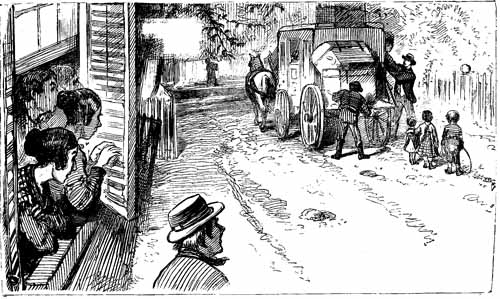
The sisters hastened to the window.
"Must have got a handsome fit-out," suggested Mrs. Leekins.
The stage stopped at the door of Crewne's new cottage, and Crewne got out. The pastor entered the parlor to open the meeting, and was selecting a hymn, when Mrs. Leekins startled the meeting by ejaculating:
"Lands alive!"
The meeting was demoralized; the sisters hastened to the window, and the good pastor, laying down his hymn-book, followed in time to see Crewne helping out a well-dressed and apparently young and handsome lady.
"Hardhack girls not good 'nough for him, it seems!" sneered Mrs. Leekins.
A resigned and sympathetic sigh broke from the motherly lips present, then Mrs. Leekins cried:
"Gracious sakes! married a widder with children!"
It certainly seemed that she told the truth, for Crewne lifted out two children, the youngest of whom seemed not more than three years old.
The gazers abruptly left the window, and the general tone of the meeting was that of melancholy resignation.
"Why didn't he ever say he was a married man?" asked the prospective Mrs. Faxton, of her lover, that evening.
"Partly because he is too much of a gentleman to talk of his own affairs," replied Faxton; "but principally because there had been, as he told me this afternoon, an unfortunate quarrel between them, which drove him to the mines. A few days ago he heard from her, for the first time in three years, and they've patched up matters, and are very happy."
"Well," said the lady, with considerable decision, "Hardhack will never forgive him."
Hardhack did, however, for Crewne and his two friends drew about them a few of their old comrades, who took unto themselves wives from the people about them, and made of Hardhack one of the pleasantest villages in the State.
THE CARMI CHUMS.
The Carmi Chums was the name they went by all along the river. Most other roustabouts had each a name of his own; so had the Carmi Chums for that matter, but the men themselves were never mentioned individually—always collectively.
No steamboat captain who wanted only a single man ever attempted to hire half of the Carmi Chums at a time—as easy would it have been to have hired half of the Siamese Twins. No steamboat mate who knew them ever attempted to "tell off" the Chums into different watches, and any mate who, not knowing them, committed this blunder, and adhered to it after explanation was made, was sure to be two men short immediately after leaving the steamer's next landing.
There seemed no possible way of separating them; they never fell out with each other in the natural course of events; they never fought when drunk, as other friendly roustabouts sometimes did, for the Carmi Chums never got drunk; there never sprang up any coolness between them because of love for the same lady, for they did not seem to care at all for female society, unless they happened to meet some old lady whom one might love as a mother rather than as a sweetheart.
Even professional busybodies, from whose presence roustabouts are no freer than Church-members, were unable to provoke the Carmi Chums even to suspicion, and those of them who attempted it too persistently were likely to have a difficulty with the slighter of the Chums.
This man, who was called Black, because of the color of his hair, was apparently forty years of age, and of very ordinary appearance, except when an occasional furtive, frightened look came into his face and attracted attention.
His companion, called Red, because his hair was of the hue of the carrots, and because it was occasionally necessary to distinguish him from his friend, seemed of about the same age and degree of ordinaries as Black, but was rather stouter, more cheery, and, to use the favorite roustabout simile, held his head closer to the current.
He seemed, when Black was absent-minded (as he generally was while off duty), to be the leading spirit of the couple, and to be tenderly alive to all of his partner's needs; but observing roustabouts noticed that when freight was being moved, or wood taken on board, Black was always where he could keep an eye on his chum, and where he could demand instant reparation from any wretch who trod upon Red's toes, or who, with a shoulder-load of wood, grazed Red's head, or touched Red with a box or barrel.
Next to neighborly wonder as to the existence of the friendship between the Chums, roustabouts with whom the couple sailed concerned themselves most with the cause of the bond between them. Their searches after first causes were no more successful, however, than those of the naturalists who are endeavoring to ascertain who laid the cosmic egg.
They gave out that they came from Carmi, so, once or twice, when captains with whom the Chums were engaged determined to seek a cargo up the Wabash, upon which river Carmi was located, inquisitive roustabouts became light-hearted. But, alas, for the vanity of human hopes! when the boat reached Carmi the Chums could not be found, nor could any inhabitant of Carmi identify them by the descriptions which were given by inquiring friends.
At length they became known, in their collective capacity, as one of the institutions of the river. Captains knew them as well as they knew Natchez or Piankishaw Bend, and showed them to distinguished passengers as regularly as they showed General Zach. Taylor's plantation, or the scene of the Grand Gulf "cave," where a square mile of Louisiana dropped into the river one night. Captains rather cultivated them, in fact, although it was a difficult bit of business, for roustabouts who wouldn't say "thank you" for a glass of French brandy, or a genuine, old-fashioned "plantation cigar," seemed destitute of ordinary handles of which a steamboat captain, could take hold.
Lady passengers took considerable notice of them, and were more successful than any one else at drawing them into conversation. The linguistic accomplishments of the Chums were not numerous, but it did one good to see Black lose his scared, furtive look when a lady addressed him, and to see the affectionate deference with which he appealed to Red, until that worthy was drawn into the conversation. When Black succeeded in this latter-named operation, he would, by insensible stages, draw himself away, and give himself up to enthusiastic admiration of his partner, or, apparently, of his conversational ability.
The Spring of 1869 found the Chums in the crew of the Bennett, "the peerless floating palace of the Mississippi," as she was called by those newspapers whose reporters had the freedom of the Bennett's bar; and the same season saw the Bennett staggering down the Mississippi with so heavy a load of sacked corn, that the gunwales amidships were fairly under water.
The river was very low, so the Bennett kept carefully in the channel; but the channel of the great muddy ditch which drains half the Union is as fickle as disappointed lovers declare women to be, and it has no more respect for great steamer-loads of corn than Goliath had for David.
A little Ohio river-boat, bound upward, had reported the sudden disappearance of a woodyard a little way above Milliken's Bend, where the channel hugged the shore, and with the woodyard there had disappeared an enormous sycamore-tree, which had for years served as a tying-post for steamers.
As live sycamores are about as disinclined to float as bars of lead are, the captain and pilot of the Bennett were somewhat concerned—for the sake of the corn—to know the exact location of the tree.
Half a mile from the spot it became evident, even to the passengers clustered forward on the cabin-deck, that the sycamore had remained quite near to its old home, for a long, rough ripple was seen directly across the line of the channel.
Then arose the question as to how much water was on top of the tree, and whether any bar had had time to accumulate.
The steamer was stopped, the engines were reversed and worked by hand to keep the Bennett from drifting down-stream, a boat was lowered and manned, the Chums forming part of her crew, and the second officer went down to take soundings; while the passengers, to whom even so small a cause for excitement was a godsend, crowded the rail and stared.
The boat shot rapidly down stream, headed for the shore-end of the ripple. She seemed almost into the boiling mud in front of her when the passengers on the steamer heard the mate in the boat shout: "Back all!"
The motion of the oars changed in an instant, but a little too late, for, a heavy root of the fallen giant, just covered by the water, caught the little craft, and caused it to careen so violently that one man was thrown into the water. As she righted, another man went in.
"Confound it!" growled the captain, who was leaning out of the pilot-house window. "I hope they can swim, still, 'tain't as bad as it would be if we had any more cargo to take aboard."
"It's the Chums," remarked the pilot, who had brought a glass to bear upon the boat.
"Thunder!" exclaimed the captain, striking a bell. "Below there! Lower away another boat—lively!" Then, turning to the passengers, he exclaimed: "Nobody on the river'd forgive me if I lost the Chums. 'Twould be as bad as Barnum losing the giraffe."
The occupants of the first boat were evidently of the captain's own mind, for they were eagerly peering over her side, and into the water.
Suddenly the pilot dropped his glass, extemporized a. trumpet with both hands, and shouted:
"Forrard—forrard! One of 'em's up!" Then he put, his mouth to the speaking-tube, and screamed to the engineer: "Let her drop down a little, Billy!"
The sounding party headed toward a black speck, apparently a hundred yards below them, and the great steamer slowly drifted down-stream. The speck moved toward shore, and the boat, rapidly shortening distance, seemed to scrape the bank with her port oars.
"Safe enough now, I guess!" exclaimed Judge Turner, of one of the Southern Illinois circuits.
The Judge had been interrupted in telling a story when the accident occurred, and was in a hurry to resume.
"As I was saying," said he, "he hardly looked like a professional horse-thief. He was little and quiet, and had always worked away steadily at his trade. I believed him when he said 'twas his first offense, and that he did it to raise money to bury his child; and I was going to give him an easy sentence, and ask the Governor to pardon him. The laws have to be executed, you know, but there's no law against mercy being practiced afterward. Well, the sheriff was bringing him from jail to hear the verdict and the sentence, when the short man, with red hair, knocked the sheriff down, and off galloped that precious couple for the Wabash. I saw the entire—"
"The deuce!" interrupted the pilot, again dropping his glass.
The Judge glared angrily; the passengers saw, across the shortened distance, one of the Chums holding by a root to the bank, and trying to support the other, whose shirt hung in rags, and who seemed exhausted.
"Which one's hurt?" asked the captain. "Give me the glass."
But the pilot had left the house and taken the glass with him.
The Judge continued:
"I saw the whole transaction through the window. I was so close that I saw the sheriff's assailant's very eyes. I'd know that fellow's face if I saw it in Africa."
"Why, they're both hurt!" exclaimed the captain. "They've thrown a coat over one, and they're crowdin' around the other. What the—They're comin' back without 'em—need whisky to bring 'em to, I suppose. Why didn't I send whisky down by the other boat? There's an awful amount of time being wasted here. What's the matter, Mr. Bell?" shouted the captain, as the boat approached the steamer.
"Both dead!" replied the officer.
"Both? Now, ladies and gentlemen," exclaimed the captain, turning toward the passengers, who were crowded forward just below him, "I want to know if that isn't a streak of the meanest kind of luck? Both the Chums gone! Why, I won't be able to hold up my head in New Orleans. How came it that just those two fellows were knocked out?"
"Red tumbled out, and Black jumped in after him," replied the officer. "Red must have been caught in an eddy and tangled in the old tree's roots—clothes torn almost off—head caved in. Black must have burst a blood-vessel—his face looked like a copper pan when he reached shore, and he just groaned and dropped."
The captain was sorry, so sorry that he sent a waiter for brandy. But the captain was human—business was business—the rain was falling, and a big log was across the boat's bow; so he shouted:
"Hurry up and bury 'em, then. You ought to have let the second boat's crew gone on with that, and you have gone back to your soundings. They was the Chums, to be sure, but now they're only dead roustabouts. Below there! Pass out a couple of shovels!"
"Perhaps some ladies would go down with the boat, captain—and a preacher, too, if there's one aboard," remarked the mate, with an earnest but very mysterious expression.
"Why, what in thunder does the fellow mean?" soliloquized the captain, audibly. "Women—and a preacher—for dead roustabouts? What do you mean, Mr. Bell?"
"Red's a woman," briefly responded the mate.
The passengers all started—the captain brought his hands together with a tremendous clap, and exclaimed:
"Murder will out! But who'd have thought I was to be the man to find out the secret of the Carmi Chums? Guess I'll be the biggest man on the New Orleans levee, after all. Yes, certainly—of course some ladies'll go—and a preacher, too, if there's such a man aboard. Hold up, though—we'll all go. Take your soundings, quick, and we'll drop the steamer just below the point, and tie up. I wonder if there's a preacher aboard?"
No one responded for the moment; then the Judge spoke.
"Before I went into the law I was the regularly settled pastor of a Presbyterian Church," said he. "I'm decidedly rusty now, but a little time will enable me to prepare myself properly. Excuse me, ladies and gentlemen."
The sounding-boat pulled away, and the Judge retired to his stateroom. The ladies, with very pale faces, gathered in a group and whispered earnestly with each other; then ensued visits to each other's staterooms, and the final regathering of the ladies with two or three bundles. The soundings were taken, and, as the steamer dropped down-stream, men were seen cutting a path down the rather steep clay bank. The captain put his hands to his mouth and shouted:
"Dig only one grave—make it wide enough for two."
And all the passengers nodded assent and satisfaction.
Time had been short since the news reached the steamer, but the Bennett's carpenter, who was himself a married man, had made a plain coffin by the time the boat tied up, and another by the time the grave was dug. The first one was put upon a long handbarrow, over which the captain had previously spread a tablecloth, and, followed by the ladies, was deposited by the side of the body of Red. Half an hour later, the men placed Black in the other coffin, removed both to the side of the grave, and signalled the boat.
"Now, ladies and gentlemen," said the captain.
The Judge appeared with a very solemn face, his coat buttoned tight to his throat, and the party started. Colonel May, of Missouri, who read Voltaire and didn't believe in anything, maliciously took the Judge's arm, and remarked:
"You didn't finish your story, Judge."
The Judge frowned reprovingly.
"But, really," persisted the colonel, "I don't want curiosity to divert my mind from the solemn services about to take place. Do tell me if they ever caught the rascals."
"They never did," replied the Judge. "The sheriff hunted and advertised, but he could never hear a word of either of them. But I'd know either one of them at sight. Sh—h—here we are at the grave."
The passengers, officers, and crew gathered about the grave. The Judge removed his hat, and, as the captain uncovered the faces of the dead, commenced:
"'I am the resurrection and the life'—Why, there's the horse-thief now, colonel! I beg your pardon, ladies and gentlemen. 'He that believeth in—'"
Just then the Judge's eye fell upon the dead woman's face, and he screamed:
"And there's the sheriff's assailant!"
LITTLE GUZZY.
Bowerton was a very quiet place. It had no factories, mills, or mines, or other special inducements to offer people looking for new localities; and as it was not on a railroad line, nor even on an important post-road, it gained but few new inhabitants.
Even of travelers Bowerton saw very few. An occasional enterprising peddler or venturesome thief found his way to the town, and took away such cash as came in their way while pursuing their respective callings; but peddlers were not considered exactly trustworthy as news-bearers, while house-breakers, when detained long enough to be questioned, were not in that communicative frame of mind which is essential to one who would interest the general public.
When, therefore, the mail-coach one day brought to Bowerton an old lady and a young one, who appeared to be mother and daughter, excitement ran high.
The proprietor of the Bowerton House, who was his own clerk, hostler, and table-waiter, was for a day or two the most popular man in town; even the three pastors of the trio of churches of Bowerton did not consider it beneath their dignity to join the little groups which were continually to be seen about the person of the landlord, and listening to the meagre intelligence he was able to give.
The old lady was quite feeble, he said, and the daughter was very affectionate and very handsome. He didn't know where they were going, but they registered themselves from Boston. Name was Wyett—young lady's name was Helen. He hoped they wouldn't leave for a long time—travelers weren't any too plenty at Bowerton, and landlords found it hard work to scratch along. Talked about locating at Bowerton if they could find a suitable cottage. Wished 'em well, but hoped they'd take their time, and not be in a hurry to leave the Bowerton House, where—if he did say it as shouldn't—they found good rooms and good board at the lowest living price.
The Wyetts finally found a suitable cottage, and soon afterward they began to receive heavy packages and boxes from the nearest railway station.
Then it was that the responsible gossips of Bowerton were worked nearly to death, but each one was sustained by a fine professional pride which enabled them to pass creditably through the most exciting period.
For years they had skillfully pried into each other's private affairs, but then they had some starting-place, some clue; now, alas! there was not in all Bowerton a single person who had emigrated from Boston, where the Wyetts had lived. Worse still, there was not a single Bowertonian who had a Boston correspondent.
To be sure, one of the Bowerton pastors had occasional letters from a missionary board, whose headquarters were at the Hub, but not even the most touching appeals from members of his flock could induce him to write the board concerning the newcomers.
But Bowerton was not to be balked in its striving after accurate intelligence.
From Squire Brown, who leased Mrs. Wyett a cottage, it learned that Mrs. Wyett had made payment by check on an excellent Boston bank. The poor but respectable female who washed the floors of the cottage informed the public that the whole first floor was to be carpeted with Brussels.
The postmaster's clerk ascertained and stated that Mrs. Wyett received two religious papers per week, whereas no else in Bowerton took more than one.
The grocer said that Mrs. Wyett was, by jingo, the sort of person he liked to trade with—wouldn't have anything that wasn't the very best.
The man who helped to do the unpacking was willing to take oath that among the books were a full set of Barnes, Notes, and two sets of commentaries, while Mrs. Battle, who lived in the house next to the cottage, and who was suddenly, on hearing the crashing of crockery next door, moved to neighborly kindness to the extent of carrying in a nice hot pie to the newcomers, declared that, as she hoped to be saved, there wasn't a bit of crockery in that house which wasn't pure china.
Bowerton asked no more. Brussels carpets, religious tendencies, a bank account, the ability to live on the best that the market afforded, and to eat it from china, and china only—why, either one of these qualifications was a voucher of respectability, and any two of them constituted a patent of aristocracy of the Bowerton standard.
Bowerton opened its doors, and heartily welcomed Mrs. and Miss Wyett.
It is grievous to relate, but the coming of the estimable people was the cause of considerable trouble in Bowerton.
Bowerton, like all other places, contained lovers, and some of the young men were not so blinded by the charms of their own particular lady friends as to be oblivious to the beauty of Miss Wyett.
She was extremely modest and retiring, but she was also unusually handsome and graceful, and she had an expression which the young men of Bowerton could not understand, but which they greatly admired.
It was useless for plain girls to say that they couldn't see anything remarkable about Miss Wyett; it was equally unavailing for good-looking girls to caution their gallants against too much of friendly regard even for a person of whose antecedents they really knew scarcely anything.
Even casting chilling looks at Miss Wyett when they met her failed to make that unoffending young lady any less attractive to the young men of Bowerton, and critical analysis of Miss Wyett's style of dressing only provoked manly comparisons, which were as exasperating as they were unartistic.
Finally Jack Whiffer, who was of a first family, and was a store-clerk besides, proposed to Miss Wyett and was declined; then the young ladies of Bowerton thought that perhaps Helen Wyett had some sense after all.
Then young Baggs, son of a deceased Congressman, wished to make Miss Wyett mistress of the Baggs mansion and sharer of the Baggs money, but his offer was rejected.
Upon learning this fact, the maidens of Bowerton pronounced Helen a noble-spirited girl to refuse to take Baggs away from the dear, abused woman who had been engaged to him for a long time.
Several other young men had been seen approaching the Wyett cottage in the full glory of broadcloth and hair-oil, and were noticeably depressed in spirits for days afterward, and the native ladies of marriageable age were correspondingly elated when they heard of it.
When at last the one unmarried minister of Bowerton, who had been the desire of many hearts, manfully admitted that he had proposed and been rejected, and that Miss Wyett had informed him that she was already engaged, all the Bowerton girls declared that Helen Wyett was a darling old thing, and that it was perfectly shameful that she couldn't be let alone.
After thus proving that their own hearts were in the right place, all the Bowerton girls asked each other who the lucky man could be.
Of course he couldn't be a Bowerton man, for Miss Wyett was seldom seen in company with any gentleman. He must he a Boston man—he was probably very literary—Boston men always were.
Besides, if he was at all fit for her, he must certainly be very handsome.
Suddenly Miss Wyett became the rage among the Bowerton girls. Blushingly and gushingly they told her of their own loves, and they showed her their lovers, or pictures of those gentlemen.
Miss Wyett listened, smiled and sympathized, but when they sat silently expectant of similar confidences, they were disappointed, and when they endeavored to learn even the slightest particular of Helen Wyett's love, she changed the subject of conversation so quickly and decidedly that they had not the courage to renew the attempt.
But while most Bowertonians despaired of learning much more about the Wyetts, and especially about Helen's lover, there was one who had resolved not only to know the favored man, but to do him some frightful injury, and that was little Guzzy.
Though Guzzy's frame was small, his soul was immense, and Helen's failure to comprehend Guzzy's greatness when he laid it all at her feet had made Guzzy extremely bilious and gloomy.
Many a night, when Guzzy's soul and body should have been taking their rest, they roamed in company up and down the quiet street on which the Wyetts' cottage was located, and Guzzy's eyes, instead of being fixed on sweet pictures in dreamland, gazed vigilantly in the direction of Mrs. Wyett's gate.
He did not meditate inflicting personal violence on the hated wretch who had snatched away Helen from his hopes—no, personal violence could produce suffering but feeble compared with that under which the victim would writhe as Guzzy poured forth the torrent of scornful invective which he had compiled from the memories of his bilious brain and the pages of his "Webster Unabridged."
At length there came a time when most men would have despaired.
Love is warm, but what warmth is proof against the chilling blasts and pelting rains of the equinoctial storm?
But then it was that the fervor of little Guzzy's soul showed itself; for, wrapped in the folds of a waterproof overcoat, he paced his accustomed beat with the calmness of a faithful policeman.
And he had his reward.
As one night he stood unseen against the black background of a high wall, opposite the residence of Mrs. Wyett, he heard the gate—her gate—creak on its hinges.
It could be no ordinary visitor, for it was after nine o'clock—it must be he.
Ha! the lights were out! He would be disappointed, the villain! Now was the time, while his heart would be bleeding with sorrow, to wither him with reproaches. To be sure, he seemed a large man, while Guzzy was very small, but Guzzy believed his own thin legs to be faithful in an emergency.
The unknown man knocked softly at the front-door, then he seemed to tap at several of the windows.
Suddenly he raised one of the windows, and Guzzy, who had not until then suspected that he had been watching a house-breaker, sped away like the wind and alarmed the solitary constable of Bowerton.
That functionary requested Guzzy to notify Squire Jones, justice of the peace, that there was business ahead, and then hastened away himself.
Guzzy labored industriously for some moments, for Squire Jones was very old, and very cautious, and very stupid; but he was at last fully aroused, and then Guzzy had an opportunity to reflect on the greatness which would be his when Bowerton knew of his meritorious action.