"Roger Willoughby" (continued 3)
Reading edition
“I say, Roger, there is no use remaining on deck to be a target for our friends,” said Stephen. “Let us slip below before we receive damage; we shall judge when the time arrives for us to act, by the noise they will make should the rovers run their opponents on board. I see Jumbo watching us.”
Roger unwillingly slipped down and followed Stephen, for he was anxious to see what was taking place. Their cabin was not altogether safe, for a shot might come through the rover’s side and reach them; but, at the same time, they could from thence easily spring upon deck. They waited anxiously. Again and again the rover fired, while they heard the shot of the English ship come crashing on board, tearing up the planks, piercing the bulwarks, striking the masts and spars, occasionally knocking over one of the crew on the deck, while shrieks and cries arose as the Moors fell wounded to the deck. None were brought below, as there were no surgeons to attend to them, and they were left to lie as they fell. Hamet was anxious to put an end to this sort of work as soon as possible, and shouted orders to his men to prepare for boarding. The English ship had gained the weather-gauge, so he could not escape. Now, suddenly putting down his helm, he ran her aboard. A loud crash was heard as the two vessels struck together; grappling-irons were thrown aboard, the Moors swarmed into their rigging to drop down on the deck of the vessel they expected to capture.
“Now is our time,” cried Roger. “Come along, Stephen! Come along, Jumbo! We must look out not to be stopped by the Moors, and make ourselves known to our friends before they cut us down.”
They made for the after part of the ship; it was the only spot whence they could hope to escape. The vessels were surging against each other; now their bows almost meeting one instant, their quarters struck together.
“Now is our time,” cried Roger, who had been waiting for the opportunity, and together they all three sprang from the quarter-rail of the Tiger on to that of the English ship, and throwing themselves over it, were the next moment on her deck, where Jumbo narrowly escaped being crushed before those parts of the vessel.
“Look out, lads; we are being boarded aft,” they heard a voice shout, and three or four seamen, with gleaming cutlasses, came springing towards them.
“No, no, we are friends; we are Englishmen,” shouted Roger and Stephen in chorus. “Save us! save us! We are escaping from the Moors.” They could scarcely get the words out in time to prevent the sailors from making mince-meat of them.
“I do believe they are Englishmen,” cried one of the men.
“All right,” cried one of the seamen. “Lie quiet, or, if you like, you will find some spare cutlasses in the companion-hatch; go and get them and help us.”
“There is another Englishman on board who wants to escape,” cried Roger, remembering poor Sam. “Try and save him if you can.”
“Ay, ay,” answered the sailor, who the next instant sprang back to hack and slash away at the Moors, who were endeavouring to gain a footing on board. As yet, fiercely as they were fighting, the Moors had gained no advantage. Some indeed had reached the deck, but it was only to pay the penalty of temerity with their lives, for not one had succeeded in gaining a footing. Roger, looking up, recognised the Captain of the English ship; there was no doubt about it, he was Captain Benbow. With a huge hanger in his hand he was slashing away furiously at the enemy, driving back some, cutting down others. Roger and Stephen made their way to the companion-hatch, where they procured a couple of hangers and joined the brave Captain. They were seen by the rovers, several of whom, uttering expressions of rage, attempted to get at them, and paid the penalty of their daring with their lives, being cut down by the British seamen the moment they reached the deck. The rovers fought with desperation, believing that they could quickly overcome the small crew opposed to them. Fresh gangs, summoned by their Captain, were attempting to leap on board, when suddenly the grapnels gave way. While some were still clinging to the sides of the Benbow frigate, the vessels parted, and the Tiger forged ahead. Ere many seconds were over not a boarder remained alive; some were hurled into the sea, others fell inside the bulwarks on to the deck.
“Now, ply them with the great guns,” cried Captain Benbow.
His crew, reloading them and running them out, in spite of the bodies which cumbered the deck, sent such showers of shot on board the rover that she did not again attempt to close, Hamet evidently considering her so tough a customer that he might pay too dear a price for victory, even should he gain at last. He was seen to haul his wind and to stand away on a bow-line, though he continued firing at the English vessel as long as he could bring his guns to bear. The shot, though they did no damage on deck, cut up the rigging and prevented the frigate from following, though Captain Benbow ordered his crew to knot and splice the ropes as rapidly as possible, in the hopes that she might be able to do so. The rover was soon out of range, and as she continued standing away the British crew gave her a lusty cheer as a farewell. On and on she stood, making all the sail she could carry. It was soon evident that the Benbow frigate had no chance of overtaking her, though the crew worked away with right good-will at the rigging. Strange as it may appear, not one of the British crew had been killed, although about a third of their number had received wounds more or less severe.
“Now, lads, let us count the bodies of these villainous Moors their friends have left behind,” said the Captain. Thirteen were found stretched on the deck, presenting a ghastly appearance, and the crew were about to heave them overboard.
“No, no, lads,” cried Captain Benbow; “we must carry some trophy on shore to show our friends at Cadiz what we have done, or they may chance not to believe our report. Bring up a cask of salt.”
There were several on board that it was intended to fill with Spanish pork. The Moors’ heads, as they were chopped off, were put into the cask with layers of salt between them, when, the whole being packed, and more salt added at the top, the head of the cask was then fastened down. The crew then set to work with buckets of water to wash down the blood-stained deck. Roger and Stephen had in the meantime, with Jumbo, been standing aft, waiting to make themselves known to the Captain, but he had hitherto been too much engaged to notice them. They now, seeing that he was for a moment disengaged while considering what was next to be done, advanced to him.
“You probably do not recollect us, Captain Benbow, though we are old acquaintances of yours,” said Stephen.
“I am the lad you promised to take to sea when you visited Eversden manor-house on the Dorsetshire coast,” said Roger.
“Bless my heart alive, I remember the circumstance perfectly, though you have grown out of my recollection, young gentlemen; but how in the name of wonder did you happen to be aboard the rover, and how did you manage to gain the deck of this ship?” exclaimed the Captain, putting out his hand and shaking theirs warmly. “Very glad to see you, however it happened, and I can congratulate you on making your escape, for it must have been no easy matter.”
Stephen and Roger between them briefly explained what had occurred. They were again welcomed by the Captain. They also mentioned Sam Stokes, and his intention of attempting to escape.
“Poor fellow, I know that he must have lost his life if he tried to do so,” said the Captain, but he inquired among his crew whether they had recognised an English face among the rover’s crew.
On this two or three came aft and declared that they had observed an old man spring on to their forecastle, that he had warded off several blows aimed at him without attempting to strike in return, and had suddenly disappeared, they supposing that he had gone overboard, although, as they had been compelled to defend the forepart of the vessel from a party of rovers who were attempting to follow him, they had not time to take any special notice.
“Then perchance he is the very man we were inquiring about, and may have succeeded in getting below. Let search be made for him,” cried the Captain.
Several of the crew on this leaped below, and one lighting a lantern, they began to search the fore peak. Before long the light from the lantern fell on an English-looking face in one of the bunks.
“Halloo! how did you come here?” exclaimed the seaman with the lantern.
“Don’t cut my head off and I will tell you all about it,” said the man in the bunk.
“You need have no fear; come out of that and we will hear what you have got to say for yourself,” said the seaman; and drawing off the blanket, he exposed to view a seeming Moor, who was quickly dragged out.
“Why, you are the very man we are looking for,” exclaimed the sailor. “Come up, our Captain wants to have a word with you.”
And Sam Stokes, willingly obeying, accompanied the men up on deck, where Stephen and Roger and Jumbo welcomed him.
“Glad to see you have escaped, my man,” said Captain Benbow, “for if you had been caught you would have had a great chance of losing your head.”
“Please you, sir, I do not feel it quite comfortable on my shoulders while I am dressed in this outlandish fashion among Christian men,” said Sam; and he whispered to Roger, who was standing near him, “Do not say that I turned Moor, Mr Willoughby, an you love me. I will soon get whitewashed, I hope.”
The Captain, taking the hint, ordered a suit of sailor’s clothes to be got up, which Sam without delay put on, and then doing up his Moorish dress in a bundle, hove it overboard, exclaiming, “I hope that I may not wear such duds as those again; and now, Captain, just to show that I am turned into a Christian once more, I shall feel greatly obliged if you will give me a glass of honest liquor. To say the truth, I have not dared to touch a drop since I turned Moor.”
“With all my heart,” said the Captain, and he ordered a glass of strong waters to be handed to Sam, who quaffed it off at once, giving a deep sigh as he reached the bottom.
“Come, that does a fellow good; I feel once more like Sam Stokes instead of the rascally Mustapha Mouser I was turned into.”
As soon as the ship had been put to rights a course was shaped for Cadiz, to which port Captain Benbow told his young friends he was bound when attacked by the Sallee rover.
“Now that you have come on board, Master Willoughby, I shall be glad to fulfil my promise and keep you if you desire to remain,” he said to Roger. “I was heartily sorry to have to leave you behind, as I knew how much you would be disappointed, but I was many months absent from England, and when I got back there was no time to send down to Dorsetshire and have you up, should you have been still willing to come; however, a promise is not broken as long as there is time to fulfil it, and so you are welcome to remain on board the Benbow frigate.”
Roger warmly expressed his thanks, and said that he would rather serve with Captain Benbow than go on board any other ship. He made the same offer to Stephen, who, however, having no wish to follow the sea as a profession, declined accepting it, though he begged that he might return home. Sam was at once duly entered as belonging to the ship. Jumbo, when he first came on board, had fixed his big round eyes on the Captain with an inquiring glance, but had been apparently too much awed to speak to him, and now he came aft, and making a profound bow, said, “Me tink you remember Jumbo, Captain Benbow; serve on board dis ship to sweep cabin when little boy.”
“Cannot say that I recollect your face; to my eyes, one nigger is much like another; but I have no doubt about the truth of your story, and am pleased to have you aboard again, and will enter you on the ship’s books as one of my crew if you wish it.”
“Oh yes, massa,” said Jumbo, with a broad grin. “Bery glad serve Captain Benbow; hope to sail wid you while you keep de sea.”
“Not much chance of my keeping anywhere else,” said the Captain.
So the matter was settled, and Jumbo, to his great delight, found himself one of the crew of the Benbow frigate. In about three days land was sighted, and that evening the ship entered the magnificent bay of Cadiz.
Next morning after breakfast the Captain ordered his boat to go on shore, and invited Roger and Stephen to accompany him.
“Jumbo, you will go with us,” he said. “You will have to carry a sack on your shoulders, but you need not ask what is in it.”
“Neber mind, Captain, me ready to do whateber you tell me,” answered Jumbo.
Roger and Stephen had taken their seats in the boat with the Captain, when Jumbo appeared with a big canvas sack, which was handed down after him. The men who were looking over the side grinned as they watched it placed in the bows of the boat.
“Give way, my lads,” cried the Captain, and they pulled for the shore.
They soon reached the quay, when, the Captain and his young friends stepping out, he ordered Jumbo to take up the sack and follow him. They had not gone far when they met two officers of the revenue, who stopped and inquired what was contained in the sack the negro carried.
“Salt provisions for my own use,” answered Captain Benbow. “You know me. I am a frequent trader to this port, and I have never attempted to smuggle.”
Still the officers insisted on seeing the contents of the sack.
“No, no,” said the Captain, “I have made up my mind not to show them. I tell you, I never ran any goods since I came to sea, and have no intention of doing so now.”
“We cannot help ourselves, Señor. What you say may be very true, but it is against our orders to allow you to pass. However, as the magistrates are sitting not far off, if you like to declare before them the contents of your sack, the negro may carry them wherever you order him.”
“The very thing I wish,” said the Captain. “I will go before the magistrates, and if they desire to see my salt provisions, they shall be welcome to do so.”
Accordingly, Captain Benbow leading, with his two young friends, Jumbo following with the sack, and the two officers bringing up the rear, proceeded to the custom-house, where a party of grave and reverend Señors were sitting. The officers at once stated what had occurred, when the president, who knew Captain Benbow, greeted him politely, expressed his regret that he should have to inconvenience him for such a trifle, but observed that he must adhere to the laws; that as soon as he had shown what the sack contained he should be at liberty to proceed wherever he might choose.
“Well, Señor, since you insist on seeing my salt provisions, I will show them to you,” said the Captain. “Jumbo, open that sack and throw the contents out on the table.”
Jumbo did as he was ordered, the whites of his eyes glancing, and his mouth at a broad grin, for he was certainly not ignorant of what he had been carrying, and, untying the string, out rolled thirteen gory heads. The magistrates started back, some with amazement, others with horror expressed in their countenances.
“There they are,” cried the Captain, “and at your service.”
“How did you become possessed of them?” asked the president.
“This bright sabre served me to cut the fruit from the branches,” he answered, and then gave an account of how he had been attacked by the Sallee rover, and succeeded in driving her off, after she had lost a large number of her men, besides those who had fallen on the deck of his ship, and whose heads he now exhibited.
The magistrates were greatly astonished, and highly delighted at his gallantry, for the Moors had much interfered with their trade of late, and had cut off a number of their ships. For although Admiral Blake, during Cromwell’s firm rule, had punished them severely and kept them in order, they had, since Charles the Second came to the throne, resumed their predatory habits with greater vigour than ever, while the Governments of southern Europe had been too much engaged with their own internal affairs to send any of their squadrons to keep them in order. The president highly complimented Captain Benbow on his gallantry, and invited him to a public banquet, to take place the next day in the Town-Hall. What became of the heads history does not narrate. They were probably returned to their sack after due note had been taken of them, and carried out to sea, and sunk with a shot or two in deep water; for it would certainly have been believed that they would not rest quietly on Christian soil, the Spaniards overlooking the fact that the ancestors of these Moors had once possessed the country as lords and masters.
Through Captain Benbow’s liberality, Roger and Stephen obtained fitting costumes to attend him at the banquet, where they had the satisfaction of seeing his health drunk and due honour done him, while they also had, through an interpreter, to give some account of their own adventures.
Some time was occupied in unloading the ship and receiving a fresh cargo. Before this was accomplished, Captain Benbow, to his astonishment, received an invitation from Charles the Second, King of Spain, to visit Madrid, and to give him personally an account of his exploit, of which his Majesty had heard through the officials at Cadiz.
“I know nothing of kings and courts, and if I go, shall feel like a fish out of water,” said the Captain to his young companions. “But, you see, kings’ commands must be obeyed, and perchance I may get a good turn or some benefit to my trade. I should like to have taken you with me, but as the king has not invited you, and I require some one to look after the ship, I must leave you behind.”
Roger and Stephen were in hopes that Captain Benbow might have taken them, as they would have wonderfully liked to have seen Madrid, but they were proud of having so much confidence placed in them, and they promised to do their best to attend to the duties of the ship both when unloading and loading, and their experience at Bristol enabled them to do the task. They had some difficulty from not knowing Spanish, but they got over it with the help of gesticulating, and a word thrown in occasionally by those who knew English. There were several English merchants, even at that time, settled at Cadiz, some of whom were shipping by the Benbow frigate. These, finding two young well-educated Englishmen on board, invited them to their houses, and were highly interested at hearing of their adventures during their captivity among the Moors, and their remarkable escape. As they became known they were made a great deal of, and thus greatly enjoyed their stay at Cadiz, though they were anxious to return home to relieve the anxiety of their fathers; but Captain Benbow had told them that the Dolphin had long since been reported lost, and they probably had been given up by their friends as dead. They were delighted, therefore, when one evening, the day’s work being over, they saw, advancing along the pier, a cavalier mounted on a stout mule, with a couple of attendants on foot. Till he drew near they did not recognise the mud-bespattered, dust-covered traveller as their Captain, but he soon made himself known by his hearty cheer as he saw them.
“How fares it, lads, with you; how fares it?” he shouted out. “All right with the Benbow?”
“Ay, ay, sir,” answered Roger. “All right with the ship and all right with us. How did you fare with the king and his courtiers?”
“A mighty deal better than I expected. Though they live in a big palace and are dressed in fine clothes, there is nothing after all, as I could see, about them to be afraid of, so I cracked my jokes and smoked my pipe, made myself at home, and his Majesty promised to write to his brother King of England, and tell him what a fine brave fellow he thought me, and it would be shame in him if he did not make me one of his own captains. The King of Spain asked me if I would become one of his, but I shook my head, and told him that I was born an Englishman, and an Englishman I hoped to die; that I had no wish to fight, but that if I did fight it would be for my country and my country alone. I am not exactly like Master William Penn, who thinks we can do without fighting altogether. The king gave me a letter which I am to deliver, and he said that he would write direct through his ambassador in London, so that this little affair of mine will make more stir in the world than I at first expected.”
The Captain received a further welcome from the inhabitants of Cadiz, who considered that in some way or other his feat reflected a great lustre on themselves.
The exhibition of Moors’ heads was in accordance with the barbarous customs of the times, and the grim humour of the brave Captain greatly took the fancy of people of all classes. As the Benbow frigate sailed out of the bay, flags were flying at the mastheads of all the other vessels in the harbour and from the flagstaffs on shore, and guns were firing and trumpets braying to do her gallant Captain honour.
Chapter Six.
The Benbow frigate sailed out of the Bay of Cadiz bound for England. The wind was fair, the sea smooth, and she carried every stitch of canvas which could be set, eager to reach her destination, the port of London. Stephen and Roger walked the deck with her commander, who was in high spirits at the success of his voyage, for he had secured not only a good freight out and home, but had received a bag of gold and other presents from the King of Spain as a testimony to his gallantry.
“And are you two young men willing to continue to sail with me?” he asked.
“With all my heart,” answered Roger promptly. “It has been the earnest desire of my heart ever since you came into our bay; and long before that I wished to go to sea, though it mattered but little to me with whom I should sail. Now I know you, I shall never wish to serve under another commander.”
Captain Benbow smiled at Roger’s enthusiasm. “I may hope to keep afloat for many a year to come, and I am always glad to have those with me who serve from affection rather than from interest, so you may depend on having a berth on board whatever ship I may command, and I will never let the grass grow under the keel if I can help it. And, Master Battiscombe, what do you say to following sea life?”
“I have not made up my mind for doing so,” answered Stephen. “I had no intention of going afloat till I was appointed supercargo of the Dolphin, and the experience I have had does not tempt me to go again, though I thank you, sir, for the offer, and am bound to confess that I would rather serve under you than any other commander.”
“Well, well, each man to his taste,” said the Captain. “I conclude that as you have been so long absent from home, and your friends must have been in great anxiety for your fate, that you would like to land as soon as possible. Should the weather permit, I will put you on shore either at the Start or the Bill of Portland. I cannot promise to run in to West Bay, lest I should be delayed in my passage up channel; may be, however, we shall fall in with a Torbay fisherman, or some craft bound to Lyme, which will land you still nearer home.”
Roger, on hearing this, was strongly tempted to ask leave to accompany Stephen, for he longed once more to see his father and uncle, and sweet Alice and Madam Pauline, but he restrained his feelings; he feared that should he once leave Captain Benbow it might not be again so easy to join him. He therefore said nothing on the subject, but applied himself as diligently as before to improving his knowledge of seamanship and navigation.
Nothing has been said of Jumbo since he was employed in carrying the Moors’ heads on shore. He had devoted himself to Captain Benbow, and fully expected to continue in his service. Sam Stokes also had entered as a seaman on board the Benbow frigate, but he was greatly changed; he had never been quite himself since they sailed from Cadiz.
“I cannot help thinking of those Moors’ heads,” he said one day to Roger, who inquired what was the matter. “Sometimes I see them dangling, and they taunt me for having deserted the ship when I had sworn on their Koran to stick to them to the last.”
“I am not very well able to say whether you are right or wrong in what you have done; still I think you were right in escaping from the Moors, for you would have died a Mohammedan if you had remained with them, and I hope you will die a Christian,” said Roger, who was greatly puzzled to console poor Sam.
“Cannot say, sir,” murmured Sam. “I was a very poor one, or I should not have turned Moor; even to save my life. There were a good many other poor fellows who refused to turn, and got cruelly treated in consequence. It seems to me that I acted like a big coward, when, to save myself, I agreed to become a Moor, and I should have been served right if I had never been able to get away from them.”
“At all events, you have great reason to be thankful that you did get away from them,” said Roger. “Now, you have to see that you behave yourself like a Christian man in future.”
“I will try,” said Sam, gravely. “I wish you would speak to the Captain and have those heads thrown overboard.”
On this it occurred to Roger that the best thing was to tell Captain Benbow of the hallucination under which Sam was suffering.
“I will soon settle that matter,” said the Captain, and he directed one of the mates to go forward and tell the men that if he ordered them to heave overboard the Moorish heads ranged on the forecastle, they were to pretend to do so. Presently he came on deck, and calling Sam aft, asked how he dared to have allowed those heads to remain on the forecastle. He then, keeping Sam by him, ordered the men to heave them into the sea, and not let one remain. They, being prepared, went through the action of heaving heads overboard. Sam looked on with open eyes and mouth agape.
“Now, my man,” said the Captain, “we have got rid of those Moorish heads.”
“Ay, ay,” said Sam, looking over the side to see some of them floating astern. “I hope we have seen the last of them; it’s my belief they have all gone to the bottom.”
After this the Benbow frigate continued her course across the Bay of Biscay without meeting with any adventure. One day the Captain was talking over his plans with Stephen. “When I get to London, as soon as I have discharged my cargo and secured another freight, one of the first things I shall have to do will be to present myself to King James and see what notice he is inclined to take of the King of Spain’s recommendation.”
“To King James!” exclaimed Stephen. “Why, I was not aware that King Charles the Second was dead.”
“Dead he is though, and, as the Spaniards say, died a true Catholic. Cannot say it is much to his credit, as he always pretended to his subjects to be a Protestant, and now that King James, who is more honest in that respect, acknowledges himself to be a Catholic, the French and the Spaniards are rejoicing at the thought that England will be turned back to the old faith, and that the object of the Spanish Armada will be gained.”
“Heaven forbid that such should be the case!” exclaimed Stephen.
“I have no wish for it, and do not believe the people of England will consent to such a change,” remarked the Captain; “but as I am a tarpaulin, as they call us, I do not trouble myself with affairs on shore, and it is my business to obey the laws, and do my duty to whatever king is on the throne.”
“I cannot altogether agree with you there,” said Stephen. “Our fathers fought to gain our civil and religious liberty, and it behoves us, their children, to defend those liberties with our lives.”
The Captain shrugged his shoulders, remarking that he had not given his thoughts to such matters.
The news he had heard made Stephen meditate a great deal, and become more than ever anxious to return home. At length the Lizard was made, and the eyes of the adventurers were gladdened with the sight once more of their native land. The wind being fair, the Benbow frigate soon afterwards passed the Start, when she came up with a small vessel running in for the land. The Captain hailed her.
“Where are you bound for?” he asked.
“Lyme,” was the answer.
“Heave-to, then, for I have a passenger for you.”
“Now, Battiscombe, here is an opportunity if you wish to take advantage of it.”
“Thank you, sir; I will do so,” said Stephen.
In another minute his small bag of clothing was got on deck. He thanked Captain Benbow for all his kindness; he and Roger grasped each other’s hands; they felt the parting more than their words could express.
“Tell them all about me,” said Roger; “how much I should have liked to come home, but that I am bound to the ship and cannot leave Captain Benbow.” He sent many more messages, which need not be repeated.
A boat was lowered, and Stephen was speedily carried on board the trader, which stood on towards Lyme, too far off then to be perceived, while the frigate, having hoisted her boat in, continued her course up channel. The Bill of Portland was soon passed, and the high cliffs of the Isle of Wight sighted. Before the sun rose the next day, the Benbow frigate had run through the Straits of Dover, and was about to haul round the North Foreland, when a heavy north-westerly gale sprang up, which compelled her quickly to shorten all sail. In vain an attempt was made to steer for the Downs; the gale increased with such fury that it became evident that she would run a fearful risk of being driven on the Goodwin Sands. The ship was stout and well found, and Captain Benbow still hoped to beat up against the wind; but he was driven farther and farther from the English coast, while under his lee he had the dangerous Flemish bank. Few men, however, knew the shoals of that coast better than he did. Now the ship was put on one tack, now on another, but on each tack she lost ground.
He might, to be sure, have run for Dunkerque, Ostend, or other places along the coast, but night was coming on, and to steer in among the sandbanks was a dangerous undertaking, with the weather so thick and squally as it then was, and without a pilot; still, unless the Benbow frigate could beat off the coast,—it was one of two alternatives which remained—she might ride to her anchors, though risk of her dragging them was very great. Still, as long as her masts and sails remained uninjured, Captain Benbow resolved to try and keep to sea; a shift of wind might enable him to gain either the Downs or the Thames. The cool intrepid way in which Captain Benbow managed his ship excited Roger’s admiration, while the crew, accustomed to confide in his skill, executed his orders with prompt obedience. When morning at length broke, dark clouds covered the sky, while leaden seas, capped with foam, rolled up around them, but no land was in sight to leeward, which showed that they had not struggled in vain; still the wind was blowing as strong as ever, and, stiff as was the Benbow frigate, it would have been dangerous to set more sail; indeed, she was already carrying as much as she could bear.
“If the gale does not increase we shall do well,” observed Captain Benbow to Roger. “As soon as it moderates we may stand in for the Thames.”
As the Captain had been on deck all night, he now went below to snatch a short sleep, leaving his first officer in command. Roger was also glad to turn in, for he could scarcely keep his eyes open. He might have been asleep for about a couple of hours, when he was awakened by hearing two loud crashes in rapid succession. He sprang up on deck to discover, to his dismay, that both mainmast and foremast were gone by the board. The Captain was already there issuing his orders to clear the wreck, and to prevent the butts of the masts striking the sides of the ship. Never, perhaps, before had the Benbow frigate been in greater peril, and it was more difficult than ever to keep her off the shoals. The long dark night was coming on, the masts were pounding away against the sides, having been cut adrift. An effort was made to rig a spar on the stump of the foremast, so as to keep steerage-way on the ship, the Captain having resolved to steer for the Scheldt, in which river he hoped to find safe anchorage. Owing to the way the ship was tumbling about, some hours passed, however, before the jury-mast could be rigged and sail set on it. The ship was then kept as much as possible to the westward, and Captain Benbow expressed a hope that he should be able to reach the mouth of the river. Before the morning came the wind had dropped considerably, and had shifted to the southward, whereon the ship’s head was immediately turned in the direction of the Thames. She had gone but a short distance, when a sail, which had been sighted at daylight coming from the northward, approached under Dutch colours.
“Mynheers and I have always been friendly, and if yonder vessel has any spars on board, I doubt not that her Captain will gladly supply us with anything we want.”
The stranger soon drew near, and Captain Benbow having explained his wants, which were indeed very evident, the Dutch Captain at once offered not only to furnish him with spars, but, it being almost calm, to send some of his crew on board to assist in getting them set up. The offer was too good to be refused. The stranger was the Elephant, Captain Coopman, who, knowing Captain Benbow by reputation, said that he was delighted to be of service to him. While the two ships lay close alongside each other, their crews busily engaged with the work in hand, another ship was approaching, which was not discovered till she was a couple of miles or so off. Captain Coopman, on observing her, expressed his astonishment and annoyance.
“She is French,” he exclaimed. “By not keeping a proper look-out, I have allowed myself to be caught.”
“But I cannot permit you to be caught by the Frenchman,” said Captain Benbow.
“Thanks, friend,” answered the Dutch Captain. “I would willingly not expose you to an attack from the Frenchman, but I cannot help myself. See, the wind has fallen completely; it has become a dead calm.”
While he was speaking, a boat was seen to put off from the stranger, and as she approached, it was observed that she was full of armed men. Captain Benbow, on this, ordered the guns to be loaded and run out, and directed his men, while the Dutch Captain, going on board his ship, followed his example. In a short time the stranger was alongside. Captain Benbow stood at the gangway.
“You are welcome to come on board if you visit us as a friend,” he said, “but I cannot allow you to step on my deck if you approach as an enemy.”
“Whither are you bound, and to what nation do you belong?” asked the stranger.
“I am English,” answered Benbow, “and am bound from Cadiz to the Thames. You, I see by the colours you carry, are French.”
“What is the other vessel alongside you?” asked the French Captain.
“She is Dutch, and has delayed her voyage to render me assistance in getting fresh masts set up, as you will observe, mine having been carried away in the gale.”
“I regret to have to interfere with her, but I must, notwithstanding, make her my prize,” said the French Captain.
“If you make prize of her you must make prize of me,” answered Captain Benbow. “In common gratitude I cannot allow her to be captured while I have the means of defending her.”
“Notwithstanding, I must take her, for I am bound to make prizes of all Dutch vessels I fall in with,” answered the stranger.
“At present, my friend, I think we are more likely to make you and your boat’s crew prisoners,” said Captain Benbow. “See, you are under our guns, and I have only to give the word, and we can sink you in a moment; however, what do you say to a compromise? You give me your word that you will let this vessel escape, and I promise not to make prisoners of you and your boat’s crew, which I shall otherwise most certainly do.”
“Who are you?” asked the French Captain, standing up in his boat. He appeared to be in the prime of manhood, and exhibited a tall yet well-knit figure, and a fine bold handsome countenance.
“John Benbow, at your service,” answered the Captain. “May I ask your name?”
“I am Jean Bart, in the service of the King of France. I am pretty well known in these seas.”
“That indeed you are; a better seaman does not sail out of Dunkerque,” answered Benbow. “I have often heard of you and your doings, and from the number of prizes you have taken, I judge that you can afford to let one go without any loss to your reputation or purse. I tell you frankly that I am glad of having an opportunity of meeting you.”
Captain Bart looked pleased at the compliment paid him.
“Come, my friend,” said Captain Benbow, “agree to my proposal. Step on board; crack a bottle with Captain Coopman and me. Your men shall be entertained forward, and while the calm lasts you need be in no hurry to take your departure.”
Without further hesitation Captain Bart agreed to the proposal.
“I trust to your honour, Captain Benbow,” he said.
“You may rest assured that, as you have given your word to allow the Elephant to continue her voyage unmolested, you will be able to leave this ship whenever you desire.”
The three Captains were soon seated in the comfortable cabin of the Benbow frigate. Captain Benbow, having regarded Captain Bart for an instant, put out his hand, exclaiming, “Why, we served together as lads for two years or more under Admiral Ruyter—surely I am not mistaken—and saw a good deal of pretty hard fighting.”
“You are perfectly right,” answered Captain Bart. “I remained with him till I was twenty-one and a half years of age, when I returned to my native town of Dunkerque, not supposing at the time that I should have to fight against my old friends the Dutch.”
“You and I must be about the same age, Captain Bart,” observed Benbow, after they had been comparing notes of certain events which had taken place.
“I was born in the year 1650,” said Bart.
“Very same year that I first saw the light,” observed Benbow. “We both of us have been ploughing the salt water pretty nearly ever since.”
“For my part I expect to plough it to the end of my days, as most of my ancestors have done; for we men of Dunkerque are born seamen, and fond of the ocean,” said Bart.
“And to my belief I am the first of my race that ever went to sea,” said Benbow.
Roger had been an interested listener to the conversation carried on in English, which Bart spoke remarkably well, as did Captain Coopman.
“Will you tell Captain Bart your adventure with the Moors’ heads, sir?” he said, thinking it would interest their guests.
The other Captain was eager to hear it, and Benbow gave the account, and told of the wonderful way in which Roger and Stephen had escaped.
“You acted bravely, my young friend,” said Captain Bart, turning to Roger. “It required no small amount of nerve and courage to escape from the Tiger. Those Sallee rovers have become the pest of the ocean. I hope that my Government will send me in search of them, though for my part I would rather catch them alive than cut off their heads, as each Moor fetches a good price as a slave, and very useful well-behaved servants they make, always provided their tempers are not irritated, and it is prudent not to allow them to carry arms of any description.”
After some time Captain Bart rose to take his leave. His men had, he found, been hospitably entertained by the crew of the Benbow frigate. Very loath to quit her, the Frenchmen, embracing their hosts in a most demonstrative manner, swore eternal friendship, expressing the hope that England and France would hereafter, as now, remain on friendly terms. The Dutchmen had of late been suffering too much from the privateers of Dunkerque to regard the French with any amicable feeling, but wisely kept on board their own vessel.
“Now, Captain Bart,” said Benbow. “I must trust to your honour not to interfere with our friend here.”
“Certainly, certainly,” answered Captain Bart, and shaking hands with his brother Captains, he stepped into his boat, which pulled leisurely towards his frigate.
“Now, my friend,” said Benbow to Captain Coopman, “yonder Frenchman may be a very honourable person, but it is as well not to trust him more than we can help. I would advise you to make sail directly it becomes dark, so that you may put as wide a distance as possible between your two vessels before to-morrow morning. I will remain here and show my lights for some time longer, so that he will not know in what direction you have gone.”
The Dutch Captain, considering Benbow’s advice sound, promised to follow it. The calm continued till about half the first watch was over, when a light breeze sprang up from the northward, thus placing the English and Dutch vessels to windward of Jean Bart’s frigate. The Elephant immediately made all sail, and stood away for the Texel, not allowing a glimmer of light to proceed from her sides, and Captain Benbow trimmed his lanterns brighter than ever, and waited for an hour or more, when, a breeze freshening, he shaped a course for the Thames.
“Come,” he said, “we have done a good turn to our Dutch friend; I hope that he will manage to escape from their clutches.”
Chapter Seven.
We must now return to Eversden. Months had passed by since Roger and Stephen had sailed from Bristol, and no news had been received of them. At length one day Mr Battiscombe made his appearance, having ridden over from Langton Park, and desired to have a word with the Colonel alone. He looked graver and sadder than usual.
“I bring you news,” he said, “and I beg you to break it to my friend Willoughby. Our two sons, as you know, sailed in the Dolphin. The owners write me word that so long a time has elapsed since they heard of her without receiving tidings of her, that they are compelled to give her up as lost. She had not been heard of at any of the ports up the Mediterranean. It is within the pale of possibility that the lads may have escaped, yet surely we should have heard.”
“God’s will be done,” said Mr Willoughby when he heard the account. “I will not give up all hope of their return, though what has happened to them it is indeed hard to guess; still there are chances by which they may have effected their escape.”
Though he could not at all times hide his grief, yet he bore up remarkably well. The only person in the family who would not consent to believe that Roger and Stephen were lost was Alice Tufnell.
“If it had been known that the Dolphin had gone down, and there was one survivor who could report that all the rest had perished, we might then believe that the ship had foundered,” she said, talking to Madam Pauline. “Who can tell but that the Dolphin may have been driven on the shore of some unknown island, whence the crew have been hitherto unable to escape? I have read of many such adventures. The ocean is very wide, and perhaps Roger and Stephen are even now living the lives of castaways, and engaged, may be, in building a vessel in which they will some day return home. If I were a man I should like to fit out a ship and go in search of them.”
“My dear, such undertakings appear very easy to the imagination, but practically the matter is very different,” answered Madam Pauline. “It would be like looking for a needle in a bundle of hay. Supposing that the two dear lads are still alive, you would not know in what direction to go. You might sail about the ocean for years and visit every known and unknown island, and yet not find them. We must have patience and simply trust in God’s mercy to bring them back if He had thought fit to save their lives.”
When, however, not only month after month, but year after year went by, and the young men did not make their appearance, even Alice began to lose hope of seeing them. She spoke of them less frequently than formerly, though a shadow of sadness occasionally crossed her fair brow, but yet little had occurred to draw out the character of Alice Tufnell. She was determined and energetic, zealous in all she undertook; at the same time she was gentle and affectionate to those who had befriended her, with her sweet and loving disposition and sweet temper. Her voice was sweet and musical, and Madam Pauline and the Colonel delighted in hearing her singing. She was now about seventeen, her figure of moderate height, well rounded and graceful, while her countenance exhibited the serene and joyous spirit which dwelt within. She frequently accompanied the Colonel on a small pony, which had been Roger’s, on his walks about the country. Sometimes she attended Madam Pauline, who, however, did not often extend her perambulations beyond the grounds or the neighbouring village. Why it was she had scarcely been able to say, but, when not engaged, Alice frequently made her way across the Downs to the top of the cliff, sometimes descending to Ben Rullock’s cottage, not that she often found the old man at home, as he was generally out fishing, or gone away to Lyme, or some other place on the coast, to do commissions for the villages. Sometimes she would sit in Roger’s favourite nook, at others would pace up and down on the cliffs, gazing out over the ocean, now blue and calm, and sparkling in the sunlight, now of a leaden hue, covered with foaming seas which came roaring up on the beach with a thundering sound. Of course she more frequently came when the wind was light and the water calm, and she could sit and gaze at them with satisfaction.
She had one day gone down to old Ben’s cottage. Not finding him at home, she had strolled along the beach till she turned with her face towards Lyme, when she observed a boat slowly rowing along the shore. That must be old Ben’s, and he probably has Toby with him, and they appear to have a passenger. It was curiosity perhaps which tempted her to linger for the arrival of the old man, to hear the news from Lyme, as it reached that place generally a day or two sooner than Eversden. She waited, now stooping to pick up a shell, now to mark with a stick she carried in her hand how far the sea had risen on the beach. Looking up as the boat drew near, she observed that the passenger had risen; as he did so he lifted his hat, but he again sat down as old Ben and Toby pulled rapidly in for the beach, up which they ran the bows of the boat. The stranger then stepping out advanced towards her, and once more bowed.
“Miss Alice Tufnell?” he said in a tone of inquiry.
“That is my name,” she answered, looking at him with a somewhat doubtful expression. He was a young man, tallish and thin, with a complexion burnt to a dark brown, his countenance showing that he had undergone toil, if not probably also sickness and suffering.
“How do you know my name?” she asked.
“What, Alice! what, Miss Tufnell! don’t you remember Stephen Battiscombe!” exclaimed the stranger.
“Is it possible?” she exclaimed, putting out her hand and gazing at his face. “I knew you were not lost; I always said so. And Roger, my dear brother Roger, why has he not come with you? Where is he?” she asked in an anxious tone.
“He is serving with the brave Captain Benbow. Though he longed to come and see you all, yet he would not quit his ship till she arrives in the Thames, and not then unless there is time to come down here and return before the Captain again puts to sea. Roger is wedded to a sailor’s life, notwithstanding the dangers he has already run in following it; but he bade me give his best and truest love to you, Miss Alice, and his father and uncle and aunt.”
Mistress Alice lingered for some time on the beach, so interested in listening to what Stephen was telling her, that she forgot he might desire to be proceeding homewards to relieve the anxiety of his own family. At length, however, Stephen suggested that they should proceed towards Eversden, when she led the way by the narrow path up the cliff. They then walked on, somewhat slowly it must be confessed, which was but natural, that Stephen might have time to narrate some of his adventures since the loss of the Dolphin. Madam Pauline was the first person they met, and she uttered an exclamation of surprise as she saw Mistress Alice approaching with a strange young gentleman, with whom she appeared on terms of intimacy.
“Who do you think he is, aunt?” asked Alice.
“Roger; no, he cannot be Roger; surely he must be Stephen Battiscombe!”
“You are right in your conjecture, my dear Madam Pauline,” said Stephen; and the little French lady, seizing both his hands and looking into his face kindly, then hurried him off to see the Colonel and Mr Willoughby, to whom he had to narrate, as briefly as he could, his and Roger’s adventures, and give the messages which his friend had sent by him. Mr Willoughby was anxious to see Roger before he again sailed, but his difficulty was to know where to find him.
“I must write to Master Handscombe,” he observed; “he will ascertain when the Benbow frigate comes into port, and will easily convey a message on board desiring him to come, and requesting the Captain to give him leave.”
After partaking of some refreshment served to him by the fair hands of Mistress Alice, Stephen set off to return home. Next morning he came back to Eversden. He omitted in his hurry, he said, to pay old Ben Rullock for bringing him from Lyme. He invited Mistress Alice to accompany him to the beach.
“It is a path I have often trod alone of late,” she answered, “and I know not why I should hesitate in accompanying you.”
As Madam Pauline did not forbid her, she accompanied Stephen. Their conversation was probably interesting to themselves, but it need not be recorded. Stephen, of course, had a vast deal to tell her of his adventures, which she had not hitherto heard. This made them linger on the way, and sit down on the top of the cliffs, that they might converse more at their ease.
Certain it was that Madam Pauline considered it her duty to chide Mistress Alice for being away so long from home, although Stephen took the blame on himself by saying that he had to wait for some time to see old Ben, who was out in his boat, but he promised to try and keep better time in future. Day after day, on some excuse or other, he returned to Eversden. His father, he said, had written to his friend Mr Kempson at Bristol, who would, he believed, restore him to his position in the counting-house, while he hoped, from the encouragement he had before received, that he should soon make a satisfactory income, which would enable him to set up house for himself. He did not venture to say who would share his fortune with him, or to hint that Mistress Alice might be interested in the matter.
All this time no news had been received of Roger. Mr Willoughby had written to Mr Handscombe, who was still in London. He replied that the Benbow frigate had not yet arrived, though she was long overdue, but the merchants to whom her freight was consigned had received notice of her having left Cadiz. Except from the account sent them through Stephen, they had not heard of her being in the channel. They spoke of the heavy gale which had occurred in the North Sea, and fears were entertained that she might have met with some disaster. This made the family at Eversden very anxious. Mr Handscombe wrote other news, however, to Mr Willoughby. He spoke of the extreme unpopularity of the king, especially among the Dissenters. Notwithstanding his promise not to support the Popish system, and to allow the right of free worship to all his subjects, he had already introduced innovations. The man who had governed Scotland with fire and sword, and murdered through his agents numberless persons for adhering to their religious principles, was, it was said, likely to commence a similar system of terrorism in England. Large numbers of Londoners, ever opposed to tyranny, were ready to revolt as soon as a leader should come forward. That leader had already been found, and only waited for an opportunity to carry out the proposed project, and to dethrone the Popish king. It was hoped that numbers in all parts of the country, especially in the western counties, would follow their example as soon as the signal was given, and the man to whom all looked as their leader had made his appearance on the scene. Mr Handscombe mentioned no names, he only spoke of reports, nor did he say whence the expected chief was likely to come; but Mr Willoughby was fully convinced that rebellion on a large scale was in prospect. He did mention the contents of this part of his letter to his brother-in-law. He felt sure that the Colonel would take no part in any proceeding of the sort, and might, from his loyal principles, feel himself called upon to support King James by sending notice of any information he might obtain, if not by taking more active measures. Mr Willoughby, however, rode over the next day to Langton Hall, and had a long consultation with Mr Battiscombe, who would, he knew, cordially support the cause calculated to overthrow the Papal system with which the country was threatened. They had a long and interesting discussion, at which his elder sons as well as Stephen were allowed to be present.
Stephen had now to set off for Bristol, Mr Kempson having agreed to receive him, but begged that he might pay one more visit to Eversden to bid his friends farewell. He rode over on a good horse that he might have a longer time to spend there. He found Mistress Alice about to set off on her favourite walk to the cliffs. As Madam Pauline was engaged up-stairs, and the Colonel was out in the fields, he did not hesitate to offer to accompany her, and she did not forbid him. They had just reached the Downs when they saw three vessels, one of large size and two others of smaller dimensions, standing in for the land. They watched them with much interest, Alice wondering what they could be, as ships of large burden seldom came near that part of the coast, Stephen observed that he knew something about the matter. “His father had received notice that morning that the Duke of Argyll, with a large force, had landed in Scotland, that the Highlands were in revolt, and that the Duke of Monmouth had sailed from the Texel. There can be little doubt,” he added, “therefore, that the ships we see belong to him, although they are fewer in number than I should have expected.”
“Then is there to be a rebellion in this part of the country?” asked Alice, in a tone of considerable anxiety. “Will the scenes I have read of in the time of Cromwell be again enacted?”
“I fear it is the only way by which we can get our rights, my sweet Alice,” answered Stephen. “I would that war could be averted, but better to have war than to be tyrannically treated, our religious and civil rights trampled on as they have been for many years past; but, for my own part, I am ready to draw the sword in defence of our freedom.”
“But can our freedom thus be secured?” asked Alice. “All the blood shed in former years gained nothing, and in the end the king, who has just died, was more securely seated on the throne than his father had been. You belong to a peaceable profession, and whatever is done, I entreat you not to engage personally in warlike undertakings.”
“I thought, Mistress Alice, that you were a heroine, and would have been ready to gird on my sword and bid me go forth and fight in a noble cause,” said Stephen, in a half playful, half serious tone.
“And so I would if I were convinced the cause was noble, right, and just, with a prospect of success.”
“I promise you, Mistress Alice, not to draw sword unless in a righteous cause,” said Stephen. “Will that satisfy you?”
“If the cause is righteous; but who is to settle that?” said Alice gravely.
While they were speaking the ships stood off the coast, the wind flowing northerly, and soon again were lost to sight.
“Perhaps after all that may not be the squadron which has been looked for,” said Stephen. “Then you have uselessly been made anxious.”
“I trust it may be so,” said Alice.
And they continued their walk discoursing on subjects far more interesting to themselves than politics. Stephen spoke of his expected career at Bristol, and hoped, he said, to pay occasional visits to Langton and the spot endeared to him more than his paternal home. Though neither wished to return, they remembered that Madam Pauline and the Colonel might naturally complain were they long absent, and they at length bent their steps homeward. As they approached the manor house they were met by a loud shout; presently Roger came rushing out towards them. He greeted Alice as a sister, and shook Stephen warmly by the hand.
“I have just arrived from London town,” he exclaimed. “We only got into the Thames a week ago. I scarcely expected to get leave, but Master Handscombe pressed the point with the Captain, and undertook that I should return in ten days, so that my holiday will be a very short one, and I must make the most of it.”
Alice and Stephen expressed their delight at seeing him, and inquired the cause of his delay. He then described to them the gale in which the frigate had lost her masts, and their strange encounter with the French Captain Bart. Stephen required very little pressing to stop for the evening meal, which was soon to be placed on the table. He mentioned to Mr Willoughby that he and Alice had seen some strange vessels in the offing. Mr Willoughby seemed deeply interested at the account, and became very thoughtful.
“It agrees with the message which Roger brought me down from London, and which I would have you carry to your father, for he would intrust nothing to him in writing. The future man is on his way, and whether our slavery is to continue or freedom is to be obtained depends on the preparations made for his reception. If the gentlemen and yeomen of the West rise to a man, success would be secured; pray say that I shall be glad to have some conversation with your father without loss of time.”
As the days were long, Stephen had broad daylight with which to return. Roger accompanied him, as the two young men had naturally much to talk about. Stephen again spoke of the vessels they had seen off the coast. He was convinced that they portended something of importance, and he proposed to Roger to ride into Lyme the next morning to learn any news the people of that town might have obtained on the subject. Roger gladly consented to accompany him, remarking, however, that he did not feel deeply interested in the matter. “Captain Benbow says that a sailor should stick to his ship and look after his men, and not trouble himself with affairs on shore, and I intend to follow his example.”
On getting back to Eversden, Roger had so much to talk about that he kept the family, who were eager to listen to him, up to a later hour than usual. Notwithstanding, he was on foot at an early hour, and mounting his father’s horse, he in a short time joined Stephen on the road to Lyme. The road was somewhat circuitous, hilly, and rough, so that it took them nearly two hours to reach the high ground above the town, whereupon they gazed across it over the blue sea. Stephen exclaimed, “Why, those must be the very three ships I saw yesterday evening; then I was not wrong in my conjecture, they must be the ships; they have, probably, troops and stores on board, and perhaps the Duke is with them. Let us ride on and ascertain.”
Riding down into the valley, on the sides and at the bottom of which the town is built, the houses in outskirts being scattered somewhat irregularly about, they proceeded to the “George Inn,” where they put up their horses, and to their surprise they found that no one was at all certain as to the object of the vessels in the offing; they were said to be Dutch, but they showed no colours. It was supposed that they were about to proceed along the coast; still there was some excitement. A boat had been seen to land at Seaton, some way to the east, and had put some persons on shore; who they were, and where they had gone, no one knew. Unable to gain any definite information in the town, Roger and Stephen walked down towards the Cob, where they saw a boat pulling out towards the ships.
“If we had been a little sooner we should have been able to go in her and ascertain what those vessels really are,” observed Stephen.
“We shall know soon enough when the boat returns,” observed Roger.
But the morning went by, and still the boat did not come back to the shore. This seemed to have created some suspicions in the minds of the authorities. They then proceeded to the Church Cliffs, to the west of the town, from which lovely spot, as they walked up and down, they could observe the vessels. Here they found a number of persons, who all offered various surmises as to the character of the strangers. Among the persons present were the Mayor and other authorities of the town. The former suggested that a gun should be fired to recall the boat, when, it was thought, if she had been retained for any particular reason, a friendly signal would be made.
“An excellent idea, Mr Mayor,” answered another member of the Corporation. “But to confess the truth, we have not a grain of powder to fire a musket; we must wait patiently till the boat comes back.”
The day passed by, till towards evening the post arrived. On this the Mayor and several of the Corporation hurried to the post-house. The post had brought a weekly News-Letter, in which it was stated that three ships had lately sailed from a port in Holland, and were supposed by the English ambassador to be bound either for England or Scotland, and that the Duke of Monmouth was aboard.
“What if those three ships out there are those spoken of!” exclaimed the Mayor. “We shall have an invasion, rebellion, and much fighting in these parts. My friends, we must call out the borough militia, we must oppose the landing, we must turn the tide of war from our own town to some other part of the coast.”
This speech was highly applauded by the loyal part of the inhabitants. The drum was immediately beat to summon the lieges to defend the town. A very few answered to the call; instead of doing so, their Captain mounted his horse, and galloped off to carry the information to London. The Mayor, finding that he had gone, with several other members of the Corporation quietly slipped out of the town, and in a short time the whole place was in a state of confusion. No one had been able to say what was about to take place. Seven boats were now seen approaching the beach west of the Cob. Roger and Stephen went down to meet them.
“Come,” said Stephen, “let us go down and meet them. We shall soon know all about the matter.”
“But, surely, you will not join them whether the Duke is there or not, till you understand what are their intentions,” said Roger.
“If the Duke comes, as I believe he will, to oppose the Papists and establish civil and religious liberty, I am bound to aid him with my life’s blood,” answered Stephen, enthusiastically.
In a short time the boats got near the beach, and from the largest a tall graceful man of handsome countenance, dressed in purple, with a star on his breast and a sword by his side, stepped on shore, when about eighty-three other persons, many of them by their dress being gentlemen, landed at the same time. As soon as all were on shore, the Duke, in a loud voice, his countenance beaming with satisfaction, exclaimed, “Silence, my friends. Let us now return thanks to God for having preserved us from the dangers of the sea, and especially from the ships which would have prevented our progress.” Kneeling down on the sand, all the rest imitating his example, he lifted up his voice in a prayer of thanksgiving, though some of those who might have joined him were silent. The Duke then rising, with a cheerful countenance, drew his sword, and, ordering his men to fall into their ranks, advanced towards the town. Numbers now rushed forward to welcome him and kiss his hand, so that it was with difficulty at times that he could make his way. Among the most eager was Stephen, who, in spite of what Roger had said, hurried up to the Duke and offered his services. The townsmen now came up shouting, “A Monmouth! A Monmouth! Protestant religion.” Amid a considerable concourse the Duke made his way to the Church Cliff, where his blue standard with the motto, “Pro religione et libertate.” This done, some temporary tables were formed, at which several writers took their seats with books before them, ready to enter the names of those who were willing to enlist under his standard. The volunteers flocked in rapidly, and the number of the force was soon increased by sixty stout young men, for whom arms were provided, chiefly from those stored in the Town-Hall for the use of the militia. The two principal leaders next to the Duke were Lord Grey of Wark, who had landed with a musket on his shoulder, a pair of pistols in his girdle, and, far more important to the cause, a Scotch gentleman, a soldier of experience, Fletcher of Salton, who, taking command of the men, at once ordered some to take possession of the forts, others to guard the avenues, and the remainder to get the arms and ammunition from on board ship, including four field-pieces—the only heavy guns brought with them.
Roger had stood aloof, for he very well knew that were he to join, it would be, in the first place, in direct opposition to his uncle’s wishes, and besides he had also engaged to serve with Captain Benbow on board a Royal ship, to which he expected shortly to be appointed. He was anxious, therefore, to return home as soon as possible, but he was unwilling to go without first ascertaining whether Stephen had made up his mind to remain with the Duke. He had some little difficulty in finding him among the crowd flocking round the standard, but at length he got up to him and took him by the arm.
“I am loth to leave you,” he said, “but go I must. Tell me, will you return to Langton and consult your father before joining the Duke? and if so, we should be on the road, for the day is waning, and little more can be done this evening.”
“I would rather ask you, Roger, if you have made up your mind not to join the noble cause. I tell you that I have resolved to throw in my lot with the Duke. You know not what I sacrifice by so doing, should success fail to attend our enterprise; but it must succeed, and ere many days are over, the Duke will be at the head of an army sufficient to drive James of York from his usurped throne.”
“I tell you I am sorry that you have so decided,” answered Roger. “Am I then to bear any message to your father except to say that you will not return home?”
“Yes, tell him that I have joined the Duke; and I am well assured that my brothers will, as soon as they hear of his landing, hasten to his standard.”
“Have you any other message?” asked Roger.
“Yes, one which I know I can confide to you,” answered Stephen in a low voice, not free from agitation; “it is to Alice. Tell her that I know I am acting contrary to her advice, and it grieves me deeply to do so, as it may appear that I am regardless of her wishes, but that I consider everything must be sacrificed to the cause of duty, and that no more sacred cause exists than the one in which I am engaged.”
“I will carry out your wishes,” said Roger with a sigh. “It seems to me as if we two had changed places; you used once to act the part of my Mentor, now I am urging my advice on you, though, alack! you appear but little inclined to follow.”
“It is impossible, Roger, for I have already signed my name as one of the Duke’s adherents, and I cannot desert him.”
Roger, all his expostulations useless, wishing his friend farewell, hurried back to the inn, where he was just in time to prevent his horse from being taken possession of by some of the Duke’s zealous adherents, who were eager at once to form a body of cavalry.
“Quick, young gentleman, and mount,” whispered the landlord; “they have already secured all the steeds they could find at the ‘Pig and Whistle,’ and will be here anon.”
Roger threw himself into the saddle. As he galloped off he heard shouts calling him back, but using whip and spur he was soon out of the town, nor did he pull rein till he was beyond reach of any pursuers. At the first hamlet through which he passed, several of the people seeing him riding fast, inquired if anything unusual had happened. Without considering that his prudent course would have been to keep silence, he replied, “Yes, the Duke of Monmouth landed this evening at Lyme, and I saw his standard set up in the market-place; what he is going to do, however, is more than I can say.”
“Hurrah! At last he has come to free us from our Popish tyrants and taxes,” cried one of the villagers; and another raised the shout of “A Monmouth! A Monmouth! We will go to him and fight for him if he wants us.”
Roger rode on, and at the next village gave the same information with a like result. No sooner had he told the people that the Duke had landed, than nearly all were eager to join him. Roger had promised Stephen to ride straight for Langton Hall to inform Mr Battiscombe of what had occurred. He was delayed here and there by having to answer numerous interrogations, and at length he reached the Hall, by which time it was nearly dark. He told a servant to hold his horse while he went into the hall where the family were assembled at supper.
“What brings you here, Master Roger, and what has become of Stephen?” asked Mr Battiscombe.
“He has joined the standard of the Duke of Monmouth, who landed this afternoon, and he bade me ride on and tell you, being assured that you would approve of his proceeding.”
“Would that I could join him myself!” exclaimed Mr Battiscombe.
“But I can, and I can,” cried out two of his other sons, rising from their chairs as they spoke. “We will join him this very night; and you will return with us, Roger, of course.”
“I am bound homewards,” answered Roger. “I could not take such a step without consulting my uncle and father.”
“For so glorious a cause we ought not to hesitate for a moment,” exclaimed one of the young Battiscombes; “but if you will not go with us we must set out without you.”
“Better wait till to-morrow morning,” said Mr Battiscombe. “Employ this evening in preparing your arms, and collecting such articles as you may require.”
After Roger’s sturdy refusal to join the Duke, the young Battiscombes treated him with unusual coldness, barely indeed with civility; he, therefore, wishing them good-evening, mounted his horse and made his way towards the manor-house.
“Have you heard anything more about the ships Alice saw last night?” asked his father.
“Yes,” answered Roger, and he described who had landed from them. “Stephen has joined the Duke, and wanted me much to do the same, but I declined till I had consulted you.”
“You acted wisely, Roger,” said his uncle. “It may be that he will gain the day, it may be that he will lose it; but certain it is that he who brings civil war into a land brings a heavy curse.”
“And has Stephen actually joined the Duke of Monmouth?” exclaimed Alice, turning pale. “I urged him not to join so desperate a cause as that which the Duke’s must be when he comes to oppose constituted authority.”
“But he does not consider it desperate,” said Roger, “but a right noble cause; and judging by the enthusiasm exhibited by the people, if the Duke has brought arms to put into their hands, and officers to drill them, he may speedily have a large army under his command.”
“That remains to be seen,” observed the Colonel. “I had hoped not to witness another civil war in our country.”
Mr Willoughby had all the time kept silence. Although, perhaps, thankful that his son had not joined Monmouth’s standard, he rejoiced that the Duke had safely landed and that the people showed enthusiasm in his cause. His belief was that the whole of the west of England would quickly be up in arms, that the army of James would melt away, and that a bloodless victory would be obtained over the tyrant. He made a remark to that effect to the Colonel.
“I wish no ill to the Duke of Monmouth,” he answered. “If he succeeds he will be called the deliverer of our country, if he fails he will be branded as a traitor. It all depends on the prudence with which he acts, no less than on the purity of his views. If his cause is so intrinsically just, he is likely to obtain general support. If not, should he fail, he will be guilty of the ruin and destruction of those who engage with him. Undoubtedly the Duke, like you and others, believes that the whole of the west country, including the noblemen and gentlemen, will rise in his favour, that a rising will take place in London, that the Duke of Argyll will be successful in Scotland, and that the rebellion will be organised in Ireland; but all this remains to be proved, and it appears to me that the Duke, before he ventured on English ground, should have thoroughly assured himself that these events would occur.”
Such were the opinions of a large number of the upper classes who were not unfavourable to the Duke, but were unwilling to hazard their lives and fortunes by taking an active part in an enterprise which had been commenced, as they considered, without due and sufficient preparation. The older men had witnessed and the younger ones had heard too much of the horrors of civil war to desire again to see it commence, unless they could be satisfied that the cause they advocated would be speedily and entirely triumphant. The large majority of Protestants would gladly have seen the Popish king driven from the throne, but even that event might be purchased at too high a price, and thus they thought it prudent to remain neutral in the coming struggle.
Before retiring to bed the Colonel summoned Roger to speak to him in private. Having commended him for the prudence with which he had acted, he added, “Now, my lad, I wish you to give me your word of honour that you will not be tempted by any persuasions to join the Duke. I know the enthusiastic spirit which animates your friend Stephen, who fully believes that he is engaged in a righteous cause, regardless of all the consequences of failure. He acts with the approval of his father, therefore I do not blame him; but I think it probable that he will endeavour to win you and others over, and I therefore wish to prepare you to resist all his arguments and solicitations.”
Roger was somewhat surprised at this address, for he fancied that Stephen, whatever he might say, was not at all likely to win him over. He, however, readily gave his word to his uncle.
“I can now with much more satisfaction enjoy your society during your brief stay with us,” said the Colonel, “and feel confident that you will make the best of your way back to London to join your ship when your leave is up.”
The next day Mr Battiscombe came over from Langton Hall to call on the Colonel and Mr Willoughby. The object of his visit was very evident. He at once entered into the subject of the Duke of Monmouth’s enterprise, and used every argument he could think of to induce his friends to support it.
He had given his sons, he said, to the cause, though his age and infirmities must prevent him from joining it personally, but he purposed setting to work to enlist men who would soon raise a body of cavalry, of which he hoped Colonel Tregellen would take command.
“I will do nothing of the sort, my friend,” answered the Colonel, laughing. “My fighting days are over, and even if I thought better of the Duke’s cause than I do, I would not risk the safety of those dependent on me by engaging in it. As a friend, I would advise you to return home and remain quietly there; you have given your sons to the cause, and I pray that they may be preserved from the dangers to which they must inevitably be exposed.”
Madam Pauline and Alice were present; the former was greatly relieved when she heard the Colonel say this. Poor Alice looked pale and anxious. She was more ready than ever to forgive Stephen for having acted contrary to her advice, when she heard that he had done so in obedience to his father’s wishes; still she dreaded the dangers to which he would be exposed,—dangers which the Colonel’s remarks had conjured up in her imagination. Roger’s stay was to be a very short one, he had spent so much time on his journey down; and as he would probably be longer returning, it was settled that he was to start on the following Monday. The family on Saturday night had retired to rest, but Roger, a very unusual thing for him, could not sleep. He had thrown open the window, which looked northward; before it, at some distance, ran the road between Lyme and Bridport. Presently he heard the tramp of feet and the murmur of voices. As he watched a part of the road which could be seen between the trees, he observed it filled with armed men marching eastward. There appeared to him to be a large number on foot pressing forward, then there came a body of horsemen. At length they all passed by. He was doubtful whether he should tell his uncle, but what would be the use, he thought, if they are Monmouth’s men?—he would not join them. Or is it likely that the Duke could so soon have got an army together? If they are the king’s, he might be called upon to give his assistance. He was very much inclined to let himself out of the house to go and ascertain what they were about. He resisted the temptation, however. Should he be discovered, his uncle, he felt, might suppose that he was breaking his word. Drowsiness stealing over him, he left his window open and turned into bed. He rose rather later than usual, and on going down to breakfast mentioned what he had heard during the night; but no one had been disturbed, and his father declared that he must have been dreaming. Roger asserted that he had both seen and heard a large body of men passing. The Colonel was somewhat unwell, and Mr Willoughby never left the house at an early hour, so Roger volunteered to go out and ascertain if anything unusual had taken place. He had just got to the edge of the plantations which bordered the high-road, when he heard the tramp of horses, and looking along it, saw a large body of mounted men trotting along at a fast rate coming from the direction of Bridport. Not wishing to encounter them, he crouched down among the underwood. At their head rode one of the officers who had landed with the Duke, who he heard was Lord Grey. His followers seemed to be in a desperate hurry, some pushing on before the others, as the oxen in a large drove are apt to do when the dogs are barking at their heels. They looked neither to the right hand nor to the left. The road was somewhat narrow, only three or four could ride abreast; thus they were some time in passing. Roger fancied they had all gone by, when, looking up, he observed a smaller party riding in better order. In the last among them, and apparently acting as an officer, he recognised Stephen Battiscombe, who kept continually turning round as if he expected some one to be following. Roger was much inclined to shout out and ask what had occurred, but he restrained himself, for he thought it possible that some of the men might look upon him as an enemy or a spy, and make him a prisoner. The appearance of Stephen had left no doubt that the party belonged to the Duke, and that they had been engaged in some expedition which had apparently not been successful. He now went on to the village, expecting there to obtain some certain information. Except the landlord of the little inn, who was too burly and short-winded to move, not a man did he find in the place.
“They are all gone, Master Roger,” said Joe Tippler; “marched away to Lyme to join the Duke of Monmouth. The Duke, they say, will soon have a mighty army, and go and take London town.”
Several women to whom he spoke could give him no further information; no one appeared to have heard the force passing during the night. Being unable to gain any further information, he was about to return home, when, on looking along the road, he saw towards the east another body of men on foot. It struck him that they might be the advanced guard of the king’s forces, and that it would be prudent to keep out of their way. He hurried back, therefore, to the plantation in which he had before concealed himself. As they came up they appeared to be marching in tolerable order, and he soon saw by their flags that they were the Duke of Monmouth’s men. They had among them several horses and a number of persons, who were evidently prisoners by the way they were guarded. Here and there some of the men appeared to have been wounded. Then there must have been fighting, and Monmouth’s party after all have been victorious, thought Roger. He now returned home to make his report. He had done nothing heroic, but he had acted with prudence in keeping out of the way. The Colonel, with Madam Pauline and Alice, was preparing to go to church when he arrived, and by his uncle’s desire he accompanied them. When they reached the church-door, however, except Master Holden and the clerk, with half a dozen poor women, no one was there. Notwithstanding, Master Holden performed the service, but it was evident that he was puzzled what to preach about, as it would have been useless to such a congregation to warn them against rebellion, as had probably been his intention. He therefore dismissed them without his usual address, observing that at any moment bodies of armed men might be visiting their peaceful village, and that they would be safer in their own houses than abroad. From Roger’s account the Colonel had no doubt that Bridport had been attacked, that the cavalry having been roughly handled had retreated, neither horses nor men being accustomed to stand fire, while the infantry perhaps had held their own, having driven back their enemies, and had retired in good order. Roger wanted to go out again after dinner to obtain some more news, but the Colonel forbade him to leave the grounds, as it was likely that the king’s forces would advance upon Lyme, if they were in sufficient number, and he might uselessly get involved in a skirmish. The remainder of the day, however, passed quietly. The next morning Roger was to start on his journey. He rose at an early hour; the whole family were up to see him off. It had been arranged that John Platt was to accompany him for the first twenty miles on the road towards London. He had a stout cob, which his uncle had given him to be sold in London for his benefit.
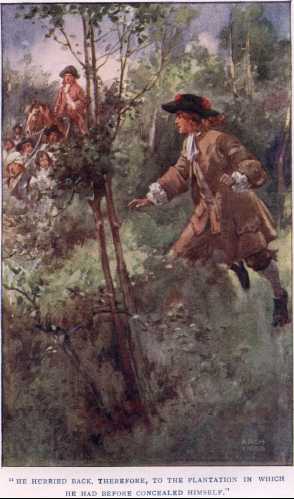
“Your father’s friend Mr Handscombe will certainly find a purchaser,” observed the Colonel. “Now, farewell, my lad, it may be months, it may be years, before you come back; you know not to what part of the world you may be sent. You have acted wisely; continue to do so, and should your life be preserved you will rise in your profession.”
Roger’s other farewells were made, and he mounted his horse. He carried a brace of pistols in his holsters, a sword by his side, and a valise strapped on behind the saddle. John Platt rode with an arquebuss hanging at his back, a good pistol in one holster, and a broadsword which had done duty in the Civil War. The Colonel ordered them to push forward as fast as possible towards London, that they might get clear of the excitement caused by the Duke’s landing, and have less chance of being interrupted. John Platt promised to carry out his master’s instructions.
“They shall pay dear, whether king’s men or rebels, if they attempt to stop us,” he said, as he clutched his big sword, which in his younger days he had used with powerful effect as a trooper under the Colonel, though at present it seemed doubtful whether his arm had still strength enough to wield it. The Colonel gave them his parting charges as they rode out of the court-yard and pushed forward, as they had been directed, towards Salisbury by by-paths with which John Platt was well acquainted. Here and there they met peasants hurrying towards Lyme, who eagerly inquired news of the Duke. Some asked if a battle had already been fought; others said that they understood the Duke had landed with an army of ten thousand men, which by this time had increased to twenty thousand.
“He landed with not ten thousand or not ten hundred either,” answered John dryly. “He may have a thousand or two about him by this time. If you take my advice you will go back home and not risk your necks by joining him.”
The advice, however, was seldom if ever followed, the men looking upon honest John as a malignant. As they advanced they met bodies of militia marching westward under Tory country gentlemen, who considered it their duty to side with the king though they had no personal affection for him. Roger on each occasion had to give an account of himself, and he found some difficulty in persuading some of these zealous Royalists that his intentions were honest. He was allowed, however, to go on, till at length the time came for his separating from John Platt. They warmly shook hands, as Roger did not consider it derogatory.
“Circumspect Master Roger,” said the old man, “do not let strangers get into your confidence; give them the cold shoulder rather; ride straight on; when you arrive at an inn, see to your horse yourself that he gets properly fed; if a stranger enters into conversation, listen to what he may have to say, but give him as little information as you can in return.”
Roger promised to follow the old soldier’s advice, and found it greatly to his advantage. His horse held out well, and by judicious management he contrived to get to London in five days after leaving Eversden. On entering London he found the city perfectly quiet, not the slightest sign, as far as he could discover, of a proposed outbreak, the fact being that the king had arrested all suspicious persons of influence. He inquired his way to the house of Mr Handscombe, who lived not far from the Thames. The cloth-merchant was at home, and received him kindly. He was looking somewhat pale and anxious, and made many inquiries as to what was going forward in the south. Roger gave him all the information he possessed, but Mr Handscombe made but few remarks in return.
“Now, my lad,” he said in a kind tone, “the sooner you get on board your ship the better for you. Captain Benbow is expecting you, and I promised to send you down as soon as you arrived, for I may not remain here long. Before you go you must take some refreshment, and I in the meantime will order a boat to be in waiting.”
“Where snail I find the Benbow frigate?” asked Roger.
“She is not the ship you are to join,” answered Mr Handscombe. “Her Captain has parted with her, and is now in command of a fine king’s ship, the Ruby, of fifty guns, lying at Deptford.”
Mr Handscombe was absent while Roger was taking the food provided for him; he appeared, on his return, in a travelling dress.
“I have made arrangements for the sale of your horse as your father requests me; here is the amount which the animal will probably fetch, put it in your pocket and do not throw it away; and now come along.”
“What, are you going with me, sir?” asked Roger.
“Yes, in the character of your father, going to see you on board your ship. Circumstances make it convenient to be away from London just at present, and the idea has struck me that I could not have a better opportunity. Your chest has been transferred to the Ruby, and you can carry your valise while I carry mine.”