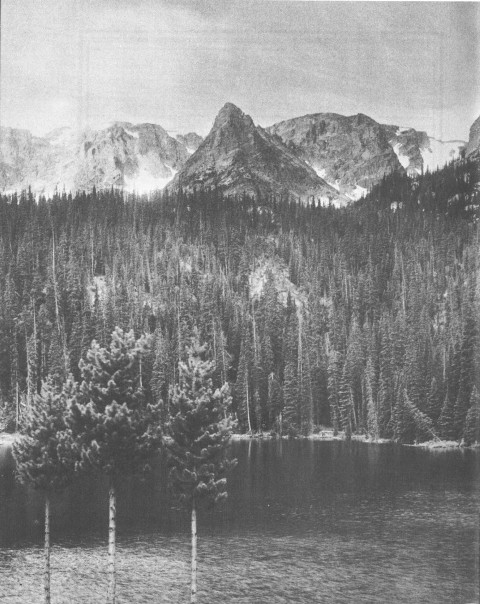
Rocky Mountain National Park
Reading edition
[COLORADO]
United States Department of the Interior
Harold L. Ickes, Secretary
NATIONAL PARK SERVICE
Arno B. Cammerer, Director
UNITED STATES
GOVERNMENT PRINTING OFFICE
WASHINGTON: 1937
DO YOU KNOW YOUR NATIONAL PARKS?
ACADIA, MAINE.—Combination of mountain and seacoast scenery.—Established 1919;—24.08 square miles.
BRYCE CANYON, UTAH.—Canyons filled with exquisitely colored pinnacles.—Established 1928;—55.06 square miles.
CARLSBAD CAVERNS, N. MEX.—Beautifully decorated limestone caverns believed largest in the world.—Established 1930;—15.56 square miles.
CRATER LAKE, OREG.—Astonishingly beautiful lake in crater of extinct volcano.—Established 1902;—250.52 square miles.
GENERAL GRANT, CALIF.—Celebrated General Grant Tree and grove of big trees.—Established 1890;—3.96 square miles.
GLACIER, MONT.—Unsurpassed alpine scenery; 200 lakes; 60 glaciers.—Established 1910;—1,533.88 square miles.
GRAND CANYON, ARIZ.—World's greatest example of erosion.—Established 1919;—1,009.08 square miles.
GRAND TETON, WYO.—Most spectacular portion of Teton Mountains.—Established 1929;—150 square miles.
GREAT SMOKY MOUNTAINS, N.C.-TENN.—Massive mountain uplift covered with magnificent forests.—Established for protection 1930;—617 square miles.
HAWAII: ISLANDS OF HAWAII AND MAUI.—Volcanic areas of great interest, including Kilauea, famous for frequent spectacular outbursts.—Established 1916;—245 square miles.
HOT SPRINGS, ARK.—Forty-seven hot springs reserved by the Federal Government in 1832 to prevent exploitation of waters.—Made national park in 1921;—1.58 square miles.
LASSEN VOLCANIC, CALIF.—Only recently active volcano in continental United States.—Established 1916;—163.32 square miles.
MAMMOTH CAVE, KY.—Interesting caverns, including spectacular onyx cave formation.—Established for protection 1936;—38.34 square miles.
MESA VERDE, COLO.—Most notable cliff dwellings in United States.—Established 1906;—80.21 square miles.
MOUNT McKINLEY, ALASKA.—Highest mountain in North America.—Established 1917;—3,030.46 square miles.
MOUNT RAINIER, WASH.—Largest accessible single-peak glacier system.—Established 1899;—377.78 square miles.
PLATT, OKLA.—Sulphur and other springs.—Established 1902;—1.33 square miles.
ROCKY MOUNTAIN, COLO.—Peaks from 11,000 to 14,255 feet in heart of Rockies.—Established 1915;—405.33 square miles.
SEQUOIA, CALIF.—General Sherman, largest and possibly oldest tree in the world; outstanding groves of Sequoia gigantea.—Established 1890;—604 square miles.
SHENANDOAH, VA.—Outstanding scenic area in Virginia section of Blue Ridge.—Established 1935;—275.81 square miles.
WIND CAVE, S. DAK.—Beautiful cavern of peculiar formations. No stalactites or stalagmites.—Established 1903;—18.47 square miles.
YELLOWSTONE: WYO.-MONT.-IDAHO.—World's greatest geyser area, and an outstanding game preserve.—Established 1872; 3,471.51—square miles.
YOSEMITE, CALIF.—Valley of world-famous beauty; spectacular waterfalls; magnificent high Sierra country.—Established 1890;—1,176.16 square miles.
ZION, UTAH—Beautiful Zion Canyon 1,500 to 2,500 feet deep. Spectacular coloring.—Established 1919;—148.26 square miles.
RULES AND REGULATIONS
Briefed
The Park Regulations are designed for the protection of your property. You, as prudent owners, will help protect the natural beauties and scenery by warning the careless and reporting infractions of the regulations. The following synopsis is for the general guidance of visitors. Full regulations may be seen at the office of the superintendent and ranger stations.
Fires.—Fires may be lighted only when necessary and in designated places. Before leaving, know your fire is out. Help protect this wonderland so all may enjoy it.
Camps.—Automobile campers must stop in the designated camp grounds. All must be kept clean and sanitary. Burn your garbage in your camp fire. Empty cans and residue must be placed in garbage cans. If no can is provided, bury the refuse.
Public property, trees, flowers, and animals.—The destruction, injury, or disturbance of public property, trees, flowers, rocks, birds, or animals, or other life is prohibited.
Fishing.—Fishing is permitted in all lakes and streams except as closed by order of the superintendent. All fish hooked less than 7 inches long shall be carefully handled with moist hands and returned at once to the water. Fifteen fish (not exceeding a total of 10 pounds) shall constitute the limit for a day's catch.
Automobiles.—Obey park traffic rules. Drive carefully at all times. The Speed limit is 20 miles per hour on grades and curves, and on straight stretches of road 35 miles per hour. All roads are patrolled. Automobiles will be stopped for checking at park entrances. Cars carrying passengers for profit are subject to restrictions.
Dogs and cats.—Must be kept securely on a leash while in the park. If you have no leash, keep the animal in your car.
Park rangers.—Are for your protection and guidance. Do not hesitate to consult them. Accidents, complaints, and suggestions should be reported to the superintendent's office immediately.
Events Of Historical Importance
1820 Maj. Stephen H. Long, commanding an exploring party sent out by President Madison in 1819, first sighted Longs Peak. Park area frequented by Arapaho and Ute Indians.
1843 Rufus B. Sage, another explorer, visited the area and later published earliest known description in "Rocky Mountain Life, or Startling Scenes and Perilous Adventures in the Far West During an Expedition of Three Years."
1859 Joel Estes, the first white settler, entered the park and in 1860 built the first cabin.
1865 Charles F. Estes, first white child born in the park.
1868 First ascent of Longs Peak. The climb was made by William N. Byers, Maj. J.W. Powell, and five other men.
1868 Rocky Mountain Jim, adventurer and frontiersman, settled in area.
1869 Earl of Dunraven, famous English sportsman, first visited this area.
1871 The Hayden Geographical Survey, under Dr. E.V. Hayden, worked in this region.
1874 First stage established between Longmont and Estes Park.
1874 Albert Bierstadt, famous artist, first visited the region.
1876 First wedding in the park: Anna Ferguson and Richard Hubbell.
1878 First hotel built by Earl of Dunraven.
1881 First public school established and held in Elkhorn Lodge.
1881 The Denver, Utah & Pacific Railroad built to Lyons and projected to Pacific Ocean through Fall River and Milner Passes by Milner, chief engineer for the company.
1900 Bear Lake fire.
1904 Big Thompson Canyon road completed.
1907 Automobile stage line established between Estes Park and Loveland.
1909 Automobile stage line established between Estes Park and Lyons.
1912 Fall River road begun. Completed in 1920.
1915 Rocky Mountain National Park Act approved January 26.
1927 Bear Lake road completed.
1929 State of Colorado ceded exclusive jurisdiction to Federal Government.
1930 Never Summer Range area added to the park.
1932 Trail Ridge road opened.
Contents
Page
Land of Lofty Mountains 1
Easy to Study Glacial Action 4
Longs Peak 4
Natural Beauties 5
Fauna and Flora 7
Automobile Trips 11
Denver Circle Trip 11
Bear Lake Road 14
Loop Trip 14
Longs Peak and Wild Basin Trip 14
Trail Trips 14
The Flattop Trail 15
Lawn Lake 15
Fern and Odessa Lakes 15
Romantic Loch Vale 18
Glacier Gorge 19
The Twin Sisters 19
Ascent of Longs Peak 19
Chasm Lake 20
Wild Basin 21
Grand Lake 21
What to Do 22
Fishing 22
Horseback Riding and Camping 23
Winter Sports 23
Administration 23
Naturalist Service 24
Public Campgrounds 24
Park Season 25
How to Reach the Park 25
All-Expense Circle Trips 26
Transportation in the Park 26
Accommodations and Expenses 27
Hotels and Lodges on Park Lands 27
Private Hotels, Cottages, and Camps 28
Distances to Principal Points of Interest 28
The Park's Mountain Peaks 32
References 35
Government Publications 37