Chapter IV · RECENT CLIMBS AROUND LANGDALE AND DOE CRAG
Reading edition
Pavey Ark.—Despite the exploitation of Gimmer Crag and other smaller local attractions, this fine mass still ranks as first favourite with most climbers who stray Langdalewards. Yet, though it becomes more and more scarred and scratched with the marks of ‘hob-nailers,’ one curious feature must impress those who visit the crags after several years’ absence. This is the curious encroachment of vegetation. Beautiful as are some of the plants and grasses which cling to the face, the cragsman revels most in seeing and climbing the stern, bare crags. The rarest botanical specimen, if it cumber a handhold, is treated with scant respect. Fortunately the more popular routes are practically free from dangerous vegetation, but recent adventures on some that are less frequented would suggest that a warning note be struck.
The Crescent Climb, which begins around the corner a few yards to the right of the Great Gully, is much spoilt by the exuberance of plant life. The first 200 feet lie altogether up a grassy slope or opening. There are steep, shelving rocks on the right, but these are not approached until an overhanging portion supervenes. Then the main feature of the Crescent begins. This is a traverse below the impending portion. The place is exposed, but the hand and footholds are ample, whilst the anchorage is all that could be desired. After crossing the rocks for about 60 feet, the heathery slopes can be gained that lead up to Jack’s Rake at rather more than half of its length. The deep, narrow rift of Gwynne’s Chimney will now be noticed right ahead, and this gives a splendid finish to the course. In fact, were it not for this attraction the Crescent would scarcely be worth the attention of climbers. The Chimney has walls of exceedingly rough rock, and an oblong-shaped mass of rock may roughly be said to divide it into two portions. The exit is made on the right, and an easy ridge leads upwards. There is plenty of indefinite scrambling until the highest point of Pavey Ark is reached.
The Buttress between the Great and Little Gullies at first sight suggests first-class climbing. Closer acquaintance, however, reveals the presence of so much vegetation and such an indefinite rock structure that the place is disappointing. The ascent had been made many years ago, but no record would appear to have been made until early in 1910, when the late J. Anton Stoop and Mr. Douglas Yeomans discovered a route, which has the merit of individuality. They started from the foot of the buttress about 50 yards to the left of the Great Gully, and adhered as closely as possible to the main ridge, gradually slanting up to the left towards the head of a small side gully which springs out of the Little Gully. The last 80 feet consisted of a vertical face, with a very conspicuous overhanging stone at the corner. The face was climbed by a chimney which had been seen from below, just to the left of the corner. The chimney consisted of two parts, with a chock-stone at the top. Above this the climb can be varied considerably; the upper rocks of Pavey Ark are famous for their wonderful gripping and ripping qualities, and they are here at their best.
A good deal of indefinite scrambling has been undertaken on the walls of the deep opening at the easterly end of the cliff—marked C on Mr. Jones’ line drawing facing p. 203. Two routes on the left-hand wall are worth passing mention. Gibson’s Chimney is a well-marked cliff in the upper part of the opening. Large cairns mark the start and the finish. There are two definite pitches, which in all afford about 50 feet of straightforward backing up practice.
Benison’s Chimney, which rises between Gibson’s Chimney and Rake End Chimney, is built on a different mould. It consists of a series of ill-defined scoops somewhat resembling the Shamrock Chimneys on the Pillar. The place is nearly 200 feet high. It reeks with danger and rank vegetation; moreover, loose holds occur at crucial points. The most difficult section occurs about 150 feet above the start. A steep bit of rock about 15 feet high has to be ascended. There is practically only one satisfactory hold on this stretch; the ulterior support is grass; and the base of operations is a quivering, turf ledge, which threatens to come away momentarily. Thus no help can be afforded the leader, whose troubles are further accentuated by a lack of anchorage. The writer trusts that few climbers will be attracted by Benison’s Chimney.
Gimmer Crag has of late years received much attention from rock enthusiasts. The shapely buttress is a conspicuous feature of the Langdale Pikes, especially when seen from the direction of Blea Tarn. The full height of the crag, which is singularly firmly weathered, is nearly 400 feet. It thrusts itself aggressively forth from the grassy spur which joins Pike O’ Stickle with Harrison Stickle. Yet, until the late Andrew Thomson, of genial memory, described its opportunities so recently as 1901, climbers scarcely seemed to realise the existence of Gimmer Crag. There are now three distinct climbs of exceptional merit and two important variations, whilst on either side of the main crag plenty of indefinite scrambling and short gully problems can be enjoyed.
The Gimmer Chimney.—This obvious cleft starts at the foot of the Crag to the right of, and lower down than the nose of, the buttress. The first serious difficulty occurs about 40 feet up, where the direct ascent of the chimney becomes impossible, and a traverse is made to the right. After an awkward upward movement has been made it is possible to force a way back into the chimney by swinging on a good handhold. The second obstacle is of the strid variety, followed by a shallow groove, with the best holds on the right wall. This gives out below a well-defined chimney, which is difficult to enter, being, as its engineering discoverer aptly described it, ‘bell-mouthed.’ Above this a traverse to the right is made, whence a chimney with holds on the right wall enables some grassy higher ledges to be reached. The final chimney is wide at the beginning, but narrows near the top, where a rib of rock protrudes and leaves a narrow but safe passage on the right.
The two face routes A and B, with their variations, start from a terrace, which extends for some considerable distance across the face. This is about 90 feet above the commencement of the Chimney Climb, and may best be reached by way of a small, slanting gully filled with bilberry bushes, now known as the Bilberry Shute. It may be most convenient first to mention the most direct ascent up the nose of the buttress; this is known as Oliverson’s variation of the A Route. This starts just to the left of the ‘Nose,’ and after about 40 feet of steep practice on comparatively small holds, a ‘three-step’ traverse is made to the right on the crest of the ‘Nose,’ whence the way lies directly upwards to the ‘belay.’ To follow the original A and B Route from the terrace a course to the right of the ‘Nose’ is followed up a rough slab crowned with broken rocks, beyond which a sloping rock ledge is gained. This may be recognized by its having a shallow ‘crevasse’ separating it from the main crag. At the further and lower end of this ledge from the point at which it is reached a leaf of rock, abutting against the base of a depression in the wall above, marks the start of a short pitch, which brings the climber to the ledge where the routes divide. This has been called Thomson’s Ledge.
A Route.—From Thomson’s Ledge a traverse to the left is made in order to continue the A Route; a recess is soon entered, out of which the way lies almost directly upwards for quite 40 feet to the ‘belay,’ where Oliverson’s Variation joins the old route about 80 feet above the terrace. A traverse to the left is then made to the foot of the shallow Lichen Chimney, the ascent of which is the stiffest part of the course, and almost 60 feet of rope is used by the leader before the second man can be brought forward from the ‘belay.’ The last pitch consists of a narrow chimney, with the best holds on the right wall, which finishes abruptly at the top of the crag.
B Route.—Starting from Thomson’s Ledge a traverse is made to the right in an upward direction until a corner is turned and the foot of Amen Corner, a 15-foot pitch of extreme severity, is reached. This is a slanting crack on a rock wall that overhangs, as also does the other wall, which forms the corner. The best method of surmounting this is to grip the upper edge of the crack and walk up the other edge with the body nearly horizontal at first, and the hands and feet close together.
From the top of this pitch a ledge, known as the Gangway, which slopes outwards and upwards, is followed for about 30 feet to a small grass platform, and the Green Gully rises straight overhead. This is awkward to enter directly, and it may be better to ascend some 15 feet on the right, whence a stride can be taken into the bed of the gully. For quite 70 feet the ascent is not difficult, and at that height the leader reaches the anchorage of the Crow’s Nest. This is a small hollow in the right wall, and it is attained by making a short traverse, where the hands do most of the work. Very little assistance can be given to those following, as the rope tends to pull the climber from his holds, but anchorage can be found by threading the rope behind the handholds which were used on the traverse.
The gully can be climbed to the summit, but being grassy and loose in places, it is preferable to finish up the sound arête directly above the Crow’s Nest.
A variation which finishes up with this section can be made by way of an upward traverse to the right from the top of the 40-foot corner on the A Route, and this would join the Green Gully about 15 feet below the Crow’s Nest. It might also be mentioned that both above and below Amen Corner traverses can be effected to the right to join the Gimmer Chimney.
The deep, wide gully to the left of the main crag possesses one cave pitch, which may be passed on the right of the chock-stone, but this may be avoided altogether by keeping to the right throughout. The other gullies on the west side of Gimmer Crag afford good scrambling, but here again the difficulties are too easily obviated.
Climbers staying at Langdale could spend an enjoyable day by walking over to Grasmere and thence visiting the crags in Easedale or Deer Bield’s Crag in Far Easedale. After the climb is over it makes a delightful finish to the day to return to Langdale over the fells by Codale and Stickle Tarns.
The Tarn Crag above Easedale Tarn is a prominent feature in a favourite landscape. Quite recently Mr. J. Stables unearthed, literally, a route thereon which gives about 200 feet of quite good, sound climbing. The beginning lies in a line below the left of the highest point, and cairns now mark the way. The passage from the first chock-stone pitch to the recess, with the ensuing face traverse, will be found the most difficult section of the ascent.
Deer Bield’s Crag in Far Easedale is quite an hour’s walk away from Grasmere. Its height is nearly 300 feet; and a buttress runs up the centre, with impossible-looking chimneys on either side. That on the left is still unclimbed, but the one on the right yielded to the attack of Messrs. Stables and Turner in 1908. They found at least half-a-dozen difficult pitches, the fourth proving to be the stiffest of all. The rock on Deer Bield’s Crag is firm and reliable, but singularly free from good ledges for hands and feet. Upward progress is made by using the numerous cracks which are a curious feature of the structure.
For an off-day there is no more pleasant spot in Langdale than the vicinity of the Oak How Needle, which is perched on the side of Lingmoor, below the upper crags. Its situation is almost opposite a point on the coach road about half a mile beyond Chapel Stile when going towards Dungeon Ghyll. The outstanding mass makes a good photograph. The ascent of the short side is easy, but a crack on the front of the rock may be considered decidedly difficult.
The outline of Bowfell as seen from near the head of Windermere is one of the most massive and picturesque in Lakeland. The Langdale Pikes are perhaps more arresting at first sight, but a longer study of the mass to their left conveys a sense of grandeur and stability lacking in the more famous ‘twin peaks of Langdale.’
The Links of Bowfell are well worth a visit from climbers passing from Dungeon Ghyll to Wastdale, for they offer a pleasant contrast to the exposed buttresses of Gimmer Crag. Unlike most of our rock-faces, they have a southerly aspect, overlooking Eskdale and Three Tarns. The gullies, starting at the eastern end of the crags, are numbered from one to eleven, but only Nos. 4, 5, and 6 contain good climbing. The others are a suitable practice ground for novices.
It is well to start operations in No. 4, which has two pitches of interest, and then descend by way of No. 3 to the foot of No. 5. The large pitch at its foot is quite entertaining, and upon the occasion of its first ascent, on a day of pouring rain, offered a stubborn resistance before capitulating on the right. Above it, easy going takes one quickly to the top of the crags, and thence around to the foot of No. 6.
This also possesses a good pitch of the chock-stone variety near its foot. The way up it lies straight to beneath the ‘capstone,’ which bars direct progress. It is then feasible to work out under the stone on the right until an upward move can be made to the top of the pitch. On the occasion of the first ascent, in September 1897, by Messrs. C. R. B. Storry, G. H. McKilburn, and the writers, the upper part of the pitch was topped by loose stones; even nowadays it is well for the following climbers to take cover under the capstone, both for their own safety and to belay the leader as he scales the pitch.
The Bowfell Buttress is a more serious proposition, and as a climb the route found up it, in December 1900, by Messrs. Shaw, Oppenheimer, Craig, Hargreaves, and West, compares in point of difficulty and length with the North Climb on the Pillar, if the latter ceased immediately above the Nose.
The Buttress faces N.N.E., overlooking Mickleden, and is best reached from Langdale by following ‘the Band’—the long, grassy spur running down towards Stool End Farm—about two-thirds of the way to the top of Bowfell. From here it is best to contour around to the right and thence along, bearing obliquely upward, to the foot of the Crags.
The work starts at the lowest point of the Buttress, and, to quote Mr. Oppenheimer’s lucid account, ‘after 30 feet of broken rocks, the foot of a long chimney is passed, and a 10-foot chimney to the right of it, with an awkward pitch, taken. This leads, in another 10 feet, to a small terrace running down to a gully on the right. The next 50 feet is an upward traverse to the left, into the long chimney, soon after entering which a good sentry-box affords a stopping-place.
‘After 40 feet straight up the long chimney the latter ends on a grass terrace, which slopes down to the right and broadens considerably; following this, for 20 feet, a rather difficult vertical crack is reached. From the shelf at the top of the crack 50 feet up, bare rough rocks lead to a grassy corner. Here there is a very convenient large block, to which the second man should belay himself as the leader advances to the left along a very exposed upward traverse, with little handhold, into a small rock corner.
‘The best plan here is to climb to the right, away from the corner, and then to the left over the top of it, on to a grassy patch sloping away to the left, beside a fine belaying pin. To the right of this a chimney starts: 40 feet up there is a small pitch; then another 40 feet on sloping slabs to the right with a wall to the left, leads to the top of the Low Man, where a cairn has been placed.
‘Twenty feet more of easy scrambling leads to the top of the buttress, which is separated from the mass of Bowfell by a narrow neck, from which scree gullies descend on either side.’
A few short scrambles can be found amongst the crags above Angle Tarn on Hanging Knott, but the terrace-like formation of the rocks hereabouts is of greater interest to the geologist than to the climber. Flat Crags, and the wild recesses of Hell Ghyll and Crinkle Ghyll, have been visited by the fraternity, but their reports of these localities are quite unfavourable, except as regards their scenery.
Doe Crag.—At the time of the writing of Jones’ chapter on this fine cliff, most of the routes up the best rock faces in the district were exhausted, and short variations had become the order of the day.
Doe Crag was the one great climbing ground which had many new, unexplored courses upon it, and the almost certain knowledge Jones had of their existence is evident to all who read his chapter in the present book. These delightful descriptions of the gullies are in every way accurate at the present time, except that the Intermediate Gully is now ascended direct over every pitch; it is only necessary in this Appendix to carry the tale through another epoch—the Buttress epoch.
This started in March 1903, when Mr. F. Philipson and the writers made the ascent of the two most prominent buttresses. Since that time the various remaining buttresses and their subsidiary ridges have been ascended in such detail and thoroughness as characterize the nail-scratched rocks of Scawfell and the Pillar. These courses are now described, irrespective of merit or difficulty, as they occur from left to right as one stands facing the crags at a point slightly above Goat’s Water. The nomenclature is that adopted by Mr. G. F. Woodhouse in his excellent monograph, and by those who later made virgin ascents on this magnificent crag. It but remains to be said that, whereas the gullies are almost exclusively for expert and ultra-expert parties, the buttresses offer climbs which in many cases may be safely undertaken by parties of moderate strength.
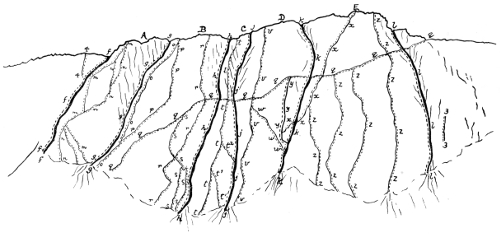
Doe Crag, seen from across Goat’s Water
A A Buttress. B B Buttress. C C Buttress. D D Buttress. E E Buttress. f Easy Gully. g Great Gully. h Central Chimney. j Intermediate Gully. k Easter Gully. l North Gully. m A Buttress Climb. Original Route. n A Buttress Variations. o B Buttress. Broadrick’s Route. p The Lion’s Crawl. q Easy Terrace. r B Buttress. Original Route. s B Buttress. Woodhouse’s Routes. t C Buttress Climb. t^1 C Buttress Climb Variation. t^2 Branch exit from Intermediate Gully. v D Buttress Climb. w Blizzard Chimney. x Easter Gully. Jones’ Route and continuation up E Buttress. y Easter Gully. Broadrick’s Crack. z E Buttress Climbs. 3 The Real Chimney. 4 Woodhouse’s Crack.
A Buttress is the magnificent bastion which separates the Easy Scree Gully from the Great Gully. Unlike the other buttresses, which afford good climbing only for about 200 feet above their bases, the best sport is to be obtained in its higher reaches. The climbing starts at about the centre of the buttress, where is a cairn, but a vast overhanging precipice forces the climber away diagonally to the left along a narrow, grass ledge, which dwindles until, at a considerable height above the screes, an awkward corner is rounded. This can be reached by two distinct variations starting lower down and to the left of the route described, both of which are very stiff. Above this a thin crack is ascended for about 30 feet until a large ledge is attained. Here a choice of routes is available. A cave pitch straight ahead can be ascended on the right wall and, after ascending some broken rocks, a traverse to the right discloses an interesting chimney, above which the serious climbing ceases. An easy gully leads to this cave pitch direct from the Easy or Little Gully.
For very strong parties a fine variation is to traverse diagonally upward to the right from the large ledge, treading the upper edge of the huge overhanging crag already referred to, until a fine chimney is entered. This is difficult, but the anchorage is good. A few feet above it an exposed traverse is made away to the right until the foot of a most sensational crack is reached. This can be climbed, or the traverse continued somewhat further until upward progress can be made by a zigzag course almost overhanging the upper confines of the Great Gully. To Messrs. Ormiston-Chant, Craig Gordon, and Parker most of the fine variations on this buttress have fallen.
B Buttress offers several good climbs, the most recently discovered of which—the Giant’s Crawl—starts at the foot of the Great Gully and, after striking straight upwards for about 100 feet of exceptional severity, follows a well-defined slab diagonally to the right for about 250 feet. It then doubles back to the left and thence to the top of the crags.
Some years ago Messrs. R. W. and H. C. Broadrick made a very fine climb up the crest of the retaining wall of the Great Gully. This started from the same point as the Giant’s Crawl, but instead of continuing across the face to the right they struck upward over some poised and shattered blocks and came upon the well-defined crest referred to; thence, by continuously steep and sensational rocks, which, however, afford good holding, they forced a way to the crest of the crags—one of the best and longest routes up the Buttresses.
A few feet below the foot, and to the right of the Great Gully, a wide broken terrace or rake gives easy access to the heart of the crags, and all the other good climbs on B, C, and D Buttresses to be described, finish on this terrace.
Some considerable distance below the start of the terrace, and at about the lowest extremity of B Buttress, a thin crack starts up to the right. This marks the start of the route by which the Buttress was first climbed. The crack gives out upon a grass ledge about 30 feet above the screes. Beyond this a somewhat awkward stretch of climbing brings one below some overhanging rocks, which entail a flank movement to the left until a conspicuous recess is reached. The continuation above this is most exhilarating, a steep exposed face of rock which takes the climber into an ideal situation, and which claims his entire attention in the continuation of its enjoyment. Two chimneys on either hand have both been climbed, but the ascent of the rock-face should not be missed. It finishes on the Easy Terrace. Above this the Buttress evidences a lack of continuous climbing, and the time will be better spent by descending the terrace and thence round to the foot of the Central Chimney.
After ascending the easy rocks at its foot for about a hundred feet, a detached pinnacle is a prominent object on the left. Messrs. Woodhouse found that by passing behind this a fine chimney could be entered and ascended to a grassy ledge at its top. A pleasing variation is to be had by passing below the pinnacle, whence a steep slab recommends itself to the gymnast, and, after a strenuous pull on the arms, lands him at the foot of the chimney mentioned above. From the grassy ledge above it the route can be varied in many ways, but the best sport lies across to the left for a few feet, where a chimney of real difficulty forms the lowest of a series of pitches of great merit.
C Buttress separates the Central Chimney from the Intermediate Gully, and throughout its entire length is set at a very high angle. It offers little temptation to stray from the line of least resistance, and the climbing is better defined than on most of the Buttress routes. For a hundred feet or so the holds are large and plentiful, but the climbing is interesting withal, until further progress in the same line is barred by impending rocks.
After traversing slightly to the right some steep slabs provide excellent sport until a good belaying pin is reached. Again discretion suggests a flank movement, this time slightly downwards to the left, and thence, after rounding a corner, upward progress is made to a grass ledge.
The scenery hereabouts is magnificent, and a few minutes can be well spent in viewing the formidable difficulties of the Central Chimney, the greater part of which is now visible. It appears anything but inviting, and most people will be content with merely looking. Our Buttress also has become difficult, and the next move up some steep slabs, which terminate on a wide grassy ledge awkward of access, is one necessitating considerable care and skill on the part of the leader.
A little beyond this, on the right, is a steep chimney leading downward to the Intermediate Gully, at a point immediately below the difficult pitch. This branch chimney was first ascended by the brothers Woodhouse, and is stiff.
The continuation of our climb now begins to lose interest, and before long we find ourselves at the foot of the final pitch of the Central Chimney, whence the going is comparatively easy.
D Buttress, separating the Intermediate and Easter Gullies, is, in the writers’ opinion, the most entertaining and prettiest problem of all. In its lower reaches it is quite easy and apt to disappoint until, at the same height as the difficult pitch of the Intermediate Gully, it rises almost vertically for above a hundred feet.
The way lies up a vertical arête, which recalls most strongly some of the Coolin Ridges. The holds are sound and rough, but none too large—just sufficient to leave a fair margin of safety in a very exposed position. This delightful stretch gives out at an excellent belay, beyond which the interest continues unabated for 50 feet or so, until it ceases on a wide grass platform. Shortly beyond this the Easy Terrace is again reached.
Before dealing with the easy climbs of the E Buttress, mention must be made of three fine chimneys, two of which have been climbed since Jones wrote his description of the Easter Gully. On page 235, after he had ascended the first pitch of the Gully and attained the ‘great hollow’ above it, he refers to ‘splendid branch gullies up to the ridges on either side.’
Two of these branch gullies were climbed many years ago, that on the left-hand wall, now called the South Chimney, by Mr. H. C. Broadrick, and its counterpart on the North Wall by the brothers Woodhouse.
This latter is known as the Black Chimney. It is deeply cut, and looks most forbidding. A closer acquaintance dispels most of its terrors, for the holds are excellent, and the fearsome upper capstone can be rounded on the right-hand side with comparative ease. It is, however, well worth a visit, and the continuation up the E Buttress is not lacking in interest.
Lower down than the South Chimney—a pretty problem in ‘backing up’—a rectangular opening in the crags, almost immediately above the first pitch of the Easter Gully, claimed the attention of Messrs. Woodhouse, Westmorland, and the writers in April 1910. A heavy blizzard of snow and hail, which fell at the time they made its first ascent, suggested the name Blizzard Chimney, and this was adopted. It has always seemed rather a pity that the majority of the names on Doe Crag are so prosy; the latter-day climbers have lacked the happy knack of giving distinctive names to their exploits.
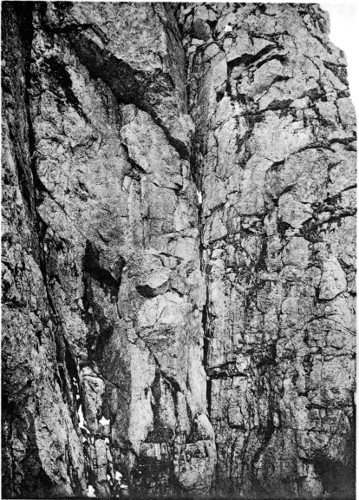
G. P. Abraham & Sons, Photos Keswick
THE BROADRICK’S AND HOPKINSON’S CRACKS DOE CRAG
The most awkward part of the Blizzard Chimney is at its foot; to effect an entry is not easy, but once attained and an exposed bulge climbed by the crack on the left, the rectangular opening is reached, and the way lies up the left-hand wall of this. After about 90 feet of moderately difficult climbing the chimney gives out on the D Buttress.
E Buttress presents a variety of fairly easy climbs. None of these possess sufficient individuality or difficulty to demand a detailed description; the routes of greatest interest are shown on the outline drawing facing p. 370. These climbs supply a real want on Doe Crag, and render the climbing upon it, from ‘easy’ to ‘exceptionally severe,’ graded to an ideal degree.
Beyond the North Gully there is no climbing of sustained interest, but the Real Chimney, a curious cleft enclosed on all sides, possesses unique features. It is about 150 feet above the foot of the crags, some distance to the right of the North Gully.
The North Gully itself was first climbed in 1901 by the Messrs. Barton, and again by the writers two years later. Since then it has been visited several times. After climbing to the under side of the chaos of jammed boulders which form the great pitch, a narrow ledge will be noticed running outward along the left wall. The feat of traversing along this with practically no support for the hands, and a fearsome drop below, led to the inclusion of the Gully amongst the ‘exceptionally severe’ courses, and rightly so. Just when the ledge dwindles to nothing, a good hold can be reached with the left hand, and then a severe struggle upwards discloses good holding above. Thence the going is easier, and the top of the boulders can soon be attained. Away at the opposite end of the crags, a hundred feet to the left of Slingsby’s Pinnacle in the Great Gully, and at about the same level is a fine crack which the brothers Woodhouse first climbed in 1905. The lowest 35 feet are of about the same standard of difficulty as the Doctor’s Chimney on Gable Crag; indeed the crack as a whole is about as long and of as great merit as its more popular counterpart on Great Gable, and is very well worth a visit.
It but remains to be said that the first pitch of the Great Gully can be climbed direct up the left-hand side of the boulder without the aid of a threaded rope—a most strenuous effort—and that the two pitches of the Intermediate Gully (which Mr. Jones obviated in the manner described in his chapter) are amongst the very finest in the whole of the Lake District.
Other climbs in the Coniston district have been discovered recently by enthusiastic members of the Fell and Rock-Climbing Club.
Sylvan Chimney is one of the best of these. It lies to the left of Church Beck, and is the most conspicuous cleft in the splintered mass of rock between Boulder Valley and Lever’s Water, being situated 300 or 400 yards below the tarn.
(Boulder Valley is the fine upland hollow running from the foot of the falls below Low Water in the direction of Lever’s Water.) The Chimney affords about 120 feet of fairly difficult climbing.
A few yards to the left of Sylvan Chimney is Gouldon Gully, which gives a rather longer but somewhat easier climb. A slab of about 70 feet provides excellent practice in neat footwork. Above it a 100-foot chimney proves interesting, but unfortunately is somewhat earthy in its interior.
Colonel Crag, the boss of rock at the foot of Paddy End, at about the same height as Sylvan Chimney, has also been thoroughly explored and climbed, but is scarcely worth a visit; indeed it is to be feared that the proximity of Doe Crag would lead to the utter desertion of vastly more entertaining places than these latest additions to the Coniston climbs.