"Robin Tremayne" (continued 5)
Reading edition
“But, Father Rose, men must see to public matters, and wear velvet robes, and carry weights of all fashions—why, the world would stand still else!”
“Must men do these things, Master Ferris? yet be there two ways of doing them. Believe me, there is one other thing they must do—they must meet Christ.”
A jovial, merry, gallant gentleman was George Ferris; and a Protestant—of some sort. But he outlived the persecution. It was not of such stuff as his that martyrs were made. The gorgeous pageants were over, and the bitter suffering came back.
Parliament was opened on the 13th of November, with a solemn mass of the Holy Ghost, the Queen herself being present in her robes; but as soon as the mass began, the Archbishop of York, and the Bishops of Lincoln and Hereford, rose and attempted to walk out of the House. Hands were laid on the Bishop of Lincoln, and his Parliament robe taken from him; and upon confession of his faith, (which he made boldly) he was cited before the Council. The Archbishop and the Bishop of Hereford were suffered to depart for that time; but rumour ran that Hereford would soon be deprived, being a married priest. Perhaps he was not made of metal that would bear the furnace; for God took His child home, before the day of suffering came. The rough wind was stayed again in the day of the east wind. But on the 14th of November came a more woeful sight. For the prisoners in the Tower were led on foot to the Guild Hall, the axe carried before them, there to be judged. First walked the Archbishop of Canterbury, his face cast down, between two others. Then followed the Lord Guilford Dudley, also between two. After him came his wife, the Lady Jane, apparelled in black, a black velvet book hanging at her girdle, and another open in her hand. After her followed her two gentlewomen, and Lords Ambrose and Henry Dudley. The Archbishop was attainted for treason, although he had utterly refused to subscribe the King’s letters patent for the disinheriting of his sisters.
Late in the evening Mr Ive looked in, to say that he hath spent all the day at the Guild Hall, and brought the sad news that the gentle Lady Jane and all the Lords Dudley were condemned to death. It was expected, however, that the Queen would not suffer the sentence to be executed on her own cousin Lady Jane. The Archbishop, Mr Ive told them, came back to the Tower, looking as joyful as he had before been cast down. He was entirely acquitted of treason, and remanded to be tried for heresy; for which he blessed God in the hearing of the Court.
“One step more,” said Mr Rose to Avery, whom he met in Cheapside. “The old service-book of King Henry must now be used, and the new of King Edward put away; and in every church in London shall the mass be next Sunday or Monday. And Saint Katherine’s Eve shall be processions, and Saint Nicholas shall go about as aforetime.”
So, slowly and darkly, closed the black year, 1553.
Married priests forbidden to minister—the English Service-Book prohibited—orders issued for every parish church to provide cross, censer, vestments, and similar decorations of the House of Baal—mass for the soul of King Edward in all the churches of London. It was not six months since the boy had died, with that last touching prayer on his lips—“Lord God, preserve this realm from Papistry!” Was that prayer lost in the blue space it had to traverse, between that soul and the altar of incense in Heaven? We know now that it was not. But it seemed utterly lost then. O Lord, we know not what Thou doest now. Give us grace to wait patiently, to be content with Thy promise that we shall know hereafter!
There was one bright spot visible to the tear-dimmed eyes of the Gospellers, and only one. The Parliament had been prorogued, and the Bloody Statute was not yet re-enacted. All statutes of premunire were repealed, and all laws of King Edward in favour of reformation in the Church. But that first and worst of all the penalties remained as yet in the oblivion to which he had consigned it. But in recompense for this, there was a very black cloud darkening the horizon of 1554. The Queen had announced to her Parliament her intended marriage with Prince Philip of Spain. All the old insular prejudices against foreigners rose up to strengthen the Protestant horror of a Spanish and Popish King. The very children in the streets were heard to cry, “Down with the Pope and the Spaniards!” Elizabeth would have known how to deal with such an emergency. But Mary was blind and deaf. Disregarding this outbreak of popular feeling, she went on, in the way which led to her ruin and England’s. It was only one of the two which was irremediable. The one was followed by a summer day of glory; the other closed only in the night of death.
The first news which reached the Lamb in 1554, was the startling information—if any information can be called startling in that age of sudden and shocking events—that the night before, Mr Ive had been hastily apprehended and committed to the Marshalsea. He was soon released, unhurt; but this occurrence quickened Mr Underhill’s tardy movements. He had already made up his mind to remove from the Limehurst, where his abode was too well-known to the enemy; the arrest of his friend and neighbour determined him to go at once. He took “a little house in a secret corner at the nether end of Wood Street,” Cheapside. About Epiphany was born Susan Bertie, the only daughter of the Duchess of Suffolk. Shortly before this the Emperor’s Ambassadors came over to treat concerning the Queen’s marriage, and were pelted with snowballs by children in the streets of the City. The vacant sees were filled up by Popish divines; Cardinal Pole was invited to return to England (from which he had been so many years exiled), in the capacity of Legate; the Queen dissolved the Court of First Fruits, and commanded that the title of “Head of the Church in earth” should be omitted from the enumeration of her titles in all future documents. Permission granted to Lady Jane to walk in the Queen’s garden and on Tower Hill revived for a moment the hopes of the Protestants so far as concerned her. No harm would come to her, they sanguinely repeated, if the Queen were left to herself. Possibly they were fight. But what likelihood was there that Gardiner would so leave her? and—a question yet more ominous—what might Philip of Spain require in this matter? Men not yet sixty years of age could remember the time when, previous to the marriage of Katherine of Aragon, the Earl of Warwick, last surviving male of the House of York, had been beheaded on Tower Hill. Once before, the royal blood of England had been shed at the demand of Spain: might the precedent not be repeated now? The only difference being, that the victim then was a tercel gentle, and now it would be a white dove.
In the middle of January, before his removal from the Limehurst, and when he was sufficiently recovered to “walk to London an easy pace,” Mr Underhill made his appearance one afternoon in the Minories. He came with the evident intention of telling his own story.
“And would you,” said he, “hear the tale of my examination and imprisonment?”
“That would we, and with a right good will,” answered Dr Thorpe, speaking for all. “We do know even what Mr Ive could tell us, but nothing further.”
“Then what Ive could not tell you,” resumed he, “take from me (these incidents in Underhill’s life are given almost entirely in his own words). I guessed (and rightly so) what was the cause of mine arrest; to wit, a certain ballad that I had put forth against the Papists, and for that I was a Sacramentary. Well, when I came into the Tower, where the Council sat, they were already busied with Dr Coxe and the Lord Ferrers; wherefore I was to wait. So I and my two men went to an alehouse to dinner in the Tower, and after that repaired to the Council chamber door, to be the first taken, for I desired to know my lot. Then came Secretary Bourne to the door, looking as the wolf doth for a lamb; unto whom my two keepers delivered me, and he took me in greedily. The Earl of Bedford was chief judge, next the Earl of Sussex, and Sir Richard Southwell; and on the side next me sat the Earl of Arundel and Lord Paget. By them stood Sir John Gage, the Constable, the Earl of Bath, and Mr Mason; at the board’s end stood Sergeant Morgan and Secretary Bourne. And the Lord Wentworth stood in the bay window. Then my Lord of Bedford (who was my very friend, owing unto the chance that I had to recover his son, as I told you aforetime; yet would not now seem to be familiar with me, nor called me not by my name), said,—‘Did not you set a ballad of late in print?’—I kneeled down, saying, ‘Yes, truly, my Lord; is that the cause I am called before your Honours?’—‘Marry,’ said Secretary Bourne, ‘you have one of them about you, I am sure.’—‘Nay truly, have I not,’ said I.—Then took he one out of his bosom and read it over distinctly, the Council giving diligent ear. When he had ended,—‘I trust, my Lord,’ said I, ‘I have not offended the Queen’s Majesty in the ballad, nor spoken against her title, but maintained it.’—‘You have, sir,’ said Morgan. ‘Yes, I can divide your ballad, and make a distinction in it, and so prove at the least sedition in it.’—‘Yea,’ I said, ‘you men of law will make of a matter what ye list.’—‘Lo!’ said Sir Richard Southwell, ‘how he can give a taunt! You maintain the Queen’s title with the help of an arrant heretic, Tyndale.’—‘You speak of Papists there, sir,’ said Mr Mason. ‘I pray you, how define you a Papist?’—‘Why,’ said I, ‘it is not long since you could define a Papist better than I.’ With that some of them secretly smiled, as the Lord of Bedford, Arundel, Sussex, and Paget. In great haste Sir John Gage took the matter in hand. ‘Thou callest men Papists there,’ said he; ‘who be they thou judgest to be Papists?’—‘Sir,’ said I, ‘I do name no man, nor I am not hither to accuse any, nor none I will accuse; but your Honours do know that in this controversy that hath been, some be called Papists and some Protestants.’—‘But we will know whom thou judgest to be Papists, and that we command thee upon thine allegiance to declare.’—‘Sir,’ said I, ‘I think if you look among the priests in Poules, ye shall find some old mumpsimuses there.’—‘Mumpsimuses, knave!’ saith he, ‘mumpsimuses! thou art an heretic knave!’ and sware a great oath.—Says the Earl of Bath, ‘I warrant him an heretic knave, indeed.’—‘I beseech your Honours,’ said I (speaking to the Lords that sat at the table, for these other that stood by be not now of the Council), ‘be my good Lords. I have offended no laws, and I have served the Queen’s Majesty’s father and her brother long time, and in their service have spent and consumed part of my living, never having as yet any preferment or recompense, and the rest of my fellows likewise, to our utter undoing, unless the Queen’s Highness be good unto us; and for my part I went not forth against her Majesty, notwithstanding I was commanded, nor liked those doings.’—‘No, but with your writings you will set us together by the ears,’ saith the Earl of Arundel.—‘He hath spent his living wantonly,’ saith Bourne, ‘and now saith he hath spent it in the King’s service; which I am sorry for: he is come of a worshipful house in Worcestershire.’ (Note 4)—‘It is untruly said of you,’ said I, ‘that I have spent my living wantonly. I never consumed no part thereof until I came into the King’s service, which I do not repent, nor doubted of recompense if either of my two masters had lived. I perceive you are Bourne’s son of Worcester, who was beholden unto my uncle Wynter, and therefore you have no cause to be my enemy, nor you never knew me, nor I you, before now, which is too soon.’—‘I have heard enough of you,’ said he.—‘So have I of you,’ said I, ‘how that Mr Sheldone drave you out of Worcestershire for your behaviour.’—With that came Sir Edward Hastings from the Queen in great haste, saying, ‘My Lords, you must set all things apart, and come forthwith to the Queen.’—Then said the Earl of Sussex, ‘Have this gentleman unto the Fleet, until we may talk further with him.’ (Although I was knave before of Master Gage.)—‘To the Fleet?’ saith Master Southwell, ‘have him to the Marshalsea!’—‘Have the heretic knave to Newgate!’ saith Master Gage again.—‘Call a couple of the guard here,’ saith Bourne, ‘and there shall be a letter sent to the keeper how he shall use him, for we have other manner of matters with him than these.’—‘So had ye need,’ said I, ‘or else I care not for you.’—‘Deliver him to Mr Garret, the Sheriff,’ said he, ‘and bid him send him to Newgate.’—‘My Lord (said I unto my Lord of Arundel, for that he was next me, as they were rising) I trust you will not see me thus used to be sent to Newgate; I am neither thief nor traitor.’—‘Ye are a naughty fellow,’ said he; ‘ye were alway tuting in the Duke of Northumberland’s ear, that ye were.’—‘I would he had given better ear unto me,’ said I; ‘it had not been with him then as it is now.’—Mr Hastings pushing by me (mine old adversary, with whom I had been aforetime wont to reason touching the Sacrament), I thought good to prove him, although he threatened before now.—‘Sir,’ said I, ‘I pray you speak for me that I be not sent unto Newgate, but rather unto the Fleet, which was first named. I have not offended. I am a gentleman, as you know, and one of your fellows, when you were of this band of the Pensioners.’—Very quietly he said unto me, ‘I was not at the table, Mr Underhill, and therefore I can say nothing to it.’ But I think he was not content with the place I was appointed to. Well, I count Ive told you all he saw, touching my progress to Master Sheriff, and thence to Newgate. But while I waited in the Sheriff’s house, my Lord Russell heard my voice, and showed very sorry for me; and sent me on the morrow twenty shillings, and every week as much while I was in Newgate. I count Ive told you moreover of my sickness.”
“Ay, and of the ill savours and noise that you could not abide,” said Dr Thorpe; “and of your changing of your lodging; and how Dr Record did visit you, and divers other things.”
“Then he told you all,” said Mr Underhill. “And now (for ’tis past nine of the clock) this great knave, rogue, and heretic, must be on his way home.”
Mr Underhill left behind him a new ballad which he had lately published. Since it probably does not exist in print now, it shall be subjoined, and in the orthography of its author.
“Love God above all thyngs, and thy neyghboure as thy selffe; Thatt this is Crist’s doctryne, no mane cane it denye; Wyche litle is regarded in Yngland’s common wealthe, Wherefore greate plags att hande be, the realme for to distroye. “‘Do as thow woldest be done unto,’ no place here he cane have, Off all he is remised, no mane wyll hym reseave; Butt pryvate wealthe, thatt cursed wreche, and most vyle slave, Over all he is imbraced, and ffast to hym they cleave. “He thatt hathe this world’s goode, and seeth his neyghboure lake, And off hym hathe no compassyone, nor showithe hym no love, Nor relevithe his nesessite, butt suffers hym go to wrake, God dwellithe nott in thatt mane, the Scriptures playnely prove. “Example we have by Dyves, thatt dayntilye dide fare, In worldely wealthe and ryches therein he dide excell, Off poore Lazarous’ mesery he hadde theroff no care, Therfore was sodenly taken and tormentide in Hell.” (See Note 5 for explanations.)
Ten quiet days followed. For many a month afterwards, quietness was only to be remembered as a lost luxury.
“Have you the news?” inquired Mr Underhill, suddenly opening Avery’s door, and coming in hastily.
“I have heard you put that question five-and-twenty times,” responded Dr Thorpe.
“Well!” he answered, “you may hear it yet again so many. There is like to be some trouble.”
“Then that is good news,” said the doctor, sarcastically, “for during some time there hath been trouble, not there hath been like to be.”
“What is it, then, Ned?” inquired John.
“Why,” answered he, “the Lord Cobham and Tom Wyatt be up in Kent, and my Lord Warden of Dover, and many another, to resist the Queen’s marriage, and to remove certain councillors from her, which (as I take it) is another way of spelling Stephen Gardiner’s name: and my Lord of Suffolk, and his two brothers (John and Thomas Grey), are fled from Shene (on pretence of going to the Court), no man knows whither: and Rochester Bridge is taken of one set of rebels, and Exeter of them in Devon—”
“Alack the day!” cried Isoult, her Devon blood stirring.
“And five hundred harnessed men are called to take the field against Wyatt. We Pensioners go down to White Hall to guard the Queen.”
And Mr Underhill shut the door, and they saw no more of him.
There was some trouble. On the 30th of January, the old Duke of Norfolk and others marched against Sir Thomas Wyatt, but the same night they came back in disorder, flying over London Bridge with only a fourth part of their company. Mr Brent, the Lamb’s next neighbour, who was one of the little army, came home with his “coat turned, and all ruinated, and not a string to his bow.” They brought news that Wyatt was coming fast on Southwark.
On the 1st of February came the Queen herself to Guild Hall, her sceptre in her hand, which was a token of peace; and Bishop Gardiner attending her, which was a token of blood. She made an oration to the people, which she had learned without book; and when it was done,—“O how happy are we,” cried Bishop Gardiner, “to whom God hath given such a wise and learned Queen!” Which outcry Dr Thorpe said was “as good as proof that the Bishop himself writ the oration.”
Wyatt and his company entered Southwark on the eve of Quinquagesima Sunday, by four o’clock; and before five he had made a bulwark at the bridge-foot, and fortified himself; but the Queen’s men still held the bridge against him. The next morning, Mr Rose, with Mrs Rose and Thekla, came to the Lamb, read the service out of the Prayer Book, and preached: but they were afraid to sing. At nine o’clock on Tuesday morning Wyatt drew off his men, seeing that he could not take the bridge, and turned towards Kingston.
In the evening came in Mr Underhill, in armour, with his pole-axe in his hand, which he set down in a corner, and sat down and talked for an hour.
“So Wyatt is gone?” said Dr Thorpe.
“Gone about to strengthen himself,” answered Mr Underhill. “He is coming back, take my word for it. He said unto his soldiers that he would pay them the next time in Cheapside; and unto the men that held the bridge quoth he,—‘Twice have I knocked, and not been suffered to enter; if I knock the third time I will come in, by God’s grace!’”
“What did you at the Court?” said Dr Thorpe. “Is good watch kept?”
Mr Underhill laughed.
“Marry, I did nothing,” said he, “for I was not suffered. I put on mine harness, and went up into the Queen’s chamber of presence, where were all her women weeping and wringing their hands, like foolish fluttering birds, and crying they should all be destroyed that night. And then Mr Norris, the Queen’s chief usher, which was appointed to call the watch, read over the names from the book which Moore (the clerk of our check) gave him; but no sooner came he to my name than quoth he,—‘What! what doth he here?’—‘Sir,’ saith the clerk, ‘he is here ready to serve as the rest be.’—‘Nay!’ saith he, and sware a great oath, ‘that heretic shall not watch here! give me a pen.’ And so strake my name off the book. So Moore cometh to me, and ‘Mr Underhill,’ saith he, ‘you are not to watch; you may depart to your lodging.’—‘May I?’ said I; ‘I would be glad of that,’—thinking I had been favoured because I was not recovered of my sickness; but I did not well trust him, because he was also a Papist. ‘Marry, I depart indeed,’ said I; ‘will you be my discharge?’—‘I tell you true,’ said he, ‘Mr Norris hath stricken you out of the book, saying these words—That heretic shall not watch here: I tell you true what he said.’—‘Marry, I thank him,’ said I, ‘and you also; you could not do me a greater pleasure.’—‘Nay, burden not me withal,’ said he, ‘it is not my doing.’ So away went I, with my men and a link. And when I come to the Court gate, I fell in with Mr Clement Throgmorton (that was come post from Coventry to the Queen with tidings of the taking of the Duke of Suffolk) and George Ferris,—both my friends, and good Protestants. So away went we three to Ludgate, which was fast locked, for it was past eleven of the clock, and the watch set within, but none without. And lo’ you, for all our calling, and declaring of our names, and the like, would they not open the gate. Mr Throgmorton cried to them that he would go to his lodging within, and Mr Ferris said he was sent with weighty affairs to my Lord Will Howard within: but they did nought but laugh, and at long last said they had not the keys. ‘What shall I do?’ said Mr Throgmorton; ‘I am weary and faint, and I wax now cold. I am not acquainted hereabout, nor no man dare open his doors in this dangerous time, nor I am not able to go back again to the Court; I shall perish this night.’—‘Well,’ said I, ‘let us go to Newgate; I think I shall get in there.’—‘Tush!’ said he, ‘it is but in vain; we shall be answered there as we are here.’—‘Well,’ said I, ‘and the worst fall, I can lodge ye in Newgate: you know what acquaintance I have there, and the keeper’s door is without the gate.’—‘That were a bad shift!’ said he; ‘I had almost as lief die in the streets; yet I will rather wander again to the Court.’ Howbeit, I did persuade them to try at Newgate; and there found we my friend Newman to be constable of the watch, which saith, ‘Mr Underhill! what news, that you walk so late?’ So he let us through the gate with a good will, and at long last we reached each man to his lodging.”
At four o’clock on the morning of Ash Wednesday, London was awoke by drums beating all through the streets of the city. John and Robin rose hastily, and went out to ascertain the cause. They came in shortly, saying that the drums beat for all soldiers to arm and repair to Charing Cross, for that Wyatt was seeking to come in by Westminster, and had reached as far as Brentford. About one or two o’clock, Wyatt came, and marched past Charing Cross, without hindrance (except that as he passed Saint James’s the Earl of Pembroke fell upon his rear), and so marched along the Strand, and up Fleet Street, until he came before Ludgate. There they knocked to come in, falsely saying that the Queen had granted their request and pardoned them; but Lord William Howard was not to be thus deceived, as others had been on the way. His answer was a stern cry of “Avaunt, traitor! thou shalt not come in here.” For a little while Wyatt rested upon a seat at the Belle Sauvage gate; but at last, being weary of this pastime, he turned back on Charing Cross. When he reached Temple Bar the Queen’s horsemen met him, and the battle began. When he saw the fight going against him, Wyatt yielded. And so Sir Maurice Berkeley and others brought him and his chief captains to Court, and at five o’clock they were taken to the Tower by water. And as they passed in, Sir John Bridges, the Lieutenant, ungenerously upbraided the prisoner, saying that “if it were not that the law must justly pass upon him, he would strike him with his dagger.” To whom Wyatt answered, “with a grim and grievous look”—“It were no mastery now.” And so they passed on.
Thus was Wyatt’s rebellion quashed. The stars in their courses fought against him.
Note 1. In addition to his cruel persecution of the Gospellers, he had been a notorious libertine.
Note 2. Cott. Ms., Appendix, twenty-eight, folio 93, 94.—Miss Strickland says (Lives of the Queens, three, page 459), that this was Mary, wife of James Basset; but the Tallies Roll for 2-3 Philip et Mary distinctly names this lady as one of Queen Mary’s maids of honour, in recording the payment of her pension—“Anna Basset, virginis Reginae.”
Note 3. Harl. Ms. 425, folio 92, 93.
Note 4. Underhill is a Warwickshire family, but Anne Wynter, the mother of Edward Underhill, was a Worcestershire woman.
Note 5. Notes on this poem. See Harl. Ms. 424, folio 9. Plags means plagues. “Wealthe” means “personal interest.” “Wreche” means “wretch.” “Lake” means “lack.” “Wrake” means “wrack.”
Chapter Nine.
Who paid the Penalty.
“And make me die the thrall of Margaret’s curse— Nor mother, wife, nor England’s counted Queen.” Shakespeare.
Few hours had been tolled on the great clock of Saint Paul’s, or had rung across the water from the Tower guns, ere England knew what was the vengeance to be taken. Once more royal blood was shed upon Tower Hill; once more England stooped to commit murder at the dictation of a foreign power. The white dove was sacrificed.
About ten o’clock on the morning of the 12th of February, Lord Guilford Dudley was beheaded on Tower Hill. It is plain that he died a Protestant, seeing that no priest was present at his death. And like the fiends they were, his executioners brought him, both going to the scaffold, and his dead body in returning, past the windows of Partridge’s house, where his poor young wife had her lodging. They let her—that tender bird of seventeen short summers—from her chamber lattice see all the horror she could see, and feel all the agony she could feel; and then they brought her forth, to die also.
Calmly and quietly, as though she had been going to her forfeited throne, she came forth to her death. And she was going to her throne. For she was one of Christ’s martyrs, and sat upon His throne with Him.
She spoke very little on the scaffold; only saying that “though she had consented unto the setting up of herself against the Queen’s Highness, yet was she innocent of all procurement or desire thereof: and that she died a true Christian woman, looking for eternal life unto the passion of Jesus Christ only, and to none other; and she thanked God, that had given her space to repent; for when she was younger, and did know the word of God, she had neglected the same, and had loved her own self and the world.” And then she said to Dr Feckenham, “Shall I say this Psalm?”
Feckenham—a man of the Jesuitical type, renowned for the softness and sweetness of his manners—bowed assent. Then the victim prayed through the Fifty-first Psalm, and prepared herself for the sacrifice. The hangman knelt down and asked her forgiveness: she replied, “Most willingly,” and “I pray you, despatch me quickly. Will you take it off before I lay me down?” Poor child! The executioner was the one who dealt with her most gently and respectfully. He said, “No, Madam.” So she handed her gloves to one of her women, and her book to Sir John Bridges, and tied the handkerchief over her eyes. Feeling about with her hands for the block, she said,—“What shall I do? Where is it? Where is it?” One of the bystanders guided her hand to it. Then she laid down her head; and saying, “Lord, into Thy hands I commend my spirit!” her head fell with one stroke. She was out of Philip’s way now. And the angels of God, for whose company she exchanged a society somewhat less angelic, were not so likely to account her in their way.
A fearful day was that from dawn to dusk. Half an hour after the execution of Lady Jane, Lord Courtenay (but a few days before made Earl of Devon) was brought into the Tower; he would not declare the cause of his coming there, saying he could not tell; “but,” added he, “let the world judge.” All the evening the noise of hammers was going in the City, for the gallows were set up everywhere. There was one at every gate of the City, and at the bridge-foot one; four in Southwark, one at Leadenhall two in Cheapside, six or eight in Fleet Street and Charing Cross—nor were these all.
Throughout London all the prisons were so full that the less important prisoners were kept in the churches, by eighty in a group. Dr Thorpe said, “If they hang all the Queen’s subjects, there will be small fear of a new rebellion.” Men greeted each other fearfully, scarcely knowing if they should ever meet again. But the worst fears of all were awakened for the Archbishop, Bishop Ridley, and Mr Latimer, within the Tower, and for Mr Rose outside it. On the 15th of February, Isoult Avery wrote in her diary—
“In Southwark all this day were the gallows at work, till I am sick at heart for every sound I hear. The gallows at Aldgate, I thank God, cannot be seen from our windows, being hid by the gate. If it could, I scantly know what should come of us. I dare not go forth of the door, lest I meet some awful sight that I may not forget to my dying day.
“God Himself showeth His displeasure by fearful sights from Heaven. Two suns should this morrow be seen in the sky, and this even was a rainbow over London, turned the diverse way, the arch on the ground, and the points on high. I dare not think what shall come next, either on earth or in Heaven, unless Christ Himself (that scarce ever was more wanted) would rend the heavens and come down to save us. Yea, Amen, Lord Jesus, come Thou quickly!”
But no sign of the Son of Man flashed on that weary land. Not yet was accomplished the number of the elect; and until the last sheep was gathered into the fold, there could be no hastening of the kingdom.
The execution of Lady Jane’s father quickly followed her own. He died, as men of his stamp often do, better than he had lived. The “subjection to bondage from fear of death,” in which he had spent his trembling life, vanished before death came to him. Boldly and bravely this timid, shrinking soul stood forth at the last, telling all the world that he died in the faith of Christ, “trusting to be saved by His blood only, and by no other trumpery.” Strange words from one of the weakest men that ever lived!—yet it is the special characteristic of Christ’s strength that it is “made perfect in weakness.” It may be chiefly when His children come to die that they understand the full meaning of that passage, “He hath abolished death.” For our faith, as it has been said, is a religion of paradoxes. Strength, whose perfection lies in weakness,—life, which is founded upon a death—glory, which springs out of shame and suffering. When the Twelve heard that, to draw all men unto Him, the Master should be lifted up from the earth, it probably never dawned upon their minds that the scene of that exaltation was to be the cross. News that made men tremble came before the end of February. The Lady Elizabeth had been summoned to Court—was it for life or death?—and Bishop Bonner had issued a commission of inquiry concerning all in his diocese, with orders to present all persons who had failed to frequent auricular confession and the mass. Many fell away in this time of temptation—Sir William Cecil (afterwards Lord Burleigh) and his wife Mildred, amongst others. The Duchess of Suffolk held on her way unwavering. Annis Holland’s second letter, which had been delayed, reached Isoult Avery in the beginning of March.
“Unto my right entirely beloved friend, Mistress Avery, that dwelleth at the sign of the Lamb, in the Minories, next without Aldgate, beside London, be these delivered.
“My Very well beloved Isoult,—My most hearty and loving commendations remembered unto thee. Sithence my last writing have I made a most woeful discovery, the which I would almost I had not done. But thou shalt know the same.
“An even of late, I was alone in my chamber sewing, having sent Maria forth to buy certain gear I lacked. And being so alone, I began to sing lowly that hymn of Saint Bernard—‘Hic breve vivitur, hic breve plangitur,’ (Note 1) when of a sudden I was aroused from my singing by a sound like a groaning, and that very near. I hearkened, and heard it again. One was surely moaning in the next chamber. Thinking that one of the bower-women might be evil at ease and lack one to help her, I crept forth from my chamber, and, listening at the door of the next, heard plainly the moaning again. I laid mine hand on the latch, and entered.
“It was a large chamber, airy, but not light. All the windows were high up in the wall. There was a bed, divers chairs, and a table; and by the table sat a woman apparelled in black, her arms laid thereon, and her head upon them. Her face showed much pain. She lifted her head slowly as I came towards her, and then I saw that she had the face of a stranger. ‘Who is it?’ she said in a whispered voice. ‘My name, Señora, is Ines de Olanda,’ said I. ‘Meseemeth you lack ease. Could I in any wise bring it unto you?’ ‘Ay, I lack ease, muchacha’ (which is to say, maiden), quoth she. ‘I lack rest. But that lieth in—the grave.’ She spake slowly and uncertainly. ‘Whence comest thou?’ she said again. ‘Thy tone is not of these parts.’—‘Señora,’ said I, ‘I am a stranger from England.’—‘And how camest thou hither?’ quoth she. ‘As reader of English unto the Queen’s Highness,’ said I. ‘How much hast thou read unto the Queen?’ she asked, and smiled.
“Her smile lighted up her face marvellously. It was not a fair face. I misdoubt if it were ever such. Her hair is near white now; but though her complexion were good, and her eyes shining and dark grey, her features must have been alway something harsh and strong. ‘Nothing at all, Señora,’ then said I; ‘for it is now three months sithence my coming, and yet had I never the honour to see her Highness.’—‘Traitors!’ quoth she angrily; and her features grew harsher than ever. I stood in silence. ‘Thou art not a Lutheran?’ she said suddenly. ‘Methinks it should fare ill, Señora, with any that were so here,’ I made answer, desiring to be discreet. ‘Is that any answer to my question?’ she said, knitting her brows. ‘Señora,’ said I, trembling greatly, ‘I cannot tell a lie, even though you may betray me. I am a Lutheran.’—‘I betray thee!’ she said pitifully. ‘Poor child! whoso doth that, it will not be I. I am under the same ban.’—‘Señora!’ I cried, much astonied, ‘you are a Lutheran? here, in the Queen’s Palace.’—‘Doth that amaze thee?’ she answered with another smile. ‘Then a second thing I can tell thee will do so yet more:—I am the Queen.’
“I set myself upon my knees afore her Highness, so soon as my astonishment would give me leave. ‘They do not burn me,’ she said, in the slow uncertain way wherein she had spoken at first. ‘I think they scarce liked to do that. But I had suffered less; for then it had been over long ago. They say I am mad. And it doth seem sometimes as if somewhat in my head were lost,’ she saith, pressing her hands wearily upon her brow. ‘It was Doña Isabel, my mother. She used to give me the cuerda!’—‘Señora,’ I answered, ‘craving your Highness’ pardon, I, being a maid from strange parts, know not that word cuerda!’—‘Have they the thing in your land?’ answered the Queen heavily. ‘Did they try that on my poor sister, your Princess of Wales (Katherine of Aragon)? Ay de mi!’—‘I know not,’ said I, ‘under the gracious pleasure of your Highness, what the thing is.’—‘Look!’ she said, pointing with her thin, trembling hand.
“I looked whither she pointed, and in the further corner of the chamber I saw a frame of pulleys set in the ceiling. But it came not presently to my mind wherefore they were there. ‘They set those short sticks under my arms,’ the Queen said, speaking heavily as it were with sleep. ‘Then they jerk up the pulleys, and I have to go up with them. It hurts very much. I think I scream sometimes, and then he beats me for disturbing people. They alway do it at night. They say I need it, and I am mad. I marvel if they cure mad people so in England. And I think if they did it sometimes in the day, it would not disturb people so much. You see, I understand it not—at least they say so. But I fancy I understood better before the cuerda.’
“I was silent from very horror, as the fearful truth dawned slowly upon me. ‘Ay de mi!’ sighed the Queen again, leaving her head fall back upon her arms. ‘My father never used to do so. They say ’tis by his command. I marvel if they tell me the truth.’—‘Who dareth to do thus unto your Highness?’ I said at last. ‘Denia,’ she said, in the same dreamy fashion, ‘and them he bringeth with him. They want me to confess, and to hear mass. I think they make me go sometimes, when that thing in mine head is lost. But if I know it, I resist them.’
“Again she lifted her head, and her voice grew more resolute. ‘Muchacha, I have been here twenty-six years. All that time, in this chamber! They left me two of my children at the first. Then they took the Infant Don Fernando from me. And all my heart twined round my little maid,—my last-born, my Catalina! So they took her. I never knew why. I never did know wherefore they began at all, save for listening to some French friars that came to see me. And they told me very good things. God was good, they said, and loved me, and Jesus our Lord had taken away all my sins. And it was good to think so. So then they beat me, and set me in the cuerda; and they called me an heretic, and a Lutheran, and all the bad words they knew. I do not think the holy angels at the gates of Paradise will turn me away, nor call me an heretic, because I thought Jesus had taken away my sins. If this be Lutheranism, then I am a Lutheran—then I will be a Lutheran for ever! And those were good friars, that came from Paris. They say the Observants are the ones I should believe. The Queen Doña Isabel set Observants about me. But the Observants beat me, and put me in the cuerda; and the Good Men (Note 2)—the French friars—said Jesus our Lord loved me, and had taken away all my sins. That was the better Evangel of the two. That thing in my head goes wrong when they give me the cuerda. But when I can sit quiet like this, and they will let me alone a little while, I love to think of Jesus our Lord, and of His taking away all my sins. I know not wherefore I should be beaten for that. It is my head, thou seest.’
“Poor, poor lady! I felt great tears running down my face, and dropping on my gown as I knelt. ‘Ay Señora mia!’ I said, so well as I could falter it, ‘Jesus, our dear Lord, hath taken away all our sins that do believe in Him. He loveth your Highness, and if you will cling to Him, He will have you to dwell with Himself at the end of this life.’
“I felt I must use words easy to be received, for her understanding seemed gone, and like unto that of a little child. ‘Ay doncella mia!’ she sighed, ‘I shall be glad when the end of this life is come.’
“And she laid down her poor head so wearily. ‘When the Lord seeth good,’ I answered. ‘Sometimes,’ she said dreamily again, ‘I want so sorely to go forth. I long so much to breathe the sweet, cool air—to see the cork-trees and the olives. They never bring me so much as an orange flower. Then my head goes wrong, thou seest, when this longing cometh on me; and then—. And sometimes I feel sick, and cannot eat. Then they make me eat with the cuerda. I wish Jesus would make haste and help me. I used to understand it all better before I had the cuerda. But I had my husband then, and my children around me. Not one of them ever comes now; and there are six (Note 3). My husband is dead—I think he is; they say so (Note 4). I think they might have let one of them come, if only just to say “Mother” to me. I cannot understand it now; and it seems so long—so long! Ay de mi! if Jesus would come!’
“I could not utter another word ere Rosada brake in. ‘Ines!’ she cried in a loud whisper; ‘what do you here? Know you not, amiga, that the Lord Marquis will well-nigh kill you if he find you in this chamber? None of her Highness’ women are ever allowed to enter at will. Back, back, as fast as you can go!’
“Then, kneeling a moment, she said hastily, ‘Criada umilisima de Su Alteza!’ (‘The most humble servant of her Highness.’) and arising, pushed me forth of the chamber, and into mine own, almost before I knew what she had said or done. Five minutes later, my Lord of Denia his steps sounded in the corridor. ‘Thank the holy Virgin and all the saints!’ cried Rosada under her breath. ‘Amiga, you know not that man. He would not hesitate one minute to stab you if he found you there, and fancied any cause of suspicion against you. ’Tis forbidden ground—Maria sin pecado (without sin)! How came you in such peril? I knew her never before left alone even a moment.’—‘I did but hear her Highness moaning,’ I said bewilderedly, ‘and was moved to go to her.’—‘The Devil must have moved you!’ she saith breathlessly. ‘I think rather,’ I answered, ‘saving your presence, Rosada, and not intending you, it was the Devil pushed me forth hither.’—‘You mean my Lord Marquis?’ quoth she, taking me rightly. ‘The saints pardon her Highness! You know she is quite out of her mind. She saith all manner of evil of him.’
“I thought it better, perchance, to make no answer. But into my mind came a remembrance touching a way wherein the fools should not err; and I thought she should maybe come in at the gates of Heaven afore either Rosada or I.
“O Isoult! I would I were forth of this horrible country! It is peopled with devils. Leonor is not one, methinks; nor assuredly is Rosada, neither this my poor sely maiden Maria; but I should find it hard to write a fourth within this palace.
“I may not make my letter much longer. Prithee tell me some news of England, if any be; and shouldst thou hear ought of my gracious mistress (the Duchess of Suffolk), I would like much to know it.
“I do well-nigh wish I had not gone into that chamber! and yet, if I have in any wise comforted her, it is well. It hath maybe done her some little good to pour forth her sorrows to me for a minute. But now I never awake of a night but I listen for those fearful screams. I thank God, I have not heard them again as yet. Methinks her gossips did blunder in naming her Juana; they should have called her Dolores (sorrows).
“I pray thee, make mine hearty commendations to Mr Avery and all other that I know; and kiss thy little Kate for me. And so I commend thee to the tuition of God. From Tordesillas, this fourteenth of August.—Thine own assuredly,—
“Annis Holland.”
When we look back over the way which the Lord has led us these forty years in the wilderness, we sometimes find in retrospect the Marahs no sadder than the Elims. Nay, there are times when the Elims are the sadder.
“A sorrow’s crown of sorrow Is, remembering happier things.”
There was much sorrow of that class for the Gospellers at this time. Ease and liberty had gone already: they were followed by the cruel agony of parting. Within fourteen days of the 25th of February, every married priest in the diocese of London was commanded to be deprived and divorced. The first would have been a sufficiently bitter draught, without the added desolation of the second. On the table before Isoult Avery lay a sheet of paper, containing a few lines of uneven writing. They were blotted with tears, and were signed “Marguerite Rose.” Their purport was to ask for shelter at the Lamb, for a few weeks, until she could see her way more clearly. Thekla herself brought her mother’s letter. There were no tears from her, only her face was white, and worn, and weary.
“And you have not wept, Thekla?” said Isoult.
“There are tears enough elsewhere,” she said, and shook her head. “I cannot weep. It would ease me, perhaps, if I could.”
“These fiends of men!” cried Dr Thorpe, who was not renowned for weighing his words carefully when he was indignant. “Is it because they cannot drive nor persuade us into the sin and unbelief of Hell, that they be determined we shall lose none of the torment of it, so far as lieth in their hand to give us? Shall God see all this, and not move? Have they banished Him out of the realm, with other strangers?”
“Bitter words, Dr Thorpe!” answered Robin, softly. “‘Shall God cast away His people, whom He foreknew?’ From them that are lights in the world, shall He who is the Light of the World depart? Nay, ‘when we pass through the waters He will be with us.’”
“They are dark waters for some of us,” whispered Thekla under her voice.
“But not fathomless, dear Thekla,” replied Robin. “There are footsteps before us, though we may not see them; and at the dreariest, there is God above us.”
“I hope so,” responded Dr Thorpe. “I am afeard, Robin, thou shalt say I am an unbeliever and a fool; but it doth look mainly as if He had fallen asleep, and the Devil had stole the reins of the world out of His hands.”
“Not an unbeliever,” said Robin, in his gentle manner; “only a believer in the dark. ‘Lord, carest Thou not that we perish?’ They were not unbelievers that said that. But you well know the answer—‘How is it that ye have no faith?’”
“’Tis main hard to get hold of it, lad!” said Dr Thorpe, more quietly, but with some choking in his voice.
“’Tis harder to do without it,” answered Robin.
Dr Thorpe never twitted Robin with his youth now. On the contrary, he seemed to respect him, as one who with few years had amassed much wisdom.
There was only one unpleasant element in the grant of a refuge to Mrs Rose. It would lock the doors of the Lamb on the beloved pastor. Where she was, he must come no more. The chief element of comfort was Thekla. She could have free access to both her parents, so long as they remained at liberty; and Mr Rose might yet be heard to preach in the houses of other Gospellers.
“Isoult,” said Dr Thorpe, coming in, a few days after this woeful letter had been received and answered, “for all the late ’headings, there be fools left in the realm.”
“Troth,” said she, laughing, “I never cast doubt else.”
“Why,” pursued he, “if they hang up all the wise men, what else shall be left? But list the marvellous news. Yesterday, a parcel of lads did gather in a field by Saint James, for to have a game of childre’s play.”
“Is that such news?” said John.
“Hold thy peace till I have made an end,” said Dr Thorpe. “These childre in their playing (as childre will) did elect to follow their fathers in their late diversion; and one half of them should be the Queen’s men, and the other half Wyatt’s men. And so rough was their play, that the lad which stood for the Prince of Spain was caught of Wyatt’s side, and half strangled of them. But in the midst thereof, ere he were full hanged, come the watch, and took all the young rebels into custody, as well the one side as the other.”
“I take it they boxed their ears and let them go,” said John.
“Do you so?” answered Dr Thorpe. “Not by no manner of means, worthy Sir; but this day are the great and mighty rebels on their trial afore the Queen’s Council, and the statesmen of this realm do sit in sad debate what shall be done with them. I had counted that the lad which was half hanged should have been enough punished for his state crimes; but maybe they think not so, but shall hang him out. But saw you a copy of the Queen’s Majesty’s ordinances?”
“Nay,” replied John. “What be they?”
“It were well to know them,” he answered. “These be they:—
“First, all the statutes of King Henry touching religion shall be put in force. No Sacramentary shall be admitted to any benefice; all married priests shall be deprived, but more lenity shall be shown to them whose wives be dead (to wit, I take it, they shall not be divorced from their dead wives). If they shall part by consent, and shall promise to commit the crime of matrimony no further, they may be admitted again, at discretion of the Bishop, but in no case to the same benefice. No religious man shall be suffered to wed. Processions, Latin service, holy days, fasts, and all laudable and honest ceremonies, shall be observed. Homilies shall be set forth. Men shall go to their parish church only. Suspected schoolmasters shall be put forth, and Catholic men put instead. And lastly, touching such persons as were heretofore promoted to any orders, after the new fashion (hark to this, Robin!) considering they were not ordained in very deed, the Bishop of the diocese, finding otherwise sufficiency and ability in these men, may supply that thing which wanted in them before, and thus according to his discretion permit them to minister.”
“Now here is a knot to untie: how say you concerning the divorce of such men, not again ordained of the Bishops? If they be not priests, then they need not to be divorced: or, if they be divorced, then are they priests.”
“Friend,” said John, “there is no better man in this world than Dr Gardiner for getting round a corner; and where he may not come round the corner, he hath Alisaunder’s sword, to cut the knot with no more ado.”
The blow fell at last, and the home in Leadenhall Street was broken up. Mr Rose himself brought his wife and daughter to the Lamb on the evening of the 10th of March, which was the last allowed for all married priests to separate from their wives. Doubtless the parting was very painful; but it passed in private, and the Averys too much reverenced his sorrow to suffer him to depart otherwise than in silence. Only John walked with him to his desolate home, and he told Isoult that not a word was spoken by either, but the clasp of Mr Rose’s hand at parting was not to be lightly forgotten.
The lads who had mimicked the rebellion were whipped and imprisoned for three days, and then released, by the Queen’s own command. On the 12th of March, the Archbishop, Dr Ridley, and Mr Latimer, set out for Oxford, where they were—ostensibly, to maintain their theories in a public disputation; really, to be martyred. Dr Hooper went part of the way with them. He was going to Gloucester—to the same end. For a week, Thekla flitted backwards and forwards between her parents; generally spending her mornings with her father, and the evenings with her mother. Robin constituted himself her guard in all her journeyings.
Sunday was the day after his bereavement, and Mr Rose was silent; but the following Sunday he preached at Mr Holland’s house, where the Gospellers gathered to hear him. Thekla remained with her mother; she would not leave her alone with her sorrowful thoughts. It was a rainy morning, but in the days before umbrellas were invented, rain was less thought of than it has been since. John Avery and his wife, Dr Thorpe, Esther, and Robin, set forth, despite the rain. Before they had gone many yards, they overtook a crowd of people, all running riverwards; and Isoult, looking towards the water, fancied that she could see the standard of the royal barge.
“Whither away?” asked John of some of the crowd.
But no answer was vouchsafed, except a cry of “The Tower!” till suddenly Mr Underhill hove in sight, and was questioned at once.
“What, know you not what all London knoweth?” said he; “that the Lady Elizabeth’s Grace is this morrow a prisoner of the Tower? ’Tis very true, I warrant you: would it were less! This moment is the Queen’s barge at hand with her. Will you see?”
“Have with you,” said Dr Thorpe, who never missed a sight, if he could possibly help it.
The rest went on. Mr Rose looked older, they thought, and more worn than was his wont; but his voice was as gentle and his smile as sweet as ever. He came to them as soon as they came in, and wanted to know all they could tell him of Mrs Rose and Thekla, though his eyes asked rather than his lips; yet his first words were a query why Thekla was not with them. His sermon was on three words of David, “He shall live.” And first he showed that David spoke this of Christ, by prophecy: and then divided his subject into three heads—“He hath lived,” “He doth live,” “He shall live.” And under the first head, he pointed out how from all eternity Christ had lived with the Father, and was His delight, rejoicing alway before Him; and how then He had lived a little babe and a weary man upon this earth defiled with sin, amidst a people who knew Him not, and would not receive Him. Then coming to the next part, “He doth live,” he showed what he now does, standing before the throne of God, within the true veil and beside the better mercy-seat, presenting in Himself every one of His people, and pleading every moment for them. And lastly, “He shall live.” He shall come again; He shall reign over the earth; He shall live for ever. And “because He liveth, we shall live also.” If He could die again, then might we. But He dieth no more, having died once for us; and we that believe in Him, He having died in our stead, can never die the second death. He hath abolished death, as well for His Church as for Himself: He that is the Living One for evermore holdeth the keys of Hell and of death. And for this cause, even the natural death, not one can suffer except by His permission. Mr Rose bade his hearers not to fall into the blunder that evil men held their lives in their hands. “Christ hath the keys, not they. If they be suffered to take our lives away, it is because we have ended our work, and He calleth us home to Him. And what child ever went home from school that went not gladly, except indeed he had an ill home? Let us not bring up an evil report of that good Land, by unwillingness to go Home.” Coming back, they found Dr Thorpe returned, and talking with Thekla.
“She is the manliest woman ever I saw in all my life!” cried he.
Thekla made no answer, except a smile; but it disappeared as soon as she saw her friends, and coming forward, she began to talk in a low tone with Robin.
“There is small praise for somebody,” said John. “Who is it—my Lady Elizabeth’s Grace?”
“Even so,” replied Dr Thorpe.
“Well, and how went the matter?” said he.
“Why,” he answered, “they took her in at the drawbridge by the Traitor’s Gate. And, the barge arrived there, my Lord Treasurer sent my Lord of Sussex to desire her Grace to land. ‘Nay, that will I not,’ quo’ she. Nor could she, in very deed, unless she had gone into the water over her shoe. My Lord of Sussex then went back from her to my Lord Treasurer, and brought word that she would not come. Then said my Lord Treasurer roughly, ‘She shall not choose.’ And all this while sat she in the rain. So my Lord Treasurer stepped forward and did proffer his cloak for her to tread on. Then up rose my Lady Elizabeth, and put back my Lord Treasurer’s cloak with her hand, with a good dash. And setting her foot upon the stair, she saith stoutly, ‘Here landeth the truest subject, being a prisoner, that ever landed at these stairs.’ To whom my Lord Treasurer—‘So much the better for you, Madam.’ So in went she, as manly as ever did man; and Sir John Gage shut up the gates upon her. She hath the stoutest stomach ever I saw. If all the men were hanged through England, there should be yet one left in her.”
On Good Friday the Marquis of Northampton was released from the Tower. Dr Thorpe said, the Queen “played at see-saw with my Lord of Northampton, for he is in the Tower this day and out the next, and so over again.” In the afternoon of Easter Sunday, Esther and Mrs Rose went out together. When they returned, Mrs Rose went up quickly to her own chamber; and Esther drew her mistress aside.
“Why, Esther, what is the matter?” said Isoult.
“Methinks I had better tell you,” replied she. “I would I could have helped it; yet the Blessed saw not good. As we came back through Poules, there was set up on a board a long list of all the priests in this diocese which have been divorced from their wives by decree of my Lord of London; and them that had parted by consent were set by themselves. And in this list—”
“Good lack!” cried Isoult. “Saw you Mr Rose’s name?”
“She saw it,” said Esther in a low voice, “though I did essay to turn her away therefrom by bidding her to observe the fair carving on the other side the way; but it was to no good. She caught the two names—‘Thomas Rose’ and ‘Margaret Van der Velde.’ And she brake forth when she saw them. I thank the All Merciful we two were alone in the cloister.”
“But what said she?”
“‘Margaret Van der Velde!’ she cried. ‘I am not Margaret Van der Velde! I am Marguerite Rose. I have borne his name for two and twenty years, and shall I cast it off now at the Bishop of London’s bidding? No, not if he were the Pope and the whole College of Cardinals!’ Then she fell into French and Spanish mixed together. And ‘Parted by consent!’ quoth she. ‘Ay Dios! que veut-on dire? what consent is there? They thrust us asunder with halberds, and then say we have parted by consent! God! art Thou in Heaven, and dost Thou see all this?’ she cried.”
“Poor soul! And what saidst thou, Esther?”
“I said little, only essayed to draw her away and to comfort her. It is hard work to bear such things, I know. But I think we be too apt to seek to be our King’s kings—to bring down the Holy One that inhabiteth eternity to the measure of our poor knowledge. ’Tis not alway when we think Israel at the lowest that Othniel is raised up to judge us. He will come at the right time, and in time to save us; but very often that is not the time we would choose.”
Poor Mrs Rose! Isoult could scarcely wonder at her words of indignation. But she had not seen nor borne the worst yet.
“Isoult!” said Dr Thorpe, coming in on the 8th of April, “there is a jolly sight in the Chepe. I take it, a piece of some Lutheran’s or Gospeller’s work, whose wit and zeal be on the thither side of his discretion. On the gallows in Cheapside is a cat hanged, arrayed in vestments, all proper, her head shaven, and her forefeet tied over her head with a round of paper betwixt them for a wafer. What say you to that for a new thing?”
“Poor cat!” said Robin; yet he laughed.
“Nay, I know not that they killed the cat o’ purpose,” said Dr Thorpe. “They may have taken a dead one.”
“But what say the folk thereto?” asked Isoult.
“Some laugh,” he answered, “and some rail, and some look mighty solemn. Underhill was jolly pleased therewith; it served his turn rightly. I met him on my way home, and he asked me first thing if I had seen Sir Cat.”
“I warrant you,” said John, “’tis a piece of his work, or else of George Ferris. Mind you not how he told us the tale of his (Underhill) stealing the copper pix from the altar at Stratford on the Bow? I will be bound one of those merry twain hath done it.”
“Little unlike,” said Dr Thorpe.
Proclamation was made of a reward of twenty nobles, increased afterward to twenty marks, to find the irreverent hanger up of the cat, but in vain. It was never discovered who did it. On Cantate Sunday—April 22—Mr Rose preached at Mr Sheerson’s house in Bow Churchyard. John and Isoult were there, with Esther, Thekla, and Robin. After service (for they were late, and it was beginning when they entered), Mr Rose came to them, and, after a few minutes’ conversation, asked if they had heard the news from Oxford.
“Nay,” said John, “is there so?”
“The sorest we might well have,” he answered. “My Lord Archbishop, Dr Ridley, and Mr Latimer, be all three cast for death.”
Such a cry broke from Isoult, that some turned to look at her, and Mrs Holland came up and asked if she was ill, or what was the matter.
“Are you assured thereof?” asked John.
“With little question,” answered he, “seeing Augustine Bernher came unto me with the news, and is lodged with me: who was himself present at the sentencing and all the whole disputation.”
“If Austin brought it, it is true,” said John, sorrowfully.
“But they will never burn Mr Latimer,” cried Isoult in anguish. “An aged man such as he is, that must die in a few years at the furthest!”
“And my Lord Archbishop, that is chiefest subject of the whole realm!” said John.
“There is an other before him now,” answered Mr Rose. “The chiefest subject of the realm is Cardinal Pole, that is looked for nigh every week.”
Austin Bernher, who had been talking with Mr Holland, now came up, and John begged him to tell them particulars of the trial.
“It was a right morris-dance,” said he, “all the examination. Mr Prolocutor Weston disputed with the beer-pot at his elbow, and forgot not his devoirs thereto in the course thereof. And (whether the said pot were in fault, I will not say, but) at opening he made a sorry blunder, for he said that the Court was called ‘to dispute the detestable heresy of the verity of the body of Christ in the Sacrament.’ There was much laughter in the Court thereupon. It was in the choir of Saint Mary the Virgin they held Court, and my Lord Archbishop was first examined. He denied all propositions advanced unto him, and spake very modestly, wittily (cleverly), and learnedly. So at the end of the day he was sent back to Bocardo, where they held him confined. Then the next day they had in Dr Ridley, who showed sharp, witty, and very earnest; and denied that (being Bishop of Rochester) he had ever preached in favour of transubstantiation. At one point, the people hissing at an answer he had given, Dr Ridley turned him around unto them, and—‘O my masters!’ saith he, ‘I take this for no judgment. I will stand to God’s judgment.’ The day thereafter called they up my master (Latimer); who, on his entering, escaped no hissings nor scornful laughter. He came in from the bailiff’s house, where he was lodged, having a kerchief and three or four caps on his head for the fear of cold, his staff in his hand, and his spectacles hanging at his breast by a string (Note 5). He earnestly desired to be allowed a seat, and also to speak in English; for (quoth he) ‘I am out of use with the Latin, and almost as meet to dispute as to be a captain of Calais.’ Moreover, he said his memory was weakened, and he very faint. Then they asked him if he would allow the verity of the body of Christ to be in the Sacrament. Quoth he, ‘I have read over the New Testament seven times, and yet could I never find the mass in it, neither the marrow-bones nor sinews of the same.’ You know his merry fashion. Then they asked him how long he had been of that opinion; and he said he had not been so long; that time had been when he said mass devoutly, for the which he craved God’s mercy now; and he had not been of this mind above seven years. Then they charged him that he was a Lutheran. ‘Nay,’ said he, ‘I was a Papist; for I never could perceive how Luther could defend his opinion, without transubstantiation.’ And they desired he should reason touching Luther’s opinion. ‘I do not take in hand to defend Luther’s sayings or doings,’ quoth my master. ‘If he were here, he would defend himself well enough.’ And so went they forward, my master answering readily, but calmly: yet he warmed up high enough once, when one spake of the priest offering of Christ. Quoth he, with some of the ancient fire that was wont to be in him, ‘He is too precious a thing for us to offer; He offereth Himself.’ Well, after his examination was over (and they took two days to it) Master Harpsfield disputed with my Lord Archbishop for his doctor’s gown. And the day thereafter (which was Friday) were they all three brought forth to be judged. Then were Dr Ridley and my master asked if they would turn; but they both answered, ‘Nay; I will stand to that I have said.’ So then sentence of burning was passed upon all of them for heresy. Then said my Lord Archbishop,—‘From your judgment and sentence I appeal to the just judgment of God Almighty; trusting to be present with Him in Heaven, for whose presence in the altar I am thus condemned.’ Dr Ridley’s answer was—‘Although I be not of your company, yet doubt I not but my name is written in an other place, whither this sentence shall send us sooner than we should by the course of nature have come.’ And quoth my master—‘I thank God most heartily that He hath prolonged my life to this end, that I may in this case glorify God by this kind of death.’ So they carried them away, each to his old lodging. And yester-morn, but an hour before I set out, there was mass, and procession down the High Street to Saint Mary’s. They caused my Lord to behold it from Bocardo, and Dr Ridley from the Sheriff’s house; but not going by the bailiff’s house, they fetched my master to see it. Who thought he was going to his burning, and saith unto the catchpole, ‘My master, I pray you, make a quick fire.’ But when he came to Carfax, lo, there came the procession in sight, Dr Weston carrying the host, and four other doctors supporting the canopy over him and his bread-god. Which no sooner had my master seen than he gathered up his heels, and away he ran, as fast as ever his old bones could carry him, into one Spencer’s shop, and would not so much as look toward it. And incontinent after that came I thence; so that I cannot tell any more.”
From May to July there was a respite in some respects. Were they waiting for Philip?
The Princess Elizabeth was released from the Tower, and sent to Richmond; Mr Bertie, summoned before Gardiner in Lent, took advantage of the temporary cessation of the persecution in the summer, and escaped to Germany. The gallows set up for Wyatt’s followers were taken down; the cross in Cheapside was regilded; and bonfires, bell-ringing, and Te Deums, were commanded throughout London, as soon as the news of Philip’s landing should be received.
“I marvel,” observed Mr Rose, one Sunday, “if we should not do better to sing Miserere mei, Deus.”
Philip came at last—too soon at any time—landing at Hampton on the 20th of July. He and the Queen were married in the Lady Chapel of Winchester Cathedral on the 25th, Mr Underhill being present, and receiving a venison pasty as his share of the spoil; and on the 19th of August, London went forth to welcome its new King. Dr Thorpe, of course, put on clean ruffles and trudged off to see the sight; so did John and Robin, though they contented themselves with strolling down to the riverside to watch the barge pass. Isoult declined, as she said, “to go see one of whom she feared so much.” John asked Mrs Rose and Thekla if they wished to go.
“What! to see the Prince of the Asturias?” (Note 6) cried Mrs Rose. “Think you we have seen too little of him in Flanders? I would as soon to see Satan.”
Thekla smiled and shook her head; and that was her answer. So when the three returned, they were desired to say, “what like were the King.”
“Not so high as Kate, nor any thing like so well favoured,” growled Dr Thorpe.
“Softly! softly!” said John, smiling.
“Call him a king!” said Dr Thorpe, who appeared somewhat put out. “On my word, I have seen many a mason and carpenter a deal fairer men, and vastly taller fellows of their hands. He should be ’shamed to be a king, and so slender and pitiful a fellow.”
Isoult could not help laughing, and so did Thekla.
“Now give us thine opinion, Jack,” said his wife.
“Well,” replied he, “methinks his Highness is somewhat taller than Kate; but truly he is under the common height of men. His limbs be well made and lithe, and his person of fair proportions. His hair is somewhat too deep to call it yellow, yet fair; his eyes grey, with a weak look thereabout, as though he might not bear overmuch light; his brow not ill-made for wit, yet drawing backward; his lips large, very red, and thick like all of his house (Note 7). He hath a fair beard and mustachio, and his complexion is fair, yet not clear, but rather of a Cain-colour.” (Note 8).
“Ah, the lip of the House of Austria—how well I know it! It maketh me to shudder to hear you,” said Mrs Rose. “Yet if his complexion be Cain-colour, he is changed from what he was. In his young years was it very fair and clear,—as fair as Walter.”
“He is mighty unlike Walter now,” said Dr Thorpe.
“And what is thy view, Robin?”
“I have not to add to what Father hath said,” replied he, “saving that I thought there was a gloomy and careworn look upon the King’s face. He is stately and majestical of his carriage; but his nether part of his face cometh forward in a fashion rather strong than seemly. It struck me he should be a man not easily turned from his purpose.”
Mr Underhill presented himself in the evening.
“Well,” said he, “saw you our goodly King Philip?”
“Nay,” said Dr Thorpe, “I saw a mighty ill-favoured.”
Mr Underhill laughed. “Verily,” said he, “I would be bond that I could match him for beauty with any the first man I should meet withal in the City. There were two swords carried afore him—”
“Ay,” said Dr Thorpe, “to cut off all heads withal that be left yet unmown.”
“I fear so much,” answered Mr Underhill, more gravely than was his wont. “Were you forth this even?”
“No,” said John; “we have all sat at home sithence my home-coming.”
“In the streets to-night,” said he, “I count I have met four Spaniards for every Englishman. If the King bring all Spain over hither, we shall be sweetly off. As I was coming hither, I protest unto you, I heard more Spanish talked than mine own tongue. I trust some of you have that tongue, or you shall find you in a foreign country—yea, even in the heart of London.”
“I have it,” said John, “and so hath Mrs Rose; but methinks we stand alone.”
“No, Mr Avery, you do not so,” quietly said Esther. (Note 9).
“Marry, I never learned any tongue save mine own, nor never repented thereof,” answered Dr Thorpe; “saving, of course, so much Latin as a physician must needs pick up withal. I count I could bray like a jackass an’ I tried, and that were good enough for any strange-born companion as ever cumbered the soil of merry England.”
Mr Underhill laughed, as did John and Robin.
“Dr Thorpe, you are exceedingly courteous, and I thank you heartily,” said Mrs Rose, smiling almost for the first time.
“Body o’ me! what is a man to do when he falleth into the ditch o’ this manner?” said he, with a comical look. “Mrs Rose, I am an ass by nature, and shall find little hardship in braying. I do beseech you of pardon, for that I meant not to offend you; and in very deed, I scarce ever do remember that you are not my countrywoman. You are good enough for an English woman, and I would you were—There! I am about to make yet again a fool of myself. Heed not, I pray you, an old man in his dotage.”
“My good friend, say not one other word,” answered Mrs Rose, kindly. “I do feel most delighted that you should say I am good enough for an English woman. I can see that is very much from you.”
Spaniards were everywhere. England had become a nation of Spaniards in her streets, as she was a province of Spain in her government. And Englishmen knew that Spain, like Rome, whose true daughter she was, never unloosed her hand from any thing she had once grasped. Isoult begged her husband to teach her Spanish; but Kate desired to know why they were all come.
“Is there no meat ne drink in their country, that they come to eat up ours?” she asked in her simplicity.
Her mother told her “they were come to wait on the King, which was a gentleman of their nation.”
“But wherefore so?” said she. “Could the Queen not marry an Englishman, that could have talked English? I am sure our Robin is good enough for any Queen that ever carried a crown on her head.”
A view of the subject which so greatly tickled Robin that he could not speak for laughing. He was, and always had been, very fond of Kate, and she of him.
A fresh rumour now ran that five thousand more Spaniards would shortly be brought over; and some of them preferred to the vacated benefices and sees.
On the 30th of September, Gardiner preached at the Cross, the Bishop of London bearing his crosier before him. All the Council were present who were then at Court. He spoke much of charity, which is commonly lauded by false teachers; and said that “great heresy had heretofore been preachen at that place, by preachers in King Edward’s time, which did preach no thing but voluptuousness and blasphemous lies.” Then he touched upon the Pharisees, who stood, said he, “for such men as will reason and dispute in the stead of obeying.” And lastly, he spoke of the King; praised his dominion and riches, and “willed all so obediently to order them that he might still tarry with them.”
“Well!” said Dr Thorpe, “I count I shall not need to order me for so long time as King Philip is like to tarry with us: but afore I do go on my marrow-bones to beg him tarry, I would fain know somewhat more of what he is like to do for us.”
Our friends at the Lamb were fearfully employed on the 5th of October. For during the previous fortnight there had been so severe a search for Lutheran books, and nearly sixty persons arrested who were found to possess them, that John determined to hide all his in a secret place: one that, he said, “with God’s grace these bloodhounds shall not lightly find, yet easy of access unto them that do know the way.” So he buried all the books at which offence could be taken, leaving only his own law-books, and Isoult’s “Romaunts” that she had when a girl, and Dr Thorpe’s “Game of the Chess,” and Robin’s “Song of the Lady Bessy,” and the “Little Gest of Robin Hood,” and similar works.
In the evening came Mr Underhill, whom they told what had been their occupation.
“Why,” said he, “but yesterday was I at the very same business. I sent for old Henry Daunce, the bricklayer of White Chapel (who used to preach the gospel in his garden every holiday, where I have seen a thousand persons), and got him to enclose my books in a brick wall by the chimney side in my chamber, where they shall be preserved from moulding or mice. Mine old enemies, the Papistical spies, John a Vales and Beard, have been threatening me; but I sent them a message by means of Master Luke, the physician of Coleman Street, to let them know that if they did attempt to take me, except they had a warrant signed with four or five of the Council’s hands, I would go further with them than Peter did, who strake off but the ear of Malchus, but I would surely strike off head and all.”
After which message Mr John Vales and Mr Beard never meddled further with the Hot Gospeller, doubtless knowing they might trust him to keep his word, and having no desire to risk their necks.
On the 3rd of November (see note in Appendix) was born Mr Underhill’s son Edward, at his house in Wood Street. This being no time to search for sponsors of rank, John Avery stood for the child, at the father’s request, with Mr Ive, and Mrs Elizabeth Lydiatt, Mr Underhill’s sister, who was staying with him at that time. And only a week later they were all at another christening, of Mr Holland’s child, baptised by Mr Rose; and the sponsors were Lord Strange, his kinsman (by deputy), Mr Underhill, and Thekla; the child was named after Lord Strange, Henry. (The sex and name of Roger Holland’s child are not recorded.) The all, however, did not include Mrs Rose; for she knew too well, poor soul! the dread penalty that would ensue if her husband “were taken in her company.”
The year ended better than the Gospellers feared. No harm had come to the Archbishop and his brother prisoners. Mr Underhill and Mr Rose were still at liberty. Cardinal Pole had returned to the fatherland whence he had been banished for many years; but from him they hardly looked for evil. The Princess Elizabeth was restored to favour. Roger Holland had left London for his own home in Lancashire, to prevent his child from being re-baptised after the Roman fashion. He meant to leave it with his father, and return himself to London. In the Gospellers’ houses, Mr Rose was still preaching: he was to administer the Sacrament on the night of New Year’s Day, at Mr Sheerson’s house in Bow Churchyard. And Philip had been King five months. Surely, the cloud had a silver lining! surely, they had feared more than there was need! So argued the more sanguine of the party. But it was only the dusk which hid the black clouds that had gathered; only the roar of men’s work which drowned the growl of the imminent storm. They were entering—though they knew it not—on the darkest hour of the night.
Note 1.
“Brief life is here our portion, Brief sorrow, short-lived care; The life that knows no ending, The tearless life is There.” Neale’s Translation.
Note 2. Boni-Homines—translated into various languages,—was the ancient title of the Waldensian Church and its offshoots.
Note 3. The best of them, and the only Lutheran—Isabel Queen of Denmark—died in 1525; but of course the imprisoned mother never knew it.
Note 4. The letters yet extant in the archives of Simancas, from Denia and others, give rise to strong suspicion that the story which the world has believed so long—Juana’s insane determination not to bury the coffin of her husband—was a pure invention of their own, intended to produce (as it has produced) a general belief in the insanity of the Queen.
Note 5. This sketch in words, given by Foxe, is one of the most graphic descriptions ever written.
Note 6. King Juan the Second of Castilla conferred this title on his heir in 1389, in imitation of that of the Prince of Wales, which he greatly admired.
Note 7. This well-known feature came into the House of Austria with the Massovian Princess Cimburgha, a strong-minded woman, who used to hammer the nails which confined her fruit-trees to the garden wall with her knuckles. She was the wife of Duke Ernest the Iron-handed, and apparently might have shared his epithet.
Note 8. In working the tapestry so much in vogue during the Middle Ages, certain persons were indicated by hair or complexion of a particular tint. To Cain was given a sallow complexion, not unlike Naples yellow, which was therefore known as Cain-colour; and Judas Iscariot being always represented with red hair, this came to be called Judas-colour.
Note 9. The English Jews, being Sephardim, spoke Spanish mostly among themselves at this time.
Chapter Ten.
The Darkest Hour of the Night.
“I falter where I firmly trod; And falling with my weight of cares Upon the world’s great altar-stairs That slope through darkness up to God, I stretch lame hands of faith.” Tennyson.
Twenty-two hours of the year 1555 had passed away. John Avery, Robin, and Esther had gone to the service held in Mr Sheerson’s house. The children had been put to bed before they went; Thekla was up-stairs with her mother, who had begged her to remain at home. Mrs Rose could give no reason for her request, except that she felt low and nervous, and had a fancy or a foreboding, which it might be, that it would be better for Thekla to absent herself. Dr Thorpe and Isoult sat alone in the little chamber of the Lamb. It was past ten o’clock—in the middle of the night, to their apprehension—but there could be no going to bed until they knew of the safety of the absent ones. At last, half-an-hour at least after they had expected it, John Avery’s hand was heard on the latch. He came in alone.
“Thou art very late, Jack,” said Isoult, when he entered. “Where leftest Robin and Esther?”
John, who had turned his back as soon as he came in, was very busy hanging up his cloak, which Isoult thought took longer than his wont. At last John came forward to the fire, and then his wife saw the look on his face, and knew that some terrible thing had happened.
“Dear heart,” he said, huskily, “the Lord doth all things well.”
“A sure sign,” murmured Dr Thorpe, “that something hath gone ill, when a man shall say that at his first home-coming. What is it, Jack? Hath Robin brake his leg in the frost?”
Suddenly the dread truth rushed on Isoult.
“O Jack, Jack! is Mr Rose taken?” she cried in terror.
John pointed above, where were two who must not hear that awful news unprepared.
“Mr Rose, and all his hearers saving two.”
“The good Lord have mercy upon them!”
So Dr Thorpe; but Isoult was silent. Tears would not come yet. “Who were the two, Jack? Is it Robin or Esther they have taken?” pursued Dr Thorpe, with his brows knit. “Both,” said he, shortly.
It was strange: but for the first moment Isoult had not remembered either Esther or Robin. Two thoughts alone were present to her; that Mr Rose was taken, and that John was safe. Now the full sorrow broke on her.
“O Jack, Jack! our Robin!—and Esther, too!”
“Beloved,” said he, his voice trembling, “both are safe with Him who having died for His own that are in the world, loveth them unto the end. There shall not an hair of their heads perish. ‘Of them that thou gavest Me have I lost none.’”
“Who was the other that ’scaped them?”
“A man whose name I knew not,” said John. “Both we stood close to a great closet in the wall, and slid therein noiselessly on the Sheriff’s entering; and by the good providence of God, it never came in their heads to open that door. So when they all were gone, and the street quiet, we could go softly down the stairs, and win thence.”
“And where were Robin and Esther?”
“Esther was on the further side of the chamber, by Mistress Sheerson, and Robin stood near Rose at the other end thereof.”
“Was the service over?”
“No. Rose was in the act of giving the bread of the Lord’s Supper.”
Dr Thorpe asked all these questions, and more; Isoult could ask only one. “How shall I tell them?”
The troubles of that night were so many that she could scarcely feel each to the full. She would have sorrowed more for Esther had there not been Robin; and perchance even more for Robin had Mrs Rose’s anguish and Thekla’s weighed less upon her.
“Thank God, Thekla was not there!” said John.
The last word had not fallen from his lips when, with no sound to herald her coming, Thekla herself stood before them. The light died away from her eyes like the sun under a cloud, and the colour left her lips; yet her voice was calm.
“Then they have taken my father?”
John bowed his head. Her sudden appearing choked his voice, and he could find no words to answer her.
“And Robin?” He bowed his head again.
“Perchance, had I been there, Mr Avery, I had thanked God rather.”
As she said this, one great sob escaped her and she, turned round and went back up the stairs without another word. No one made any motion to follow. Her voice would break the tidings best, and this was an agony which none could spare her. In dead silence they sat for nearly half an hour. No sound came from the chamber above, save the soft murmur of Thekla’s voice, which could just be heard when they listened for it. Her mother’s voice they did not hear at all.
At last Isoult rose, lighted a candle, and went gently up-stairs. She paused a moment at Mrs Rose’s door. Should she go in, or not? All she could hear was Thekla reading or repeating a verse of Scripture.
“‘In the world ye shall have tribulation; but be of good cheer: I have overcome the world.’”
Thekla opened the door while Isoult still stood there.
“Shall I come in, Thekla?”
“I think not, Mrs Avery, but I thank you,” she answered. “She hath not awoke to the full sorrow yet; it is rather a shock, a stun, than an agony. And who is dead to pain is alike dead to comfort. She will feel it more to-morrow, and then it may be an help unto her to talk with you.”
“And for thee, Thekla, poor child!” said Isoult, sympathisingly.
“For me?” said she, the ghost of a smile flickering a moment about her lips. “It may be I have scarce awoke either; but I dare not allow myself to think. I have my mother to comfort and support. If she can sleep at all, then will be my time.”
“And who is to support thee, poor Thekla?” whispered Isoult.
“Mrs Avery,” she answered, the light returning a moment to her eyes, “He that holdeth up heaven and earth can surely hold me up.”
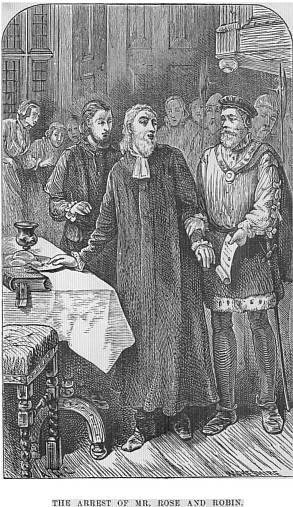
Isoult said no more, but to bid her “good-night.” She wondered at her, but glided softly away.
The first thing in the morning, when Isoult rose and went into the nursery, she saw a woman bending over Walter’s crib, with black shining hair that she knew could be on no head but Esther’s.
“Esther, dear heart!” she cried, gladly, “I never was more fain to see a face than thine this morrow.”
She lifted her head and smiled. Ay, certainly it was Esther.
“But how earnest thou safe?” asked Isoult.
“‘Is any thing too hard for the Lord?’” she answered, in her soft, measured voice. “There were more prisoners than Sheriff’s men, and not enough rope to tie us all together; so they marched some of the women last, and untied. And while we went through a dark alley, I took mine opportunity to slip aside into a doorway, the door standing open, and there lay I hidden for some hours; and in the midst of the night, ere dawn brake, I crept thence, and gat me to the house of my friend Mistress Little, that I knew would be stirring, by reason that her son was sick: and I rapping on her door and calling to her, she knew my voice, and let me within. So there I abode till the gate was opened; and then coming home, Mrs Thekla saw me from her window, and opened to me, not many minutes since.”
“I thank God, that saved thee!” cried Isoult. “Now, Esther, is there any likelihood of Robin escaping likewise?”
“Yes,” she said quietly, “if it shall be good in the eyes of the Blessed to work a miracle to that end.”
“But no otherwise?” wailed Isoult.
“Not, I think, with aught less,” answered she. “They tied him and Mr Rose together, and marched them first, the Sheriff himself guarding them.”
Even in this agony there was cause for thankfulness. Mrs Holland was not there, nor Mr Underhill and his wife, nor Mr Ive and Helen, nor Mr Ferris.
When the evening came, Isoult went up to Mrs Rose. She found her, as Thekla said, awake now, and bemoaning herself bitterly. Yet the deepest part of her anguish seemed to be that she was left behind. She flung her arms around her friend’s neck, weeping aloud, and spoke to her in French (which, or Spanish, she used when her heart was moved), calling her “Isoude, chère soeur” and besought her to call her Marguerite.
“I am so alone now,” she sobbed; “it should make me to feel as though I had yet a sister.”
There was no change in Thekla, nor any tears from her. The next day, the Lord sent them comfort, in the person of Austin Bernher, who came straight from his good work, and told them that he had seen all the prisoners. Mr Rose, they heard with heavy hearts, was in the Tower; a sure omen that he was accounted a prisoner of importance, and he was the less likely to be released. Robin was in the Marshalsea: both sent from the Clink, where they were detained at first. Austin spoke somewhat hopefully of Robin, the only charge against him being that brought against all the prisoners, namely, absence from mass and confession, and presence at the service on New Year’s night; yet he did not hide his conviction that it would have been better for them all had that service been any other than the Lord’s Supper. Isoult asked Austin if he had any hope of Mr Rose.
“None whatever, as touching this life,” was his terrible answer.
Both sent a message by Austin.
“Robin’s was,—‘Tell my father and mother, Austin, that I am, it may be, less troubled than they; for I am ready to serve God in what way He will have me; and if this be the way, why, I will walk therein with a light heart and glad. That it hath pleased Him to exalt me to this calling, with all mine heart and soul, friend, I thank God! I can go unto the stake as I would to my bridal; and be assured of an happier and blesseder meeting therefor hereafter. Kiss the dear childre for me, and tell them God hath given me some physic that I need, after the which He promiseth me somewhat very sweet.’”