Volume 2 — CHAPTER VI.
Reading edition
Indian tradition.—Manco Capac.—His reign.—Religion.—Property.—Agriculture.—Buildings.—Public roads.—Manufactures.—Domestic animals.—Results of the conquest of the country by the Spaniards.
The Peruvians have a tradition that the city of Cuzco was founded in this manner. The early inhabitants of the country were ignorant, and brutal as the wild beasts of the forest, till a man and woman of majestic form, and clothed in decent garments, appeared among them. They declared themselves to be children of the sun, sent to instruct and to reclaim the human race. They persuaded the savages to conform to the laws they proposed, united them, the Indians, together in a society, and taught them to build the city.
Manco Capac was the name of this wonderful man; the woman was called Marna Ocollo. Though they were the children of the sun, it seems they had been brought up very industriously; for Manco Capac taught the Indians agriculture, and other useful arts; and Marna Ocollo taught the women to spin and weave, and make feather garments.
After the people had been taught to work, and had built houses and cultivated fields, and so on, Manco Capac introduced such laws and usages as were calculated to perpetuate the good habits of the people. And thus, according to the Indian tradition, was founded the empire of the Incas.
The territory was, at first, small; but it was gradually enlarged by conquering the neighboring tribes,—merely, however, to do good by extending the blessings of their laws and arts to the barbarians,—till the dominions of the Inca Atahualpa, the twelfth in succession, extended from north to south along the Pacific Ocean above 2000 miles; its breadth from east to west was from the ocean to the Andes. The empire had continued four hundred years.
The most singular and striking circumstance in the Peruvian government, was the influence of religion upon its genius and its laws. The whole civil policy was founded on religion. The Inca appeared not only as a legislator, but as the messenger of heaven. His precepts were received as the mandates of the Deity. Any violation of his laws was punished with death; but the people were so impressed with the power and sacred character of their ruler that they seldom ventured to disobey.
Manco Capac taught the Peruvians to worship the sun, as the great source of light, of joy, and fertility. The moon and stars were entitled to secondary honors. They offered to the sun a part of those productions which his genial warmth had called forth from the bosom of the earth, and his beams had ripened. They sacrificed some of the animals which were indebted to his influence for nourishment. They presented to him choice specimens of those works of ingenuity which his light had guided the hand of man in forming. But the Incas never stained the altar of the sun with human blood.
Thus the Peruvians were formed, by the spirit of the religion which they had adopted, till they possessed a national character more gentle than that of any other people in America.
The state of property in Peru was no less singular than that of religion, and contributed, likewise, towards giving a mild turn of character to the people. All the lands capable of cultivation, were divided into three shares. One was consecrated to the sun, and the product of it was applied to the erection of the temples, and furnishing what was requisite towards celebrating the public rites of religion.
The second share belonged to the Inca, or was set apart as the provision made by the community for the support of government. The third and largest share was reserved for the maintenance of the people, among whom it was parcelled out. All such lands were cultivated by the joint industry of the community.
A state thus constituted may be considered like one great family, in which the union of the members was so complete, and the exchange of good offices so perceptible, as to create stronger attachment between man and man than subsisted under any other form of society in the new world. The Peruvians were advanced far beyond any of the nations in America, both in the necessary arts of life, and in such as have some title to be called elegant.
Agriculture was carried on by the Peruvians with a good deal of skill. They had artificial canals to water their fields; and to this day the Spaniards have preserved and use some of the canals made in the days of the Incas. They had no plough, but turned up the earth with a kind of mattock of hard wood. The men labored in the fields with the women, thus showing the advance of civilization over the rude tribes which imposed all the drudgery upon females.
The superior ingenuity of the Peruvians was also obvious in their houses and public buildings. In the extensive plains along the Pacific Ocean, where the sky is always serene and the climate mild, the houses were, of course, very slight fabrics. But in the higher regions, where rain falls and the rigor of the changing seasons is felt, houses were constructed with great solidity. They were generally of a square form, the walls about eight feet high, built of bricks hardened in the sun, without any windows, and the door strait and low. Many of these houses are still to be seen in Peru.
But it was in the temples consecrated to the sun, and in the buildings intended for the residence of their monarchs, that the Peruvians displayed the utmost extent of their art. The temple of Pachacmac, together with a palace of the Inca and a fortress, were so connected together as to form one great structure, nearly two miles in circuit.
Still this wide structure was not a very lofty affair. The Indians, being unacquainted with the use of the pulley and other mechanical powers, could not elevate the large stones and bricks which they employed in building; and the walls of this, their grandest edifice, did not rise above twelve feet from the ground. There was not a single window in any part of the building. The light was only admitted by the doors; and the largest apartments must have been illuminated by some other means.
The noblest and most useful works of the Incas, were their public roads. They had two, from Cuzco to Quito, extending, uninterruptedly, above fifteen hundred miles. These roads were not, to be sure, equal to our modern turnpikes; but at the time Peru was discovered there were no public roads in any kingdom of Europe that could be compared to the great roads of the Incas.
The Peruvians had, likewise, made considerable advances in manufactures and the arts which may be called elegant. They made cloth, and they could refine silver and gold. They manufactured earthen ware; and they had some curious instruments formed of copper, which had been made so hard as to answer the purposes of iron. This metal they had not discovered. If they had only understood the working of iron and steel as well as they did that of gold and silver, they would have been a much richer and more civilized people.
The Peruvians had tamed the duck and the llama, and rendered them domestic animals. The llama is somewhat larger than the sheep, and in appearance resembles a camel. The Indians manufactured its wool into cloth; its flesh they used for food; moreover, the animal was employed as a beast of burden, and would carry a moderate load with much patience and docility. The aid of domestic animals is essential to the improvement and civilization of human society.
In short, the Peruvians, when contrasted with the naked, indolent, and ignorant inhabitants of the West Indian Islands, seem to have been a comfortable, ingenious, and respectable nation. The conquest of their country destroyed their system of government. They were made not merely to pay tribute to their new rulers, but, far worse, they were reduced to the condition of slaves. They were compelled to leave the pleasant fields they used to cultivate, and driven in crowds to the mountains in search of gold. They were forced to labor hard, and allowed only a scanty subsistence; till, heart-broken and despairing of any change for the better, they sunk under their calamities and died!
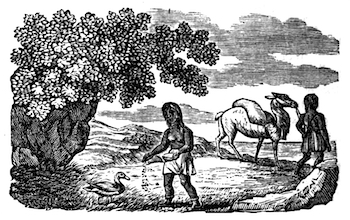
An Indian girl feeding a duck. Llama carrying a burden on its back.
In a few years after Pizarro entered Cuzco, a great part of the ancient population of Peru had been swept away, destroyed by the avarice and cruelty of their conquerors.